They Ordered the Old Veteran Aside Before an Entire Ballroom Parted for Him
Chapter 1: The Old Man Outside the Velvet Rope
“Move aside. The important guests are arriving.”
Christopher Lewis stepped into William Miller’s path with one polished shoe planted on the edge of the red carpet.
Behind him, the entrance to the military ball blazed with chandeliers and camera flashes. Officers in dark dress uniforms moved through the glass doors beside civilians in evening gowns. A string ensemble played somewhere beyond the registration tables, its music softened by the steady closing of limousine doors.
William looked past Christopher toward the ballroom.
“I was invited,” he said.
Christopher’s eyes moved over the worn dark coat, plain trousers, and shoes polished carefully enough to reveal their age. No medals. No ribbons. No escort.
“That may be,” Christopher said, lowering his voice as a photographer passed, “but this entrance is for registered guests and senior arrivals. General Thompson’s motorcade will be here shortly.”
William remained where he was.
He was nearly eighty, narrow through the shoulders, with silver hair cut close and a face marked by deep, orderly lines. His right hand trembled faintly beside his coat. The rest of him stood perfectly straight.
Christopher glanced toward the curb, then back at him.
“Sir, I need you behind the velvet rope.”
William reached inside his coat.
The movement made the cloth pull tight across his chest. For an instant, a square outline showed beneath the inner lining before his fingers emerged holding a cream-colored invitation.
Christopher took it.
The card bore the gala seal and a line printed beneath it:
REMEMBRANCE OF THE DISBANDED LONG-RANGE RECONNAISSANCE UNIT
There was no formal guest name on the front.
Christopher turned it over. “Where did you get this?”
“It came in the mail.”
“That isn’t what I asked.”
William’s gaze settled on him, steady but not hostile. “It came from General David Thompson’s office.”
Christopher carried the invitation to the registration table. Two staff members worked behind tablets arranged between floral displays. He entered William’s name, then tried it again with different spacing.
Nothing appeared.
“William Miller?” he asked.
“Yes.”
“No middle initial?”
William gave it.
Christopher entered that too. No result.
The line behind William had begun to curve toward the curb. A decorated colonel and his wife waited directly behind him. The colonel checked his watch but said nothing.
Christopher handed the invitation to one of the staff members. “Check the supplementary list.”
He turned back to William.
“Do you have military identification?”
“Not current.”
“Veterans identification?”
“At home.”
“Government-issued identification?”
William took out his wallet and produced a driver’s license.
Christopher compared the photograph with his face. The license proved only that he was William Miller. It did not explain why an anonymous memorial invitation had brought him to an elite military ball.
A junior guard approached from the doorway. “Problem?”
“Guest-list discrepancy,” Christopher said. “Keep the entrance moving.”
The guard nodded, though his attention lingered on William.
Across the covered drive, a color guard emerged from a side corridor carrying the national colors toward the ballroom. Conversations softened as they passed.
William’s heels came together.
His trembling hand flattened against the seam of his trousers. His shoulders drew back—not with the uncertain effort of an old man imitating a posture, but with the immediate precision of a command his body had never forgotten.
The junior guard noticed.
So did Christopher.
Then the color guard passed, and the pressure of the waiting line returned.
Christopher shifted the rope stand aside. “Sir, you can wait near the outer wall while we verify this.”
William did not move.
A program lay open on the registration table. His eyes lowered to the evening’s schedule.
“Your date is wrong,” he said.
Christopher followed his gaze. “Excuse me?”
“The reconnaissance action.” William touched one line with a bent finger. “You printed October seventeenth.”
“That information came from the archive.”
“It happened on the nineteenth.”
The staff member searching the supplementary list looked up.
Christopher felt the colonel behind William lean slightly closer.
“The program has already been approved,” Christopher said.
William’s finger remained over the date. “It is still wrong.”
A burst of camera flashes lit the drive as another senior officer arrived. Christopher’s earpiece crackled.
“Three vehicles just cleared the south checkpoint,” a voice said. “Receiving line in four minutes.”
Christopher took the paper invitation from the staff member.
“Any result?”
“No William Miller. No unnamed guest under the unit entry either.”
Christopher’s jaw tightened. He had been warned twice that evening about unauthorized attendees. At the previous year’s ceremony, a man with an altered invitation had reached the reception floor and interrupted a presentation. The incident had cost Christopher one major contract. Tonight’s renewal depended on nothing going wrong.
He folded William’s invitation once and held it with the programs.
“I’ll contact the general’s liaison,” he said. “Until then, you need to clear the carpet.”
William’s gaze went to the folded card. “I would like that back.”
“When verification is complete.”
“It belongs to me.”
“And the entrance belongs to the event.” Christopher regretted the words as soon as he heard them, but another message snapped through his earpiece.
“Motorcade two minutes out.”
Christopher turned to direct the staff. A family needed rerouting. A photographer had crossed the security marker. Two aides arrived asking about seating changes. Programs shifted from hand to hand.
When he looked down again, William’s invitation was gone.
Christopher checked beneath the top program, then the registration folder.
“Where is it?” William asked.
“It’s here.”
Christopher lifted a clipboard, moved a stack of place cards, and checked the floor.
It was not there.
William watched without accusation. That made Christopher’s irritation sharper.
“We have a digital record,” he said.
“You told me there wasn’t one.”
The junior guard glanced away.
Christopher pointed toward the outer barrier. “Please wait there.”
William finally stepped off the carpet. He moved slowly but without stooping, each step measured as guests flowed around him. No one pushed him. No one needed to. The movement of uniforms, satin, cameras, and rank carried him backward as efficiently as a hand against his chest.
At the outer rope, he turned toward the glass doors.
Inside the foyer, a memorial display occupied the wall opposite the receiving line. Enlarged photographs surrounded a tall banner bearing the name of his former unit. Beneath the lettering was an embroidered emblem reconstructed in bright new thread.
William stared at it.
His right hand rose to the inside of his coat, pressing against the faded square hidden there.
The mountain was wrong.
The border was wrong.
And beneath the central figure, where five words had once been stitched by hand, there was nothing at all.
Chapter 2: The Emblem That Never Belonged There
“That symbol inside belongs to another unit.”
William’s voice was quiet, but Christopher heard it above the arriving cars and hurried footsteps.
He followed William’s gaze through the glass. “It was approved by the military archive.”
“Then the archive approved a mistake.”
Christopher checked the drive. The first motorcycle escort had appeared beyond the gate.
“Sir, this is not the time.”
“For them, there may not be another.”
Christopher lowered his voice. “You have no confirmed invitation, no current military identification, and now you’re challenging an exhibit that took six months to prepare.”
William’s hand stayed inside his coat.
“I am telling you the mountain should be split at the summit. The border should be black, not gold. And there were words underneath.”
“What words?”
William paused.
The question seemed to take something from him.
“Stand unseen,” he said. “Bring them home.”
The junior guard looked through the doors at the blank space beneath the emblem.
Christopher touched his earpiece. “I need the archival officer at the entrance.”
A minute later, Mary Martinez came quickly across the foyer carrying a thick black folder against her evening uniform. She was younger than William had expected, perhaps in her forties, with a pen clipped precisely beside her name tag.
Christopher met her at the barrier.
“This gentleman says the memorial insignia is incorrect.”
Mary looked at William. “What part?”
“All of it that matters.”
Christopher exhaled through his nose.
William pointed through the glass. “The mountain was divided by a narrow line. The outer stitching was dark. Five words belonged beneath it.”
Mary opened the folder on the registration table. Plastic sleeves held photocopies, correspondence, and enlarged fragments of old photographs.
“The official unit insignia was never formally entered into the central heraldic registry,” she said. “What we used was reconstructed from two surviving images.”
“Neither showed the bottom edge,” William said.
Mary stopped turning pages.
“No,” she said. “They did not.”
Christopher folded his arms. “That proves he can see the display.”
Mary ignored him and removed a grainy photograph. Six soldiers stood beside a helicopter, their uniforms washed pale by age. A shadowed patch appeared on one man’s shoulder, partly obscured by a rifle strap.
“The black border?” she asked.
“It was cut from signal cloth because the first shipment never reached us.”
Mary looked up. “How would you know that?”
William’s fingers pressed harder against the inside of his coat.
Christopher saw the motion. “What are you carrying?”
William did not answer.
Mary turned several pages and found a typed inventory of disputed materials. Near the bottom, a sentence had been added in blue ink.
Possible original insignia retained by unidentified survivor. Never submitted for authentication.
Mary read it twice.
Christopher leaned over. “Unidentified?”
“The note was made twenty-three years ago,” she said. “There’s no attached name.”
“So it proves nothing.”
“It proves someone may still have the original.”
Christopher’s earpiece crackled again.
“Motorcade at the final checkpoint. Ninety seconds.”
He straightened. Staff members moved into assigned positions. The string ensemble inside stopped mid-piece, then began the formal arrival music. Officers gathered along the foyer’s edge.
Christopher closed Mary’s folder.
“We cannot investigate this now.”
Mary kept one hand on it. “If the emblem is wrong, the memorial presentation is wrong.”
“It has command approval.”
“Based on our reconstruction.”
“And it can be reviewed tomorrow.”
William looked at her. “Tomorrow it will already have been shown as truth.”
That silenced her.
Christopher glanced between them. He understood the point. He also saw the line of headlights turning toward the covered entrance, the photographers taking their places, and the senior host waiting behind the doors.
His contract supervisor stood near the ballroom entrance watching him.
Christopher made his choice.
“To the outer barrier,” he told the junior guard. “Now.”
The guard hesitated. “Sir, perhaps we should hold him near registration until—”
“General Thompson arrives in less than a minute. Clear the entrance.”
The guard approached William carefully. “Sir, please come with me.”
William did not resist, but neither did he move.
His attention remained on the false emblem.
Mary reopened her folder and scanned the handwritten note. “Mr. Miller, do you have the insignia mentioned here?”
William’s hand shifted beneath his coat.
For one moment Christopher thought he would take something out. Instead, William withdrew his empty hand and let it fall beside him.
“No,” he said.
Mary studied his face. “You knew the motto.”
“Anyone could have heard it.”
“Not according to the records.”
The first vehicle stopped beneath the canopy.
A uniformed aide stepped out and moved toward the rear door.
Christopher’s voice hardened. “We are finished.”
William turned his head toward him. The old man’s posture had not changed, but something behind his restraint had. It was not anger at being denied entry. It was the look of a man watching a door close on people who could not knock for themselves.
Christopher pointed beyond the last rope stand.
“Escort him behind the outer barrier.”
The junior guard placed no hand on William. He simply waited.
William looked once more at the banner, at the bright gold border and the empty space where the motto should have been.
Then he looked at Christopher.
“Ask General Thompson why he invited the last man.”
The aide opened the vehicle door.
Christopher’s face lost its practiced composure.
Mary’s fingers tightened on the archival note.
And from inside the car, a polished black shoe touched the carpet.
Chapter 3: The Invitation Without a Living Name
Mary found the invitation request while Christopher was still trying to decide whether to stop the motorcade reception.
She had pulled up the archive correspondence on her tablet, searching for William Miller, when a document appeared under the unit designation instead.
“Here,” she said.
Christopher leaned toward the screen.
The request had come from General David Thompson’s office six weeks earlier. It authorized one private guest for the unit memorial. The entry under NAME had been left blank.
In its place were two words:
UNIT REPRESENTATIVE.
Christopher looked at William. “Why isn’t your name here?”
William watched the senior aides gathering near the first vehicle. “Because I asked that it not be.”
Mary scrolled down.
A note from the general’s office confirmed that the guest wished to attend without introduction, decorations, or public acknowledgment. A later administrative line showed the entry had failed during transfer into the gala database because the required surname field was empty.
“You created the problem,” Christopher said.
William’s eyes shifted to him. “I asked not to be placed above the men being remembered.”
“You asked to enter a secured military event without a name.”
“I had an invitation.”
“Which is now missing.”
Christopher said it too quickly. The admission hung between them.
Mary closed the tablet cover halfway. “The invitation was valid.”
“It was incomplete.”
“But valid.”
Christopher glanced toward the car. The rear passenger had not yet emerged. An aide stood beside the open door speaking urgently into a phone, buying them seconds Christopher had not requested.
He stepped closer to William.
“I can still get you inside.”
William said nothing.
“There is a service corridor behind coat check. It opens near the memorial wall. You can enter without going through the receiving line, and no announcement will be made.”
Mary looked at Christopher, surprised.
He kept his eyes on William. “You wanted anonymity. I’m offering it.”
“And the banner?”
Christopher’s mouth tightened. “The presentation begins in twenty minutes. We cannot replace a custom display in twenty minutes.”
“Cover it.”
“That would create questions.”
“It should.”
Christopher lowered his voice. “I am trying to solve this without turning the entrance into a spectacle.”
William looked through the glass at the soldiers assembling beneath the false insignia. “You are trying to hide the error before anyone important sees it.”
“That is not fair.”
“No,” William said. “It is not.”
Christopher’s face colored, but he controlled himself. “Last year, an unauthorized man entered a formal ceremony using a modified invitation. He reached the floor before security stopped him. My company nearly lost its military contracts. Tonight we have senior command, foreign guests, and hundreds of service members in one building. I cannot suspend procedure every time someone says he belongs.”
Mary held up the tablet. “He does belong.”
“Then he can use the service entrance.”
William’s right hand trembled more visibly now. He slipped it inside his coat, perhaps to conceal the weakness.
A loose thread caught around his finger.
He looked down.
The thread came from the inner seam where the hidden square had rubbed against the lining for years. He freed it with his left hand, slowly, as though the small snag demanded greater care than the crowd or the motorcade.
Mary noticed the worn place inside the coat.
“How long have you carried it?” she asked.
William’s hand stopped.
Christopher looked between them. “Carried what?”
Mary opened the archival folder again and laid the blue-ink note beside the photograph.
“The original patch.”
William’s gaze rested on the six men in the faded image. One face had been cut by a crease. Another was almost erased by glare. The man at the center wore the shadowed shape on his shoulder.
William closed the folder.
“You have your approved display,” he said.
“That is not what I asked.”
“No.”
Outside, another vehicle rolled beneath the canopy. Doors opened. Officers stepped onto the carpet and were directed toward a secondary entrance while staff whispered explanations about a brief delay.
Christopher checked his watch.
“Mr. Miller, this is the last offer. Take the private corridor, attend the remembrance quietly, and submit any correction to the archive afterward.”
William drew his hand from his coat, still empty.
“Afterward,” he repeated.
“Yes.”
“They will photograph the banner.”
Christopher said nothing.
“They will print it in the program record. Young soldiers will stand beneath it. Someone will put it into another archive, and the next person will say it must be true because the last archive said so.”
Mary looked down at the reconstructed emblem through the glass.
William continued, his voice barely above the foyer music.
“They were unseen when they lived. That was the work. They do not need to remain unseen because correcting a banner is inconvenient.”
Christopher’s expression hardened again, but this time there was uncertainty beneath it.
“The general is waiting,” he said.
“Then let him wait long enough to remember why he came.”
William turned toward the outer drive.
The movement was small, but Mary understood it. He would leave rather than walk secretly past the false emblem. He would give up the only ceremony his unit had ever received because he could not accept honor built on another erasure.
“Please,” she said.
William stopped.
Mary did not ask him to prove his rank or identity. She touched the handwritten note instead.
“Let me see what the archive failed to preserve.”
For several seconds, he stood without moving.
Then his shoulders lowered by the smallest degree—not bending, not surrendering, but allowing a burden to shift.
He opened his coat.
From an inner pocket stitched by hand, he removed a square of cloth no larger than his palm.
The patch had once been dark green. Age had faded it toward gray. One edge was scorched. The border was black, repaired in two places with uneven thread. A narrow pale line split the embroidered mountain at its summit.
Beneath it, dim but legible, were five words.
STAND UNSEEN. BRING THEM HOME.
Mary inhaled sharply.
Christopher stared at the object he had nearly sent through a service corridor.
William held the patch between trembling fingers, but his spine remained straight.
“This,” he said, “is what belonged on your wall.”
Chapter 4: The Patch Carried Out of Fire
Mary turned the patch over and found the repairs before anyone spoke.
Two short lines of brown thread crossed the backing near the lower corner. One was tight and even. The other wandered slightly, as if sewn in darkness or by hands too tired to hold steady.
She pulled the archival folder closer and slid a sealed photograph from its sleeve.
“Don’t touch the surface,” she told Christopher.
The photograph showed the same six soldiers beside the helicopter. Mary angled it beneath the entrance lights and raised a magnifying card over the commander’s shoulder.
There, almost hidden beneath the rifle strap, were two pale stitches crossing the bottom edge of the patch.
Mary looked at William.
“The repairs match.”
Christopher’s attention moved from the photograph to the motorcade beyond the doors. A senior aide had begun leading officers toward the secondary entrance, but the delay was now visible. Guests in the foyer had stopped pretending not to watch.
“A matching repair does not establish ownership,” Christopher said.
“It establishes that the reconstruction is wrong,” Mary replied.
She placed the patch beside the photograph. The split mountain, black border, and faded motto aligned with details the enlarged image had preserved only as shadows.
William reached to take it back.
Mary released it immediately.
The cloth disappeared halfway into his closed hand.
“Who repaired it?” she asked.
“The first line was done by our radio mechanic.”
“And the second?”
William looked at the uneven stitches.
“I did.”
His voice changed around the words. Not enough for the crowd to notice, but Mary heard the distance in it.
Christopher touched his earpiece. “Receiving line is being held. I need this resolved now.”
Mary opened the archive packet to the memorandum describing the unit’s final operation. Much of the page had been blacked out in the original. The declassified copy reduced the event to three dry sentences: contact lost, intelligence delivered, supporting unit presumed destroyed.
“Mr. Miller,” she said, “were you present during the final action?”
William folded the patch once, hiding the motto.
“Yes.”
“In what capacity?”
“Radio.”
“You were the operator?”
“One of them.”
Mary scanned the memorandum. “The report says a messenger carried updated enemy positions through the eastern ravine.”
William’s jaw tightened.
Christopher looked at him. “Was that you?”
William said nothing.
Mary found a roster sheet, incomplete and poorly copied. Several names were legible. Others had been typed over handwritten corrections. At the bottom, one notation read: Courier detached before loss of position. Identity unresolved.
“You left them,” Christopher said.
The words were not an accusation at first. They were a conclusion spoken too plainly.
William’s face turned toward him.
Christopher understood his mistake a second too late.
“I mean—you were the courier.”
“I was ordered out.”
The tremor in William’s right hand stopped.
For the first time that evening, his posture did not look ceremonial. It looked defensive, the old body braced against something that had been moving toward him for fifty years.
Mary kept her voice low. “What were you carrying?”
“Grid corrections. Enemy movement. A radio frequency that was about to be abandoned.”
“To whom?”
“A battalion west of the ridge.”
Mary looked again at the memorandum. “The battalion that withdrew before encirclement.”
William’s eyes stayed on the folded patch. “They moved.”
“That information saved them.”
“It reached them.”
“You carried it.”
“The men behind me carried it farther.”
Christopher glanced at the crowd, then at William. “What does that mean?”
William’s thumb rubbed the scorched edge of the cloth.
“It means they held the ridge while I crossed the ravine.”
The string ensemble inside had stopped. Without the music, the foyer seemed larger and more exposed. The only steady sound came from boots crossing polished stone as staff rerouted arrivals.
Mary studied the photograph again. Six men beside a helicopter. William was not among them.
“Was this taken before the mission?”
“Three days.”
“The commander wore the patch?”
William nodded.
“How did you get it?”
His eyes lifted to hers.
“He gave it to me.”
Mary waited.
William offered nothing more.
Christopher looked toward the glass doors. His contract supervisor was approaching now, face set, a phone pressed against one ear.
“We have less than five minutes before command enters this foyer,” Christopher said. “Whatever this is, it cannot be authenticated in an entrance alcove.”
Mary closed the folder.
“It has been authenticated enough to stop us presenting the wrong emblem.”
“You do not have authority to stop the program.”
“I have authority over the archival display.”
“You had authority when you approved it.”
The words struck. Mary’s expression tightened.
Christopher continued, quieter. “If you cover that banner now, every camera in the room will turn toward it. Command will want an explanation. The event will be delayed, and the memorial will become a public correction instead of a tribute.”
“It already needs correction.”
“Tomorrow.”
William unfolded the patch.
“Tomorrow is where people put what they do not intend to fix.”
Christopher turned to him. “You are not the only person responsible for this event.”
“No,” William said. “I am responsible for six men who cannot object.”
Something in his voice carried past the registration table.
Nearby officers stopped speaking. The junior guard stood with his hands clasped behind his back, watching Christopher now rather than William.
Mary lifted her phone. “I’m ordering the banner covered.”
Christopher stepped between her and the ballroom doors.
“No.”
Her eyes narrowed. “Move.”
“If that display changes without command authorization, this entire entrance will lock down. My staff will be blamed for a security disruption, you will be blamed for presenting unverified material, and the ceremony may be canceled before the unit is mentioned at all.”
For the first time, Christopher’s fear showed without polish. It was not fear of William. It was fear of failure becoming permanent, of another event collapsing under his supervision, of the people watching him finding confirmation of every doubt already attached to his name.
Mary lowered the phone slightly.
Christopher saw hesitation and pressed it.
“Give me ten minutes. Let the general enter. We brief him privately. If he orders the display changed, I will change it myself.”
William looked at the banner.
Ten minutes. Long enough for photographs. Long enough for guests to stand beneath the false symbol. Long enough for the mistake to become part of the official evening.
He stepped toward the doors.
The junior guard moved instinctively, not blocking him but preparing to.
Christopher raised one hand. “Mr. Miller.”
William kept walking.
“Sir, you cannot enter.”
William stopped so close to the velvet rope that the brass hook touched his coat.
Christopher’s hand hovered near the rope stand.
William looked through the glass at the bright emblem made by people who had never seen the original. His voice, when it came, was no longer quiet enough to remain private.
“You lost my invitation. Your record lost my name. Your archive lost their words.” He opened his hand, exposing the patch. “Now you want me to stand here while you lose them again because the room is already decorated.”
Christopher’s face went still.
Mary lifted the phone once more.
“Cover the banner,” she told a staff member inside.
Christopher caught the rope before it could be opened.
“I cannot permit that without approval.”
William turned on him.
The anger in his face was brief and clean. It did not come from being told to wait, or from the missing invitation, or from the service entrance offered like a kindness. It came from the folded program bearing the wrong date and the bright false emblem above men whose names had nearly vanished.
“They did not hold that ridge for your schedule.”
The words landed harder than a shout.
Christopher’s grip loosened.
Outside, the final vehicle door opened.
The officers nearest the entrance straightened. Photographers lifted their cameras. The junior guard came to attention.
David Thompson entered beneath the canopy, flanked by aides, his gaze already moving toward the receiving line.
Then he saw the faded cloth in William’s trembling hand.
He stopped before his polished shoe reached the carpet.
Chapter 5: When the General Lowered His Hand
David Thompson’s right hand rose before anyone around him understood why.
His heels locked together. His shoulders squared. The salute was slow, exact, and directed not toward the officers waiting inside, but toward the old man standing beside the velvet rope.
The entrance fell silent.
William did not move.
Camera shutters began clicking, then stopped as aides lowered their hands and stared. Officers along the foyer followed David’s line of sight to the patch.
Christopher released the rope.
David held the salute.
“Mr. Miller,” he said.
William’s fingers closed around the cloth. “General.”
A colonel near the doorway snapped to attention. Then another officer did the same. The movement spread unevenly, born first from rank and only afterward from recognition.
William’s hand remained at his side.
David lowered his salute.
The absence of a returned gesture unsettled the room more than refusal would have. Christopher saw it in the faces around him. They had expected a clean reversal: the old man revealed, the general saluting, the ceremony restored.
William gave them no such relief.
“You found the patch,” David said.
“I never lost it.”
David’s gaze moved to the banner inside. His expression changed when he saw the gold border and empty space beneath the mountain.
“Who approved that?”
Mary stepped forward. “I did, based on the surviving archive images.”
“And now?”
“Now I know it is wrong.”
David looked at Christopher. “Why is Mr. Miller outside?”
Christopher’s answer came carefully. “His name was absent from the guest list. His invitation was misplaced during verification. When he challenged the display, I followed access procedure while the claim was reviewed.”
“You offered him the service corridor,” Mary said.
David’s eyes returned to Christopher.
Christopher did not deny it. “I was trying to admit him without compromising the receiving line.”
William glanced at him, then away.
David took one step closer to William. “I should have met you myself.”
“You should have put their names in the program.”
David stopped.
William opened the patch again. “Name them.”
No one moved.
David looked toward the assembled guests. “Now?”
“You saluted me before you said one of their names.”
The general’s face tightened, not in anger but recognition.
William continued. “You invited me because you learned what happened to your father’s battalion. You found the man who carried the message. That is what you wanted the room to see.”
“My father’s men were surrounded,” David said. “Your information opened their withdrawal route.”
“Their route was opened by the men who kept the enemy looking east.”
David nodded once. “Then tell me their names.”
William’s mouth pressed into a hard line.
“You have the archive.”
“We have fragments.”
“Then you built a ballroom around fragments.”
Mary lowered her eyes.
David turned to an aide. “Close the doors. Hold all arrivals.”
The aide hesitated only long enough to understand the scale of the order. Then he moved.
The glass doors shut behind the last guests. Staff halted the receiving line. The photographers were instructed to lower their cameras.
David faced the room.
“The program is suspended until the memorial record is corrected.”
A murmur moved through the civilians near the ballroom entrance and died beneath the stillness of the officers.
Christopher’s contract supervisor stepped forward, but David raised one hand without looking at him.
“No presentation proceeds under a false emblem.”
Mary opened the archival folder on the registration table.
“I have six confirmed names and two probable entries,” she said. “The roster is damaged.”
William looked at the pages.
“Six names,” he said. “There were seven at the ridge.”
Mary searched the sheets. “Including you?”
He did not answer.
David saw the hesitation. “My father wrote about the radio operator who came through the ravine. He said the man arrived bleeding, handed over the coordinates, and tried to go back.”
William’s eyes sharpened. “Your father should not have written that.”
“He wrote that they restrained you because the ridge was already lost.”
“Then he wrote enough.”
“He spent the rest of his life trying to learn your name.”
William folded the patch again.
David stepped nearer. His voice dropped so the room had to remain silent to hear it.
“I have spent twelve years trying to find you.”
“You found the wrong man.”
“I found the surviving man.”
“That is not the same thing.”
David’s gaze held his. “No. It is not.”
The answer took some of the resistance from William’s face, but not the burden.
David gestured toward the ballroom. “Come inside. Stand beside the memorial while we correct it.”
William turned toward the outer drive.
Christopher saw the decision before anyone else. William was going to leave.
“Mr. Miller,” David said.
William reached for the front of his coat.
“I came to see their names.”
“You will.”
“I did not come to replace them.”
“You won’t.”
But the officers were still facing him. The cameras, though lowered, remained pointed in his direction. The old machinery of recognition had already begun, and William could feel it pulling the unit’s story toward the single living figure in front of them.
He took one step toward the exit.
David did not block him.
Instead, he asked, “What did your commander say when he gave you that patch?”
William stopped.
The cloth in his hand seemed suddenly heavier.
For several seconds, he looked not at David but at the black stitches along the border. When he spoke, his voice had lost its anger.
“He said the signal would not hold. He put the coordinates inside my shirt and gave me the patch because I kept telling him I was coming back.”
No one interrupted.
“He told me to cross the ravine. I said I would bring help.”
William’s breath caught once, almost invisibly.
“He said there would be no ridge left to return to.”
David lowered his head.
William looked toward the false banner through the closed doors.
“Then he told me, ‘If anyone remembers us, stand straight enough for all of us.’”
His shoulders remained squared, but his right hand had begun to shake again.
“I thought that meant I should never take what belonged to them.” He looked at the officers still holding themselves rigid around him. “I thought if no one knew my name, they could not put it above theirs.”
David said nothing.
William’s gaze fell to the patch.
“He ordered me to stand for them,” he said. “I have spent fifty years hiding instead.”
Chapter 6: A Corridor Wide Enough for the Dead
William turned toward the exit while hundreds of uniformed guests waited for his decision.
No one called after him at first.
His shoes crossed the edge of the red carpet with the same measured care that had brought him in from the curb. The patch remained folded in his hand. The false banner was being lowered behind the glass doors, its bright gold edge collapsing into the arms of two staff members.
Mary came from the registration table carrying several pages.
“Mr. Miller.”
He stopped but did not turn.
“I have the names.”
That brought him back.
Mary laid the damaged roster beside a clean sheet she had begun filling in by hand. Six names were written in dark ink. A seventh line remained blank.
William looked down at them.
One spelling was wrong. He corrected it.
Another man’s middle initial had been copied from a later service record. William crossed it out.
Mary handed him the pen.
“The last line,” she said.
He read the six names again.
“They were at the ridge,” he said.
“So were you.”
“I left.”
“You were ordered to carry the intelligence.”
“That is not the same as staying.”
“No,” Mary said. “But leaving under orders did not remove you from the unit.”
William placed the pen on the paper without writing.
David stood several feet away. He had dismissed the aides from his side and removed his cap, holding it beneath one arm. Without the receiving line and the movement of staff around him, he appeared less like the center of the gala and more like a man waiting outside a closed room.
“My father lived because you crossed that ravine,” he said.
William’s jaw tightened.
David continued before he could object. “That does not mean the others mattered less. It means their decision reached someone.”
“They died.”
“Yes.”
“I lived long enough to have children. Grandchildren. A house paid off. A wife who had to learn why I woke up standing beside the bed.”
The room remained still.
“That life came after them,” William said. “Every good year felt borrowed.”
David did not offer comfort. “Borrowed things are still meant to be used.”
William looked at him.
“My father used what you brought him. He moved his battalion. He spent the rest of his service teaching young officers that intelligence means nothing unless someone carries it through.” David glanced at the patch. “You have carried them for fifty years. Perhaps they did not ask you to carry them alone.”
William looked back at the blank line.
His hand closed around the pen.
The first letter came slowly. The tremor made the stroke uneven, but he did not ask Mary to write it for him.
William Miller.
He placed his name beneath the six others, last.
Mary took the page only after he released it.
“Seven at the ridge,” she said.
William nodded once.
Christopher stood near the velvet rope, no longer directing anyone. His earpiece hung loose against his collar. Beyond him, the registration staff had recovered the missing invitation from beneath a stack of seating cards. It lay on the table, creased but intact.
David stepped toward William.
“The ballroom is waiting.”
William looked through the doors. The inaccurate banner had been removed. In its place, the bare memorial wall showed photographs, empty hooks, and a strip of lighter fabric where the false emblem had hung.
“They will wait longer,” he said.
David listened.
“The names are read first.”
“Yes.”
“All of them.”
“Yes.”
“No introduction listing my medals.”
David glanced at Mary.
She closed the program folder. “There will be no individual citation.”
“And no one calls me a hero.”
A faint movement crossed David’s face. “What should they call you?”
William looked at the list.
“The man who carried what they gave him.”
David nodded.
Mary went inside with the corrected sheet. The ballroom announcer stepped away from the podium as she approached. Staff removed the planned introduction card. A new page was placed beneath the light.
William watched the changes through the glass.
For the first time that evening, people were not moving him aside or moving around him. They were changing the ceremony because he had refused to enter it falsely.
He unfolded the patch.
The faded mountain lay in his palm. He pressed it against his chest, feeling the rough stitches through his shirt.
Then he lowered it and held it outward.
Not as a credential.
Not as proof that he deserved the room.
As the unit’s missing name.
The ballroom doors opened.
Inside, rows of officers and soldiers stood facing the entrance. Civilian guests had moved behind them. The music stands were empty. No cameras flashed.
Mary reached the podium.
She read the six names.
Each one entered the room alone.
William’s lips moved with them.
After the sixth, Mary paused.
“And William Miller,” she said, “radio operator and surviving unit member.”
The last words struck him harder than the salute had.
Surviving unit member.
Not courier detached before loss of position. Not unidentified messenger. Not old man outside the rope.
Member.
His hand shook around the patch.
David stepped beside him. “Will you enter?”
William looked down the foyer toward the memorial wall.
“I will walk for seven.”
David replaced his cap.
He turned toward the assembled formation and gave a single command.
“Make way.”
The response came first as the hard click of heels.
Then hundreds of soldiers stepped backward at once.
The movement opened from the ballroom doors through the grand foyer, widening in perfect lines until a straight corridor stretched from William to the bare memorial wall.
No one applauded.
No one spoke.
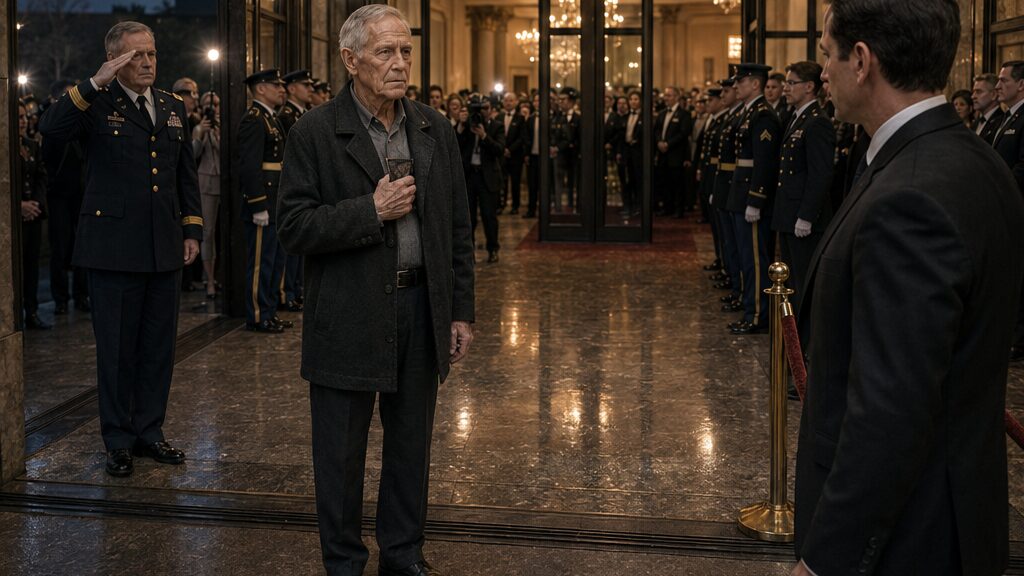
Two walls of uniforms stood motionless beneath the chandeliers, their hands rising in synchronized salutes.
Christopher remained at the corridor’s edge beside the velvet rope he had used to keep William out.
William stood at the entrance with the patch held before him.
For the first time in fifty years, the path ahead was wide enough to carry the dead.
Chapter 7: He Walked Past Without Looking Back
William took one step into the corridor and discovered that his right hand would not rise.
The patch rested against his palm, its scorched edge caught between two trembling fingers. On both sides of him, soldiers held their salutes with such stillness that the smallest movement became visible: a breath beneath a row of medals, the tightening of a jaw, the brief shine of an eye beneath the chandeliers.
William had returned salutes thousands of times.
His body knew the motion.
Still, his arm remained at his side.
David stood several paces behind him and made no attempt to help. The corridor had been opened for William, but no one could walk it on his behalf.
He moved forward.
The first few steps carried him past officers old enough to remember Vietnam only through photographs. Farther along stood younger soldiers whose uniforms were unmarked by years but whose posture held the weight of the names Mary had read.
William kept the patch extended before him.
He did not look left or right. If he met one face, he feared he might see admiration meant only for him. So he watched the bare memorial wall at the end of the corridor and walked for seven men.
At the velvet rope, Christopher stood alone.
The brass hook still connected one end of the barrier to its post, narrowing the edge of the corridor. Christopher looked at it, then at William approaching.
He unfastened it.
The rope fell loose in his hand.
William stopped beside him.
Christopher’s face had lost the controlled expression he had worn at the entrance. His earpiece was gone. Without the clipboard, instructions, and flowing line of guests, he seemed smaller—not humiliated by the soldiers, but stripped of the certainty that had allowed him to mistake control for judgment.
He held out the cream-colored invitation.
“We found it beneath the seating cards.”
A hard crease divided the gala seal. William took the card with his left hand.
Christopher looked at the patch.
“I saw an old man without the right credentials,” he said. “I decided that was all there was to see.”
William slid the invitation into his coat.
He offered no reassurance.
He offered no accusation either.
Christopher lowered his eyes and drew the velvet rope completely away from the path.
William continued.
The ballroom seemed farther than it had from outside. Each measured step pulled against his hips and knees. His spine remained straight, but the effort had become visible in the set of his mouth.
The salutes did not fall.
At the end of the corridor, Mary stood beside the memorial table. The inaccurate banner was gone. In its place lay the corrected roster and the enlarged photograph of the six soldiers beside the helicopter.
A clear archival sleeve waited at the center.
William reached the table and stopped.
Mary did not touch him. “The unit record will be amended under the authentic emblem. The photograph, the motto, the date, and all seven names.”
William looked at the empty sleeve.
“You will keep it here?”
“Tonight, if you leave it. Afterward it goes to the military archive under preservation controls. It will not disappear into an unverified file.”
He turned the patch over.
The uneven brown repair crossed the backing where he had stitched it after the ridge. For years, he had told himself he carried the cloth because records failed and institutions forgot. That had been true.
It had not been the whole truth.
The patch was the last thing his commander had placed in his hand.
Keeping it hidden against his chest had preserved more than history. It had preserved the moment before William turned toward the ravine—the last second in which all seven men had still been alive, still belonging to the same patch.
To surrender it felt like leaving them a second time.
Mary waited.
David approached only as far as the corridor’s end. The soldiers remained at attention behind him.
William placed the patch above the sleeve, but his fingers would not open.
“I told my wife it was evidence,” he said.
Mary’s voice stayed quiet. “Was it?”
“Yes.”
He looked at the old photograph.
“And it was the last thing I had that he touched.”
Mary lowered the sleeve.
“Then you do not have to leave it.”
The permission unsettled him more than pressure would have.
William had expected an archive to claim the object, a general to request it, or the ceremony to require one final sacrifice. Instead, the decision remained where it had always been—in his hand.
He looked down the two walls of saluting soldiers.
For fifty years, he had believed he alone stood between his unit and erasure. If he released the patch, he feared the men would recede into paper again.
But their names had been spoken aloud.
Their motto had been restored.
Hundreds of soldiers now knew why the mountain was split and why the border was black.
William turned to the roster.
He touched the first name with one finger and spoke it.
Then the second.
He continued slowly, giving each man the space between breaths that the program had once denied them. At the sixth name, his voice roughened.
The room did not move.
Finally, he touched the seventh line.
“William Miller.”
He had never spoken his own name with theirs before.
The patch loosened in his hand.
William laid it inside the clear sleeve.
Mary sealed the edge and placed it beneath the photograph, centered above the corrected list. The faded cloth looked smaller beneath the ballroom lights than it had inside his coat, but it no longer looked hidden.
David stepped forward and raised his hand once more.
This time, William faced him.
His right arm began to rise.
The tremor traveled from his fingers through his wrist, making the motion slow and imperfect. No one looked away. He brought his hand to his brow and held it there.
David’s salute remained rigid.
Behind him, the corridor of soldiers held theirs.
William stood for the men at the ridge.
He stood for the messenger who had crossed the ravine.
And, for the first time, he allowed those to be the same man.
When he lowered his hand, the soldiers followed.
No applause broke the silence. No music rushed in to tell the room what it should feel.
William looked once at Christopher, who still stood beside the removed rope.
Then he looked at the patch resting with the seven names.
His shoulders eased.
The straight line of his spine softened—not into defeat, but into the posture of an old man who no longer had to carry an entire unit beneath his coat.
The story has ended.