They Turned Away the General in the Cheap Suit Before Learning Why He Came Alone
Chapter 1: The Man Who Did Not Look Important
“The Base Commander is expecting a very important guest from the Pentagon. Clear the area.”
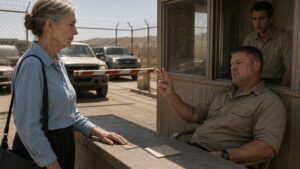
Jessica Allen delivered the order before Joseph Harris had both feet beyond the painted visitor line.
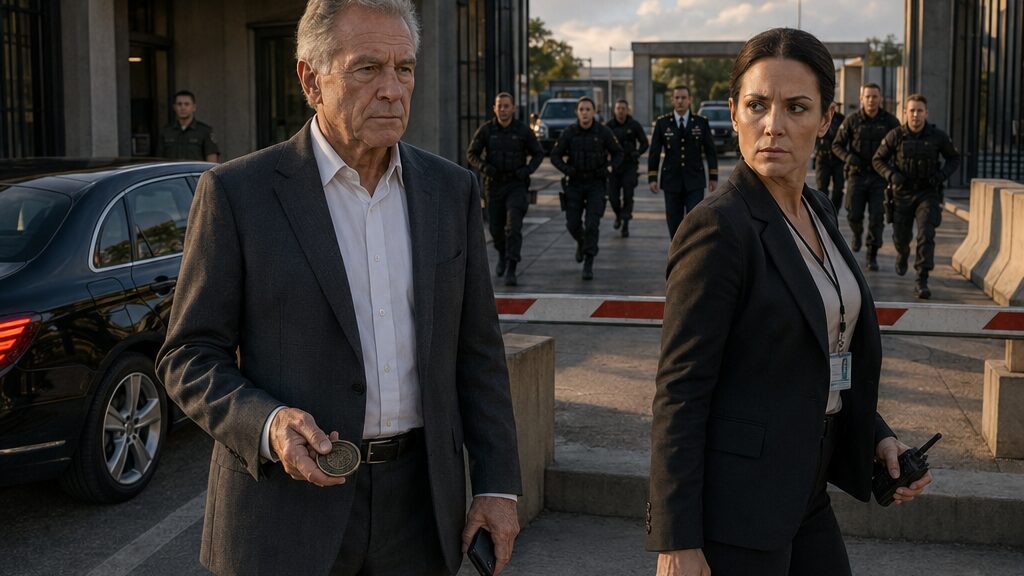
She stepped between him and the checkpoint desk, one hand raised as a black staff car rolled toward the inspection lane behind her. Her gala badge hung from a blue ribbon over a fitted dark jacket. Joseph’s charcoal suit had no badge, no ribbon, and no shine left at the elbows.
He stopped without protest.
Beyond the barrier, uniformed personnel guided polished vehicles beneath temporary banners stretched between the gatehouse columns. One banner showed a younger Joseph in dress uniform, though distance and glare softened the face. Beneath it, large gold letters announced an evening of courage, command, and sacrifice.
Jessica did not glance at the banner. She was looking at his shoes.
“The public entrance is around the east perimeter,” she said. “Shuttle service is available from the outer lot.”
“I’m expected here.”
“Everyone says that today.”
Her tone was not openly rude. It was worse than rude. It had the smooth impatience of someone who believed the question had already been settled.
Joseph reached inside his jacket. The two security personnel nearest the desk shifted their attention toward his hand.
He withdrew a retired military identification card and offered it between two fingers.
Jessica accepted it, but her eyes barely crossed the photograph before moving back to his suit.
“No gala credential.”
“My name should be on your list.”
“Your name?”
“Joseph Harris.”
A junior guard at the terminal turned sharply. He was young enough that surprise still reached his face before training stopped it.
Jessica saw the movement.
“What?”
The guard leaned toward the card. “Ma’am, that category code—”
A horn sounded from the arrival lane. Jessica took the card from his reach and held it against her clipboard.
“Later. We have a convoy in ninety seconds.”
Joseph looked past her at the lane. Temporary cones had narrowed three inspection routes into one. Two guards were checking rear compartments while a third waved vehicles forward before the inspection team had cleared the previous car.
“You’re stacking the second vehicle inside the first vehicle’s security space,” he said.
Jessica followed his gaze despite herself.
The next sedan had already crossed the painted stop line. Its driver waited less than ten feet behind the vehicle being searched.
“If the lead car is held,” Joseph continued, “the second driver has nowhere to reverse and your outer barrier cannot close.”
The junior guard looked from the lane to Jessica. “He’s right.”
Jessica’s jaw tightened.
“We are operating under an approved event plan.”
“Then the approved plan has a blind corner.”
The lead vehicle was released. Its replacement advanced. Jessica signaled to an attendant to move one cone farther back, then faced Joseph as though he had attempted to embarrass her.
“You need to step away from active operations.”
“I only asked you to verify my name.”
“And I told you the public entrance is on the east perimeter.”
Joseph extended his hand for his identification. She did not return it.
A metallic edge pressed into his palm. He had been turning the coin without noticing, sliding it beneath his thumb until its worn ridges found the same old callus.
Jessica’s eyes dropped to it.
The coin had once been bright. Years in his pocket had dulled the raised seal and smoothed the outer lettering. It looked ordinary unless held still and examined closely, which Joseph rarely allowed anyone to do.
“You’re also not permitted to carry loose commemorative items through a secured checkpoint without inspection,” she said.
Joseph almost smiled.
Instead, he closed his hand.
A bus approached the secondary lane, carrying older men and women in formal clothes. Some wore service pins. Others held cream-colored gala envelopes. An attendant directed the bus toward a narrow inspection point beside the visitor parking lot.
One woman stepped down before the bus had fully stopped. She held a folder to her chest and asked a guard where the memorial families were supposed to enter.
The guard pointed toward a temporary queue behind portable fencing.
Joseph watched the woman join a line that barely moved. At the main lane, a civilian couple in evening clothes passed through after a coordinator recognized the sponsor’s logo on their invitation.
“Are the families being processed separately?” he asked.
Jessica gave him a measured look. “The primary entrance is reserved for command guests, donors, speakers, and designated VIPs.”
“The families aren’t designated guests?”
“They have their own reception procedure.”
Through the fence, an elderly man removed his jacket so a staff member could search the lining. The wind lifted the corner of a photograph he was carrying.
Joseph’s faint amusement disappeared.
“Who approved that distinction?”
“The command staff.”
“Which member?”
Jessica drew herself straighter. “You do not have standing to question base procedures.”
“Everyone who enters through them has standing to notice how they work.”
That answer landed badly. The junior guard lowered his eyes, but not before Jessica saw his reaction.
She returned Joseph’s identification at last, pressing it into his open hand.
“You are delaying an active checkpoint. Stand behind the public barrier while I determine whether your name appears anywhere in the general attendance records.”
“My name won’t be in the general records.”
“Then you may not be attending.”
Joseph remained still for a moment.
He could have ended it. One sentence would have done it. His rank, his former command, Nicholas’s title—any of them would have broken the scene open.
But that had been the problem for most of his life. Doors changed when people learned who stood before them. Voices softened. Rules acquired exceptions. The behavior before recognition vanished beneath the performance afterward.
He stepped behind the waist-high barrier.
Jessica seemed surprised by his compliance, then relieved. She turned back to the lane and began issuing instructions through her radio.
Joseph stood beside a sign directing uncredentialed visitors toward the east perimeter. Above him, his younger face looked down from the banner.
The image had been taken after the operation.
He remembered the photographer asking him to hold the new coin where the camera could see it. He had refused. The photograph showed only his uniform and the hard emptiness of a man who had returned with fewer people than he had taken out.
A staff member near the secondary line called, “Casualty families, keep your invitations visible. Delays are expected.”
The worn coin clicked softly against Joseph’s wedding ring.
Jessica finished directing another vehicle and returned to him.
“I’ve given you an opportunity to leave without making this an enforcement matter.”
“I’ve given you my name and valid identification.”
“You have given me an old military card, no gala pass, no escort, and no appointment confirmation.”
“The confirmation is inside.”
“Then whoever invited you should have arranged access.”
“They did.”
“Clearly, they did not.”
Joseph looked once more toward the memorial families. The line had grown longer. Several chairs stood unused inside the primary reception area.
Jessica lifted her radio.
“My next call brings the Sergeant of the Guard,” she said. “After that, the decision will no longer be mine.”
Joseph met her eyes.
“It has been yours from the beginning.”
Chapter 2: The Identification She Chose Not to Read
Jessica placed Joseph’s identification face down beside the terminal.
The scanner waited less than six inches away.
“Run the number,” Joseph said.
“I am not required to process every individual who approaches a restricted gate without the proper event credential.”
“It would take less time than this conversation.”
“That is not your determination.”
She slid a laminated directive across the desk, perhaps intending the printed authority to end the discussion. The header carried Eric Adams’s command seal. Several paragraphs outlined vehicle spacing, media control, ceremonial timing, and the need to maintain an immaculate arrival corridor for the Pentagon delegation.
Near the bottom, one sentence had been highlighted:
Unescorted or improperly credentialed persons must be redirected immediately to prevent visible disruption of distinguished-guest movements.
Joseph read it twice.
“Visible disruption,” he said.
Jessica tapped the page. “Those are the Base Commander’s instructions.”
“They say redirect. They don’t say refuse verification.”
“They leave operational judgment to checkpoint leadership.”
“And you are checkpoint leadership?”
“For this event, yes.”
There was pride in the answer, but strain beneath it. Joseph noticed the edge of her temporary contractor badge, the expiration date only weeks away, and the faint indentation where she had gripped her clipboard too tightly.
A staff car stopped at the inspection point. Jessica glanced toward it, checking the arrival lane as if the event’s success were balanced on every polished hood.
Joseph picked up his identification.
The coin slipped from his other hand.
It struck the metal base of the barrier with a sharp ring and spun once on the pavement.
Jessica saw the raised seal before Joseph bent to retrieve it.
“Another souvenir?” she asked.
He straightened slowly. “Something like that.”
“You’ll need to surrender it for inspection if you enter.”
“If I enter.”
Her mouth tightened at the correction.
A voice rose from the secondary queue.
“My letter says main reception.”
The woman Joseph had noticed earlier stood at a folding table, holding out a cream envelope. She was in her late fifties, perhaps early sixties, with silver threaded through dark hair pulled neatly behind her head. The folder she carried had been repaired with clear tape along one edge.
A staff member examined her invitation.
“You’re on the family list, ma’am.”
“Yes. That is what I am telling you.”
“The family list processes through the east reception.”
“My brother’s name is in tonight’s memorial.”
“All memorial families use the east reception.”
The woman looked toward the main gate, where uniformed guests crossed beneath the banner without waiting.
“My letter has code C-Four,” she said.
The staff member turned the invitation sideways as if the code might change.
Joseph moved closer to the barrier.
“C-Four is command-hosted casualty family,” he said. “It should permit main reception access.”
Jessica swung toward him. “Remain where I placed you.”
The woman looked at Joseph.
“How do you know that?”
He had helped write the original protocol years earlier, after watching a widow stand alone outside an event honoring her husband.
“Because the code was created to prevent exactly this confusion.”
Jessica took the invitation from the staff member.
The name printed across the top read Mary Torres.
Below it, in smaller lettering, appeared the memorial designation:
Family representative for Paul Johnson.
Joseph’s fingers stopped moving over the coin.
Mary saw his face change.
“You knew him,” she said.
It was not a question.
Jessica studied Joseph again, but suspicion arrived before curiosity.
“Public biographies for tonight’s honoree list the operation and casualties,” she said. “Anyone could know those names.”
Mary’s gaze sharpened. “I didn’t ask you.”
Joseph looked toward the gala banner.
Paul’s name was not visible from the gate.
“Yes,” he said. “I knew him.”
Mary held his eyes for another second, searching for something he did not offer.
Jessica handed back the invitation. “The code does not override the designated traffic plan. East reception.”
Mary did not move. “The bus driver told us the east station is short-staffed. Some of the older families have been waiting forty minutes.”
“The main entrance must remain clear.”
“For whom?”
“The Pentagon guest.”
Joseph looked at the empty carpeted walkway beyond the gate.
Jessica followed his glance and mistook it for challenge.
“Both of you are now interfering with controlled access.”
Mary gave a small, humorless laugh. “I have a signed invitation.”
“And a designated point of entry.”
Joseph rested both hands on the barrier.
“Call the command office,” he said. “Ask whether C-Four families were meant to be placed behind sponsors.”
Jessica’s face colored. “Do not instruct me in my duties.”
“Then perform them without instruction.”
The junior guard turned toward the terminal. “Ma’am, I can verify both credentials.”
Jessica blocked the keyboard with her clipboard.
“No. The motorcade window opens in six minutes. We are not adding unscheduled database queries while command vehicles are inbound.”
Joseph looked at the dark monitor, then at his card in his own hand.
This was no longer an error.
She had been offered the answer twice and rejected it because the answer might require her to admit uncertainty.
Mary stepped away from the table.
“I’ll use the east entrance,” she said.
Joseph heard the resignation beneath the words. It sounded practiced.
Jessica nodded as though order had been restored. “Thank you.”
“No,” Joseph said.
Mary paused.
He had come intending to enter quietly, stand at the back during the memorial, and leave before the speeches turned toward him. He had cancelled the motorcade because he did not want uniformed men opening doors beneath a banner carrying his name.
He had told himself anonymity was humility.
Now Mary Torres was being sent around the perimeter of a building where her brother would be reduced to a line in someone else’s tribute.
Joseph stepped around the end of the barrier.
Jessica moved instantly. “Sir, return to the public side.”
He stopped beside Mary, not beyond the checkpoint.
“Her code is valid.”
“So is your identification,” Jessica said, the admission escaping before she could stop it. “Neither gives you the correct event access.”
Mary looked from one of them to the other.
“Harris,” she said quietly. “You said your name was Harris?”
Joseph did not answer.
Her grip tightened on the taped folder.
“General Harris?”
Jessica stared at her, then at Joseph.
For one brief moment, doubt appeared. It could have changed everything.
A radio call announced that the command arrival lane had to be cleared immediately.
Jessica seized the easier truth.
“The guest from the Pentagon is arriving with an official motorcade,” she said. “This man walked from the outer lot.”
Joseph had, in fact, walked from the outer lot after dismissing the driver two blocks from the installation.
Jessica raised her radio.
“Checkpoint coordination to guard control. I need assistance removing two noncompliant visitors from the command entrance.”
Mary stepped back as if struck by the word removing.
Joseph looked at her invitation, Paul’s name still visible beneath her thumb.
His silence was no longer protecting anyone.
He reached inside his cheap charcoal jacket and took out his phone.
Chapter 3: The Quiet Call That Changed the Gate
“Hey, son,” Joseph said when the call connected. “Your new checkpoint guard is threatening to call the Sergeant of the Guard on me. Thought you should know.”
Jessica lowered her radio by an inch.
The voice through Joseph’s phone was too faint for her to hear clearly, but its first word carried in the sudden quiet.
“General?”
Joseph’s thumb closed over the worn coin in his palm.
Across the installation, Nicholas Thomas stopped in the command operations corridor with three senior officers behind him and a ceremonial aide speaking into his other ear.
“Where are you?” Nicholas asked.
“Main visitor gate.”
“That’s impossible. Your motorcade is still staged at the south residence.”
“I cancelled it.”
“You cancelled—” Nicholas cut himself off. “Are you outside the barrier?”
“I’m beside it.”
“Do not move.”
Joseph looked at Jessica. “I wasn’t planning to storm the base.”
“Dad—” Nicholas caught the word and replaced it. “General, stay exactly where you are.”
The correction hurt more than Joseph expected. Nicholas had learned years ago that official language was safer with him.
Joseph ended the call before his son could ask why he had come alone.
Jessica recovered first.
“You expect me to believe you just called the Chief of Staff?”
“I did call the Chief of Staff.”
“Your son.”
“Yes.”
Her expression hardened around the obvious inconsistency. “The Chief of Staff’s motorcade is already inside.”
“He came before me.”
Mary stood perfectly still, the taped folder pressed against her chest.
The junior guard had turned back to the terminal. This time he ignored Jessica’s clipboard. He entered Joseph’s identification number manually, checked the card against the screen, then went pale.
“Ma’am.”
Jessica did not look at him. “Not now.”
“Ma’am, you need to see this.”
A siren chirped once from inside the installation—not an alarm, but a priority gate signal. The inner vehicle barrier began to rise.
Jessica straightened and brought the radio to her mouth.
“Guard control, confirm response team purpose.”
No answer came.
Then boots struck pavement beyond the gate.
A squad of elite operators appeared at the far end of the reception corridor, moving at a controlled run. They wore formal operational uniforms rather than combat equipment, but their speed and formation made every person at the checkpoint pull back.
Jessica stepped away from Joseph.
“I told you,” she said, though the certainty had left her voice. “You should have complied.”
Mary watched the approaching squad. “They aren’t looking at him like a threat.”
The operators reached the checkpoint.
Their leader did not reach for Joseph’s arm. He passed him, pivoted, and took position facing outward.
The others divided into two rigid lines.
Within seconds, Joseph stood between them inside a protective corridor extending from the visitor barrier to the open gate.
No one spoke.
The junior guard came to attention so sharply his chair rolled backward into the desk.
Jessica stared at the formation.
The squad leader saluted.
“General Harris, the command group is en route.”
Joseph did not return the salute. He was in civilian clothes, and the gesture would have turned the moment into precisely what he had come to avoid.
“At ease,” he said.
The operator lowered his hand but remained rigid.
Jessica’s eyes moved to Joseph’s closed fist.
The coin’s edge showed between his fingers. A narrow flash of the raised Presidential seal caught the checkpoint light.
Recognition reached her in pieces: the old images from military archives, the coin shown in ceremony photographs, the operation discussed in gala planning sessions, the man she had been told would arrive under escort.
Her face emptied.
“You’re the Pentagon guest.”
Joseph looked at Mary rather than Jessica.
“I’m one of the guests.”
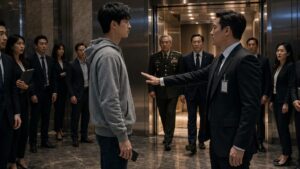
Another set of footsteps approached, less synchronized and more frantic. Eric Adams came through the gate with his dress coat unfastened, followed by senior officers and two aides struggling to keep pace.
Nicholas was behind them.
He had no reason to run. The Chief of Staff did not run toward cameras, subordinates, or ceremonies.
He ran now.
Eric reached Joseph first and snapped into a salute.
“General Harris.”
The title traveled through the checkpoint. Guards straightened. Staff members froze beside their tables. A driver halfway through presenting an invitation lowered it without being told.
Joseph let the silence hold.
Eric’s arm remained raised.
“At ease,” Joseph said.
Eric lowered it. “Sir, I offer my immediate apology. We were informed your motorcade was delayed. Your protective detail was preparing to meet you at the south entrance.”
“I changed the arrangement.”
“Yes, sir. We were not notified.”
“Nicholas was.”
Nicholas stopped a few feet away. He looked at Joseph’s suit, then at the barrier, then at Mary Torres.
“I was notified that you did not want the motorcade,” he said. “I was not notified that you intended to arrive on foot.”
“You would have sent another motorcade.”
“I would have sent a car.”
“That is another motorcade with fewer vehicles.”
For a moment, Nicholas nearly smiled. It faded before reaching his eyes.
Jessica found her voice.
“General, I was following the event access directive. You had no visible credential and declined to identify your status.”
“I gave you my name and identification.”
Her eyes dropped.
“I should have verified them.”
“Yes.”
The single word carried no anger. It left her nowhere to hide.
Eric turned toward her. “Coordinator Allen, step away from checkpoint control.”
Joseph raised one hand.
“Not yet.”
Eric stopped.
Joseph pointed toward the secondary reception line. “Why are casualty families being processed outside the primary entrance?”
Eric’s attention moved toward the fence, where the waiting families had begun watching the assembled command group.
“The gala access plan separates guest categories to maintain security and timing.”
“Whose timing?”
Eric hesitated.
Nicholas answered. “Mine.”
Joseph looked at his son.
Nicholas held the gaze. “The ceremony is scheduled to begin in twenty-three minutes. The opening sequence was designed around your arrival.”
“That was your first mistake.”
The operators remained in formation, creating a corridor that led directly beneath the banner bearing Joseph’s younger face.
Mary stepped closer.
“General Harris,” she said.
Joseph turned.
She studied him now with confirmation rather than suspicion. “You knew my brother.”
“Yes.”
“Were you there when he died?”
The checkpoint seemed to contract around the question.
Nicholas’s expression changed. Eric glanced toward the waiting cameras inside the gate. Jessica held her radio at her side, forgotten.
Joseph’s fist tightened around the coin.
“I was there when the decision was made.”
Mary’s eyes did not leave him. “Whose decision?”
Joseph could have answered. The truth was short enough.
Mine.
Instead, the old habit took hold. He placed the answer behind a wall of silence and told himself the gate was not the place.
Mary saw the refusal.
Whatever recognition had softened her face disappeared.
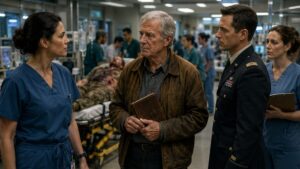
Eric stepped into the gap. “General, the gala hall is prepared. The command staff and invited families are waiting to recognize the historic rescue operation and celebrate your leadership.”
Joseph looked through the honor guard toward the banner.
The gold letters beneath his photograph caught the late sun.
THE MAN WHO BROUGHT EVERYONE HOME.
Paul Johnson had not come home.
Neither had the two operators who remained with him beyond the collapsing perimeter.
Joseph opened his fist. The worn Presidential coin lay against his palm, its seal dulled by years of being carried where no one could see it.
He looked at Eric.
“Then the gala is honoring the wrong man.”
Chapter 4: The Celebration Built Around the Wrong Name
Joseph stopped beneath the banner before anyone could guide him farther inside.
The younger version of his face looked down from twenty feet above the reception corridor. Beside it, a polished image of the Presidential Challenge Coin glowed under staged lighting, every ridge bright, every letter untouched by years in a pocket.
Beneath both images, the slogan stretched across the wall:
THE MAN WHO BROUGHT EVERYONE HOME.
Joseph pointed at it.
“Who approved those words?”
Eric Adams followed his finger. Color rose above the collar of his dress uniform.
“The communications office developed the campaign, sir. It was reviewed through command channels.”
“Which channels?”
Eric glanced at Nicholas.
Nicholas did not look away. “Mine.”
The honor guard had remained outside the corridor, but their presence followed Joseph through the glass doors. Guests gathering beyond the reception hall had begun turning toward the entrance. An aide whispered into a headset, attempting to delay the opening announcements without making the delay obvious.
Joseph rubbed his thumb across the real coin in his hand.
The replica on the banner had no scratches.
“Take it down,” he said.
Eric shifted his weight. “The main program begins in eighteen minutes. Removing the display now would draw considerable attention.”
“It should.”
Nicholas stepped closer. “We can discuss the wording in the briefing room.”
“We are discussing it here.”
A photographer at the far end of the corridor lowered his camera when Joseph looked toward him. Staff members pretended to adjust floral arrangements and lighting cables while listening.
Eric spoke carefully. “Sir, the phrase refers to the extraction of the surviving unit. It was never intended to diminish the casualties.”
“It says everyone.”
“It is ceremonial language.”
“It is false language.”
Nicholas exhaled through his nose. “Dad.”
Joseph’s eyes moved to him.
The word had slipped out under pressure. Nicholas seemed almost embarrassed by it.
“We have families in the building,” Nicholas continued. “Senior leaders. Operators who were on that mission. We can revise the remarks without dismantling the event in the hallway.”
“Have you read the full program?”
“I approved it.”
“That was not my question.”
Nicholas’s expression tightened. “Yes.”
Joseph held out his hand.
An aide hurried to retrieve a printed program from the registration table. Its cover showed the same polished coin and the same photograph. Inside, entire pages described Joseph’s leadership, the extraction route, and the number of personnel recovered.
The dead appeared near the end.
Three names beneath a single heading:
Those Lost in Service.
No actions. No decisions. No explanation of why they had not boarded the final aircraft.
Paul Johnson’s name stood first.
Joseph read the paragraph twice, though he had already seen an earlier version weeks before. That version had been enough to make him cancel the motorcade. He had told Nicholas only that the event felt excessive. He had not said the words that mattered.
This is wrong.
His silence had allowed the draft to become a program, the program to become banners, and the banners to become truth in the eyes of everyone entering the building.
“You knew I objected,” Joseph said.
“I knew you disliked being honored.”
“I objected to this.”
“You never said that.”
Joseph looked up.
Nicholas’s voice had not risen, but the old frustration was there, sharpened by years of receiving half-answers and respectful distance from his own father.
“You sent back the motorcade plan with one line crossed out,” Nicholas said. “You refused the rehearsal. You declined every call about the tribute. I was left to decide whether you were uncomfortable or simply being yourself.”
“Being myself.”
“Unavailable.”
Eric turned slightly, giving them the illusion of privacy without leaving.
Joseph closed the program.
Before he could answer, a voice from the adjacent preparation hall carried through the open doors.
“The supporting names go after the film.”
Joseph went still.
Inside, two staff members stood near a projection screen, arranging memorial photographs on a narrow table. One held a list and tapped the lower portion.
“The main emotional beat is the General’s entrance,” the staff member said. “If we spend too long on the supporting names, we lose the transition into the keynote.”
Mary Torres stood several feet behind them.
She had entered through a side corridor. Her invitation was now clipped to a plain paper badge, while primary guests wore embossed credentials on dark ribbons.
The staff members saw her expression and fell silent.
“Supporting names?” Mary asked.
Neither answered.
She looked past them and found Joseph in the corridor.
He had faced rooms full of hostile officers, grieving families, and men waiting to hear whether they would be sent back into danger. None of those moments felt as exposing as Mary crossing the preparation hall with Paul’s taped folder in her hands.
She stopped before him.
“So it is true,” she said.
Joseph did not ask what she meant.
“The gate staff said this was your tribute. I thought maybe they were simplifying it.” She lifted the program from his hand and opened to the casualty page. “Three names in six lines.”
“Mary,” Nicholas began.
She ignored him.
“My brother served eighteen years. He wrote letters from places he was not allowed to name. He came home twice with injuries he told our mother were training accidents.” Her finger rested on Paul’s name. “And tonight he is a supporting name in a story about you.”
Joseph’s hand closed around the coin.
“I did not write this.”
“But you let people write it for years.”
The words struck where anger would not have.
Eric stepped forward. “Ms. Torres, the program was never intended to—”
“I know what it intended.” She turned on him. “It intended to make people feel proud before dinner.”
Eric stopped.
Joseph looked at the paper badge clipped to Mary’s dress.
“How long were you held outside?”
“Long enough to watch sponsors pass me.”
Eric’s face tightened. “That should not have happened.”
Joseph turned toward him. “Your directive said to keep the arrival corridor immaculate.”
“It was meant to control vehicle congestion and media positioning.”
“You taught them what mattered.”
Eric absorbed that without defense.
“I did,” he said.
Jessica had made her own choices, Joseph knew. She had ignored the identification, rejected verification, and treated uncertainty as permission for contempt. But she had done it beneath orders that measured success by clean lines, polished vehicles, and the absence of inconvenient people.
Joseph looked again at the banner.
His face. His coin. His triumph.
Mary watched him with an anger that had survived too many official letters.
“Were you there?” she asked.
“Yes.”
“When Paul stayed behind?”
The coin pressed hard enough into Joseph’s palm to leave its shape.
Nicholas waited beside him. Eric waited. Even the staff members in the preparation hall had stopped moving.
Joseph could hear the aircraft again—not as a full memory, but in fragments. The warning tone. A voice breaking over the radio. Someone calling fuel numbers. Paul speaking with a calmness that had made the choice unbearable.
Not here, Joseph thought.
The same instinct had governed him for decades. Protect the family from operational detail. Protect Paul from being called disobedient. Protect the survivors from the weight of the decision. Protect himself from saying the sentence aloud.
He placed the program on the table.
“The public account does not contain everything.”
Mary’s laugh was small and wounded. “That is what every official told us.”
“There were reasons.”
“There are always reasons when the dead cannot argue.”
Joseph lowered his eyes.
That, more than any accusation, broke the perfect control in his face. His shoulders did not collapse. His voice did not fail. But Mary saw shame where she had expected authority.
Nicholas saw it too.
“Tell her,” he said.
Joseph looked at his son.
Nicholas’s expression held no command now. Only a request Joseph had refused in different forms for years.
Joseph shook his head once. “Not in a corridor.”
Mary opened her folder.
From inside, she removed a sealed envelope yellowed at the edges. Paul’s handwriting crossed the front.
General Harris.
No rank. No unit. Just the name.
“This came back with his personal effects,” she said. “It was never mailed.”
Joseph stared at it.
“I did not know it existed.”
“I was told parts of it might be classified. I was told to wait. Then I was told the review was complete, but nobody could explain what he meant.”
She set the envelope on top of the gala program.
“My brother wrote that you would tell us when you were ready.”
Chapter 5: What the Presidential Coin Could Not Honor
The letter ended halfway through a sentence.
Mary stood in the private memorial room with the single page trembling between her hands. Joseph had expected accusation, instruction, perhaps some final message Paul had never sent.
Instead, the last lines read:
If they ask why we stayed, tell them it was because the wounded could not move and the ridge would not hold without us. General Harris will understand. When he can, he will make sure—
Nothing followed.
The paper was torn cleanly across the bottom.
Mary turned it over, as though the missing words might have bled through.
“That is all?”
“That is how it came back.”
The memorial room shared a wall with the gala hall. Through it came the muted thump of music and the shifting murmur of hundreds of guests waiting for a ceremony already running late.
Nicholas closed the door.
Eric remained outside to control the delay.
Joseph stood before a row of framed photographs. Paul Johnson was younger in his official portrait than Joseph remembered him at the end. The picture had caught the impatience in his eyes but not the humor that usually softened it.
Mary folded the page along its existing crease.
“What happened on the ridge?”
Joseph placed the coin on the narrow table beneath Paul’s photograph.
Under the room’s low light, the Presidential seal was barely visible.
“The extraction perimeter collapsed sooner than our models predicted,” he said. “We had wounded personnel moving toward the aircraft. Paul’s team held the northern approach.”
“Held it against what?”
“People trying to stop the evacuation.”
Mary waited.
Joseph did not offer more detail. The location and enemy no longer mattered to the moral shape of the memory.
“The final aircraft had space,” he continued, “but the wounded were still below the ridge. Paul received the withdrawal signal.”
“And ignored it.”
“Yes.”
Mary’s mouth tightened.
“He decided to stay?”
“Paul did not make the decision alone. Two operators remained with him. They knew the aircraft could not sit exposed long enough to recover everyone.”
“Did you order them back?”
“Three times.”
“Then why didn’t they come?”
Joseph looked at Paul’s photograph.
“Because the wounded would not have reached the landing point if the ridge was abandoned.”
The music beyond the wall stopped abruptly. A voice tested the microphone, then disappeared.
Mary lowered herself into a chair.
For years, she had imagined Paul waiting for rescue that never came. Official summaries had described deteriorating conditions, an emergency withdrawal, and three unrecovered casualties. The language made them sound overtaken by circumstance.
“You left them there,” she said.
Nicholas looked toward Joseph, but Joseph answered without defense.
“Yes.”
The word settled into the room.
“I was the final authority,” he said. “The pilot reported fuel below the return threshold. The aircraft had sustained damage. Another approach would have exposed everyone aboard, including the wounded Paul had stayed to protect.”
“You could have tried.”
“We had tried.”
“One more time.”
“That was what I wanted.”
Mary’s eyes brightened, but her voice remained steady. “That was not what I asked.”
Joseph accepted the correction.
“One more attempt would likely have brought down the aircraft. I ordered it out.”
He remembered the pilot refusing at first. He remembered issuing the order again, using the voice that allowed no misunderstanding. He remembered Paul’s final transmission arriving beneath the engine noise.
Good call, General. Get them home.
The official report had recorded only the extraction order.
“Paul disobeyed you,” Mary said.
“He chose the wounded over his own recovery.”
“Why wasn’t that in the report?”
“It was.”
“Not in the version we received.”
Joseph’s silence answered before his words did.
“The complete report described his refusal to withdraw. There were people who wanted the action reviewed as insubordination.”
Mary stared at him.
“So you buried it.”
“I restricted the operational detail.”
“To protect him?”
“That was what I told myself.”
Nicholas moved away from the door.
Joseph looked at his son now because looking at Mary had become difficult.
“I believed the citation would carry the truth without exposing the order he disobeyed. I believed his family would be spared an argument over whether he followed procedure.”
Mary held the torn letter in both hands.
“And instead we were told almost nothing.”
“Yes.”
The admission seemed to take something physical from him. He placed one hand on the table beside the coin.
Nicholas studied the worn metal.
“You carried that every day,” he said.
Joseph nodded.
The coin had been presented in a bright room months after the operation. A President had spoken of courage, decisiveness, and lives saved. Cameras had recorded the handshake. Joseph had felt the weight placed into his palm and thought only of three men who would never touch it.
“He praised the decision,” Joseph said. “He said commanders are remembered for bringing people home.”
Mary looked toward the gala program visible beneath Paul’s letter.
“The same words on the banner.”
“Yes.”
“Did you tell him?”
“No.”
“Did you tell anyone?”
“The people in the aircraft knew.”
“That is not what I asked.”
Joseph’s thumb traced a scar in the coin’s edge.
“No.”
Nicholas gave a short breath that carried years of frustration.
Joseph turned toward him.
“What?”
“You always do this.”
Mary glanced between them.
Nicholas’s voice remained controlled, but control made it sharper.
“You decide silence is noble, then leave everyone else to build meaning around it. You would not tell me why you hated this gala. You rejected every plan without offering another. You let me think the problem was that you could not accept gratitude.”
“I did not ask for this event.”
“No. You only refused to help shape it.”
Joseph straightened. “You had the report.”
“I had the official report. The one you helped seal.”
The words landed cleanly.
Nicholas looked at the coin rather than his father.
“I built the gala around you because public honor was the only kind you could not walk away from without someone noticing. I thought if the whole branch thanked you, maybe you would stand still long enough to hear it.”
Joseph’s first response rose from habit: criticism of the premise, the spectacle, the waste.
He let it die.
Nicholas was not defending the banners. He was admitting need.
“You could have told me,” Joseph said.
Nicholas almost laughed. “I learned from you.”
The wall between them carried the amplified voice of the master of ceremonies.
“Ladies and gentlemen, please take your seats. Our honored guest has arrived.”
Mary folded Paul’s letter and laid it beside the coin.
Her anger had changed. It had not disappeared, and Joseph did not expect it to. But its edge was no longer aimed at a simple villain.
“My brother chose to stay,” she said.
“Yes.”
“And you chose to leave.”
“Yes.”
“To save the others.”
Joseph did not answer immediately.
“To obey the numbers,” he said. “To save the others. To avoid losing more people. All of those are true. None of them makes the choice clean.”
Mary looked at Paul’s portrait.
“I spent years believing he was waiting for you.”
“He was not waiting.”
The certainty in Joseph’s voice made her turn.
“He knew the aircraft was leaving. He made sure it could.”
Mary closed her eyes for one breath.
When she opened them, she touched the unfinished sentence.
“Then why keep this from us?”
“I thought I was protecting his name.”
“You protected the version of him the institution found easiest to honor.”
Joseph looked down at the gala program.
She was right.
Protective silence had become omission. Omission had become polished language. Polished language had become a banner claiming everyone came home.
Beyond the wall, the announcer’s voice rose.
“Please welcome the legendary commander whose decision brought an entire unit back from impossible conditions—General Joseph Harris.”
Applause began in the gala hall.
Joseph picked up the coin, then stopped.
For the first time in years, he did not put it back into his pocket.
He looked at Nicholas.
“Stop the program before they repeat the lie.”
Chapter 6: The General Who Refused His Own Salute
The stage lights went dark while the audience was still rising.
Applause fractured into scattered claps, then stopped. The giant screen behind the podium went black, erasing Joseph’s photograph and the polished coin displayed beside it.
In the service corridor, Eric lowered his radio.
“They think we have a power failure.”
“Let them,” Joseph said.
Eric faced him. “Sir, we have branch leadership, foreign guests, families, and media inside that room. If we halt the ceremony without explanation, speculation will begin immediately.”
“It should have begun before the banners were printed.”
Nicholas stood beside the stage entrance. “What do you intend to say?”
Joseph looked through the narrow opening in the curtains. Hundreds of silhouettes waited in the dim hall. Staff members moved along the walls, whispering into headsets. On the front row, several empty seats carried cards marked MEMORIAL FAMILY.
“How many families are still outside?” he asked.
Eric checked with an aide.
The answer came quietly. “Nine parties remain in secondary processing. Four have entered through the east corridor but have not been seated.”
“Why?”
The aide glanced at Eric.
Eric took the burden. “The event matrix prioritized command guests and scheduled speakers at the main entrance. Family arrivals were assigned flexible seating because their attendance numbers changed.”
“Flexible,” Joseph repeated.
Nicholas’s face tightened as he understood.
The hierarchy that had dismissed Joseph’s suit had not begun with Jessica. It had been printed into schedules, colored into badges, and disguised as efficiency.
Joseph stepped away from the stage entrance.
“Open the main gate to every family credential.”
Eric raised the radio.
“And the honor guard?” Nicholas asked.
Outside the gala hall, the elite operators still held formation along the reception corridor, waiting to escort Joseph toward the stage.
Joseph looked at their rigid backs.
“Turn them around.”
Eric paused. “Sir?”
“They are facing the wrong people.”
The order moved through radios and earpieces.
On a security monitor near the corridor, the main gate feed appeared. Jessica stood beside the checkpoint desk, no longer holding command authority. A senior security officer questioned the junior guard while arriving families waited behind the barrier.
The honor guard moved into view.
Instead of forming around Joseph, the operators marched toward the gate, turned outward, and took positions along the route from the family checkpoint to the memorial hall.
The first delayed family entered between them.
An older woman carrying a framed photograph stopped when she saw the formation. One operator lowered his gaze toward the photograph, then saluted it.
No announcement accompanied the gesture.
The woman continued walking.
Joseph watched until she disappeared from the monitor.
“That,” he said, “is the arrival sequence.”
Nicholas looked at him. “You still need to go onstage.”
Joseph’s instinct was to refuse. The truth could be placed into a revised report. Mary could speak. Eric could announce procedural changes. Joseph could leave before his presence distorted the room again.
Nicholas recognized the retreat before Joseph voiced it.
“Do not disappear now.”
“I am not the person they need to hear.”
“You are the person who helped create the silence.”
Joseph looked at him.
The sentence held no cruelty. That made it impossible to reject.
Eric’s radio sounded.
“Sir, Coordinator Allen is requesting permission to make a statement before being removed from event duty.”
Eric frowned. “This is not the time.”
Joseph looked at the monitor. Jessica stood with her shoulders squared, facing the security officer and the camera mounted above the terminal.
“Put her on the command feed,” he said.
Eric hesitated. “General, she may be attempting to protect her contract.”
“She may.”
The audio opened through the corridor monitor.
Jessica’s voice came thinly from the speaker.
“My name is Jessica Allen. I was serving as checkpoint coordinator. General Harris presented valid identification. A guard recommended database verification. I chose not to run it.”
Someone off camera asked whether the event directive caused the refusal.
“The directive influenced my decision,” Jessica said. “It did not require me to ignore the card. I judged him by his clothing and arrival method. I also redirected a casualty-family representative whose credential authorized main reception.”
Her breath caught once.
“I was wrong before I knew his rank. His rank only made the error visible.”
Joseph studied the screen.
Jessica had not asked for forgiveness. She had not blamed pressure, though pressure had been real.
Eric reached for the radio. “We will handle her statement through the formal review.”
“Keep it in the record,” Joseph said.
“Yes, sir.”
“And do not make her the whole record.”
Eric lowered his hand.
Joseph turned toward him.
“You wrote the directive.”
“I did.”
“Nicholas approved the guest structure.”
Nicholas nodded.
“I cancelled my escort and refused to explain why.”
Neither man spoke.
“We are not repairing this by finding the lowest-ranking person and handing her the entire failure.”
The stage manager approached from the curtains. “The audience has been waiting nine minutes. We need a decision.”
Joseph opened his hand.
The worn coin lay in his palm.
He could walk onto the stage, raise it, and prove every claim attached to his name. The room would stand. Cameras would capture the seal. The story would become the general in the cheap suit receiving the honor he deserved.
That story was cleaner than the truth.
He closed his fingers around the coin, but did not return it to his pocket.
“Bring up the memorial stand,” he said.
The stage manager blinked. “Before the keynote?”
“There will be no keynote.”
Eric stepped closer. “Sir, canceling the formal address may be interpreted as condemnation of the installation.”
“It is correction, not condemnation.”
“And the mission account?”
Joseph looked at Nicholas.
His son waited without rescuing him.
“I will give it.”
The house lights rose halfway.
Joseph walked through the curtains without music, introduction, or escort.
The audience began to stand again. Senior officers came to attention. Several raised their hands to salute.
Joseph stopped before the podium.
“Remain seated.”
The room obeyed in uneven waves.
He saw donors in formal clothes, operators in uniform, officials at front tables, and families still being guided into empty seats. Mary stood at the side of the stage holding Paul’s letter.
Behind Joseph, staff members rolled out the simple memorial stand that had originally been scheduled for a brief appearance after the tribute film.
The large screen remained dark.
“There has been a failure at this installation tonight,” Joseph said.
No microphone flourish. No ceremonial greeting.
“A man was denied entry because he did not look important. That man happened to be me.”
A ripple moved through the room.
Joseph continued before it could become the evening’s easiest lesson.
“That is not the failure.”
He looked toward the newly arriving families.
“The failure is that my name changed the response. Others were delayed by the same system, and no command group ran to the gate for them.”
Eric stood at the side wall, receiving every word without looking away.
Joseph described the directive, the ignored identification, and the hierarchy of arrivals. He named his own secrecy as part of it.
“I refused the motorcade. I did not explain my arrival. I believed avoiding ceremony was humility. Silence is not humility when it leaves other people to carry the consequences.”
Nicholas lowered his eyes.
Joseph turned toward the memorial stand.
“The program you received describes a mission in which my decisions brought everyone home.”
He unfolded the printed gala program and tore no pages, made no display of anger. He simply set it face down.
“That did not happen.”
The room became utterly still.
“People survived because three operators remained on a ridge they had been ordered to leave. They protected wounded teammates until the final aircraft could depart. I gave the order for that aircraft to leave without them.”
Mary’s hand tightened around Paul’s letter.
Joseph did not ask the audience to understand. He did not offer operational detail that belonged elsewhere. He gave the shape of the truth and accepted his place inside it.
“The decision saved lives. It also left Paul Johnson and two members of his team behind. Both facts must be carried together.”
He stepped away from the podium.
A senior officer near the front began to rise, perhaps to salute, perhaps to interrupt.
Joseph shook his head.
“No salute belongs to me before their names are restored.”
He crossed to the memorial stand and opened his hand.
The coin caught the stage light, but he did not raise it toward the audience.
“This was given to me for command under impossible conditions. I carried it as though private guilt were the same as remembrance.”
He placed it on the empty stand.
The metal made one quiet click against the wood.
Then Joseph turned toward Mary.
She remained near the curtain, uncertain whether entering the light would make her brother part of another performance.
Joseph extended no commanding hand. He simply stepped aside, leaving the center of the stage open.
“Mary,” he said, “you decide whose name we speak first.”
Chapter 7: The Names Spoken After the Barrier Rose
Mary stood before the silent audience with Paul’s unfinished letter in one hand and Joseph’s worn coin in the other.
The metal looked smaller beneath the stage lights than it had at the gate. Its Presidential seal was visible now, but no one in the room seemed to be looking at it as proof of Joseph’s importance.
They were waiting for her to choose what came next.
Mary unfolded the letter carefully.
“My brother did not finish this,” she said. “For years, I thought the missing words were the answer someone had taken from us.”
Her voice carried without force. The room’s silence did the rest.
She read Paul’s final complete line.
“General Harris will understand. When he can, he will make sure—”
Mary stopped at the torn edge.
Joseph remained beside the memorial stand, not behind the podium. Nicholas stood several feet away, giving him space that no longer felt respectful. It felt like distance.
Mary looked at Paul’s photograph.
“I think I know how he meant to finish it.”
She placed the page on the stand.
“Make sure they remember why we stayed.”
Joseph closed his eyes for one second.
The words were not an absolution. Paul had not asked him to feel less responsible. He had asked for memory to remain attached to choice.
Joseph stepped toward the microphone.
Behind him, staff members had removed the banner carrying his photograph. The empty wall showed pale rectangles where the fasteners had been.
He opened the original gala program.
The three names still occupied six lines near the back.
Joseph did not read the heading.
“Paul Johnson,” he said.
Mary’s fingers closed around the coin.
“He remained on the northern ridge after receiving the withdrawal signal. He did so because wounded personnel were still moving below him, and he believed leaving the position would expose them before they reached the aircraft.”
Joseph looked across the front rows.
No one moved.
“He was ordered back. He understood the order. He chose not to obey it.”
A few officers shifted in their seats at the plainness of the statement.
Joseph continued.
“He was not careless. He was not abandoned without knowledge of the risk. He made a decision that forced me to make another.”
He named the second operator, describing how the man had carried communications equipment between damaged positions after the primary radio failed.
He named the third, explaining how the operator used the last usable medical supplies on wounded teammates rather than reserve them for himself.
No medals followed their names. No inflated language. Joseph gave each man an action, a choice, and a place in the truth.
When he finished, he closed the program.
“These details were withheld because we feared how the choices would be judged,” he said. “We protected reputations and lost people in the process. We turned men into a collective sentence because a clean story was easier to honor than a difficult one.”
Mary watched him.
Her anger was still present. Joseph could see it in the set of her mouth. But it no longer required him to be a coward or a hero. It allowed him to be the commander who had made the final decision and the man who had spent years refusing to share its weight.
A door opened at the rear of the hall.
Jessica entered with two elderly guests.
She no longer wore the coordinator’s blue ribbon. Her temporary badge had been removed, leaving only the two pinholes in her jacket. She held a paper manifest and checked each name before guiding the guests toward the empty family seats.
At the next arrival, she did not wave the invitation toward another table.
She read the name.
“Mrs. Johnson,” she said quietly. “Your seat is in the first section.”
The woman corrected her surname.
Jessica apologized, repeated it correctly, and walked beside her rather than pointing the way.
The act did not erase the gate. It was not meant to.
Eric approached Joseph after the last delayed family was seated.
“The formal review will begin tomorrow morning,” he said. “The event directive, access matrix, staffing decisions, and individual conduct will all be included.”
Nicholas joined them.
“We could handle the personnel matter administratively,” he said. His eyes moved toward Jessica. “She admitted the failure before anyone forced her to.”
Eric understood the offer. “A formal investigation could end her contract.”
Joseph looked toward the family seats.
“No investigation designed to find one expendable person.”
Nicholas lowered his voice. “That is not what I proposed.”
“It is where quiet solutions often end.”
Joseph turned to Eric.
“Her choices belong in the record. So do yours. So do his.”
Nicholas accepted the glance.
“And mine,” Joseph said. “I refused the plans without explaining the harm. I left others to interpret my silence as consent.”
Eric nodded once. “The review will address the system and the decisions inside it.”
“Make the findings available to the families.”
“That may expose command embarrassment.”
“It should.”
No one argued.
The remainder of the ceremony proceeded without the tribute film, keynote address, or planned presentation. The tables remained set for celebration, but the guests moved instead through the memorial hall, where photographs and names had been rearranged at eye level.
Mary stood before Paul’s photograph.
Joseph approached but stopped far enough away that she could decide whether to acknowledge him.
She turned the coin over in her hand.
“The President gave this to you?”
“Yes.”
“For bringing people home.”
“For the command decision.”
“Do you want it back?”
The answer had once seemed impossible. He had carried the coin through promotions, retirement, his wife’s funeral, and years of nights when he woke hearing the final aircraft lift away.
It had become punishment shaped like honor.
“No,” he said.
Mary studied him.
“Leaving it here does not settle what happened.”
“I know.”
“It does not mean I am finished being angry.”
“I know that too.”
She placed the coin beneath Paul’s photograph.
The Presidential seal faced upward. Beside Paul’s name, it no longer testified only to the commander praised after the mission. It marked the cost hidden beneath that praise.
Mary adjusted it until it lay flat.
“He trusted you to tell us.”
Joseph looked at the unfinished letter.
“I waited too long.”
“Yes.”
She did not soften the word.
Then she moved one step aside, leaving space for him before the photograph.
That was all she offered. Joseph understood it as more than forgiveness given too quickly would have been.
Near midnight, the main visitor gate stood almost empty.
The temporary sponsor signs had been removed. The secondary family barrier had been folded and stacked against the gatehouse wall. The main barrier remained raised while guards reviewed names directly at the desk.
Jessica stood with Eric near the terminal, answering questions for the initial incident record. When Joseph passed, she straightened.
“General Harris.”
He stopped.
“I am sorry,” she said. “Not because of who you were. Because I decided what you deserved before I read what you gave me.”
Joseph looked at the scanner beside the terminal.
“What will you do next time?”
“Run the identification. Ask the question. Treat the person as though the answer may matter even when the name does not change anything.”
He nodded.
“That is where security begins.”
He did not promise to protect her contract. He did not demand its termination. Accountability would continue after the emotion of the night faded.
Outside the raised barrier, Nicholas waited beside an ordinary sedan.
“No escort?” Joseph asked.
“I thought a car might be permitted.”
“Barely.”
Nicholas opened the passenger door, then paused.
Joseph looked back through the gate. The memorial hall was visible beyond the corridor, its lights low. Somewhere inside, the coin remained beneath Paul’s photograph.
For the first time in decades, Joseph felt its absence in his pocket.
The emptiness was not relief. Not yet.
Nicholas followed his gaze.
“We can go back,” he said.
Joseph had expected his son to say General, sir, or nothing at all.
Instead Nicholas said, “Dad.”
Joseph turned.
Years of distance stood between the word and his answer. None of it could be crossed by ceremony, rank, or one honest night.
But the barrier behind them was open.
“Yes, son,” Joseph said. “Let’s go back.”
Together, they walked toward the memorial wall.
The story has ended.