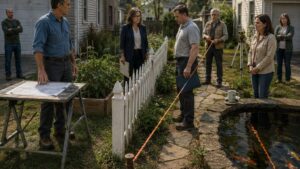
The HOA Called His Daughter’s Safety Ramp a Violation, Then the Excavator Opened His Wall
Chapter 1: The Machine Was Already Running Outside
The side door shook before William Campbell reached it.
At first he thought the storm-damaged wall had finally shifted again. Then came the grind of steel teeth against wood, the low diesel cough of a machine too large for his narrow side yard, and a splintering crack that made the glass in the kitchen cabinet jump.
He crossed the mudroom in three steps and threw the door open.
The excavator bucket was already under the outer beam of the ramp.
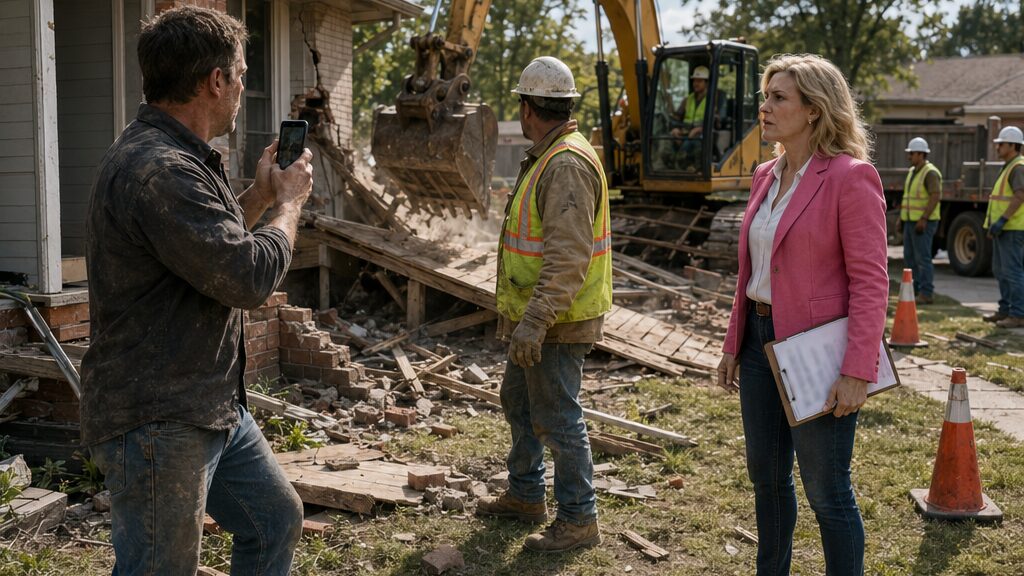
For one stunned second, William saw the whole scene as if it belonged to someone else’s house: orange cones crooked in the grass, two workers in neon vests standing near the brick-faced support wall he had built six days ago, a yellow machine crowding the driveway, its arm lifted like it was about to peel open the side of his home. A loose board from the ramp hung at an angle. Dust rose from the torn-out posts.
“Stop!” William shouted.
The operator did not hear him, or pretended not to. The bucket flexed upward. The beam groaned. A line of screws popped free one after another.
William stepped down from the threshold and felt the old porch tremble under his boots. “Stop the machine!”
A man in a hard hat turned from the crew truck. He raised one hand, palm out, as if William were the dangerous part of the morning.
“Sir, you need to stay clear of the work zone.”
“That is my daughter’s access ramp.”
The man looked over his shoulder at the bucket, then back at William. “We’re under contract to remove unauthorized exterior additions.”
William had heard phrases like that before. They never arrived alone. They came with fine print, waiting periods, and people who said “policy” in the same tone other people used for weather. But policy had never sent an excavator to his driveway.
He pulled his phone from his pocket and started recording.
“State your name,” he said.
The hard-hat man hesitated. “Frank Ramirez. Site supervisor.”
“Frank Ramirez, who hired you to tear out my daughter’s medical access?”
Frank’s jaw tightened. Behind him, the excavator bucket lifted again, and one of the ramp posts tore loose with a sound like a bone cracking.
William moved forward.
Frank stepped into his path. “Sir, I’m telling you, stay back.”
William stopped at the line of cones, close enough to smell wet dirt and hydraulic oil. “Turn it off.”
Frank looked toward the street.
A white SUV had pulled up behind the crew truck. It had a neighborhood association decal on the door and a magnetic sign that read civil compliance vehicle. Not police, not really, but close enough to make neighbors open blinds.
The driver’s door opened.
Katherine Hall stepped out in a bright pink blazer, white blouse, fitted jeans, and heels that sank immediately into the torn grass. She held a clipboard against her chest like it could shield her from the noise. Her blonde hair was neat, her face composed, until she saw how much of the ramp was already gone.
William kept the phone up.
“Katherine,” he said, his voice lower now. “Tell him to turn it off.”
She glanced at the camera. Her eyes narrowed, not with anger exactly, but with the practiced discomfort of someone who had been recorded before.
“Mr. Campbell, this removal is being conducted pursuant to the Westbridge Estates exterior compliance order.”
“The what?”
She unclipped the top page and held it out, but did not step close enough for him to take it. “You were notified that the unauthorized structure was in violation of section 7.4 of the community standards.”
William stared at the paper. Across the yard, a worker began lifting boards into the bed of a truck.
“That structure,” William said, “is the only way my daughter gets into this house without being carried.”
Something flickered in Frank’s expression.
Katherine’s pen hovered over her clipboard. “Your application did not include an approved medical accommodation.”
“My application included Angela Baker’s letter, the emergency repair photos, and the engineer’s note about the side wall.”
“I can only speak to the file the board reviewed.”
“The board reviewed the wrong file.”
The excavator operator swung the arm slightly, adjusting the bucket. The metal teeth bumped against the brick-faced support beneath the side entry. William heard the scrape through his chest.
“Frank,” he said without looking away from Katherine, “if that bucket touches the wall, you are no longer removing a freestanding structure. You are damaging the house.”
Frank turned sharply toward the machine. “Hold up!”
The operator paused, bucket suspended.
For three seconds, the whole yard seemed to wait.
Then one of the partially loosened supports shifted under its own weight. The bucket, still hooked under a brace, jerked as the beam dropped. The brick veneer cracked in a jagged line from the side door down toward the foundation. A hidden anchor snapped loose and shot across the grass.
Dust burst out from behind the brick.
Katherine stepped back so fast one heel twisted in the mud.
Frank swore under his breath and waved both arms. “Shut it down! Shut it down!”
The engine wound down, but the silence after it felt worse. It made room for small sounds: brick ticking loose, a worker coughing, Katherine’s clipboard paper flapping in the breeze.
William walked past the cone.
“Sir—” Frank began.
William bent near the base of the wall and picked up the broken piece that had skidded through the mud. It was an anchor bolt, sheared at the neck, the end bright and raw where metal had failed. He held it up in front of his phone.
“This,” he said, “was part of the temporary bracing.”
Katherine stared at the exposed wall. The color had drained from her face, leaving the pink blazer almost harsh against the gray dust.
“You had no right to remove that,” William said.
She swallowed. “The order was for the ramp and exterior additions.”
“The ramp was tied into the brace because the side entry was unsafe after the storm. The engineer explained that. In writing.”
“I didn’t see—”
“That does not make it disappear.”
A curtain moved in the house across the street. Scott Thompson stood on his porch, phone in one hand, watching over the rail. William saw him and felt heat climb his neck. This was the thing he had tried to avoid: Amy’s life turned into a neighborhood event, her home access reduced to gossip over property lines and resale value.
He lowered his voice, but not the phone. “My daughter is inside.”
Katherine’s gaze snapped to him.
“She cannot use the front steps,” William said. “She cannot come down this side now. And you have just pulled out the support under the only entry we had adapted.”
A vehicle rolled to the curb behind Katherine’s SUV. A uniformed officer got out slowly, one hand resting near his belt, the other raised in the bored caution of a civil standby that had become less civil than expected.
Frank looked at the officer, then at Katherine. “Ma’am, I need clarification on scope.”
Katherine did not answer him. She was staring at the crack in the wall, at the space where the ramp had been, at the bolt in William’s dusty hand.
The officer approached. “Who’s the property owner?”
William kept his phone recording and raised his free hand. “I am.”
The officer turned to Katherine. “And who authorized the work?”
Her lips parted, but the answer seemed to catch somewhere behind the clipboard.
Frank pointed toward the torn-open support. “We were told all attached supports.”
William looked at Katherine.
The words landed between them.
All attached supports.
Katherine looked once more at the exposed wall, then down at the papers clipped in front of her, as if the right sentence might rearrange itself if she stared hard enough.
“That wasn’t supposed to come down,” she said.
Chapter 2: The Notice That Arrived After Demolition
The violation notice was taped to the front door after the ramp was already half gone.
William found it when he circled the house because the side entry had been blocked with caution tape. The paper sat under a clear plastic sleeve, clean and square against the painted door, as if the morning had been orderly, as if the yellow machine had waited respectfully at the curb until every rule had been observed.
He stood on the porch and read the first line twice.
NOTICE OF EMERGENCY COMPLIANCE REMOVAL.
The date was that morning. The delivery time was marked 9:15 a.m.
William checked the video on his phone. The first clip he had taken, the one showing the excavator bucket already under the beam, was timestamped 9:08.
He took a photo of the notice. Then another. Then one with the street number visible, because he had learned over the years that people who hid behind process always loved to say a photograph lacked context.
Inside, the house smelled like dust.
Amy called from the hallway before he could set the papers down. “Dad?”
He turned fast enough that the notice bent in his hand. “Stay where you are.”
“I’m not moving.” Her voice came tight from the den, where they had moved her desk after the storm because the front of the house meant steps and the side entry had been easier. “I heard something crack again.”
“It’s taped off.”
“What is?”
He did not answer immediately.
Amy appeared in the doorway, one hand on the frame, the other bracing against the arm of her chair. She had pulled her hair back in a messy knot. Her face had the careful blankness she used when adults talked about her as if she were not in the room.
William folded the notice with the printed side inward.
“They removed more than the ramp,” he said.
She looked past him toward the mudroom. The caution tape across the side door glowed yellow through the glass.
“Can I get out?”
“Not that way.”
Her mouth tightened. Not fear first. Anger. William knew that look and hated the relief it gave him. Anger meant she was still holding herself upright inside.
“I told you they’d make it weird,” she said.
“They made it wrong.”
“You said the paperwork was enough.”
“It should have been.”
Amy looked at the folded notice in his hand. “Was my letter in it?”
William glanced toward the kitchen table. The blue folder sat where he had left it the night before, stuffed with receipts, repair estimates, photographs, and the printed email from Angela Baker. He had written “temporary medical access” on the HOA form because Amy had asked him not to write the full history in a document that might get passed around a boardroom.
A small privacy, he had told himself. A decent one.
Now a machine had used the space left by that privacy.
“I’m checking,” he said.
She watched him too closely. “Dad.”
“I’m checking everything.”
He set the notice on the table and opened the folder. The sheared anchor bolt lay beside it in a plastic sandwich bag, mud still pressed into the threads. He had bagged it because his hands needed something to do after the officer left and Katherine repeated that the matter would be reviewed.
The matter. Not the wall. Not Amy. Not the ramp.
William pulled up the HOA portal on his laptop. His password failed once because his fingers hit the wrong keys. He forced himself to slow down.
Under submissions, his emergency repair application sat there, four weeks old.
Status: Pending Supplemental Review.
He clicked the file.
There it was: his description, shorter than it should have been.
Storm damage affected side entrance. Temporary ramp and bracing needed for safe access during permanent repair review. Request emergency approval.
Below it, the attachment list loaded.
Exterior_Photos.pdf.
Engineer_Letter_Side_Entry.pdf.
Medical_Access_Note_ABaker.pdf.
He leaned back so sharply the chair creaked.
Amy rolled closer. “What?”
“They received it.”
“All of it?”
He turned the screen. “All three attachments.”
Her eyes moved over the filenames. She did not smile. “So why did they do that?”
William had no answer good enough to speak in front of her.
His phone buzzed.
An email from Katherine Hall had arrived, brief and polished.
Mr. Campbell, today’s removal was performed under the emergency compliance authority approved by the board following review of the exterior violation file. Please do not disturb the work area until further notice. The association will contact you regarding next steps.
Attached was the file Katherine said the board had reviewed.
William opened it.
The file contained one photo of the ramp from the street, taken at an angle that made the temporary plywood look larger than it was. One complaint summary. One excerpt from section 7.4 about exterior additions. One note: Owner did not obtain prior written approval.
No engineer letter. No Angela Baker note. No attachment list.
Amy read over his shoulder and went still.
“That’s not our application,” she said.
“It’s part of it.”
“It’s the part that makes us look bad.”
William closed the laptop halfway, then opened it again. Hiding the screen did not change what was on it.
“I’ll send the receipt,” he said.
“To who?”
“All of them.”
“Are you going to send Angela’s full note?”
He looked at her.
Amy’s jaw shifted. “You promised.”
“I promised I wouldn’t make you a story.”
“You think they won’t?”
From outside came the dull slam of a truck tailgate. William flinched before he could stop himself. The crew had left the heavy machine in the driveway with its bucket lowered, as if the house were not done being threatened. The officer had gone. Katherine had gone. Frank had left a business card with dirt on one corner and an apology he had not fully spoken.
William opened a new email and began attaching files.
He wrote carefully.
The removal began before notice was delivered. Your reviewed file excluded attachments submitted with the application. The removed structure was temporary medical access and temporary side-entry support. Preserve all records, work orders, emails, board votes, and contractor instructions.
He stopped before typing Amy’s name.
The cursor blinked after the words medical access.
Amy waited.
He added: for a resident of the home.
It was true. It was also thin. It was the same kind of thin that had let Katherine stand in the yard and say she had not seen the medical claim.
Amy did not correct him. Somehow that made it worse.
William sent the email to Katherine, Heather Nelson, and the general HOA board address. Then he printed the portal receipt, the attachment list, the notice, the timestamped photos, and still frames from the video. The printer choked on page seven. He opened the tray too hard and snapped one of the plastic guides loose.
“Dad,” Amy said quietly.
He stood there with paper in one hand and broken plastic in the other.
“I’m fine.”
“No, you’re not.”
He wanted to say he did not have the luxury of being otherwise. Instead he put the plastic guide down beside the sheared bolt and breathed through his nose until the hot buzzing behind his eyes faded.
His inbox chimed again.
This time the email came from Heather Nelson.
Mr. Campbell, our records indicate your application was incomplete at the time of board review. The ramp and associated exterior supports were not approved. Removal was authorized under emergency compliance due to liability concerns, visual impact, and failure to cure the violation within the required period.
William read it once. Then again.
There was no mention of the attachment list.
No mention of the timestamp.
No mention of the wall.
Amy looked at the screen, then at the taped side door.
“They’re going to pretend it wasn’t there,” she said.
William picked up the bagged anchor bolt and laid it beside the printed receipt.
“No,” he said. “They’re going to explain why it disappeared.”
Chapter 3: The Pink Blazer Meets the Missing File
“We can’t discuss medical claims that were never submitted,” Katherine Hall said.
She said it before William sat down.
The HOA management office had a glass conference room at the front, bright enough to make everything feel exposed and still somehow airless. Katherine sat on one side of the table in the same pink blazer, though today it looked less like armor. Heather Nelson sat beside her with a laptop open, a neat stack of folders squared to the edge of the table. Behind them, through the glass, a clerk pretended not to listen.
William remained standing.
He placed the blue folder on the table. Then the plastic bag with the sheared anchor bolt. The bolt landed with a small, ugly tap.
Katherine’s eyes went to it despite herself.
“I’m not here to discuss claims,” William said. “I’m here to discuss documents you received and removed from the file.”
Heather’s fingers paused over her keyboard. “No one removed anything.”
“Then your system lost them.”
“Our system stores what is submitted.”
William opened the folder and slid the portal receipt across the table. “Three attachments. Exterior photos. Engineer letter. Medical access note.”
Katherine did not touch the page. Heather did.
Heather adjusted her glasses and read with the quick irritation of someone hoping the document would disappoint her. It did not. A small vertical line appeared between her brows.
“This shows upload activity,” Heather said.
“It shows file names.”
“It does not show board review.”
William looked at Katherine. “That’s the problem.”
Katherine folded her hands around her pen. “Mr. Campbell, the board was presented with an exterior violation. A ramp and attached supports were installed without written approval.”
“I requested emergency approval four weeks before you sent a machine.”
“You began construction before approval was granted.”
“Because the side entry was unsafe and my daughter needed access.”
Katherine’s expression tightened at the word daughter. Not sympathy. Caution. “Again, the board did not receive medical documentation.”
Heather opened a folder and turned it around.
The top page was a compliance summary. A color photo showed William’s side yard from the street. The ramp looked rough in the picture, he had to admit that. Temporary plywood, exposed fasteners, sandbags at the base where the ground still softened after rain. What the photo did not show was Amy pausing at the landing, one hand clenched until the tremor passed. It did not show William measuring slope twice because Angela said too steep was worse than no ramp at all. It did not show the cracked brick under the side threshold.
Under the photo, someone had typed: Unapproved exterior structure visible from street. Owner did not cure after notice.
William tapped the sentence. “What notice?”
Heather clicked twice on her laptop. “Initial courtesy notice was mailed.”
“I never received it.”
“It was sent to the property address.”
“Katherine taped the removal notice to my door seven minutes after the excavator was already under the ramp.”
Katherine’s pen clicked once. “The notice delivery time is being reviewed.”
“By who?”
“The association.”
“The association is the one that sent it.”
Heather sat straighter. “Mr. Campbell, I understand this is upsetting. But there is a difference between uploading materials and receiving approval. Owners cannot self-authorize construction because they believe circumstances are urgent.”
William felt his hand close around nothing. He opened it under the table.
He had promised Amy he would not make her medical history a weapon, not even in defense. But every sentence in this room had been designed to make his restraint look like absence.
He removed one page from the folder and set it down.
“This is from Angela Baker,” he said. “Occupational therapist. I’m giving you the first paragraph only.”
Katherine glanced at Heather before reading.
The paragraph was clinical, measured, almost cold.
Resident requires a stable low-slope access route to enter and exit the home safely during recovery and ongoing mobility limitation. Removal of the temporary access route without equivalent replacement creates a foreseeable safety risk.
Katherine read the last sentence twice.
Heather said, “This is not in the board packet.”
“No,” William said. “It’s in the application you say was incomplete.”
Heather turned back to the laptop. “There may be a supplemental review folder.”
“May be?”
“It depends how the portal categorized attachments.”
William stared at her. “You authorized demolition without checking?”
Katherine answered before Heather could. “The board authorized removal of an unapproved exterior structure after the file presented showed no approved accommodation and no engineering basis for attachment to the home.”
“The file presented by who?”
The room went quiet enough that the clerk beyond the glass looked up.
Heather closed the folder halfway. “I prepared the compliance packet from the records available.”
“Available,” William repeated.
“At the time.”
Katherine leaned forward. “Mr. Campbell, you need to understand the association is facing increased liability scrutiny. Temporary structures, especially those attached to a residence, are not something we can ignore. Three years ago, this board allowed a homeowner to leave an unsafe deck repair in place while paperwork caught up. Someone was hurt.”
William had not expected that. For the first time since the meeting began, Katherine’s voice lost its polished edge.
“That does not give you the right to remove mine without reading the warning that said not to,” he said.
“I am explaining why emergency compliance exists.”
“And I am explaining why emergency access exists.”
Katherine looked down at the bolt. “The contractor exceeded the intended scope.”
William pulled out a still frame from his video and placed it beside the bolt. Frank standing near the cones. The bucket under the support. Katherine’s SUV in the background. “Frank Ramirez said the work order told him to remove all attached supports.”
Heather’s face changed—not much, but enough.
William saw it.
“What?” he asked.
Heather clicked through something on the laptop. “The standard language may have populated from the removal template.”
“Template.”
“For structures with attachments.”
“My daughter’s access ramp was reduced to a template?”
Katherine’s jaw tightened. “No one is reducing your daughter to anything.”
“You did when you didn’t read why it was there.”
The words came sharper than he intended. He thought of Amy in the hallway, asking whether they would turn her into a story. Shame moved under his anger, quick and unwelcome.
He drew the medical page back half an inch. “I am not authorizing this office to circulate her full records.”
Katherine watched the movement. “Then the board can only evaluate what you provide.”
“I provided enough to stop an excavator.”
Heather printed something from a small machine behind her. She took the page, read it, and did not hand it over.
William pointed to it. “Is that the work order?”
“It’s internal.”
“It was external when it opened my wall.”
Katherine held out her hand, and Heather reluctantly passed it to her. Katherine read, then looked away toward the parking lot.
William knew that look. It was the look from the yard, when the brick cracked and the authority in her clipboard met the weight of what it had done.
“This matter will go to an emergency board hearing,” Katherine said.
“When?”
“Tomorrow evening if we can notice it properly. Two evenings at the latest.”
“My side entry is unsafe now.”
“You may not reinstall the structure before approval.”
William laughed once, without humor. “So you tear it out, damage the support, admit the wrong documents may not have been reviewed, and tell me my daughter still can’t have a way out?”
“The area has been deemed noncompliant and potentially unsafe.”
“It was made unsafe by your crew.”
Katherine stood, gathering the papers into a stack that did not quite align. “Until the board issues a revised decision, the removal stands.”
William picked up the bolt, but not the blue folder.
Katherine noticed. “Mr. Campbell, your documents.”
“Keep them.”
Heather looked alarmed. “We can’t accept originals.”
“They’re copies. The originals are already somewhere in your system, apparently hiding from you.”
He walked to the glass door, then stopped.
“Katherine.”
She looked up.
“If Amy needs emergency transport and that side entry is blocked, I’m giving them your name.”
The clerk froze at her desk.
Katherine did not answer immediately. Then she said, “The board will review the matter.”
William nodded once, because if he said more, his voice would stop being steady.
Outside, the morning sun flashed against Katherine’s SUV, the same one that had arrived behind the excavator. William sat in his truck and opened the camera roll on his phone. The first frame showed the machine already under the ramp.
He sent the video to himself, to a backup drive, and to an email folder named Side Entry.
Then he called Amy.
“They’re holding a hearing,” he said when she answered.
“Can we put the ramp back before then?”
William looked through the windshield at the HOA office door.
“No,” he said. “They said it has to stay removed until they approve what they shouldn’t have removed.”
Amy was silent for a moment.
“So I’m trapped until they vote?”
William closed his eyes.
Across the parking lot, Katherine came out carrying her clipboard, and for once she looked at the papers as if she did not trust them either
Chapter 4: The Board Calls Safety an Appearance Problem
“The temporary ramp made the whole street look like a construction zone,” Scott Thompson said, and several heads turned toward William as if he had parked the excavator there himself.
The HOA clubhouse smelled faintly of floor polish and old coffee. Folding chairs had been set in rows, more than William expected, and every one of them seemed angled toward the long table where Katherine Hall sat with her clipboard, Heather Nelson with her laptop, and Linda Smith with a folder already open in front of her. On the wall behind them, a projector showed a blown-up photograph of William’s side yard before the removal: plywood ramp, brick-faced support, sandbags, temporary rail.
From that angle, without Amy, without the storm crack, without the narrow side door, it did look rough.
William hated that the picture could tell a lie without changing a single pixel.
Scott stood near the aisle, arms folded, dressed like someone who had come from a showing appointment. “I’m not saying nobody should make repairs,” he added, though his tone suggested he meant exactly that. “But there are standards. Some of us are trying to sell. Buyers see something like that, they ask what kind of neighborhood this is.”
William sat in the front row with the blue folder on his lap and the bagged anchor bolt in his coat pocket. Amy was not there. He had asked if she wanted to come; she had looked at him like the question hurt.
“I don’t want to sit in a room while they decide whether I’m embarrassing the street,” she had said.
So William had promised he would speak only what needed to be spoken.
Katherine tapped her pen once against the clipboard. “Mr. Thompson, please keep comments to the exterior compliance issue.”
“That is the issue,” Scott said. “If everyone starts building temporary structures first and asking later, then what’s the point of having rules?”
William stood.
Katherine looked at him. “Mr. Campbell, you’ll have your opportunity.”
“He mentioned asking later,” William said. “I asked four weeks earlier.”
Heather’s fingers moved on her keyboard. “The association acknowledges receipt of an application. The question is whether the application contained sufficient documentation at the time of review.”
“It contained three attachments.”
Linda Smith leaned closer to her folder. She had not spoken much yet. Her hair was pinned back, her expression hard to read. “Heather, the board packet I received had one photo and the violation summary. I don’t remember seeing three attachments.”
“You didn’t,” William said.
Katherine’s eyes flicked to him. “Let the board address its records.”
William opened the folder and removed the portal receipt. “Then address this.”
He walked to the end of the table and placed the page in front of Linda first, not Katherine. It was a deliberate choice, and he saw Katherine notice it.
Linda read the attachment list. “Exterior photos. Engineer letter. Medical access note.”
The room shifted. Not loudly. A few chairs creaked. Someone in the back whispered, then stopped.
Katherine’s voice stayed even. “The document Mr. Campbell is showing indicates upload activity. It does not establish that the attachments were included in the compliance packet reviewed by the board.”
“That sounds like your problem,” William said.
A flush climbed Heather’s neck. “It becomes the owner’s problem when work is performed without written approval.”
William looked at the projected photo. The ramp in the image seemed crude under the fluorescent light, stripped of reason. He pulled out one page from Angela Baker’s letter. His thumb covered the lines below the first paragraph.
He had folded it before leaving home so he would not accidentally show too much.
“This is the only medical language I’m reading tonight,” he said.
Katherine’s face tightened. “Mr. Campbell—”
“My daughter’s name is not going into neighborhood discussion.”
The whispering stopped.
William read from the page, keeping his voice flat because anything else would break something. “Resident requires a stable low-slope access route to enter and exit the home safely during recovery and ongoing mobility limitation. Removal of the temporary access route without equivalent replacement creates a foreseeable safety risk.”
He lowered the page.
Scott shifted his weight. “Nobody knew that.”
William turned. “The HOA knew it.”
Heather said, “The board did not receive that note.”
“Because you didn’t put it in the packet.”
Heather sat very still.
Linda took off her glasses and set them on the table. “Heather, where would an attachment like that go if the portal didn’t put it in the main packet?”
Heather did not answer right away.
Katherine did. “There is sometimes a supplemental review queue for documents that include medical or structural terminology.”
“Sometimes?” Linda asked.
Heather clicked through screens on her laptop, her jaw tight. “The portal can flag files for manual review if they contain sensitive information. That doesn’t mean they were ignored. It means they were routed differently.”
William felt the edge of the anchor bolt through his coat pocket.
“Routed where?” he asked.
“To supplemental review,” Heather said.
“Reviewed by who?”
Heather looked at Katherine.
Katherine did not look back.
Linda folded her hands. “Did the board have the supplemental materials before voting on emergency compliance?”
Heather’s mouth opened, then closed.
Katherine answered carefully. “The board acted on the compliance packet available at the time.”
Linda’s expression changed then, just slightly. “That is not the same answer.”
Scott stepped forward. “With respect, this doesn’t change the fact that he built something visible from the street. There are buyers coming through my house this week. The first thing they see is a torn-up entry and caution tape.”
William turned toward him. “The caution tape is there because the HOA sent a crew.”
“And before that, it looked temporary.”
“It was temporary.”
“For how long?”
“Until the permanent repair was approved.”
Scott let out a breath. “That’s the problem. Everyone has a reason. If standards bend for one person—”
“My daughter getting through a door is not your slippery slope.”
The room went silent again, but this time William felt the cost of the sentence. He had brought Amy into the room despite promising not to. Not by name, not by diagnosis, but enough. Enough for neighbors to look down, enough for Scott’s mouth to flatten, enough for Katherine to write something on her clipboard.
He hated all of them for making that feel necessary. He hated himself more for waiting until the ramp was gone.
Linda looked at the projected photo. “Mr. Campbell, was the brick-faced support part of the ramp or part of the wall stabilization?”
“Both,” William said. “The engineer letter explains that the side entry was shifting after the storm. The ramp frame was tied into temporary bracing so Amy could use the side door while the permanent work was pending.”
Katherine frowned. “The board was told the ramp was attached to the home in a noncompliant manner.”
“It was attached because the wall was unsafe.”
Heather spoke too quickly. “That wasn’t in the packet.”
William looked at her. “That’s not a defense.”
A murmur moved through the room.
Katherine rapped her pen lightly. “This meeting is not a hearing on damages. It is to determine whether emergency access approval should be granted and whether enforcement should be paused.”
“Paused?” William said. “You already enforced.”
Linda turned to Heather. “Pull up the work order.”
Heather hesitated.
“Now,” Linda said.
Heather connected her laptop to the projector. For a moment, the photo of William’s ramp vanished, replaced by a blank desktop. Then a PDF opened.
William saw the line before anyone read it aloud.
Scope of work: Remove unauthorized ramp structure and all attached exterior supports.
The words sat on the wall in black and white.
Katherine’s pen stopped moving.
Linda leaned toward the screen. “All attached exterior supports?”
Heather said, “That is standard language for noncompliant additions.”
William heard a chair scrape at the back of the room.
Frank Ramirez stood near the doorway, hard hat tucked under one arm, work boots leaving faint dust marks on the clubhouse floor. He looked uncomfortable under the sudden attention, but he did not step back.
“I’m sorry to interrupt,” Frank said. “But that line is why my operator hooked the brace.”
Katherine’s face went pale.
Frank looked at William, then at the board. “The work order told us to remove all attached supports.”
Chapter 5: The Wall Opens Wider Than the Violation
The city inspector pressed a red tag against the side door before William could ask his first question.
UNSAFE ENTRY — DO NOT USE.
The adhesive made a soft scraping sound as the inspector smoothed it over the glass. William stood in the mudroom and watched the red square block the view of the torn yard beyond it. On the other side of the door, the empty bolt holes looked darker in the morning light, small black mouths where the brace had been ripped away.
“You’re telling me my daughter can’t use this door at all,” William said.
The inspector kept writing on the clipboard. “I’m telling you no one should use this door until the temporary support is restored or a permanent repair is completed.”
“The temporary support was removed yesterday by the HOA’s contractor.”
“I saw the photos.”
“And?”
“And now it’s unsafe.”
The answer was not cruel. That almost made it worse. It was just practical, official, clean. A fact with no one inside it.
William looked toward the hallway. Amy had not come out, but he knew she was listening. The house carried sound differently now, with the side wall exposed. Every voice seemed to travel through the studs.
The inspector handed him a copy of the tag. “You’ll need a stabilization plan from your engineer or licensed contractor. I’d also document existing damage before any further work.”
William almost laughed. “I’ve been documenting.”
“Good,” the inspector said. He glanced toward the yard, where the excavator had finally been removed, leaving ruts in the grass. “Keep doing it.”
After the inspector left, William stood in the side yard and photographed the empty holes one by one. He set the bagged sheared bolt beside each hole for scale. Mud stained the plastic. The bolt looked too small to have mattered so much.
His phone rang while he was kneeling by the cracked brick.
Katherine Hall.
He almost let it go to voicemail.
Instead he answered and put it on speaker, recording with his other phone from the porch rail.
“Mr. Campbell,” Katherine said. “I understand the city inspector came by.”
“You understand fast.”
“The association was copied on the unsafe-entry notice.”
“Good.”
There was a pause. “I’m calling to see whether we can prevent this from escalating further.”
William looked at the red tag through the side-door glass. “You mean prevent it from costing the HOA more.”
“I mean prevent an already complicated issue from becoming more adversarial.”
“My daughter can’t use the side door.”
“I’m aware.”
“Then start there.”
Katherine’s breath came through the speaker, controlled but not calm. “The association is prepared to withdraw the fine pending review and suspend additional enforcement on the ramp issue.”
“The ramp issue.”
“Mr. Campbell—”
“The wall is tagged unsafe.”
“That damage will need to be evaluated separately.”
“The crew you hired removed the support.”
“The contractor may have exceeded scope.”
William picked up the bolt. “The work order said all attached supports.”
“That language is under review.”
“Everything is under review except the damage.”
Katherine went quiet long enough that he heard paper moving on her end.
“There are insurance concerns,” she said finally. “Anything the association admits prematurely could compromise coverage for everyone.”
There it was again. Everyone. Community. Liability. Words large enough to hide a person behind.
William put the bolt back in the plastic bag. “You called to offer me nothing with nicer grammar.”
“I called to offer withdrawal of the fine and a path back to approval.”
“Does that path include restoring safe access now?”
“Not until the board votes.”
“Does it include paying for the support your crew removed?”
“That has not been determined.”
“Then no.”
“Mr. Campbell, refusing interim resolution may delay—”
“No,” he said again, and ended the call before his voice rose.
When he turned, Amy was in the hallway.
She had moved quietly, one hand on the wall, her chair angled behind her. She looked smaller than she had that morning, or maybe the red tag made the whole house feel like it was shrinking around her.
“You recorded that?” she asked.
“Yes.”
“Good.”
William slipped the phone into his pocket. “You should be in the den.”
“I’m tired of being placed.”
He had no answer.
Amy looked at the side door. “How long until they fix it?”
“I’m pushing them.”
“That’s not a time.”
“No.”
She nodded once, absorbing the answer as if it were another step she had to calculate. “I didn’t drink anything this morning.”
William turned toward her.
“What?”
“I didn’t drink anything. Yesterday either, not much.”
“Amy.”
“Because the bathroom on this side is closer, and if I have to cross the house every time, and if the front steps—” She stopped, irritated with herself for needing to say it. “I’m managing it.”
The words struck harder than the excavator had.
William saw, all at once, the spaces inside the house he had thought were inconveniences and the way Amy had been measuring them like distances on a map only she could see. Doorway to hallway. Hallway to den. Den to bathroom. Bathroom back to chair. Each trip negotiated against pain, fatigue, pride.
He had been fighting the HOA over the ramp outside.
She had been rationing water inside.
“Why didn’t you tell me?”
Her face closed. “Because you already look like that.”
“Like what?”
“Like every problem is a nail and you’re the only hammer.”
He looked down at his hands. Dust sat in the creases of his knuckles, pale against the skin.
“I was trying to keep this from becoming about you,” he said.
“It is about me.”
“I know.”
“No,” she said, and now her voice sharpened. “You know it in the way you know how to fix a board. You don’t know it in the way that I’m sitting here waiting for strangers to decide if I get to leave my house without being carried.”
William did not move.
Amy looked away first. “I didn’t want them knowing everything. I still don’t. But pretending they don’t need to know anything didn’t work.”
There was no accusation in that last sentence. That made it land deeper.
William took the folded page from Angela Baker’s letter out of his pocket. The first paragraph was creased soft from being handled. Below it were the lines he had refused to show, the details about fatigue, transfer risk, the danger of steps during flare-ups. Not dramatic. Not shameful. Just true.
“I should have written it clearer,” he said.
Amy’s mouth tightened. “We both wanted it smaller.”
Outside, a truck slowed in front of the house, then moved on. Neighbor curiosity had become its own traffic pattern.
William’s laptop chimed from the kitchen.
He almost ignored it. Then it chimed again.
He opened the email.
It was not addressed to him. It was a forwarded chain, sent by mistake or desperation from Heather Nelson to Katherine Hall, with William accidentally copied beneath a stack of prior replies.
At the top, Heather had written: We need to contain this before tomorrow. Insurance review is Monday, and Thompson’s complaint is already in the packet.
Below that, an earlier message from Heather appeared.
If we leave the attached structure in place, it will be visible during the carrier walkthrough. Recommend emergency compliance removal before end of week.
William read it once.
Then he read it again, slower.
Amy watched his face. “What is it?”
He turned the laptop toward her.
The red unsafe-entry tag glowed behind them through the side door, and on the screen, dated three days before the excavator came, was the sentence that made the whole house feel suddenly colder.
Recommend emergency compliance removal before end of week.
Chapter 6: William Brings the Ramp Into the Room
William set the sheared anchor bolt beside Katherine Hall’s clipboard before anyone said good evening.
It made a dull sound on the polished table, too small for the room and too heavy for what followed. Conversations stopped in pieces. Heather Nelson looked at the bolt, then at the board packet in front of her. Linda Smith sat very still. Katherine’s hand, already resting on her pen, did not move.
William remained standing.
The clubhouse meeting room was full again, but quieter this time. The neighbors who had come for spectacle seemed to sense that the story had changed shape. Scott Thompson sat near the aisle, no longer leaning back with the confidence of a man defending property values. Frank Ramirez stood by the wall, hat in both hands.
William placed three pages beside the bolt.
“The engineer’s warning,” he said. “Angela Baker’s medical access note. The email recommending removal before the insurance walkthrough.”
Heather’s face went tight. “That email was internal and taken out of context.”
William looked at her. “Then put it back in context.”
Katherine closed her eyes for half a second.
Linda opened the packet. “We’re here to determine immediate corrective action, not to relitigate every sentence.”
“With respect,” William said, “every sentence is why my wall is open.”
The board chair cleared his throat from the center seat, but Linda spoke before he could redirect. “Let him finish.”
William had rehearsed on the drive over. Not a speech. He did not trust speeches. Speeches let people admire themselves for listening. He had brought documents because documents had been used against him. He had brought the bolt because no one could refile it into the wrong folder.
He turned the engineer letter so the highlighted line faced the board.
Temporary side-entry bracing should not be removed until permanent stabilization is installed.
“This was uploaded with my application,” he said. “Your portal accepted it. Your board packet left it out. Your work order told the contractor to remove all attached supports. The city has now tagged the side entry unsafe.”
Heather leaned toward her microphone. “The supplemental attachment queue is not automatically part of the compliance packet. That is a system limitation, not intentional misconduct.”
“You knew there was a supplemental queue when I came to your office.”
“I discovered that after reviewing—”
Katherine interrupted quietly. “Heather.”
The single word stopped her.
Katherine looked at William, then at the room. She was not wearing the pink blazer now. Her jacket was dark gray, and without the bright color she seemed less certain where to place her authority.
“I signed the emergency compliance authorization,” she said.
Heather turned. “Katherine, we should be careful—”
“I signed it,” Katherine repeated. “I did so after reviewing the compliance packet, not the supplemental attachments.”
The room held its breath.
William did not feel relief. Relief would have required the wall to be whole.
Katherine continued, her voice controlled. “That was my responsibility. I should have confirmed whether any supplemental materials existed before authorizing physical removal.”
Linda looked at her. “Why didn’t you?”
For the first time, Katherine’s answer did not sound prepared.
“Because I thought delay was the greater risk.”
William watched her fingers press against the edge of the clipboard.
“A few years ago,” she said, “the board allowed a temporary deck repair to remain while an owner completed approval. It failed. A guest was injured. The association was named in the claim. Since then, I have treated unapproved attached structures as immediate liability concerns.”
Scott shifted in his chair. Someone in the back murmured.
Katherine looked toward William. “That experience does not excuse what happened at your home.”
“No,” William said. “It doesn’t.”
“It explains why I moved fast.”
“And why you didn’t look closely.”
Her mouth tightened, but she nodded once. “Yes.”
Heather sat back as if the word had physically pushed her.
Linda picked up the medical access note. “Mr. Campbell, you’ve only provided limited medical information. Is this sufficient for us to approve emergency accommodation?”
The question was fair. That did not make it easy.
William felt every eye turn toward him. He thought of Amy at the kitchen table that afternoon, sliding the full Angela Baker letter across to him without looking up.
“They don’t get everything,” she had said. “But they get enough to stop pretending.”
He unfolded the full letter now, but he kept one section covered with his palm.
“This letter confirms that a resident of my home requires a stable, low-slope route for safe entry and exit,” he said. “It confirms removal without equivalent replacement creates foreseeable safety risk. It confirms the side entry was recommended because the front steps are not safe for regular use.”
Linda nodded. “Does it identify the resident?”
William’s throat tightened.
He looked at the bolt. Then at the door. Then at Katherine’s clipboard, where so many decisions had apparently become tidy enough to hurt people.
“My daughter,” he said. “Amy Campbell.”
No one spoke.
He did not give them more. He did not give them diagnosis, history, pain levels, or the private map of the house Amy carried in her body. He gave them only what they should have needed to know before the machine arrived.
“She is not here because she should not have to perform need for a board that already had the letter,” he said.
Linda’s face softened, but not in the way William feared. Not pity. Recognition.
She turned to the board chair. “I move that enforcement be suspended immediately, the violation and fine withdrawn pending correction of the record, and emergency temporary access approved tonight.”
Heather leaned forward. “The association should not characterize this as more than a clerical error until counsel—”
“It wasn’t just clerical,” William said.
Heather looked at him sharply. “The records issue began as clerical.”
“The damage did not.”
Katherine lifted her head. “Heather, the removal order relied on incomplete review.”
Heather’s voice thinned. “If we admit responsibility before insurance—”
“There it is,” William said.
The room quieted again.
He picked up the printed email and held it so the board could see the highlighted sentence. “Insurance review is Monday. Thompson’s complaint is in the packet. Recommend emergency compliance removal before end of week.”
Scott’s face reddened. “I filed a complaint about appearance. I didn’t ask anyone to tear open his house.”
William turned toward him. “You called it a construction zone.”
Scott looked down. “I didn’t know.”
“No,” William said. “You didn’t ask.”
The words were not loud. That made them worse.
Frank stepped forward from the wall. “The work order was ambiguous. I should have stopped when I saw the brace tied into the wall.”
Katherine looked at him. “You called for clarification.”
“After the crack.” Frank’s gaze moved to William. “Before would have mattered.”
William accepted the sentence with a short nod. It was not enough, but it was something rare in the room: a person naming his own part without hiding behind a system.
The board voted.
The motion passed to suspend enforcement and authorize emergency temporary access immediately. Linda added language requiring a corrected accommodation review procedure. The board chair read it into the record, stumbling slightly over the wording.
For a moment, it looked like the room wanted to exhale.
William did not.
He had seen too many people mistake approval for repair, apology for access, a vote for a door that opened.
Heather began gathering papers. “Then we can circulate revised approval tomorrow.”
“No,” William said.
She looked up, startled.
Katherine watched him carefully.
William placed the anchor bolt in the center of the table again. “The city tag is on my door tonight. My daughter is still inside a house with one unsafe entry and front steps she can’t use. You approved emergency access, but you haven’t accepted responsibility for restoring what your order removed.”
Linda’s pen stopped.
William looked at each board member, then at Katherine. He kept his voice steady because Amy deserved that much.
“Not until the repair responsibility is in writing.”
Chapter 7: The Space Where the Ramp Returns
The first sound in the side yard was not metal tearing loose, but a drill biting cleanly into new lumber.
William stood on the edge of the driveway with a paper cup of coffee going cold in his hand, watching the emergency repair contractor set the first anchor where the old support had been ripped out. The drill whined, stopped, whined again, then seated the bolt with a firm final turn that traveled through the wood like a promise.
No excavator waited at the curb. No cones blocked him from his own door. The grass still carried the bruised ruts of the machine, and the brick veneer had not yet been fully rebuilt, but the open wound in the side of the house had framing around it now, measured and braced and signed off by people who had finally read the whole file.
A worker held up the next bracket. “Here?”
William stepped closer, checked the line against the engineer’s drawing, and nodded. “There.”
The contractor did not smile at him for being careful. He only marked the spot and kept working. William appreciated that. After a week of being told to calm down, wait, cooperate, understand, and let the process work, it was almost a relief to stand beside someone who treated caution as useful.
From inside, Amy called, “Is it loud enough to mean progress?”
William looked through the open side door. The red unsafe-entry tag was gone. A temporary plywood panel covered the unfinished section of wall. The old threshold had been reinforced underneath, not prettied up, not hidden, made sound first.
“It means the anchors are going in,” he called back.
“Real ones?”
“Real ones.”
She did not answer, but he heard the quick release of breath she tried to disguise as annoyance.
A white SUV stopped at the curb just after noon.
William knew the vehicle before he saw who stepped out. Katherine Hall came up the driveway carrying a slim folder, not a clipboard. She was wearing dark slacks and a pale blue shirt, no pink blazer, no bright official color against the damaged house. She paused at the edge of the work area and waited until William looked at her.
That, too, was different.
“I have the corrected approval,” she said.
William set the coffee down on the porch rail. “Signed?”
“Signed by the board chair, Linda Smith, and me. It includes emergency accommodation approval, temporary access authorization, permanent repair permission, and association responsibility for the damage caused by removal of the attached supports.”
“Responsibility,” William repeated.
Katherine handed him the folder. “In writing.”
He opened it standing there in the driveway, because he no longer accepted summaries when paper could say something else. He read every page. The words were careful. Counsel had clearly touched them. But the important sentences were there.
Violation withdrawn.
Fine removed.
Emergency accommodation approved.
Association to cover temporary access restoration and reasonable repair of damage caused by removal work.
Procedure revised for medical and structural supplemental attachments.
He closed the folder.
Katherine looked toward the side door. “How is Amy?”
William studied her face. The question sounded plain. Not polished, not performed for neighbors. Still, he did not give her more than Amy had agreed to.
“She’ll be better when she can use her own door.”
Katherine accepted the boundary with a small nod. “The board adopted the emergency review change last night. Any attachment flagged as medical, structural, or safety-related now pauses enforcement until a person confirms review. Not the portal. A person.”
William glanced at the workers setting the second rail post. “That should have existed already.”
“Yes,” Katherine said.
He waited for her to add something that softened the admission. She did not.
Across the street, Scott Thompson stood near his mailbox, pretending to sort envelopes. William saw his phone in his hand. When Scott noticed William looking, he lowered it.
Katherine noticed too. “Several neighbors have asked whether the video will be released.”
William’s jaw tightened. “Several neighbors can ask each other why they watched a machine tear down a ramp before asking who needed it.”
“I wasn’t suggesting you owe them anything.”
“No,” he said. “You were telling me they’re waiting.”
She looked down at the folder in his hand. “They are.”
Inside, Amy’s chair rolled softly over the kitchen floor. William turned before she reached the doorway. She had put on a gray sweater and the stubborn expression she used when she had decided not to ask permission.
“Don’t start,” she said.
“I didn’t say anything.”
“You were about to.”
He stepped back from the threshold. “They’re still working.”
“I can see that.”
The contractor looked from William to Amy. “We’ve got the temporary rail secure. If you want to test the slope before we lock the top plate, now’s the time.”
William almost said not yet.
Amy saw it.
“Dad.”
He swallowed the words.
The workers cleared the path. The ramp was raw wood, temporary but solid, with new metal anchors bright against the base. It did not look like the old one. It looked better, because Angela Baker had redrawn the slope and the contractor had followed the specifications without arguing about appearance.
Amy moved onto the landing slowly.
William walked beside her but did not touch the chair.
Her hands tightened on the rims. The first foot of ramp took effort. The second took less. At the midpoint she stopped, not because she had to, but because she could. She looked out at the yard, at the ruts, at the patched wall, at Katherine standing near the driveway with the signed folder no longer in her hands.
Then Amy kept going.
At the bottom, she turned the chair in a neat half circle and looked up at William. Her face did not collapse into gratitude. It did not need to. She had reached the ground without being carried.
“That,” she said, “is what the form should have said.”
William felt something in his chest loosen and hurt at the same time. “Yeah.”
Katherine stepped forward, then stopped herself. “Amy, I’m sorry.”
Amy looked at her for a long moment. “Don’t make the next person prove it after the machine shows up.”
Katherine nodded. “We won’t.”
Amy glanced at William. “That was not forgiveness.”
“I know.”
“Good.”
Later, when the workers packed up and the afternoon light flattened across the repaired side entry, William sat at the kitchen table with his laptop open. A message from a neighborhood group waited on the screen.
People should see what happened. Post the full video.
There were other messages too. Some angry on his behalf. Some hungry for the worst angle, the dust cloud, Katherine’s shocked face, the moment the wall cracked. A week ago, William might have posted all of it without thinking past the satisfaction of being believed.
Amy rolled up beside him and read the screen.
“You want to?” she asked.
“Part of me does.”
“The loud part?”
He smiled a little. “The hammer part.”
She leaned back. “I don’t want my letter online.”
“It won’t be.”
“I don’t want to be the sad girl in the ramp video.”
“You won’t be.”
William opened a new post. He attached one photo: not Katherine, not the excavator, not Amy. Just the sheared old anchor bolt beside the newly installed one, dull broken metal next to clean steel.
He wrote three sentences.
The HOA has withdrawn the violation and approved emergency access after reviewing the full medical and structural documentation. The damaged side entry is being repaired, and the board has adopted a rule requiring safety-related attachments to be reviewed before enforcement. Please ask what a structure is protecting before calling it an eyesore.
He read it to Amy.
She nodded. “Post that.”
He did.
That evening, after the contractor left and the new ramp settled into the quiet of the house, William took the sheared old bolt from its plastic bag. He cleaned the mud from the threads but left the broken neck as it was. Then he placed it on the small shelf beside the side door, below the light switch, where he would see it before stepping outside.
Amy watched from the hallway. “Keeping evidence?”
“No.”
“A trophy?”
“No.”
“What, then?”
William looked at the bolt, then at the ramp beyond the glass. The new anchors held steady under the porch light. The side door opened without warning tape, without a notice, without anyone standing between his daughter and the yard.
“A reminder,” he said.
Amy rolled closer and touched the doorframe once, lightly, as if testing whether home had become home again.
Outside, the street was quiet. No engine. No clipboard. No crowd waiting for a scene. Just the ramp, the repaired threshold, and the small broken piece of metal left where William would never forget what happened when paperwork erased the person behind the request.
The story has ended.