The HOA Vice President Tried To Tow His Work Truck Until The Property Line Became Federal Evidence
Chapter 1: The Wrong Font On A Working Man’s House
The wood chipper screamed before anyone told Tomás Aguilar what it was doing in front of his house.
It sat at the curb like a yellow animal with its mouth open, its metal chute pointed toward his fence, its engine coughing blue-gray breath into the quiet Saturday morning. The sound rolled under the garage roof and shook the handles of the chisels hanging above Tomás’s workbench.
He came out from behind his pickup with a hand plane in one hand and sawdust on both sleeves.
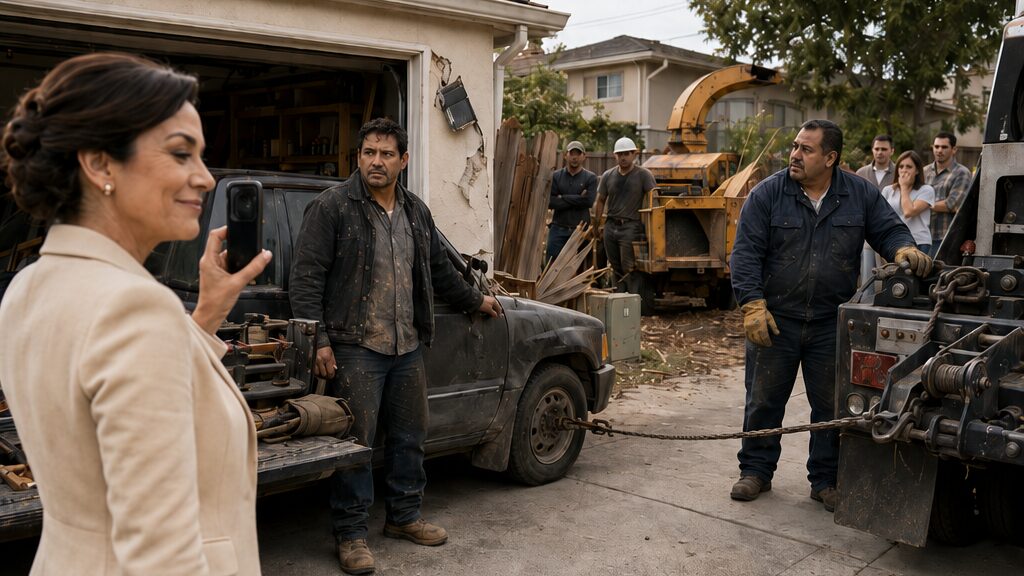
Across the driveway, Valeria Gómez lifted her phone higher.
“There he is,” she said, not to him, but to the little black lens. “Repeat noncompliance, visible from the street. This is exactly what happens when residents think rules are optional.”
Two workers stood behind her with gloves and pry bars. A tow truck idled behind the chipper, its amber lights turning slow circles on the garage wall. The whole street had the stunned, frozen look of people pretending not to watch through blinds.
Tomás set the hand plane down on the edge of the pickup bed.
“Valeria,” he said, keeping his voice flat. “What is this?”
She smiled without warmth and angled her phone so it caught his face first, then swung toward the front wall of the house.
The house number plaque hung beside the garage door. It was small, dark, and hand-cut, with numbers carved deeper at the bottom than the top because the person who made it had used an old gouge and no template. The numbers leaned a little. Tomás had once thought about sanding it smooth. He never had.
Valeria stepped toward it as if presenting evidence.
“This,” she said, “is what this is.”
One worker gave a short laugh.
Tomás looked from the plaque to the machines. “You brought a wood chipper for a house number?”
“For the fence boards,” Valeria said. “The plaque comes first.”
“The fence isn’t part of any notice.”
Valeria’s eyes narrowed just enough to show him he had stepped into the part she wanted recorded. “You received four notices, Tomás. Four. The architectural standard is clear. House numbers must use approved lettering. Yours uses the wrong font, the wrong finish, and the wrong mounting board.”
“The wrong font,” he repeated.
“It looks impoverished,” she said, and this time she turned the phone back toward him to catch what the word did.
It landed harder than it should have. Not because he had not heard worse in job sites, permit offices, and supply yards where men looked at his truck before they looked at his face. It landed because she said it in front of his garage.
Behind him, the pickup stood with its tailgate down, loaded for a cabinet repair across town: clamps, saw horses, a miter saw, toolboxes, lumber, a canvas roll of old chisels wrapped in faded cloth. The truck had primer patches on one fender and a dent in the passenger door. It was ugly on bad days and reliable on good ones.
It was not decoration. It was food.
Tomás wiped his palm slowly against his jeans. “Turn that phone off.”
“No,” Valeria said. “Transparency protects the community.”
“You’re recording my house.”
“I’m recording an enforcement action.”
He glanced at the sidewalk. A neighbor’s curtain moved. Farther down, Sara Mendoza stood near her mailbox with one hand wrapped around a coffee mug she had forgotten to drink from. She looked at the tow truck, then at him, then at the ground.
Tomás had seen that expression before at HOA meetings: someone who knew a rule had been bent but feared being the next person brought under it.
Valeria tapped the screen once, likely checking the angle. “For anyone watching later, this is what happens when a resident refuses simple correction. The board gave him every opportunity.”
“I didn’t refuse,” Tomás said. “I told the board the line by the fence isn’t yours.”
Valeria’s face tightened. The phone stayed steady.
“The plaque is on your house,” she said. “Do not change the subject.”
“You brought a chipper for a fence you don’t own.”
“Again, deflection.” Her voice grew brighter, more polished. “This is why we document.”
One of the workers shifted his pry bar from one hand to the other. He was young, avoiding Tomás’s eyes.
Tomás stepped between him and the plaque. “Nobody touches it.”
Valeria lowered the phone half an inch. Not enough to stop filming. Enough to let him see the satisfaction underneath. “You have already been assessed daily fines. You skipped the hearing. You ignored correction timelines. This morning the HOA is authorized to remedy the violation and recover costs.”
“Show me where it says tow truck.”
She did not answer immediately.
The amber lights from the tow truck crawled over her cream-colored blouse, her HOA badge, the glossy folder tucked under her arm. Everything about her looked prepared except the pulse moving in her jaw.
“The truck,” she said, “is obstructing access.”
“It’s in my garage.”
“It blocks the work zone.”
Tomás turned and looked at the pickup, parked fully inside the open garage except for the lowered tailgate. His tools were strapped in. The tarp rope was coiled neatly. Nothing crossed the driveway line.
“That truck feeds my family,” he said.
The worker with the pry bar looked down.
Valeria did not. “Then you should have made better choices before letting your property become a visual burden on everyone else.”
The words moved through him, hot and slow. He thought of the first week he had owned the house, before the new HOA board began sending letters with red boxes and photographs. His father, Ana Aguilar, had still been alive then, standing beside the garage with a pencil behind one ear, holding the scrap of cedar that would become the plaque.
Make it straight, Tomás had said.
His father had smiled. Straight enough to find you.
The chipper revved. The sound swallowed the memory.
“Last time,” Tomás said, louder. “Get off my property.”
Valeria’s smile vanished. She turned fully toward the camera now, placing herself in the frame with Tomás over her shoulder. “The resident has now become verbally aggressive.”
“I said get off my property.”
“And continues to misunderstand the limits of private ownership inside a governed association.”
The tow truck door opened.
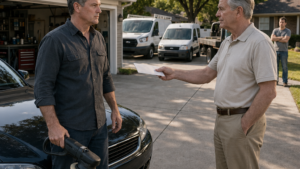
A broad-shouldered man climbed down wearing work gloves and a tired expression. He had a clipboard tucked into the back pocket of his jeans and the practiced caution of someone who had arrived at too many disputes halfway through. Valeria waved him forward without looking.
“Carlos,” she said, “position the truck.”
The man paused near the curb. “The pickup’s inside the garage.”
“It needs to be moved for access.”
Tomás stepped toward him. “You hook that truck, you’re stealing my living.”
Carlos looked past him into the garage. He saw the stacked toolboxes, the workbench, the boards clamped for cutting, the old canvas roll. His mouth flattened.
“I was told it was a non-running vehicle,” Carlos said.
Valeria cut in fast. “You were told it was obstructing enforcement. That is enough.”
“It runs,” Tomás said. “I drove it yesterday.”
“Then move it,” Valeria said.
“So you can feed my fence into that thing?”
She did not deny it.
The street seemed to shrink around the machines. The chipper’s open mouth, the tow hook swinging from its chain, the phone lens black and dry in Valeria’s hand. Tomás felt every object becoming part of a system built to make him move backward.
He reached for the garage door button mounted inside the frame.
Valeria lifted her voice. “Do not close that garage. Interference will be documented.”
His finger stopped half an inch from the button.
That was how she wanted him: caught between anger and proof, between protecting what was his and looking guilty for touching anything.
He dropped his hand.
Valeria took one clean step toward the house number plaque. “Remove it.”
The young worker looked at Tomás. “Sir, I’m just—”
“No,” Tomás said.
Valeria spoke over him. “Crowbar it off.”
The pry bar slid under the edge of the handmade board.
Tomás heard the first small crack before he saw the wood lift from the wall. It was a dry sound, almost gentle, and for one impossible second his body refused to move, as if standing still could undo it.
The worker pried again.
The plaque bent outward.
Valeria angled the phone closer. “Wrong font,” she said softly. “Wrong neighborhood.”
Tomás took one step forward.
The tow truck behind her beeped as Carlos reversed toward the driveway, slow and reluctant, its chain swaying like a warning.
Valeria did not look away from her phone.
“Hook it,” she said, “before he performs poverty for sympathy.”
Chapter 2: The Phone Was Already Recording Before The Notice
“Repeat offenders always pretend not to understand rules,” Valeria announced, walking backward so her phone kept Tomás, the damaged plaque, and the tow truck in one frame. “They delay, deflect, and then act shocked when enforcement arrives.”
Tomás moved toward Carlos, not fast enough to be called a lunge, not slow enough to look calm. The tow truck’s reverse alarm beeped through the wood chipper’s growl, each sound clipping into the next. Carlos had one hand raised toward him, palm out, while the other hovered near the tow controls.
“Don’t make me part of this,” Carlos said under his breath.
“You already are.”
“I got a work order.”
“Show it.”
Carlos looked toward Valeria.
Valeria’s phone followed the glance. “The contractor is not required to debate with you.”
“I asked for proof,” Tomás said.
“You received proof by certified mail.”
“You sent me pictures of my own house with red circles on them.”
“And violation language.”
“And fines.”
“And deadlines you ignored.”
Tomás laughed once, without humor. “I ignored meetings where you muted me after thirty seconds.”
Valeria’s eyes sharpened. “Because you were disruptive.”
“I asked about the relay box.”
There it was again: the brief tightening at the corner of her mouth.
Sara Mendoza had moved closer, no longer hiding by the mailbox. She wore slippers and a cardigan, one sleeve pulled over her hand. Her eyes went to the small gray metal relay box beyond the side fence, half hidden by ornamental grass and a leaning post. It had been there longer than most residents, ignored until it was inconvenient.
“Sara,” Tomás called, “you’re the secretary. Tell them.”
Sara’s face went pale.
Valeria turned the phone toward her so quickly it felt like a weapon being aimed. “Yes, Sara. Please explain how the board voted.”
Sara hugged her mug with both hands. “The board voted on a final correction notice.”
“Correct,” Valeria said.
“For the plaque,” Sara added.
Tomás looked at Valeria. “Not the truck.”
Sara swallowed. “Not towing the truck.”
Carlos lowered his hand.
Valeria’s smile returned, thinner now. “The contractor determines access needs on-site. That is standard.”
“I don’t determine anything,” Carlos said. “I tow what I’m told to tow.”
“Then you should be careful what you admit while a resident is escalating.” Valeria took a half step closer to him. “You signed the service authorization.”
His jaw worked. “For obstruction removal.”
“And there is an obstruction.”
Tomás turned to the young worker still holding the pry bar under the plaque. “Take that out.”
The worker hesitated.
Valeria’s voice snapped. “Continue.”
The pry bar moved.
The plaque tore free at one corner, pulling a strip of backing wood with it. The sound was small, but Tomás felt it in his teeth. A splinter dropped onto the concrete near his boot.
His father had carved the backing from cedar because the old siding would not hold screws. No one else knew that. To Valeria it was an ugly board. To the camera it was evidence of noncompliance. To the worker it was a task.
Tomás bent and picked up the splinter.
The edge was rough against his thumb. He remembered Ana’s hands, square and scarred, pressing the board flat against the house while Tomás held the level wrong. His father had said nothing about the mistake until the screws were in.
Now the crookedness made sense. They had both seen it. They had both left it.
“You don’t have to do this,” Sara said quietly.
Valeria spun on her. “Excuse me?”
Sara shrank, but did not retreat. “I mean—we could pause. Call the board.”
“I am the vice president.”
“Valeria—”
“And you are the secretary, not legal counsel.”
Sara’s lips pressed shut.
Tomás looked at her. “What’s in the file?”
Nothing moved except the phone in Valeria’s hand.
“What file?” Valeria asked.
Sara’s gaze flicked once, unwillingly, to the gray relay box.
Valeria saw it. Her face changed. Not much. Enough.
“This is not about the side yard,” Valeria said loudly. “This is about visible standards and repeated disrespect for every family that pays to maintain this community.”
The camera swung back to Tomás.
He understood then that she was not only recording what happened. She was building a version of it. Every glance away, every silence, every question she did not answer would be cut around the bright center of his face when anger finally broke through.
He forced himself to breathe through his nose.
“You started filming before you handed me any notice,” he said.
“For safety.”
“For posting.”
“For accountability.”
“For humiliating.”
Valeria tilted her head. “You feel humiliated because you know how this looks.”
He almost said what? Poor? Working? Mine?
Instead he said, “I feel humiliated because you brought an audience to my home.”
For a moment, something uncertain passed behind her eyes. It looked almost like recognition, then disappeared under the polish of her voice.
“You chose to live in an association,” she said. “That means your choices affect other people.”
“My number plaque affects other people?”
“Visual neglect spreads.”
The phrase sounded rehearsed. Maybe from a board meeting. Maybe from a comment thread. Maybe from the place inside her that needed one crooked thing to explain every fear she had about losing control.
Carlos walked to the rear of his tow truck and unlatched the chain. Metal clattered onto pavement. He moved slower than necessary.
Valeria noticed. “Carlos, we are billed by the hour.”
He stopped pretending to adjust the hook.
The young worker gave the plaque one more pull. It came off the wall entirely.
Tomás stepped forward and caught it before it hit the ground. The broken backing scraped his palm. The carved numbers looked worse up close: uneven, chipped, stubborn. He pressed it against his chest without thinking.
Valeria lowered the phone just long enough to look at him with naked irritation.
“That is HOA property now,” she said.
“It was on my house.”
“It was a violation removed under authority.”
“You don’t own my father’s work.”
She blinked at that. A small, human pause.
Then the phone rose again.
“For the record,” she said, “the resident is now attempting to sentimentalize a noncompliant object.”
Sara flinched as if the sentence had struck her too.
Carlos dragged the chain toward the driveway. Its links rasped across concrete, leaving a dark line near the threshold of the garage. Tomás watched it cross the place where he swept sawdust every evening.
“You said final notice,” he told Sara.
Sara looked miserable. “That’s what the minutes say.”
“The minutes don’t matter if the violation continues,” Valeria said.
“They matter if you changed the action,” Sara whispered.
Valeria’s head turned slowly.
“What did you say?”
Sara looked at the phone, then at the workers, then at the curtains trembling in nearby houses. Her courage drained visibly from her face.
“I said the board should know we’re here,” she murmured.
“The board will see the video.”
That was enough to silence her.
Tomás set the damaged plaque carefully on the workbench just inside the garage. He did not trust himself to hold it any longer. His hand left a faint smear of blood on the wood from where the splinter had opened his skin.
Valeria saw the blood and lifted the phone toward it.
“No,” Tomás said.
“Don’t touch me.”
“I’m telling you not to use that.”
“You don’t control documentation.”
A worker near the side fence called out, “Which boards?”
Valeria turned before Tomás could answer.
“The section by the utility box,” she said. “All visible damaged boards.”
Tomás’s head snapped toward her.
“No.”
Valeria checked something on her phone, then tucked the glossy folder more tightly under her arm. “They’re weathered, mismatched, and attached to the same general violation pattern.”
“That fence line is not yours.”
“That sentence has been reviewed.”
“By who?”
“By people who understand property better than you understand fonts.”
Sara shut her eyes.
The worker at the fence lifted a pry bar.
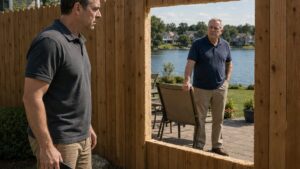
The gray relay box stood three feet beyond him, dull and square, with a small federal sticker worn almost colorless by years of sun. Most people never saw it. Postal trucks came twice a year. A technician opened it, made notes, locked it again. Tomás had kept the weeds cut because his father told him not to let official things look abandoned.
Valeria pointed toward the fence.
“Start there,” she said. “The chipper is already paid for by the hour.”
Chapter 3: The Fence Boards Beside The Federal Relay Box
The first fence board vanished into the wood chipper before Tomás could reach it.
One second it was in a worker’s gloved hands, gray with age and sun, the nail holes dark where Ana had once told him to stop wasting good screws. The next it was caught by the machine and chewed into a shrieking spray of pale splinters.
Tomás stopped so suddenly his shoulder hit the side mirror of his pickup.
“No more,” he said.
Nobody heard him over the engine.
He moved toward the side yard, but Carlos stepped into his path, not aggressive, just there.
“Sir,” Carlos said, “don’t go near the chipper.”
“They’re destroying the wrong fence.”
“I hear you.”
“Then stop them.”
Carlos looked toward Valeria. “I can’t control her crew.”
“You can control your truck.”
The tow operator’s eyes went past him, into the garage again. Toolboxes. Saw horses. Clamps. The old canvas roll tied with twine. His expression shifted in a way Tomás recognized from other working men: the quick inventory of another man’s life and the cost of touching it.
Valeria saw the hesitation from across the driveway.
“Carlos,” she called, “if you are refusing the contracted work, I will document breach of service and report it to dispatch myself.”
The muscles in Carlos’s neck tightened.
“I said I’m working,” he called back.
“Then work.”
Tomás stepped around him. Carlos did not stop him this time.
By the fence, the second board had already come loose. Behind the gap stood the gray relay box, half sunken into its concrete pad, with the old access path Tomás kept trimmed. A faded label clung to the door. Federal property. Authorized personnel only. The words were not clear from the sidewalk, but Tomás knew them the way he knew knots in lumber.
“You are crossing a federal easement,” he shouted.
Valeria laughed once, sharp enough to cut through the chipper’s roar. “There it is. The magic phrase.”
“It’s not a phrase.”
“To everyone watching, this is a common delay tactic. Suddenly the fence is special. Suddenly the mailbox is federal. Suddenly the rules don’t apply.”
“It’s not a mailbox,” Tomás said. “It’s a relay box.”
“Utility clutter does not exempt you from HOA standards.”
Sara moved closer to the curb, her face pinched. “Valeria, maybe we should verify the boundary note.”
The phone swung toward her again.
This time Sara did not fully retreat, but her voice thinned. “There was a note. In the old file. Before the digital transfer.”
Valeria smiled as if Sara had handed her a gift. “And was that note part of the current enforcement packet?”
Sara looked down. “No.”
“Then it is not before us today.”
Tomás stared at her. “Not before you?”
Valeria adjusted her sunglasses on top of her head. “You were invited to present relevant documents at the hearing.”
“You muted me.”
“You were disruptive.”
“I said federal relay box and you muted me.”
“You shouted.”
“I spoke.”
“You refused process.”
Tomás felt something inside him close, not with anger yet, but with the dead weight of a door he had been holding open too long. He had thought the papers would be enough when the time came. He had thought truth had a natural gravity, that people would eventually turn toward it if he waited. But here, in the machine noise and phone glare, truth was only another object someone could step over.
He turned and went into the garage.
Valeria followed at a distance, phone raised. “The resident is retreating after refusing lawful correction.”
Tomás ignored her.
The plastic folder was under the workbench, behind a box of hinges and a coffee can full of old screws. It had been there for six years, wrapped in a grocery bag to keep sawdust off the documents. He had opened it after the first HOA notice. Then after the second. Each time, he had looked at the brittle deed copies, the survey sketch, the old Federal Post Office transfer page, and put them back.
He had not wanted a fight with people who treated meetings like courts and neighbors like defendants.
He pulled the folder out now.
His hands were not steady.
On the workbench, beside the damaged plaque, his blood had dried into a small dark crescent. He laid the folder next to it and opened the plastic flap.
Valeria came no farther than the garage threshold. She kept the phone pointed in but did not step inside.
“Garage junk,” she said. “This is what I mean by hoarding conditions.”
Tomás lifted the first deed copy. The paper had softened at the folds. His father’s pencil marks still showed near one corner, where Ana had written: Keep this. Line is old post office land.
“Read it,” Tomás said.
“I don’t accept random papers from residents during enforcement.”
“Read it.”
She angled the phone down to show the scattered pages. “He is now producing irrelevant, unverified paperwork from a garage storage bin.”
Sara whispered, “Tomás, don’t let her—”
Valeria stepped closer, and Sara stopped.
Outside, the chipper caught another board. The grinding filled the garage like something alive.
Tomás flinched despite himself.
Valeria caught it. “This is what refusal costs.”
He looked at her then, really looked. Beneath the makeup and board polish and sharp HOA badge, there was a tremor she kept hidden behind process. She needed this to go cleanly. She needed the workers moving, the machines running, the video proving she could still make someone obey.
“What happened at the last board meeting?” he asked.
For the first time, she did not answer fast enough.
Sara’s eyes lifted.
Tomás saw it. Valeria saw that he saw it.
“The truck,” Valeria said loudly. “Move the truck.”
Carlos stood near the pickup’s rear bumper with the tow hook in his hand. “It’s loaded.”
“Then he should have thought of that before obstructing enforcement.”
“It’s not obstructing anything,” Tomás said.
Valeria turned the camera toward his open garage, but she framed it tightly: oil stain, old boards, a cracked bucket, the crooked shelf where spare hinges sat. She did not show the labeled toolboxes, the stacked cabinet doors, the clamp rack built from scrap maple. She did not show work. She showed mess.
“Look at the condition,” she said softly, almost tenderly, to the lens. “This is why standards exist.”
Tomás crossed the garage in three strides. “You don’t get to turn my work into trash.”
“Then keep it out of view.”
“It’s a garage.”
“In a governed community.”
Carlos crouched by the rear axle.
Tomás looked down at the deed page in his hand. The print was small. The survey lines were old. The federal language sat in the middle of a paragraph no one would read while machines screamed. He had brought proof to a performance, and Valeria knew exactly how useless that made it.
Sara stepped toward the folder. “I can show Officer—”
“There is no officer,” Valeria snapped. “There is an enforcement action that has already been delayed long enough.”
The young worker came from the fence carrying another board. He avoided the garage entirely, head down, moving fast toward the chipper.
Tomás saw the line now: plaque, fence, truck. Not separate acts. A path. Remove the number. Destroy the boundary. Take the tools.
Carlos hooked the chain.
The sound was final.
Metal caught under the pickup with a heavy clank, and the truck shifted half an inch as tension entered the line.
Tomás moved, but Valeria moved too. She stepped into the edge of the garage and planted one polished shoe on the open plastic folder, pinning the brittle deed copy against the concrete.
“Careful,” she said, phone high, voice sweet with triumph. “You’re starting to look dangerous.”
Outside, Carlos walked back to the tow controls.
The chain tightened.
The pickup groaned against its own weight, and the plastic folder spread open under Valeria’s shoe like a mouth no one was willing to
Chapter 4: When The Tow Chain Pulled His Livelihood
The pickup’s rear wheels scraped forward, and every tool in the bed answered with a crash.
The miter saw slammed against a toolbox. A bucket of screws tipped and burst open under the tarp. The canvas roll of chisels struck the sidewall with a sound too soft to belong in all that machine noise, but Tomás heard it anyway.
“Stop!” he shouted.
Carlos’s hand jumped off the tow controls for half a second.
Valeria’s phone rose higher.
“Here we go,” she said, breathless now, as if the scene had finally become useful. “The resident is escalating. He has been warned repeatedly, and now he is threatening a licensed contractor.”
“I’m not threatening anyone.” Tomás stepped over the open folder, but Valeria’s shoe still pinned one corner of the deed copy. “You are stealing my truck.”
“It is being removed from an enforcement zone.”
“It is inside my garage.”
“Because you refuse to cooperate.”
The tow chain tightened again.
The pickup lurched another foot.
The front tire crossed the line where the garage floor met the driveway. A clamp fell from the bed, bounced off the concrete, and skidded toward the chipper. Tomás bent to grab it, but the truck moved again, dragging the clamp under the tailgate.
Carlos shut the controls off.
“I need him to move the tools first,” Carlos said.
Valeria turned on him. “No. You need to complete the job.”
“I’m telling you, the load isn’t secure.”
“Then secure it.”
“That’s his property.”
“And the truck is obstructing ours.”
Carlos stared at her. “Lady, this is getting out of hand.”
Valeria’s mouth hardened. For a moment the phone dropped enough that Tomás saw her not as a vice president or a camera, but as someone cornered by the very scene she had built. Her jaw trembled once before she locked it still.
“If you stop now,” she said to Carlos, “I will report that you abandoned an authorized enforcement action after being intimidated. You can explain that to your dispatcher.”
Carlos looked at the pickup, then at Tomás. “I got a daughter,” he said quietly. It was not an excuse exactly. It was a confession of the kind men made when they were about to do something they knew was wrong because rent still came due.
Tomás understood it too well, and hated him for making him understand.
“That truck feeds my family,” Tomás said again, but the sentence had lost its power. Valeria had already turned it into evidence of desperation. Carlos had already turned it into something he could regret later.
From the fence line came another splitting crack.
The young worker had pulled loose a board near the relay box. The exposed gap showed the gray metal face more clearly now, its faded warning label almost visible through dust and grass. The wood chipper chewed the previous board and spit fragments into its collection bag.
Tomás looked down at the papers under Valeria’s shoe.
The deed copy had creased across the old survey mark. His father’s pencil note was half hidden beneath the edge of her polished sole.
Keep this. Line is old post office land.
He had kept it. He had kept it in plastic, in darkness, in silence. He had kept it the way he kept spare screws in coffee cans and offcuts stacked by length. He had kept it because his father told him to, and because some part of him believed keeping a thing safe was the same as using it.
It was not.
Valeria’s voice cut back in, louder, aimed toward the street and the unseen watchers behind curtains.
“You can see the aggressive posture. He has been given multiple options. Compliance is always easier than conflict.”
Tomás looked at her phone. Not at her face. At the lens.
He saw himself inside it: sawdust shirt, blood on one palm, eyes too wide, shoulders squared in the open mouth of his garage. She had framed him perfectly. Not the broken plaque. Not the deed. Not the boards feeding the chipper. Him.
A man about to become what she had been calling him all morning.
He stepped back.
Valeria smiled. “Good. Carlos, continue.”
The tow chain tightened for the third time.
The pickup rolled another few inches. The canvas roll came loose completely and spilled open. Three old chisels slid across the truck bed. One handle was dark walnut, worn smooth at the grip, the brass ferrule dented from years before Tomás had owned it.
His father’s favorite.
Tomás did not remember moving toward the driver’s side. One instant he was standing beside the folder. The next his hand was on the pickup door.
Carlos shouted, “Sir, don’t get in.”
Valeria’s voice sharpened with delight. “He is entering the vehicle. He is entering the vehicle during a lawful tow.”
Tomás opened the door.
The smell inside hit him first: pine dust, vinyl warmed by sun, old coffee, machine oil. The smell of mornings when he left before sunrise for someone else’s kitchen repair. The smell of his father riding passenger with a thermos between his knees, telling him that a man could lose money and recover, lose time and recover, but once he let people convince him his work was shameful, recovery took longer.
Tomás slid into the seat.
The tow chain held the pickup at an angle. The steering wheel trembled faintly from the tension. Through the windshield, the tow truck blocked the driveway, broad and white and indifferent.
Carlos ran toward the driver’s window. “Put it in park! Don’t do this.”
“It is in park,” Tomás said.
“Then stay there. Let the police sort it.”
Tomás looked past him.
Valeria had followed with the phone. “Yes, stay there. Let everyone see how unstable this is.”
Her voice was almost shaking now, though her smile remained. Tomás saw the fear underneath it—not fear of him, not yet, but fear that if the scene stopped before he broke, all she would have was a video of herself destroying a working man’s property over lettering.
She needed the ending.
Tomás turned the key.
The pickup engine caught on the second try, rough and loud, rattling under the hood like an old dog waking angry.
Carlos stepped back. “No, no. Don’t hit the gas.”
Valeria moved closer, camera fixed.
“This is now reckless behavior,” she said. “This is exactly why the board has discussed stronger action.”
Tomás’s hands settled on the wheel.
For the first time that morning, he became still.
Not calm. Not peaceful. Still.
The machines kept screaming. The chipper. The tow truck. The camera’s soft electronic chirp. The clatter of his tools in the bed. But inside the cab, the world narrowed to simple lines: tow truck ahead, chain below, garage behind, fence to the side, relay box beyond the broken boards.
He saw the damage he had allowed by waiting.
He saw Valeria’s shoe on the folder.
He saw his father’s chisel lying loose in the truck bed.
He pressed the brake, shifted into drive, then stopped.
Carlos stood near the front fender, palms up. “Think about this.”
Tomás looked at him through the windshield. “Move.”
Carlos did.
Valeria did not. She stayed beside the driveway, phone raised, face bright with the terrible hope that he would give her exactly what she wanted.
Tomás looked once at the plaque on the workbench. The broken backing. The crooked numbers. The blood mark beside it.
Then he turned the wheel hard.
He did not aim for Carlos. He did not aim for Valeria. He aimed for the side of the tow truck where the rear equipment box jutted out past the wheel well, the place where metal would stop metal and the chain would lose its pull.
He floored the gas.
The pickup leapt forward against the tow line with a scream from its tires. The chain snapped tight, the front end dipped, and for one fraction of a second the truck seemed to tear itself between two decisions.
Then it surged.
The impact came like the world splitting open.
Metal folded. Glass rattled. The tow truck rocked sideways with a deep, ringing boom that knocked the worker at the fence to his knees and sent Valeria stumbling back. The wood chipper coughed and choked as someone hit its emergency stop. A toolbox burst open in the pickup bed, scattering screwdrivers across the driveway like thrown silver.
Then silence fell so hard Tomás heard his own breathing.
The pickup’s hood was bent upward. Steam hissed from somewhere near the grille. The tow chain hung slack now, crooked and useless.
Tomás’s chest slammed against the seat belt. His hands stayed locked to the wheel.
Outside, Carlos was shouting. Valeria was shouting. Sara was crying his name from the curb. But for two seconds Tomás could not move.
He had stopped the truck.
He had also crossed a line no paper could uncross.
The driver’s door stuck when he pushed it open. He forced it with his shoulder and stepped down onto the driveway. Pain ran through his ribs, sharp enough to bend him slightly, but he stayed upright.
Valeria stood several yards away, hair knocked loose, phone still clutched in her hand.
Her face had changed completely.
Not frightened now. Triumphant.
“He attacked us,” she screamed, turning the phone toward the street. “You all saw it. He attacked us on camera.”
In the distance, sirens began to rise.
Tomás looked at the broken tow truck, the slack chain, the dented front of his pickup, and the deed folder still spread open under Valeria’s shoe.
The sirens grew louder.
Valeria backed toward the curb, phone shaking in her hand, and shouted over them, “He attacked us on camera.”
Chapter 5: The Crash Made Everyone Look At The Boundary
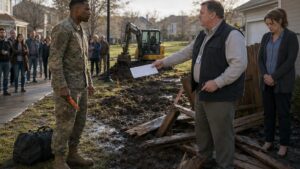
“Step away from the vehicle,” Officer Fernando Ortega ordered before he knew anyone’s name.
Tomás stood beside the pickup with one hand braced on the dented hood and the other pressed against his ribs. Steam curled between him and the tow truck. The chain that had been dragging his livelihood out of the garage now lay slack across the driveway, ugly and harmless for the first time all morning.
Valeria reached Fernando before he reached Tomás.
“He rammed them,” she said. “He rammed a contractor during an HOA enforcement action. I have it all recorded.”
Fernando held one hand out to slow her without looking away from Tomás. “Sir. Away from the truck. Hands where I can see them.”
Tomás lifted both hands.
Pain pulled through his side.
Carlos stood near the rear of the tow truck, pale and breathing hard, one glove off, staring at the crushed equipment box as if he had not yet decided whether to be angry or grateful he had moved.
The young worker by the fence had shut down the chipper. The sudden quiet made the neighborhood feel exposed. Curtains opened wider. A neighbor stood on a porch with a phone half raised, then lowered it when Fernando glanced over.
Valeria did not lower hers.
“Officer, he is dangerous,” she said. “He has been aggressive from the moment we arrived.”
Fernando looked at Tomás’s blood-marked palm, the damaged pickup, then the open garage. “Did you strike anyone?”
“No,” Tomás said.
“He used a vehicle as a weapon,” Valeria snapped.
Fernando’s eyes returned to Tomás. “Did you ram the tow truck?”
Tomás swallowed. The easy lie came and died before reaching his mouth. “Yes.”
Valeria almost smiled.
Tomás kept his hands up. “Because they were towing my truck out of my garage.”
“Because he refused lawful compliance,” Valeria said. “This is an HOA matter that escalated because he became unstable.”
Fernando turned his head slightly. “Ma’am, I’ll get your statement. Right now I need everyone quiet.”
The word quiet landed in the driveway with strange force.
Tomás had used quiet like a tool for years. Quiet at meetings. Quiet through notices. Quiet when neighbors joked that at least his garage smelled like honest work, as if that softened the insult. Quiet when Valeria’s first violation letter used the phrase visual inconsistency. Quiet had brought him here, hands up beside his damaged truck.
He lowered his voice but not his hands. “Check the fence line.”
Fernando’s expression did not change. “We will.”
“Check it before you decide what this is.”
Valeria gave a tight laugh. “He is trying to distract you from the crash.”
“That fence is by a Federal Post Office relay box,” Tomás said. “They tore boards beside it. I told them before the tow.”
Fernando looked toward the side yard.
The gap in the fence stood open like a missing tooth. Behind it, the gray relay box was fully visible now. A strip of grass lay flattened by workers’ boots.
Valeria stepped into Fernando’s line of sight. “The relay box is irrelevant to the vehicle assault.”
“Don’t stand between me and the scene,” Fernando said.
She moved, offended but careful.
Another officer began separating the workers near the curb. Fernando pointed to Carlos. “You. Tow operator. Did he warn you about the relay box?”
Carlos looked at Valeria first.
She raised the phone.
Fernando noticed. “Answer me, not the camera.”
Carlos pulled off his other glove. “He said it. More than once.”
Valeria’s mouth opened.
Carlos continued before she could cut him off. “He said the fence line wasn’t HOA land. Said there was a federal easement or something. I didn’t know what he meant.”
“And you continued towing?”
“I was told to.”
“By her?”
Carlos did not answer for a second. His eyes went toward the crushed tow box, then the pickup, then Tomás. “Yes.”
Valeria stepped forward. “I hired a licensed contractor under valid authority. I am not responsible for a resident choosing violence.”
Fernando turned to her. “Where is that authority?”
She thrust the glossy folder toward him so quickly one page slid loose and fluttered onto the driveway. “Violation notices, photographs, board certification, contractor authorization. Everything is there.”
Fernando took the folder and opened it on the hood of his patrol car.
Tomás watched him read. He wanted to speak. He wanted to say the papers were missing the only part that mattered. He wanted to shout that Valeria had stepped on the deed copy, mocked it, hidden behind procedure while destroying the proof of a boundary older than her board.
But Fernando was already looking at him as a man who had rammed a truck. Every extra word would feed the shape Valeria had built.
Sara stood near the mailbox, both hands clasped at her chest. Her coffee mug lay broken near the curb. She looked smaller than she had in meetings, stripped of agenda packets and minutes and the safe language of motions.
Tomás met her eyes.
She looked away.
Valeria saw the exchange. “Officer, this woman can confirm he was given multiple opportunities. She is the secretary.”
Fernando looked up. “Are you Sara Mendoza?”
Sara nodded.
“Come here, please.”
She came slowly, like each step cost her a little more standing in the neighborhood.
Valeria spoke before Sara reached them. “Sara has the minutes. She can confirm the board’s frustration with ongoing noncompliance.”
Fernando asked, “Did the board authorize towing this pickup?”
Sara’s mouth moved, but no sound came out.
Valeria said, “Access removal is implicit in enforcement.”
Fernando did not look at her. “I asked Ms. Mendoza.”
Sara’s fingers twisted in her cardigan sleeve. “No. The vote was for a final correction notice and cost assessment if the plaque wasn’t changed.”
Valeria’s face hardened. “That is not a complete characterization.”
Sara breathed in. “There was no vote to tow the truck.”
“And the fence?” Fernando asked.
Sara’s eyes filled suddenly, not with tears but with the strain of finally stepping out from behind silence. “There was an old boundary note in the paper file.”
Tomás’s hands lowered an inch before he caught himself.
Fernando noticed but said nothing.
“What kind of note?” he asked.
Sara glanced at Valeria. “From before most of us were on the board. Something about the side strip and a postal relay box. It said enforcement near that line required verification.”
Valeria laughed too loudly. “An old internal note does not override current architectural standards.”
“Where is the note?” Fernando asked.
Sara’s voice dropped. “It wasn’t included in today’s packet.”
“Why not?”
Nobody answered.
The question moved through the driveway more sharply than the sirens had. Carlos looked at Valeria. The worker by the fence looked at Valeria. Even the neighbor on the porch looked at Valeria.
She lifted her phone again, but her hand was no longer steady.
“This is exactly the problem,” she said, aiming the phone toward herself now. “People muddy a simple issue with irrelevant paperwork because they cannot accept community responsibility.”
Tomás could hear the comment thread she imagined beneath it. The likes, the support, the praise for holding standards. She was still trying to rescue the frame.
Fernando closed the glossy folder. “This packet doesn’t mention a boundary note.”
“Because there is no verified boundary issue,” Valeria said.
Tomás pointed toward the garage. “The papers are in there.”
Fernando followed the gesture. On the concrete near the threshold, the plastic folder still lay open. The brittle deed copy had a shoe print across one corner.
“Those are unverified personal papers,” Valeria said.
“They were under your foot,” Tomás said.
Her eyes flashed. “Because you threw them around while behaving erratically.”
For the first time since the crash, anger came close enough to take his voice. He felt it rise, hot and useful and dangerous.
Fernando saw it too. “Tomás. Stay with me.”
The use of his name stopped him.
Not because it was kind. Because it was exact. Because for the first time all morning someone had spoken to him instead of about him.
Tomás breathed once through his nose.
“I waited too long,” he said, each word scraped clean. “I should have shown the deeds when the first notice came. I didn’t because every time I tried to talk, she made it into a performance. That’s on me. But I told them before they touched the fence. I told them before they hooked my truck.”
Fernando studied him. “You understand ramming the tow truck is still serious.”
“Yes.”
Valeria seized on it. “He admits it.”
Tomás did not look at her. “I admit I hit the truck. I don’t admit they had the right to take mine.”
Fernando turned toward the relay box again. The faded federal label caught the afternoon light through the broken fence gap.
“Dispatch,” he said into his radio, “I need verification on a postal relay box and possible federal property interest at this address.”
Valeria lowered her phone. “That is unnecessary.”
Fernando looked at her hand, then at the phone. “Everything here is necessary now.”
Sara took one small step closer to Tomás. Her voice was barely above a whisper. “I’m sorry.”
He did not answer. Not yet.
Carlos shifted near the tow truck. “Officer?”
Fernando turned.
Carlos pointed toward the pickup. “Before he got in, he told me not to hook it. He said it was his work truck. I saw the tools. I should’ve stopped.”
Valeria’s head snapped toward him. “You should be careful.”
Carlos looked at her with tired disgust. “I am.”
Fernando’s radio crackled, but only with dispatch confirming they were checking. No answer yet.
Valeria opened her glossy folder again and pulled out another page. “Officer, I have an enforcement summary signed this morning. It authorizes immediate remedy of all visible noncompliant exterior elements.”
She handed it to him.
Tomás saw the page only briefly, but he saw enough: the neat type, the HOA header, the signature line, the missing attachment list. It looked official in the way Valeria understood official. Clean. Current. Printed on heavy paper.
Sara stared at it. “That wasn’t in the packet yesterday.”
Valeria did not look at her. “Emergency addendum.”
“The board didn’t vote on an emergency addendum.”
“It was within vice presidential discretion.”
Sara’s face changed. Fear remained, but something else entered with it. Offense, maybe. Or recognition.
Fernando tucked both folders under one arm. “I’m going to look at the papers in the garage.”
Valeria blocked him with words, if not her body. “Officer, he just admitted to vehicle impact. This paperwork game can happen after arrest.”
Tomás felt the handcuffs before he saw them. Not physically, but in the way Fernando glanced once toward his belt.
The machinery had changed shape. It was no longer the chipper or the tow chain. It was process. Report. Arrest. Liability. A story written cleanly because the messier truth was too much trouble.
Tomás looked at the relay box through the broken fence.
Then he pointed to it, arm steady despite the pain in his ribs.
“Call the Post Office before you touch me,” he said.
Chapter 6: The Original Deeds In The Plastic Folder
Fernando read the brittle deed twice, then stopped looking at Tomás and started looking at Valeria.
The shift was small. His shoulders squared toward the garage workbench instead of the damaged pickup. His thumb stayed pressed to one line on the page, holding it flat where the old fold wanted to rise. The paper looked fragile under his hand, yellowed at the edges, with the faint shoe print still crossing the corner like a dirty denial.
Valeria noticed the change before anyone spoke.
“That document is decades old,” she said. “It may not reflect current association authority.”
Fernando did not answer.
He lifted the deed copy and compared it with the rough survey sketch beneath it. Then he looked through the open garage, past the dented pickup, past the broken fence gap, to the gray relay box standing in the exposed strip of grass.
“Tomás,” he said, “where did these come from?”
“My father kept them before me.”
“I need more than that.”
“They came with the house. Originals were transferred from the previous owner. My father marked the section when we rebuilt the fence.”
Valeria gave a sharp laugh. “His father marked it. Wonderful. That’s our legal standard now?”
Fernando looked at her. “Stop talking for a moment.”
The silence afterward was not peaceful. It was stunned.
Valeria’s face flushed high along her cheekbones, but she closed her mouth.
Fernando turned back to the page. “This references a Federal Post Office property strip tied to a relay installation.”
Tomás nodded once.
“You said technicians come here?”
“Twice a year most years. Sometimes once. White service van. They park at the curb, open the box, leave paperwork in a sleeve inside.”
“Do you have any of that paperwork?”
Tomás’s mouth went dry.
He looked toward the old metal cabinet beside the workbench. For years, whenever a technician had left a duplicate notice or service card because access grass needed trimming, Tomás had put it in the same drawer as sandpaper receipts and spare keys. Not filed. Not sorted. Kept.
Like everything else.
“Maybe,” he said.
Valeria seized the hesitation. “Maybe. Exactly. This is nonsense.”
Fernando said, “Find it.”
Tomás moved to the cabinet. His ribs protested when he bent. He opened the second drawer and shoved aside a roll of painter’s tape, sandpaper sheets, a cracked tape measure. Beneath them was a stack of stained envelopes, delivery receipts, and two pale cards with postal seals faded by time.
His hands shook as he pulled them free.
He hated that they shook. Hated that Valeria could see it. Hated that the truth, after all his years of keeping it safe, looked so much like clutter.
He laid the cards beside the deeds.
Fernando read the top one.
Valeria moved closer, phone angled down. “For the record, he is now producing additional unsorted materials from a garage drawer after damaging a commercial vehicle.”
Fernando covered the card with his hand. “Do not film documents at close range.”
“This is a public enforcement matter.”
“This is now a police matter.”
Her mouth tightened.
Outside, another patrol car pulled up. A second officer spoke with dispatch near the curb. The workers stood apart from the chipper, suddenly careful not to touch anything. Carlos leaned against his tow truck with his arms folded, eyes on the ground.
Sara came to the garage threshold but stopped there, as if crossing into Tomás’s workspace required permission she had not earned.
“I have the notice log,” she said.
Valeria turned. “Sara.”
The word carried warning.
Sara looked at Tomás’s damaged plaque on the workbench, then at the papers under Fernando’s hand. “No,” she said softly. “You don’t get to use my minutes and then tell me what I saw.”
Valeria’s face changed in a way Tomás had not expected. For the first time, the anger carried hurt. Not guilt, not remorse, but the shock of being disobeyed by someone she thought belonged on her side.
“I protected this board from becoming a joke,” Valeria said. “You know how they talk about us. You know what happens when one house gets away with it.”
Sara’s voice trembled. “A crooked number plaque was not going to ruin the neighborhood.”
“One turns into ten.”
“No,” Sara said. “One turns into you bringing a chipper.”
Fernando looked between them. “The notice log.”
Sara opened a canvas tote hanging from her shoulder and pulled out a thin binder. Her hands fumbled with the clip. A few pages slid loose. She caught them against her chest before they fell.
Valeria lowered her voice. “Think carefully.”
Sara did. Everyone could see it. She thought about her own house, her own mailbox, her own name spoken into Valeria’s phone someday. She thought about board meetings where silence had felt like neutrality because someone else was the target.
Then she handed the binder to Fernando.
“The vote was Thursday,” she said. “Final correction notice only. Valeria added the contractor language afterward. I noticed this morning.”
Fernando flipped through the pages. “Why didn’t you report it earlier?”
Sara’s eyes flicked to Valeria. “Because I kept telling myself she would stop at the plaque.”
No one spoke.
The answer was too ordinary to be dramatic and too honest to dismiss.
Fernando took the binder to the hood of his patrol car and laid it beside Valeria’s glossy packet. The difference between them was ugly. Sara’s pages had handwritten corrections, signatures, coffee rings, the messy trail of a meeting. Valeria’s addendum looked cleaner, stronger, and suddenly less real.
Dispatch crackled through Fernando’s radio.
He turned away to listen.
Tomás stood beside the workbench, feeling the whole morning pause around a voice too tinny for anyone else to hear fully. He caught fragments: postal facility, property interest, relay equipment, federal contact notified.
Fernando replied in short, controlled phrases.
Valeria began talking before he finished. “Officer, even if there is an easement, that does not excuse him ramming a tow truck.”
Fernando clipped the radio back. “No one said it did.”
She lifted her chin.
“But it changes what your crew was doing here,” he continued.
“It was HOA enforcement.”
“Your crew removed boards adjacent to protected equipment after being warned about the property status. Your tow operator was instructed to remove a work vehicle from a private garage under paperwork that appears to exceed the board vote. And your own packet omits a known boundary concern.”
Valeria’s eyes darted to the phone in her hand, then back up. “Appears. Known. Concern. Those are not crimes.”
Tomás heard the old confidence returning. She needed the world made of terms. Terms could be argued. Terms could be clipped into videos. Terms could be turned into smoke.
Fernando looked toward the chipper. “That machine touched the boards?”
The young worker answered before Valeria could. “Yes, sir.”
“How many?”
“Three.”
Valeria snapped, “Do not answer without the contractor present.”
The worker stared at her. “You hired us.”
Fernando looked at Carlos. “What did you hear Ms. Gómez say about the truck?”
Carlos rubbed both hands over his face. “I heard her say it would be a better lesson than a fine.”
Valeria went still.
Carlos looked ashamed after saying it, but not sorry. “I didn’t think she meant— Look, I thought it was just tough talk. Then I saw the tools.”
Tomás gripped the edge of the workbench.
The small sentence struck him harder than the insults. A better lesson than a fine. Not obstruction. Not access. A lesson. His truck had been selected because it would hurt.
Valeria recovered quickly. “That is a mischaracterization of a private scheduling discussion.”
Fernando said, “Was your phone recording then?”
“No.”
Sara looked at her.
Valeria saw it and added, “Not that portion.”
Fernando’s eyes narrowed.
Tomás’s blood-marked hand rested near the damaged plaque. He looked down at the crooked numbers. The gouges in the wood were uneven because Ana had carved the first two after dinner, tired from his own shift, then finished the last one the next morning when light was better. Tomás had teased him about the difference.
His father had said, You want perfect, buy plastic. You want ours, hold the board.
Tomás had held the board.
Now the backing was split where the pry bar had entered.
Fernando returned to the garage with Sara’s binder and the deed copy. “Here’s where we are. The postal property contact confirms there is an active relay installation and a federal interest in that strip. They’re sending a field supervisor, but for now, no one touches the fence, the box, or any equipment used near it.”
Valeria folded her arms. “Fine. Pause the fence issue. Arrest him for the truck.”
Tomás met Fernando’s eyes. “I hit the tow truck.”
Fernando nodded. “Yes, you did.”
“I was trying to stop them taking mine.”
“That will be in the report.”
“I want it in the report that I warned them.”
“It will be.”
“I want it in the report that she stepped on the deed.”
Fernando looked at the shoe print, then at Valeria’s polished shoe.
“That will be photographed.”
Valeria laughed once, but the sound had no body. “This is absurd.”
“No,” Sara said, surprising everyone again. “It’s documented.”
The word hung there, stolen from Valeria and turned.
Fernando gave the deed to the second officer for photographs. Then he looked at Valeria’s phone.
“You said you recorded the enforcement from the beginning.”
“I recorded for safety.”
“Good,” Fernando said. “Were you recording when you ordered them to remove the boards?”
Chapter 7: She Filmed Her Own Arrest On The Pavement
Valeria’s phone kept recording from the ground after she dropped it.
It landed faceup near the curb, angled toward the driveway, catching a crooked slice of the scene: the yellow flank of the silent wood chipper, the bent nose of Tomás’s pickup, the broken fence gap, and Valeria’s polished shoe stepping backward out of frame as Fernando waited for her answer.
“Were you recording,” he repeated, “when you ordered them to remove the boards?”
Valeria looked down at the phone as if it had betrayed her by existing.
“I recorded portions,” she said.
Fernando held out his hand. “I need the device.”
“No.” The word came too quickly.
His expression did not change. “You just stated you recorded a disputed enforcement action that may involve property damage, unauthorized towing, and a federal property issue. I need the device preserved.”
“It’s my personal phone.”
“It may contain evidence.”
“It contains private information.”
“Then we will handle it according to procedure.”
Valeria bent to pick it up, but the second officer stepped closer, and she stopped with her hand halfway down.
The phone screen glowed between them.
From where Tomás stood by the garage, he could see the live image still moving. It showed the driveway from ground level, making everyone look taller, harsher, stranger. His damaged truck filled the background like an injured animal. His open garage sat behind it, tools exposed, workbench visible, plaque broken beside the deed.
All morning Valeria had used that camera to make him small.
Now it was looking up at her.
“Officer,” she said, recovering a cleaner tone, “you need to consider the safety context. He used his vehicle. He admitted it. Everything else is administrative.”
Fernando crouched and picked up the phone with two fingers at the edges. The recording timer was still running.
He looked at the screen, then at her. “Is this livestreaming?”
Valeria hesitated.
Sara answered from near the garage threshold. “She usually records first and uploads later. Sometimes she streams to the board group.”
Valeria’s head turned. “Sara, enough.”
“No,” Sara said, still pale but steadier than before. “It has been enough since you brought the chipper.”
The word chipper made the workers look toward the machine at once. It sat with its chute open, packed with splinters from Tomás’s fence. One board fragment had lodged near the feed table, the old paint still visible on it. Fernando followed their gaze.
“Photograph that,” he told the second officer. “And the board pieces in the collection bag.”
Valeria’s voice sharpened. “You are treating an HOA contractor like a criminal operation.”
“I’m treating a machine used in disputed property destruction as evidence.”
“That is outrageous.”
“So was bringing it here for a number plaque,” Carlos muttered.
Valeria looked at him as if she would remember the sentence later.
Carlos did not look away this time.
Fernando tapped the phone screen, not scrolling, only stopping the active recording and noting the time. “Ms. Gómez, is there a passcode?”
“My attorney can answer that.”
“You can call one.”
“Then I am calling one now.”
He did not hand her the phone. “On another device.”
The second officer spoke quietly into a radio. The words impound, evidence hold, and federal contact passed through the driveway one after another. They changed the air more than sirens had. The tow truck and the wood chipper stopped being tools Valeria brought to dominate the scene. They became objects with numbers, photographs, chain of custody.
Valeria heard it too.
“Impound?” she said. “No. The equipment belongs to contractors. You cannot punish businesses because one resident had a meltdown.”
Fernando looked at Carlos. “Your truck stays until we process the scene.”
Carlos rubbed his mouth with one hand. “My boss is going to love that.”
“You’ll get documentation.”
Carlos let out a breath. “I’ll take documentation over being dragged into federal damage.”
Valeria stepped toward him. “You were hired to perform a job.”
“I was hired wrong.”
“You signed.”
“Because you said it was approved.”
“It was.”
Sara lifted the binder slightly. “Not like this.”
Valeria’s face flashed with something raw and personal. “You all enjoy this, don’t you? The second someone tries to keep this neighborhood from sliding, everyone acts offended. Do you know what the board hears? Do you know what they say when listings sit? When buyers drive through and see patched fences, work trucks, handmade signs like this is some back road?”
Tomás looked at the damaged plaque on his workbench.
Handmade signs.
Valeria’s voice caught, but she pressed forward. “I am the one who answers complaints. I am the one who gets called controlling when I enforce rules and useless when I don’t. One house becomes the example. That is how associations work.”
“No,” Fernando said. “That is how you made this work today.”
The second officer returned from the chipper. “Three boards processed. One partially intact in the feed tray. Collection bag has fresh material.”
Fernando nodded. “Tag it.”
Valeria’s phone buzzed in his hand with incoming messages. He did not look at them. The screen lit and dimmed, lit and dimmed, as if the little black rectangle were panicking for her.
Tomás took a step toward the workbench.
His ribs hurt worse now that the adrenaline had thinned. Each breath pulled against the seat belt bruise forming under his shirt. His pickup’s front end sagged at an angle that told him repairs would not be simple. Maybe not cheap. Maybe not soon.
But the tools were still there.
He climbed carefully onto the rear tire and looked into the bed. The miter saw was scratched, one toolbox dented, screws scattered everywhere. The old canvas roll lay open. He reached for the walnut-handled chisel first.
It had a new nick along the handle.
He closed his fingers around it, then set it gently back inside the canvas.
From the curb, Fernando said, “Tomás.”
He turned.
“I need to be clear with you. The crash will be documented. There may be a separate review of your actions.”
Valeria seized on that with a faint, desperate sound of relief.
Tomás nodded. “I know.”
“I’m not ignoring it.”
“I know.”
Fernando watched him for a moment. “But it will also be documented that your truck was being removed after warnings about the property boundary, after boards were destroyed, and under authority that is now in question.”
Valeria snapped, “In question is not unlawful.”
Fernando looked at her. “The postal contact has requested the equipment be held pending review. The board paperwork is inconsistent. The recording may show intent. That is enough to stop treating this as a normal HOA issue.”
He turned to the second officer. “Impound the wood chipper and tow truck as evidence. Notify the contractor companies where to retrieve documentation. Nobody moves them until cleared.”
Valeria stared at him. “You cannot be serious.”
The second officer began writing numbers onto evidence tags.
The workers stepped away from the chipper as if it had become contagious. Carlos put both hands on his hips, looked at his damaged tow truck, then at Tomás’s pickup.
“Your front end’s bad,” he said.
Tomás gave him a flat look.
Carlos nodded once, ashamed. “Yeah. I know. Not the point.”
“No,” Tomás said. “It’s part of the point.”
Carlos accepted that.
Fernando approached Valeria. “Ms. Gómez, I need you to place your hands behind your back.”
The driveway went completely still.
Valeria blinked. “Excuse me?”
“You’re being detained while we sort charges related to destruction of property, possible misuse of association authority, and interference with protected equipment. You’ll have a chance to make a full statement.”
“No.” Her laugh broke in the middle. “No, I called you.”
Fernando stepped closer. “Turn around.”
“This is his fault.” She pointed at Tomás. “He did this. He made this happen. He refused every reasonable correction.”
Tomás did not answer.
That refusal seemed to enrage her more than any shout would have. “You think this makes you noble? You rammed a truck. You live like rules are insults. You—”
“Valeria,” Sara said.
It was not loud, but it stopped her.
Sara’s eyes were wet now. “Stop recording people long enough to see them.”
Valeria looked at her, and for one second the whole morning seemed to strip down to two women who had sat at the same board table, one terrified of disorder, one terrified of becoming the next target. Then Valeria turned away from her.
Fernando took her wrist.
The handcuffs clicked once.
Valeria flinched as if the sound had struck her reputation before her skin.
The second click followed.
Near the curb, her phone rested in an evidence sleeve now, screen still glowing through plastic. The angle caught her from the side as Fernando guided her toward the patrol car. Her hair had come loose. Her HOA badge had twisted on her blouse. She kept her chin raised, but the performance had nowhere left to go.
Tomás walked to the workbench and picked up the plaque.
The backing was split. The numbers were crooked. A shallow gouge ran across the lower corner where the pry bar had bitten. He brushed sawdust from the carved lines with his thumb and found the uneven place where his father’s hand had slipped.
For years he had treated that imperfection like something to excuse.
Now it felt like a signature.
He held the plaque against his chest, not for the neighbors, not for Fernando, not even for Valeria as she passed.
But she saw it anyway.
For once, she had nothing ready to say.
Fernando opened the patrol car door. Valeria turned her head toward the curb, toward the phone she had dropped, toward the lens sealed in plastic and still pointed at her.
The camera that came to shame Tomás watched her lower herself into the back seat in handcuffs.
Chapter 8: The Plaque Went Back Up Crooked
The driveway was silent the next morning, but the pickup’s dent caught the light like a bruise.
Tomás stood in front of it with a mug of coffee he had forgotten to drink, studying the crushed grille, the bent hood, the shallow fan of spilled screws he had missed in the cleanup. Without the chipper, without the tow truck, without Valeria’s phone lifted like a verdict, the driveway looked almost ordinary.
Almost.
The fence gap remained open near the relay box. Three boards missing. One post scraped raw. The gray metal box stood beyond it in the cut grass, plain and indifferent, as if it had not been the quiet center of everything.
Tomás set the coffee on the workbench and picked up a hammer.
His ribs complained when he reached for the first replacement board. He had pulled it from the scrap stack before sunrise, planed only the edge that needed fitting, and left the weathered face alone. The HOA-approved choice would have been new lumber, smooth stain, uniform finish. He could imagine Valeria’s voice even now.
Visual inconsistency.
He held the board against the gap.
It did not match.
Good, he thought, and drove the first nail.
The sound was small compared to yesterday’s crash, but it carried farther than he expected. Across the street, a curtain moved. Two houses down, someone closed a garage door too quickly. The neighborhood had watched the machines arrive and watched the police leave with them. Now it seemed unsure how to watch repair.
Sara came over while he was setting the second board.
She stopped at the edge of the driveway instead of stepping onto it. In her hands was the binder from yesterday, no longer clutched like a shield. She had tied her hair back and looked as if she had not slept.
“Can I come closer?” she asked.
Tomás kept the board steady with one hand. “You can.”
She walked to the fence but stayed out of his way.
For a while, neither of them spoke. He hammered two nails. The second bent halfway in because his side tightened at the wrong moment. He pulled it out with the claw and tried again.
Sara watched the relay box. “A postal supervisor called this morning. They left a message for the board.”
Tomás nodded. “They called me too.”
“What did they say?”
“That they’re opening a boundary review. Proper markers. Written access instructions. All the things that should have been done before anybody brought a chipper.”
Sara looked down. “I should have said something earlier.”
Tomás set another nail. “Yes.”
The simple answer hurt her. He could see it. He did not soften it.
She folded her hands around the binder. “I kept thinking if I waited, she would stop at the next line. The notice. The plaque. The fence. There was always a next line.”
He drove the nail in flush. “I did the same thing.”
Sara looked at him.
He touched the edge of the board, checking that it sat firm. “First letter, I should have brought the deeds to the board in person. Second letter, I should have sent copies certified. Third letter, I should have called the Post Office. I kept them in a drawer and thought keeping them safe meant something.”
“It did mean something.”
“Not enough.”
The words hung between them, not cruel, not gentle.
Sara opened the binder and pulled out a folded paper. “This came by courier to the board email, then someone printed it and slid it under my door. Official notice of federal boundary review. Temporary restriction on HOA enforcement near the relay strip.”
Tomás took it carefully.
The paper was clean, white, current. Not brittle. Not marked by his father. Not stepped on. It said in plain language what the old deeds had said in harder language for years.
He read it once and handed it back.
“Keep a copy,” Sara said.
“I will keep more than a copy this time.”
A faint smile passed over her face and disappeared.
From the garage workbench, the broken plaque waited beside fresh screws. Tomás had cleaned the blood from it last night. He had glued the split backing and clamped it until morning. The repair line still showed. The numbers still leaned.
Sara noticed where he was looking. “Are you replacing it?”
“No.”
“The board may recommend approved lettering after all this.”
“The board can recommend anything it wants in writing.”
He walked to the workbench and picked up the plaque.
In daylight, the imperfections were worse. The gouge from the pry bar crossed the lower corner. One screw hole had widened. The dark finish had faded around the edges where fingers had touched it over the years.
Tomás held it in both hands.
He remembered his father that first afternoon, laughing at the slant.
Tomás had been younger then, still embarrassed by things that looked homemade in a neighborhood that prized smooth surfaces. He had said they could buy one at the hardware store.
Ana had tapped the cedar board with one knuckle.
This one knows who made it.
Tomás carried the plaque to the space beside the garage door.
Sara remained by the fence, watching quietly.
He positioned it where it had been, lining up the old screw holes. The repaired backing did not sit perfectly flat. He adjusted it, then stopped. Straightening it would require drilling new holes. For years he had left it crooked by accident, or by avoidance, or because changing it felt like admitting embarrassment.
Now he left it crooked because it was true.
He drove the first screw.
The plaque shifted slightly. He held it steady and drove the second.
When he stepped back, the numbers leaned the same way they always had.
A neighbor across the street opened her front door, looked over, and did not say anything. Another car slowed at the corner, then continued. No applause came. No apology parade. No instant repair of the dented truck or the missing day of work or the report Fernando had warned him would still exist.
Tomás preferred it that way.
Clean endings belonged to people who had not paid for lumber.
Sara came closer to the plaque. “She always called it the wrong font.”
Tomás slid the screwdriver into his back pocket. “My father didn’t know fonts.”
“What did he know?”
He looked toward the garage, where the tools sat safe in the pickup bed despite the dented front end. The miter saw would need calibration. The walnut-handled chisel needed sanding. The toolbox latch was bent. All fixable, eventually.
“He knew where a line was,” Tomás said.
Sara closed the binder slowly. “The board is meeting Monday.”
“I know.”
“They’ll ask for your statement.”
“They’ll get it.”
“And Valeria’s position will be reviewed.”
Tomás did not answer. He looked at the relay box through the repaired fence gap. The new board did not hide it completely. He had left a narrow sightline, enough to see the gray corner from the driveway.
Sara noticed. “You left it visible.”
“Yes.”
“On purpose?”
“Yes.”
She nodded once, understanding more than he expected.
A delivery truck turned onto the street, slowed at his driveway, and stopped. The driver stepped out with a flat envelope and checked the address.
“Tomás Aguilar?”
Tomás raised a hand.
The envelope required a signature. He signed on the driver’s screen, careful because his palm still stung where the splinter had cut it. After the truck pulled away, he opened the envelope at the workbench.
Inside was a formal notice confirming the federal boundary review, a temporary protection order for the relay access strip, and contact information for submitting evidence of yesterday’s damage.
Sara read over his shoulder but did not touch the paper.
“This continues,” she said.
Tomás folded the notice once along its crease. “Properly.”
The word felt unfamiliar in his mouth, not because he had never respected process, but because for once it did not sound like something being used against him.
He placed the notice in a new folder, bright blue, clean, labeled in marker: RELAY BOX / PROPERTY LINE. Then he took the old plastic folder, the brittle deeds, and his father’s pencil-marked copy and set them inside too.
Not hidden under the bench.
On the shelf above it.
He spent the next hour clearing the driveway. Sara helped gather screws until her knees hurt. Carlos’s company sent someone to photograph the tow mark, but no one crossed the garage threshold. A postal supervisor came near noon, inspected the relay box, and placed a temporary marker flag in the grass. The small orange flag fluttered where the fence had been opened.
By then, the plaque was dry in the sun.
Tomás loaded what tools he could salvage back into their proper places. The pickup would not drive until a mechanic looked at it, but the bed still held his work. He locked each toolbox, rolled the canvas around the chisels, and tied it with fresh twine.
Before closing the garage, he stood for a moment inside it.
The room smelled of cedar, dust, glue, and metal. Yesterday, Valeria had framed it as disorder. Today, Tomás saw every shelf as a sentence he understood. Clamps. Planes. Scrap wood. Receipts. Proof. Damage. Repair.
Sara stood at the driveway edge. “Are you all right?”
He almost said yes.
Instead he looked at the dented pickup, the repaired fence gap, the relay box beyond it, and the crooked plaque holding its place beside the garage door.
“No,” he said. “But I’m here.”
That seemed to be enough truth for both of them.
Sara walked back toward her house, binder under one arm, moving slower than before but not smaller.
Tomás pressed the garage button. The door rattled, then began to lower. Halfway down, he stopped it.
He stepped outside again and checked the plaque one last time.
The numbers were still crooked.
The fence still showed its repair.
The relay box still stood where it always had.
Tomás looked at all three, then at the pickup with his tools locked safely inside. He lowered the garage door fully this time and listened until it clicked shut.
The story has ended.