The HOA Tore Down Grandpa’s Dock Ramp Before Learning Why He Built It
Chapter 1: The Crew Was Already Pulling Out The Ramp
The first board came loose with a crack Frank Campbell heard from thirty yards out on the lake.
He had been guiding his small fishing boat toward the dock with one hand on the tiller and the other pressed against the cooler lid, keeping the biggest catfish he had caught in three summers from sliding across the deck. The fish was still heavy with lake water, its whiskers dragging over the white cooler, its tail thumping whenever the boat dipped in another boat’s wake.
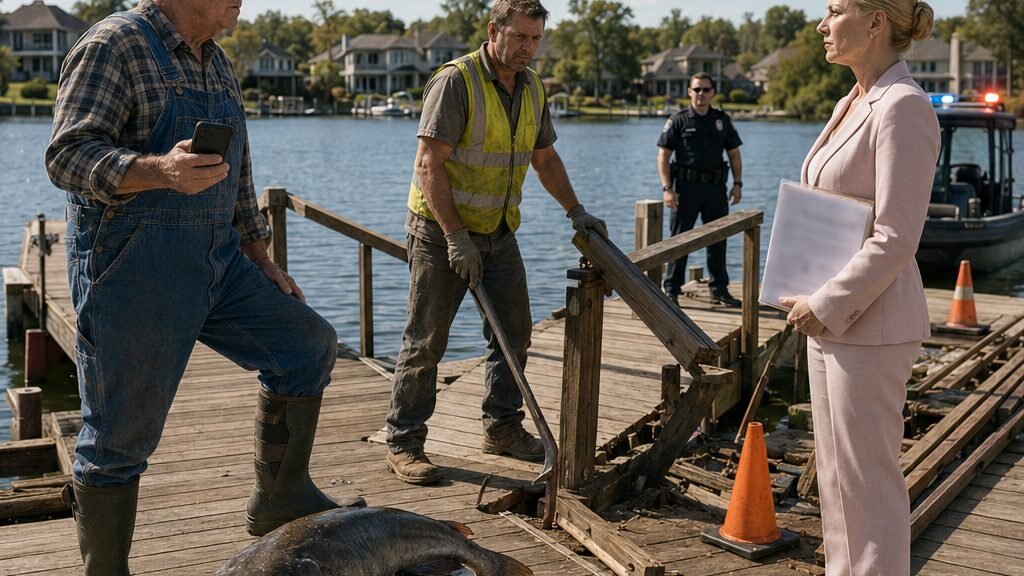
Then Frank saw a man in a yellow vest brace one boot against the dock ramp and drive a pry bar under the handrail post.
The post snapped sideways.
Frank cut the motor too fast. The boat nosed against the dock with a dull bump. His knee locked as he stood, and for one hard second he had to grip the gunwale until the lake steadied beneath him.
“Hey,” he called.
The man with the pry bar looked up. Two other workers stood near the ramp, one carrying a cordless saw, the other coiling orange extension cord across Frank’s boards. A pickup was backed halfway down the gravel access lane with its tailgate open. The first section of Frank’s new handrail lay in the truck bed like lumber pulled from a wreck.
Frank tied the boat with a knot his fingers could do faster than his thoughts. Then he lifted the catfish in both hands, more from habit than sense, and stepped onto the dock.
His boot landed where the ramp used to meet the main platform. Without the rail, there was nothing to catch him. His weight shifted wrong. Pain flashed through his right knee, up into his hip, and he swallowed the sound before it became anything another man could hear.
The worker with the pry bar lowered it.
“You Mr. Campbell?”
“This is my dock,” Frank said. “That’s my rail.”
The man wiped sweat from his upper lip with the back of his wrist. “I’m Kevin Hall. We’re contracted to remove the unapproved structure.”
Frank looked from the loosened post to the orange cones, then to the catfish still clutched against his shirt. Its tail slapped once against his overalls.
“Unapproved structure?” he said. “It’s a ramp and a handrail.”
Kevin glanced toward the driveway, not at Frank. “Sir, I just have the work order.”
“Then stop working until I see it.”
One of the younger workers shifted the saw to his other hand. The saw was off, but the blade guard clicked softly. Beyond the dock, water slapped against pilings. Across the lake, glass-front houses glittered in neat rows, all beige siding and perfect decks, each one trying not to look like anyone had ever spilled bait on it.
Frank set the fish on the dock beside the cooler. It landed with a wet slap, ridiculous and enormous, its body curving across two boards. For one strange second, every man looked down at it.
Kevin blinked. “That’s a big fish.”
“It is,” Frank said. “And this is still my dock.”
A white pontoon with blue striping moved slowly along the shoreline. Frank saw the flashing light on its roof before he read the county seal on the side. Marine patrol. Behind it, on the access road, a silver SUV stopped near Frank’s mailbox. A woman stepped out in pale pink slacks and a matching blazer, holding a clipboard against her chest like a shield.
Cynthia Lee did not hurry. That was the first thing Frank noticed. She came down the gravel path in clean shoes, stepping around mud as if the ground had been placed there incorrectly.
“Mr. Campbell,” she called. “Please step away from the work area.”
Frank turned his phone over in his pocket and pressed the side button until the screen lit.
“Morning to you too, Cynthia.”
“This is not a discussion on the dock,” she said. “You were notified.”
“I was fishing.”
“You were mailed notice of violation and removal.”
“I got a letter saying there’d be a review.” Frank lifted the phone to chest height. “Nobody told me a crew was coming onto my property today.”
Cynthia stopped just before the ramp, where the boards changed color from old gray to the honey-brown of Frank’s repairs. Her sunglasses hid her eyes, but her mouth was tight.
“The association has authority to correct unapproved exterior modifications after written notice.”
“Then show me the written notice that says they could start before I saw it.”
She held out a paper.
Frank did not take it. “When was that delivered?”
“This morning.”
“What time?”
Cynthia’s mouth tightened further.
Kevin looked away.
“What time?” Frank repeated.
“It was posted at approximately nine fifteen.”
Frank looked at the sun, then at his boat, then back to her. “I left this dock at seven. Came back at eleven. Your crew was already pulling posts.”
“You were out on the water during enforcement.”
“I was out on my water catching lunch.”
“That is not relevant.”
“The rail is relevant.” Frank moved one step toward the ramp, slow because his knee would not allow any other kind of motion. “That rail is how I get back to my house without going into the lake.”
The marine patrol boat bumped softly against the outer dock. An officer stepped onto the boards and rested one hand on his belt, careful, not aggressive yet, but present enough to change the air.
“Sir,” the officer said, “we need everyone calm.”
“I am calm,” Frank said.
Cynthia turned to the officer with the smoothness of someone who had been waiting for a witness. “Mr. Campbell is interfering with an authorized enforcement action.”
Frank’s thumb found the red button on his phone screen. Recording.
“Officer,” he said, “ask her whether she has a court order.”
Cynthia gave a short laugh. “This is HOA property governance, not a criminal proceeding.”
“It’s my dock.”
“It is a regulated lakefront element attached to a property under association covenants.”
“It’s my dock,” Frank said again, quieter.
Kevin held his pry bar against his thigh. The younger workers had gone still. The catfish shone on the boards between them all, one black eye pointed skyward, its mouth open as if it had something to add.
Cynthia looked down at it and then at Frank. “This is exactly the problem. Fishing equipment, coolers, unauthorized alterations—this entire area has been allowed to deteriorate.”
Frank felt heat climb the back of his neck, but he kept his voice level. “That handrail is two weeks old. I sanded every edge.”
“It does not match approved waterfront specifications.”
“I matched what my hands could hold.”
“Mr. Campbell, move aside.”
Frank stepped in front of the remaining post. His right hand shook, so he lowered the phone against his chest to hide it. The officer noticed anyway. Frank saw his eyes flick down to the knee brace under the denim, then back up.
Kevin cleared his throat. “Mrs. Lee, the order says full removal today.”
Frank turned toward him. “Full?”
Kevin’s face had the embarrassed blankness of a man wishing he had taken a different job. “Ramp rail, added incline boards, support cleats, all newer material.”
“If you take the incline boards, I can’t get from the dock to the yard.”
Cynthia said, “You can use the original steps until your application is properly resubmitted and approved.”
“The original steps are why I built the ramp.”
“Then you should have waited for approval.”
Frank looked past her to the lake, where his fishing line still trailed from the boat into green water. He had waited through winter. He had waited through two committee meetings that got postponed. He had waited while his knee worsened and the old steps grew slick with algae. He had waited until waiting became the dangerous part.
He bent, slowly, and picked up the catfish by the gill plate. Its weight pulled at his shoulder, but he lifted it anyway and set it on top of the cooler, out of the workers’ path.
Then he placed himself back in front of the rail.
“I want your name, your authority, and the order in writing before another tool touches this dock.”
Cynthia’s jaw shifted. “Officer, he has been warned.”
The marine patrol officer looked from the clipboard to Frank’s phone, from Frank’s phone to the torn-open ramp. “Mr. Campbell, are you refusing to clear the work area?”
Frank kept the camera steady.
“I’m refusing to let them call a safety rail a decoration.”
Cynthia turned fully toward the officer.
“Then please document that Mr. Campbell is interfering with authorized removal.”
Chapter 2: The Notice Called Safety An Appearance Problem
Frank’s right knee buckled on the third porch step, and the only thing that kept him from dropping the folder was the removed ramp board leaning against the railing.
He caught it with his forearm. The board slid, scraping white paint from the porch post before it jammed against the step. Frank stood frozen, breath locked behind his teeth, one hand gripping the violation packet Cynthia had finally let him take, the other pressed to the board that should still have been down at the dock.
Across the yard, Kevin’s truck was gone. The dock looked wrong without the rail, like a mouth missing a tooth. Orange cones remained around the torn section, though nobody had asked Frank whether cones helped him walk.
He straightened before anyone could see.
No one was there.
That should have comforted him. Instead it made him angry.
Inside, the kitchen smelled faintly of lake mud and fish. Frank set the packet on the table beside a coffee mug he had not used that morning. His hands left dark prints on the envelope. He washed them at the sink, slower than necessary, watching through the window as small waves slapped the dock where the ramp now ended in a drop.
Only when his breathing settled did he sit.
The notice was five pages long. Cynthia’s name appeared twice. The words “unauthorized exterior modification” appeared six times. “Waterfront aesthetic consistency” appeared once in bold. “Potential liability exposure” appeared in the paragraph that ordered removal.
Safety did not appear at all.
Frank read the first page twice before he understood that the HOA had not denied what he built. It had denied what they claimed he built: an extension, a visual alteration, a nonconforming addition to the shoreline profile.
He took his reading glasses from the windowsill and opened the folder where he kept receipts. Lumber. Galvanized brackets. Marine-grade screws. Nonskid strips. Two afternoons of work with his neighbor’s old miter saw and three evenings measuring slope by laying a level across the boards.
He had submitted the request. He remembered that much. A one-page form, a simple drawing, two photos. He had written “repair to existing dock access” in the description box.
He had not written “my knee locks without warning.”
He had not written “I almost went into the water in March.”
He had not written Betty’s name.
A car door closed outside.
Frank gathered the papers into a stack and pushed himself up before he heard the knock. Amy Perez did not wait for him to reach the door. She opened it with the key he kept telling her not to use unless it was necessary.
“Dad?”
“I’m in the kitchen.”
She came in carrying a grocery bag and stopped when she saw the mud on the floor, the violation papers, the board propped at an angle outside the window.
“What happened?”
“HOA happened.”
Amy set the bag down without taking her eyes off him. “Why is part of your ramp on the porch?”
“Because apparently it offended the lake.”
She moved to the window. Frank watched her see it in pieces: cones, missing rail, scraped boards, the hard gap where the incline had been. Her shoulders lifted.
“They removed it?”
“They started. I made them pause after they’d already done enough damage.”
“Made them pause how?”
Frank looked at the papers. “I asked questions.”
“Dad.”
“I recorded.”
“Were the police here?”
“Marine patrol.”
Amy turned from the window. “You called me last week and said the HOA sent a form. You said it was handled.”
“It was handled until they decided it wasn’t.”
She came to the table and picked up the notice. Frank hated the speed with which she read official things, as if the words jumped into place for her while they made him work for every line.
“Incomplete application,” she said.
“It was not incomplete.”
“They marked medical justification absent.”
Frank reached for the paper. “That’s not their business.”
Amy did not let go of it. “It is if you’re asking for an accommodation.”
“I asked to repair my dock.”
“You built a ramp.”
“I built a safer way down.”
“For you.”
“For anyone.”
“For you,” she repeated, softer, which was worse.
Frank turned away and opened the refrigerator, though he wanted nothing from it. The catfish lay wrapped in butcher paper on the bottom shelf. Even there, it looked too large for the day that had carried it home.
“I’m not putting my medical history in front of Cynthia Lee and half the neighborhood,” he said.
Amy dropped the paper on the table. “So you gave them a way to pretend this was about appearance.”
“They were always going to pretend.”
“Maybe. But you helped them.”
That landed harder than he wanted it to. He closed the refrigerator.
Amy looked tired then, not angry exactly. She was still in work clothes, hair pinned back poorly, one sleeve cuff twisted under her watch. She had driven over because someone on the lake had probably texted her before Frank could decide whether to call.
“Show me what you sent,” she said.
Frank opened the drawer under the microwave and removed the copy of his application. It was folded once. He had liked the look of it when he mailed it: neat, practical, no begging. He had drawn the rail himself with a ruler.
Amy laid it next to Cynthia’s notice.
“Where’s the doctor’s letter?”
“In the file cabinet.”
“Why isn’t it attached?”
“Because I don’t need a doctor to tell me how to get to my dock.”
“No,” Amy said. “But apparently they need one.”
Frank’s hand tightened on the back of the chair. Outside, the lake brightened under afternoon sun, pretty as a postcard and just as indifferent. His house had always looked smaller from the water than from the road. Betty used to say that was why she loved it. From the lake, it looked like a place that belonged to itself.
Amy found the fee schedule on the last page.
“Dad.”
“What now?”
“It says if you reinstall without approval, they fine you daily.”
“They can send all the paper they want.”
“Fifty dollars a day for the first week. Then two hundred. Then legal costs.”
Frank took the page and read the numbers. They were printed neatly, calmly, as if fines were weather.
“I’ll appeal.”
“You’ll appeal with the doctor’s letter.”
He said nothing.
Amy sat across from him. “Why won’t you let them see it?”
“Because the minute people see one thing wrong with you, they start measuring the rest of you.”
“I’m not asking you to stand in the clubhouse and list every ache.”
“It’s not aches.”
“I know.”
“No,” Frank said, sharper than he meant. “You know what I let you know.”
Amy leaned back. For a moment she looked exactly like Betty when she was trying not to answer anger with anger.
The phone on the table buzzed. Frank glanced down. A message from an unknown number contained a photo taken from across the cove: him on the dock, standing in front of the crew, the giant fish on the cooler, Cynthia in pink pointing toward him. Under it, someone had typed: Your dad is famous on the neighborhood page.
Amy saw enough before he turned the screen over.
“Great,” she whispered.
Frank stared at the back of the phone.
“Let them laugh at the fish,” he said.
“They’re not just laughing.” Amy’s voice was quiet. “They’re writing the story without you.”
He gathered the application, the denial, the fee page, the receipts, and tapped them against the table until the edges lined up. Control lived in small things. Straight paper. Clean knots. Proper measurements. Boards sanded smooth enough not to cut a hand.
Amy reached for the file cabinet key hanging beside the pantry.
Frank’s hand covered it first.
She looked at him. “Dad.”
“No.”
“The letter matters.”
“I said no.”
“Why?”
Frank kept his palm over the key and looked past her to the dock, where the missing rail made a bright, raw stripe against the old gray boards.
He did not answer.
Chapter 3: Cynthia Had An Insurance Deadline
The email from the insurance representative arrived at 6:42 a.m. with the subject line Cynthia Lee had been dreading for three weeks: Waterfront Exposure Review — Immediate Attention Required.
She opened it standing in her kitchen, still in slippers, coffee untouched beside the laptop. Three attachments loaded slowly under the message. One was a claims summary. One was a shoreline photograph marked with red circles. One was a draft recommendation that included the phrase potential suspension of lakefront liability coverage.
Cynthia read that phrase three times.
By seven, she was dressed. By seven thirty, she was in the HOA office with the lights still off in the hallway. By eight, the inspection checklist was spread across the conference table, and Frank Campbell’s property sat in the middle of it like a problem she should have solved cleanly the first time.
Unauthorized ramps/rails.
Unpermitted dock extensions.
Loose private storage at waterline.
Nonstandard access structures.
She underlined the last one.
The office was a converted sales center near the entrance gate, all cream walls and framed photographs of the lake at sunset. Every picture made the community look peaceful. None showed what Cynthia saw in the reports: aging docks, homemade stairs, patched boards, private ladders, old cleats, and residents who treated shared shoreline rules as suggestions until something broke and everyone wanted the association to pay.
Her phone buzzed.
Jason Martin did not bother with greetings. “Did you see the neighborhood page?”
“Good morning to you too.”
“He made us look ridiculous.”
Cynthia pinched the bridge of her nose. “Mr. Campbell did not post the photo.”
“Somebody did. He’s standing there with a fish the size of a child while your crew looks like they’re robbing him.”
“My crew was performing authorized correction.”
“Then why does it look like marine patrol came to arrest a grandpa?”
Because you asked me to move before the insurance inspection, Cynthia almost said.
Instead she said, “The photo is misleading.”
“The photo is everywhere.”
“It is on a private community page.”
“And three lake residents sent it to me before breakfast.” Jason’s voice dropped. “Cynthia, we cannot look like we’re losing control of the shoreline.”
Control. That was the word men like Jason used when they wanted someone else to absorb the ugliness of enforcement.
Cynthia opened the first attachment. The insurer had circled three docks from the east cove, one with a sagging swim ladder, one with a deck box blocking access, one with an added ramp that did not match any approved standard. Frank’s ramp was not circled, but it would be if the inspector walked far enough.
“Jason, Frank Campbell submitted an incomplete application. He was notified. The repair did not match the architectural standard.”
“It was ugly.”
“It was noncompliant.”
“It looked like a loading ramp at a bait shop.”
Cynthia closed her eyes briefly. “Please do not say that at the meeting.”
“You think there’ll be a meeting?”
“There has to be. He requested an appeal.”
“Before or after he played dock hero with a catfish?”
Cynthia looked at the printed covenant binder on the shelf. Equal enforcement had seemed clean when she first ran for the board. She had campaigned on it. No favorites. No quiet exceptions for people who knew the right neighbor or had lived here long enough to believe rules expired around them.
Then she became compliance chair and learned that every exception had a story, and every story came with someone demanding she treat it as law.
“He has the right to be heard,” she said.
“He had the right to apply correctly.”
“Yes.”
“And he didn’t.”
“No.”
“Then don’t let this turn into a pity hearing.”
Cynthia bristled. “It is not a pity hearing.”
“It will be if he brings his daughter and that fish picture.”
She moved the phone from one ear to the other and looked again at the insurance warning. If coverage changed, dues would rise. If dues rose, Jason would blame her. If an accident happened on a nonconforming dock, the same people mocking enforcement would ask why she had not acted sooner.
“I am scheduling the hearing for next Thursday,” she said. “Removal status will be noted as substantially completed pending review.”
There was a pause.
“Substantially completed?” Jason said.
“The unsafe elements were partially removed. Work was paused due to owner interference.”
“That helps?”
“It creates a record.”
“It better.”
Cynthia ended the call before he could say more.
By midmorning she walked the lakefront with her clipboard, starting at the public access path and moving along the association easement where the grass ended and private docks began. She wore flats this time. The ground near the water was softer than it looked.
At the first dock, she photographed a cracked step.
At the second, she noted an unapproved storage bench.
At the third, an older woman watched from a screened porch and pulled the curtain closed when Cynthia lifted the camera.
Cynthia lowered it.
She was not blind to how she looked. She knew the pink blazer in the photo had become part of the joke online. She had seen one comment before the page moderator removed the thread: She dressed up to bully a fisherman.
Bully.
The word stayed with her longer than she wanted.
At Frank’s property, the cones were still visible from the easement. The removed rail had been carried up toward the porch. The dock looked rougher now, not better. Cynthia stood at the edge of the yard and studied the slope from the house to the water.
It was steeper than the photos had shown.
She wrote: Site grade significant.
Then she crossed it out.
Significant was not a covenant term.
Behind her, tires crunched on gravel. Jason Martin stepped out of his golf cart wearing a lake association polo and the expression of a man arriving at a problem he intended to own.
“He’s not home?” he asked.
Cynthia clipped her pen to the board. “I don’t know.”
“He better not be working down there.”
“Jason.”
“I’m serious.” He handed her his phone. “Look.”
The photo was blurry, taken from across the cove. Frank stood on the dock that morning, not rebuilding exactly, but measuring. A long board lay across two sawhorses. Beside it sat a tackle box, a thermos, and what looked like the same large cooler from the viral photo.
Cynthia zoomed in. Frank’s face was indistinct, but his posture was unmistakable: one shoulder lowered, one leg stiff, hand braced against a post that no longer had a rail attached.
Jason tapped the screen. “He’s already defying the order.”
“He may be documenting.”
“With lumber?”
Cynthia did not answer.
Jason leaned closer. “If we let him put that thing back before the inspection, every owner on this lake will claim their homemade add-on is a safety feature.”
“Some might be.”
He stared at her.
Cynthia hated that she had said it aloud.
She handed back the phone. “The hearing is scheduled. Until then, he cannot reinstall.”
“And if he does?”
“Then the association will issue escalating penalties.”
Jason smiled without warmth. “Good. Put that in writing.”
Cynthia returned to the office after noon and drafted the notice herself. She kept the tone formal. She cited the sections. She included the hearing date. She included the fine schedule. She included the phrase continued owner interference may require further enforcement action.
Before sending it, she opened Frank’s original application again.
The drawing was careful. Not professional, but careful. The little handrail line had been measured and labeled. At the bottom, in block letters, Frank had written: Repair to existing dock access. Safer slope. Same footprint.
No medical letter. No request for accommodation. No explanation beyond the words he had chosen.
Same footprint.
Cynthia stared at that phrase longer than the others.
Then another message came in from Jason.
This one was not blurry. It was a closer photo, probably taken from a boat passing slowly near Frank’s dock. Frank was kneeling beside the torn ramp with a drill in one hand and his phone in the other. A board lay across the gap where the incline had been.
Jason’s text below it read: He’s already rebuilding it.
Chapter 4: The Fish Everyone Laughed At Became Evidence
Frank found the saw marks because the board would not sit flat.
He had carried the stripped section of handrail down from the porch before breakfast, not to rebuild it, no matter what Jason Martin’s boat photo suggested, but to lay it beside the torn ramp and measure what the crew had actually removed. The board rocked on something when he set it down. He thought at first it was a screw head, then a warped edge.
When he turned it over, he saw the older cuts.
Not the clean, bright gouges from Kevin Hall’s crew. These were dark in the grain, weathered almost black, half hidden under the place where Frank’s newer bracket had been bolted. Two old saw lines ran across the underside of the rail at an angle that matched nothing Frank had installed.
He crouched too fast and pain bit into his knee. He stayed there anyway, fingers pressed to the old marks.
“Well,” he whispered, “that’s not mine.”
The lake was quiet except for the hollow slap under the dock. His cooler sat nearby, empty now except for a roll of measuring tape, a plastic bag of screws, and the folded violation notice Amy had insisted he carry. The catfish had become fillets days ago, but the cooler still looked like evidence of something foolish and public. Every time Frank saw it, he remembered Cynthia’s face when she looked at the fish instead of the rail.
He took photos from three angles. Then he dragged the board into better light and took more.
A motor coughed from the access lane. Frank straightened with one hand on the dock post. Kevin’s pickup stopped above the yard, not backed in this time, no trailer attached. Kevin stepped out alone.
Frank did not wave.
Kevin came down the slope slowly, hands visible, as if approaching a dog that had reason to bite. “I’m not here for work.”
“You left something?” Frank asked.
“Came to pick up a pry bar one of my guys misplaced.”
Frank looked at the rail. “You mean the one he used to start without asking me?”
Kevin’s eyes went to the torn ramp. “I told them to wait when I saw you coming in.”
“But not before.”
“No.”
That single word had more honesty in it than Frank expected. It made him angrier, not less.
Kevin spotted the overturned board. “You found the old cuts.”
Frank’s grip tightened on the post. “You knew about them?”
“Not until we pulled the bracket off.” Kevin stepped closer but stopped before entering the cone area. “There was old hardware under your hardware. Rusted through. Looked like a rail had been there years ago.”
Frank stared at him. “Did you tell Cynthia?”
“I told the guy on my crew to photograph everything. Whether it went up the chain, I don’t know.”
“Convenient.”
Kevin looked down at the dock, then back toward the big houses across the cove. “Mr. Campbell, I get paid to remove what the work order says. I don’t get paid to argue with board members.”
“But you knew you weren’t just removing new lumber.”
Kevin’s jaw shifted. “I knew there was older stuff under it.”
Frank bent, slower this time, and picked up the board. He turned it so Kevin could see the saw marks.
“Does this look like a new addition to you?”
“No.”
“Would you say that if they asked?”
Kevin rubbed both hands over his face. He looked younger than Frank had first thought, tired in a way that belonged to bills, not age.
“I’d say what I saw.”
“That’s not what I asked.”
Kevin met his eyes then. “Yes. If they ask me straight, I’ll say it.”
Frank nodded once. It was not trust, not yet, but it was something he could put in a folder.
Kevin glanced at the cooler. “You really catch that fish same morning?”
Frank looked at it. “Yes.”
“My kid saw the photo online. Asked if the fish called the cops.”
Despite himself, Frank almost smiled.
“That fish had more sense than most people on that dock.”
Kevin’s laugh was brief and uneasy. He found the missing pry bar under the edge of the main platform, but before he left, he pointed to a patched section near the outer post. “You might want a picture there too. Looks like an old anchor hole under the stain.”
After Kevin drove away, Frank took pictures until his phone battery dropped into the red.
At noon, he put the board into the back of Amy’s car because it no longer fit easily in his own trunk. Amy had come on her lunch break after receiving three messages from him, all photos, no explanation.
“You are not rebuilding,” she said before saying hello.
“I am collecting.”
“Collecting evidence or splinters?”
“Both, if they’re useful.”
She helped him load the board, though she insisted he let her carry the heavy end. He let her, and the letting cost him more than the carrying would have.
The county records office sat twenty minutes inland, in a low brick building beside the courthouse annex. It smelled like toner, dust, and rain trapped in old carpet. Frank had not been there since he and Betty filed a shoreline repair permit years ago, back when the clerk behind the counter had worn cardigans and called everyone honey.
The current clerk looked through Frank’s photos with polite caution.
“Private HOA records won’t be here,” the clerk said.
“I’m not asking for HOA records. I’m asking for county dock permits or shoreline sketches before the HOA changed their rules.”
“What address?”
Frank gave it.
The clerk typed. Pages clicked. The computer made soft complaining sounds. Amy stood beside Frank with the violation folder clutched to her chest like a case file. Frank wanted to tell her to relax her shoulders. He did not, because she had learned that posture from him.
“Here’s a 1998 shoreline survey,” the clerk said. “A 2006 repair permit. A 2012 incident note. A 2016 sketch attached to a minor maintenance filing.”
Frank’s hand stopped on the counter.
Amy looked at him. “Incident note?”
The clerk was already printing. “I can give you the public portions. Anything medical or emergency-response detailed may be redacted.”
“Print the sketch first,” Frank said.
The page came out warm. The dock was drawn in thin black lines, the house a plain rectangle above it. There, beside the old steps, someone had sketched a short rail. Not Frank’s ramp exactly. Not his slope. But a handrail, in the same footprint, before Cynthia’s current standards were written.
Amy exhaled. “Dad.”
“It proves there was a rail.”
“It proves there was something.”
The clerk slid the incident note behind the sketch. The top half was partly blacked out. The date sat in the corner. Frank knew the date before his eyes reached it.
His fingers went cold.
Amy did not touch the paper. “Dad?”
Frank took the sketch and folded it too carefully.
The clerk looked between them. “There’s a name listed on the note. Betty Campbell. Is that relation?”
The room tightened around Frank, every drawer, every buzzing light, every paper edge suddenly too sharp.
Amy reached for the incident note.
Frank closed his hand over it first.
Chapter 5: Betty’s Fall Was The Reason He Never Said
Amy found Betty’s name in the folder after dinner because Frank hid the incident note badly.
He had slipped it behind the county sketch, then tucked both beneath the violation packet on the living room coffee table, as if paper could forget the order in which it had been touched. Amy waited until he went to the kitchen for water. When he came back, she was standing by the window with the redacted page in her hand and the lake dark behind her.
“Why is Mom’s name on a county incident note?”
Frank stopped at the edge of the rug. The glass in his hand clicked softly against his wedding ring.
“Put that down.”
“No.”
“Amy.”
“No.” Her voice did not rise. That made it harder to move past. “You had all afternoon to tell me.”
“It’s old.”
“It’s Mom.”
Frank set the glass on the mantel because the table was too close to her. Outside, the dock was a black shape against silver water. The missing rail could not be seen in the dark, but Frank knew exactly where the gap was. His body knew it before his eyes did.
Amy looked down at the page. “The date is ten years ago.”
“Eleven in August.”
“It says shoreline fall.”
“Part of it says that.”
“Why didn’t I know?”
Frank felt the old answer rise, polished by years of use: because it was handled, because your mother didn’t want fuss, because you had your own children and your own bills and your own life. Every answer had some truth and not enough of it.
“She didn’t want you scared,” he said.
Amy’s face changed. Not softening. Sharpening.
“That sounds like something you wanted.”
Frank crossed to Betty’s old chair, then changed his mind and remained standing. The chair still held the faded blue cushion she had chosen because it looked like lake water in morning light. On the side table beside it sat her fishing cap, sun-bleached at the brim, untouched except when Frank dusted around it.
“She fell on the old steps,” he said.
Amy waited.
“She was carrying a basket. Towels, I think. Maybe the small tackle box. It had rained earlier, but the sun was out by then. Boards looked dry.” He looked at the cap, not at Amy. “She stepped down, reached for the post, and there wasn’t anything to hold but that old square edge. Her foot went out. She hit the side of the dock before she went into the water.”
Amy pressed the page to her chest.
“She was alone?”
“I was in the shed.”
The quiet after that was worse than accusation.
“I heard the basket,” Frank said. “Not her. The basket hit first. Then water. I got there fast.”
“How bad?”
“Bad enough.”
“Dad.”
“She cracked two ribs. Bruised her hip. Took water into her lungs and pretended she hadn’t.” His mouth tightened. “She was angry with me because I wanted to take her to the hospital. Imagine that.”
Amy’s eyes glistened, but she did not look away. “And after?”
“After, I put temporary grip strips on the steps. She told me not to build anything ugly because Cynthia’s committee would have a fit even back then.”
“Mom said that?”
Frank almost smiled. “Your mother could call a person ridiculous without using the word.”
“Why didn’t you build the rail then?”
“I did.”
Amy glanced toward the folder. “The sketch.”
“Short rail. Not a ramp. Enough for her hand. Enough that she kept going down there.” He swallowed. “When she got sicker, she didn’t go as much. After she passed, I let the rail rot more than I should have. Told myself it wasn’t urgent if it was only me.”
“And then you fell.”
“I slipped.”
“Dad.”
His hand went to his knee before he could stop it. Amy saw.
The first slip had been in March, with cold still in the boards and algae slick under the morning shade. He had gone down to clear a branch from the ladder. His right knee locked on the second step, and his left foot shot forward. He had caught the old post with both hands and torn the skin along his palm. For half a second, he had hung over the water, looking at his own reflection broken beneath him, thinking not of dying, but of Amy finding out.
“I didn’t go in,” he said.
“That is not the standard.”
“It should count for something.”
“It counts as warning.”
Frank moved to the window. His reflection stood over the dock, older than he felt when nobody watched him climb. The doctor had used words he hated: progressive, instability, assistive, accommodation. He had folded the letter into a file and built the ramp instead.
“I know what happens,” he said. “First it’s a rail. Then it’s ‘maybe you shouldn’t live alone.’ Then it’s ‘maybe the lake is too much.’ Then people talk around you like you’re a chair they might move.”
Amy came up beside him, not touching. “I have never said you shouldn’t live here.”
“Not yet.”
“That’s unfair.”
“Yes.”
The word surprised them both. Frank let it stand. It was unfair. It was also what fear sounded like when it had worn pride as a coat for too long.
Amy set the incident note on the table, then opened the folder and pulled out the doctor’s letter. She must have found it while he was at the sink. Frank should have been angry. Instead he was tired.
“This says you need stable hand support on slopes and steps,” she said.
“It says too much.”
“It says what they needed to know.”
“It says what they’ll use.”
“To do what?”
“To decide I’m not Frank with the fish and the dock and the house. I’m the old man with a condition.”
Amy turned toward him fully. “They already decided who you were. They decided you were stubborn, messy, noncompliant, and in the way. Your silence did not protect you.”
Frank looked at the doctor’s letter in her hand. He had hated the paper from the day it came, not because it was wrong, but because it said in one page what he had spent two years negotiating privately with furniture, railings, slower steps, and lies about being fine.
Amy picked up Betty’s cap from the side table. “Mom would have made you attach the letter.”
“She would have threatened to staple it to my forehead.”
“She would have told Cynthia exactly where to put her waterfront aesthetic consistency.”
This time Frank did smile, but it hurt.
Amy placed the cap beside the removed rail sketch. “The hearing is tomorrow.”
“I know.”
“If you only argue the old rail existed, they’ll say the new ramp was still different. If you only argue notice, they’ll say procedure can be corrected later. If you don’t tell them why, they will keep making this about boards.”
Frank rubbed his thumb along the edge of the folder. “I don’t want a room full of neighbors hearing my doctor’s words.”
“Then choose your own.”
He turned from the window. “What does that mean?”
“It means you don’t have to beg. You don’t have to read the letter out loud. But you have to stop giving them empty spaces to fill with whatever makes them comfortable.”
Outside, a boat moved slowly across the cove, its lights trembling in the water. Frank imagined the photo again: him holding the fish, Cynthia pointing, the officer standing nearby. People had seen a joke. Then a violation. Then a stubborn old man.
Maybe they had never had enough to see anything else.
Amy slid the county sketch, the incident note, the doctor’s letter, and the notice into one folder. She did not take over. She simply placed the folder between them.
Frank lifted Betty’s cap. The fabric had softened at the band where her fingers used to pinch it before setting it on his head by mistake.
“I promised her I’d keep the way down safe,” he said.
Amy’s eyes filled then.
Frank put the cap back on the table.
“But tomorrow,” he said, “I’m not telling them all of her.”
“No,” Amy said. “Tell them enough.”
He nodded once, but the nod was not agreement yet. It was only the door opening a crack.
Amy closed the folder and pushed it toward him.
“Then tomorrow you either tell them why,” she said, “or they get to write the story for you.”
Chapter 6: The Board Treated A Promise Like A Violation
Frank walked into the clubhouse carrying the removed rail instead of a speech.
Conversations stopped before he reached the first row of folding chairs. Someone near the coffee urn whispered. Someone else lifted a phone, then lowered it when Amy looked directly at them. The rail was longer than Frank should have carried, awkward against his shoulder, one end wrapped in a towel to keep splinters from cutting his palm. Every step from the parking lot had sent a hot line up his knee, but he refused to drag it.
If the board wanted to discuss his rail, they could look at it while they did.
Cynthia Lee sat at the center of the long table beneath a framed photograph of the lake. She wore navy this time, not pink. Her clipboard was squared to the table edge. Beside her sat two board members Frank knew by face and Jason Martin, who had arranged his papers in three neat stacks and looked at the rail as if Frank had brought in a dead animal.
“Mr. Campbell,” Cynthia said, “you can place materials along the side wall.”
Frank set the rail across the empty table in front of the first row. The sound it made was not loud, but it carried.
“I’ll keep it where everyone can see what we’re talking about.”
Amy sat behind him with the folder in her lap.
The meeting opened with minutes, agenda approval, and a reminder about civility. Frank stood through it because he was not certain he could get up again smoothly once seated. When Cynthia finally called his address, the room shifted forward.
She presented first. She did not sneer. Frank almost wished she would. It would have been easier to stand against cruelty than against clean sentences.
“The association’s position is that the owner installed unapproved alterations to a regulated waterfront element,” Cynthia said. “The application submitted did not include engineering details, architectural conformity information, or any request for medical accommodation. In light of the upcoming waterfront insurance review, correction was authorized under section eight point three of the covenants.”
She clicked a remote. A photo appeared on the screen: Frank’s dock before removal, the new ramp visible, the handrail brighter than the old boards.
Jason leaned toward his microphone. “This is not about anyone’s hobby. This is about shoreline consistency and liability.”
Frank looked at the screen. The photo had been taken from across the water. Whoever took it had waited until his fishing rods and cooler were out, making the dock look cluttered, almost theatrical.
Cynthia continued. “Work was paused when Mr. Campbell entered the active work area and refused to clear the site.”
Frank placed his phone on the table. “I have the recording.”
“We are not disputing that work paused.”
“No. You’re skipping when it started.”
A board member shifted. Cynthia’s eyes flicked to the phone, then back to him. “Notice was posted that morning.”
“That morning,” Frank said, “after I had already gone out on the water.”
“Notice requirements do not depend on the owner’s chosen activities.”
“My chosen activity was leaving my dock before you taped paper to my door and sent men to pull boards before I came home.”
Jason spoke before Cynthia could. “Mr. Campbell, with respect, you had already been informed your application was incomplete.”
Frank turned toward him. “And with respect, Jason, incomplete is not the same as permission to tear out what keeps a man upright.”
A rustle moved through the room.
Cynthia’s voice hardened. “Exceptions create liability. If every resident independently builds ramps, rails, extensions, or platforms, the association cannot certify the shoreline as safe.”
Frank put one hand on the removed rail. The old saw marks faced upward.
“Does removing a safety rail create no liability?”
For the first time that night, Cynthia did not answer immediately.
Frank lifted the rail slightly and turned it so the board could see the underside. “These cuts were under my brackets. Old cuts. Old anchor holes still in the dock. The county sketch from 2016 shows a handrail in the same footprint. I repaired access that already existed.”
Jason reached into his stack and pulled out a paper with visible satisfaction. “Your application says nothing about a medical need.”
The words struck exactly where Frank had expected, and still he felt them land. Jason held the application up like a winning card.
“You described it as ‘repair to existing dock access,’” Jason said. “No accommodation request. No doctor letter. No engineering report. No explanation that the association could evaluate.”
Frank could feel Amy behind him, still as a held breath.
Jason slid the paper toward Cynthia. “We cannot be blamed for not considering information he chose not to provide.”
There it was. The part Frank had given them. The empty space Amy warned him about.
Cynthia looked down at the application. She did not look triumphant. That bothered Frank more. She looked relieved.
Frank reached into his folder and took out the doctor’s letter, folded once. He did not open it yet.
“You’re right,” he said.
The room went quiet in a different way.
“I did not include everything I should have included.”
Amy’s chair creaked softly behind him.
Frank kept his eyes on the rail. “I thought if I wrote down enough practical facts, practical people would understand. Old steps too steep. Boards slick. Rail rotted. Slope safer. Same footprint.” He touched the old saw mark with one finger. “I left out the part where my knee locks without warning. I left out the doctor’s words because I did not want my neighbors deciding the house I’ve lived in for thirty years was too much for me.”
No one moved.
“I left out my wife’s fall.”
Cynthia lowered the application.
Frank heard a sound behind him, maybe Amy, maybe someone else. He did not turn.
“Betty fell on those steps years ago. Broke ribs. Took water. She kept fishing after, because she was stubborn in better ways than me. I put a rail there then. Let it go after she passed. When I nearly went in this spring, I built it back stronger.”
He unfolded the doctor’s letter but did not read from it. He placed it beside the rail.
“This is not a deck extension. It is not a decoration. It is how I get from my house to the dock and back without ending up in the lake.”
Cynthia’s face had changed, but she held her posture. “Mr. Campbell, had that information been included—”
“It should have been,” Frank said. “But your crew still started before I had a hearing.”
Kevin Hall stood from the back row.
Frank had not seen him come in. Kevin wore a clean work shirt, hands folded awkwardly in front of him.
Cynthia turned. “Mr. Hall, this portion is for board deliberation.”
“I’ll just say what happened,” Kevin said. “We arrived before nine. Started staging. Notice got posted after we were already unloaded. We were told the owner had been fully notified and not to delay unless law enforcement instructed us.”
Jason leaned into his microphone. “You were contracted for removal, not interpretation.”
“No argument.” Kevin looked at Frank, then at Cynthia. “But we had the first rail post loose before Mr. Campbell got back. That’s the truth.”
The room hummed with whispers.
Cynthia’s fingers closed around her pen. “Thank you. That will be noted.”
Frank thought that might be enough to shift the night. Then Jason pushed the application across the table again.
“The owner admits his submission was incomplete. The board cannot retroactively approve unpermitted work because the story became sympathetic online.”
Frank almost laughed, not because it was funny, but because Jason had managed to call his wife’s fall a story without saying her name.
A uniformed marine patrol officer stood near the side wall. He had been silent until then, arms loose, cap in one hand. Cynthia had asked him to attend in case the board needed official confirmation of the dock incident. Frank had expected him to say little.
Instead the officer cleared his throat.
“There’s one point I need to correct.”
Cynthia looked up sharply.
The officer stepped forward. “Dispatch notes from that morning did not describe a construction dispute. The call from the association representative reported an agitated resident obstructing authorized personnel near the waterline and creating a safety concern.”
Frank turned slowly toward Cynthia.
She did not look at him.
Jason said, “That sounds accurate enough.”
The officer’s gaze stayed on the board table. “When I arrived, Mr. Campbell was holding a phone. He was not threatening anyone. The crew had already removed part of the rail. I am not here to interpret HOA rules, but if this record is being used to support enforcement, it should reflect that the danger described to us was not what I observed.”
The clubhouse air changed.
Frank looked at Cynthia then, not with victory, but with the cold recognition that she had not only misunderstood him. She had made sure uniformed authority arrived expecting a different man than the one standing on his dock.
Cynthia’s pen rested motionless over her notes.
Frank touched the removed rail once, then lifted his phone from the table.
“Cynthia,” he said, “when you called marine patrol, what exactly did you tell them I was going to do?”
Chapter 7: The Rule Changed When The Person Was Visible
The county accessibility inspector measured the empty space where Frank nearly fell and said nothing for so long that even Cynthia stopped taking notes.
The tape measure stretched from the torn edge of the dock ramp to the first intact board, a bright yellow line crossing open air. Frank stood on the grass above the water with one hand on the temporary cane Amy had brought and the other clenched in his jacket pocket. He had refused the cane at the house. Then his knee had caught on the slope coming down, and Amy had handed it to him without a word.
He had taken it without arguing.
That felt like a defeat until he reached the dock and saw the holes where the rail used to stand.
The inspector crouched and tapped one of the exposed concrete anchors with a capped pen. “These are older than the recent repair.”
Frank looked at Cynthia.
She was watching the hole too.
Jason Martin stood several yards back in sunglasses, arms folded. He had come as a board representative, though nobody had asked him to speak. Kevin Hall stood by his truck with a roll of new caution tape, not part of any crew today, just a man asked to explain where boards had been and what had been removed.
The inspector straightened. “Mr. Campbell, show me how you used the original steps.”
Amy’s hand tightened around her folder.
Frank looked down at the steps. Three boards, uneven from years of sun and lake moisture. Without the rail, they looked steeper than he remembered. Maybe they had always looked that way and pride had softened the angle.
“I can show you,” he said.
“You don’t have to prove it by risking a fall,” Amy said.
The inspector did not smile. “A description will be sufficient.”
Frank was grateful and irritated at the same time.
He pointed. “Right foot there. Left there. If the right knee locks, I reach for the post. That post used to have the rail. Without it, I reach for air.”
The inspector wrote something down.
Cynthia said, “The association is not disputing that hand support may be useful. The concern is unauthorized construction on a regulated lakefront element.”
“Useful,” Amy repeated under her breath.
Frank touched her sleeve once. Not now.
The inspector turned to Cynthia. “Do you have an emergency accommodation review process?”
Cynthia’s pen stopped.
“We have architectural review procedures.”
“That is not what I asked.”
“We review requests as submitted.”
“If a resident needs a safety modification before the next monthly review, what is the expedited process?”
Cynthia looked toward Jason. Jason looked at the lake.
“We do not currently have a separate emergency process,” Cynthia said.
The words did not sound dramatic. They landed quietly, like a board set into place.
Frank watched her write them down herself.
The inspector flipped through the papers Amy had organized: the old county sketch, the incident note with Betty’s name redacted in part but not enough, Frank’s application, the doctor’s letter, Cynthia’s denial, the work order, Kevin’s written statement about timing. None of it, alone, fixed the dock. Together, it made the missing rail harder to pretend away.
“The original application was incomplete,” the inspector said.
Jason made a small sound of agreement.
Frank did not look at him.
“But the association had enough information to identify this as an access repair,” the inspector continued. “Same footprint. Existing dock access. Safer slope. That language should have triggered follow-up questions before physical removal.”
Cynthia’s face tightened, but she nodded once.
Frank felt no triumph. He had wanted one clean fact to end everything. Instead, the truth came in pieces and made everyone look smaller than their certainty.
The inspector walked the slope again, measured the rise, photographed the anchor holes, and studied the waterline where the ramp met the main dock. “The replacement can be approved if it meets slope, grip, and handrail height requirements. The visual standard may apply to finish and material, but not in a way that defeats the safety function.”
Jason lowered his sunglasses. “So any homeowner can claim safety and build whatever they want?”
The inspector turned to him. “No. A homeowner can document a need, and an association can review reasonable specifications without removing the structure first.”
Jason looked as if the distinction offended him.
Cynthia closed her folder. “The board can approve a revised plan with conditions.”
Frank looked at her. “What conditions?”
“Matching stain. Rail height adjusted to standard. No storage on the ramp. Medical documentation kept confidential with the accommodation file. Work performed by a licensed contractor.”
“Kevin can do it,” Frank said.
Kevin looked up, startled.
Cynthia glanced toward him. “If properly licensed and insured.”
“I am,” Kevin said.
The inspector nodded. “That would be acceptable from my perspective.”
For the first time since the rail had come out, Frank saw the shape of a path back. Not clean. Not free. But possible.
Then Cynthia removed one more paper from her folder.
“The association is prepared to withdraw the ongoing daily fine while the revised application is processed,” she said. “And to allow reconstruction under the inspector’s recommendations.”
Amy exhaled.
Frank did not. “Prepared?”
Cynthia slid the paper toward him on a clipboard. “Provided you sign acknowledgment that the association’s initial enforcement was based on the information available at the time, and waive further claims related to removal damage.”
The lake made a soft sound beneath the dock.
Frank looked at the paper but did not take the pen.
Amy’s voice was controlled. “You want him to give up any claim for tearing out the rail before the hearing?”
“We are trying to resolve this efficiently,” Cynthia said.
Jason stepped forward. “The board is offering more than enough. He gets his ramp.”
Frank looked at the empty anchor holes. Then at Kevin, who had the decency to look uncomfortable. Then at Cynthia, whose face carried something more complicated than victory. She looked tired. Cornered, maybe. Still wrong, but not blind to how wrong had become.
“If I sign this,” Frank said, “the ramp goes back.”
“Yes.”
“And the next person who needs something before the monthly meeting?”
Cynthia did not answer immediately.
Jason laughed once. “This is not a policy seminar.”
Frank turned to him. “It should have been one before they sent a pry bar to my dock.”
The inspector clicked the cap back onto the pen.
Frank picked up the clipboard. He read every line. The words were dressed politely, but he knew a trade when he saw one: his immediate access in exchange for silence about the way they took it.
His knee ached. The gap in the dock waited. His pride wanted to sign for one reason, his exhaustion for another. Amy said nothing. That was her gift this time.
Frank handed the clipboard back without signing.
Cynthia’s shoulders lowered a fraction. “Mr. Campbell—”
“I will rebuild,” he said. “I will use the right height, the right stain, the right contractor. I will keep my medical papers in whatever confidential file keeps the neighborhood from chewing on them.”
“Then sign.”
“No.”
Jason’s face hardened. “Then you’re choosing delay.”
“I’m choosing paper that protects more than me.”
The inspector looked at him with quiet attention.
Frank planted the cane tip beside one of the empty holes. “Put the emergency accommodation process in writing. Put the withdrawal in writing. Put the reimbursement for what your crew removed in writing. Not a handshake. Not a promise for the minutes. Writing.”
Cynthia’s mouth opened, then closed.
Frank looked down at the dock, at the place where his hand still reached for a rail that was no longer there.
“I waited once because the form wasn’t ready,” he said. “I’m not doing that again.”
Chapter 8: The Ramp Went Back Before The First Cast
Kevin Hall came back with new lumber before Frank had tied a single lure to the morning line.
The truck rolled down the gravel access lane just after eight, slow enough not to spit stones into the grass. This time the boards in the bed were not torn-out pieces stacked like evidence. They were sanded, measured, labeled in pencil, and bundled beside two cans of stain Cynthia’s revised approval letter had called shoreline cedar, as if a color name could make a rule feel generous.
Frank stood at the top of the slope with Betty’s old cap in one hand and the cane in the other.
Kevin stepped out and looked at the dock. “You ready?”
“No,” Frank said. “But start anyway.”
Kevin smiled a little. “Fair enough.”
Amy arrived ten minutes later with coffee, the folder, and a warning that she would not spend the day watching him pretend he did not hurt. Frank told her he had no intention of pretending anything. Then he stepped wrong near the first cone, caught himself with the cane, and chose not to curse when she raised an eyebrow.
The new policy had come by email first, then by certified mail, because Frank had insisted on paper he could hold. Emergency safety or access requests would now be reviewed within five business days. Temporary stabilization could not be removed before review if a resident submitted credible safety documentation. Medical details would be kept confidential. Physical enforcement required written notice delivered before crew arrival, not during it.
The violation against Frank’s dock had been withdrawn in a separate letter.
The reimbursement check had come in a third envelope, smaller than anger wanted but large enough to replace what was broken.
Frank had read all three at the kitchen table twice. Then he had put them in the folder beside Betty’s incident note and the photo of the catfish, the one somebody had printed from the neighborhood page before the moderators deleted the thread.
By midmorning, the ramp began to look like itself again. Kevin worked carefully, measuring twice, checking the slope with a level, setting each support where the old anchor marks and new specifications agreed. The sound of the drill did not make Frank flinch now. It made the dock feel awake.
Cynthia arrived when the first rail post went up.
She parked by the mailbox and walked down in flat shoes, carrying no clipboard this time. A single envelope rested in her hand. Jason came behind her, though Frank doubted he had been invited. He wore his lake association polo and the expression of a man attending a ceremony he intended to dislike.
Kevin stopped drilling.
Frank looked at Cynthia. “If that envelope changes anything, hand it to Amy first.”
“It doesn’t change the approval.” Cynthia held it out. “Original signed withdrawal. For your records.”
Frank took it but did not open it.
Cynthia looked at the ramp frame. “The height looks compliant.”
Kevin said, “It is.”
The answer had more edge than the words required. Frank pretended not to hear it.
For a moment, Cynthia watched the empty lake instead of the work. “The board adopted the emergency process last night.”
“I know,” Frank said.
“I wanted you to have the signed copy.”
“Thank you.”
It was not forgiveness. It was not friendship. It was a sentence laid down flat enough for both of them to step on.
Cynthia nodded and turned to go, but Jason was already looking at the new rail with open irritation.
“So this is what we’re calling fairness now?” he said. “Special permission after the fact?”
Amy stiffened.
Frank lifted one hand before she could answer.
Kevin set the drill down.
Jason looked around at them as if the dock had become a small courtroom. “I’m asking a simple question. Everyone else follows the rules. Frank ignores them, makes a scene, and gets a custom ramp.”
Frank looked at the rail post Kevin had just fastened. Fresh wood, clean grain, metal bracket tight against the board. Beside it, leaning against the cooler, was a short piece of the old removed rail. Frank had kept the section with the dark saw marks. Not to brood over it. To remember what happened when people took apart a thing before asking what held it together.
“Fairness,” Frank said, “isn’t making every person climb the same step when one of them can’t stand on it safely.”
Jason’s jaw tightened. “That sounds nice.”
“It’s practical.”
“It’s an exception.”
“So was your dock box.”
Jason went still.
Cynthia’s eyes shifted toward Frank.
Frank tapped the old rail section with the cane. “You complained about my ramp while your storage box sat past the easement line for three years. I never filed on you because it wasn’t hurting me.”
Jason’s face colored. “That is different.”
“Most things are when they belong to us.”
No one spoke for a few seconds. The lake filled the silence, water ticking under the boards.
Cynthia finally said, “Jason, the board will review all waterfront items under the same updated process.”
He looked at her, betrayed by the word same.
Frank almost felt sorry for him. Almost. Jason had wanted rules sharp enough to cut someone else and soft enough to bend around his own corners. Frank understood that more than he liked. Pride had done a similar thing in him, just quieter.
Kevin returned to work. By noon, the rail stood firm. By one, the nonskid strips were down. By two, the stain had darkened the new boards enough that they no longer shone like accusation against the old dock.
Amy walked beside Frank for the first test.
He wanted to tell her he could do it alone. The sentence came up by habit, worn smooth from years of use. He held it behind his teeth.
Instead, he set one hand on the new rail and one on the cane. Amy walked on his left without touching him.
Halfway down, his knee tightened.
He stopped.
The rail held.
Amy looked at the water, giving him the dignity of not watching his face. He breathed through the pain, then took the next step. At the bottom, he rested his hand on the post where the old rail had once been, where Betty’s hand had reached for nothing, where his had nearly done the same.
“It’s solid,” Amy said.
“Yes.”
“You okay?”
“No,” Frank said.
She turned to him.
He looked out across the cove. “But I’m here.”
Amy’s eyes softened. She did not hug him. She knew better on the dock. She only stood beside him while Kevin packed up his tools and Cynthia left quietly up the slope.
When everyone was gone, Frank brought out the fishing rod. The cooler sat by the rail, empty except for ice and a sandwich Amy had made without asking. Betty’s cap rested on the bench. The old rail section leaned under it, scarred underside facing the boards.
Frank baited the hook slowly. His fingers were clumsier than they used to be, but they knew the work. He cast from the end of the dock, the line flashing once in the afternoon light before it settled into the lake.
Behind him, the new ramp waited for his return.
He glanced once at the rail, then at Amy, then at the house above the slope.
For the first time in weeks, he did not measure the distance back with fear.
The story has ended.