The HOA Chair Blocked His Delivery Until Her Own Gate Cameras Exposed Everything
Chapter 1: The Whistle Before the Air Brakes
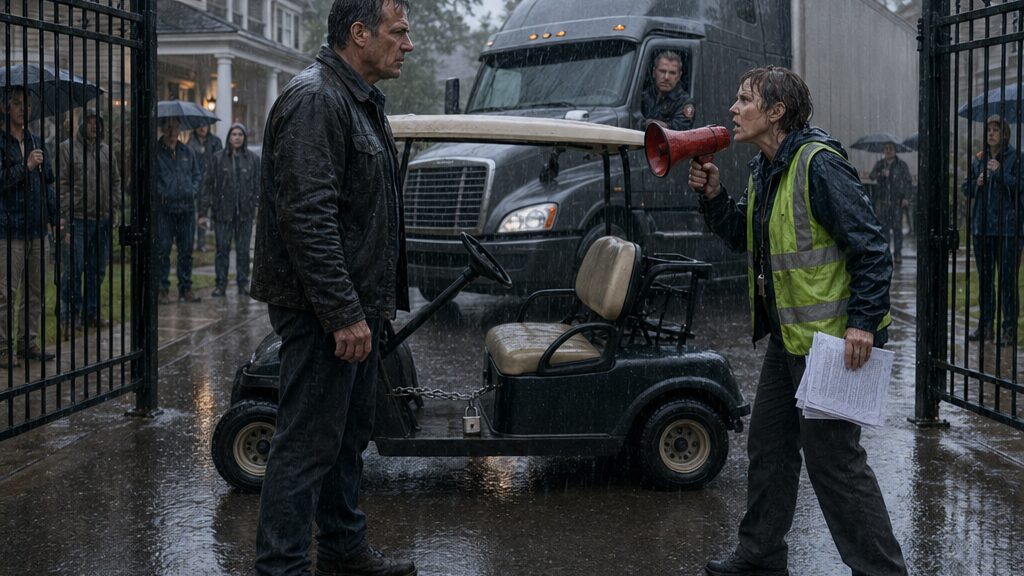
The whistle cut through the diesel growl a fraction of a second before the trailer crossed the mouth of Jonathan Baker’s driveway.
David Allen hit the brake.
The eighteen-wheeler stopped with a hard sigh of air, its rear wheels angled across the rain-dark lane and its trailer pointed toward Jonathan’s locked side-yard gates. Water jumped from the tires. Inside the cab, David leaned forward over the wheel, staring into his mirror.
A white HOA golf cart had shot from the clubhouse path and stopped sideways behind the trailer.
Brenda Robinson stood beside it in a reflective vest, one hand raised like a traffic officer. A silver whistle hung between her teeth. In her other hand she carried a red megaphone.
She blew again.
David lowered his window two inches. “Ma’am, get that vehicle out of my backing lane.”
Brenda raised the megaphone.
“THIS COMMERCIAL VEHICLE IS NOT AUTHORIZED TO ENTER.”
Her amplified voice rolled between the identical brick houses. Porch lights came on despite the late-morning gray. Curtains moved.
Jonathan was already walking down his driveway.
He wore an old canvas work jacket over a dark shirt. Rain soaked the shoulders before he reached the gates. Beyond them stood the unfinished workshop, its wide doorway open and empty, waiting for machinery that had crossed three states to get there.
He stopped with one hand on the gate latch.
“Brenda.”
She turned the megaphone toward him. “You need to keep your distance while the Gate Committee handles this.”
“There is no gate here.”
“There is a controlled access route.”
“This is a public lane beside my property.”
Brenda gave a short laugh and looked toward the neighbors gathering under porches. “You see the problem. This is why we need procedure.”
Jonathan unlocked the first gate. The steel frame swung inward without a sound.
He had built both halves himself after paying for the engineered footings, the reinforced apron, the drainage channel, and the survey that proved the trailer could clear the corner without touching a lawn or curb. The opening was sixteen feet wide. The hinges were rated for more weight than the gates would ever carry.
The truck had permission to be there.
Brenda’s golf cart did not.
David climbed down from the cab, keeping the open door between himself and the rain. He was broad through the shoulders, older than Jonathan had expected, with the tired caution of a man who had spent years watching other people turn their mistakes into his liability.
“I’m David Allen,” he said. “You Baker?”
Jonathan nodded.
“I have a signed delivery plan with your permit number. But I’m not moving another foot until she clears the lane.”
“She will.”
Brenda blew the whistle again.
David flinched. “Tell her to stop doing that around a loaded rig.”
Brenda approached with the megaphone lowered. A stack of papers was tucked beneath her arm, each page marked with stamps and yellow tabs.
“This pavement was selected for aesthetic continuity,” she said. “It is not designed for an eighteen-wheeler. One wrong turn and you shatter the entire surface.”
Jonathan looked down at the wet asphalt.
The decorative pavers began thirty feet farther inside the development and ended before his lot. The truck was not touching them.
“You received the load map,” he said.
“I received an application.”
“You received the engineer’s certification.”
“I receive many things. Receipt does not mean approval.”
Two board members appeared behind her carrying umbrellas. One positioned himself near the front of the truck. The other stood beside the golf cart as if guarding it.
Brenda lifted the papers.
“These are legal injunctions concerning construction traffic, heavy equipment, commercial nuisance, and property-value protection. Police have already been contacted.”
Jonathan extended his hand. “Let me see them.”
“You can review them through counsel.”
“Then stop waving them at my driver.”
“Your driver is trespassing.”
David’s jaw tightened. “I entered from a public road following written instructions.”
Brenda pointed the megaphone at his cab. “Your company will be billed for any damage.”
Jonathan stepped between them.
“Talk to me.”
The rain strengthened, drumming against the truck roof. David checked his phone and turned the screen toward Jonathan.
A dispatch message filled it.
DELIVERY WINDOW: 45 MINUTES REMAINING. FAILURE TO UNLOAD WILL REQUIRE RETURN TO TERMINAL.
Jonathan read it twice.
The machinery inside the trailer had been wrapped, crated, and braced for the journey. Returning it would mean storage fees, a new permit window, another rig, another escort, and weeks of delay.
The empty workshop behind him seemed to widen.
“Forty-five minutes,” David said. “After that, dispatch owns the decision.”
Jonathan reached inside his jacket and removed a thick waterproof folder. He opened it on the truck’s metal step, sheltering the pages beneath the cab door.
Municipal access permit. Temporary delivery authorization. Turning-radius diagram. Pavement-load certification. Carrier insurance. Stormwater protection plan. Copies of every email sent to the HOA.
David scanned the first pages, then looked toward the double gates.
“You built to this?”
“Exactly.”
David followed the diagram with one finger. “Trailer comes wide, rear axle stays outside the gutter, tractor corrects once the tail clears the west post.”
“Yes.”
“This is cleaner than half the commercial docks I deliver to.”
Brenda’s whistle shrieked.
“DOCUMENTS DO NOT OVERRIDE COMMUNITY STANDARDS.”
Jonathan closed his eyes for one second.
The sound pulled another morning across his mind: the same lane, a smaller truck, his father seated behind the front window with a blanket over his knees. That truck had left too.
Jonathan had told himself there would be another delivery.
There had not been enough time.
He shut the folder.
“What do you want, Brenda?”
Her expression changed—not much, but enough. The theatrical concern faded. What remained was expectation.
“The committee can issue a same-day conditional entry.”
“For what?”
“A roadway protection assessment.”
“How much?”
Brenda glanced at the watching porches, then lowered the megaphone. Her voice became almost courteous.
“Four thousand eight hundred dollars. Payable immediately.”
David stared at her. “To let me move thirty feet?”
“To protect the community from the financial risk you represent.”
Jonathan looked at the two board members. Neither met his eyes.
“Show me the published assessment.”
“This is an emergency action.”
“Show me the vote.”
“The committee has delegated authority.”
“Show me the rule.”
Brenda pulled the whistle from her mouth and let it swing against her vest.
“You’re doing what you always do,” she said. “You bury everyone in paper and pretend that makes you reasonable.”
Jonathan felt the permit folder grow heavy in his hand.
She stepped closer.
“Four thousand eight hundred. The truck passes. Otherwise it leaves.”
“You planned this.”
“I planned to protect the neighborhood.”
“No. You waited until the trailer was in the lane.”
Brenda smiled without warmth.
“You paid less attention the first time.”
Chapter 2: The Gate He Built Twice
David’s phone rang before Jonathan could answer her.
He listened without speaking, rain running from his hair onto his collar. Then he looked toward the trailer and pressed two fingers against the bridge of his nose.
“They’ve prepared the return authorization,” he said.
Jonathan glanced at the time. “We still have forty minutes.”
“On paper. Dispatch sees a blocked access route and a civil dispute. They don’t want the rig trapped when police arrive.”
“It isn’t trapped.”
David looked at Brenda’s golf cart, the board members near his front bumper, and the neighbors filming from under porch roofs.
“It is from where I stand.”
Jonathan turned away from Brenda and opened the second half of the double gate.
The two steel frames now stood against the fence, leaving the full entrance exposed. Beyond them, the reinforced concrete apron sloped gently toward the workshop. Painted reference marks showed where David’s rear wheels should track. Jonathan had refreshed them the evening before, kneeling alone beneath a work light.
The path was open.
The lane was not.
David joined him at the entrance. He studied the gateposts, the drainage cut, and the distance to the workshop door.
“You poured this apron?”
“Designed and poured it.”
“And moved the fence back?”
“Three feet.”
David crouched to examine the edge. “That’s the weak point most people miss.”
“I know.”
David stood. “You work in transport?”
“Fabrication.”
“That explains the tolerances.”
Jonathan looked through the open workshop.
Wooden benches lined one wall. Empty conduit waited for machine hookups. A row of old steel drawers sat beneath a pegboard where tools had once hung in another building, years earlier.
Against the far wall rested a narrow drafting table. On top of it lay a yellow legal pad under a sheet of clear plastic.
His father’s handwriting covered the top page.
LATHE LEFT WALL. MILL CENTERED UNDER BEAM. KEEP THREE FEET CLEAR FOR MATERIAL STOCK.
The notes had been made with a shaking hand but measured to the quarter inch.
David followed Jonathan’s gaze. “What’s in the trailer?”
“Precision lathe. Vertical mill. Surface grinder.”
“For a business?”
“Eventually.”
David waited.
Jonathan did not usually explain the workshop. Explanation made it feel like a plea, and he had spent too many years refusing to plead.
“My father and I designed it,” he said. “He was supposed to help me set the first machine.”
David looked back at the empty building. “He couldn’t?”
“He died before the first delivery came.”
The words landed between them without decoration.
At the front of the property, Brenda’s megaphone barked instructions to someone near the truck. Jonathan saw one board member taking photographs of the tires.
David lowered his voice. “Was that the delivery she mentioned?”
Jonathan nodded.
The earlier truck had arrived during the last month his father could still walk from the bedroom to the front room. Jonathan had arranged the chair by the window so he could watch the trailer come in.
Brenda had stopped it at the corner.
Back then she had called the demand a special road deposit. Eight hundred dollars in cash because, she said, the online system was under maintenance. Jonathan had refused. He had shown her permits. He had argued for twenty minutes while his father watched from behind the glass.
The driver left.
That evening Jonathan had opened a complaint form on his computer. He had typed the time, the amount, and the names of those present. Then he imagined the board emails, the insinuations, the notices taped to his gate. He imagined Brenda telling the neighborhood that grief had made him hostile.
He deleted the draft.
When neighbors asked why the machinery had not arrived, he said the carrier canceled.
His father never asked him to explain.
That silence had been worse.
David’s phone buzzed again.
“I need to be direct with you,” he said. “If I move this truck against a physical blockade and somebody steps behind me, my license is on the line. If the HOA files a claim, the company will review whether I ignored a known dispute.”
“You won’t move until the path is clear.”
“Even if you tell me to?”
“Even then.”
David nodded once, some of the suspicion leaving his face.
Jonathan had wanted to drag the golf cart away the moment he saw it. He had wanted to snap the whistle cord and throw the megaphone into the gutter.
Instead, David’s caution shifted the weight of the conflict. This was not only Jonathan’s gate, Jonathan’s promise, Jonathan’s old shame. Another man’s livelihood sat in the cab, attached to every decision made in the rain.
Brenda approached with Rachel Flores beside her.
Rachel carried a leather folder pressed to her chest. She served as HOA treasurer and had lived three houses down from Jonathan for eleven years. She had once told him that his problems with Brenda seemed “interpersonal.”
“The board is documenting noncompliance,” Rachel said. “It would be better if the truck left voluntarily.”
Jonathan held up the municipal folder. “You’ve seen these approvals.”
“I’ve seen copies.”
“You received them by certified mail.”
“That doesn’t settle the HOA’s authority.”
“What authority?”
Rachel’s eyes moved toward Brenda.
Brenda answered. “The authority to prevent reckless damage.”
David pointed down the lane. “Show me the fragile section.”
“The entire visual surface is integrated.”
“That’s not an engineering term.”
“It is a community standard.”
Jonathan opened the permit folder again. He separated the turning plan from the load certification and handed both to David.
“Check the axle figures.”
David read them carefully. “This was reviewed by a civil engineer.”
“Yes.”
“And the route is rated above my loaded axle weight.”
“Yes.”
Rachel shifted beneath her umbrella.
Brenda said, “The report does not account for saturation.”
Jonathan turned to the certification.
“It does. Page three.”
Brenda’s mouth tightened.
David found the section. “Wet-condition factor is included.”
The rain tapped against the plastic sleeves. From a nearby porch, someone lowered a phone as if the argument had become harder to simplify.
Jonathan flipped to the delivery acknowledgment, expecting the email receipt from the HOA office.
A signature appeared at the bottom.
BR-RECEIVED.
Beside it was a date from six days earlier.
Underneath, in the same hand, someone had written:
PAVEMENT LOAD CERTIFICATION ATTACHED AND REVIEWED.
Jonathan stared at the initials.
He remembered dropping the packet at the clubhouse. Brenda herself had opened the door, accepted it, and said she would put it in the committee file.
He had treated that as progress.
He turned the page toward Rachel.
“Whose signature is this?”
Rachel did not answer.
David leaned closer. “That’s acknowledgment of the engineering report.”
Jonathan raised the document so Brenda could see it.
“You reviewed the certification six days ago.”
Brenda’s gaze dropped to the page, then rose again.
For the first time that morning, she did not reach for the megaphone.
Chapter 3: The Injunction That Proved Too Little
“This injunction is for another address.”
Jonathan read the line again, louder, while Brenda stood beneath the neighbor’s porch awning with rainwater dripping from the hem of her reflective vest.
PROPERTY SUBJECT TO ORDER: 114 CAMPBELL COURT.
Jonathan’s house was 206.
The residents watching from nearby porches began checking one another’s faces.
Brenda snatched at the page. Jonathan moved it beyond her reach.
“You asked me to respect these papers,” he said. “I’m reading them.”
“They establish precedent.”
“They establish a noise restriction at a house on the other side of the development.”
“The legal principle is the same.”
“The order limits demolition work before eight in the morning. It says nothing about deliveries. Nothing about heavy trucks. Nothing about collecting money.”
Rachel Flores stepped beneath the awning and closed her umbrella. She was pale around the mouth.
“The packet includes supplemental material,” she said.
Jonathan handed her the injunction. “Find the part that lets you block a public lane.”
Rachel scanned the first page, then the second. Rain blew sideways beneath the awning and dotted the paper.
Brenda pulled another document from the stack. “Section twelve of the community standards grants emergency discretion where property damage is imminent.”
“Then quote it.”
“I don’t perform legal readings in the street.”
“You were performing one five minutes ago.”
The red megaphone hung at Brenda’s side. Her thumb pressed repeatedly against its trigger without activating it.
David remained near his cab, filming openly now. The truck’s hazard lights flashed against the wet houses at steady intervals.
Jonathan took the second document.
It was a violation notice issued two years earlier to a contractor who had operated a concrete saw after permitted hours. Brenda had highlighted the words commercial disturbance and property harm, leaving the rest of the paragraph unmarked.
“You built a stack,” Jonathan said.
“I assembled relevant authority.”
“You assembled pages that look official from a distance.”
A neighbor across the lane spoke from beneath a porch roof. “Does she have an order for this truck or not?”
Brenda turned, relief and irritation crossing her face together. “This is precisely why residents should allow the board to work without interference.”
“That isn’t an answer,” the neighbor said.
Jonathan felt the balance of the street change—not toward him, exactly, but away from Brenda’s certainty.
It was a small shift. He did not trust it.
Crowds could turn twice.
He gave Rachel the full stack. “You’re the treasurer. Show me where four thousand eight hundred dollars appears in the fee schedule.”
Rachel’s fingers tightened around the papers.
“The schedule may not include emergency assessments,” she said.
“Then show me the emergency assessment procedure.”
Brenda answered before she could. “The Gate Committee can impose temporary financial protections.”
Rachel looked at her. “Can it?”
Brenda’s eyes sharpened. “We discussed this.”
“We discussed possible road damage.”
“And agreed there had to be security.”
Rachel lowered her voice, but the rain did not hide it. “We discussed obtaining a bond certificate.”
“The situation changed.”
“When?”
“When that truck arrived without final authorization.”
Jonathan tapped Brenda’s signature on the load certification.
“You knew it was coming.”
“Knowing is not approving.”
“You knew the road was rated for it.”
“The report was incomplete.”
David called from beside the cab. “What was incomplete?”
Brenda ignored him.
Rachel opened her leather folder and removed the HOA’s published fee schedule. She ran one finger down the columns: pool key replacement, clubhouse deposit, architectural review, late-payment processing, document reproduction.
There was no gate fee.
No roadway protection assessment.
No emergency truck charge.
Rachel stopped at the bottom of the page.
“Brenda,” she said, “where did four thousand eight hundred come from?”
Brenda stepped closer to her.
“Not here.”
“You announced it through a megaphone.”
“Because he forced this into public view.”
Jonathan almost laughed, but nothing about Rachel’s expression was funny. She had spent years protecting the board from conflict by calling every conflict a misunderstanding. Now she was looking at the blank space where the fee should have been.
Brenda turned toward the residents.
“The pavement repair last winter cost this community more than thirty thousand dollars. People complained for months. They complained about the color match, the assessment, the delay, the contractor. And who fixed it? The board did. Who took responsibility? I did.”
Her voice no longer came through the megaphone. Without amplification, it sounded less commanding and more strained.
“If we allow every homeowner to bring industrial equipment through these streets, we lose control of the very standards people bought into.”
Jonathan looked at her carefully.
There it was: not innocence, but a reason she could still present to herself as duty.
“The truck isn’t using the repaired section,” he said.
“One exception becomes ten.”
“It isn’t an exception. It is permitted access to my property.”
“And if the pavement breaks?”
“The carrier’s insured.”
“And when insurance delays? When residents blame the board? When property values fall because this place begins to look like an industrial yard?”
She pointed toward his open workshop.
Jonathan felt the old pressure gather around him—the suggestion that his work, his tools, his gates, even his father’s unfinished plan were visual threats to someone else’s idea of order.
He kept his voice level.
“You had the engineering report.”
Brenda lifted her chin. “Reports are written by people who do not live here.”
Rachel closed the fee schedule.
“We need counsel,” she said. “Until counsel responds, the truck should wait.”
David checked his watch. “It can’t.”
Rachel looked at him with genuine distress. “Then perhaps it should reschedule.”
Jonathan stepped between them.
“You don’t get to create a delay and call the return voluntary.”
Brenda reached for the megaphone again.
“Emergency board session,” she announced. “Effective immediately.”
Rachel stared at her. “We cannot hold a session with two members in a roadway.”
“We have a quorum.”
“We have no notice.”
“Emergency authority waives notice.”
“For safety action, not fees.”
Brenda’s face hardened. “Rachel, confirm the motion.”
The other board members moved closer, umbrellas forming a dark half-circle around her.
Rachel looked at the residents, then at the truck, then at Jonathan.
He knew what she feared. Not only Brenda. If the fee was improper, Rachel had failed to see it. If Brenda had misused board authority, every unexplained deposit in the books might become Rachel’s problem.
Institutional collapse had always frightened her more than individual unfairness because institutions left records.
People only left stories.
“Rachel,” Brenda said quietly, “confirm it.”
Rachel opened her mouth.
Then her gaze fell to Jonathan’s permit packet.
A corner of the load certification protruded from beneath the turning diagram. On the back, in blue ink, was a handwritten note Jonathan had not noticed because he had been reading the signed front.
Rachel pulled the page free.
Her lips moved as she read.
Brenda saw the note and reached for it.
Rachel stepped back.
“What does it say?” Jonathan asked.
Rachel did not answer immediately. Rain rattled against the awning. David’s hazard lights flashed once, then again.
At last she turned the paper toward Jonathan.
The handwriting matched Brenda’s signature.
LOAD ACCEPTABLE—HOLD ACCESS UNTIL ASSESSMENT PAID.
Chapter 4: What the Cameras Had Already Seen
“Don’t say fee while his camera light is on.”
Brenda’s voice came through the garage speakers low and clear.
Jonathan froze with one hand on the security console.
Outside, beyond the open garage door, she was still speaking to Rachel beneath the awning. Her public voice carried over the rain, firm and procedural. On the monitor, however, the live feed showed what had happened four minutes earlier: Brenda leaning toward one of the board members beside the golf cart, shielding her mouth with the injunction papers.
“Call it an assessment,” she had whispered. “And do not say cash again.”
Jonathan dragged the playback bar backward.
The gate camera had caught the whole exchange.
Rachel stood behind him, holding the load certification with Brenda’s handwritten note. David remained near the garage entrance, watching both the screen and his truck.
“You record audio?” Rachel asked.
“The cameras cover my property line.”
“You never told the board.”
“The board never asked.”
Jonathan replayed the clip.
Brenda’s whisper filled the garage again.
Rachel pressed her lips together. “That could be interpreted several ways.”
David looked at her. “Only if you remove the words.”
Rachel did not answer.
Jonathan opened the morning’s full recording. The screen divided into four angles: the lane, the double gates, the driveway, and the workshop entrance. He moved through the footage until Brenda’s golf cart appeared.
The whistle sounded through the speakers. The truck stopped. Brenda raised the megaphone.
Then came the demand.
Four thousand eight hundred dollars. Payable immediately.
Jonathan felt something cold settle beneath his anger. The evidence was better than he had expected. It was also worse.
Brenda had not improvised in panic. She had arrived prepared, placed the golf cart where it would trap the trailer, positioned board members around the cab, and carried unrelated legal papers to make the blockade appear official.
Rachel leaned closer to the monitor.
“She said the committee could issue conditional entry.”
“She said payment would allow the truck through,” Jonathan replied.
“That may still be treated as a temporary damage deposit.”
“Where would the money go?”
Rachel looked down at the folder in her arms.
Jonathan noticed the movement.
“Where?”
“I don’t know.”
“You’re the treasurer.”
“I do not personally process every receipt.”
“But you reconcile the accounts.”
A board member appeared at the garage opening.
“Brenda wants everyone back in the lane.”
Jonathan ignored him.
On the monitor, the gate camera framed the open steel entrance and the truck waiting beyond it. The picture stirred a memory he had kept flattened for months.
He opened the archive calendar.
The date of the first failed delivery was still marked.
He clicked it.
The video loaded slowly.
His father’s old chair was visible through the front window in the upper corner of the driveway camera. The image was small, but Jonathan could make out the pale blanket over his knees.
A box truck waited in the lane.
Brenda stood beside the driver’s door without the reflective vest. She looked less polished then, almost hurried. Her voice was faint but audible.
“There is an eight-hundred-dollar road deposit.”
The driver asked for a receipt.
Brenda said the payment system was down.
Jonathan watched his younger self step into the frame carrying the same permit folder. He remembered every word that followed, but the recording made the scene strange. He sounded measured. Reasonable. Almost detached.
He had believed restraint would protect him.
Onscreen, Brenda lowered her voice.
“Pay it, Jonathan. Your father is watching.”
Rachel inhaled.
David turned from the screen toward him.
Jonathan stopped the playback.
For months he had told himself he deleted everything connected to that day. The complaint draft was gone. The emails had never been sent. But the camera archive had remained because he had never looked.
Rachel spoke carefully. “Why didn’t you report that?”
Jonathan kept his eyes on the frozen frame. His father’s chair remained visible behind the rain-streaked window.
“I didn’t want another fight.”
“So you said nothing?”
“I told people the carrier canceled.”
David folded his arms. “Did she collect money from anyone else?”
Jonathan looked at the archive dates.
His cameras activated whenever vehicles slowed near the gates. He had considered those clips useless—contractors checking addresses, delivery vans turning around, maintenance trucks waiting for residents.
Now he opened a date three months after his father died.
A roofing truck stopped in the lane.
One of Brenda’s board members approached the passenger side. After a short exchange, the contractor handed him a white envelope. The truck continued.
Rachel’s face changed.
Jonathan opened another date.
A landscaping trailer waited beside the same golf cart. Brenda spoke to the driver. A second envelope passed through the window.
“Those may be deposits,” Rachel said, but her voice had lost its certainty.
“Find them in the accounts,” Jonathan said.
She opened her leather folder and began searching through printed summaries.
Outside, Brenda blew the whistle.
The sound pierced the garage.
“ALL BOARD MEMBERS RETURN TO THE ROADWAY.”
The man at the entrance shifted his weight. “You heard her.”
David raised his phone and pointed it at him. “You’re standing on private property.”
The man stepped back.
Jonathan returned to the live footage. The camera microphone picked up Brenda speaking to the remaining board member.
“He has recordings,” she said. “Stand by the west post. Block the angle.”
The man outside the garage looked toward her.
“Don’t,” Jonathan said.
He hesitated, then obeyed Brenda.
Onscreen, his umbrella moved directly in front of the lane camera.
The image became a wall of black fabric.
Rachel stared at the monitor. “She just ordered him to obstruct it.”
“Yes.”
“Why would she do that if she believed the fee was authorized?”
Jonathan did not answer. Rachel had finally asked the question she had spent years avoiding.
David’s phone rang.
He stepped into the rain to hear, one hand pressed over his free ear. Through the open garage, Jonathan watched him look at the truck, then at the road ahead.
When the call ended, David remained still for a moment.
“How long?” Jonathan asked.
“Ten minutes.”
Rachel looked up. “Ten minutes until what?”
“Until dispatch orders me back.”
Brenda climbed into the golf cart.
She pulled the parking lever hard, turned the front wheels across the lane, and removed the key. Then she held it above her head for Jonathan to see.
The whistle hung between her lips.
“Move it now,” Jonathan called.
Brenda let the key drop into the pocket of her reflective vest.
“Go ahead,” she said. “Show everyone who you really are.”
Chapter 5: The Crash Everyone Would Remember Wrong
The truck’s reverse lights went dark.
David climbed into the cab and began entering the return code into his dispatch terminal. The trailer remained angled toward Jonathan’s open gates, close enough that its red marker lights reflected against the wet steel posts.
Jonathan stepped into the lane.
“Don’t submit it yet.”
David leaned toward the open window. “Nine minutes.”
“Keep the truck stopped.”
“It is stopped.”
“Keep it that way no matter what happens.”
David studied him, then set the terminal aside.
Brenda stood beside the golf cart with the megaphone lifted. The board members had formed a loose line behind her. Rachel remained near the garage, no longer sheltered by the awning, the incriminating note held under her folder.
Jonathan walked until only the overturned logic of the scene stood between him and his own property: an open legal entrance behind him, a permitted truck in front of him, and a golf cart parked sideways as if four rubber tires could create authority.
He pointed toward the gate camera.
“It recorded the demand.”
Brenda pressed the megaphone trigger. “THE CAMERA DOES NOT CHANGE THE RULES.”
“It recorded you telling them not to say fee.”
One of the board members looked at her.
Brenda lowered the megaphone.
“Move the cart,” Jonathan said.
“You have no right to touch community property.”
“You have no right to block this lane.”
“I have a duty to prevent damage.”
“You signed the load report.”
“The report does not grant you unilateral access.”
“It says the route is safe.”
“It says the route may bear the weight under engineered conditions.”
“The conditions are right there.” Jonathan pointed at the painted tracking marks. “You reviewed the plan.”
Brenda glanced toward the neighbors.
Her need to control their understanding was visible now. Jonathan saw it in the way she straightened the vest, repositioned the whistle, and raised the papers so the official stamps faced outward.
“This is not about one report,” she said. “It is about whether individual residents can override community government whenever they decide their private project is more important than everyone else.”
“Then why four thousand eight hundred dollars?”
“To ensure compliance.”
“Compliance with what?”
“With the committee.”
The words came too quickly.
Rachel moved closer. “Brenda.”
Brenda ignored her.
Jonathan took another step. “So the pavement isn’t the issue.”
“The pavement is one issue.”
“Is the truck safe on this route?”
She looked at him, then at the camera.
Jonathan waited.
Rain streamed from the edge of the megaphone.
Finally she said, “The load is probably safe.”
David’s cab camera was pointed directly at them.
Jonathan kept his voice even. “Then move the cart.”
“No.”
“Why?”
“Because you do not get to bypass us.”
“Bypass what?”
“The committee’s authority.”
“You mean the payment.”
“I mean the process.”
“There is no process in the published rules.”
“There is now.”
Rachel stepped between two board members. “We did not vote on that.”
Brenda turned on her. “You are not helping.”
“I’m not validating an assessment I never approved.”
“You approved roadway protection reserves.”
“That is not the same thing.”
Brenda’s face flushed. “Do you know what happens if this road fails? Everyone blames us. Do you know what happens if residents decide every rule is optional? The whole place declines. Then they vote us out and ask why nobody protected their investment.”
For one moment the anger fell away, leaving fear beneath it.
Jonathan understood the fear. He had lived inside a different version of it—fear that one loud scene would reduce him to the unstable man Brenda said he was.
Understanding did not make her harmless.
“You had six days to raise a lawful objection,” he said. “You waited until the truck was here.”
“Because that is when leverage exists.”
Silence followed.
Even Brenda seemed to hear what she had admitted.
David checked the time through the cab window. “Seven minutes.”
Jonathan looked at the golf cart.
“Last warning,” he said. “Move it.”
Brenda raised the megaphone until its metal rim nearly touched his face.
“Touch this vehicle and I will have you arrested.”
Jonathan could smell wet plastic and the metallic tang of the speaker grill.
Behind her, the board members closed in.
One moved to Jonathan’s left. Another stepped between the golf cart and the curb. A third stood near the rear axle, making it impossible to push or roll the vehicle without risking contact.
Brenda had turned their bodies into part of the barricade.
Jonathan stepped back.
She smiled.
It was not triumph exactly. It was relief. He had retreated, and retreat confirmed the world she believed in.
He looked toward the open gates.
Beyond them, inside the workshop, his father’s drafting table waited beneath the plastic sheet. The empty floor had remained empty because Jonathan once chose to protect his reputation rather than challenge a lie.
He had called that discipline.
It had been fear.
David leaned from the cab. “Five minutes.”
Jonathan removed his canvas jacket and placed it over the fence.
Rachel saw what he was doing.
“Jonathan, don’t.”
He rolled his shoulders once.
Brenda tightened her grip on the megaphone. “This is being witnessed.”
“I know.”
He pointed toward the people surrounding the cart.
“Move back.”
Nobody did.
Jonathan raised his voice for the first time.
“Move away from the vehicle.”
The command carried farther than the megaphone had.
David climbed down from the cab. “You heard him. Clear the space.”
Rachel grabbed one board member by the sleeve and pulled him toward the curb. Another stepped away on his own.
Brenda remained beside the front seat.
Jonathan looked directly at her.
“Back up.”
She lifted the whistle to her lips.
He took three slow steps away from the cart.
Brenda blew.
The sound cut through him, sharp as the morning his father had watched the first truck leave.
Jonathan lowered his shoulder and ran.
At the last instant, Brenda jumped aside.
His shoulder struck the golf cart below the seat rail.
Pain burst across his collarbone. The cart rocked onto two wheels, hung there for a breath, then rolled onto its side.
Plastic shattered against the pavement. The windshield cracked and folded beneath the roof. The megaphone fell from Brenda’s hand and bounced into the gutter.
The whistle stopped.
Jonathan went down on one knee, catching himself with both hands. Rainwater splashed over his knuckles. His shoulder burned from neck to elbow.
For several seconds, no one moved.
Then Brenda screamed.
“He attacked me! He destroyed community property!”
She ran toward the overturned cart, then stopped when she saw the broken windshield. One of the board members raised his phone. Another backed away as if Jonathan might charge again.
Jonathan stood slowly.
The golf cart lay beyond the truck’s backing line. The path to the gates was clear.
David stared at him.
“You hurt?”
“Not enough.”
“That was a bad decision.”
Jonathan looked toward the cameras.
“Maybe.”
Brenda retrieved the megaphone from the gutter. Water poured from its speaker.
“You are finished,” she said. “Everyone saw that.”
Jonathan looked at the neighbors filming from their porches.
She was right about what they had seen.
They had seen a man run through the rain and overturn a vehicle.
They had not yet seen the part before it.
Sirens rose beyond the development entrance.
Blue light flickered across the wet roofs, growing brighter as two patrol vehicles turned into the lane.
Brenda pointed at Jonathan with both hands.
“Arrest him!”
The first cruiser stopped beside the shattered golf cart.
Chapter 6: The Part Before the Impact
“Step away from the truck.”
The officer’s command was calm, but his hand rested near his belt.
Jonathan raised both hands and moved toward his driveway.
The nameplate above the officer’s pocket read MARTIN.
Edward Martin looked from Jonathan to the overturned golf cart, then to Brenda, who was speaking so quickly that her words collided.
“He charged it deliberately. He threatened us. He destroyed HOA property in front of witnesses.”
Edward held up one hand.
“Stop. Is anyone injured?”
“He could have killed me.”
“Were you struck?”
“No, because I moved.”
Edward looked at Jonathan. “Were you trying to strike her?”
“No.”
“You ran at a vehicle while she stood beside it.”
“I told her to move.”
“That wasn’t my question.”
Jonathan felt his shoulder throbbing beneath the wet shirt. “I hit the cart.”
“Do you understand that could constitute a serious offense?”
“Yes.”
Edward nodded toward the second officer. “Keep them separated.”
Brenda immediately protested. “I am the complainant.”
“You are part of the incident.”
“I represent the association.”
“At the moment, you represent yourself. Stand by that patrol car.”
The sentence quieted her more effectively than the sirens had.
Edward approached the cart. He examined the fractured windshield, the locked brake lever, and the wheel position. Then he looked along the lane toward Jonathan’s open gates.
“Whose truck?”
“Mine for the delivery,” Jonathan said. “The carrier owns it.”
David raised a hand from beside the cab. “I’m the driver.”
“Did the truck make contact with anything?”
“No.”
“Was it moving when the cart overturned?”
“No.”
Edward turned to Jonathan. “Why did you do it?”
“Because she refused to clear the access route.”
“That does not automatically authorize you to overturn property.”
“I know.”
Brenda shouted from the patrol car. “He has always been hostile to enforcement.”
Edward looked at her. “I told you to wait.”
She folded her arms, the whistle resting against her vest.
Rachel stood several feet away holding the leather folder. Rain had softened its edges.
Edward noticed the cluster of documents.
“What are those?”
“HOA records,” Rachel said.
“Are you on the board?”
“Treasurer.”
“Then stay where I can find you.”
Jonathan expected her to object. She did not.
Edward examined the injunction papers next. He read the first page, turned it over, and frowned.
“This address is not here.”
Jonathan said nothing.
Edward checked another page. “This is a noise notice.”
Brenda called out, “They establish the association’s authority to prevent damage.”
Edward carried the papers toward her.
“Do any of them order this truck to leave?”
“Our counsel advised broad enforcement discretion.”
“Where is that written?”
“We are waiting for counsel to respond.”
Edward handed the stack to the second officer.
“So right now, the physical destruction is clear and the legal restriction is not.”
Brenda’s posture loosened.
Jonathan understood what Edward saw. Broken glass was visible. A payment demand was not.
“The cameras recorded it,” he said.
Edward looked toward the gate post.
“What did they record?”
“The blockade. The fee demand. Her admission that the load was safe.”
Brenda stepped away from the patrol car. “Those cameras record residents without consent.”
Edward pointed her back. “Stay there.”
David approached holding his phone.
“My cab system recorded audio too.”
Edward looked between them. “Nobody shows me selected clips. I want the full sequence from before the truck entered until officers arrived.”
Jonathan hesitated.
The hesitation lasted less than a second, but Edward noticed.
“Is there a problem?”
“No.”
There was.
The full archive would not only show Brenda’s conduct. It would show the earlier delivery. It would show Jonathan arguing, refusing the money, then doing nothing afterward. If investigators asked why he had preserved the video but never reported it, he would have no clean answer.
Edward followed him into the garage.
David came with them. Rachel remained at the entrance until Edward motioned her inside.
Jonathan opened the live archive.
“Start ten minutes before the truck arrived,” Edward said.
They watched in silence.
The trailer entered the development. Brenda’s cart waited near the clubhouse path before moving. The whistle sounded. The truck stopped. Board members took positions around it.
Edward leaned closer.
“She was waiting?”
“Yes,” Jonathan said.
The recording continued.
Brenda’s amplified safety claims filled the garage. Then her voice lowered near David’s cab.
“Four thousand eight hundred and the truck passes.”
Edward stopped the video.
“Play that again.”
Jonathan did.
“Four thousand eight hundred and the truck passes.”
Edward wrote something in a small notebook.
Brenda’s public voice followed seconds later.
“THE PAVEMENT CANNOT SUPPORT THIS VEHICLE.”
David opened his cab recording. From that angle, Brenda’s face was visible through the side window.
The audio captured her more clearly.
“I don’t care what the engineer wrote,” she said. “You do not enter until the assessment is paid.”
Edward replayed the sentence.
Outside, Brenda began arguing with the second officer.
Edward walked to the garage door.
“Bring me the megaphone.”
“What?”
“The megaphone. Hand it over.”
“It belongs to the HOA.”
“Then the HOA can retrieve it after we determine whether it was used during an unlawful demand.”
Brenda’s face changed.
The second officer took the wet megaphone from her.
Edward pointed toward separate spots along the curb.
“You stand there. The other board members stand apart. No conversations.”
“This is absurd.”
“Do it now.”
The board scattered under the officers’ direction.
Back in the garage, Edward turned to Rachel.
“You handle the accounts?”
“Yes.”
“Does the four-thousand-eight-hundred-dollar fee exist?”
“Not in the published schedule.”
“Has money been collected from contractors or delivery drivers before?”
Rachel gripped the folder.
“There are contributions.”
“What kind?”
“Voluntary roadway protection contributions.”
“Voluntary according to whom?”
“The entries do not specify.”
“Who told you how to classify them?”
Rachel looked through the open garage door at Brenda.
“Answer the question,” Edward said.
“Brenda.”
“How many?”
“I would need the ledger.”
“Where is it?”
“At the clubhouse and in the accounting system.”
“Can records be changed remotely?”
Rachel’s silence was enough.
Edward spoke to the second officer through his radio, instructing him to prevent any board member from accessing a phone or association computer.
Rachel opened her folder and removed several printed account summaries.
“I approved these,” she said. “I thought they were donations toward road repairs.”
“Did you ask why contractors were donating?”
“No.”
“Why not?”
Her eyes dropped.
“Because the reserve was short. And because I did not want another fight with her.”
Jonathan looked at Rachel.
The words were his own flaw spoken in another person’s voice.
Edward reviewed the entries. Dates aligned with several recordings from Jonathan’s archive. Amounts varied. Eight hundred. Twelve hundred. Two thousand.
Not proof by themselves. But a pattern had begun to take shape.
Edward pointed at the archive calendar.
“You said your system has older clips.”
Jonathan placed his hand on the mouse.
He could give Edward today and nothing else. Today was enough to challenge Brenda’s account of the crash. It might protect him.
The older footage would widen the case.
It would also show that he had known.
“There’s something you need to see,” Jonathan said.
He opened the first failed delivery.
His father’s chair appeared in the window.
Brenda demanded eight hundred dollars. Jonathan refused. The truck left.
Edward watched the entire clip.
“When was this reported?”
“It wasn’t.”
“Why?”
Jonathan looked at the frozen image of his father beneath the blanket.
“I told myself I was preventing escalation.”
Edward waited.
“I was protecting myself,” Jonathan said. “And while I did that, she kept stopping other people.”
Rachel looked away.
Jonathan selected the full archive folder.
“I’ll give you everything.”
Edward’s expression remained procedural, but his tone changed.
“Do not alter or delete any file. We will need a verified copy.”
“You can take the system.”
“I may.”
Outside, David’s dispatch terminal sounded from the cab. The delivery window had expired.
Jonathan heard it through the rain.
Edward stepped into the lane and spoke into his radio.
“Request a financial-crimes unit and a supervisor. Possible coordinated extortion involving association officers. Secure the clubhouse records.”
Brenda rushed forward.
“You cannot call this extortion based on one angry man’s private recordings.”
Edward turned toward her.
“It is not one recording.”
Rachel closed her eyes.
The participating board members looked toward the development entrance, where another patrol vehicle had appeared.
Edward’s voice carried across the lane.
“Nobody leaves, and nobody touches those records.”
Chapter 7: The Last Signal in the Rain
David stood on the truck’s lower step with one hand gripping the open cab door.
“I can make one more attempt,” he said. “After that, dispatch closes the load and sends me back.”
The terminal inside the cab was still sounding at regular intervals. Each tone marked a delivery window already exceeded.
Edward looked down the lane.
The golf cart lay on its side near the curb, its cracked windshield pressed against the pavement. Three patrol vehicles occupied the opposite edge of the road. Board members stood separated beneath the watch of officers while rainwater ran from their clothes.
The route was no longer blocked, but it was narrow.
“How much space do you need?” Edward asked.
David pointed toward the entrance. “I need the patrol car moved six feet, the cart pulled another three toward the curb, and everyone off the west side. Once I commit, I can’t stop halfway without trapping the tractor.”
Edward gave orders.
Two officers shifted the patrol vehicle. Another attached a tow strap to the golf cart and dragged it across the wet pavement until broken plastic scraped against the gutter.
Jonathan stood beside his open gates, holding his injured shoulder close to his body. The pain had settled into a deep pulse. He could lift the arm, but not without feeling the impact again.
Beyond the gates, the workshop remained empty.
For a few more minutes, at least.
Edward approached Brenda.
She was standing beside the patrol car with her hands held in front of her. She had not been handcuffed yet, but an officer remained close enough to prevent her from leaving. Her reflective vest had darkened in the rain. The whistle rested against the center of her chest.
“You reviewed the turning plan?” Edward asked.
Brenda stared at him.
“I received documents.”
“That was not the question.”
Rachel stood several yards away with an officer and the account summaries. Her face was drained of color.
Edward pointed toward the painted lines leading through Jonathan’s gates.
“You knew the approved route.”
Brenda’s mouth tightened. “I understood what he proposed.”
“Then you can identify the clearance points.”
“I am not directing that truck.”
Edward glanced toward the financial-crimes investigators entering the clubhouse with evidence cases.
“You told everyone the pavement was too fragile. You also wrote that the load was acceptable and held access until payment. Right now, you are going to show the driver the route you reviewed while my officers keep the lane secure.”
“This is humiliating.”
Edward’s expression did not change.
“This is traffic control.”
David climbed into the cab and restarted the engine. The diesel rumble moved through the pavement beneath Jonathan’s boots.
Brenda looked toward the watching houses.
Most of the neighbors had stopped filming. They watched in silence now, as if the presence of investigators had turned the spectacle into something less comfortable.
Edward handed Brenda a reflective signaling wand from the patrol vehicle.
“Stand near the east post. Keep outside the wheel path. Follow the driver’s instructions.”
Her fingers closed around the wand.
The whistle remained hanging from her neck.
Jonathan met her eyes as she walked toward the gate. There was no satisfaction in her face now, only disbelief that the symbols she had used to command the street no longer belonged to her.
David lowered his window.
“You know the plan?” he called.
Brenda did not answer.
Edward said, “She does.”
David pointed. “Then give me the west clearance first.”
Brenda moved into position.
The truck rolled forward to reset its angle. Air brakes released with a long hiss. The tractor swung left, then began reversing slowly.
Brenda lifted the wand.
“More to your left,” she said.
David leaned toward the mirror. “Louder.”
“More to your left.”
The trailer moved across the lane, its rear corner approaching the open gates.
Jonathan stood inside the entrance near the west post. He watched the tire line, the trailer edge, and the drainage channel. Every measurement he had made was becoming motion.
The rear axle cleared the gutter.
The trailer passed the first gatepost with inches to spare.
Brenda signaled a correction.
She knew exactly where it belonged.
Rachel saw it too.
“You knew,” she said from behind the officer. “You knew the route would work.”
Brenda kept her eyes on the trailer.
“The drawing was accurate,” she said.
It was the nearest she came to admitting anything.
David straightened the tractor. The trailer eased between the double gates without touching steel, curb, decorative pavement, or grass.
The excuse that had stopped it disappeared beneath the tires.
A financial-crimes investigator approached Edward and spoke quietly. Edward listened, then nodded toward Brenda and two other board members.
The officers moved in.
Brenda lowered the signaling wand.
Edward faced her. “You and the participating board members are being detained while investigators secure association records and review coordinated payment demands.”
Rachel stepped forward. “I gave you the account summaries.”
“And that will be documented,” Edward said. “It does not remove your responsibility for approving the entries.”
Rachel stopped.
No one was allowed the easy role of hero now.
David continued backing until the trailer reached the workshop apron. He set the brake and climbed down.
“It’s in,” he said.
Jonathan looked at the machinery inside the trailer through the open rear doors. Heavy crates stood strapped in two rows, their wood darkened at the edges from the long trip.
Edward approached him.
“We need your complete archive.”
“You’ll have it.”
“Today’s footage and every related recording.”
Jonathan looked toward the frozen image still visible on the garage monitor: his father seated behind the window during the first failed delivery.
“Yes.”
Edward studied him. “You understand the older recording raises questions about when you first knew?”
“I do.”
A neighbor near the curb said, “You had proof before?”
Jonathan turned.
The whole lane seemed to wait.
He could have narrowed the truth. He could have said he forgot the clip existed. He could have blamed grief, confusion, or the board.
Instead he said, “I knew she demanded money the first time. I didn’t report it.”
Rachel lowered her gaze.
“Why not?” the neighbor asked.
Jonathan looked through the gates at the truck finally resting where it belonged.
“Because I thought staying quiet would keep it from getting worse.”
Rain tapped against the steel gate frames.
“It only kept it from getting worse for me.”
He gave Edward the names of the roofing contractor and landscaping company whose vehicles appeared in the archive. Then he removed the security drive from the garage system and placed it in an evidence bag.
He left the cameras running.
By early afternoon, the board members had been taken away. Brenda passed Jonathan before entering the patrol vehicle. The whistle still hung from her neck, but she did not touch it.
David opened the trailer and lowered the lift equipment.
Together, they moved the first crate into the workshop.
On one side, beneath the carrier label, a clear plastic envelope had been fastened to the wood. Jonathan opened it.
Inside were the original placement measurements his father had written months before his death.
LATHE LEFT WALL.
MILL CENTERED UNDER BEAM.
KEEP THREE FEET CLEAR FOR MATERIAL STOCK.
David read the top line and stepped back without speaking.
Jonathan carried the page to the drafting table and laid it beneath the clear plastic sheet.
Outside, the lane remained crowded with patrol vehicles, investigators, wet papers, and the wreckage of the golf cart.
Inside, the first crate waited beneath the beam.
Jonathan walked back to the entrance and pulled one steel gate inward, then the other. They met in the center with a solid, controlled weight.
He closed them not to keep the truck out, but because the delivery had finally passed through.
The latch settled into place.
Behind him, David began cutting the first shipping strap.
Jonathan turned toward the unfinished workshop and went to help.
The story has ended.