The HOA Chair Ordered Her To Carry Two Tons By Hand, Then Learned Who Owned The Road
Chapter 1: The Whistle At The Public Gate
Laura heard the whistle before she saw the truck.
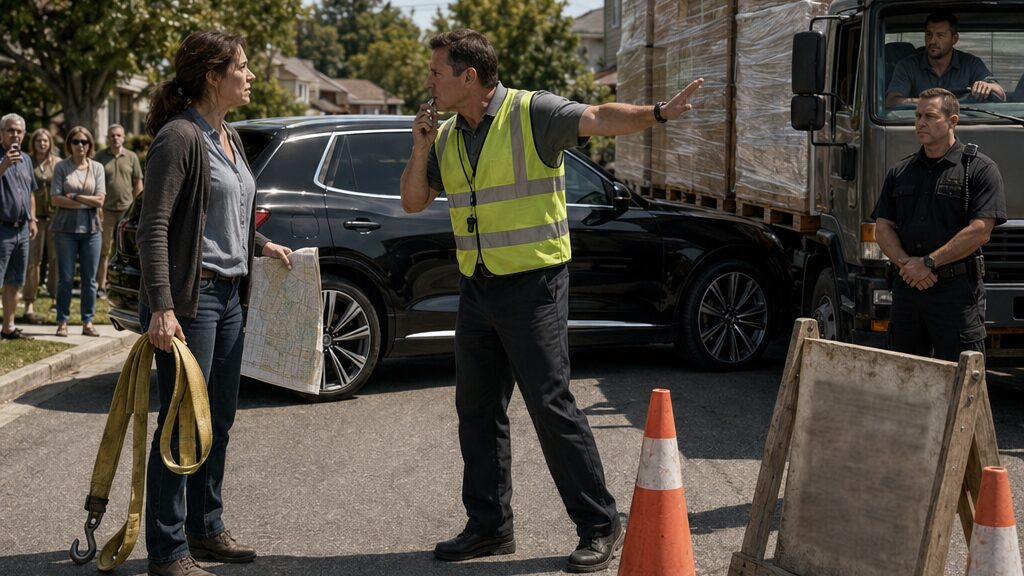
It cut through the quiet street in two sharp bursts, too loud for a Saturday morning, too official for a man in a reflective vest standing beside a row of ornamental shrubs. She was on her front step with her phone in one hand and the delivery receipt in the other, staring down the curve of Maple Hollow Drive where the road bent toward the entrance.
The truck was supposed to be there in three minutes.
Gary King was already there.
He stood near the front edge of the neighborhood, in the pale strip of sun between two trimmed lawns, wearing his bright vest over a tucked polo shirt as if the fabric gave him rank. A silver whistle hung from his neck. Beside him, David Clark leaned against a dark security pickup with his arms crossed, the kind of stillness that asked people to imagine what he might do if they did not cooperate.
Laura stepped off her porch.
Across the street, a curtain shifted. A garage door paused halfway up. The neighborhood was awake now, not openly, never openly, but in the way it always woke when there might be something to judge.
Gary lifted one orange cone from the bed of David’s pickup and placed it in the street.
Laura stopped at the end of her walkway. “Gary.”
He looked over as if surprised to find her in front of her own house. “Morning, Laura.”
“What are you doing?”
“Protecting community access.”
“That’s a street.”
“That is a controlled residential approach.”
“It’s Maple Hollow Drive.”
Gary smiled without warmth and set down another cone. “Which falls under Gate Committee observation during high-disruption activity.”
Laura tightened her fingers around the delivery receipt. She had read enough HOA emails to know that phrases like that came from men who wanted rules to sound heavier than they were. High-disruption activity meant trucks. Trucks meant noise. Noise meant complaints. Complaints meant Gary got to stand in the street with his whistle and make everyone remember he existed.
From the entrance, a low engine groaned. The sound rolled closer, diesel-heavy and slow, and Laura felt her shoulders loosen for the first time that morning.
The materials had arrived.
For three months, the back corner of her house had been wrapped in temporary sheeting where water damage had eaten through the framing after the last storm. The contractor had held an opening for her. The deposit had cleared. The delivery fee had been paid in advance, nonrefundable after dispatch. If the load went back today, the schedule collapsed, and Laura would be staring at another season of plastic flapping against studs whenever the wind came up.
Gary knew that. He had been at the meeting where she requested permission for the repair dumpster. He had sent four follow-up emails about “visual disruption.”
David walked to the rear of his pickup and pulled out a flat wooden sign. It was hand-painted white with blocky black letters.
ROAD CLOSED BY HOA.
The words were crude and uneven, but the size of the board made them look more convincing than they deserved.
Laura felt heat rise under her collar. “You can’t close the road.”
Gary set the sign upright on its folding legs. “We can restrict access.”
“To my house?”
“To the community.”
“It’s my delivery.”
“It is a commercial vehicle entering a residential zone.” He tapped the whistle against his chest. “We’ve had vendor issues before.”
She knew what that meant. The landscaper he had turned away for not having a magnetic company placard. The appliance van he had made wait at the entrance until the driver called the homeowner. The moving truck he had photographed from four angles as though couches were contraband.
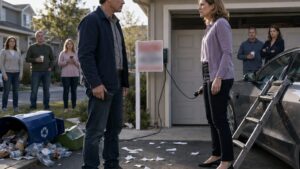
A woman stepped onto the sidewalk two houses down: Cynthia Nelson, HOA secretary, cardigan pulled tight around her as if the morning had suddenly become cold. She glanced at Gary, then at Laura, then at the sign.
Laura walked toward her. “Did the board approve this?”
Cynthia’s mouth pressed thin. “I don’t think this is the time.”
“That’s not an answer.”
Cynthia lowered her voice. “He printed a notice for this one.”
Laura stared at her.
“For today?”
Cynthia looked toward Gary again. “I’m just saying he came prepared.”
The engine noise grew louder. Around the bend, the white delivery truck appeared, broad and high, its flatbed stacked with wrapped pallets strapped down in gray bands. Even from a distance, the weight of it seemed to change the street. The houses looked smaller. The cones looked ridiculous.
Gary saw it too. His posture sharpened.
David walked into the street and dragged two cones farther apart, not to make room but to widen the theater. Gary picked up the wooden sign and moved it into the center line. Then, with practiced ceremony, he blew the whistle once.
The truck slowed.
Laura lifted a hand toward the driver, trying to signal him past the nonsense, but Gary stepped ahead of her.
The truck rolled closer, air brakes sighing. The driver leaned slightly toward the open window, a man in his thirties with a clipboard on the dash and a cautious face. Laura saw the name stitched on his work shirt: Ryan.
“Delivery for Moore?” he called.
“Yes,” Laura said quickly. “Driveway’s just there.”
Gary turned his head with a slow, public patience. “Driver, stop where you are.”
Ryan looked from Gary’s vest to David’s crossed arms to the sign.
Laura moved closer. “Ryan, you’re fine. This is my street. My driveway is clear.”
“It is not clear,” Gary said. “Access is temporarily closed by the HOA.”
The truck idled in the road, pallets strapped behind Ryan like a promise being held hostage.
Several neighbors had come out now. No one stood near Laura. They clustered in safe places: porch steps, driveway edges, behind open car doors. She could feel their attention touching her face, her clothes, the temporary sheeting still visible at the back of the house.
Gary’s eyes flicked toward them, then back to her.
That was when Laura understood.
This was not a misunderstanding. It was not Gary overreacting to a truck. He had chosen the hour. He had printed the notice. He had brought David, cones, a sign, a whistle, and an audience.
He was not blocking a delivery.
He was staging her obedience.
“Gary,” she said, keeping her voice level, “move the cones.”
He lifted the whistle to his mouth.
“Driver,” he called, stepping directly in front of the truck’s path, “halt.”
Ryan’s foot hit the brake.
The truck stopped ten houses short of Laura’s driveway.
Chapter 2: Two Tons From The Gate By Hand
“One piece at a time,” Gary said, pointing at the wrapped pallets on the truck as though he had discovered a reasonable compromise. “If the materials are so necessary, Laura can carry them from the gate herself.”
For a moment, no one spoke.
The truck engine kept knocking in place. The straps around the pallets trembled faintly with the vibration. Laura stared at the load: dense bundles of framing lumber, weatherproof panels, and sealed hardware crates stacked higher than her shoulders. Two tons, the invoice said. The number had seemed abstract when she signed for it. Now it sat in front of the neighborhood like a dare.
“You want me to carry two tons of material by hand,” she said.
Gary gave the small shrug of a man performing patience. “You chose a delivery method that violates community standards.”
Ryan leaned out of the window. “Sir, this is curbside driveway drop-off. We don’t unload at gates.”
“Then you may return to your dispatch center.”
Laura stepped toward the cab. “No. Ryan, don’t leave.”
Gary blew the whistle once, making her flinch before she could stop herself. The sound bounced off the truck’s side and came back sharper.
“Please do not approach the vehicle while the Gate Committee is conducting access review,” he said.
A neighbor’s phone rose quietly in the corner of Laura’s vision.
She felt it then, that old pressure in her ribs: don’t react too much, don’t give them the clip they want, don’t become the angry woman they already describe in emails. She folded the delivery receipt once, then unfolded it, smoothing the crease with her thumb.
“Show me the rule,” Laura said.
Gary blinked.
“The exact rule. In writing.”
He reached into a clipboard tucked under his arm and pulled out a sheet already marked with yellow tabs. Of course. Cynthia’s warning returned: He printed a notice for this one.
Gary held the paper where Laura could see the bold heading, though not long enough for her to read all of it. “Commercial vehicles exceeding committee-approved weight limits may be restricted from residential access points when such access creates nuisance, damage, obstruction, or disruption.”
“That says access points,” Laura said. “Not this street.”
“It says may be restricted.”
“By whom?”
“The Gate Committee.”
“On what roads?”
Gary’s smile faded slightly. “Laura, this is not a courtroom.”
“No. It’s a public street.”
A small movement passed through the watching neighbors. Not support. Not yet. Just a shift, a breath, the sound people made when a fight turned from embarrassing to interesting.
Gary turned the paper back toward himself. “You are not authorized to interpret governing language.”
“And you are?”
“I chair the committee responsible for access safety.”
Ryan cleared his throat. “Ma’am, I’m sorry, but I need a clear go or no-go. If security says the road is closed—”
“It isn’t security,” Laura said. “It’s a contractor and a man with a whistle.”
David came off the curb.
He did not hurry. That made it worse. He moved to the driver’s side of the truck and stood close enough that Ryan had to look down at him.
“This vehicle proceeds past the sign,” David said, “and you’re trespassing on community property.”
Ryan’s jaw tightened. “I’m not trying to get into anything. I’ve got six more drops.”
Laura looked up at him. “Your drop is here.”
“My company policy says if there’s an access dispute, we wait for clearance or return the load.”
“Return it?” The word came out too quickly, too sharp.
Ryan glanced at the clipboard on his dash. “If I can’t reach the driveway, dispatch marks it refused or inaccessible. Depends what they tell me.”
Gary seized the words. “There. Inaccessible. That’s accurate.”
“It is accessible,” Laura said. “You made it inaccessible.”
Gary turned so the neighbors could hear him clearly. “The community made rules. Laura chose to ignore them. The rest of us cannot be expected to absorb the consequences of one resident’s construction project.”
The temporary sheeting at the back of her house snapped in the faint breeze, plastic against wood. Several faces tilted that way.
Laura had lived under that sound for months. At night, it became a hand tapping the wall. During rain, it became a drum. Every delay had cost money. Every email had cost her another piece of calm. She had told herself Gary was annoying, not dangerous. She had told herself to wait, document, stay polite.
Now he had her delivery stopped in the street and her neighbors watching as if her damaged house were evidence against her.
Cynthia stood near her mailbox, arms locked across her middle. She would not meet Laura’s eyes.
“Gary,” Laura said, “I paid for delivery to my driveway. You can’t force me to unload two tons by hand because you dislike seeing a truck.”
“I dislike residents who pretend individual inconvenience outranks community standards.”
“It’s a repair.”
“It is a disruption.”
“It’s my home.”
“It is one property inside a governed association.”
Laura laughed once, but there was no humor in it. “You hear yourself?”
Gary’s cheeks colored. For the first time, something like embarrassment flashed under his performance. The neighbors had heard the laugh too. His hand closed around the whistle.
“You have been given an accommodation,” he said. “You may transport your materials manually from the entrance. The truck may remain outside the restricted area for ten minutes.”
Ryan looked at Laura. His voice dropped. “Ma’am, I’m sorry. Dispatch is already pinging me.”
“Give me a few minutes.”
“I don’t think I have many.”
Gary checked his watch with exaggerated care. “As of now, the vehicle is illegally parked in a restricted residential approach. The fine begins immediately. Fifty dollars for the first minute, increasing every five minutes thereafter.”
Laura stared at him. “You’re fining me because your cones are blocking my delivery?”
“I am fining you because you created a violation.”
David shifted near the cab, making Ryan pull his elbow back inside.
The whistle swung from Gary’s neck, bright and useless and somehow in control of everything.
Laura looked past him to the pavement under the cones. Maple Hollow Drive curved cleanly through the neighborhood, city-maintained asphalt patched last spring by municipal crews whose orange trucks had come without asking Gary’s permission. She remembered the invoice notice in her property-tax statement. She remembered the map folded in her garage drawer, the one she had printed and never used because using it meant declaring war.
Gary lifted his pen over the fine sheet.
“Minute one,” he said.
Chapter 3: The Map She Had Not Used
The drawer stuck before it opened, as if the house itself wanted one more second to think.
Laura pulled harder. The metal runners scraped, and the bottom drawer of the garage filing cabinet lurched out with a sound that made the tools on the wall tremble. Behind her, through the open garage door, Gary’s whistle shrieked again, followed by his voice carrying across the street.
“Documenting continued noncompliance.”
She shut her eyes for half a beat.
Not anger. Not yet. Find the map.
The file tabs were too neat, because neatness had been her way of not confronting anyone. Repair estimate. Contractor deposit. Insurance denial. Permit request. HOA correspondence. City road maintenance. She found the last folder with two fingers and slid it free.
Inside was the municipal map.
It was folded into quarters, the city seal visible in one corner, Maple Hollow Drive traced in a thin public-works line that did not care about Gary’s vest or whistle. Laura had printed it after the second vendor turned back at the entrance. She had highlighted the street, clipped the city email to it, and told herself she would bring it up at the next meeting.
Then she had pictured Gary smiling in front of the board, asking why she was so hostile.
So she had left it in the drawer.
Outside, Ryan’s truck idled with the patience of a machine that could still leave.
Laura set the map on top of the file cabinet and dug for the permit packet. The updated framing plan was there. The contractor letter was there. The city receipt was there.
The confirmation stamp was not.
Her stomach dropped.
“No,” she whispered.
She flipped the page. The update form had been filed online after the contractor changed the delivery date. She had the submission number. She had the automatic receipt. But the printed page Gary would understand, the clean stamp that said accepted, had never arrived. She had meant to follow up. Then the temporary sheeting tore loose in the wind, and the contractor called, and work swallowed two days, and she told herself the digital receipt was enough.
It was enough for the city.
It would not be enough for Gary.
A shadow moved across the garage floor.
Laura looked up.
Cynthia stood just outside, not entering, not leaving. Her face had gone pale in a way that did not match simple curiosity. Her gaze was fixed on the edge of the municipal map.
“You have that,” Cynthia said softly.
Laura’s fingers tightened over the paper. “You know what it is.”
Cynthia swallowed. “I know Gary argued about it.”
“When?”
“That’s not—”
“When, Cynthia?”
The whistle sounded again, two short blasts, as if Gary were calling dogs.
Cynthia’s eyes flicked toward the street. “After the city trucks repaired the potholes last spring. Someone asked whether the HOA could still restrict vendor traffic if the city maintained the road. Gary said the ownership question was complicated.”
“It isn’t complicated.”
“I didn’t say I agreed with him.”
“You didn’t say anything at all.”
Cynthia looked wounded, which irritated Laura more than anger would have. “I keep minutes. I don’t run the committee.”
“But you saw the records.”
“I saw a folder.”
Laura stepped toward her, map in one hand, permit packet in the other. “And today you watched him put a road-closed sign on a public street.”
Cynthia’s mouth opened, but Gary’s voice cut through before she could answer.
“Laura, hiding in your garage will not stop the fine schedule.”
Laura walked out.
The sunlight felt harsher than it had ten minutes ago. The street was no longer simply blocked; it had become arranged around her absence. Gary stood near the front of Ryan’s truck with his clipboard up. David remained by the driver’s door. Neighbors had moved closer by degrees, still pretending they were not gathered.
Laura placed the municipal map on the hood of her parked car and unfolded it.
“Here,” she said. “Maple Hollow Drive is listed as a municipal road. Public maintenance, public easement, taxpayer-funded.”
Ryan leaned from the cab, trying to see.
Gary did not look at the map. His eyes went instead to the packet beneath Laura’s arm.
“What else is in your hand?”
“My permit documents.”
“Excellent. Then show everyone the approved update for today’s high-weight delivery.”
Laura felt Cynthia go still behind her.
“It’s a material delivery for approved repairs,” Laura said.
“That was not my question.”
“I have the submission receipt.”
Gary’s face sharpened. He had smelled weakness. “Submission is not approval.”
“The city accepts digital filing.”
“Then where is the accepted update?”
Laura hated the pause before her answer. It was small. Less than a second. But Gary caught it, and so did everyone watching.
“I’m waiting on the stamped copy.”
Gary turned to the neighbors with a look of almost sorrowful vindication. “There it is.”
“No,” Laura said. “That does not change the road.”
“It changes your credibility.”
He stepped closer to her car and, before she could stop him, tapped the permit packet with one finger. “You are attempting to force a heavy commercial delivery through the community while concealing incomplete paperwork.”
“I’m not concealing anything.”
“You ran inside and came back waving a map because you knew your permit update was defective.”
“That’s not what happened.”
“But it is what everyone just saw.”
The words landed harder because they were built around a sliver of truth. Laura had gone inside. She had hesitated. The stamp was missing. Gary had taken the one weak hinge and hung the whole lie on it.
Ryan checked something on his dash and rubbed a hand over his mouth.
“Ma’am,” he said quietly, “dispatch wants an answer.”
Laura turned. “Tell them the driveway is accessible.”
His eyes moved to the cones, the sign, the SUV now angled more aggressively as Gary had ordered David to pull it sideways across the lane. “Not from where I’m sitting.”
“Ryan—”
“I’m sorry. They’re telling me five minutes before I have to return the load or mark it inaccessible.”
Gary’s pen clicked.
The sound was small, almost delicate.
Laura looked down at the municipal map spread open on her hood. It showed the road clearly, cleanly, without cones or whistles or neighbors pretending not to stare. On paper, the path to her driveway was open.
In front of her, Gary’s SUV blocked it completely.
Ryan’s voice came again, lower this time.
“Five minutes, Ms. Moore.”
Chapter 4: The SUV Across The Taxpayer Road
Laura spread the municipal map flat across the hood of her car just as Gary slapped a fine notice over the center of it.
The paper landed across Maple Hollow Drive, covering the thin city line with a bright block of penalty language and Gary’s tight signature. For one second, Laura saw only his hand on top of the road she had been trying to show them.
“Do not touch my documents,” she said.
Gary left his palm there. “Do not pretend a map excuses an incomplete permit.”
Ryan’s truck rumbled behind him, the sound uneven now, as if the idling engine had become impatient. The wrapped pallets sat ten houses away from where they belonged. On the far side of the cones, the luxury SUV gleamed across the lane, angled hard enough that even a bicycle would have trouble squeezing past. Gary had moved it while Laura was inside, turning the blockade from symbolic to absolute.
“You parked that across the road,” Laura said.
“I positioned my vehicle to protect community property.”
“This is taxpayer asphalt.”
Gary’s nostrils flared. “That phrase again.”
“Because it’s true.”
He leaned closer, lowering his voice just enough that it felt personal, though everyone could still hear. “You are using a technicality to justify a heavy truck entering a residential street with defective paperwork.”
Laura looked past him at Cynthia. “Tell him.”
Cynthia stood near the curb with her cardigan sleeves pulled over her knuckles. Her eyes went from the map to the fine notice, then to Gary’s face. She seemed to shrink inside herself.
“Cynthia,” Laura said.
Gary did not turn. “The secretary is not here to rescue you.”
“She saw the city records.”
Cynthia’s lips parted.
Gary glanced over his shoulder, one sharp movement. “Cynthia keeps minutes. She does not issue interpretations.”
“That isn’t what I asked,” Laura said.
A neighbor murmured something. Another phone came up.
Cynthia took one step forward, then stopped. “There was… a question raised last spring.”
Gary’s jaw tightened.
Laura held on to that tiny break. “What question?”
Cynthia’s voice almost disappeared under the truck’s engine. “Whether the streets were part of the municipal maintenance zone.”
Gary laughed quickly, too quickly. “Which was never resolved by the board.”
“It was resolved by the city,” Laura said, and tried to lift the fine notice off the map.
Gary pressed it down harder.
His smile had vanished. Under the vest and the whistle and the committee title, Laura saw something rawer than authority. Panic, maybe. Or the shame of a man whose costume was starting to slip in front of the people he needed to impress.
“You don’t understand what’s at stake,” he said.
“My delivery is at stake.”
“The neighborhood is at stake. We have a vote next month on permanent access enforcement. People are tired of trucks, dumpsters, strangers, contractors leaving ruts, residents acting like this is any other street.”
“It is a street.”
“It is our community.”
“No,” Laura said. “It’s your campaign.”
That struck him. Not loudly. Not dramatically. But his face changed. For a second, the performance fell away, and she saw how much of this morning had been built for witnesses. The vest. The whistle. The sign. The SUV. The fine notice. Proof, not of law, but of Gary King being necessary.
Then he put the mask back on.
“You will not turn this into a personal attack because you failed to manage your construction project.”
“My house is damaged.”
“Many people have problems. They don’t all bring two tons of commercial disruption into a quiet residential zone.”
Laura heard a small intake of breath from someone nearby. The words had done what Gary wanted. They made her repair sound indulgent. They made the plastic sheeting on her house look like bad manners.
She pulled the fine notice free. It tore at the corner.
Gary snatched at it. “That is an official HOA document.”
“It was covering a public map.”
“It is evidence of your violation.”
“It is evidence you won’t let people read.”
David moved in then.
He stepped between Laura and the SUV, broad shoulders squared, security badge catching light. “Ma’am, back up.”
Laura did not move. “Don’t block me.”
“You need to stay on your property.”
“I am standing in the street.”
“Exactly.”
His hand came down on her forearm.
It was not a shove. It was not a grab that would leave bruises. It was a controlled, professional touch meant to move her without looking like force. That made it worse.
Laura looked at his fingers on her sleeve.
The street went very quiet, even with the truck running.
“Take your hand off me,” she said.
David released her, but only after a beat too long.
Gary immediately raised his clipboard. “She advanced on the blockade. Security redirected her.”
Laura turned her head slowly toward him. “You are blocking me from a public road.”
“You are escalating.”
“You brought a sign that says road closed.”
“Because you refused process.”
“You parked your SUV sideways.”
“To prevent unauthorized access.”
“You had him put hands on me.”
David’s face hardened. “I didn’t put hands on you. I kept you from creating a safety issue.”
Laura stared at him long enough that he looked away first.
Ryan called from the cab, “Ms. Moore.”
The urgency in his voice cut through everything.
Laura stepped toward the truck, keeping distance from David now. “How long?”
Ryan held up his phone through the window. “Dispatch says I need to clear this stop now. I’ve been flagged as obstructing traffic.”
Gary spread his hands. “There is no traffic. The road is closed.”
“You closed it,” Laura said.
Ryan looked miserable. “I can’t stay in a dispute. If I leave, it goes back to the yard. They’ll reschedule when access is confirmed.”
“When?”
“I don’t know. Could be weeks.”
Weeks.
The word hit harder than Gary’s whistle. Weeks meant the contractor would give the slot away. Weeks meant more rain under plastic. Weeks meant calling the bank, calling the supplier, calling everyone and explaining that a man in a vest had decided her house could wait.
Laura looked at the pallets.
Then at the cones.
Then at the wooden sign.
Then at Gary’s SUV, polished and heavy and smug across the taxpayer road.
Her mouth tasted metallic. She thought of the first email she had not answered sharply enough. The meeting where she had sat quiet while Gary referred to “some residents” creating visual deterioration. The vendor who apologized and drove off because Gary told him the “community” did not allow weekday access. Each time, Laura had gone inside, saved the evidence, and told herself there would be a right moment to use it.
There had never been a right moment.
Only this one, ugly and public and already half lost.
Gary clicked his pen again. “Minute four.”
Laura folded the municipal map once, carefully, and tucked it beneath her arm.
“What are you doing?” Gary asked.
She did not answer.
She walked past her car, up her driveway, and into the garage. Behind her, voices rose, Gary’s among them, louder now that he could narrate her retreat. She heard David say something to Ryan. She heard the truck’s air brakes exhale again.
The tow strap hung on the wall beside the old work gloves.
It was thick, yellow, and heavy enough that when she lifted it down, the metal hook knocked against the cabinet with a dull, final sound. She had bought it years ago after a storm left a fallen limb across the driveway. She had used it once. Since then it had hung there, coiled and waiting, a tool for moving what could not be moved by asking.
Laura stood with it in both hands.
For one last second, she saw herself the way the neighbors would: angry woman, unstable woman, rule-breaker woman, the one who made everything worse.
Then Ryan’s voice carried from the street.
“Ms. Moore, I’m sorry. I have to go.”
Laura stepped out of the garage carrying the heavy tow strap at her side.
Chapter 5: When The Strap Snapped Tight
The hook hit the asphalt beside Gary’s SUV with a sound that made every whisper stop.
Laura let the rest of the tow strap uncoil from her hand. It slapped the pavement in a thick yellow line, bright against the gray street, lying between the delivery truck and the polished rear of the vehicle Gary had parked across the lane.
Gary stared at it.
Then he laughed once, not because anything was funny, but because the alternative was fear. “Absolutely not.”
Laura looked at Ryan. “Back up six feet and line your hitch with his rear tow point.”
Ryan’s mouth opened. He looked from her to the SUV, then to David. “Ma’am, I can’t just drag someone’s vehicle.”
“You can move an obstruction from a public road at the receiver’s instruction.”
“I don’t know that.”
“I do.”
Gary lifted his phone and started recording. “For the record, Laura Moore is instructing a commercial driver to vandalize a resident’s vehicle.”
Laura turned toward his phone. “For the record, Gary King has blocked a municipal street with a private SUV, cones, and an unauthorized sign to detain a lawful delivery.”
The silence after that felt different. The neighbors were still watching, but the shape of their attention had changed. Laura was no longer simply protesting. She was naming.
David stepped toward the strap. “Nobody touches that vehicle.”
Laura faced him. “Do not touch me again.”
His eyes flicked, just briefly, to her forearm. “You need to calm down.”
“No,” she said. “You need to decide whether you are security or a participant in an illegal blockade.”
Gary barked a laugh. “Illegal. She keeps saying illegal because she thinks repetition creates law.”
Laura lifted the folded municipal map from under her arm and held it up. “This creates law. The city map creates law. The maintenance records create law. Your whistle does not.”
Ryan still had not moved.
The truck idled behind him, huge and capable, but his hands stayed locked on the wheel. Laura could see the calculation on his face: company rules, insurance forms, liability, a job he probably needed.
“I’m sorry,” he said. “I need dispatch approval.”
“You won’t get it in time.”
“That’s the point. I can’t risk—”
“You’re not the one taking responsibility.”
Gary pounced. “Listen to the driver, Laura. He understands consequences.”
Laura looked up at Ryan through the open cab window. “Ryan Walker, this delivery is addressed to my house. I am the receiving property owner. I am instructing you to move an obstruction from the public right-of-way so you can complete the paid delivery. I accept responsibility for that instruction.”
Ryan swallowed.
David said, “That doesn’t mean anything.”
“It means she just put herself on the hook,” Ryan said quietly.
Gary’s face tightened.
Laura stepped closer to the SUV. She crouched before the rear underside, found the tow point, and clipped the hook in place. Her hands shook only after it latched. She curled her fingers into a fist to hide it.
Gary rushed forward. “Get away from my car.”
Laura stood. “Move it yourself.”
“I will not be coerced into obeying your tantrum.”
“Then it gets moved.”
“You touch that vehicle again and I will press charges.”
“You’ve had every chance.”
David moved between Laura and the truck, his boots planted wide. “This is over. Driver, leave.”
Ryan did not leave.
For the first time, he took his foot off the brake and shifted the truck into reverse. The beep of the backup alarm started, sharp and mechanical. A few neighbors stepped backward, suddenly aware that they had come too close.
Gary swung his phone toward Ryan. “I have you on video. Your company will hear from our attorneys.”
Ryan backed up slowly, aligning the hitch. “My company’s going to hear from someone either way.”
David strode toward the cab. “Turn it off.”
Laura stepped in front of him.
He stopped short enough that his shirt brushed her shoulder.
“Move,” he said.
“No.”
“You are interfering with safety operations.”
“You are standing in the path of a public delivery.”
His jaw worked. For one second, Laura thought he might put his hands on her again. She felt fear then, clean and cold. Not fear of pain. Fear of being shown to everyone as someone who could be moved.
She held her ground.
Behind David, Gary kept recording. “She is threatening security now. Everyone sees this.”
Cynthia’s voice came from the curb, thin but audible. “Gary, maybe move the car.”
He turned on her. “Do not involve yourself in enforcement.”
“I am involved. I’m the secretary.”
“You keep minutes. You do not countermand the chair.”
Cynthia flinched, but she did not step back. “The board hasn’t voted on permanent access enforcement.”
“This is temporary authority.”
“For today?” Laura asked.
Gary’s eyes flashed. “For violations.”
“For me.”
No one answered.
Ryan climbed down from the cab with work gloves in his hand. He moved quickly, before his courage could drain away. Laura handed him the loose end of the strap. Together they secured it to the truck’s rear hitch.
The yellow line now ran taut enough to show intention but loose enough to leave one final chance.
Laura turned to Gary.
“Move your SUV.”
Gary’s face had gone red under the edges of his sunglasses. “No.”
“Move it now.”
“I said no.”
Laura nodded once.
She looked at Ryan. “Slow pull. Just enough to clear the lane.”
Ryan’s hands flexed in the gloves. “If something snaps—”
“It won’t. Slow pull.”
Gary stepped toward the driver’s side of the SUV as if he meant to get in, then stopped. To move it now would be to admit the whole blockade depended on his willingness. To keep it there would be to test whether Laura would really do what everyone could see coming.
His pride chose for him.
“This is destruction of community property,” he shouted.
Laura looked at the wooden sign, the cones, the SUV, the street under all of it.
“No,” she said. “This is the road opening.”
Ryan climbed back into the truck.
The engine deepened. The strap lifted off the asphalt, inch by inch, shedding grit as it tightened. The hook groaned against the SUV’s tow point. Gary lunged toward it, then stopped when David caught his arm, not to protect Laura, but because even he understood the danger of stepping into the line.
The strap snapped tight.
For a heartbeat, nothing moved.
Then the SUV jerked sideways.
Tires screamed against the asphalt. The sound ripped down the manicured street, raw and impossible, drowning Gary’s shout. The rear of the SUV lurched, dragging across the cone stack. Orange plastic folded and shot out from under the bumper. The wooden HOA sign tipped, bounced once, and splintered under the front wheel as the vehicle skidded sideways.
Neighbors gasped. Someone yelled for everyone to move back. David swore. Gary’s whistle swung wildly from his neck as he ran after the sliding SUV with his phone still in his hand.
Ryan braked fast.
The truck rocked. The strap went slack.
Gary’s SUV sat crooked near the curb, scraped and furious-looking, no longer blocking the lane.
For the first time all morning, the road to Laura’s driveway was open.
Gary stared at the crushed cones and broken sign. His face twisted between disbelief and rage.
Then he turned toward Laura and screamed, “That was community property!”
Chapter 6: The Sign Broke Before The Lie Did
The wooden HOA sign cracked again under the SUV’s tire as Gary kicked at the broken frame, trying to free it from the mess of cones and splinters.
“Community property,” he shouted, voice breaking on the second word. “You destroyed community property in front of witnesses.”
Laura stood beside the slack tow strap and felt the fear arrive late.
It came after the noise. After the rubber stink. After the impossible sight of Gary’s SUV no longer blocking the road. Her heartbeat seemed to move through her hands, her throat, even the soles of her feet. She had done it. She had told Ryan to pull. The street was open.
And now everyone was looking at what it had cost.
Gary raised his phone so close to her face that she saw her own reflection in the black glass. “Say it. Say you ordered him to damage my vehicle.”
Laura looked past the phone at the road. “I ordered a public obstruction moved.”
“You are done,” Gary said. “I’m calling law enforcement. I’m calling the board. I’m calling every attorney this community has.”
Ryan stepped down from the truck, pale. “I pulled slow.”
“You pulled my car with a commercial truck,” Gary snapped. “Because she told you to.”
Laura unclipped the strap from the SUV and let the hook drop. “Your car was across the lane.”
David came up beside Gary, breathing hard. “Don’t touch anything else.”
“I’m removing my equipment,” Laura said.
“That strap is evidence.”
“Then photograph it.”
Gary jabbed at his phone. “Already did.”
The neighbors had widened their circle. No one wanted to stand near the broken sign now. The crude board lay faceup in the street, one leg snapped, the words ROAD CLOSED BY HOA split through the middle. It looked less official broken than it had standing. The raw wood showed through the paint. The screws were cheap. The legs had been hinged with hardware-store brackets.
Laura stared at it.
“Who authorized that sign?” she asked.
Gary looked at her as if she had said something absurd. “The committee.”
“The city?”
“The HOA.”
“The road department?”
“This is not a city matter.”
Laura picked up the municipal map from the hood of her car and walked to the broken sign. She unfolded it on the pavement near Gary’s feet, smoothing the creases with both hands. Wind lifted one corner. Cynthia stepped forward and, without quite looking at Laura, placed her shoe gently on the edge to hold it down.
Gary saw the movement. “Cynthia.”
She did not move her foot.
Laura pointed to the map. “Maple Hollow Drive. Municipal maintenance boundary. Public right-of-way. It runs from the entrance to the cul-de-sac.”
Gary’s face had gone blotchy. “You are not qualified to interpret that.”
“Then we’ll wait for someone who is.”
He gave a sharp laugh and lifted the phone to his ear. “Yes. I need officers dispatched to Maple Hollow Drive. A resident used a delivery truck to destroy HOA property and damage my vehicle.”
Ryan rubbed both hands over his face. “This is going to get me fired.”
Laura turned to him. “You followed the receiving owner’s instruction on a public road.”
“That doesn’t mean dispatch cares.”
“I’ll give a statement.”
Gary pointed at her while speaking into the phone. “She is still escalating. She is making threats.”
“I haven’t threatened you.”
“You weaponized a truck.”
“You blocked one.”
David stepped closer to Gary. “Tell them she put hands on me too.”
Laura’s head snapped toward him. “What?”
David stared back. His professional stillness had begun to crack. “You refused a lawful direction. You came into my space.”
“You touched me.”
“You advanced on a secured area.”
“There was no secured area.”
Gary repeated into the phone, “Security contractor was assaulted during enforcement.”
Cynthia made a small sound.
Laura turned. “You saw him touch me.”
Cynthia looked at David, then at Gary, then at the map under her shoe. Her face showed the misery of someone who had spent too long surviving by not being the loudest person in any room.
“Cynthia,” Laura said, softer this time.
Cynthia closed her eyes briefly. “I saw David put a hand on Laura’s arm.”
David’s mouth tightened. “To redirect her.”
“You also saw the city folder,” Laura said.
Gary lowered the phone from his mouth. “Careful.”
Cynthia opened her eyes.
The warning in Gary’s voice did something that Laura’s pleading had not. It straightened Cynthia by half an inch.
“There was a folder,” Cynthia said. “After the city repaired the potholes. Gary asked me to pull prior access complaints. The boundary records were in the same file.”
Gary’s face went still. “You don’t know what you saw.”
“I know the map looked like that one.”
The crowd shifted again, more noticeably now. The certainty Gary had built all morning began to loosen at the edges. Laura saw a neighbor lower her phone. Another took two steps closer to the map.
Gary sensed it too. He raised his voice. “This is exactly why committees exist. Residents do not get to wave papers and destroy property based on personal interpretations.”
A siren did not come, but a white municipal pickup turned into the street with an amber light on top and a city seal on the door.
Laura had not called the city. For a second, she thought she was imagining it.
The pickup slowed near the scattered cones. A man in a public-works shirt stepped out, clipboard in hand, eyes moving from the dragged SUV to the broken sign to the open map at Laura’s feet.
Gary lowered his phone.
The man looked at the wooden board. Then at the cones. Then at Gary’s reflective vest.
“I’m John Martin,” he said. “Public works supervisor. We received a road obstruction complaint.”
Gary recovered fast. “Good. This resident damaged private community property and—”
John held up one hand, not rudely, but with the practiced fatigue of a man who had heard too many versions of the same argument.
He crouched beside the map.
Laura’s breath held.
John studied the street line, then looked up at the broken sign.
“Who authorized a road closure on a municipal street?” he asked.
Chapter 7: The Public Map Under His Shoes
“This is not private access,” John Martin said.
The words did not come loudly. They did not need to. They fell into the street with more weight than Gary’s whistle, the broken sign, or the idling delivery truck.
Gary’s hand went to the whistle at his chest as if he meant to blow it, then stopped. The silver piece hung useless against the reflective vest.
John crouched beside the map, one knee near a tire mark left by Gary’s dragged SUV. He traced the printed line of Maple Hollow Drive with the tip of his pen, then looked toward the entrance where the cones still formed a crooked orange wound in the road.
“This street is within the municipal right-of-way,” he said. “Public maintenance, public access, public enforcement.”
Gary recovered enough to straighten. “That map does not reflect the governing documents of the association.”
John looked up. “I don’t enforce HOA documents. I enforce city right-of-way.”
“The HOA maintains access standards.”
“Not by closing a city road.”
Gary’s eyes moved quickly now, from John to the neighbors to David. He was searching for the version of the morning where he still looked like a man in charge.
“The resident created the emergency,” Gary said. “She brought in an unapproved heavy delivery with incomplete permit paperwork. My committee acted to prevent damage.”
John stood. “Permit issues do not authorize a private road closure.”
“It wasn’t a closure. It was a temporary access restriction.”
John turned toward the broken wooden sign, its split face still visible under the SUV’s front tire. “The sign says road closed.”
A few neighbors looked away.
Laura watched Gary’s mouth tighten. The same sentence would have been dismissed from her. From John, it became a fact.
Gary pointed toward David. “The security contractor placed the cones for safety. I relied on his professional judgment.”
David’s head snapped toward him. “Gary.”
Laura heard the first crack between them.
Gary did not look at him. “David was managing the operational aspect.”
David’s face changed. Not innocence. Not even outrage. Recognition. He had backed Gary all morning because Gary represented the paying client, the committee, the contract that kept his small company’s trucks in the neighborhood. Now the contract was becoming a rope around his own neck.
“You told me the board cleared this,” David said.
Gary’s smile flashed and died. “The board authorized enforcement.”
“Of private entrances,” Cynthia said.
Everyone turned.
She stood at the edge of the map, her shoe still holding down one corner. Her voice shook, but this time it did not disappear.
Gary stared at her. “Cynthia.”
“No.” She swallowed. “No, Gary. The last minutes say private entrances and common drives. Not Maple Hollow Drive. Not the municipal street.”
“You’re confused.”
“I typed them.”
Laura felt the street shift again, not physically, but in the way people’s eyes moved. They stopped asking whether Laura had overreacted and started asking what Gary had known.
John held out his hand. “Minutes?”
Cynthia looked at Gary first. Old habit. Then she reached into the slim folder tucked against her side and removed several folded pages.
Gary took a step toward her. “Those are internal association records.”
John did not raise his voice. “Ma’am, you don’t have to hand me anything you don’t want to.”
Cynthia hesitated, then gave the pages to John.
Gary’s face went flat.
John scanned them. His thumb stopped midway down the second page. “There’s a note here about city-maintained roads.”
Laura’s breath caught.
Cynthia nodded once. “Gary asked that it be tabled.”
“That is procedural,” Gary snapped.
John kept reading. “And there’s a city response attached?”
Gary lifted both hands. “A response to a hypothetical inquiry. It was not a formal determination.”
Cynthia’s voice came again, quieter. “It said the streets were public.”
For a moment, even Ryan’s truck seemed to idle softer.
David turned fully toward Gary now. “You had that before today?”
Gary’s eyes flashed. “Do not pretend you didn’t understand the assignment.”
“The assignment was to enforce HOA access.”
“The assignment was to maintain order.”
David gave a short, humorless laugh. “You said the streets were community-controlled.”
“They are community-used.”
“That’s not the same thing.”
John folded the pages. “Who hired the security contractor for traffic enforcement?”
Gary did not answer.
David rubbed both hands over his head. His voice dropped, stripped of the hard professional edge he had used on Laura. “I asked you, Gary. I asked if we had written authority. You said the committee was voting next month and this was the demonstration.”
Gary’s eyes cut toward the neighbors, furious. “That is not accurate.”
“It is,” David said. “You said if people saw us hold the line today, they’d approve the permanent contract.”
Laura looked at Gary. There it was, not in a document, not under a city seal, but from the man who had helped him. The morning had been a demonstration. Her damaged house, her delivery, her public embarrassment—props in Gary’s argument for more power.
Gary saw the realization land. He swung toward Laura.
“You caused this,” he said. “All you had to do was follow process.”
Laura almost answered. The old part of her wanted to defend every form, every delay, every email, every reason she had waited and tried to be careful. But the street no longer needed that from her.
“No,” she said. “All I had to do was let you keep pretending.”
Two officers had arrived while John was reading, their cruiser parked near the entrance with its lights flashing silently. One spoke with John. The other examined the cones, the sign, the SUV’s position, the tire marks, then asked Laura what had happened.
She told him in order. The delivery. The cones. The demand to carry the load by hand. David’s hand on her arm. The five-minute deadline. The final warning. The strap.
She did not embellish. She did not soften.
When David heard her mention his hand on her arm, his shoulders folded inward.
“I didn’t hurt her,” he said.
The officer looked at Laura. “Do you want to make a statement regarding unwanted physical contact during the obstruction?”
David’s eyes widened.
Gary stepped away from him.
That was the ugliest part. Not Gary’s shouting. Not the whistle. The step. The clean little movement by which Gary separated himself from the man who had enforced his orders all morning.
David saw it too.
“Gary,” he said.
Gary stared straight ahead.
The officer spoke with David, then with John, then into his radio. The words came in fragments: unlawful obstruction, public right-of-way, contractor license, possible detainment. David’s posture sank with each one.
A few minutes later, the officer asked David to turn around.
David did it slowly, as though his body had become older in the space of a morning. When the cuffs clicked, Cynthia put a hand over her mouth. Ryan looked down at the pavement.
Gary whispered, “This is excessive.”
David turned his head. “Say you told me.”
Gary said nothing.
“Say it,” David pleaded. “Tell them I was acting under HOA instruction.”
Gary’s mouth opened. No sound came.
David’s eyes found Laura then, and the hardness was gone. What remained was fear, shame, and a desperate hope that she might be kinder than he had been.
“Please,” he said, voice cracking as the officer guided him toward the cruiser. “Please don’t press assault charges. I was doing the job. I thought I was doing the job.”
Laura stood with the municipal map open at her feet, the road line visible between her shoes. The power in the street had changed hands so completely that it frightened her.
Gary looked at her as if she had become dangerous.
And for the first time that morning, Laura had to decide what kind of dangerous she was willing to be.
Chapter 8: The Road Opened, But Not Quietly
“Where do you want the pallets?” Ryan asked.
The question was so ordinary that Laura almost did not understand it.
For hours, the street had been whistles, cones, threats, paper, rubber, splintered wood, and people watching her as if her life had become a public hearing. Now Ryan sat in the cab with the delivery truck pointed toward her driveway, one hand on the wheel, waiting for simple instructions.
Laura looked at the open road.
No SUV blocked it. No sign claimed it. The cones had been gathered into a crooked pile near the curb, bright and powerless. Gary stood beside his damaged vehicle with one officer and John Martin, speaking in a stiff, low voice that no longer carried authority across the lawns.
Laura stepped back from the map and pointed to the driveway. “As close to the garage as your lift can get.”
Ryan nodded. The truck moved.
It rolled slowly past the place where Gary had stood with his whistle. The front tires crossed the faint black marks left by the tow strap pull. Then it continued, steady and lawful, up the stretch of Maple Hollow Drive that had been open on paper all along.
Neighbors watched in silence as the two-ton delivery reached Laura’s house.
The lift gate lowered with a hydraulic whine. Ryan worked carefully, almost reverently now, guiding the first wrapped pallet down until it settled on Laura’s driveway. The weight of it thudded through the concrete and into her feet.
For three months, she had imagined that sound.
Not victory. Not applause.
Work beginning.
Cynthia approached while Ryan lowered the second pallet. She stopped several feet away, as if there were still an invisible cone between them.
“Laura.”
Laura kept her eyes on the pallet. “If this is about the minutes, you should give copies to John.”
“I already did.”
“Good.”
Cynthia folded her hands together. “I’m sorry.”
Laura turned then.
Cynthia looked smaller without the protection of process. “Not because I secretly liked what Gary was doing. I didn’t. But I kept telling myself minutes weren’t decisions. That if I wrote things down correctly, I wasn’t part of them.”
Laura said nothing.
Cynthia’s eyes went to the street, to the place where David had been led away. “Silence turned out to be a decision too.”
The words landed softly, but they did not ask Laura to comfort her. Laura appreciated that.
“I was afraid of becoming the neighborhood problem,” Laura said.
Cynthia gave a sad, brief smile. “I think Gary counted on that.”
Ryan rolled the third pallet down. The driveway began to fill with materials: lumber, panels, hardware, all the physical proof that Laura’s house was not a violation. It was a home being repaired.
Near the curb, Gary’s voice rose.
“This is not over,” he said.
Laura looked over.
Gary stood with two neighbors who had drifted to his side, their expressions tight with the discomfort of people already rewriting what they had seen. One of them glanced at Laura and looked away quickly.
“There will be civil action,” Gary continued, though his voice lacked the clean edge it had carried that morning. “Damage claims. Abuse of process. The board will review all of this.”
John Martin said something Laura could not hear. Gary’s jaw clenched.
The threat should have scared her more. It still scared her some. Lawsuits, fines, board meetings, whispers at mailboxes—none of that vanished because the road had opened. The neighborhood would not transform by evening. Some people would call her brave. Some would call her unstable. Some would say both, depending on who was listening.
But the fear no longer filled the whole street.
Laura took out her phone and photographed everything: the pallets in her driveway, the open lane, the tire marks, the broken sign being lifted into the city pickup, the map on the pavement, the cones stacked beside the curb. Not frantically. Not to prove she was innocent to people determined not to know.
To keep the record.
Ryan came down from the lift gate and handed her the delivery form. “I marked it completed at driveway.”
Laura signed.
He hesitated before taking the form back. “I thought I was going to have to leave.”
“So did I.”
“I’m glad I didn’t.”
Laura looked toward the road. “You waited long enough.”
Ryan nodded, then climbed back into the truck.
As he secured the lift gate, the officer near the cruiser closed the rear door where David sat inside. David did not look out. His head was bowed, shoulders shaking once before he went still. Laura felt no triumph watching him. He had made choices. He had touched her. He had helped block the road. But he had also been abandoned by the man who taught him that authority was just whoever paid the invoice.
The officer returned to Laura. “We’ll need your full written statement later. Regarding the physical contact, you can decide how you want to proceed.”
Laura glanced at Gary.
He was watching her with a look that tried to be hatred and landed closer to fear. The same man who had ordered her to carry two tons by hand now seemed unable to move one step without checking who stood with him.
Laura looked back at the officer. “I’ll give the statement. I want the detainment and obstruction documented. As for the contact, I’m not deciding in the street.”
The officer nodded. “That’s fair.”
It was more than fair. It was hers.
Not Gary’s performance. Not David’s plea. Not Cynthia’s guilt. Hers.
The last pallet came down just after noon. The truck pulled away slowly, no whistle stopping it, no cones narrowing its path. As it passed the entrance, Ryan lifted one hand from the window. Laura raised hers back.
John and a city worker loaded the broken HOA sign into the municipal pickup. The board scraped against the bed, letters split apart by the crack through the middle. ROAD CLOSED BY HOA became pieces of painted wood, nothing more.
Cynthia stood beside Laura for a moment, both of them watching it go.
“Do you think he’ll stop?” Cynthia asked.
Laura folded the municipal map along its worn creases. “No.”
Cynthia looked worried.
Laura tucked the map under her arm and faced the open street.
“But next time,” she said, “he won’t be the only one with paper.”
Cynthia nodded once, accepting the rebuke inside the promise.
The city pickup drove off with the broken sign. Gary’s SUV remained near the curb, scraped and stranded, waiting for a tow of its own. His whistle lay on the pavement where he must have dropped it. No one picked it up.
Laura walked up her driveway and stood beside the delivered pallets. The temporary plastic at the back of the house snapped once in the wind, but it sounded different now. Not like something failing. Like something ready to be removed.
Behind her, Maple Hollow Drive stayed open.
The story has ended.