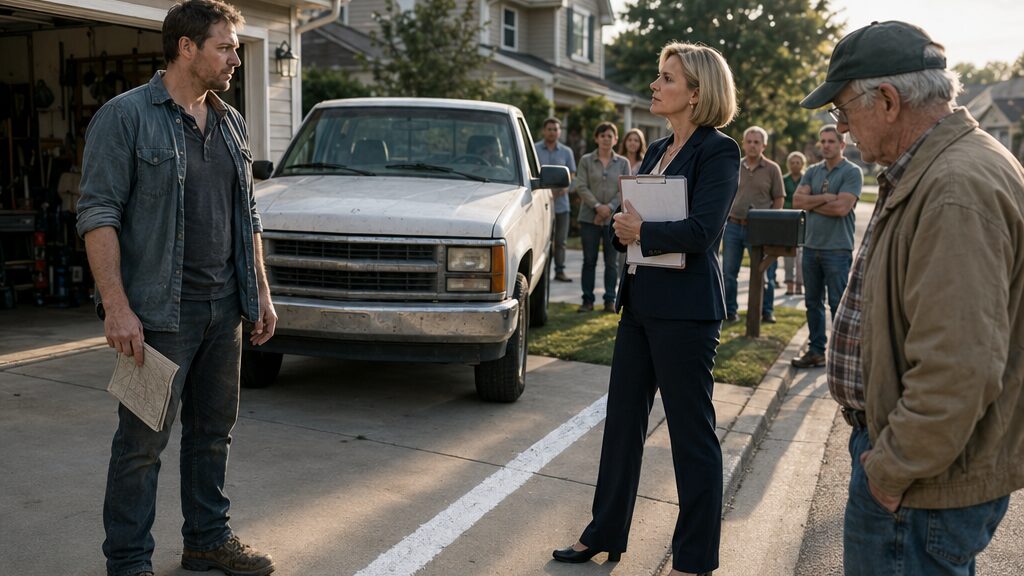
The White Line Across Tyler’s Driveway Wasn’t Just a Parking Rule
Chapter 1: The Line Was Dry Before Tyler Got Home
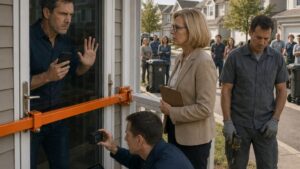
The white stripe cut across Tyler Walker’s driveway like somebody had drawn a boundary through his life while he was gone.
He stopped with one boot on the concrete and the truck door still open behind him. The engine ticked as it cooled. His right hand stayed on the door frame. For a second, he thought it was tape, the kind utility crews used before digging, but the line was too wide and too clean for that. It crossed from the left edge of his driveway to the right, bright against the old gray slab, running under the nose of his truck as if the truck had been parked wrong in its own home.
The paint was already dry.
Tyler looked toward the curb. No city truck. No workers. No orange cones. Just his front lawn, his father’s two trimmed maples, and Karen Clark standing on the sidewalk with a clipboard held against her ribs.
She was waiting for him.
“Evening, Tyler,” she said, like she had come by to borrow a rake.
Tyler shut the truck door carefully. He had grease on his knuckles from the shop, and his shoulders ached from leaning over a transmission all afternoon. He stared at the line again. It ran across the driveway just behind where his front tires usually rested.
“What is that?”
Karen glanced at the paint as if she had nearly forgotten it was there. “That is the new neighborhood parking limit.”
Tyler looked up. “The what?”
“The parking limit,” she repeated, a little louder. “Several homeowners have raised concerns about vehicles extending too far toward the sidewalk. The board has been reviewing driveway compliance.”
“My truck is in my driveway.”
“Not entirely within the appropriate limit.”
He gave the smallest laugh, not because it was funny, but because his body did not know what else to do. “Karen, you painted a line across my driveway.”
She adjusted the clipboard higher, hiding whatever papers were clipped there. “A contractor painted the line.”
“Who told him to?”
She held his gaze. Her mouth tightened into something almost satisfied.
“I did.”
Tyler did not answer. Across the street, a curtain shifted in the front window of the house beside George Hill’s. Someone had been watching. Maybe more than one person.
His father would have said something sharp. Not loud, not dramatic. Just sharp enough to leave a mark. Tyler could almost hear him from the porch, his voice low and worn thin from years of not being heard by people who enjoyed hearing themselves.
Instead, Tyler crouched and touched the edge of the paint with two fingers. Dry, chalky, slightly raised. Fresh enough that it smelled faintly chemical in the heat still coming off the concrete.
“You didn’t ask me,” he said.
Karen gave him a patient smile that made the back of his neck warm. “The association does not need individual permission to mark compliance boundaries related to common-view standards.”
“This isn’t common area.”
“It faces common view.”
“That’s not the same thing.”
“It is when the board is dealing with repeated violations.”
He stood. “Repeated?”
Her eyes flicked toward the truck. It was old, white, and clean enough, though the bumper had a dent his father had put in it years ago backing into a trailer hitch. Tyler had kept it because it ran well and because selling it had felt too much like throwing away a voice he already missed.
“Your vehicle has been reported more than once,” Karen said. “The front end extends beyond the acceptable parking depth.”
“Reported by who?”
“I’m not going to discuss other homeowners’ complaints.”
“There’s no complaint because there’s no rule.”
“There is now.”
He felt that one settle between them.
A lawn mower droned two houses down, then cut off. The sudden quiet made the street feel staged. Tyler looked at the white line, then at Karen’s clean shoes on the sidewalk. She hadn’t stepped onto his driveway. Not one inch. She knew exactly where to stand.
“You’re saying you decided where I’m allowed to park on my own concrete.”
“I’m saying the neighborhood has standards. People bought here because of those standards.”
“My father bought here before you knew this street existed.”
Karen’s face changed, not enough for anyone watching from a window to notice, but enough for Tyler to regret saying it. She did not look hurt. She looked as if she had found the loose thread in him.
“I understand this house has been through a transition,” she said. “That doesn’t exempt it from association rules.”
Transition. As if his father’s empty recliner and the boxes still stacked in the spare room were an administrative category.
Tyler turned his head toward the garage, where the old workbench was visible in the dimness. His father’s jars of screws were still lined up under the shelf. Tyler had meant to clear them out in March. Then April. Then he had stopped pretending he was going to.
He looked back at Karen. “Where is this rule written?”
“It’s in the updated compliance packet.”
“Send it to me.”
“You received the annual packet.”
“I received a landscaping notice and a budget summary. Nothing about painting my driveway.”
Karen sighed. “This is exactly why we’re trying to make boundaries clear.”
“That line isn’t clear. It’s vandalism.”
Her chin lifted. “Be careful with that word.”
“Be careful with paint.”
For a moment, neither of them moved.
A car slowed as it passed. The driver looked at the stripe, then at Tyler, then kept going. Tyler felt the attention like dust on his skin. He hated that. Hated being watched while something private was made public. His father had spent the last years of his life arguing with letters, boards, notices, corrections. Tyler had promised himself he would not inherit the fights along with the mortgage.
Karen opened the top page on her clipboard and slid out a printed sheet. “This is a courtesy warning.”
She held it out. Tyler did not take it.
“What happens if I park where I’ve always parked?”
“A formal violation may be issued.”
“For parking in my driveway.”
“For exceeding the marked limit.”
“Marked by you.”
“Marked according to board guidance.”
He stared at the page. The top corner had the HOA logo printed in blue, the kind of little subdivision emblem that looked official because someone had paid for a template. Below it were checkboxes. Vehicle placement. Curb obstruction. Sidewalk clearance. Visual nuisance.
Visual nuisance.
Tyler reached out and took the paper, but only by the edge. He did not want her to see that his hands had started to shake.
Karen’s voice softened, which made it worse. “I’m trying to keep this from becoming a bigger issue.”
“You painted a bigger issue across my driveway.”
“You can move the truck behind the line.”
“The truck won’t fit behind the line unless I park halfway into the garage.”
“Then perhaps the truck is not appropriate for this driveway.”
His father’s truck. His father’s driveway. His father’s house that still smelled faintly of sawdust in the hallway when the air conditioner kicked on.
Tyler folded the warning once, slowly, so he would not crumple it.
Karen watched the gesture. “The board meets next month. I’d rather not have to bring your address up formally.”
The threat was wrapped in neighborly concern, but Tyler heard the metal underneath.
He looked down at the white stripe. It was crooked by maybe half an inch near the right edge, where the painter had lifted the roller too soon. That bothered him more than it should have. Someone had done damage and not even done it straight.
“Who approved this?” he asked.
“I told you.”
“No,” Tyler said. “You told me you decided it. I’m asking who approved it.”
Karen’s mouth tightened again. “Tyler, you’re making this harder than it needs to be.”
That was what they always said when they had already made the hard part for you.
He stepped past her toward the porch. “Send me the rule.”
“You have the warning.”
“Send me the rule.”
Behind him, Karen’s shoes clicked once on the sidewalk. “If you park beyond that line tonight, I’ll have to document it.”
Tyler stopped at the first porch step. His key was already in his hand. He could feel the old brass teeth pressed into his palm.
He wanted to tell her to get off his property. He wanted to ask why a woman who lived three houses down had spent part of her day arranging paint on a dead man’s driveway. He wanted to say his father had been right about every person who mistook a clipboard for a conscience.
Instead, he unlocked the door.
Inside, the house was quiet and stale from being closed all day. Tyler set his lunch container on the counter, washed the grease from his hands, and stood at the kitchen sink longer than he needed to. Through the small window above it, he could see the nose of the truck and the white line under it.
He waited until Karen’s footsteps faded.
Then he went back outside.
The warning was not in his hand anymore. For a second, he thought he had left it on the porch rail. Then he saw a second copy, neatly tucked beneath the driver-side windshield wiper, angled so anyone passing could read the bold heading.
Courtesy Notice of Parking Boundary Noncompliance.
Tyler stood in the driveway with the folded paper in one hand and the public warning pinned to his truck, while the white line shone across the concrete between them.
Chapter 2: Everyone Came Outside to See the Mark
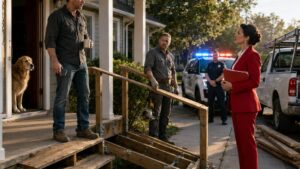
The garage door rattled upward the next morning, and Tyler found half the street looking at his driveway.
Not standing in a neat crowd, not officially gathered, but close enough to pretend they had all arrived by accident. A woman with a coffee mug near the curb. Two men by the mailbox across the street. George Hill in his faded cap, arms folded, squinting at the white stripe like it had insulted him personally. Karen Clark stood closest to the driveway, dressed for a meeting that had not been announced, her clipboard back in place.
Tyler’s truck sat exactly where it always did, its front tires just beyond the painted line.
He had left it there on purpose.
That had felt brave at midnight. It felt less brave with six neighbors staring at the front bumper.
Karen looked from the truck to him. “I was hoping you’d choose not to escalate.”
Tyler stepped out of the garage. “I parked in my driveway.”
“The line is visible.”
“Yes. That seems to be the problem.”
A few people shifted. Someone gave a short breath that was almost a laugh and then swallowed it.
Karen turned slightly toward the neighbors, not fully addressing them, but letting her voice carry. “This is exactly why the board has to clarify standards. When one homeowner ignores vehicle placement, it affects sight lines, sidewalk access, emergency clearance, and the overall appearance of the street.”
“My truck isn’t blocking the sidewalk,” Tyler said.
“It is beyond the marked limit.”
“The mark appeared yesterday.”
“Because the issue existed before yesterday.”
George stepped closer to the edge of the driveway. He was in his seventies, maybe, though Tyler had never asked. He had lived on the street longer than almost anyone. Tyler’s father used to talk to him by the mailbox, both of them pretending to discuss fertilizer when they were really comparing which board member had lost their mind that month.
George pointed at the line with his chin. “Karen, where’d this rule come from?”
“It’s in the updated packet,” she said.
“I read the packet.”
Karen’s smile did not move. “Then you may have missed the relevant section.”
“I was a survey tech for thirty-four years. I don’t usually miss lines.”
That time the laugh came from more than one person.
Tyler felt the street tilt a little. Until then he had been the man with the truck past the line. Now the line itself was on trial.
Karen flipped a page on her clipboard. “The board has received several complaints about driveway overhangs. Not only here. On this block generally.”
“Who complained?” one neighbor asked.
“We don’t need to personalize this.”
“You painted his driveway,” George said. “It’s already personal.”
Karen’s face colored, but she kept her posture. “The paint is temporary. It’s a visual guide.”
Tyler looked at the thick white stripe baked onto his concrete. “Temporary for who?”
She ignored that. From the clipboard she pulled a folded copy of a subdivision diagram and held it up. “This is the compliance reference map. It shows the acceptable front-drive boundary relative to the sidewalk and curb apron.”
The paper had been copied too many times. Even from where Tyler stood, he could see the gray blur of old lot lines, the heavy black marks that had probably been added later, the HOA logo stamped in the corner.
Karen pointed to a dark bar on the diagram. “The line is consistent with this.”
George put on reading glasses from his shirt pocket and leaned in. “That map doesn’t show driveway depth. It shows original setback from the old sidewalk easement.”
Karen blinked. “It shows the boundary.”
“It shows a boundary,” George said. “Not necessarily the one you think.”
Tyler felt something stir in his memory. Not a full thought, just a picture: his father at the kitchen table, paper spread under one hand, pencil in the other, muttering about a copy of a copy. Tyler had been carrying groceries. He had not stopped. He had been tired of hearing about the HOA by then, tired of mail and measurements and the way his father could turn dinner into a property lecture.
He turned toward the garage.
Karen saw him move. “Tyler, walking away doesn’t change the violation.”
“I’m not walking away.”
In the back corner of the garage, beside the workbench, there was a metal file cabinet his father had labeled with masking tape. Taxes. Warranty. House. Tyler had opened the first two after the funeral and avoided the third. The drawer stuck, then gave way with a screech. He pushed past insurance papers, appliance manuals, old HOA newsletters, until he found a long yellow envelope with the word PLAT written in his father’s blocky hand.
When he came back outside, Karen was speaking to the neighbors again.
“—not about punishing anyone. This is about fairness. If we let one driveway become a parking extension, then everyone starts testing the limits.”
Tyler unfolded the old plat map without answering.
It was larger than Karen’s copy and creased so deeply the paper wanted to fold back into itself. The ink was faded, but the lot lines were fine and sharp. His father had marked one section in pencil near the front of the property. Tyler saw the street name, the curve of the sidewalk, the driveway cuts. He saw his lot number. Then Karen’s. Then George’s.
George stepped beside him and went still.
“Where did you get that?” Karen asked.
“My father’s files,” Tyler said.
“That may be outdated.”
George’s mouth tightened. “No. This is older. That’s different.”
“Older is outdated,” Karen said.
“Not if the newer one was copied wrong.”
The street grew quiet.
Tyler held the map out. “George, can you read that front line?”
George took one edge of the paper, careful with the creases. He traced the boundary with one finger, then looked from the map to the driveway. He walked slowly toward the curb, counting under his breath. One neighbor moved out of his way. Karen stood fixed in place.
George stopped near the painted stripe.
“This line,” he said, tapping the air above the paint, “doesn’t match the lot boundary.”
Karen let out a controlled sigh. “It matches the compliance map.”
“I’m not done.” George looked at the old plat again. “If you extend this mark across the front line the way it’s painted, it cuts through Tyler’s legal driveway depth.”
“That’s not—”
“And it doesn’t stop here.”
Tyler followed George’s gaze across the street edge, past the strip of lawn between properties, toward the next driveway, then the next.
George pointed once, twice, three times.
“It crosses three driveways.”
A neighbor with the coffee mug said, “Three?”
George nodded. “Tyler’s, the next one over, and…” He lowered the map and looked directly at Karen. “Yours.”
Karen’s hand tightened around the clipboard. “Wait, what?”
The words hung there, small and unprotected.
People looked toward Karen’s house three doors down, where her own driveway widened near the garage in a neat fan of newer concrete. Tyler had never paid attention to it before. Now everyone did.
Karen took two quick steps toward the map. “Let me see that.”
Tyler did not pull it away, but he did not hand it over either. “Careful. It’s old.”
George kept hold of one corner. “The issue is the diagram you’re using. It looks like somebody took an old easement line and treated it as a parking boundary.”
“That’s your interpretation,” Karen said.
“It’s geometry.”
Someone laughed then, not cruelly, but openly enough to make Karen’s face harden.
Tyler should have felt victory. Instead he felt exposed. His father’s map was open in front of everyone. His father’s pencil marks. His father’s old fight, whatever it had been, unfolding on the driveway like a second white line.
Karen regained her voice. “This needs board review.”
“You didn’t need board review to paint it,” Tyler said.
The neighbors went quiet again.
Karen looked at him then, really looked, and Tyler saw something behind the irritation. Not doubt exactly. Calculation. Fear, maybe, though he could not tell of what.
She folded her copy of the diagram with sharp, practiced movements. “Until the board reviews it, the warning stands.”
George stared at her. “Even after that?”
“Especially after this,” she said.
By noon, two neighbors had taken pictures. By two, Tyler had borrowed a pressure washer from George. By four, water ran down the driveway in chalky streams, carrying pieces of Karen’s white line toward the gutter.
The paint faded, then broke, then lifted in streaks. But at the far right edge, where the roller had pressed hardest, a pale scar remained in the pores of the concrete.
Tyler stood over it with the wand still humming in his hand.
George, beside him, looked back toward Karen’s driveway and said quietly, “You know, if that mark is where she says it is, then her driveway’s inside it too.”
Chapter 3: The Paint Was Gone, But the Warning Stayed
By the next morning, the white line was only a ghost in the concrete, but the violation letter in Tyler’s mailbox looked very much alive.
It came in a white envelope with the HOA return address printed in the corner and his name centered in a window. No stamp, just hand-delivered. Someone had walked up to his porch before breakfast and left it where he would have to touch it.
Tyler stood at the mailbox with the envelope bent between his fingers. His truck was parked in the garage now, not because Karen had won, but because he had spent the night thinking about fines, hearings, and the long patience of institutions that had nothing better to do than make ordinary people prove where their own driveway ended.
He opened the envelope in the kitchen.
Formal Notice of Violation.
Not courtesy. Not warning. Formal.
The letter said his vehicle had been observed beyond the marked parking boundary. It referenced the compliance packet, the curb-visibility standard, and a potential fine if the violation continued. It also stated that removal or alteration of association-applied markings did not void the underlying rule.
Tyler read that line three times.
Removal or alteration.
He looked out the kitchen window at the damp driveway, the pressure washer hose still coiled near the garage. His first instinct was to call Karen and say something he would regret. His second was to throw the letter into the trash and go to work.
He did neither.
The phone number at the bottom of the letter led to a recorded message first, then a hold tone, then a woman’s voice that sounded tired before he had said his name.
“Association office, this is Lisa Carter.”
Tyler gripped the edge of the counter. “This is Tyler Walker on Maple Ridge Court. I got a violation letter.”
There was a pause. Paper shifted. “Yes, Mr. Walker. I have that file.”
“Then you know the line was wrong.”
“I know there is a dispute about the marking.”
“It crossed three driveways.”
“I understand that was said.”
“It wasn’t just said. There’s a plat map.”
Another pause. “Mr. Walker, I’m the treasurer. I’m helping with administrative calls this week because the manager is out. I can’t withdraw a violation on my own.”
“Who can?”
“The board can review it at the next meeting.”
“Next month?”
“The regular meeting is next month.”
“You sent a formal notice in one day, but correcting it takes a month?”
Her voice lowered slightly. “I’m not trying to make this harder for you.”
“Then don’t.”
Silence stretched. Tyler closed his eyes. He heard himself, heard the edge in his voice, and hated that Karen had gotten him there by breakfast.
Lisa exhaled. “The notice was generated because the marking was removed and the vehicle was documented beyond it.”
“Documented by Karen.”
“I can’t discuss individual board member submissions.”
“Of course not.”
“But if you have contrary documentation, you can submit it.”
“I have a county plat.”
“Then submit it.”
“And until then?”
“The violation remains open.”
He looked again at the letter. “There was a contractor. Who hired him?”
“I don’t have that in front of me.”
“Can you get it?”
“That would be part of the maintenance invoice file.”
“I want a copy.”
“You’re entitled to request association records in writing.”
The phrase landed with a familiarity that made Tyler’s jaw tighten. His father had said those words once with bitter amusement, reading from some letter at the kitchen table. Entitled to request. Not entitled to receive easily. Not entitled to be believed.
Tyler kept his voice level. “Then I’m requesting it.”
“In writing,” Lisa said.
“I’ll email you in five minutes.”
He did. He wrote three sentences, deleted two that sounded angry, attached photos of the faded line and his father’s plat map, then sent the request before he could talk himself out of it.
He went to work late. All morning, under the lift at the shop, the letter stayed folded in his back pocket, pressing into him every time he bent. His boss asked once if everything was all right. Tyler said yes too quickly and got back under the car.
By lunch, Lisa had replied.
Mr. Walker,
Attached please find the maintenance invoice responsive to your request. Please note that provision of this document does not constitute board review or withdrawal of any pending violation.
Lisa Carter
Treasurer
The attachment was a scanned invoice from Ronald Baker, Exterior Maintenance and Marking. Tyler opened it on his phone with greasy fingers and enlarged the description line.
Board-approved curb boundary work, Maple Ridge Court, lots 14–16. White guide marking per written instruction from K. Clark.
Lots 14–16.
Tyler’s house was lot 14. The neighbor between him and Karen was lot 15. Karen was lot 16.
He sat on an overturned bucket behind the shop, the sun reflecting off the cracked screen of his phone, and felt the first clean piece of anger he had felt since the line appeared. Not hot. Not wild. Clean.
Karen had not made a mistake only on his driveway. She had ordered markings across three lots and then acted surprised when George read the map aloud.
Either she had not known what she was doing, or she had known enough to hope no one else would.
After work, Tyler drove home with the invoice printed from the shop office and placed on the passenger seat. He parked in the garage again, then hated himself for it. The concrete outside showed only faint traces now. Anyone passing would think the problem had been washed away.
His mailbox held nothing new. His porch was empty. For ten quiet minutes, the house let him believe he could put the papers in a drawer and wait for the meeting like a reasonable person.
Then he saw the metal file cabinet in the garage.
The House drawer was still half open from yesterday, the yellow plat envelope resting on top. He meant only to put the map away. That was what he told himself. Put it away, eat dinner, stop feeding the thing.
But when he lifted the envelope, something behind it slid forward and dropped flat against the drawer.
A brown folder, worn soft at the corners.
His father’s handwriting covered the tab in black marker.
Boundary Correction.
Tyler stood there with the garage light buzzing overhead. He did not pick it up right away. The folder seemed heavier than paper should be, as if opening it meant admitting his father had been trying to show him something long before Karen ever painted the driveway.
Finally, Tyler pulled it free.
Inside, clipped to the first page, was a copy of the same plat map.
The same front section was circled in pencil.
And beside the circle, in his father’s handwriting, were four words Tyler had never seen before.
HOA map is wrong.
Chapter 4: His Father Had Folded the Same Map First
Tyler opened the folder on the kitchen table and found his father’s anger organized into paper clips.
The first page was the plat map, folded into quarters, the crease worn white where thumbs had pressed it open too many times. The same front strip of the property was circled in pencil, but there were other marks too: small arrows, measurements in the margins, question marks beside the copied easement line. His father had not scribbled like a man ranting at clouds. He had measured. He had compared. He had tried to make the paper tell the truth.
Tyler stood over it with one hand braced on the table.
The house was quiet except for the refrigerator motor and the faint hum of a neighbor’s blower somewhere down the street. On the table beside the folder lay Karen’s warning, the formal violation, Ronald Baker’s invoice, and the printout of Tyler’s email to Lisa. Four different pieces of paper, all saying the same thing in different voices: prove what should not need proving.
He lifted the next sheet.
A letter from his father to the HOA board, dated six years earlier.
To whom it may concern,
The subdivision boundary reference used in recent parking and driveway correspondence does not match the recorded county plat for Lots 14 through 16. The difference affects legal driveway access and cannot be treated as a visual standard without correction.
Tyler stopped reading.
Six years.
His father had been fighting the same line before it was paint.
He sat down hard in the chair. The legs scraped against the floor, loud enough to make him glance toward the hallway as if someone might answer. No one did.
He remembered that year in fragments. His father still strong enough to mow the lawn but winded by the time he reached the maple trees. A stack of envelopes on the kitchen counter. Tyler arriving late from the shop, eating standing up, nodding without listening while his father talked about easements and board packets and “somebody using the wrong map because it’s convenient.”
Tyler had thought it was stubbornness. Another neighborhood fight. Another old man refusing to let a small thing go.
Now the small thing had been painted across the driveway.
The folder contained copies of emails, certified mail receipts, a photo of the driveway before the newer sidewalks were poured, and a handwritten note: County says correction must be acknowledged by HOA before recorded update can be attached to association documents.
At the bottom of the note, his father had written one more line.
Tyler can handle if needed.
He pushed the paper away like it had burned him.
The next morning, he called in late to the shop and drove to the county records office with the folder on the passenger seat. He had never been there before. The building sat behind the courthouse, low and beige, with automatic doors that opened into air that smelled like old paper and floor cleaner.
A county records clerk sat behind a long counter under fluorescent lights. She had a stack of forms beside her keyboard and a pen tucked behind one ear.
“I’m looking for property records,” Tyler said, placing the folder down carefully. “Subdivision plat. Maple Ridge Court. Lots 14 through 16.”
The clerk slid a form toward him. “Owner name and parcel number if you have it.”
“I have the lot number.”
“That’ll help.”
He filled out what he could. His handwriting looked too much like his father’s when he wrote Walker. The clerk took the form, typed for a while, frowned once, then typed again.
“You’re looking for the original recorded plat or later amendments?”
“Both, I guess.”
She glanced at the papers he had brought. “You have a dispute?”
“HOA says my driveway ends where the county map says it doesn’t.”
“That happens more than it should.”
The sentence was so ordinary it almost made him laugh.
She printed two pages, then disappeared into a back room. Tyler waited under a framed notice about record request fees. At the far end of the counter, someone argued softly about a deed transfer. Tyler checked his phone twice, though no one had called. Karen had not emailed. Lisa had not replied to his second message. The quiet felt procedural, not peaceful.
When the clerk returned, she carried a larger sheet in a protective sleeve.
“This is the recorded subdivision plat,” she said. “Original. And here is the sidewalk easement adjustment from twelve years ago.”
Tyler leaned over the counter. The county map matched his father’s. The driveway depth was clear. The line Karen had ordered would slice through the usable approach, not mark a legitimate parking boundary.
The clerk tapped another printed sheet. “There was a correction request opened by a George Walker.”
Tyler swallowed. “My father.”
“It looks like he submitted supporting documents and requested that the association update its internal reference map.”
“Was it approved?”
Her fingers moved over the keyboard. “County didn’t need to approve the HOA’s internal map. We only record official plats and amendments. But the note here says acknowledgment requested from the association.”
“Did they acknowledge it?”
The clerk’s face became careful, the way Lisa’s voice had become careful on the phone. “There’s no completed acknowledgment attached.”
“So it was never corrected.”
“Not in the association packet, from what this shows.”
Tyler looked down at his father’s folder. The neatness of it hurt. “He wasn’t making it up.”
“No,” the clerk said, more gently now. “Not from what I’m seeing.”
That small sentence reached a place in Tyler he had kept shut since the funeral. His father had spent years sounding bitter because nobody would listen. Tyler had mistaken bitterness for obsession. Maybe the two had grown together, but they had not started that way.
The clerk pulled one more page from the printer. “There is a reference to a notice sent to the association. I can check the archive.”
“How long?”
“A few minutes if it was scanned correctly. Longer if not.”
“I’ll wait.”
He waited with both hands folded over his father’s folder. He thought of the pencil line on the map. Not paint. Pencil. Something that could be erased if proven wrong. His father had always used pencil for measurements until the last answer was certain.
When the clerk returned, her expression had changed.
“I found the notice,” she said. “It was scanned under correspondence, not correction documents.”
She turned the page toward him.
The letter was from the county records office to the Maple Ridge HOA, dated five years and nine months earlier. It identified the mismatch between the county plat and the association’s reference diagram. It recommended updating association materials to avoid improper enforcement related to driveway access. At the bottom was a received stamp.
Tyler’s eyes moved to the signature line.
Received by the HOA board president.
Not Karen. Someone before her.
But received.
The clerk gave him a copy. “You’ll probably want this.”
Tyler stared at the stamp. For two days, he had wondered whether Karen had invented a rule. Now the paper in front of him suggested something worse and duller: somebody had been told the rule was wrong and had kept using it anyway.
He folded the copy once, then stopped himself and laid it flat inside his father’s folder.
Outside, in the parking lot, Tyler sat in his truck without starting it. The folder lay on the passenger seat where Ronald Baker’s invoice had been the day before. He pressed both palms against the steering wheel and tried to picture his father walking out of this same building with the same kind of paper, still believing a correction could be made if he simply showed the right person the right proof.
Tyler’s phone buzzed.
An email from Lisa Carter.
Mr. Walker,
The board has received your additional comments. Please be advised that discussion of historical map issues may not be relevant to your current violation. You may attend the next open meeting and speak during homeowner comment.
Regards,
Lisa Carter
Historical map issues.
Tyler looked at the county notice again, at the received stamp dark on the page, and understood that the next meeting was no longer about paint.
Chapter 5: Karen Needed the Wrong Map to Be Right
Lisa Carter called Tyler on Saturday morning and asked a question that did not sound like a question.
“Do you understand what correcting that map will do to Karen’s lot?”
Tyler stood in the garage with the county records spread across the hood of his truck. He had been arranging the papers by date, trying to build something cleaner than anger. The phone was on speaker beside the windshield wiper where Karen’s warning had been tucked three days earlier.
“What does that mean?” he asked.
Lisa was quiet long enough that he could hear voices in the background, then a door closing. “It means this isn’t only about your driveway.”
“I know that.”
“No,” she said. “I mean Karen’s driveway extension may fall inside the same disputed strip.”
Tyler looked toward the open garage door. Down the street, Karen’s house sat tidy and pale behind clipped shrubs. Her driveway widened near the garage, a newer fan of concrete that held two cars side by side if both were parked tightly. He had noticed it after George pointed out the lot numbers. Now he could not stop noticing it.
“She had work done?” Tyler asked.
“A few years ago.”
“Approved?”
“I don’t have the full file.”
“That sounds like an answer trying not to be one.”
Lisa let out a tired breath. “I’m calling because I think you should understand the board will be defensive.”
“The board painted my driveway.”
“Karen authorized a contractor.”
“Using board language.”
“Yes,” Lisa said, and there was a strain in the word. “Using board language.”
Tyler picked up Ronald’s invoice and set it beside the county notice. “Why are you telling me this?”
“Because if you walk into the meeting asking for the whole map to be corrected, it may trigger review of three lots, not just yours. That affects reserves, restoration, possible contractor costs, maybe legal review.”
“The map is wrong.”
“I’m not arguing that.”
“But you’re warning me not to say it too loudly.”
“I’m warning you that people rarely thank you for being right when it costs them money.”
Tyler almost answered, but the sentence stayed with him. It sounded like something his father would have understood too well.
After the call ended, he walked down the sidewalk with the folder under one arm. He did not plan to go to Karen’s house. That was what he told himself until he reached the edge of her driveway and stopped.
The newer concrete was a shade lighter than the older slab, smooth and clean, feathered into the original drive with a careful seam. No painted lines crossed it. No courtesy notice sat under her windshield wiper. Her two trash bins were tucked neatly behind a side fence, lids closed, handles turned in.
The front door opened before he could decide whether to leave.
Karen stepped out, holding a set of keys. She stopped when she saw him standing near the curb.
“If you’re here to make accusations, Tyler, this is not the place.”
“I’m here because Lisa called me.”
Karen’s face tightened. “Lisa shouldn’t be discussing board matters privately.”
“She said correcting the map affects your driveway.”
Karen came down one step. “My driveway is not the issue.”
“It became the issue when your line crossed it.”
“My line did not cross my driveway.”
“On the county plat, it does.”
“That plat is not how the HOA has interpreted the frontage standard.”
He looked at her then, at the careful blouse, the clipped hair, the keys in her hand. She looked less like someone who had won and more like someone guarding a door with her back against it.
“Why did you order the paint before the board approved it?”
Her eyes moved past him toward the street. “Homeowners were complaining.”
“About my truck?”
“About more than your truck.”
“But you started with mine.”
“You were the most visible violation.”
“I was the easiest one.”
“That’s not fair.”
He almost laughed. “Karen.”
She stepped off the porch fully then, lowering her voice. “You don’t know what people say at these meetings. They want the neighborhood clean, but they don’t want to be the ones knocking on doors. They want property values protected, but when someone has to enforce the standards, suddenly that person is the villain.”
“So you painted first and checked later.”
“I used the packet I was given.”
“After George said it was wrong, you still kept the violation open.”
Her mouth pressed flat. For the first time since the line appeared, she looked genuinely tired.
“There’s an annual inspection in three weeks,” she said. “The management company comes through, takes photos, flags everything. Overgrown shrubs, cracked fences, vehicles, driveway additions. The board president asked me to get ahead of the obvious issues.”
“My truck was obvious.”
“Yes.”
“And your driveway?”
Her eyes flashed. “My driveway was approved.”
“By who?”
“The board at the time.”
“Using which map?”
She did not answer.
A teenage boy appeared briefly behind the screen door, backpack over one shoulder. Karen turned her head, and her face changed with the speed of a curtain being drawn. “I’ll be there in a minute.”
The boy disappeared.
Tyler saw it then, not as forgiveness, but as shape: Karen was not only protecting a title. She was protecting the version of herself that kept the house orderly, the board pleased, the neighbors quiet, her kid from hearing adults talk about violations and fines and mistakes attached to their address.
She looked back at Tyler. “I am not trying to hurt you.”
“You already did.”
The words landed harder than he intended. Karen blinked once.
Tyler looked down at the folder. “My father tried to correct this.”
“I heard your father had disagreements with prior boards.”
“He had documents.”
“He also had a way of making every issue personal.”
Tyler felt the heat rise. “He was sick.”
“I know.”
“No, you don’t.”
Karen’s face softened, but only slightly. “You’re right. I don’t.”
For a few seconds, neither spoke. A car rolled past slowly, the driver pretending not to look.
Karen came down to the walkway, close enough now that her voice could not carry. “I can get the fine dropped.”
Tyler looked at her.
She continued quickly. “The board doesn’t need another fight. I can recommend withdrawal of the violation due to unclear marking. You stop pushing the historical correction. We agree the paint was premature. It goes away.”
“The map stays wrong.”
“The practical issue goes away.”
“For me.”
“For now.”
“And the next person?”
Her jaw tightened again. “Most people just want to live here without turning every line into a court case.”
“My father tried to fix it quietly.”
“Your father didn’t have to deal with the current inspection cycle.”
“No. He had to deal with cancer and certified letters.”
Karen looked away.
Tyler had not meant to say cancer. He had barely said the word aloud in months. It changed the air between them, making the tidy lawn and trimmed shrubs feel indecently normal.
When Karen spoke again, her voice was lower. “I am sorry about your father.”
He believed she meant it. He also believed she still wanted him to stop.
She held out one hand, palm down, not asking for the folder, just trying to flatten the moment. “Take the withdrawal. Don’t make this bigger than it needs to be.”
Tyler thought of the white line bright across the driveway, of neighbors watching him as if the truck were proof of character, of his father’s note: Tyler can handle if needed.
He had spent years thinking handling something meant not letting it touch him.
“No,” he said.
Karen’s hand dropped.
“I’m requesting time at the board meeting,” Tyler said. “Not homeowner comment. Agenda time.”
“You won’t get that.”
“Then I’ll ask in writing.”
“Tyler—”
“And I’m submitting the county notice.”
Her face closed, the tiredness sealed behind authority again.
“Then understand,” she said, “once you make this a board matter, it won’t only be your version on the table.”
For the first time, Tyler did not step back from the warning. He tucked the folder under his arm and turned toward home.
At the end of Karen’s driveway, he stopped and looked once at the pale seam where the newer concrete met the old.
Then he crossed the street, already composing the email in his head.
Chapter 6: The Board Wanted Silence More Than Accuracy
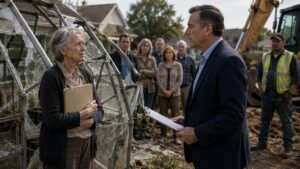
Tyler arrived at the clubhouse ten minutes early and found his violation already printed on the agenda under Unresolved Homeowner Compliance.
Not Boundary Review. Not Map Correction. Not Unauthorized Marking.
Unresolved Homeowner Compliance.
The agenda was taped to the glass door beside a notice about pool hours. Tyler stood outside with the folder tucked against his ribs and read the line twice while his reflection hovered over the words. Behind the glass, folding chairs had been arranged in rows. At the front, the board table held water bottles, name placards, and a small projector aimed at a pull-down screen.
Karen was already inside.
She saw him through the door and looked away first.
That should have felt like something. It didn’t. Tyler opened the door and stepped into the low murmur of neighbors pretending this was a normal meeting.
George sat near the aisle and lifted two fingers in greeting. Lisa Carter was at the board table with a binder open in front of her, flipping pages too quickly. The HOA board president, a heavyset man with reading glasses low on his nose, tapped a pen against the agenda.
Tyler took a seat in the second row. The folder rested on his knees, both hands flat over it.
At seven sharp, the board president called the meeting to order. They moved through minutes, landscaping bids, pool repairs. Tyler watched the hands of the clock over the exit sign and felt, with every routine item, how institutions protected themselves with boredom. Make the room tired enough, and truth would start to look like inconvenience.
When the president reached compliance, he cleared his throat. “We have an unresolved parking boundary matter at the Walker property.”
Tyler stood. “I requested agenda time for a boundary correction.”
“You may speak during homeowner comment.”
“This is the same issue.”
The president peered over his glasses. “The agenda item concerns the violation notice.”
“The violation is based on the wrong map.”
Karen leaned toward her microphone though she did not need one in the small room. “The board has not determined that.”
A few neighbors turned. Tyler saw one of them glance down, embarrassed to be interested.
The president raised a hand. “Mr. Walker, you’ll have three minutes during comment.”
Tyler felt the old instinct rise: sit down, wait, do it politely, don’t make the room turn against you. His father had not followed that instinct. His father had become sharp and tired and, in Tyler’s memory, embarrassing.
Tyler stayed standing.
“Then I’d like the violation tabled until the board reviews the county plat.”
“That is not the motion before us,” the president said.
Lisa stopped flipping pages.
Karen’s voice came smooth and controlled. “The homeowner removed an association-applied marking and continued parking beyond the boundary. Those are the facts before the board tonight.”
Tyler opened the folder. Not dramatically. Just enough that the county notice sat on top.
“Ronald Baker is here,” he said.
Everyone looked toward the back row.
Ronald Baker sat near the door in a work jacket with paint on one cuff. He looked as if he regretted every life choice that had brought him there. Tyler had called him that afternoon, expecting no answer. Ronald had answered on the third ring and said, “I figured this was coming.”
The board president frowned. “Mr. Baker is not on the agenda.”
“He painted the line.”
Ronald shifted in his chair. “I can answer if asked.”
Karen’s face went still.
Lisa closed her binder. “I think we should ask.”
The president looked irritated now, but several neighbors had turned fully in their seats. Public boredom had broken.
“Fine,” he said. “Briefly.”
Ronald stood, cap in both hands. “I was hired to paint guide markings on Maple Ridge Court. Lots 14 through 16. I was given a diagram and written instruction from Ms. Clark.”
Karen leaned forward. “Under compliance authority.”
Ronald nodded carefully. “That’s what I was told.”
“Before board approval?” Lisa asked.
Karen turned to her. “We discussed driveway visibility.”
“That isn’t what I asked.”
The room shifted again. Lisa’s voice had changed. It had lost its administrative cushion.
Karen looked at the president. “We had ongoing complaints. The board agreed something needed to be done.”
Ronald cleared his throat. “For what it’s worth, I asked if the marks had been surveyed. The line looked odd with the driveway cuts.”
Tyler’s eyes lifted.
Karen said, “You did not say that.”
“I asked if the map was official,” Ronald said. “You said it was the HOA standard.”
The words did not explode. They simply landed, and no one could sweep them up.
The president tapped his pen once. “This is getting beyond the scope.”
“No,” Lisa said.
The room went quiet.
Lisa opened her binder to a tabbed section. “I have the county record Mr. Walker submitted. I also pulled the association map packet from our digital files. The diagram used for recent compliance letters is labeled ‘draft frontage guide.’ It is not the recorded plat.”
Karen’s chair creaked as she sat back.
The president’s face reddened. “Lisa, we haven’t reviewed that as a board.”
“We’re reviewing it now because we issued a violation from it.”
Tyler looked at her, surprised. She did not look at him. Her eyes stayed on the papers, as if courage was easier when read from a page.
Karen’s voice sharpened. “This is exactly why we have procedures. We cannot let one homeowner bring in a stack of emotional documents and derail enforcement.”
Tyler felt the words before he understood them.
Emotional documents.
Karen looked at him then, and maybe she regretted the phrase as soon as it left her mouth, but she did not take it back.
“My father’s correction request is not emotional,” Tyler said.
The president lifted both hands. “Mr. Walker—”
“No.” Tyler heard his own voice, quiet but different. “You can call me out of compliance. You can call this historical. But don’t call his work emotional because he died before you fixed it.”
The room stilled completely.
He had not planned to say that. He had planned to let the papers speak because papers could not tremble. But his hand was on the old folder now, and under his palm was the page where his father had written Tyler can handle if needed.
Tyler took out the county notice, the recorded plat, his father’s letter, Karen’s copied diagram, and Ronald’s invoice. One by one, he laid them on the front table.
“This is the county plat,” he said. “This is the HOA draft diagram. This is the notice the county sent the association almost six years ago. This is my father’s request that the packet be corrected. And this is the invoice for paint applied to three lots before the board approved it.”
No one interrupted.
George stood from the second row. “I knew his father was working on something. I didn’t know they’d received notice.”
The president stared at the pages as though they had appeared without anyone’s permission. “This needs executive review.”
Lisa shook her head. “Not if we’re discussing whether the violation was issued from a valid standard.”
Karen’s face was pale now. “Tyler is using his father’s death to embarrass this board.”
There it was. Not a rule. Not a packet. A blade.
Tyler looked at her for a long moment.
A month ago, maybe even a week ago, he would have folded the papers back into the folder and gone home before the room saw too much of him. He would have told himself he had kept his dignity because he had kept his grief private.
Instead, he picked up his father’s correction request and placed it beside the HOA’s wrong diagram, edge to edge, so the difference between the two lines was impossible to miss.
“My father tried to keep this from becoming public,” Tyler said. “I’m the one who waited too long.”
Chapter 7: Tyler Drew the Boundary Where It Belonged
The board president looked at the two maps on the table and said, “There is no agenda item tonight for a boundary vote.”
Tyler heard a few chairs shift behind him. The sentence had the sound of a door closing, official and hollow. For one moment, his fingers tightened on the edge of his father’s correction request, and the old reflex came back: gather the papers, step aside, let them bury the problem under procedure until everyone forgot who had been marked in the first place.
But the photo of the white line was still projected on the screen.
It was larger than life there, cutting across his driveway in a bright, careless slash. Beside it, on the table, the county plat waited under the fluorescent lights. The two lines could not both be true.
Tyler looked at the board president. “Then add one.”
“We don’t add voting items from the floor.”
“You issued a violation from the floor,” Tyler said. “The paint went down before board approval. The notice came before review. The only thing you’re slowing down is the correction.”
Karen sat very still. Her hands were folded around a pen she had not used in several minutes. The sharpness had drained from her face, leaving something strained and exposed.
The president took off his glasses. “Mr. Walker, I understand you’re upset.”
“No,” Tyler said. “That’s not what this is.”
He picked up the county plat and placed it beneath the projector camera Lisa had set up for budget spreadsheets. The image jumped onto the screen, replacing the photograph of the painted driveway with the recorded map. Fine black lines, lot numbers, driveway cuts. It looked plain and almost boring, which made Tyler trust it more.
“This is the recorded plat,” he said. “Lots 14, 15, and 16. Mine, the neighbor’s, Karen’s.”
He took a pencil from the table. Not a marker. Not a pen. A pencil. He placed its tip against the projected paper beneath the camera and traced the correct boundary lightly, not hard enough to scar the page.
“This is where the county says the legal driveway access sits.”
The room leaned forward. Even the board president did, though he seemed annoyed with himself for doing it.
Tyler pulled the printed photo of the white line back under the camera and placed it beside the map. He drew another faint pencil line on a blank sheet between them, showing where Karen’s painted mark had been placed.
“This is where the HOA marked it.”
The difference was obvious. Not enormous to someone driving by, maybe. But enough to turn a driveway into a violation. Enough to threaten a fine. Enough to make his father spend his last good years writing letters no one answered.
George rose slowly from his chair. “That correction protects access for all three homes.”
The neighbor from Lot 15, who had said almost nothing until then, stood halfway. “Wait. My driveway too?”
George nodded toward the screen. “If the wrong guide keeps being used, yes. Your front approach could be called noncompliant the same way.”
The neighbor looked at the board table. “Then why is this only Tyler’s violation?”
No one answered quickly enough.
Lisa’s face had tightened with the look of a person counting costs and finding them ugly. “Because Tyler’s truck was documented,” she said at last. “But the underlying standard appears to be… unreliable.”
Karen turned toward her. “That is not a formal determination.”
“It should become one,” Lisa said.
The board president put his glasses back on. “We cannot expose the association to open-ended liability based on one meeting.”
Tyler set the pencil down. “I’m not asking for open-ended anything. I’m asking for a recorded motion to suspend the violation, file the corrected plat with the association packet, and restore the damage caused by the marking.”
“Damage is a strong word,” Karen said.
Tyler looked at her. “There’s still paint in the concrete.”
“You pressure-washed it.”
“Because you put it there.”
Her mouth opened, then closed. The pen in her hand clicked once.
The president cleared his throat. “The association may be willing to withdraw the fine as a courtesy while we review the matter.”
“No,” Tyler said.
The word came out before he dressed it up.
The room went quiet again.
Lisa looked up from her binder. Karen looked relieved for half a second, as if she thought he had refused help out of pride and made himself unreasonable. The president leaned back.
Tyler understood what they expected. He could take the private win. He could go home with the fine gone and the paint mostly washed away. The neighborhood would remember a weird argument about a line, then move on. Karen’s driveway would remain untouched. The wrong diagram would stay in a packet until the next person parked past a boundary that had never been real.
His father had probably been offered some version of that too. A delay. A courtesy. A promise of review. Something soft enough to feel like peace and thin enough to tear.
“I don’t want a courtesy,” Tyler said. “I want the record corrected.”
The neighbor from Lot 15 sat back slowly, but his eyes stayed on the screen.
George spoke from the aisle. “You need a motion. Doesn’t have to settle every cost tonight. But you can suspend enforcement tied to that map and direct the packet to be corrected.”
Lisa’s fingers moved to a clean page. “That’s true.”
The president shot her a look. “Lisa.”
She did not look away. “It is. We can also authorize an estimate for restoration at the affected driveway.”
Karen’s chair scraped. “Affected driveway? There is one driveway with paint.”
“Because only one was painted,” Lisa said. “The boundary issue affects three.”
“And my property?” Karen asked, the words sharper than she seemed to intend.
There it was.
No one had said her driveway extension aloud until then. Not directly. The room heard it anyway.
The president’s face folded into irritation. “Any review of improvements would be separate.”
“Then keep it separate,” Karen said.
Tyler looked at her and saw the same thing he had seen outside her house: not just arrogance, not just rule hunger, but fear that one correction would pull on everything she had made look orderly.
He could have pushed then. He could have said her driveway should be measured first. He could have made the room turn toward her the way it had turned toward him on his own driveway. Part of him wanted to. The part of him that had held the warning notice, that had watched neighbors stare at his truck, that had read the phrase emotional documents and felt his father dismissed a second time.
Instead, he picked up the pencil again and set it beside the plat.
“I’m asking for the same rule to apply to everyone,” he said. “Not a special rule for Karen. Not a special rule for me.”
Karen looked at him then, confused enough that she could not hide it.
Tyler turned back to the board. “Suspend my violation. Stop using the draft diagram for enforcement. Attach the county plat and the county notice to the association packet. Get an estimate to repair my driveway surface. Review any affected property under the corrected map going forward.”
The president was silent.
Lisa looked down at her notes, then raised her hand slightly. “I move that the board suspend the Walker violation pending correction of the association frontage reference, attach the recorded county plat and related county notice to the compliance packet, and obtain a restoration estimate for the marked driveway.”
For a second, no one moved.
Then another board member, quiet until now, said, “Second.”
The president looked as if the word had been dragged from him personally. “Discussion?”
Karen’s pen lay still on the table. “This makes it look like I acted alone.”
Ronald, from the back, said softly, “You signed the instruction.”
It was not cruel. That made it worse.
Karen’s face tightened. “I acted because homeowners were pressuring the board to address visible issues before inspection.”
Lisa nodded once. “That can be included in the minutes. It doesn’t make the map correct.”
The president rubbed his forehead. He looked toward the neighbors, toward George, toward the projected plat. Procedure had stopped protecting him because too many people could now see the line.
“All in favor,” he said.
Lisa raised her hand. The quiet board member raised his. After a long pause, the president raised his too, not high, just enough to be counted.
Karen did not.
“All opposed?”
Karen’s hand rose alone.
“The motion carries,” the president said.
No one applauded. Tyler was grateful for that. Applause would have made the room too simple. Instead, people exhaled, shifted, looked at the map as if it had become part of their street in a way it had not been before.
Lisa wrote the motion down carefully. “The violation is suspended effective tonight.”
“Suspended,” Tyler said.
“For now,” the president replied. “Pending formal correction.”
“Recorded correction,” Tyler said.
Lisa looked up. “I’ll make sure the wording says that.”
Karen gathered her papers with quick, controlled motions. One sheet slipped from her folder and slid halfway across the table. It was a copy of Ronald’s invoice. Tyler recognized the description line even upside down.
Board-approved curb boundary work.
Karen put her hand over it before anyone else could pick it up.
The meeting moved on, or tried to. Pool furniture. Mailbox paint colors. A reminder about trash bins. The words floated around Tyler without landing. His folder was lighter now, though it held the same pages. When the meeting adjourned, neighbors stood in small clusters instead of rushing for the door.
George came up beside him. “You did that right.”
Tyler slipped the pencil into the folder pocket. “I almost didn’t.”
“I know.”
Across the room, Karen stood with her teenage son near the exit. He must have arrived during the meeting and waited by the wall, looking uncomfortable in the way only teenagers can when adults make home feel public. Karen saw Tyler notice him. Her face changed again, not proud now, not official. Just tired.
Tyler looked away first.
By the door, Lisa handed him a copy of the handwritten motion. “This isn’t the end of it,” she said.
“I know.”
“But it’s in the minutes now.”
Tyler folded the copy once and placed it in the folder, beside his father’s request.
Outside, the clubhouse parking lot was mostly dark. Tyler walked to his truck under the yellow light near the entrance. Before he got in, he looked back through the glass doors. Karen was still inside, standing alone at the board table, staring down at the place where the wrong diagram and the corrected plat had been laid side by side.
Chapter 8: Only the Faintest Trace Stayed in the Concrete
The restoration crew arrived two weeks later and made the ghost of the white line louder before they made it disappear.
The grinder screamed against the concrete, a high, rough sound that pushed Tyler back toward the garage with his coffee cooling in his hand. Pale dust lifted where the paint had settled into the pores. For a few minutes, the stripe reappeared as a wound being cleaned too hard—brighter in patches, stubborn at the right edge where Ronald’s roller had pressed deepest.
Tyler watched from beside the workbench.
The truck was parked in the street for the first time since the meeting, legally and deliberately, with no warning under the wiper. The HOA had sent a corrected notice three days earlier: violation suspended, frontage guide under revision, county plat attached for interim reference. The language was still stiff. No one had written, We were wrong. But the wrong map was no longer hiding in the packet.
That had to count for something.
A worker leaned into the garage opening. “We’ll blend the finish as best we can. Might still be a faint shade difference.”
“That’s fine,” Tyler said.
The worker nodded and went back to the grinder.
On the kitchen table inside, the folder had changed shape over the last two weeks. Tyler had added Lisa’s motion, the corrected notice, the restoration estimate approved by the board, and a copy of the email confirming the county plat would be attached to the association file. His father’s original correction request stayed on top. Tyler had stopped moving it to the bottom.
George came over just after ten, carrying two paper cups from the coffee place by the highway.
“Figured you’d be standing here pretending not to supervise,” he said.
Tyler took one. “I’m not supervising.”
“No. You’re silently judging their technique.”
Tyler almost smiled. “There’s a difference.”
George looked at the driveway. “They’re doing decent work.”
The grinder whined again. Fine dust settled on the grass near the edge of the slab. Tyler watched the last visible piece of the stripe blur into a lighter patch.
“Did my father talk to you about it?” Tyler asked.
George did not pretend not to know what he meant. “Some.”
“Why didn’t you tell me?”
“You weren’t ready to hear it.”
Tyler looked at him.
George took a slow drink of coffee. “That’s not an excuse. Just the truth as I saw it. After he got sick, people stopped arguing with him because they didn’t want to upset him. Then they stopped listening for the same reason. I should’ve paid closer attention.”
“He wrote that I could handle it if needed.”
George’s face softened. “He said something like that once.”
“What exactly?”
“He said, ‘Tyler thinks I’m fighting the board because I’m bored. One day he’ll know I was trying to leave the house easier than I found it.’”
The grinder stopped.
The sudden quiet made Tyler hear the leaves moving in the maple trees. He looked toward the driveway, but for a second he saw his father at the kitchen table instead, pencil in hand, shoulders bent, not defeated yet. Tyler had mistaken the papers for obsession because grief had made him selfish before death even arrived. He had wanted his father to talk about anything else. The weather. The shop. Dinner. Not boundaries. Not notices. Not another letter from people who could outlast him with procedures.
“He was hard to listen to sometimes,” Tyler said.
George nodded. “He was. Being right doesn’t always make a man easy.”
That did make Tyler smile, though it hurt.
A car slowed near the curb. Tyler turned as Karen Clark stepped out from her sedan. She wore jeans and a plain sweater instead of her board clothes. For a moment she stood with one hand on the open car door, watching the workers brush dust away from the driveway.
George looked at Tyler, then at Karen. “Want me to stay?”
Tyler shook his head. “No. It’s okay.”
George squeezed his shoulder once and walked back toward the sidewalk, slow enough that he could still hear if things went wrong.
Karen crossed the lawn edge but stopped before the driveway. She had learned that much, at least.
“I didn’t know the crew was coming this morning,” she said.
“Lisa scheduled them.”
Karen nodded. Her eyes followed the pale patch where the line had been. “They did a better job than I expected.”
Tyler waited.
She reached into a folder under her arm and pulled out a paper. “This is the contractor invoice copy. The original is with the association records now. Lisa said you already had one, but…” She held it out.
Tyler took it. She did not quite meet his eyes.
The description line had been circled in blue ink. Board-approved curb boundary work. Beneath it, someone had added a note: Authorization disputed; corrective action approved.
“Why bring this to me?” he asked.
Karen’s fingers tightened on the folder. “Because I should have given you the file when you asked.”
“I asked Lisa.”
“You asked me first, in the driveway.”
He remembered: Who approved this?
He had not expected her to remember too.
Karen looked toward the street, where George had stopped near his mailbox and was making a poor show of sorting nothing. “The board president is stepping down at the end of the quarter.”
Tyler blinked. “Because of this?”
“Because of several things. This made them harder to ignore.”
“And you?”
“I’m staying on compliance for now.” She said it quickly, then added, “With a review process. No markings without board approval. No enforcement from draft maps.”
“That seems basic.”
“It is.”
The old Karen would have corrected his tone. This one only nodded.
A worker came over with a hose and sprayed the driveway clean. Water moved across the concrete in a thin sheet, carrying pale dust toward the gutter. Karen watched it go. Her expression was difficult to read. Pride still lived there. So did embarrassment. Maybe both would remain.
“My driveway extension is being reviewed,” she said.
Tyler had not asked.
“I figured you’d hear anyway.”
“Probably.”
“It was approved by the board at the time.”
“Using the wrong map?”
She looked down. “Using the packet everyone used.”
The distinction mattered to her. Tyler understood that now. Karen had not forged a thing or built in secret. She had trusted the same wrong authority she later wielded against him. That did not undo what she had done, but it made the shape of it sadder.
“What happens?” he asked.
“I may have to file for a variance. Or cut back part of the extension. I don’t know yet.”
Her voice held steady, but barely. Tyler thought of her teenage son waiting at the clubhouse wall, trying to disappear from adult consequences.
He said, “I didn’t ask for them to start with yours.”
“I know.”
“I asked for the same rule.”
“I know,” she repeated.
The worker shut off the hose. The driveway gleamed wet in the sun. The line was gone if you did not know where to look. If you did, there was still the faintest difference in the concrete, a pale memory running from edge to edge.
Karen saw it too.
“I’m sorry for painting it,” she said.
Not I’m sorry you felt. Not I’m sorry this became complicated. Painting it.
Tyler looked at the driveway for a long moment before answering. “I’m sorry I waited until after my father died to read his folder.”
Karen’s eyes lifted, surprised.
“That part isn’t yours,” he said. “But it’s true.”
She held the empty folder against her side. “He was right about the map.”
“Yeah.”
“I wish the board had listened then.”
Tyler thought about letting the sentence pass. It would have been easier. Cleaner. But clean was not the same as honest.
“You were the board this time,” he said.
Karen absorbed it. Her mouth tightened, then loosened. “Yes.”
There was nothing else she could say that would repair it more than that.
She left a few minutes later, walking back to her car without looking toward George’s mailbox. Tyler watched her drive away, then turned back to the driveway.
George returned as if he had not been waiting. “Well?”
“She apologized.”
“Fully?”
“Enough to use the word paint.”
George considered that and nodded. “That’s something.”
The workers packed up near noon. Lisa’s corrected notice arrived by email while Tyler was sweeping dust from the garage threshold. He printed it at the shop later that day on plain white paper. At home, he placed it in the folder with the county plat and his father’s correction request.
For the first time since opening the House drawer, he did not feel the urge to hide the papers away.
He carried the folder to the kitchen table and unfolded the recorded plat one last time. The creases were deep now, old and new crossing each other. His father’s pencil marks remained along the front boundary, careful and light. Tyler added nothing in ink. He only traced the correct line once with his finger.
George stopped by again near evening, this time with no coffee and no excuse. They stood in the driveway while the concrete dried in uneven patches.
“Your father would’ve liked the pencil better than the paint,” George said.
Tyler looked down at the faint trace that remained. “Because pencil can be corrected?”
“Because pencil means the person drawing the line knows he might still have to listen.”
The street was quiet. A delivery truck turned at the corner. Someone’s sprinkler clicked on and began its steady sweep. Ordinary sounds, returning to an ordinary place that had never been as simple as it looked.
Tyler folded the plat carefully, following the old creases first, then the newer one he had made at the meeting. He did not fold it small enough to disappear.
Inside, he placed the corrected packet in the kitchen drawer nearest the back door, the one with tape, batteries, and the spare garage remote. Easy to find. Easy to open. Not hidden in the file cabinet with the things people avoided until they became emergencies.
Before he closed the drawer, he looked at his father’s handwriting one more time.
HOA map is wrong.
Tyler slid the corrected notice on top of it.
Then he shut the drawer, not to bury the papers, but to leave them where the next person who needed the truth would not have to search so hard.
The story has ended.