The Mechanic They Threw From First Class Owned Every Door They Guarded
Chapter 1: The Mechanic Behind the Service Door
The maintenance worker was eating his dinner on an overturned bucket beside the waste compactor.
Every few seconds, the machine compressed another load behind him with a hydraulic groan. The air smelled of hot wiring, detergent, and spoiled fruit. A paper cup balanced between his boots. His sandwich rested on its wrapper across one knee.
George Walker stopped in the service corridor.
“Break room full?” he asked.
The worker looked up at George’s grease-darkened shirt and worn tool roll. Seeing another mechanic, he gave a tired half-smile.
“Wrong clothes for the nearest one.”
He nodded toward a steel door marked STAFF ACCESS. Beyond it, according to the airport plans George knew almost by memory, lay a short passage to the First Class VIP Lounge’s employee rest area.
“Security won’t let maintenance through,” the worker said. “Says guests can see us crossing.”
George looked at the bucket, the compactor, the cup trembling with each mechanical impact.
“Did you report it?”
“Three times.”
“And?”
“Resolved.”
The word was dry enough to cut.
George had spent the previous hour moving through the airport’s service levels without an escort. He wore the same charcoal work shirt he had once worn beneath machinery, though this one was newer and deliberately stained. The tool roll was not a prop. Its leather edges had softened beneath his hands over four decades.
Inside his jacket sat an executive access card capable of opening almost every controlled door in the terminal.
He had not used it yet.
“Show me the door,” George said.
The worker pointed, then hesitated. “Latch sticks. They said they put in a repair order.”
George crossed the corridor and pulled. The handle moved, but the tongue remained lodged inside the frame.
He crouched slowly, his left knee complaining. From the tool roll he selected a narrow driver and an old steel pick. Two turns loosened the plate. He pressed the tongue, adjusted the alignment, and tightened it again.
The latch clicked cleanly.
The worker stared.
“You been doing this long?”
“Long enough to know when a repair order was never opened.”
George pushed the door once more, then let it close. The smooth sound brought back an older airport—concrete floors, deafening turbines, men eating from metal lunch boxes wherever supervisors permitted them to stand.
He had promised those men something when his first maintenance company won its airport contract.
No one who worked with their hands would ever be treated as an embarrassment.
He had repeated that promise when V-Group became large enough to build lounges instead of merely repairing what lay beneath them.
Somewhere between those years, the promise had become language in a company archive.
George left the worker with the repaired door and continued toward the maintenance bay. A terminal tablet hung charging near the supervisor’s station. He entered a temporary inspection code and opened the complaint log.
He found the first report quickly.
Maintenance personnel denied access to nearest designated rest facility during scheduled shift.
Status: Resolved.
The second described a cleaner ordered to carry visible supplies through a distant loading route while recovering from a leg injury.
Status: Resolved.
The third said a baggage technician had been refused drinking water because a private event was underway.
Status: Resolved.
George opened the closure notes.
Each contained the same sentence.
Staff reminded of alternate service pathways to protect premium guest experience.
Different dates. Different workers. Identical language.
He photographed all three entries with the plain dark phone hidden inside his jacket.
His pulse remained steady, but the inspection no longer felt abstract.
A public-address chime sounded overhead. Near the far end of the bay, two event workers hurried past carrying silver trays and a standing sign wrapped in black cloth.
“Change of room,” one said to the other. “Allen event moved into First Class.”
George recognized the name.
Nicholas Allen was supposed to be celebrating the expansion of his family’s luxury automotive brand. He did not yet know that the acquisition documents transferring control to V-Group had entered final execution.
The private event would place more pressure at the lounge entrance. More wealthy guests. More concern about appearance. More chances for the truth to show itself.
George tightened the strap around his tool roll.
The path from the service corridor opened onto a polished concourse lined with soft lighting and silent advertisements. The contrast was immediate. Behind him, carts rattled and compressors hummed. Ahead, carpet absorbed every footstep.
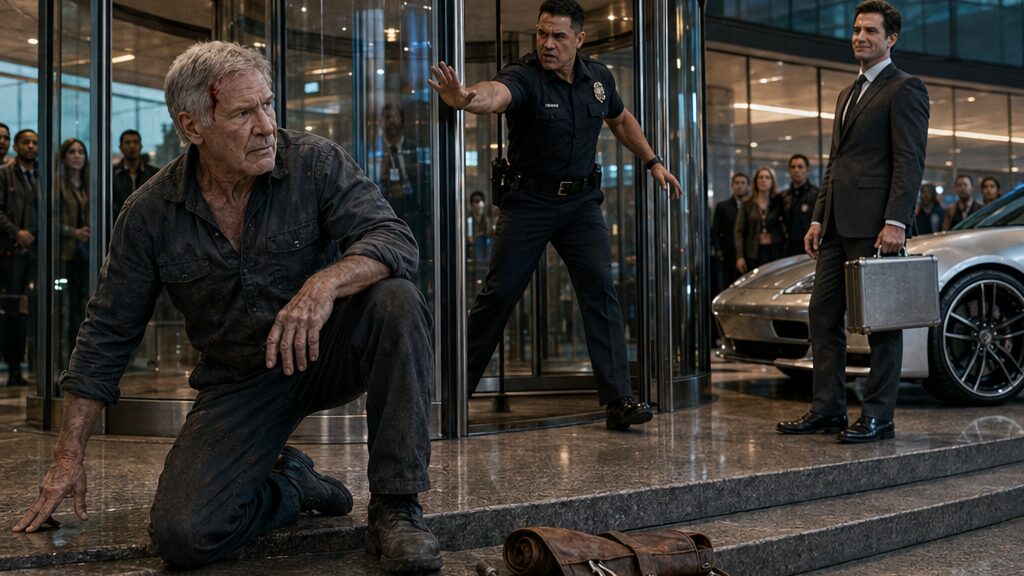
At the center of the lounge entrance stood a stainless-steel revolving glass door, its curved panes gleaming beneath recessed lights.
George knew the model. He also knew the vibration pattern in the motor housing meant the lower safety sensor was slightly misaligned.
A traveler in a cream jacket entered. The door turned without pause.
A second traveler followed, carrying shopping bags.
Then a maintenance worker approached from the side with a coiled cable over one shoulder.
The revolving door stopped.
A uniformed security coordinator raised one palm without even looking at the worker’s access badge. He pointed toward the service passage.
The worker turned away.
George watched Brandon Perez adjust his jacket and resume scanning the entrance.
The old phrases returned with painful precision.
Not where customers can see you.
Use the back.
People paid not to look at men like us.
George stepped onto the polished stone.
Inside the lounge, a receptionist glanced toward him. Her name badge read Ashley Baker. Recognition did not cross her face, but concern did. Her gaze flicked from his clothes to the service corridor behind him.
Brandon moved before George reached the revolving door.
One hand pressed against the stainless-steel rail, stopping the next compartment from advancing.
His eyes traveled over George’s stained sleeves, scuffed boots, and tool roll.
“Loading dock is the other way,” Brandon said.
George looked through the curved glass at the quiet lounge beyond it.
“I’m not making a delivery.”
“Then you’re lost.”
“No,” George said. “I’m exactly where I intended to be.”
Brandon shifted his body fully into the entrance.
“Not dressed like that, you’re not.”
Chapter 2: The Dress Code Nobody Wrote Down
A young man in loose athletic trousers and an expensive sweatshirt walked past George while Brandon was still telling him that work clothes violated lounge standards.
The traveler did not slow. Brandon stepped aside, smiled, and allowed the revolving door to carry him through.
George watched the glass complete a full turn.
Then Brandon blocked it again.
“That rule seems flexible,” George said.
Brandon’s jaw tightened. “That guest has access.”
“So do I.”
“Then show me.”
George did not reach into his jacket yet.
“First tell me where the dress requirement is posted.”
Brandon glanced toward the lounge interior. Behind the reception desk, Ashley kept her attention on the screen in front of her, though her hands had stopped moving.
“This is a premium facility,” Brandon said. “We maintain standards.”
“That wasn’t my question.”
“You don’t need a written sign to know you can’t walk into First Class covered in grease.”
George raised one sleeve. The stain near his cuff came from a service hinge two floors below.
“Does the grease make me dangerous?”
“It makes you inappropriate.”
“For whom?”
The door rotated behind Brandon as another pair of guests exited. Their reflections slid across the curved glass, briefly passing over George’s face before vanishing into the concourse.
Brandon stepped closer.
“Sir, I’m trying to handle this professionally. We have a private function beginning. If you need employee facilities, use the service level.”
“The nearest employee rest room is through that passage.”
“Not during an event.”
“Where is that restriction written?”
Brandon’s voice lowered. “You’re making this harder than it needs to be.”
George had heard that sentence from foremen who wanted injured workers to finish shifts without filing reports. He had heard it from executives who wanted complaints translated into softer language before they reached the board.
He looked toward Ashley.
“Can you tell me whether maintenance personnel are prohibited from that rest area?”
Ashley’s lips parted.
Brandon turned his head. “Reception doesn’t set security policy.”
“I didn’t ask who sets it.”
Ashley glanced down the corridor behind George. “He came through an authorized service access point.”
“Back to your desk,” Brandon said.
She did not move immediately.
Brandon’s voice sharpened. “Ashley.”
She returned her hands to the keyboard, but the color had left her face.
George felt the test changing. He had expected performance, perhaps evasion. He had not expected an employee to offer the truth in a near whisper and retreat as though she had stepped too close to an edge.
“How many complaints have been filed about this entrance?” George asked.
Brandon gave a brief laugh. “Complaints from who?”
“Workers.”
“That’s not your concern.”
“It became my concern when I found three reports closed with the same sentence.”
For the first time, Brandon studied him rather than merely his clothes.
The look lasted only a second, but George saw calculation enter it.
“Who are you?” Brandon asked.
“A person asking you to verify access before judging appearance.”
“Then produce your credential.”
George reached inside his jacket.
At that moment, movement gathered near the display area beside the lounge. A sleek supercar sat beneath white lights, its silver body reflected in the surrounding glass. Event staff drew the black cover away from a sign bearing the Allen company emblem.
Nicholas Allen approached with a heavy steel briefcase in one hand.
He was younger than George expected, perhaps in his late thirties, dressed with the studied looseness of someone who wanted wealth to look effortless. Two assistants followed at a distance.
Nicholas stopped when he saw the obstruction at the entrance.
“What is this?” he asked.
Brandon’s posture changed at once. His shoulders drew back. His voice became efficient.
“Unauthorized individual, sir. I’m clearing him now.”
George watched the transformation. Brandon had not become more professional. He had become more theatrical.
Nicholas looked George over.
“For heaven’s sake,” he said. “Our guests will be here any minute.”
“I understand,” Brandon said.
“No, I don’t think you do. We moved this event because your team promised controlled access.”
The words struck the exact pressure point. Brandon’s contract. His authority. His fear of appearing weak before a client.
George withdrew the card from his jacket.
It was matte black, marked only with an embedded security strip and a small V-Group symbol.
“Scan this,” he said.
Brandon took half a step forward, then stopped.
Nicholas glanced at the card. “Anyone can buy something that looks official.”
“Scanning it would answer the question,” George said.
Brandon’s gaze shifted from the card to Nicholas.
The revolving door began to turn as a guest approached from inside. George stepped into the open compartment and held the card toward the reader mounted on the central column.
Brandon seized the outer rail.
The door halted halfway.
George stood trapped between two curved panes, one foot inside the lounge threshold and one still facing the concourse.
“Step back,” Brandon ordered.
“The reader is six inches from my hand.”
“You are not entering.”
“Then scan the card yourself.”
Ashley had risen behind the desk. “The directory can verify executive credentials.”
Nicholas exhaled sharply. “Why are we still discussing this?”
Brandon released the rail just enough for George to step backward. As soon as he did, Brandon moved into the space between him and the reader.
“There is no executive coming to this event dressed like a mechanic,” Brandon said.
“You’ve stopped pretending this is about a written rule.”
“It’s about common sense.”
“No,” George said. “It’s about who you think deserves the door.”
Something flickered in Brandon’s face—not uncertainty, but recognition that the conversation had become dangerous to his image.
Nicholas shifted the briefcase to his other hand.
“Remove him,” he said.
George held the card out once more.
Brandon struck his wrist.
The credential spun from George’s fingers, hit the stainless-steel base of the revolving door, and slid across the polished floor.
Ashley gasped.
Brandon planted one shoe beside it.
“Anyone can steal a piece of plastic,” he said.
Chapter 3: The Shove on the Stone Steps
Brandon stepped over the fallen credential and caught George by the front of his jacket before George could bend to retrieve it.
The grip pulled the fabric tight across George’s chest.
“Take your hand off me,” George said.
“Then leave.”
Brandon’s voice was controlled, but his eyes kept darting toward Nicholas. The wealthy heir stood beside the silver supercar, watching with the impatience of someone waiting for a stain to be wiped from a table.
George could have ended it.
One call to Timothy Wright would bring senior management running. One sentence spoken loudly enough would turn Brandon’s certainty into panic.
But that was the problem.
The moment his name carried its full weight, everyone would remember respect.
They would not remember what they had done before it.
“Verify the card,” George said. “Before you make this worse.”
Ashley came around the reception desk.
“I can pull up the internal directory.”
Brandon looked over his shoulder. “Stay out of this.”
“You asked for identification. He provided it.”
“I said stay at the desk.”
Ashley stopped, divided between the order and the man being held in front of her.
George saw the fear in that hesitation. It was not fear of physical violence. It was the quieter fear of schedules changed, reports rewritten, contracts not renewed.
He had spent years building systems intended to prevent exactly that kind of power from hiding in small decisions.
Yet here it stood, gripping his jacket.
Brandon released him with a short push.
“Final warning.”
George steadied himself.
“Is that what you wrote on the other incident reports?”
Brandon went still.
Nicholas glanced between them. “What incident reports?”
“Nothing relevant to your event,” Brandon said quickly.
George bent for the credential.
Brandon moved first. His polished shoe came down on the edge of the card.
“Do not reach toward me.”
“It’s under your foot.”
“You made an aggressive movement.”
Ashley stared at him. “He was picking up his card.”
Brandon’s face hardened. The fragile support he had expected from silence was breaking, and Nicholas was watching it happen.
“Sir,” Brandon said to George, loud enough for nearby travelers to hear, “this is a controlled facility. You have refused multiple lawful instructions.”
“Name the law.”
“You are creating a disturbance.”
“You created the disturbance when you struck my hand.”
A few passengers had slowed. A phone lifted near the edge of the concourse.
Nicholas noticed the gathering attention.
“This is exactly what I paid to avoid,” he said. “Get him out.”
Brandon seized George’s upper arm.
George planted his boots.
He was no longer young, but old strength remained in him—the kind built by lifting housings that should have required two men and holding machinery steady while someone else tightened the bolts.
Brandon tugged and failed to move him.
A flush rose beneath the guard’s collar.
George looked at him calmly.
“Now you’re embarrassed,” he said.
The words struck harder than shouting would have.
Brandon twisted George toward the revolving door.
“This isn’t a place for filthy mechanics. Get out.”
He drove both hands into George’s chest.
The force carried George backward into the moving compartment. His shoulder hit the curved glass. The door turned with him, too fast for his feet to recover.
Then he was expelled onto the exterior stone steps.
His heel caught the edge.
The sky and terminal lights swung sideways. He struck the steps with one hip, then his shoulder, then the side of his head.
Metal tools burst from the loosened roll and scattered across the stone.
For several seconds, all sound seemed distant.
Then the airport returned in pieces—the whir of the revolving door, a rolling suitcase, Ashley calling for someone to get medical help.
George pressed one palm to the step.
When he lifted it, a thin smear of blood marked his fingers.
Brandon emerged through the door.
“You need to leave the area.”
George looked up at him.
Even now, Brandon was not frightened by what he had done. He was frightened that the scene had not ended neatly.
Nicholas remained inside, visible through the glass. His reflection doubled across the curved panels, standing beside the supercar as though there were two of him.
George pushed himself upright.
Pain ran from his hip into his lower back. A small screwdriver lay near his boot. Farther away, the tool roll had opened completely.
An old laminated identification card had slipped from a hidden fold in the leather.
It was yellowed at the edges and carried a photograph of George at twenty-three, hair dark, face narrow, wearing an airport maintenance uniform.
Nicholas stepped outside and picked it up.
“Well,” he said, reading the faded print. “At least the costume has detail.”
George rose to his full height.
“It isn’t a costume.”
Brandon reached for him again.
George caught his wrist.
The movement was fast enough to stop everyone nearby.
He did not squeeze hard. He did not twist. He simply held Brandon’s arm suspended between them.
“You were warned once,” George said.
For the first time, uncertainty crossed Brandon’s face.
George released him.
Ashley had reached the doorway with a first-aid kit. “Please sit down. You’re bleeding.”
George looked at her, then at the blocked entrance.
“My sitting down won’t make this safe.”
Brandon rubbed his wrist. “You just assaulted security.”
“No,” Ashley said, louder now. “He stopped you from touching him again.”
Brandon turned toward her.
That look carried a promise of later consequences.
George saw it, and the last defense of his secrecy weakened. This was no longer only about what Brandon would do to him. Ashley had crossed a line on his behalf without knowing who he was, and she would pay for it if he allowed the false hierarchy to stand.
Inside his jacket, his phone began to vibrate.
Timothy.
George ignored it.
Nicholas held the old identification card beside George’s bloodied face.
“George Walker,” he read.
His expression shifted slightly.
Not recognition. Something closer to irritation at a name he felt he should know.
The phone in Nicholas’s pocket started ringing.
He pulled it out, glanced at the screen, and rejected the call.
A second later, it rang again.
“Legal,” he muttered. “They can wait five minutes.”
George looked at the steel briefcase hanging from Nicholas’s hand, then through the glass at the supercar displayed beneath the lounge lights.
Five minutes, he thought.
That was all the time Nicholas believed he still owned.
Edit
Chapter 4: Three Blows Against the Supercar
“Bring restraints,” Brandon said into his radio. “No medical team until the subject is secured.”
George stood on the stone steps with blood sliding toward his eyebrow.
Ashley stared at Brandon. “He hit his head.”
“He attacked me.”
“He stopped you from grabbing him again.”
Brandon’s thumb tightened over the radio button. “Possible assault on security. Property intrusion. Send airport police.”
George pressed a folded handkerchief against his temple. His hip throbbed each time he shifted his weight, but the sharper pain came from the ease with which Brandon rearranged what had happened.
The old identification card remained in Nicholas’s hand.
The revolving door turned between them, dividing the entrance into moving fragments. In one curved pane, George appeared bent and bloodied. In the next, Brandon looked broad enough to fill the doorway. Nicholas’s reflection slid across both of them, the steel briefcase hanging at his side like a weight that belonged nowhere.
George’s concealed phone vibrated again.
He drew it out far enough to see Timothy Wright’s name.
The acquisition must have closed.
One answer would bring Timothy, lawyers, airport management, and a wall of titles. Brandon would step back. Nicholas would change his voice. Ashley would be praised for whatever version of courage management found easiest to celebrate.
George declined the call.
“Preserve the entrance footage,” he told Ashley.
Brandon turned. “Do not touch the security system.”
Ashley looked from him to George. “Who are you?”
“A man who just gave you a lawful request concerning evidence of an assault.”
“You have no authority here,” Brandon said.
George kept his eyes on Ashley. “Save the incident log. Export it before anyone can amend the time stamps.”
Brandon moved toward the desk.
Ashley moved first.
She slipped behind reception, entered her credentials, and opened the security archive. A warning box appeared on the screen.
Brandon reached over the counter. “Close that.”
“No.”
It was a small word, nearly swallowed by the lounge music, but it stopped him.
Ashley selected the camera feeds covering the revolving door, stone steps, and display area. Her hand trembled as she began the export.
Brandon lowered his voice. “You understand I review contractor conduct reports.”
“I understand what the camera recorded.”
Nicholas gave an irritated laugh. “This has become absurd.”
He looked at George’s old card again.
“Airport mechanic,” he said. “Nineteen seventy-four. You keep this around so people believe the act?”
George descended the final step and approached him.
“You think dirty clothes require an explanation.”
“I think men who belong behind service walls should be grateful those walls exist.”
The sentence landed with an intimacy Nicholas could not have understood.
George saw a maintenance tunnel from fifty years earlier. He saw men stripping insulation from overheated cables while executives crossed above them on carpet. He remembered promising that if he ever controlled both sides of the wall, no worker would be hidden to preserve someone else’s comfort.
The silver supercar shone beneath its display lights.
Its front plate carried the Allen emblem. George had approved the asset schedule during acquisition review. The vehicle belonged to the promotional division whose ownership had transferred with the final closing documents.
Nicholas followed his gaze and smiled.
“Don’t touch what you’ll never afford.”
George’s phone vibrated a third time.
This time a message appeared beneath Timothy’s name.
CLOSING COMPLETE. V-GROUP CONTROL EFFECTIVE IMMEDIATELY.
The words should have cooled him.
Instead, they made the distance between what he owned and what he had allowed unbearable.
Brandon approached from the side.
“Hands where I can see them.”
“My hands have been visible since you struck one of them.”
“You are being detained.”
“By what authority?”
“Airport security.”
“You are an event contractor.”
Brandon’s face tightened. “I’m responsible for safety in this area.”
“You refused medical help to the man you pushed down the steps.”
“I used necessary force against a trespasser.”
Ashley spoke from behind the desk. “The export is complete.”
Brandon swung toward her. “Delete it.”
“No.”
“Delete the incident log and return to your station.”
Ashley removed a small storage device from the console and closed her fingers around it.
“No.”
George watched Brandon understand that the scene had escaped him. His authority had depended on everyone accepting his description before examining the facts. Now the facts existed outside his reach.
Two members of the security team arrived from the concourse.
Brandon pointed at George. “Restrain him.”
They advanced uncertainly.
George did not step back.
The revolving door continued turning behind him. In its glass, all three guards multiplied around the old mechanic they believed they had cornered.
Nicholas held out George’s old identification card as though offering evidence at a trial.
“This man has no business here,” he said. “He used to repair equipment. That’s all.”
George looked at the photograph of his younger face.
“That work built everything you’re standing inside.”
Nicholas tossed the card onto the hood of the supercar.
“And now other people own it.”
George’s restraint broke without drama. There was no shout, no warning.
He took the steel briefcase from Nicholas’s hand.
Nicholas was so surprised that his fingers opened before resistance reached them.
George turned toward the car.
Brandon lunged. “Put that down.”
George raised the briefcase with both hands and brought it onto the hood.
The impact cracked through the concourse.
Steel struck aluminum. The polished surface buckled beneath the edge of the case, leaving a deep angular dent.
Every person near the lounge froze.
George felt the blow jar his shoulders. Pain crossed his injured hip. The ruined metal reflected the display lights in broken lines.
Nicholas stared at the damaged hood.
“Do you know what that costs?”
George looked at him.
“Yes.”
He lifted the briefcase again.
Brandon took one step forward, then stopped when George’s gaze found him.
“You called this place safe,” George said. “You meant safe for the right clothes.”
The second blow landed beside the first.
The hood folded lower with a grinding collapse. The Allen emblem snapped from its mount and skittered across the floor.
A woman near the concourse screamed. Phones rose. The security team shifted but did not advance.
George lifted the case for a third time.
Nicholas’s phone began vibrating in his pocket.
George brought the steel edge down.
The center of the hood caved inward.
At the far end of the concourse, airport police appeared.
Chapter 5: The Message That Changed Every Uniform
The third impact was still echoing when the officers entered with their hands near their restraints.
George lowered the briefcase.
The revolving door stopped mid-turn as the lounge’s emergency lockdown engaged. One glass compartment sealed against the entrance, trapping guests, staff, Brandon, Nicholas, and George on the same side of the barrier.
Brandon pointed toward George.
“He assaulted security and destroyed that vehicle. Arrest him.”
One officer looked at the blood on George’s temple, then at the crushed hood.
“Set the case down, sir.”
George placed it carefully on the floor.
Nicholas rushed forward. “That car is a limited promotional model. He attacked it without warning.”
“He shoved me down the steps first,” George said, indicating Brandon.
“That is false,” Brandon said. “I removed a trespasser using reasonable force.”
Ashley emerged from behind the desk holding the storage device.
“The cameras recorded everything.”
Brandon looked at her as if she had betrayed something personal.
The officer extended a hand. “I’ll take that.”
Before Ashley could give it to him, Nicholas’s phone vibrated again. He pulled it out with an angry motion.
The anger disappeared as he read.
His face lost color.
He looked at George, then back at the screen.
“What?” Brandon asked.
Nicholas did not answer.
The phone rang. This time he accepted.
“Yes?”
A voice spoke rapidly through the receiver. Nicholas turned away, one hand covering his other ear.
“No. That wasn’t the agreed sequence.”
He listened.
“When did it become effective?”
Another pause.
His eyes moved toward the broken supercar hood.
“Five minutes ago?”
George stood silently while Nicholas’s understanding assembled itself.
Nicholas ended the call and opened a message that had arrived beneath it. His lips moved as he read the first line.
“What does it say?” Brandon demanded.
Nicholas swallowed.
“V-Group completed the acquisition.”
No one responded.
Brandon frowned. “Of what?”
“My company.”
His gaze fixed on George.
“The message says the head of V-Group is George Walker.”
The nearest security guard lowered his hands.
Brandon’s mouth opened, but no words came.
Nicholas read the rest in silence, then looked at the old man’s bloodied work shirt with something close to fear.
“You own the lounge group.”
George pressed the handkerchief more firmly against his temple.
“I control it.”
“And the vehicle?”
“It transferred with the promotional division.”
Nicholas looked toward the ruined hood, then at the briefcase dented from the blows.
One officer shifted his posture. “Mr. Walker, would you like your corporate representatives present before we proceed?”
“No.”
The answer came sharply enough to turn every head.
George looked at the officer.
“You will proceed exactly as you would if I repaired machinery for a living and owned nothing.”
Brandon found his voice. “He destroyed property. You saw the result.”
“And you will document that,” George said. “You will also review the assault before anyone decides my title changes what happened.”
Nicholas stepped closer. “Perhaps we should handle this privately. The acquisition announcement hasn’t been released.”
George faced him.
“You encouraged a guard to throw an old man out because you didn’t like his clothes.”
“I didn’t tell him to injure you.”
“You told him to remove me so your guests wouldn’t see me.”
Nicholas’s eyes flicked toward the watching passengers.
“It was a chaotic moment.”
“No. It was clear until the message arrived.”
The officer inserted Ashley’s storage device into a secure terminal at the checkpoint. The footage loaded.
They watched without sound at first.
George approached the revolving door. Brandon blocked him. A wealthy guest passed in casual clothing. George produced his credential. Brandon knocked it away.
Then the angle changed.
Ashley appeared inside the lounge, speaking toward Brandon. The microphone track carried her voice.
“He came through an authorized service access point.”
Brandon ordered her back.
The footage continued.
His hand closed on George’s jacket. George tried to retrieve the card. Brandon stepped on it. Nicholas gestured impatiently.
Then came the shove.
On screen, George struck the stone steps hard enough that one officer inhaled through his teeth.
Brandon looked away.
The second officer froze the frame.
“This occurred after the credential was presented?”
Ashley nodded. “And after I told him the service entry was authorized.”
“I believed the card was stolen,” Brandon said.
“Did you request verification?” the officer asked.
“I assessed an immediate risk.”
“The subject was standing still.”
“He was refusing to leave.”
George watched the officer rewind the footage.
The door turned backward on the screen. George rose from the steps, tools seeming to leap back into their roll, blood returning beneath his skin.
For years, reports had transformed moments this way—not by reversing them visibly, but by changing their order until responsibility disappeared.
Footsteps approached from the concourse.
Timothy Wright entered with two airport administrators behind him. His tie was slightly crooked, and the strain on his face sharpened when he saw George’s injury.
“George.”
Brandon’s expression collapsed completely.
Timothy moved toward him. “We need medical—”
“Later,” George said.
Timothy stopped.
Ashley stood beside the checkpoint, still holding herself rigid.
George looked at the operations director he had trusted for fourteen years.
“There were complaints about this entrance.”
Timothy’s eyes shifted toward the administrators. “We can discuss internal reports in private.”
“How many?”
“George—”
“How many?”
Timothy exhaled.
“Seven formal submissions. Several informal notes.”
Ashley’s face tightened.
George asked, “Why did I see only three?”
“They were categorized as customer-service matters.”
“They described intimidation.”
“They did not initially meet the threshold for safety escalation.”
“Who decided that?”
Timothy did not answer quickly enough.
George felt his anger drain, leaving something colder.
“You did.”
“I consolidated them to protect the acquisition and avoid drawing conclusions before review.”
“You marked them resolved.”
“The contract manager reported corrective guidance had been issued.”
Brandon seized on the words. “Exactly. I followed the standards communicated to me.”
Timothy looked at him. “Those standards did not authorize assault.”
“No,” George said. “They only taught him which people we preferred not to see.”
The shame came quietly.
It did not erase what Brandon had chosen. It did not excuse Nicholas. But it moved the center of the failure closer to George than he wanted it.
Ashley stepped forward.
“There was another complaint,” she said.
Timothy’s face changed.
She looked at George.
“A baggage technician reported Brandon after a private event last winter. Brandon said the technician threatened a VIP.”
“Did he?” George asked.
“No. I was there.”
The stopped revolving door held everyone beneath the same light.
“What happened to him?” George asked.
Ashley’s voice fell.
“He was dismissed.”
Chapter 6: The Complaints Buried Under First Class
George’s initials appeared at the bottom of the first recovered complaint.
G.W.—Reviewed.
He sat at the polished conference table inside the closed lounge, his old tool roll placed beside the file. Someone had cleaned the blood from his temple and fixed a narrow bandage above his eyebrow. The injury pulsed each time he leaned toward the screen.
The original complaint filled half the display.
A baggage technician described being blocked from the nearest drinking station during a twelve-hour shift. When he objected, Brandon accused him of approaching a VIP aggressively.
The summary sent to George months later contained none of that.
Operational disagreement resolved through contractor guidance.
He remembered approving the summary during a crowded morning of acquisition calls.
Reviewed.
One word. Two initials. A door closed.
Timothy sat across from him. Ashley occupied the chair nearest the exit. Nicholas stood by the glass wall, speaking quietly into his phone until George looked at him.
Nicholas ended the call.
Brandon remained in the adjacent security office under police supervision. The officers had not yet taken him away. They were reviewing witness statements, medical evidence, and the contractor’s authority at the time of the shove.
Timothy folded his hands.
“We have enough to act against Brandon and the security company tonight.”
“You mean isolate it,” George said.
“I mean respond to the evidence we have.”
“We have my initials.”
“On a summary you were given in incomplete form.”
“And who preferred incomplete forms?”
Timothy’s silence answered.
George unfastened the tool roll.
Inside lay the narrow driver, steel pick, adjustable wrench, and the old laminated card Nicholas had mocked. He placed the card beside the complaint.
The young mechanic in the photograph looked certain the world could be repaired if a man found the right tool.
George no longer trusted that certainty.
Timothy leaned forward. “If we release every complaint before legal review, we jeopardize the acquisition, the airport contract, and thousands of jobs.”
“If we do not release them, what do we protect?”
“Continuity.”
“That word has buried more truth than resolved ever did.”
Ashley looked down at her hands.
George turned toward her. “Why didn’t you tell someone outside the lounge?”
“I did.”
Timothy stiffened.
Ashley continued. “I used the ethics portal. I received an automated response saying the matter had been assigned to operations.”
George looked at Timothy.
“It reached my office,” Timothy said. “The contractor disputed her account. There was no independent footage preserved.”
“Because Brandon controlled the incident archive,” Ashley said.
“I did not know that.”
“You didn’t ask.”
Her voice cracked on the last word, but she did not take it back.
George felt the room shift. Ashley had spent months believing senior leadership did not listen. Timothy had spent years believing he protected George by deciding what deserved his attention.
George had rewarded both beliefs through distance.
A police officer opened the conference-room door.
“Mr. Walker, Brandon Perez has agreed to answer limited questions regarding prior incidents.”
Brandon entered without his radio. His uniform remained neat, but something had left his posture. He sat at the far end of the table.
George pushed the complaint toward him.
“Do you remember this worker?”
“Yes.”
“Did he threaten a guest?”
“He raised his voice near one.”
“That wasn’t my question.”
Brandon looked at Ashley, then at Timothy.
“No.”
“Why did you say he did?”
“He refused to use the lower corridor after being instructed.”
“So you wrote him as dangerous.”
“I wrote the incident in terms management understood.”
The room went still.
George asked, “What terms were those?”
“Guest comfort. Controlled visibility. Premium ambiance.”
Timothy closed his eyes briefly.
Brandon’s voice grew steadier as he spoke, not because he felt innocent, but because he believed the structure around him proved his logic.
“My first year, I got written up for allowing contractors across the main floor during a private arrival. After that, I removed a cleaner who argued at the desk. The client praised the response.”
He looked toward Nicholas.
“Another time, Mr. Allen’s staff complained that maintenance crews were visible behind the display area. I rerouted them. My supervisor called it proactive.”
Nicholas turned from the window. “I never ordered anyone assaulted.”
“You ordered us to make workers disappear,” Brandon said. “You didn’t care how.”
Nicholas’s face tightened. “That is not the same thing.”
“No,” George said. “It is the instruction before the injury.”
Brandon looked at him.
“Every promotion I received came after I removed someone who didn’t fit.”
George let the statement remain where it belonged: explanation, not absolution.
“You knew my credential might be genuine,” he said.
Brandon’s eyes dropped.
“You heard Ashley say the corridor was authorized.”
“Yes.”
“You shoved me anyway.”
Brandon’s jaw worked before the answer came.
“Yes.”
“Why?”
“Because everyone was watching.”
There it was.
Not policy. Not confusion. Choice.
George closed the complaint file.
Nicholas moved toward the table.
“I will cooperate fully, provided the acquisition announcement remains separate from any discrimination review. Combining them could trigger lender concerns and damage both companies.”
George studied him.
“You still believe the main danger is being seen beside what happened.”
“The company employs families. Reputation has practical consequences.”
“So does silence.”
“This can be handled without detonating the transaction.”
George looked at the caved hood beyond the glass wall. His own anger had already made concealment impossible. He would answer for that damage. But the broken car was not the deepest harm in the building.
Timothy lowered his voice.
“We can suspend the contractor, compensate the dismissed worker, and establish a review after closing communications stabilize.”
“The closing is complete.”
“The public announcement is not.”
George touched the worn leather of his tool roll.
Years earlier, he had believed owning the doors meant he could keep them open. Instead, he had placed people between himself and those doors, then accepted their summaries when they said everything worked.
“Retrieve every complaint connected to this lounge,” he said.
Timothy did not move.
“Formal, informal, deleted, reassigned, closed, or renamed. Include contractor evaluations, client requests, staffing changes, and dismissal records.”
“George, legal needs time.”
“They can review copies after the originals are preserved.”
Nicholas stepped closer. “You will destroy confidence in the acquisition.”
“If confidence depends on hiding this, there was nothing to acquire except another locked door.”
George turned to the officer.
“Send the complete file to the investigators.”
Timothy stared at the initials on the complaint.
“And my approvals?” he asked.
George looked at his younger face on the old identification card, then at the two letters beneath the sanitized report.
“Especially those.”
Timothy’s shoulders lowered.
George took out his phone and opened the executive authorization system. He entered his code, attached the release order, and signed it with his full name rather than initials.
The confirmation appeared on every screen in the room.
All suppressed records authorized for external preservation and investigation.
George placed the phone beside the tool roll.
For the first time that day, nothing about his authority was hidden.
Nothing about his failure was hidden either.
Chapter 7: The Door Opened From Both Sides
Brandon arrived expecting termination papers and found two airport police officers waiting beside the revolving door.
The entrance had been unlocked, but the glass remained motionless. A temporary notice stood beside it:
AUTHORIZED WORKERS, CONTRACTORS, AND TICKETED GUESTS MAY USE THIS ENTRANCE REGARDLESS OF ATTIRE.
Brandon read it twice.
His uniform was still pressed. His shoes still carried the same polished shine they had the previous afternoon. Without the radio clipped to his shoulder, however, the jacket seemed borrowed from someone more certain.
George stood near the stone steps with his tool roll in one hand.
The bandage above his eyebrow was visible. He wore the same grease-stained shirt.
Ashley waited inside the lounge beside Timothy. Nicholas stood farther back near the damaged supercar, its caved hood covered only by a plain evidence sheet.
One officer approached Brandon.
“Mr. Perez, we need you to surrender your security identification.”
Brandon looked through the glass at George.
“I was told this was an employment meeting.”
“The contractor has suspended you,” the officer said. “Our matter is separate.”
Brandon did not reach for his badge.
“You reviewed the footage.”
“Yes.”
“You saw him destroy the vehicle.”
“We documented that.”
Brandon’s voice rose. “Then why is he standing there?”
George answered before the officer could.
“Because I agreed to remain available, gave a full statement, and accepted responsibility for the damage.”
Nicholas stepped forward. “The vehicle belongs to a company controlled by V-Group. We are not filing a property complaint.”
George turned toward him.
“That does not erase what I did.”
Nicholas stopped.
George looked back at Brandon. “The decision concerning your arrest is not mine.”
For a moment, Brandon seemed to search for the version of the scene in which George’s wealth explained everything. It would have been easier to believe the officers were obeying an owner than examining evidence.
The officer extended his hand again.
“Your badge.”
Brandon unclipped it slowly.
The small shield rested in his palm before the officer took it away.
“You are being arrested on suspicion of aggravated assault against a senior citizen.”
Brandon’s face tightened.
“I was performing my duty.”
“You admitted you knew his authorization might be valid,” the officer said. “You also admitted you used force because people were watching.”
“I was under pressure.”
George watched him.
That part was true.
Nicholas had demanded a flawless entrance. The contractor had rewarded visible removals. Timothy’s reporting system had softened every warning. George himself had accepted clean summaries rather than asking who had been pushed out of sight.
Pressure had shaped the corridor.
But it had not placed Brandon’s hands on George’s chest.
The officer guided Brandon’s arms behind him.
The handcuffs closed with a hard metallic click.
Several lounge employees watched from behind reception. No one applauded.
George was grateful for that.
As Brandon was turned toward the revolving door, his eyes met George’s.
“You built the system,” he said.
George did not look away.
“Yes.”
Brandon’s expression shifted, as if he had expected denial.
“But you chose what to do inside it,” George said.
The officers led him through the glass compartment. The door completed one slow rotation and delivered him to the concourse where he had thrown George the day before.
Nicholas watched until they disappeared.
Then he faced the lounge staff.
“This proves the system worked once the facts reached the right level.”
George’s head turned sharply.
“No.”
Nicholas blinked.
“We have video, an arrest, and immediate action,” he said. “That matters.”
“It matters to Brandon’s case. It does not prove the system worked.”
George pointed toward the service corridor.
“The system left one worker eating beside a waste compactor. It dismissed another after a false report. It taught Ashley that telling the truth could cost her schedule. It sent me summaries designed not to disturb me.”
Nicholas lowered his voice. “The public statement should emphasize decisive correction.”
“That is the language we used before.”
Timothy stood with his hands clasped in front of him. He had not worn his executive pin that morning.
George turned to him.
“The review begins today. You will remain suspended from operations until the independent panel completes its work.”
Timothy nodded once.
“I understand.”
George studied the man who had spent years protecting him from difficult information.
“Do you?”
Timothy looked toward the revolving door.
“I thought loyalty meant bringing you problems after I had made them manageable.”
“And I taught you that.”
Timothy’s eyes returned to him.
“Yes.”
The answer hurt more than an excuse would have.
George accepted it without protest.
Ashley stood near the reception desk holding a folder against her chest. She looked as though she expected someone to tell her where to stand.
George crossed the lounge toward her.
“I want you to co-chair the worker-access panel.”
Her grip tightened on the folder. “Because I saved the footage?”
“Because you know what it costs to speak inside this building.”
“I waited too long.”
“So did I.”
Ashley glanced at the employees watching them.
“I don’t want a photograph.”
“There won’t be one.”
“I don’t want to be called brave in a press release.”
“You won’t be.”
“And the panel cannot report through operations.”
“It will report independently to the board and to elected worker representatives.”
She considered him.
“Can we review dismissals, not only access complaints?”
“Yes.”
“Contractors too?”
“Yes.”
“Then I’ll do it.”
There was no ceremony. She opened the folder and began marking changes on the temporary policy.
George returned to the entrance.
A small group of maintenance workers waited beyond the service corridor, uncertain whether the notice truly applied to them. The worker George had found beside the compactor stood at the front, holding a paper cup.
He looked through the glass at George’s stained shirt.
“They said we can use this way now.”
“You can.”
“For how long?”
The question exposed the weakness of every temporary order.
George opened his tool roll and placed it on the reception counter.
The worn leather looked out of place beside the polished surface. That was precisely why he left it there.
“Until the permanent policy is written,” he said. “And after that, the people using the door will have authority to enforce it.”
The worker nodded, but caution remained in his face.
George understood. Ownership had made promises before.
Nicholas approached the ruined supercar and lifted one corner of the evidence sheet.
“What will you do about this?”
George looked at the crushed metal.
“Pay for the damage.”
“You own it.”
“That does not make the loss imaginary.”
“And the acquisition?”
“It proceeds under review.”
Nicholas gave a humorless laugh. “You may have damaged both companies to prove a point.”
“No. I damaged a car because I lost control.”
The plainness of the admission silenced him.
George touched the bruise beneath his jacket.
“I should have stopped the confrontation before it became violent. I believed staying hidden would reveal the truth.”
“It did,” Nicholas said.
“It also put Ashley at risk and gave Brandon more time to hurt someone. A leader should not need to become a secret victim before listening.”
Near the entrance, an airport administrator waited with reporters’ questions gathered on a tablet.
George declined the prepared statement and spoke only to the employees present.
“I did not discover a failure yesterday,” he said. “I arrived late to one I helped create.”
No one clapped.
The revolving door began to move.
The maintenance worker stepped into the first compartment. Another worker followed in the next. A cleaner entered behind them with a supply bag visible at her side.
No guard redirected them.
George picked up his tool roll from the counter.
Ashley held the inner rail so the door would not stop on its faulty sensor. George noticed the slight tremor in the mechanism and smiled faintly.
“That lower sensor still needs alignment,” he said.
The maintenance worker looked at him. “You want me to put in an order?”
“No.”
George opened the roll and handed him the narrow driver.
“We’ll fix it now.”
Together they crouched at the stainless-steel base while passengers moved around them. The worker loosened the sensor plate. George showed him the correct angle, then let him make the adjustment.
When they stood, the door turned smoothly from both sides.
George entered beside the workers.
As the curved glass carried them into the lounge, he saw his reflection beside theirs—an old man in dirty clothes, no longer testing whether the door would open only for him.
This time, he was not walking ahead of them.
The story has ended.