The Will Said The Lake Dock Wasn’t His, But His Mother Had Promised It Differently
Chapter 1: The Woman In Pink Said The Dock Was No Longer His
“This isn’t your dock.”
Nancy White’s voice snapped across the water before Daniel Roberts saw her feet hit the first plank.
He stood at the far end of the dock with the old brass key folded inside his palm, the ridges biting into the soft place below his thumb. Behind him, the lake was still enough to hold the reflection of the house in one broken shape: glass walls, cedar beams, the high deck his mother had loved, and the boat slip Daniel had repaired twice before anyone else noticed the pilings were starting to rot.
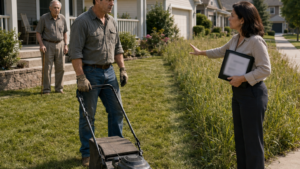
Nancy came fast from the lawn, her bright pink tracksuit almost violent against the gray morning. Her white shoes struck the dock boards hard enough to make the ropes tremble against the cleats. Oversized sunglasses hid her eyes, but not the set of her mouth.
“Daniel,” she said, breathless and furious, “you need to get off this property.”
He did not move.
The key had been on his ring since he was twenty-four. His mother had pressed it into his hand after his father died, standing right where he stood now, telling him that no matter who got busy, angry, married, divorced, or far away, the dock was where family came back. He had not thought of it as inheritance then. It had been smaller than that, and larger. A promise without witnesses.
Nancy stopped three feet from him. She held a cream-colored folder in one hand, the kind estate attorneys used when they wanted bad news to look orderly.
“I said leave.”
Daniel looked past her toward the house. The porch lights were still on, though the morning was already bright. The curtains in their mother’s upstairs room were drawn. Three weeks ago, hospice had taken away the narrow bed. Two days after that, Nancy had started referring to the place as “the lake property” instead of “Mom’s house.”
“I came for the skiff,” Daniel said. His voice sounded almost too calm to him. “The mechanic called. The bilge pump’s still not right.”
“You don’t have a skiff here.”
He looked down at the water where the small aluminum boat bumped softly against its line.
Nancy followed his gaze and gave a short laugh. “You know what I mean.”
“No,” Daniel said. “I don’t.”
Her jaw tightened. She opened the folder and pulled out a stapled packet. She had marked one page with a yellow tab. “The estate has been clarified.”
“That’s a new word for it.”
“Don’t do that “The estate has been clarified.”
“That’s a new. Don’t stand here acting like this is some misunderstanding.” Nancy flipped the packet toward him but did not hand it over. “The house, dock, and lake access are mine under the revised will. Mine. Not yours. Not shared. Not available whenever you feel nostalgic.”
Something cold moved through him, not surprise exactly, but the first shape of it. He had known there was a reading scheduled later that afternoon. Mark Hill’s office had called to confirm. Daniel had assumed it would be formal, uncomfortable, maybe sad. He had not imagined Nancy would arrive before breakfast dressed like she had come to win a race.
“The will hasn’t been read,” he said.
“It doesn’t need to be read for me to know what it says.”
Daniel finally looked at the packet. The top page carried Mark Hill’s letterhead and a summary of estate assets. He saw his mother’s name. He saw Nancy’s. He did not see his own.
A motor growled somewhere across the water. A white speedboat moved past the cove, its wake spreading thin lines toward the dock. Daniel watched the ripples reach the posts and break apart.
Nancy stepped closer. “You always do this.”
“Do what?”
“Stand there like you’re the only person who ever cared about her.”
He took that because it was partly true that he stood still when he should have said things. For three years, he had fixed loose railings, sorted pill bottles, made soup she barely ate, carried laundry down the back stairs, and left before Nancy arrived because their mother got tired when they argued. He had told himself peace was a form of care. He was no longer sure.
“I didn’t come to fight you,” he said.
“No. You came to make me look cruel for enforcing what Mom wanted.”
Daniel’s hand closed tighter around the key. “Then show me the page.”
Nancy held the packet to her chest. “You can hear it from Mark like everyone else.”
“Then why are you here now?”
A flicker crossed her face, too quick to name. Then she turned toward the house and lifted her phone. “Because you’re trespassing, and I’m done pretending you don’t understand boundaries.”
“Nancy.”
She tapped the screen.
“Nancy, don’t call anyone.”
She put the phone to her ear and stared at him over the rim of her sunglasses. “My brother is refusing to leave private property.”
Daniel looked down at the key in his palm. It was not proof. It was only metal, cut years ago by a hardware store clerk who had asked whether he wanted the rubber cap in red or blue. He had chosen neither. His mother had laughed and said that plain keys lasted longer.
Nancy gave the dispatcher the address.
By the time the sheriff’s cruiser rolled down the gravel drive, two lake neighbors had come out onto their decks. Daniel saw one of them raise a hand to shade her eyes. The sound of tires over stone reached the dock before the red and blue lights flashed against the windows of the house.
Deputy Ryan Campbell stepped out, one hand resting near his belt, the other open at his side. He was younger than Daniel remembered from town meetings, but careful in the way he approached. Another deputy stayed near the cruiser.
“Morning,” Ryan called. “Who placed the call?”
Nancy lifted her hand. “I did. I’m the owner.”
Daniel looked at her then.
Not beneficiary. Not executor. Owner.
Ryan glanced between them. “And you are?”
“Daniel Roberts,” Daniel said. “Her brother.”
Ryan’s expression changed just enough to show the word had mattered. “All right. Family property dispute?”
“It is not a dispute,” Nancy said quickly. “The revised will leaves this property to me. He has no legal right to be on this dock.”
Ryan looked at Daniel. “Do you have any paperwork showing access?”
Daniel almost held up the key. The childishness of that stopped him. A key was not a deed. A memory was not a clause. A promise was not probate.
“Not with me,” he said.
Nancy exhaled as if that settled the world.
Ryan turned back to her. “Ma’am, if the estate is still in process, I’m not removing him from a dock on a criminal trespass claim without clear documentation. This sounds civil.”
“I have documentation.” Nancy thrust the packet forward.
Ryan accepted it, scanned the first page, then slowed. “This is a summary from an attorney.”
“It says the lake property goes to me.”
“It says that, yes.” He kept reading. “But I don’t see transfer documents. I don’t see an order. And if he’s family—”
“He is trying to take advantage of confusion.”
Daniel’s head came up.
Nancy heard the silence after her own sentence and seemed to realize too late what word she had used.
“Whose confusion?” Daniel asked.
She pressed her lips together. “Don’t twist my words.”
Daniel took one step toward her, not enough to threaten, only enough to stop letting the dock hold all the distance between them. “What date did she sign it?”
Nancy’s fingers tightened around the folder. “You’ll hear all that this afternoon.”
“What date, Nancy?”
Ryan lowered the packet slightly. The lake slapped once against the dock post.
Nancy looked toward the house, then back at Daniel. “March eighteenth.”
For a moment he could not place the date. Then he did, and the dock seemed to tilt under his boots.
March eighteenth was after the night his mother had asked whether his father was coming in from the boathouse, though their father had been dead for eleven years. It was after Daniel had found the cereal in the refrigerator and the dish soap in the pantry. It was after Nancy had started saying visitors upset her.
Daniel opened his hand. The old key lay against his skin, dull and ordinary.
“She signed away the lake house six weeks before she died?” he asked.
Nancy’s face hardened. “She changed her mind.”
Daniel looked from the packet to the drawn curtains of his mother’s room. The cruiser lights flashed red, then blue, across the glass.
“Then I need to know,” he said quietly, “whether she still had one to change.”
Chapter 2: The Lawyer Read The Line Where His Name Vanished
Mark Hill read the sentence twice because Daniel did not react the first time.
“The lake residence, including all attached land, dock structures, water access rights, and related maintenance assets, shall pass solely to my daughter, Nancy White.”
The second reading landed harder, not because the words changed, but because the room did not. The office remained polished and quiet. The framed degrees stayed straight on the wall. The silver pen remained exactly parallel to the edge of Mark’s desk. Nancy sat beside Daniel with her ankles crossed, the cream folder resting neatly on her lap.
Daniel sat with the dock key on the table in front of him.
He had not meant to bring it out. When Mark began sorting copies, Daniel’s hand had gone to his pocket, and there it was. He placed it beside the will because he needed something in the room that had touched his mother’s hand.
Mark cleared his throat. “Mr. Roberts, you are named in the document.”
Daniel looked at him.
“There are personal items assigned to you. Your mother’s father’s fishing tackle. The framed photograph from the lower hallway. The cedar toolbox in the boathouse, pending Nancy’s access approval.” Mark paused before adding, “And a savings account with a balance of approximately eight thousand dollars.”
Nancy made a small movement, not quite a flinch. Daniel noticed because he was looking for anything that did not behave like certainty.
“The boathouse needs Nancy’s approval?” Daniel asked.
“It is part of the lake residence.”
“The toolbox was mine. I built it with Dad.”
Mark looked down at the page. “The document identifies it as personal property stored on premises.”
Nancy leaned forward. “Daniel, don’t start with every object. That’s not what this is.”
He turned to her. “What is this?”
Her sunglasses were gone now. Without them, her eyes looked more tired than triumphant. “Mom changed her mind. That was her right.”
The words sounded rehearsed. Maybe she had said them in the car. Maybe she had said them to herself at the kitchen sink. Maybe she had needed to.
Daniel nodded once, then looked at Mark. “When did she first contact you about revising the will?”
Mark’s professional stillness shifted. “Your mother requested estate updates earlier this year.”
“Earlier this year is not an answer.”
Nancy gave a sharp sigh. “This is exactly why she didn’t tell you.”
Daniel kept his eyes on Mark. “What date?”
Mark folded his hands. “The final execution date was March eighteenth.”
“I know that now.”
“The initial call to schedule the consultation was in late February.”
Daniel remembered late February. His mother had stopped using the stove because she forgot to turn off the burner. He had installed automatic shutoff knobs. Nancy had told him he was making the house feel like a hospital.
“Who made the call?” he asked.
Mark hesitated.
Nancy laughed without humor. “Are you accusing me of making appointments now?”
“I’m asking who made the call.”
Mark looked at Nancy, and that was enough to change the temperature in the room.
Daniel picked up the will copy. The paper was warm from the printer, the black text so clean it felt indifferent. He scanned past paragraphs that treated a life as categories: residence, account, vehicle, furnishings. His mother’s name appeared at the top of every page. Her initials appeared at the bottom.
On the signature page, two witness names sat below hers.
He did not know either one.
“Who are these people?” Daniel asked.
Mark took the page when Daniel slid it across. “Witnesses to execution.”
“I can read that. Who are they?”
“They were available at the time.”
“At your office?”
Mark adjusted his glasses. “One was from a nearby professional service. The other was a qualified adult witness.”
Nancy’s fingers tapped once against the folder. “The signatures are valid. That’s what matters.”
Daniel looked at her. “That’s what matters to you.”
“What matters to me is that Mom made a decision and you can’t stand it.”
He almost answered in anger. He could feel the sentence forming, old and sharp: You were barely there until the house became valuable. But it was not true enough. Nancy had been there. Every Thursday, toward the end. Before that, she had sent checks when the roof needed work, complained about invoices, and called their mother every Sunday. She had cared in a way Daniel had often dismissed because it did not look like his kind of care.
That was one of his mistakes. He could see it even through the hurt.
But caring did not explain March eighteenth.
Mark slid a separate packet toward him. “These are copies for your records.”
Daniel did not touch them. “What was my mother’s condition when she signed?”
“Daniel,” Nancy said.
He ignored her. “Did she know what she was signing?”
Mark’s mouth tightened. “I am not a physician.”
“You’re an attorney. Did she understand the document?”
“Capacity is a legal standard.”
“Then answer legally.”
For the first time, Mark looked less like a man reading a file and more like a man standing near a door he regretted opening. “At the time of execution, I had no formal finding of incapacity.”
“That isn’t what I asked.”
“That is what I can answer.”
Nancy stood. “This is harassment.”
Daniel looked up at her. “Sitting in a lawyer’s office asking when our mother signed away the family dock is harassment?”
“It was not the family dock,” she snapped. “It was Mom’s property. And she left it to me.”
Mark lifted one hand. “Let’s keep this civil.”
The word made Daniel glance at the dock key. Civil. That was what Deputy Campbell had called it that morning. Civil meant no one would be taken away. Civil meant the paper would sit between them and behave like truth until someone proved otherwise.
“Was there an earlier will?” Daniel asked.
Mark’s expression closed. “I can only discuss instruments relevant to the current estate administration.”
“That sounds like yes.”
“It means I am not going beyond today’s scope.”
Nancy gathered her purse. “We’re done.”
Daniel turned back to the witness names. One signature was almost unreadable, a loop and a line. The other had an address printed beneath it because Mark’s office had required contact information. Daniel stared at the street name, trying to place why it bothered him.
Then he saw it.
Not the person. The building.
The address was on Lakeview Medical Plaza Road, the same road as the clinic where his mother had gone for memory testing. But this suite number was not her doctor’s office. It was across the hall from it.
Daniel tapped the page once.
Mark looked down.
“My mother never mentioned being at this office,” Daniel said.
Nancy paused at the door. “She didn’t have to tell you everything.”
Daniel kept his finger on the witness address. The dock key lay beside his other hand, suddenly less like a keepsake and more like a question.
“No,” he said. “But someone took her there.”
Chapter 3: The Calendar Still Had Nancy’s Visits Circled
The kitchen calendar was still turned to March, and every Thursday had Nancy’s name circled in blue ink.
Daniel stood in the doorway for a long moment before stepping inside. The house smelled wrong without his mother in it. Not empty exactly. Stripped. The lemon cleaner Nancy liked had covered the old scents of coffee, cedar, lake damp, and the powder his mother used after washing her hands.
The calendar hung beside the refrigerator, beneath a magnet shaped like a trout. Daniel had bought it from a gas station gift rack years ago because his mother had said it was ugly enough to deserve a home.
He moved closer.
Nancy – 10 AM.
Nancy – 10 AM.
Nancy – 10 AM.
On the week of March eighteenth, the Thursday square had been circled twice.
Daniel took out his phone to photograph it, then stopped. His thumb hovered over the camera button while a familiar shame moved through him. He had been in this kitchen all winter. He had changed lightbulbs, cleaned gutters, sorted medicine. He had seen this calendar every week and never noticed the pattern because he had trained himself not to read Nancy as danger.
He took the photograph anyway.
A key scraped in the front lock.
Daniel turned as the door opened. Nancy stood in the entry with a paper grocery bag against her hip. For a second neither of them spoke.
Then she looked past him into the kitchen and saw the calendar.
“What are you doing in here?”
“You told Mark I could collect personal items.”
“I said from the boathouse. Not wander through the house.”
“This was Mom’s kitchen.”
“It is part of the estate.”
He looked at the grocery bag. Inside were trash bags, a roll of packing tape, and a stack of white labels.
“You’re clearing it already?”
“I’m preserving value.”
“Is that what we’re calling it?”
Nancy set the bag down harder than necessary. “Don’t make every practical thing sound heartless. The house has to be maintained. Bills have to be paid. Insurance, taxes, dock repairs, tree work. You think memories cover that?”
Daniel felt the hit because she had chosen the one place where her anger had a root. He had done labor. She had often paid invoices. Their mother praised him for showing up and called Nancy only when something cost too much.
“You’re right,” he said.
Nancy blinked. She had been ready for resistance, not agreement.
“You did pay for things,” Daniel said. “And I should have said that more.”
Her face changed for half a second. Then she looked away. “That doesn’t mean you get to pick through my house.”
“Your house,” he repeated.
“Yes.”
The word came easier to her now.
Daniel nodded toward the calendar. “Why were you here every Thursday?”
Nancy walked to the counter and reached for it. Daniel put his hand over the March page before she could tear it away.
“Don’t,” he said.
Her eyes sharpened. “Move your hand.”
“No.”
It was the smallest refusal he had ever made, and somehow it filled the kitchen.
Nancy lowered her voice. “You have no idea how ugly this can get.”
“I’m starting to.”
“You think if you collect enough little scraps, everyone will decide I tricked her.”
“I don’t know what happened yet.”
“Yes, you do. You decided the second you didn’t get what you wanted.”
Daniel’s hand remained on the calendar. “I wanted what she told me.”
“She told people lots of things.”
“Did she tell you to change the locks?”
Nancy’s answer came too late.
Daniel looked toward the mudroom door. “You did, didn’t you?”
“She was getting confused. People were coming in and out.”
“People meaning me?”
“People meaning anyone. Contractors. Neighbors. You left keys everywhere.”
“I left one with Carol in case Mom fell.”
Nancy’s mouth tightened at Carol’s name.
A knock came from the back porch.
Both of them turned.
Carol Perez stood beyond the glass, one hand raised, her silver hair tucked under a faded lake association cap. She looked as if she had already decided to leave and only her guilt had kept her there.
Nancy opened the door halfway. “This isn’t a good time.”
Carol looked past her at Daniel. “I saw your truck.”
“It’s still not a good time,” Nancy said.
Daniel stepped around the kitchen table. “Carol, did Mom ever seem worried about visitors?”
Carol’s fingers tightened around the strap of her canvas bag. “That depends what you mean.”
Nancy gave a brittle laugh. “Do not drag neighbors into probate.”
Carol looked at her then, and the softness left her face. “You dragged the sheriff to the dock.”
Silence settled in the kitchen.
Daniel opened the door wider. Carol came in but stayed near the threshold, as though crossing too far would make her a witness instead of a neighbor.
“What did you mean?” Daniel asked.
Carol looked at the calendar. “Your mother used to call me when she couldn’t reach you.”
“She had my number.”
“I know. Sometimes she said Nancy told her you were working and not to bother you.”
Nancy turned red. “She was anxious. I was trying to keep her calm.”
Carol did not argue. That made it worse.
“There was one week,” Carol said, “your mother came out on the back deck in her robe. It was cold. She asked if I’d seen you. Said she thought you were coming to fix the loose step.”
Daniel remembered that week. Nancy had texted him: Mom’s exhausted. Don’t come today. She gets worse after too many visits.
He had stayed away because he believed it was kind.
“What week?” he asked.
Carol pointed to the calendar, not touching it. “First Thursday in March, I think.”
Daniel found the square. Nancy – 10 AM.
His chest tightened.
Nancy grabbed the grocery bag. “This is ridiculous. She had good days and bad days. Everyone knows that.”
Daniel looked at her. “Was March eighteenth a good day?”
Nancy did not answer.
Carol’s gaze moved from Daniel to Nancy. “Was that the day with the black car?”
Nancy went still.
Daniel turned. “What black car?”
Carol immediately looked sorry she had said it. “I don’t know. A sedan. Looked like a lawyer’s car, if cars can look like that. It came midmorning. I remember because your mother had asked me the day before whether Daniel was coming, and then that car pulled in instead.”
Daniel stared at the calendar. March eighteenth had not been a Thursday. It had been a Tuesday.
Nancy reached for the calendar again. This time Daniel lifted it off the wall before she could touch it.
“That stays,” he said.
“It belongs to the house.”
“It belonged to Mom.”
“She left the house to me.”
Daniel folded the calendar carefully, keeping March visible. “Then tell your lawyer I took a picture of it.”
Nancy’s voice dropped. “You are making a mistake.”
“No,” Daniel said, slipping the calendar page into the inside pocket of his jacket. “I made the mistake already.”
He walked out through the mudroom before she could block him. The gravel drive was bright with sun, the lake beyond it flat and blue. He reached his truck and tried his old house key in the side door out of habit.
It did not turn.
Daniel stood there, hand on the useless key, while Nancy watched from the kitchen window.
Behind him, Carol spoke quietly from the porch.
“Daniel,” she said, “the day that black car came, Nancy had told me your mother wasn’t seeing anyone.”
He turned.
Carol’s face was pale now.
“But your mother saw me from the window after they left,” she said. “She looked confused. And she asked me why you hadn’t come for the papers.”
Chapter 4: The Medical Record Made The Signature Date Worse
The words were printed in a box near the bottom of the clinic note, plain as a grocery receipt.
Disoriented to date and place.
Daniel read them once while standing at the records counter, then again with his thumb pressed against the page as if the pressure might make the sentence mean something else. The medical records clerk had slid the packet through the window with a tired kindness, asking him to check that the dates looked right before he left.
The dates looked right. That was the problem.
March fifteenth. Three days before the will signing.
His mother had been unable to state the year. She had asked the nurse whether the appointment was in the old church basement, though the clinic had been in the same glass building for eight years. She had repeated the same question twice in ten minutes. The doctor had recommended follow-up evaluation and supervision with decision-making.
Daniel stood there too long.
“Sir?” the clerk asked gently.
He looked up.
“Do you need a chair?”
“No.” His voice scraped. “No, thank you.”
He put the page back into the folder, but his hand missed the edge and bent one corner. It was a small damage, nothing that mattered, and still it made him angry with himself. He smoothed it carefully with both palms.
Outside, in the clinic parking lot, he sat in his truck with the folder open across the steering wheel. The dock key lay on the dashboard where he had tossed it before going inside. Sunlight caught the brass and made it look newer than it was.
March fifteenth: disoriented to date and place.
March eighteenth: revised will executed.
He tried to put his mother in Mark Hill’s office three days later. Sitting straight because Nancy would have told her to. Wearing the pale blue cardigan she saved for appointments. Smiling politely at strangers because illness had not taken her manners first. Maybe looking to Nancy when a question came too quickly. Maybe signing because everyone in the room acted like signing was what came next.
Daniel closed his eyes and saw her on the porch in winter, asking why his father had not come up from the boathouse.
He should have known then.
His phone buzzed against the cup holder. Nancy’s name filled the screen.
He let it ring until it stopped. Then it started again.
This time he answered.
“What are you doing?” Nancy demanded.
Daniel looked at the clinic entrance. People came and went through the automatic doors carrying forms, prescriptions, coffee cups, lives that still had ordinary errands inside them.
“I picked up Mom’s medical records.”
The silence on the line was brief, but full.
“You had no right.”
“I’m her son.”
“You’re not her executor.”
“I’m listed as an authorized contact from last year. They released the records.”
Nancy inhaled sharply. “Daniel, listen to me. You are taking painful things and twisting them because you didn’t like the will.”
“She was disoriented three days before she signed.”
“She had good mornings and bad afternoons.”
“The appointment was at ten.”
Another silence.
He could hear her moving, maybe walking from one room to another in the lake house, maybe closing a door though there was no one left there to overhear.
“You have always done this,” she said, quieter now. “You take one thing and make it the whole story.”
“It’s a medical note.”
“It’s one note.”
“It says she needed supervision with decision-making.”
“She had supervision. I was there.”
Daniel’s fingers tightened on the phone. “That’s what worries me.”
Her voice hardened instantly. “Be careful.”
“Nancy—”
“No, you be careful. You’re grieving. I understand that. I even forgive some of this because you spent so long being needed that you don’t know what to do now that she’s gone. But if you keep implying that I manipulated our mother, I will answer it.”
“With what?”
“With the truth. That you were already taking things from the house before she died. That you controlled who repaired what. That she complained you made her feel helpless.”
Daniel looked at the folder. He remembered his mother snapping at him when he put labels on the pill organizer. I can read, Danny. He had apologized, then kept labeling them because she had taken two blood pressure pills the week before. Care and control had shared a wall so thin he had sometimes crossed it without feeling the step.
“She said that?” he asked.
“She said a lot of things when you weren’t there.”
The sentence landed where Nancy meant it to.
Daniel looked at the key on the dashboard. “Maybe she did.”
Nancy’s tone shifted, sensing a seam. “I’m not trying to hurt you. But you weren’t the only one carrying this. The taxes alone were impossible. The dock insurance went up. The roof estimate was sitting unpaid until I handled it. Mom knew I was the one keeping the place from falling apart.”
“And that means she wanted me removed from it?”
“It means she understood reality.”
Daniel breathed through his nose and watched a man help an elderly woman into a car near the entrance. The woman gripped his sleeve with both hands, trusting him not because of paperwork, but because he was there.
Nancy said, “I’ll offer you something.”
He said nothing.
“Twenty-five thousand. From me, not the estate. You sign a release saying you won’t challenge the will, won’t interfere with the property, and won’t come onto the dock without permission. You keep the fishing tackle, the photograph, the toolbox if you really need it. We end this before everyone gets dragged through it.”
Daniel looked at the medical page again. The words did not grow louder. They did not have to.
“You think this is about twenty-five thousand dollars?”
“I think you’re about to spend more than that trying to prove Mom didn’t know her own mind.”
“I’m trying to find out whether anyone let her use it.”
“That’s cruel.”
“Maybe,” he said. “But it’s not as cruel as calling a confused woman’s signature her final word because it gives you the house.”
Nancy’s breath shook with anger. “I knew you would do this. I told Mark you would.”
That caught him. “You told Mark?”
“I told him you’d make this ugly.”
“When?”
She did not answer.
Daniel sat forward. “When did you tell him I’d make this ugly, Nancy? Before or after March eighteenth?”
“You’re impossible.”
The call ended.
For a while Daniel did not move. The truck cab was warm, and the smell of old vinyl and lake mud from his boots made him suddenly think of all the mornings he had driven from the house to the pharmacy, the hardware store, the clinic, never wondering who else was building a paper trail while he was keeping the day from falling apart.
His phone buzzed again. Not a call this time. A text from a cousin he had not heard from since the funeral.
Nancy says you’re contesting Mom’s wishes and trying to force a sale delay. Is that true?
Then another, from an aunt.
Please don’t make this about money. Your mother would hate the fighting.
Daniel stared at the messages. Nancy had moved faster than he had. She had turned the private wound into a family story with him as the threat.
He opened a reply, typed, deleted it, typed again, deleted that too. His old habit rose up: say less, wait, let people calm down, let the truth become obvious.
But truth had not become obvious. It had been stapled, signed, and handed to him as a fact.
He took a photo of the medical note. Then he sent one message to both relatives.
I’m not asking for money. I’m asking why a will was signed three days after a clinic note said Mom was disoriented to date and place.
He attached the image before he could lose courage.
By late afternoon, Daniel had driven back toward the lake without deciding to. He parked along the public pullout above the cove, where he could see the roofline of the house through pines. The dock reached into the water like a finger pointing at something no one wanted to name.
The key sat on the dashboard beside the folder.
His phone rang again.
This time it was Mark Hill.
Daniel answered without greeting.
For a moment Mark said nothing. Papers shifted on his end. A door closed.
“Mr. Roberts,” Mark said, his voice lower than it had been in the office. “I received a message from Nancy saying you obtained medical records.”
“That’s right.”
“I need to be careful about what I say.”
“Then be careful.”
Another pause.
Daniel watched light move across the lake. A boat passed far out, too distant to hear.
Mark exhaled. “There is something about that signing I should have told you.”
Chapter 5: The Attorney Remembered Who Answered For Her
“Did my mother speak for herself that day?”
Daniel asked it before he sat down.
Mark Hill stood behind his desk with one hand on the back of his chair, looking at the closed office door as if he wished there were another exit. The blinds were half lowered. A yellow legal pad lay on the desk, blank except for the date at the top.
“Mr. Roberts,” Mark said, “I agreed to this meeting to clarify process, not to provide ammunition.”
Daniel took the chair opposite him. He set the medical record folder on his lap and the dock key on the desk.
The small sound of brass touching wood seemed to bother Mark more than the folder.
“I’m not asking you to fight for me,” Daniel said. “I’m asking what happened in this room on March eighteenth.”
Mark sat slowly. “Your mother was not seen in this office.”
Daniel’s eyes lifted.
“She signed at a conference room I use occasionally at Lakeview Medical Plaza,” Mark said. “It was closer to where she had appointments. Nancy said travel had become difficult.”
Daniel remembered the witness address. Across the hall from the clinic. The black sedan Carol had seen. The calendar square circled twice.
“Who arranged that?”
“Nancy coordinated the appointment.”
“Did Mom ask for it?”
Mark looked down at the legal pad. “The stated purpose was to update her estate plan.”
“That’s not an answer.”
“It is the cleanest answer I have.”
Daniel leaned back, anger held carefully behind his teeth. “Clean answers are what got us here.”
Mark’s face tightened, but he did not deny it.
Daniel opened the folder and slid the March fifteenth medical note across the desk. Mark did not touch it at first. He read it from a distance, then pulled it closer with two fingers.
“Did you have this?” Daniel asked.
“No.”
“Did you ask about her medical condition?”
“I asked standard capacity questions.”
“Did she answer them?”
Mark’s eyes moved to the dock key, then away.
“Some,” he said.
The word was small, but it cracked something.
Daniel waited.
Mark removed his glasses and rubbed the bridge of his nose. Without them, he looked older and less certain. “Your mother was polite. She understood she was signing estate documents. At least, that was my assessment at the time.”
“At least?”
“She knew her name. She recognized Nancy. She identified the property.”
“Did she identify me?”
Mark’s silence answered before he did.
“She referred to you as Danny,” Mark said. “She said you fixed the dock.”
Daniel looked at the key.
“And then?”
“Nancy clarified that you had been compensated in other ways.”
Daniel’s head came up. “Compensated?”
“That you had use of the property for years. That you had tools stored there, boats there, access whenever you wanted. She framed the lake clause as a practical matter.”
“A practical matter.”
“I am telling you what was said, not endorsing it.”
“Did Mom say she wanted me cut out?”
Mark’s hand moved toward the legal pad, then stopped. “She said she wanted things to be easier.”
Daniel felt the room sharpen around that sentence. “Easier for who?”
“That was not specified.”
“Did you ask?”
Mark looked at him then, and there was the first honest shame in his face. “Not well enough.”
Daniel sat very still.
Outside the office, a phone rang once and was silenced. Somewhere beyond the wall, a printer started, producing clean pages for other people’s problems.
Mark continued, more carefully. “Nancy did a great deal of the talking at first. I redirected questions to your mother. More than once.”
“But Nancy answered.”
“She corrected details.”
“What details?”
“Dates. Asset names. The distinction between the residence and other personal property.” He paused. “When I asked your mother whether she understood that the lake property would pass solely to Nancy, your mother looked at Nancy.”
Daniel’s throat tightened. “And Nancy said?”
“That this was what they had discussed.”
“What did Mom say?”
“She nodded.”
Daniel looked away from Mark because if he kept looking, the anger might turn into something less useful. On the wall was a photograph of a sailboat, framed in black. A decoration chosen by someone who thought water meant calm.
“She nodded,” Daniel repeated.
“That can be legally sufficient.”
“I’m sure it can.”
Mark flinched at the quietness.
Daniel took the medical record back and placed it beside the key. “Why didn’t you tell me this when I asked about capacity?”
“Because I represent the estate process, not you. Because I had no formal incapacity finding. Because saying more could expose me to an accusation that I mishandled an execution I believed, at the time, was valid.”
“At the time.”
Mark’s jaw worked. “You should understand something. Families often disagree after death. People remember promises differently. They assign meaning to objects. They hear affection as intention. The law cannot treat every painful surprise as undue influence.”
Daniel nodded slowly. “That sounds like something you’ve told yourself a lot.”
Mark looked down.
Daniel softened his voice, but not the question. “Was she alone with you at any point?”
Mark’s answer came too quickly. “Briefly.”
“How briefly?”
“Several minutes.”
“What did she say when Nancy wasn’t in the room?”
Mark put his glasses back on. “She asked whether Daniel would still be able to come to the lake.”
The room changed.
Daniel did not breathe for a moment. The sentence did not solve anything. It did not rewrite the will. It did not prove fraud. It did not restore the dock under his feet. But it was the first living thing anyone had said from inside that day.
“What did you tell her?” Daniel asked.
“I told her the document, as drafted, left control of the lake property to Nancy.”
“And?”
“She seemed confused by the distinction between ownership and access.”
Daniel closed his eyes briefly.
Mark said, “I asked Nancy back in to clarify the intended arrangement.”
Daniel opened his eyes. “You asked Nancy to clarify Mom’s intention?”
Mark did not defend himself. Not at first.
“I made an error in judgment,” he said.
Daniel let the admission sit between them. It was not enough. It was more than he had expected.
“What did Nancy say?”
“That family access could be handled informally.”
Daniel laughed once, not because anything was funny. “Informally.”
“Yes.”
“The same woman who called the sheriff on me for standing on the dock.”
Mark’s expression folded inward.
Daniel picked up the key, then set it down again. He needed his hands empty. “Will you put this in writing?”
Mark stiffened. “I cannot characterize your mother’s capacity beyond my role.”
“I’m not asking you to diagnose her. I’m asking you to write what happened. That Nancy arranged the appointment. That she answered for Mom. That Mom asked whether I could still come to the lake.”
“That would be a serious statement.”
“It was a serious day.”
Mark looked toward the closed blinds. “If you pursue a formal inquiry, I may be required to answer questions.”
“That is not the same thing as choosing to tell the truth.”
“No,” Mark said quietly. “It is not.”
For the first time, Daniel saw him not as the man who had erased him with a paragraph, but as a man who had let uncertainty pass because certainty was easier to file. It did not absolve him. It made the harm less tidy.
Daniel gathered the medical note and slid it back into the folder. “Was there an earlier will?”
Mark’s shoulders lowered slightly, as if he had expected the question and dreaded it anyway.
“Yes.”
Daniel’s hand stopped over the key.
“How much earlier?”
“Four years.”
“What did it say about the lake house?”
“I do not have the full document in this office.”
“But you know.”
Mark’s eyes met his. “I know there was a different clause.”
Daniel waited.
Mark opened a drawer and removed a file index sheet, not the will itself. He turned it so Daniel could see the old matter number.
“The prior instrument gave Nancy administrative authority over the residence if your mother became unable to manage it,” Mark said. “But it included language regarding your continued dock and boathouse access.”
Daniel’s fingers curled slowly.
“What language?”
“I’m not comfortable quoting from memory.”
“Where is it?”
“Archived with probate storage copies. You can request it through the clerk if you have standing as a named beneficiary in the prior document.”
“In the prior document,” Daniel said.
“Yes.”
“So in the old will, I had standing. In the new one, I have almost none.”
Mark did not answer.
Daniel stood.
Mark slid the index sheet across the desk. “Take the matter number.”
Daniel looked at it before picking it up. The printed digits felt heavier than the will copy had.
At the door, he stopped. “Why tell me this now?”
Mark was quiet long enough that Daniel almost left without the answer.
Then Mark said, “Because when your mother asked whether you could still come to the lake, she did not ask like someone changing her mind.”
Daniel turned.
Mark’s face held no triumph, no rescue, no clean redemption.
“She asked,” he said, “like someone afraid she had already lost the answer.”
Chapter 6: The Earlier Will Left The Dock Open
The old clause used his mother’s own language.
Daniel knew it before he reached the end of the sentence.
The probate clerk had brought the archived copy in a gray file box and told him he could review it at the side table but not remove it. The paper smelled faintly dusty, the way stored documents did when they had been waiting without knowing they mattered.
He turned to the lake property section with his pulse in his throat.
My daughter Nancy White shall manage the residence and related expenses if I cannot do so. My son Daniel Roberts shall retain lifetime reasonable access to the dock, boathouse, and lower lakeside room, as these are places of personal and family use and shall not be denied to him without cause.
Without cause.
Daniel read those two words three times.
Not ownership. Not half the house. Not the kind of inheritance relatives could measure and resent across a table. Access. A room. The dock. A way back.
His hand went to his pocket for the key and closed around it.
The clerk watched from behind the counter, pretending not to watch. Daniel took a photo of the clause, then another of the signature page dated four years earlier. Same mother’s name. Firmer handwriting. Familiar witnesses: Carol Perez and a neighbor who had since moved away.
He sat back.
For two weeks, Nancy had let people think he wanted the lake estate. She had said money. She had said grief. She had said he was trying to take what their mother had chosen to give her. And somewhere in a box, in a clause written before confusion entered the house like fog, their mother had named exactly what Daniel wanted and exactly what Nancy had denied.
When he left the records office, the sun was sharp enough to hurt. He stood beside his truck and called Carol.
She answered on the second ring. “Did you find something?”
“Yes.”
He heard her breath catch.
“I need to ask you about the old will.”
“I signed as witness,” she said. “I remember.”
Daniel leaned against the truck door. “Did Mom tell you why she wrote it that way?”
Carol was quiet for a moment. “She said Nancy understood bills better, and you understood the lake better.”
He shut his eyes.
“She didn’t mean it as an insult,” Carol added quickly.
“I know.”
“She said Nancy would keep the roof over it. You would keep the heart in it.” Carol’s voice thinned. “Those were her words, Daniel. I didn’t know she changed it.”
“She asked Mark whether I could still come to the lake on the signing day.”
“Oh.”
The small sound carried years of things Carol had chosen not to say.
Daniel opened his eyes. “Why didn’t you tell me sooner that Nancy was controlling visits?”
“I should have.”
“Carol.”
“I didn’t want to make trouble while your mother was alive. Then after she passed, I thought maybe I had misunderstood. Families have arrangements neighbors don’t know about.” Her voice tightened. “And Nancy told me more than once that stress made your mother worse. I thought stepping back was kindness.”
Daniel looked at the old will photo on his phone. “I thought the same thing.”
That was the worst part. Nancy had not built the silence alone. She had used the silence Daniel already trusted.
“Can I come by?” he asked.
Carol met him on her porch with two glasses of iced tea neither of them drank. From her deck, the lake house was visible through a break in the pines. The dock stretched out beyond the trees, empty in the bright afternoon.
Daniel handed her the printed copy he had made at the library. She put on her reading glasses and held the paper with both hands.
“There,” she said softly when she reached the clause. “That sounds like her.”
“Did she ever say it out loud?”
Carol smiled sadly. “Often. Not in legal words. She called it your coming-back place.”
Daniel looked toward the water.
“She said, ‘Nancy needs something solid to manage, or she’ll think nobody trusts her,’” Carol continued. “‘Daniel needs somewhere he doesn’t have to ask permission to be sad.’”
He turned back, unprepared for the precision of the wound.
Carol removed her glasses and wiped at one lens though it was clean. “I’m sorry.”
Daniel folded the page carefully. “Nancy thinks Mom loved me more.”
Carol hesitated.
“Say it,” Daniel said.
“She thinks people saw your care and not hers.”
“They saw what was in front of them.”
“And the checks weren’t.” Carol’s voice was gentle, not excusing. “Your mother talked about you because you were there fixing the step or making soup. Nancy came in with folders and insurance forms. Nobody praises the person arguing with the assessor on the phone.”
Daniel looked down. He had known this, but not let it matter enough.
“She still had no right to do what she did.”
“No,” Carol said. “She didn’t.”
The answer helped because it held both truths without blending them.
Daniel’s phone buzzed. A message from a number he did not recognize showed a photo preview before he opened it: a real estate sign leaning against a truck bed.
The text beneath read: Heard you may want to know. They’re doing buyer walkthroughs this week.
He opened the image fully.
The sign was white with blue letters. LAKEFRONT ESTATE. PRIVATE DOCK. EXCLUSIVE ACCESS.
Behind it, unmistakable even at an angle, was the gravel drive to his mother’s house.
Carol saw his face and stood. “What is it?”
Daniel showed her the phone.
Her mouth tightened. “She wouldn’t.”
“She is.”
He called Nancy.
She answered with noise in the background: voices, a car door, the hollow sound of someone walking through an empty room.
“What do you want?” she asked.
“Are you selling the house?”
A pause. Then, coolly, “I’m exploring options.”
“There’s a sign being unloaded.”
“Then I suppose options are moving quickly.”
Daniel stepped off Carol’s porch and started toward his truck.
“The old will preserved my access,” he said.
“The old will isn’t controlling.”
“It shows what Mom intended before March.”
“It shows what she intended four years ago.”
“And three days before the new will, a clinic note says she was disoriented.”
Nancy’s voice dropped. “You need to stop using her illness like a weapon.”
“You used her signature like one.”
For a second, neither spoke.
Then Nancy said, “You don’t know what it was like being the one she called when something cost money. You got the soft version of her. I got the panic. The overdue bills. The fear that the house would swallow everything she had left.”
“You could have talked to me.”
“I did talk. You listened like a martyr and then did whatever you thought was noble.”
Daniel reached his truck and opened the door. “I’m coming there.”
“No, you are not.”
“If buyers are walking the property, they need to know access is disputed.”
“You show up and embarrass me in front of buyers, I’ll call Ryan again.”
“Then call him.”
Nancy’s breath shook. “Why are you doing this?”
Daniel looked at the dock key in his palm. Its teeth had worn smooth in places from years of ordinary use. For the first time since the funeral, he knew exactly what he was fighting for and exactly what he was not.
“Because Mom didn’t leave me the house,” he said. “She left me a way back to her. And you’re trying to sell it as exclusive access.”
He ended the call before she could answer.
At the lake house, the For Sale sign had not yet been planted. It leaned against the back of a truck near the drive, bright and clean, while two people in business clothes stood with Nancy on the upper deck. Nancy had changed from pink into a cream jacket, her hair smoothed, her face composed for strangers.
Daniel stopped at the edge of the gravel.
No one saw him at first.
Then Nancy turned.
Across the lawn, across the distance she had spent weeks trying to make legal, her expression changed from polished welcome to warning.
Behind her, the delivery driver lifted the sign and carried it toward the path that led down to the dock.
Chapter 7: The Dock Was Still Standing When The Truth Came Out
“Nobody told you you could stand there.”
Nancy’s voice carried down from the upper deck as Daniel stepped onto the first board of the dock. Two buyers stood behind her with polite, uncertain faces, holding glossy packets that showed the lake house in summer light. The For Sale sign had been planted beside the path, its metal legs pressed into the soil near the hydrangeas their mother had never managed to keep alive.
Daniel looked at the sign first.
PRIVATE DOCK. EXCLUSIVE ACCESS.
Then he looked at Nancy.
She had dressed carefully for the showing: cream jacket, gold earrings, hair pinned smooth at the back. No pink, no sunglasses, no fury on the surface. But when she came down the steps toward him, her smile was the same hard shape she had worn three weeks ago.
“This is not the time,” she said.
“It became the time when you put exclusive access in a buyer packet.”
One of the buyers shifted. Nancy heard it and turned her head just enough to recover her showing voice. “This is a family matter that has already been settled through estate documents.”
Daniel held up the folder in his hand. “Not settled.”
Nancy walked faster. “Daniel.”
The delivery driver had left the sign box near the dock path. Carol Perez stood beside it, both hands wrapped around the strap of her canvas bag. She had not come close yet. She looked at Daniel once, and he understood she was afraid, but there.
A black sedan turned into the gravel drive.
Nancy saw it and stopped.
Mark Hill stepped out, adjusting his jacket. He did not look like a rescuer. He looked like a man who had chosen the harder version of his day.
Nancy’s face drained of color beneath her makeup. “Why is he here?”
Daniel kept his voice even. “Because buyers should not be told the dock has clean exclusive access when the prior will says otherwise.”
“The prior will is not controlling.”
“No. But it tells the truth about what Mom wanted before March eighteenth.”
The buyers looked at each other. Nancy noticed. Her anger sharpened.
“You are trying to ruin a sale because you cannot accept that Mom trusted me with this place.”
Daniel stepped fully onto the dock. The boards gave the old familiar creak under his boots. His mother used to joke she could tell who was coming by how the dock complained. His father’s steps had been heavy. Nancy’s quick. Daniel’s, she said, sounded like someone trying not to wake the fish.
He reached into his pocket and took out the brass key.
Nancy stared at it. “That key doesn’t mean anything.”
“It used to mean I didn’t have to ask.”
“Things changed.”
“What date did she sign it, Nancy?”
Her mouth tightened.
The same question hung over the water, stripped of the panic and police lights of the first morning. This time there were no sunglasses, no sheriff’s cruiser, no packet waved like a weapon. Just the dock, the sign, the buyers, Carol near the path, Mark beside his car, and Nancy with nowhere to send the question except back into the room where it began.
“You know the date,” she said.
“Say it.”
“This is harassment.”
“No. This is the part you keep skipping.”
Mark walked down to the edge of the lawn. “Nancy, the access issue should be disclosed before any sale discussion moves forward.”
She turned on him. “You represent the estate.”
“I represent proper administration.”
“You told me the will was valid.”
“I told you the executed document appeared valid on its face.”
“That is the same thing to most people.”
“No,” Daniel said. “It isn’t.”
Nancy looked at him then, and for the first time that morning her composure cracked enough to show the old exhaustion underneath. Not guilt. Not yet. Something rougher: the bitterness of someone who believed she had been forced to fight for every practical inch of a house everyone else turned into a memory.
“You want to do this in front of strangers?” she asked.
“You put the sign up.”
“You want me humiliated.”
“I want you to stop calling it Mom’s choice without saying what happened around it.”
Nancy laughed once, but it broke in the middle. “You always get to sound noble. Even now.”
The buyers began backing toward the path. Mark spoke quietly to them, and after a moment they moved up the lawn, still holding the glossy packets but no longer looking at the house the same way.
Nancy watched them go. “Do you know what you just cost me?”
Daniel looked at the house. “No.”
“Of course you don’t. You never knew what anything cost. You fixed things with tools you already had and everyone called you devoted. I sent checks. I fought insurance. I refinanced my own house to help with the roof when Mom was too proud to ask you.”
Daniel absorbed it because some of it was true.
“You should have told me.”
“I tried.” Her voice rose. “Every time I brought up selling, taxes, repairs, you looked at me like I was putting a price tag on her.”
“Maybe I did.”
The admission stopped her.
Daniel swallowed. “Maybe I made it easy for you to think I didn’t see what you carried. But that does not explain March eighteenth.”
Nancy looked away toward the water.
Carol stepped closer then. “Nancy.”
“Don’t,” Nancy said.
Carol stopped.
Daniel opened the folder and took out the old will clause. The paper moved slightly in the lake breeze.
“She didn’t leave me the house,” he said. “She left you management. She left me access. The dock. The boathouse. The lower room. That was the balance.”
“That was four years ago.”
“And three days before the new will, the clinic note says she was disoriented to date and place.”
“She had moments.”
“Yes,” Daniel said. “She did. So why did you let one of those weeks become the week that erased this?”
Nancy’s eyes filled, and she seemed angry at them for doing it. “Because I was tired.”
The sentence came out small.
Not enough. But real.
Daniel waited.
Nancy wiped quickly under one eye, ruining nothing and revealing everything. “You think I sat there planning some grand betrayal. I was trying to keep the place from collapsing. She would panic about bills and then forget we talked about them. She would tell you sweet things about the dock and tell me she didn’t know how we would afford the taxes. She told me, more than once, that I should just handle it.”
“Handling it didn’t require cutting me out.”
“She said you had already had the lake your whole life.”
Daniel went still.
Nancy looked at him then, almost pleading for the sentence to land as justification. “That is what she said.”
“Or that is what you needed her to mean.”
Her face hardened, but the tears stayed. “You got to be the son who showed up with soup. I got to be the daughter who said no to bills, no to repairs, no to keeping every old thing because sentiment doesn’t pay contractors. And when she was scared, she looked at me because I was the one with numbers. So yes, when she said make it easier, I believed she meant make it mine.”
Mark had reached the dock approach now. “Nancy, when your mother asked whether Daniel could still come to the lake, you told me family access could be handled informally.”
Nancy shut her eyes.
Daniel felt the old reflex rising: soften, spare her, let the worst sentence pass unnamed. He had lived inside that reflex so long it felt like kindness.
This time he did not move.
Carol spoke, her voice shaking but clear. “She told me the dock was Daniel’s coming-back place. She said that before she got sick. She said it more than once.”
Nancy turned toward her. “And did she tell you who paid the insurance?”
“No,” Carol said. “But she didn’t say love should be billed against access.”
The words hurt Nancy. Daniel saw that they did.
He stepped down from the dock onto the gravel path and held out the brass key.
Nancy looked at it as if he were offering her a blade.
“This is the old key,” he said. “It doesn’t open the house anymore. You made sure of that. Maybe legally you can keep doing that for a while. Maybe longer. I don’t know.”
She did not take it.
“I’m not asking for half the sale. I’m not asking for the house. I’m asking you to put in writing that any sale preserves my lifetime access to the dock, boathouse, and lower lakeside room, or you pause the sale until a court decides whether March eighteenth holds up.”
Nancy stared at him.
Mark said, “That is a reasonable path to avoid a formal challenge.”
“Of course you’d say that now,” Nancy snapped.
Mark accepted it with a small nod. “I should have said more then.”
The admission loosened something in the air. Not forgiveness. Something thinner, but necessary.
Nancy looked back at the house. The buyers had reached their car. One of them placed the glossy packet on the roof while searching for keys, as if it had become too heavy to hold.
“If I agree,” Nancy said slowly, “you stop telling everyone I stole from her.”
Daniel shook his head. “No.”
Her eyes flashed.
“I stop saying what I can’t prove,” he said. “I won’t stop saying the new will doesn’t tell the whole story.”
For a moment he thought she would refuse. Her pride rose visibly, old and armored. Then her gaze dropped to the dock key in his palm, and something in her face shifted—not toward softness, but toward recognition of a loss she had caused and could not fully turn back from.
“She asked for you after they left,” Carol said quietly. “That day. She asked why you hadn’t come for the papers.”
Nancy pressed a hand to her mouth.
Daniel did not ask whether she had heard that before. Her face told him enough. Maybe their mother had asked Nancy too. Maybe Nancy had ignored it because the paperwork was already moving and stopping it would mean admitting the arrangement was not clean. Maybe grief and resentment had done what greed alone could not have done.
Finally Nancy reached into her purse. She removed a newer key on a silver ring, bright-edged and unused.
“The lower room still has the old blue chair,” she said, not looking at him. “I didn’t clear it.”
Daniel’s throat tightened.
She held the new key out, then stopped before placing it in his hand. “This doesn’t fix everything.”
“No,” Daniel said.
“And I’m not saying the whole will is wrong.”
“I know.”
“I’ll have Mark draft access language before any sale continues. Dock, boathouse, lower room. Reasonable use. Maintenance responsibilities shared.”
Mark nodded once. “I can prepare an acknowledgment and sale condition.”
Nancy placed the new key in Daniel’s hand.
For a second both keys rested there together: the old brass one worn smooth by years, the new silver one cut for a lock changed in anger. Daniel closed his fingers around them, feeling the difference.
He could have said thank you, but it would have been too clean. He could have accused her again, but the morning had already done that. Instead, he looked at the dock, at the place where she had first told him he no longer belonged.
“Mom didn’t want me to own this place,” he said. “She wanted me not to be removed from it.”
Nancy looked out over the water. “I know that now.”
It was not an apology. Not fully. But it was the first sentence from her that did not hide behind paper.
The buyers drove away. The For Sale sign remained beside the path, but Mark pulled the packet from its holder and tucked it under his arm before leaving with Nancy to draft the correction. Carol stayed near the hydrangeas, crying silently, not for victory but for the cost of arriving at it.
Daniel walked to the end of the dock alone.
The water moved under him in small dark folds. He slipped the old brass key off his ring and held it for a moment. Then he placed it on the weathered dock post where his mother used to set her coffee while watching the lake.
The new key stayed in his pocket.
Behind him, the house was still not his. His family was not healed. The will had not vanished, and the law had not turned grief into fairness.
But the dock was still standing.
And this time, when Daniel remained there, no one told him to leave.
The story has ended.