The HOA Sent A Crew To Tear Down His Fence Before Learning Who It Protected
Chapter 1: The Crew Was Already Pulling Out The Posts
The first fence post cracked loose before Christopher Mitchell reached the bottom of his driveway.
It made a short, ugly sound, wood against wet clay, followed by the grind of a machine backing away with a chain hooked around the base. The post had gone in only two days earlier. Christopher had set it himself with James Hall, tamping the gravel, checking the line twice, making sure the barrier angled just right between the side yard and the dock path.
Now it leaned from the earth like a pulled tooth.
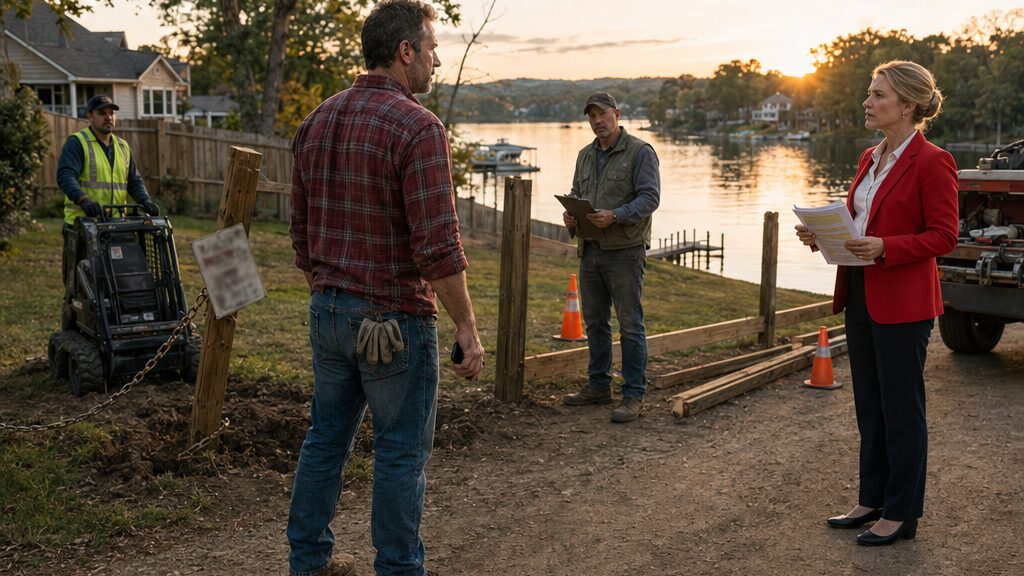
Christopher stopped only long enough to take in the scene. A white utility truck sat half on his grass. Orange cones marked a crooked path from the driveway to the lake. Two workers in neon vests stood near the fence line, one holding bolt cutters, the other guiding the chain attached to the machine. The new “PRIVATE PROPERTY” sign hung from the next post at an angle, one screw already torn free.
“Stop,” Christopher called.
The worker at the machine looked at the crew supervisor. The supervisor looked down at a clipboard as if the paper on it could make Christopher disappear.
Christopher kept walking. He wore the red plaid shirt he had been working in all afternoon and still had his gloves tucked into his back pocket. He had been at the hardware store for twenty minutes, just long enough to buy two more bags of concrete mix and a gate latch. He had expected to come back and finish the job before sunset.
Instead, strangers were removing it.
“I said stop.” His voice came out lower this time. Not louder. Lower.
The machine engine idled. The second worker lowered the bolt cutters, but the chain stayed hooked around the next post.
“You’re Christopher Mitchell?” the crew supervisor asked.
“This is my property.”
“We were instructed to remove an unauthorized waterfront structure.”
Christopher pointed at the post hole. “That is a fence. And no one instructed you through me.”
The supervisor shifted his weight. “We’re just the removal crew.”
“That doesn’t answer who gave you permission to come onto my property.”
A red car had parked behind the utility truck. Christopher had not noticed it until the driver’s door opened. Laura Wright stepped out in a bright red blazer, one hand full of highlighted papers, the other holding her phone. She walked over the grass carefully, avoiding the muddy spots as if the ground itself had failed to meet community standards.
“Mr. Mitchell,” she said, already irritated. “You were notified.”
“When?”
“The association issued notice of violation.”
“When?” he repeated.
Her mouth tightened. “A copy was placed at your front door this morning.”
Christopher looked up the slope toward his porch. From where he stood, he could see the pale rectangle taped beside the door, fluttering faintly.
“This morning,” he said, “while I was gone?”
“The timing of your errands is not under the HOA’s control.”
“The crew was already here when I got back.”
Laura held out the papers, but not close enough for him to take them. “You installed an unapproved fence and signage along a regulated lakefront sightline. That is a violation of the architectural guidelines, section seven.”
Christopher stared at the highlighted lines. He saw phrases like exterior consistency, lake access corridor, and unauthorized structures. He did not see Rebecca’s name. He did not see the request he had submitted. He did not see the two photos of the drop-off near the dock where wet leaves gathered and the ground slipped toward the water.
“I filed a safety modification request three weeks ago,” he said.
Laura did not blink. “It was incomplete.”
“It was received.”
“It was not approved.”
“There’s a difference.”
“Yes,” she said. “And the difference is why this structure is being removed.”
Behind her, the worker holding the bolt cutters watched them both with the uncomfortable stillness of a man who wanted his paycheck but not the argument attached to it. The machine idled against the sound of the lake. Across the water, the late sun made the dock boards glow softly, almost peacefully, as if the whole yard were not being pulled apart.
Christopher stepped between the next fence post and the chain.
The crew supervisor lifted one hand. “Sir, you need to move.”
“No.”
“Sir—”
“No one touches another post until I see written authority that lets you enter this property and remove my materials.”
Laura gave a short laugh without humor. “This is written authority.”
“That’s an HOA packet.”
“It is an enforcement order.”
“It is not a court order.”
Laura’s expression changed for half a second, not enough for most people to notice. Christopher noticed. He had spent years noticing small changes: a door opening too fast, a screen left unlocked, Rebecca’s breathing shifting from quiet to sharp, the particular silence that came before she ran.
He took out his phone and started recording.
Laura’s eyes dropped to the screen. “That is unnecessary.”
“Then it shouldn’t bother you.”
The crew supervisor rubbed the back of his neck. “Look, Mr. Mitchell, we were told the association had authority to remove non-compliant materials.”
“You were told wrong.”
Laura stepped closer. “You don’t get to decide that alone.”
“I’m not deciding alone. I’m asking for proof.”
“You created this situation by refusing to follow process.”
Christopher looked at the fence. It was simple: treated posts, horizontal rails, a latch point waiting near the dock path. Not pretty yet. Not finished. But when it was done, it would guide anyone leaving the house toward the safe side of the yard and away from the sudden slope that dropped behind the old willow. He had planned the height carefully. Low enough not to block the lake view. High enough to slow Rebecca if she bolted.
“I followed enough process to keep my daughter safe,” he said.
Laura’s face sharpened. “This is not about your daughter. This is about an unapproved exterior alteration.”
He regretted saying even that much. He saw one neighbor across the road pause near a mailbox. Another stood on a porch with a coffee mug. Sound carried too easily over the lake.
Christopher lowered his voice. “You don’t know what this is about.”
“I know what you installed.”
“No,” he said, “you know what it looks like.”
The machine coughed, and the chain trembled against the post behind him. Christopher turned toward the worker at the controls.
“Shut it off.”
The worker glanced at Laura.
Christopher kept the phone steady. “If that machine pulls while I’m standing here, this stops being an HOA issue.”
The engine went quiet.
For a moment, nobody moved. The only sound was the loose sign tapping softly against the rail. PRIVATE PROPERTY. The words looked harsher now that the post leaned sideways, like the sign was accusing him instead of warning anyone else.
Laura’s voice cooled. “You are interfering with authorized enforcement.”
“I’m preventing unauthorized removal.”
“The board will not tolerate this.”
“The board can meet with me.”
“They already reviewed your submission.”
“No,” Christopher said. “Someone reviewed the version they wanted to see.”
The red in Laura’s blazer looked almost artificial against the dirt and grass and lake. She shuffled her highlighted pages, finding the line she wanted. “The modification request lacked proper medical documentation, lacked detailed elevation drawings, lacked neighbor impact review, and was installed before approval. That is four separate violations.”
“It was an urgent safety repair.”
“Urgency does not cancel the rules.”
“No,” Christopher said, “but rules don’t cancel safety.”
The crew supervisor exhaled quietly. He looked toward the truck, then back to Laura. “Do you want us to continue or wait?”
Laura looked at Christopher’s phone, then at the half-pulled post, then at the neighbors beginning to collect along the road as if the lake had offered them a show.
Her confidence did not disappear. It rearranged itself.
“I’m calling the sheriff,” she said.
Christopher nodded once. “Good.”
That answer bothered her more than an argument would have. She turned away, already dialing.
The crew supervisor started to step back toward the truck, but Laura snapped her fingers without looking at him. “Do not leave yet.”
Christopher stayed in front of the next post, the crooked sign tapping behind his shoulder, while Laura lifted the phone to her ear and said, “Yes, I need a deputy at a property enforcement site. The homeowner is refusing to let an authorized crew proceed.”
Chapter 2: The Highlighted Papers Did Not Say Enough
“Who authorized the crew to enter the property?” the sheriff deputy asked.
The question landed cleanly in the driveway, and for the first time since Christopher had seen the post come loose, Laura Wright did not answer immediately.
The sheriff vehicle sat angled behind the red car, lights off, one tire in the gravel dust. A second deputy remained near the road, keeping the curious neighbors back without making much of it. The first deputy stood beside the crooked fence post with Laura’s highlighted packet in one hand and Christopher’s folded copies in the other.
Laura recovered. “The homeowners association has enforcement authority under its governing documents.”
The deputy looked at the crew supervisor. “That’s not what I asked.”
The supervisor cleared his throat. “We were hired by the association.”
“To remove materials from private property?”
“To remove a violation.”
The deputy turned a page in Laura’s packet. “A civil violation?”
Laura stepped in. “Deputy, this is a planned community with binding covenants. Mr. Mitchell agreed to them when he bought here.”
Christopher said nothing. He had learned, standing beside hospital beds and school conference tables and county service desks, that if you spoke too soon people stopped listening to the part that mattered. He kept his phone down now, still recording, his thumb aching against the case.
The deputy scanned Christopher’s papers. “You submitted a request dated three weeks ago.”
“Yes.”
“For a fence repair and safety barrier?”
“Yes.”
Laura’s eyes narrowed. “A request. Not an approval.”
The deputy nodded. “I understand that.”
“Then you understand the structure is unapproved.”
“I understand your association says that.” The deputy looked toward the half-pulled post. “I’m asking whether you have a court order, writ, or any document authorizing physical removal today over the owner’s objection.”
Laura’s highlighted packet seemed suddenly too thick and too thin at once.
“It’s an enforcement order,” she said.
“From the HOA?”
“From the architectural committee.”
“That’s not the same thing.”
Christopher felt the words move through him without relief. Not yet. A pause was not safety. A pause did not put the post back in the ground. A pause did not close the open path to the dock.
Laura’s lips pressed together. “So you’re saying community rules are meaningless?”
“No, ma’am,” the deputy said. “I’m saying I’m not here to enforce an HOA removal without legal authority. I’m here because you called about a disturbance.”
“There is a disturbance. He is obstructing the crew.”
“He’s standing on his property.”
“He’s violating recorded covenants.”
“That may be. But I’m not ordering him to move so your crew can pull out fence posts.”
The crew supervisor looked relieved and worried at the same time. One of the workers had already started coiling the chain, quietly, as if sound might restart the argument.
Laura turned to Christopher. “This is temporary.”
He met her eyes. “The damage isn’t.”
She glanced at the post hole, then away. “You installed before approval.”
“I filed before installing.”
“You filed an incomplete request.”
“Because I was trying to protect private information.”
“That isn’t how the process works.”
“No,” Christopher said. “It isn’t how people work.”
The deputy looked between them. “Can the crew leave the materials where they are?”
Laura answered before the supervisor could. “No. Removed materials are evidence of the violation.”
Christopher’s jaw tightened. “Those are my materials.”
“They are non-compliant materials placed in a regulated area.”
“They’re fence rails.”
“They alter the lakefront.”
“They keep someone from reaching the water unsupervised.”
The sentence came out before he could stop it. It hung there, exposed. The neighbor across the road leaned slightly, pretending not to.
Laura’s gaze sharpened with a strange kind of victory, as if he had finally put something on the table she could file, categorize, challenge.
“Then you should have submitted complete documentation.”
Christopher’s hand curled around his phone.
The deputy handed Laura back her packet. “The crew should stop work for today. If the HOA wants to pursue this, do it through the proper civil process or board procedure.”
Laura took the papers. Some of the highlighted tabs fluttered in the breeze.
“So he gets rewarded for ignoring the rules?”
“He gets not having his fence removed by a crew without the right order,” the deputy said.
Christopher turned toward the supervisor. “Put the post back.”
The supervisor winced. “I can’t do that without authorization from whoever hired us.”
Christopher stared at him. “You had authorization to pull it out.”
The man looked away.
It was a small thing, but it told Christopher exactly where the day stood. The HOA could damage quickly. Repair would require permission, signatures, return calls, revised scopes, liability concerns, and someone deciding whether helping him was worth the trouble.
The deputy must have seen something in his face because he said, more quietly, “Document the condition as it is now. Take photos from every angle.”
“I already am.”
“Good.”
Laura stepped toward her car, then stopped and faced Christopher again. She had lost the immediate removal, but not the posture. “There will be an emergency board meeting Monday evening. You’ll receive formal notice by email.”
“I’ll be there.”
“The violation will remain active pending review. Daily fines may apply.”
The deputy looked at her. “Ma’am.”
Laura did not look back at him. “The board has its own process.”
Christopher almost laughed. The sound would have come out wrong, so he swallowed it.
The workers began loading tools, leaving the pulled post on the ground beside the hole. The “PRIVATE PROPERTY” sign still hung crooked from the next post. One screw had torn a bright slash through the wood. Christopher took photos of it, then the tire tracks, then the orange cones, then the notice taped to his front door, time-stamped by his own phone because that was all he had.
James Hall arrived as the utility truck was leaving. His old pickup bumped down the driveway too fast, stopping short near the grass.
“I just got your message,” James said, stepping out. “They actually started?”
Christopher pointed.
James’s face changed when he saw the post on the ground. “That was set right.”
“It still is. Just not upright.”
“I’m sorry.”
“You didn’t send them.”
“No, but I put it in. Feels like watching someone tear up your own work.”
Christopher looked at the open gap toward the dock. “It wasn’t just work.”
James started to ask something, then did not. Instead, he took out his phone and photographed the damage from the contractor’s side, getting close to the post base and the chain marks. “I’ll send you what I have from earlier too.”
“You were here?”
“This morning. Before they showed.” He hesitated. “I took pictures when I finished the sign bracket. Time stamp should show it.”
Christopher looked at him. “Send everything.”
By the time the sheriff vehicle pulled away, the sun had dipped low enough to turn the lake copper. The neighbors drifted back into their houses, disappointed by the lack of shouting. Laura’s red car was the last to leave. She sat in it for several minutes, typing.
Christopher stood at the broken fence until his phone buzzed.
The message was from Rebecca.
Dad, what happened? Mrs. Adams texted that people were at the fence.
Before he could answer, another message appeared.
Please don’t tell them everything about me.
Chapter 3: The Request He Filed Was Too Careful
The loose sign tapped all night.
Christopher woke at 2:17 to the small wooden knock carrying through the back of the house. Tap. Pause. Tap. Not loud enough to be urgent, but too steady to ignore. He lay still, staring at the ceiling, until the next tap pulled him out of bed.
He did not turn on the kitchen lights. He knew the path through the house without them: past the hallway where Rebecca’s sneakers sat lined under the bench, past the framed lake photo she had taken on a good morning, past the back door with its extra latch placed higher than usual.
Outside, the fence line was a row of shadows. The half-pulled post lay where the crew had left it. The “PRIVATE PROPERTY” sign moved in the dark, one corner knocking against the rail whenever the wind came off the lake.
Christopher opened the door and listened.
The water was quiet. That was worse, sometimes. Quiet water looked harmless.
He pulled the door shut, locked both latches, and sat at the kitchen table with the folder he had not wanted to open again.
The first page was his request to the HOA architectural committee.
Fence repair and safety barrier along existing lakefront boundary. No view obstruction intended. Materials: treated wood, natural finish. Purpose: family safety concern near dock path and slope.
He had written and rewritten that sentence for almost an hour before sending it. He remembered deleting medical accommodation twice. He remembered hovering over Rebecca’s name. He remembered her standing in the hallway, arms folded into the sleeves of her hoodie, saying, Please don’t make me a file they pass around.
So he had made the request careful. Respectful. Too careful.
Now Laura had used every blank space in it.
His laptop lit the kitchen in a cold square. He opened the HOA portal and clicked through the message thread. Received. Under review. Additional documentation may be required. No final decision had arrived before he and James began the repair. No formal denial. No emergency hearing. No phone call.
Just a notice on the door and a crew in the yard.
At 2:41, his phone buzzed.
James Hall had sent six photos.
The first showed the fence at 9:18 that morning, straight and clean, the sign bracket installed but empty. The second showed the “PRIVATE PROPERTY” sign leaning against James’s toolbox. The third, at 9:42, showed the sign attached properly to the post. The fourth made Christopher sit back.
It showed Laura’s red car at the top of the driveway at 10:06.
The door notice, according to Christopher’s own photo, had been taped up at 11:37.
He opened the last two images. A utility truck turning in. The crew supervisor walking with Laura toward the fence. No notice visible on the front door in the background.
Christopher sent back one sentence.
Did you take these before they posted the notice?
James replied almost immediately.
Looks that way. I didn’t know what they were doing yet.
Christopher saved each file twice.
Then he opened the other folder, the one from Rebecca’s specialist. He had not sent it to the HOA. He had only attached a short letter confirming a safety-related home modification was recommended. The full plan was different. It named the risk plainly. It described episodes of sudden flight during sensory overload, especially toward open outdoor spaces, reflective surfaces, and water. It recommended environmental barriers, controlled access points, alarmed doors, and reduced unsupervised pathways to hazards.
Rebecca hated that language.
Christopher hated that it was accurate.
The first time she had run toward the lake, she had been twelve. A neighbor’s leaf blower had started while she was on the back porch, and before Christopher understood what was happening, she had bolted down the slope in socks. He caught her near the willow, one foot sliding in mud, both hands clamped over her ears. Afterward she could not look at him for an hour. Later, sitting on the stairs, she whispered, I knew where I was. I just couldn’t stop going.
He had promised her then that the house would change before she had to explain herself to everyone else.
Now the house was half changed and everyone else was watching.
At 6:12, the HOA email arrived.
NOTICE OF ACTIVE VIOLATION AND DAILY FINE ASSESSMENT.
Christopher read it standing by the kitchen counter, jaw tight, while coffee went cold beside him.
The message stated that his unauthorized lakefront structure remained partially in place, creating a visual obstruction, possible access confusion, and liability exposure. It ordered him to remove the remaining posts within seventy-two hours or face daily fines beginning Monday. It also demanded that no further work occur pending formal board review.
At the bottom was Laura Wright’s name.
He forwarded the email to himself, printed it, then put it behind James’s photos in the folder. The stack was getting thicker, but it still did not contain the thing Laura would force him to show.
He heard movement in the hallway.
Rebecca stood near the kitchen doorway in sweatpants and a faded school sweatshirt, hair pulled messily behind one ear. She was sixteen, nearly as tall as him now, with his serious eyes and her mother’s way of studying a room before entering it.
“You’re up early,” he said.
“So are you.”
He closed the folder halfway, too late for her not to see the letterhead.
Her gaze dropped to it. “Are they making you send that?”
“No.”
“Dad.”
“I said no.”
“That means not yet.”
He rubbed both hands over his face. “They’re calling it a view obstruction.”
Rebecca gave a short, bitter smile. “I’m sorry my safety blocks their view.”
“Don’t do that.”
“Do what?”
“Make yourself the problem.”
She looked toward the back door. “Is the post still down?”
“Yes.”
“And the gap?”
“I locked the door.”
“That wasn’t what I asked.”
Christopher did not answer. Rebecca walked past him to the glass and looked out. In the gray morning, the missing post was easy to see. So was the path beyond it, opening toward the wet slope and the dock.
“I don’t want them talking about me at a meeting,” she said.
“I know.”
“I don’t want Mrs. Wright saying my name.”
“She won’t.”
“You can’t promise that.”
He wanted to say he could. He wanted to say there was still a way to keep every part of her private and still make them understand. But the careful request lay on the table, and its carefulness had become a weapon in someone else’s hand.
His phone rang before he found an answer.
The screen showed Virginia Adams.
Christopher stepped into the hallway before answering. “Virginia.”
Her voice was low. “I thought you should know what was said last night.”
“Last night?”
“Laura spoke with three board members informally after the sheriff left. She’s framing this as a lake-access issue. She said you’re trying to discourage neighbors from using the shared shoreline path.”
“There is no shared path through my yard.”
“I know the maps are disputed around that bend.”
“They’re not disputed. People just got used to cutting across before I lived here.”
Virginia was quiet for a beat. “Christopher, did your request use the word accommodation?”
He looked back toward the kitchen, where Rebecca stood still at the glass.
“The letter did,” he said. “The form didn’t.”
Virginia exhaled softly. “Then you need to be ready. Because Laura told the board this was about blocking lake access.”
Chapter 4: The Board Called It A View Obstruction
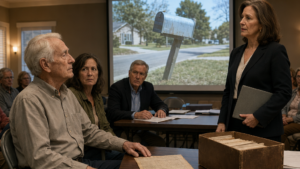
The photo of Christopher’s broken fence was already on the screen when he walked into the HOA clubhouse.
Someone had enlarged it until the crooked “PRIVATE PROPERTY” sign filled half the wall. The torn screw hole looked enormous under the projector light, a bright raw mark in the wood. From the angle of the photo, the fence did not look like a safety barrier. It looked like a warning aimed at the neighborhood.
Christopher stopped just inside the door.
Laura Wright stood near the front table in the same red blazer, speaking quietly with two board members. A stack of printed packets sat in front of her, each one marked with colored tabs. Virginia Adams sat at the end of the table, hands folded over a legal pad, her face unreadable.
A few neighbors occupied folding chairs. Not many. Enough.
Laura looked up when she saw him. “Mr. Mitchell. You’re on the agenda.”
“I didn’t realize my property was already giving the presentation.”
“It’s evidence of the violation.”
“It’s evidence of damage.”
The room quieted. Christopher took the seat closest to the aisle, folder on his lap, phone in his pocket, every printed page arranged in the order he had practiced at the kitchen table. He had left Rebecca at home with the back door locked and the porch camera active. She had not wished him luck. She had only said, “Don’t let them turn me into the reason everyone stares.”
He had promised.
Now he was not sure what that promise allowed.
Laura called the meeting to order with the smooth voice of someone who trusted procedure more than weather. She summarized the issue as an unauthorized waterfront fence, erected without final approval, bearing signage that could discourage residents from accessing “common lake amenities.” The words slid past the missing post, past the dock slope, past the latch he had bought and never installed.
Christopher waited until she finished.
When she asked if he wanted to respond, he stood with his folder.
“I filed a request three weeks before the crew arrived,” he said.
Laura glanced at the board. “An incomplete request.”
“I submitted the form the portal required.”
“The form lacked required documentation.”
“It included a safety letter.”
“A vague letter,” Laura said. “Not sufficient for exterior modification approval.”
Christopher opened the folder, but did not pull out the specialist’s full plan. He pulled out the shorter letter instead, the one he had already sent. “This states the modification was recommended for family safety.”
Laura leaned back slightly. “The association does not dispute that you used the word safety. The association disputes your right to install a fence before approval.”
A board member shifted in his chair. Another looked at the screen, then at Christopher, as if trying to decide whether a sign could be both rude and necessary.
Virginia’s pen moved once across her pad.
Christopher kept his voice even. “The existing path from the back door to the dock runs past a drop-off that becomes slick after rain. The fence guides the path away from that edge.”
Laura tapped her packet. “The lakefront guidelines require sightline review before any structure is added within thirty feet of the shoreline.”
“It’s twenty-two inches lower than the hedge two houses down.”
“That hedge was grandfathered.”
“My daughter’s safety wasn’t grandfathered.”
The room tightened. Christopher felt the sentence expose too much and too little at once.
Laura’s expression flickered. “Again, Mr. Mitchell, if there is a medical basis for this request, there is a formal accommodation process. That process does not allow an owner to build first and justify later.”
“I tried to avoid putting private medical details into a community file.”
“That was your choice.”
It landed harder than she probably meant it to. Or maybe exactly as hard.
Christopher looked toward the screen. The crooked sign hung there under the projector light, his own words enlarged into something ugly. PRIVATE PROPERTY. Laura had chosen that image carefully. Not the slope. Not the post hole. Not James’s photo of the crew before the notice. The sign.
“This isn’t about keeping neighbors from the lake,” he said.
Laura turned to the room. “But that is the effect. A private-property sign placed across a lake-adjacent path creates confusion. It creates the appearance of private ownership over community water.”
“There is no community path through my yard.”
“There has been informal access for years.”
“Informal access is a polite way to say people got used to crossing land they didn’t own.”
A neighbor in the second row muttered something. Laura lifted a hand before the murmur could grow.
“The association also has insurance obligations,” she said. “Unapproved barriers near the water create liability. If someone trips, if emergency access is blocked, if another owner follows this example, we have a broader problem.”
For the first time, Christopher heard something behind the polished words that was not only power. Fear, maybe. Not fear for Rebecca. Fear of being blamed. Fear of losing control of a system she had promised to manage.
He could have pressed harder. He could have shown the full plan and let the room absorb the clinical language Rebecca hated. He could have made every neighbor understand why water mattered, why sudden sound mattered, why a fence could be the difference between a bad minute and a disaster.
Instead, he took out a sealed envelope.
“This is limited documentation,” he said. “It confirms the fence is a safety accommodation recommended for a resident of the home. It does not authorize public discussion of diagnosis or treatment details.”
Laura’s eyes went to the envelope. “The board cannot evaluate what it cannot review.”
“The board can review whether a safety accommodation exists.”
“It can review whether a complete application exists.”
Virginia finally spoke. “Laura, we can accept sealed documentation for executive review.”
Laura turned toward her. “Not if the modification has already been installed in violation.”
“That’s a separate question.”
“It is the same question. If we let owners build first and submit sealed letters later, we lose architectural control.”
Christopher looked at Virginia. Her face remained controlled, but her pen had stopped moving.
The board chair, a role-only man with reading glasses low on his nose, cleared his throat. “Mr. Mitchell, are you willing to pause all work while the board completes review?”
“The work is already paused because half of it was pulled out.”
“Are you willing,” the chair repeated, “not to reinstall or continue the fence until a decision is issued?”
Christopher thought of the open gap, the locked back door, Rebecca standing at the glass.
“I’m willing not to expand it,” he said. “I’m not willing to leave a hazardous gap if I can safely brace it.”
Laura seized on that. “So he’s refusing.”
“I’m refusing to let a damaged safety barrier stay damaged.”
The chair removed his glasses and rubbed the bridge of his nose. “The board will take the matter under full review. The violation remains active pending determination. Daily fines will remain assessed but may be withdrawn depending on outcome.”
“Meaning I’m fined while you decide whether the thing you damaged was necessary.”
The chair did not answer.
Laura stacked her packets. “The association expects compliance during review.”
Christopher slid the sealed envelope across the table. Virginia reached for it before Laura did.
Laura’s hand stopped.
For one second, both women looked at the envelope as if it were heavier than paper. Virginia picked it up and wrote the date and time across the front. “Received at meeting,” she said.
Laura’s smile was thin. “Noted.”
Christopher gathered his folder. He had given them more than he wanted and less than they needed. The truth was in the room now, but only as a sealed shape, easy to delay, easy to question, easy to process until the purpose of it bled out.
As the meeting broke into low conversations, Virginia came around the end of the table. She did not touch his arm. He was grateful for that.
“Christopher,” she said quietly, “did Laura see the word accommodation before she ordered the crew?”
He looked at the projected sign still crooked on the wall. “The letter was in the portal.”
“That isn’t what I asked.”
He turned back to her.
Virginia’s voice dropped further. “Did she see it?”
Chapter 5: The Notice Was Posted After The Damage
“This was logged before the violation notice,” the county clerk said.
Christopher stared through the glass divider at the copy she had stamped and slid back to him. The received date sat in blue ink beside the HOA portal printout he had brought, square and plain and not nearly dramatic enough for what it meant.
“Can I get that certified?” he asked.
The clerk nodded. “For the portal receipt and the attachment list, yes. I can’t certify what your HOA did with it after that.”
“I just need proof it was there.”
“You’ve got proof it was transmitted and logged.”
He paid the small fee with a card that took too long to process. While the machine blinked, he looked down at the pages: request form, safety letter, attachment confirmation. No full diagnosis. No private plan. But enough to show Laura had received something more than a fence sketch and a stubborn homeowner.
Outside the county office, he sat in his truck and placed the certified copy beside James’s photos. The folder had become thick enough to resist closing. It should have made him feel better.
Instead, it made him angry at himself.
He had believed that if he kept the request tidy, polite, and limited, the process would meet him halfway. He had treated the HOA like a stubborn hinge: oil it, align it, tighten the screws, and it would work. But the process had not jammed by accident. Someone had pushed it in the direction that suited them.
His phone buzzed as he started the engine.
James Hall.
“I need to tell you something,” James said.
Christopher pulled his hand away from the ignition. “Tell me.”
“They called me this morning.”
“Who?”
“The association office. Not Laura directly. Someone from the office, then the removal supervisor. They asked if I could be available to take down the rest if the board confirmed the violation.”
Christopher looked at the stamped page in the passenger seat. “And?”
“I said no.”
“You almost didn’t.”
Silence.
Christopher closed his eyes briefly.
James exhaled into the phone. “I do a lot of work in that neighborhood. Deck repairs, docks, storm cleanup. If they tell people I’m difficult, that hurts.”
“You built the fence.”
“I know.”
“You knew why I needed it.”
“I knew part of why.”
Christopher opened his eyes. Across the parking lot, a woman helped an older man down from a curb, one hand steady at his elbow. Nobody had to submit drawings for that. Nobody asked whether the gesture matched the neighborhood.
James spoke again. “I’m not proud of hesitating.”
“Then don’t just be sorry.”
“I took photos. I’ll write a statement. Times, condition of the fence, no notice on the door when I left. I’ll put my license number on it.”
Christopher’s grip loosened on the phone. “Today?”
“I can meet you by my truck in twenty.”
James was waiting at the lakeside hardware store, parked near the lumber racks. His neon work vest lay across the dashboard. He had written the statement by hand on a clipboard because, he said, printed words looked too easy to deny. Christopher read it twice.
At 9:42 a.m., sign installed and fence upright. At 10:06 a.m., red vehicle arrived. At 10:19 a.m., utility truck and crew entered property. No notice observed on front door at time of departure. Later photos show notice posted after crew present.
James had signed at the bottom.
“This helps,” Christopher said.
“It doesn’t fix the post.”
“No.”
James leaned against the truck bed, arms folded. “Why didn’t you tell them straight out at the start?”
Christopher knew what he meant. The daughter. The doctor. The reason the fence mattered.
“Because it isn’t mine to hand around.”
James looked toward the lake road. “Sometimes people don’t understand until you show them the whole broken part.”
“People also like staring at broken parts.”
James nodded, accepting that because there was nothing easy to say against it.
Christopher returned home with the certified copy, James’s statement, and two temporary braces he was not sure he was allowed to install. The lakefront looked worse in daylight. Without the pulled post, the fence line bent awkwardly, guiding the eye to the gap instead of away from it. The “PRIVATE PROPERTY” sign was still crooked, and the torn screw hole had widened.
He was photographing it again when an email notification appeared.
Subject: SAFETY CONCERN — PARTIAL STRUCTURE CONDITION.
Laura had copied the board.
The message stated that because Christopher’s unauthorized fence was now partially removed and unstable, it posed an immediate hazard. Unless he consented to full removal or obtained temporary written approval by sunrise, the association would send a crew to remove the remaining unstable sections “to reduce liability exposure.”
Christopher read the line twice.
They had created the hazard. Now they were using it to finish the removal.
He forwarded the email to Virginia without comment, then took photos of the post hole, the chain marks, and the braces still in his truck. He wanted to install them. He wanted to put the fence back upright and dare Laura to object. But if he touched the posts now, she would call it proof he ignored the review.
He was still standing there when the back door opened.
Rebecca stepped onto the porch.
He turned too quickly. “I thought you were inside.”
“I was.”
“You need shoes.”
“I’m on the porch.”
The old impatience in her voice was there, but thinner than usual. She looked past him toward the gap. Her hands were tucked inside the sleeves of her sweatshirt, fingers hidden.
“Is that where they pulled it out?”
“Yes.”
She came down one step.
“Rebecca.”
“I’m not going to the water.”
“I didn’t say you were.”
“You were about to.”
He stopped.
She looked at the open space near the willow, then at the dock beyond it. The water was dull under the afternoon sky. No sparkle, no invitation, just a flat gray surface waiting at the bottom of the slope.
“They think it’s ugly,” she said.
“They think it wasn’t approved.”
“That means ugly with paperwork.”
Despite himself, Christopher almost smiled. Then her face changed, and the almost-smile vanished.
“Is it gone because of me?”
“No.”
“Dad.”
“It’s not gone.”
“That’s not what I asked.”
He walked closer but stopped at the bottom of the porch steps, leaving her the space she liked when the world was too full. “They’re trying to remove it because they don’t understand what it’s for.”
“Because we didn’t tell them.”
“Because I didn’t tell them enough.”
“I asked you not to.”
“I agreed.”
“So it is because of me.”
“No.” The word came too sharp. He softened it. “It’s because adults with authority made choices before asking the right questions.”
Rebecca looked down at the porch boards. “But if they knew, maybe they wouldn’t have.”
He could not promise that. Not anymore.
His phone rang in his hand. Virginia again.
He answered without taking his eyes off Rebecca.
“I saw Laura’s email,” Virginia said. Her voice was tight now, the caution stripped back. “Christopher, you need to be ready at sunrise. She’s telling the board the partial fence is an emergency hazard.”
“It is a hazard because her crew made it one.”
“I know.”
“Does she?”
A pause.
Then Virginia said, “I don’t know what Laura will admit. But I found the agenda note from before the first crew visit. It says removal authorized due to non-compliant lake-access obstruction. No mention of safety accommodation.”
Christopher looked at the folder under his arm, then at Rebecca.
Virginia added, “If you have more documentation and you’re willing to use it, tomorrow may be the time.”
Rebecca watched his face change.
After he hung up, she said, very quietly, “What happens tomorrow?”
Christopher looked at the open gap, the post on the ground, and the sign hanging crooked like a question nobody wanted to answer.
“The crew is coming back at sunrise.”
Chapter 6: The Second Crew Found Him Waiting
The crew truck backed toward the fence while Christopher stood in front of the next post.
Its reverse alarm cut through the dawn in short, flat beeps. Orange cones rattled in the truck bed. A worker lowered the tailgate, and the same crew supervisor stepped down with a clipboard held against his chest as if it might shield him from what he already knew.
Christopher had been there since 5:40.
The crooked “PRIVATE PROPERTY” sign hung just behind his left shoulder. At his feet lay the post Laura’s crew had pulled out, the base still clumped with dried clay. In his right hand, he held the certified portal receipt, James’s signed statement, and the HOA email Laura had sent the afternoon before. In his jacket pocket was the sealed letter Rebecca had placed on the kitchen table before going back to her room.
She had not said, Use it.
She had said, Don’t let them make it sound like I’m not real.
Laura arrived at 6:03 in the red car.
She stepped out wearing a cream blouse under a navy coat this time, the red blazer absent, though the same highlighted packet was under her arm. Her face tightened when she saw Christopher already recording.
“Mr. Mitchell,” she said, “you were notified.”
“So were you.”
“I’m not going to argue in your driveway.”
“You sent a crew to my driveway.”
The supervisor looked miserable. “We’re here to remove unstable sections only.”
“Unstable because you pulled the first post.”
“We have instructions.”
Christopher looked at him. “From her?”
“From the association.”
“That’s not what I asked.”
The man said nothing.
Laura opened her packet. “The partially removed fence presents a hazard. The association is acting to reduce liability pending final board review.”
Christopher held up the certified receipt. “My safety request was logged before your violation.”
“We discussed this. Logged is not approved.”
“You saw the safety letter before you ordered removal.”
Laura’s eyes flicked toward the phone.
“That is a yes-or-no question,” Christopher said.
“It is an incomplete characterization.”
“It’s a simple question.”
“No, it is not,” she said, her voice sharpening for the first time. “Because homeowners routinely use vague safety claims to bypass review, and the association is facing an insurance renewal in less than a month. If we allow unapproved lakefront barriers, we expose every resident here to higher premiums and inconsistent enforcement.”
There it was. Not the whole truth, but a piece of it. The fear under the packet.
Christopher lowered the receipt slightly. “So you needed an example.”
“I needed compliance.”
“You chose my fence because it was visible.”
“I chose your fence because you built before approval.”
“I built because my back door opens toward water.”
Laura looked toward the house. The curtains were closed. Christopher was grateful.
A second car turned into the driveway before Laura could answer. Virginia Adams got out carrying a phone and a thin folder. She had not dressed like someone arriving casually. Her coat was buttoned wrong, one side higher than the other, as if she had left in a hurry.
“Do not start work,” she said to the crew.
Laura turned. “Virginia, this is an enforcement action already authorized.”
“By whom?”
“By the committee.”
Virginia held up her phone. “I’m recording for the board file. When did you first see the request labeled as a safety accommodation?”
Laura’s face changed so quickly that Christopher almost missed it. Not fear exactly. Calculation.
“This is not a board meeting,” Laura said.
“No,” Virginia said. “It is a second attempted removal after the first one was paused by a deputy. I want the record clear.”
The supervisor took one step back from the fence.
Laura’s fingers tightened around the packet. “The first submission did not include sufficient documentation.”
“That wasn’t my question.”
Christopher heard his own words from the day before echoed back by someone who had no reason to help him except that the facts had become harder to ignore.
Virginia continued, “Did you see the safety letter before sending the first crew?”
Laura looked at the workers, then at Christopher’s phone, then at Virginia’s.
“I saw a letter,” she said.
“Was it attached to his request?”
“Yes.”
“Did it use safety language?”
“It used general language.”
“Did you tell the board there was a safety accommodation request before describing the fence as a lake-access obstruction?”
Laura’s jaw set. “The request was incomplete.”
Virginia’s voice stayed calm. “That is not an answer.”
For a moment, the lake behind them seemed too still. Christopher could hear a bird somewhere near the willow and the soft mechanical tick of the truck cooling in the driveway.
Laura looked at Christopher. “If there is a legitimate medical accommodation, you should have submitted it properly.”
He reached into his jacket pocket.
The sealed envelope felt too thin for the weight it carried. Rebecca had written her initials across the flap in small block letters. Not her full name. Just enough to say she had touched it, chosen it, allowed it.
Christopher held it where Laura and Virginia could see.
“This is a sealed medical letter confirming the need for a controlled outdoor barrier and restricted access toward water. It is for executive review only. It does not give the board permission to discuss my daughter’s diagnosis in open session, and it does not give anyone permission to turn her into neighborhood gossip.”
Laura looked at the envelope, then at him. “If that had been provided earlier—”
“It was not required for you to stop and ask before tearing down the fence.”
“You built first.”
“You removed first.”
Virginia stepped closer. “Christopher, are you submitting that now?”
He did not answer immediately.
The house behind him was quiet. He imagined Rebecca standing on the other side of the curtain, listening for tones more than words. He imagined her at twelve, mud on her socks, hands over her ears. He imagined her at the kitchen table, pushing the envelope toward him without looking up.
For years, he had treated her privacy like a locked door. Keep it closed, keep her safe. But the fence had taught him what doors taught too late: if no one knew why a boundary existed, someone would eventually call it obstruction.
He handed the envelope to Virginia.
“Limited review,” he said.
Virginia accepted it with both hands. “Limited review.”
Laura watched the transfer as if it were a procedural defeat she intended to appeal. “This still does not resolve the violation.”
“No,” Christopher said. “It resolves your excuse for pretending you didn’t know there was a person behind it.”
The words were quiet. They did not sound like victory. They sounded like something that had cost him.
The crew supervisor cleared his throat. “Are we removing anything?”
“No,” Virginia said.
Laura turned on her. “You don’t have unilateral authority to stop enforcement.”
“Neither do you,” Virginia said. “Not after this.”
Laura’s face flushed. “The board delegated architectural enforcement to my committee.”
“For routine violations. Not for a disputed safety accommodation with medical documentation and a prior removal attempt that may have begun before notice.”
The supervisor shut the truck tailgate without being asked.
Laura heard it and turned. “No one instructed you to pack up.”
He met her eyes for the first time all morning. “I’m not touching that fence until someone gives me something a lot clearer than what I got.”
Christopher felt the smallest shift in the ground beneath the scene. Not rescue. Not resolution. Just one more person refusing to let paper do more than it actually said.
Virginia took a photo of the sealed envelope against the hood of her car, then photographed Christopher’s certified receipt, James’s statement, and the email ordering sunrise removal. She did it carefully, saying each document title aloud for the recording.
Laura stood with her highlighted packet pressed flat against her side.
“You are creating a liability problem for the association,” she said.
Christopher looked back at the fence. “The problem was already there. I tried to build something around it.”
Virginia closed her folder. “I’m calling for an emergency
Chapter 7: The Sign Went Back On Straight
Laura read the corrected motion without looking at Christopher.
Her voice remained clear, but the paper trembled once when she turned the page. The HOA clubhouse was quieter than it had been the week before. No enlarged photo filled the wall this time. No crooked sign. No dramatic projection. Just a long table, a row of tired board members, a sealed envelope in the center, and Christopher seated in the aisle with the same folder on his lap.
Rebecca had stayed home.
That had been her choice, and Christopher had not tried to change it. Before he left, she had handed him the small brass gate latch he had bought the day everything started. She had kept it on her desk all week, turning it over in her fingers while the board reviewed documents, while Virginia emailed updates, while Laura stopped responding except through formal notices.
“For when they stop pretending it’s about the view,” Rebecca had said.
Now the latch sat in Christopher’s jacket pocket, heavier than it should have been.
Laura continued reading.
“The board acknowledges receipt of a limited medical accommodation letter, contractor statement, property-owner request record, and documentation concerning the timing of the initial enforcement action. Upon review, the board finds that the lakefront barrier may be approved as a safety accommodation, provided that final installation complies with the attached maintenance and finish requirements.”
She swallowed.
“The violation notice issued against Christopher Mitchell is withdrawn. Associated daily fines are voided. No further removal action is authorized pending completion of the approved repair.”
No one clapped. Christopher was glad. Applause would have made it feel like a show, and it had never been that.
The board chair adjusted his glasses. “Mr. Mitchell, the approved conditions are as follows: neutral stain, maximum rail height as submitted, no expansion beyond the marked boundary, and a recorded maintenance obligation so the structure does not become a hazard.”
Christopher nodded. “I can agree to those.”
Laura placed the motion on the table. “The association also clarifies that the sign may remain if repositioned on the interior-facing side of the post and if the wording is consistent with property-boundary notice rather than lake-access restriction.”
Christopher looked at her for the first time since she had begun reading. “The sign says private property.”
“The placement created confusion.”
“The crew tore it crooked.”
Virginia Adams, seated two chairs away from Laura, said, “The corrected placement is already in the proposed conditions. We don’t need to debate the old photograph again.”
Laura’s mouth closed.
Christopher felt the small satisfaction of that, then let it go. He had carried too much anger all week for it to be useful now. Anger had kept him standing in front of the post at sunrise. It had kept his hands steady while he handed over Rebecca’s sealed letter. But it could not install the fence. It could not rewrite what had been said in porches and messages and lakefront whispers. It could only sit in him like a tool he had used and needed to put down.
The chair turned toward him. “Is there anything you want added to the record?”
Christopher stood.
Several faces lifted. Laura’s did not.
He had written something the night before and thrown it away. Too long. Too polished. Too close to begging people to understand something they should have stopped to ask about in the first place.
So he spoke from the one thing he knew he could say without betraying Rebecca.
“I’m not asking the board to discuss my daughter’s private life,” he said. “I’m asking you to create a process where a resident can say safety and have that word taken seriously before a crew is sent to undo the repair.”
Virginia’s pen paused over her notes.
Christopher continued, “If a request is incomplete, tell the person what is missing. If medical information is sensitive, provide a private way to review it. If there’s a hazard, don’t make it worse and then call that the reason to remove everything. That’s all I want added.”
The room held still around the last sentence.
Laura finally looked up. Her expression was controlled, but not victorious. Not even angry in the way it had been. She looked tired, cornered by the exact process she had trusted to protect her.
“The management office can draft a revised accommodation procedure,” she said.
Virginia looked at the chair. “It should be board policy, not office discretion.”
The chair nodded. “Add that to the motion.”
A board member beside him wrote it down.
Christopher sat.
It was not an apology. It did not clean the mud from the pulled post or erase the neighbor’s stare from the road. It did not give Rebecca back the week she had spent checking the locked door and pretending not to. But it changed what could happen next time, and Christopher recognized, with some reluctance, that practical repair was often quieter than justice.
The vote passed with Laura abstaining.
Afterward, while chairs scraped and folders closed, Virginia came to him with a copy of the signed motion.
“You’ll want this before anyone changes the wording,” she said.
Christopher took it. “Thank you.”
“I should have asked harder questions sooner.”
He folded the paper carefully into his folder. “Yes.”
Virginia accepted that without flinching. “I know.”
Across the room, Laura gathered her highlighted packet. For a moment Christopher thought she might leave without speaking. Then she approached, stopping far enough away that neither of them had to pretend this was friendly.
“The insurance review was real,” she said.
“I believe you.”
Her eyes moved to his folder. “So was the risk of inconsistent enforcement.”
“I believe that too.”
Something in her face tightened, almost relief, almost resentment. “You put the association in a difficult position by building before approval.”
Christopher looked at her until she heard herself.
Then he said, “You put my family in a dangerous position by removing before understanding.”
Laura’s gaze dropped.
She did not apologize. She only nodded once, a small procedural surrender, and walked away with her packet pressed to her side.
James Hall arrived at the house the next morning with new concrete, replacement hardware, and a quieter manner than usual. He did not make jokes while unloading. He only set the tools beside the fence line and looked at the old post hole.
“Same line?” he asked.
“Same line,” Christopher said. “Neutral stain after it cures.”
James nodded toward the sign. “Inside face?”
“Inside face.”
They worked until the sun stood high over the lake. The damaged post could not be reused, so Christopher cut it down and set it aside near the shed. James tamped gravel into the new hole. Christopher held the replacement post level while concrete filled the space around it.
The repair looked almost plain when finished. That surprised him. After everything, he expected the fence to look like an argument. Instead, it looked like what it had always meant to be: a simple barrier guiding the yard away from danger.
When the concrete had set enough, Christopher took the brass latch from his pocket and installed it on the small gate near the dock path. The click it made when it closed was clean and final.
James lifted the “PRIVATE PROPERTY” sign. The torn screw hole was still visible at one corner.
“You want a new one?” he asked.
Christopher considered it.
“No,” he said. “Use that one.”
James looked at him, then nodded.
They fixed it straight on the interior-facing side of the post, where anyone coming from the yard would see it before reaching the gate. The words no longer faced the road like a challenge. They faced the house like a reminder.
Rebecca came outside just before sunset.
Christopher heard the back door open and turned. She wore sneakers this time. Her sweatshirt sleeves covered half her hands. She stopped at the porch first, taking in the fence, the repaired post, the sign, the latch.
“Looks normal,” she said.
Christopher wiped his hands on a rag. “That was the idea.”
She walked down the steps slowly. He did not move toward her. He let her choose the path. She followed the fence line to the gate, trailing her fingers along the top rail once, lightly, as if checking whether it was real.
At the latch, she stopped.
“Can I?”
He nodded.
She opened it. The hinge swung smoothly. Beyond it, the dock path curved away from the willow and the slick drop, guiding her toward the safer boards James had reinforced months earlier. She stepped through, then closed the gate behind her.
Click.
She looked back at him through the fence.
“Does it lock?”
“Only when we need it to.”
She nodded, accepting the difference.
Together they walked the dock path, Christopher a few steps behind. Rebecca stopped at the place where the new fence redirected the route. She looked toward the slope, then toward the water. The lake moved gently against the dock posts, indifferent and beautiful and dangerous in the same breath.
“I hated that letter,” she said.
“I know.”
“I still hate it.”
“I know.”
“But I liked that you didn’t let her read it out loud.”
Christopher felt something in him loosen that no board vote had touched.
“I promised you,” he said.
Rebecca looked back at the gate. The sign was visible from where they stood, straight now, small against the fence rail.
“You promised to keep me private,” she said. “Not invisible.”
He did not answer right away. The difference was simple enough that he should have known it before she had to say it.
“You’re right,” he said.
She gave him a quick glance, the kind that meant she was not ready for a large moment. Then she walked to the end of the dock, stopped where the boards widened, and breathed in the lake air.
On the way back, she reached the gate before him. She opened it, stepped through, closed it, and waited for the latch to click.
It did.
Rebecca smiled—not because anyone had approved it, not because Laura understood, not because the HOA had learned kindness in a single vote, but because the fence was there, ordinary and sturdy, doing its job without asking her to explain why she needed it.
The story has ended.