They Sent A Crew To Tear Down His Flood Wall Before The Storm Proved Why It Stood
Chapter 1: The Crew Was Already Cutting The Wall
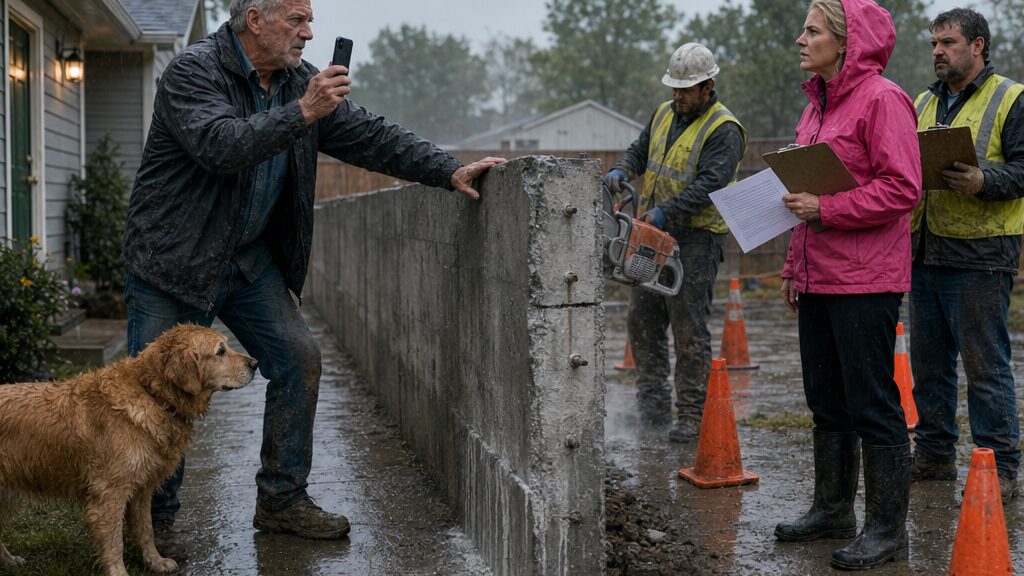
The saw was already biting into the concrete when Stephen Carter reached the side yard.
It screamed against the wall in short, angry bursts, throwing pale dust across the wet grass. Two orange cones leaned in the mud near the base where Mark Hall had set the new anchor bolts only three days earlier. A man in a yellow vest braced one boot against the wall and guided the blade along a chalk line Stephen had not drawn.
Stephen stopped at the corner of the house with one hand on the downspout and the other around his phone.
For a moment he did not shout. He watched.
The blade touched the first bolt plate. Sparks snapped out and died in the damp air.
“Shut it off,” Stephen said.
The worker did not hear him over the saw. Or pretended not to.
Stephen stepped off the patio onto the narrow concrete path that ran between the house and the flood wall. His golden retriever, River, came after him, nails ticking on the path, then halted at the sound and lowered his head.
“Shut it off.”
This time the worker looked back. The saw kept screaming.
Stephen lifted his phone and began recording.
The crew supervisor, a square man with a clipboard tucked under one arm, crossed from the truck parked half on Stephen’s grass. “Sir, you need to stand clear of the work area.”
“This is my property.”
“We have authorization.”
“From who?”
“The association.”
Stephen kept the phone steady. “Show me the court order.”
The supervisor’s face tightened, not with anger exactly, but with the annoyance of a man whose morning had been scheduled by someone else. “We’re not here for a court matter. We’re here to remove a noncompliant structure.”
“That structure keeps water out of my house.”
“It’s an unapproved wall extension.”
“It’s a repaired flood barrier with a gate.”
The saw finally stopped. Silence rushed in afterward, filled by the faint tapping of rain on the crew truck hood. Beyond the wall, the drainage ditch sat low and brown, already carrying a slow sheet of water toward the culvert at the end of the street. The storm had not arrived yet, but the neighborhood had been warned. Everyone had been warned.
Stephen moved between the worker and the cut.
The supervisor held out one hand. “Sir, don’t do that.”
“No one touches another bolt until I see the order.”
The worker with the saw wiped dust from his cheek and glanced toward the street, as if waiting for someone more official to appear.
Stephen turned the phone slightly, letting the camera take in the fresh saw mark, the loosened anchor plate, the orange cones, and the unfinished line of the wall. It was not a tall wall, not from his side. Three feet of reinforced concrete rose beside the path, capped smooth, with a steel gate wheel half-hidden in a recessed box. From the street side, where the ground dropped away toward the ditch, it looked much higher. It looked, Stephen knew, like something built to keep the world out.
That was because it had been.
A bright pink rain jacket came around the side of the crew truck.
Karen Wright walked fast, hood down despite the rain, a white envelope pressed flat against her clipboard. She did not look at the cut first. She looked at Stephen’s phone.
“Mr. Carter,” she said. “You were notified.”
Stephen did not lower the camera. “No, I wasn’t.”
“The association sent notice.”
“When?”
Karen’s mouth thinned. “The date is on the letter.”
“Then hand it to me.”
She crossed the grass as if stepping into court. Her boots sank slightly where the yard sloped toward the wall. She stopped outside the cones and held the envelope toward him.
Stephen did not take it. He kept recording. “Read the date.”
Karen’s eyes moved once to the supervisor. “This modification is illegal under community exterior standards. It changes drainage conditions and creates liability for adjoining properties.”
“That wasn’t what I asked.”
“You had no approval to raise or reinforce this wall.”
“I asked you to read the date.”
The first small crack in Karen’s control appeared around her jaw. She turned the envelope and looked at it though she must have known what it said.
“This morning,” she said.
Stephen let that sit in the wet air.
Behind him, River gave a low whine. At the kitchen window, a curtain shifted. Betty was awake, then. He had hoped the noise would not reach her room.
“This morning,” Stephen repeated. “Your crew was cutting my wall before I had the letter in my hand.”
“The board authorized emergency removal because the storm system has changed the risk profile.”
“The storm is why the wall has to stay.”
Karen took one step closer. “The wall may be why your side stays dry and everyone else floods.”
The worker with the saw looked down at his boots. The supervisor stared at his clipboard.
Stephen could have said a lot then. He could have said he had sent the first photo of standing water on his back step in March. He could have said he had asked for the culvert to be cleared before spring storms. He could have said Betty’s room sat on the low side of the house, where the old floor vent had taken in water once before.
Instead he opened the photos on his phone and held the screen toward Karen.
The first photo showed floodwater against his back door two years earlier, brown and shining under porch light. The second showed River standing on the only dry strip of concrete, ears back, while water licked the threshold. The third showed a dark line on the doorframe, sixteen inches above the sill.
“Dated,” Stephen said. “All of them.”
Karen’s eyes flicked over the images. For a second she looked less certain. Then the clipboard came back up between them.
“Photos do not substitute for architectural approval.”
“No,” Stephen said. “They explain why I asked for it.”
“You repaired before approval.”
“I repaired after no one answered.”
“That is not how this process works.”
Stephen looked past her to the cut in the wall. Concrete dust had mixed with rainwater and run down like chalky milk. The anchor bolt Mark had installed was half exposed now. One more pass with the saw and that section would lose the strength it had been built to hold.
“This wall protects the path to the side door,” Stephen said. “That path has to stay dry.”
“For your convenience?”
His hand tightened around the phone before he could stop it.
Karen saw the movement. Her voice softened slightly, which somehow made it worse. “Mr. Carter, the association has to consider all homeowners. We can’t let one resident build a private levee because he’s worried about his landscaping.”
Stephen looked at the wet path, then at the window where the curtain had gone still.
“My landscaping,” he said.
Karen glanced at the house. “If there is some other issue, you should have included it in your application.”
“You didn’t answer the application.”
“You submitted incomplete materials.”
“I submitted photos, measurements, contractor notes, and the gate plan.”
“There is no approved gate plan on file.”
“Then someone lost it.”
Karen’s eyes hardened again. “Be careful.”
Stephen lowered the phone just enough to look at her without the screen between them. “I have been careful for two years.”
The supervisor cleared his throat. “Mrs. Wright, do you want us to stand down or continue?”
Karen kept her eyes on Stephen. “The removal is authorized.”
Stephen stepped closer to the cut wall and planted one hand flat on the concrete cap. The rain had made it cold. He could feel faint vibration where the saw had been.
“You start that saw again,” he said, “and you do it on camera with me standing here asking for the legal authority to remove a safety structure before an active flood warning.”
Karen’s nostrils flared. “You’re obstructing association enforcement.”
“I’m documenting trespass.”
“You invited this by ignoring the rules.”
“No,” Stephen said. “I invited Mark Hall to repair a wall your board ignored until rain was on the radar.”
The supervisor shifted his weight. The worker lowered the saw to his side.
For the first time, Karen looked past Stephen toward the house long enough to notice the ramped threshold at the side door, the sandbags stacked under the eave, the orange extension cord running from the garage to the back room window.
“What is that cord for?” she asked.
Stephen’s face closed before he could stop it.
“None of your concern.”
“It becomes our concern when exterior alterations—”
“No.” His voice stayed low, but something in it made the supervisor look up. “You don’t get to ignore the water, ignore the emails, cut the wall, and then ask what’s inside my house.”
Karen held the envelope against her clipboard. Rain darkened the shoulders of her pink jacket.
“You are making this harder than it has to be,” she said.
Stephen looked at the saw mark again. He knew exactly how much strength the crew had already taken from the section. Not enough to fail today, maybe. Enough to worry him if the storm stalled over the county. Enough to make Mark curse when he saw it.
A police siren gave one short chirp out front.
Karen turned toward the sound with visible relief.
“Good,” she said to the supervisor. “Once the officers confirm access, resume removal.”
River pressed against Stephen’s leg. At the kitchen window, Betty’s curtain moved again.
Stephen raised his phone and started recording the driveway.
Chapter 2: The Notice On The Door Came Too Late
The violation notice was taped to the front door so low that rainwater from the porch roof had already blurred the bottom line.
Stephen found it after the officers arrived, after Karen led them toward the side yard with the brisk confidence of someone giving a tour, after the crew supervisor agreed to pause “temporarily” while everyone sorted out property access. The paper had been slapped over the old flood mark on the white doorframe, the same brown stain Stephen had never painted over because forgetting was how people made the same mistake twice.
He peeled the tape carefully so the page would not tear.
The printed header read: Emergency Exterior Compliance Action.
The date was that morning.
The time stamp, in small type near the bottom, was 8:12 a.m.
Stephen had heard the saw at 8:07.
He stood on the porch with the paper in one hand and his phone in the other. Rain tapped off the gutter into the flowerbed Betty used to keep planted with yellow marigolds before the steps got too difficult. River sat by the door, watching him with worried brown eyes.
Inside, Betty called, “Steve?”
He opened the door. “It’s paused.”
“That’s not what I asked.”
“I know.”
Betty Thomas sat in the wide chair beside the kitchen table, wrapped in a gray cardigan, one hand resting on the armrest, the other near the small portable oxygen concentrator humming beside her. She did not use it all day, not usually, but storm air made her breathing shallow. Her walker stood folded against the counter, close enough for pride, not close enough for safety.
Stephen put the notice facedown on the table.
Betty looked at it anyway. “That from her?”
“From the association.”
“That means from her.”
He did not answer.
The kitchen table was already covered with the things Stephen hated showing people: printed emails, contractor receipts, county drainage diagrams, photographs in plastic sleeves, notes in his blocky handwriting. He had kept them in a metal file box in the garage. He had told himself that was enough. Records mattered. Dates mattered. A person who had the facts did not need to stand in a clubhouse and beg.
Now the wall had a saw cut in it.
He spread the notice flat and took a picture of it beside the clock on the stove.
Betty watched him. “You should call Mark.”
“I’m calling him.”
Mark Hall answered on the second ring with wind in the background. “I heard.”
“From who?”
“Crew guy I know. He said they started cutting.”
“They did more than start.”
A pause. “How deep?”
“First bolt plate exposed. Chalk line along the center section.”
Mark swore under his breath. “That section holds the gate housing square. If they cut too far, you’ll get pressure movement.”
“The board says there’s no gate plan on file.”
“There was a gate plan. I emailed it with the revised drawing.”
“To me.”
“To you and the architectural committee address.”
Stephen looked at the stack of papers. “Send it again.”
“I will. But Stephen…” Mark’s voice shifted. “Karen called me last night.”
Stephen’s fingers stilled on the table.
“What did she say?”
“That I should reconsider doing unapproved work in the subdivision if I wanted future jobs there.”
Betty’s eyes lifted.
Stephen kept his voice even. “She threatened you.”
“She didn’t use that word.”
“They never do.”
“She said the association had concerns about my license. About liability. About whether I’d documented the original condition before repairs.”
“You did.”
“I did. But I’ve got two crews and a slow month coming.” Mark exhaled. “I’m not proud of hesitating.”
“You finished the work.”
“Because you paid me and because the wall needed it. But I should have told you she called.”
Stephen looked toward the back window. Through the glass, he could see Karen at the side yard speaking to one officer, her pink jacket bright against the wet gray morning. The officer was listening, hands on his belt, while the crew waited by the truck.
“Send everything,” Stephen said. “Every email. Every plan. Every photo from before you touched the wall.”
“You’ll have it in five minutes.”
“And Mark?”
“Yeah?”
“If they ask whether that wall was optional, answer straight.”
“It wasn’t optional.”
Stephen ended the call.
Betty pushed herself higher in the chair. “What does she think is in that room, Steve?”
“She didn’t ask that way.”
“But you heard her thinking it.”
He sorted the papers into piles because his hands needed something to do. “I’m not putting your medical business in front of the whole neighborhood.”
“You might not get to keep it private if they take the wall.”
“They’re not taking the wall.”
“You don’t know that.”
Stephen looked at her then. She had the same narrow face their mother had carried into old age, the same way of making a sentence gentle without making it soft. The last flood had left her sitting on the bed in the back room with water under the door and no way to cross the hallway without slipping. He had carried her then, badly, one arm under her knees and one behind her back, both of them pretending the fear in her breathing was only irritation.
Afterward, she had made him promise not to let water decide where she could live.
He had made the promise too quickly. That was his habit. Fix first. Explain never.
His email chimed.
Mark’s files arrived in a string: gate drawing, pre-repair photos, invoice, concrete specification, drainage note, a forwarded message to the architectural committee dated five weeks earlier. Stephen printed what mattered, then laid the pages beside the notice.
The pattern emerged with the bluntness of math.
March 3: Stephen sent photos of standing water near the back door.
March 7: automated reply.
March 14: Stephen requested permission to reinforce the existing flood wall.
March 18: Mark sent measurements and a gate diagram.
March 29: Stephen followed up.
April 5: Stephen followed up again.
April 11: Karen replied that the matter would be reviewed after the spring landscaping inspection.
April 27: weather service issued first seasonal flood warning.
This morning: emergency removal.
Betty tapped one finger against the table. “They knew.”
“They knew I asked.”
“No,” she said. “They knew why.”
Stephen did not answer fast enough.
She looked toward the side door where the concrete path ran outside, narrow but level, from her room to the driveway. “You didn’t tell them about the equipment.”
“I told them the path had to remain dry.”
“That’s not the same.”
“It should have been enough.”
Betty’s mouth pressed into a thin line. “That’s you being stubborn and calling it principle.”
Stephen gathered the printed emails into a folder. “That’s me not handing strangers a reason to discuss you under old business.”
A knock hit the front door before Betty could respond.
Stephen opened it halfway. One of the officers stood there, rain shining on his shoulders. Behind him, Karen waited under the porch edge, envelope still in hand.
“Mr. Carter,” the officer said, “for now the crew is going to leave the equipment on site and suspend work until the association clarifies the paperwork.”
“For now,” Karen added.
Stephen looked at her. “You mean until the appeal.”
“There will be an emergency board meeting at six,” Karen said. “Given the storm warning, the board will decide whether immediate removal proceeds in the morning.”
“You damaged the wall this morning.”
Karen’s expression flickered. “No section has been removed.”
“That isn’t what I said.”
The officer glanced between them, already wishing himself elsewhere.
Karen held out another page. “You may attend and speak for three minutes.”
Stephen took it because refusing would give her one more line for the record.
“Three minutes,” he said.
“The same as every homeowner.”
He almost laughed. Instead he looked down at the notice, at the clean black letters pretending the morning had been orderly.
Behind him, Betty’s concentrator gave a small change in tone, a strained little rise before it settled again.
Karen heard it. Her eyes moved past his shoulder.
Stephen stepped slightly, blocking her view.
“You’ll have your meeting,” he said.
Karen nodded once. “And you should prepare yourself for the possibility that the board disagrees.”
After they left, Stephen closed the door and stood with one hand flat against it. The old waterline stain disappeared behind the fresh notice.
From the back room, Betty called his name again.
This time her voice was not steady.
He turned and found her leaning toward the hallway, eyes fixed on the floor vent near the baseboard.
A dark bead of water trembled between the metal slats.
Chapter 3: The Board Called Safety A Liability
Stephen walked into the HOA clubhouse and saw his wall projected ten feet wide on the screen.
Someone had drawn red circles around the gate housing, the new concrete cap, the anchor plates, and the section the crew had started cutting. The photo had been taken from the street side, low enough to make the wall look taller than it was. In the image, Stephen’s roofline barely showed behind it, as if the house itself were hiding.
A murmur moved through the folding chairs when he came in.
Karen stood at the front beside the screen, still wearing the pink rain jacket, though the room was warm and smelled of damp carpet and coffee left too long on a burner. Three board members sat behind a plastic table with name placards. None of them looked directly at Stephen for more than a second.
Rebecca Lewis sat in the second row, arms crossed tight against her chest.
Stephen took the chair nearest the aisle. The folder rested on his knees. He had marked the pages with yellow tabs, then blue ones, then removed half of them because three minutes was not enough time for the truth, only enough for a version someone could interrupt.
Karen tapped the remote. Another photo appeared: water pooled along Stephen’s side yard two years earlier, before the repair. His own photo. Cropped.
“This is not about anyone’s personal hardship,” Karen said. “This is about drainage, liability, and equal enforcement of exterior standards.”
Stephen looked at the cropped photo and felt Betty’s words at the kitchen table settle under his ribs.
You didn’t tell them enough.
Karen continued, “The structure at 1846 Briar Lane was modified without final approval. It now appears to alter water movement along the shared drainage corridor.”
A neighbor in the back said, “That’s what I said last year.”
Another answered, “My crawlspace took water after he built it up.”
Stephen opened his folder but did not stand yet.
Karen’s voice stayed measured. “The association has an obligation to prevent individual modifications from creating community-wide risk, especially before a major storm event.”
“Then why didn’t you clear the culvert?” Stephen asked.
Heads turned.
Karen looked at him over the remote. “Mr. Carter, you’ll have your opportunity to speak.”
“That was my opportunity six weeks ago.”
A board member cleared his throat. “Let’s maintain order.”
Stephen closed his mouth. It cost him more than he expected.
Karen moved to the next slide. A diagram appeared, simplified almost to the point of dishonesty: Stephen’s lot, the wall, arrows showing water flowing away from his property toward the lower street.
“The concern,” Karen said, “is that by reinforcing and raising this barrier, Mr. Carter may be protecting one property at the expense of others.”
Rebecca stood before anyone called on her. “My garage flooded the year he raised it.”
Stephen turned in his chair.
Rebecca’s face was pale with anger, but there was exhaustion underneath it. She was not performing. Her hands shook as she held a phone with pictures ready on the screen.
“I had water halfway up the storage shelves,” she said. “My husband’s tools rusted. The drywall had to come out. And every time I asked about drainage, I got told it was being reviewed. Then I drive past his place and there’s a wall higher than mine.”
“It wasn’t higher than yours,” Stephen said.
“From my side it was.”
There it was: the part Karen did not have to invent. Fear had already done the work.
Stephen looked at Rebecca’s phone, at the little glowing photos of wet boxes and gray water, and the anger he had carried from the kitchen shifted. He had been so focused on his own door, his own vent, his own promise, that he had let everyone else imagine the wall as an answer built against them.
“I’m sorry your garage flooded,” he said.
Rebecca blinked, as if she had expected a fight and been handed something heavier.
Karen stepped in quickly. “And that is precisely why unilateral modifications are unacceptable.”
Stephen stood.
The board member glanced at the timer on the table. “Mr. Carter, you have three minutes.”
Stephen placed the first page on the table: an email printout with dates. “I requested review before the repair. More than once.”
Karen folded her hands. “Incomplete requests are not approvals.”
He placed the second page down: Mark’s gate diagram. “The wall includes a controlled overflow gate. It was designed to relieve pressure into the drainage corridor without sending water across the yard or into the house.”
Karen’s eyes sharpened.
Stephen heard the room change. Not belief yet. Interest.
He put down the third page: a photo of the recessed steel wheel set into the wall cap. “That gate has been there since the repair. It is not visible from the street unless you know where to look.”
Rebecca leaned forward. “A gate?”
Stephen nodded once. “It opens into the ditch, not toward your garage.”
“Then why didn’t anyone say that?” she asked.
He felt the question land exactly where it should have.
“I should have,” he said.
Karen seized the pause. “No approved plans showing that gate exist in the association file.”
“I sent them.”
“To a committee address, according to you.”
“According to the email record.”
“An email record does not establish approval.”
“No,” Stephen said. “But it establishes notice.”
Karen’s composure cooled. “Mr. Carter, you installed first and are now asking the board to excuse it because you believed your situation was urgent.”
“It was urgent.”
“Every homeowner believes their issue is urgent.”
Stephen looked at the red-circled wall on the screen. Then at Rebecca. Then at the board, whose members looked trapped between fear of floodwater and fear of premiums.
He did not say Betty’s name.
He did not say oxygen concentrator, floor vent, walker, wet hallway, or the weight of carrying someone who had trusted the floor until it moved under her.
He said, “The side path has to stay dry for safe access to the house.”
Karen tilted her head. “Safe access for whom?”
Stephen’s throat tightened.
The whole room seemed to wait. It was not a cruel wait, not entirely. Some people were curious. Some were irritated. Some wanted a reason that would make the problem simple.
Stephen closed the folder.
“For the resident of the house,” he said.
Karen let the silence after that answer work against him.
A board member asked, “Can you provide medical documentation or accessibility certification?”
Rebecca looked down at her hands. That question had embarrassed her, though she had not asked it.
Stephen held the folder by its spine. “I can provide proof that water reached the house before the repair. I can provide proof that I requested review. I can provide proof that your crew damaged the wall before my appeal was heard.”
Karen turned to the board. “And we can provide proof that no final exterior approval was granted, no drainage engineering review was completed, and no neighboring impact assessment was accepted.”
“That’s because you never completed the review.”
“The burden is not on the association to approve retroactively what should not have been built.”
“The burden is on the association not to destroy a safety structure before a storm.”
The room went quiet enough for the rain to be heard ticking against the clubhouse windows.
For one second, Stephen thought someone on the board might slow things down. One member looked at the projected photo, then at the emergency weather alert scrolling silently across a phone in front of him. Another whispered to Karen. She shook her head once.
The vote happened with procedural calm.
Temporary emergency removal of the noncompliant wall section. First light, weather permitting. Contractor access authorized. Homeowner appeal to continue after mitigation.
The words came in pieces, each one clean enough to avoid sounding like what it meant.
Rebecca turned around before Stephen reached the aisle.
“If that gate is real,” she said quietly, “why hide it?”
He looked at her, and for the first time all day, he had no answer that did not make him smaller.
Outside, the rain had thickened. In the parking lot, water ran along the curb toward the dark ditch beyond the clubhouse lawn.
Stephen opened his truck door just as his phone buzzed with a message from Mark.
If they remove that section at first light, the gate housing may not hold under pressure. Call me before you touch anything.
Chapter 4: The Culvert Nobody Wanted To Photograph
The culvert mouth was almost invisible under weeds, silt, and a collapsed mat of dead leaves.
Stephen stood at the edge of the drainage ditch with a flashlight in one hand and Mark Hall’s message open on his phone in the other. Rain tapped on the hood of his jacket. Water moved below him in a sluggish brown sheet, not fast enough to drain the street, not slow enough to ignore. It slid toward the hidden opening and folded back on itself, swirling around a knot of branches caught in rusted wire.
Mark crouched beside the ditch and angled his own light under the weeds.
“That’s not drainage,” he said. “That’s a cork.”
Stephen said nothing. His boots sank into mud at the slope’s edge. The ditch ran behind four houses before turning toward the road, where the shared culvert was supposed to carry stormwater under the entrance drive and out toward the county channel. On the HOA map, it was a clean blue line. In front of him, it was a clogged throat.
Mark pulled on work gloves and reached for a branch.
“Don’t,” Stephen said.
Mark looked back. “I’m not leaving it like this.”
“You pull the wrong piece, the bank comes with it.”
Mark hesitated, then stood. He knew Stephen was right. The bank had softened. Grass roots hung out in ropes where water had eaten at the side. A white plastic grocery bag pulsed under the surface, caught on something metal.
Stephen stepped down carefully and pushed his measuring stick into the water. It struck silt after only ten inches. He moved it forward. Same depth. Again. Less.
“The pipe’s half buried,” he said.
“At least.”
Lightning flashed beyond the rooftops, white for an instant across the neighborhood. In that flash, Stephen saw the red tips of two wooden stakes leaning in the weeds behind Mark.
He moved the flashlight.
The stakes were old survey markers, weathered gray except for the faded paint at the top. One had a strip of orange tape knotted around it, almost black with dirt. The other was stamped with a small metal tag: DRAINAGE REPAIR LIMIT.
Mark saw it at the same time.
“Well,” he said softly. “Somebody’s been here before.”
Stephen climbed the bank and pushed through the weeds until he reached the stakes. He touched one with two fingers. It wobbled but held. The wood had been in the ground long enough for the mud to swallow half the tag.
“Not county,” Mark said. “Those look like association project stakes.”
Stephen’s jaw tightened.
He took photos from every angle: the stake, the tag, the blocked culvert, the water folding back against itself, the depth mark on his stick. He took one with Mark’s flashlight shining into the pipe, where a pale line of old construction fill showed under the debris.
Mark held the light still. “You told them about this?”
“I told them water wasn’t moving.”
“That’s not the same as this.”
Stephen looked at him.
Mark lifted both hands. “I’m not taking her side. I’m saying this matters.”
Stephen’s phone buzzed with a weather alert, but he ignored it.
They followed the ditch line back toward Stephen’s wall. Water had started gathering near the low side of Rebecca Lewis’s fence, flattening the grass. Her garage sat beyond it, dark windows reflecting lightning. From there the ground sloped gently toward Stephen’s wall before dropping into the ditch. Without the culvert pulling water out, the neighborhood had nowhere to send it but sideways.
Mark stopped near the recessed gate in Stephen’s wall. “Your wall didn’t create the bowl.”
“No.”
“But it changed where people noticed the bowl.”
Stephen looked at the wall, at the section the crew had cut. Rainwater had washed the concrete dust into a pale streak below the anchor plate. The saw mark looked small in the dark, almost harmless, until he touched it and felt the edge bite his glove.
“I should have brought them out here,” he said.
“Who?”
“Neighbors. Board. Anyone.”
Mark leaned on his flashlight. “Would they have come?”
Stephen had an answer ready, but it died before he said it.
He had sent emails. He had taken pictures. He had filed requests and measured waterlines and paid for repairs. He had done everything that let him remain alone. What he had not done was stand in Rebecca’s driveway and say, Look there, not here. What he had not done was tell a room full of frightened homeowners that his wall was only the visible part of a problem under all their feet.
A truck passed slowly on the street above, tires hissing through water.
Mark pointed his flashlight toward the entrance drive. “There’s something else.”
They walked along the ditch until they reached a shallow bend behind a row of trimmed shrubs near the clubhouse service lane. A small metal sign lay facedown in the mud. Mark turned it with his boot.
COMMON AREA DRAINAGE MAINTENANCE — TEMPORARY ACCESS
The sign was streaked with dirt, but the letters were clear.
Stephen photographed it.
Mark rubbed rain off his face. “Temporary access for what?”
Stephen opened the folder of photos on his phone. He had taken so many over the years that finding anything felt like digging through his own stubbornness. Porch water. Doorframe stains. Mark’s forms. Ditch water. Gate installation. Then he stopped.
The photo was from last spring’s landscaping day, when he had complained that the crew was putting mulch over a soggy strip behind the clubhouse instead of checking the drain. He had taken the picture because the new shrubs looked ridiculous standing in mud.
In the background, partly turned away, stood Karen Wright in a navy blazer, one hand on a clipboard, facing a man in a county vest near the same orange-taped stakes.
Stephen enlarged the image until the pixels blurred, then steadied it.
Mark came closer. “That her?”
“Yes.”
“When was it?”
“Last April.”
“Before you repaired the wall.”
Stephen stared at the tiny version of Karen. She had known where the stakes were. Maybe not everything. Maybe not the full blockage, not the fill, not the depth of silt. But she had stood there, in daylight, with a clipboard, before the board ever called Stephen’s wall the danger.
His anger rose so fast he had to breathe through it.
Mark watched him carefully. “Don’t go to her tonight.”
“I’m not.”
“Stephen.”
“I said I’m not.”
But the old habit was there, ready: take the picture, take the proof, confront the person who pretended not to know. It would feel good for one minute. It would fix nothing before the storm.
His phone buzzed again, this time louder, a hard emergency tone that made both men reach for their pockets.
The alert filled the screen.
FLASH FLOOD WARNING. BRIAR CREEK BASIN. MOVE TO HIGHER GROUND. DO NOT DRIVE THROUGH FLOODED ROADS.
A second message came behind it from the county emergency system.
MANDATORY FLOOD WARNING FOR LOW-LYING SUBDIVISIONS NEAR BRIAR CREEK. PREPARE IMMEDIATELY.
Mark looked toward the hidden culvert, then toward Stephen’s cut wall.
“They can’t remove that section in the morning,” he said.
Stephen closed the photo of Karen and saved it twice.
Across the neighborhood, porch lights came on one by one.
From Stephen’s house, through the rain and the dark, River began barking at the back door.
Chapter 5: The Pink Raincoat Came By Boat
Karen’s boat struck the wall with a hollow metal thud while blue police lights flashed under brown water behind her.
Stephen was standing on the dry side with one hand on the gate housing and the other gripping River’s collar. The dog had been barking since dawn, not at the storm, not at the water, but at the wrongness of the street beyond the wall. Where asphalt had been, there was now a moving sheet of muddy floodwater. Mailboxes stood like posts in a lake. A recycling bin drifted past Rebecca Lewis’s driveway, turned lazily, and vanished behind the police cruiser sunk to its windows near the curb.
Two officers stood on the cruiser’s roof.
One of them held a radio over his head.
Karen stood in the aluminum boat with her pink rain jacket zipped to her chin, one hand clutching the side rail, the other pointing at Stephen as if the distance between them were a courtroom aisle.
“You need to open that wall,” she shouted.
Stephen looked from her to the waterline against the concrete. The pressure was heavy but steady. The gate had been designed for controlled release into the ditch, not panic, not accusation, not a crowd shouting over stormwater.
“Not until I know where the water’s going,” he called back.
“It’s going into everyone else’s homes!”
Rebecca was waist-deep near her porch two houses down, braced against the railing. Her hair was plastered to her face, and she had a plastic storage tote wedged under one arm. “Stephen!” she shouted. “My garage is gone. My street is gone. Your yard is dry.”
He heard the accusation. He also heard the terror inside it.
Behind him, his yard was wet but not flooded. The concrete path to the side door remained visible. Sandbags held at the threshold. The extension cord to Betty’s backup battery was elevated on hooks under the eave. To anyone in the water, it must have looked like proof of selfishness: Stephen standing dry with his dog while the neighborhood sank around him.
He turned toward the house.
Betty’s window curtain moved.
Karen’s boat scraped the wall again. A flood rescue worker seated near the stern steadied it with an oar. The worker looked exhausted, not interested in the HOA fight, only in keeping the boat from spinning.
Karen lifted a plastic-covered page. “The association has already voted this structure noncompliant. You are worsening an emergency.”
Stephen almost laughed, but the sound would have been ugly.
“Karen, the culvert is blocked.”
“That is not the issue right now.”
“It is the only issue right now.”
“The issue is that your wall is holding back water from the drainage path.”
“The drainage path is plugged with silt and fill.”
“You are not an engineer.”
“No,” he said. “I’m the person who photographed it last night.”
Rebecca yelled something he could not make out. The wind tore it sideways.
One of the officers on the cruiser roof shouted toward Karen’s boat, “We need to move people off this street!”
Stephen saw it then: not just water around homes, but motion. The flood was pushing from the lower end back toward them because the culvert had failed to take it. If he opened the gate too fast, water would hammer the ditch, rebound off the blockage, and surge along the weakest ground. If he kept it closed, pressure would build against the wall, especially where the crew had cut the anchor plate.
The wall gave a faint sound.
Not a crack. Not yet.
A tick, like a stone hitting glass.
Stephen put one hand against the cut section.
Water seeped through the saw line in a thin, trembling thread.
Mark had warned him.
Karen saw him look down. Her face changed. “What happened there?”
“Your crew happened there.”
“That cut was superficial.”
He looked at her over the wall. “You don’t know what that word means in concrete.”
The rescue worker in Karen’s boat looked sharply at the saw mark. “Is that wall compromised?”
Stephen did not answer fast enough.
Karen seized it. “He altered it. He created the risk, and now he’s refusing to mitigate.”
Rebecca stared at the leak. For the first time, doubt crossed her face.
Stephen stepped to the recessed box and lifted the metal cover. The gate wheel sat inside, slick with rain, marked with the small directional arrows Mark had engraved into the plate: SLOW OPEN — DITCH RELEASE.
He pointed. “This is the overflow gate.”
Karen looked as if the object had insulted her.
Rebecca waded closer, holding the porch rail as long as she could before letting go. “That’s real?”
“It’s real,” Stephen said. “And it opens toward the ditch, not toward your garage.”
“Then open it!”
“If I open it too far, too fast, I may send pressure back through the blocked culvert and under your foundation.”
“Then do something!”
He did not blame her for that. Those three words were what people said when the water was at their door.
Behind him, River whined. Stephen turned and saw Betty at the side window, pale and upright, one hand braced on the sill. She should not have been standing. She had dragged herself there anyway.
He moved toward the house.
Karen shouted after him, “Mr. Carter, do not walk away from this.”
Stephen stopped halfway between the wall and the side door.
He looked at the dry path. Twelve feet of concrete. That was all it was. Twelve feet from Betty’s room to the driveway. Twelve feet between home and being trapped. Twelve feet that had become a public argument because he had treated a private promise as if it could stay private forever.
He went inside.
Betty was still near the window, one hand gripping the sill hard enough to whiten her knuckles. Her concentrator hummed beside the bed. The battery indicator showed yellow.
“You need to sit,” he said.
“You need to open the gate.”
“I need to keep you dry.”
“You need to keep us human.”
He stared at her.
She was breathing carefully, each inhale measured. Rain tapped at the glass behind her. Outside, Karen’s voice rose again, sharp and official even through the wall.
Betty nodded toward the window. “That woman in the boat is wrong about you. Don’t make her right by acting like this wall only belongs to us.”
Stephen swallowed. “If the water comes through here—”
“Then we deal with it. Like we did before.”
“We didn’t deal with it before. I carried you through it.”
“And then I asked you to build something better. Not something lonely.”
The backup battery gave a short beep.
Stephen looked down.
The yellow light had turned red.
At the same instant, from outside, came the sound he had been waiting not to hear.
A sharper crack moved through the wall, followed by Karen shouting his name.
Chapter 6: Tell The Flood That
“That wall is illegal!” Karen shouted as water rose over the police car hood.
Stephen came out of the side door with his rain jacket open, the gate key in his hand, and Betty’s red battery alarm still ringing inside the house. River stayed at his heel until Stephen pointed back. The dog resisted for half a second, then retreated to the doorway, trembling with the need to follow.
Karen’s boat had drifted closer. The rescue worker held it off the wall with an oar. Rebecca stood on her porch steps now, water moving around her thighs. One of the officers on the cruiser roof had both hands cupped around his mouth.
“Sir, if you can relieve pressure safely, now’s the time!”
Karen pointed at the cut section. “You heard him. Open it.”
Stephen looked at the floodwater pressing against the concrete, then at the seep running from the saw mark. The leak had widened into three threads. The wall was not failing yet. It was warning him.
He stepped to the recessed gate box.
Karen’s voice sharpened. “You should have complied before it got to this.”
Stephen put the key in the lock.
“Tell the flood that,” he said.
The words landed harder than he intended. Karen stopped speaking. Rebecca looked up from the water. Even the rescue worker’s eyes flicked to Stephen’s face.
But Stephen did not smile. He did not look around to see who had heard it. He turned the key, lifted the cover, and wrapped both hands around the steel wheel.
The gate was stiff from pressure.
He did not force it.
First, he looked toward the ditch line, judging the water’s direction by the tug on floating leaves, the way debris collected near the bend, the color change where deeper water rolled under the surface. He had watched water most of his life: in basements, boiler rooms, maintenance tunnels, parking lots after bad grading. Water told the truth before people did, but only if you respected how little it cared.
“Rebecca,” he called. “Move up two steps.”
“What?”
“Up two steps. Away from the garage side.”
She hesitated.
“Do it now.”
Something in his voice reached her. She dragged herself up the steps, pulling the tote with her.
Stephen looked toward the police cruiser. “Officers, if the flow pushes toward the bend, don’t try to cross it.”
One officer lifted a hand in acknowledgment.
Karen gripped the side of the boat. “You are not in charge of emergency operations.”
“No,” Stephen said. “I’m in charge of this gate.”
He turned the wheel one quarter.
A low groan moved through the wall. Water punched through the hidden channel into the ditch with a force that made the boat rock backward. The rescue worker cursed and shoved off with the oar.
“Slow!” Mark’s warning echoed in Stephen’s mind though Mark was not there.
Stephen held the wheel steady.
The first release hit the ditch, struck the debris-choked culvert, and rolled back in a muddy boil. He watched the rebound climb the bank, then settle lower than he feared.
Good.
Another quarter turn.
More water moved. The pressure against the wall shifted. The thin leaks at the saw cut slowed for a moment, then pulsed again.
Inside the house, the battery alarm kept beeping.
Stephen’s grip slipped on the wet wheel.
Betty had made him promise after the last storm, sitting on the bed with a blanket around her shoulders and a towel under her feet. She had not cried. That had made it worse. She had looked toward the hallway where the water had come in and said, “I can’t live in a house where the door decides whether I’m a prisoner.”
He had said, “I’ll fix it.”
She had answered, “Not just for me.”
He had heard the first half because the first half was easier.
Now Rebecca’s street was the second half.
Stephen turned the wheel another quarter, then stopped again.
The flow strengthened into a controlled chute. Water pulled from the flooded street side toward the ditch channel. Around Rebecca’s driveway, the surface began to move differently, no longer pressing flat against her garage door but drawing sideways, inch by inch, toward the release.
Rebecca saw it before Karen did.
“It’s dropping,” she said.
Only a little. Not enough to save the drywall. Not enough to undo the night. But enough to change what everyone was seeing.
Karen stared at the gate housing. Rain ran from her hood onto her cheeks. Without the pink jacket, without the clipboard, she might have looked like any other frightened homeowner watching liability become water.
“You had no approval,” she said, but the words had lost their edge.
Stephen kept his hands on the wheel. “You had notice.”
The rescue worker shouted toward the officers, “We can move the boat to the Lewis porch once the current steadies.”
Stephen nodded, though the words were not for him. He watched the cut section. The saw line still wept, but the wall held.
For now.
He left the gate at three-quarters and ran inside.
Betty sat on the bed, one hand over the alarm button as if she could quiet it by dignity alone. The battery unit flashed red beside her.
“Main power’s flickering,” she said.
“I’m moving you to the front room.”
“I can walk.”
“Not through the hall if the vent backs up.”
She gave him a look that, on another day, would have ended the argument. Today she let him bring the walker. He unplugged the concentrator, switched to the portable battery, and lifted the cord over the chair so it would not drag. His hands worked fast, but not cleanly. He dropped the adapter once. His breath came hard.
Betty touched his wrist. “Steve.”
He stopped.
“You opened it?”
“Yes.”
“How much?”
“Enough.”
“Good.”
He wanted to be angry at that. He wanted to say she had no idea what enough meant outside. But her hand was thin on his wrist, and she was looking at him not like a patient, not like a burden, but like the only person who knew the exact shape of his fear.
They moved slowly to the front room. River circled them, whining. Stephen positioned Betty in the high-backed chair near the front window, set the battery unit on a stool, checked the cord, checked the floor, checked the hallway twice.
A faint line of water glistened near the back vent.
Not spreading yet. Waiting.
Outside, someone shouted.
Stephen ran back to the wall.
The boat had reached Rebecca’s porch. The rescue worker was helping her step in while she clutched the storage tote to her chest. One officer had climbed down from the cruiser roof into the boat, soaked to the waist. The other waited, radio still raised.
Karen was still standing in the boat, but she was no longer pointing at Stephen.
She was looking at the wall.
Stephen followed her gaze.
The water moving through the gate had relieved the broad pressure, but the saw-cut section was taking uneven force. The loosened anchor plate trembled in tiny movements, tapping against the concrete with each surge.
Tick.
Tick.
Tick.
Stephen stepped toward it.
“Don’t get close,” the rescue worker shouted.
He got close enough to see the crack begin.
It started at the corner of the saw cut, thin as a pencil line, then moved diagonally across the face of the wall toward the gate housing. Not a collapse. Not yet. But a line that should not have existed, drawn exactly where the crew had weakened the section before the flood came.
Karen saw it too.
Her face changed, not with triumph or fear alone, but with recognition she could not yet afford to admit.
Stephen put one palm flat against the cold concrete, feeling the vibration move under his skin.
The gate kept draining. Rebecca’s boat pulled away from the porch. The police cruiser shifted slightly in the current.
Then the anch
Chapter 7: The Crack Showed Who Broke It
The crack did not follow the floodwater’s pressure line.
That was the first thing Stephen saw when the water finally dropped enough for him to stand beside the wall without brown current curling around his boots. The neighborhood still smelled of mud, wet insulation, and gasoline from stalled engines. The police cruiser sat at an angle near the curb, water draining from its open doors. Across the street, Rebecca Lewis’s garage door sagged inward, marked by a dark line nearly three feet high.
But Stephen’s eyes stayed on the wall.
The crack began exactly where the crew’s saw had bitten into the concrete.
It ran from the exposed anchor plate in a diagonal scar toward the gate housing, crossing the pale saw dust that rain had pressed into the surface. Not random. Not natural. Not the broad curved stress mark he would have expected from water pushing evenly against the wall.
Mark crouched beside it, his fingertips moving just above the concrete without touching.
“They cut through the reinforcement pocket,” he said.
Stephen stood behind him, holding River’s leash in one hand and the folded violation notice in the other. The paper was soft now from being handled too many times. “Can you prove that?”
Mark gave him a tired look. “The wall is proving it.”
Karen Wright arrived before noon with the crew supervisor, an insurance adjuster, and two board members who stayed near the truck as if the mud might accuse them too. Karen had changed out of the pink rain jacket. She wore a dark coat and rubber boots, her hair pulled back tight. Without the bright color, she looked smaller, but no less determined.
She stopped at the cones still lying where floodwater had scattered them. “No one should be touching that structure until the association’s adjuster documents it.”
Stephen stepped back from the wall. “Document it.”
The adjuster took pictures from the street side first. Karen spoke quietly to him, one hand moving toward Stephen’s yard, then toward Rebecca’s damaged garage. Stephen could not hear every word, but he caught enough.
Unapproved.
Failure point.
Altered drainage.
Mark stood. “You’re looking at the wrong line.”
Karen turned. “Mr. Hall, your work is part of the review.”
“My work held until your crew cut into it.”
The supervisor stiffened. “We made a preliminary cut under authorization.”
“You exposed the anchor plate beside the gate housing before a flood warning.”
“We were told the wall section was scheduled for removal.”
Stephen looked at Karen.
She did not look away. “The board voted emergency mitigation.”
“After the crew started.”
“That is disputed.”
Stephen unfolded the notice and held it up. “Time-stamped after the saw.”
The board member closest to Karen shifted but said nothing.
Rebecca came across the street then, still in mud-streaked jeans and borrowed boots, carrying a plastic tote against her hip. She moved slowly, like someone who had spent the morning lifting ruined pieces of her life and had run out of places to put them.
“Is it true?” she asked.
Karen’s face tightened. “Rebecca, this area is not safe.”
“Is it true the cut caused the crack?”
The adjuster lowered his camera.
Mark pointed to the diagonal line. “The flood loaded the wall. That was always going to happen. But the crack starts at the cut, not the base, not the center pressure point. Whoever weakened this section gave the water a place to work.”
Rebecca looked at Stephen. “And the gate?”
“It worked,” Stephen said. “Not perfectly. The culvert pushed water back. But it relieved enough pressure to move the boat.”
Rebecca swallowed. “It dropped at my steps.”
No one spoke for a moment.
Karen stepped into that silence. “The gate’s operation does not resolve the approval violation or the possibility that the wall changed the flood pattern.”
Rebecca turned on her. “The culvert changed the flood pattern.”
Karen’s expression closed. “Drainage maintenance is being reviewed.”
“It’s been reviewed for years.”
Stephen looked at the tote in Rebecca’s arms.
She set it on the hood of the crew truck and opened the lid. Inside were damp file folders, plastic bags, and a stack of papers curled from humidity. “The clubhouse back office took water at the floor. A board member asked for help moving records before they got worse. I found my own complaint.”
Karen took a step forward. “Those are association files.”
“They were floating under a desk.”
Rebecca pulled one page from a plastic sleeve and held it flat against the truck hood.
Stephen recognized the old HOA format: homeowner complaint, committee note, disposition. Rebecca’s name stood at the top. The date was two years old.
At the bottom, in neat block letters, someone had written: Defer until budget review. Culvert maintenance not urgent unless repeated structure flooding occurs.
Rebecca tapped the line with one muddy finger. “My garage flooded twice after this.”
Stephen felt something shift in the group around the truck. Not vindication. Something more useful and less clean: attention moving away from him and toward the ground everyone shared.
Mark leaned closer. “Are there more?”
Rebecca looked at Karen. “A whole folder.”
Karen’s face had gone pale under the controlled mask. “Those records require context.”
“Then give it,” Stephen said.
The adjuster stepped back, no longer photographing.
Karen looked toward the board members. One of them shook his head faintly, not at her, maybe at the situation, maybe at himself. She wrapped both hands around her clipboard.
“You don’t understand what happens if the association accepts fault for the drainage system,” she said. “Our insurance was already under review. We had a prior claim threat after the east basin overflow. If the board acknowledged a known culvert failure without funding a full engineering plan, every damaged homeowner could come after the association at once.”
Rebecca stared at her. “So you blamed his wall.”
“I tried to prevent a larger liability event.”
“You sent a crew to cut it before the storm.”
Karen’s voice rose for the first time, not sharp but strained. “Because if that wall was deemed the cause, the association had to show action. If we waited and three more houses flooded, we would be accused of ignoring a known obstruction.”
Stephen watched her as she spoke. He had wanted her to admit she knew. He had imagined it would feel like a door opening. Instead it felt like standing over the same clogged culvert, seeing how many things could gather in one place until water had nowhere to go.
“You were afraid,” he said.
Karen looked at him, and for a second there was no president in her face. Only a woman who had chosen the wrong danger to believe in.
“Yes,” she said. Then her jaw set. “And you built before approval.”
“I repaired because the water was already at my door.”
“You still should have forced a hearing.”
“I should have brought everyone to the ditch,” Stephen said. “I should have shown them the gate before fear made the story for me.”
Rebecca’s eyes flicked to him.
He did not look away. “That part is mine.”
Karen gripped the clipboard tighter. “And the unapproved work is yours too.”
“The ignored culvert is not.”
The county inspector arrived in a white truck with mud up the tires and a flashing amber light on top. He walked the wall, the ditch, Rebecca’s driveway, and the culvert without saying much. He photographed the saw cut, the crack, the exposed anchor, the old repair stakes, and Rebecca’s deferred complaint. Then he stood beside the gate housing while everyone waited in a half circle of mud and silence.
“No repair work resumes,” he said, “and no removal work resumes, until an emergency review is held.”
Karen drew herself up. “The association has internal procedures.”
“You can bring them,” the inspector said. “Tomorrow morning, county building office. Bring the plans, complaints, notices, maintenance records, and whoever authorized that cut.”
Stephen looked at the cracked wall. The gate wheel sat wet and still under its metal cover.
The inspector pointed at it. “And bring the person who can explain why that gate worked when the culvert didn’t.”
Chapter 8: The Wall Stayed, But Not For The Reason They Thought
The hearing began with a photograph of the police cruiser underwater beside Stephen’s dry wall.
No one spoke when the county inspector placed it on the screen. The image filled the small meeting room with the strange unfairness everyone had seen during the flood: brown water up to the cruiser windows, officers stranded on the roof, Karen’s aluminum boat beside the concrete wall, and beyond it Stephen’s narrow dry path leading to the side door.
River was not in the photo. Betty was not in the photo. The cut in the wall was barely visible.
That was the trouble with pictures, Stephen thought. They showed enough to start an argument, not always enough to end one.
He sat at the table with his folder closed in front of him. Mark sat two chairs down, hands folded, work boots still stained with mud. Rebecca sat behind them with a stack of damp copies she had dried under books. Karen sat across the aisle, a binder open, the violation notice clipped neatly inside as if straight paper could repair a crooked week.
The inspector tapped the screen. “We are not here to decide who looked worse in a flood photograph. We are here to decide what has to be made safe before the next rain.”
Stephen let out a breath he had not known he was holding.
Karen’s attorney was not there. No one’s attorney was. The inspector had made that clear. Emergency review, not litigation. Facts first. Responsibility after.
Mark explained the repair sequence. Existing wall, undermined base, reinforced cap, recessed overflow gate, new anchor plates. He spoke plainly, without defending himself too much, and when the inspector asked whether the work should have had final written approval, Mark said, “Yes.”
Stephen looked at him.
Mark added, “But it should also have received timely review before the storm season.”
The inspector wrote that down.
Karen presented the association’s position: exterior standards, drainage liability, no final approval, neighbor complaints, insurance pressure. Her voice was steady until the inspector asked who authorized physical removal before Stephen’s appeal.
She looked at the binder.
“The board voted emergency mitigation.”
“After the crew arrived?”
Karen did not answer immediately.
The inspector looked up.
“Yes,” she said. “After work had begun.”
The room went still around that small word.
Rebecca leaned forward. “And the culvert complaints?”
Karen turned a page she did not need. “They were deferred pending budget review.”
“How many times?”
Karen’s fingers stopped on the binder ring.
The inspector waited.
“Three,” she said.
Stephen closed his eyes for one second.
Three times water had been treated as a line item. Three times the neighborhood had been told to wait. Three times he had gone back to his own wall, his own sandbags, his own promise, telling himself records were enough.
The inspector turned to him. “Mr. Carter.”
Stephen opened his folder.
He did not start with Betty. He started with dates. March photos. Email confirmations. Mark’s gate plan. Measurements. The notice time stamp. The saw cut. The crack. The culvert depth. The old stakes. Rebecca’s deferred complaint. He laid each page down like a tool, not a weapon.
Karen watched without interrupting.
When he reached the photo of the waterline on his back door, his hand slowed.
The inspector noticed. “Is there an access concern inside the residence?”
Stephen looked at the paper. He had promised himself he would not turn Betty into proof. He had also promised her she would not be trapped by a door again. Those promises had been fighting inside him all week.
Before he could answer, Betty spoke from the back of the room.
“There is.”
Stephen turned.
She had come in quietly during Mark’s testimony, with the flood rescue worker helping her through the door and River’s leash looped around her wrist. She sat in a county office wheelchair, not because she liked it, but because the hallway was long and pride was not worth falling for.
“Betty,” Stephen said softly.
She gave him the look that had ended arguments since childhood.
The inspector turned toward her. “Ma’am, you don’t have to speak if you prefer not to.”
“I prefer my house not deciding whether I can leave it.”
No one moved.
Betty rolled herself closer to the table. River walked beside her, then sat, pressed against her knee.
“I live in the back room of my brother’s house,” she said. “I use the side path because it’s level. During the last flood, water came through the back and across the hall. Stephen had to carry me. I asked him to make sure that did not happen again.”
Stephen looked down at his hands.
Betty continued, voice thin but steady. “I did not ask him to build a wall against the neighborhood. I asked him to keep a way open. There’s a difference.”
Rebecca wiped at her cheek and looked away.
Karen stared at the table.
Betty turned her chair slightly toward her. “I understand rules. I spent half my life filling out forms for things people could see with their own eyes. But if a rule makes a person wait at a flooded door until the paperwork feels comfortable, the rule needs help.”
The inspector was silent for a moment, then wrote something on his pad.
Stephen felt the old urge to protect her from being looked at, discussed, measured. But Betty was not shrinking. She had not become evidence. She had become a resident in her own right, saying what he had been too proud and too afraid to say.
The decision did not come like a victory.
It came in conditions.
The wall could remain as an emergency flood barrier, subject to inspection and reinforcement at the damaged section. The gate could remain, but its operation plan had to be filed with the county and the HOA. The drainage easement behind the lots had to be cleared within ten days. The culvert required immediate professional assessment and temporary debris removal before the next storm system. Stephen had to allow inspection access twice a year. The association had to withdraw the violation and suspend exterior enforcement on the wall pending final drainage compliance.
Karen sat very still while the inspector read it.
Then he slid a form across the table. “Mrs. Wright, sign the withdrawal.”
Her hand hovered over the pen.
For the first time since Stephen had known her, Karen looked not at the rule in front of her, but at the people around it: Rebecca with mud still under one fingernail, Mark with concrete dust embedded in his boots, Betty with River’s head resting against her knee, Stephen with the folder worn soft at the edges.
Karen signed.
No one clapped.
Stephen was grateful for that.
A week later, the wall stood with new anchor bolts set cleanly into patched concrete. The crack had been sealed and reinforced, but not hidden; Stephen had asked Mark to leave the faint line visible under the new surface coating. A reminder did not have to be ugly to be honest.
The culvert behind the entrance drive had been opened enough for water to move again. Not fixed fully. Not yet. Orange safety fencing marked the work area, and a temporary sign warned residents away from the ditch. This time the sign faced the street where everyone could see it.
Stephen stood beside the wall with a small metal marker in his hand. It was no bigger than a ruler, stamped with the date of the flood and the water height on both sides. He screwed it into the post near the gate.
Rebecca came up the path carrying a box of salvaged tools from her garage. “You marking the line?”
“Both lines,” Stephen said. “Street side and house side.”
She nodded. “Good.”
Karen arrived a few minutes later with a folder. She did not wear pink. She wore rubber boots and a plain gray jacket, and she stopped outside the gate as if asking permission without saying the words.
“The culvert crew starts full excavation Monday,” she said.
Stephen nodded.
Karen held out a copy of the filed gate plan. “For your records.”
He took it. “Thank you.”
She glanced toward the house. Betty sat by the side window with River inside beside her chair, both of them watching as if supervising the entire neighborhood.
“I should have asked who needed the path,” Karen said.
Stephen looked at the wall, then at the opened ditch beyond it. “I should have told people before they had to guess.”
Karen accepted that with a small nod. It was not forgiveness. It was something more useful for the next storm.
After she left, Stephen opened the gate box and turned the wheel one slow quarter, then back again. Smooth. Controlled. Documented.
Betty came out with her walker after lunch, refusing his arm until the last step, accepting it only where the path sloped slightly near the repaired section. River trotted ahead, then circled back, tail moving low and steady.
At the wall, Betty touched the new marker.
“This one says where the water stopped?”
“Yes.”
“And that one?” She pointed through the gate toward the street side.
“Where it didn’t.”
She looked at him. “Both matter.”
Stephen watched a thin stream of clear water move through the reopened ditch, not fighting the wall now, not searching for a weak place. Just moving where it should have been allowed to move all along.
He tightened the last screw on the marker, then stepped back beside Betty.
The wall still