The Little Blue Library That Made the HOA Afraid of a Neighborhood Becoming Kind Again
Chapter 1: The Notice on the Little Blue Door
Linda Clark already had her phone raised when Justin Hall stepped out onto his front porch.
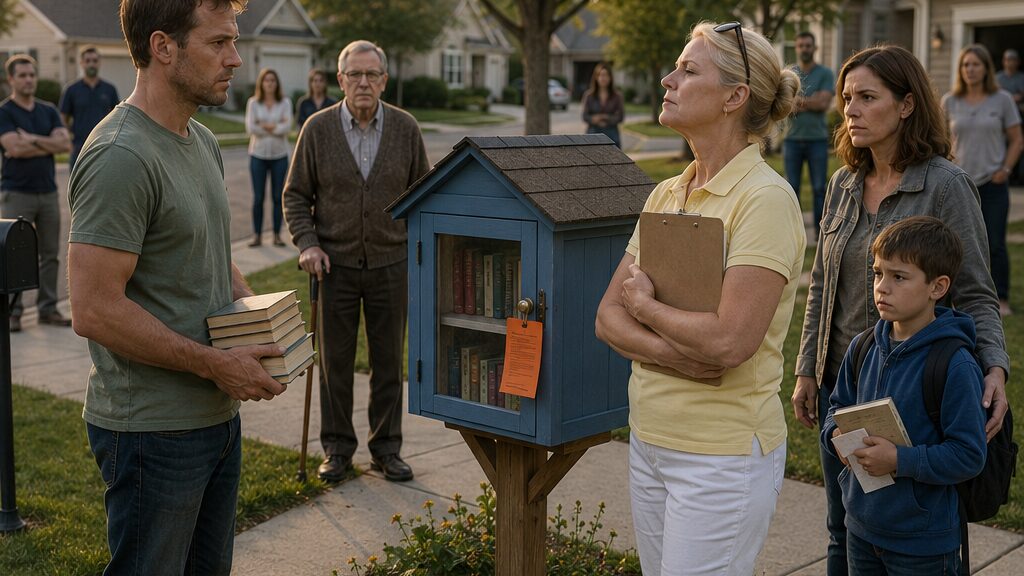
She stood at the edge of his lawn in a pale yellow polo shirt and white pants, the kind of outfit that seemed chosen to match every clean fence and trimmed hedge on Briar Glen Lane. Her sunglasses sat on top of her head, and her thumb hovered over her screen as if the little blue library in Justin’s yard might try to escape before she documented it.
“Mr. Hall,” she called, not loudly enough to sound rude, but loudly enough for the neighbor across the street to pause beside his trash bin. “You can’t leave that here.”
Justin looked past her to the box.
It was no taller than a birdhouse, mounted on a cedar post he had sanded by hand in the garage. The roof was painted navy. The walls were a weathered, cheerful blue. He had fitted a clear acrylic door to the front and a small brass knob polished smooth by his own thumb. Inside, two narrow shelves held paperbacks with cracked spines, children’s books with bright covers, and one old hardcover he had almost kept inside the house.
A tiny sign under the roof read: Take a book. Leave a book if you can.
Linda took a picture.
Justin closed the front door behind him and came down the steps. “It’s a library.”
“It is an unapproved front-yard structure.” She corrected him with the patience of someone repeating a line she had practiced. “And it’s placed within view of the street.”
“It’s a box of books.”
“It’s a structure.” She tapped something into her phone. “And now it’s also a potential nuisance.”
The word landed harder than he expected. Nuisance. Like a fallen branch. Like a barking dog. Like something rotting behind a fence.
He looked at the library again. The blue paint had dried darker than the color swatch at the hardware store. He had considered repainting it, then decided against it. The person he had built it for would have liked the imperfection.
Linda moved closer, careful not to step onto the mulched bed around the post. “People are going to leave things here. Old magazines. Trash. Political flyers. Books nobody wants. Children will crowd the sidewalk. People will park in front of other homes. Once you invite public use, you lose control of what happens.”
Justin slid his hands into his jeans pockets. A screw had cut the side of his index finger that morning, and the sting helped him keep still. “There’s no crowd.”
“There will be if you advertise it.”
“I’m not advertising.”
“You put it on the sidewalk side of your yard.” Linda’s gaze moved over him, then to the garage, then back to the box. “That is advertising.”
Across the street, the neighbor with the trash bin pretended to adjust the lid, listening openly now. Two houses down, a delivery driver slowed, watched long enough to understand there was a disagreement, and kept walking.
Justin felt the old instinct rise in him: explain nothing, give nothing, let people talk until they tired themselves out. He had survived months that way. Nods at the mailbox. Short answers at the grocery store. A polite wave at the annual HOA barbecue, then back inside before anyone could ask how he was doing.
Linda lifted her phone again, this time angling it so the whole little library fit in the frame. “I’m documenting the condition before it becomes an issue.”
“It’s been up less than an hour.”
“Exactly. Which is why I’m addressing it now.”
He could have told her he had checked the county website. He could have said the structure was on his property, not blocking the sidewalk. He could have said the post was sunk eighteen inches deep, sealed properly, and set far enough back not to obstruct anyone’s path. He could have said the books inside weren’t random.
Instead he said, “I’ll keep it clean.”
Linda gave him a tight smile. “That’s not the point.”
“It usually is, with nuisances.”
Her smile vanished. “The point is that Briar Glen has standards. People moved here because this community has a consistent appearance. If everyone decides to put up whatever personal project they like, the whole street changes.”
Justin looked down the street. The whole street was nearly identical in the late afternoon light: beige siding, trimmed lawns, matching mailboxes, seasonal wreaths allowed only after October first. The only thing that looked awake was the small blue box.
“It might change in a good way,” he said.
Linda inhaled through her nose. “That’s not how rules work.”
For a moment, Justin almost laughed. Not because anything was funny, but because of how small and enormous it all felt. A box of books. A compliance chair. His pulse starting to beat like he had been caught doing something shameful.
Linda turned her phone toward him. On the screen was a close-up of the library door. His reflection floated faintly in the acrylic, distorted over the spines of the books. “I’ll be sending this to the board. You should remove it voluntarily before a notice becomes necessary.”
“Tonight?”
“I would recommend immediately.”
He glanced at the top shelf. A thin children’s book leaned against a paperback mystery. Behind it sat a worn novel with a blue cloth cover, the one he had almost left in the storage box, the one with handwriting on the first page.
Keep moving. Don’t let good books sit in the dark.
His throat tightened. He kept his face empty.
“I’m not taking it down today,” he said.
Linda lowered the phone a few inches. “Mr. Hall.”
“Justin is fine.”
“Justin.” She said his name as if making a note of his informality. “If you force the association to act, there will be a process. A notice. A cure period. Possible fines. A hearing if you contest. I’m trying to spare you that.”
“That’s generous.”
Her eyes narrowed, searching his face for sarcasm. He had not meant to sound sharp, but there it was, hanging between them.
“This neighborhood has had problems before,” she said. “Small things turn into larger things when no one addresses them early. People leave items out. People assume common courtesy will handle it. Then I get six emails from residents asking why rules only apply to some homes.”
“Has anyone complained?”
“I am telling you what will happen.”
“That’s not the same thing.”
The neighbor across the street finally rolled his trash bin toward the side of his house, but slowly enough to keep listening. Justin felt the heat climb into his neck. He hated this part more than the threat itself—the way a private choice became a performance the moment someone official-looking stood on your curb.
Linda slipped her phone into the back pocket of her white pants and folded her arms. “Books invite browsing. Browsing invites loitering. Loitering invites litter. And if someone takes a book and doesn’t bring one back, then what exactly is this? A giveaway pile?”
Justin looked at the little sign. Take a book. Leave a book if you can.
“If someone needs a book,” he said, “they can have one.”
“That is not a management plan.”
“No.”
“It is not even an approval request.”
“No.”
Her mouth pressed into a thin line. “Then you understand the position you’re putting the board in.”
He did not answer. He was thinking of the approval form still folded in the kitchen drawer. Purpose of exterior modification. Decorative, functional, or seasonal? He had stared at that line for twenty minutes. He had tried to write memorial, then crossed it out. He had tried community library, then imagined a board member asking whose memory, what community, what hours, what liability.
So he had built it without asking.
Linda took one step back toward the sidewalk. “You’ll receive something formal if this remains.”
Justin nodded once.
She looked at the box again, and for just a second her expression changed. Not softer, exactly. More wary. As if the library was not merely ugly to her, but dangerous in some way she could not admit on a sunny sidewalk.
Then she turned and walked down the block, her phone already in her hand again.
Justin waited until she passed the next driveway before he moved. The neighbor across the street disappeared behind his gate. The delivery truck door slammed somewhere farther down. A lawn sprinkler ticked in a measured arc.
He opened the library door.
The hinges gave a small clean squeak. He had meant to oil them but had stopped himself. A little sound was good. A little sound meant the door was moving.
Inside, the books had shifted when Linda touched the frame for her photo. He straightened them gently. A paperback thriller. A cookbook with a torn dust jacket. Two children’s books. A collection of poems no one would take if they judged it by the cover. He added three more from the cardboard box he had left on the porch: a middle-grade adventure, a clean romance with a lavender cover, and an old field guide to birds.
He almost added the blue hardcover, then held it back.
Not yet.
He closed the door and stood with one hand resting on the roof. The paint was still faintly tacky in the seams. The post was solid. The brass knob caught the sunlight.
From the outside, it looked cheerful. Almost foolishly cheerful.
Inside his chest, something had started to shake.
He went back into the house, washed the dust from his hands, and made himself stay away from the front windows for an hour. He answered two work emails. He reheated coffee he did not drink. He opened the kitchen drawer and looked at the folded HOA approval form, then shut it again.
When he finally stepped outside near sunset, the street had gone quiet. Porch lights glowed. A dog barked behind a fence and stopped. The little blue library stood exactly where he had left it, innocent and accused.
Justin walked to it slowly.
At first he thought the shifted row of books was only the angle of the light. Then he opened the door.
The middle-grade adventure was gone.
In its place, the remaining books leaned toward the empty space, as if something had passed through them and left a small breath behind.
Justin stood there with his fingers on the brass knob, listening to the evening settle over Briar Glen Lane.
Someone had taken the first book.
Chapter 2: Three Days Before the Street Changed
Linda Clark returned three days later wearing a beige trench coat, a dark scarf, and the expression of someone arriving early to catch a lie before it had time to clean itself up.
Justin saw her from the kitchen window.
She did not ring the bell. She did not call his name. She stopped at the sidewalk, planted both feet on the concrete, and stared at the little blue library as though it were a stain spreading across the neighborhood one inch at a time.
Justin dried his hands on a dish towel and stayed inside.
The missing book had not come back. Two others had disappeared since then, both from the bottom shelf. Someone had left a paperback western with a cracked spine on Tuesday morning, and by Tuesday evening it was gone too. There had been no trash. No flyers. No magazines. No crowd.
Still, every time the library door clicked in the wind, Justin felt as if the whole street had heard it.
Linda leaned forward, not touching the box this time. Her eyes moved over the shelves, counting. Then she stepped back and took a picture.
Justin let the curtain fall.
A school bus sighed to a stop at the corner at 3:18. The brakes made their usual sharp hiss, and children spilled onto the sidewalk in loose clusters. Backpacks bounced. Sneakers slapped pavement. A parent near the corner raised one hand without looking up from her phone.
Justin told himself not to watch.
He watched anyway.
Sarah Thompson’s son came down the sidewalk with his blue hoodie pulled half over his head, walking a few paces ahead of his mother. Justin knew Sarah only in the way neighbors in Briar Glen knew each other: driveway nods, trash-day timing, a half-remembered hello from last spring’s mulch delivery. She lived five houses down in a ranch with gray shutters and a minivan that always seemed to have one door not fully closed.
Her son slowed when he reached the library.
Linda turned toward him instantly.
The boy stopped. He looked at the little sign, then at Linda, then back at the books. Sarah caught up and placed a hand lightly between his shoulders.
“Come on,” she said softly. “Don’t bother anything.”
“It says take a book,” the boy said.
Sarah glanced at Linda and then, uneasily, at Justin’s house. Justin stepped back from the window before she could see him. He felt foolish doing it. It was his yard. His box. His books. Still, he remained behind the curtain like a man spying on his own life.
Linda cleared her throat. “That structure is under review by the association.”
Sarah blinked. “Oh.”
“It may not be permanent.”
The boy’s hand had already moved toward the brass knob. Now it froze.
Justin’s palm tightened around the dish towel.
Sarah gave a small embarrassed smile, the kind people offered when they wanted to escape a conflict they had not started. “Maybe not today, then.”
But her son was looking through the acrylic door with a concentration Justin recognized. Children did not pretend indifference well. His gaze had found the thin book about backyard astronomy on the lower shelf, the one with a picture of a moon crater on the cover.
“I can bring it back,” he said.
Linda said, “That is exactly the concern.”
Sarah’s face tightened. Not anger yet. More like the calculation of a parent deciding how much trouble a moment is worth.
Justin moved before he finished thinking. He opened his front door and stepped onto the porch.
“It’s fine,” he called.
All three of them turned.
His voice sounded too loud in the clean afternoon. He came down the steps, keeping his hands visible and his pace easy. Linda’s eyes sharpened.
“Justin,” she said. “I don’t think encouraging use while this is unresolved is appropriate.”
“It’s a library,” he said. “Use is the point.”
Sarah looked apologetic. “We don’t want to get in the middle of anything.”
“You’re not,” Justin said.
He opened the library door himself. The hinges made their small squeak. The boy’s eyes went straight to the astronomy book.
“You like space?” Justin asked.
The boy nodded. “Mostly planets. And black holes.”
“Good choice, then.”
The boy took the book with both hands, like it might be fragile. He did not run. He did not grab anything else. He looked at the sign again.
“What if I don’t have a book to leave?”
“If you can,” Justin said. “Not if you can’t.”
Linda made a small sound, almost a laugh without humor.
Sarah noticed. Her shoulders drew inward. “We have some at home,” she said quickly. “We can find one.”
“You don’t have to.”
“We can,” she repeated, and Justin heard the fear beneath the politeness. Not fear of him. Fear of being noticed. Fear of becoming the kind of resident whose name came up in a board email.
The boy hugged the astronomy book to his chest. “Thank you.”
Justin nodded, and that was almost the end of it. A small thing. A child with a book. A mother steering him gently down the sidewalk. Linda with her phone.
Then, just before they reached the next driveway, the boy turned back.
“I’ll bring it back,” he called.
Justin lifted a hand. “Whenever.”
Linda waited until Sarah and her son were out of earshot. “You see what you did.”
Justin looked at her. “Yes.”
“You put a parent in an uncomfortable position.”
“No,” he said quietly. “You did.”
Color rose under Linda’s makeup, faint but visible. For the first time, her polished control slipped. “You don’t know the complaints I deal with.”
“I know no one complained about him.”
“That’s not how prevention works.”
“It might be how distrust works.”
Her jaw set. “I hope you’re prepared to explain that at a hearing.”
“There is a hearing?”
“There will be if this continues.”
He should have stopped there. He should have let her walk away. Instead, he said, “It’s been three days, Linda. Nothing bad has happened.”
She looked past him to the box. “That depends on what you call bad.”
Before he could ask what she meant, she turned and walked away.
That night, Justin found himself checking the window again and again. He hated that Linda had turned a box into something he monitored like a wound. At nine, he opened the library to make sure the shelves were dry after the sprinklers came on. At ten, he opened it again and adjusted the western paperback. At ten-thirty, he almost took the remaining books inside.
Instead he added one more.
A paperback copy of a novel he had loved years ago, its pages soft at the corners.
The next afternoon, when he came back from the grocery store, something white was tucked between the door and the frame.
For a second, he thought it was a warning.
He left the grocery bags on the walkway and opened the library with fingers that had gone stiff. A folded notebook page slipped into his hand. The handwriting was large, uneven, and pressed hard into the paper.
Thank you for the space book. I liked the moon part. I put in one about sharks.
No name.
Justin looked at the bottom shelf. There, between a cookbook and the poetry collection, was a children’s book about sharks with a library-sale sticker still on the spine.
He read the note twice. Then a third time.
Whoever left this.
That was what it felt like the note was really saying. Thank you, whoever left this. Thank you, stranger. Thank you for not asking whether I deserved it first.
His throat tightened so suddenly he had to look away.
Across the street, Linda stood near the curb.
He had not seen her arrive. She held her phone up, pointed directly at him, the note, and the open blue door.
Justin folded the paper once, carefully, and slipped it into his shirt pocket.
Linda lowered her phone and walked away without saying a word.
The next morning, an orange envelope waited in Justin’s mailbox, stamped with the Briar Glen Homeowners Association logo and the words NOTICE OF EXTERIOR MODIFICATION VIOLATION printed across the front.
Chapter 3: The Orange Tag Everyone Could See
The orange tag was already swinging from the little blue door when Justin reached the curb.
It was clipped beneath the brass knob with a plastic fastener, bright enough to be seen from three houses away. The paper snapped lightly in the evening breeze, tapping the acrylic door again and again, like a finger demanding attention.
NOTICE OF VIOLATION.
Justin stopped halfway down the walkway.
For one strange second, he noticed everything except the words: the angle of the tag, the tiny scratch on the knob, the shadow of the roofline over the books inside. Someone had opened the library to attach it. Someone had touched the door, the hinges, the shelves he had measured twice and cut once because the first board split down the center.
Linda stood beside it with a clipboard held against her chest.
Two teenagers with backpacks had stopped on the sidewalk. A delivery driver slowed near the mailbox. Across the street, a garage door remained half open, the shadow of someone inside not moving.
Justin kept walking.
“Mr. Hall,” Linda said.
He did not correct her this time.
He read the tag.
Unapproved front-yard structure. Potential attractive nuisance. Use of residential lot for unauthorized exchange activity. Corrective action required.
The phrase made his stomach twist.
Exchange activity.
Not reading. Not sharing. Not neighbors. Activity.
“You came onto my property,” he said.
Linda lifted her chin. “The association has authority to document exterior violations visible from common areas.”
“That’s not what I asked.”
“I stepped no farther than necessary.”
The teenagers looked at each other. One whispered something Justin could not hear. He felt their attention like heat on the back of his neck.
He reached for the tag.
Linda’s voice sharpened. “I wouldn’t remove that.”
His fingers stopped just short of the plastic clip.
“The notice has been photographed in place,” she said. “Removal doesn’t cancel the violation.”
Justin let his hand fall. “I got the envelope.”
“This is the physical posting.”
“On a box of books.”
“On an unapproved structure.”
The delivery driver walked faster, eyes fixed ahead, unwilling to become part of whatever this was. Justin envied him.
Linda flipped a page on her clipboard. “You were notified verbally. You continued to encourage use. There is now evidence of increased traffic and exchange.”
“Evidence.”
“Photographs.”
“Of a child returning a book?”
“Of repeated interaction with the structure.”
Justin looked down at the sidewalk. His pulse had begun to thud in his ears. He could argue. He could tell her she was making herself ridiculous. He could take the tag off and tear it in half. The thought passed through him with surprising clarity.
Then he saw Sarah’s son at the corner.
The boy had stopped beside his mother, one hand gripping the strap of his backpack. Sarah saw the orange tag and slowed. Her face changed first with confusion, then embarrassment, then something close to guilt, as if her family had caused this by touching the box at all.
Justin took his hand away from the tag.
He opened the little library door instead.
The orange paper lifted with the movement and slapped softly against the acrylic. Inside, the books were still neat. He had stocked them that morning before work: two mysteries, one children’s adventure, a gardening guide, the shark book, and the poetry collection no one had taken yet.
From the cardboard box on the porch, he brought over a stack he had meant to add later. His movements were slower than usual because everyone was watching. He placed each book inside carefully, spine facing outward.
Linda stared at him. “You are worsening the violation.”
Justin slid the last paperback onto the lower shelf. “I’m stocking the library.”
“It is not approved as a library.”
He closed the door. The tag swung and settled crookedly over the sign.
Take a book. Leave a book if you can.
Linda turned slightly toward the gathering neighbors, her voice now pitched for more than Justin. “This is exactly why the board has a process. One resident cannot decide to create a public amenity in a front yard simply because he personally likes the idea.”
Sarah stepped closer, but not all the way. Her son stayed behind her, eyes fixed on the tag.
“It wasn’t messy,” Sarah said.
Linda looked at her with practiced calm. “That is not the only consideration.”
“He brought the book back.”
“Again, not the only consideration.”
The boy’s face went red.
Justin felt the first crack in his restraint. Not because Linda was humiliating him. He could absorb that. He had been absorbing things for a long time. But the boy’s shoulders had pulled inward, and Sarah looked like she regretted letting him read about the moon.
“It’s not his fault,” Justin said.
Linda frowned. “I didn’t say it was.”
“You didn’t have to.”
A few more residents had stopped now. A man walking a dog. A woman with grocery bags. Robert Lee, from the white ranch at the bend, stood near the mailbox cluster with one hand resting on his cane. Justin had seen him only a handful of times since winter, always alone, always moving carefully as if the outside air required negotiation.
Linda noticed the small crowd and straightened. “No one is assigning blame. We are preserving community standards.”
Robert’s voice came from the curb, dry but steady. “Forbidding books is a standard now?”
Linda turned. “No one is forbidding books, Mr. Lee.”
“Just the place where people can find them.”
The teenagers grinned but hid it quickly.
Linda’s face tightened. “The issue is precedent. If this is allowed, then the next resident may install a toy bin, or a donation cabinet, or a political literature box, and then the association will be accused of selective enforcement when we object.”
There it was, Justin thought. Not the mess. Not the books. The fear of what came next.
Rebecca Martin arrived near the edge of the sidewalk, holding a folder against one hip. Justin recognized her from the HOA newsletters: secretary, meeting minutes, cheerful reminders about pool passes and mailbox paint colors. She looked younger than Linda, or maybe only less armored.
“Linda,” Rebecca said quietly. “I thought the written notice was going out by mail.”
“It did.”
Rebecca’s eyes moved to the orange tag. “Posting was not discussed.”
“It’s a visible violation.”
“It’s also Friday evening.”
Linda gave her a look that warned against disagreement in public. Rebecca closed her mouth but did not leave.
The little library door squeaked.
Everyone turned.
Sarah’s son had stepped forward while the adults spoke. In his hand was the astronomy book. He held it so tightly the cover bowed.
Sarah whispered his name, but he was already at the box.
He opened the door just wide enough to slide the book onto the lower shelf. Then he took a folded sheet of paper from his hoodie pocket and placed it on top.
The orange tag brushed his wrist. He flinched.
Justin saw it. So did Sarah. So did Linda.
The boy backed away quickly, his face burning.
“I brought it back,” he said, barely above a whisper.
No one spoke.
Justin opened the door again and picked up the folded paper. He knew he should wait until they were inside, away from everyone’s eyes. But the tag was still swinging there, loud in its silence, calling the child’s carefulness a nuisance.
He unfolded the page.
Thank you for letting me borrow it. I didn’t know the moon had mountains. My mom said we can leave another book when we find the box in the garage.
Justin stared at the words until they blurred slightly. He folded the note along the same crease and held it flat in his palm.
Sarah swallowed. “He wanted to make sure he returned it before anything happened.”
The boy looked at the ground.
Justin wanted to tell him that he had done everything right. He wanted to say the box existed for exactly this. Instead the old wall rose in him again. If he spoke too much, the rest might come. The storage boxes. The handwriting inside the covers. The promise he had delayed until delay became permanent.
So he only said, “Thank you.”
The boy nodded once and moved back beside his mother.
Linda glanced at the note but did not soften. “Anecdotal use does not address the rule.”
Robert gave a short laugh. “A child returns a book with a thank-you note, and you call it anecdotal?”
“I call it unmanaged.”
Justin looked at Linda then. Really looked at her. Beneath the sternness, there was tension around her mouth that did not match triumph. She was not enjoying this as much as people might think. She looked cornered by the very crowd her own tag had gathered.
But she still lifted her clipboard.
“The hearing is scheduled for Tuesday at seven,” she said. “Community clubhouse. You may present your position. Until then, continued use will be considered evidence that the violation is ongoing.”
Sarah’s eyes moved to Justin. Robert’s did too. Rebecca watched him with something like warning.
Justin placed the boy’s note inside his shirt pocket beside the first one.
He wanted to say yes, he would present his position. He wanted to say no, he would not let them make a trial out of a blue box and a child’s handwriting. He wanted to say the books had belonged to someone who believed a neighborhood could be measured by what it shared, not what it fined.
What came out was smaller.
“I’ll be there.”
Linda nodded once, as if she had won the only answer that mattered.
The neighbors began to separate, slowly, reluctantly. Sarah guided her son away. Robert turned his cane toward home. Rebecca lingered just long enough to look at the orange tag still clipped to the little blue door.
When the sidewalk was almost empty, Linda stepped closer to Justin.
“You should have filled out the form,” she said, quieter now.
Justin looked at the library. Through the acrylic, the returned astronomy book sat on the lower shelf, its spine lined up neatly with the others.
“I know,” he said.
Linda seemed surprised by that. For a second, he thought she might ask why he hadn’t.
She didn’t.
She tucked the clipboard under her arm and walked away, leaving the orange tag bright against the blue door, where every person passing after dinner could see that the smallest thing on Briar Glen Lane had become official.
Chapter 4: The Books Were Never Decoration
The storage box had been sealed with blue painter’s tape, and Justin stood over it in the garage for nearly ten minutes before he could make himself cut it open.
KEEP MOVING was written across the cardboard lid in black marker.
Not his handwriting.
The letters leaned slightly to the right, impatient and practical, as if the person who wrote them had been on her way to do three other things and had trusted him to understand the rest.
Justin held the utility knife in one hand and the orange violation tag in the other. He had brought the tag inside after dark, not because Linda had been right about removal not canceling anything, but because he could not sleep knowing it was tapping against the acrylic door like a public accusation. He had clipped it to a nail above the workbench instead. There it hung now, bright and official, over the box he had avoided opening for months.
The hearing was in two days.
He cut the tape.
The first thing he smelled was paper: dry, dusty, faintly sweet. The second was cedar, because he had lined the bottom of the box with scraps from the same wood he later used for the library post. He had done it without thinking, then realized what he had done and left it that way.
Inside were books packed spine-up in careful rows. Paperbacks with soft corners. Hardcovers with faded jackets. A spiral notebook tucked along one side. Bookmarks made from receipts, pharmacy slips, grocery lists, a postcard from a beach town they had never actually visited but always joked about visiting “when things slowed down.”
Things had not slowed down. Things had stopped.
Justin reached for the notebook, then stopped himself and pulled out a book instead. A mystery novel. Inside the front cover, in the same slanted handwriting, was a name and a date. Beneath it, a note:
Robert might like this. Too many teachers in mysteries are either saints or fools.
Justin gave a short breath that was almost a laugh. It hurt.
He set the book aside.
The next had a sticky note tucked into page seventy-three.
For a neighbor with a garden and patience.
Another:
For a kid who thinks science is boring. Prove them wrong.
Another:
Keep this one moving, J. Don’t let it become shelf guilt.
He sat down on the low wooden stool by the workbench. The garage was half lit by the overhead bulb, half by the evening coming through the small window above the tool chest. Outside, cars passed slowly toward their driveways. The neighborhood was settling into dinner, sprinklers, televisions, garage doors lowering with polite mechanical sighs.
Justin turned the next book over in his hands.
It was the blue hardcover.
He had not meant to pack it away. After the funeral, people had come through the house with casseroles and soft voices, touching his shoulder as if checking whether grief had a temperature. Someone had gathered the books from the living room into boxes to “make space.” He had nodded because nodding was easier than choosing. Later, when he unpacked the kitchen and the bedroom and the bathroom, he left the book boxes in the garage.
For nine months, they sat where he could see them every time he took out the trash.
Then, in August, he opened one and found the note.
Keep moving. Don’t let good books sit in the dark.
That was when the idea had started.
Not as a protest. Not as a front-yard structure. Not as a violation.
As a way to stop failing at one small promise.
He opened the blue hardcover. The spine complained softly. On the title page, beneath a small stain from coffee or tea, was another note.
This one is for you. Return it when you finish, and no cheating by pretending you hated it.
He had borrowed it two summers ago and never returned it.
He had been busy. She had been sick, though no one called it that yet. He had put the book on his nightstand, then under a stack of mail, then in the car, then back in the house. When she asked if he had finished it, he said almost. When she asked again, he said he would bring it by Sunday.
Sunday became a hospital room.
Then no one asked him for the book again.
Justin pressed his thumb against the handwriting until the ink blurred under the moisture on his skin. He shut the cover and placed it carefully on the workbench, away from the orange tag.
A knock sounded at the side door.
He froze.
The knock came again, lighter this time. “Justin? It’s Sarah.”
He wiped his face once with the heel of his hand, annoyed at himself, and went to the door.
Sarah Thompson stood outside in a gray sweatshirt, arms folded against the evening chill. Her son waited at the end of the walkway with one foot on a scooter, pretending not to listen. She held a paperback in one hand and the stiff awkwardness of someone who had practiced a sentence during the walk over.
“Sorry,” she said. “I know it’s late.”
“It’s fine.”
Her eyes moved past him into the garage, to the open box, then away quickly. “We found another book to leave. He wanted to bring it before the hearing, in case…” She stopped. “In case it isn’t there after.”
Justin took the paperback. “Thank you.”
Sarah looked toward the street. “Can I ask you something?”
He already knew what it was. “You can.”
“Do you want anyone to come Tuesday?”
He held the book between both hands. The cover showed a dog running through tall grass. A children’s book. Used, but clean.
“I don’t want this to turn into a scene,” he said.
“It already turned into one.”
He looked at her then.
Sarah’s expression was not accusing. That made it worse. She looked tired in the practical way parents looked tired at the end of a weekday, but there was something firmer underneath.
“My son thinks he got you in trouble,” she said.
“He didn’t.”
“I told him that. But he saw the tag. He heard Mrs. Clark.”
“Linda.”
“Linda,” Sarah corrected, though the name did not soften anything. “He asked if borrowing something was bad if a grown-up didn’t like it.”
Justin looked past her to the boy, who pushed the scooter forward an inch and then back.
Sarah lowered her voice. “I don’t know what this is about for you. You don’t owe me that. But if they’re going to talk about people using it, maybe people who used it should be allowed to say something.”
His first instinct was no. It rose so fast it almost came out before he understood it. No, don’t come. No, don’t bring your child into a room where adults measure kindness against bylaws. No, don’t stand beside me, because if you do, I may have to say why I built it, and if I say why I built it, the thing I have kept intact will become neighborhood information.
Sarah waited.
The garage light hummed.
Justin looked back at the open box. The handwritten notes inside covers. The blue hardcover on the workbench. The orange tag above it, official and empty.
“I appreciate it,” he said. “But I think it’s better if I handle it.”
Sarah’s face changed only a little. Enough.
“You sure?”
“No,” he said, then hated the honesty. “But yes.”
She nodded, embarrassed now for offering. “Okay.”
“It’s not about you.”
“I know.”
“It’s not about your son.”
“I know that too.” Her voice cooled just enough to let him feel the distance he had created. She turned toward the walkway. “I hope it works out.”
Her son lifted one hand when she reached him. Justin raised his own, but the boy had already turned the scooter around.
Justin watched them go down the sidewalk. At the library, Sarah paused. She opened the little blue door and let her son place the book inside. He did it carefully, pushing it between the shark book and the poetry collection. Then he shut the door gently, as if the box might be frightened.
When they walked away, Justin stayed at the side door until they disappeared behind the curve of hedges.
He had wanted the library to be used. He had wanted people to take the books, return the books, leave notes, maybe trust one another in a way that did not require a sign-up sheet. But the first person who had offered to stand with him, he had turned away because he could not bear the thought of being seen too clearly.
Back in the garage, he picked up the blue hardcover and opened it again.
This one is for you.
He read the line until it stopped being a sentence and became a charge.
At the bottom of the storage box, under the notebook, was the approval form he had printed months earlier and never filed. The top half was blank. The bottom still had a crease where he had folded it after staring at the question he could not answer.
Purpose of exterior modification:
Justin took a pen from the workbench.
He set the form beside the orange tag, wrote one word, crossed it out, wrote another, and crossed that out too.
At last he dropped the pen, picked up his phone, and scrolled to Sarah Thompson’s number from the neighborhood directory.
His thumb hovered over the call button.
Then the screen went dark in his hand.
Chapter 5: The Board Called It a Nuisance
Linda had enlarged the photograph of the orange tag until the little blue library looked less like a box of books and more like a crime scene.
Justin saw it the moment he stepped into the community clubhouse.
The photo sat on an easel beside the folding table where the HOA board had arranged water bottles, printed packets, and a small digital recorder. The tag blazed at the center of the image. Beneath it, the library’s sign was partly visible, the words Take a book cut off by glare.
Linda stood near the easel in a navy blazer, speaking quietly to two board members. Rebecca Martin sat at the table with a laptop open, fingers resting near the keys but not typing. She looked up when Justin entered.
For a second, Justin considered turning around.
The clubhouse smelled like floor cleaner and coffee that had been sitting too long. Metal chairs were arranged in three short rows. More residents had come than he expected. Sarah sat in the back with her son beside her, though she had not told him she was coming. Robert Lee sat near the aisle, cane hooked over the chair in front of him. A few neighbors Justin recognized by face but not by name whispered over the printed agenda.
He felt a quick, hard twist of shame. He had told Sarah not to come, and she had come anyway. He deserved that.
Linda turned and gave him a formal nod. “Mr. Hall.”
“Linda.”
Rebecca cleared her throat. “We’ll begin in a moment. You can sit at the front when your item is called.”
His item.
Justin sat in the front row and set his folder on his knees. Inside were three things: the mailed notice, the orange tag, and the folded notes from Sarah’s son. The blue hardcover was at home on the kitchen table. He had almost brought it, then left it there. There were limits to what a room like this could hold.
The meeting began with pool maintenance, mailbox repainting, and a reminder about trash cans being screened from street view. Justin heard almost none of it. He watched Linda’s printed packet move from hand to hand along the board table. On the top page, his address appeared in bold.
When Rebecca announced “Exterior Modification Violation, 114 Briar Glen Lane,” the room shifted. Chairs creaked. Someone coughed. Sarah’s son stopped swinging his feet.
Linda stood.
“The matter before the board,” she said, “is an unapproved front-yard structure being used for public exchange activity. The structure is visible from the street and has been installed without application, architectural review, or use restrictions.”
Her voice was even. Not cruel. That made it harder to dismiss. She sounded like a person describing a leaking pipe.
She clicked a remote, and the enlarged photo changed to another: the library with its door open, books inside. Then another: Sarah’s son placing the astronomy book back. Then another: Justin standing with the folded note in his hand.
Something cold moved through him.
Sarah made a small sound behind him.
Linda did not look at her. “These images show continued use after verbal warning and mailed notice.”
Rebecca leaned toward her microphone. “Linda, just to clarify, was the resident informed that photographing minors would be part of the packet?”
A tight silence followed.
Linda’s face remained composed. “The photograph documents the use of the structure. The child’s face is not visible.”
“It’s visible enough for his parent to recognize him,” Rebecca said.
The board chair glanced between them. “Let’s keep to the rule question.”
Linda nodded. “Of course. The governing documents prohibit unapproved exterior structures and any object that creates a nuisance or changes the residential character of the lot. My concern is not books. It is precedent and enforceability.”
Justin looked at the packet in his lap.
Precedent again.
Rebecca scrolled on her laptop. “The specific rule says ‘sheds, cabinets, storage units, decorative structures, or similar exterior additions require approval.’ It doesn’t use the phrase public exchange.”
Linda replied, “A book-exchange box is plainly similar to a cabinet.”
“Maybe.” Rebecca’s tone stayed careful. “But if it’s not storage for the homeowner’s property and not commercial, we should be precise.”
Linda’s eyes flicked toward her. “Precision is exactly why we require applications before installation.”
The board chair turned to Justin. “Mr. Hall, would you like to speak?”
Justin stood with the folder in his hand.
Every chair seemed too close. The room had the same waiting quality as the sidewalk on Friday, but worse because here the waiting had been arranged officially.
“I built it,” he said. “I should have filed the form.”
Linda’s expression changed a fraction, almost satisfaction.
Justin looked at Rebecca instead of Linda. “I didn’t. That’s on me.”
The board chair nodded. “Why not?”
There it was. The simple question that had stopped him for months.
Justin opened the folder. His fingers touched the orange tag, then moved past it to the folded notes. He took out the first one.
“The form asked for a purpose,” he said. “I didn’t know how to write it.”
Someone in the second row shifted.
Linda’s pen paused.
Justin unfolded the note from Sarah’s son but did not read it aloud yet. “It’s not a decoration. So I didn’t want to call it decorative. It’s not storage. It’s not a business. It’s just books people can take if they want.”
“That still requires approval,” Linda said.
“I understand.”
“You understood before installation?”
He looked at her. “Yes.”
The admission moved through the room. Not loudly, but he felt it. Linda had something now. Not malice. Fact.
Sarah leaned forward. “He’s not the only person using it.”
The board chair looked toward the back. “We’ll allow resident comment in a moment.”
Justin turned slightly. Sarah met his eyes, not asking permission this time.
Robert stood before the chair could formally invite him. It took him longer than it would have taken most people. His cane slipped once against the metal chair and Sarah reached to steady it. Robert nodded thanks and faced the board.
“I taught English for thirty-four years,” he said. “I live alone now. I don’t drive much after dark. Last week I walked past that little box and found a mystery novel with a note inside that said a retired teacher might enjoy it.” He glanced at Justin, who looked down. “I don’t know who wrote the note. I don’t need to know. I took the book home. Finished it in two nights. Brought back two of my own.”
Linda’s expression tightened, not because Robert was wrong, but because he was persuasive in a way rules could not easily interrupt.
Robert rested both hands on his cane. “I hadn’t walked farther than my mailbox in a month.”
No one moved.
Justin’s grip on the folder tightened.
That was the small payoff he had not expected and did not deserve. He had built the box for a promise, but someone else had needed it for a reason of his own.
The board chair thanked Robert. Sarah spoke next, briefly. She did not dramatize. She simply said her son had borrowed a book, returned it, and learned that trust could be practiced in small ways. Her voice shook only once, when she said he had thought he caused the violation.
Linda looked down then.
Not long enough to be surrender. Long enough to be human.
When Sarah sat, Linda stood again. “I respect those comments. I do. But the board cannot govern based on touching individual stories. We govern based on documents. Residents have contacted me privately asking whether they may now install free-item boxes, plant stands, coolers, donation bins. If I tell them no while this remains, we invite accusations of selective enforcement.”
Rebecca asked, “How many residents?”
Linda hesitated. “Several.”
“How many?”
“Three.”
The room stirred.
Linda’s voice sharpened. “Three is enough if the rule becomes unenforceable.”
The board chair rubbed his forehead. “Could this be approved as a decorative yard feature with conditions?”
Rebecca looked doubtful. “If we call it decorative while everyone agrees it is functional, we create a different problem.”
Another board member leaned back. “What about a temporary approval? Thirty days. Resident maintains it. Board reviews language.”
Linda considered that. Too quickly, Justin thought.
“Thirty days,” she said. “As a seasonal decorative display. No expansion. No additional signage. No placement of items outside the structure. At the end of thirty days, it comes down unless a formal rule amendment exists.”
Justin heard the trap before he understood its shape. Decorative. The word he had refused to write. The word that would save the box tonight by lying about what it was.
The board chair turned to him. “Mr. Hall?”
He felt Sarah watching. Robert too. Rebecca’s eyes were on the orange tag still inside his folder.
Justin could refuse. He could force a vote. He could lose tonight and carry the library back into the garage like evidence of his own pride. Or he could accept a false name for a true thing and buy thirty days.
He stood.
“I’ll maintain it,” he said. “No books outside the box. No blocking the sidewalk. If there’s litter, I’ll clean it.”
“And you accept the thirty-day temporary classification?” the chair asked.
Justin’s mouth went dry.
Decorative.
He thought of the handwritten notes in the garage. The blue hardcover on the kitchen table. Sarah’s son watching from the back row, trying to understand how adults could turn a returned book into a violation.
“For now,” Justin said.
Rebecca’s fingers moved over the keyboard. “Temporary thirty-day allowance under review.”
Linda capped her pen. She smiled, not broadly, not cruelly, but with the controlled satisfaction of someone who had moved the problem to a clock.
As people began to stand, she passed close enough for only Justin to hear.
“Thirty days means thirty days.”
Chapter 6: When the Empty Shelves Proved Everything
The shelves were completely empty.
Justin opened the little blue door on a Wednesday morning two weeks into the thirty-day allowance and stared at the bare wood as if someone had taken the floor out of a room.
No books leaned crookedly against one another. No folded notes sat between covers. No shark book, no mystery novel, no poetry collection no one wanted until someone finally did. Only two dust lines remained where the lower shelf had been full the night before.
For one bright, panicked moment, Linda was right.
He looked down at the mulch. No torn pages. No wrappers. No books dropped in the grass. He turned toward the sidewalk. It was empty except for a jogger at the far corner and a delivery truck idling three houses down.
The little sign inside the door looked suddenly foolish.
Take a book. Leave a book if you can.
He ran one hand along the shelf. Smooth. Clean. Bare.
From behind him, a voice said, “I wondered when you’d notice.”
Justin turned too quickly.
Sarah stood near the driveway in work clothes, a travel mug in one hand and a canvas tote over her shoulder. Her son was not with her. She glanced at the empty shelves and gave him a nervous smile.
“I didn’t take them,” she said.
“I didn’t think you did.”
“You looked like you might think somebody did.”
“I looked like Linda.”
That made her laugh once, despite herself.
Justin closed the door. The hinge squeaked into the quiet. “They were full last night.”
“I know.”
He waited.
Sarah shifted the tote on her shoulder. “Come with me for a minute.”
“I have a call in twenty.”
“This will take five.”
He followed her down the sidewalk, feeling strangely exposed walking away from the empty library. Two houses down, past the clipped hedges and identical mailbox posts, the neighborhood opened toward the corner where the school bus stopped. It was not bus time, but there were people there.
More people than usual.
A teenager sat on the curb with a fantasy paperback open across his knees. A woman in scrubs stood beside a stroller, flipping through a cookbook. Robert Lee was there too, leaning on his cane while a neighbor held out two hardcovers for him to inspect. A small cardboard box sat on the grass beside the sidewalk with books inside and a handwritten sign on printer paper:
For the blue library when there’s room.
Justin stopped.
Sarah watched him. “It’s been happening on weekends mostly. Then yesterday after dinner, people started bringing more than would fit.”
He looked from the cardboard box to the people. “Why didn’t anyone tell me?”
“You told me you wanted to handle it.”
The words landed without cruelty, which made them land harder.
A parent near the stroller noticed him and straightened. “We weren’t trying to make a mess.”
“I know,” Justin said.
“We were going to bring them over once there was space.”
A teenager lifted his book without looking up. “There’s space now.”
Sarah gave him a look. The teenager lowered the book slightly. “Sorry.”
Robert smiled faintly. “He’s not wrong.”
Justin stepped toward the cardboard box. Inside were mysteries, children’s books, a Bible with a cracked black cover, three romance paperbacks, a book on home repair, and a stack of thin early-reader books tied with twine. Some had sticky notes. Some did not. None looked dumped.
On top was the poetry collection.
Someone had taken it after all.
A yellow sticky note on the cover said:
Not usually my thing. Liked two poems. Leaving it for someone patient.
Justin touched the note with one finger.
The empty shelves had not meant failure. They had meant circulation. Movement. The thing he had promised but not trusted enough to recognize when it happened faster than he could manage.
He looked back toward his house. From this angle, the little blue library was just visible between two lawns, small and bright beneath the maple tree. He had built it as if he could control the shape of grief. He had measured the shelves, sealed the roof, selected the first books, and imagined himself as caretaker. But now the books had outrun him.
Sarah set her tote down and pulled out three paperbacks. “People were worried about leaving too many at your house. So they started meeting here.”
“Meeting.”
“Not formally.” She winced. “Don’t say that word near Linda.”
Robert chuckled. “We prefer accidental recurring coincidence.”
Justin almost smiled.
Then a car slowed at the stop sign.
Linda Clark’s silver sedan rolled past the corner, slow enough for everyone to understand she had seen them. Her window was up. Her face was forward. But her eyes moved over the cardboard box, the residents, the books in hand.
The sedan continued down the street.
The mood changed.
Sarah picked up the printer-paper sign and folded it quickly. The woman in scrubs placed the cookbook back into the box. The teenager shut his paperback.
Justin felt the anger first, clean and useful. Then something underneath it: responsibility.
“She’ll say this proves her point,” Sarah said.
“She’ll say the library created a gathering.”
“Didn’t it?”
He looked at her.
She did not look away. “I’m not saying that’s bad. But you need to know what it is now.”
A gathering. A routine. A little exchange that had stepped outside his box because people had taken the invitation seriously.
Robert tapped his cane against the sidewalk. “Rules have an easier time with objects than with habits.”
Justin looked at him. “Did you make that up as a teacher?”
“I stole most of my best lines from better readers.”
A few people laughed, softly, relieved to be allowed.
Justin crouched and picked up the cardboard box. It was heavier than he expected. Sarah reached for one side.
“I’ve got it,” he said, then stopped. The old reflex again. His burden, his box, his problem.
Sarah held his gaze.
He let her take one side.
Together they carried the books back to his yard. The others followed at a distance, not a line exactly, but close enough that the street seemed to move with them. At the library, Justin opened the door, and Sarah began handing him books.
Not all of them fit.
That fact, small and practical, changed something in him.
“We’ll rotate,” he said.
Sarah nodded. “I can keep some at my place.”
“I can make a sign-up sheet.”
She raised an eyebrow.
“No,” he said immediately. “Bad word.”
Robert arrived last, breathing harder than he wanted anyone to notice. He held out one book. The mystery with the note about teachers.
“Finished it,” he said.
Justin took it. Inside the front cover, beneath the original handwriting, Robert had added a new line in neat block letters.
She was right. This teacher was neither saint nor fool.
Justin stared at the two handwritings sharing the page.
“Who wrote the first note?” Robert asked quietly.
Justin closed the cover.
Someone down the street called, “Mrs. Clark is back.”
Linda was walking now, not driving, a folder pressed under one arm. Her pace was measured, but color marked her cheeks. She stopped at the edge of Justin’s yard and looked at the half-filled library, the books still in the cardboard box, the residents standing too close together to pretend coincidence.
“This is no longer contained,” she said.
Justin set Robert’s book on the top shelf. “It’s contained.”
“There are books outside the structure.”
“Because people brought too many.”
“That is exactly the problem.”
Sarah said, “We were moving them.”
Linda looked at her. “This is not personal, Sarah.”
“It feels personal when you photograph my child.”
Linda’s mouth tightened. “I regret that you felt that way.”
Sarah’s face hardened. “That is not the same as regretting it.”
Rebecca Martin’s car pulled up behind Linda’s sedan before Linda could answer. She got out holding a folder of her own, her expression tense and apologetic.
“I was just coming to speak with Justin,” Rebecca said.
Linda turned. “About?”
Rebecca glanced at the group, then at the library. “There’s been a request for an emergency board vote.”
Justin felt the street narrow.
Linda did not deny it.
Rebecca stepped closer to Justin and lowered her voice, though everyone still heard enough. “The request isn’t just for removal of your box. The proposed language would prohibit all front-yard exchange containers, informal donation points, and unattended shared-use items.”
Sarah whispered, “All of them?”
Rebecca nodded once. “If it passes, even a temporary allowance won’t protect this.”
Justin looked at the little blue library. The shelves were full again, but not because he had filled them alone.
For the first time since he built it, that frightened him less than losing it.
Linda adjusted the folder under her arm. “The board has to think beyond one sympathetic case.”
Justin looked at the cardboard box still on the grass, at Sarah standing beside it, at Robert holding himself upright with both hands on his cane.
Then he looked back at Rebecca.
“When is the vote?”
“Friday,” she said. “And if you want to protect more than the box, you need to bring them something better than a story.”
Chapter 7: The Rule That Could Not Measure Kindness
Justin brought the orange tag to the final board meeting instead of a lawyer.
He had folded it once, then unfolded it, then smoothed it flat against the kitchen table until the crease remained like a scar across the word nuisance. Now it sat in his folder beside the two notes from Sarah’s son, Robert’s mystery novel, and a single sheet of paper titled Community Library Maintenance Guideline.
The clubhouse was fuller than before.
Not crowded. Briar Glen did not do crowded; it did contained interest. Residents stood along the back wall with their arms folded. Parents kept children close. A few people held books, not raised like signs, just carried against their chests as if they had not known where else to put them.
Linda sat at the board table with her folder squared to the edge. She looked tired, though she had made herself immaculate: white blouse, dark blazer, hair pinned back, lipstick fresh. Rebecca Martin sat beside the board chair, reading something on her laptop with a frown that deepened when Justin entered.
Sarah caught his eye from the second row. She gave one small nod.
Robert sat beside her, cane across his knees. The mystery novel rested on top of it.
Justin took the front chair.
The board chair opened the meeting without the usual comments about landscaping or trash cans. “We’re here to consider proposed language regarding unattended front-yard exchange containers and shared-use items, as well as the temporary allowance granted to 114 Briar Glen Lane.”
Linda rose immediately.
Justin watched her place both hands on the table. She did not look at him when she began.
“I want to be clear,” she said. “This was never about disliking books.”
Someone in the back made a quiet sound. Not a laugh. Not quite.
Linda continued. “The concern is precedent. Once the association permits one resident to maintain an unattended exchange point, we must be prepared for every variation that follows. Donation bins. Food coolers. Toy boxes. Political materials. Items left outside overnight. Arguments about what counts as generous and what counts as clutter.”
She turned a page.
“Years ago, before some of you lived here, the board allowed an informal holiday donation table near the clubhouse. It began well. Within two weeks, people were dropping off broken appliances, stained furniture, and bags of clothing in the rain. Volunteers stopped coming. Residents complained. The association had to pay for removal. And the same people who asked for the table blamed the board for not managing it.”
Her voice did not break, but something in it changed. A small hardening around an old embarrassment.
Justin looked up.
Linda’s eyes moved briefly to the room. “So yes, I am cautious when residents say, ‘Trust people.’ Because when trust fails, the board is still responsible for the mess.”
For the first time, Justin understood that her fear was not entirely invented. It had a history. Not a noble one, maybe, but a human one. She had once allowed something open-ended, and it had become a public failure with her name attached to it.
Then she lifted the proposed amendment.
“To avoid selective enforcement, I recommend a clear prohibition.”
The understanding did not make her harmless.
Rebecca leaned toward her microphone. “Before we move to a vote, I’d like the record to reflect that this language is broader than the original violation. It would affect not only Mr. Hall’s library but any unattended shared-use item visible from the street.”
“That is the point,” Linda said.
“It may also prohibit things we have historically allowed informally,” Rebecca replied. “Seed packets left for neighbors. Extra produce baskets. Lost-and-found bins during yard sale weekends.”
“If residents want exceptions, they can apply.”
Justin almost smiled at the word. Apply. As if kindness needed to stand in line.
The board chair turned to him. “Mr. Hall, you asked to speak.”
Justin stood.
The room seemed to pull back from him, though no one moved. He laid his folder on the small table in front of the board and took out the orange tag.
Linda’s eyes fixed on it.
“I brought this because it was the first thing most people saw,” Justin said.
He held it up, not high. Just enough.
The paper had lost some of its stiffness. The plastic fastener still dangled from the punched hole. “This told my neighbors what the library was before they had a chance to decide for themselves.”
Linda’s mouth tightened, but she did not interrupt.
Justin placed the tag on the table. Beside it, he laid the first folded note from Sarah’s son. Then the second. Then Robert’s mystery novel, opened to the inside cover where two handwritings shared the page.
“I should have applied before I built it,” he said. “I didn’t. That was my mistake.”
He felt the sentence move through the room differently this time. Not as surrender. As foundation.
“The reason I didn’t apply is because I didn’t know how to tell the truth on the form.”
He heard Sarah’s son shift in his chair.
Justin kept his eyes on the board table. “The form asked whether the structure was decorative, functional, or seasonal. It’s not decorative. It’s functional, but not the way a shed is functional. And it isn’t seasonal. At least, I hope it isn’t.”
He stopped before the next part could rise too fast.
No one rushed him.
“The first books came from someone who used to write notes inside them before giving them away. Not instructions. Just little thoughts about who might need them next. She believed books shouldn’t sit in the dark if they could be moving through someone’s hands.”
His voice had gone rough. He let it. He did not say her name. He did not explain the hospital room, or the unread blue hardcover on his kitchen table, or the months of sealed boxes. Those were not for the association.
“I delayed that promise,” he said. “Longer than I should have. Then I built the box.”
Linda looked down.
Justin turned one page in his folder and took out the maintenance guideline. “But the library isn’t only that anymore. People are using it. That means Linda is right about one thing: it has to be managed. Not banned. Managed.”
Rebecca looked up fully now.
Justin handed copies to the board. “One box per lot. On private property only. Set back from the sidewalk. No loose items outside. Books only. No food, clothing, flyers, or household goods. Resident owner responsible for daily cleanup and weather maintenance. If there are three verified nuisance complaints in thirty days, the board reviews that specific box. Not the whole idea.”
The board chair read quickly. Another board member leaned over to see.
Linda said, “That still creates enforcement work.”
“Yes,” Justin said. “Less than a ban that turns every neighborly gesture into a violation.”
A murmur moved through the room.
Linda’s eyes flashed. “And when someone leaves a broken toaster beside it?”
“I remove it.”
“And when you’re out of town?”
“Sarah offered to help maintain a schedule.” Justin looked back at her. “If she still wants to.”
Sarah sat straighter. “I do.”
Robert lifted a finger. “I’ll take Mondays. I am nosy then anyway.”
A few people laughed softly.
Linda did not.
“This is exactly the problem,” she said. “You are creating an informal committee outside the board.”
Rebecca said, “Or residents are solving the management issue the board identified.”
Linda turned to her. “Until they stop.”
“Then the guideline has a review process.”
Linda’s face changed. There was frustration there, but beneath it, something more exposed. “You all think this is simple because it looks kind right now.”
The room stilled.
“You think I enjoy being the person who says no.” Her voice was controlled, but not polished now. “I said yes once. People thanked me for being flexible. Then the same people sent me photos of garbage bags and asked why I had let the neighborhood become a dump. I was the one standing here explaining why good intentions weren’t enough.”
No one answered immediately.
Justin looked at the orange tag on the table. For the first time, it seemed less like a weapon and more like armor that had been used too long.
He said, “Then don’t say yes to good intentions.”
Linda looked at him.
“Say yes to responsibility.”
The words stayed in the room.
Justin slid the returned notes closer to the tag. “This library works only if people keep choosing to return, replace, clean, and care. If they don’t, then it fails, and I take it down. But don’t write a rule that assumes failure before people have had a chance to prove otherwise.”
The board chair leaned back, reading the guideline again.
A board member asked, “Would you accept a six-month review?”
Justin nodded. “Yes.”
“Signage limited to instructions?”
“Yes.”
“No expansion without review?”
“Yes.”
Linda said, “And if residents accuse us of selective enforcement?”
Rebecca answered before Justin could. “Then we point to the written criteria and enforce the criteria. That is cleaner than pretending a book box and a bag of broken appliances are the same thing.”
Linda stared at her.
For a moment, Justin thought Linda might push back harder. She might force the whole room to choose sides with no middle. Instead she sat down slowly, both hands around her pen.
The vote was not unanimous.
Two board members voted to adopt Rebecca’s motion to draft a limited community-use guideline based on Justin’s proposal, with a six-month review. One voted no. Linda voted no as compliance chair, her voice clear and cold. The board chair paused long enough to make the room hold its breath, then voted yes.
The motion passed, but not finally. Rebecca would draft the written amendment for approval and resident notice.
Sarah let out a breath behind Justin. Robert tapped his cane once against the floor, softly.
Justin did not feel victory. He felt like he had set down something heavy and discovered there was still more to carry.
As residents began to stand, Linda gathered her folder. Justin expected her to leave without looking at him.
Instead she stopped beside the table where the orange tag still lay.
“You understand,” she said quietly, “if this fails, it will not be remembered as everyone’s idea.”
Justin picked up the tag.
“No,” he said. “It’ll be remembered as mine.”
Linda studied him for a moment. Then she nodded, once, not approving, not forgiving, only acknowledging that he had finally accepted the weight of the thing he had built.
Rebecca came over with a clean copy of the proposed amendment, still warm from the printer.
“I’ll need this in writing before Monday,” she said. “Your responsibilities. The resident schedule. Maintenance details. Everything.”
Justin took the paper.
Linda was already at the door when Rebecca added, “And Justin? Make it good. This is the version they’ll vote on.”
Chapter 8: The Last Book Was Not the End
The shelves were nearly empty again one month later, but this time Justin did not panic.
He stood in front of the little blue library at sunset with a grocery bag of books in one hand and a maintenance card in the other. The card was laminated now, tied inside the door with plain twine. Its wording was simple enough to survive board review and human enough that Rebecca had only sighed once before approving it.
Books only. Please keep the sidewalk clear. Take what you need. Leave what you can. This library is maintained by neighbors of Briar Glen.
The last line had not been his idea. Sarah had added it in pencil on the draft. Justin had stared at it for a long time before typing it in.
Neighbors.
Not Justin Hall. Not 114 Briar Glen Lane. Not temporary decorative allowance.
Neighbors.
He opened the door. The hinge squeaked, still unoiled. He had decided to leave it that way.
Only three books remained: an early-reader book about frogs, a paperback with a cracked red spine, and Robert’s mystery novel. The mystery sat facedown on the lower shelf with a folded note tucked beneath its cover.
Justin smiled before he picked it up.
Robert had been leaving notes more often lately, always in block letters, always pretending they were for the next reader when half of them were clearly for Justin.
This one read:
The trouble with lending books is that they come back carrying other people. This is also the point.
Justin read it twice.
Then he turned the note over.
On the back, in smaller writing, Robert had added:
Found three more in my den. Don’t let me keep pretending I’m saving them for later.
Justin looked down the street toward Robert’s house. The porch light was already on. A stack of books waited beside his door in a brown paper grocery bag. Justin would walk down for them after he finished here, unless Robert appeared first and accused him of neglecting his duties as unofficial assistant librarian.
A car slowed at the curb.
Justin looked up.
Linda Clark parked in front of his house without pulling into the driveway. For a moment she sat with both hands on the wheel, facing forward. The engine ticked off. Her window reflected the sunset, hiding her face.
Justin did not move.
The six-month review had not come yet. The written guideline had passed after two rounds of edits, three tense email threads, and one reminder from Rebecca that rules did not become stronger by making them crueler. Linda had not spoken to Justin since the meeting except for a brief, formal email confirming that the box must remain “clean, limited, and monitored.”
Now she stepped out of the car carrying a book.
It was a hardcover, dark green, no dust jacket. She held it against her side in a way that made it look less like an offering than an item she intended to return to a store.
“Evening,” Justin said.
Linda closed her car door. “Mr. Hall.”
He almost corrected her, then decided not to.
She walked to the library and stopped at the edge of the mulch. Her eyes went to the maintenance card first. Then to the nearly empty shelves.
“You need more stock,” she said.
“I’m picking some up from Robert.”
“Of course you are.”
There was no bite in it. Not quite.
She looked at the book in her hand. For a second, he thought she might explain. Instead she opened the little door and placed it on the top shelf, spine outward, perfectly aligned with the others.
Justin saw the title. A gardening book.
A good one, older, with pages thick enough to survive dirt on fingertips.
Linda shut the door.
The hinge squeaked.
She winced faintly. “You still haven’t oiled that.”
“No.”
“It’s annoying.”
“A little.”
She looked at him then, and something almost like humor passed across her face before discipline erased it.
Justin waited. He had learned some silences did not need to be filled. Some were doors. Some were walls. It took patience to know which.
Linda glanced down the street. A child on a bike slowed near the corner, saw them, and pedaled on. The neighborhood carried on around them with suspicious normalcy: sprinklers ticking, a garage closing, someone calling a dog inside.
“I had a community table once,” Linda said.
Justin did not answer.
“At the clubhouse. Holiday season. Coats, toys, pantry items. It was supposed to be simple.” She looked at the blue library, not at him. “By the second week, people were dumping whatever they didn’t want to haul away. I spent a Saturday morning loading wet bags into my car because the trash service wouldn’t take them.”
“That sounds awful.”
“It was embarrassing.”
There it was. Not awful. Embarrassing.
Justin understood the difference.
Linda smoothed one sleeve. “People remember the person who allowed the mess. They rarely remember who made it.”
“No,” Justin said. “They don’t.”
She seemed to hear more in that than he had meant to say.
“I still think open-ended things fail without structure,” she said.
“I think they fail without care.”
“That is not a disagreement.”
“No,” he said. “I guess it isn’t.”
A small breeze moved through the maple tree. Inside the library, Robert’s note shifted under the mystery cover.
Linda looked at the orange tag then.
Justin had placed it inside the door after the guideline passed, tucked flat against the back wall behind the books. At first Sarah had said it looked strange, almost hostile. Robert had said history usually did. Justin left it there, not as a threat, but as memory. A reminder that a thing could be nearly ended by the first word placed on it.
Linda noticed it through the acrylic.
“You kept that?”
“Yes.”
“Why?”
“So I don’t forget what it looked like when it almost became easier to remove the box than understand it.”
Linda’s face tightened. Then, unexpectedly, she nodded. “Fair.”
The word was small, but it cost her something.
She turned toward her car, then stopped. “The gardening book has notes in the margins. They’re not instructions. Just notes.”
Justin looked at the book.
“Someone might not like that,” she added.
“Someone might.”
Linda opened her car door. “Good night, Mr. Hall.”
“Good night, Linda.”
She drove away without apology.
Justin waited until her taillights disappeared around the bend before he opened the library again. He took out the gardening book and flipped through it carefully. The margins held Linda’s handwriting, neat and controlled.
Prune after bloom, not before.
Works better in shade than people think.
Too much water looks like care until roots rot.
He stopped at that one.
Then he placed the book back on the top shelf.
A few minutes later, Sarah came up the sidewalk with her son and a tote bag so full of books that one corner had begun to split. Her son was taller now in that sudden way children seemed to grow when adults were busy fighting over rules.
“Are we too late?” Sarah asked.
“For what?”
“To restock before Robert complains.”
“He already left a note.”
“Of course he did.”
Her son opened the tote and began handing books to Justin. He no longer asked permission before opening the little blue door. He still closed it gently.
They could not fit everything.
That had become ordinary.
Sarah pulled out a paperback and frowned. “This one might be too worn.”
Justin took it. The cover was bent, the pages yellowed, but the binding held. Inside, someone had written in pencil:
Good for a waiting room. Short chapters.
“It’ll move,” he said.
Sarah smiled at that.
Robert appeared at the end of his driveway with the brown paper bag in one hand and his cane in the other. Justin started toward him, but Robert lifted the cane in warning.
“I am capable of crossing a street,” Robert called.
“You are capable of making it dramatic,” Sarah called back.
“Teaching was theater with worse chairs.”
Justin laughed before he could stop himself.
The sound surprised him. It came out rough, unused, but real. Sarah heard it and looked away kindly, giving him the privacy of not noticing too much.
Robert arrived breathing hard but satisfied. He placed the bag at Justin’s feet. “Three histories, two mysteries, one cookbook I deny owning, and something with a spaceship on the cover.”
Sarah’s son immediately reached for the spaceship book.
“Exchange,” Robert said.
The boy held up a paperback from his backpack. “I brought one.”
“Then the system survives another day.”
They stood together by the little blue library while the sun lowered behind the roofs and the shelves filled, emptied, and filled again in small adjustments. A neighbor walking a dog stopped to browse. A teenager dropped off a paperback without making eye contact. The woman in scrubs took the frog book and left two early readers in its place.
No one applauded. No one made a speech.
That was better.
When the last of the extra books had been placed in the cardboard overflow box to be stored at Sarah’s for rotation, Justin opened the library one final time. He slipped Robert’s note behind the maintenance card, then changed his mind and placed it inside the mystery novel where it belonged.
The orange tag was visible at the back, a dull square of warning behind the first new row of books.
Justin reached into the grocery bag and took out the blue hardcover.
He had brought it outside three times that week and carried it back in twice. The third time, he had left it in the bag and told himself he was not deciding yet.
Now he opened the cover and looked at the handwriting.
This one is for you. Return it when you finish, and no cheating by pretending you hated it.
He had finished it the night before.
Not because the guilt had disappeared. Not because the promise had been repaired as cleanly as a painted board. But because the book had stopped being proof of what he failed to return and had become something else in his hands.
Something moving.
He took a pencil from his pocket and wrote beneath the old note:
Finished late. Still worth returning.
Then he placed the blue hardcover on the top shelf, in front of the orange tag.
For a moment, his hand stayed on the spine.
Sarah said nothing. Robert said nothing. Even the boy seemed to understand that the quiet had a shape.
Justin closed the little door.
The hinge squeaked softly.
Inside, the books waited in the amber light, not safe from loss, not protected from misuse, not guaranteed to return. Only offered.
And for the first time, that felt like enough.
The story has ended.