The Receipt Under Her Hand
The Receipt Under Her Hand
Part I — The Wrong Man
“Hey! Step away from that register!”
The voice cracked through the mini-mart so sharply that even the refrigerator hum seemed to flinch.
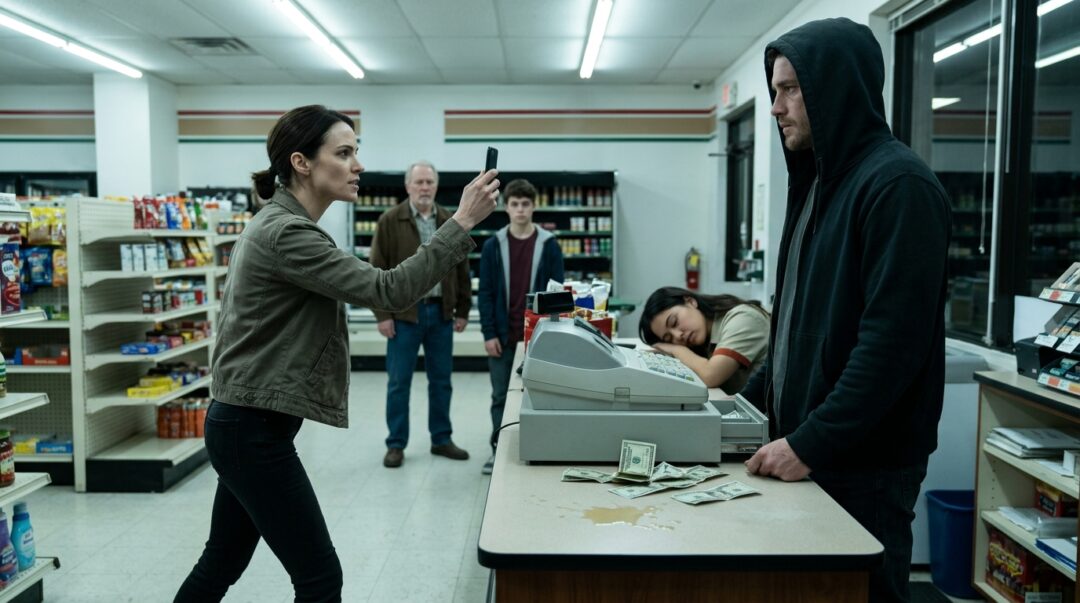
Wren Holloway had been halfway through counting damp bills when she shouted, and now every head in the store turned at once. A tall man in a dark hoodie stood at the checkout counter with a bag of chips tucked against his side, a sports drink balanced near the card terminal, and loose cash spread under his hand. Behind him, the cashier was asleep—truly asleep—with her cheek pressed into her folded arms as if the weight of the night had finally pushed her down where she stood.
The man did not move.
Wren took two steps forward, phone already in her hand. She had been reaching for a bottle of water near the cooler when she saw him leaning past the customer line, too close to the open register, too close to the sleeping girl. She did not know how long he had been there. She only knew how it looked.
The store was small enough that nothing happened privately. Two aisles of snacks. One wall of coolers. A buzzing lottery machine by the door. Harsh fluorescent lighting that made everyone appear tired, guilty, or both. Near the back, an older man with a basket and a teenager in a school sweatshirt had frozen in place, both of them staring toward the counter as if waiting to see whether this was a robbery or only the beginning of one.
“Did you hear me?” Wren snapped. “Get away from her.”
The man slowly looked over his shoulder.
He was younger than she expected, maybe late twenties, with a narrow, exhausted face and dark stubble that made him look older when the light caught it wrong. His hood was up. His work pants were faded at the knees. One boot was wet at the toe, as if he had come in from a puddle. He had the kind of guarded expression that made people decide things about him too quickly.
“What are you doing?” Wren demanded.
He glanced once at the sleeping cashier, then back at the money in his hand.
“Paying,” he said.
The answer was so flat, so restrained, that it almost felt insolent.
Wren gave a short, disbelieving laugh. “That’s what you call it?”
The cashier had not stirred. She looked impossibly young from this angle, all loose ponytail and wrinkled store vest, one hand hanging limp beside a display of gum and hard candy. A paper cup had tipped over near the card reader, leaving a dark stain across the counter. A few dollar bills lay at the edge of the wet ring.
“Don’t touch anything else,” Wren said. “I’m recording now.”
The man’s eyes flicked briefly to her phone, then away.
“Card reader keeps timing out,” he said. “I’m paying exact cash.”
Wren had seen enough people lie badly to know the tone they usually used—too fast, too eager, too offended. This man didn’t sound like that. He sounded tired. Annoyed, maybe. But not frightened.
That only irritated her more.
“Then why are you behind the line?” she shot back. “Why are you touching the bills?”
At the back of the store, the teenager shifted his weight. The older man did not move. Everyone was waiting for the same thing now: either proof or escalation.
The man looked down at the money again, and for a moment Wren mistook his silence for guilt.
Then the receipt printer gave a dry little chirp.
The sound was small, but in the stillness it landed like something heavier.
Wren’s certainty loosened by a fraction.
The man pulled the thin strip of paper free, set it down beside the chips, and slid two coins away from the damp edge of the spill with one finger. Not into his pocket. Back into a neat stack.
“I said don’t touch it,” Wren snapped, but there was less force behind it now.
He finally looked at her fully.
“They’re soaked,” he said. “They were sticking together.”
Wren opened her mouth, then shut it again.
He placed another folded bill on the counter.
“I left extra.”
“For what?”
“In case one tears,” he said.
Only then did Wren really look.
The money wasn’t disappearing. It was organized. The chips and drink were lined up in front of the terminal like items waiting to be checked out, not grabbed in a rush. The spill had spread toward the loose cash, and the smallest bill at the edge was already wrinkling from the moisture. Nothing about the scene had changed since she first saw it. Only the meaning had.
The sleeping cashier made a tiny sound in her throat and shifted slightly, but did not wake.
Wren lowered the phone an inch.
“Who falls asleep like that?” she muttered, half to herself.
The man’s expression altered for the first time. Not much. Just enough for Wren to see that he had already asked himself the same question—and maybe answered it.
The receipt lay under the fluorescent light, plain and undeniable.
What had looked like theft was beginning to look like something else entirely, and Wren hated how quickly the certainty drained out of a moment once facts arrived.
Still, she was not ready to let go of the role she had stepped into.
“Wake her up, then,” she said. “If you’re so honest, wake her up and pay her.”
His eyes went back to the cashier.
“No.”
The answer came quietly, but it stopped Wren cold.
“No?” she repeated.
“She needs the sleep more than the witness.”
It was such an unexpected thing to say that for a second no one in the store moved at all.
Then the cashier startled awake.
She lifted her head too fast, blinking into the bright light, one cheek creased from the counter. Confusion moved over her face in slow waves. First the customers. Then Wren with the phone still half-raised. Then the man at the counter. Then the receipt. Then the money.
Color drained out of her expression.
“Oh my God,” she whispered.
No one answered.
The shame hit her before the explanation did. Wren could see it happen. The girl sat up straighter, trying to gather herself into some version of professionalism, but her hands trembled when she reached for the counter. She looked from the man to the receipt and then to the damp bills by the spill, as if she already understood enough to know how bad this must have looked.
“I’m sorry,” she said quickly, voice rough with sleep. “I’m so sorry. I—”
The man cut her off with a small shake of his head.
“Lock it next time,” he said.
He picked up his drink, tucked the receipt a little farther beneath the cashier’s hand so it wouldn’t blow away when the door opened, and turned toward the exit.
By then Wren had completely lowered her phone.
He passed her without another word.
The bell over the door jingled once. Cold air swept in, then out. And just like that, the person everyone had decided to fear was gone.
Leaving behind a paid receipt, exact change, and a silence no one seemed eager to break.
Part II — Night Shift Gravity
The cashier’s name was Marisol Vega, and by the time the shift clock reached 11:40 p.m., she had stopped feeling like she was moving through time so much as dragging herself underneath it.
The mini-mart sat on the corner of a tired road outside a strip of dim storefronts and a twenty-four-hour laundromat. During the day it was busy enough to feel normal. At night it shrank into something lonelier. The bright aisles looked overexposed, the coolers sounded louder, and every problem seemed bigger because there were fewer people around to diffuse it.
Marisol had worked six nights in a row.
Her manager called it temporary. The word had started to lose meaning on the fourth night.
A coworker had quit without notice. Another had gone home sick and stayed gone. The owner, who liked to remind everyone that he gave chances where other places would not, had responded the way he responded to most labor shortages: by telling the remaining people they needed to be team players.
Marisol was twenty-two and too good at saying yes when older people spoke to her like disappointment was something she owed them money for.
By ten each night, the exhaustion settled behind her eyes. By eleven, it began pulling at her joints. The bright blue vest the store required always felt heavier in the last hour, as if the fabric absorbed fatigue from the air.
That week she had been sleeping in slices. Two hours here. Ninety minutes there. Her mother had gone back to work after a knee injury, but she still couldn’t stand for long, and Marisol had been handling errands before shifts, dishes after shifts, and phone calls during breaks. She had started keeping receipts in her pockets because the days blurred enough that proof mattered.
By the seventh night, she was afraid of simple things.
Afraid of miscounting the drawer.
Afraid of forgetting cigarettes behind the counter and getting accused of giving them away.
Afraid of missing her bus and paying for a ride she couldn’t afford.
Afraid of making a mistake large enough to become someone else’s excuse to talk down to her.
She had not meant to fall asleep.
That was the part that would stay with her later—the way people always talked about fatigue as though it announced itself clearly and gave permission first. In reality it crept in by degrees. A blink held too long. A hand on the counter just to steady herself. A thought slipping off midway through. Then, if the body had gone long enough without mercy, a sudden absence.
A collapse disguised as a pause.
The paper cup had tipped over sometime after eleven-thirty. She remembered that much in fragments. A customer had left it near the card terminal. She had meant to wipe it up. Then another customer came in for cigarettes, then scratch-offs, then gas on pump four, and by the time the counter cleared again the cup had rolled near the edge and dribbled cola toward the loose singles she had separated for change.
She remembered seeing it.
She did not remember losing the fight to stay upright after that.
Across town, the man Wren had accused of stealing had been ending a different kind of day.
His name was Silas Boone, though most people in the warehouse called him Boone because last names felt safer than familiarity. He spent his evenings unloading late freight with two other men and one broken pallet jack that management had been “meaning to replace” for three months. He liked the work only in the narrow sense that it tired him honestly. Boxes did not patronize you. They did not ask you to smile. They did not pretend your strain was character-building.
That night rain had started around nine, needling the loading dock and slicking the asphalt outside. Silas had clocked out late, shoulders burning, with a headache humming behind one eye and a bruise forming at the base of his thumb where a crate had shifted unexpectedly.
He stopped at the mini-mart because it was on the route home and because he had eaten badly all week. Chips. A sports drink. Maybe some aspirin if they were cheap.
He noticed Marisol the moment he walked in, though not because she was asleep.
She was trying not to be.
That, he recognized.
There was a specific way exhausted people held themselves when they were losing the argument privately but still believed they might recover before anyone noticed. The rigid little inhale. The blink that came a fraction too late. The shoulders lifting as if posture could substitute for rest.
Silas had seen it in his mother after double shifts at the nursing home. In men on forklifts who thought energy drinks were a medical strategy. In himself, once, standing at a red light and not remembering when it had turned green.
Marisol rang up one customer, then another. Slow, but precise. She apologized twice for nothing. When Silas set his items on the counter, she fumbled with the scanner, missed the barcode, and gave him a look so mortified it made him glance away to spare her.
“Take your time,” he said.
She nodded once, grateful and ashamed at the same time.
Then another customer came up behind him asking for cigarettes, and someone at the door shouted about a pump not clearing, and Marisol turned in three directions too quickly. The card reader flashed an error. A paper cup rolled onto its side.
Silas saw the sequence happen like tiny failures clicking into place.
By the time she finally turned back toward him, her eyes had unfocused. She braced a hand on the counter for half a second. Then she folded forward onto her arms as if a string had been cut.
He didn’t move at first. Neither did anyone else. There was a shocked pause built from simple human disbelief.
The man behind him cursed softly and backed away.
Silas said her name before realizing he didn’t know it. “Hey.”
No response.
Her breathing was steady. Not passed out. Not hurt. Just gone.
A sign on the cigarette cabinet read ALL TRANSACTIONS MONITORED BY CAMERA, which struck him as almost funny given the situation.
He looked toward the back room. Empty.
Toward the office. Door shut.
Toward the card reader. Error again.
He could have walked out.
Anyone in the world would have understood the temptation. Maybe not endorsed it, but understood it. The register wasn’t hanging open, but the counter was messy, the worker was asleep, and the only immediate witness was the kind of camera that mostly helped after damage had already been done.
Instead he waited a beat, then another.
He tried the card terminal once more. It timed out.
He almost left money and took the items on faith, but the spilled cola had reached the loose cash near the tray and stuck a few bills together in a damp edge. He didn’t want to walk out without knowing whether his payment would be obvious or just create a worse mess for whoever woke up to sort it.
So he began separating the wet bills.
That was what Wren saw when she came from the cooler.
Not the whole situation. Only the sharpest possible angle of it.
Part III — Witnesses
Wren stayed in the store long after Silas left.
At first she told herself she was doing the responsible thing. The cashier was shaken. Someone had to stay a minute. Someone had to make sure she was all right, make sure the drawer matched, make sure the girl understood how close she had come to disaster.
But the truth was narrower and less flattering.
Wren didn’t want to walk out carrying the version of herself that had raised a phone at an innocent man.
Marisol took the receipt from beneath her hand and stared at it as though it had arrived from someplace stranger than a register printer. Her face was still flushed with sleep and humiliation.
“I really fell asleep?” she asked, voice small.
The older man from the back aisle came forward at last and placed his basket on the counter. “Looks like you needed it,” he said gently.
Something in Marisol’s expression softened dangerously at that, as if kindness might undo the thread holding her together.
Wren stepped in too quickly, eager to be useful.
“You should probably wash those bills,” she said, instantly hearing how stupid it sounded.
Marisol gave a short, startled laugh that turned into a swallow.
“He paid?” she asked.
Wren nodded.
“And left extra,” the older man added.
Marisol closed her eyes for one second.
When she opened them, she looked toward the door as if some part of her still believed the man might come back and give her a chance to apologize properly. But the rain-streaked glass showed only the reflection of the store.
“What was he like?” she asked.
The question caught Wren off guard.
What was he like?
She could describe what he looked like. Hooded. Tired. Guarded. Worn around the edges in a way respectable people learned to read as trouble even when it was only strain. She could describe how he had stood there and taken her accusation without trying to charm his way out of it. How he had refused to wake the cashier just to clear his own name faster.
What she could not easily describe was why that restraint unsettled her more than any anger would have.
“Quiet,” Wren said finally.
Marisol looked down at the receipt again.
The total was modest. Chips, sports drink, aspirin. But the extra bill lay folded beside it, deliberate and unmistakable.
“People don’t do that,” she murmured.
Sometimes they did, Wren thought. The problem was that people like her often looked right through them first.
She left without buying the water.
In the parking lot the rain had become mist, fine enough to hang in the air rather than fall. She sat in her car with the engine off and watched droplets gather on the windshield until the store lights blurred.
Wren was not cruel. She had built an entire adult identity around not being cruel.
She intervened. She paid attention. She noticed when women were being followed too closely in parking lots. She once made a scene in a restaurant because a server was crying and the manager kept pretending not to see it. She was, by most ordinary measures, the kind of person people praised for having instincts.
And maybe that was part of the problem.
Instinct was only noble while it was right.
Tonight it had felt good for exactly five seconds—to step in, to raise her voice, to be the first person willing to call danger by its name. Then the facts had shifted under her, and she had discovered how much of certainty could actually be vanity wearing moral language.
She replayed the moment in her head.
The wet bills.
The stacked coins.
The receipt.
The line he had spoken without looking at her: She needs the sleep more than the witness.
That had been the wound of it. Not because it was poetic. Because it was true, and because it implied a mercy Wren had not extended.
She had seen a sleeping cashier and a rough-looking man and chosen the shape that fit easiest into a story she already believed she understood.
She started the car and drove home with the radio off.
For Marisol, the rest of the shift passed in a thin, unreal glaze.
Every time the bell above the door rang, her heart lurched.
She locked the register between customers after that, every single time, even when stepping only two feet away. She wiped the counter twice. She recounted the drawer once, then again. The extra bill remained in her pocket like an object that carried its own temperature.
At 2:07 a.m., when the manager called to ask whether closeout was done, she almost told him everything. Almost said I fell asleep standing up and a stranger protected me from the mistake.
But she could already hear how it would sound in his mouth. Not like concern. Like liability.
So she said only, “Almost done.”
When she got home near dawn, her mother was asleep on the couch with the television still on mute. Marisol stood in the kitchen under the stove light and unfolded the receipt again.
On the back, in small block letters, there were three words she had not noticed before.
Get some rest.
No name. No lecture. No demand to be remembered.
She sat down at the table and cried so quietly the walls did not learn about it.
Part IV — The Weight of Being Seen
Silas did not think about the store again for two days.
That wasn’t because it hadn’t mattered. It was because his life had taught him to step over certain moments even when they snagged at him. Warehouse. Bus ride. Microwave dinner. Sleep. Back again. There was always another immediate thing to carry.
Still, he noticed the absence of the receipt in his wallet where he had meant to keep it until payday. He remembered leaving it tucked under the cashier’s hand. He remembered the woman with the phone and the practiced authority in her voice. He remembered the girl waking up into shame.
He told himself it was over.
Then on the third night, he stopped at the mini-mart again.
Not because he needed anything badly. Because unfinished things sometimes pull harder than finished ones.
Marisol saw him the second he came through the door.
For one impossible instant she thought she had imagined him into being. Then he stepped out from the rain, hood down this time, hair damp, shoulders broad with the same tired heaviness she remembered. He looked almost younger without the hood, less like a threat and more like what he probably was—someone who worked too hard for too little and had learned to wear caution like a coat.
She left the counter before she could overthink it.
“Wait,” she said.
He stopped near the coolers.
“I wanted to say thank you.”
He shifted slightly, as if bracing for something more complicated.
“You don’t have to.”
“I do.”
The store was emptier than before. A delivery truck hissed outside. The lights made everything feel too exposed for gratitude, but Marisol had spent two days living with the fact that a stranger had protected her in the exact moment she had been most humiliatingly unable to protect herself.
“I could’ve lost my job,” she said.
His expression didn’t change much, but she saw he understood that part already.
“You looked done in,” he said.
She laughed once, softly. “That obvious?”
“To anyone awake.”
That almost made her laugh again.
Almost.
“I found your note.”
He looked away, not embarrassed exactly, just unwilling to stand inside praise for long.
“It wasn’t much.”
“It was.”
There was a pause between them that did not feel awkward so much as careful.
Marisol had imagined this conversation differently. Bigger. More emotional. She had imagined herself explaining everything—the double shifts, her mother’s knee, the manager, the fear that sat in her stomach every time the drawer was short even by a dollar. But standing in front of him now, she understood that part of what made his kindness matter was how little he had asked in return. He had not demanded her story to justify helping her. He had simply seen enough.
So she chose honesty without performance.
“I was embarrassed,” she said. “More than I’ve ever been.”
His eyes came back to hers. “Yeah.”
That should have stung. Instead it steadied her.
“But then I kept thinking,” she said, “if you wanted to make me feel worse, you could have. You didn’t.”
“No point.”
“There was to me.”
Something shifted in his face then, not quite softness, not quite sadness. Recognition, maybe. Of the fact that humiliation often lasts longer for the person who survives it than for the people who witness it.
Marisol reached into her pocket and pulled out the folded extra bill.
“I still have this.”
He frowned slightly. “Why?”
“I didn’t know if you’d come back.”
A breath passed. Then another.
Finally, Silas stepped closer and took the bill, but instead of pocketing it, he slid it into the donation jar by the register—the one collecting money for a local shelter that almost no one noticed anymore.
Marisol stared at him.
“There,” he said. “Now it belongs somewhere.”
She smiled before she could stop herself.
It changed his whole face that she did.
Not into warmth exactly. Into surprise.
The bell above the door rang, and Wren walked in carrying a bottle of water she absolutely did not need.
She stopped dead.
For a second all three of them held still inside the same fluorescent frame: the exhausted cashier, the wrongly accused man, and the woman who had once mistaken being first for being right.
Wren recovered first.
“I was hoping…” She faltered, which Marisol suspected almost never happened to her. “I mean—I came by the other night, but you weren’t here.”
Silas said nothing.
Wren looked at him directly. “I owe you an apology.”
He leaned one shoulder lightly against the counter, not helping her and not making it harder either.
“You thought what it looked like,” he said.
“I did.”
“And?”
“And I was wrong.”
She did not decorate it. That counted for something.
“I was too sure,” she added. “Too loud too.”
Marisol watched Silas consider that.
Then he nodded once, as if accepting the existence of the apology without turning it into a ceremony.
Wren let out a breath she had clearly been holding for days.
“I’m glad you came back,” she said.
Silas almost smiled. “I needed aspirin.”
The laugh that escaped Marisol then was small but real, and this time even Wren smiled.
Something loosened in the store.
Not redemption exactly. Nothing that dramatic. Just a brief, rare correction. Three people standing inside the aftermath of a mistake, each of them changed in some minor but meaningful way by having remained long enough to face it.
Wren bought the water at last. Silas bought the aspirin. Marisol stayed awake.
When he stepped to the register, Silas set the bottle and the box down in front of Marisol with exaggerated care, and she scanned them with an ease she had not felt in days.
The card reader worked on the first try.
“Good,” he said.
“Very funny,” she replied.
He took the receipt this time.
Before leaving, he looked at the counter, then at her.
“Lock it next time,” he said again, but now the words held the shape of a private joke around an old wound.
“I will.”
He nodded and turned toward the door.
The bell rang. Rain gusted in. Then he was gone once more into the wet neon dark.
Marisol watched his reflection disappear from the glass and felt, for the first time in a week, not only tired but also intact.
Later, after the late rush that never really came, she tucked a handwritten sign beside the register where only she would see it unless someone leaned too close.
It read:
Stay awake.
Lock the drawer.
Don’t decide too fast who people are.
She never told her manager the real story.
But she kept the lesson.
And months later, when she saw a man in muddy work boots fumbling for exact change while a line built behind him and another customer rolled her eyes, Marisol only smiled and said, “Take your time.”
Because sometimes the person everyone reads wrong is the only one in the room behaving with grace.
And sometimes the smallest proof of that is nothing more dramatic than a printed receipt, left under a tired hand so it won’t blow away.