The HOA Tore Out His Lake Dock Rail Before Learning Why His Daughter Needed It
Chapter 1: The Rail Was Already Half Gone
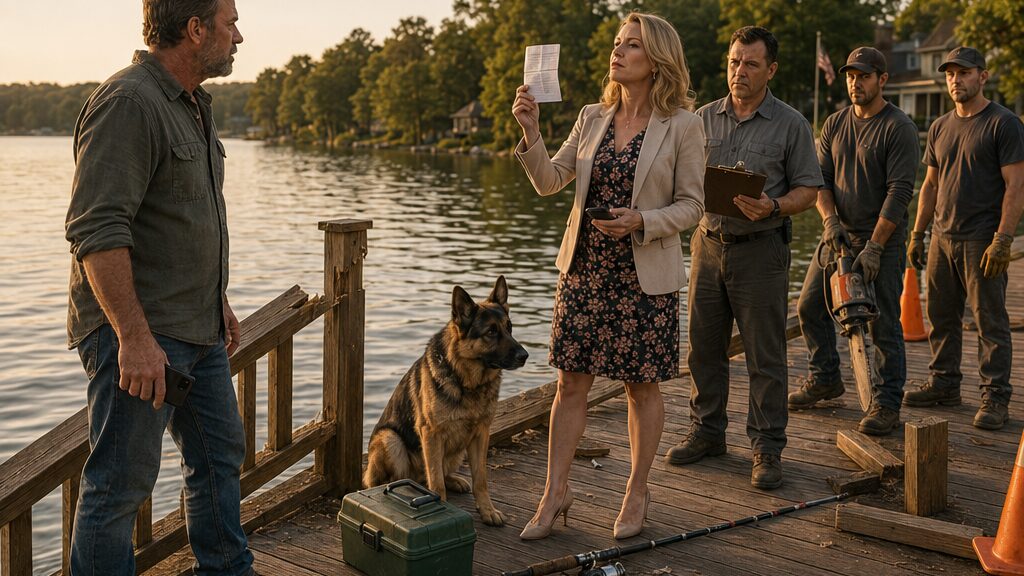
The power tool screamed from the dock before Joshua Miller saw the notice.
He stopped halfway down the back steps with the fishing rod still in one hand and the green tackle box knocking against his knee. The German Shepherd lifted his head from beside the porch and gave one low bark toward the water.
At first Joshua thought a neighbor’s boat motor had caught wrong against the stillness of the lake. Then the sound bit again—metal teeth chewing through wood—and he saw a man in a gray work shirt bent over the left side of his dock, cutting through the rail Joshua had bolted in three weeks earlier.
Half of it was already gone.
Two vertical posts lay on the dock boards. The smooth handrail Emma had practiced gripping, inch by inch, leaned against a worker’s boot like scrap. A second worker stood near the shoreline with orange cones stacked in his arms. The crew supervisor held a clipboard and did not look up until Joshua stepped onto the grass.
“Stop,” Joshua called.
The saw whined down but did not stop spinning at once. It coughed, clicked, and settled into a dangerous silence.
The worker looked back at the supervisor. The supervisor looked toward the lake path, where Cynthia Perez was walking toward them in white sandals and a bright floral dress that seemed too cheerful for the sound that had just been made.
Joshua kept moving. Not fast. Not running. He set the tackle box down near the first loose screw before it rolled between the dock boards.
“That rail is not trash,” he said.
Cynthia reached the end of the dock before the supervisor answered. She held a folded paper in one hand and her phone in the other, already open as if she had been expecting an argument worth recording.
“Mr. Miller,” she said, calm in the way people sounded when they had practiced being calm in front of witnesses. “The association issued notice. This structure is non-compliant.”
Joshua looked at the rail. The clean cut through the cedar post showed pale wood inside, raw as bone.
“You issued notice for removal?”
“For an unauthorized alteration to a lakefront common-view structure.”
“It’s on my dock.”
“It is attached to a lakefront dock visible from shared water,” Cynthia said. “That makes it subject to lake committee standards.”
The dog stepped onto the dock behind Joshua and stopped beside the tackle box. His ears were forward, body still.
Joshua put one palm out toward the workers without touching either of them. “Nobody cuts another board until I see the order.”
The supervisor shifted his weight. “We’re just doing what we were contracted to do.”
“I’m not blaming you,” Joshua said. “But you’re on my property removing my materials.”
Cynthia unfolded the paper and held it out. “You were notified that the modification had to be removed by the association if you failed to restore the dock voluntarily.”
Joshua took the page. It was a violation notice. He recognized the language from the email she had sent ten days before: exterior alteration, failure to obtain written approval, lakefront uniformity, possible liability exposure. At the bottom, in bold, it said corrective action may be taken at owner expense.
It did not say a crew could come onto his dock without a removal order. It did not say they could cut through something before he was home.
“This isn’t an order,” he said.
“It is enforcement.”
“It’s a notice.”
Cynthia’s eyes moved over his face, then to the fishing rod in his hand. “You were given time.”
“I was given a violation while my accommodation request was still pending.”
Her mouth tightened at the word.
“This was not approved,” she said.
“It was necessary.”
“This lake isn’t yours to alter.”
The sentence fell clean and hard across the dock. One of the workers looked away. The supervisor lowered his clipboard. The lake behind them was bright under the late sun, the water flat and gold, neighbors’ docks lined in neat, quiet rows along the shore.
Joshua felt the old pull in his chest, the one that told him to say less. He had spent months saying less. Less to neighbors who asked why Emma no longer walked down to the water. Less to the board when they wanted “details” he did not want strangers discussing over coffee. Less to Emma when she caught him watching every step she took across uneven ground.
He bent, picked up one of the loose screws, and held it between two fingers.
“This rail is a medical accommodation.”
Cynthia looked almost annoyed that he had said it in front of the crew.
“You did not submit approved medical accommodation documentation to the board.”
“I submitted a written request.”
“You submitted a dock modification request.”
“I submitted a safety access request.”
“That is not how it was categorized.”
Joshua stared at her. “By whom?”
Cynthia did not answer right away. She turned to the supervisor. “Continue with the removal.”
Joshua stepped between the worker and the remaining rail.
The dog gave another low bark. Joshua glanced back once, sharp enough that the dog settled, though he did not move from the dock.
The worker held the saw by his side. “Sir, I need you to clear the work area.”
“No,” Joshua said.
Cynthia’s eyebrows lifted. “Are you obstructing an enforcement action?”
“I’m asking for the written authority that lets you come onto private property and remove a medical accommodation.”
“You cannot call something a medical accommodation after violating the rules.”
Joshua took out his phone. His hand was steady, though his stomach had gone tight and cold. He opened the camera and pointed it at the cut rail, the cones, the supervisor’s clipboard, Cynthia’s folded notice.
“For the record,” he said, “Cynthia Perez, HOA president, has sent a crew onto my property to remove a safety rail after being told it is a medical accommodation. I have asked for a removal order. She has provided a violation notice.”
“Mr. Miller,” Cynthia said, voice lower now, “you are escalating this.”
“You started cutting before I got here.”
“We left notice on your door.”
“When?”
She glanced toward the house.
“When?” Joshua repeated.
“This afternoon.”
He let the camera hold on the half rail.
“The crew was already here this afternoon.”
The supervisor cleared his throat. “We arrived at four.”
Joshua looked at Cynthia. “What time did you leave the notice?”
Cynthia’s face changed only slightly, but he saw it. A flicker. A calculation. Then she folded the notice again.
“The appeal window expired.”
“It has not expired if you never answered the accommodation request.”
“There is no approved accommodation request.”
The word approved did all the work she needed it to do.
A truck door shut somewhere up the drive. Joshua turned enough to see a responding officer walking down the side path, one hand near his belt, the other loose at his side. A neighbor must have called. Or Cynthia had. Either way, the blue uniform changed the posture of everyone on the dock. The worker set the saw on the boards. The supervisor held the clipboard against his chest. Cynthia lifted her chin.
Joshua did not move away from the rail.
The officer stopped at the start of the dock. “What’s going on?”
Cynthia spoke first. “This homeowner is interfering with authorized HOA enforcement.”
Joshua kept his phone down at his side now, still recording but not pointed at anyone’s face. “A crew is removing a safety rail from my dock without showing a removal order.”
The officer looked at the cut post, the cones, the saw, then at Cynthia. “Ma’am, do you have paperwork authorizing entry and removal today?”
Cynthia held out the violation notice.
The officer read the first page, then turned it over as if the missing authority might be printed on the back.
“This is a violation notice,” he said.
“It authorizes corrective action,” Cynthia replied.
“Does it authorize this crew to enter his property today and remove installed materials?”
Cynthia’s confidence thinned around the edges. “The association has enforcement power under the covenants.”
“I’m asking whether you have an order for today’s removal.”
The lake went quiet around them. Even the dog stood still.
Joshua watched Cynthia reach into the folder under her arm. She pulled one page, then another, then stopped. The papers trembled once before she pressed them flat against the clipboard.
All she had was the notice.
Chapter 2: The Notice Said Dock Expansion
Joshua opened the green tackle box on the kitchen table and found the stamped request tucked beneath a coil of fishing line, exactly where he had hidden it from himself.
The house was quiet except for the refrigerator and the dog drinking from his bowl near the back door. Outside, the dock was dark now, the cut rail showing in the porch light like a missing tooth. The crew had left after the officer told everyone to pause until the paperwork was clear. Cynthia had left last, heels sharp against the path, saying the board would be informed of Joshua’s refusal to comply.
He spread the papers across the table.
The first copy was his. Three pages. HOA exterior review form. Sketch of the dock edge. Measurements. Materials list. Cedar handrail, matte finish, removable winter brackets. Temporary access strip across the uneven boards. He had written safety rail for lake access in the project description box.
The second copy was the one Cynthia had emailed back.
At the top, someone had written DOCK EXPANSION in blue ink.
Joshua stared at those two words until they stopped looking like words.
The rail had not widened the dock. It had not extended toward the water. It had not added a platform, bench, roof, ladder, light, or boat fixture. It was a narrow rail along the left edge, where the boards sloped just enough to punish anyone whose balance failed without warning.
He found the photo he had included: the dog lying beside the tackle box, the unpainted rail clamped temporarily in place. In the picture, the lake looked harmless.
A door creaked behind him.
Emma stood at the edge of the kitchen in loose sweatpants and a gray sweatshirt, one hand braced against the wall. She was twenty-three and hated being watched. That was why Joshua looked first at her face, not her hand.
“Did they come back?” she asked.
“No.”
“Then why are you sitting like that?”
He looked down and saw both fists closed on the papers.
“Because the notice says dock expansion.”
Emma’s eyes went to the table, then past him through the glass door toward the lake. “That’s not what it is.”
“I know.”
“Do they?”
He did not answer quickly enough.
She came closer, each step deliberate, the way Sarah had taught her to walk when the floor changed under her. The dog lifted his head and thumped his tail once but did not get up. Emma lowered herself into the chair across from Joshua and picked up the top page.
There were moments when he still saw her at twelve, racing barefoot down the dock with a fishing worm clenched in one fist and the dog chasing after her, both of them wild with summer. Then she would pause before sitting, hand hovering for balance, and the present would correct him.
Emma turned the paper around. “Who wrote this?”
“I don’t know.”
“Cynthia?”
“Maybe. Maybe the office.”
“Does it matter?”
“It matters if they changed what I asked for.”
She looked at him. “Did you tell them why?”
Joshua reached for the next page, then stopped.
“I told them it was for safe access.”
“Dad.”
“I said it was medically related.”
“You said that exactly?”
He looked toward the back window. The lake reflected the porch light in a broken path. “I didn’t put your details in an HOA form.”
Emma’s face hardened, not with anger exactly, but with the old exhaustion of being discussed in rooms she had not entered. “Thank you.”
“It may have hurt us.”
She looked down at the paper.
Joshua opened the tackle box’s upper tray. Hooks, swivels, a red-and-white bobber Emma had bought when she was little because she said it looked like candy. Beneath the tray was a plastic sleeve of older photographs he had brought out to match the dock measurements.
He pulled one free before he could decide not to.
Emma at sixteen, sitting on the dock with the German Shepherd as a puppy sprawled across her lap. Her fishing rod was bent, her mouth open in a laugh, Joshua’s hand visible at the edge of the frame reaching for the net. Behind her was the same left edge of the dock where the rail now stood half-cut.
Emma took the photo.
The small laugh that escaped her had no strength in it. “He was so fat.”
“He was a puppy.”
“He was a barrel with paws.”
Joshua smiled because she did, but it did not last.
She set the photo down beside the violation notice. The contrast was cruel: her laughing face, the stamped language, DOCK EXPANSION in blue ink.
Her phone buzzed on the table. She glanced at it and went still.
“What?” Joshua asked.
She turned the screen toward him.
A neighbor had posted a short video in the community group. The frame showed Joshua standing on the dock, phone in hand, blocking the worker from the rail. Cynthia stood opposite him, floral dress bright against the water.
The caption read: Trouble at Miller dock. Unauthorized construction drama?
Joshua’s throat tightened.
Emma took the phone back and scrolled with her thumb. “People are asking what happened.”
“I’ll call the group admin.”
“Everyone knows?”
“No.”
“They know enough to guess.”
He hated the shame in her voice more than he hated Cynthia’s notice.
“You are not the violation,” he said.
Emma looked at him for a long moment. “But I’m the reason.”
“No,” Joshua said, too fast. “You’re the reason I should have been clearer.”
That landed between them.
The dog stood, came to Emma, and pressed his head against her knee. She put one hand on him, fingers moving automatically through his fur.
Joshua gathered the papers into two piles: what he had sent, what the HOA had returned. He saw the gap now. No letter from Sarah. No specific accommodation language. No sentence that said Emma Miller requires a stable handhold and level access to safely use the lakefront area of her home. He had avoided the words because Emma had flinched when Sarah first suggested them.
He had told himself he was protecting her.
His email chimed.
The subject line was all capital letters: FINAL CORRECTIVE NOTICE — LAKEFRONT VIOLATION.
Joshua opened it.
Cynthia’s message was brief. The association had paused removal as a courtesy after law enforcement confusion, but the violation remained active. Daily fines would begin Friday if the remaining rail and access strip were not removed. If Joshua failed to comply, the association reserved the right to complete removal and bill the cost to his account.
Emma read over his shoulder.
“Friday,” she said.
Joshua shut the laptop gently, because if he shut it hard she would hear more than anger. “I’m calling Sarah in the morning.”
Emma pushed the photograph back toward him. “Don’t send that to them.”
“I won’t.”
“I mean it. Don’t make me the sad picture in their meeting.”
He nodded. “I won’t.”
But later, after Emma went back down the hall and the dog settled by the kitchen door, Joshua sat with the papers until the porch light clicked off on its timer. He looked again at the request he had written, the words he had chosen to keep small, and the words someone else had written over them.
His phone rang just after nine.
Sarah Johnson did not say hello first.
“Joshua,” she said, “did they classify your request as a dock expansion?”
He stood so quickly the chair legs scraped the floor.
“Yes.”
There was a pause on her end, short but heavy.
“Then they may not have reviewed it as an accommodation at all.”
Chapter 3: She Called It A Lake Standard
Cynthia Perez had already printed a color photo of Joshua standing in front of the crew by the time he reached the HOA office.
It lay in the center of the conference table, enlarged to fill an entire page. Joshua’s face was caught in a hard angle, one hand raised, the phone in the other. The worker with the saw was half visible behind him. The rail looked jagged and unfinished, not because Joshua had built it poorly, but because someone had cut it apart.
Across the top, in Cynthia’s neat handwriting, were three words: OWNER OBSTRUCTING ENFORCEMENT.
Joshua remained standing.
Cynthia sat at the head of the table with a folder squared in front of her. James Sanchez sat two chairs down, shoulders slightly rounded, reading glasses low on his nose. The HOA board secretary was at a small desk by the window with a laptop open. Through the blinds, Joshua could see the lake path and the pale morning water beyond it.
“You asked for a meeting,” Cynthia said.
“I asked for review of the file.”
“This is the file.”
Joshua looked at the photo again. “That’s a picture of me asking your crew not to cut a medical accommodation without showing an order.”
“It is a picture of you preventing contracted enforcement.”
“Then we should start with the contract.”
Cynthia’s expression cooled. “Mr. Miller, this is not a deposition.”
“No,” Joshua said. “It’s my house.”
James glanced up.
Joshua placed his own folder on the table but did not sit. He had spent half the night arranging the pages in order so his hands would not search when Cynthia pressed him. Original request. Stamped receipt. Email confirmation. Violation notice. Photos before the cut. Photos after the cut.
“I want to know why my request was labeled dock expansion,” he said.
“It was processed under lakefront exterior modification.”
“That is not what I asked for.”
“You added a rail to a dock.”
“For safe access.”
“Many owners could claim convenience as safety after the fact.”
Joshua felt heat move up the back of his neck. He kept his voice level. “I claimed it before the fact.”
Cynthia opened her folder. “Your form did not include sufficient medical documentation.”
“My form included the phrase medical safety access.”
“Without supporting detail.”
“Did anyone ask for supporting detail?”
The secretary’s typing slowed.
Cynthia turned one page. “The review committee is not required to chase incomplete applications.”
“Then why didn’t you deny it as incomplete?”
“We issued a violation because you installed before approval.”
Joshua looked to James. “Was my request reviewed as an accommodation?”
James adjusted his glasses and reached for a packet near his elbow. “The category listed here is dock expansion.”
“It was not an expansion,” Joshua said.
James read the top page, then the second. “The drawing shows a rail along the existing edge.”
“And an access strip over uneven boards,” Cynthia added. “Both visible from the water.”
Joshua turned to her. “Visible from the water is not the same as unsafe.”
“The board has standards for a reason. If every homeowner starts attaching private structures to lakefront docks, we lose uniformity and we create liability.”
“The liability is someone falling because you removed the handhold.”
Cynthia’s eyes sharpened. “You cannot put the association in the position of approving every unverified claim.”
There it was, Joshua thought. Not cruelty in the simple way people wanted cruelty to look. Procedure. Fear. A woman protecting the shape of authority because if one exception entered, the wall might crack.
He opened his folder and slid the stamped request across the table.
“Please read the description line.”
Cynthia did not pick it up.
James did.
He read silently, lips moving once around the words. Then he looked at Cynthia’s packet.
“What?” she asked.
James turned the page sideways. “The file copy in our packet doesn’t have the second description page.”
Joshua went still.
Cynthia reached for the paper. “That page is supplemental. The official form is the signed application.”
“The signed application says see attached safety description,” Joshua said.
James looked again. “This copy doesn’t have that attachment.”
Cynthia took the board packet from him. “The attachment was not relevant to the structure classification.”
“How would the board know that if they never saw it?” Joshua asked.
Cynthia placed the pages down with controlled care. “Mr. Miller, you installed first. That remains the central fact.”
“It’s not the only fact.”
“It is the enforceable fact.”
The secretary resumed typing, fast now.
Joshua finally sat. Not because he felt calmer, but because he knew standing over the table helped Cynthia’s photograph tell the story she wanted.
“Then put this in the minutes,” he said. “I am requesting formal accommodation review. I am requesting the complete file. I am disputing the classification of dock expansion. And I am asking that no further removal happen until the board reviews the original request.”
Cynthia folded her hands. “The emergency board vote is scheduled for Friday evening.”
Joshua heard the word before he understood it. “Vote?”
“To determine whether the association proceeds with full corrective action and fines.”
“That’s in two days.”
“You’ve had notice.”
“I’ve had a mislabeled violation.”
James shifted in his chair. “Cynthia, if there’s an accommodation question, we may need more time.”
“We need consistency,” Cynthia said, turning to him now. “The carrier’s letter was clear. Lakefront structures must be uniform, documented, and approved. We cannot have owners building first and explaining later.”
Joshua looked between them. “What carrier letter?”
Cynthia closed the folder. “Insurance guidance following the spring review.”
“May I see it?”
“It concerns association operations.”
“It’s being used to remove something from my property.”
“It will be summarized at the meeting.”
Joshua gave a short nod, though nothing in him accepted it.
The meeting went on for another twenty minutes, but the shape of it did not change. Cynthia spoke of standards. Joshua returned to access. Cynthia spoke of process. Joshua returned to classification. James asked twice for the original packet, and twice Cynthia said the office file was what had been provided.
When Joshua stood to leave, he gathered his papers slowly. The enlarged photo of him remained on the table, his raised hand frozen in a posture that looked more aggressive than it had felt.
At the door, Cynthia spoke without looking at him.
“You should think carefully before turning this into a public disability dispute.”
Joshua turned back.
James looked up sharply.
Cynthia’s face had not changed. That was the worst part. She looked as if she had offered advice.
Joshua’s hand tightened around the folder. “I’m trying to keep it from becoming one.”
“Then remove the rail voluntarily and submit the proper documentation like everyone else.”
“Like everyone else,” Joshua repeated.
He left before he said anything Emma would later have to hear about.
Outside, the lake path curved behind the clubhouse and down toward the water. Joshua walked it because he needed air before he drove. The morning was bright, but the docks looked different now. Every rail, ladder, bench, and boat cleat seemed to have a rule attached to it, some visible, some waiting.
Behind him, the clubhouse door opened.
James Sanchez stepped out with a file folder tucked under his arm.
“Joshua.”
Joshua stopped.
James came down the path but kept distance between them, as if aware that being seen too close might matter.
“I’m not promising anything,” James said.
“I didn’t ask you to.”
“I know.” James looked toward the lake. “But I checked the packet they gave us for Friday. Your original attachment isn’t there. The one about safety access.”
Joshua felt the air change.
“Maybe it was lost,” James said, though he did not sound convinced. “Maybe it was separated when the file was scanned. I don’t know.”
“Who handles that?”
“The office receives it. Cynthia reviews lakefront categories before board packets go out.”
Joshua looked back at the clubhouse windows. The blinds were still angled down.
James lowered his voice.
“Your original packet isn’t in the board file.”
Chapter 4: The Missing Page Changed Everything
“Did you ever send the page I gave you?” Sarah Johnson asked before Joshua had fully sat down.
The clinic office smelled faintly of rubber mats and hand sanitizer. On Sarah’s desk, between a stack of exercise bands and a model of a knee joint, lay a copy of Joshua’s HOA request with a yellow sticky note attached to the corner. Sarah had printed it from the email he forwarded that morning. The first page was there. The drawing was there. The materials list was there.
The recommendation letter was not.
Joshua looked at the empty space where the fourth page should have been.
“I thought I attached the safety description.”
“You attached your description,” Sarah said. “Not mine.”
Her voice was careful, which made it worse. Sarah had never pushed Emma harder than Emma could stand, but she also never let Joshua make a soft story out of a hard fact.
Joshua rubbed one thumb along the edge of the folder. “She didn’t want it sent.”
Sarah leaned back. “Emma?”
“She didn’t want the board reading about her balance issues.”
“I remember,” Sarah said. “I also remember telling you we could write it narrowly. Functional need. No diagnosis. No private history.”
“I know.”
“Joshua.”
He looked up.
“They’re tearing out the thing that keeps her from falling.”
The sentence had no accusation in it, but it found the place in him where accusation would have landed.
He had brought the green tackle box into the truck because he did not trust himself to leave anything behind anymore. It sat on the passenger floorboard outside with copies of old photos, stamped forms, and the screw he had taken from the dock. He had become the kind of man who carried proof around like bait.
Sarah opened a file drawer and removed a single page. “This is the recommendation I drafted last month. The one you asked me to keep general.”
Joshua read the top line.
To whom it may concern: The resident requires a stable handhold and level access support to safely reach the lakefront dock area of the home.
No diagnosis. No dramatic language. No plea.
Just need.
“I should have sent it,” he said.
Sarah did not soften it for him. “Yes.”
He folded the page once, then unfolded it because folding felt like hiding. “She asked me not to.”
“And you’re her father, so you tried to protect what she asked you to protect.” Sarah’s gaze stayed on him. “But privacy cannot be the only safety plan.”
He sat with that.
Outside the office door, someone moved equipment across the therapy floor. A dull wheel squeaked, then stopped. Joshua heard Emma’s voice in memory, tight and embarrassed: I don’t want people voting on my body. He had agreed too quickly because he wanted to be the one person who never forced her to explain herself.
Now Cynthia had explained her instead.
Dock expansion. Violation. Obstruction.
Sarah slid the page into a clean envelope. “You can submit this before the hearing.”
“Cynthia will say it’s late.”
“She can say what she wants. It existed before the removal.”
Joshua stood, then paused with his hand on the envelope. “Will you come to the hearing?”
Sarah shook her head slowly. “If Emma asks me to, yes. If you ask me to because you don’t want to say the hard part yourself, no.”
That hit more directly than he expected.
He almost defended himself. He almost said he had stood in front of a saw, that he had called out the notice, that he had done everything except tell strangers more about his daughter than they deserved to know. Instead he put the envelope under his arm.
“I’ll talk to her.”
Sarah nodded. “Then talk to her, not around her.”
In the truck, he sat for a minute before starting the engine. The green tackle box was open on the floorboard, the old photo of Emma and the dog half visible beneath the tray. He pushed the lid down gently and drove home.
Emma was on the back porch when he arrived, seated in the old wooden chair near the steps. The dog lay across her feet. From there, the dock was visible through the trees, but the broken rail was partly hidden by the slope of the yard. Joshua wondered if she had chosen the chair for that reason.
She saw the envelope before he spoke.
“Sarah gave you the letter.”
“Yes.”
Emma looked toward the lake. “I told you not to send it.”
“You did.”
“And you didn’t.”
“No.”
“So why does it feel like I’m still in trouble?”
Joshua sat on the porch step below her, not beside her, giving her the higher ground without making a show of it. “Because I let them define the repair without giving them enough truth to stop them.”
Emma’s jaw moved once.
He held out the envelope but did not make her take it. “It doesn’t say anything you didn’t agree to last month. No diagnosis. No history. Just that you need a stable handhold and level access.”
“I hate that word.”
“What word?”
“Need.”
The dog lifted his head at her voice.
Emma looked down at her hands. “I used to run down there. I used to carry two rods and a bucket and that stupid tackle box because you always forgot something. Now everyone gets to know I need a handhold?”
“Not everyone.”
“The board. Cynthia. James. Whoever prints the packet. Whoever whispers after.”
Joshua did not answer right away. Down by the dock, the exposed brackets caught the light. Without the rail, they looked useless and sharp, little metal mouths left open.
“I thought keeping it vague was respecting you,” he said. “Maybe some of it was. But some of it was me not wanting to admit the lake changed for us.”
Emma turned her face toward him.
He kept going before he could choose easier words. “I promised you it would still be yours. Then I tried to keep that promise quietly enough that nobody would notice.”
A small sound left her, almost a laugh, almost not. “That sounds like you.”
“I know.”
She took the envelope at last. Her fingers slid under the flap but did not open it. “If we send this, I don’t want them using me in some big emotional argument.”
“I won’t.”
“I’m serious.”
“So am I.”
“No pictures from before. No video of me walking. No sad story about the hospital. No making Cynthia cry.”
Joshua nodded once.
Emma looked at him more closely. “You wanted to.”
“I wanted to make them understand.”
“That’s different from making them sorry.”
He looked down.
She opened the envelope and read the page. It took less than a minute. When she finished, she placed it on her lap and smoothed the crease with her thumb.
“This is all?”
“That’s all.”
She breathed out slowly. “You can use it.”
“Emma—”
“You can use it,” she repeated. “But if Cynthia asks what happened to me, you say the rail is the point. Not me.”
Joshua felt the tightness in his chest shift, not gone but changed. “The rail is the point.”
“And the dock,” she said. “And the fact that I live here too.”
He looked toward the water.
A figure stood at the end of the lake path near the common bulletin post. Cynthia, in a pale jacket now, was pressing a notice under the clear plastic cover. When she stepped aside, Joshua could read only the largest line from the porch: COMMUNITY REMINDER — UNAUTHORIZED PRIVATE LAKE STRUCTURES.
Emma saw him looking and turned.
Cynthia smoothed the page once with the heel of her hand, then walked away without looking toward the house.
Joshua stood.
“Dad,” Emma said.
“I’m just going to read it.”
The dog rose, but Joshua pointed once to the porch. “Stay.”
By the time he reached the bulletin post, Cynthia was gone. The notice was not addressed to him, which somehow made it worse. It warned all residents that unapproved lakefront alterations, including rails, platforms, ramps, extensions, and access strips, created liability exposure and could be removed by the association after notice.
Someone had already underlined rails in black marker.
Joshua took a photo of the notice, then another from farther back showing his dock beyond it. He was still holding the phone when he heard an engine grind in the distance.
Not a boat.
A truck.
He turned toward his driveway. A white work truck rolled slowly past the front of his house, orange cones stacked in the back and a pair of cut rail posts lying beside them. The same crew supervisor sat in the passenger seat.
The truck stopped at the curb.
Chapter 5: This Morning Was Not Notice
Joshua saw his rail posts in the truck bed before anyone knocked.
They were stacked beside the orange cones, cedar scraped where the brackets had been torn loose, one end of the handrail marked by the saw cut from the first day. The pieces looked smaller in the truck than they had on the dock, as if being removed from their purpose had made them ordinary.
Joshua stood in the driveway with Sarah’s envelope in one hand and his phone in the other.
The crew supervisor stepped out first. He did not meet Joshua’s eyes immediately. Two workers got out behind him, slower than before, carrying tool bags instead of starting the saw. Cynthia’s car stopped at the curb behind the truck, and she emerged with a folder pressed against her side.
“This is not happening today,” Joshua said.
Cynthia walked up the driveway. “Full corrective removal was scheduled after continued noncompliance.”
“You posted the community notice yesterday afternoon.”
“And individual notice was delivered this morning.”
Joshua looked past her to his front door. A folded paper was tucked under the handle.
He walked to it, pulled it free, and held it up. “This morning.”
“Yes.”
“The crew is already here.”
“You were aware of the violation.”
“I was not aware you were returning today to take more materials.”
The crew supervisor shifted. “We were told the owner had been notified.”
“When?” Joshua asked him.
The man looked at Cynthia.
Joshua kept his voice even. “I’m asking you. When were you told I had been notified?”
“This morning,” the supervisor said.
“Before or after you loaded my rail posts into your truck?”
Cynthia cut in. “Those posts were removed during the first enforcement visit.”
“They were left on my dock after the officer paused removal.”
“They were detached.”
“They were mine.”
“They are part of a non-compliant structure.”
Joshua turned the phone camera on, not close to anyone’s face, just enough to capture the truck, the posts, the cones, the notice in his hand.
“For the record,” he said, “notice was placed on my door this morning after the crew arrived with my materials already loaded.”
Cynthia’s lips tightened. “You are creating a record that will not help you.”
“I hope it helps everyone.”
The dog barked from inside the house. Emma was not visible at the window, but Joshua knew she could hear. He had told her to stay inside when he saw the truck. She had hated him for that with her eyes but had not argued. The agreement from the night before still held between them: the rail was the point. Not a spectacle. Not a scene made out of her body.
Cynthia opened her folder. “The association’s insurance carrier has required immediate action on unauthorized lakefront structures.”
“Show me that requirement.”
“It is in the board materials.”
“Show me now.”
“That is not necessary for field enforcement.”
Joshua looked at the crew supervisor. “Have you seen an insurance document requiring immediate removal today?”
The supervisor swallowed. “No, sir.”
Cynthia turned her head sharply. “You have a work order.”
“I have a work order,” he said. “Not insurance papers.”
For the first time that morning, Cynthia looked less angry than exposed. It lasted only a second.
“This is exactly why owners cannot be allowed to debate enforcement with vendors,” she said.
“I’m not debating him,” Joshua said. “I’m asking whether you told him something you can prove.”
“You installed before approval.”
“You classified before review.”
Cynthia stepped closer. “Move away from the driveway and dock access.”
“No.”
The word came out quiet. Not heated. Not negotiable.
The crew supervisor looked toward the remaining rail posts on the dock. Only two still stood, connected by a short section Joshua had not let them cut. Without the rest, the remaining rail looked fragile. But it was still enough for Emma to grip at the step down from the shore path if she had to.
“You are obstructing again,” Cynthia said.
“I am preventing removal of a medical accommodation pending review.”
“The board has not recognized that term.”
“The board has not seen the page you left out.”
Cynthia’s face changed. Not much. Enough.
“You should be careful,” she said.
“With what?”
“With accusations.”
Joshua held up Sarah’s sealed envelope. “I’m being careful with my daughter. That’s why I’m asking for process instead of making this a public fight.”
A neighbor had stopped on the lake path, pretending to check a mailbox that belonged to someone else. Another stood farther down with a coffee mug. Joshua felt their attention like heat on the side of his face.
Cynthia saw them too. Her posture straightened.
“Proceed,” she told the supervisor.
The supervisor did not move.
Cynthia looked at him. “You have authorization.”
He glanced at Joshua’s phone. “I’d be more comfortable if we waited for clarification.”
“We are not waiting.”
A cruiser turned slowly into the street.
Joshua did not know who had called this time. Maybe the neighbor. Maybe Emma. Maybe Cynthia, expecting again that a uniform would give her words more weight. The responding officer parked at the curb and walked up the driveway with the look of someone recognizing a situation that had not improved since last time.
“Same issue?” the officer asked.
“Escalated,” Cynthia said.
“Clarified,” Joshua said.
The officer looked at the notice in Joshua’s hand, then at the posts in the truck. “Whose materials are those?”
“Mine,” Joshua said.
“They were removed as part of enforcement,” Cynthia said.
The officer pointed toward the truck. “Were they loaded today?”
The crew supervisor nodded. “Yes.”
“From where?”
“The dock.”
The officer looked at Cynthia. “Do you have a court order or written property access order authorizing removal of his materials from the property today?”
Cynthia’s voice sharpened. “This is an HOA matter.”
“Then handle it as an HOA matter without creating a property dispute I have to keep responding to.”
The line did not decide the case. It did not approve the rail. It did not make Cynthia wrong in any official way. But it stopped the workers from carrying tools down the driveway.
Small mercy, Joshua thought, was still sometimes just the absence of more harm.
The officer told the crew not to remove any additional materials until the authority was clear. The supervisor, visibly relieved, ordered the workers to unload the posts and place them beside the garage. One of them carried the cut rail down carefully, as if it had become more valuable now that everyone was watching.
Cynthia waited until the officer stepped aside to speak with the supervisor, then faced Joshua.
“Daily fines begin today,” she said. “The board will also consider sanctions for obstruction.”
Joshua lowered his phone. “Put it in writing.”
“I will.”
“And include the specific rule allowing you to remove a medical access feature before accommodation review.”
“You keep using that phrase as if repetition makes it true.”
“No,” Joshua said. “Documentation makes it true.”
Her eyes dropped to the envelope.
For a moment, he thought she might ask what was inside. Instead she closed her folder.
“The hearing is tonight,” she said. “You will have your chance to speak.”
After the crew left, Joshua carried the returned posts to the side of the house. The cut ends left faint dust on his palms. He placed them on two sawhorses rather than on the ground. He did not know why that mattered, except that Emma had touched those rails. That was enough.
Inside, Emma stood at the kitchen counter with the dog pressed against her leg.
“I heard the truck,” she said.
“I know.”
“Did they take it?”
“No.”
She looked at his hands. “But they tried.”
Joshua washed the cedar dust from his fingers and watched it spiral down the drain. His phone buzzed on the counter before he reached for a towel.
A message from James Sanchez.
No greeting. Just an image.
Joshua opened it.
It was a photo of an insurance memo, angled as if James had taken it quickly over a table. Most of the page was about lakefront uniformity, inspection concerns, and maintenance records. But one paragraph near the bottom had been circled in blue.
Exceptions may be reviewed for documented safety, accessibility, or medically necessary use, provided the association maintains written findings and reasonable design conditions.
A second message appeared beneath it.
Cynthia did not include this paragraph in the board summary.
Chapter 6: The Exception Was Always There
Cynthia opened the hearing with the photo of Joshua standing in front of the saw.
She had enlarged it again, mounted it on the screen at the front of the clubhouse so every board member and neighbor in the folding chairs could see him frozen with one hand raised, body placed between the worker and the rail. The image looked more dramatic than the moment had felt. It did not show the missing order. It did not show the cut cedar under the worker’s boot. It did not show Emma inside the house listening to a tool chew through the edge of her world.
“This,” Cynthia said, facing the room, “is what happens when owners decide personal preference overrides community process.”
Joshua sat in the second row with his folder on his lap and the removed rail bracket wrapped in a towel beside his chair. Emma had chosen not to come. He had not asked twice. Before he left, she had handed him the recommendation letter and said, “Only what they need. Nothing else.”
He had promised.
James Sanchez sat at the board table, avoiding Joshua’s eyes. The board secretary typed with both hands, expression blank. A few neighbors whispered when the photo appeared. Someone near the back muttered that docks were getting out of hand.
Cynthia clicked to the next slide: a cropped image of the rail before removal. From that angle, it looked like an added structure, not a handhold.
“The association has received insurance guidance requiring consistent lakefront conditions,” she said. “Unapproved rails, platforms, ramps, and extensions create liability for all homeowners.”
Joshua raised his hand.
Cynthia did not call on him.
She continued through the timeline as she wanted it understood. Unauthorized installation. Notice. Failure to remove. Contractor obstruction. Continued noncompliance. Emergency vote.
When she finally turned toward him, her face held the stiff patience of someone granting a courtesy. “Mr. Miller, you may speak.”
Joshua stood with the folder in one hand and the bracket in the other.
The metal was heavier than it looked. Two screw holes, one torn edge where the wood had split around it. He placed it on the table in front of the board. The sound it made was small, but it carried.
“I installed before written approval,” he said.
Cynthia’s expression did not change, but he felt the room shift. People expected excuses. Starting with the fact gave them less to lean against.
“I did it because my daughter had already slipped on the dock steps,” Joshua continued. “I am not going to describe her private medical history in this room. I am going to describe the access problem. The boards slope at the left edge. The step down from the shore path has no stable handhold. The rail gave her one.”
A woman in the back stopped whispering.
Joshua opened the folder. “I submitted a request for safety access. It was categorized as dock expansion.”
Cynthia leaned toward her microphone. “The installed feature was an exterior modification.”
“Yes,” Joshua said. “An exterior modification requested for safety access.”
He slid copies across the table. One to the secretary. One to James. One toward Cynthia, though she did not touch it.
“The form you gave the board is missing the attached description page referenced on the signed application.”
James looked down at his copy. His jaw tightened.
Cynthia spoke before he could. “The board cannot be expected to infer medical necessity from vague language.”
Joshua took the recommendation letter from the folder.
“That is why I brought this.”
The room felt suddenly smaller.
He could hear the lake through the open window behind him, a soft slap of water against the clubhouse dock. He thought of Emma’s voice: The rail is the point. Not me.
“This letter is from Sarah Johnson, the occupational therapist who advised the access support. It does not disclose diagnosis. It confirms a functional need for a stable handhold and level support to reach the dock area safely.”
He placed it on the table.
Cynthia looked at the letter as if it had arrived too late to be real. “This was not in the original board packet.”
“No,” Joshua said. “It was not.”
“Then the board did not have it.”
“The board also did not have the description page I did send.”
James lifted his eyes. “Cynthia, why wasn’t the attachment in our packet?”
Cynthia turned toward him. “The application was incomplete for accommodation purposes and noncompliant for lakefront purposes. The classification was appropriate.”
“Did you classify it before or after reviewing the attachment?”
“The attachment did not change the physical nature of the structure.”
“It changed the purpose,” Joshua said.
Cynthia faced him. “Purpose does not exempt owners from standards.”
Joshua reached into his folder again. This was the part he had considered leaving out because James had sent it privately, because he did not want to turn the hearing into a trap. But Cynthia had put his picture on the screen first. She had made the room believe his raised hand was the whole story.
He held up the insurance memo.
“The carrier letter has an exception paragraph.”
Cynthia’s eyes went to James.
There. Not fear exactly. Recognition.
Joshua read the circled line, slowly enough for the secretary to type it. “Exceptions may be reviewed for documented safety, accessibility, or medically necessary use, provided the association maintains written findings and reasonable design conditions.”
The back of the room went quiet.
James removed his glasses and rubbed the bridge of his nose. “That paragraph wasn’t in the summary.”
“The summary was not the complete letter,” Cynthia said.
“Why not?” James asked.
“Because the immediate concern was unapproved structures.”
“The exception is part of the concern.”
Cynthia’s composure tightened into something harder. “James, if we allow one owner to install first and demand accommodation later, we invite every owner to bypass review.”
Joshua looked at her then, really looked. Under the polished voice was strain. Not just anger. Fear made narrow. Fear of losing control of a shoreline she had promised to make orderly. Fear of being blamed if something happened. Maybe fear of that insurance letter becoming a judgment on her before anyone else could judge her.
But fear did not put the rail back.
“You could have reviewed it,” Joshua said. “You could have asked for limited documentation. You could have told me the design needed a change. Instead, you sent a crew.”
Cynthia’s hand closed around her pen.
“You installed without approval,” she repeated.
“Yes,” Joshua said. “And if the board fines me for installing before written approval, I will answer that. But do not call it a dock expansion. Do not remove it as if it protects nothing. And do not tell this room there was no exception when the exception was always there.”
A board member whispered to the secretary. James leaned toward his microphone.
“I move that we table sanctions and reopen the application under safety and accessibility review.”
Cynthia turned sharply. “That rewards noncompliance.”
“It corrects the category,” James said.
“It undermines enforcement.”
“It restores the file.”
The room held its breath in the plain, uncomfortable way community rooms did when procedure stopped hiding the moral question.
Cynthia looked down at her folder, then back at Joshua. “There is another option.”
Joshua waited.
“The owner removes the remaining rail and access strip voluntarily, pays the incurred removal costs and fines to date, and reapplies under the proper category with full documentation. The board may then consider approval with conditions.”
A few heads nodded, relieved by the sound of a compromise.
Joshua looked at the bracket on the table. Pay for the damage. Remove what remained. Start over. Weeks without the rail. Weeks of Emma watching him carry things she used to carry herself. Weeks of asking permission to restore what should not have been cut in the first place.
He heard Sarah’s voice: If you ask me to come because you don’t want to say the hard part yourself, no.
He heard Emma’s: The rail is the point.
“No,” Joshua said.
Cynthia’s eyes narrowed.
He placed Sarah’s recommendation beside the bracket. Then he placed his original request page beside it, the one with see attached safety description written under the project box, the one the board had not been given.
“You denied a project I never applied for.”
Chapter 7: The Lake Was Never Hers Alone
The same crew returned one week later carrying the rail back toward the dock.
Joshua saw them from the kitchen window before the truck engine had fully died. For one second, his body misunderstood the scene and tightened for the old fight: white truck, orange cones, workers stepping onto his driveway, cedar in their hands. Then he saw the difference. The saws stayed in the truck. The supervisor carried a level and a sealed packet instead of a removal order. The cut posts had been sanded clean.
Emma stood behind Joshua with one hand on the counter.
“They’re early,” she said.
“They asked for eight.”
“It’s seven fifty.”
“That is early.”
The smallest smile touched her mouth, then left when Cynthia’s car pulled in behind the truck.
Joshua watched Cynthia step out in a navy jacket, not the floral dress, not the pale lake-path jacket, but something plainer and more formal. She carried a folder under one arm. James Sanchez got out of his own car a moment later and walked toward the crew first, not toward Cynthia.
The board’s decision had arrived two days after the hearing: violation withdrawn, fines suspended, application reopened and approved under documented safety accommodation with design conditions. The remaining rail would be restored at association expense because the first removal had proceeded before complete review. Future lakefront safety requests would require full board packet inclusion, not summary-only review by one committee officer.
It was not an apology.
It was enough to make the truck come back with the rail.
Joshua opened the back door, and the dog pushed past him before he could give the command. The dog trotted halfway down the yard, stopped at the dock path, and looked back as if asking whether this time the people were allowed.
“Stay by me,” Joshua called.
The supervisor met him at the edge of the driveway. His face carried the discomfort of a man returning to undo work he wished he had questioned sooner.
“Mr. Miller,” he said. “We’ve got the revised drawing.”
Joshua took the packet. The rail would be reinstalled along the same edge, but the top strip would be rounded brighter than the dock boards for visibility at dusk. The access strip would remain, with two textured panels replacing the temporary boards Joshua had used.
“Sarah reviewed this?” Joshua asked.
“Attached sign-off is in there.”
Joshua found it. Sarah’s note was brief. Adequate stable handhold. Improved visual contrast. Reduced trip risk. He looked back toward the porch. Emma was still there, watching through the glass.
Cynthia walked down the driveway with James beside her.
“Mr. Miller,” she said.
Joshua waited.
She opened the folder and removed one page. “The association is withdrawing the violation dated June third. Removal costs will not be billed to your account.”
He accepted the page.
Her eyes flicked toward the dock, where the worker laid the first post beside the exposed bracket holes. “The approval is conditional on the design shown in the revised drawing. No additional extension, lighting, seating, or permanent platform may be attached without separate review.”
“I read it.”
“And the rail color must remain as approved.”
“I read that too.”
James looked at Cynthia, then at Joshua. “The board also voted to revise packet procedures. Any supporting documents referenced on a signed application have to be included in the review file.”
Cynthia’s jaw tightened slightly, but she did not contradict him.
Joshua folded the withdrawal notice once and put it in his back pocket. “That should have been the rule already.”
“Yes,” James said. “It should have.”
The supervisor called from the dock. “Mr. Miller? Can you look at the height before we set these?”
Joshua walked down the path. The dock boards still held the scars from the first removal. Around the old bracket holes, the cedar was slightly splintered, even after sanding. The workers had placed the rail where it had been, but the new top piece caught the morning light differently. It would be more visible. Less like the old dock. Safer.
Cynthia followed only as far as the grass. For once, she did not step onto the dock as if it belonged to her more than anyone else.
Joshua crouched by the first post. “This is fine.”
The supervisor lowered his voice. “I’m sorry about the way it happened.”
Joshua looked at him. The man seemed to mean it, but the apology had nowhere useful to go. “Ask what you’re removing next time.”
The supervisor nodded. “I will.”
The work took less than two hours. The sound of the drill was still hard for Joshua to hear, even when it was putting things back. Emma stayed inside for the first hour. Then she came onto the porch with the dog pressed close to her leg, watching the workers secure the final section.
Cynthia saw her and looked away first.
James noticed. So did Joshua.
When the crew finished, the supervisor placed the level across the rail and showed Joshua the bubble centered between the lines. Then he handed him the signed completion sheet.
“No charge,” he said. “Per the association.”
Joshua signed only after reading every line.
Cynthia waited near the path with one final document. “The board needs acknowledgment of the design conditions.”
Joshua took it, read it, and signed. The terms were narrow but fair enough: no further dock additions without review, safety rail approved as accommodation, association not responsible for personal equipment left on the dock, owner to maintain materials in good condition.
Cynthia accepted the paper back. Her fingers pressed the edge a little too hard.
“I know what people are saying,” she said quietly.
Joshua glanced toward the lake path. A few neighbors had slowed their morning walks. None came close.
“I’m not responsible for that.”
“No,” Cynthia said. “You’re not.”
It was the nearest she came to admitting the room had changed around her.
James shifted beside her. “Cynthia.”
She looked at him, then back at Joshua. Whatever he had expected—defense, another rule, a colder version of regret—she did not give it.
“Three years ago,” she said, “before you moved in, a child fell from the north dock during a cookout. Different board. No inspection records. No standard drawings. The family sued everyone whose name was on a committee list.”
Joshua said nothing.
“The carrier nearly dropped us,” she continued. “After that, I promised there would be no more exceptions handled casually.”
“That explains the fear,” Joshua said. “Not the missing page.”
Her face closed, but not fully. “I thought if the board saw medical language, they would approve first and ask design questions later.”
“So you made sure they didn’t see it.”
“I summarized the file according to the structure.”
Joshua looked at the new rail. “You summarized my daughter out of it.”
Cynthia flinched then. A small thing. Real.
“I won’t apologize in front of the neighborhood,” she said.
“I didn’t ask you to.”
“I signed the withdrawal.”
“I saw.”
“And the procedure revision.”
“I saw that too.”
For a moment, they stood with the water bright behind them and the restored rail between them, not as peace, not as forgiveness, but as proof of what had nearly been lost to clean paperwork.
Emma opened the back door.
Joshua turned immediately.
She stepped onto the porch with the dog beside her. One hand on the porch rail. One step, then the next. Joshua moved toward her by instinct, then stopped himself before he reached for her elbow.
Emma noticed. Her eyes flicked to his hand, then to his face.
“Is it done?” she asked.
“Yes.”
She came down the path slowly. The workers busied themselves loading tools they had already packed. James stepped aside. Cynthia stayed where she was, holding the folder against her ribs.
At the dock entrance, Emma paused.
The new rail waited on the left edge, smooth and steady. Brighter than before. Not hidden. Not pretending to be part of the old dock. Its difference was the condition of its approval, but also the truth of it.
Emma placed her hand on the top rail.
Joshua saw her test it once with her weight. Her shoulders lowered a fraction. She took the step onto the dock.
No one spoke.
The dog followed and lay down beside the green tackle box, which Joshua had set near the first post that morning. The old photo from the tackle box was not there. No proof from the past. No sad offering. Just the box, the rod, the rail, the lake.
Emma walked to the end of the dock without Joshua touching her. At the final step, she gripped the rail and looked back.
“Are you going to stand there all day,” she asked, “or did you bring bait?”
The question broke something open in him, quietly enough that he could keep it to himself.
Joshua went to the tackle box. His hands shook once when he opened the latch, so he let them. Emma pretended not to see. He baited the hook, handed her the rod, and stepped back.
Cynthia and James had started up the path. The crew truck door closed. The morning returned by pieces: water against wood, dog breathing, reel clicking as Emma adjusted the line.
She cast badly. The line dropped short, barely past the dock.
“Terrible,” Joshua said.
“I’m recovering.”
“From that cast?”
She laughed once, surprised by herself.
Joshua stood beside her, close enough to catch her if she asked, far enough that she did not have to. His hand rested near the rail, not on her shoulder.
The lake had never belonged to Cynthia. It had never belonged only to the board, or the insurance file, or the people who liked every dock to look untouched from across the water.
For the first time in weeks, Emma looked out across it as if some pa