The Spoon and the Red Bass
Part I — The Thing His Mother Would Not Leave
David was halfway into his stage shirt when his mother walked past security with a parcel wrapped in brown paper and said, in the same tone she used when asking for more tea, “No, I’ll give it to him myself.”
Nobody stopped her.
That was the first thing that unsettled him.
The second was that she had come backstage at all.
His mother hated noise, hated crowds, hated the fake urgency of people with headsets and laminated passes. She usually kissed his cheek before a show, wished him luck in the hallway if she had to, then disappeared into the dark before the first chord. But tonight she crossed a room full of amplifiers and cables as if she had business there, small and neat in her navy coat, eyes bright and fixed, the brown paper parcel held against her chest.
Behind her, a woman from Soundline magazine clicked her pen and smiled at David like she had already found the angle she wanted.
“Perfect,” she said. “This is exactly what I mean. Family, before the myth.”
David dragged his shirt down and laughed without humor. “I’m not a myth. I’m late.”
“You’re always late,” said the journalist, Claire Mercer. She was elegant in a way that suggested she had practiced it. Her hair was pinned back. Her notebook looked expensive. “That’s good copy too.”
He reached for his red bass where it leaned against the amp case, its lacquer bright under the yellow backstage lights. His hands knew the instrument better than they knew rest. Tune, check cable, breathe, step out, become larger than yourself. He liked that sequence because it required so little feeling.
His mother stopped in front of him.
“You should keep this now,” she said.
She put the parcel into his hand.
It was light. Too light to matter. He peeled back the paper and found an old metal spoon, dull with age, the bowl nicked, the handle stamped with a number he couldn’t make sense of at first.
Not a monogram.
Not a store mark.
A number.
He looked up. “Mama?”
His mother’s face gave him nothing easy. “Keep it.”
Claire leaned in, sensing something with the greed of a professional and the sincerity of one too. “Is that from your childhood?”
David turned the spoon over. The metal was cold. He had the strangest feeling that he had seen it before, not in memory exactly, but in the way you recognize a shadow from years of walking past it without ever looking straight at it.
His father stood farther back by the wall, in his dark coat, one hand folded over the other. He had the kind of stillness that made other men look theatrical. He had not yet sat for the interview and, from the set of his mouth, did not intend to.
David frowned. “Why now?”
His mother glanced toward the stage, where the crowd had started its restless thunder. “Because later becomes too easy.”
That answer irritated him more than it should have.
“Later is five minutes from now,” he said. “I’m on.”
“No,” she said quietly. “Later is years.”
Claire did not write that down, but David saw her remember it.
Someone shouted his name. The drummer was ready. The house lights were dropping.
David closed his fist around the spoon and felt, absurdly, as if he had been handed something alive.
His mother touched the sleeve of his shirt once, a soft, almost formal gesture. Then she stepped back.
“After,” she said.
He went onstage with the spoon in his pocket and the bass in his hands, and for the first time in months, the shape of his own life felt like an interruption.
The crowd screamed when he stepped into the light.
This part, he understood. The white flare of spotlights. The roar like weather. The red bass hot under his palm. He knew exactly how to become motion, noise, appetite, edge. He knew how to let people think the sound came from confidence instead of hunger.
But the spoon knocked lightly against his thigh every time he moved.
Halfway through the second song, he missed a cue he had played a hundred times.
No one in the crowd noticed. The band corrected around him.
He hated that more.
When the set ended, sweat cooling on his back, Claire was waiting again near the dressing room, notepad ready, eyes alert. His mother sat in one of the folding chairs with her hands folded over her purse. His father stood by the door as if he were guarding a border only he could see.
Claire smiled. “Can we start with the spoon?”
David stared at her.
“That’s where the story is,” she said.
He almost told her there was no story. He almost said it out of reflex, out of protectiveness, out of the old family habit of trimming the edges off pain before anyone else could touch it.
But his mother answered first.
“It was with me in Bergen-Belsen,” she said.
Claire stopped moving.
The room held still so suddenly that David heard the amp hum.
He looked at his mother, then at the spoon in his hand. The number on the handle no longer looked abstract.
His father said, without raising his voice, “I had one too once.”
David felt something open in him, not like understanding. More like a drop.
He knew the outline. Jewish. Poland. War. Camps. Survival. Canada. Marriage. Work. Children. It was the family history you could say in six hard nouns and then stop.
He had never asked for more because in their house, more was a form of trespass.
Now the spoon sat in his palm like proof of a country he had lived beside and never entered.
Claire spoke carefully now. “Would either of you want to—”
“No,” his father said.
His mother looked at David instead.
“Tomorrow,” she said. “Come for lunch.”
It was not a request.
David slid the spoon back into the paper, but his hands were not steady.
Claire closed her notebook. “I can wait.”
His father gave a thin, unreadable smile.
“That,” he said, “would be the first useful thing.”
On the drive home, David kept the spoon on the passenger seat. At every red light he glanced at it.
He had stood in front of ten thousand people that night, and all he could think was that his mother had placed an old spoon in his hand and changed the scale of everything.
He reached his apartment just before midnight. The red bass case lay open by the wall where he had dropped it. He should have slept. He should have showered, called someone, eaten something.
Instead he sat on the floor and unwrapped the spoon again.
The metal caught the weak kitchen light.
It looked too ordinary for what it had survived.
That frightened him most.
Part II — What They Carried Before They Had Him
His mother served soup before she told him how she met his father.
That, more than anything, made David understand that whatever was coming would not arrive in the language of revelation. It would come through kitchen habits. Through corrections. Through the refusal to perform.
The kitchen smelled of onions and dill. His father sat straight-backed at the table in a pressed shirt, as if they were receiving officials instead of their son. His mother set down bread, wiped her hands, and looked at the spoon where David had placed it between the salt and the pepper.
For a moment no one touched it.
David tried to begin gently. “You never told me about that one.”
“We told you enough,” his father said.
His mother gave him a brief look. “Enough for a child.”
David met her eyes. “I’m not a child.”
“No,” she said. “That is the problem now.”
Then she sat.
“In the ghetto,” she said, “I did not notice him first because he was handsome. He was not handsome then. Everyone was becoming bones.”
His father made a soft sound that might have been disapproval.
“It is true,” she said.
David almost smiled. That tiny seam of marital argument, so ordinary, made the next words hit harder.
“There were bread lines,” she went on. “Work details. Lists. Rumors. Someone always saying they heard this family was moved, that family was gone, someone bribed a guard, someone hid a child, someone was shot. It was a whole city made of waiting and not knowing.”
She broke the bread into small pieces as she spoke, not looking at any of them.
“Your father used to give wrong information with great confidence.”
“It was not wrong,” his father said. “It changed.”
She ignored that. “He told people transports were delayed. That a workshop was hiring more men. That the Germans would need tailors, mechanics, people with strong hands. Sometimes he believed it. Sometimes he was trying to keep people from panicking.”
His father looked at the table. “Panic did not help.”
“No,” she said. “Neither did hope. But we kept both.”
David listened to them and felt the story becoming human in a way the family outline never had. Not victims. Not symbols. Two young people in a place where information itself could kill or sustain.
“How did you start talking?” he asked.
His mother dipped bread into soup. “He stood in front of me in line three times in one week.”
“It was not by accident,” his father said.
That surprised David enough to make him laugh.
His father glanced up, almost offended by the reaction. “I knew her brother worked in a warehouse. People who worked near warehouses heard things first.”
His mother snorted. “You see? Romance.”
But David saw it then: not a grand beginning, not love at first sight, but repeated proximity under pressure. The economy of desperate attention. A boy noticing which family still heard things. A girl noticing who spoke as if certainty itself could be rationed.
His mother’s voice thinned a little as memory carried her deeper.
“He brought me half a potato once.”
His father said, “A very small one.”
“You remember the size?”
“I remember it was not worth this much admiration.”
“It was not admiration,” she said. “It was information.”
David looked between them.
His mother finally smiled, and for a second she was younger than he had ever seen her. “If someone gave away food in that place, he was either stupid or serious.”
“Which was I?”
“Still unresolved.”
Then her face changed. The warmth did not disappear. It folded.
“The ghetto got tighter,” she said. “Less food. More removals. Names read out. Whole apartments emptied by morning. After some time, nobody said ‘Where did they go?’ as if there were many possible answers.”
David’s spoon stopped halfway to his mouth.
His father took over for the first time, his voice level and exact. “At first you live inside rumor. Then rumor becomes schedule.”
The sentence hit David so hard he repeated it silently.
His mother nodded once. “By then we were looking for each other on purpose. Not to be in love. To count. To say, still here. Still here.”
She touched the spoon at last, just one finger against the handle.
“When they sent us to Auschwitz, we were still close enough to believe close meant something.”
David felt the room tilt.
There it was. The word he had heard all his life and never once in this kitchen.
His father did not flinch. “The train smelled of waste and iron and fear. People think fear has no smell. They are wrong.”
His mother added, “And prayer. That has a smell too when too many people make it in one place.”
David opened his mouth, then closed it again.
He had wanted details. Now that they were coming, he found there was no clean way to receive them. Every sentence made the next one heavier.
“What happened there?” he asked.
His father looked at him directly. “Everything. Too much. Nothing that leaves properly.”
His mother did not rescue him from that. Instead she said, “For a little while, we were in the same machinery. That is different from being together.”
David stared.
“I could know he was somewhere alive,” she said. “Do you understand? Not safe. Not near. Alive. That became a kind of luxury.”
Then she told him about the separation.
Not in a dramatic rush. In the same controlled voice she might have used to explain a train schedule.
His father was transferred to Dachau.
She was sent to Bergen-Belsen.
No embrace at the gate. No final promise. No speech anyone would remember forever. Just a tearing of the world into separate distances.
“I did not even see him leave,” she said.
David’s throat tightened. “Then how did you know?”
“I heard a name close to his. Then later a man who had been on a labor detail said he thought he saw him in a group being moved. Thought. Saw. Group. Moved. That was enough to live on for a while.”
His father turned his glass in his fingers. “And I heard she had gone north with women from another block. I spent three days deciding whether the person who told me had meant her or someone with a similar surname.”
No one spoke.
The kitchen clock ticked above the stove.
David looked at the two people who had made his life and realized with a kind of shame that he had always imagined survival as a line. You survive, then you continue. But this was not a line. It was a room full of half-knowledge, mistaken reports, hunger, waiting, and names that could vanish because someone had said them badly.
He heard himself ask the stupidest question possible.
“Did you think you’d find each other again?”
His mother answered first. “Sometimes.”
His father said, “That is too generous.”
She looked at him. “Sometimes I allowed it. Better?”
His face softened by a degree. “Better.”
David wanted more. He hated himself for wanting more.
“What was it like?” he asked quietly. “Being apart and not knowing?”
His father’s expression closed at once.
His mother saw it and let out a breath.
“This is where you become like the journalist,” his father said.
David stiffened. “That’s not fair.”
“It is exact.”
“I’m not trying to make a story out of it.”
“No?” His father’s tone stayed calm, which made it cut deeper. “You want sequence. Meaning. A shape you can carry. That is also making.”
David pushed back from the table. “I’m your son.”
“Yes,” his father said. “Which is why I am telling you to be careful.”
His mother reached for the bread knife, then set it down untouched.
“I asked him to come,” she said to her husband. “Do not punish him for arriving.”
The silence after that felt crowded.
Then his mother said, almost gently, “There is more. But not all at once.”
David looked at the spoon again.
He had thought it was a clue.
It was beginning to feel more like a demand.
Part III — The Shape Survival Makes
He came back two days later, then three days after that.
The interview with Claire should have continued. He ignored her calls at first, then answered only enough to postpone her. She kept her tone professional, but urgency was starting to show through.
“This profile won’t wait forever,” she told him. “And I think you know now what it really is.”
That was exactly what he feared.
At his parents’ apartment, the story came in fragments tied to objects, meals, weather, fatigue. His mother remembered through tasks. She could describe a bread ration while washing plates, a guard’s boots while folding laundry, a woman in the next barrack while buttoning her coat. His father remembered through corrections and refusals.
“It was not winter yet.”
“The workshop was not in the south yard.”
“No, that came later.”
He never narrated long. He amended. He disputed. He guarded the edges of truth so fiercely that David began to understand that precision was not pedantry. It was dignity.
From Bergen-Belsen, his mother remembered lice, swelling, the terrible flattening of time. She remembered women trading scraps of cloth, names, rumors, prayers they no longer believed but repeated anyway because the mouth needed work. She remembered making herself useful whenever possible because useless people disappeared faster.
“I was not noble,” she told David one afternoon. “Do not write me noble in your head.”
“I’m not writing anything.”
“Everyone writes. Even silently.”
She saw too much. That was another thing he had inherited from her without deserving it.
“What do you mean?” he asked.
She dried a plate, then turned to him. “You want clean categories. The brave, the broken, the cruel, the good. There was hunger in all of it. Hunger changes the borders.”
His father, reading in the other room, said without looking up, “Some people became worse. Some became more visible. It is not the same thing.”
David sat with that.
It would have been easier if they had given him a story where suffering preserved purity. It would have made grief simpler. More useful. More printable. But that was not what they were giving him.
They were giving him damage without performance.
His mother told him that sometimes she hated women for dying because the dead took up space. Then she said she hated herself for thinking it.
His father admitted once, almost accidentally, that when he got an extra crust of bread in Dachau, he hid it instead of sharing.
“You were starving,” David said.
His father looked offended. “I know that.”
David realized then that absolution was as unwelcome in that apartment as pity.
The pressure of the story shifted. At first he had wanted to know how they survived. Now he was beginning to understand a harder question: who had they become in order to do it?
That frightened him more than the camps themselves.
He had wanted his parents preserved in suffering the way old photographs preserved faces. Instead survival had changed them, and not only then. It had followed them into marriage, into work, into the way his father folded shirts and saved rubber bands and hated waste with a private fury. Into the way his mother wrapped leftovers as if tomorrow might still be rationed.
He had grown up inside the afterlife of events he barely knew how to name.
And he had called that normal.
The break came on a gray afternoon when Claire sent over a typed draft of the feature “for tone.”
David read it in his apartment with the spoon beside the ashtray and felt his skin go hot.
It was skillful. That was the problem.
It began with the red bass and the screaming audience. It made him seem dangerous and brilliant and touched by darkness. It folded in his immigrant parents, their suffering, their resilience. It suggested that the hardness in his music had been forged in inherited history, that the son had turned catastrophe into sound.
By the second page, his mother had become atmosphere.
By the third, his father was origin material.
By the last paragraph, David himself had become the meaning of what they had endured.
He drove to his parents’ place with the pages on the passenger seat and knocked hard enough that his mother opened the door already frowning.
“What happened?”
He handed her the draft.
She read standing up. Halfway through, she sat.
His father took the pages from her and read more slowly.
When he finished, he placed them on the table very carefully, as if roughness would dignify them.
David said, “I didn’t ask for it to be like that.”
His father’s mouth thinned. “But you almost liked it.”
David opened his mouth, then stopped.
That was the humiliating thing. For one brief, ugly minute, he had liked the shape of it. The grandeur. The clean line from suffering to significance. The terrible comfort of being the visible proof that what they had lived through had become something.
His father saw the answer in his face.
“That is what I meant,” he said.
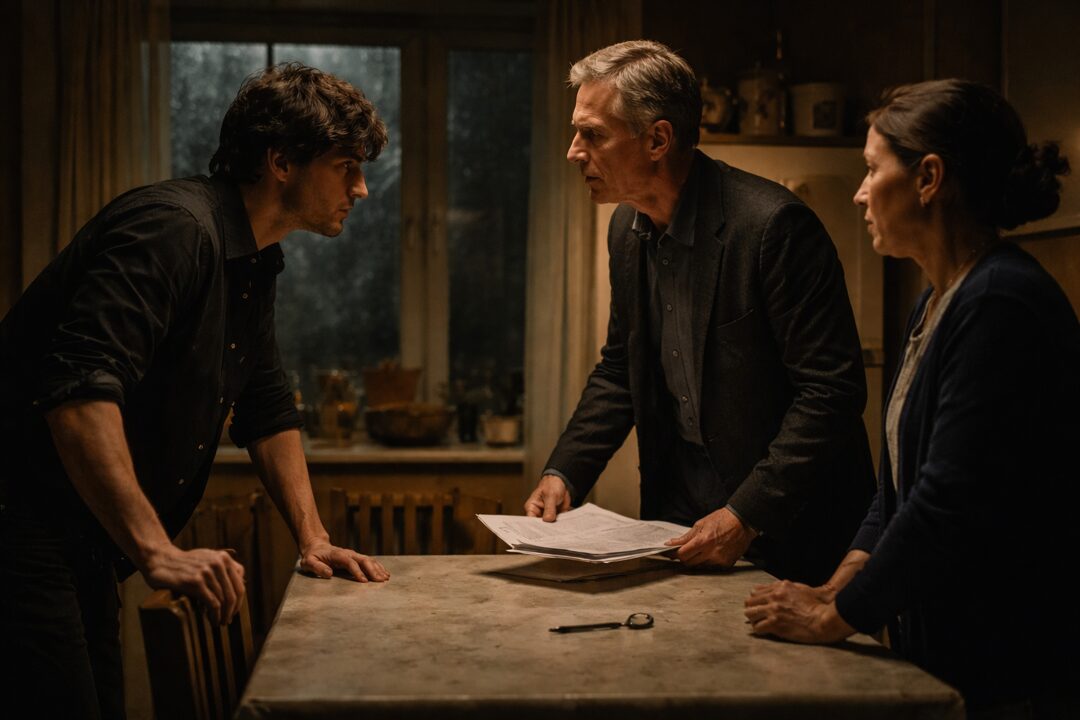
David snapped. “Then help me. Stop talking to me like I’m a thief every time I ask a question.”
The room went still.
His mother looked between them, tired suddenly.
His father stood. He was not a large man, but when he was angry, the room made space.
“You think because you are our son, everything belongs to you,” he said.
“I think because I’m your son, I should know who you were.”
His father shook his head once. “No. You should know what we can bear to give.”
The sentence landed so hard David could not answer.
His mother pressed her fingertips to her temple. “Enough.”
But his father was looking only at David now.
“You want the story to hold still,” he said. “It never did. Not then. Not after. Not now.”
Then his voice dropped, quieter and somehow worse.
“When the war ended, I did not go to her. I did not know where she was.”
David stared. “What?”
His mother closed her eyes.
There it was—the turn, though he didn’t yet understand its full size.
His father sat down again, all the anger going flat inside him.
“People think liberation is a door,” he said. “One side horror, other side reunion. They like doors.”
No one moved.
“It was paper,” he said. “Lists. Stations. Displaced persons camps. Someone heard this name. Someone saw that transport. Someone said Bergen-Belsen survivors were sent here, or there, or nowhere. Every answer made three more missing people.”
David looked at his mother.
Her voice was almost expressionless now, which meant the feeling under it had become too old for display.
“I thought he was dead twice,” she said. “Then alive. Then dead again.”
His father nodded. “I heard she had married a farmer in Belgium.”
David blinked. “What?”
“It was nonsense,” his mother said. “But for two weeks he believed it.”
“I did not believe it,” his father said.
“You were angry about it. That means you believed enough.”
The room held a strange, painful current: not romance, not even grief. Something rougher. The insult of almost losing someone not once but repeatedly through rumor, bureaucracy, exhaustion.
“How did you find each other?” David asked.
Neither answered at once.
His mother finally said, “Not beautifully.”
That was the whole point, he was beginning to see. Nothing had happened beautifully.
Part IV — Not Beautifully
They met again in a corridor that smelled of disinfectant and boiled cabbage.
That was how his mother told it.
Not on a train platform with swelling music. Not through a crowd parted by destiny. Not running, not weeping, not calling each other’s names across impossible distance.
A corridor.
A relief office in Germany after the war, full of notices, missing-person slips, clerks, bad coffee, men who had lost whole branches of themselves and women who had stopped expecting surprise.
David sat very still as his mother spoke. It was evening. Rain tapped the window. His father was in his chair, one hand pressed lightly to the left side of his chest as if it ached there more often now.
“I had gone to ask again about transport lists,” his mother said. “A woman in line ahead of me stepped aside. He was there behind her.”
His father corrected her. “Not behind. Across.”
She waved that off. “Across, behind, what difference now?”
“It is different.”
David almost smiled despite himself. The old battle over exactness. The way they held to detail because detail was the only honest scale.
His mother looked at the table, not at either of them. “I knew him and I did not know him.”
That line stayed in the room.
His father had lost more weight. His face was narrower, his hair thinner, his stare harder in a way that was not hardness at all but the shape endurance takes when there is no energy left for disguise.
“And I thought,” his mother said, “if this is him, then what happened to the boy who gave me half a potato?”
No one spoke.
David felt the cruelty of the truth and the mercy of it at once.
His father said, “You were not exactly as advertised either.”
His mother almost laughed. “No.”
It had not been a cinematic reunion because neither of them had arrived intact enough for one.
They stood there, each carrying rumors of the other’s death, each having practiced some version of permanent loss just to keep moving, and now the lost person was standing three paces away looking improbable and altered and real.
“What did you say?” David asked.
His mother thought for a moment. “I said, ‘You’re late.’”
His father looked at her. “You did.”
“And what did you say?”
His father’s hand stayed against his chest. “I said, ‘I was told you married a Belgian farmer.’”
For the first time in all those visits, David laughed out loud.
His mother’s smile came and went quickly. “You see? Romance.”
Then she added, “But we did not embrace immediately.”
David’s laughter died.
His father’s eyes were fixed on nothing visible. “I did not know if she wanted to touch me.”
His mother said, very softly, “Neither did I.”
The silence that followed was the deepest one yet.
David had not known until that second how much he had still been protecting himself with fantasy. Somewhere inside him, despite everything, he had kept a clean reunion scene alive. He had needed it. Needed them to come back to each other in a way that proved love had defeated the machinery built to destroy it.
Instead the truth was worse and more human.
Love had not defeated anything.
It had survived altered.
His mother finally said, “We walked outside together because neither of us wanted to be seen having the wrong reaction.”
His father’s mouth shifted, almost a smile. “She cried first.”
“You cried first.”
“I was sweating.”
“In October?”
David looked from one to the other and felt his chest tighten with a tenderness too painful to enjoy.
His father noticed. “Do not make it into something nice,” he said.
David swallowed. “I’m trying not to.”
“Good.”
Then his father leaned back, closed his eyes briefly, and for the first time David saw the effort it cost him just to sit upright through these tellings.
The next week, his father missed lunch because of a doctor’s appointment he brushed aside too quickly. Then another. His mother’s mouth set into a thinner line each time anyone mentioned it.
“It is his heart,” she told David in the hallway while his father was in the bathroom. “Nothing dramatic yet.”
Nothing dramatic yet was the kind of phrase people used when they were already afraid.
Pressure entered the story from the side. Time, which had always been present in the room as history, became present as urgency.
Claire called again. Then, when David didn’t answer, she came to a rehearsal with a revised draft and concern arranged carefully on her face.
“I rewrote it,” she said. “More restraint. Less triumph.”
He took the pages but did not look down.
“I know I pushed,” she said. “But I’m not trying to steal anything.”
“No,” he said. “You’re trying to shape it.”
“That’s my job.”
He thought of his father saying, People like doors.
Claire lowered her voice. “This matters, David. People should know where you come from.”
He surprised himself by answering immediately.
“They should know where my parents came from,” he said. “That’s different.”
Claire watched him, measuring the shift.
“You can still tell it well.”
He looked at her then. She was not cruel. That would have been easier. She was intelligent, sympathetic, and dangerously good at making suffering legible to strangers.
“That’s the problem,” he said.
That night he read her new draft in bed and found it improved, more careful, less insulting. It still bent everything toward him. Toward the stage, the sound, the public figure. Toward the ancient human urge to make pain produce something we can clap for.
He set the pages aside and sat in the dark for a long time.
He could feel the temptation of it like heat.
To be the answer. To be the reason. To let their past pour into his present and come out as meaning instead of residue.
He almost called Claire and said yes.
Instead he picked up the spoon.
The metal had warmed from the room.
He turned it over and over until he understood that he had been asking the wrong thing all along.
Not: what does this explain?
But: what does this require?
Part V — What He Refused to Turn Into a Story
The next show was smaller.
No arena. No blinding roar. Just a theater with red seats, low light, and the kind of audience that listened as hard as it applauded. The room had a different pressure. Less conquest. More exposure.
His parents came.
His father looked pale under the lobby lights but wore his suit anyway. His mother adjusted his tie with two sharp tugs and then pretended not to.
Claire was there too, in the third row with her notebook closed for once.
Backstage, David set the spoon on top of the red bass case and stared at them together: the bright lacquered curve of the instrument that had made strangers chant his name, and the dull metal relic that had outlived camps, transports, relief offices, marriage, migration, work, and silence.
They did not explain each other.
That was the point.
A stagehand knocked. “Two minutes.”
David picked up the bass. Then, after a second, he picked up the spoon too and slipped it into his jacket pocket.
Onstage, the first three songs went by in a blur of muscle memory and clean sound. He could feel the audience leaning toward him, ready to be given whatever version of him they had paid to believe in.
Between songs, he usually talked fast and little. A joke. A name. A shrug.
Tonight he stepped to the microphone and did not speak at once.
The room quieted.
He could see his mother in the aisle seat, still as ever. His father beside her, hands folded over his cane though he insisted he did not need one. Claire farther back, face lifted, waiting.
David thought of every polished sentence available to him.
He let them go.
“My parents met,” he said, “in a place where no one should have had to meet.”
The room held.
He kept his voice level because anything else would have felt like theft.
“They were Jewish kids in Poland. They were sent to Auschwitz. Then they were separated into different camps.” He swallowed once. “Somehow they survived. Later, somehow, they found each other again.”
That was all.
No speech about triumph. No claim that music had redeemed history. No neat line connecting horror to art like current to a lamp.
He looked down once toward the front row.
“My life is not the point of that,” he said quietly. “But it comes after.”
He stepped back before the sentence could grow decorative.
The audience did not clap immediately. David was grateful for that. Then the applause came—not huge, not ecstatic, just full and human and uncertain in the right way.
After the set, there were people who wanted to shake his hand, people who said thank you for reasons they could not quite phrase, people who looked like they had been reminded of someone they had failed to call.
Claire approached carefully.
“That was better than anything I wrote,” she said.
David was too tired to soften the answer. “I know.”
To her credit, she nodded.
“I won’t run the piece,” she said.
He looked at her.
“Or not like that,” she added. “Not if you don’t want me to.”
He believed her. That was the strange mercy of the night. Everyone seemed briefly more honest than usual.
His parents were waiting near the stage door.
Outside, the air was cold enough to bite. Cars hissed on the wet street. His father looked exhausted, and therefore almost transparent in his insistence on standing upright.
David reached into his jacket and brought out the spoon.
He held it out to his mother.
“I think this is yours.”
She looked at his hand but did not take it.
“No,” she said. “It was mine.”
He frowned. “Mama—”
She folded his fingers over it, one by one.
“You keep making one mistake,” she said. “You think if you cannot carry all of it, you should carry none.”
He stared at her.
“That is not humility,” she said. “That is avoidance.”
His father let out a breath that might have been agreement.
David looked at him.
For a moment, the old distance was there. Then something in it gave way—not into warmth, not into ease, but into permission.
His father said, “You do not have to make it beautiful.”
The line struck him harder than praise ever could have.
David nodded once because speaking would have broken something.
His mother patted his cheek with a quick, almost impatient tenderness. “Good,” she said. “Now we go home.”
But home was not one place anymore. He felt that as he watched them move slowly to the car, his mother’s hand under his father’s elbow, his father pretending not to lean.
He stood on the sidewalk with the spoon in his fist until the taillights disappeared.
Part VI — Afterlife
Past midnight, his apartment was finally quiet.
The city outside still moved in streaks of rain and neon, but inside there was only the low refrigerator hum and the ache that comes after being looked at too closely by people you love.
David did not turn on all the lights.
He set the red bass case on the floor and opened it. The instrument lay inside like something built for certainty.
Then he placed the spoon beside it.
Not on the strings. Not inside the case.
Just next to it on the worn rug, metal near lacquer, dullness beside shine.
He stood there longer than he meant to.
All his life he had misunderstood what it meant to be the son of survivors. He had thought it was a fact about origin, a difficult inheritance folded neatly into the first pages of biography. Something true, serious, and mostly behind him.
It was not behind him.
It had been in the way his mother saved string. In the way his father hated waste. In every silence that entered a room and changed its temperature. In the fact that love in their house was often practical before it was spoken. In the way they had protected pain so hard that they had almost hidden it from him entirely.
And now it was here too, in this room, beside the object that had given him a public life.
He thought of the corridor in Germany. Of his mother seeing a man she knew and did not know. Of his father hearing nonsense about a Belgian farmer and being wounded by it because some part of him had still dared to believe she belonged to the future.
He thought of the half potato in the ghetto. Of the spoon in Bergen-Belsen. Of two people meeting where no one should have had to meet, separating where no one should have been sent, and finding each other not beautifully, but anyway.
That last part felt most important.
Not beautifully, but anyway.
He sat on the floor.
The spoon caught a thin line of light.
His life did not justify theirs. It did not redeem what had happened to them. It did not close the distance between a camp number and a concert hall.
It came after.
That was smaller than the story he had almost agreed to sell. Smaller, and truer.
He reached out and touched the edge of the bass case, then the spoon.
Two different kinds of survival. One visible. One not.
By the window, dawn had not started yet, but the black of the sky was loosening.
In a few hours there would be another rehearsal, another room, another chance to step into the version of himself strangers recognized. He would do it. He knew that. The work still existed. The stage still waited. The red bass would still flash beneath the lights.
But something had shifted in the order of things.
He no longer felt like the destination of his parents’ story.
Only one continuation.
Fragile. Lucky. Obligated.
He left the spoon where it was and went to wash his face.
When he came back, he looked at the two objects on the floor one more time, as if checking that they could remain in the same frame without one devouring the other.
They could.
That did not solve anything.
It simply made the truth easier to stand near.
By the time the first pale light touched the window, David had his jacket on again.
He picked up the bass case with one hand.
With the other, he slipped the spoon into his pocket.
Then he stepped out into the waking city, carrying both.