They Called His Service Dog Filthy Until He Silenced the Tent and Exposed Every Fraudulent Fine
Chapter 1: The Dog They Put Beneath His Name
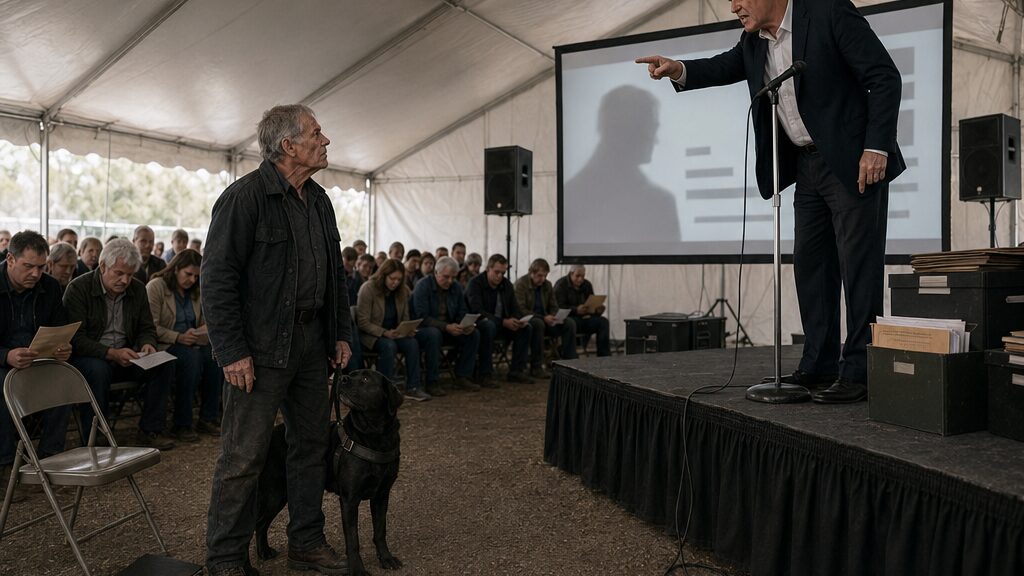
The projector changed the moment Raymond Mitchell stepped beneath the white tent.
The blue slide advertising the annual budget meeting vanished. In its place appeared a photograph of Raymond walking beside his service dog near the community pond. Above the image, in block red letters, were the words:
EMERGENCY ENFORCEMENT ACTION.
The dog paused at Raymond’s left knee.
Raymond felt the animal register the change in his stride before he did. A brief tightening of the leash. A shift of warm weight against his leg. Not fear. Attention.
At the far end of the tent, George Hall stood behind a long table on a raised wooden dais. He watched Raymond see the screen.
Then he smiled.
“Mr. Mitchell,” George said into the microphone, his voice rolling through two black speaker towers. “Your assigned seating is in the rear section.”
A volunteer pointed toward a folding chair separated from the center aisle by three rows of residents. No clear path to the floor microphone. No room beside the chair for the dog to lie without extending into the walkway.
Raymond remained where he was.
“I filed for an appeal,” he said.
George tapped the microphone with one finger.
The sound struck the tent like a small gunshot.
Several residents flinched. Raymond did not move, but the air locked halfway into his lungs.
“The board is aware of what you filed,” George said. “Please take your assigned seat so we can maintain order.”
The dog pressed its shoulder against Raymond’s calf.
Raymond counted the tent poles. One, two, three. He felt the pressure against his leg, loosened his grip on the leash, and walked to the chair.
Karen Thompson sat two rows ahead with a sealed white envelope in her lap. She glanced back at him, then at the dog, but lowered her eyes before either of them could speak.
Around her, residents held the evening’s real admission tickets: yellow citations, red warning notices, payment envelopes with the HOA address printed in heavy black type.
The posted agenda still hung beside the entrance.
Budget review. Landscaping contract. Insurance renewal. Open floor.
Nothing about Raymond. Nothing about his dog.
George waited until Raymond sat. Then he clicked a remote.
The photograph shrank to the upper corner of the screen. Beneath it appeared a list of charges.
UNAUTHORIZED ANIMAL IN COMMON AREA.
FAILURE TO COMPLY.
REPEAT SAFETY VIOLATION.
ADMINISTRATIVE REVIEW FEE.
DAILY NONCOMPLIANCE PENALTY.
At the bottom, in numbers large enough to be read from the lawn:
TOTAL DUE: $38,000.
A murmur moved through the chairs.
Raymond read the dates.
April 9. April 11. April 11 again. April 16. May 2.
On April 11, he had been at a veterans’ clinic forty miles away. The dog had been with him. The appointment receipt was in the thick file resting against his boot.
George folded his hands on the table.
“This is not an ordinary pet dispute,” he said. “This concerns repeated disregard for community standards and documented aggressive behavior.”
The dog lay down with its chin across Raymond’s shoe.
“Medical service animal,” Raymond said.
He did not raise his voice. He knew George heard him.
George continued as though no sound had come from the rear.
“Our community has obligations. Property values do not preserve themselves. Safety does not enforce itself. Exceptions, however sympathetic, cannot become excuses.”
A woman near the aisle lifted her hand.
George looked past her.
“Questions will be taken after the board presentation.”
He advanced the slide. A blurred photograph showed the dog standing across Raymond’s knees beside a bench.
The caption read: ANIMAL MAKING FORCEFUL CONTACT WITH OWNER AND BLOCKING WALKWAY.
Raymond recognized the moment. A lawn mower had backfired near the pond. The dog had moved across his legs, applied pressure, and held him until the flash of memory passed.
George had turned a trained response into evidence of danger.
A thin whine rose through the speaker system.
The left tower gave a burst of feedback.
The sound tore across Raymond’s hearing. For half a second the tent disappeared. White fabric became dust. Folding chairs became metal frames in a place he no longer named. His fingers closed around the leash.
The dog rose immediately.
It turned sideways, pressed firmly against Raymond’s shin, then lifted its head until its nose touched the back of his hand.
Raymond looked down.
Dark eyes. Steady body. Four paws planted.
Here.
He opened his hand.
The feedback died.
No one on the dais acknowledged what had happened. But several residents had turned to look, and what they saw was not an animal lunging or barking. They saw the dog hold still until Raymond’s breathing returned.
George clicked to the next slide.
“Because previous notices have failed,” he said, “the board is considering an immediate common-area prohibition, with an additional penalty of five hundred dollars for each violation after tonight.”
Raymond looked up sharply.
“That wasn’t in the notice.”
This time Karen turned fully around.
George’s mouth tightened. “Mr. Mitchell, you will have an opportunity to speak.”
“You moved the terms after the appeal was filed.”
Michael Anderson, seated at the edge of the dais, leaned toward his own microphone.
“Please remain seated.”
“I am seated.”
A few people laughed under their breath. The sound stopped when George looked across the rows.
He raised one hand toward the screen.
“The board has also been advised that continued nonpayment may require collection remedies, including a lien.”
The tent went still.
Raymond felt the word move through the residents more powerfully than the microphone.
Lien.
Karen’s envelope bent between her fingers.
George had not built this hearing only to take the dog from him. He wanted everyone under the tent to imagine a notice nailed to their own door.
The screen changed again, displaying a table of violations and authorizations. Karen leaned toward the woman beside her, whispering something while pointing at a code on Raymond’s list.
AR-17.
Her hand went to the top page inside her envelope. She slid it halfway out.
The same code was visible near the bottom.
Raymond saw the recognition cross her face.
George saw her looking.
Karen pushed the paper back into the envelope and folded both hands over it.
Raymond turned his attention to the screen.
Beside the heading BOARD AUTHORIZATION appeared a scanned signature. The first letter rose too high. The final stroke bent backward like a hooked wire.
He had seen that exact defect before.
Heather Williams had slipped copied meeting minutes beneath his garage door two weeks earlier. One version recorded a four-to-one vote approving new surveillance rules. The other recorded no vote at all.
The approving signature on the altered version carried the same high first letter. The same backward hook.
Not similar.
Identical.
Raymond lowered his gaze to the thick file at his boot.
George had placed the forged mark on a screen large enough for two hundred people to see.
Either he did not know it was false, or he believed no one in the tent would dare say so.
Raymond rested one hand on the dog’s back.
For the first time that evening, the pressure inside his chest was not fear.
It was recognition.
Chapter 2: Every Fine Carried the Same Scar
Three days earlier, Raymond had enlarged the violation photograph until the dog’s body dissolved into blocks of ink.
The important detail remained sharp.
At the upper edge of the image, reflected in the pond’s metal waste bin, stood a narrow black surveillance camera mounted to a light pole.
Raymond checked the date printed beneath the photograph.
March 18.
He opened the copied board minutes and found the vote authorizing cameras in common areas.
March 29.
For eleven days, the board had collected images under authority it did not yet claim to possess.
The dog lay beneath Raymond’s garage worktable while he arranged the papers in rows. Yellow notices on the left. Meeting minutes in the center. Printed photographs on the right. A small recorder sat near his elbow.
He pressed play.
George’s amplified voice filled the garage.
“Residents who respect the rules have nothing to fear from consistent enforcement.”
Raymond stopped the recording and placed a notice beneath it.
FAILURE TO RESPECT COMMUNITY SAFETY REQUIREMENTS.
He played another segment.
“Repeated noncompliance leaves the board no reasonable alternative.”
He set down a second notice.
REPEATED NONCOMPLIANCE HAS LEFT THE BOARD NO REASONABLE ALTERNATIVE.
The phrases were not legal language. They were George’s language, repeated through letters carrying different signatures.
Raymond marked each match with a blue pencil.
The dog lifted its head when someone knocked on the side door.
Karen stood outside holding a casserole dish she had not cooked. The grocery-store label was still fixed to the foil lid.
“I thought you might forget to eat,” she said.
“I don’t.”
“You do.”
Raymond moved aside.
Her eyes went immediately to the worktable.
“You’ve made a command center.”
“It’s a table.”
“With more paper than my tax accountant uses.”
She set down the dish. One corner of a yellow notice showed from her handbag.
Raymond looked at it. Karen closed the bag.
“You came to ask something,” he said.
“I came to bring food.”
“You brought evidence with it.”
Her expression hardened. “That is exactly why people don’t talk to you.”
“Because I notice things?”
“Because you make people feel like they’re already on the witness stand.”
Raymond looked at the blue marks covering his pages. He knew she was right, which made answering harder.
He pulled out a chair.
Karen remained standing for several seconds, then sat and removed her notice.
The amount due was $4,600. Most of it came from “deferred landscaping corrections” issued after her husband’s death, when she had failed to repaint a fence within thirty days.
Raymond placed her paper beside his.
AR-17 appeared on both.
So did a review fee dated on a Sunday when the HOA office was closed.
At the bottom was the signature with the high first stroke and backward hook.
Karen watched his face.
“What?”
“This authorization matches mine.”
“They use the same form.”
“Not the form. The signature.”
He put Heather’s copied minutes between them.
Karen leaned closer.
For a moment, relief crossed her face. Not joy. The smaller relief of learning that private humiliation might not be private failure.
Then it disappeared.
“You can’t take this,” she said.
“I need a copy.”
“No.”
“Karen.”
“I said no.”
“The investigator needs originals or affidavits from more than one household.”
She pulled the notice toward herself. “You talked to police?”
“I provided a packet.”
“And now George knows?”
“I don’t know what George knows.”
Her breathing quickened. “I arranged a settlement. Half now, half next month. They agreed not to file a lien.”
“A settlement confirms a debt that may be false.”
“A roof confirms I still have somewhere to sleep.”
Raymond kept his voice level. “If they did this to both of us, they did it to others.”
“And what happens while you prove that? Do you pay my lawyer? Do you keep them from putting my name on the screen?”
He had no answer that would protect her.
Karen folded the notice once, then again.
“You’ve got folders. Codes. Police numbers. You act like the facts are enough.”
“They have to be.”
“No. People have to be. And you haven’t told anyone what you’re doing.”
“I’m telling you now.”
“You’re asking me now.”
The distinction struck harder than he expected.
She stood.
The dog rose but stayed beside Raymond’s chair.
Karen looked down at it. “That report George sent around said the dog knocked you sideways near the pond.”
“It interrupted an episode.”
“What kind of episode?”
Raymond’s jaw tightened.
Karen waited.
When he did not answer, she put the notice back in her bag.
“That’s what I mean,” she said softly. “You want everyone else to hand you the part that scares them. You won’t even name yours.”
After she left, Raymond returned to the photograph.
The first aggression report described the dog as “crossing the owner’s body, applying force, and preventing free movement.”
He opened the training manual supplied by the service program.
DEEP PRESSURE INTERRUPTION: DOG POSITIONS ACROSS HANDLER’S LEGS OR TORSO TO REDUCE ESCALATION AND RESTORE ORIENTATION.
George had described the task accurately. He had only changed its meaning.
Raymond added the report to the file.
His phone rang near dusk.
The lead investigator did not waste words.
“The pattern is concerning,” the investigator said. “Impossible dates. Duplicate codes. Conflicting minutes. But copies tell me something may have happened. They don’t tell me who changed what.”
“The board has the originals.”
“Then we need lawful access, voluntary production, or someone inside willing to preserve them.”
“They’ll destroy them.”
“Suspicion isn’t enough for me to promise action.”
“They’re threatening my home.”
“I understand.”
“No. You understand the file.”
Silence held between them.
The investigator finally said, “Get original notices from other residents. Signed statements if they will give them. And do not create a confrontation we cannot control.”
When the call ended, Raymond stared at Karen’s empty chair.
He had proof of a pattern and no one willing to stand inside it with him.
A delivery van stopped in front of the house after dark. The driver slid a certified envelope beneath the storm door and left.
Raymond opened it at the worktable.
NOTICE OF EXPEDITED EMERGENCY HEARING.
The date had been moved forward by two weeks.
At the bottom, beneath the proposed common-area ban, was a new paragraph:
Upon approval, the animal must be removed from all association-controlled property immediately following the vote.
Raymond read it twice.
The dog touched its nose to his wrist.
George had learned enough to become afraid.
And fear had made him hurry.
Chapter 3: The President Who Needed an Audience
“There is not enough money to pay the insurance renewal.”
Stephanie Martin placed the account summary on George Hall’s desk and kept one finger on the final line.
The number in red was not large enough to impress anyone from a city budget office. Inside a homeowners association, it was enough to expose every promise George had made.
George did not look at the paper.
Through the office window, workers were raising the white meeting tent on the common lawn. One crew assembled the dais. Another rolled black speaker towers across the grass.
“The collection cycle closes Friday,” he said.
“Only if the payments come in.”
“They will.”
“Some residents are disputing them.”
“Residents dispute everything until a lien notice arrives.”
Stephanie removed her finger from the page. “The tent invoice was charged to storm preparedness.”
“It is a temporary public structure.”
“It has stage lighting.”
“The evening meeting requires lighting.”
“And the consulting invoice?”
George turned from the window.
A framed campaign photograph hung behind him from his unsuccessful run for county office. In it, he stood at a podium beneath a banner promising RESPONSIBLE LOCAL LEADERSHIP. He had lost by fourteen points.
“The consultant prepared community communication materials,” he said.
“She prepared your slides.”
“She prepared board slides.”
Stephanie opened a ledger. “Insurance is due in nine days. The landscaping contractor is already waiting. If the larger penalties do not come in, we miss one of them.”
George finally looked at the red number.
“Raymond Mitchell owes thirty-eight thousand dollars.”
“He disputes thirty-one thousand of it.”
“He disputes the board’s authority.”
“That is not the same thing.”
“To residents, it becomes the same thing very quickly.”
Michael Anderson stood near the filing cabinet with the hearing packets under one arm. He had said nothing since entering.
George pointed to him.
“Tell her what happens if we allow exceptions.”
Michael shifted his weight. “Exceptions can complicate enforcement.”
“They destroy enforcement,” George said. “One resident keeps an animal in restricted areas. Another delays repairs. Another leaves a vehicle where it lowers every neighboring sale price. Then the people who followed the rules pay for those who did not.”
Stephanie closed the ledger. “A trained service dog is not an abandoned vehicle.”
“It is an accommodation request attached to repeated complaints.”
“Complaints written after the cameras went up.”
George’s face changed by one degree.
“Those cameras protect residents.”
“They were installed before the recorded vote.”
“The board had discussed them.”
“Discussion is not authorization.”
George stepped around the desk.
“Do you know what destroys a neighborhood first? It is not fraud, Stephanie. It is the belief that rules are optional. Paint peels. Grass grows. People stop paying because they think someone else will cover it. Then the widows and retirees who put everything into these houses watch their equity drain away.”
His voice was quieter now. More convincing.
Michael had heard him make the argument before, and part of it remained true. George could walk through the community and identify every broken gutter, dead hedge, and leaning fence. He remembered which residents had complained about speeding cars and which had begged the board to stop short-term rentals.
He also remembered who had challenged him.
Raymond Mitchell’s name appeared more often than anyone else’s.
George tapped the ledger.
“I will not let disorder become compassion simply because a veteran knows how to stand quietly while everyone feels guilty.”
Stephanie’s mouth tightened.
“He requested the original financial ledgers,” she said.
The office fell silent.
“When?” George asked.
“Yesterday. Certified request.”
“On what grounds?”
“Assessment accounting and penalty reconciliation.”
George looked toward the tent again.
“Financial questions are outside the scope of the hearing.”
“He can raise them during open floor.”
“There will be no open floor until the emergency action is complete.”
Michael shifted the packets under his arm. “The posted agenda says otherwise.”
“The chair may reorder business.”
Stephanie gathered the account summary. “You are using the dog hearing to collect money.”
“I am enforcing a rule so that people understand the cost of ignoring every rule.”
“You are counting on fear.”
“I am counting on consequences.”
George took the hearing packets from Michael and began turning pages.
Halfway through, Michael reached out.
“Wait.”
George stopped.
Michael removed two sheets bearing the same heading:
EMERGENCY COMMON-AREA ANIMAL POLICY.
One version recorded approval by a four-to-one board vote. The other showed the policy as pending discussion.
Both carried the same date.
“Which goes into the packet?” Michael asked.
George glanced at Stephanie.
“The approved version.”
Michael studied the signature at the bottom. “I don’t remember voting.”
“You were present.”
“I remember discussing complaints.”
“You supported enforcement.”
“That is not a vote.”
George slid the approved version back into the packet.
“The hearing will ratify any procedural uncertainty.”
Michael did not release the second page.
For years, he had told himself that procedure was the clean part. George could be abrasive. Stephanie could manipulate fees. Residents could become emotional. Michael’s role was to keep meetings orderly and make sure rules were followed.
The two pages in his hands did not allow that comfort.
George watched him.
“A crowded meeting is not the place to indulge technical confusion,” he said. “Raymond intends to provoke disorder. Your responsibility is to prevent it.”
“What exactly do you want me to do?”
“Control the floor microphone. No unscheduled speakers. No financial accusations during the animal hearing.”
“And if he refuses?”
“You tell him to sit.”
Michael looked through the window at the workers fastening the projector screen to its frame.
George placed a hand on his shoulder.
“You think order is cruelty because the loudest person calls it cruelty. But when a meeting breaks down, everyone pays. Keep it controlled.”
Michael folded the conflicting policy page and put it into his jacket pocket.
“I’ll control the microphone,” he said.
George smiled as though a vote had passed.
On the lawn, he climbed the unfinished dais and tested the central microphone.
“Good evening,” he said.
His voice spread across the empty chairs and struck the neighboring houses.
He adjusted the height, waited three seconds, and tried again.
“Good evening. Tonight, the board will address a serious threat to community safety.”
He looked toward the projector technician.
“Put Mitchell’s total on the screen before he speaks. Full size.”
The technician nodded.
“And when he reaches the floor microphone?”
George looked at Michael.
Michael’s hand rested on the audio control.
“Cut him if he leaves the scope of the hearing,” George said.
A blast of feedback shrieked from the left speaker.
George winced, then laughed.
“Fix that before tomorrow.”
As the workers continued, George returned to the office alone. He opened the bottom drawer of his desk and removed a sealed envelope.
IMMEDIATE REMOVAL ORDER was printed across the front.
He placed it beneath his prepared remarks, directly below the line where he had written the phrase filthy animal and underlined it twice.
When Michael came back for the remaining packets, George covered the envelope with one hand.
“After the vote,” he said, “you take the dog before Mitchell leaves the tent.”
Chapter 4: The Lifeline Raymond Refused to Explain
The feedback burst from Raymond’s recorder so sharply that his hand missed the stop button.
The garage walls seemed to move inward.
The worktable vanished behind a white flare. His lungs locked. The metal shelving, the concrete floor, the hanging rake—all of it flattened into disconnected shapes while the sound kept drilling through him.
The service dog rose from beneath the table before Raymond’s chair scraped backward.
It pressed hard against his left leg.
Raymond tried to stand.
The dog shifted across his knees, blocking the motion, then leaned its full weight into him.
“Off,” Raymond managed.
The command came out thin.
The dog did not obey because it had not been trained to obey the wrong command during an episode.
Raymond’s fingers clawed at the edge of the table. His heart hammered against his ribs with the old senseless certainty that something terrible had already happened and was still happening.
The dog nudged his wrist.
Here.
Its body remained steady while Raymond’s shook.
He forced his eyes to the worn leather collar, then to the brass ring attached to the leash, then to the gray fur near one ear.
Three things.
The garage returned by inches.
He reached blindly for the recorder, found it, and shut it off.
The silence that followed felt enormous.
Raymond slid from the chair to the floor. The dog came with him and lay across his thighs until his breathing slowed.
He kept one hand against its ribs.
Years earlier, before the dog, Raymond had spent three days in his bedroom without answering the telephone. He had closed the blinds, turned off the lights, and convinced himself that isolation was control.
By the third night, he had stopped caring whether he woke again.
A neighbor had found him only because water from an overflowing sink had leaked through the wall.
The service program had called the dog a medical intervention. Raymond had called it unnecessary until the first time it interrupted a collapse before he understood one had begun.
He had never told anyone in the community that part.
George had received enough in the accommodation request: post-traumatic stress disorder, trained interruption, deep pressure response, disorientation during acute episodes.
Enough to approve the dog.
Enough, apparently, to design a hearing around the sounds most likely to break Raymond’s control.
The side gate clicked.
The dog lifted its head but did not leave Raymond’s legs.
Heather Williams appeared in the garage doorway holding a brown envelope against her chest.
She stopped when she saw him on the floor.
“Should I call someone?”
“No.”
“Raymond.”
“I said no.”
The dog looked at him.
Raymond closed his eyes briefly.
“Give me a minute.”
Heather waited near the door while he used the workbench to pull himself upright. He hated the weakness in his knees more because she had witnessed it.
She placed the envelope on the table.
“I heard the recording from the sidewalk.”
“I was preparing.”
“For what? Another war?”
“For the speakers.”
Heather looked at the recorder. “You thought playing it repeatedly would make it easier?”
“It usually works.”
“Did it?”
Raymond did not answer.
She opened the envelope and removed a folded sheet covered in blue ink. Five names appeared down one side. Beside them were handwritten marks: two approvals, one objection, two abstentions.
“This is the original tally from the surveillance discussion,” she said. “No policy passed.”
Raymond compared it with the typed minutes in his file. The official version recorded four approvals and one objection.
“Why did you keep this?”
“I keep everything until the minutes are accepted.”
“They were accepted.”
“I know.”
“Then why didn’t you correct them?”
Heather’s gaze went to the open garage door.
“My mother’s house has three unresolved exterior citations. She lives with me now, but the property is all she owns. George said corrections to the minutes could delay her appeal.”
“And you believed him.”
“I believed he could make the delay real.”
Raymond placed the handwritten tally beside the typed minutes.
“Will you say this tomorrow?”
Heather’s silence answered first.
“I’ll give it to an investigator,” she said. “I’m not standing in front of that crowd.”
“This needs a voice attached to it.”
“So does your accommodation request.”
Raymond looked at her.
Heather removed another page from the envelope. It was a copy of the board’s risk assessment for the dog.
Several phrases had been highlighted.
Handler may experience acute disorientation.
Animal trained to interrupt physical movement.
Deep pressure intervention may involve forceful contact.
Raymond read the sentences twice.
“They took this from my medical paperwork.”
“George asked me to attach supporting language to the complaint packet. I recognized it.”
“Who gave it to him?”
“The board keeps accommodation files in the office.”
“Those are supposed to be restricted.”
“I know.”
The dog stood beside Raymond now, shoulder touching his leg.
Heather said, “He changed the headings. He turned treatment instructions into warnings.”
Raymond’s mouth went dry.
The report calling the dog aggressive had not merely misunderstood its behavior. George had known exactly what the dog was trained to do.
“He wants people to see a dangerous animal,” Heather said. “And an unstable owner.”
Raymond folded the risk assessment and added it to the evidence file.
“Then say that tomorrow.”
“I can’t promise.”
“You can.”
“No. I can choose it. That’s different.”
The words held him still.
Heather took a step back. “You expect fear to disappear because you found proof. It doesn’t.”
After she left, Raymond carried the file into the house.
Near the community mailboxes, Karen waited with her payment envelope tucked beneath one arm.
“I heard Heather was here,” she said.
Raymond stopped.
Karen nodded toward the envelope. “I’m paying tomorrow.”
“You know the amount is false.”
“I know it may be false.”
“You saw the signature.”
“I also saw the lien language.”
“If everyone pays, the records disappear into settlements.”
“My house does not become less real because your case is stronger.”
Raymond felt the answer forming—sharp, factual, useless.
Karen studied him.
“What is the dog trained to stop?”
He gripped the leash.
“That isn’t relevant.”
“It is the entire reason they’re targeting you.”
“The records are enough.”
“There you go again.”
“What do you want me to say?”
“The truth.”
He looked toward his house. The bedroom window was visible beyond the hedge.
The dog moved closer.
Raymond could have told her.
He could have said that the animal had once found him unresponsive on a dark floor and barked until a neighbor came. He could have said that sleep still broke apart some nights and that certain sounds turned time inside out.
Instead he said, “Pay if you’ve decided to pay.”
Karen’s face closed.
“I thought you were gathering all this for us,” she said. “Maybe you’re only gathering it so you won’t need us.”
She walked away before he could answer.
Inside the garage, Raymond assembled eight evidence packets.
Forged vote comparison.
Duplicated penalty codes.
Unauthorized surveillance dates.
Altered minutes.
Confidential medical language.
Investigator contact information.
On the front of each packet, he wrote the police case number in thick black ink.
Then he placed an empty folder on top of the stack.
He stared at it for a long time before printing a label.
RESIDENT RECORDS NEEDED.
The folder remained open on the worktable, waiting for people Raymond had never trusted enough to ask properly.
Chapter 5: When the Microphone Became a Weapon
George struck the gavel once and erased the budget meeting with a sentence.
“The first item tonight is an emergency vote concerning the permanent exclusion of Raymond Mitchell’s animal from all association-controlled property.”
The white tent was nearly full.
Residents occupied every folding chair and stood in clusters near the open sides. Payment boxes sat on tables beside the entrance. Volunteers had arranged envelopes by street, as if obedience could be made efficient.
Raymond sat in the rear with the service dog beneath his chair and the evidence packets stacked against his boot.
The empty folder remained empty.
George looked down from the dais.
“The board has received repeated reports of forceful animal contact, obstruction of walkways, and behavior creating fear among residents.”
A slide appeared showing the dog across Raymond’s legs near the pond.
The photograph had been cropped tightly enough to remove the lawn mower that had backfired.
Raymond raised his hand.
George did not acknowledge him.
“Because prior corrective notices have been ignored, the board must consider immediate action.”
A resident near the front called, “What happened to the budget?”
Michael Anderson leaned toward the control panel.
George said, “The chair has reordered the agenda due to an urgent safety concern.”
The resident started to answer, but the microphone at the floor remained dark.
Raymond felt the dog’s body shift beneath him.
The left speaker hummed.
George continued, his voice polished by rehearsal.
“Some may find enforcement unpleasant. But fairness requires consistency. A community cannot protect property values if one person’s preferences override everyone else’s rights.”
Raymond looked across the rows.
Karen sat near the center aisle. Her payment envelope rested unopened on her lap.
Heather stood along the tent wall with a clipboard, recording the meeting.
Stephanie Martin kept her eyes on the ledger box beneath the board table.
Michael did not look at Raymond.
The projector changed to the list of charges.
Thirty-eight thousand dollars.
Several residents whispered.
George pointed with a metal pen.
“The total reflects accumulated noncompliance, administrative review, safety inspections, and daily penalties.”
Raymond stood.
“I challenge the dates.”
Michael activated the floor microphone but did not look up.
“You may speak when recognized.”
“I filed an appeal.”
George smiled. “You will receive three minutes following the board presentation.”
“You moved the hearing forward.”
“Sit down.”
The word struck through the speakers.
The dog emerged from beneath the chair and pressed against Raymond’s shin.
George watched the movement.
“There,” he said. “That contact is precisely what residents have reported.”
“It is a trained alert.”
“Your interpretation is noted.”
“It is not interpretation.”
George clicked the remote.
The screen displayed a diagram labeled ESCALATION OF ANIMAL CONTROL RISK. Beneath it were phrases taken from Raymond’s medical accommodation file.
Acute disorientation.
Interruption of physical movement.
Forceful contact.
The crowd’s unease changed shape.
Raymond heard it in the rustling chairs.
George had stripped the words of every medical heading and presented them as behavioral warnings.
Raymond looked toward Heather.
Her pen had stopped.
“Where did you get that?” Raymond asked.
George folded his hands.
“The board has reviewed all relevant documentation.”
“That is protected medical information.”
“Mr. Mitchell, remain within the scope of the hearing.”
“You made it the scope.”
Michael’s finger hovered over the audio control.
George said, “The animal’s classification does not grant unlimited access when behavior creates a threat.”
The dog sat beside Raymond, silent and still.
George’s voice grew louder through the speakers.
“We have residents who follow rules even when those rules inconvenience them. Widows who repaint fences. Families who correct landscaping. Retirees who pay assessments on fixed incomes. Why should one individual be exempt?”
Karen’s hand closed over her envelope.
Raymond looked at the yellow notice protruding from the bag of the man beside her. A familiar code appeared at the bottom.
AR-17.
Another woman held a red warning sheet with the same block of language Raymond had marked in blue pencil.
The hearing was doing what George intended. Everyone was watching Raymond’s humiliation and imagining their own.
But they were also holding the pattern.
Raymond lifted one evidence packet.
“I need the floor microphone.”
George checked his watch theatrically. “Three minutes.”
Michael switched on the microphone at the center aisle.
Raymond walked toward it with the dog close to his left leg. Chairs scraped as residents made room.
The microphone stood lower than his chest. He adjusted it.
A sharp pulse of feedback burst from the speakers.
His vision narrowed.
The dog immediately leaned into him.
George pointed.
“Again, the animal is physically controlling him.”
Raymond placed one hand on the dog’s shoulder and focused on the metal grille before his face.
“My penalty list includes dates when I was not in the neighborhood,” he said. “The surveillance photograph predates authorization for the camera that took it. The board minutes exist in two versions.”
George said, “Those allegations concern matters outside this hearing.”
“They concern the signature authorizing every charge on that screen.”
A murmur rose.
Raymond opened the packet.
“If you received a notice bearing code AR-17, look at the signature at the bottom. The first letter rises above the printed line. The final stroke bends backward.”
Karen removed her notice.
The man beside her leaned closer.
Michael cut the microphone.
Raymond’s mouth kept moving for two words before he realized no sound was carrying.
George’s amplified voice replaced his.
“Mr. Mitchell has used his allotted time to make unsupported accusations.”
“I had thirty seconds.”
“Sit down.”
Raymond did not move.
Across the tent, papers began unfolding.
Karen held her notice beside the projected signature. Her face changed.
She passed the sheet to the man beside her.
He removed his own.
Stephanie noticed.
“George,” she said quietly.
He ignored her.
“Tonight’s decision concerns safety, not bookkeeping.”
“It concerns both,” Raymond said without amplification.
Only the nearest rows heard him.
George raised the gavel.
“The board will proceed to a vote.”
Michael stared at the conflicting policy page hidden beneath his notes.
One by one, the board members answered.
George voted yes.
Stephanie hesitated, then voted yes.
Michael’s turn came.
He looked at Raymond, the dog, and the growing chain of notices moving through the chairs.
“Yes,” he said.
The word was almost inaudible before the microphone strengthened it.
The motion passed.
George reached beneath his papers and removed the sealed envelope.
“The immediate removal order is now effective.”
The service dog stood.
Raymond felt the first tremor in his leg.
George opened the envelope and handed the document to Michael.
“The animal must leave all association-controlled property tonight. Any further presence will trigger an additional five-hundred-dollar penalty per occurrence. Continued refusal will result in lien proceedings against the home.”
The dog pressed harder against Raymond.
George watched with satisfaction.
Then he leaned toward the microphone and pointed from the dais.
“That filthy animal is banned—effective tonight.”
Michael unfolded the removal order.
Chapter 6: The Crash That Gave Them Silence
Michael stepped down from the dais carrying the removal order as though the paper itself could decide what his hands would do.
The service dog moved across Raymond’s knees.
Not lunging.
Not barking.
Blocking him from rising too fast.
The pressure in Raymond’s chest climbed with the amplified hum. George’s last words remained suspended above the crowd, repeated faintly by the speaker system.
Filthy animal.
Banned tonight.
Lose the home.
Michael stopped three paces away.
“Raymond,” he said, too quietly for the dais microphone to catch. “You need to leave.”
“With the dog.”
“Yes.”
“And if I come back?”
Michael glanced at the order. “There will be another violation.”
George spoke through the microphone.
“Mr. Anderson, execute the removal.”
The phrase made Michael flinch.
Raymond looked around the tent.
Karen still held two notices side by side.
Residents were comparing signatures in whispers, but each whisper remained private. George’s voice floated above them all.
“The board will now proceed to collections and remaining business.”
Remaining business.
As though Raymond and the dog could be removed, the screen restored, the payment boxes filled.
Raymond bent and picked up the thick evidence file.
The dog shifted to remain against his leg.
George saw the file.
“Do not approach the dais.”
Raymond took one step.
Michael moved in front of him. “Don’t.”
“I need the records where people can see them.”
“You can submit them through counsel.”
“By morning, the ledgers may be gone.”
George’s voice sharpened through the speakers.
“Mr. Anderson, remove him now.”
The left tower gave another piercing squeal.
The dog pressed sideways.
Raymond saw Karen cover one ear. A child near the tent wall began crying. Heather dropped her pen.
The sound stopped, but the pulse it triggered did not.
Raymond’s vision caught on the folding chair beside him.
Gray metal frame. Vinyl seat. Rubber feet.
He remembered the investigator’s warning.
Do not create a confrontation we cannot control.
He remembered the removal order.
He remembered the dog finding him in a dark room years earlier, refusing to leave even when Raymond had wanted everything to leave.
George tapped the microphone stand.
“Control your animal—or lose your home.”
Something inside Raymond stopped trying to endure.
He handed the leash to his left hand, gripped the folding chair with his right, and lifted it.
Michael stepped backward.
“Raymond—”
Raymond hurled the chair.
It crossed the space above the empty front row and struck the projector screen near its center.
The white fabric split.
The chair tore through, twisted in the support frame, and crashed into the speaker cables behind it.
One black tower toppled sideways onto the dais steps.
The microphone emitted a deafening metallic shriek.
Then every speaker went dead.
Silence fell so suddenly that the tearing screen could still be heard fluttering.
No one moved.
The service dog stood tight against Raymond’s leg.
Raymond’s arm remained extended from the throw.
A board member had ducked behind the table. The chair had missed him by less than a yard.
Raymond saw that distance clearly.
Not symbolic. Not harmless.
He had thrown metal through a crowded meeting.
George recovered first.
“He attacked the board!”
Without amplification, his voice sounded smaller, but panic gave it force.
“Call the police. Detain him.”
Raymond lowered his arm.
“I’m not leaving.”
“You could have killed someone.”
“Yes.”
The answer silenced George for half a beat.
Raymond set the evidence file on the floor, opened it, and removed the first stack of packets.
“I threw the chair,” he said. “I will answer for it.”
Residents in the nearest rows heard him. The words passed backward in fragments.
George pointed at Michael.
“Seize the file. Take the animal.”
Michael looked down at the removal order.
Then at the torn screen.
“The order authorizes removal from common property,” he said. “It does not authorize me to seize a service animal.”
“It authorizes enforcement.”
“It does not authorize seizure.”
“Then take the documents.”
“No.”
George stared at him.
Michael folded the order once.
“I agreed to control the microphone,” he said. “I did not agree to confiscate evidence.”
The refusal shifted the room more than the crash had.
Raymond walked toward the dais.
No one blocked him.
He placed the thick file on the board table with one heavy slap.
“These are copies,” he said. “Forged vote comparisons. Duplicate penalty codes. Camera invoices dated before approval. Two versions of meeting minutes. Medical information taken from a restricted file.”
George reached for the top page.
Raymond placed his hand over it.
“Not for you.”
He turned the stack toward the residents.
“For them.”
Karen stood.
George said, “These documents are stolen, altered, and meaningless without context.”
Raymond opened the first packet.
“Page one shows the signature on my fine authorization. If your notice has the same signature, bring it forward.”
No one moved at first.
The dog nudged Raymond’s wrist.
His hand was shaking.
The crowd saw it.
George saw it too.
“This display proves the board’s concern,” he said. “Mr. Mitchell is unstable.”
Raymond looked down at the dog.
He could hide again. Say the shaking came from anger. Refuse George the satisfaction of hearing the private truth.
Instead he faced the residents.
“This dog is trained for post-traumatic stress episodes,” he said. “Years ago, I locked myself in a room and stopped answering anyone. I nearly died there.”
The silence changed.
The confession did not feel like surrender. It felt like stepping into cold water without knowing whether the bottom remained beneath him.
“The dog interrupted the next collapse,” Raymond continued. “It has interrupted every one since. The behavior George called aggression is the task that keeps me oriented. The dog did not make me throw that chair. I did that. The dog was trying to stop me.”
Karen’s envelope slipped from her lap to the ground.
Raymond touched the file.
“These papers do not prove everything. Your originals matter. Your signatures matter. The board ledgers matter. If you sit there because you are ashamed of your fine, that shame is what they are collecting.”
George moved around the table.
“Do not listen to him. He has just committed a violent act.”
“He’s right about that,” Raymond said.
The admission interrupted George again.
Raymond pointed to the damaged screen.
“I will not call that restraint. I will not ask you to excuse it. But before anyone removes me, compare your papers.”
Karen stepped into the aisle.
She did not approach yet, but she held her notice in both hands.
Others began unfolding theirs.
A man near the entrance read his authorization aloud. A woman answered that hers matched. Another resident called out the AR-17 code.
The tent filled with voices no microphone controlled.
George turned to Stephanie.
“Close the ledgers.”
Stephanie sat frozen behind the table.
“Now.”
She bent and pulled a gray storage box from beneath the dais.
George pointed toward the rear opening of the tent.
“Take it to the office.”
Michael moved toward the exit, but instead of blocking residents, he unlatched the canvas flap and held it open.
Stephanie lifted the box.
Raymond watched her.
The lead investigator needed originals. Board records. Someone inside willing to preserve them.
George snapped, “Move.”
Stephanie took two steps toward the rear.
Then she stopped.
Her face had lost all color.
She turned back, carried the box to the center of the dais, and set it beside Raymond’s file.
The lid struck the table with a flat wooden knock.
George’s mouth opened.
Stephanie placed both hands on the box.
“Those totals,” she said, looking at the projected list still glowing through the torn screen, “are not the totals I certified.”
Edit
Chapter 7: Not Another Envelope in Their Box
Karen crossed the aisle before George could answer Stephanie.
Her payment envelope was still sealed.
She walked past Raymond, past Michael, and up the steps of the dais. No one tried to stop her. The torn projector screen shifted behind the board like a white flag that had failed to fall.
Karen reached into the collection box marked MAPLE COURT, found the envelope bearing her name, and pulled it free.
George pointed at her.
“That payment has already been submitted.”
“It has not been opened.”
“It is association property once deposited.”
Karen tore the envelope down one side.
The sound was small, but the tent heard it.
She removed the check, folded it in half, and put it in her pocket. Then she laid her yellow notice beside the forged-signature page in Raymond’s file.
“Mine has the same mark,” she said.
Raymond stood at the edge of the dais with one hand on the dog’s harness.
Karen pointed to the bottom of her notice.
“The first letter goes above the line. The last stroke bends backward.”
A resident near the front raised his paper.
“So does mine.”
Another voice came from the rear.
“AR-17?”
Karen turned.
“Yes.”
“I have it twice.”
Residents began leaving their chairs.
They did not rush the dais at first. They formed an uncertain line, holding notices as though they were ashamed to let anyone see the amounts.
Raymond looked at the empty folder he had brought.
It would not remain empty.
George moved between the residents and the board table.
“You are comparing standardized forms. Similarity proves nothing.”
Stephanie opened the ledger box.
George spun toward her.
“Close that.”
She removed a thick account book and placed it flat on the table.
“You said those totals were mine,” she said.
“They came from your office.”
“They came through my office.”
“That distinction will not protect you.”
Stephanie’s hands trembled, but she did not close the book.
George faced the crowd.
“The treasurer is attempting to avoid responsibility for accounting decisions she certified.”
Stephanie laughed once, without humor.
“You changed Raymond’s total after I signed the reconciliation.”
“You approved daily penalties.”
“Starting after the hearing.”
“You knew enforcement was escalating.”
“I knew you wanted it escalated.”
George stepped closer. “Be careful.”
“You told me to backdate the emergency policy.”
The tent quieted again.
Stephanie looked toward Raymond.
“You requested the ledgers. George found out the same afternoon. He said if the dog policy appeared older than your request, your challenge would look retaliatory instead of theirs.”
George’s face tightened.
“She is lying because the accounts are short.”
“The accounts are short,” Stephanie said. “And that is why you needed the penalties.”
She turned the ledger so the residents could see.
Columns of figures ran across the pages. Maintenance. Storm preparation. Security improvements. Community communication.
Beside several entries were penciled reference numbers.
Raymond opened his packet to the invoice section.
“The tent,” he said. “Charged to storm preparedness.”
A resident looked up at the canopy.
Another pointed to the speaker tower lying across the steps.
“And those?”
“Security communication equipment,” Stephanie said.
George struck the table with his palm.
“This community required upgrades. People complained that meetings were inaccessible.”
“You bought a political stage,” Karen said.
“It is a public meeting tent.”
“With stage lights.”
Voices rose.
A citation flew from the rear and landed near George’s shoes.
Someone shouted, “Thief.”
Another resident crumpled a warning notice.
Raymond saw the movement spread. Anger had broken through fear, but it was becoming its own kind of current. The dog stiffened beside him as bodies pressed closer to the dais.
“Stop,” Raymond said.
Few heard him.
A second paper struck the table.
George backed toward the ledger box.
Michael moved to the rear opening of the tent and unlatched the canvas flap completely.
“Files stay here,” he said.
George glared at him. “You have no authority to say that.”
“Neither do you.”
Michael held the exit open, not for George, but so everyone could see that nothing would be carried unseen into the office.
Heather stepped away from the wall.
She still held her clipboard.
George pointed at her. “Record that this meeting has become disorderly and unsafe.”
Heather removed the handwritten tally from beneath her notes.
“I recorded the original surveillance discussion,” she said.
George’s voice sharpened. “That was preliminary.”
“You recorded four votes in favor.”
“The final consensus was clear.”
“There were two.”
Heather read the names of the positions without reading the names of the people.
“Two approvals. One objection. Two abstentions. The motion failed.”
Michael took the conflicting policy sheet from his jacket pocket.
“I have the second version.”
George stared at him.
Michael unfolded it and placed it beside Heather’s tally.
For years, he had hidden inside procedure. Now the two versions lay under his hands like evidence of every moment he had chosen not to ask what order was protecting.
Sirens sounded beyond the lawn.
The crowd shifted toward the open side of the tent.
Police officers entered first, followed by the lead investigator Raymond had spoken with. The investigator stopped beneath the torn screen and took in the toppled speaker, bent chair, open ledgers, crowded dais, and service dog pressed against Raymond’s leg.
“Everyone step back from the table,” the investigator said.
George moved forward immediately.
“That man attacked the board. He threw a chair at us.”
“I threw it,” Raymond said.
George turned, startled by the admission.
Raymond continued, “It struck the screen and equipment. It nearly struck a board member.”
The investigator looked at him.
“Are you injured?”
“No.”
“Anyone else?”
No one answered.
George lifted both hands.
“You see? He admits it. Remove him before this becomes worse.”
The crowd surged closer.
A resident raised a payment envelope over his head.
“Not another dime.”
Others repeated it.
The chant began unevenly, then caught.
“Not another dime.”
“Not another dime.”
The dog shifted behind Raymond’s leg.
The sound inside the tent thickened. Not amplified, but powerful enough to become dangerous.
Raymond climbed one step onto the dais.
“Quiet.”
The chant continued.
He raised his voice.
“Do not throw anything else.”
Karen looked at him.
The chant weakened.
“Do not block the exits,” Raymond said. “Do not touch the board. Do not give anyone a reason to call these records a riot.”
The last word died without repetition.
Residents lowered their envelopes.
Raymond pointed toward the tables.
“If your notice is original, keep it in your own hand until an officer logs it. Take a photograph first. Write your name and address. Do not pass it around.”
The investigator watched him for a moment, then nodded to the officers.
“Secure the ledger box. Separate original documents from copies. Nobody removes anything.”
George tried to step toward the rear exit.
An officer blocked him.
“I am the HOA president.”
“Then remain available.”
Stephanie sat down behind the table.
Michael moved away from the exit and placed both hands where the officers could see them.
Heather held out the handwritten tally.
The lead investigator looked across the residents.
“Copies help establish a pattern,” the investigator said. “But we need people willing to sign statements and surrender original notices for examination.”
Fear returned to several faces.
Raymond recognized it. This was the point where indignation had to become cost. Names. Signatures. The surrender of documents that might decide whether someone kept a house.
Karen stepped forward.
She raised her yellow notice.
“I will.”
The investigator pointed her toward an officer with an evidence bag.
A man behind her lifted two notices.
Then a woman near the side aisle raised a red warning letter.
Across the tent, envelopes rose one after another—not as missiles, not as applause, but as promises to be counted.
Chapter 8: What Remained Beneath the Torn Screen
At dawn, Raymond carried the bent folding chair back beneath the tent.
One of its legs dragged through the grass.
The police tape had been lifted along the entrance but still surrounded the dais. The projector screen hung in two ragged sections. Without the lights, microphones, and crowd, the white canopy looked ordinary again.
An officer near the evidence table watched Raymond approach.
“You are not supposed to cross the tape.”
“I won’t.”
Raymond set the chair on the grass beside the fallen speaker.
“I brought back the damaged property.”
The officer looked from the chair to Raymond.
“It never left.”
“This piece did.”
The vinyl seat had torn loose during the crash and landed outside the tent. Raymond had found it near the hedge after taking the dog home.
He placed it across the bent frame.
The lead investigator emerged from behind the dais carrying a sealed evidence bag.
“You came voluntarily.”
“Yes.”
“You understand we still need a formal statement about the chair.”
“Yes.”
“And that the fraud investigation does not erase what you did.”
“I know.”
The dog stood at Raymond’s left side, calm but attentive.
The investigator glanced at it.
“Was the dog under control during the meeting?”
“The dog was. I wasn’t.”
The answer seemed to surprise them both.
The investigator took out a notebook.
Raymond described the throw without softening it. The distance. The direction. The board member who had ducked. The sound of the speaker collapsing.
He did not call it necessary.
He did not call it brave.
When he finished, the investigator closed the notebook.
“The ledgers are being preserved,” the investigator said. “The association’s disputed collection accounts have been frozen pending review. We are looking at possible forgery, misuse of funds, falsified minutes, and unauthorized disclosure of medical accommodation records.”
“George?”
“Being investigated.”
“Stephanie?”
“Also being investigated.”
“She preserved the box.”
“That matters. It does not settle her responsibility.”
Raymond nodded.
“And me?”
“The property-damage report will be reviewed separately. Your cooperation matters too. It does not erase your responsibility.”
“That is fair.”
The investigator studied him.
“Most people argue at this point.”
“Most people didn’t throw the chair.”
Raymond turned toward the torn screen.
The dog touched its nose to his hand.
He lowered his palm to its head.
Weeks later, the community met again on the same lawn.
There was no tent.
No dais.
No projector.
A plain folding table stood beneath an oak tree with copied records arranged in labeled stacks. Returned payment envelopes filled three cardboard boxes. Residents sat in a broad semicircle at ground level.
The association’s attorney had suspended contested fines. An outside accountant had begun reviewing five years of records. George and Stephanie were barred from accessing the office while the investigation continued. Michael had resigned from the board and submitted the conflicting policy documents. Heather had given a recorded statement authenticating the original tally.
Nothing had become simple.
The insurance payment still had to be made. The landscaping contractor still wanted money. Several maintenance problems George had identified were real, even if the way he funded them had not been.
Residents argued about what should happen next.
A man near the front stood.
“We should call the reform committee the Raymond Mitchell Coalition.”
Several people murmured approval.
Raymond, seated at the edge of the semicircle, shook his head.
“No.”
The man smiled. “You started this.”
“I broke equipment.”
“You exposed them.”
“The records exposed them.”
“You made people look.”
Raymond glanced at Karen.
She sat beside one of the boxes of returned envelopes, checking names against a list.
“Call it what it is,” Raymond said. “Independent audit committee. Appeals reform. Something useful.”
Another resident said, “People need a symbol.”
“No. They need rules that cannot be bent around one person.”
He stood with the dog beside him.
“Annual independent audits. Recorded votes kept in more than one place. Accommodation records restricted to designated reviewers. Appeals heard before fines multiply. No officer controls the microphone and the minutes.”
There was no microphone now. His voice traveled only as far as the residents were willing to listen.
Karen closed her list.
“And no emergency hearings without written notice,” she said.
Heather added, “Original tallies kept with the final minutes.”
Michael, standing at the back rather than sitting with the former board, said, “And any member can request that conflicting documents be entered into the record.”
Some residents looked at him with open distrust.
He accepted it without speaking again.
The discussion moved to the handling of George and Stephanie.
A resident proposed posting their photographs at the mailboxes beside a list of accusations.
Another suggested reading every questionable charge aloud at the next meeting.
“They put Raymond’s name on the screen,” someone said. “Let them see how it feels.”
Agreement moved through the chairs.
Raymond felt the dog lean lightly against his leg.
“Do not do that,” he said.
The resident frowned. “Why protect them?”
“I’m not.”
“They humiliated you.”
“Yes.”
“So why should they get privacy?”
“Because accusations are not verdicts. Because some of the charges will be proven and some may not. Because if we build another dais and put different people under it, we have learned nothing.”
The lawn became quiet.
A woman near the front folded her arms. “They deserve consequences.”
“They do.”
“Then what are you asking for?”
“Consequences without theater.”
Karen looked at Raymond for a long moment.
Later, during a break, she found him near the edge of the lawn.
The dog lay in the grass between them.
“I thought your silence meant you looked down on us,” she said.
Raymond watched residents sort documents at the plain table.
“I thought your fear meant you had surrendered.”
“I almost did.”
“I almost made certain you had to.”
Karen glanced at him.
“You mean by not telling us what you needed?”
“Yes.”
The word came easier than it would have weeks earlier.
She rubbed one thumb along the crease where her payment envelope had been folded.
“When you said the dog kept you alive, I understood the notices differently.”
Raymond looked down at the animal.
“I should have said it before.”
“You did not owe George your medical history.”
“No.”
“But maybe you owed the rest of us enough truth to know what we were standing beside.”
Raymond nodded.
The meeting resumed.
A temporary chairperson called for three votes.
The first authorized an independent audit.
The second established a protected appeal process for disputed fines and accommodation matters.
The third ordered every unopened disputed payment envelope returned to its owner.
Hands rose across the lawn.
No applause followed.
Volunteers carried the boxes through the semicircle and returned the envelopes one at a time. Residents checked their names, signed receipts, and took their papers home.
Raymond remained beneath the open sky with his hand resting on the dog’s back.
There was no speaker hum.
No projected accusation.
No raised platform.
Only voices at ground level, sometimes frightened, sometimes angry, no longe