The Morning Our Book Box Vanished, I Learned Why My Neighbor Needed Everyone to Blame Me
Chapter 1: The Yellow Marker Beside My Wife’s Book Box
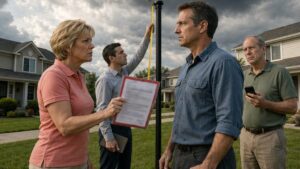
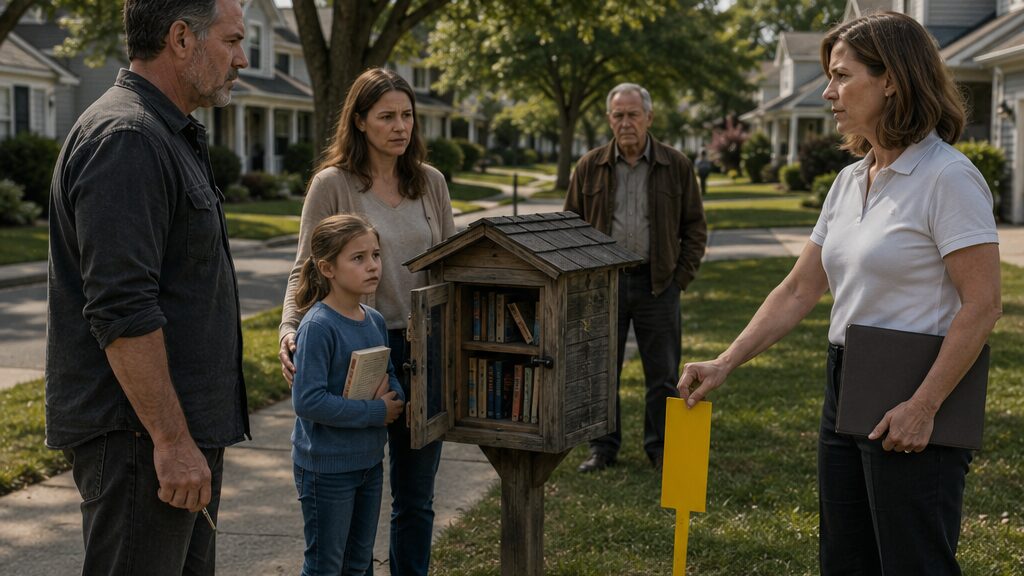
Christine Campbell drove a yellow violation marker into my lawn while a little girl still had one hand inside the book box.
The child froze with a paperback halfway through the opening. Her mother, standing beside a stroller on the sidewalk, looked from Christine to me as if she had accidentally walked into the middle of an argument already in progress.
“Go ahead,” I told the girl.
Christine straightened. She wore a white polo with the neighborhood association emblem stitched near the collar and held a thin folder against her hip. Two people stood several yards behind her, both from the architectural-review committee. I knew their faces from annual meetings. I had never seen either of them inspect my property.
The girl slid the paperback into the lower shelf.
“Thank you,” she whispered.
Her mother guided her away.
Christine waited until they were out of earshot.
“You need to remove that structure before the weekend is over.”
I looked at the marker. It was bright enough to be seen from across the street.
TEMPORARY COMPLIANCE NOTICE.
No details. No citation number. Just a plastic flag announcing to every passing dog walker that something on my lawn had become official business.
“You could have put a letter in my mailbox.”
“We don’t place official notices in mailboxes.”
“You know what I mean.”
“I do.”
That was one of Christine’s talents. She could make agreement sound like correction.
The box stood three feet from us, cedar siding faded silver at the edges, roof painted dark green, front door framed in oak. Through the clear panel, paperbacks leaned against children’s books, a cookbook, two mysteries, and a thick biography someone had wedged sideways that morning.
I had built it seven years earlier.
I did not tell Christine that.
She already knew.
“You’re calling it a structure now?” I asked.
“It is anchored to the ground.”
“So is my mailbox.”
“Your mailbox is covered under a different section.”
One committee member shifted his weight. The other studied the curb.
Christine opened her folder.
“The current setback standards require written approval for freestanding installations within the street-facing portion of the lot. We have no current approval on file.”
“There was approval.”
“Show me.”
The answer came too fast. “I shouldn’t have to.”
Something small tightened behind her eyes.
“That is not how records work, Robert.”
I felt the brass key in my pocket. My fingers closed around it through the fabric.
Three years earlier, after my wife died, I had started locking the box at night only during heavy storms. The lock itself had been her idea, not mine. She had insisted on a proper door because rain had warped the first stack of donated books before we even installed the post.
I could have said that.
I could have explained the whole thing in thirty seconds.
Instead I said, “People use it every day.”
Christine glanced through the clear panel.
“Use does not establish compliance.”
A teenage boy approaching on a bicycle slowed near us.
“Mr. Miller?”
I turned.
He held up a paperback with a cracked red spine. “You still want returns on the bottom shelf?”
“Yes.”
He opened the box, traded his book for another, and rode away.
The committee members watched him go.
I almost smiled.
Christine did not.
“You see?” I said.
“I see someone using an unapproved installation.”
“Of course you do.”
The sharper edge in my voice drew a few more eyes. George Brown had stopped on his porch across the street. A delivery driver paused beside a van. The mother with the stroller was farther down the block but had turned back.
Christine lowered her folder.
“This is exactly why we brought committee witnesses.”
I stared at the two people behind her.
“You brought them for my book box?”
“We’re documenting an unresolved condition.”
“Unresolved since when?”
“A complaint was submitted.”
“By who?”
“That isn’t relevant.”
“Let me guess.”
One committee member cleared his throat.
Christine’s expression changed—not much, but enough.
“You have had informal conversations about this before.”
“You mean you’ve mentioned that you don’t like it.”
“I said the association needed consistency.”
“No. You said it made the entrance to the street look cluttered.”
Her face hardened.
There it was. Not triumph. Not quite anger. Something more personal and more controlled.
She stepped closer to the box.
“Unauthorized structures do not become community property just because someone likes them.”
George crossed the street before I could answer.
“Then you’ve got a long list,” he said.
Christine turned. “Excuse me?”
“Basketball hoops. Planters. That bench on Flores Lane. Half the decorative posts in this development.”
“This matter does not concern you, George.”
“I use the box.”
The teenage reader had not been an exception. Neither had the little girl.
Within five minutes, without anyone calling for them, three neighbors had said some version of the same thing. The parent with the stroller returned to explain that her daughter took early-reader books. A man walking a terrier said his mother traded mysteries there. George said he had borrowed two gardening manuals and returned both.
The attention should have helped.
Instead Christine seemed to become more rigid with every voice.
“The number of users changes nothing,” she said. “Standards exist so that enforcement does not become a popularity contest.”
For the first time, one of the committee members spoke.
“She’s correct about that part.”
The words landed harder than I expected.
I looked at him.
He lifted both hands slightly. “I’m not taking a position on removal. I’m saying usage doesn’t cure a missing approval.”
Missing approval.
Not no approval.
I seized on the difference.
“You know there was paperwork.”
“I know there may have been older correspondence,” Christine said. “That is not the same thing as current written authorization.”
I had boxes of old files in my workshop. Tax receipts, permits, estimates, warranty sheets. Somewhere in them might have been the email from the previous property manager. Or a printed note. Or nothing.
I could not remember.
I hated that I could not remember.
Christine saw the hesitation.
“You have until Monday.”
“To do what?”
“Remove it voluntarily.”
“And if I don’t?”
“The board can proceed.”
A breeze moved through the maple branches above us. The yellow marker trembled beside the post.
I took the brass key from my pocket.
Christine watched my hand.
I opened the box, straightened the biography that had been shoved sideways, then closed the little oak-framed door. The latch clicked. I turned the key once.
It was an unnecessary gesture. Everyone there knew I was not removing anything that afternoon.
I slipped the key back into my pocket.
Christine’s gaze stayed on the lock.
“You think this is about winning,” she said quietly.
“I think this is about books.”
“No. You think because people approve of what you’re doing, rules become optional.”
“And you think because you have a folder, you can make something disappear.”
One of the committee members said, “Let’s keep this civil.”
Christine stepped back.
Her anger was gone now. That unsettled me more than if she had shouted.
She picked up nothing, removed nothing, and walked toward the sidewalk with the others. At the curb she stopped and looked once more at the locked box, the yellow marker, and my hand still resting over the key in my pocket.
“By Monday,” she said, “this problem will be gone.”
Chapter 2: By Sunrise, Only Four Dark Holes Remained
At six twelve the next morning, I stepped onto my porch with a mug of coffee and saw four dark holes in the grass.
For several seconds, my mind refused to arrange them into meaning.
The yellow violation marker lay flattened near the curb. A pale rectangle of pressed grass marked where the cedar box had cast its shadow. Dirt clung to the edges of four bolt holes like fresh wounds.
The book box was gone.
My mug slipped against my palm. Coffee splashed over my fingers.
I set it on the porch step and crossed the lawn barefoot.
The first thing I touched was the ground.
That made no sense, but I did it anyway.
The concrete footing remained below grade. Whoever had removed the box had not ripped it out with a truck or smashed the post. I brushed dirt aside and found clean metal threads where the mounting bolts had been backed out.
Deliberate.
Careful.
I reached into my sweatpants pocket and pulled out the brass key.
It lay in my palm, bright and useless.
The lock it belonged to had vanished with everything else.
I called the non-emergency police number first. The desk officer asked whether I had video, witnesses, a serial number, proof of value. I answered no, no, no, and then explained that it was a handmade neighborhood book-sharing box.
There was a brief pause.
“Was it entirely on your property, sir?”
“Yes.”
“You’re certain?”
I looked at the sidewalk.
“I’m certain.”
That was not the same as having a survey in my hand, and I heard the weakness in my own voice.
The officer gave me an incident number and said an officer could follow up if evidence emerged.
By six forty, I was knocking on doors.
Most people had seen nothing.
One neighbor’s camera faced his porch. Another had been offline since a router change. A couple at the corner had heard a vehicle after two in the morning but assumed it was someone coming home late.
George found me kneeling beside the holes.
He did not ask what happened. He looked once at the empty patch and swore under his breath.
“They unbolted it,” I said.
He crouched with difficulty and ran one finger over the exposed fitting.
“Somebody came prepared.”
“I know.”
“You call the police?”
“Yes.”
He glanced toward Christine’s house.
I followed his eyes.
Her SUV was not in the driveway.
That was all it took.
My anger, which until then had been contained in measurements and questions, found a direction.
“She said it would be gone.”
George stood slowly. “She did.”
“Yesterday.”
“I was there.”
“And now it’s gone.”
“I can count, Robert.”
The restraint in his voice irritated me.
“What are you saying?”
“I’m saying knowing what it looks like isn’t the same as knowing what happened.”
I almost laughed.
The sound that came out was harsher.
At seven fifteen, Christine’s black SUV turned onto the street.
I stepped off my lawn before I had decided to.
She slowed at her driveway, saw me, and stopped.
The driver’s window came down.
“Where is it?” I asked.
Her expression did not change.
“Good morning to you too.”
“Where is my box?”
She looked past me toward the four holes.
For a fraction of a second, something crossed her face.
Recognition.
Not surprise.
I was certain of it.
“You tell me,” she said.
“You stood there yesterday and said it would be gone by Monday.”
“I said the problem would be gone.”
“It’s Saturday.”
“Yes, Robert. I’m familiar with the calendar.”
George had followed me halfway across the street. Curtains shifted in two houses.
I pointed toward the empty patch.
“Someone unbolted it in the middle of the night.”
Christine rested one hand on the steering wheel.
“Maybe someone finally got tired of it.”
The sentence was quiet.
Almost casual.
A hot pressure rose behind my ribs.
“Say that again.”
“I said maybe someone got tired of the ongoing conflict.”
“No. You said tired of it.”
“Do not put words in my mouth.”
“You don’t need my help.”
Her eyes flicked toward the growing number of people watching.
That should have stopped me.
Instead I said, “You want to save us all some time and tell me where you took it?”
George said my name from behind me.
Christine’s face went white, then red.
“That is an accusation.”
“It’s a question.”
“No, it isn’t.”
“You threatened it in front of witnesses.”
“I gave notice of enforcement.”
“And twelve hours later somebody with tools removed it.”
She opened the SUV door.
For one second I thought she was coming toward me. Instead she stepped out, shut the door, and stood beside it.
“You have spent years acting as though your intentions place you above process,” she said. “Maybe this morning you should consider that not everyone in this neighborhood sees you as the victim.”
The words hit harder because part of me knew there were papers in my workshop I had not looked at for years.
I pushed that thought away.
“Where is the box?”
“I have no idea.”
Her answer came cleanly.
Too cleanly, I thought.
She walked into her house.
By eight, the street had become a low-grade public meeting.
People stood near the holes with coffee cups. Someone photographed the ground. A parent asked whether the children’s books had been taken too. I realized I had not even considered the books separately from the box.
That realization made the loss worse.
George stayed after the others drifted away.
“You know the gardening book I told you about?” he asked.
I was measuring the bolt spacing with a tape I had brought from my garage.
“What about it?”
“I lied.”
I looked up.
He shrugged.
“Not about borrowing it. About why.”
“I don’t understand.”
“My grandson sent me a text saying I’d kill every tomato plant again if I didn’t learn something. I didn’t want to ask him what book to buy.”
Despite myself, I almost smiled.
George nodded toward the holes.
“That box gets used by people you never see.”
“I know people use it.”
“No. You know books move.”
The distinction irritated me because I did not understand it yet.
He continued.
“I’ve seen folks come early. Late too. People who don’t want to be caught browsing certain things. Divorce books. Debt. Grief. Job stuff.”
“Why wouldn’t they just go to the library?”
“Maybe because the library has a desk.”
I stared at him.
He put his hands in his pockets.
“You built a place where nobody had to explain what they needed. I’m not sure you ever noticed.”
Before I could answer, my phone buzzed.
A neighborhood-group notification.
Someone had posted a photograph of the empty holes.
The comments were already multiplying.
UNBELIEVABLE.
CALL THE POLICE.
WE ALL KNOW WHO THREATENED IT.
I scrolled too quickly.
One comment named Christine.
Another tagged the HOA.
A third repeated my own words from the street: someone with tools had removed it.
My stomach tightened.
I had wanted witnesses.
I had not considered what witnesses became online.
Across the road, Christine’s blinds closed.
At ten thirty I went back to the holes with a socket wrench and checked the fittings again. Whoever did it had known enough to use the correct size. No splintering. No torn hardware. The whole box might still be intact.
That small fact gave me something I had not felt since sunrise.
Hope.
Then a voice behind me said, “Robert.”
Angela Torres stood at the end of my driveway in blue scrub pants and a gray sweatshirt. She looked as though she had not slept.
She worked hospital nights and usually waved from a distance.
Now she kept glancing toward Christine’s house.
“I heard what happened,” she said.
“So did everybody.”
“I didn’t see the posts until I got home.”
I stood.
Angela folded her arms, then unfolded them.
“My doorbell camera catches more of the street than I thought.”
The brass key was still in my hand.
“What did it catch?”
She hesitated.
“A vehicle,” she said. “At two seventeen this morning.”
Chapter 3: The Camera Clip Everyone Thought Settled Everything
Angela froze the video on a black SUV, and I recognized Christine’s license plate before she said a word.
We stood shoulder to shoulder at her kitchen counter. The room smelled of burnt coffee. Angela had changed out of her scrubs but still wore the exhausted expression of someone who had been awake through two different days.
On the tablet screen, the image was grainy and monochrome.
2:17:08 A.M.
The SUV entered from the left.
Christine’s SUV.
Same plate.
Same small scrape near the rear bumper.
“Play it,” I said.
Angela did not.
“Robert, before you see this, I need you to understand the camera misses part of your yard.”
“Play it.”
She pressed the screen.
The vehicle rolled forward and stopped near my property line. A figure crossed the frame.
Dark clothing. Indistinct face.
The person disappeared beyond the edge of the camera’s view.
For nearly three minutes, nothing moved except digital noise and a moth flashing white near Angela’s porch light.
Then the figure returned backward, carrying one side of the box.
My box.
Even in black and white, even at that angle, I knew the shape of the roof. I knew the slight sag of the lower trim. The figure maneuvered it toward the open cargo area of the SUV.
My hand tightened on the counter.
“There.”
Angela paused it.
The box filled half the rear opening.
Proof.
Not perfect proof of the person’s identity, but proof that my property had entered Christine’s vehicle at two in the morning.
“I need a copy.”
Angela rubbed both hands over her face.
“I knew you’d say that.”
“It’s my box.”
“I know.”
“The police asked whether I had video.”
“I know.”
“Then send it.”
She looked toward the dark tablet screen.
“I don’t want this all over the group.”
“I didn’t ask you to post it.”
“No, but somebody will.”
“I can give it to the police.”
“That’s what I want.”
Her answer should have settled it.
It did not.
“Why did you wait?”
Angela met my eyes.
“I got home twenty minutes ago.”
“You could’ve checked from work.”
“I was working.”
The irritation in her voice brought me back a step.
She had spent the night in a hospital. I had spent it asleep while someone removed the box.
I nodded.
“All right.”
She copied a short segment and sent it to my phone.
I watched it again before leaving her kitchen.
The figure reached the rear of the SUV.
Lifted.
Adjusted.
Loaded.
Something bothered me.
I replayed the moment.
“What?” Angela asked.
“The door.”
“What door?”
“The box door.”
The person never opened it.
The brass key sat in my pocket.
Whoever removed the box had taken it locked.
That meant the books were probably still inside.
For the first time since sunrise, I had a concrete reason to believe the box had not been destroyed.
I walked home with the clip on my phone and the beginnings of vindication in my chest.
By noon, it was online.
I did not post it.
That mattered to me, although less and less as the day went on.
The neighborhood-group moderator called first.
“Robert, did you authorize Angela to share security footage?”
“She shared it?”
There was a pause.
“You haven’t seen the group?”
I opened the app.
The first post had already collected more comments than anything our neighborhood page had seen in years.
A twelve-second clip.
Not the whole segment Angela had sent me.
It began with Christine’s SUV entering frame and ended with the box halfway into the cargo area.
The caption read:
SO I GUESS WE KNOW WHAT HAPPENED TO THE COMMUNITY LIBRARY.
My phone vibrated continuously.
The comments were vicious.
Some demanded criminal charges.
Some wanted Christine removed from the committee.
One person posted yesterday’s confrontation as if it were sworn testimony. Another claimed Christine had been trying to “ban books,” which was nonsense. Someone else said the box contained children’s reading material and called the removal an attack on families.
Facts became decorations around anger.
I called Angela.
“What did you do?”
Her voice was tight. “I sent it to the moderator because people were naming me as someone with a camera. I said not to post until we reviewed everything.”
“Everything?”
“I mean the whole file.”
“You told me the camera missed the yard.”
“It does.”
“Then what else is there?”
A pause.
“Robert, I’m trying to deal with this.”
“That’s not an answer.”
“I know.”
The line went quiet.
Then she said, “I have to call you back.”
She disconnected.
I stared at my phone.
That should have been the moment my certainty cracked.
Instead another notification appeared.
Christine Campbell has commented.
I opened it.
The comment was short.
A partial video does not establish full context. Residents are encouraged to avoid harassment and allow formal review.
The replies arrived beneath it so fast I could barely read them.
FULL CONTEXT? YOUR CAR.
RETURN THE BOOKS.
YOU THREATENED HIM YESTERDAY.
Christine deleted the comment within minutes.
At two, the police desk officer called back and asked me to email the footage. I did. He cautioned me that vehicle ownership did not automatically identify the person shown.
“I understand.”
I said it because I wanted to sound reasonable.
I did not feel reasonable.
At three, George came over carrying a grocery bag.
“What’s that?”
“Books.”
“For what?”
He looked toward the holes.
“Habit, I guess.”
Inside were two paperbacks and a gardening guide.
I laughed once, but there was no humor in it.
“People are tearing Christine apart online.”
George leaned against my porch rail.
“You happy?”
The question offended me.
“She took my property.”
“Video shows your property going into her vehicle.”
“You sound like Angela.”
“Maybe Angela’s got a point.”
“Christine threatened the box.”
“Yes.”
“Her SUV came at two seventeen.”
“Yes.”
“My box was loaded into it.”
“Yes.”
“Then what exactly are we debating?”
George studied me.
“Whether being right about one thing means you get to stop thinking.”
I walked away from him.
That afternoon, strangers from adjacent developments began requesting access to the private group. Screenshots appeared on larger local pages. Someone made a slowed version of the footage with arrows pointing at the SUV.
The story was no longer mine.
Neither, apparently, was the box.
At five forty, I heard the slot in my front door.
An envelope slid across the floor.
The return address belonged to the HOA management company.
I opened it standing in the entryway.
FORMAL NOTICE OF NONCOMPLIANCE AND TEMPORARY SUSPENSION OF REINSTALLATION.
I read the first paragraph twice.
The association acknowledged the reported unauthorized removal of personal property and stated that issue would be reviewed separately.
Then came the rest.
Current records reflected no written approval for the book-sharing structure.
No replacement installation would be permitted pending architectural review.
I sat at the bottom of the stairs.
Behind me, through the front window, I could see the four dark holes in the lawn.
The viral clip had proved that my box entered Christine’s SUV.
It had not proved I had been entitled to put the box there in the first place.
Chapter 4: The Rule I Had Refused to Read Twice
The unopened HOA packet was under a stack of invoices in my workshop, exactly where I had put it six months earlier so I would not have to look at it.
I knew the envelope before I touched it.
Blue association logo. Bulk-mail stamp. My name printed through the plastic window.
ANNUAL GOVERNANCE AND ARCHITECTURAL STANDARDS UPDATE.
I stood at the workbench with the formal suspension notice beside me and felt the kind of shame that arrives before proof because some part of you already knows what the proof will say.
The envelope was still sealed.
I cut it open with a utility knife.
Most of the packet was what I remembered from previous years: roof colors, fence heights, drainage, exterior lighting. Then I reached the revised section on street-facing installations.
Freestanding structures within the front setback area required current written approval.
Current.
There was a transition clause too. Older installations previously tolerated or informally approved were supposed to be registered within ninety days of the revision.
I read that paragraph twice.
Then a third time.
My wife and I had installed the box years before the revision. The former property manager had walked past it dozens of times. Once, after a storm damaged the roof, he had emailed me asking whether I planned to repair it.
I had treated that as approval.
The new policy did not.
On the pegboard above my bench hung the brass key.
I had placed it there the night before because carrying it in my pocket had started to feel ridiculous. Beneath it, pinned behind an old lumber receipt, was a small piece of graph paper covered in my wife’s handwriting.
Thirty-four inches from sidewalk edge.
Door swings toward house.
Leave room for stroller.
I had forgotten the note existed.
For a moment I could see her in the workshop again, pencil tucked behind one ear, arguing that my first design was too high for children.
I reached for the paper.
Then stopped.
The HOA packet remained open under my hand.
At ten Monday morning, I carried both documents to the management office.
The property manager read the old email on my phone and shook his head.
“This helps show history,” he said.
“But?”
“But it is not an approval.”
“You people knew the box was there.”
“I did not work here then.”
“The association knew.”
“I understand why you see it that way.”
I hated that sentence.
“Do you?”
He leaned back.
“Yes.”
His answer was quiet enough to disarm me.
He turned his monitor slightly so I could see a property map.
“The complication is that the prior manager was informal about several things. The board revised procedures because records were inconsistent.”
“So Christine was right.”
“About the registration requirement? Yes.”
The word landed cleanly.
I looked away.
He continued. “That does not authorize anyone to enter your property and remove personal belongings.”
“I know.”
“And those are separate issues.”
“That’s what your letter says.”
“They need to remain separate.”
I heard the warning inside it.
The viral clip had already made separation nearly impossible.
I pointed at the map.
“What happens if I rebuild?”
“Right now? Do not.”
“You’re suspending a box that isn’t even there.”
“We’re suspending reinstallation pending review.”
“Because Christine complained.”
“Because your file has no current approval.”
I leaned both palms against his desk.
“What about everything else?”
He studied me.
“What everything else?”
“The basketball hoop two streets over. The decorative posts. The bench on Flores Lane.”
His expression changed slightly.
“You would need to submit specific examples.”
“I’m giving you specific examples.”
He exhaled.
“That bench does not appear to have an approval record.”
I straightened.
“The posts?”
“I would need to check.”
“The hoop?”
“Portable equipment is treated differently, depending on placement.”
“Convenient.”
“Robert.”
The tone stopped me.
He folded his hands.
“If your position is that enforcement has been inconsistent, you may have a legitimate argument. If your position is that inconsistency means no rule applies to you, you do not.”
I said nothing.
He looked at the unopened packet I had brought with me.
“You received the update.”
“Yes.”
“You opened it?”
I could have lied.
“No.”
The admission burned worse than I expected.
He nodded once, not smugly.
“That matters.”
I left with copies of the current standards and a notice for Tuesday night’s open board meeting.
At the county records desk, the news got worse and better at the same time.
The clerk confirmed my property line stopped where I thought it did. The box had been on my land.
But the setback zone still extended into that portion of the lot under the development documents.
Private property did not mean unrestricted property.
I knew that in my professional life. I had spent years telling clients permits mattered even when a project seemed harmless.
Somehow, with the box, I had decided intention should be enough.
By late afternoon I was back in the workshop.
The neighborhood group continued exploding.
Someone had posted Christine’s committee history. Someone else had found an old complaint she filed about holiday lights. A local page had reposted the security clip with a caption implying she had stolen books from children.
I started typing a comment.
The box was on my property. The footage is clear. Do not let procedural distractions—
I stopped.
Procedural distractions.
That was exactly what I had accused Christine of believing rules were: weapons when useful, irrelevant when inconvenient.
I deleted the comment.
George knocked on the open workshop door.
“You look terrible.”
“Thank you.”
He came inside carrying two coffees.
His eyes moved to the packet.
“You found something.”
“I missed the registration requirement.”
He handed me a cup.
“Bad?”
“Bad enough.”
“You going to admit it?”
The question irritated me because I had been asking myself the same thing for hours.
“I didn’t authorize anyone to take the box.”
“I didn’t say you did.”
“I was still on my property.”
“I didn’t say you weren’t.”
“You sound like the property manager.”
“That poor man.”
I glared at him.
George sipped his coffee.
Then he noticed the graph paper beneath the key.
“Her handwriting?”
“Yes.”
He did not touch it.
My wife’s note looked smaller with someone else standing there.
“I promised her I’d keep it going,” I said.
The words came out before I could stop them.
George looked at me.
I had never told him that.
Not directly.
“She knew she was sick by then,” I said. “She made me promise.”
George nodded toward the key.
“Keep what going?”
“The box.”
“Or the books?”
I looked at him.
He did not press.
Instead he walked to the bench and set his coffee beside the HOA papers.
“There’s something else.”
“What?”
“I’ve been thinking about what I told you Saturday. About people using it when nobody’s around.”
I waited.
“A few weeks ago, early morning, I saw Susan Roberts at the box.”
The name took a second to place.
Christine’s sister.
She had been living at Christine’s house for several months, though nobody seemed to know for how long.
“What was she doing?”
“Taking a book.”
“So?”
George rubbed his jaw.
“It wasn’t a novel.”
“What was it?”
“A job-search guide.”
I felt the room change around that small fact.
George continued.
“She saw me. Hid it under her jacket like she’d been caught stealing.”
I looked at the key hanging above my wife’s note.
Christine had spent weeks trying to remove the box.
Susan had been using it before dawn.
“What does that have to do with Christine?”
George’s expression told me he had been asking himself the same question.
“I don’t know,” he said. “But I think you’d better find out.”
Chapter 5: The Books Christine Could Not Bear to See Missing
George remembered three titles.
He gave them to me Monday evening on his porch, one by one, while the neighborhood group continued tearing Christine apart on both our phones.
“A job-search guide,” he said. “The blue one.”
“I know it.”
“A book about getting out of debt.”
I stopped.
“What book?”
“White cover. Red letters. Somebody donated it maybe two months ago.”
I knew that one too.
George watched my face.
“And the third?”
He hesitated.
“A recovery memoir.”
The traffic on the main road beyond the development made a low, steady sound. Somewhere nearby, a sprinkler clicked across a lawn.
“You saw Susan take all three?”
“Not the same day.”
“How often were you watching my box?”
“Apparently more often than you.”
I ignored that.
“When?”
“Over a month or so.”
I stood.
George said, “Robert.”
“What?”
“Don’t go charging over there.”
“I’m not.”
“You have your charging-over-there face.”
I walked home anyway.
Not to Christine’s.
To my own shelves.
When the box filled up, I rotated books through a cabinet in the garage. I had always told myself I knew what moved. Mysteries disappeared quickly. Children’s books came and went in waves. Cookbooks sat longer than anyone expected.
I found the empty spaces only after George named them.
The blue employment guide.
The debt book.
The memoir.
I had noticed none of them.
Then I remembered replacements.
A newer edition of the employment guide had appeared about two weeks after the first vanished. The debt book had come back in a different printing. The recovery memoir had been replaced by another title on the same subject.
I had assumed different neighbors were donating similar things.
Now I pulled out my phone and scrolled through old pictures of the box.
I photographed it occasionally after repairs or before storms.
There.
A picture from six weeks earlier.
The blue guide on the upper shelf.
Next photo, nine days later.
Gone.
Three days after that, a newer edition in its place.
I zoomed in.
A small price sticker remained on the back cover.
Local bookstore.
The same store whose paper bags I had seen Christine carrying from her SUV more than once.
The thought arrived slowly because I resisted it.
Christine had been replacing the books.
I sat on the garage floor.
For months, I had imagined her objection as pure contempt. Books made the street cluttered. Neighbors gathered. Standards slipped. Her authority was challenged.
Maybe all of that was true.
But it was not all.
My wife had refused to put a checkout sheet inside the box.
I remembered the argument clearly now.
“How do we know what’s missing?” I had asked.
“That’s the point,” she said.
“What point?”
“Nobody owes us an explanation.”
At the time I thought she was being sentimental.
Now, sitting under fluorescent garage light with my phone in my hand, I understood what George had tried to tell me.
I knew books moved.
I had not known who needed them.
At seven thirty, I saw Susan in Christine’s driveway.
She was carrying two grocery bags from the SUV toward the house. She was in her forties, maybe younger than Christine by several years, with dark hair tied loosely behind her head. I had waved to her before.
Never spoken more than a sentence.
I crossed the street.
“Susan.”
She stopped.
The reaction was immediate.
Not fear.
Recognition.
“You know,” she said.
I had not expected that.
“Know what?”
Her mouth tightened.
“Don’t.”
“I’m asking about the box.”
“I know what you’re asking about.”
Behind the front curtains, a light moved.
I lowered my voice.
“George saw you using it.”
Susan shut her eyes briefly.
“Of course he did.”
“He wasn’t spying.”
“I don’t care.”
“I’m not trying to embarrass you.”
She gave a short laugh.
“Then you picked a strange week to come over.”
I looked at the grocery bags cutting into her fingers.
“Christine replaced some of the books you took.”
Susan stared at me.
That confirmed it more clearly than an answer.
“She did, didn’t she?”
Susan set the bags on the driveway.
“You need to leave this alone.”
“Why?”
“Because my life is not evidence.”
The words stopped me.
“I didn’t say it was.”
“You’re thinking it.”
“No.”
“Yes, you are. You found out I borrowed books and now you think you found the secret reason she hated your box.”
I could not deny it.
Susan saw that.
“She didn’t hate the books.”
“Then why did she spend weeks trying to remove them?”
Her face changed.
Anger first.
Then something tired underneath.
“You want the version that makes sense on Facebook?”
“I don’t care about Facebook.”
“That’s convenient now.”
The accusation landed.
I looked toward my house, where the empty holes were visible in the dusk.
“I made one accusation before I had proof.”
“And then everyone else did the rest.”
“I didn’t post the footage.”
“No. You just gave people a villain before they saw it.”
I wanted to defend myself.
I did not.
Susan picked up one grocery bag, then put it down again because her hands had started shaking.
“I lost my job last year,” she said. “Then my apartment.”
I stayed still.
“I moved in with Christine because I had nowhere else to go. I was supposed to be there six weeks.”
She looked toward the house.
“It’s been eight months.”
The recovery memoir took on a different weight.
Susan noticed my glance toward nothing.
“Don’t.”
“I’m not asking.”
“Good.”
The front door opened.
Christine stepped outside.
She saw us.
For the first time since I had known her, she looked frightened before she looked angry.
“Susan.”
“I’m fine.”
“Come inside.”
Susan’s shoulders stiffened.
“I said I’m fine.”
Christine looked at me.
“You need to leave.”
“This is my conversation,” Susan said.
Christine ignored her.
“Robert, whatever you think you’ve learned—”
“I learned you were replacing books.”
Silence.
That was my answer.
Christine’s face went still.
Susan looked away.
“Why?” I asked.
Christine walked down the driveway.
“Do not discuss my sister with neighbors.”
“I didn’t.”
“You’re doing it now.”
“With your sister.”
“Because you cornered her.”
“I walked across the street.”
“You have a formal dispute with me. You now discover something private about my household and suddenly—”
“Stop,” Susan said.
Christine stopped.
Susan turned to me.
“After I took the first job book, Christine found it in my room.”
Christine’s jaw tightened.
Susan continued.
“She bought another copy and put it back.”
“Why?”
“Because she didn’t want anyone noticing it was gone.”
I looked at Christine.
“That makes no sense.”
“It does if you know her,” Susan said.
Christine said, “Enough.”
“No.”
The word came sharp.
Susan faced her sister.
“You wanted the shelves to look untouched. You wanted me to stop going over there. You wanted nobody asking why I was taking books about debt or work or anything else.”
“I was protecting you.”
“You were hiding me.”
Christine’s face broke for half a second.
Not theatrically.
Just enough to show the wound beneath the control.
Then it closed again.
“You have no idea what people in this neighborhood are like.”
Susan laughed without humor.
“Yes, I do. I live with one of them.”
Christine flinched.
I should have felt vindicated.
Instead I felt like an intruder.
Susan turned back to me.
“Keep me out of your meeting tomorrow.”
“I haven’t decided what I’m saying.”
“Decide.”
“Susan, the box was removed.”
“I know.”
“Christine’s SUV—”
“I know.”
“Then you know why this matters.”
Her eyes met mine.
“Yes.”
The single word held more than I understood.
Christine said her name again, softer this time.
Susan picked up the grocery bags.
Before she reached the door, she looked back at me.
“Christine took the box,” she said. “But not for the reason your neighbors think.”
Chapter 6: What the Full Footage Showed After the Viral Clip Ended
Angela opened her front door Tuesday morning and said, “I withheld six minutes.”
No greeting.
No invitation.
Just the confession.
I stared at her.
“Six minutes of what?”
“The footage.”
My first reaction was anger so immediate I stepped back from it physically.
“You told me the camera missed my yard.”
“It does.”
“You gave me a clip.”
“I gave you the part that showed your property entering the SUV.”
“And kept six minutes.”
“Yes.”
“Why?”
Angela glanced toward the street.
“Come inside.”
I did not move.
“Robert.”
“Why?”
“Because Susan is in it.”
That got me through the door.
The tablet was already on her kitchen counter.
Angela closed the blinds before pressing play.
The footage began earlier than the clip I had seen.
2:13:41 A.M.
Christine’s SUV entered frame.
This time Angela did not skip ahead.
Christine got out.
Even in monochrome, I recognized her posture. She crossed toward my yard carrying something long and metallic.
A socket wrench.
My stomach tightened.
She disappeared beyond the camera edge.
Two minutes later, she returned carrying the box with both arms.
Alone.
Christine had removed it.
Not a shadow.
Not a guess.
Her.
She set it near the open rear hatch, then tried the little front door.
Once.
Twice.
She pulled harder.
The lock held.
My hand moved instinctively toward my pocket, though the key was at home.
Angela paused the video.
“She couldn’t open it.”
“I can see that.”
The anger in my voice was not for her alone.
Christine had stood in her driveway Saturday morning and told me she had no idea where the box was.
Angela resumed.
Christine tilted the box and started lifting it toward the cargo area.
Then another figure entered frame from the direction of Christine’s house.
Susan.
She moved fast.
No coat. Bare arms.
She grabbed the other side of the box.
For one terrible second, the image looked exactly like the cropped clip everyone had been sharing: two figures loading stolen property.
Then Susan yanked backward.
Christine nearly lost her grip.
There was no audio, but their argument was visible in their bodies.
Susan pointed toward my house.
Christine pointed toward the SUV.
Susan tried to pull the box away.
Christine shoved it farther into the cargo area.
Angela stopped the recording.
“That’s why I didn’t post it.”
I looked at her.
“You thought hiding this was neutral?”
“No.”
“Then what?”
“I thought if the whole thing went online, Susan would become part of it.”
“She is part of it.”
Angela’s expression hardened.
“That doesn’t mean strangers deserve her.”
The sentence silenced me.
She played the rest.
Susan stood behind the SUV for nearly a minute while Christine moved out of frame. Then Susan climbed into the passenger side.
The vehicle left.
At 2:23, the street was empty again.
“That’s all?”
“From that night.”
“You said six minutes.”
“That is six minutes.”
“Where did they go?”
Angela looked at me.
“I asked Susan yesterday.”
I turned.
“You what?”
“She came here after the clip spread.”
“Why?”
“Because she knew my camera existed.”
A sour feeling moved through me.
Everyone had been having parts of this story without me.
Angela continued.
“Christine intended to take the box to a disposal site outside the development.”
My throat tightened.
“Intended?”
“Susan stopped her.”
“How?”
“She threatened to call the police from the car.”
I stared at the frozen image.
“So where is it?”
“In a storage unit.”
The words took a moment to land.
“The box exists?”
“Yes.”
“With the books?”
“As far as Susan knows.”
I put both hands flat on the counter.
For four days I had imagined rain ruining the books. A dump truck crushing the cedar. My wife’s handwriting on the underside of the roof buried under garbage.
Alive was the wrong word for an object.
Still, relief hit like it.
“Where?”
Angela gave me the facility name.
“Unit rented under Christine?”
“Susan.”
That complicated things again.
“Why?”
“Because Susan refused to let Christine dump it and didn’t want to bring it back at three in the morning after the fight.”
I laughed once.
“This is insane.”
“Yes.”
“Christine removed it.”
“Yes.”
“Lied to me.”
“Yes.”
“Then let everyone think—”
“I know.”
“And Susan helped hide it.”
Angela’s face sharpened.
“She helped keep it from being destroyed.”
“That’s not the same as returning it.”
“No.”
At least she did not pretend otherwise.
My phone buzzed.
A reminder for the HOA meeting that evening.
Open forum. Seven p.m.
Angela saw the screen.
“You’re going to use this.”
It was not a question.
“I’m going to tell the truth.”
“All of it?”
I looked at the frozen frame of Susan pulling against the box.
There were truths inside that footage the neighborhood group would devour.
Susan’s presence.
Her dependence on Christine.
The books.
The job loss.
The recovery memoir.
Every cruel theory people had posted about Christine could be replaced with a more intimate cruelty: proof that she had tried to erase evidence of need from her own household.
It would explain everything.
It would also expose Susan.
Angela touched the tablet.
“The board can review the full file privately.”
“Christine will say context.”
“She already has.”
“She’ll say emergency enforcement.”
“Probably.”
“She’ll say I was noncompliant.”
“You were.”
The bluntness hurt.
I picked up the tablet and watched Christine test the locked door again.
She had tried to open the box before loading it.
Why?
To remove the books?
To see which ones were inside?
To make it easier to dispose of?
The footage could not answer.
Only people could.
At six forty-five, I entered the HOA meeting room carrying a folder, my old email, the revised standards, and the brass key.
The room was fuller than I had ever seen it.
Phones glowed in hands.
Neighbors who had never attended a meeting stood along the wall.
Christine sat near the front beside the property manager. Her face was pale but controlled.
Susan was not beside her.
I thought she had stayed away.
Then I saw her in the back row.
Alone.
Angela sat two chairs from her, the tablet in her lap.
The board president called the meeting to order.
Procedural items came first. Minutes. Landscaping contract. Drainage complaints.
Nobody listened.
Finally he reached the open dispute.
“We have received video evidence relating to the removal of Mr. Miller’s property,” he said. “We have also received concerns regarding incomplete footage circulated publicly.”
The room shifted.
Christine did not look back.
The board president turned to me.
“Mr. Miller, before you speak, I need to ask one question.”
I stood.
He nodded toward Angela’s tablet.
“Do you want the full footage played publicly?”
Every face in the room turned toward me.
An association staff member placed a microphone in my hand.
At the back, Susan watched without moving.
I looked down at the brass key resting in my palm.
Then I raised the microphone.
Chapter 7: I Told the Truth That Could Not Humiliate Her Sister
The board president looked from me to Angela’s tablet.
“Mr. Miller?”
The microphone felt too light in my hand.
Across the room, someone whispered, “Play it.”
Another voice answered, “Let everyone see.”
Christine sat rigidly near the front, both hands folded over a closed binder. She had not looked at Susan once.
I looked toward the back row.
Susan’s face had gone still.
I thought about the blue employment guide. The debt book. The memoir. I thought about the comments already online from people who knew nothing and had somehow become certain of everything.
Then I looked at the board president.
“No,” I said.
The room shifted.
He leaned toward his microphone.
“You do not want the full footage shown?”
“Not publicly.”
A murmur moved through the chairs.
Christine turned for the first time.
Her expression was unreadable.
The board president said, “You understand that the footage may be relevant to your complaint.”
“It is.”
“Then why withhold it?”
I tightened my grip on the microphone.
“Because part of it involves someone who is not the subject of my complaint.”
A few people turned toward Angela.
Others looked around the room, searching for a new person to blame.
I continued before that could gather momentum.
“The board can review the complete file privately. The police can review it. But I am not asking this room to watch someone else’s private life become neighborhood entertainment.”
For a moment, no one spoke.
Then a man near the wall said, “But we deserve context.”
I turned toward him.
“No. We deserve facts that concern the removal of my property. Those are not the same thing.”
The words surprised me as I said them.
A week earlier I would have wanted every fact, every rumor, every weakness. I would have called it transparency.
The board president nodded slowly.
“Then state your complaint.”
I opened my folder.
My hands were shaking.
“The full footage shows Christine Campbell entering my property after two in the morning with a tool. It shows her removing the book box. It shows her attempting to open the locked door. It shows the box being placed into her SUV.”
Christine stared at the table.
I continued.
“The box still exists. It is in a storage unit.”
The room erupted.
Questions. Gasps. Someone swore under his breath. The board president struck his gavel once.
“Order.”
Christine closed her eyes.
I could have stopped there.
Instead I pulled out the HOA packet.
“There is something else.”
The room quieted again.
I held up the standards update.
“My box did not have current written approval.”
The sentence was harder to say than the accusation.
Several heads turned toward Christine.
I heard George exhale somewhere behind me.
I continued.
“The old management company knew it was there. I had an email showing awareness. I treated that as permission. When the association changed the registration requirement, I received the packet.”
I put the unopened envelope on the table beside the microphone.
“I did not open it.”
No one moved.
The property manager looked down.
I forced myself to continue.
“So I am not asking this board to pretend I followed every rule. I did not.”
Christine looked at me then.
For the first time all evening, her expression held something other than defense.
Not gratitude.
Recognition, maybe.
I turned toward the board.
“But noncompliance does not authorize a committee chair to come onto my property at two in the morning and take something because she believes the process is too slow.”
Christine rose.
The board president said, “Ms. Campbell, you will have an opportunity—”
“No,” she said. “He is right about one part.”
Every face turned.
She remained standing beside her chair.
“I removed it.”
The admission did not produce the explosion I expected.
The room became quiet.
Christine’s voice was controlled, but not steady.
“I believed the structure was an escalating safety and compliance issue.”
Someone laughed sharply.
The board president struck the gavel.
Christine continued.
“There had been repeated refusal to cooperate. Residents were gathering near the street. Children were stopping at the edge of an active roadway. The installation was not current in the records.”
“You could have called an emergency meeting,” the property manager said.
Christine looked at him.
“I believed delay would make the situation worse.”
“You believed?” I said.
She faced me.
“Yes.”
“You told me the next morning you had no idea where it was.”
Her jaw tightened.
“That was wrong.”
“Wrong?”
“I should not have said it.”
“You lied.”
A tremor of anger moved through the room again.
Christine gripped the back of her chair.
“Yes,” she said.
The answer took something out of me.
I had expected denial.
Excuses.
Procedure layered over procedure.
Instead she stood there and admitted the ugliest part in one word.
The board president leaned forward.
“Did any board member authorize removal?”
“No.”
“Did management?”
“No.”
“Did the architectural-review committee vote?”
“No.”
“Did you enter Mr. Miller’s lot?”
“Yes.”
“Did you intend to dispose of the box?”
Christine hesitated.
Susan lowered her head.
“Yes.”
The room reacted again.
This time I did not.
I thought of Susan grabbing the other side of the box in the footage.
I thought of Christine replacing books so no one would notice which ones her sister needed.
Nothing about that excused what she had done.
But the story was no longer clean enough for the kind of victory people online wanted.
The board president asked me whether I wanted to continue.
I looked down at the brass key.
Then I placed it on the table.
The small metallic sound carried farther than it should have.
“My wife helped design that box,” I said.
I had not planned to say it.
George shifted behind me.
“She was sick when we finished it. She made me promise to keep it going.”
The room blurred at the edges for a second.
I kept my eyes on the key.
“I spent years telling myself that meant the box had to stay exactly where it was, exactly as it was, and under my control.”
I touched the old graph paper in my folder.
“She wanted no sign-out sheet. No names. No explanations. People could take what they needed and bring something back if they could.”
I looked toward the back row.
Not directly at Susan.
Near her.
“I forgot that part.”
The silence changed.
Less hungry now.
I turned back to the board.
“I will apply for approval. I will move the structure if the setback requires it. I will accept conditions that are actually applied consistently.”
The board president nodded.
“And what are you requesting regarding Ms. Campbell?”
“Restitution for damage and removal. A formal finding that committee members cannot conduct self-help enforcement. Review of inconsistent enforcement records.”
Christine’s face tightened.
“And,” I said, “I am asking for permission to submit a different plan.”
The property manager looked up.
“What kind of plan?”
“A compliant replacement.”
Someone behind me whispered, “Replacement?”
I picked up the key and held it between two fingers.
“Not mine alone.”
The room went quiet again.
“I want shared stewardship. More than one key. Written maintenance responsibility. Clear placement. Annual review if that’s what the standards require.”
George said, “I’ll do it.”
A few people laughed softly, not because it was funny but because the tension needed somewhere to go.
The board president looked toward him.
George raised one hand.
“I’m serious.”
The parent with the young child spoke from the side wall.
“So am I.”
The board president held up a hand before more volunteers could join.
“We are not voting on a new installation tonight.”
“I know.”
“But you are making a formal proposal?”
“Yes.”
He looked at the other board members.
Then at Christine.
Then at the key in my hand.
“We will take it under expedited review.”
It was not approval.
Not yet.
But it was a door that had not been open an hour earlier.
As the meeting adjourned, people gathered in uneven knots.
No applause.
No triumphant confrontation.
Christine remained beside her chair while others moved around her.
Susan walked toward the exit without speaking to anyone.
I almost followed.
Then Christine said my name.
I turned.
She looked exhausted.
“You could have played it.”
“Yes.”
“Why didn’t you?”
I thought about answering.
Instead I said, “The board has the facts it needs.”
Her eyes moved toward the back door where Susan had disappeared.
For once, Christine had nothing prepared.
I left the meeting room with the brass key in my pocket and a copy of the application form in my hand.
At the bottom of the first page, under ownership and maintenance responsibility, I drew a line through the word individual.
Then I wrote:
Shared stewardship.
Chapter 8: The First New Key Was Not Mine to Keep
Six weeks later, I arrived at the rebuilt box before sunrise and found a book already inside.
The front door was locked.
I checked it twice.
The brass key on my ring still fit, which meant whoever placed the book there had used one of the new copies.
For a few seconds I stood on the sidewalk looking through the clear panel.
The book was an employment guide.
New edition.
Blue cover.
I knew immediately who had left it.
The box stood eight feet farther back from the curb than the original. The new footing had passed inspection. Reflective edging marked the path. The door opened toward the house, exactly as my wife had written on that old piece of graph paper.
Leave room for stroller.
We had repaired the original cedar body instead of replacing it completely.
One lower trim piece had been cracked during removal. Christine paid for that.
She paid the storage charges too.
The board issued a formal finding that no committee member could enter private property or remove disputed items without authorization. The association also reviewed unregistered front-yard structures instead of pretending my box had been the only one.
Some people were angry when their decorative posts received notices.
Consistency, it turned out, was popular until it became personal.
Christine stepped down from architectural-review decisions involving immediate neighbors. She did not resign from the HOA entirely.
That disappointed people online.
They wanted exile.
The board chose procedure.
For once, I understood the difference.
George arrived carrying two coffees.
“You opened it without me?”
“I didn’t open it.”
He looked through the glass.
“That book wasn’t there yesterday.”
“No.”
He looked at me.
“You know who?”
“I think so.”
A movement across the street caught my eye.
Susan stood near Christine’s driveway in a dark sweatshirt, keys in one hand.
She saw us looking.
George lifted his coffee.
Susan shook her head once.
No announcement.
No thanks.
No public credit.
Then she got into her car.
Later that morning, when the parent with the young child arrived for the informal reopening, I asked whether Susan wanted her name added to the stewardship list.
The answer came back through Angela.
No.
That felt right.
By nine, the box held twice as many books as it had at sunrise.
A teenage reader returned a mystery. George added gardening books. Someone left a packet of county library outreach information on the lower shelf. The parent’s daughter chose an early-reader book and sat on the grass while her mother talked with Angela.
Nobody made a speech.
I had requested that.
The neighborhood group posted pictures anyway.
This time the moderator disabled comments after the first argument started about whether Christine should be allowed to attend.
She came at ten fifteen.
Conversation thinned when people saw her.
Christine crossed the lawn carrying nothing.
She stopped several feet from me.
The repaired box stood between us.
“You changed the roof trim,” she said.
“It was cracked.”
“I know.”
That was all for a moment.
She looked through the glass.
Her eyes stopped on the blue employment guide.
I watched her see it.
She did not touch the door.
“I am not asking you to forgive me,” she said.
“I know.”
“I thought I was protecting several things at once.”
I waited.
She looked toward her house.
“I protected none of them.”
There was no useful answer to that.
So I did not invent one.
After a moment she said, “The placement is better.”
I almost laughed.
“Thank you.”
A faint change crossed her face.
Not a smile.
Close enough to prove she still remembered how.
Then she walked away.
George joined me beside the box.
“You’ve got the keys?”
I reached into my pocket.
The original brass key remained scratched from years of use. Beside it were three newer copies.
One for me.
One for George.
One for the parent who had volunteered to handle children’s-book rotation.
Angela already had hers.
I held out the first copy.
George looked at it but did not take it.
“You sure?”
“No.”
“That’s encouraging.”
I pressed it into his palm.
He closed his fingers around it.
The gesture should have felt like giving away part of my wife’s last project.
Instead it felt like finally understanding it.
The box had never been valuable because I guarded it.
It mattered because people could approach it without permission, take what they needed without explanation, and leave something behind when they were ready.
For years I had kept the only key and called that protection.
Now George had the first new one.
Angela had another.
A mother down the street would hold the next.
I kept the second key, not the only key.
Then the little girl from the day Christine planted the yellow marker came running across the grass with a book held against her chest.
She opened the door herself.
Nobody asked what she was returning.
Nobody wrote down her name.
The key in my pocket rested quietly among the others.
The story has ended.