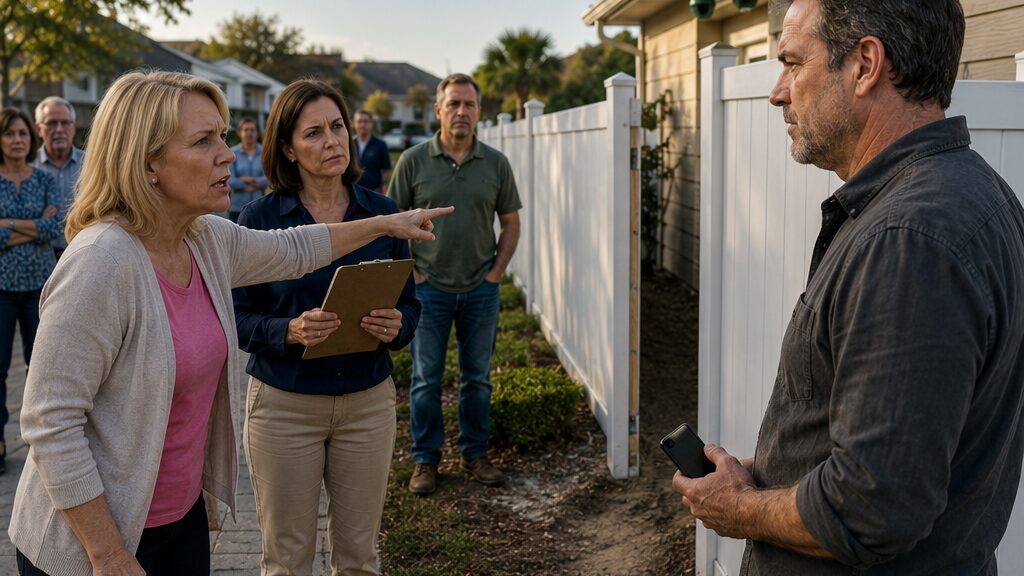
The Night My Neighbor Demanded Silence, I Finally Asked Why She Needed My Backyard Dark
Chapter 1: The Lights Came On at Two in the Morning
“Turn that thing off!”
Thomas Davis was halfway down the stairs when Margaret Wilson shouted again from somewhere beyond his front door.
“It’s waking up the entire neighborhood!”
The digital clock on the microwave read 1:57 a.m.
Thomas stopped in the dark kitchen, one hand on the counter. For a second he listened past the pounding in his chest. The house was quiet except for the low hum of the refrigerator and, from the back of the property, the faint two-note chime that had pulled him out of bed.
Not an alarm.
Two short tones. Then silence.
He opened the front door.
Margaret stood barefoot on his lawn in pale floral pajamas, her blonde hair loose around her shoulders. One arm was wrapped across her waist; the other pointed toward him as though he had been caught doing something deliberate.
Behind her, porch lights had come on at two neighboring houses.
“Margaret.”
“Don’t ‘Margaret’ me. This is the fourth night.”
Thomas stepped onto the porch. Humid air pressed against his face.
“What are you talking about?”
Her mouth fell open.
“That noise. Those lights. Whatever ridiculous security system you installed.”
From the side of the house came a soft mechanical click.
Then the backyard glowed green.
Not brightly enough to light the whole property. Thomas had aimed the low-mounted motion lamps downward, across the strip of grass between his rear porch and the white fence. Their color was a side effect of the night-preserving bulbs the installer had recommended. In darkness, they made the lawn look submerged.
Margaret threw both hands up.
“There. That.”
Thomas looked toward the side gate.
“It’s not an alarm.”
“Then why does it go off every night?”
The question came too quickly.
Thomas turned back to her.
Margaret seemed not to notice the pause. She was breathing hard, whether from anger or the walk across the lawns he could not tell.
“The chime is inside my house,” he said.
“I can hear it.”
“No, you can hear the relay outside. Barely.”
“I hear enough. And the lights shine through my bedroom.”
Her house stood two lots over, partly screened by a row of crepe myrtles and Gregory Baker’s garage.
Thomas glanced toward it.
“Your bedroom doesn’t face my yard.”
Margaret’s expression tightened.
“That is not the point.”
A window opened across the street. Someone looked out, then withdrew.
Thomas felt the old pressure gather behind his ribs: the unpleasant awareness of being observed while still not fully understanding what he was defending himself against.
He folded his arms.
“The system reacts to movement.”
“A cat is movement.”
“It’s calibrated above that size.”
“A raccoon.”
“It tracks direction.”
Margaret stared at him.
Thomas heard himself continue, harder now.
“Something is moving through my backyard.”
“At two in the morning?”
Again, too quickly.
He looked toward the green-lit grass.
The lamps had gone dark.
“When did I say two?”
Margaret blinked.
“You just—”
“No.”
She drew her cardigan-less arms tighter around herself. “Well, it’s always around now, isn’t it?”
Thomas said nothing.
The neighborhood had known one another too long for silence to remain neutral. In daylight, Margaret waved from her mailbox. She organized meal trains when residents were sick and remembered which children sold fundraiser cookies. She had once brought Thomas soup after he threw out his back replacing an air-handler motor at work.
Now, barefoot in his grass, she looked furious enough to call him dangerous.
“You installed all this without asking anyone,” she said.
“It’s my property.”
“There it is.”
“What?”
“That attitude.”
Thomas almost laughed, but there was no humor in him.
His eyes went again to the side of the house. Beyond it stood the white fence, patched twice over the years. Near the rear corner, where the fence met a landscaped common path, one section had never aligned properly. There was a narrow worn gap beside the last post. Too small for a mower. Wide enough for a person who turned sideways.
He had meant to fix it.
For years, meaning to had seemed sufficient.
Margaret followed his gaze.
The movement was slight, but Thomas saw it.
“You know where the sensor is,” he said.
“What?”
“The lights. You looked straight at them.”
“They’re obvious.”
“They’re behind the fence line from here.”
Her anger returned with startling speed.
“Oh, for God’s sake, Thomas. Listen to yourself. You’ve got cameras, sensors, lights—now you’re interrogating me because I know where the glow comes from?”
“I asked a question.”
“No. You implied something.”
A second-story light came on at Gregory’s house.
Margaret lowered her voice.
“People are tired of this.”
“People?”
“Yes, people.”
“Who?”
“This isn’t a deposition.”
Thomas felt his jaw tighten.
That was his mistake. He knew it even as he made it: once pushed, he stopped explaining and started building walls out of questions.
But explanation had failed him before.
Two years earlier, when he had noticed the side gate standing open three mornings in one month, he had told himself it was wind. When a muddy print appeared near the rear steps, he had blamed a utility worker. He had ignored the small disturbances because sensible men did not panic over gates and footprints.
Then he had come home to a pried kitchen window, drawers emptied onto the floor, and the wooden box containing his late father’s watch gone forever.
The police report had called the point of entry “likely rear access.”
Thomas had never told Margaret that.
He had barely told Gregory.
He looked at the dark gap beside the fence.
“The system doesn’t activate by itself,” he said.
Margaret gave a short, exhausted laugh. “Fine. Then fix it so it doesn’t punish everyone else.”
“Someone keeps crossing.”
“You don’t know that.”
“I’ll check.”
Something changed in her face.
Not fear exactly.
Calculation.
It vanished so fast Thomas might have doubted it if he had not spent twenty-eight years maintaining buildings and watching people react when machinery exposed a problem they had hoped would remain intermittent.
Margaret stepped backward off his lawn.
“Do whatever you want. But when the HOA gets involved, don’t act surprised.”
“The HOA?”
“You’re disturbing the neighborhood.”
“You said the entire neighborhood was awake.”
“Look around.”
Two porch lights. One open window. Gregory’s upstairs lamp.
Hardly an uprising.
Margaret turned away.
Thomas watched her cross toward the sidewalk, but instead of following the direct line toward her own house, she hesitated near the corner of Gregory’s hedge. Her head turned once toward the back of Thomas’s property.
Then she kept walking.
Inside, Thomas locked the door and stood in the kitchen without turning on a light.
The two-note chime sounded again.
This time he moved immediately.
He picked up his phone, opened the security app, and watched a blank loading circle spin over the live feed.
The backyard appeared in green-gray night vision.
Empty.
He checked the event log.
1:58 a.m.
Motion detected.
Then another entry beneath it.
2:03 a.m.
He frowned. That event had not triggered the full chime, only the camera.
Thomas opened the archived clip.
For three seconds nothing moved. The fence stood pale against the darkness. The worn gap beside the last post looked like a vertical cut in the image.
Then a human silhouette slipped through it.
The figure paused inside his backyard.
Not a raccoon.
Not wind.
A person.
And before the clip ended, the figure turned toward the house as if checking whether Thomas had seen.
Chapter 2: The Shortcut Everyone Remembered Differently
The HOA notice was taped directly beside Thomas’s security sign.
He found it at 6:40 the next morning, printed on cream paper and sealed inside a clear plastic sleeve as though someone expected rain.
NOTICE OF REPORTED NUISANCE CONDITION.
Thomas read the first line twice.
By the third, he was angry enough to tear it down.
He did not.
Instead, he photographed it where it hung.
The complaint cited “recurrent nighttime illumination and audible activation affecting neighboring residences.” It requested voluntary correction within seven days and warned that an inspection could follow.
No mention of a person crossing his property.
No mention of 2:03 a.m.
Thomas looked toward the Wilson house.
Margaret’s curtains were closed.
He spent the morning at work replacing a failed pump controller in an office complex and thinking about the silhouette. By lunch, he had watched the clip fourteen times.
The figure was medium height. Loose top. Dark lower half. No visible face.
He refused to guess.
That evening, he walked the fence line with a tape measure and his phone.
The worn gap was twenty-one inches at its widest point. Grass had been pressed flat on both sides. Not fresh enough to prove a particular crossing, but not accidental either.
“Planning to build a checkpoint?”
Thomas turned.
Gregory Baker stood in his driveway holding a bag of potting soil against one hip.
“Funny.”
“I’m serious. You’ve been measuring that fence for ten minutes.”
Thomas slipped the tape measure into his pocket.
“Someone came through at two this morning.”
Gregory’s expression changed, though not in the way Thomas expected.
“Through there?”
“You knew about it?”
“I knew people cut through sometimes.”
Thomas stared at him.
Gregory set the bag down.
“Don’t do that.”
“Do what?”
“Look at me like I confessed to breaking into your house.”
“I said someone crossed my backyard at two in the morning.”
“And I said the gap isn’t new.”
“That wasn’t my question.”
Gregory rubbed dirt from his palm.
“There used to be a gate.”
Thomas looked at the fence.
“No.”
“Before you moved in.”
“I’ve owned this house eleven years.”
“Exactly.”
The answer landed badly.
Gregory nodded toward the gap. “The previous owner kept a little pass-through there. People used it to get from the back section to the landscaped path. Saved maybe four minutes walking around the block.”
“People.”
“Here we go.”
“Who?”
“Me, for one.”
Thomas went still.
Gregory gave a reluctant shrug.
“Years ago. Daytime. The old owner didn’t care.”
“You never thought to mention that?”
“Mention what? That I walked through a gate fifteen years ago?”
“It’s not a gate now.”
“I can see that.”
Thomas glanced toward the flattened grass.
Gregory followed his eyes.
“I’m not saying people should be in your yard at two a.m.”
“Sounds like you’re working up to it.”
“I’m saying you moved into a place where a habit already existed, and you apparently didn’t know.”
“A habit on private property.”
“Yes.”
“Without permission.”
“Now? Maybe. Then? Not necessarily.”
The distinction irritated Thomas precisely because it was real.
He picked up the tape again.
Gregory sighed.
“You know what your problem is?”
Thomas looked at him.
“You hear one thing you don’t like and turn the whole conversation into a hearing.”
“My problem is somebody crossing my yard.”
“No. That is a problem. Your problem is you think admitting context weakens your case.”
Thomas felt the words strike somewhere closer than he wanted.
He turned back to the fence.
“Margaret filed a nuisance complaint.”
Gregory was silent.
That silence was answer enough.
“You knew.”
“She mentioned calling Sarah.”
“And?”
“And I told her the lights were annoying.”
Thomas laughed once.
Gregory’s face hardened.
“They are, Thomas.”
“So that makes this fine?”
“I didn’t say that.”
“You never do.”
Gregory picked up the bag of soil.
“For what it’s worth, I also told her nobody has a right to walk through your yard just because they used to.”
Thomas looked at him.
But Gregory was already carrying the bag toward his garage.
The HOA office occupied one room beside the subdivision pool, with a copier, two filing cabinets, and a conference table too large for the space. Sarah Green sat at the far end with a laptop open.
She had the careful expression of someone determined to appear neutral before anyone had spoken.
“Thomas, thanks for coming.”
“I didn’t request the meeting.”
“No, but I thought a conversation might prevent escalation.”
He set the notice on the table.
“What exactly are you investigating?”
Sarah glanced at it.
“Complaints.”
“How many?”
“I’m not going to identify residents.”
“I didn’t ask who.”
A pause.
“Three households have communicated concerns.”
Thomas leaned back.
“About the light?”
“And the audible component.”
“The audible component is inside my house.”
“We’ve received a different account.”
“From Margaret.”
Sarah’s eyes sharpened.
“I didn’t say that.”
“You didn’t have to.”
She closed the laptop halfway.
“This is what I want to avoid. Personalizing it.”
“Someone crosses my property at night. Margaret comes to my lawn demanding I disable the system. The next morning I get this.”
“I understand why you connect those things.”
“Do you?”
“Yes.”
Her answer was quiet enough to slow him.
Sarah continued. “I also understand that residents remember an informal route through that section.”
“An informal route is not an easement.”
“I didn’t say it was.”
“Then why am I here?”
“Because the board regulates nuisance conditions. Not property title.”
Thomas pushed the notice toward her.
“The nuisance condition happens when motion is detected.”
“Then perhaps the sensitivity can be adjusted.”
“It already was.”
“Perhaps the chime—”
“No.”
Sarah studied him.
It was the kind of flat refusal Thomas used at work when a manager suggested running damaged equipment until budget approval arrived. He trusted it because machines did not care whether his tone offended them.
People did.
Sarah reopened the laptop.
“All right. Then I’ll schedule a compliance walk. We’ll document the equipment, the direction of the lights, and the reported impact.”
“When?”
“Thursday.”
Thomas stood.
“Bring whoever complained.”
“I can’t compel residents to attend.”
“Margaret will.”
Sarah’s expression gave him nothing.
Outside, the afternoon sun made the green security lamps look harmless—small fixtures mounted low beneath the eaves and along the garden edge. During daylight they were blind objects.
Thomas stopped beside the white fence.
The gap seemed different now that Gregory had given it a history.
Not permission.
History.
That distinction bothered him all the way into the house.
He spent the next two evenings reviewing clips. Some showed nothing useful: branches moving, a blur at the edge, a delivery package reflecting infrared light. Others showed legs, shoulders, partial bodies.
At 2:11 a.m. on Monday, someone crossed.
At 1:54 a.m. on Wednesday, another figure moved through the same gap.
At 2:06 a.m. on Friday, the camera caught a pale shape for less than four seconds.
Thomas slowed the clip.
Frame by frame.
The figure emerged from the gap, turned sideways beneath the green light, and lifted one arm to shield her face.
Her face remained blurred.
But the garment did not.
Pale fabric.
Small dark flowers.
Thomas enlarged the image until the pixels broke apart.
He had seen that exact floral pattern from his porch three nights earlier.
Margaret had not merely known when the system activated.
She had been standing inside his backyard when it did.
Chapter 3: She Asked for Darkness Beside the White Fence
Sarah Green arrived with a clipboard already marked UNRESOLVED NUISANCE.
Thomas saw the words before she reached his gate.
It was Thursday, late afternoon. Two board members followed her along the landscaped path, and Margaret Wilson walked beside them in a pink athletic top and sunglasses, though the sun had dropped behind the houses.
Gregory stood near his driveway.
Three other residents had found reasons to be outside.
Thomas looked at the gathering and understood that the compliance walk had become a hearing without chairs.
Sarah stopped at the edge of his property.
“Thomas, we’ll keep this straightforward.”
“That would be new.”
Her mouth tightened.
One of the board members glanced down at his papers.
Margaret folded her arms.
“This is exactly the attitude people have been dealing with.”
Thomas looked at Sarah.
“You brought her.”
“Margaret asked to observe because her residence is listed among the affected properties.”
Thomas almost smiled.
Instead, he stepped aside.
“Go ahead.”
Sarah inspected the low fixtures first. Thomas showed her the angle of each lamp, the motion zone in the app, and the interior chime settings. She took photographs.
Margaret interrupted twice.
“The app doesn’t show how bright they are at two in the morning.”
“The fixtures point down,” Thomas said.
“They still flash.”
“When something moves.”
“There are animals.”
“The system ignores small animals.”
“You keep saying that.”
“Because it does.”
Margaret removed her sunglasses.
“And yet night after night, there it is. Green light through the trees. That ridiculous noise. People shouldn’t have to live like they’re beside a prison yard because you’ve convinced yourself ordinary neighborhood activity is a threat.”
One resident murmured agreement.
Thomas felt heat climb the back of his neck.
Sarah looked from Margaret to him.
“Let’s keep the language measured.”
“I am being measured,” Margaret said. “Everyone should be allowed to use that path without being treated like a criminal.”
Thomas’s attention sharpened.
“That path?”
She pointed toward the landscaped common walkway beyond his fence.
“You know what I mean.”
“No. I want to be clear.”
“Oh, come on.”
“You said everyone should be allowed to use that path.”
“The shortcut.”
One of the board members shifted.
Thomas looked at him, then at Sarah.
“My backyard.”
Margaret gave an exasperated laugh.
“This is what he does. Every word becomes a trap.”
“Is it my backyard?”
“No one is disputing ownership.”
“Then why are we discussing who should be allowed through it?”
“Because people have used that route for years.”
“Did you?”
The question landed cleanly.
Margaret’s face did not change at first.
Then she glanced toward Sarah.
“This isn’t about me.”
Thomas took out his phone.
Gregory straightened across the driveway.
Sarah lowered her clipboard.
“Thomas.”
He unlocked the screen.
Margaret shook her head. “What now?”
“You came to my lawn at two in the morning and told me the system activated every night.”
“It does.”
“You said people use the shortcut.”
“They do.”
“You told Sarah your residence was affected.”
“It is.”
Thomas opened the first clip.
“Then explain this.”
He did not raise the phone dramatically. He simply held it between them.
The video played.
Green-gray darkness.
The white fence.
The narrow gap.
At 2:06 a.m., a woman stepped into frame wearing pale floral clothing.
Margaret looked once and immediately looked away.
Thomas paused the image.
“Who is that?”
Her eyes returned to the screen.
The residents behind Sarah had gone quiet.
Margaret’s voice came out lower.
“You can’t even see a face.”
Thomas swiped.
Second clip.
1:58 a.m.
Same build. Same walk.
This time the figure turned enough for a profile to catch the light.
Thomas paused.
“Who is that?”
Margaret’s jaw tightened.
“You’ve been recording people without telling them?”
“There are camera notices at both entries.”
“That’s not an answer.”
“No. It’s another question.”
Sarah stepped closer.
“Let me see.”
Thomas handed her the phone.
Margaret reached as though to stop it, then caught herself.
Sarah watched the clip twice.
One board member leaned over her shoulder.
Thomas opened a third event.
2:12 a.m.
Margaret in a light cardigan now, crossing from the fence gap toward the side of the house. The timestamp sat bright in one corner.
Sarah looked up.
“Margaret?”
A flush spread from Margaret’s throat to her cheeks.
The first resident who spoke did so softly.
“You said it was everybody.”
Margaret turned.
“It is.”
“But that’s you.”
“I never said I hadn’t used it.”
Thomas felt something cold settle into place.
“Yes, you did.”
“No. I said this wasn’t about me.”
“You filed a complaint about a system you were triggering.”
“I filed a complaint about a disturbance.”
“You demanded I turn it off.”
“Because it’s excessive.”
“At two in the morning, while you were in my yard.”
Her voice sharpened.
“Your yard is between two parts of a route this neighborhood used before you ever lived here.”
“And you knew exactly why the lights came on.”
Margaret looked around at the watching residents.
For the first time since Thomas had known her, she seemed unable to decide which version of herself the room—or this improvised outdoor room—required.
The helpful neighbor.
The angry resident.
The woman on the screen.
She settled on anger.
“You think a camera makes you right about everything.”
Thomas almost answered.
Then Sarah touched the phone.
“There’s another event.”
Thomas looked down.
The clip list had advanced when she swiped. A thumbnail showed a timestamp from the previous week.
2:17 a.m.
“I haven’t reviewed that one,” he said.
Margaret’s eyes moved to the screen.
Something flickered across her face.
Sarah tapped it.
The footage began with an empty yard.
Then a figure entered through the same gap.
Not Margaret.
Taller, perhaps. Dark clothing. Head lowered.
Thomas stepped closer.
The person moved fast across the lawn, but instead of following Margaret’s usual line toward the side path, the figure stopped near the rear corner of Thomas’s house.
One resident inhaled sharply.
“There,” Thomas said.
The figure disappeared beyond the camera edge.
Sarah replayed it.
Margaret had gone very still.
Thomas felt the satisfaction of the previous minute drain away.
He took back the phone and checked the event list.
There were more clips he had not examined. More motion entries. More silhouettes.
His certainty had been narrower than his evidence.
Gregory crossed the street toward them.
“Thomas,” he said quietly, “you told me one person was doing this.”
“I said someone was crossing.”
“You just made this about Margaret.”
“She is crossing.”
“I can see that.”
Margaret suddenly laughed, but the sound was brittle.
“There. You see? He has no idea who he’s filming. He sees movement and decides everyone is dangerous.”
Thomas looked at her.
“You still lied.”
“I did not lie.”
“You knew you were setting it off.”
Her eyes flashed.
“You don’t know what I knew.”
“Then tell me.”
The words came harder than he intended.
For a second neither of them moved.
The white fence stood behind Margaret, its worn gap visible between her shoulder and the last post. The green fixtures beneath Thomas’s eaves were dark in the afternoon light.
Sarah cleared her throat.
“This inspection is no longer limited to fixture placement.”
Margaret turned on her.
“What does that mean?”
“It means the board needs a complete account before making a determination.”
“From him?”
“From everyone.”
Margaret’s face closed.
Thomas opened another clip.
Then another.
The timestamps appeared across different nights, usually between 1:45 and 2:30.
Some showed Margaret.
Some showed only fragments.
One showed a second figure entering several minutes after Margaret had already crossed out of view.
Thomas tried to enlarge it.
Margaret moved beside him so quickly that he nearly dropped the phone.
“That’s enough.”
He looked at her.
Her voice had changed.
No public anger now.
No performance.
“Why?”
“Because you’ve made your point.”
“I don’t think I have.”
“You have footage of me. Congratulations.”
“Who is the other person?”
Margaret’s lips parted.
Sarah was speaking to one of the board members behind them, already discussing records and follow-up dates. Gregory had stepped away toward the residents.
For the first time that afternoon, Thomas and Margaret stood inside a pocket of relative privacy.
He lowered his voice.
“You wanted the system off because you were using the yard.”
Margaret looked past him toward his house.
“That’s what you think?”
“It’s what the footage shows.”
“No. The footage shows where I walked.”
“Every night?”
“Not every night.”
“Close enough.”
Her eyes came back to his.
Thomas expected another denial.
Instead, Margaret leaned nearer, her face pale beneath the anger.
“You have no idea who you almost put on that screen.”
Chapter 4: The Evidence That Made Thomas Less Certain
“You accused the wrong person.”
The night-shift resident did not raise his voice.
That made the sentence worse.
Thomas stood at the front of the HOA meeting room with his phone still connected to the wall-mounted screen. Behind him, a paused green-tinted image showed a figure bent near the rear corner of his house at 2:17 a.m.
The room was fuller than usual. Folding chairs ran in uneven rows beneath fluorescent lights. Sarah Green sat at the board table with the HOA president and two other board members. Margaret had taken a seat along the side wall, arms crossed, saying nothing.
The night-shift resident remained standing in the aisle.
Thomas looked from him to the screen.
“You’re saying that’s you?”
“Yes.”
“At two seventeen in the morning.”
“I work nights.”
A few chairs shifted.
Thomas kept his voice level. “Why were you in my backyard?”
“My dog got loose.”
Gregory Baker, seated two rows back, lowered his head.
Thomas noticed.
The resident continued. “She slipped her collar when I got home. I saw her go behind the houses. I cut through because I heard her tags near your fence.”
“You could have knocked.”
“At two in the morning?”
“You could have called.”
“I didn’t have your number.”
Thomas looked at the frozen image again. The figure’s posture had seemed furtive when he reviewed it alone in his kitchen. Head down. Shoulders forward. A pause near the corner of the house.
Now the resident pointed at the screen.
“That’s me checking under your hedge.”
Thomas said nothing.
“And that”—the man nodded toward the edge of frame—“is where she was stuck.”
The clip ended before any dog appeared.
Thomas felt the room waiting for him to reject the explanation.
He almost did.
Instead he said, “Do you have anything that confirms it?”
The resident gave a humorless laugh.
Gregory stood.
“I do.”
Thomas turned.
Gregory held up his phone.
“What is that?”
“A message he sent me that night.”
Gregory walked forward and handed the device to Sarah rather than Thomas.
Sarah read silently, then angled the screen toward the board.
The message timestamp was 2:24 a.m.
Found her. Sorry if you heard me yelling behind the houses.
There was a photograph beneath it of a muddy dog wrapped in a bath towel.
The meeting room seemed to contract.
Thomas looked at Gregory.
“You knew?”
“I knew about this one.”
“And you waited until now?”
“I tried to tell you the footage didn’t prove motive.”
“That is not the same thing.”
“No,” Gregory said. “It isn’t.”
Thomas heard what sat underneath the answer.
You would not have listened.
He glanced toward Margaret.
For the first time all evening, she looked almost sympathetic.
That angered him more than mockery would have.
Thomas faced the room.
“One mistaken identification does not erase repeated crossings.”
“No one said it does,” Sarah replied.
“You were about to.”
“I was about to say the board cannot treat your interpretation of every clip as established fact.”
“My camera records movement.”
“Yes.”
“That’s fact.”
“Movement is fact,” Sarah said. “Intent is not.”
A murmur passed through the room.
Thomas looked at the screen.
Frozen in green light, the resident no longer looked like an intruder. He looked like a man bent over searching for something.
The pixels had not changed.
Only Thomas had.
The HOA president leaned toward the microphone.
“We should pause before this becomes more adversarial.”
“It already is,” Margaret said.
Every head turned.
She had not moved from the wall.
Thomas waited.
Margaret looked at Sarah, not him.
“He showed selected clips outside my home and in front of neighbors. He implied anyone crossing that yard was a threat.”
“I showed you crossing my property,” Thomas said.
“Yes.”
The single word startled him.
Margaret continued.
“I crossed. I am not denying that.”
“You did three days ago.”
“I said this wasn’t about me.”
“That was misleading.”
“Yes.”
The admission moved through the room more effectively than shouting.
Margaret unfolded her arms.
“But Thomas is also showing fragments and telling everyone what they mean before he knows.”
He felt the floor shift beneath the argument.
Sarah closed her folder.
“I’m going to recommend postponing any final nuisance determination.”
Thomas stared at her.
“You issued me a notice.”
“A preliminary notice.”
“You scheduled an inspection.”
“Yes.”
“Now there is evidence that the complaint came from someone repeatedly entering the detection zone, and your response is to investigate me?”
Sarah’s expression tightened.
“My response is to investigate the system, the scope of the recording, the complaint history, and the route itself.”
“The route is my yard.”
“We will verify that.”
“I own it.”
“I’m aware.”
“Then what are you verifying?”
“Whether any recorded easement, access agreement, or association-maintained passage exists.”
Thomas laughed once.
“Now?”
“Now that everyone has stopped pretending the history is simple.”
The words landed harder than Sarah probably intended.
Thomas gathered his phone and cable.
The HOA president said something about submitting additional materials. Thomas did not hear the rest.
Outside, Gregory caught up with him near the landscaped path.
“Thomas.”
He kept walking.
“Thomas.”
“What?”
Gregory stopped several feet away.
“I wasn’t trying to embarrass you.”
“You brought a message into a public meeting.”
“Because you brought a man’s image into a public meeting.”
“I had footage of him in my yard.”
“Yes.”
“At two in the morning.”
“Yes.”
“And somehow I’m the problem.”
Gregory’s shoulders dropped.
“There. That.”
“What?”
“You keep making everyone choose between saying you’re right and saying you’re wrong.”
“Because either he was on my property or he wasn’t.”
“He was.”
“Then—”
“And he was looking for his dog.”
Thomas stared at him.
Gregory stepped closer.
“Both things can be true.”
The path behind them ran toward the rear section of the subdivision, curving past trimmed shrubs and a cluster mailbox. From there, the old fence gap was visible across Thomas’s lawn.
Gregory followed his gaze.
“I should have told you more about the shortcut years ago.”
Thomas said nothing.
“I thought it had faded out.”
“It should have.”
“Maybe.”
“No. Not maybe.”
Gregory nodded.
“Fine. It should have.”
Thomas waited for the rest.
“But you should have asked what you were seeing before you started naming people.”
Thomas’s grip tightened around his phone.
“You don’t know what happens when you ignore signs.”
Gregory looked at him carefully.
Thomas immediately regretted the sentence.
“What signs?”
“Nothing.”
“Thomas.”
“I said nothing.”
He walked away.
At home, he put the meeting papers on the kitchen table and opened the security archive again.
For an hour he watched without pausing to label anyone.
Movement.
A shoulder.
A figure.
An empty frame followed by swaying grass.
Margaret appeared most often.
He began writing timestamps on a yellow legal pad.
1:58.
2:06.
2:11.
1:52.
Then he noticed something he had missed.
On three separate nights, Margaret crossed through his yard from the common path toward the side street. She disappeared beyond camera range.
Four minutes later, another figure appeared near the far edge of the system.
Not entering his backyard.
Moving behind the houses toward Margaret’s property.
Thomas pulled up a wider-angle camera.
The second figure was barely visible.
He checked another date.
Margaret crossed at 2:03.
At 2:09, the other person reached her back door.
A third date.
Margaret at 1:47.
Second figure at 1:54.
Thomas sat back.
The footage was not showing random crossings.
It was showing a pattern.
Margaret went first.
Someone followed minutes later.
Chapter 5: What Margaret Was Protecting Was Not Permission
The woman on Thomas’s porch knew exactly where his camera stopped seeing.
She stood one step below the top landing, just outside the left edge of the doorbell camera’s widest angle.
Thomas noticed before he recognized her.
“Emily.”
Margaret Wilson’s daughter looked older than he remembered. Mid-thirties, maybe. Hair pulled back. No makeup. A dark sweatshirt despite the warm night.
She did not smile.
“Can we talk?”
Thomas kept one hand on the door.
“It’s almost ten.”
“I know.”
“How?”
She glanced toward the side of the house.
“The camera on the back corner catches the fence gap. The porch camera catches this side of the steps. I’m standing between them.”
Thomas felt something inside him go cold.
“You’ve been studying my cameras?”
“No.”
“Then how do you know?”
Emily looked down the street.
“Because my mother has.”
Thomas opened the door wider.
“Come up.”
“No.”
“Why?”
“I don’t want to be inside your house.”
He nearly took offense, then saw the strain in her face.
“All right.”
He stepped onto the porch and closed the door behind him.
The green motion lights in the backyard were off. After the meeting, Thomas had manually disabled them while he reviewed the system settings. The darkness felt wrong now, not peaceful.
Emily folded her arms.
“My mother shouldn’t have filed that complaint without telling them she used the yard.”
Thomas waited.
“She shouldn’t have acted like it was everybody else’s problem.”
Still he said nothing.
Emily’s eyes lifted.
“You want me to say she lied.”
“She did.”
“Yes.”
The answer was immediate.
Thomas had expected defense. The lack of it unsettled him.
“Then why are you here?”
“Because you found the other clips.”
He watched her.
“You’re the second person.”
Emily closed her eyes briefly.
Not denial.
Thomas felt the pattern lock into place.
“You came to her house after two.”
“Yes.”
“How many nights?”
“I don’t know.”
“You don’t know?”
“Enough.”
“And she crossed first.”
“Yes.”
“Why?”
Emily looked toward the street again.
A car passed at the far intersection, headlights sliding across parked vehicles and disappearing.
“My husband and I separated in February.”
Thomas said nothing.
Emily’s voice stayed controlled.
“It wasn’t clean. We kept changing our minds. I moved out, then back in, then out again. I didn’t want people knowing where I was staying.”
“Why?”
“Because it was private.”
“That doesn’t answer me.”
“No, Thomas. It answers you. You just don’t like it.”
The words were sharp, but her hands were trembling.
He noticed and hated that he noticed.
Emily continued.
“I was sleeping at my mother’s some nights. Not every night. I would park on the next street because I didn’t want my car in her driveway.”
“So you walked behind the houses.”
“Yes.”
“And Margaret came through my yard first to meet you.”
“Yes.”
Thomas looked toward the dark side of his property.
“There’s a public sidewalk around the block.”
“I know.”
“Eight minutes.”
“Closer to twelve from where I parked.”
“Twelve minutes does not give you access to my yard.”
“I know.”
That stopped him.
Emily looked directly at him.
“I know.”
The porch seemed suddenly too small.
“Your mother doesn’t.”
“She does.”
“No.”
“She does, Thomas. She just convinced herself that because people used that gap years ago, because the old owner didn’t care, because Gregory remembered a gate, because nobody stopped her the first few times—she convinced herself asking permission would make it more real.”
“Make what more real?”
Emily’s jaw tightened.
“That I kept coming back.”
Thomas looked away.
The green lights remained dark.
He thought of Margaret in floral pajamas, furious on his lawn. Her insistence that the whole neighborhood was awake. Her refusal to admit that she knew exactly what moved through the sensor zone.
“Why did she cross first?”
“To check that you were asleep.”
Thomas turned back.
Emily flinched at his expression.
“So she knew.”
“Yes.”
“She knew the system.”
“Yes.”
“She knew she was triggering it.”
“After the first few times.”
Thomas laughed without humor.
“And instead of stopping, she filed a complaint.”
Emily’s face hardened.
“I told you she was wrong.”
“She tried to force me to disable it.”
“I know.”
“She told the HOA everyone needed access.”
“I know.”
“Then what exactly are you asking me for?”
Emily was quiet long enough that Thomas heard a sprinkler click on two houses away.
“Don’t show them everything.”
There it was.
He leaned against the porch rail.
“You came here to protect her.”
“No.”
“It sounds like it.”
“I came here to protect me.”
Thomas looked at her.
Emily’s composure slipped for the first time.
“I don’t want my marriage discussed in that room. I don’t want people pausing video of me walking behind houses at two in the morning and deciding why. I don’t want my mother explaining my life because she needs to save face.”
“You let her fight me.”
“Yes.”
The answer came low.
“You let her call me unreasonable.”
“Yes.”
“You knew.”
“I knew some of it.”
“That’s convenient.”
Emily’s eyes flashed.
“You think I feel good standing here?”
“I don’t know how you feel.”
“No. You don’t.”
Thomas almost replied that cameras did not record feelings.
He stopped himself.
Emily rubbed her palms against her sleeves.
“There was another route.”
He waited.
“I could have parked by the shopping strip and come in from the north entrance. Longer walk. Better lit.”
Thomas’s expression changed.
“She knew?”
“Yes.”
“And chose my yard anyway.”
Emily nodded.
“Because no one could see me from the main street.”
The meaning settled between them.
Not necessity.
Concealment.
Margaret’s reason was human. Even sympathetic, perhaps.
It was still a choice.
Thomas looked toward the dark lawn.
“You could have asked.”
“My mother said you’d say no.”
“She never asked.”
“I know.”
“She decided my answer for me.”
“Yes.”
Thomas laughed once, quietly.
Emily stepped down one stair.
“There’s something else.”
He waited.
“She’s going to say the cameras target women.”
Thomas straightened.
“What?”
“At the emergency meeting.”
“What emergency meeting?”
Emily stared at him.
“You don’t know?”
Thomas pulled out his phone.
An unread HOA email sat at the top of his inbox, received six minutes earlier.
EMERGENCY BOARD SESSION — PROPOSED TEMPORARY DEACTIVATION ORDER.
He opened it.
The meeting was scheduled for the next evening.
The stated concern was “potentially intrusive nighttime surveillance and selective monitoring of residents.”
Thomas read the line twice.
Emily spoke from the steps.
“My mother thinks if she makes this about safety and privacy, the board won’t ask why she was in your yard.”
Thomas looked at her.
“And what do you think?”
Emily’s face tightened with something close to shame.
“I think she’s scared.”
“That isn’t what I asked.”
She nodded once.
“I think she’s wrong.”
Thomas held the phone at his side.
On it were enough clips to destroy Margaret’s account.
Enough to expose Emily’s hidden visits.
Enough, perhaps, to win.
Chapter 6: He Could Win by Showing Everything
“The proposed order requires immediate deactivation pending review.”
Sarah Green read the sentence into a room so quiet Thomas could hear the fluorescent ballast buzzing overhead.
He sat at the aisle end of the second row with a folder on his lap.
Inside it were property records, a printed map of his backyard, a list of motion events, and still images he had almost brought on a flash drive.
Almost.
Margaret sat across the room.
She did not look at him.
The HOA president asked, “Temporary deactivation of all components?”
Sarah checked the document.
“Exterior motion illumination and any audible response linked to the disputed zone.”
Thomas raised his hand.
The president sighed.
“Mr. Davis, you’ll have time.”
“I’d like the wording clarified.”
“You’ll have time.”
Thomas lowered his hand.
A week earlier he would have kept it raised.
Sarah continued.
“The basis is the unresolved nuisance complaint, concerns regarding surveillance scope, and inconsistent interpretations of recorded activity.”
Inconsistent interpretations.
Thomas felt the phrase settle exactly where it belonged.
When the board opened public comment, Margaret stood first.
Of course she did.
She walked to the front with no papers.
“I’m not asking anyone to take away Thomas’s right to protect his home.”
Thomas nearly laughed.
Margaret heard it.
Her eyes flicked toward him, then away.
“I am asking whether one person’s fear gives him the right to illuminate and record a route residents have used for years.”
Thomas felt Gregory shift behind him.
Margaret continued.
“Women have been filmed at night without knowing how those images might be used.”
There it was.
Emily had warned him accurately.
Margaret’s voice tightened.
“I was shown footage of myself publicly. I was asked to identify myself in front of neighbors. That should concern everyone.”
A murmur moved through the chairs.
Thomas looked down at his folder.
The flash drive was not there.
He had left it in his kitchen drawer.
On purpose.
Margaret finished with a softer voice.
“This does not have to become uglier.”
Thomas almost admired the line.
When his turn came, he carried only the folder to the front.
Sarah watched him approach.
The HOA president said, “Please keep remarks relevant to the proposed order.”
Thomas placed one sheet on the table.
“I will.”
He turned toward the room.
“My camera records movement.”
No one reacted.
“That sentence is true. I used to think it meant the camera told me what the movement meant.”
Gregory looked up.
Thomas continued.
“I was wrong.”
Margaret’s head turned.
Thomas felt the admission scrape on the way out.
“At the last meeting, I identified a resident from footage and treated his presence in my yard as proof of bad intent. He was looking for his dog. Gregory had a timestamped message that supported that.”
The night-shift resident sat near the back. Thomas found him.
“I should have asked before I accused you.”
The man gave a small nod.
Nothing more.
Thomas faced the board again.
“That does not make the footage false. It makes my interpretation incomplete.”
Sarah’s pen stopped moving.
Thomas opened the folder.
“This is a parcel record from the municipal office. There is no recorded pedestrian easement through my backyard.”
He passed copies forward.
“This is the subdivision plat. Same result.”
Another page.
“This is a map of my detection zone.”
He unfolded it on the table.
The drawing was simple: house outline, white fence, gap near the rear post, green shaded area showing where the lamps and motion sensor activated.
No faces.
No private lives.
“No camera points into a bedroom. No camera points through a neighbor’s window. The system records the section of my yard where people repeatedly cross.”
Margaret stood.
“You selected that area because you knew people used it.”
Thomas looked at her.
“I selected it because that is where the movement occurred.”
“And because you wanted to catch people.”
“Yes.”
The room went still.
Thomas did not look away.
“I wanted to know who was entering my property.”
Margaret folded her arms.
“There.”
“No,” Thomas said. “Not there.”
His voice remained even.
“I’m not going to pretend I installed cameras for decoration. I was afraid.”
The word cost more than he expected.
Gregory stared at him.
Thomas continued before he could stop.
“Two years ago, someone entered my house through the rear after I ignored an open gate and footprints because I didn’t want to be the paranoid neighbor. I lost property. More than that, I lost the belief that dismissing signs made me reasonable.”
No one spoke.
“I should have said that earlier.”
Margaret’s face changed slightly.
Thomas closed the folder.
“But my fear does not create an easement. My mistake about one resident does not create an easement. A former owner’s tolerance does not create an easement.”
Sarah leaned forward.
“What evidence do you have that the complaint was influenced by personal use?”
Thomas felt the moment arrive.
He could show everything.
Emily’s figure.
The repeated sequence.
Margaret crossing first.
The late-night arrivals.
He looked at Margaret.
She knew.
For the first time since the conflict began, she seemed afraid of him.
Thomas removed one printed still.
Only one.
He placed it on the table.
The image showed Margaret beneath the green light at 2:06 a.m. Her face was visible enough to identify. The background showed the fence gap.
Nothing else.
Then he placed a page of timestamps beside it.
“These are motion events in which Margaret appears in the disputed zone.”
Sarah counted silently.
Margaret’s voice came thin.
“You have more footage.”
“Yes.”
“Show it.”
Thomas looked at her.
“No.”
The answer unsettled the room.
Margaret stared.
Thomas continued.
“The additional footage involves people whose private circumstances are not necessary to decide whether my backyard is common access.”
Sarah’s expression sharpened with understanding.
Margaret looked down.
Thomas turned to the board.
“The complaint submitted against my system did not disclose that one of the complainants repeatedly entered the activation zone.”
Sarah opened a file.
“That is correct.”
Margaret’s head snapped toward her.
Sarah continued.
“The written complaint describes the crossing activity as general neighborhood use. It does not disclose the complainant’s own recurring use.”
Margaret stood fully now.
“I used the route.”
The admission came into total silence.
Thomas did not move.
Margaret’s hands tightened at her sides.
“I used it more than once.”
The HOA president asked, “Why was that omitted?”
“Because I didn’t think it changed the issue.”
Sarah said, “It changes your direct interest.”
Margaret looked at Thomas.
“There were reasons.”
“I know,” he said.
Her face lost color.
He let the words sit there and nothing more.
She understood the choice he had made.
No Emily.
No marriage.
No second figure on the screen.
Margaret swallowed.
“I believed the route was established.”
Thomas replied, “You also knew another route existed.”
Her eyes closed briefly.
“Yes.”
The room shifted.
Not triumph.
Something heavier.
Gregory stood near the back.
“I want to say something.”
The president looked weary.
“Briefly.”
Gregory faced the board.
“I disagreed with Thomas.”
Thomas turned.
“I still think he handled parts of this badly.”
A few people glanced at Thomas.
Gregory continued.
“But he just admitted that himself. And I was wrong about something too. I treated old habit like it settled present permission.”
He looked toward the map.
“It doesn’t.”
Thomas felt no rush of victory.
Only relief that someone had finally said the sentence without being forced.
Sarah gathered the papers before her.
“I’m withdrawing my recommendation for immediate deactivation.”
Margaret sat down.
The HOA president leaned toward Sarah.
“On what basis?”
“On the basis that the nuisance complaint is materially entangled with undisclosed use of the activation zone, and the association has not established any access right through the parcel.”
Thomas exhaled slowly.
Sarah raised one hand before anyone could speak.
“This does not end the matter.”
Of course it didn’t.
“We still need a final boundary determination, formal review of the recorded access history, and revised guidance on nuisance complaints involving complainant conduct.”
Thomas looked at the green-shaded map spread across the table.
The system would stay on.
For now.
Sarah closed the file.
“The deactivation motion is withdrawn. The board will issue a final ruling on the boundary and access question after review.”
Thomas returned to his seat.
Across the room, Margaret finally looked at him.
There was no gratitude in her face.
No apology.
But there was something else.
She knew exactly what he could have shown.
And exactly what he had chosen not to.
Chapter 7: The Path Closed, but the Porch Light Stayed On
The contractors arrived at 7:12 on a Tuesday morning and drove a post into the exact place where half the neighborhood had spent years pretending no boundary existed.
Thomas stood beside the white fence with a mug of coffee in one hand while the older contractor checked the line against a printed survey.
“This corner?” the contractor asked.
Thomas looked at the worn strip of dirt beside the last post.
For more than a decade, shoes had compressed the earth there. The grass ended in a narrow brown channel leading from the landscaped common path into his yard. Even after weeks without regular traffic, the route was still visible.
“That corner,” Thomas said.
The contractor marked it with orange paint.
Across the street, a garage door stopped halfway up.
Thomas did not look over.
Three weeks had passed since the emergency HOA meeting. Long enough for people to stop discussing the conflict openly and begin discussing it in lowered voices near mailboxes instead.
The final ruling had arrived four days earlier.
The association recognized no recorded easement, no maintained pedestrian passage, and no communal right of access through Thomas’s parcel. The nuisance notice had been withdrawn. The board had also adopted a new procedure requiring disclosure when a complainant’s own conduct contributed directly to the condition being reported.
Sarah’s language, Thomas thought.
Careful. Dry. Difficult to argue with.
The ruling did not call Margaret a liar.
It did not call Thomas reasonable.
It simply closed the question the neighborhood had avoided.
Habit was not permission.
A drill whined against the fence rail.
Thomas flinched before he could stop himself.
The contractor looked over.
“You all right?”
“Fine.”
He took another drink of coffee.
Near the back of the property, the green motion fixtures remained off in daylight. Thomas had recalibrated them himself. The detection zone no longer extended toward the common landscaping. The chime volume had been reduced. A small sign beside the side gate now stated, plainly, that motion recording operated within the property boundary.
Not hidden.
Not apologetic.
Explained.
Gregory crossed the street carrying two paper cups.
“I see the Berlin Wall is underway.”
Thomas looked at the spare cup.
“That for me?”
“No. I thought I’d taunt you while double-fisting coffee.”
Thomas accepted it.
For a moment they stood watching the contractors remove the old misaligned section.
Gregory nodded toward the survey stakes.
“So. You won.”
Thomas tasted the coffee.
“Did I?”
“You’re getting a fence.”
“I had a fence.”
“You’re getting a fence people can’t walk through sideways.”
“That’s generally the idea.”
Gregory smiled, but it faded.
“I should’ve told you about the old gate.”
Thomas looked at him.
Gregory continued.
“I honestly didn’t think it mattered anymore.”
“It did.”
“I know.”
Thomas rubbed one thumb along the seam of the paper cup.
“I should’ve told you why I installed the system.”
Gregory’s eyes shifted toward him.
“The break-in?”
Thomas nodded.
“You never said.”
“I know.”
“Why?”
Thomas watched the contractor lift the old fence panel away. For a few seconds, the backyard opened completely to the path beyond it.
“Because I didn’t want everyone knowing I was scared.”
Gregory gave him a long look.
“You were robbed.”
“I know.”
“That’s a normal thing to be scared after.”
“I know that too.”
“But?”
Thomas looked at him.
“But knowing something is normal and wanting people to know it about you are different things.”
Gregory nodded slowly.
The contractor called for another measurement.
Gregory stepped back.
“For what it’s worth, admitting you were wrong about the dog changed the room.”
Thomas gave him a dry look.
“You enjoyed that.”
“A little.”
Thomas almost smiled.
Gregory started toward his driveway, then stopped.
“Sarah said the board’s reviewing the complaint forms.”
“I heard.”
“And Margaret?”
Thomas looked toward the Wilson house.
“No idea.”
That ceased to be true just after noon.
The contractors had finished setting the new post and were attaching the final fence section when Margaret appeared beside the common path.
She stood where the gap had been.
For a second, neither she nor Thomas spoke.
The new boards rose between them, pale and clean against the older weathered fence. There was no opening now. No worn invitation.
Margaret touched one hand to the top rail.
“So that’s it.”
Thomas set down the wrench he was using to adjust a sensor bracket.
“That’s it.”
She looked older than she had three weeks earlier. Not dramatically. Just less armored.
“I received the ruling.”
“So did I.”
“I know.”
The contractors carried their tools toward the truck, leaving them alone.
Margaret looked at the green fixture beneath the eave.
“You kept them.”
“Yes.”
“Quieter?”
“Yes.”
She nodded.
Thomas waited.
Margaret traced a finger along the new wood grain.
“What if there’s an emergency?”
“There are gates.”
“Locked gates.”
“With keypads.”
“What if someone needs to get through quickly?”
Thomas knew where the conversation was going.
“No.”
Margaret looked at him.
“I haven’t asked yet.”
“You’re asking for an exception.”
“I’m asking whether there could be one.”
“For you?”
“For family.”
Thomas felt the old instinct return: the desire to make the answer hard enough that no one could mistake it.
He let the impulse pass.
“Not unrestricted access.”
Margaret’s mouth tightened.
“So nothing changed.”
“A lot changed.”
“From where I’m standing, you got what you wanted.”
Thomas looked at the sealed fence gap.
“No. What I wanted was for people to stop coming through without asking.”
“And if I ask?”
“I’ll answer based on what you’re asking for.”
She looked away.
Thomas continued.
“If there is an actual emergency, call me. I can open the gate remotely. If Emily needs a safe way into your house and there’s a real reason she can’t use the street, ask me then.”
Margaret’s face changed at Emily’s name.
Thomas kept his voice even.
“I’m not giving you a standing right to cross.”
“You knew.”
“Yes.”
“How much?”
“Enough.”
Margaret lowered her hand from the fence.
“And you didn’t show them.”
“No.”
“Why?”
Thomas looked toward the house.
The answer was not simple enough to sound impressive.
“Because it wasn’t mine to use.”
Margaret stared at him.
A lawn mower started somewhere behind the row of houses.
She said, “You could have ended me in that room.”
Thomas’s expression hardened slightly.
“I was trying to end the argument.”
“That isn’t the same thing.”
“No.”
She looked down at the worn dirt now blocked by new boards.
For a long moment, neither spoke.
Then Margaret said, “I could have asked.”
Thomas waited.
“I knew that.”
Her voice was low.
“I told myself you would say no. Then I told myself the old route had always been there. Then I told myself everyone used it, so it wasn’t really about me.”
Thomas said nothing.
Margaret gave a faint, bitter laugh.
“It was easier than saying my daughter was sleeping in my guest room because her marriage was falling apart.”
Thomas looked at her.
“She didn’t want that known.”
“I know.”
“I didn’t either.”
“I know that too.”
Margaret’s eyes lifted.
“I thought people would judge her.”
Thomas almost said they probably would have.
Instead he said, “So you judged my answer before I gave it.”
She absorbed that.
“Yes.”
The word hung between them.
Not an apology.
But closer than anything before it.
Thomas reached into his pocket and took out a small card.
He held it through the space above the fence rail.
Margaret looked at it without taking it.
“What’s that?”
“My number.”
“I have your number.”
“Not the gate line.”
She finally took the card.
“It rings my phone and can open the side gate remotely.”
Margaret looked at him.
“For emergencies?”
“For emergencies.”
“And you decide what counts.”
“Yes.”
A spark of the old anger appeared.
Thomas did not move.
Then, unexpectedly, Margaret nodded.
“Fair enough.”
She turned toward the path.
“Margaret.”
She looked back.
Thomas nodded toward the card.
“Use the street first.”
For one second, she seemed offended.
Then a reluctant smile touched one corner of her mouth.
“I assumed you’d say that.”
Thomas looked at her.
This time, she caught the point herself.
The smile disappeared, replaced by something quieter.
“Yes,” she said. “I suppose that was the problem.”
She walked away along the public path.
That evening, Thomas completed the final sensor adjustment.
He stood in the backyard with his phone, moving slowly across the detection zone. The green lights came on only after he crossed the boundary he had programmed. Soft illumination spread over the grass.
No chime outside.
Inside the house, two low tones sounded.
He walked back toward the porch.
The lights faded.
At 8:43 p.m., they activated again.
Thomas stopped at the kitchen counter.
For a fraction of a second, his body reacted before his mind did. Shoulders tight. Pulse rising. Phone already in his hand.
The old pattern.
Movement meant danger.
Evidence meant certainty.
He opened the live feed.
A delivery driver stood near the side gate holding a package and looking down at the address label. The driver had taken two steps off the walkway, enough to enter the edge of the zone.
Thomas watched.
The driver looked toward the porch.
Thomas did not sound the chime again.
He did not rush outside.
He opened the door and called, “You’ve got the right house.”
The driver lifted the package.
“Sorry. Couldn’t see the number.”
Thomas stepped onto the porch.
“No problem.”
The driver handed it over and left by the walkway.
Behind him, the green lights remained on for another ten seconds before dimming.
Thomas stood with the box under one arm.
Across the street, Gregory raised a hand from his driveway.
Farther down, Margaret was walking home along the sidewalk, not the yards.
Thomas looked toward the new fence.
The gap was gone.
The boundary remained.
And when the porch light clicked on above him, he did not mistake being able to see for already knowing what he was looking at.
The story has ended.