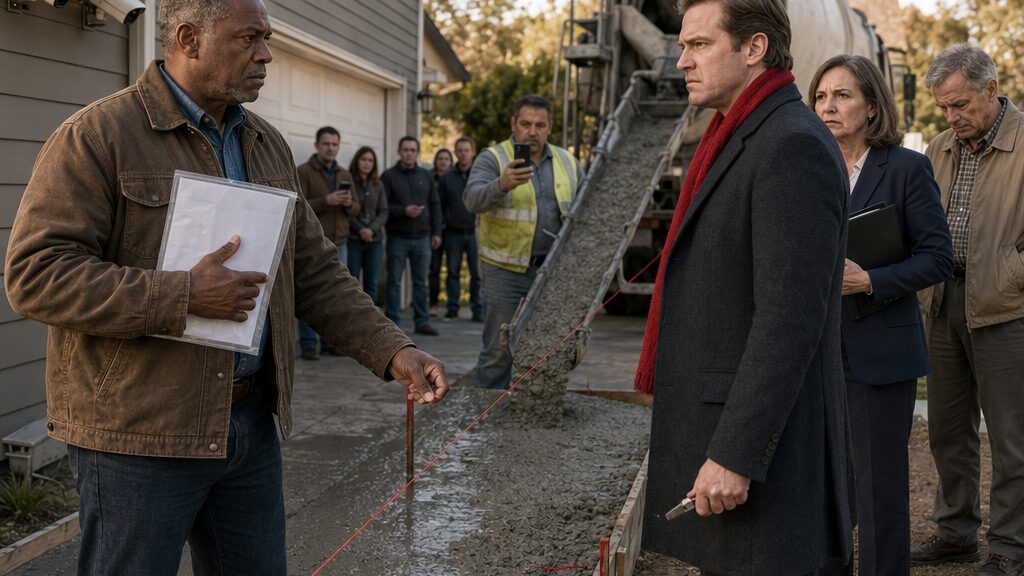
He Let His Neighbor Pour the Concrete, Then Made Him Face the Line He Crossed
Chapter 1: The Concrete Truck Arrived Before the Argument Was Finished
The concrete truck was already backing toward Paul Mitchell’s side garden when he stepped out with his coffee.
Its reverse alarm cut through the quiet Monday morning in hard, mechanical bursts. White lights blinked beneath the rotating drum. The driver watched his mirrors while a worker in a fluorescent vest waved him between Tyler Harris’s garage and the narrow strip of grass that separated the two properties.
The truck’s rear wheels crushed the edge of Paul’s mulch bed.
Paul set his coffee on the porch rail and walked down the driveway.
“Hold it.”
The worker lowered one hand, but the truck continued another foot.
Paul raised his voice just enough to carry over the engine. “Stop the truck.”
The driver braked.
Tyler emerged from his garage wearing clean work boots and a dark overcoat that looked too formal for a construction site. A red scarf hung loose around his neck. He carried rolled plans beneath one arm and smiled as though Paul had arrived to admire the project.
“Morning,” Tyler said. “They’ll be out of your way by lunch.”
Paul looked past him. Wooden forms had been set along the side of Tyler’s garage, running toward the backyard. The nearest board sat inches from Paul’s hydrangeas. A metal chute rested folded above it.
“What are you pouring?”
“Garage extension. Ground-level room behind it.”
“You didn’t mention an extension.”
“I mentioned improvements.”
“You said you were widening the garage door.”
Tyler opened the plans. “Wider garage, accessible entrance, small room in the back. Twelve feet total.”
Paul looked down the line of forms. Under the hedge, half-hidden by leaves and old mulch, a faded red survey stake leaned toward Tyler’s gravel.
“That form crosses the property line.”
Tyler glanced at the stake and shrugged. “That thing’s older than both of us.”
“It was here when you bought the house.”
“It was here when I bought the house because nobody bothered to pull it out.”
Paul walked to the nea
Chapter 4: The Approval That Was Never Complete
The stop-work notice appeared on Tyler’s front window before eight the next morning.
Its orange border was visible from the street. Beneath it, the new concrete sat pale and unmarked, already firm enough to hold the footprints of anyone foolish enough to test it. The red survey string still hovered over one edge, sagging slightly where the overnight moisture had tightened its knots.
Paul stood beside the county code-enforcement officer while she photographed the slab.
“The permit application was started,” she said, scrolling through her tablet. “But it was never completed. No structural review, no setback verification, no inspection schedule.”
Tyler came out carrying the orange notice he had peeled from the glass.
“My contractor filed everything.”
The officer did not raise her voice. “Your contractor uploaded a preliminary form. That is not an issued permit.”
“So this is paperwork.”
“This is construction without a permit.”
“And his survey?”
“That is a separate civil boundary issue. But based on the recorded plat and what I can see here, you should not build anything further until it is resolved.”
Tyler looked at Paul as if the officer had merely confirmed Paul’s talent for making trouble official.
Cynthia arrived ten minutes later with the property manager and two members of the board. Joseph came alone. He stopped near the curb rather than joining the cluster around Tyler.
Cynthia examined the notice.
“The association needs a meeting,” she said. “Today.”
Paul looked at her. “The county already met the concrete.”
“This now affects the entire community.”
“It affected the community yesterday.”
She ignored that. “We need to determine what the board approved and whether the application was materially inaccurate.”
Tyler laughed. “You approved the plans. Don’t start acting surprised.”
Cynthia turned toward him. “You represented that adjacent-owner concerns had been resolved.”
“They were.”
Paul felt Elizabeth shift beside him.
“No,” she said. “They were typed.”
Cynthia’s eyes moved to her.
Elizabeth held up a copy of the application. “My father never signed this. There is no email, no written acknowledgment and no date.”
Tyler’s jaw tightened. “He told me he didn’t object.”
“To work on your property,” Paul said.
The officer attached a second copy of the notice to a stake beside the slab.
“Nothing gets covered, framed or altered until the permit and boundary issues are resolved.”
Tyler folded the notice into quarters.
“My mother’s discharge date does not move because you people need another meeting.”
For the first time, the officer’s expression softened.
“I’m sorry about your mother,” she said. “But I cannot authorize an occupied structure built without review.”
Tyler looked away.
The HOA meeting room was full by six that evening. Cynthia had intended the session to be closed, but the dispute had already drawn too many neighbors, and the association attorney had advised that any vote affecting approval procedures should occur on the record.
Paul sat beside Elizabeth at the end of a long folding table. Tyler sat across from them. Joseph occupied the seat nearest the wall, a binder open in front of him.
Cynthia began with the careful language of someone trying to make a failure sound procedural.
“The board approved an exterior design based on the materials submitted. The association does not certify property boundaries, issue building permits or determine title.”
Paul placed the site sketch on the table.
“But you treated the approval as permission to proceed.”
“We approved the appearance and placement as represented.”
“The placement was represented without the property line.”
Cynthia folded her hands. “That is now clear.”
“It was clear before the pour.”
The room went still.
Cynthia glanced at Joseph.
Paul followed her eyes.
“Who reviewed the measurements?” he asked.
“The architectural committee,” Cynthia said.
“Who?”
Two board members exchanged looks. Joseph lowered his gaze to the binder.
Paul waited.
Finally, Joseph closed it.
“I reviewed the sketch.”
His voice was quiet, but the room carried it.
Paul leaned back slightly. “Did you notice the parcel line was missing?”
Joseph looked at Tyler, then at Cynthia.
“Yes.”
Elizabeth exhaled through her nose.
Cynthia turned sharply. “You never raised that during the vote.”
“I asked whether Tyler had spoken with Paul.”
“And I told you he had,” Tyler said.
Joseph’s face tightened. “You said the side-yard placement was understood.”
“It was understood.”
“Not by him.”
Tyler pressed both palms to the table. “My mother broke her hip. She can’t use my front steps. The contractor gave me one window before moving to another job. The loan lock expires in days. Everybody keeps pretending this is a patio I wanted for a barbecue.”
Joseph looked down at his hands.
“My wife used a wheelchair before she died,” he said.
The anger in Tyler’s face faltered.
Joseph continued. “I knew what delays do. I knew how many times people say accessibility matters until it costs them time or money. When your drawing lacked the boundary, I told myself Paul would speak if there was a real problem.”
Paul heard the sentence for what it was: an admission and an accusation aimed partly at himself.
“You saw the flaw,” Paul said.
“I saw a question.”
“And stayed quiet.”
“Yes.”
“Because you thought the reason was good enough.”
Joseph’s eyes met his. “Because I wanted it to be.”
No document could have surprised Paul more. Joseph had not been bribed, careless or ignorant. He had recognized the danger and chosen the version of silence that felt compassionate.
Cynthia called for a short recess. No one moved.
The board’s attorney joined by speakerphone. After reviewing the survey, application and permit record, he advised the board to rescind its approval immediately. The association could not cure an inaccurate submission by pretending it had never relied on it.
The vote was unanimous.
Cynthia signed the rescission.
For a moment, Paul experienced the clean satisfaction of seeing the process corrected. Then Tyler pushed back his chair.
“So that’s it? You erase one approval and leave me with a slab, contractor bills and nowhere for my mother to sleep?”
“The county has not ordered demolition yet,” Cynthia said.
“Yet.”
“The parties can negotiate.”
Tyler looked at Paul.
The anger was still there, but something desperate had moved beneath it.
“How much?”
Paul did not answer.
“For the strip,” Tyler said. “Name a number.”
“This is not a sale.”
“Everything is a sale when both people sign.”
Elizabeth glanced at her father, but Paul kept his attention on Tyler.
“You told me the line was wrong.”
“I’m saying we can solve it.”
“You told the crew to pour because you thought the concrete would solve it.”
Tyler’s mouth tightened. “The room has to fit a bed, a bathroom and turning clearance. If I move the wall inward, the garage loses width. If I move it back, the drainage trench has to be rebuilt. Every redesign costs time I don’t have.”
Cynthia slid a legal pad toward him. “A permanent easement could be considered through mediation.”
Elizabeth sat forward. “You approved the wrong plan, and now your solution is for him to give up the land?”
“Our solution is to avoid unnecessary loss.”
Paul looked toward the windows. Beyond the meeting room, porch lights dotted the development in even intervals. The neighborhood had always valued things that looked settled.
Joseph spoke from the wall.
“Removal is not the only remedy.”
Paul turned to him.
Joseph did not defend himself. “But it must be Paul’s choice.”
The next Tuesday, Tyler came to Paul’s house carrying an envelope.
He remained on the porch rather than stepping inside.
“I had the strip appraised,” he said.
Paul opened the envelope. The offer was more than four times the estimated market value of the narrow piece of land. It included payment of Paul’s survey costs, attorney expenses and new landscaping.
“You borrowed more money for this?” Paul asked.
“I found it.”
“That wasn’t my question.”
Tyler looked past him into the house.
“My mother’s current place has stairs to the only bathroom. I promised she would not go to a facility.”
Paul held the offer between them.
“I understand the promise.”
“Then sign the easement.”
There was no apology in Tyler’s voice. Not even a request. Only a new price attached to the same assumption.
Paul looked down at the number again.
It was enough to replace the roof, rebuild the deck and leave money untouched. It was far more than the strip was worth.
But Tyler was not paying for dirt.
He was paying for the right to make Paul’s refusal disappear.
Chapter 5: The Price of Keeping Everyone Comfortable
The civil mediator placed the permanent easement agreement in front of Paul and turned it so the signature line faced him.
The document was twelve pages long. It granted Tyler continued use of the encroached strip, transferred maintenance obligations and prevented Paul or any future owner from interfering with the structure.
Tyler sat at the opposite end of the table. Cynthia represented the HOA. The contractor’s insurer attended by video, a silent face in a small square on the wall monitor.
“The payment is substantial,” the mediator said. “It covers the value of the land, survey costs, legal review, replacement landscaping and an additional inconvenience allowance.”
Paul ran one finger along the lower edge of the first page.
“And the concrete stays.”
“Yes.”
“The false acknowledgment?”
Cynthia spoke before the mediator could. “The association will amend the file to state that no adjacent-owner signature was obtained.”
“Amend,” Elizabeth said from beside him. “Not remove.”
“The original record must be preserved.”
Tyler leaned forward.
“We can spend a year arguing about whose form had what line on it, or we can finish a room my mother can use.”
Paul looked at him. “You keep making those the only choices.”
“They’re the choices we have now.”
“They’re the choices you created.”
Tyler’s eyes hardened, then shifted toward the agreement.
“The slab is already there.”
There it was.
Not an accident. Not merely urgency. A strategy spoken plainly because he believed the hardest part had already cured.
Paul sat back.
“You thought once it hardened, I would give in.”
Tyler did not answer immediately.
The mediator glanced between them.
Finally, Tyler said, “I thought you would be practical.”
“Meaning?”
“Meaning you would look at six or eight inches of unused ground and compare it to tearing apart a finished foundation.”
“It was not finished when I warned you.”
“You were always going to fight it.”
“I was asking you to move the forms.”
“And lose the schedule.”
“So you decided I would lose the land.”
Tyler rubbed both hands over his face.
“I decided the project could not stop.”
The sentence was quieter than his earlier defenses. It also made them useless.
Paul looked down at the agreement again.
The narrow strip was not beautiful. It held mulch, two aging hydrangeas and part of a drainage channel. No child played there. No chair fit between the hedge and the garage. Its practical value was small.
That was what made surrender tempting.
The mediator called a break.
At home that evening, Paul opened an old storage box looking for photographs of the side yard before Tyler bought the neighboring house. He found utility bills, warranty papers and a stack of pictures held together by a faded rubber band.
In one photograph, his wife stood beside the hedge wearing gardening gloves and squinting into the sun. Behind her, bright and upright, was the original red survey stake.
Paul sat at the kitchen table.
He remembered the afternoon the stake had begun leaning. A landscaping crew had removed a damaged fence panel, and one worker had kicked loose soil around the marker. Paul had wanted to call the former neighbor and reset everything formally.
His wife had touched his wrist.
It’s still there, she had said. We don’t have to turn every small thing into a fight.
He had loved her ease with people. He had also hidden behind it.
Years later, when Tyler installed gravel along the garage, Paul noticed the marker had shifted again. He said nothing. The hedge covered the difference. Peace seemed cheaper.
Elizabeth entered through the back door and found him holding the photograph.
She sat across from him.
“That’s Mom.”
Paul nodded.
“And the stake.”
“Yes.”
She studied the picture. “So you knew it had moved.”
“I knew it wasn’t straight.”
“You could have fixed this before Tyler bought the place.”
“I could have.”
Elizabeth had arrived ready to argue. The admission took the force out of her.
Paul placed the photograph on the table.
“Your mother asked me not to fight over it.”
“She didn’t ask you to give it away.”
“No.”
“She also didn’t know what Tyler would do.”
“No.”
Paul looked toward the dark window over the sink.
“I made keeping things comfortable into a rule. Then I called it patience.”
Elizabeth’s voice softened. “You were trying to keep your promise.”
“A promise can become an excuse if the person you made it to is no longer here to correct you.”
The following afternoon, the contractor sent notices to both homeowners and the HOA. Unless responsibility was assigned within ten business days, the company would pursue payment through liens and litigation. The insurer denied full coverage because work had begun without an issued permit and continued after written notice.
Pressure moved outward.
Cynthia called twice. The mediator sent a revised agreement. Tyler sent no message at all.
Paul walked the property line at dusk. The concrete had lightened to an even gray. Near the rear corner, a short piece of the original red string remained trapped beneath the edge, its exposed end stained with cement.
Tyler came out of his garage.
For once, he wore no coat, no scarf, no polished shoes. His sweatshirt carried a streak of drywall dust.
“The contractor says the saw cut could damage the rest of the slab,” he said.
“They can shore it.”
“It could crack the foundation wall.”
“The wall has not been built.”
“The footing.”
Paul waited.
Tyler looked toward the concrete.
“My mother asked why the room wasn’t ready.”
“What did you tell her?”
“That there was a property issue.”
“Did you tell her you knew before the pour?”
Tyler’s mouth pressed into a line.
“No.”
“Why not?”
“Because she would tell me to tear it out.”
The answer surprised Paul.
Tyler kicked lightly at the gravel.
“She thinks taking help means owing people. She would rather go back to her house and crawl up the stairs than believe somebody gave up land for her.”
“Then why are you asking me to do it?”
“Because I’m not her.”
Paul looked at him.
For the first time, Tyler’s need did not arrive disguised as certainty. It was still selfish. It was also afraid.
“There is another design,” Paul said.
Tyler’s head lifted.
“The county planning desk gave Elizabeth setback options. Narrower garage bay. Room shifts toward the rear. The accessible entrance remains level.”
“That costs more.”
“Yes.”
“And delays everything.”
“Yes.”
Tyler laughed bitterly. “Easy for you to say.”
“No. It is simply mine to say.”
They stood beside the slab without speaking.
The next morning, mediation resumed.
The agreement waited in the same place. Cynthia had added a commitment that the HOA would pay part of the easement price through its insurer. Tyler had increased his offer again.
Paul slid the document back across the table.
“I’m not signing.”
Tyler stared at him.
The mediator asked, “Are you rejecting the payment or requesting different terms?”
“I am rejecting the easement.”
Cynthia leaned forward. “Paul, removal may cost every party more than this settlement.”
“I know.”
“It may reduce Tyler’s ability to complete any version of the project.”
“I know.”
“And the land involved is less than a foot wide.”
Paul looked at her.
“Then it should have been easy to stay off it.”
No one answered.
The contractor’s representative appeared on the screen and warned again about liens. The mediator explained the likely allocation process: Tyler’s direct instruction after notice, the contractor’s decision to continue, the HOA’s reliance on an incomplete sketch. Responsibility would be disputed, but not avoided.
Paul signed the removal authorization.
His hand remained steady.
The mediator took the page and placed it in the case file.
Across the table, Tyler watched the signature dry.
Chapter 6: The Saw Followed the Line Exactly
The jackhammers started at 7:03 in the morning, six minutes before Tyler came outside in a white bathrobe.
Paul stood near his porch with a mug of coffee warming both hands. The demolition crew had erected dust screens and laid protective mats across the grass. A compact saw sat beside the slab, its hose connected to a water tank. The recovered red survey string had been stretched between the stakes once more.
The demolition supervisor checked it against the stamped survey.
“Cut line follows this exactly,” he said.
Paul nodded.
A jackhammer bit into the rear edge of the encroaching section. The sound rolled between the houses.
Tyler burst through his side door.
“Stop!”
The operator released the trigger.
Tyler crossed the driveway, bathrobe open over sweatpants and a T-shirt.
“You cannot start without me.”
The supervisor held up a folder. “Notice was delivered three days ago.”
“I filed an objection.”
“The removal order is active.”
“I requested an emergency review.”
“The county denied the delay yesterday.”
Tyler looked at Paul.
“You knew?”
“Yes.”
“And you let them start before I came outside?”
“The notice listed seven.”
Tyler stared at the mug in Paul’s hands.
“You’re drinking coffee while they tear apart my mother’s room.”
“There is no room.”
“There would have been.”
“Not there.”
Several neighbors watched from porches and driveways. Paul could feel the same pressure that had surrounded the pour, but the balance had changed. Then Tyler had stood beside wet concrete and assumed completion would create permission. Now Paul stood beside authorized machinery with every right to humiliate him.
He chose not to.
Paul turned to the supervisor. “Give us five minutes.”
The crew stepped back. The silence after the jackhammer felt larger than the noise.
Tyler lowered his voice.
“If they cut that footing, I may lose the entire project.”
“The engineer approved the sequence.”
“Your engineer.”
“The insurer’s engineer.”
Tyler looked toward the dust screens. “The contractor says they should preserve the slab and settle damages.”
“The contractor also says you ordered him to continue after notice.”
“He could have refused.”
“He could have.”
Tyler’s anger moved across his face searching for somewhere to land.
“The board approved it.”
“The board rescinded it.”
“After Cynthia stood here and defended it.”
“She did.”
“So why am I the one losing everything?”
“You are not.”
Paul set his coffee on the porch rail and took a second folder from Elizabeth, who stood near the front steps.
He opened it on the hood of his truck.
“These are the revised drawings.”
Tyler did not approach.
Paul turned the pages so he could see them: a narrower garage bay, the accessible room shifted toward the rear, a level entrance from the driveway and a redesigned drainage channel fully inside Tyler’s parcel.
“The county completed an expedited preliminary review,” Paul said. “The dimensions work.”
Tyler finally stepped closer.
“You submitted plans for my house?”
“Elizabeth found an architect willing to revise your existing plan. I paid for the preliminary drawing.”
Tyler looked up sharply.
“Why?”
“Because removing what crossed the line does not require removing what your mother needs.”
The anger in Tyler’s face did not disappear. It lost its shape.
“This pushes the wall back.”
“Three feet at the front, less at the rear.”
“My truck won’t fit beside the ramp.”
“It will fit in the garage.”
“I use that bay for storage.”
Paul said nothing.
Tyler looked at the plans again.
“The room is smaller.”
“Yes.”
“But the bathroom works.”
“Yes.”
Tyler touched the page without picking it up.
Behind them, a car door closed. Cynthia and Joseph had arrived together. Cynthia carried a document case. Joseph carried nothing.
“The insurer finalized allocation,” Cynthia said.
Tyler straightened.
She removed three letters.
“The contractor’s carrier will cover the controlled removal and structural inspection, subject to its reservation of rights. The association’s insurer will cover part of the redesign and Paul’s legal and survey costs because approval relied on an incomplete application.”
“And me?” Tyler asked.
“You are responsible for the remaining removal cost, permit penalties and part of the redesign.”
“How much?”
She handed him the letter.
He read the number and closed his eyes.
“That wipes out the rest of the loan.”
Joseph spoke from behind Cynthia.
“The board also corrected the minutes.”
Tyler opened his eyes.
Joseph unfolded a statement.
“I submitted a written account that I noticed the missing parcel line before approval and failed to raise it formally. It is now part of the record.”
Cynthia’s jaw tightened, but she did not interrupt.
Joseph turned to Paul.
“I should have said it when the question first appeared.”
Paul looked at him.
“Yes.”
The answer was neither forgiveness nor cruelty. Joseph accepted it with a small nod.
Tyler stared at all of them—the board president, the engineer who had stayed silent, the neighbor who had refused payment and then paid for revised plans.
“What happens if I reject this?” he asked.
Cynthia said, “You may continue litigation. The removal still proceeds unless a court intervenes.”
“And if I accept?”
“The insurer releases funds today. The county reviews the revised permit on an expedited schedule. Your contractor has agreed to return after inspection.”
Tyler looked toward the slab.
The red string ran above it, bright against the gray.
“Five minutes are up,” the demolition supervisor said gently.
Tyler folded the revised drawings.
“Do it.”
The saw started first.
Water sprayed from the blade as it lowered into the concrete. The operator followed the surveyed line with deliberate precision. Gray slurry gathered along the cut, and the red string trembled in the machine’s vibration without breaking.
Paul picked up his coffee.
It had gone lukewarm, but he drank it anyway.
When the saw reached the rear corner, the crew exposed the short length of original string trapped beneath the slab. The cement-stained end emerged intact from the broken edge.
Tyler watched them lift the first section away.
“This was supposed to be ready before she came,” he said.
Paul stood beside him, not close enough to suggest comfort.
“It can still be ready for her. Just not on the original date.”
“You make delay sound cheap.”
“No.”
Paul looked at the crew stacking broken concrete into the loader.
“I know exactly what delay costs when you wait too long to say something.”
Tyler glanced at him.
Paul did not explain.
By noon, the encroaching strip had been removed. The remaining footing passed the engineer’s preliminary inspection. The hydrangeas were gone, but the crew rebuilt the drainage edge and left clean soil where the concrete had been.
No one applauded.
The neighbors drifted back inside once the machinery stopped. Cynthia left after signing the insurance documents. Joseph remained long enough to help roll the dust screens, though no one asked him to.
Tyler sat on his front step with the revised plans.
The civil mediator arrived with the final agreement. It assigned costs, released claims upon completion of the redesign and confirmed that no easement would be created.
Tyler read every page.
Paul waited near the property line.
At last, Tyler signed.
He carried the agreement over and held out Paul’s copy.
“The architect says the smaller plan will work,” he said.
Paul took it. “Good.”
Tyler looked toward the newly exposed strip of earth.
“I should have—”
The words stopped.
Paul waited, but Tyler could not finish them.
His face tightened with the effort, then closed again.
“I’ll have the contractor restore your landscaping,” he said instead.
“That is in the agreement.”
“Yes.”
Tyler nodded once and went inside.
Paul looked down at the recovered piece of red string lying beside the permanent stake. The concrete stain had stiffened half of it, but the unburied end still moved in the morning breeze.
The line had been restored.
What remained between the two houses was less certain.
Chapter 7: What Remained After the Concrete Was Gone
Tyler’s mother arrived in a gray sedan and entered the house without touching a single stair.
Paul watched from his driveway as Tyler unfolded a walker beside the new ramp. The redesigned entrance curved gently from the pavement to a narrower side door. The garage wall had been moved inward, the accessible room shifted toward the backyard, and a fresh drainage channel ran entirely inside Tyler’s property.
Six weeks earlier, Tyler had insisted none of that could be done.
Now his mother crossed the threshold slowly, one careful step at a time.
She paused beneath the doorway and looked back at the ramp.
“You built this?”
Tyler kept one hand near her elbow without touching it. “The contractor did.”
“That isn’t what I asked.”
He glanced toward Paul.
Paul had been replacing mulch around the new hydrangeas. He lowered the bag but did not approach.
Tyler’s mother followed his gaze.
“You’re the neighbor.”
“Yes, ma’am.”
She studied the repaired strip between the houses. A permanent metal boundary marker had been set into the ground near the front corner, flush enough not to catch a shoe. The red survey string was gone.
Almost gone.
Paul had kept the cement-stained piece in his garage.
Tyler’s mother looked at the narrower garage opening, then at the room behind it.
“He said there was trouble with the first plan.”
“There was.”
Tyler shifted his weight. “Mom, let’s get you inside.”
She ignored him.
“Was it on your land?”
Paul looked at Tyler before answering.
“Yes.”
Her mouth tightened.
“I told him not to build anything that required somebody else to be generous.”
Tyler’s face colored. “You didn’t know the details.”
“I knew you were in a hurry.”
“The discharge date moved twice.”
“And that made the property line move?”
Paul looked down to hide the beginning of a smile.
Tyler saw it anyway.
His mother touched his sleeve. “Take me inside. Then you can tell me the part you left out.”
Tyler guided her through the doorway. Before disappearing, she looked back at Paul.
“The ramp is good.”
“It is.”
“Thank you for whatever part of it was yours.”
Paul nodded.
He did not tell her about the preliminary drawings or the architect’s invoice. Gratitude was not the reason he had done it, and he did not want Tyler’s mistake transformed into a debt his mother had to carry.
That evening, a notice from the HOA appeared in every mailbox.
ANNUAL MEETING—BOUNDARY VERIFICATION POLICY.
Paul read it at his kitchen table while Elizabeth poured herself coffee.
“They want your endorsement,” she said.
“They want attendance.”
“They want both. Cynthia called me.”
Paul looked up. “Why did she call you?”
“Because you stopped answering after the third message.”
“I answered the first two.”
“You said you would review the proposal.”
“I reviewed it.”
“And?”
“It is better than what they had.”
Elizabeth sat across from him.
The draft required a licensed survey for additions within five feet of a property boundary. It required adjacent owners to sign acknowledgments by hand or through verified electronic consent. HOA approval letters would state in bold print that architectural approval did not replace county permits or establish ownership.
It was a good rule.
That did not make the process that produced it good.
“She wants you to stand beside her when she presents it,” Elizabeth said.
“No.”
“You should go.”
“I did not say I wouldn’t go.”
“You said no.”
“To standing beside her.”
Elizabeth smiled faintly. “There he is.”
Paul folded the notice.
Six weeks earlier, that comment would have irritated him. Now he understood it as recognition.
The annual meeting filled the clubhouse beyond its usual capacity. Residents occupied every folding chair, and several stood along the back wall. The concrete dispute had become neighborhood shorthand for every approval anyone had ever disliked.
Cynthia called the meeting to order.
She looked more tired than Paul remembered. The sharp efficiency remained, but some of its certainty had been worn away.
Joseph sat at the end of the board table with a printed statement in front of him.
Tyler arrived late and took a chair near the side wall. He did not look at Paul.
Cynthia presented the proposed policy in plain language. No project near a boundary would receive architectural approval without a current survey. No typed neighbor acknowledgment would be accepted. Permit numbers would be verified before work began.
When she finished, she turned toward Paul.
“Mr. Mitchell reviewed the policy and can speak to why these safeguards matter.”
Paul remained seated.
A quiet passed through the room.
Cynthia’s expression tightened for an instant. Then she corrected herself.
“Mr. Mitchell may speak if he chooses.”
Paul stood.
He did not walk to the board table. He remained beside his chair, among the homeowners whose names appeared on the same dues schedule as his.
“The policy is necessary,” he said. “I support it.”
Several people nodded.
“But the failure was not only that the old rule lacked a survey requirement.”
Cynthia kept her hands folded.
“The board received an incomplete drawing. Someone noticed the boundary was missing. The application claimed I had no objection when I had never signed anything. After a survey proved the problem, the board still treated its approval as more important than the property line.”
No one interrupted.
Paul looked toward Joseph.
Joseph met his eyes.
“A better form helps,” Paul continued. “It does not replace someone speaking when the form is wrong.”
Joseph rose from his chair.
“He is correct.”
Cynthia turned slightly toward him, but Joseph had already unfolded his statement.
“I reviewed the application. I noticed the parcel boundary was not shown. I did not require correction before voting because I believed delaying an accessibility project would cause unnecessary harm.”
He paused.
“My intention does not change the result. I remained silent while the board gave weight to information I knew was incomplete.”
The room stayed quiet.
There was no applause. Paul was glad for that.
Joseph sat down.
Cynthia looked at the proposed rule, then at Paul.
“The minutes will include both statements,” she said.
The policy passed without opposition.
After the meeting, residents gathered around the board with questions about fences, sheds and old decks. Paul moved toward the exit before anyone could ask him to retell the concrete story.
Tyler caught up near the door.
“My mother likes the room,” he said.
“I saw her arrive.”
“She says the smaller one is easier to move around in.”
Paul nodded.
Tyler shoved his hands into his jacket pockets.
“The garage is tighter.”
“I assumed so.”
“I sold one of the storage cabinets.”
“That sounds practical.”
Tyler gave a brief, humorless laugh. “You enjoy that word now?”
“No.”
They stepped outside.
The clubhouse parking lot was nearly empty. Beyond it, porch lights marked the curve of the street.
Tyler looked toward his house though it was not visible from there.
“I kept thinking the project was the promise,” he said. “Get the room done by the date. Keep her out of a facility. Don’t make her wait.”
Paul listened.
“I stopped asking what I was promising everybody else.”
The sentence was not an apology. It was closer than anything Tyler had managed on demolition day.
“You knew before the pour,” Paul said.
“Yes.”
“You used my silence.”
“Yes.”
Tyler looked at him.
“I am not asking you to say it is fine.”
“It is not.”
“I know.”
Paul waited.
Tyler took one hand from his pocket, then returned it.
“I’m sorry I made your no into something I thought I could outlast.”
The words came without polish. That made them easier to believe.
Paul did not offer forgiveness he had not yet decided to give.
“Your mother has a good entrance,” he said.
Tyler nodded. “She does.”
They walked to their separate cars.
The next morning, Paul carried the cement-stained piece of red survey string from his garage to the property line.
The permanent marker caught a thin edge of sunlight. It was small, plain and nearly level with the soil. No bright color warned anyone away. It did not need to.
Paul drove the old red stake into the mulch beside it. The wood was faded, one end softened by years underground. He tied the recovered string around its top, leaving the concrete-stiffened section visible.
Elizabeth came through the side gate carrying two cups of coffee.
“You’re keeping it?”
“Yes.”
“As evidence?”
Paul considered the question.
“No.”
She handed him a cup.
“Then why?”
He looked across the restored strip. Tyler’s new wall stood entirely beyond the marker. The ramp remained clear. Water moved through the rebuilt channel without crossing either yard.
“To remember that a line can exist before anybody respects it.”
Elizabeth followed his gaze.
“And after?”
Paul pressed the soil firmly around the old stake.
“After, it still has to be kept.”
From Tyler’s side of the property came the soft roll of a walker over the ramp, followed by his mother’s voice telling him not to hover.
Paul lifted his coffee.
Tyler appeared in the doorway. Their eyes met across the narrow space.
Neither man waved.
Neither looked away.
Between them, the permanent marker held its place, and the old red string moved lightly a