They Towed Eleven Cars Before Dawn, Then Nancy Found Her Name Beneath the Road
Chapter 1: Eleven Empty Driveways Before the Rain Stopped
The tow chain tightened with a metallic snap just as Ashley Flores came running into the street in pink slippers.
“Wait! That’s my car!”
Her robe flared behind her in the rain. One slipper slid sideways on the black pavement, and she caught herself against the sedan’s rear quarter panel as the tow truck lurched forward. The operator braked, but only long enough to lean out his window.
“Ma’am, step away from the vehicle.”
“My work bag is in there. My son’s booster seat is in there.”
Across the street, Kevin Mitchell stood beneath a golf umbrella with a clipboard tucked against his white shirt. Two more tow trucks idled behind him, amber lights sweeping over mailboxes and wet lawns.
“You received notice,” he said.
Ashley stared at him. “At four in the morning?”
“You received notice last week.”
“That was a warning about visitor parking.”
Kevin glanced at the clipboard. “The board adopted revised enforcement procedures.”
Nancy Lee watched from behind her front window, one hand still resting on the curtain. She had awakened to diesel engines and the hard clank of chains. For several seconds she had thought a utility crew was working on the storm drain. Then she saw Ashley in the street.
The tow operator eased forward again.
Ashley followed the car three steps before the second slipper came off. “Kevin!”
He did not raise his voice. That was part of what made him difficult. He spoke with the flat patience of someone explaining a rule to a child.
“People keep demanding exceptions because they don’t read the bylaws.”
Nancy opened her front door.
Cold rain speckled her glasses. The first truck carried Ashley’s sedan toward the subdivision entrance while the other operators moved methodically from one marked vehicle to the next.
Yellow notices glowed against windshields.
Nancy stepped onto the porch and saw one fixed beneath the driver-side wiper of her own car.
She did not remove it.
Instead, she went back inside, took her phone from the kitchen counter, and returned. She photographed the notice in place, then shifted slightly so the image also caught Kevin, the line of tow trucks, and the digital time reflected faintly across the glass.
5:18 a.m.
The notice accused her of overnight street parking and demanded a forty-dollar administrative penalty. Beneath that, in smaller type, it warned that unpaid violations could result in towing and restricted access privileges.
Nancy read it twice.
Her car was not in the street. Its right tires rested on the concrete apron at the end of her driveway. The left tires sat inches from the gutter because a section of the driveway had cracked and lifted after the last freeze.
Kevin crossed toward her, tapping the bottom edge of his clipboard against his palm.
“You need to move that by six.”
Nancy looked from the notice to him. “Who authorized the towing?”
“The association.”
“That isn’t a person.”
“The board authorized it.”
“Under what ownership interest?”
Kevin’s expression altered by less than a fraction. Most people would have missed it.
“This road belongs to the HOA.”
Nancy looked past him. Ashley stood barefoot under a neighbor’s porch roof, calling someone on her phone. Farther down the street, another resident argued with a driver who was already securing a pickup.
“How many?” Nancy asked.
Kevin followed her gaze. “How many what?”
“Vehicles.”
“Enough to make the rules meaningful.”
Nancy began walking.
She counted the empty spaces as she went. Ashley’s driveway. The pickup near the corner. A compact car from the townhouse end. Two work vans usually parked nose to tail. A nursing assistant’s hatchback. The older couple’s sedan beside the retention pond.
Eleven.
By the time she returned, the street looked unnaturally wide. Rainwater ran along the curb where tires had been. The absence of cars made the houses seem farther apart, as if the neighborhood had been emptied before anyone woke.
Kevin was waiting beside her mailbox.
“Two hundred dollars to release each vehicle,” he said. “Plus storage if they wait.”
“Your forty-dollar notice says nothing about two hundred.”
“The towing company sets its own fees.”
“Then the association is imposing a penalty through a private contractor.”
“We’re enforcing parking restrictions.”
Nancy held up her phone. “On whose land?”
Kevin gave a short laugh. “Nancy, I know you worked around property records once. That doesn’t make this complicated.”
“I didn’t say it was complicated.”
“Good. Pay the notice or appeal it.”
“And if I appeal?”
“It won’t change anything.”
He reached toward her windshield, pulled the yellow paper free, and tore it once through the middle.
The sound was small beneath the rain.
Kevin let both halves fall near the curb.
“There,” he said. “Now you don’t have to look at it.”
Nancy crouched and picked up the pieces.
He watched her flatten them against her palm. “You should worry less about paper and more about access. If that vehicle remains in violation, the board can restrict use of the common roadway to reach your driveway.”
Nancy stood slowly.
“Restrict access to my property?”
“To the association roadway.”
The words settled differently than the rest.
Association roadway.
Property line.
Access.
For the first time that morning, Nancy looked not at Kevin but at the pavement between them. Rain had gathered in the shallow seam where the asphalt met the concrete apron.
She remembered a blue line.
Not clearly. Only the color and the angle of it across an old sheet in a flat archival box. She had last opened that box before her husband died, when they had argued quietly at the dining room table about whether an old development defect mattered if everyone had lived with it for decades.
Let sleeping paperwork lie, he had said.
Kevin tapped the mailbox with his clipboard.
“You have until tomorrow morning.”
Nancy folded the torn notice along its original crease.
“Do you have the recorded deed for this roadway?”
Kevin’s smile disappeared. “The association has maintained it for thirty years.”
“That wasn’t my question.”
His shoulders stiffened. “Be careful what kind of problem you create here.”
Nancy met his eyes. “I’m trying to identify the one you already created.”
He turned away before she did.
Inside, she set the wet halves of the notice on a clean dish towel. Then she went to the small room that had once been her husband’s office.
The lower drawer of the map cabinet resisted before sliding open.
She removed tax plats, mortgage releases, an old survey, and a brittle development brochure. At the bottom lay a folded county plat in a clear sleeve, its edges softened by time.
Nancy carried it to the desk and switched on the lamp.
The subdivision appeared in black ink: lots, dimensions, drainage paths, easements. Down the center ran the private road.
A thin blue pencil line began at the boundary of Nancy’s parcel, turned beneath the asphalt, and continued almost to the cul-de-sac.
She leaned closer.
Beside the line, in her own handwriting from more than twenty years ago, were four words:
Underlying fee follows Lot 7.
Lot 7 was hers.
Chapter 2: The Blue Line No One Had Questioned
“The deed you’re expecting isn’t here.”
The county recorder clerk said it without drama, one hand still resting on the keyboard.
Nancy stood at the public counter with her old plat inside a protective sleeve. Behind the clerk, rows of gray filing cabinets filled the room beneath fluorescent lights.
“Try the developer’s corporate name,” Nancy said.
“I did.”
“There were two spellings in early filings.”
“I checked both.”
“The association may have taken title through a corrective deed.”
The clerk turned the monitor slightly, though Nancy could not see more than a list of instrument numbers.
“There’s a declaration. There are easements. There’s an assignment of maintenance obligations. There is no conveyance of the roadway parcel to the association.”
Nancy felt the old professional instinct rise in her—not excitement exactly, but the sharpening that came when an expected document failed to exist.
“Show me the assignment.”
The clerk printed the index page, then retrieved a scanned instrument. Nancy read it standing at the counter.
The developer had granted the association the right and duty to maintain the paved surface, drainage structures, signs, and landscaped margins. The instrument permitted collection of assessments for those purposes.
It did not convey the underlying land.
It did not mention parking enforcement.
It did not mention towing.
Nancy read the final page twice.
“What about the access easements to the individual lots?”
“Recorded with the plat.”
“Permanent?”
“It appears so.”
That word—appears—was careful and appropriate. Nancy had used it thousands of times herself.
She ordered certified copies of the plat, her deed, the maintenance assignment, and every indexed instrument connected to the roadway. The clerk stamped each certification in blue ink.
The round seal landed partly across the old boundary line.
Nancy watched it dry.
At home, she spread the documents across her dining table and built a chain of title from the original farm parcel forward. The developer had subdivided the land, sold the lots, and reserved broad access rights over the roadway. When Nancy and her husband bought Lot 7, the deed’s legal description included an irregular strip that ran beneath most of the subdivision street.
It was not obvious from the house-facing parcel map used for tax mailings.
It was obvious in the metes-and-bounds description.
Her husband had noticed it during refinancing. Nancy had traced it afterward, then found the incomplete maintenance assignment. They had discussed hiring counsel.
He had refused.
Thirty families use that road, he had said. Nothing good comes from making them think we can take it away.
Nancy had answered that ownership defects did not disappear through politeness.
Then they had folded the plat and put it away.
A knock sounded at the back door.
Ashley stood outside wearing jeans, a sweatshirt, and borrowed rain boots.
“They want four hundred and eighty-six dollars now,” she said as soon as Nancy let her in. “Tow, storage, after-hours release, and something called administrative processing.”
Nancy moved a stack of papers from one chair.
“Sit down.”
“I can’t sit down. I’m supposed to be at work in forty minutes.”
“Can someone drive you?”
“My sister can today. Not every day.” Ashley looked at the documents. “You found something.”
“I found that the road was never separately deeded to the association.”
Ashley went still. “So Kevin can’t tow people.”
“I didn’t say that yet.”
“You just said they don’t own it.”
“Ownership and regulatory authority aren’t always identical. There are easements, covenants, maintenance rights—”
“Can he tow cars or not?”
Nancy aligned the corner of the plat with the deed beneath it. “I need to read the declaration and any amendments.”
Ashley laughed once, without humor. “My supervisor told me if I miss another opening shift, they’ll move me off full-time.”
“I’m trying to make sure anything we do holds.”
“We?”
Nancy looked up.
Ashley folded her arms. “You knew where to look before anybody else even understood the question. That means you have a plan.”
“I have records.”
“That isn’t the same thing?”
“No.”
For Nancy, the distinction was absolute. A record could prove one element and mislead about another. A plan required knowing which rights survived, who had relied on them, and what remedy would not create a larger injury.
Ashley looked toward the window. Her empty driveway was visible through the bare branches between their houses.
“Kevin told the board chat that the tows will continue until every violation is cleared.”
“I’ll request the towing authorization.”
“When?”
“Today.”
“When will you tell everyone what you found?”
“When I can say what it means.”
Ashley’s face tightened. “People don’t need a lecture on title law. They need their cars.”
Nancy heard the accusation beneath the words, but she did not answer it. She gathered the certified copies into separate folders.
Ashley picked up one half of the torn yellow notice from the counter. Nancy had dried it and placed it beneath a glass paperweight.
“He did this?”
“Yes.”
“And you just picked it up?”
“Yes.”
Ashley put it down carefully. “You always look calm when you’re angry.”
“I’m not sure that’s true.”
“It is.”
After Ashley left, Nancy called the county right-of-way office.
Christopher Adams answered on the fourth transfer.
“Nancy Lee,” he said after she identified herself. “I thought you retired to avoid exactly this kind of call.”
“I retired from being paid for it.”
She explained the missing road conveyance, the maintenance assignment, and the towing sweep.
Christopher remained silent long enough that she could hear him turning pages.
“Send me the instrument numbers,” he said. “Not conclusions. Numbers.”
“I know how to make a referral.”
“I remember.”
By midafternoon, Nancy had requested towing invoices, board resolutions, and the property-owner authorization provided to the tow company. She also sent copies of the certified documents to the association by email and certified mail.
Kevin responded in eleven minutes.
The association possesses full authority over all common and maintained areas. Your attempt to interfere with enforcement may expose you to additional liability.
No deed citation. No parcel number.
At dusk, an envelope appeared beneath Nancy’s front door.
It had not come through the mail.
Inside was a new notice on bright yellow paper.
EMERGENCY ENFORCEMENT ACTION.
Her vehicle was scheduled for removal at six the following evening, during a special HOA meeting at the clubhouse. The stated basis was repeated noncompliance and obstruction of association operations.
At the bottom, someone had added a sentence in bold:
ACCESS PRIVILEGES MAY BE SUSPENDED PENDING BOARD REVIEW.
Nancy read it twice, then turned it over.
On the back, in Kevin’s handwriting, were five words:
Bring your old map, Nancy.
Chapter 3: The Chain Stopped Above Nancy’s Bumper
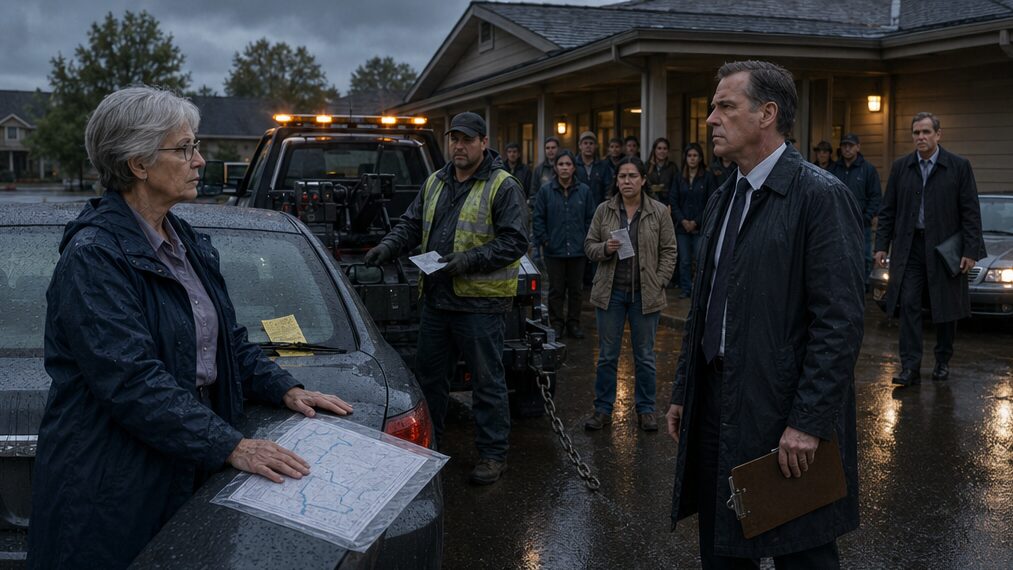
The tow operator had already hooked one J-arm beneath Nancy’s rear axle when she laid the certified plat across the hood.
Rain ticked against the plastic sleeve.
“Before you raise it,” she said, “I need you to read the owner authorization.”
The operator kept one gloved hand on the control lever. He was younger than Nancy expected, with water running from the brim of his cap.
“You need to talk to the association.”
“I am talking to the person whose license is attached to this tow.”
Behind him, the clubhouse doors stood open. Residents had gathered beneath the awning and along the curb, some carrying folded notices, others holding phones. Kevin stood near the truck’s cab with his clipboard and a dark raincoat buttoned to the throat.
“This is obstruction,” he said.
Nancy did not look at him. “May I see the authorization?”
The operator glanced between them.
Kevin stepped closer. “The association owns and maintains this roadway. Her vehicle is in violation. Proceed.”
Nancy pointed to the form clipped inside the truck’s open passenger door. “That document should identify the property owner or lawful agent authorizing removal.”
“You don’t get to inspect company records,” Kevin said.
The operator shifted his weight.
Nancy looked at him. “Does the authorization list a parcel number?”
He released the control lever.
Kevin’s voice hardened. “Do the job you were contracted to do.”
“Sir,” the operator said, “I need everybody to step back.”
Nancy did, leaving the plat spread across the hood. The blue county certification stamp overlapped the thin boundary line running beneath the drawn road.
The chain hung six inches below her bumper.
Kevin reached for the yellow notice tucked under Nancy’s wiper. “This is the controlling violation.”
“That is an association notice,” Nancy said. “It is not proof of ownership.”
He pulled it free. “You’re creating confusion to avoid a forty-dollar fine.”
He tore the duplicate notice down the center.
Several people murmured.
Ashley stood near the front of the crowd, arms folded tightly. She had recovered her car that afternoon after borrowing money from her sister. A white towing receipt protruded from her coat pocket.
Nancy watched the torn halves flutter onto the wet hood beside the plat.
Then she pointed to the authorization form.
“Read the parcel number aloud.”
The operator took the clipboard from the cab. His eyes moved down the page.
Kevin said, “This is private business.”
“It stopped being private when you sent three trucks down the street before dawn,” Ashley said.
The operator read the number.
Nancy slid a certified deed from her folder and placed it beside the plat.
“Now compare it with the legal description on that deed.”
“I’m not a surveyor,” he said.
“You don’t need to be. The parcel number is printed on the first page.”
He looked.
Rain collected at the lower edge of the plastic sleeve. Nancy held it flat with two fingers.
The operator checked the authorization again. “These don’t match.”
Kevin moved beside him. “The HOA is the managing authority for the entire subdivision.”
“The form says owner or authorized owner’s agent.”
“We are the authorized agent.”
“Authorized by who?”
“The governing documents.”
Nancy finally turned toward Kevin. “Which recorded instrument grants towing authority over my parcel?”
“The maintenance assignment gives the association control.”
“It gives the association responsibility for pavement, drainage, signs, and landscaping.”
“And enforcement necessary to preserve them.”
“That phrase does not appear in the document.”
Kevin’s face reddened. “You’re parsing language while the road deteriorates and residents treat it like overflow storage.”
A man beneath the awning called out, “My truck was in my own driveway.”
“Half of it was beyond the apron,” Kevin replied.
Another resident lifted a yellow notice. “Mine was at the curb for nine minutes.”
“We have photographs.”
“So does Nancy,” Ashley said.
The operator lowered the clipboard.
“I’m not taking this one.”
Kevin stared at him. “You have a contract.”
“I have an authorization that identifies the association as property owner. She has a certified deed with a different parcel number. Until somebody clears that up, I’m not attaching my name to it.”
“You already hooked the vehicle.”
“And I’m unhooking it.”
The release mechanism clicked.
The chain dropped away from Nancy’s axle and struck the pavement with a heavy, final sound.
For one brief moment, no one spoke.
Nancy felt the crowd shift toward her—not physically, but in expectation. They wanted a declaration. They wanted her to say Kevin had no authority, that every tow was invalid, that the road was hers and she would make everything right.
She could have said the first part with confidence.
The rest was not yet true.
Kevin stepped close enough that only she and the operator could hear him clearly.
“You think that map gives you the right to hold this entire neighborhood hostage?”
Nancy met his gaze. “I stopped an unsupported tow.”
“You’ve done more than that.” He turned toward the residents. “She is claiming private ownership of the only road serving thirty-two homes.”
Voices rose at once.
“Can she close it?”
“What happens to deliveries?”
“What about emergency vehicles?”
“My closing documents say I have access.”
Nancy raised one hand, but the questions kept coming.
Kevin faced her again. Some of his earlier smugness had disappeared. What remained looked more like fear.
“Tell them,” he said. “Tell them what you believe you own.”
Nancy looked down at the plat.
The blue line ran beneath the road, but pale arrows crossed it from every lot. Access easements. Drainage rights. Utility corridors. She had noticed them, of course. She had simply not yet decided how much they limited the leverage she thought she possessed.
“I hold the recorded underlying parcel interest,” she said. “That does not mean I can erase other recorded rights.”
“Can you stop us from using the road?” a woman asked.
“I don’t know yet.”
The answer produced a silence more uneasy than the shouting.
Ashley stepped forward. “But the HOA can’t tow from it?”
“The association has not shown clear authority to authorize towing from my parcel.”
“That’s not the same answer,” Kevin said.
“No,” Nancy replied. “It isn’t.”
A county sedan turned into the subdivision, its tires hissing across the wet street. Christopher Adams parked behind the tow truck and emerged carrying a narrow document case.
He took in the crowd, the disconnected chain, the plat on Nancy’s hood, and Kevin’s clipboard.
“I asked you to wait until I reviewed the instruments,” he said to Nancy.
“They were towing the car.”
Christopher’s mouth tightened. “That explains urgency. It does not explain certainty.”
Kevin moved toward him. “Are you here on behalf of the county?”
“I’m here because your office received a private-road inquiry involving possible unauthorized towing. I’m not here to decide a civil title dispute on the curb.”
Kevin pointed at Nancy. “She’s telling residents she owns the road.”
“I said I own the underlying parcel interest.”
Christopher opened his case and removed a copy of the recorded plat.
He placed it beside Nancy’s.
With a pen, he traced the blue boundary line. Then he tapped the series of access arrows crossing it from lot to lot.
“Nancy,” he said quietly, “you may own the ground.”
Several residents leaned closer.
Christopher’s pen stopped at the subdivision entrance.
“But that does not mean you own everyone’s way home.”
Chapter 4: Owning the Ground Was Not Owning the Answer
“No,” Christopher said, sliding Nancy’s proposed notice back across the desk. “You cannot post the road as private property and threaten residents with trespass.”
Nancy left her hands folded in her lap.
The county conference room had no windows, only a whiteboard crowded with faded marker stains and a table too large for the three people sitting around it. Christopher had placed copies of the plat, the maintenance assignment, and six individual deeds in separate rows.
“My deed includes the roadway parcel,” Nancy said.
“It appears to include the underlying fee interest.”
“Then the association cannot use it without my permission.”
Christopher tapped one of the homeowner deeds. “This family has a permanent right of ingress and egress.”
He tapped another.
“So does this one.”
Then another.
“Every lot I reviewed has some version of the same recorded access language. The rights vary slightly, but they do not vanish because the underlying land was never conveyed properly.”
Nancy looked at the plat.
The blue line still ran beneath the road, firm and continuous. Christopher had drawn pale arrows over it in pencil, one from each lot toward the subdivision entrance. They crossed her boundary like stitches.
“What can the association do?” she asked.
“Maintain the surface. Repair drainage. Replace signs. Collect assessments for those purposes, assuming the declaration supports it.”
“And towing?”
“I have not found automatic towing authority in the documents you gave me.”
“So Kevin was wrong.”
“On the authorization he presented to the tow company, likely.”
Nancy disliked the word likely.
Christopher noticed. “You taught half the people in this building not to make conclusions beyond the instrument.”
“I taught them not to hide behind caution when the record was clear.”
“The record is clear about some things and incomplete about others.”
He turned the plat so it faced her.
“You own the ground, Nancy. The residents own rights across it. The association has maintenance obligations over it. Nobody has the clean, complete control they have been pretending to have.”
Nancy took off her glasses and cleaned them with the edge of her sleeve.
“What happens to the fines?”
“The county does not void HOA penalties.”
“The penalties depend on authority over the road.”
“Then challenge them through the association process or civil court.”
“That could take months.”
Christopher’s expression softened, though his voice did not. “The towing company has paused removals pending review. That is the immediate protection I can help create.”
“Paused for how long?”
“Until the company receives legally sufficient authorization.”
Nancy replaced her glasses.
A pause was not a correction. It was space between injuries.
By the time she reached the subdivision clubhouse that evening, folding chairs filled the meeting room and people stood along the back wall. The disconnected tow chain had already become neighborhood legend. Several residents nodded when Nancy entered. One man raised his hand as if saluting her.
Kevin sat behind the board table with Maria Thomas and two other members. A printed sign on the wall read SPECIAL INFORMATION SESSION.
Ashley stood near the front.
She did not smile at Nancy.
Kevin opened the meeting by announcing that all towing and unpaid parking penalties were temporarily suspended.
A low murmur moved through the room.
“That includes storage charges?” Ashley asked.
“No,” Kevin said. “The towing company is a separate business.”
“You hired them.”
“The board contracted for lawful enforcement.”
“On land you said you owned.”
Kevin kept his eyes on the paper before him. “Ownership remains under review.”
Nancy heard several people repeat the phrase.
Under review.
It was the kind of language institutions used when they wished to retreat without admitting movement.
A resident near the aisle asked whether Nancy could block the road.
“No,” Christopher said from the side wall.
He had agreed to attend only after insisting he would not provide legal advice. Now he stepped forward and held up the plat.
“The recorded access rights remain. Ms. Lee’s underlying title interest does not permit her to deny homeowners reasonable access to their properties.”
The room changed.
Not loudly. Shoulders lowered. A woman near the door exhaled. Someone whispered, “Thank God.”
Nancy should have felt relieved for them.
Instead, she felt the weight of every gaze turning from gratitude to reassessment.
Kevin leaned back in his chair.
“So the road is not hers to control.”
Christopher looked at him. “That is not what I said.”
“It is what everyone needs to understand.”
“What everyone needs to understand,” Christopher replied, “is that control is divided. The association may maintain the road. Residents may use it. Ms. Lee appears to hold the underlying land. Towing authority has not been established.”
Ashley pulled the towing receipt from her coat pocket.
“Then who pays this?”
No one answered.
She turned toward Nancy. “When did you first think the road might be in your deed?”
Nancy felt the room narrow.
“The morning of the towing.”
“That morning?”
“I remembered the old plat after Kevin threatened my driveway access.”
Ashley stepped closer. “Before my car was released?”
“Yes.”
“Before the second truck took the nursing assistant’s car from the corner?”
Nancy knew the exact moment. She had been at the recorder’s office while that tow occurred. Ashley had called twice. Nancy had silenced the phone because the clerk was bringing out the maintenance assignment.
“I did not yet know what the documents meant.”
“But you knew enough to check.”
“I knew enough to avoid making a claim I couldn’t support.”
Ashley’s voice remained controlled, which made the words carry farther.
“You knew enough to save your own car.”
The room went still.
Nancy looked at the receipt in Ashley’s hand. The paper had been folded so many times the edges had softened.
“I was trying to make sure the challenge held,” Nancy said.
“While everyone else paid.”
“That is not fair.”
“No,” Ashley said. “It isn’t.”
Kevin watched them without interruption.
Nancy saw then how easily silence could become a tool for anyone in the room. She had believed hers was different because it served accuracy. Kevin believed his served order. Both required other people to trust what they had not been allowed to see.
Christopher announced that residents should preserve notices, invoices, photographs, and payment records. The board agreed to freeze new fines until counsel reviewed the documents.
It was a real gain.
No one applauded.
The meeting broke into clusters. People surrounded Christopher. Others pressed Kevin for copies of board resolutions. Ashley left through the side door before Nancy could reach her.
Nancy returned home carrying the plat under her arm.
The porch light revealed an envelope propped against her front door.
No stamp. No return address.
Inside was a photocopied memorandum dated six months earlier. The subject line read ROADWAY TITLE AND ENFORCEMENT RISK.
A blue line had been drawn beneath one paragraph:
Ownership of the underlying roadway remains unresolved. The association should not represent itself as fee owner or authorize removal of vehicles on that basis without further title review.
At the bottom of the page, beside the notation RECEIVED AND REVIEWED, were Kevin Mitchell’s initials.
A smaller sheet had been tucked behind the memo.
Nancy recognized Maria Thomas’s neat block handwriting.
He knew before the first tow.
Chapter 5: The Memo Kevin Chose Not to Read Aloud
Kevin’s initials were pressed so hard into the copy that the pen strokes had left shadows through three pages.
Nancy held the memorandum beneath her dining room lamp while Maria sat across from her, both hands wrapped around a cup of coffee she had not touched.
“You kept this?” Nancy asked.
“The board records room kept it.”
“Then why did you bring me a copy in secret?”
Maria looked toward the dark window.
“Because if I requested it officially now, Kevin would know before I got home.”
“He already knows the memo exists.”
“He knows it existed. He thinks the attorney’s file is privileged and the working copy was destroyed.”
Nancy lowered the pages.
The memorandum did more than question ownership. It advised the board to obtain a title report before expanding roadside enforcement and warned that towing from disputed private land could expose both the association and individual board members to liability.
“You were treasurer when this arrived.”
“Yes.”
“Did you read it?”
“Not at first.”
Maria’s voice was almost inaudible.
“Kevin summarized it as a paperwork problem the attorney would clear. By the time I read the full copy, the towing contract had been signed.”
“And you said nothing.”
“I asked questions.”
“In a closed board meeting?”
“Yes.”
“Where residents could not hear them.”
Maria finally looked at her. “You hid a plat in a drawer for twenty years.”
The sentence landed cleanly.
Nancy sat back.
Maria pushed the coffee away.
“I’m not saying that makes the towing right. I’m saying everybody in this room has reasons for believing delay is responsibility.”
“What was Kevin delaying?”
“An assessment.”
Maria opened a folder she had brought beneath her coat. Inside were balance sheets, insurance notices, and contractor bids.
The association’s reserve account held less than eighteen thousand dollars. The lowest estimate for drainage repair and resurfacing exceeded one hundred and forty thousand. The insurer had warned that coverage might not renew if the road defects remained uncorrected.
Nancy studied the figures.
“How did it get this low?”
“Years of keeping dues flat. Emergency tree removal. Two drainage failures. Legal fees from the fence dispute.”
“And towing revenue?”
Maria slid over a budget projection.
There it was: enforcement income.
Not enough to repair the road, but enough to pay the next insurance installment and postpone a special assessment until after the annual election.
“Kevin told the board strict enforcement would solve two problems,” Maria said. “Clear the roadway and create enough revenue to keep coverage active while we negotiated the repair loan.”
“He built a budget around violations.”
“He built a bridge.”
“With other people’s cars.”
Maria flinched.
Nancy regretted the sharpness but not the point.
“Why didn’t the board raise dues honestly?”
“We tried. Residents shouted us down. Some are choosing between medication and groceries. Others simply refuse to believe the road costs anything because it has always been there.”
“So Kevin decided they would pay without voting.”
“He decided fines were permitted under the declaration.”
“Parking fines, perhaps. Not towing from land the association falsely claimed to own.”
“I know that now.”
“You knew enough six months ago.”
Maria gathered the loose pages into a square.
“I knew enough to be afraid of every option.”
The following afternoon, Nancy and Maria entered the HOA records room under a written inspection request. Kevin was already there.
He stood beside three file boxes wearing shirtsleeves, his tie loosened. Without the clipboard and raincoat, he looked older.
“You should have asked me for the memo,” he said to Maria.
“I did in January.”
“You asked whether counsel had concerns.”
“And you said they were resolved.”
“They were being resolved.”
Nancy placed the copy on the table.
“By towing eleven cars?”
Kevin glanced at the document but did not touch it.
“The roadway had become unsafe. Delivery trucks could barely turn. Emergency access was compromised. We received complaints for months.”
“Then enforce restrictions you can lawfully enforce.”
“We did.”
“You represented the association as the property owner.”
“The association has maintained that road since before half these residents moved in.”
“Maintenance is not title.”
“Title is not the only source of authority.”
“Then show me the source you relied on.”
Kevin’s jaw tightened.
Nancy had expected arrogance. What she saw instead was exhaustion held together by habit.
He opened one of the boxes and removed photographs of cracked asphalt, standing water, and cars parked along both sides of a narrow bend.
“An ambulance lost three minutes here last winter,” he said. “Three minutes while a driver backed out because two residents refused to move their vehicles.”
“That does not excuse false authorization.”
“No. It explains why I stopped waiting for everyone to agree.”
Maria said, “You also stopped telling them the truth.”
Kevin turned on her. “The truth was that we had forty-six days before the insurance payment. The truth was that the repair assessment would be four thousand dollars per home if the loan failed. How many families do you think would survive that?”
“You should have let them decide,” Nancy said.
“They already decided. Every time they voted against higher dues.”
“That is not consent to undisclosed towing revenue.”
Kevin looked at her for a long moment.
“And you? Did your neighbors consent to you keeping ownership of their road in a cabinet?”
Nancy felt heat rise beneath her collar.
“I did not create the defect.”
“Neither did I.”
“You used it.”
“So did you when the chain reached your bumper.”
The records room seemed suddenly too small.
Nancy looked at the photographs again. The road damage was real. So were the towing receipts. Kevin had not invented the crisis. He had chosen a solution that depended on people not knowing what he knew.
That choice remained his.
By the end of the inspection, they found towing invoices spanning fourteen months. The recent dawn sweep had been the largest, but not the first. Revenue had gone into the general operating account, then toward insurance and drainage expenses.
Nothing suggested personal theft.
That almost made it worse. Kevin had converted improper authority into ordinary bills, allowing necessity to make the decision look reasonable.
Three evenings later, he came to Nancy’s house alone.
She opened the door but did not invite him in.
He carried a document envelope and eleven cashier’s checks.
“Full reimbursement,” he said. “Tow, storage, penalties. Every affected household.”
Nancy looked at the checks through the clear envelope window.
“What is the condition?”
Kevin handed her a second document.
A quitclaim deed.
It transferred Nancy’s underlying roadway interest directly to the HOA.
“No meeting?” she asked.
“Board approval is sufficient.”
“No resident review?”
“Their access rights remain unchanged.”
“And the title warning?”
“Becomes irrelevant once ownership is corrected.”
Nancy read the proposed consideration. One dollar and other valuable consideration.
“You want me to cure the defect privately.”
“I want to end the uncertainty.”
“You want the refunds to buy silence.”
“I want eleven people repaid before this becomes a lawsuit that consumes whatever money is left.”
“And you stay president.”
“If the board removes me, that is the board’s decision.”
“After you control the deed and the records.”
Kevin’s eyes moved to the torn yellow notice beneath the paperweight on her counter.
“You can punish me,” he said. “Or you can get people their money back.”
Nancy looked at the checks again.
Ashley could repay her sister. The nursing assistant could cover the fee that had overdrawn her account. Eleven families could be made whole by morning.
All Nancy had to do was sign before anyone else saw the terms.
Kevin placed a pen on top of the deed.
“This offer expires before the meeting,” he said.
Chapter 6: The Meeting Where Neither Side Could Hide
Eleven refund checks lay in a straight row beside the deed transferring the road to the HOA.
Kevin had arranged them on the board table before the clubhouse doors opened.
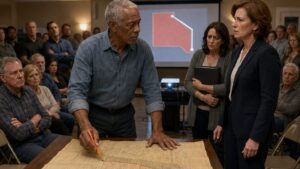
By seven, every chair was occupied. Residents stood against the walls and crowded into the hallway. The original plat had been enlarged and projected onto the screen behind the board, its blue boundary line bright enough to divide the room.
Nancy sat in the front row with a banker’s box at her feet.
Ashley took the chair beside her but left a space between their elbows.
Kevin called the meeting to order.
“We have an opportunity to resolve the towing dispute tonight without extended litigation,” he said. “The affected households will receive full reimbursement. The roadway title defect will be corrected. Maintenance and access will continue without interruption.”
He lifted the quitclaim deed.
“All that is required is Ms. Lee’s signature.”
A few residents turned toward Nancy.
A man in the back said, “Then sign it.”
Someone else asked when the checks would be distributed.
Kevin did not look triumphant. He looked prepared.
Nancy rose.
“What happens to the towing records?” she asked.
“They remain association records.”
“The title memorandum?”
“Counsel will determine retention requirements.”
“The board’s false claim of ownership?”
“The deed cures the underlying issue.”
“It does not cure what happened before the deed.”
Murmurs moved through the room.
Kevin kept his voice level. “No one is asking you to surrender anyone’s legal claim.”
“You are asking me to transfer the road before residents see the records.”
“I am asking you to prevent further damage.”
Nancy looked toward Ashley.
Ashley’s face gave her nothing.
Nancy bent, opened the banker’s box, and placed copies of the plat, deeds, maintenance assignment, invoices, budget sheets, insurance warning, and title memorandum on the front table.
Then she added one more document.
Her husband’s handwritten note from more than twenty years earlier.
Do not reopen unless access is threatened.
The words looked smaller beneath the projector light.
Nancy faced the room.
“My husband and I knew the road title was unresolved.”
The room quieted.
“We found the defect during a refinance. I traced the parcel. He asked me not to pursue it because he believed raising the issue would frighten the neighborhood and turn our home into a dispute.”
Kevin sat very still.
Nancy continued.
“I agreed. After he died, I kept agreeing, even though he was no longer here to ask me. I told myself I was preserving stability.”
Ashley’s arms unfolded.
“When the towing began, I remembered the plat. I did not tell all of you immediately. I waited for certified records because I wanted to be certain.”
She looked directly at Ashley.
“That delay protected my argument. It did not protect your car.”
Ashley’s mouth tightened.
Nancy did not look away.
“I was wrong.”
No one spoke.
The admission felt less dramatic than Nancy had imagined and more costly. There was no release in it, only the removal of a defense she had used for years.
She turned to the projected plat.
“The blue line shows the land beneath the road within my recorded parcel. These arrows show permanent access rights belonging to each home. The maintenance assignment gives the HOA limited responsibilities. None of those rights should belong to one person’s private interpretation—not Kevin’s and not mine.”
Kevin leaned forward.
“What is your alternative?”
Nancy lifted a draft agreement.
“A recorded shared-road trust. My underlying interest transfers to the trust, not directly to the board. Every lot receives a defined beneficial interest tied to access. Maintenance decisions remain with the association but require published budgets, independent review, and resident approval above a set amount.”
A resident near the wall asked, “Who controls towing?”
“No towing from the roadway without a publicly adopted policy, clear notice, and written authorization consistent with the recorded agreement.”
“What about the refunds?”
“They should be issued tonight without conditions.”
Kevin’s hand closed over the edge of the table.
“You are proposing a new legal entity, an audit, and amended governance documents. That will cost money we do not have.”
“It will cost less than litigation.”
“That is speculation.”
Maria stood from her seat at the board table.
“The association has less than two months of usable reserves.”
The room erupted.
Kevin turned toward her. “This is not the agenda item.”
“It is the reason for the towing plan,” Maria said.
She carried copies of the financial summary to the aisle.
“The road needs major repairs. Insurance renewal is at risk. The board used towing revenue to delay a special assessment.”
Several residents began speaking at once.
“You budgeted our fines?”
“How much is missing?”
“Did anyone take money?”
Maria raised her voice just enough to be heard.
“I found no personal payments. The money went to association expenses. That does not make the towing authority valid.”
Kevin stood.
“You all rejected dues increases for four consecutive years. You demanded repairs without paying for them. You complained about blocked access, cracked pavement, drainage, insurance, and enforcement. Every decision brought anger, so yes—I chose one.”
“You chose it alone,” Ashley said.
Kevin looked at her.
“I chose the option that kept the policy active.”
“And nearly cost me my job.”
His expression shifted, but he did not answer.
Nancy distributed the proposed resolution: suspend Kevin’s enforcement authority, authorize an independent audit, release refunds without requiring the deed, and direct counsel to prepare the shared-road trust for resident review.
The discussion lasted more than an hour.
Some residents feared the audit would expose them to higher dues. Others wanted the HOA dissolved, though Christopher, standing near the back, reminded them that drainage and road maintenance would still require money and organization. One homeowner wanted Nancy to keep the road personally because she was “the only person who understood it.”
Nancy refused.
“That would leave you depending on my judgment instead of Kevin’s. That is not a solution.”
Ashley finally took the microphone.
“I still think Nancy should have told us sooner.”
Nancy felt the room tighten again.
Ashley continued.
“But she just put every document she has on that table, including the one that makes her look bad. Kevin had six months to do the same thing.”
Kevin lowered his eyes.
“I don’t want Nancy owning the road,” Ashley said. “I don’t want Kevin owning it either. I want to know the rules before somebody takes my car.”
The motion went to a written vote.
Maria and a volunteer counted the ballots twice.
The audit and trust resolution passed by one vote.
No one cheered. Some residents looked relieved. Others looked sick at the thought of repair costs. A woman near the door quietly asked for a payment plan before any assessment was approved.
Kevin remained standing behind the board table.
“I challenge the validity of the vote,” he said. “The notice did not authorize transfer of a real-property interest or suspension of an elected officer.”
Maria closed the ballot box.
“The resolution directs counsel to prepare the transfer. It does not execute it tonight.”
“Then nothing has been solved.”
Nancy looked at the eleven checks.
“Something has.”
She picked them up and handed them to Maria.
“Distribute these without the deed.”
Kevin reached for the stack, then stopped.
Every person in the room was watching, but the decision belonged to him alone.
After several seconds, he withdrew his hand.
Maria called the affected residents forward one at a time.
Ashley accepted her check without looking at Kevin.
When the last envelope was gone, he gathered the unsigned deed.
“You may have won a vote,” he said to Nancy, “but I will contest the transfer, the audit, and my suspension.”
Nancy closed the banker’s box.
“Then the records will be reviewed where everyone can see them.”
Kevin folded the deed once, sharply, and walked out through the side door.
On the projector screen, the blue line remained beneath the arrows crossing it from every home.
Chapter 7: A Road Recorded for Everyone Who Lived There
“Do you understand that once you sign this, you cannot take the road back by yourself?”
The county recorder clerk held the final page above the counter, one finger marking the signature line.
Nancy looked through the glass partition at the document she had spent six weeks helping to shape. The old parcel description remained in the opening section. Beneath it came the access schedule, maintenance obligations, voting thresholds, audit requirements, and limits on enforcement.
Her name appeared once as grantor.
Every household appeared afterward as a beneficiary.
“I understand,” she said.
Christopher stood beside her with a document case tucked beneath his arm. Ashley and Maria waited several feet behind them. Kevin had arrived alone and taken a chair near the wall.
The clerk lowered the page.
Nancy signed.
Her pen crossed the printed reference to the old blue boundary line before curving beneath her name. For an instant, the ink looked darker where the two met.
The clerk checked the notary block, pressed the county seal into the paper, and carried the agreement toward the recording desk.
Nancy’s hand remained on the counter.
The road had belonged to her in the narrowest legal sense for decades. She had never paved it, cleaned its drains, or decided who crossed it. Yet giving up that narrow ownership felt less like transferring land than opening a locked drawer she had mistaken for safety.
Christopher glanced toward her.
“You can still change your mind until they assign the instrument number.”
“No,” Nancy said. “I changed it six weeks ago.”
The independent audit had arrived three days earlier.
It confirmed that the HOA had collected towing charges and related penalties without establishing sufficient authority over the roadway parcel. Eleven households from the dawn sweep were owed refunds, and five earlier tows required reimbursement as well. Every unsupported violation would be removed from homeowner records.
The audit also confirmed what no one wanted to celebrate.
The association’s reserve crisis was real.
The insurance warnings were real.
The drainage repairs could not wait another season.
No money had been stolen. Kevin had not paid himself or diverted funds to friends. He had used unauthorized enforcement revenue to cover legitimate obligations, convincing himself that the purpose cleansed the method.
The board removed him as president but did not expel him from the association. The audit report recommended that counsel review whether individual liability applied to the false owner authorizations. No one promised him immunity.
He had contested the resident vote for four weeks.
Then, the morning before the recording appointment, he withdrew the challenge.
Now he sat with his hands clasped between his knees, watching the clerk stamp the agreement he had once tried to obtain in private.
Maria walked over to him.
“You could have stayed home.”
“I live there,” Kevin said.
It was not an apology.
It was also not nothing.
The clerk returned with a receipt and instrument number.
“Recorded,” she said.
Ashley released a breath beside Nancy.
Christopher handed each of them a certified copy. Kevin accepted his last.
“The trust becomes effective immediately,” Christopher said. “The association retains maintenance responsibility under the new schedule. Enforcement policies require public notice, recorded authority, and a resident vote.”
Kevin looked at the pages.
“And the audit?”
“Continues on its own track.”
“So withdrawing the challenge changes nothing for me.”
“It changed the cost for everyone else.”
Kevin absorbed that. Then he nodded once.
Outside the recorder’s office, Ashley caught Nancy by the sleeve.
“My refund cleared.”
Nancy smiled. “Good.”
“I paid my sister back. Most of it.”
“Most?”
“She refused the gas money.”
They stood beside the county building while traffic moved through the intersection. Ashley’s tone softened.
“I still wish you’d told me sooner.”
Nancy looked down at the certified agreement in her hands.
“I still wish I had.”
Ashley waited, perhaps expecting an explanation.
Nancy did not offer one.
The mistake did not become smaller because she could explain its logic.
By the following week, the subdivision road had been milled and patched along its worst section. Drainage crews cleared the blocked inlet near the bend where the ambulance had lost time. Fresh asphalt darkened the surface, not smooth enough to disguise every old seam but sound enough to carry winter traffic.
The residents approved a special assessment after three meetings.
It was smaller than Kevin had feared and larger than many families could comfortably pay. Maria helped create an installment plan. Two households applied for hardship extensions. Nobody called the cost fair. They called it visible.
That difference mattered.
The eleven dawn-sweep households received corrected account statements. The five earlier towing cases took longer, but the board approved reimbursement after reviewing the invoices.
Kevin attended the first road-trust meeting from the back row.
He spoke once, asking whether the drainage contractor’s warranty covered settling at the cul-de-sac. His question was practical and irritatingly useful. No one thanked him. No one ordered him silent.
He was an ordinary homeowner now.
Nancy chaired no committee.
When asked, she said she would review documents but would not hold a permanent officer position. Ashley joined the resident oversight group. Maria remained treasurer under monthly reporting rules that placed bank statements in an online folder accessible to every household.
The old plat went into the community records box in the clubhouse.
Nancy made one final copy for herself.
She stored it without the blue pencil annotation.
On the first clear morning after the repairs, Ashley parked beside Nancy’s house and walked over carrying two cups of coffee.
“You know I’m legally parked,” she said.
Nancy looked at the tires. “Mostly.”
Ashley laughed and handed her a cup.
They crossed to the clubhouse together. Inside, the community records box sat on a low shelf beneath the meeting notices.
Nancy removed the two halves of the original yellow citation from her coat pocket.
She had kept them beneath the glass paperweight through every meeting, every records request, and every argument. The paper had dried stiff, the torn edges no longer matching perfectly.
Ashley watched her place both halves in a clear sleeve.
“You’re leaving that here?”
“Yes.”
“I thought you kept everything.”
Nancy slid the sleeve into the box beside the recorded agreement and closed the lid.
“Not everything needs to belong to me.”
Outside, a delivery truck turned onto the repaired road. Its tires crossed the place where Nancy’s blue line had once seemed to divide ownership from everyone else’s rights.
The truck continued toward the homes at the far end.
No one stopped it.
The story has ended.