The HOA Fined Margaret for Wednesday Bible Study, Then Her Ledger Exposed What the Board Had Buried
Chapter 1: The Notice Beside the Wednesday Photograph
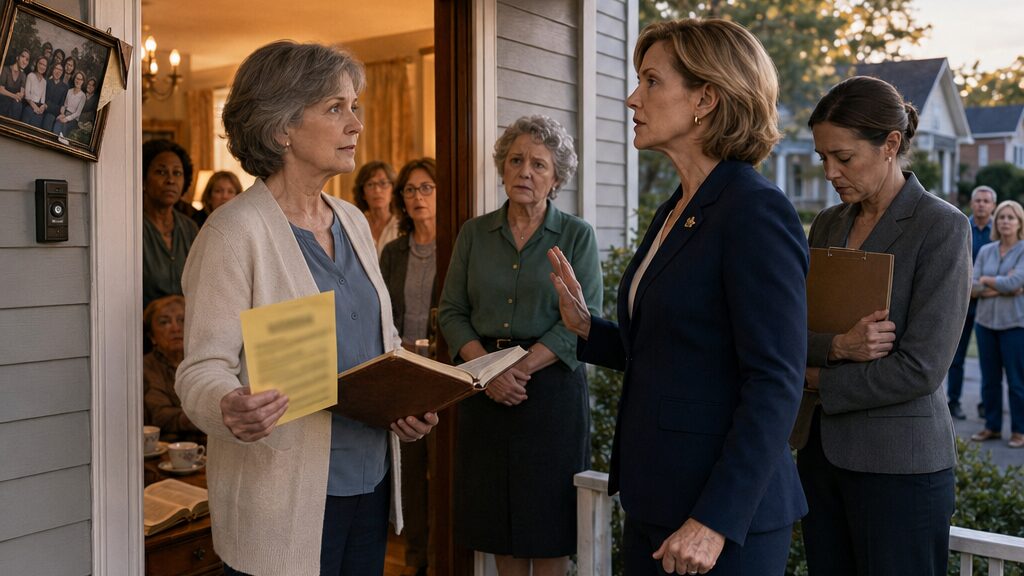
Nancy Baker pressed the strip of clear tape across Margaret Harris’s front door before Margaret had finished asking what she was doing.
The bright notice covered the lower corner of a framed photograph hanging beside the entryway—a picture of eight women crowded around Margaret’s dining table eleven years earlier, each holding a teacup and laughing at something outside the frame.
“Please don’t tape anything to the glass,” Margaret said.
Nancy smoothed the paper with the flat of her hand. Behind her stood a property-management employee holding a clipboard and staring determinedly at the porch boards.
“This is an official notice,” Nancy said. Her voice carried past the azaleas and into the street, where two neighbors were pulling into their driveways. “It needs to be visible.”
Inside the house, conversation had stopped. Margaret could feel seven women watching through the open doorway. The faint scent of chamomile drifted out with the cool air.
Margaret read the first line.
UNAUTHORIZED COMMERCIAL GATHERING.
Below it, in bold type, was a second violation for excessive noise and a demand for four hundred dollars within thirty days.
She looked at Nancy. “Commercial?”
“Donations are collected.”
“We put cash in a bowl twice a year for a missionary family.”
“That is a financial activity.”
“It is not a business.”
Nancy folded her arms. She wore a navy jacket despite the warmth, and a small gold association pin gleamed at her collar. “The board reviewed the matter.”
“The board met about my living room?”
“The board reviewed a compliance report.”
Margaret glanced at the employee. “Did you prepare it?”
The woman tightened her grip on the clipboard. “I documented the violation.”
“From inside the house?”
“From the public right-of-way.”
Ruth Jackson appeared in the doorway behind Margaret. “We’ve been meeting here since before half those houses were built.”
Nancy did not look at her. “Longevity does not create an exemption.”
A car slowed at the corner. Margaret saw the driver turn his head toward the porch. Nancy had placed the notice high enough for anyone walking past to read the heading.
Margaret reached up and peeled it carefully from the glass. The tape lifted part of the photograph’s paper backing where it had overlapped the frame.
“You are required to keep that posted,” Nancy said.
“Show me the rule.”
“It’s cited on the second page.”
Margaret turned the notice over. “Section seven, paragraph four?”
“Yes.”
“That section governs home-based businesses with customers, employees, deliveries, or exterior advertising.”
“The board’s interpretation includes recurring financial gatherings.”
Margaret read the noise citation. “Fifty-three decibels?”
“An average reading.”
“Measured where?”
“Across the street.”
“At what time?”
Nancy’s expression changed so slightly that another person might not have noticed. Margaret had spent thirty-seven years watching people react to questions they had hoped would not be asked.
“During last Wednesday’s gathering,” Nancy said.
“Across the street, with passing traffic?”
“The reading met our standard.”
“There is no residential noise limit of fifty-three decibels in the bylaws.”
“The board may adopt reasonable enforcement guidelines.”
“Where are those guidelines published?”
Nancy’s jaw tightened. “You may appeal.”
“To whom?”
“The compliance committee.”
“Who appointed them?”
“I did, as president.”
The answer settled over the porch more heavily than the accusation itself.
Ruth stepped closer. “Then what kind of appeal is that?”
Nancy finally looked at her. “The kind provided by the governing documents.”
Margaret folded the notice once, aligning its edges. Her pulse had begun to beat behind her eyes, but her hands remained steady.
On the hall table behind her lay a worn brown leather ledger. It had not been opened in years. She had placed it there that morning while cleaning the study, intending to decide whether to keep it or throw it away.
She picked it up.
The leather felt dry beneath her fingers. When she opened to the first blank page, a faint dust line marked the spine.
“What was the exact noise-guideline number?” she asked.
Nancy stared at the ledger. “I just told you.”
“You gave me a measurement. I’m asking for the adopted policy number.”
The property-management employee shifted her weight.
Nancy said, “You can request supporting documents through management.”
Margaret wrote down the date, the time, the number on the notice, and Nancy’s name.
Then she said, “I am requesting the complete enforcement record for this citation, all complaints relating to my address, the minutes adopting the decibel standard, and the testing records for the device used.”
Nancy gave a restrained laugh. “That is excessive for a four-hundred-dollar violation.”
“I’m not finished.”
The women inside had moved closer. Margaret heard the soft clink of someone setting down a cup.
“I also want four years of vendor contracts, bid records, ownership disclosures, and payments approved by the board.”
For the first time, Nancy’s practiced expression failed. It was not fear exactly. It was calculation—the quick inward movement of someone revising the shape of a problem.
“What do vendor contracts have to do with your Bible study?” she asked.
“I don’t know yet.”
Nancy lowered her voice. “Margaret, this does not need to become unpleasant.”
“It became unpleasant when you posted an accusation over a photograph of my friends.”
“I am enforcing standards evenly.”
“Then the records will show that.”
The property-management employee looked at Nancy, waiting.
Nancy took a step back. “You have thirty days to pay or file your appeal.”
“I will file a records request tomorrow.”
“The board is not obligated to indulge harassment.”
“A lawful inspection request is not harassment.”
“You are not acting as an auditor here.”
The words landed harder than Nancy could have known.
For one moment Margaret was back in a conference room years earlier, under white fluorescent lights, listening as an attorney repeated the same distinction: You were responsible, but you were not the only person responsible. It had not felt like mercy then. It had felt like public measurement of the exact size of her failure.
She closed the ledger.
Nancy mistook the silence for retreat. “Think carefully before you turn a minor compliance issue into something larger.”
Margaret met her eyes. “That is exactly what I’m doing.”
Nancy left with the employee, both walking too quickly to appear unhurried.
Inside, the tea had gone untouched. The women sat in a loose semicircle, their open Bibles resting on their laps, but no one looked at the page.
Ruth took the notice from Margaret and read it again.
“Four hundred dollars,” she said. “Maybe we divide it eight ways and be done with this.”
A few of the women shifted. No one agreed aloud, but no one challenged her either.
Margaret placed the damaged photograph face down on the hall table.
“It isn’t the amount,” she said.
“I know,” Ruth replied. “But peace has a price.”
Margaret looked at the folded notice, then at the closed ledger. “So does silence.”
After everyone left, she carried both items to the kitchen. She made a fresh cup of chamomile and forgot to drink it.
At the top of a clean ledger page, she copied the four categories Nancy had not expected her to request:
Vendor contracts.
Competitive bids.
Ownership disclosures.
Board-approved payments.
Then she drew a line beneath them and wrote one question.
Why did she ask what contracts had to do with the fine?
Chapter 2: Ten Business Days Without an Answer
At midnight on the tenth business day, Margaret refreshed her email for the final time.
The inbox remained unchanged.
No acknowledgment. No proposed inspection date. No explanation from the management office. Only a neighborhood message Nancy had sent that afternoon with the subject line PRESERVING CIVILITY DURING ENFORCEMENT MATTERS.
Margaret opened it again, though she had already read it twice.
The message did not name her. It did not need to.
Recent events, Nancy wrote, had shown that certain residents were responding to routine compliance actions with excessive and adversarial demands. The board would not allow personal grievances to disrupt planned improvements or undermine confidence in the association.
Below the signature was a new paragraph about an upcoming community renovation and the possibility of a dues adjustment.
Margaret printed the email and set it beside the original notice.
The old ledger lay open between them.
She had filled six pages in ten days: dates, calls, certified-mail receipts, governing-document references, and every discrepancy she could confirm. The writing looked familiar—small, exact, angled slightly forward. Seeing it again made her uneasy. It belonged to a version of herself who had believed that enough precision could prevent harm.
At nine the next morning, she walked into the management office carrying a copy of her request.
The property-management representative behind the desk recognized her immediately.
“We’re processing it,” the woman said.
“The statutory response period has passed.”
“We have a large volume of documents.”
“You have not proposed a time or format for inspection.”
“Our attorney is reviewing the scope.”
Margaret placed the certified-mail receipt on the counter. “Then please date-stamp this follow-up and note that I am copying the association’s attorney.”
The woman looked toward a closed office door. “Mrs. Harris, people usually don’t ask for four years of records over one fine.”
“Perhaps they should.”
The date stamp came down harder than necessary.
Margaret left with her copy and drove to the county records office. She had told herself she was only confirming corporate registrations. Nothing more. She would not infer misconduct from a name. She would not repeat the mistake of letting pressure turn a possibility into a conclusion.
The clerk directed her to a public terminal.
Greenfield Landscaping Group appeared within minutes.
The company’s registered organizer was Gregory Green.
Margaret sat still, reading the filing twice. Gregory was not only the HOA treasurer. His name appeared on every quarterly financial report she had received during the previous three years.
She searched for amendments, related entities, and business addresses. The registered office matched a small warehouse near the highway. No ownership-disclosure form appeared in the HOA meeting packets available on the association website.
Her first instinct was to photograph the screen and send it to Ruth.
Instead, she copied the filing number into the ledger.
A connection was not yet proof of an improper contract. Gregory might have disclosed it in executive session. The board might have obtained independent bids. The work might have been fairly priced.
Margaret repeated those possibilities until her breathing slowed.
When she returned home, Nancy’s email had already done its work.
A neighbor who usually waved from his mailbox looked down as Margaret passed. Another sent a polite message asking whether Wednesday meetings would continue, because “people were concerned about escalation.” Ruth called just before dinner.
“Are you suing the association?” she asked.
“No.”
“Nancy’s message makes it sound like lawyers are involved.”
“I copied the association attorney because management ignored the deadline.”
“You could have told us.”
“I didn’t want to involve everyone.”
“We’re already involved. Our cars are in your driveway every Wednesday.”
Margaret pressed her fingers to the edge of the ledger. “I am trying to keep this factual.”
“And quiet?”
“Yes.”
Ruth exhaled. “Those aren’t always the same thing.”
After the call, Margaret drafted a response to Nancy’s neighborhood email. She wrote that the board had missed a lawful records deadline. She added Gregory’s company registration and the absence of public disclosures.
Then she deleted the entire message.
If she accused him before seeing the contracts, Nancy would call it retaliation. Worse, Nancy might be right.
Three days later, a delivery truck stopped at Margaret’s curb.
The driver rolled six banker boxes up the walkway on a metal handcart. Each box bore a typed label: FINANCIAL RECORDS, VENDOR FILES, BOARD MATERIALS.
The top box also contained a letter stating that the production satisfied her request.
Margaret signed for the delivery and carried the first box to the kitchen.
By noon, invoices covered half the table.
Greenfield Landscaping appeared again and again: eighteen thousand five hundred dollars per quarter, approved by Gregory as treasurer and countersigned by another board officer. The descriptions were broad—seasonal maintenance, drainage support, landscape restoration, common-area services.
She checked the years.
The first box contained the current year. The next held the year before that. The third skipped backward two years.
Margaret opened every remaining box.
The same gap remained.
One full fiscal year was missing—the year Greenfield’s quarterly payments had first increased to eighteen thousand five hundred dollars.
She checked the production letter. It claimed all responsive vendor records had been supplied.
At the bottom of the last box lay an empty folder labeled GREENFIELD—EXECUTIVE REVIEW.
Margaret turned it upside down.
Nothing fell out.
Chapter 3: Rounded Invoices and Missing Signatures
Every quarterly Greenfield invoice ended in the same two numbers: five hundred.
Eighteen thousand five hundred for spring. Eighteen thousand five hundred for summer. The same for fall and winter. Storm cleanup, irrigation repairs, tree removal, ordinary mowing—it made no difference.
Margaret entered each amount into a spreadsheet while the old ledger lay open beside her laptop. The paper columns and electronic cells formed parallel records, one built for calculation and one for judgment.
By Saturday afternoon, she had found another pattern.
The invoices contained no labor hours. No material quantities. No separate equipment charges. No change orders. Some referenced work orders that were not included in the boxes. Others used identical language across different seasons.
She wrote at the top of a ledger page: Rounded billing is a risk indicator, not proof.
Then she underlined not proof.
The distinction mattered because anger had begun to make the numbers feel simpler than they were.
On Sunday morning, Margaret walked the common areas with copies of selected invoices in a folder. The neighborhood looked maintained. Grass had been cut along the entrance road. Crepe myrtles had fresh mulch rings. A drainage channel behind the clubhouse had been cleared recently enough that the red clay still showed beneath the straw.
Near the retention pond, three Greenfield workers were replacing broken sections of pipe.
The crew supervisor recognized the logo on Margaret’s folder.
“You with the board?” he asked.
“No.”
“Then I probably shouldn’t discuss invoices.”
“I’m not asking what you charge. I’m trying to confirm what work was performed.”
He wiped his hands on his work pants. “We do what they call us for.”
“Did your company repair drainage behind the west row of homes last year?”
His expression sharpened. “After that storm? Yes, ma’am. We worked four nights.”
Margaret showed him an invoice labeled seasonal landscape restoration. “Would that have included the drainage repair?”
“I don’t write the bills.”
“Was it a significant job?”
“We had two pumps running, a mini excavator, six men. Water was getting close to foundations.”
There was nothing about emergency drainage on the invoice.
“Why would it be described as landscape restoration?”
He looked toward the other workers. “You’d need to ask Gregory.”
“Was the work necessary?”
“Yes.”
“Was it completed?”
“Yes.”
His answer was immediate and without defensiveness.
Margaret thanked him and walked back toward the clubhouse.
The finding should have weakened her suspicion. Instead, it changed its shape.
Real work had been done. Potentially important work. But the invoices concealed what the work actually was, making it impossible for homeowners to evaluate the cost or understand where reserve funds had gone.
At home, Margaret separated the questionable amounts into categories.
Confirmed conflicted payments.
Unsupported rounded charges.
Documented work with unclear pricing.
Missing records.
She refused to total them together.
By late afternoon, she had calculated a defensible range rather than a dramatic number. At minimum, tens of thousands of dollars lacked adequate documentation or independent approval. At maximum, if the missing records showed no bidding and no disclosure, the exposure could exceed two hundred thousand.
The range annoyed her. It lacked the force of a single figure.
It was also honest.
Ruth arrived carrying a paper bag of sandwiches and found Margaret surrounded by invoices.
“You’ve turned the kitchen into an office,” she said.
“Only temporarily.”
“You said that about the dining room after your husband died.”
Margaret looked up.
Ruth removed two cups from the cabinet without asking. “The others want to know whether Wednesday is still happening.”
“Yes.”
“Here?”
“Yes.”
“With the violation still open?”
Margaret closed one invoice. “Nancy has not prohibited the meeting.”
“She has told everyone you are threatening improvements.”
“I am requesting records.”
“You keep saying that as though procedure makes people less frightened.”
Margaret opened the reserve study she had found at the bottom of a board-materials box. The cover was five years old.
“This is what should frighten them.”
The report recommended major contributions for road resurfacing, clubhouse roofing, pond stabilization, and drainage replacement. The board had funded barely half the suggested annual amount. A handwritten note in the margin proposed delaying three projects.
Ruth read the summary. “Is the association broke?”
“No. But the reserves are dangerously weak.”
“So Nancy wasn’t lying about needing more money.”
“No.”
The word tasted inconvenient.
Margaret showed her the Greenfield invoices and explained the missing detail, the ownership connection, and the absent year.
Ruth listened without interrupting. “Could Gregory have done the work cheaper than someone else?”
“Possibly.”
“Could Nancy believe she was protecting the neighborhood?”
“Possibly.”
“Then what exactly are you proving?”
Margaret looked at the spreadsheet.
“That they concealed decisions homeowners had a right to understand.”
“But not that every dollar was stolen.”
“No.”
Ruth leaned against the counter. “You sound disappointed.”
“I am being careful.”
“You sound disappointed that the truth is complicated.”
Margaret turned back to the ledger. “Complicated truth is still truth.”
The doorbell rang.
No one stood on the porch. An envelope had been placed beneath the mat.
Inside was a single sheet of paper with no signature.
YOU ARE LOOKING AT THE INVOICES, NOT THE VOTE.
Below the sentence was a date from the missing fiscal year and a notation:
Closed executive session—emergency vendor authorization.
At the bottom, written more faintly, were two words.
Ask Paul.
Chapter 4: The Former Board Member Who Stayed Silent
Paul Nelson admitted he had voted for the contract before Margaret had even sat down.
They stood in his garage between a workbench and a row of metal shelving crowded with paint cans, extension cords, and labeled plastic bins. Paul kept the side door open, though the afternoon heat pushed through it in waves.
“I voted yes,” he said. “That’s the part you need to understand first.”
Margaret held the unsigned note inside a clear folder. “Did you leave this at my house?”
Paul looked toward the street. “I’m not answering that.”
“Then why did you ask me to come?”
“Because you’re about to tell sixty people something that is true in one direction and false in another.”
“I haven’t told anyone anything.”
“You will.”
He nodded at the brown ledger beneath her arm.
Paul had served on the HOA board for six years before resigning without explanation. Margaret remembered him as the person called when clubhouse doors failed or irrigation timers flooded the entrance median. He rarely spoke at meetings unless a repair involved measurements.
“Start with the vote,” she said.
Paul leaned against the workbench. “The storm hit the west side three summers ago. The drainage trench backed up. Water was within inches of two foundations. The reserve study said the whole system needed replacement, but we hadn’t funded it.”
“Who is we?”
“The board. Me included.”
“And Gregory?”
“Told us he could put crews out that night.”
Margaret opened the ledger. Paul glanced at the handwriting, then at her face.
“I know that book,” he said.
“No, you don’t.”
“I saw your picture in the business paper years ago. Same kind of ledger on the table.”
Her fingers stopped.
Paul’s expression changed, as if he regretted saying it but not enough to take it back. “I’m not trying to insult you.”
“Then stay with the association records.”
“We authorized emergency work in executive session. Gregory brought pumps, equipment, labor. He probably saved those houses.”
“Why hide it inside landscaping invoices?”
“Because emergency drainage repair wasn’t in the approved budget. Neither was the retaining-wall failure two months later. Nancy said if we showed the actual overruns, homeowners would panic before we could present a recovery plan.”
“Nancy was not president then.”
“No. She was the loudest person arguing against Gregory’s contract.”
Margaret looked up.
Paul gave a bitter half smile. “That surprised you.”
“What changed?”
“She won the election.”
“That does not explain it.”
“It explains more than you think.”
He crossed to the shelving and removed a dented file box. Inside were old meeting packets, maintenance photographs, and copies of board emails. He did not hand the box to her.
“When Nancy campaigned, she promised to restore the entrance, renovate the clubhouse, stabilize the pond, and hold dues steady for one year. Then she saw the reserve numbers.”
“She knew before the election that the study existed.”
“She knew the summary. She didn’t know how many projects had been pushed.”
“So she protected Gregory.”
“She decided the neighborhood couldn’t survive another public fight. Gregory agreed to keep doing work without immediate payment on some items. Later, he rolled those amounts into quarterly invoices.”
“Without bids.”
“Yes.”
“Without disclosing his ownership.”
Paul stared at the floor. “Everyone knew Gregory owned the company.”
“Everyone on the board?”
“Yes.”
“Everyone paying dues?”
“No.”
“That is not disclosure.”
“I know.”
“Did Nancy know it violated the conflict policy?”
“She knew it looked bad.”
Margaret wrote the words exactly.
Paul reached toward the ledger. “Don’t put my name in that.”
“You asked me here to give information.”
“I asked you here so you wouldn’t accuse people of stealing money that paid for actual work.”
“I have not accused anyone of theft.”
“You will if you stand up there with two hundred thousand dollars on a screen.”
“I calculated a range.”
“Nobody remembers ranges. They remember the biggest number.”
His warning was fair, which made it harder to dismiss.
Margaret closed the ledger. “Will you provide copies of the executive-session records?”
“No.”
“Will you confirm this at a meeting?”
“No.”
“Then what do you expect me to do?”
“Tell them the contracts were bad. Tell them the process was wrong. But don’t make me the person who proves it.”
“You voted for it.”
“I also argued against continuing it. That part never made the minutes.”
“You want accountability without being accountable.”
Paul’s face tightened. “You know something about one mistake following a person.”
The garage seemed to narrow around them.
He had found the point he could use against her, whether he meant to or not.
Margaret had spent years refusing to discuss the audit that ended her career. A junior accountant had entered an accrual incorrectly. Margaret, exhausted and eager to close the engagement, had signed before checking one supporting schedule. The company corrected the filing. No investor lost money. No one was charged. None of that changed the fact that her signature had been on the opinion.
“You read a newspaper article,” she said.
“I read that you corrected the error yourself.”
“After I signed it.”
“And you resigned.”
“That was my decision.”
“Was silence part of the decision?”
She stared at him.
Paul looked away first. “You’re asking me to do what you didn’t do.”
“I accepted responsibility.”
“You disappeared.”
The side door creaked. Ruth stood there holding a covered dish.
“I knocked at the house,” she said. “A neighbor told me you were here.”
Paul swore under his breath.
Ruth’s gaze moved from him to Margaret, then to the open file box.
“What mistake?” she asked.
“No one said mistake,” Margaret replied.
“You did,” Paul said quietly. “Years ago.”
Ruth waited.
Margaret lifted the ledger, suddenly aware of how much it resembled a shield.
“This is not relevant to the HOA records.”
“That’s what Nancy will say,” Paul warned. “Then she’ll make it relevant.”
Ruth set the dish on the workbench. “Margaret, did something happen when you were an accountant?”
“It was resolved.”
“That isn’t what I asked.”
Margaret’s instinct was to close the conversation, leave the garage, and work alone until the evidence could speak without needing her. She had done that before. Precision had been safer than explanation.
But Ruth’s expression was not accusing. It was hurt.
“I signed an audit opinion before one schedule was fully checked,” Margaret said. “There was an error. I found it, corrected it, and resigned after the review.”
“Why didn’t you ever tell us?”
“Because it was mine to carry.”
Ruth shook her head. “You keep deciding what other people are allowed to carry with you.”
Paul looked between them. “This is why Nancy will win if you hide anything. She doesn’t need to disprove your numbers. She only needs to make the room wonder what else you left out.”
Margaret picked up the file folder.
“Will you give me one document?” she asked Paul. “Not your statement. The vote notice.”
He hesitated, then removed a photocopy from the box. The executive-session notice listed emergency vendor authorization but no vendor name, amount, or conflict disclosure.
Margaret placed it in the folder.
At her front door, Ruth stopped her.
“Are you hiding mistakes in this investigation too?”
Margaret looked at the ledger in her hands and understood that a correct answer would not be enough unless she was willing to show how she had reached it.
Chapter 5: Sixty-Two Names Beneath One Request
Ruth signed the petition before Margaret had finished explaining what it asked for.
They sat at the dining table Wednesday morning with eight blank signature pages, the open ledger, and cups of chamomile neither of them had touched.
“I still think paying the fine would have been easier,” Ruth said.
Margaret looked at the signature.
“But easier for whom?”
Ruth capped the pen. “Exactly.”
The petition requested an emergency membership meeting to review vendor conflicts, reserve spending, enforcement practices, and the missing executive-session records. Margaret had written each subject beside a corresponding page reference in the ledger so no accusation stood alone.
By noon, they had seven signatures.
By two, Nancy’s counterpressure had begun.
A homeowner at the end of the block opened her door only a few inches. “I was told signing could delay the pond work.”
“Reviewing the finances may delay it,” Margaret said.
“Then why would I sign?”
“Because the current plan asks you to pay more without showing where the previous money went.”
The woman glanced toward the street. “I don’t want my name on a side.”
“This is a request for a meeting.”
“Everything here becomes a side.”
She closed the door gently.
At another house, a man showed Margaret three violation letters: one for a basketball hoop left at the curb, one for a trash bin visible after noon, and one for landscaping changes made five years earlier.
“When did these begin?” Margaret asked.
“After I questioned the clubhouse renovation estimate.”
He signed.
A widow two streets over produced a fine for a visiting nurse’s car that had remained overnight. Another homeowner had been cited for placing campaign signs two inches beyond the approved window after asking why dues statements no longer included reserve balances.
The pattern was not universal. That made it more credible. Most residents had received nothing. The people cited were often those who had asked questions publicly.
Margaret noted dates and rule numbers but refused to add conclusions.
By evening, they had twenty-six signatures.
Nancy called just after Margaret returned home.
“I would prefer to speak privately,” she said.
“We are speaking privately.”
“I mean in person.”
Nancy arrived ten minutes later without her board pin. She stood in the kitchen while Margaret left the petition visible on the table.
“You have made your point,” Nancy said.
“What point is that?”
“That the violation attracted more attention than it was worth.”
Margaret waited.
Nancy placed an envelope beside the ledger. Inside was a draft letter withdrawing the $400 fine.
“No payment,” Nancy said. “No adverse record. You may continue meeting on Wednesdays.”
“In exchange for what?”
“Nothing formal.”
“Then there is something informal.”
Nancy’s gaze moved to the petition. “Withdraw the records demand. Stop circulating claims about Gregory. Let the finance committee complete its work.”
“There is no independent finance committee.”
“The board is the finance committee.”
“That is the problem.”
Nancy’s control slipped. “You think I wanted this? I walked into a reserve fund that could not cover one major failure. Roads were deteriorating. The pond wall had shifted. The clubhouse roof leaked over electrical wiring. The previous board deferred everything.”
“So you hid it.”
“I managed it.”
“You classified my Bible study as commercial.”
“I needed residents to understand that standards would be enforced.”
“You selected someone you expected not to fight.”
Nancy did not answer.
That silence was more honest than anything she had said.
Margaret pushed the withdrawal letter back. “Cancel the fine without conditions. The meeting request continues.”
“You are going to cost every household money.”
“The repairs already cost money.”
“You have no idea what happens when property values start falling. People blame the person in charge. They do not remember who deferred the work ten years ago.”
“Then tell them the truth.”
Nancy’s laugh held no humor. “Truth is easy when you are retired and have nothing left to lose.”
Margaret felt the old shame rise before she could stop it.
“I lost my career because I signed something before I had checked enough,” she said. “I will not help you ask this neighborhood to sign another dues increase before they have checked enough.”
Nancy looked at her differently.
“So that is what this is,” she said. “A second chance.”
“No. It is the first chance these homeowners have had to see the records.”
Nancy picked up the envelope. “Gregory employs twelve people. If you freeze his contract, those men lose hours. If the drainage fails, the same residents applauding you will ask why you stopped the work.”
“I am not asking anyone to applaud.”
“You will enjoy it when they do.”
Margaret opened the door. “The fine may be withdrawn. The petition will not be.”
Nancy left without another word.
The next morning, Greenfield trucks did not arrive.
By nine, Gregory had sent a message to the board and copied several homeowners. Until accusations against his company were resolved, he wrote, Greenfield could not continue discretionary services. Any resulting landscape deterioration, blocked drainage, or safety hazard would be the responsibility of those interfering with the contract.
The message spread faster than the petition.
Two people withdrew their signatures.
One man called Margaret and demanded to know whether his basement would flood.
She told him she did not know.
That answer cost her three more signatures.
At the dining table, Ruth watched Margaret draw a line through each withdrawn name.
“You could reassure them,” Ruth said.
“With what?”
“That emergency work will continue.”
“I cannot promise that.”
“You could say the board has other options.”
“I do not know whether it does.”
Ruth folded her hands. “Then tell them what you do know—including the part about your audit.”
Margaret looked at the remaining pages.
That afternoon, at each door, she changed her explanation.
She told residents that some Greenfield work had been real and necessary. She told them the reserve fund was weak. She told them an audit might cost money and repairs might still require higher dues. Then she told them she had once signed an opinion too quickly and would not ask them to trust her without seeing her calculations.
Some refused.
Others signed because she had stopped offering them a clean victory.
At the fifty-eighth house, a homeowner placed the petition on the hood of his truck and signed beside a ledger reference.
“You’re saying this might still cost me?” he asked.
“Yes.”
“But at least we’ll know why?”
“That is the purpose.”
He handed back the pen. “That should have been the purpose all along.”
By sunset on the second day, sixty-two names filled the pages.
Margaret laid the petition beside the open ledger. Around it sat eight cold cups of chamomile from the Bible study Ruth had quietly moved to the dining room while neighbors came and went.
The threshold in the bylaws was fifty-eight.
Margaret emailed the petition to management, the board, and the association attorney.
Nancy responded twelve minutes later.
The petition is invalid. No emergency meeting will be scheduled.
Beneath that sentence she cited a procedural rule Margaret had never seen in any published version of the bylaws.
Chapter 6: The Meeting Nancy Could Not Cancel
Gregory’s chair was empty when Margaret walked to the podium.
The clubhouse had been arranged for confrontation: board members behind a long raised table, homeowners in folding chairs below them, a projector facing a white screen. Nancy sat at the center with the association attorney on one side and the HOA secretary on the other.
The emergency meeting was taking place because the attorney had overruled Nancy’s rejection. The procedural rule she cited belonged to an outdated draft that had never been adopted.
Sixty-two signatures had been enough.
Margaret set the brown ledger beneath the projector’s light.
Nancy leaned toward her microphone. “Before Mrs. Harris begins, the board wishes to remind everyone that allegations are not findings.”
Margaret plugged in her laptop. “I agree.”
A murmur moved through the room.
On the screen appeared the photograph from Margaret’s entryway, its lower corner torn where the violation notice had been taped across it. Beside it she displayed the $400 citation.
“This is where the review began,” she said. “Not because four hundred dollars would bankrupt me, and not because I believe religious gatherings are exempt from ordinary rules. It began because the cited rules did not match the conduct, the noise standard had not been formally adopted, and the appeal would have gone to a committee appointed by the person who issued the violation.”
Nancy’s face remained still.
Margaret advanced to the enforcement log.
Five residents who had questioned spending had received citations within ninety days of doing so. Other residents with similar violations had received warnings or nothing.
“This does not prove every citation was retaliatory,” Margaret said. “It does show enforcement was not applied consistently.”
A homeowner in the second row raised his folded violation letters but said nothing.
Nancy interrupted. “This meeting was requested to discuss finances.”
“The enforcement records explain why financial questions were discouraged.”
Margaret displayed Gregory’s business registration, then the quarterly invoices.
“Greenfield Landscaping Group received repeated payments of eighteen thousand five hundred dollars per quarter. Gregory Green served as HOA treasurer during those payments. I found no ownership disclosure in the records produced to homeowners, no competitive bids for the continuing arrangement, and no documented recusal from approval.”
The empty chair beside Nancy seemed to enlarge.
Margaret showed the spreadsheet. She did not lead with the maximum figure.
“The records support a minimum range of payments lacking sufficient documentation or independent approval. The higher estimate exceeds two hundred thousand dollars, but I am not presenting that number as proven loss.”
A voice called from the back, “Why not?”
“Because work was performed.”
The room quieted.
Margaret displayed photographs of the repaired drainage channel and the old reserve study.
“Greenfield crews completed emergency drainage work that may have prevented damage to homes. The reserve fund was also materially underfunded before Nancy became president.”
Nancy shifted slightly.
Margaret continued. “Those facts do not cure an undisclosed conflict. They do mean the issue is more complicated than theft.”
The clubhouse door opened.
Gregory entered carrying a banker box.
Every head turned.
He walked past the rows without looking at Margaret and set the box on the board table.
“The missing year,” he said.
Nancy’s face changed. “Gregory, we discussed—”
“No,” he said. “You discussed.”
He removed folders and placed them in front of the attorney.
Margaret remained at the podium. “Are those the executive-session invoices?”
“And work orders. Crew logs. Equipment rentals.”
“Why were they not included in the production?”
Gregory looked toward the management representative. “I was told they were privileged.”
The attorney opened one folder. “Financial records do not become privileged because they were discussed in executive session.”
Nancy leaned toward him. “Some documents contain legal advice.”
“Then those portions may be reviewed separately.”
Gregory faced the homeowners.
“When the west drainage failed, I had men who needed work and equipment sitting idle. My wife had been in treatment for six months. I was behind on payroll taxes and trying not to lay people off.”
He paused, his hands gripping the chair in front of him.
“I told myself the neighborhood needed the work and I could do it faster. Both were true. I also made money. That is true too.”
No one moved.
Nancy said, “The board approved emergency authorization.”
Paul Nelson stood near the wall.
“I voted for it,” he said.
Margaret saw several people recognize him.
Paul walked to the center aisle but did not approach the podium. “I voted to hire Gregory during the storm. I also voted later to continue quarterly billing without bids because we had already buried costs in the landscaping category and did not want homeowners to see how weak the reserves were.”
Nancy’s voice sharpened. “You resigned before the recovery plan.”
“I resigned because I did not want my name on it.”
“That does not make you honest now.”
“No,” Paul said. “It makes me late.”
The line landed without drama because he did not ask forgiveness.
Margaret looked at the open box. The evidence she had wanted was finally in the room, but it did not give her the clean case she had once imagined.
Gregory produced photographs of flooded trenches, pump rentals, and crew time sheets. One work order showed four nights of emergency labor. Another showed repairs to a retaining wall near the playground.
“These jobs were real,” he said. “Some invoices were higher because I carried unpaid balances from earlier work. Nancy wanted the totals flat so monthly statements would look predictable.”
All eyes turned to her.
Nancy lifted her chin. “We were buying time.”
“With inaccurate descriptions,” Margaret said.
“With continuity,” Nancy replied. “Had we announced that reserves could not cover urgent drainage, every homeowner trying to sell would have suffered. Contractors would have demanded payment up front. Insurance questions would have started. We needed one year to stabilize the accounts and pass the renovation package.”
“You fined residents who asked questions.”
“I enforced rules.”
“You used enforcement to protect the plan.”
Nancy’s voice lowered. “I protected the neighborhood from panic.”
Margaret thought of the offer in her kitchen, the withdrawn fine, the promise that everything could remain quiet if she stopped asking.
She could now present Nancy as the architect of every concealment. The room was ready for it. She felt that readiness like a current.
Instead, she turned to the final slide.
It contained no accusation. Only four recommendations.
Independent forensic audit.
Immediate suspension of conflicted contracts pending review.
Publication of executive-session financial decisions where legally permitted.
Temporary finance committee with open monthly reporting.
A man in the front row said, “You want to suspend Greenfield after proving they kept homes from flooding?”
“I want emergency services separated from a no-bid recurring contract,” Margaret said. “The board can authorize necessary safety work while an independent review determines fair payment.”
“And the dues increase?”
“Paused until the reserve position is verified.”
“So we may still pay more.”
“Yes.”
The answer produced an uneasy silence.
Margaret rested one hand on the ledger.
“I made a professional mistake years ago because I signed before I had checked enough. I corrected it, but I also left the profession and stopped letting anyone see how uncertain judgment can be before it becomes final. I will not ask this community to replace the board’s certainty with mine.”
She looked at Gregory.
“Some work was necessary.”
Then at Paul.
“Some people objected too late.”
Then at Nancy.
“And some concealment was deliberate.”
Nancy’s face had lost its color, but she did not look away.
Margaret closed the laptop. “The records should be released. An independent reviewer should decide what was reasonable, what was excessive, and what must be repaid. The purpose is not to produce one villain. It is to stop requiring homeowners to trust decisions they are not permitted to examine.”
No applause followed. Margaret was grateful for that.
Instead, people began speaking at once—about flooded yards, fixed incomes, property values, Gregory’s employees, Nancy’s enforcement letters, and the cost of an audit.
The association attorney tapped the microphone.
“There is one matter the membership may decide tonight,” he said. “Whether to direct the board to release all executive-session financial records not protected by attorney-client privilege.”
Nancy leaned forward before he could finish.
“Then we will vote,” she said. “But everyone in this room should understand what disclosure means. It may expose mistakes made by prior boards, increase audit costs, delay repairs, and confirm that additional dues are unavoidable.”
Her eyes moved across the homeowners and stopped on Margaret.
“You asked for the full truth. Now decide whether you are willing to pay for it.”
The secretary distributed ballots.
Margaret remained beside the open ledger while sixty-two petitioners and dozens of uncertain neighbors bent over slips of paper, choosing whether the cost of knowing was greater than the cost of remaining protected from it.
Chapter 7: What the Ledger Could Not Repair
The disclosure vote passed by four ballots.
For several seconds, no one spoke. The HOA secretary checked the count twice, sliding the paper ballots into two neat stacks as though a straighter edge might change the result.
Forty-three in favor.
Thirty-nine opposed.
The association attorney read the numbers into the record. A few people exhaled. Someone near the back muttered that the vote would cost them all. There was no cheering.
Margaret remained beside the podium with one hand resting on the open ledger. The page beneath her palm held the original rule number from the violation notice, the date Nancy had posted it, and four categories Margaret had once intended to investigate alone.
Vendor contracts.
Competitive bids.
Ownership disclosures.
Board-approved payments.
Now the same questions belonged to everyone in the room.
Nancy sat behind the board table, her shoulders straight. She waited until the secretary had gathered the ballots before moving the microphone closer.
“The membership has spoken,” she said. “The board will comply with the lawful scope of the resolution.”
The phrase lawful scope drew a low murmur.
Nancy continued. “I will also submit my resignation as president, effective upon appointment of an interim officer.”
The room shifted again, this time with surprise.
Gregory stared down at the banker box he had brought. Paul stood near the wall with both hands in his pockets.
Nancy removed the small gold association pin from her jacket and placed it beside the microphone.
“I do not agree with the suggestion that every decision made during my term was dishonest,” she said. “The neighborhood had serious deferred obligations. Some of you demanded improved roads, drainage, landscaping, and property values while opposing every increase necessary to pay for them.”
A man in the third row started to answer, but the attorney raised a hand.
Nancy looked directly at Margaret.
“You have forced open records that should have been handled better. That is true. You have also damaged confidence in the community I was trying to protect.”
Margaret felt dozens of people turn toward her.
The accusation was not entirely false. That made it heavier.
“The confidence was already damaged,” Margaret said. “Most people simply did not know why.”
“You think knowing repairs it?”
“No.”
Nancy’s expression hardened, but a small uncertainty passed through it.
Margaret closed the ledger.
“Exposure is not repair,” she said. “It only tells us where repair has to begin.”
Nancy gave a short nod that might have been acknowledgment or dismissal. Then she stood, collected none of the papers in front of her, and walked out through the side door.
No one followed.
The meeting continued for another two hours.
The attorney explained that an independent audit would require proposals from outside firms. Greenfield’s recurring contract would be suspended pending review, but emergency drainage services could be authorized separately if weather or safety required them. The planned renovation package and dues increase would be paused until the actual reserve position was verified.
Each answer produced another question.
Who would pay for the audit?
Could the board recover excessive payments?
Would insurance cover any governance failures?
How long could the pond repairs wait?
Could Gregory submit bids in the future?
Gregory answered the last question himself.
“Not while I’m treasurer,” he said.
He removed a folder from the banker box and pushed it toward the attorney. “My resignation too.”
A homeowner asked whether that was an admission.
Gregory’s mouth tightened. “It is an admission that I should never have approved payments involving my own company.”
“And the money?”
“The audit can decide what was fair.”
“That isn’t an answer.”
“No,” Gregory said. “It isn’t.”
Margaret watched him gather the remaining work orders into chronological order. His hands were rough and nicked around the fingernails. She thought of the crew supervisor near the retention pond, of pumps running through the night, of invoices made deliberately vague because vagueness had served everyone in authority.
Useful work did not excuse concealed profit.
Concealed profit did not make every useful act false.
The room had wanted one clean answer and received a ledger full of separate ones.
Before the meeting adjourned, the membership approved an interim finance committee. Margaret expected someone to nominate her as chair.
Instead, Ruth stood and said, “Margaret should serve, but she should not have to hold it alone.”
The wording saved her from refusing.
The committee would include five homeowners, none currently on the board. Monthly bank reconciliations, contract summaries, reserve transfers, and meeting minutes would be posted in a shared portal. Any member with a financial interest in a vendor would be required to disclose it in writing and leave the vote.
Paul volunteered to help assemble old maintenance records but did not ask for a committee seat.
“That’s probably wise,” Ruth told him.
He accepted the judgment without argument.
Near midnight, Margaret returned home carrying the ledger, the damaged group photograph, and a copy of the resolution. The bright violation notice still lay in a kitchen drawer.
The next morning, management emailed a formal withdrawal.
The $400 charge was canceled.
The commercial-gathering designation was removed from her account.
No violation would appear in future resale disclosures.
Margaret read the message once and felt almost nothing.
For weeks, the fine had represented the entire injury. Now it looked small beside the contracts, the missing records, the divided vote, and the knowledge that several neighbors would soon blame her when audit invoices arrived.
By afternoon, the first complaint did.
A handwritten note appeared in her mailbox.
HOPE YOUR PRINCIPLES PAY THE ACCOUNTANT.
The next day, a neighbor stopped her near the curb and asked whether she was pleased that the clubhouse roof would be delayed.
“I am not pleased,” Margaret said.
“You got what you wanted.”
“I wanted accurate records.”
“And now we have to pay someone to tell us we’re short of money.”
“We were short before the vote.”
“That does not make the bill easier.”
“No.”
The neighbor seemed dissatisfied by her refusal to fight.
At the first interim committee meeting, the outside auditor estimated that the review would cost less than residents feared but more than anyone welcomed. Preliminary reserve calculations suggested the original dues increase had been too large, though some increase would still be necessary after years of deferred funding.
The board had not invented the shortage.
It had hidden its shape.
Gregory’s invoices would be tested against crew logs, equipment rentals, comparable market rates, and the emergency work actually performed. Some payments might be justified. Others might require reimbursement or negotiation.
Margaret copied the engagement scope into her ledger, then stopped.
The other committee members already had printed copies.
She looked around the table. A retired teacher was checking dates. A small-business owner had highlighted contract clauses. Ruth was arranging bank statements into monthly groups.
Margaret tore the pages containing her index from the ledger carefully along the binding.
Ruth looked up. “What are you doing?”
“Making copies.”
“You hate people writing in your records.”
“They are not my records.”
At the community printer, Margaret duplicated the index for every committee member. She handed the original pages to Ruth.
“Keep these with the shared file.”
Ruth accepted them without making the moment larger than it was.
Three days later, Nancy came to Margaret’s house.
She did not step onto the porch. She remained on the walkway where she had once stood watching the notice go up.
“I received the audit request,” she said. “They want my emails.”
“They want everyone’s relevant emails.”
“I know.”
Margaret waited.
Nancy glanced toward the repaired photograph beside the doorway. “I should not have cited your Bible study.”
“No.”
“I thought you would pay it.”
“I know.”
Nancy’s lips pressed together. “That does not mean the financial problems were imaginary.”
“I know that too.”
“You will still have to recommend higher dues.”
“Probably.”
“And people will blame you.”
“Some already do.”
For the first time, Nancy looked tired rather than controlled.
“I meant to fix this place,” she said.
Margaret believed her.
“You decided people could not be trusted with the condition it was in.”
“They would have panicked.”
“Some would have.”
“And voted down everything.”
“Possibly.”
Nancy looked toward the street. “Then perhaps nothing would have been repaired.”
“Perhaps. But it would have been their failure too.”
Nancy considered that, then shook her head.
“You make shared failure sound noble.”
“It is not noble. It is only shared.”
Nancy did not apologize. Margaret had not expected her to.
Before leaving, she said, “The fine was never about the tea.”
“No,” Margaret replied. “It was about choosing someone quiet.”
Nancy walked back toward her house.
The following Wednesday, the Bible study did not meet at Margaret’s.
Ruth had moved it to her own living room while Margaret’s kitchen remained crowded with committee binders and copied statements. Eight cups waited on Ruth’s coffee table. The women sat close together, their books open, conversation low.
Margaret arrived last.
Ruth handed her a cup of chamomile and nodded toward an empty place on the sofa.
Margaret set her purse on the floor.
For a moment, her hand remained on the strap. The brown ledger was inside. She had brought it out of habit, along with two questions she intended to check before the next committee meeting.
Ruth saw the hesitation.
“You can leave it there,” she said.
Margaret sat down.
The women began where they had stopped weeks earlier. No one mentioned the fine. No one asked about Gregory’s invoices or Nancy’s resignation. Outside, a landscaping truck passed without turning into the neighborhood.
Margaret took a sip of tea.
The ledger remained closed inside her purse, beyond her reach but not hidden.
When Ruth asked her to read the next passage aloud, Margaret opened the book in her lap and let seven other women hold the silence with her.
The story has ended.