The Neighbor Handed Jack A Flood Damage Bill While His Wall Held Back The Water
Chapter 1: The Bill Came Across The Flood Wall
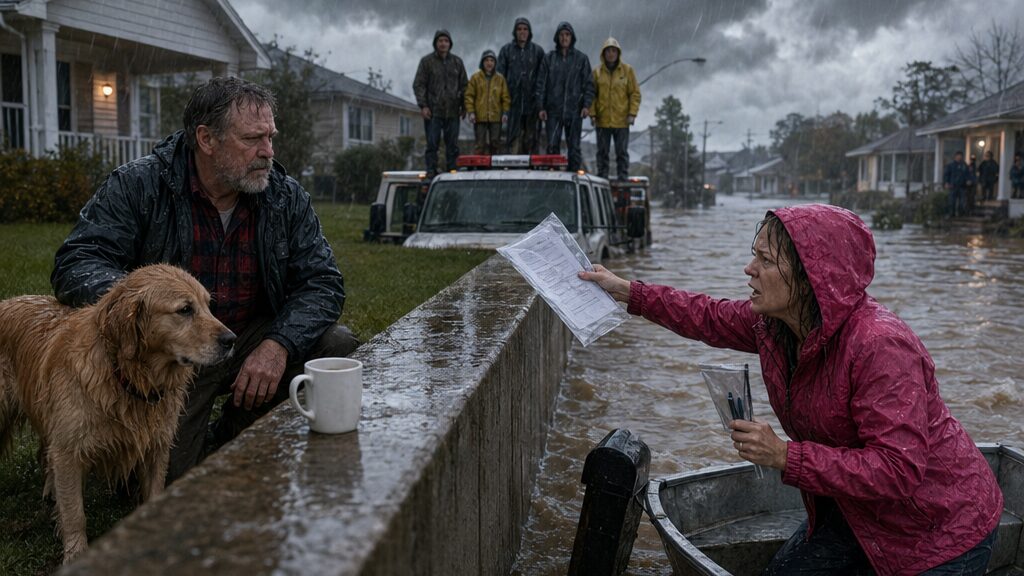
The plastic sleeve skidded across the wet top of Jack Harris’s flood wall and slapped against his white coffee mug.
Inside it was a repair estimate, folded once, the black numbers fat enough for him to read through the rain.
$46,800.
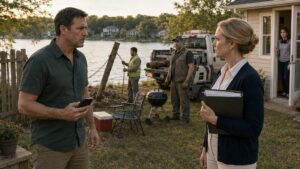
“Don’t you just sit there like you didn’t do this!” Samantha Perez shouted from the aluminum boat rocking in the brown water below.
Jack kept one hand on the collar of his golden retriever, who had risen when the boat bumped against a drowned mailbox. The dog’s ears were forward, not afraid, only alert. Muddy water moved below them like a living thing, carrying leaves, a plastic flowerpot, and someone’s welcome mat down the middle of what had been Hillcrest Lane.
On Jack’s side of the concrete wall, the grass was wet but green. The water had not crossed. It pressed against the other side of the wall, ugly and restless, licking at the seams, but it had held exactly where Emily had always said it would.
Across the street, the neighborhood had become a shallow river. A police cruiser sat half-swallowed near the corner, lights dark, roof slick with rain. Two neighbors stood on top of it, one holding a trash bag over his head, both staring now at Jack as if Samantha had just placed evidence of a crime in front of him.
Jack looked from the sleeve to Samantha.
Her pink rain jacket clung to her shoulders. Her hair was pasted against her face. One hand gripped the side of the boat while the other pointed at the wall so hard her whole arm trembled.
“That wall is illegal,” she said. “You diverted everything straight into my basement.”
Jack did not answer right away. He lifted his mug before the paper could soak through the bottom edge. The coffee was cold now. Rain had thinned it to a bitter puddle.
Samantha shoved the boat closer with one oar. “Did you hear me?”
“I heard you.”
“Then sign it.”
Jack glanced at the sleeve again. A contractor’s logo sat near the top. Mark Rivera. Emergency restoration estimate. Basement water removal, framing, electrical assessment, mold prevention, structural review. The amount sat at the bottom like a sentence already handed down.
“There’s nothing for me to sign,” Jack said.
Samantha gave a short, sharp laugh. “That’s funny. Mark says your wall caused this. My insurance says if it’s diverted water, they need a responsible party. And you are the only yard on this street that looks like a golf course right now.”
The two neighbors on the cruiser shifted. One of them said something Jack could not hear over the rain. The words did not matter. Their faces did.
They had all seen his wall for years. Some called it ugly. Some called it overkill. Samantha had once joked that Jack was building a fortress for a rainstorm that would never come. Emily had smiled politely that day and said nothing. Jack had said less.
Now the storm had come, and the wall had done what it was supposed to do, and somehow that had made him look guilty.
Samantha slapped the estimate with her palm. “You don’t get to hide behind concrete and coffee while the rest of us drown.”
Jack felt the sentence land harder than he wanted it to. His fingers tightened around the mug.
“I didn’t flood your house,” he said.
“Then why is my street underwater and your yard dry?”
“Because I built for water.”
“You built to push it at us.”
“No.”
“You expect me to believe that?”
Jack looked past her boat, toward the street drain that had vanished beneath the brown current. He knew where it was by memory. Third mailbox down, six feet from the curb, covered every fall by oak leaves because the common culvert pulled too slow. He had complained about it when Emily was still alive. He had brought photographs. He had brought dates. He had been told the board would review it.
Review, in HOA language, meant a folder moving from one table to another until nobody remembered who first opened it.
Samantha reached into the boat and pulled out a pen sealed inside a sandwich bag. “I’m not asking you for charity. I’m asking you to take responsibility.”
Jack watched the pen appear. That was when the day changed shape.
Until then, Samantha had been a frightened neighbor shouting from floodwater. Wrong, but frightened. He could forgive fear a great deal. The estimate was different. The pen was different. The plastic sleeve on his wall was not panic.
It was a demand.
“No,” Jack said.
Samantha blinked through the rain. “No?”
“I am not signing that.”
“You haven’t even read it.”
“I read the number.”
“You owe me more than the number.”
The dog gave one low sound in his throat. Jack put his hand flat between the dog’s shoulders.
Behind Samantha, another small boat drifted near the police cruiser. An emergency volunteer called for people to stay where they were. Nobody moved toward Jack’s wall. They watched. Rain struck the water in thousands of little bursts. The whole street smelled of mud, gasoline, and soaked drywall.
Samantha lifted her voice. “Everybody sees what happened, Jack. Your wall turned this street into a bathtub.”
One of the neighbors on the cruiser looked away, but the other did not.
Jack wanted, briefly and sharply, to tell them everything. He wanted to tell them about the county storm maps, the elevation marks, the engineer Emily had insisted they pay for when everyone else laughed at the price. He wanted to say Samantha’s basement had taken seepage during the spring storm two years before the wall went up. He wanted to say the water had always found the low end of the lane and that pretending otherwise would not change gravity.
Instead, he said, “The wall is permitted.”
Samantha’s mouth tightened. “Show me.”
“Not from the top of a wall in a flood.”
“So you don’t have it.”
“I have it.”
“Then sign that you’ll submit it to insurance.”
“No.”
Her face changed. Not louder. Harder. “You think being calm makes you right?”
Jack looked at the estimate beside his mug. The paper was beginning to curl inside the sleeve. Mark Rivera’s printed words blurred behind beads of water.
“I think being wet doesn’t make you right either,” he said.
Samantha stared at him as if he had slapped her. For a second, Jack regretted it. Not because it was untrue, but because Emily would have hated the edge in his voice.
Then Samantha leaned forward in the boat and jabbed a finger toward his chest. “Tell that to my basement. Tell that to the furnace sitting in three feet of water. Tell that to the boxes I couldn’t carry upstairs in time.”
Jack said nothing.
The rain filled the silence.
Samantha’s anger thinned just enough for fear to show through. Her lips shook before she pressed them together. Then she looked back at the flooded street, at the cruiser, at the people watching, and fear hardened again into accusation.
“You had time to build yourself a wall,” she said. “Must be nice.”
Jack’s hand moved to the mug. He did not drink. He only lifted it out of the path of the rain and set it farther from the repair estimate.
“The water doesn’t care what’s nice,” he said.
Samantha pulled the boat back a few inches. “The insurance adjuster is coming tomorrow. I’m telling them you refused to cooperate.”
“I refused to sign something false.”
“You refused because you know what this looks like.”
Jack looked down at the water pressing against the concrete. “I know exactly what it looks like.”
“Good,” she said. “Then you know why nobody is going to believe you.”
The volunteer called again from the street. Samantha ignored him.
Jack picked up the plastic sleeve and held it out toward her. She did not take it.
“Keep it,” she said. “You’ll need to get used to seeing that number.”
The boat scraped against the mailbox as she pushed away. The neighbors on the cruiser watched her go, then looked back at Jack. One of them looked at the wall. One looked at his dry lawn. Neither looked at the drain under the water.
Samantha turned the boat sideways in the current, rain shining on her pink hood.
“And don’t act surprised,” she called. “The HOA already has a copy.”
Jack stood still with the estimate dripping from his hand.
On the wall beside him, the white mug sat untouched, a pale circle against wet concrete. Below it, floodwater struck the barrier again and again, trying to find a weakness.
Chapter 2: The Wall Looked Guilty From The Street
The notice was taped to the dry side of Jack’s gate before breakfast.
It had been sealed in a clear folder and pressed flat beneath two strips of painter’s tape, as if whoever left it feared the weather but not the insult. Jack saw the HOA letterhead before he opened the gate. He stood there in his boots, with the dog nosing at the wet grass behind him, and knew Samantha had not waited for the floodwater to recede before making the story official.
He peeled the folder loose.
Emergency Property Review Notice.
His name appeared twice on the first page. Wall, barrier, diverted water, neighbor damage, pending insurance review, requested documentation. The sentences had the careful softness of people trying not to accuse while building a record that they had.
At the bottom, Margaret Jones had signed in blue ink.
Please provide permitting, inspection, drainage, and construction records within forty-eight hours. Failure to respond may result in board action, emergency assessment, or referral to insurer.
Jack folded the notice once, then unfolded it because the crease had gone through his name.
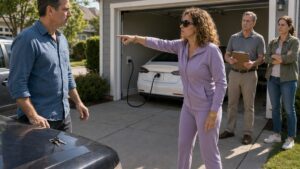
The street beyond the wall still held water, though it had dropped enough to reveal the tops of mailboxes and the backs of stranded cars. Mud streaked driveways. A child’s bicycle lay tangled in hedge branches across the lane. Samantha’s house sat two lots down, garage door open, men carrying wet boxes out into the yard.
Jack did not go over. He wanted to. He had almost gone twice before dawn, once with a thermos, once with his old pump. Both times he had stopped at the gate, remembering the estimate on the wall and the pen in the sandwich bag.
Help could become admission if offered to someone determined enough.
Inside, he put Margaret’s notice on the kitchen table beside Samantha’s plastic-wrapped estimate. The two packets looked related, like one had given birth to the other overnight.
The dog settled near the back door, still watching the yard.
Jack opened his laptop.
The county permit portal was ugly and slow. He typed in his address, then the year. The wall permit appeared after two failed searches: retaining/flood mitigation barrier, r
Chapter 4: The Old Drainage Number Changed Everything
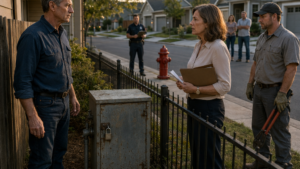
Tyler Allen placed a faded drainage map on the county records counter and tapped the blue line with the back of his pen.
“Your wall is here,” he said. “Secondary protection. Not primary flow control.”
Jack leaned over the counter.
The map smelled faintly of dust and toner, a copy of a copy pulled from some back shelf or dead database that still knew more than the public portal. Hillcrest Lane appeared in thin gray lines, each lot divided neatly, each ditch and drain drawn as if water were obedient. Near Jack’s property, the wall was marked with a small rectangle and a note: approved residential mitigation, no alteration to existing street drainage.
Tyler tapped another line, lower on the page.
“This is the original swale.”
Jack followed the mark with his eyes. It curved along the edge of the Perez driveway, then toward the common culvert at the low end of the subdivision.
“That’s on Samantha’s side,” Jack said.
“It was.” Tyler glanced toward the clerk’s desk, then lowered his voice. “The aerials suggest it may not be there now.”
Jack looked up.
Tyler was younger than Jack remembered, or maybe Jack had reached the age where everyone behind a municipal counter looked younger than they ought to. He wore a county badge on a lanyard and had the careful manner of a man trying to help without becoming responsible for the help.
“You found the final inspection?” Jack asked.
Tyler slid over another page.
Jack saw the green stamp first.
Final inspection approved.
He did not touch it for a moment. The inspector’s signature sat at the bottom, exactly where memory had kept it. The date was three weeks after the concrete cured. Emily had made chicken that night because the inspector had said the wall would hold if they maintained the weep holes and kept the drain clear. Jack had forgotten the chicken. He had not forgotten her relief.
“You were right,” Tyler said. “It got archived under the drainage improvement project number instead of the wall permit. Someone must have linked them because the wall was reviewed during the neighborhood drainage update.”
“Can you certify this copy?”
“I can stamp that it came from county records.” Tyler hesitated. “I can’t say what caused this week’s flood.”
“I’m not asking you to.”
“You may need more than this.”
Jack folded his hands over the edge of the counter. “Because of the swale.”
Tyler nodded once.
He opened a folder on the counter and removed a printed aerial photograph. The first image was old, taken several years earlier, the summer before Jack’s wall went in. Samantha’s driveway showed a shallow green channel beside it, the swale cut low enough that grass grew darker there.
Tyler placed a second photo beside it. Newer. The driveway had been widened. The green channel was gone, replaced by pale gravel and a cleaner edge of concrete. Jack could see a line of decorative stones where water once had room to move.
“That’s not proof by itself,” Tyler said. “Photos don’t show grade.”
“No,” Jack said. “But they show something changed.”
Tyler looked relieved that Jack had said it instead of forcing him to. “There may be a permit, or there may not. Some driveway drainage work goes through the HOA before it ever reaches us. Depends on how they described it.”
“How did they describe mine?”
“As a wall people noticed.”
Jack almost smiled. It didn’t reach his face.
Tyler stamped the final inspection page, then the drainage map. Each thump sounded like a door opening only partway.
“Jack,” Tyler said as he slid the pages back, “I knew you from maintenance. You were always exact.”
“That’s a polite way to say stubborn.”
“It’s a polite way to say you usually had pictures.”
Jack looked at the stamped papers.
“I had someone who made sure I kept them.”
Tyler did not ask.
Outside the records office, the sky had cleared into a hard, washed-out blue that made the flood damage look less dramatic and more permanent. Jack drove back slowly. The water had retreated from most of Hillcrest Lane, leaving mud rings on siding and fences. Piles of ruined carpet and swollen baseboard had begun appearing at curbs.
Near Samantha’s driveway, Mark Rivera’s truck was parked with orange cones around the open garage. Samantha stood beside him, holding her phone as if the street itself were on trial. When Jack slowed, she turned.
Mark said something to her. Samantha looked from Jack’s truck to the concrete wall at the far end of the block. Then she lifted her phone and took another picture.
Jack did not stop.
At home, he spread Tyler’s documents across the kitchen table. Samantha’s demand packet sat on the left. The HOA notice sat beside it. The stamped inspection page went in the center, clean and factual. The drainage map took up the most space, old lines crossing old assumptions.
The dog rested his chin on Jack’s boot.
Jack took out the three photographs from the meeting. Old floodwater before the wall. Emily’s dated handwriting on the back. He placed them under the map and began building the timeline.
Spring storm before wall: street flooded.
County drainage review: culvert concerns noted.
Wall approved as secondary protection.
Final inspection approved.
Current flood.
Samantha estimate blaming redirected water.
The line looked good until he reached the empty space between the old drainage plan and the current aerial photograph.
Something had happened there.
He opened his laptop and searched the HOA portal. It had never been good, and after the flood half the links were down. Meeting minutes loaded slowly, year by year. He searched “Perez driveway.” Nothing. “Drainage.” Too much. “Swale.” One result.
The minutes opened from a meeting three years earlier.
Homeowner request: lot drainage/driveway edge improvement. Approved subject to contractor compliance and no adverse impact to common drainage.
No name on the visible summary.
Jack stared at the line. It was almost something and not enough of anything.
His phone buzzed.
A message from an unknown number contained a single photograph. For one sharp second, he thought it was another picture of him on the wall.
It was not.
It showed Samantha’s driveway in the middle of a construction day. Gravel piled near the curb. A shallow trench half-filled. Mark Rivera’s truck parked in the background. A handwritten date had been added in the corner by whoever took it.
Below the photo was a short message.
Thought you might need this. They filled the low strip that used to carry water.
No name.
Jack stared at the picture until the shapes settled. The swale was there, open in the foreground. Half of it had already been filled.
He called the number. It rang once, then went to voicemail with no greeting.
Jack set the phone down.
The proof was coming in pieces, each one useful, each one dangerous. A final inspection showed his wall was legal. An aerial showed the swale was gone. A neighbor’s photograph suggested it had been filled. But none of it yet proved that Mark’s work, Samantha’s driveway, or the HOA’s delay had caused the flood damage. It only proved the story everyone wanted to tell was too simple.
He went back to the HOA minutes and searched the date from the anonymous photograph.
One attachment appeared at the bottom of a meeting packet, mislabeled under landscaping variance.
Jack clicked.
A scanned invoice opened sideways.
Mark Rivera Restoration and Exterior Works.
Customer: Samantha Perez.
Scope: driveway regrade and swale fill.
Jack did not move.
The house was quiet except for the dog breathing at his feet and the soft tick of water still dripping somewhere outside.
Then he saw Samantha’s signature at the bottom.
Chapter 5: The Folder Emily Kept Was Not Just Proof
Jack opened Emily’s folder and found her warning before he found the proof.
Use this if they ever blame the wall.
The sentence sat on the inside flap in blue ink, small and practical, as if she had written it while labeling groceries or reminding him to clean the dryer vent. No drama. No fear. Just instruction. Emily had always trusted that future trouble could be made smaller if past facts were kept where a person could reach them.
Jack stood over the kitchen table with one hand on the folder and the other gripping the back of a chair.
He had spent two years not opening it.
Not because he did not need the records. Because the folder still felt like hers. The angle of her handwriting, the little dash under “wall,” the way she had paper-clipped photographs in date order—all of it made the room fill with her without giving him the mercy of hearing her voice clearly.
The dog came to the table and nudged his knee.
“I know,” Jack said.
He sat down.
The first section was labeled Before Wall. Inside were photographs of Hillcrest Lane after earlier storms. Samantha’s porch steps in water. The curb near the common culvert submerged. Jack’s own garden drowned before the concrete existed. Each photo had a date, rainfall total, and an arrow Emily had drawn in pencil.
Water path.
Blocked drain.
Standing water near Perez driveway.
He placed them in a row.
The second section was labeled County / HOA. There were copies of emails Jack remembered sending and some Emily had sent after he got tired of being polite. Drainage concern. Common culvert capacity. Swale maintenance. Request for board review.
One note had a yellow sticky flag still attached.
Margaret — deferred until budget review.
Jack read it twice.
The date was four years old.
He remembered that meeting. Emily had worn the yellow raincoat and sat beside him with a folder on her lap. Margaret had thanked them for their “continued attention to drainage,” then moved the issue behind landscaping repairs, clubhouse carpet, and pool furniture.
Emily had said nothing on the ride home until they pulled into the driveway.
Then she had looked at the ditch line and said, “They think water waits for budgets.”
Jack had laughed then. Not because it was funny, exactly. Because if he didn’t laugh, he would have gone back to the clubhouse and said what she was too decent to say.
He found the handwritten note in the third section.
It was on torn notebook paper, unsigned except for a house number at the top. The writing was cramped.
Culvert backed up again after heavy rain. Water coming across low side by Perez driveway. HOA said wait for maintenance cycle. This was before Jack’s wall.
Jack looked toward the window. Across the yard, the wall sat pale in the last of the daylight. It had never looked like victory to him. It had looked like a compromise with reality.
His phone lit up.
Samantha Perez.
He let it go to voicemail.
The phone buzzed again a moment later. He pressed play, setting it on the table between Emily’s folder and Samantha’s demand packet.
Samantha’s voice came out strained and too controlled. “Jack, this has gone far enough. My adjuster needs a named source before they can move the claim. If you sign the acknowledgment in the morning, this doesn’t have to become worse. If you don’t, I’m adding your name directly to the insurance claim and sending the board everything Mark has. I can’t sit on forty-six thousand dollars because you don’t want to admit what everybody can see.”
There was a pause. When she spoke again, the anger cracked.
“I don’t have that kind of money.”
The message ended.
Jack sat still.
There it was. The part she had not shouted from the boat. The part that made her dangerous and human at once.
He replayed the last sentence once, then stopped before it could soften him into a mistake.
He was sorry. He was not responsible.
Those two truths could stand in the same room.
He took out a legal pad and began arranging the documents by date. Emily’s old photos. The drainage complaints. The deferred HOA maintenance note. The permit approval. The final inspection Tyler had stamped. The current flood estimate. The anonymous construction photo. Mark’s invoice.
The timeline stretched across the table, and for the first time, Jack saw the shape clearly.
The wall had not appeared first. The drainage problem had.
The swale had not disappeared by accident. It had been filled.
The HOA had not been surprised by the culvert. It had delayed repair.
Samantha had not invented her ruined basement. She had chosen the easiest person to attach it to.
He stood too quickly, and the chair legs scraped the floor.
For two days, he had let people ask whether his wall was legal. He had answered that question because it was the one they handed him. But the better question had been beneath it the whole time, under the same brown water.
Where was the water supposed to go?
He copied the voicemail to a file. Not as a weapon, he told himself. As a record. Emily would have done that. She would have labeled it, dated it, kept it in the right folder, and then made tea because fear made people careless.
He almost smiled at that.
Then he found one more page tucked behind the old photos.
It was a printout of a message from Emily to Margaret, sent the year before the wall.
Margaret, if the board will not clear or enlarge the common culvert, we will have to protect our own property. I am asking again that this be entered into the minutes so no one later claims we acted without warning.
Under it, Margaret had replied with two lines.
Received. The board does not consider private mitigation necessary at this time.
Jack leaned back.
Private mitigation.
The same words, years apart, had gone from unnecessary to suspicious to evidence against him.
He looked at the folder flap again.
Use this if they ever blame the wall.
Emily had known people. Maybe better than he had. Jack had known pipes, grades, waterlines, inspection schedules. Emily had known what frightened people did when a bill arrived.
He gathered the pages into three stacks: wall records, drainage history, current demand. He did not include every page. Too many documents would let Margaret bury the truth in procedure. He needed enough to make the order visible.
His hand paused over Emily’s email.
Bringing it meant turning a property dispute into something larger. It meant showing the room that Margaret had known. It meant Samantha’s demand would no longer be just Samantha’s fear; it would point back at meetings, budgets, and decisions the neighborhood had preferred not to remember.
Jack put the email in the stack.
At ten-thirty, his phone rang again. Margaret this time.
He did not answer.
A text followed.
Tomorrow, 9:00 a.m. Clubhouse. Insurance representative attending by request. Please bring final documentation.
Jack looked at the word “final.”
People loved that word when they wanted to stop listening.
He opened the old brown envelope he had taken to the first meeting and emptied it. Too small. Too flimsy. He went to the hall closet and found the black document case Emily had used for taxes. It still had one of her address labels tucked in the side pocket.
He placed the demand packet in first.
Then the final inspection.
Then the photos.
Then Mark’s invoice.
Then Emily’s email.
Last, he put in the note from the folder flap, not because he planned to show it, but because he could not leave it behind.
Near midnight, Jack reheated the coffee he had not finished and poured it into the white mug. The same mug from the wall. A brown ring had dried near the handle, and when he set it on the table, it left a faint circle on one of Emily’s older copies.
He wiped it quickly, then stopped.
There was already a ring on one of her pages, old and pale, exactly the same size.
For a moment, the kitchen held both of them.
Then the phone lit again.
A new voicemail from Samantha, shorter this time.
“If you don’t sign by morning,” she said, “your name goes on the claim.”
Jack saved it, labeled it, and placed the phone beside Emily’s folder.
By morning, silence would no longer be enough.
Chapter 6: Jack Brought The Flood Back In Order
Samantha placed the insurance form in front of Jack with both hands.
“Sign that you’re the source,” she said, “and this ends today.”
The clubhouse fell so quiet that Jack could hear the old wall clock above the bulletin board stutter at each second. The form lay between them on the folding table, its signature line marked with a yellow tab. Beside it sat Samantha’s plastic-wrapped repair estimate, the same packet that had slid across his flood wall in the rain.
Jack set Emily’s black document case on the table.
“No,” he said.
Samantha closed her eyes for half a second. When she opened them, the tiredness in her face made her look less angry and more cornered. “You keep saying no like that proves something.”
“It proves I won’t sign a false statement.”
Margaret stood at the end of the table, clipboard pressed to her ribs. Mark Rivera sat two chairs away from Samantha, his contractor’s clipboard on his lap. An insurance adjuster had taken the chair nearest the wall outlet, laptop open, expression carefully neutral.
Neighbors filled the back rows. Not as many as the first meeting, but enough. Enough to look. Enough to remember the photo of Jack on the wall.
Margaret cleared her throat. “Let’s keep this orderly.”
Jack opened the document case. “That would be a change.”
A few heads turned. Margaret’s mouth tightened, but she said nothing.
Jack removed the first page and placed it in the center of the table.
“Final inspection,” he said. “County stamped copy. The wall passed.”
The adjuster leaned forward. Margaret picked it up before Samantha could.
“This wasn’t in the portal,” Margaret said.
“It was archived under the old drainage project number.”
Mark shifted in his chair. “That doesn’t address water movement during this storm.”
“No,” Jack said. “It addresses the claim that I built an illegal wall.”
Samantha stared at the stamped page as if the ink had betrayed her.
Jack placed the second page down: the drainage map.
“This is the county drainage plan before my wall. The common flow ran toward the low culvert by the Perez driveway.”
“That’s old,” Mark said.
“It is.”
Jack placed the old photo beside it.
“This is older.”
The room bent toward the table.
The photograph showed Samantha’s porch with water already climbing the first step. No wall in Jack’s yard. No concrete barrier. No dry green strip behind him. Just Hillcrest Lane flooded in the same low place, years before anyone could blame his property.
Samantha did not reach for it.
Jack turned the photo so she could see the date on the back.
“You had water before my wall,” he said. “I’m not saying this week wasn’t worse. I’m saying your claim starts with something untrue.”
The adjuster picked up the photo and asked, “Do you have the date verified elsewhere?”
Jack handed over the attached rainfall printout. “Emily kept weather records with the pictures.”
At his wife’s name, his voice almost slipped. He steadied it by taking out the next page.
Margaret saw the yellow sticky flag before he spoke.
Jack placed Emily’s email on the table.
“Before the wall, we asked the board to address the common culvert.”
Margaret’s eyes sharpened. “Jack—”
“You received the request.”
“This isn’t the place to relitigate old maintenance priorities.”
“It became the place when you used my wall to avoid them.”
The words came out level, but the room reacted as if he had raised his voice.
Margaret looked at the back rows. “The board did not ignore drainage.”
Jack placed the handwritten note beside the email.
“Deferred until budget review,” he said. “That phrase appears in the minutes more than once.”
The adjuster typed something.
Mark leaned forward. “None of that proves my client’s basement damage came from the culvert.”
“Your client?” Jack asked.
Mark paused.
Samantha looked at him too.
“I mean the homeowner whose property I assessed,” Mark said.
Jack let the correction sit there.
Then he placed the aerial photographs on the table. Old driveway. New driveway. Open swale. Filled edge.
Mark’s face changed before Samantha’s did. Only a flicker, but Jack saw it because he had worked too many years around men who hoped a buried problem would stay buried.
“The swale was there,” Jack said. “Then it wasn’t.”
Samantha’s hand moved toward the papers and stopped.
Jack took out the last invoice.
Mark Rivera Restoration and Exterior Works.
Driveway regrade and swale fill.
He slid it across the table, not toward Samantha, but toward the adjuster.
The adjuster read the top, then the scope, then the signature line. “Ms. Perez, did this work occur?”
Samantha’s face flushed. “It was driveway work. The side strip was always a mess.”
“Did you disclose this drainage modification when you submitted the claim?”
“It wasn’t a drainage modification.”
Jack said nothing.
Mark cleared his throat. “It was cosmetic grading along the edge of the driveway. It wouldn’t have mattered in a storm event of this scale.”
“Then why did your estimate name my wall as the directional cause before reviewing the old drainage plan?” Jack asked.
Mark looked at him. “Because the observed waterline indicated pressure from your side.”
Jack tapped the map. “Your filled swale is between my wall and her basement.”
“Water was everywhere.”
“Exactly.”
The adjuster looked from Mark to Samantha. “I’m going to pause any third-party liability designation until the drainage history is reviewed.”
Samantha turned toward her. “Paused? My house is torn apart.”
“I understand,” the adjuster said. “But I can’t accept a named source based on an incomplete site history.”
“Incomplete?” Samantha’s voice cracked. “My basement is not incomplete. My furnace is gone.”
Jack felt the pull of pity then, strong and inconvenient. Her fear was real. The number on the estimate was real. The ruined boxes on her lawn were real.
But so was the signature on the swale invoice.
“Samantha,” he said quietly, “you knew the driveway work changed that strip.”
She looked at him then, and for a second the room disappeared from her face. No board. No adjuster. No neighbors.
“I knew Mark cleaned it up,” she said. “I didn’t know it mattered.”
“You didn’t want it to matter.”
Her eyes filled, but she did not let the tears fall. “You had a wall, Jack. You were dry. I walked down my stairs and saw water over my knees.”
“I’m sorry.”
“Stop saying that like it helps.”
“It’s the only part I can give you.”
Her mouth trembled. “You could have signed.”
“No.”
“Just until insurance sorted it.”
“That is not what a signature does.”
The adjuster’s hands stilled over her keyboard.
Jack looked around the room, not at the neighbors first, but at Margaret. “I didn’t build the wall in secret. I didn’t build it without warning. I didn’t build it to flood anybody. I built it after the street flooded, after the culvert backed up, after the board deferred repairs, after my wife asked that the warnings be entered into the minutes.”
Margaret looked down at Emily’s email.
Jack’s hand rested on the black document case. “I should have brought this the first night. I didn’t because some of it was hers, and I didn’t want a room full of people touching it like evidence.”
No one moved.
“That was my mistake,” he said. “But my mistake doesn’t make me liable for a false claim.”
The room held still in a different way now. Not friendly. Not apologetic. But listening.
Margaret picked up the drainage map again. Her face had gone pale under the clubhouse lights. “The HOA will need to review the culvert maintenance records.”
Samantha turned toward her. “Now?”
Margaret did not answer her directly. She looked at Jack, then at the adjuster, then at Mark’s invoice on the table.
“Now,” she said quietly. “We’ll need to review all of them.”
Chapter 7: The Wall Was Never The Whole Story
The revised claim notice was waiting in Jack’s mailbox in the same kind of plastic sleeve Samantha had used on the wall.
For a moment, he did not take it out.
He stood at the curb with the mailbox door hanging open, one hand resting on the damp metal, looking at the clear sleeve as if it might still find a way to accuse him. The street behind him was no longer a river, but it had not returned to what it had been. Mud stained the lower fence boards. Piles of torn-out drywall sat in front of three houses. The police cruiser had been towed away, leaving two dark tire marks where the tow truck had dragged it from the soft shoulder.
Jack pulled the sleeve free.
The first line named Samantha Perez. The second named her policy number. His own name appeared once near the middle, in a paragraph short enough to read twice before believing it.
No third-party liability designation will proceed against Jack Harris based on current documentation.
He read it again.
The dog waited beside the gate, watching him through the bars. Jack folded the page carefully, then unfolded it again because creasing official paper had begun to feel like tempting fate.
At the bottom, the adjuster had added a note that further review of subdivision drainage, prior site grading, and HOA-maintained culvert conditions would continue separately.
Separately.
It was a clean word for a messy thing.
Jack walked back through the gate and set the notice on top of the wall, weighing one corner with the white mug he had carried outside without thinking. The mug was empty. He had brought it out because his hand wanted the old shape, the handle worn smooth where his thumb always landed.
On the far side of the wall, Hillcrest Lane smelled of bleach, wet lumber, and sun-baked mud. A truck backed into Samantha’s driveway with a warning beep that made the dog lift his head. Mark Rivera’s company name was no longer on the side of any vehicle there. A different crew had been coming and going since the meeting.
Jack did not feel victorious about that.
He had expected vindication to feel cleaner. He had imagined, against his better judgment, that a corrected document would loosen something in his chest. Instead, it made the air around him quieter and heavier. The claim had moved away from him, but the flood had not moved backward. Samantha’s house was still open to the studs. The HOA was still arguing over who should pay for the culvert work. Neighbors still lowered their voices when he walked by, though not all for the same reason now.
Some had begun nodding again. Some looked embarrassed. A few looked resentful, as if Jack’s proof had created a bill that would land on everyone.
Maybe it had.
The gate latch clicked.
Jack turned.
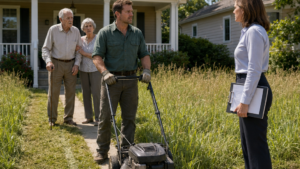
Samantha stood on the street side, one hand on the latch, the other holding a folded paper. She wore jeans and a gray sweatshirt with the sleeves pushed up. Without the pink rain jacket, without the boat, without the floodwater between them, she seemed smaller and more tired.
The dog walked to the gate but did not bark.
Samantha looked at the animal first. “He remembers me yelling.”
“He remembers boats.”
Her mouth moved like it almost became a smile, then stopped.
“I got the revised notice,” she said.
Jack nodded.
“They removed your name.”
“I saw.”
She looked past him at the paper beneath the mug. “I figured you would.”
The gate stayed closed between them. Neither reached for it.
Samantha unfolded her paper but did not hand it over. “The HOA sent me a letter. They’re reviewing the culvert maintenance records and the driveway grading. My adjuster says everything is delayed now.”
Jack said nothing.
“I know you think that’s fair.”
“I think it’s more accurate.”
“That’s not the same thing when your walls are torn out.”
“No,” Jack said. “It isn’t.”
A crew member down the street dropped a plank into a dumpster. The sound cracked through the lane and bounced off the concrete wall. Samantha flinched, then pretended she had not.
Jack saw it and wished he had not. Pity was easier when it did not ask anything of him.
She folded the paper again. “I should have waited for the inspection.”
“Yes.”
The bluntness surprised even him. Samantha looked up.
He could have softened it. He had spent years softening things: complaints to the HOA, warnings about drainage, the way he said Emily’s name in public. Softness had its uses. But it had also allowed people to place his picture under a caption and call it evidence.
Samantha swallowed. “I was scared.”
“I know.”
“I wasn’t trying to ruin you.”
“You were trying to put my name on forty-six thousand dollars.”
She looked down at the wet street. “I told myself it was temporary. Just until insurance sorted it.”
“That’s what you said.”
“Was I supposed to just sit there and watch everything go?”
“No.”
“What would you have done?”
Jack looked at the wall beneath his hand, at the pale line where water had reached and failed to cross. He thought of Emily’s folder on the kitchen table, the note inside the flap, the way her records had saved him only after he stopped treating them like something too private to use.
“I would have wanted somebody to blame,” he said. “That doesn’t mean I would have had the right person.”
Samantha’s eyes shone, but she kept her face steady. “Mark told me the wall made sense as the cause.”
“Mark filled the swale.”
“He said it was cosmetic.”
“You signed the invoice.”
“I signed a lot of things that day. He told me it would keep the driveway edge from washing out.” She pressed her lips together. “And I wanted it done before the appraisal.”
Jack looked at her.
There it was again: not a confession, not a villain speech, just the plain little machinery of people choosing convenience and calling it harmless until water found the choice.
Samantha seemed to hear what she had revealed. Her shoulders stiffened. “I didn’t know it would matter.”
“I believe that.”
Her face changed.
“I also believe you didn’t want to know once it did.”
For a long moment, Samantha said nothing. The truck in her driveway beeped again. Somewhere beyond the corner, a pump coughed to life.
“I can’t fix what I did to you,” she said.
Jack rested his hand on the gate. The metal was warm from the sun. “No.”
“I can tell Margaret I pushed too hard.”
“You should tell the adjuster the full truth.”
“I did.” She looked toward her house. “Yesterday.”
Jack nodded once.
It was not forgiveness. It was not refusal. It was a place to put the fact.
Samantha’s eyes moved to the mug on the wall. “That picture of you made everyone mad.”
“I noticed.”
“You looked like you didn’t care.”
“I was trying not to say something cruel.”
That startled her into a tired laugh, one breath only. “You still did.”
“I know.”
She looked through the gate at him then, and for the first time since the flood, her face held no demand. “I’m sorry your wife got dragged into it.”
Jack’s hand left the gate.
Samantha must have heard from Margaret, or the adjuster, or someone who had seen the email with Emily’s name. He had known that once he brought the folder, Emily would no longer belong only to the kitchen table and the hallway closet. Still, hearing Samantha speak of her felt like a hand reaching into a drawer he had not opened for company.
“She prepared for this,” Jack said.
“For the flood?”
“For people.”
Samantha looked away.
The apology that might have followed did not come. Maybe she did not know how to offer one large enough. Maybe Jack did not know how to receive it without giving away more than he meant to. They stood with the gate between them until the dog lost interest and lay down in the grass.
Finally, Samantha stepped back. “The board meeting is Thursday. They’re saying emergency assessment.”
“I heard.”
“People are going to blame you for that too.”
Jack picked up the revised notice and slipped it back into its plastic sleeve. “People have practice.”
“That doesn’t bother you?”
“It bothers me.” He looked down the street, where the low end of the lane dipped toward the culvert no one could pretend not to see anymore. “It just doesn’t change the grade.”
Samantha almost smiled again. This time it stayed a little longer, sad and thin. “No. I guess it doesn’t.”
She left without opening the gate.
Jack watched her cross to her driveway, stepping around a stack of ruined trim. At the garage, she paused and spoke to one of the workers, then disappeared inside the stripped house.
By late afternoon, an HOA email arrived confirming that the complaint against Jack’s wall had been closed pending no further action. Beneath that, in the same message, Margaret announced a special assessment discussion for culvert repair, independent engineering review, and common drainage restoration.
Jack read it at the kitchen table.
Closed pending no further action.
He let those words sit beside Emily’s folder.
Then he took the revised claim notice, the HOA closure email, the stamped final inspection, and Samantha’s original estimate. He put them in date order, because Emily would have. He hesitated over the plastic sleeve from the flood wall, then slid it in too. Not because he wanted to remember Samantha’s accusation, but because the story would be dishonest without the thing that had started it.
Last, he opened the folder flap.
Use this if they ever blame the wall.
Jack touched the sentence once with his thumb.
“I did,” he said quietly.
The dog lifted his head from the doorway, then settled again.
Jack closed the folder and returned it to the hall closet, not at the back this time. He placed it in front of the house manuals, where it could be reached without digging. Some things did not stop hurting because they became useful. Some things became useful because someone had loved you carefully enough to leave them behind.
Near evening, clouds gathered again beyond the roofs.
Jack carried the white mug outside and set it on the flood wall. The concrete still held a faint muddy line from the storm, proof of how high the water had climbed and where it had stopped. On the far side, the street crews had marked the culvert with orange paint. On his side, the grass had begun to dry.
He stood with one hand on the wall while the dog leaned against his leg.
The neighborhood did not look at him the way it had before. Maybe it never would again. But the corrected notice was filed, his name was removed, and the wall remained exactly what it had always been: not an accusation, not an apology, not a weapon.
A boundary.
Jack left the mug there facing the low end of the street, where the next storm would come from.
The story has ended.