The Neighbor Who Built a Fountain Over the Drainage Easement and Dared Us to Stop Him
Chapter 1: The Fountain Above the Rising Water
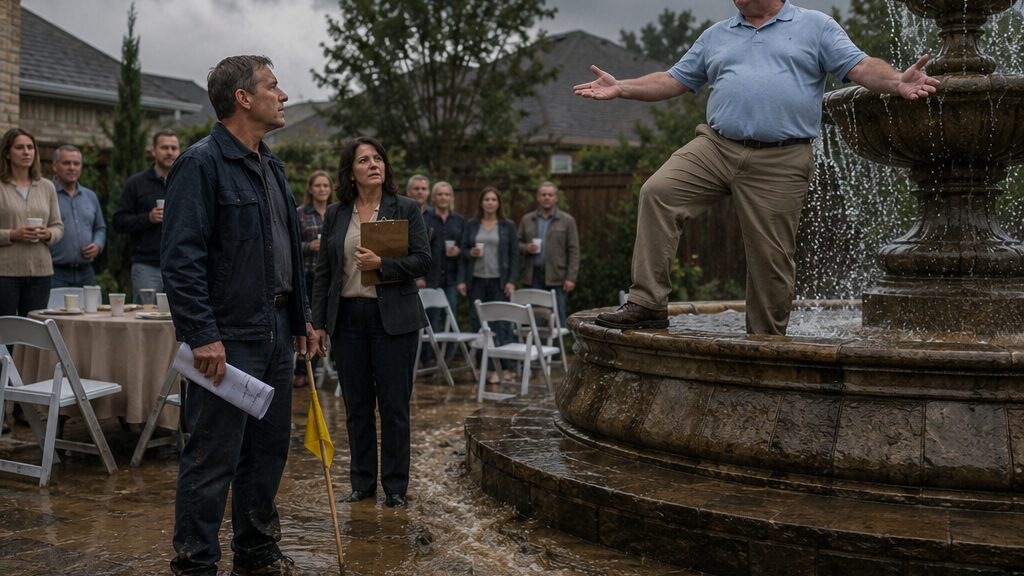
Nicholas Campbell stood on the rim of his fountain and pointed down at Gregory Lewis as if he were addressing a trespasser.
“Go cry to the county,” he said.
Behind him, three streams of clear water arched from bronze-colored spouts into a wide stone basin. The spray caught the late-afternoon light and broke it into bright flecks. Below the retaining wall, muddy water had begun collecting around Gregory’s shoes.
Nicholas spread his arms toward the fountain, the curved patio, and the rows of white folding chairs arranged for the neighborhood garden tour.
“You see all this?” he asked. “This is my property.”
Gregory looked past him instead of up at him.
The fountain occupied most of the shallow depression that had once carried rainwater between the Campbell and Lewis lots. Its lower basin was nearly twelve feet across, surrounded by new stonework and fresh sod. Beyond it, the ground rose where it should have dipped.
Gregory had noticed the change two weeks earlier. He had told Nicholas then that the shallow channel was not an empty strip of lawn. It was part of a drainage easement recorded when the subdivision was built.
Nicholas had smiled as though Gregory had complained about the color of his mulch.
Now nearly twenty neighbors stood along the garden path holding paper cups of lemonade while the sky darkened above the roofs.
Deborah Williams, the HOA president, came through the side gate with a clipboard tucked against her chest.
“Gregory,” she said quietly, “this is not the time.”
“The water doesn’t care what time the tour ends.”
A few nearby conversations stopped.
Nicholas laughed from the fountain. “There it is. The expert has spoken.”
Gregory felt the familiar pressure behind his ribs—the urge to correct every careless word, to explain grades and runoff volume and soil saturation until nobody could pretend not to understand. Years earlier, he had learned how quickly technical explanations could be turned into evidence that a person was difficult.
So he said only, “Cars parked along the lower curb should be moved.”
Deborah’s mouth tightened. “There’s no flooding.”
“Not yet.”
“You’ve made your concern clear.”
Gregory looked down. Brown water was spreading over the tops of his work shoes.
He took out his phone and photographed the fountain, the pooling water, and the yellow survey flag he had placed that morning at the edge of his property. He had not commissioned a full survey yet. The flag marked only the old drainage line he remembered from maintenance plans and the original plat folded inside his kitchen drawer.
Nicholas watched him.
“Taking pictures of my yard now?”
“Of the water.”
“Same difference.”
A low rumble moved across the neighborhood. The first hard drops struck the fountain basin, darkening the pale stone. Guests drew closer beneath the covered patio.
Nicholas stepped down from the rim but remained on the raised platform.
“You’re upset because I improved the yard,” he said. “Just say that.”
Gregory looked at the new sod laid across the former swale. Water was already searching for another route. It pressed against the raised edge of the patio, spread sideways, and began turning toward the gap between the houses.
“I’m upset because you filled the drainage channel.”
“It was a ditch.”
“It carried runoff from four lots.”
“It carried weeds.”
Deborah stepped between them. “The architectural committee reviewed the fountain.”
“Did they review the drainage plan?”
Her hesitation was brief, but Gregory saw it.
Nicholas saw it too and spoke before she could answer.
“The board saw the design. Nobody objected until Gregory decided he owned the neighborhood.”
A woman near the chairs lowered her cup. Another neighbor glanced toward the street.
Gregory pointed toward the lower curb. “The storm inlet there will be underwater in less than five minutes.”
Nicholas shook his head. “You want everyone frightened so you can feel important.”
Gregory’s hand tightened around his phone.
He remembered a council meeting twelve years earlier, fluorescent lights, wet coats, and a row of residents demanding to know why their basements had flooded. Gregory had explained that maintenance crews had requested money to clear a blocked culvert. The request had been delayed above him. None of that mattered once photographs of ruined furniture appeared on the projector screen.
He had been the man at the microphone. The man people could see.
He had promised himself never to stand there again.
“Move the cars,” he repeated.
Deborah’s voice hardened. “Stop disrupting the tour.”
A gust pushed rain beneath the patio roof. The fountain pump continued humming, sending decorative water upward while stormwater collected below it.
Gregory stepped away from the group and walked toward the street. He knocked on the windows of two parked cars and told their owners the inlet was likely to overflow. One moved immediately. The other looked to Deborah first.
Then the water reached the curb.
It came not as a wave but as a fast brown sheet, carrying pine needles and clipped grass. It covered the inlet grate and rose around the tires of the remaining car.
The owner hurried for his keys.
No one applauded Gregory’s prediction. The garden-tour guests simply began gathering bags and folding umbrellas, their attention shifting from the fountain to the water moving where it should not.
Nicholas climbed down fully.
For the first time, he looked at the ground instead of Gregory.
The runoff pressed against the stone border of the fountain platform, split, and traveled through the narrow space between the two houses. Half turned toward Gregory’s rear patio.
Gregory walked after it.
At the property line, the water had already crossed the yellow flag. It spread over his pavers in thin ripples, carrying muddy foam toward the back step.
Nicholas followed as far as his side of the fence.
“It’s rain,” he said. “Rain makes things wet.”
Gregory crouched and placed two fingers against the moving water. The flow was stronger than it had been during storms before the fountain was built.
He looked toward the old swale line. Nothing moved there. The fountain and its raised base had sealed it.
“This is the part you don’t understand,” Gregory said.
Nicholas folded his arms. “No. This is the part where you threaten me with paperwork.”
Gregory stood.
“I’m not threatening you.”
“Good.”
“I’m telling you what the water is doing.”
Nicholas glanced toward the departing guests. His jaw shifted.
“Then tell the water to stay on your side.”
He walked back toward the fountain.
By the time Gregory reached his own patio door, water had covered the first row of pavers. It slid beneath the outdoor storage bench and gathered against the brick foundation.
He switched on the porch light and crouched beside the nearest vent.
The water was still several inches below it.
For now.
Another surge came through the gap between the houses. It crossed the patio in a wider sheet and struck the foundation with a soft, continuous slap.
Gregory took one final photograph.
Then he went inside to find the subdivision plat.
Chapter 2: Eight Feet Inside the Recorded Easement
The fresh water mark stopped three inches below Gregory’s foundation vent.
He found it at sunrise: a muddy line across the brick, level and unmistakable, with blades of grass pasted against the mortar. The patio had drained overnight, but the storage bench sat crooked where the current had shifted it.
Gregory photographed the mark with a tape measure beside it.
Inside, the subdivision plat lay open across the kitchen table. Rainwater had stained one folded corner when he carried it outside the night before. The blue drainage line ran behind the houses in a shallow curve, passing directly beneath the center of Nicholas’s fountain.
Gregory traced it once with his finger, then stopped.
Knowing where the line should be was not enough. He needed someone else to establish where it was.
Laura Green arrived before nine in a white utility truck with survey equipment secured in the bed. She stepped out wearing field boots and a sun-faded cap.
“You said active drainage dispute,” she said.
“It became active yesterday.”
She studied the water mark, the patio, and the raised ground beyond the property line. “You have the recorded plat?”
Gregory handed it to her.
Laura unfolded it carefully. “This is old.”
“It’s the original subdivision filing.”
“I meant the paper.”
“It survived three kitchen remodels.”
She gave him a brief look. “Let’s see if it survives your neighbor.”
Nicholas was waiting at the side gate.
He wore a clean polo shirt and held a coffee mug. The fountain was running again, though the county had issued a voluntary water-conservation notice that week.
“No access,” he said.
Laura stopped outside the gate. “I need to locate recorded monuments and verify the easement boundary.”
“You can do that from his yard.”
“Not accurately.”
Nicholas looked at Gregory. “You hired her. That makes her part of your complaint.”
“It makes me a surveyor,” Laura said. “Nothing more.”
“This side of the fence is private.”
Laura nodded. “You can deny entry. I’ll document the denial and work from public monuments and adjoining property.”
Nicholas appeared disappointed that she had not argued.
“Good,” he said. “Document whatever you want.”
He closed the gate.
Laura watched the latch settle. “Friendly.”
“He thinks courtesy means surrender.”
“And what do you think it means?”
Gregory looked toward the fountain spray rising above the fence. “Usually, wasted time.”
Laura unloaded a tripod, receiver, and marking paint. For the next hour she worked from Gregory’s lot and the rear common strip, locating pins buried near the corners. Gregory stayed out of her way until she called him over.
“You were right about the general line,” she said. “But the basin isn’t just touching it.”
“How far?”
“I want the full set before I say.”
She placed a flag near the fence, then another farther into the Campbell yard as close as she could reach without crossing the boundary. When viewed from Gregory’s patio, the two flags formed a line through the fountain’s lower basin.
Laura lowered the receiver.
“Approximately eight feet,” she said. “Possibly a few inches more, depending on the monument check.”
Gregory had expected confirmation. He had not expected the number to feel so large.
The fountain was not grazing the easement. It occupied it.
Laura walked the old swale line toward the rear corner. Near the fence, she pressed a probe into the ground. It stopped abruptly.
“Compacted fill,” she said.
“Stone base?”
“Maybe. But the original grade should be lower here.”
She tried again two feet away. The probe sank farther.
“The swale wasn’t covered,” she said. “It was filled.”
Gregory looked at the fountain. Clear water spilled from one basin into another, controlled by a pump and recirculated through hidden pipes. Beneath it, the route meant for uncontrolled water had been erased.
Laura photographed the grades and marked several elevations.
“That explains the split flow,” she said. “The runoff reaches the raised pad, moves around it, and takes the lowest available path.”
“My patio.”
“Your patio first.”
Gregory looked at her. “First?”
“The easement continues downstream. If this backs up enough, other lots may be affected.”
He folded the plat along its old creases.
“How many?”
“I’m not answering until I finish the drainage overlay. Don’t turn an estimate into a neighborhood announcement.”
He almost said he had no intention of announcing anything. The words felt responsible in his mind. They also felt familiar.
At the county records office, a clerk retrieved the subdivision file and scanned the recorded easement language. The drainage route was reserved for stormwater conveyance and access. Permanent structures were prohibited unless formally relocated and approved.
Gregory asked whether the fountain had a county permit.
The clerk found no drainage review attached to the address.
“That doesn’t mean no permit exists,” she said. “It means I don’t see one in this file.”
“What does enforcement need?”
“A complaint, supporting documentation, and proof the owner was notified. The county generally gives the property owner an opportunity to correct before inspection.”
“The water reached my foundation.”
“Include the photographs.”
Gregory placed the stained plat, Laura’s preliminary measurements, and the water-mark images in a folder. Facts, ordered properly, should have been enough to bring relief.
Instead, he felt the urgency sharpening.
When he returned home, Laura was kneeling near the rear fence with one glove pressed into damp soil.
“I found something,” she said.
She had cleared away fresh sod where the runoff had peeled back an edge. Beneath it lay a narrow strip of orange plastic, broken near the top.
Laura pulled carefully until a short construction stake emerged from the mud.
Black lettering remained visible on one side.
DRAINAGE—DO NOT FILL.
Gregory stared at it.
“Could that predate the fountain?” he asked.
“The plastic is recent. Same type crews use now.”
“Maybe the contractor placed it and removed the rest.”
“Maybe.”
Laura turned the stake over. A strip of bright marking ribbon remained tied below the broken end.
“This wasn’t buried by age,” she said. “It was knocked down and covered.”
The fountain pump started on the other side of the fence. Water rose above the stone rim and fell in a polished arc.
Gregory looked from the warning stake to the basin aligned over the survey flags.
The question was no longer whether Nicholas had built in the wrong place.
It was whether someone had warned him before the first stone was laid.
Chapter 3: The Approval Nobody Wanted to Own
The first thing Gregory saw inside the HOA clubhouse was a photograph of Nicholas’s fountain.
It had been mounted on a display board beneath the words NEIGHBORHOOD IMPROVEMENTS. In the photograph, the stone was clean, the lawn bright, and the drainage swale invisible. Nicholas and Heather stood beside the basin holding glasses of sparkling water while Deborah smiled between them.
Gregory stopped in front of it.
The HOA treasurer, arranging chairs for the emergency board meeting, noticed where he was looking.
“That was for the summer newsletter,” she said. “Deborah wanted examples of projects that added value.”
“Was it approved?”
She adjusted one chair until it aligned with the others. “That depends what you mean.”
Gregory turned.
The treasurer glanced toward the closed office door. “You should ask Deborah.”
By six thirty, the clubhouse held Deborah, two other board members, Nicholas, Heather, Gregory, and Laura. The surveyor had nearly declined to attend.
“I establish boundaries,” Laura had told Gregory. “I don’t referee neighborhood politics.”
“I need you to explain the measurements.”
“I’ll explain my work. I won’t say what anyone intended.”
“That’s all I’m asking.”
She had looked at him long enough to suggest she heard the difference between the words and his tone.
Now Laura placed a single survey sheet on the table. Gregory set beside it the stained subdivision plat, photographs of the water mark, and the broken orange stake.
Nicholas leaned back in his chair.
“This is harassment dressed up as engineering.”
Deborah opened the meeting before Gregory could respond.
“We are here to determine whether this is an HOA architectural matter or a private dispute between adjoining homeowners.”
“It’s a recorded drainage easement,” Gregory said.
“And the county can evaluate that.”
“The HOA promoted the fountain.”
Deborah glanced toward the display board visible through the open doorway. “The newsletter is not a permit.”
“Was there a permit?”
“The architectural committee reviewed the appearance.”
“That wasn’t my question.”
Nicholas pushed his chair back slightly. “See? This is what he does. He decides what answer he wants, then keeps asking until someone gives it to him.”
Heather kept her eyes on the table.
Gregory felt heat rise along his neck. He forced his hands flat against the folder.
Laura spoke before he did.
“My survey places the lower basin approximately eight feet within the recorded easement. The constructed pad also raises the original drainage grade.”
One board member studied the sheet. “Does that mean the fountain caused the water on his patio?”
“It means the pad obstructs the documented conveyance path. Determining sole cause would require a drainage analysis, but the altered grade is consistent with the observed diversion.”
Nicholas smiled without humor. “So she can’t prove it.”
Laura met his eyes. “I can prove where you built it.”
The room went quiet.
Gregory slid the photograph of the foundation mark forward. “This was the morning after the garden tour.”
Deborah looked at it but did not pick it up.
“The board sympathizes with the damage concern,” she said. “However, Gregory has repeatedly approached the Campbell property, placed markers near it, photographed guests, and disrupted an HOA event.”
“I photographed the water.”
“Several residents felt confronted.”
“They were standing in the runoff path.”
“That is your interpretation.”
Gregory looked at the promotional photograph again. Deborah’s fear was no longer difficult to see. If the fountain violated a recorded easement, the board’s praise of it would become more than embarrassing. It could become evidence that appearances had replaced review.
“Show me the application,” he said.
Deborah’s expression changed.
Nicholas turned toward her. “You said this was approved.”
“I said the design looked approvable.”
The words landed softly, but everyone heard them.
Nicholas sat forward. “You told us the committee loved it.”
“We did.”
“You said we could move ahead.”
“I said I didn’t anticipate an aesthetic objection.”
Heather looked at Nicholas for the first time.
Gregory opened the HOA guidelines. “The application requires a site plan, setback dimensions, utility conflicts, and drainage impact for permanent hardscape.”
Deborah closed the booklet with one hand. “We are aware of our own rules.”
“Then where is the completed review?”
“The contractor was supposed to provide supplemental drawings.”
“Did he?”
Deborah did not answer.
The HOA treasurer left the table and returned with a thin file. Inside were color renderings of the fountain, material samples, a photograph of the empty yard, and an application signed by Nicholas. The page for drainage review was blank.
A yellow note had been attached to the front.
Looks beautiful. Need final site details.
The initials beneath the note were Deborah’s.
Nicholas took the file and flipped through it.
“You never told me this was incomplete.”
Deborah’s face tightened. “You began construction before the committee issued the final letter.”
“You stood in my yard and said the neighborhood needed projects like this.”
“That was not authorization to ignore county restrictions.”
Gregory saw the conflict shifting away from him, but the relief he expected did not come. Nicholas’s anger had found a wider target. Heather’s silence had become rigid.
The board agreed to review the file and consult its attorney. It was a small concession, less than enforcement and more than dismissal.
Then Deborah added, “Until legal counsel responds, the HOA will take no action affecting the structure.”
“How long?” Gregory asked.
“A week, perhaps two.”
“There’s another storm forecast next weekend.”
“We cannot remove a homeowner’s improvement based on one meeting.”
Gregory held up the broken stake. “Someone marked the drainage line before construction.”
Nicholas’s eyes went to it.
Only for a second.
But Gregory saw recognition.
Nicholas recovered quickly. “That could have come from anywhere.”
Laura placed the stake beside her survey. “It was beneath the new sod along the filled swale.”
Deborah ended the meeting before the argument could deepen.
Outside, dusk had settled over the parking lot. Heather left first, walking several steps ahead of Nicholas. He stood beneath the clubhouse light while Gregory carried the documents to his car.
“You think you’ve won something,” Nicholas said.
“No.”
“You embarrassed my wife. You dragged the board into it. Now you’re digging garbage out of the dirt and calling it evidence.”
“The county requires notice before they inspect.”
Nicholas laughed once. “Then send one.”
Gregory opened his car door.
“I already did.”
A delivery truck turned into the lot. The driver stepped out holding a stiff white envelope and asked for Nicholas Campbell.
Gregory had arranged certified personal delivery after the post office’s first attempt went unanswered.
Nicholas signed for it while Gregory watched from several feet away.
He tore open the envelope immediately.
The removal notice was concise: the fountain obstructed a recorded drainage easement; corrective action was requested; supporting survey information was enclosed; failure to respond would result in a formal county complaint.
Nicholas read the first page, then looked at Gregory.
The clubhouse light reflected off the damp pavement between them.
“You really want to do this?” he asked.
“I want the drainage restored.”
Nicholas folded the notice once, sharply, and tucked it beneath his arm.
“Then let’s see how far your paperwork gets you.”
Chapter 4: Cute Paperwork and a Costly Refusal
Nicholas was waiting beside the fountain when Gregory returned from work.
The certified envelope lay on the wet stone rim, darkened at one corner by spray. Nicholas tapped it with two fingers.
“Cute paperwork,” he said.
The fountain pump hummed behind him. Water climbed through the center column and spilled from bowl to bowl, though the county’s conservation notice still stood at the entrance to the subdivision.
Gregory remained outside the gate.
“You signed for it.”
“I signed for an envelope.”
“The survey is inside.”
“I saw your flags.”
“The fountain is eight feet into the easement.”
Nicholas leaned one hip against the basin. “Then call the county.”
“I’m giving you a chance to correct it first.”
“You’re giving me a chance to tear apart my yard because water got on your patio.”
“It reached my foundation.”
“And your house is still standing.”
Gregory looked at the envelope. It had been folded twice, then opened flat. Nicholas had read it carefully enough to crease every page.
“The notice gives you ten days to respond,” Gregory said.
Nicholas lifted the envelope and let it fall back onto the stone.
“Here’s my response. No.”
The answer should have simplified things. Gregory had followed the sequence the county required: survey, notice, opportunity to correct. He could now file the complaint without wondering whether he had escalated too quickly.
Instead, Nicholas’s refusal felt less like a door closing than a hand pushing him toward one he had spent years avoiding.
“You’re willing to risk penalties over this?”
“You’re assuming anyone agrees with you.”
“Laura’s survey agrees with me.”
“You paid Laura.”
“The plat predates both of us.”
Nicholas’s mouth tightened.
“You like saying things that make people feel stupid.”
Gregory almost answered that facts did not have feelings. The sentence reached the back of his teeth before he stopped it.
“That isn’t what I’m trying to do.”
“It’s what you do.”
Nicholas picked up the envelope and carried it toward the house. At the patio door, he turned.
“You wanted the county involved. Do your worst.”
The pump continued running after he went inside.
That evening Gregory spread the complaint materials across his kitchen table. The stained plat. Laura’s preliminary survey. Photographs of the water mark. The buried warning stake. The certified delivery receipt.
The documents formed a clean sequence. He should have felt prepared.
His phone rang before he finished labeling the photographs.
The insurance adjuster had reviewed the images Gregory submitted after the storm. Her voice remained courteous as she asked whether he knew of an obstruction affecting drainage.
“I know there’s a structure in the recorded easement.”
“And you have notified the owner?”
“Yes.”
“Has the obstruction been corrected?”
“No.”
A pause followed, filled by keyboard clicks.
“We need to be clear about mitigation,” she said. “If another loss occurs after a known condition has been identified, coverage may depend on whether reasonable steps were taken to prevent further damage.”
“I can’t remove something from another person’s property.”
“I understand. I’m not instructing you to do that.”
“Then what are you instructing me to do?”
“To document all efforts, notify the appropriate authority, and protect your property where feasible.”
The careful language disturbed him more than a direct refusal would have.
“What happens if water enters the house next time?”
“That determination would be made after the loss.”
Gregory looked at the brick outside the kitchen window. The water mark was invisible in the dark, but he knew exactly where it sat.
“Could coverage be denied?”
“It could be limited if the company concludes a known risk was not reasonably addressed.”
After the call, Gregory added the insurance email to the complaint packet.
The dispute had shifted again. Nicholas was not merely gambling with county penalties. His refusal was transferring financial risk onto Gregory before another drop of rain fell.
Gregory opened the drainage overlay Laura had sent. The blue line continued beyond his lot toward three downstream homes. She had not finished calculating their exposure, but the direction was plain.
He considered calling the owners.
One was an older couple who had lived there since the subdivision opened. Another had recently repaired a crawlspace moisture problem. Telling them the easement might be blocked would not simply inform them. It could alarm them, start arguments, and turn a dispute into a neighborhood campaign before the county inspected.
Gregory told himself he needed verified findings first.
It sounded prudent.
It also allowed him to keep control of the story.
He returned to the complaint packet and completed the county form. Under “Nature of Obstruction,” he wrote: Permanent decorative fountain and raised hardscape constructed within recorded stormwater easement, diverting runoff toward adjoining foundation.
He attached twenty-three photographs, the survey, the plat, the notice, and the delivery receipt. Then he added a short timeline stripped of every insult Nicholas had used.
When he finished, the packet was almost an inch thick.
The next morning, Gregory delivered it to the county drainage office. A clerk stamped the first page and said an inspector would review the file before scheduling a site visit.
“How long?”
“Usually ten business days.”
“There’s rain forecast before then.”
“I can mark it as involving active foundation exposure.”
“Will that move it faster?”
“It may.”
The answer was not a promise.
Gregory left the office carrying the duplicate packet. On the drive home, his anger settled into something colder. Nicholas had challenged him to use the process. Gregory would use every part of it correctly.
When he entered the subdivision, the fountain was visible between the houses. Its spray rose above the fence in regular silver bursts.
Heather Campbell stood near Gregory’s driveway.
She held no umbrella, though a light drizzle had begun. Her arms were folded tightly across a gray cardigan.
“Can I ask you something?” she said.
Gregory stopped beside his mailbox.
“If it’s about the complaint, I already filed it.”
“I know.”
Her eyes moved toward her house.
“Nicholas said the county can’t make us remove anything while the HOA is reviewing it.”
“That isn’t how the easement works.”
“I didn’t come to argue about that.”
Gregory waited.
Heather lowered her voice.
“Does the whole fountain have to go?”
“I can’t answer without a redesign.”
“What if it were smaller?”
The question was so different from Nicholas’s refusal that Gregory did not respond immediately.
Heather looked toward the gate as if expecting it to open.
“Could part of it stay,” she asked, “if it wasn’t over the drainage line?”
Chapter 5: What the Fountain Was Paying For
Before sunrise, Gregory saw rows of folding chairs arranged around the fountain.
Small white tags hung from the chair backs. A narrow table stood beneath the patio roof with folded linens stacked on top. Extension cords crossed the stonework, leading toward lights wrapped around the fence.
Heather moved between the chairs carrying a box of glass candle holders.
The setup was too formal for a neighborhood gathering.
Gregory watched from his garage while pretending to sort tools. The fountain had not been built only for Nicholas’s pride. It was a backdrop.
Heather noticed him and crossed the side yard.
“Please don’t photograph this,” she said.
“I wasn’t.”
She looked at the phone clipped to his belt, then at the open garage.
“There’s a bridal shower at ten.”
“Here?”
“I host small events.”
Gregory thought of the neighborhood newsletter photograph, the polished stone, the white chairs. “How long?”
“Since spring.”
“Before the fountain?”
“I did two last year. Mostly tables under the patio. The fountain was supposed to make the space look finished.”
Her phrasing made the project sound less like luxury than equipment.
Gregory set down the wrench in his hand.
“You asked whether it could be smaller.”
Heather nodded.
“We can’t lose every booking.”
“The county hasn’t ordered removal yet.”
“But it will.”
“You don’t know that.”
She looked at him with a tired steadiness. “Nicholas does.”
A vehicle turned onto the street. Heather stepped farther into the garage so she could not be seen from the Campbell driveway.
“Nicholas lost his job in January,” she said.
Gregory said nothing.
“He told people he was consulting. He wasn’t. We used savings for three months, then the mortgage went up when the escrow changed. The events cover part of the difference.”
“And the fountain brings bookings.”
“People want pictures.”
The answer was practical, almost embarrassed.
Gregory looked across the yard. The fountain lights remained on despite the early hour. Clear water spilled into the basin while Heather’s extension cords lay close to damp stone.
“Financial pressure doesn’t change the drainage route.”
“I know.”
“Does Nicholas?”
Her silence answered before she did.
“He thinks if we remove it, everyone will know we’re in trouble,” she said. “He thinks people already look at him differently.”
“People are looking at water near their foundations.”
“You don’t have to convince me.”
That was the first thing Heather had said that sounded like a confession.
Gregory pulled a sheet of graph paper from a shelf and cleared space on his workbench. He drew the property line from Laura’s measurements, then marked the easement width.
“A smaller basin might fit here,” he said. “Outside the protected area. It would need a separate review and a lower pad.”
Heather leaned over the drawing.
“Could we reuse the stone?”
“Probably some of it.”
“And keep the center column?”
“If the weight and plumbing work.”
For several minutes they discussed dimensions without mentioning Nicholas. Heather asked about sight lines from the patio and whether the fountain could still appear behind a row of chairs. Gregory shifted the proposed basin toward the house and reduced it to less than half the original width.
The sketch did not solve the complaint, but it proved the choice was not between total surrender and danger.
Heather touched the edge of the paper.
“He won’t agree if it looks like your idea.”
“Then make it yours.”
She almost smiled.
A car door closed next door.
Heather straightened.
Nicholas came through the side gate carrying two bags of ice. He stopped when he saw her in Gregory’s garage.
His attention moved from Heather to the drawing.
“What is that?”
Heather placed one hand over the paper too late.
“A possible redesign.”
Nicholas set the ice on the driveway.
“You asked him to redesign my yard?”
“Our yard.”
“You went behind my back.”
“I asked whether we had another option.”
“We do. We keep what we built.”
Gregory stepped away from the workbench. “The smaller basin would sit outside the easement.”
“I wasn’t speaking to you.”
“You came into my garage.”
Nicholas’s face reddened. “You’ve been working on her since that meeting.”
“No one is working on me,” Heather said.
Nicholas looked at her as though the sentence had struck him.
“You think he’s helping us?”
“I think the county is going to make us change it.”
“He wants to tear it out.”
“I want the drainage open,” Gregory said.
Nicholas pointed at the sketch. “Then why are you drawing my fountain?”
“Because she asked whether part of it could stay.”
Heather gripped the edge of the workbench. “Nicholas, the contractor warned us.”
The garage went still.
Gregory looked at her.
Nicholas did not ask what she meant.
“That wasn’t a warning,” he said. “It was a note about grading.”
“He said the drainage line crossed the pad.”
“He said he needed the final site plan.”
“He put a stake there.”
Nicholas turned toward Gregory, and the fear beneath his anger became visible for the first time.
“You found it.”
“The broken stake?”
“You had no right to dig on my property.”
“It washed into the edge of mine.”
Nicholas stepped closer. “You’re taking pieces of my yard, photographing my guests, sending surveyors, and now meeting privately with my wife.”
Gregory felt the old instinct to retreat into precision. He could list every boundary he had not crossed, every photograph taken from his property, every documented step.
Instead he said, “You knew there was a problem before construction.”
“I knew there was an old ditch.”
“You knew enough to remove the marker.”
“I didn’t remove anything.”
Heather closed her eyes briefly.
Nicholas picked up the graph paper and crumpled it once, crushing the proposed basin into his fist.
“The event starts in two hours,” he said to Heather. “You should get ready.”
She did not move.
He carried the ice toward the house.
Gregory unfolded the drawing after Nicholas left. Deep creases crossed the sketched fountain, but the measurements remained readable.
Heather stared at the open side gate.
“He was different before he lost the job,” she said.
“Pressure explains choices. It doesn’t erase them.”
“I know that too.”
She took the damaged sketch and folded it carefully.
The bridal shower proceeded that morning. Guests posed beside the fountain while Gregory worked inside his garage with the door lowered halfway. He heard laughter, the pump, and occasional bursts of music.
By afternoon the chairs were gone.
At five, an email arrived from the HOA.
Subject: Formal Conduct Complaint.
Nicholas alleged that Gregory had conducted unauthorized surveillance, interfered with lawful property use, harassed household members, and attempted to pressure Heather into altering an approved improvement.
The complaint requested an immediate hearing and restrictions on Gregory’s contact with the Campbell property.
Attached was a photograph taken from Nicholas’s driveway.
It showed Heather and Gregory leaning over the redesign together.
Nothing in the image revealed what Heather had told him about the contractor’s warning.
To defend himself fully, Gregory would have to reveal the confidence she had placed in him.
Chapter 6: The Order Posted on Stone
The county inspectors arrived while twelve women were posing in front of the fountain.
Heather had arranged another event beneath the patio roof. Pale flowers stood in glass jars along the tables, and a photographer was directing the group toward the water when two county trucks stopped at the curb.
Nicholas crossed the yard before the inspectors reached the gate.
“This is a private event.”
The drainage inspector showed his identification. “We provided notice of today’s site visit.”
“You can come back.”
“We’re here regarding an obstruction within a recorded easement.”
Every conversation under the patio stopped.
Gregory watched from his property as Nicholas looked toward him.
“You planned this.”
“I filed the complaint before the event was scheduled.”
Heather quietly began guiding guests toward the front gate.
The inspector asked Nicholas for permission to enter. Nicholas hesitated long enough for the county compliance officer to point toward the recorded access language on her tablet.
“Denial will be documented,” she said.
Nicholas opened the gate.
Laura arrived ten minutes later with her survey equipment. She placed her original flag beside the basin and checked the alignment while the inspector measured elevations across the filled swale.
The fountain continued running through the inspection.
Nicholas stood with his arms folded. Gregory remained on his own side until the inspector asked him to indicate where the stormwater had crossed his patio.
He showed the photographs, the foundation mark, and the path between the houses.
The inspector crouched near the raised pad and pressed a rod into the soil.
“This fill is continuous,” he said.
“It was landscaped,” Nicholas replied.
“It replaced the conveyance grade.”
“The HOA reviewed it.”
The compliance officer looked up. “HOA review does not alter a county easement.”
Deborah arrived midway through the inspection, still wearing office clothes. She carried the architectural file and spoke first to Nicholas, then to the officers.
“The association is reviewing whether the project received final approval.”
Nicholas laughed without amusement. “Now you’re reviewing.”
Deborah ignored him.
The fountain contractor arrived last.
Gregory did not know who had called him until Heather stepped from the patio and said, “I did.”
The contractor carried a thin job folder. He looked uncomfortable before anyone questioned him.
“I’m not here to take sides,” he said.
“Then provide the records,” the compliance officer replied.
He opened the folder on the patio table. The original estimate included a handwritten condition: Final placement subject to drainage-line verification. A second page contained a rough site sketch with the easement marked in orange.
Across the bottom, the contractor had written: Owner advised fountain pad conflicts with swale. Await relocation decision.
Nicholas stared at the page.
“That wasn’t final.”
“It was my warning,” the contractor said.
“You kept building.”
“You told us the HOA had cleared the location and said the drainage line was abandoned.”
Deborah’s face lost color.
“I never said it was abandoned.”
Nicholas turned on her. “You said there had never been standing water there.”
“I commented on what I had observed.”
“You said the project would raise property values.”
“That was not permission to disregard the contractor.”
The old triangle of blame formed in front of Gregory: Nicholas pointing toward Deborah, Deborah toward the contractor, the contractor back toward Nicholas. Each statement contained some truth. None altered the raised ground beneath their feet.
The compliance officer closed the folder.
“This establishes prior knowledge of the drainage conflict.”
Nicholas looked at Heather. “You called him here?”
She stood beside the empty flower table.
“Yes.”
His expression changed, not into anger at first, but disbelief.
The inspector completed the measurements and photographed the warning stake Gregory had preserved. Before leaving, he said the county would issue findings in writing.
Three days later, a laminated notice appeared on the fountain.
Gregory saw it from his kitchen window. It had been fastened to the stone column above the lower basin, where spray dampened its bottom edge.
ORDER TO CORRECT DRAINAGE OBSTRUCTION.
The county required removal or approved relocation by a stated deadline. Daily penalties would begin afterward.
Nicholas stood beside the notice reading it without moving.
For a moment, Gregory felt the clean satisfaction he had expected from the beginning. The plat had mattered. The survey had mattered. The notice, photographs, and inspection had built something stronger than Nicholas’s certainty.
Then Heather came outside.
“What happens to the events?” she asked.
Nicholas tore neither the order nor the fountain apart. He simply said, “We appeal.”
That evening the HOA called an emergency meeting.
The harassment complaint against Gregory remained on the agenda, but Deborah addressed the approval file first. Her voice was lower than usual.
“The architectural review was incomplete,” she said. “The board’s informal communications may have created confusion, but no final authorization was issued.”
Nicholas placed both hands on the table.
“You used our fountain in your newsletter.”
“That does not override the recorded restrictions.”
“You stood beside it for the photograph.”
“I made a mistake.”
The admission altered the room more than an accusation would have.
Deborah released the incomplete file to the board and recommended cooperation with the county. But the association attorney had identified an appeal window, and Nicholas had already submitted one, arguing inconsistent HOA guidance and disputed causation.
The appeal did not cancel the order. It delayed physical enforcement while the county reviewed the procedural claim.
“How long?” Gregory asked.
The compliance officer, attending by phone, answered through the speaker.
“Up to thirty days.”
Gregory looked toward the clubhouse windows. The sky beyond them was clear.
“The next storm won’t wait thirty days.”
No one answered.
The harassment complaint was postponed. Nicholas left without speaking to Heather.
When Gregory returned home, the removal order still hung on the fountain. The pump pushed water over the stone beneath it as though nothing had changed.
His phone displayed a weather alert.
A tropical system that had been expected to pass east had shifted inland. Its remnant circulation was now projected to cross the county within five days, carrying several inches of rain.
Gregory opened Laura’s drainage overlay.
The blue line ran from Nicholas’s fountain, past Gregory’s foundation, and onward toward three homes whose owners still did not know how much depended on the blocked swale.
Chapter 7: The Storm Gregory Failed to Share
The downstream neighbor was waiting on Gregory’s porch with photographs in her hand.
She did not greet him. She held out the first image: muddy water pooled beneath a crawlspace vent, dark insulation hanging behind the opening.
“This was after the garden tour,” she said. “You knew, didn’t you?”
Gregory looked past her toward the street. County trucks were not coming. The appeal had frozen enforcement, and the storm was now less than twenty-four hours away.
“I knew the easement continued behind your lot.”
“That isn’t what I asked.”
He took the photograph. A ruler had been placed beside the water line. Four inches below the vent.
“I didn’t know it had reached your house.”
“You knew it could.”
The second downstream homeowner stood near the walkway holding a clear plastic folder. Laura’s drainage overlay was visible inside it.
“She showed us the line,” he said. “Three homes. Yours, hers, mine.”
Gregory looked at Laura, who stood beside her truck at the curb.
“I told them the survey facts,” she said. “They asked.”
The first neighbor folded her arms. “How long have you had this?”
“Since the day after the first storm.”
“And you only told Nicholas?”
“And the county.”
“Why?”
The answer Gregory had repeated to himself—because the analysis was incomplete, because panic would not help, because he wanted verified information—sounded thinner with two damaged houses in front of him.
“I thought I could get it corrected before anyone else had to be involved.”
“You thought you could control it.”
The words struck with uncomfortable precision.
Gregory handed back the photograph. “Yes.”
No one spoke for a moment.
Then he said, “I was wrong.”
The first neighbor’s expression did not soften, but she stopped moving toward the steps.
“What happens now?”
Gregory unfolded the plat across his patio table. The creases were nearly worn through. Water stains blurred one corner, but the blue easement line remained clear.
“We need temporary access across all affected lots,” he said. “If the county authorizes emergency work, equipment may have to enter from the lower end. The Campbell side is the obstruction point, but this route belongs to the drainage system, not one yard.”
“You expect Nicholas to allow that?”
“No.”
“Then what good are signatures?”
“They show every other owner consents. They remove every delay except his.”
By noon, the plat had traveled through three kitchens.
Gregory explained the grades, the blocked swale, and the emergency route without hiding behind technical terms. At the second house, he pointed to the crawlspace and admitted he should have warned them earlier. At the third, he answered questions about damaged landscaping and temporary access.
Each owner signed a single authorization attached to Laura’s map.
The document did not erase their anger. It converted it into something useful.
At the county drainage office, Gregory placed the signed authorization before the compliance officer.
“The appeal prevents routine removal,” she said.
“What about emergency access?”
“If there is an immediate threat to structures, the county can authorize protective work. We need current field conditions and owner access.”
“You have access from three of four properties.”
“The obstruction is on the fourth.”
“The easement grants entry.”
“Entry, yes. Forced removal during an appeal is another question unless the emergency threshold is met.”
Gregory leaned forward. “How high does the water have to get?”
The officer looked at the weather warning on her screen.
“Call when active flooding begins. Document everything.”
Gregory almost laughed. They had spent weeks proving what would happen, and the final permission depended on waiting for it to happen.
That evening the HOA clubhouse filled with residents carrying flashlights, rain jackets, and copies of insurance policies. Deborah stood at the front table with the incomplete fountain file open beside her.
Nicholas sat near the door. Heather was not with him.
Gregory placed the signed plat on the table.
“The drainage route serves four homes,” he said. “I knew that before most of you did.”
The room quieted.
“I thought I could handle the obstruction through Nicholas, the board, and the county without turning it into a neighborhood fight. That kept the conflict smaller. It also kept information from people who had a right to know.”
Nicholas gave a short, bitter laugh. “So now you’re admitting you caused panic.”
Gregory faced him.
“I’m admitting I made the risk private when it wasn’t.”
That distinction settled over the room.
Deborah looked at the signatures. “The board can authorize access through the common strip.”
“And the Campbell gate?” Gregory asked.
Nicholas stood.
“No.”
Several residents began speaking at once.
He raised his voice over them. “The appeal is active. Nobody brings machinery through my yard and destroys my property because a storm might be inconvenient.”
Deborah closed her eyes briefly.
“The county order is still valid,” she said.
“The removal is stayed.”
“Enforcement is delayed. The violation is not erased.”
Nicholas turned toward her. “You’re trying to save yourself.”
“Yes,” Deborah said. “And I should have acted sooner.”
The admission stopped him.
She slid the incomplete approval file across the table.
“I encouraged the project because it looked good in photographs. I accepted assurances instead of requiring the drainage review. That was my mistake. I will not use another mistake to protect the first one.”
The board voted to authorize emergency drainage access across the common property and to cooperate with the county.
Nicholas left before the vote ended.
Gregory followed him outside. Wind moved through the trees in uneven bursts, scattering dry leaves across the parking lot.
“You can still open the gate voluntarily,” Gregory said.
“You think humiliating yourself in there makes you honest?”
“No.”
“You stood up and confessed just enough to make everyone follow you.”
“I told them what I withheld.”
“You want them afraid.”
“I want them ready.”
Nicholas stepped close enough that Gregory could smell coffee on his breath.
“You don’t come onto my property.”
“If water threatens the houses, the county may.”
“Then let the county knock.”
He drove away.
The first rain began after midnight. By two, water covered the lower curb. Gregory moved sandbags against his patio door and checked the foundation vent every fifteen minutes.
At three twelve, the flow between the houses became a brown channel.
He called the county emergency number and sent photographs.
At three twenty-six, the first downstream neighbor reported water beneath her house.
At three thirty-one, Gregory heard metal strike metal next door.
Nicholas had chained the side gate.
The fountain pump was off now, but rain overflowed the upper bowls and poured down the stone in uncontrolled sheets. The county removal notice slapped against the center column.
Gregory stood beneath his porch roof with the signed plat inside his jacket.
His phone rang.
Heather’s name appeared on the screen.
When he answered, he heard rushing water before her voice.
“I’m in the basement,” she said. “It’s coming under the door.”
Chapter 8: Where the Water Was Meant to Go
Muddy water pressed against the Campbell basement door hard enough to bow the lower panel inward.
Gregory reached the chained side gate as Heather shouted from inside the house. Nicholas stood beneath the patio roof holding the key, rain running from his hair and sleeves.
“You called him?” he demanded.
Heather’s voice came through the open basement window.
“I called someone who knows what to do.”
County trucks stopped at the curb. An emergency excavation crew arrived behind them with a compact loader and cutting equipment. The drainage inspector examined the water level, then the signed access authorization Gregory carried.
“We have an immediate structural threat,” he said. “We’re opening the easement.”
Nicholas closed his fist around the key.
“If you tear out that fountain, I’ll hold every one of you responsible.”
Gregory looked past him. Water had reached the lower patio step. Behind the fountain, the filled swale held a wide brown pool that could no longer move downstream.
“We don’t need to tear out all of it tonight,” Gregory said.
The inspector turned. “Explain.”
“The lower basin seals the drainage grade. Cut through the downstream wall, lift that section, and remove the compacted fill beneath it. The center column can wait.”
One crew member studied the basin. “Faster to break the whole pad.”
“Faster to destroy it,” Gregory said. “Not faster to release the water safely.”
Nicholas stared at him.
“You’re trying to save it?”
“I’m trying to save the houses.”
A dull crack came from the basement door.
Heather shouted Nicholas’s name.
His hand opened.
The key lay in his palm.
For one second, pride and fear remained balanced there. Then he unlocked the chain.
The crew entered.
Gregory marked the line using Laura’s original survey flag, still standing beside the fountain despite the rain. He directed the first cut along the lower basin wall, outside the load-bearing center. Stone dust turned instantly to paste.
Nicholas hovered near the patio until the inspector ordered him back.
“Can you preserve the facing?” he asked.
The crew member looked at the water rising behind the basin.
“Not if you want this open now.”
Nicholas looked toward Heather’s basement window.
“Open it.”
The saw bit through the stone.
A section of the basin broke inward. Water surged through the gap, carrying mud, mulch, and fragments of sod. The crew lifted the broken piece with the loader and pulled away the fill beneath it.
For several seconds, the released runoff scattered across the yard without direction.
Then Gregory pointed toward the old grade.
“Lower there. Follow the flags.”
The bucket cut into the compacted soil. Beneath the fill, the original swale appeared as darker earth.
Water found it.
The brown sheet narrowed, gathered speed, and moved beneath the broken fountain wall into the reopened channel. It crossed the Campbell yard, passed Gregory’s patio, and continued behind the downstream homes.
The level against the basement door began to fall.
Heather emerged upstairs wrapped in a raincoat. Nicholas met her at the patio step, but neither spoke. They watched the water leave the yard through the route that had always belonged there.
At Gregory’s foundation, the line stopped below the vent.
At the first downstream house, the crawlspace water receded.
The fountain’s center column remained standing above a shattered lower basin. Rainwater ran down its surface without pattern or control.
Nicholas looked at the broken stone.
“I thought if it stayed,” he said quietly, “everything else might stay too.”
Heather took his hand, though her face remained turned toward the drainage channel.
Gregory did not answer. Some admissions needed room more than forgiveness.
Several weeks later, Laura returned to mark the restored easement. The swale had been reshaped and seeded with grass. The HOA paid part of the restoration cost after Deborah released the full approval record and the board accepted responsibility for its incomplete review.
Outside the easement, near the Campbell patio, a smaller circular basin stood on a low legal pad.
Its center column had been salvaged from the original fountain.
Heather could still place chairs behind it. Nicholas had rebuilt the stone facing himself, using the pieces the crew had saved before the emergency cut.
The fountain no longer dominated the yard.
During the first autumn rain, Gregory stood beside the property line holding the old plat. Nicholas came out and watched clear water circulate through the smaller basin.
Below it, stormwater moved through the open swale in a shallow, steady current.
Nicholas nodded toward the folded paper.
“You keeping that forever?”
Gregory looked at the stained creases and the blue line that had once seemed like proof enough.
“No,” he said.
He folded it and handed it to Deborah for the HOA records.
Then he watched the water pass four homes without stopping.
The story has ended.