The Gravel Lane He Kept Blocking Became the Only Way Either Neighbor Could Get Home
Chapter 1: The Trailer Across the Only Working Lane
Charles Miller hit the brake hard enough to throw a box of electrical fittings off the passenger seat.
His white work van stopped less than two feet from the side of a weathered travel trailer stretched across the gravel lane. The trailer was long enough to bridge the entire passage between two rows of manufactured homes, its rear stabilizers planted near Charles’s fence and its hitch angled toward the neighboring lot.
There was no room to pass on either side.
Charles remained behind the wheel for a moment, listening to a copper coupling roll beneath the seat. He had owned the property for six days. That morning was supposed to be the first time he backed the van through the rear gate and unloaded his ladders into the detached workshop.
Instead, the lane had become a wall.
He stepped out and looked beneath the trailer. A portable metal sign lay face-up in the gravel, one leg bent.
TOW WARNING.
The letters were faded but readable.
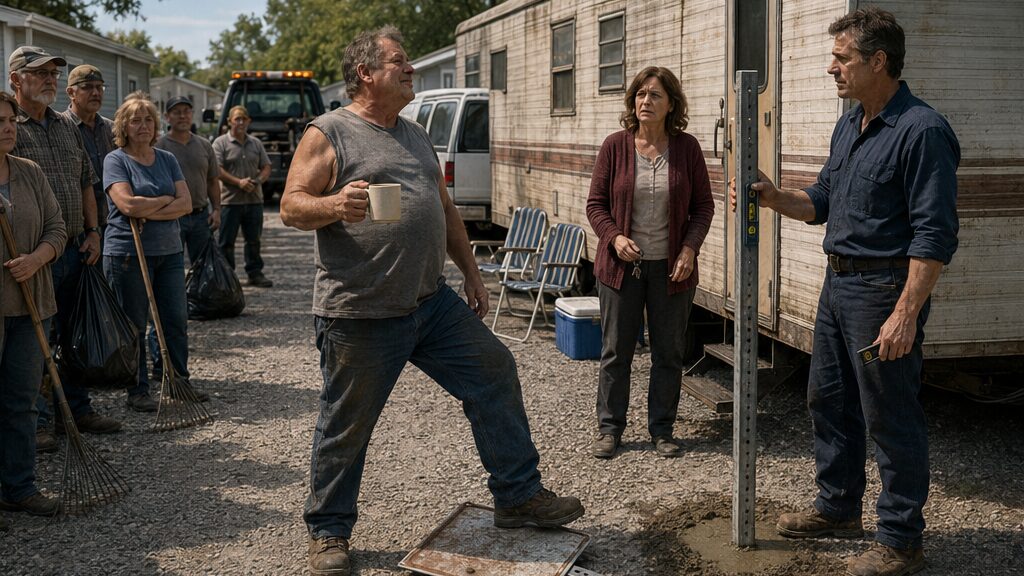
A man in a sleeveless gray shirt emerged from the neighboring home carrying a coffee mug. He was broad through the chest and stomach, with a slow walk that suggested the trailer had been placed exactly where he wanted it.
“You trying to get through?” he asked.
Charles looked at the trailer, then at him. “That was the idea.”
The man smiled as though Charles had delivered the expected answer. “Jason Davis.”
“Charles Miller.”
They did not shake hands.
Charles pointed toward the rear gate behind the trailer. “I need access to that building.”
Jason took a drink. “Trailer won’t be here forever.”
“When is it moving?”
“Probably tomorrow. Maybe Monday.”
Charles had an estimate scheduled at eight the next morning. The customer wanted a panel replaced in an older house, and Charles needed the larger extension ladder stored in the workshop. He could carry it around the front homes by hand, but not without crossing two yards and lifting it over a chain-link fence.
“This lane is part of the easement on my property,” Charles said. “It has to stay clear.”
Jason’s expression changed only slightly. “That what somebody told you?”
“It’s on the deed.”
“People park back here all the time.”
“I’m not asking about all the time. I’m asking about this trailer.”
Jason turned his mug in his hands. A teenage boy stood in the doorway behind him, watching.
“You just got here,” Jason said. “Might want to learn how things work before you start quoting paperwork.”
Charles felt the first hard pull of anger behind his ribs. He knew the feeling too well: the moment when another person treated calmness as uncertainty. Years earlier, his former business partner had used the same tone while explaining why Charles should not worry about missing invoices.
Charles had worried too late.
He took out his phone and photographed the trailer, the blocked gate, and the fallen sign.
Jason laughed. “There it is.”
“What?”
“The camera. Been here less than a week, already building a case.”
“I’m documenting an obstruction.”
“You call it that. We call it the back lane.”
Jason set one shoe on the edge of the fallen sign.
Charles lowered the phone.
“I need the trailer moved today.”
Jason’s smile disappeared. “It’s my property.”
“The trailer is. The lane isn’t.”
For a few seconds they stood close enough for Charles to smell coffee and cigarette smoke. The teenage boy vanished from the doorway.
Then Jason stepped off the sign and spread one hand toward the rows of homes.
“Ask anybody,” he said. “Holiday weekends, cookouts, people got company—this is where the overflow goes. Nobody’s ever had a problem.”
“I have a problem.”
“That’s because you’re treating it like a private driveway.”
“It reaches my rear gate.”
“And it runs behind six homes.”
Charles looked past him. Curtains had shifted in two windows. An elderly resident stood beside a small shed pretending to sort garden tools.
The dispute had become public without anyone raising a voice.
Charles picked up the warning sign. One leg had been crushed flat, probably by a tire. The bolt holding the crossbar had pulled loose.
“Did you run over this?”
Jason shrugged. “That thing’s been lying around for years.”
Charles carried it to his van and leaned it against the bumper.
“I’ll give you until noon.”
Jason’s mouth tightened. “You’ll give me?”
Charles heard the mistake as soon as he said it. He had meant to establish a deadline. It sounded like authority.
“I need my access,” he said.
“You need to relax.”
Charles left before anger made the decision for him.
Inside his new home, unpacked boxes lined the walls. The dining table held closing papers, insurance forms, utility transfers, and the black folder his real estate agent had handed him after the sale.
He found the deed beneath a packet of community rules.
The legal description ran across two pages in language designed to discourage ordinary people from reading it. Charles followed the parcel boundaries with one finger until he found the easement reference: a twelve-foot access corridor running from the community service road to the rear boundary of his lot.
He read it twice.
Then he opened the community handbook. It prohibited blocking designated emergency and service access, but no map was attached.
At eleven forty-five, Charles returned to the lane.
The trailer had not moved.
Jason had added wheel chocks.
Charles called the association office. A woman answered on the fourth ring and introduced herself as Anna Lewis, the property manager.
Charles explained the deed, the blocked gate, and the damaged sign.
Anna was silent long enough for him to hear a keyboard.
“The back lane has always been complicated,” she finally said.
“Is it an access lane?”
“It serves several functions.”
“Can someone park a forty-foot trailer across it?”
“Temporary parking has been tolerated.”
“My deed gives me access.”
“That may be a matter between property owners.”
Charles looked at the trailer. Jason sat beneath his awning now, talking to another resident.
“The association has a rule against blocking service access.”
“We would need to verify whether that section is designated service access.”
“There was a warning sign.”
“Was it installed by the association?”
“I don’t know.”
“Then please don’t arrange any towing until the board reviews it. Unauthorized towing creates liability.”
“How long does review take?”
“The board meets on the second Thursday.”
“That’s nearly two weeks.”
“I understand that’s frustrating.”
“No,” Charles said. “I don’t think you do.”
He ended the call before she could answer.
That afternoon, he carried the extension ladder by hand through the narrow strip beside his home, scraping one knuckle against the fence. The job took twice as long to load. He arrived late to the estimate and apologized without explaining why.
That evening, he opened every document in the black folder.
Near the bottom was a photocopied site plan from an older association packet. The print was faint, and several lot numbers had been changed by hand. Charles turned on a desk lamp and held the page close.
A dashed line followed the same gravel lane behind the homes.
Beside it, in block lettering, were five words:
SERVICE ACCESS — KEEP CLEAR AT ALL TIMES.
Charles set the damaged tow sign on the table beside the map.
The association had not failed to identify the lane.
Someone had decided not to enforce it.
Chapter 2: The Rule Everyone Followed Until Someone Needed It
The delivery truck backed away while Charles stood at the rear gate waving both arms.
The driver lowered the window. “Can’t make that turn with the trailer there.”
“You can unload at the front.”
The driver looked at the three wooden cable reels strapped inside the truck. Each weighed more than two hundred pounds.
“Front delivery wasn’t what the order says.”
“I’ll move them.”
“Not without a forklift.”
The truck left with Charles’s materials still inside.
Across the lane, Jason sat in a folding chair beside the trailer. He lifted two fingers in a casual salute.
Charles did not return it.
The electrical job attached to those cable reels was his largest scheduled project that month—a renovation of four rental units. The supplier could redeliver in three days, but only if Charles paid a second freight charge. The contractor had already warned him that delays would bring another electrician onto the job.
Charles photographed the departing truck, the blocked lane, and the trailer’s wheel chocks. He saved the images in a folder labeled ACCESS.
By Tuesday, the folder held nineteen photographs.
At the association office, Anna Lewis arranged his printed deed, the old site map, and the community handbook into three separate stacks as though distance between the papers might reduce their connection.
The office occupied a converted single-wide near the entrance. Its walls displayed notices about water shutoffs, pet registration, and spring cleanup. A framed photograph showed a previous board standing in front of the clubhouse ten years earlier.
Anna tapped the site plan.
“I’ve never seen this version.”
“It came with my closing papers.”
“It may be outdated.”
“The easement on my deed isn’t.”
“I’m not disputing your deed.”
“You’re disputing whether I can use what it guarantees.”
Anna folded her hands. She appeared tired rather than hostile, which made Charles more impatient.
“The problem,” she said, “is that the back lane has been used for temporary overflow parking for at least fifteen years. The association did not object. Residents came to rely on that practice.”
“Then the association allowed a bad habit.”
“That’s one interpretation.”
“It’s an access lane.”
“It is also common-area gravel in sections.”
Charles slid the site plan toward her. “The part behind my lot is marked service access.”
Anna glanced at the closed office door before lowering her voice.
“Past boards avoided this because enforcement would affect more than Jason. Sheds, fences, planters—several things may be inside old access boundaries.”
“So nobody enforces anything.”
“I didn’t say that.”
“You said people rely on the violation.”
“I said the history matters.”
Charles leaned back. “History doesn’t fit my van through a trailer.”
Anna’s jaw tightened. “And anger doesn’t make a private tow lawful. Do not call a towing company without written authorization.”
“From whom?”
“That is what I’m trying to determine.”
“When?”
“The board meeting.”
The same answer as before.
Charles gathered his documents.
Anna touched the corner of the old map. “Mr. Miller, I understand you need access. But Jason has lived here a long time. His wife cares for her mother. Their situation is not simple.”
Charles paused. “What does that have to do with his trailer?”
Anna looked as though she had nearly said too much.
“You should speak to him again.”
“I already did.”
“Then try without a deadline.”
Charles left with the papers under his arm.
At the county records office, a clerk pulled the original subdivision plat from a digital archive. The image appeared on a large monitor, clearer than the copy Charles owned.
The twelve-foot corridor was unmistakable.
The clerk printed a certified copy and stamped it.
“Easement was recorded with the original development,” she said. “No release or abandonment on file.”
“Can long-term parking cancel it?”
“I can’t give legal advice. But the easement still appears in the record.”
It was a small victory, and Charles felt no relief.
His phone rang before he reached the parking lot. The contractor for the rental renovation was calling.
“The supplier says materials went back.”
“They couldn’t reach my unloading gate.”
“You told me you had storage.”
“I do.”
“Then why can’t they reach it?”
Charles watched people cross the county building lobby carrying folders and rolled plans.
“There’s an access issue.”
“How long?”
“Three days.”
“I can’t lose three days. Tenants are already out of those units.”
“I can start the rough work.”
“Without cable?”
Charles had no answer that sounded competent.
The contractor exhaled. “I’m giving the job to somebody with materials on hand.”
The call ended.
Charles stood beside his van with the certified plat in one hand. The lost contract would have covered his mortgage and van payment for nearly two months. He could have told Anna that. He could have told Jason.
Instead, he opened the ACCESS folder and added a note beneath the delivery photograph: Lost project due to obstruction.
At home, he removed the bent leg from the tow-warning sign and clamped it to his workbench. He heated the metal, straightened it, drilled a new hole, and replaced the bolt. The work was familiar and exact. Metal did not interpret his motives. A bent piece either aligned or it did not.
He cleaned mud from the face of the sign until the red letters showed clearly.
Then he placed the certified easement plat beside it and took another photograph.
That evening, Anna called.
“I spoke with the association’s insurance representative,” she said. “They are concerned about towing from disputed common space.”
“It isn’t disputed in the county record.”
“The towing company may still require association authorization.”
“Will you provide it?”
“Not before the board reviews the matter.”
Charles stared through the kitchen window at the trailer.
“What happens if I lose another job?”
Anna did not answer immediately. “You could consult an attorney.”
“With what money?”
The question escaped before Charles could stop it.
Anna’s voice softened. “Is your business in trouble?”
Charles looked at the stack of unpaid supplier invoices beneath his phone. He had spent two years rebuilding after his former partner emptied their operating account and disappeared behind a bankruptcy filing. He had promised himself no one would again learn how close he was to the edge.
“My business is my concern,” he said.
“Then the association’s liability is ours.”
The line went quiet.
“Do not tow without written confirmation,” Anna repeated.
After the call, Charles installed the repaired sign beside his rear gate. He sank the post into a bucket of quick-setting concrete, planning to place it at the edge of the easement once the trailer moved.
On Friday evening, the trailer finally disappeared.
For the first time all week, the gravel lane lay open.
Charles backed his van through the gate and unloaded his tools. He felt the tension ease from his shoulders as the tires crossed the rear threshold.
At six the next morning, voices woke him.
He looked through the back window.
The trailer had returned.
Two folding chairs sat behind it. A blue cooler rested between them. Residents carrying rakes and trash bags were gathering for the association cleanup.
Jason lowered himself into one chair and placed his boots on the damaged base of the old sign he had dragged back into the lane.
He looked directly toward Charles’s window.
This time, the obstruction was not convenient.
It was an invitation.
Chapter 3: The Warning Sign Beneath His Boot
By eight o’clock, half the community had seen Jason standing on the fallen warning sign.
He did not simply rest his boot there. He planted it across the red letters while talking to a loose circle of residents gathering rakes, pruning shears, and black trash bags for the cleanup.
Charles carried the repaired sign from his workshop with a bag of concrete over one shoulder.
Jason saw him and raised his coffee mug.
“Here comes the new highway department.”
A few people laughed. Not many, but enough.
Charles set the bag down beside the boundary marker shown on the county plat. He had measured the location twice before sunrise.
Jason gestured toward him. “Man’s trying to own the whole back road because he bought one little place.”
“It’s a recorded access corridor,” Charles said.
“To your shed.”
“To my workshop.”
“Same difference.”
Charles opened the concrete bag.
An elderly resident leaned on a rake. “We’ve parked back here for years.”
Charles nodded. “I’ve been told.”
“Nobody complained.”
“Nobody needed to get a work van through my gate before.”
Jason spread his arms toward the group. “There. Hear that? We all have to change because he runs a business out of his backyard.”
Charles could feel every face turn toward him. The association rules allowed home-based businesses as long as they did not create excess traffic. His van was marked with the company name. Jason had found another angle before Anna had even used it.
Charles took out his phone and photographed the trailer.
Jason laughed. “You going to take pictures of all of us?”
“Only the obstruction.”
“You mean my property.”
“I mean what your property is blocking.”
Nancy emerged from their home carrying a cardboard box. She kept her eyes down as she crossed toward the trailer.
Charles noticed her glance at the tow sign, then at Jason’s boot.
“Jason,” she said quietly.
He ignored her.
Charles mixed water into the concrete bucket. The scrape of his trowel against plastic sounded unnaturally loud.
“What’s that for?” Jason asked.
“A permanent post.”
“You don’t have permission to install that.”
“It’s on my boundary.”
Jason stepped off the old sign. “Anna know?”
“She has the map.”
“That isn’t what I asked.”
Charles set the repaired metal post into the concrete and checked it with a small level.
Jason moved closer. “You called somebody, didn’t you?”
Charles looked at his watch. “The trailer needs to move by eight-thirty.”
Several residents stopped pretending to work.
Jason’s mouth opened in disbelief, then curled into a smile. “Or what?”
“Or the towing company will remove it.”
The smile held, but color rose into Jason’s face.
“Anna told you not to do that.”
“She told me the association wouldn’t authorize it. The towing company reviewed the certified easement, the posted notice, and the state requirements. They accepted authorization from the property owner whose access is obstructed.”
Jason looked toward the entrance road.
Charles saw the first uncertainty enter his expression.
“You think paperwork makes you right about everything,” Jason said.
“No. It makes the lane an easement.”
“That trailer has been parked there longer than you’ve owned this place.”
“That doesn’t make it yours.”
Nancy stopped beside the trailer door. “Jason, maybe we should move it.”
He turned on her. “Where?”
“Just for today.”
“And next weekend? And after that? We keep moving every time he snaps his fingers?”
Charles tightened his grip on the trowel.
“I asked you twice before I called anyone.”
“You gave orders.”
“I asked for access.”
“You showed up with a camera.”
Because people lied after the fact. Because signatures vanished. Because a man Charles had trusted for eleven years had once looked him in the eye and said the missing money was an accounting delay.
Charles did not say any of that.
At eight twenty-seven, the low growl of a diesel engine came from the entrance road.
People turned.
A tow truck rounded the last row of homes and entered the gravel lane, amber lights flashing without a siren.
Jason stared at Charles. “You’re actually doing this.”
Charles stepped away from the wet concrete.
The tow operator climbed down, carrying a clipboard. He examined the posted sign, the certified plat Charles provided, and the trailer’s position across the corridor.
Jason moved between him and the hitch.
“This is private property.”
The operator kept his voice even. “Whose property?”
“Mine.”
“The trailer?”
“All of it.”
The operator pointed to the plat. “The trailer is sitting across a recorded access easement. Notice was posted. Owner provided photographs and written demand to clear.”
Jason looked around at the residents as if expecting someone to overrule the man.
The elderly resident shifted his rake to the other hand.
Anna had not come.
“You hook that up,” Jason said, “you’ll hear from my lawyer.”
“That’s your right.” The operator placed the clipboard on the truck hood. “You can also move it yourself now and avoid the tow.”
Jason folded his arms.
The operator waited.
Charles watched the minute change on his phone.
At eight thirty-two, the operator lowered the wheel lift.
The first metallic clank silenced the lane.
Jason stood beside the old warning sign, no longer smiling. The winch cable slid beneath the trailer with a hard, dragging sound. Residents backed away from the gravel.
Charles felt vindication arrive—not as pleasure, but as a loosening in his chest. The trailer was going to move. His gate would open. The lane would become usable because he had refused to let another person’s confidence replace the record.
Then Nancy screamed.
“Wait.”
She ran from the house without closing the door, one hand pressed to her chest.
The operator stopped the winch.
Nancy reached the trailer steps and pulled at the locked handle.
“My mother’s oxygen concentrator is in there.”
Every face turned toward Charles.
Jason moved first. “You happy now?”
Charles looked at Nancy. “Why is it in the trailer?”
“We keep the spare unit there. And her portable tanks. The house is crowded, and she only needs them when the main machine acts up.”
“Why didn’t you get them before?”
“I was trying.” Her voice shook. “Jason said there was time.”
The operator looked at Charles. “Your call whether we pause for retrieval.”
Jason stepped close enough that Charles could see sweat along his hairline.
“You tow this now, and something happens to her—”
“Stop,” Nancy said.
Jason fell silent.
Charles looked at the trailer, the cable, the residents, the phone still in his hand. He had followed every step. He had given notice. He had verified the easement. None of that changed the fact that medical equipment was behind the locked door.
“Open it,” Charles said.
Jason reached into his pocket, but Nancy held out her hand.
“Give me the key.”
He hesitated.
That hesitation changed something.
Nancy took the key from him and climbed inside with the teenage grandson. They carried out a compact concentrator, two green oxygen cylinders, a folded wheelchair, and a sealed box of tubing. The amount of equipment made the trailer’s use look less casual than Charles had assumed.
The residents watched each item cross the lane.
Charles helped the grandson lift the concentrator onto a porch cart.
“Thank you,” Nancy said without meeting his eyes.
Jason gave a bitter laugh. “Don’t thank him. He’s still taking it.”
Charles faced him. “You had three days after the written notice.”
“You knew she was sick.”
“I knew Anna said you had family complications. I didn’t know equipment was stored inside.”
“You never asked.”
The accusation landed because it was true.
Charles had asked when the trailer would move. He had asked whether Jason understood the easement. He had not asked why the trailer remained there or what it contained. He had considered explanation Jason’s responsibility and documentation his own.
The operator cleared his throat. “Are we proceeding?”
Charles looked at the open lane beyond the trailer. His work van waited behind the gate. The trailer had been moved and returned deliberately. Jason had stood on the warning sign in front of the neighborhood. Cancelling now would not create understanding. It would establish that any personal consequence could erase the boundary.
“Yes,” Charles said. “Proceed.”
Nancy closed her eyes.
Jason stared at him with a look no photograph could explain.
The winch tightened. The trailer shifted six inches, tires grinding into gravel. Then it rolled slowly toward the tow truck.
No one laughed now.
When the truck pulled away, the lane seemed wider than Charles remembered. The repaired warning sign stood upright in fresh concrete beside the boundary marker. Charles had imagined that sight would feel like resolution.
Instead, it looked like a verdict.
That afternoon, the towing company emailed the recovery notice. The initial charge was eight hundred ninety dollars, with storage fees beginning the following morning.
Charles printed the invoice and placed it in his ACCESS folder.
His phone vibrated.
Someone had posted a photograph in the community’s online group. It showed Nancy carrying an oxygen cylinder while the trailer sat hooked behind her. Charles appeared in the background holding his phone.
The caption read:
NEW OWNER TOWS SICK WOMAN’S MEDICAL EQUIPMENT OVER A PARKING DISPUTE. $890 TO GET IT BACK.
Comments were already multiplying beneath it.
Charles opened the image full-screen.
The warning sign was visible near the edge of the photograph, but the words were too small to read.
Chapter 4: The First Tow Cost More Than Money
Jason’s fist struck Charles’s front door before seven on Monday morning.
The first blow rattled the narrow glass pane. The second brought two porch lights on across the street. By the third, Charles had already taken his phone from the kitchen counter, though he stopped himself from opening the camera.
He opened the door instead.
Jason stood on the porch holding a printed copy of the towing invoice. The page had been folded into quarters and crushed in one hand.
“You cost me eight hundred ninety dollars.”
Charles kept one hand on the doorframe. “The towing company charged you.”
“You called them.”
“I gave you notice.”
“You put my wife’s mother at risk.”
A curtain shifted in the home opposite Charles’s. An elderly resident had stepped onto the neighboring porch in slippers.
Charles lowered his voice. “Nancy removed the equipment before the trailer left.”
“After she had to beg.”
“She didn’t have to beg.”
Jason thrust the invoice toward him. “That picture’s everywhere. People know what you did.”
Charles had seen the comments. Some called him cruel. Others suggested reporting his business. One person had posted the phone number printed on his van and written, Ask yourself if this is who you want inside your home.
Two appointments had canceled Sunday evening.
“I know what the picture shows,” Charles said.
“It shows you standing there while my wife carries oxygen tanks.”
“It doesn’t show the three notices.”
Jason leaned closer. “Nobody cares about your notices.”
That was the part Charles believed.
Nancy appeared at the edge of the porch in a cardigan, her face drawn from lack of sleep.
“Jason,” she said. “Come home.”
“He wants rules? He’s going to get rules.”
Charles looked past him toward the lane. The trailer was gone, but tire grooves remained in the gravel. The repaired warning sign stood straight in its concrete base.
Jason followed his gaze.
“You think that sign makes you safe?” he asked.
Nancy caught his arm. “Enough.”
Jason pulled free but stepped down from the porch.
Before leaving, he turned back. “Meeting tonight. Everybody’s coming.”
Charles watched them cross the lane. Nancy never looked up.
At six, the association meeting room was already full.
Metal folding chairs had been arranged in rows, and several residents stood along the walls. Anna sat at a plastic table with three board members. In front of her lay a stack of complaint forms, copies of the online photograph, and the towing invoice.
The photograph had been enlarged. The warning sign appeared at the far edge, cropped nearly out of view.
Charles sat alone in the second row.
Jason and Nancy entered together. Residents shifted to make space for them near the front.
Anna tapped the table. “We’re here to address emergency concerns raised after Saturday’s towing incident, along with questions regarding access, parking, and commercial activity.”
“Emergency concerns?” Charles asked.
Anna looked at him. “Please let me finish.”
Jason folded his arms.
Anna summarized the incident without naming who had first blocked the lane. She described a disputed access corridor, a privately authorized tow, medical equipment stored in the removed trailer, and growing conflict among residents.
Charles felt the wording tilt the room before discussion began.
A board member held up the community handbook. “Our concern is that unilateral enforcement created a health risk.”
“The equipment was removed,” Charles said.
“Because Nancy reached the trailer before it left.”
“I stopped the tow.”
“You paused it,” Jason said.
Charles turned toward him. “And gave you access.”
“You still took it.”
Anna raised one hand. “One at a time.”
The elderly resident from the cleanup leaned forward. “What happens next time the machine fails and the spare isn’t here?”
Nancy answered before Jason could.
“The concentrator is in the house now.”
The room quieted.
Jason looked at her.
Nancy kept her hands clasped in her lap. “Charles let us take everything out before the trailer moved. That part should be clear.”
It was the first time anyone had corrected the online version in public.
A woman near the wall asked, “Then why wasn’t that in the post?”
Jason’s jaw tightened. “Because it never should’ve been towed.”
Nancy did not argue, but she did not withdraw what she had said.
Charles felt a small opening appear and close just as quickly when Anna slid another document to the center of the table.
“There is a separate issue,” she said. “Several complaints question whether Mr. Miller’s commercial van and stored equipment comply with the home-occupation section of our rules.”
Charles stared at her. “My van has nothing to do with the trailer.”
“It concerns community-wide consistency.”
“Consistency would have kept the lane clear.”
“We are reviewing all related rules.”
Jason gave a short laugh. “That’s what you wanted, right? Everything by the book.”
Charles looked at the printed rule Anna had placed on the table. It prohibited commercial vehicles over a certain weight from overnight parking unless stored behind an approved screen. His van sat behind his home when the lane was open, but the workshop fence had not yet been approved as screening.
If the board enforced the rule immediately, he would have nowhere lawful to keep the vehicle.
Anna spoke carefully. “The board is considering a temporary ban on commercial vehicles within the community until these access and parking issues are resolved.”
The words landed harder than Jason’s fist had that morning.
“You’d block my business because he blocked my easement?”
“This is not punishment.”
“What would you call it?”
“A temporary risk-control measure.”
Charles heard the old language of invoices and vanished money: temporary adjustment, accounting correction, short delay. Neutral phrases laid over someone else’s loss.
“How long?” he asked.
“The board has not decided.”
Jason turned in his chair to look at the residents. “Maybe businesses don’t belong back there in the first place.”
Charles could have explained then. He could have told them about the rental project he had lost, the canceled appointments, the supplier invoices, and the operating account his former partner had emptied. He could have told them the van was not a symbol of ambition. It was the last functioning part of a business he had already rebuilt once.
Instead, he said, “My finances are not part of this meeting.”
Anna’s expression changed, almost imperceptibly. She had given him room to speak, and he had closed it.
A board member asked whether Charles had formal approval for the workshop.
“The structure was included in the sale.”
“That wasn’t the question.”
Charles placed the certified easement plat on the table.
“This is the issue. The lane is recorded access. The association map says keep clear. Jason received notice and refused to move.”
Jason slapped the towing invoice beside the plat.
“And this is the result.”
For a moment the two papers lay side by side: one proving the right, the other proving the cost.
The board postponed the commercial-vehicle decision for forty-eight hours and instructed both men to avoid further confrontation. Anna promised a written access determination after consultation with counsel.
No one left satisfied.
Outside, Nancy caught up with Charles near his van.
“You didn’t know about the equipment,” she said.
Charles stopped.
She glanced back toward the meeting room. Jason was speaking with Tyler Anderson beside the entrance.
“No,” Charles said. “I didn’t.”
“I told him to move the trailer Friday night.”
Charles waited.
“He said you wouldn’t actually tow it.”
“Why did he think that?”
Nancy rubbed one thumb across her wedding ring. “Because people usually back down when he makes things public.”
She looked ashamed of the sentence.
“Thank you for saying what happened in there,” Charles said.
“I’m not taking your side.”
“I didn’t ask you to.”
“No,” she said. “You usually don’t ask much.”
She walked away before he could answer.
Charles remained beside the van, the keys in his hand.
Across the community, Jason climbed into his pickup. Instead of driving toward his own lot, he turned onto the gravel lane.
He stopped behind Charles’s rear gate.
Then, while Charles watched from less than fifty yards away, Jason switched off the engine, stepped out, and locked the truck.
Chapter 5: Every New Tow Revealed an Older Lie
At five twelve the next morning, Charles opened his back door and found Jason’s pickup filling the lane.
The truck sat squarely between the warning sign and the rear gate. Its mirrors had been folded inward, leaving no pretense that the parking was temporary or careless.
A folded sheet of paper rested beneath the driver-side wiper.
Charles crossed the gravel and removed it.
WAIT FOR THE BOARD.
There was no signature.
He photographed the truck, the paper, the warning sign, and the locked gate. Then he called the towing company.
His thumb hovered over the final number.
Nancy’s porch light came on.
She stepped outside wearing house shoes and a heavy sweater, though the morning was already warm.
“Please don’t call yet.”
Charles lowered the phone. “Is he moving it?”
“He’s asleep.”
“Wake him.”
“I tried.”
Charles looked at the pickup. “The board hasn’t suspended the easement.”
“I know.”
That answer stopped him.
Nancy walked closer, keeping her voice low. “Give me thirty minutes.”
“He parked here after the meeting.”
“I know.”
“He left a note.”
“I know.”
“Then tell me what thirty minutes changes.”
Nancy looked toward her home. “It gives me time to tell you something before he decides how to tell it.”
Charles put the phone in his pocket but did not promise anything.
Inside Nancy’s kitchen, medical tubing hung neatly beside a portable concentrator near the wall. The room was crowded but clean. Prescription bottles occupied one end of the counter, and unopened association mail was stacked beneath a fruit bowl.
Nancy set two towing notices on the table.
The first was the eight-hundred-ninety-dollar recovery invoice. The second showed two days of storage fees.
“He hasn’t paid it,” she said.
“The trailer is still at the yard?”
“Yes.”
“Then why is his pickup here?”
“Because he thinks if he keeps you from using the lane, the board will call the first tow improper and make the association pay.”
Charles stared at her. “That isn’t how it works.”
“I told him.”
Nancy opened a drawer and removed another envelope. This one bore the association’s return address. The notice inside was six months old.
It cited unapproved long-term trailer storage, excess occupancy, and items extending into the service corridor.
Charles read the date twice.
“He knew,” he said.
“Before you bought your place.”
“He knew the lane was designated access.”
“He knew the board had warned him.”
“Then why did Anna say the matter was unclear?”
“Because Jason challenged the notice. The old board never followed through.”
Nancy sat opposite him. “My mother moved in last year after she couldn’t live alone. Our grandson was already staying some nights. The trailer became storage because there wasn’t room inside. Then the storage lot raised its monthly rate, and Jason brought it back here.”
“He could have told me.”
“He could have told me more too.”
She pushed a second paper across the table. It was a statement from the storage facility showing months of unpaid charges and a termination date.
“He said we were current,” Nancy said. “He said the association had approved temporary placement behind the homes.”
Charles looked toward the window. Jason’s pickup remained visible through the blinds.
“What else?”
Nancy’s mouth tightened. “The trailer registration expired. The roof leaks. If we move it too often, something underneath may give way. He’s afraid the tow yard inspection will show it can’t safely travel.”
“So he keeps blocking the lane because he has nowhere lawful to put it.”
“And because he doesn’t want me to know how much we owe.”
Charles placed the papers down carefully.
The picture of Jason changed without becoming kinder. His mockery, the public challenge, the insistence that everyone had always parked there—each had protected a practical arrangement and a private lie.
“He told Tyler you targeted us because we couldn’t afford a lawyer,” Nancy said.
“Did Tyler believe him?”
“He believes whichever version lets him act first.”
Outside, an engine started.
Charles stood.
Jason’s pickup reversed three feet, then stopped. Jason stepped out in yesterday’s clothes.
He saw Charles through the kitchen window.
Nancy closed her eyes.
Jason entered without knocking. His gaze moved from Charles to the papers on the table.
“What are you doing?”
Nancy stood. “Telling him what you wouldn’t.”
Jason snatched up the association notice. “This is family business.”
“It became his business when you parked across his gate.”
“I’m handling it.”
“You’ve been handling it with his tow bills and my grocery money.”
Jason’s face changed. The anger remained, but beneath it Charles saw something close to panic.
“You think he’s going to help you?” Jason asked. “He’s collecting evidence.”
Charles felt the accusation strike near the truth.
He had photographed every obstruction. He had copied every notice. He had recorded dates, calls, delivery losses, and canceled jobs. The folder in his workshop was thick enough to present in court.
“I am collecting evidence,” Charles said.
Nancy looked at him.
Charles continued, “Because every time I trusted somebody to do what they said, I lost another option.”
Jason gave a humorless smile. “There he is.”
“But I haven’t called the truck yet.”
Jason glanced toward the window.
“Move the pickup,” Charles said. “Pay the release fee before storage grows. Then we take the easement and trailer issue to the board with everything on the table.”
Jason crumpled the old notice in his fist.
“You don’t get to set terms in my house.”
“These aren’t terms. It’s the last chance before another tow.”
Jason stepped toward Charles.
Nancy moved between them.
“Move it,” she said.
For one second, Charles thought Jason might refuse simply because both of them had asked.
Then he turned, walked outside, and drove the pickup away.
Charles did not feel victorious. He felt the weight of the unused tow call in his pocket.
Two days later, Jason parked an unregistered utility trailer across the lane after midnight.
Charles had it removed at sunrise.
The following weekend, a borrowed pickup appeared in the same place. Its owner came running before the tow operator finished attaching the lift and moved it after learning why it had been parked there.
Each incident added another page to Charles’s folder and another layer of resentment to the community. The warning sign acquired a long scrape across its face. Someone bent the top corner backward. Charles straightened it with pliers but left the scar visible.
By Saturday afternoon, Jason’s trailer remained at the tow yard, accumulating storage fees neither household could comfortably pay.
Charles was unloading a spool of wire through his rear gate when a dark SUV entered the lane too fast.
Gravel struck the bottom of his van.
The SUV stopped sideways across the corridor, nose near Jason’s lot and rear bumper near Charles’s sign. Tyler Anderson climbed out wearing sunglasses and carrying himself with the certainty of a man arriving after hearing only one side.
Jason came from his porch.
“You know Tyler,” he said.
Charles set the wire spool down. “Move the SUV.”
Tyler looked at the warning sign. “This the famous road?”
“It’s an access easement.”
“Looks like gravel.”
“It still needs to stay clear.”
Tyler locked the SUV with a chirp. “We’re waiting for management.”
“Then wait somewhere else.”
Jason stepped beside him. “Anna said no more unilateral action.”
“She said the board was reviewing the van rule. She didn’t suspend the easement.”
Tyler removed his sunglasses. “You really going to tow family now?”
“It’s your vehicle.”
“You know what I mean.”
Charles looked toward Nancy’s house. She stood behind the screen door, one hand covering her mouth.
“Move it,” Charles said again.
Tyler leaned against the hood.
“No.”
A siren sounded beyond the main entrance.
At first no one moved. Sirens passed the nearby road often enough to become background noise.
Then the sound turned into the community.
An ambulance rounded the entrance and slowed behind a parked maintenance cart. Its horn gave one short blast.
The driver pointed toward the back lane.
The community’s front loop was partially blocked by cleanup dumpsters. The gravel corridor was the only direct route to the rear row.
Tyler’s SUV sat across it.
The ambulance horn sounded again, longer this time.
Chapter 6: The Convoy That Forced the Truth Into Public
The ambulance horn pressed through the narrow lane, loud enough to shake the loose corner of the warning sign.
Tyler straightened from the SUV.
“Move it,” Charles said.
Tyler took out his keys, but Jason caught his wrist.
“Wait. They can go around.”
“They can’t,” Charles said. “The dumpsters block the loop.”
The ambulance driver leaned from the window and shouted, “We need the rear row.”
Residents appeared between homes. An elderly man pointed frantically toward a unit near the far fence.
Tyler pulled against Jason’s hand. “Let go.”
Jason released him, but in the confusion Tyler dropped the keys into the gravel beneath the SUV.
Everyone looked down.
The horn sounded again.
Charles knelt and swept his hand beneath the driver-side door. Dust coated his palm. The keys were not there.
“Back up,” he told Tyler.
“What?”
“Everyone back up so I can see.”
Jason stood frozen beside the hood.
Charles turned toward him. “Who needs the ambulance?”
Jason looked toward the rear row. “I don’t know.”
Nancy ran from her house. “It’s the elderly resident near the sheds. His daughter called me.”
The emergency had nothing to do with either family, which somehow made the obstruction worse.
Charles pulled his phone out.
Anna answered immediately. “I’m on my way.”
“I don’t need you on the way. I need authorization to clear the emergency access.”
“You cannot tow an occupied—”
“The SUV is locked across the lane, and the keys are lost.”
Tyler crouched near the rear tire. “Not lost. Dropped.”
“How long?” Charles asked.
Tyler did not answer.
Anna said, “Give me five minutes.”
The ambulance driver sounded the horn a fourth time.
Charles looked at the warning sign. Its face pointed toward his rear gate, where he had placed it to defend his own access.
He grabbed the metal post with both hands and turned it in the still-curing gravel base until the red letters faced the approaching ambulance and the entire lane.
TOW WARNING.
For the first time, the sign no longer looked like a private threat.
It looked like a rule everyone should have needed.
Charles called the tow operator.
“This is Miller. Emergency obstruction. Same recorded corridor. I need the fastest truck you have.”
Anna’s voice sharpened through the other phone. “Charles, wait for me.”
“No.”
“You could create liability.”
“The ambulance is already waiting.”
He ended the call.
Tyler found the keys less than a minute later, wedged beneath the running board. He unlocked the SUV and started it, but the engine turned over without catching.
“You flooded it,” Jason said.
“It’s fuel injected.”
“Then why isn’t it starting?”
Tyler tried again. The starter ground uselessly.
The ambulance driver climbed down and approached.
“How far to the patient?” Charles asked.
“About four hundred yards. We can carry gear, but if we need transport, we lose time coming back.”
Charles opened the rear doors of his work van. “Use this to move equipment.”
The driver hesitated only long enough to check the floor. Charles swept aside tool cases, cable boxes, and a folded ladder. Two emergency workers transferred bags and a collapsible stretcher into the van.
Charles drove them through the narrow margin between the SUV and the fence, tires climbing partly onto his own lot. Branches scraped the passenger side. At the rear row, he stopped near the elderly resident’s home and helped unload.
The ambulance remained trapped at the lane entrance.
By the time Charles returned on foot, the first tow rig was approaching.
Anna arrived behind it in her sedan, followed by two board members.
“You called them anyway,” she said.
Charles pointed toward the waiting ambulance. “Yes.”
The tow operator assessed the SUV, then shook his head. “Can move it, but I need room behind.”
Jason’s unregistered utility trailer, returned from elsewhere that morning, occupied the only workable angle near his lot.
Charles stared at it.
Jason said, “That one isn’t blocking the center.”
“It blocks the truck’s approach.”
“You’re not towing both.”
The operator looked between them. “If that trailer moves, I can pull the SUV straight out.”
“Do it,” Charles said.
Jason stepped forward. “You don’t authorize my trailer.”
Charles turned to Anna. “Does the association?”
Anna’s face had gone pale. Residents were gathering again, but this time no one laughed.
A board member whispered to her.
Anna looked at the ambulance, then at the old site map Charles had sent days earlier, now open on her tablet.
“The lane is designated service and emergency access,” she said.
Jason stared at her. “You told everybody it was disputed.”
“I said portions were disputed.”
“You let him make us the problem.”
Anna held his gaze. “The association received prior notices regarding your trailer and failed to complete enforcement.”
Silence moved through the group.
Charles heard the admission clearly: management had known.
Anna continued, “Remove both obstructions.”
Jason’s expression collapsed into disbelief.
The first tow rig hooked Tyler’s SUV. A second arrived ten minutes later for the utility trailer. The machines worked in opposite directions, cables tightening, amber lights flashing against the metal siding of nearby homes.
As soon as the SUV cleared, the ambulance rolled through.
No one cheered.
Tyler stood with his arms crossed while his vehicle was secured. Jason watched the utility trailer rise onto the second rig. Nancy remained near the warning sign, one hand resting against the bent corner Charles had never fully repaired.
The two trucks pulled away in line behind the ambulance, forming a slow convoy through the community.
Charles thought of the first tow and the brief satisfaction he had felt when the lane opened. There was none now. Only exhaustion and the recognition that every person standing there had helped make a private argument large enough to delay an emergency.
The elderly resident was transported before noon. His condition was serious but stable, according to his daughter.
The board called an emergency meeting in the association office that afternoon.
This time, the certified plat, old service map, towing invoices, complaint photograph, and prior notices all lay on the same table.
Anna spoke first.
“The association knew the corridor carried a recorded access designation. Past boards tolerated temporary obstruction and did not resolve encroachments. Current management continued that delay.”
Jason sat beside Nancy, his hands clasped between his knees.
A board member asked Charles to describe the business impact.
He almost gave the answer he had given before: private matter.
Instead, he looked at the folder in front of him and left it closed.
“I lost a four-unit renovation because materials couldn’t be delivered,” he said. “Two customers canceled after the online post. My van is not extra parking. It carries the tools that pay for the property.”
No one interrupted.
Charles continued, “Two years ago, my business partner emptied our operating account. I paid what I could, sold what I couldn’t, and started again alone. This workshop is the only storage I can afford. If I can’t reach it, the business doesn’t bend. It ends.”
The words left him feeling exposed rather than relieved.
Jason looked up.
For the first time since Charles had moved in, he did not appear amused, angry, or defensive. He looked as though he had been given information he could not dismiss without effort.
Anna folded her hands. “Why didn’t you explain this earlier?”
Charles looked at the photographs in his folder.
“Because I thought the deed should be enough.”
Nancy answered quietly. “And Jason thought living here longer should be enough.”
Jason glanced at her, but he did not argue.
The board moved into closed discussion for twenty minutes. When they returned, Anna carried a typed proposal.
“The association will formally designate the full corridor as service and emergency access,” she said. “No parking, storage, or temporary obstruction will be permitted.”
Charles nodded.
“The association will reimburse Mr. Miller for documented business losses and towing-related legal consultation, subject to review.”
Jason shifted in his chair.
Anna looked at him. “The board will also begin termination proceedings against the Davis household for repeated safety violations, unauthorized storage, and deliberate obstruction.”
Nancy’s face drained of color.
Jason stood. “You’re evicting us?”
“The board is offering Mr. Miller full reimbursement and immediate enforcement support if he provides a statement confirming the repeated violations and their effect.”
Every eye moved toward Charles.
Anna slid the prepared statement across the table.
His name had already been typed beneath the final paragraph.
All he had to do was sign.
Chapter 7: The Lane Stayed Open Without Becoming a Weapon
Charles read the prepared statement once and pushed it back across the table.
Anna did not touch it. “Is something inaccurate?”
“It leaves out the association’s part.”
“The board has already acknowledged prior enforcement failures.”
“Not in this.”
The document described repeated violations by the Davis household, the emergency obstruction, towing costs, and Charles’s business losses. It ended with a recommendation that Jason and Nancy’s residency be terminated for the safety of the community.
Charles’s signature line waited beneath it.
Jason sat rigid beside Nancy. The anger had gone out of his posture, replaced by something heavier. Nancy kept both hands around a paper cup she had not lifted.
A board member leaned forward. “Mr. Miller, you asked us to enforce the rules.”
“I asked you to keep the lane clear.”
“This is how we do that.”
“No. This is how you remove the people you let break the rule for years.”
Jason looked at Charles then.
Anna’s voice remained measured. “Repeated deliberate obstruction cannot be ignored.”
“I’m not asking you to ignore it.”
“What are you asking?”
Charles looked toward the closed association-office door. Beyond it, the gravel lane ran behind the homes, open now except for the permanent warning sign and the marks left by tow-truck tires.
“I want the easement recorded in the community rules exactly as it appears on the plat. I want service and emergency access enforced against everybody, including me. I want Jason responsible for the towing charges tied to the vehicles he placed or directed there. Tyler pays his own.”
Tyler, seated against the wall, shifted but said nothing.
“And the eviction?” Anna asked.
Charles looked at Jason. “That depends on whether he admits what he did.”
Jason’s face tightened. “I already lost the trailer.”
“That wasn’t the question.”
Nancy turned toward him. “Answer it.”
Jason stared at the statement in front of Charles.
The room stayed quiet long enough for the refrigerator in the adjoining kitchenette to cycle on.
Finally, Jason said, “I parked there knowing he needed the lane.”
Anna opened her folder. “Speak clearly for the record.”
Jason gave her a hard look, then faced the board.
“I knew the easement was on the old map. I knew the association had warned me before Charles bought the place. I thought if I kept using it the way everybody always had, nobody would make me stop.”
His voice lowered.
“And after the first tow, I blocked it because I wanted him to pay for embarrassing us.”
Nancy closed her eyes.
Jason continued, each sentence seeming to cost more than the last. “I told Tyler Charles was trying to push us out. I knew that wasn’t the whole truth.”
Tyler looked toward the floor.
Charles felt no satisfaction. The admission did not repair the canceled work, the public accusations, or the ambulance waiting behind the SUV. It only made the harm impossible to disguise as confusion.
A board member asked, “Why should we believe it won’t happen again?”
Jason rubbed one hand across his mouth. “Because I can’t afford another one.”
“That is not enough,” Anna said.
“No,” Nancy replied. “It isn’t.”
She set down the paper cup.
“We’ll accept a repayment plan for the authorized towing charges. We’ll remove the trailer from the tow yard and relocate it or surrender it if it can’t be moved safely. We’ll comply with an occupancy review.”
Jason turned toward her. “Nancy—”
“You hid the notices. You hid the storage debt. You made every decision alone and called it protecting us.”
His expression hardened from instinct, then softened into exhaustion.
Nancy looked at the board. “But eviction would put my mother in a place that cannot manage her equipment, and it would punish everyone in our home for what Jason chose.”
Anna glanced at the other board members.
Charles opened the old site plan on the table. During the three weeks since the emergency, he had walked the perimeter with a tape measure. A narrow strip near the maintenance shed sat outside the easement and beyond the fire-turn radius. It was covered in weeds and broken landscape timbers.
He pointed to it.
“This can hold a trailer.”
Anna frowned. “That area is common property.”
“It isn’t used.”
“It would need grading.”
“I can help with the electrical relocation for the maintenance light. The association can bring in gravel when the next road load comes.”
Jason studied the map. “That’s on the other side of the community.”
“It’s also not across anyone’s gate.”
One board member measured the strip on the plan with a ruler. “There may be enough clearance if the trailer is under the length limit.”
“The current trailer may not be roadworthy,” Anna said.
“Then it doesn’t go there,” Charles replied. “It gets removed properly. But the location could become approved storage for residents who pay for a space and follow inspection rules.”
Anna looked at him. “You are proposing the association create a storage area.”
“I’m proposing you replace the custom that caused this with something people can actually follow.”
The board recessed.
No one spoke while they waited. Tyler left first, stopping near Jason’s chair.
“I’ll handle my tow bill,” he said.
Jason nodded.
Tyler looked at Charles but offered neither apology nor challenge. Then he walked out.
When the board returned, Anna carried a revised resolution rather than the prepared statement.
The Davis household could remain under a twelve-month compliance agreement. Jason would accept responsibility for the first trailer tow, the utility-trailer tow, and documented damage to the sign. Tyler’s charge would remain separate. The association would not reimburse Charles for the towing itself, but it would compensate part of his verified delivery and business losses from its liability reserve.
All commercial-vehicle restrictions would be reviewed rather than imposed retroactively.
The easement would be formally marked as service and emergency access. Any future obstruction would trigger immediate enforcement.
The storage-strip proposal would proceed if county setbacks and insurance requirements allowed it.
Jason read the agreement slowly.
“If I miss a payment?” he asked.
“The compliance agreement returns to the board,” Anna said.
“And if somebody else parks in the lane?”
“They are towed under the same procedure.”
Jason looked at Charles. “Including him?”
“Including me,” Charles said.
Jason signed.
Three days later, the tow yard determined that the old trailer’s frame had weakened beyond safe transport. Jason chose to surrender it rather than pay for structural repairs and additional storage. He said little while signing the release.
Nancy stood beside him, holding the empty key ring.
The community spent the following two weekends clearing the proposed storage strip. Not everyone volunteered. Some residents still avoided Charles. Others nodded when he passed without stopping to speak.
Charles used his small trencher to reroute conduit for the maintenance light. Jason operated a borrowed plate compactor after the gravel arrived. They worked on opposite ends of the strip for most of the morning.
Near noon, Jason shut off the machine.
“You could’ve signed that statement.”
Charles stripped insulation from a length of cable. “Yes.”
“Would’ve solved your problem.”
“It would’ve moved it.”
Jason looked toward the row where his home stood. “You don’t trust me.”
“No.”
The answer was plain enough that Jason almost smiled.
“Fair,” he said.
Charles fitted the cable into the junction box. “Trust isn’t required for the lane to stay open.”
“No. Guess not.”
At the easement entrance, the old warning sign had been removed from its concrete base. Its face was scratched, its corner bent, and one red letter had begun to peel.
Anna had ordered a replacement with new wording.
SERVICE AND EMERGENCY ACCESS
KEEP CLEAR
AUTHORIZED VEHICLES ONLY
When it arrived, Charles carried it to the lane with a post-hole digger. Jason came from his lot holding a level.
Neither man mentioned the first sign beneath Jason’s boot.
Charles set the post. Jason checked it, tapped one side of the base with his work shoe, and handed the level back.
“Little left.”
Charles adjusted it.
They filled the hole together without conversation.
The following Monday, Charles returned from a service call with his van loaded with conduit, breakers, and a new extension ladder. As he turned into the gravel lane, he saw Jason beside the storage strip moving a wheelbarrow.
A pickup had stopped near the easement entrance while its driver checked an address. For a moment, the vehicle’s rear end angled toward the lane.
Jason put down the wheelbarrow and waved the driver forward into an open visitor space.
Then he stepped aside.
Charles drove past the new sign and through his rear gate without braking.
In the mirror, Jason had already returned to work.
The lane remained between them—recorded, marked, and open—not as proof that either man had won, but as the narrow space both had finally agreed not to take from the other.
The story has ended.