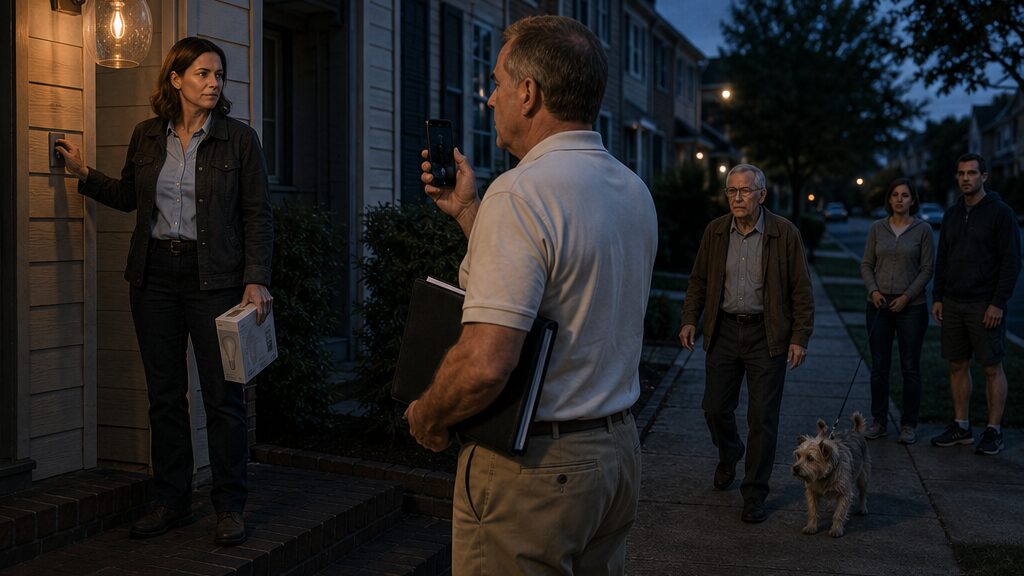
The HOA Said Her Porch Light Was Too Bright, Then Called the Darkness Dangerous
Chapter 1: The Violation Waiting Inside Her Mailbox
The envelope had been taped directly beneath the glowing porch bulb.
Sarah Walker saw it before she reached the first step: white paper, blue association seal, one corner lifting in the warm air. Above it, the new glass fixture cast an amber circle across the brick wall and down over the doormat. Someone had positioned the envelope where the light would illuminate it.
Across the street, Ronald Clark lowered his phone.
Sarah stopped with one hand on the railing.
Ronald stood at the edge of his driveway in pressed khakis and a pale polo shirt, facing her house as though he had been waiting for a delivery. His phone remained angled toward the porch.
“Evening,” he called.
She looked at the envelope, then at him. “Were you taking pictures of my house?”
“Architectural documentation.”
“That wasn’t my question.”
His mouth tightened. “You’ll understand when you read the notice.”
Sarah climbed the steps without answering. She pulled the envelope from the tape, leaving a gummy strip beneath the fixture, and unlocked the door. Ronald’s phone rose again before she stepped inside.
The envelope was heavier than ordinary mail. She set her work bag on the kitchen counter, slid a finger beneath the flap, and unfolded two pages of formal language.
NOTICE OF EXTERIOR MODIFICATION VIOLATION.
The first paragraph stated that the fixture installed three weeks earlier created “excessive luminance and glare inconsistent with the community’s visual harmony.” The second said the light could disturb neighboring residences. The third ordered correction within seven calendar days.
Beginning on the eighth day, the association could assess a daily fine.
Sarah read it twice.
Her porch light was a reproduction fixture with seeded glass and a warm LED bulb. She had selected it because the original fixture—rusted, crooked, and packed with dead insects—had belonged to her aunt’s house since the development opened. The replacement was not a floodlight. It did not face the street. It did not even reach Ronald’s front steps.
She turned to the attached photographs.
The first showed her porch at 8:12 p.m.
The second had been taken at 9:47.
The third was timestamped 11:03.
All three were shot from across the street.
Sarah carried the pages to the front window and moved the curtain aside by an inch. Ronald had gone inside, but the upstairs blinds of his house remained open. From there, he had a direct view of her porch.
She looked back at the notice.
The phrase visual harmony caught in her mind.
She had seen it before.
In the hall closet, beneath a stack of tax records and her aunt’s old recipe binders, sat a narrow cardboard file box. Sarah pulled it out and found envelopes marked LANDSCAPING, MAILBOX, WINDOW COVERINGS. Her aunt had kept every notice the association had ever sent.
One letter objected to the mailbox being “insufficiently neutral.”
Another required the removal of ornamental grass because it created an “unstructured appearance.”
A third warned that cream-colored curtains visible from the street did not preserve “visual harmony.”
The wording was nearly identical.
Sarah sat on the hallway floor with the new notice in her lap.
Her aunt had never fought any of them. She had repainted, replanted, replaced, and paid. Whenever Sarah asked why, she would say, “It’s easier not to make yourself a target.”
That sentence had irritated Sarah when her aunt was alive. Now it sounded less like caution and more like surrender.
The porch light clicked on automatically as dusk deepened.
Sarah returned outside with the notice. The fixture’s amber glow fell cleanly across the steps. She stood at the sidewalk and looked back at the house. The bulb was visible through the textured glass, but the light did not reach beyond the small planting bed.
A dog-walking neighbor approached from the corner and nodded.
“New light looks nice,” the neighbor said.
“Too bright?”
The neighbor looked up, puzzled. “Compared to what?”
Sarah almost laughed.
Across the street, Ronald’s front door opened.
He came out carrying a slim black binder.
“I assume you received it,” he said.
“I did.”
“The committee has had multiple concerns.”
“Multiple people complained?”
“I didn’t say that.”
“You said multiple concerns.”
Ronald shifted the binder beneath his arm. “The fixture is out of character with the original elevation, and the output is excessive.”
Sarah held up the notice. “What measurement did you use?”
He stared at her.
“For the brightness,” she said. “What did you measure?”
“The effect is visible.”
“That isn’t a measurement.”
“The governing documents don’t require a laboratory test.”
“No, but this letter says excessive luminance. That’s measurable.”
Ronald’s face changed slightly—not confusion, exactly, but the discomfort of a person hearing a question he had not expected.
“The standard is reasonableness,” he said.
“Whose?”
“The committee’s.”
He turned toward his house, then paused.
“You have seven days, Sarah. I would advise you not to turn this into something larger than it needs to be.”
The sentence landed with the same soft pressure her aunt had endured for years.
Sarah watched him cross the street. He did not hurry. He did not need to. The letter, the committee title, and the fine schedule were supposed to do the hurrying for him.
Back inside, she placed the new notice beside the old ones and opened the association handbook on her laptop.
Exterior lighting appeared under Architectural Standards, Section 8.4.
Fixtures must be warm in tone, glare-free, visually compatible with the community, and no greater than forty watts.
Sarah leaned closer to the screen.
She read the section once.
Then again.
No lumen range.
No minimum output.
No maximum output except for wattage.
No required beam angle, color temperature, shield rating, or measured light at the property line.
The rule had been written as if watts and brightness were the same thing.
Sarah looked through the window at the amber porch light, then across the street at Ronald’s darkened bedroom.
For the first time since opening the envelope, she smiled.
Chapter 2: Forty Watts and No Honest Answer
“Everyone else understands the rule,” Elizabeth Garcia said.
Sarah held the phone away from her ear and looked at it, as though the screen might explain how that sentence counted as an answer.
She was standing in her kitchen before work, the handbook open beside a printed specification sheet for her bulb. Steam rose from a mug she had forgotten to drink.
“I’m not asking what everyone understands,” Sarah said. “I’m asking what the association measures.”
Elizabeth exhaled quietly. “The fixture must be warm, glare-free, appropriate to the neighborhood, and forty watts or less.”
“Yes. What lumen level is considered excessive?”
“The documents don’t specify lumens.”
“What light level at the property line is prohibited?”
“They don’t specify that either.”
“What about shielding?”
A pause.
“Sarah, we’re a homeowners association, not a lighting laboratory.”
Sarah ran one finger down the specification sheet. Her current bulb used eight and a half watts and produced eight hundred lumens.
“So an eight-watt LED could violate the rule for being too bright,” she said, “while a thirty-nine-watt decorative bulb could comply even if it barely produced light.”
“That’s not how the standard is intended.”
“But it is how it’s written.”
Elizabeth’s voice became firmer. “The committee applies reasonable judgment.”
“Ronald Clark’s judgment?”
“The architectural committee’s.”
“Who submitted the complaint?”
“I can’t discuss another resident’s identity.”
“He photographed my porch from his driveway and told me to read the notice.”
Silence held for a beat.
Elizabeth lowered her voice. “The easiest solution is to replace the bulb with something less intense and submit a photograph.”
“The fixture is already warm. It’s shielded by seeded glass. It uses eight and a half watts.”
“The complaint also mentions glare entering a bedroom across the street.”
That was new.
Sarah looked through the kitchen window toward Ronald’s house. His upstairs bedroom faced hers, but her fixture sat below the porch roof and pointed downward. For the light to enter his bedroom directly, it would have needed to bend upward, cross the street, and pass through the mature maple in his yard.
“When was that added?” Sarah asked.
“I’m looking at the file.”
“It isn’t in the notice.”
“It came in as a supplemental concern.”
“After the notice was issued?”
Elizabeth did not answer immediately.
Sarah heard keyboard clicks.
“It was received this morning.”
Ronald was strengthening the complaint while she questioned it.
“When does my compliance period begin?” Sarah asked.
“From the date on the original notice.”
“So he can keep adding allegations, but my deadline doesn’t change.”
“Sarah—”
“Thank you, Elizabeth.”
She ended the call before anger made her less precise.
At work, Sarah’s supervisor found her at her desk with three browser windows open and a lighting calculator on the second monitor.
“Commercial bid?” the supervisor asked.
“Residential politics.”
“That pays worse.”
Sarah gave a brief smile and turned back to the screen.
The association’s rule had likely been written before LEDs became standard. A forty-watt incandescent bulb produced roughly four hundred fifty lumens. Modern LEDs could produce the same brightness with a fraction of the power, or far more light while still drawing less than forty watts.
The rule did not regulate brightness. It regulated an outdated assumption about brightness.
Sarah placed the handbook beside two product sheets.
Her current bulb: 8.5 watts, 800 lumens.
A high-output LED she found online: 32 watts, 4,000 lumens.
Both under the association’s forty-watt maximum.
She imagined installing the brighter one and watching Ronald discover that his rule permitted something five times more intense than the bulb he had reported.
The thought was satisfying for exactly three seconds.
Then she pictured her aunt repainting a mailbox because a committee disliked the shade of brown. Her aunt had always complied. Sarah had inherited not only the townhouse but the accumulated silence inside it.
She did not want to become that quiet.
But she also did not want to stand in a clubhouse explaining electrical terminology to people who had already decided what reasonable meant.
By lunch, Sarah had found another possibility.
Decorative filament bulbs, designed more for appearance than useful illumination, could consume twenty-five or forty watts while producing very little light. Some novelty bulbs emitted less than a night-light. They were warm. They were technically glare-free. They fit vintage fixtures.
They were ridiculous.
And compliant.
She printed the product description and slipped it inside the association handbook.
That afternoon, an email arrived from Elizabeth.
The subject line read: SUPPLEMENTAL EXTERIOR LIGHTING CONCERN.
Ronald’s new complaint alleged that Sarah’s fixture projected light into his second-floor bedroom and had disrupted his sleep for several nights. He requested immediate correction and committee inspection.
Attached was a photograph of Sarah’s illuminated porch, taken from Ronald’s upstairs window.
Sarah studied it.
The photograph had been zoomed so tightly that the bulb filled most of the frame. The exposure was adjusted, making the glass appear white-hot while the surrounding house disappeared into blackness.
It was not proof of glare.
It was proof that a camera could be made to exaggerate light.
She forwarded the image to her personal account, saved the original file, and checked the metadata. The photograph had been taken at 7:18 p.m., less than twenty minutes after sunset, not during the late-night hours described in his complaint.
Her professional instinct urged her to build a table, compare angles, calculate spill, and answer every claim.
Instead, Sarah closed the spreadsheet.
Technical truth would not stop Ronald if the association allowed him to define discomfort however he wanted.
That evening she drove to a hardware store on the edge of town. Rows of LED packages promised daylight brightness, energy savings, security, clarity, and whole-room illumination.
A clerk in an orange apron asked whether she needed help.
“Yes,” Sarah said.
“What are you looking for?”
She glanced at the shelves glowing beneath bright retail panels.
“The dimmest bulb you sell.”
The clerk laughed, then stopped when she did not.
“For a night-light?”
“For a porch.”
He studied her face. “How dim?”
Sarah placed the printed HOA rule on the cart between them.
“Almost useless,” she said. “But under forty watts.”
Chapter 3: The Smallest Light on the Street
The new filament glowed above Sarah’s porch while her hand disappeared into the darkness beneath it.
She held her palm six inches below the bulb. The thin amber wire inside the oversized glass globe burned with the frail light of a candle at the far end of a room. Her fingers were barely visible.
The hardware-store clerk had found the bulb in a back section reserved for decorative restaurant fixtures. It used twenty-five watts and produced so little useful illumination that the packaging described it as an “atmospheric accent source.”
Ronald’s rule required warm light.
It was warm.
The rule prohibited glare.
It produced almost none.
The rule allowed up to forty watts.
It used twenty-five.
Sarah stepped off the porch and looked back. The bulb appeared to be on, but the steps beneath it remained nearly black.
Across the street, Ronald’s front door opened.
He came outside carrying his phone and the same black binder.
Sarah had expected him. What she had not expected were the neighbors already slowing along the sidewalk. Two people walking dogs turned their heads toward the porch. One squinted openly.
“Is it on?” one of them asked.
Sarah reached inside and flipped the switch off.
The amber filament vanished.
She flipped it on again.
A small laugh escaped from one of the dog walkers before being covered by a cough.
Ronald crossed the street.
“What did you install?”
“A compliant replacement.”
“That is not exterior lighting.”
“It’s an exterior-rated bulb in an exterior fixture.”
He climbed one step and looked up through the seeded glass. “What is the wattage?”
Sarah held out the box.
Ronald took it and read the front, then the side panel, then the front again.
“Twenty-five watts,” Sarah said.
“I can see that.”
“Warm amber output. Decorative filament. No directional glare.”
“This is obviously intended to mock the committee.”
“The notice ordered me to correct the violation. I corrected it.”
Ronald opened his binder and removed a copy of the rule. “Exterior lighting must maintain neighborhood character.”
Sarah pointed to the fixture. “Same fixture. Warmer bulb.”
“It must provide appropriate illumination.”
“Show me that sentence.”
Ronald’s thumb stopped against the page.
The neighbors had moved closer without pretending otherwise now. One dog sat on the sidewalk and looked between Sarah and Ronald.
He turned a page.
Sarah waited.
“The standard requires reasonableness,” he said.
“No. You require reasonableness. The document requires no more than forty watts.”
Ronald held the packaging toward the porch light, trying to read the smaller print. The bulb was too dim to help him.
The absurdity of it pressed against Sarah’s restraint. She wanted to laugh. More than that, she wanted Ronald to understand that he had built the trap himself.
Instead, she took out her phone and turned on the flashlight so he could read.
His jaw tightened.
The beam illuminated the packaging, the rule in his binder, and the polished edge of his shoes. Around them, the porch remained dark.
“Twenty-five watts,” he repeated.
“Yes.”
He studied the box for another possible violation.
“Not a cool tone,” Sarah said.
He looked up sharply.
“Not unshielded. Not above forty watts. Not inconsistent with the fixture style.”
“You’re enjoying this.”
“I’m documenting compliance.”
The phrase was his own. He recognized it.
One of the neighbors looked away to hide a smile.
Ronald handed back the box. “This will be reviewed.”
“By the committee you chair?”
“By the association.”
Sarah switched off her phone flashlight. Ronald’s face receded into shadow while the tiny amber filament glowed above him.
For one clean moment, she felt the victory settle.
He had photographed her home, expanded the complaint, and treated an ordinary fixture like a threat to neighborhood order. Now he stood beneath a bulb he could not prohibit, unable to read his own rule without her help.
Then Timothy Lewis came around the corner.
Sarah knew him by routine more than conversation. He walked every evening at nearly the same time, one hand holding a short leash attached to an old terrier. He moved carefully but refused offers to drive him anywhere inside the neighborhood.
“Evening,” Timothy called.
His gaze went toward the group, then toward Sarah’s porch.
“Power out?”
“No,” one of the dog walkers said. “Apparently that’s the new light.”
Timothy slowed.
The terrier pulled toward Sarah’s planting bed. Timothy followed, angling around Ronald and the neighbors. His foot reached for the edge of the walkway where the concrete dropped slightly toward the grass.
In daylight, the change was obvious.
Under the amber filament, it disappeared.
His shoe landed half on the edge.
Timothy lurched sideways.
Sarah moved before she thought. She caught his forearm, but his free hand struck the rough concrete as he steadied himself. The terrier barked. The leash scraped across the path.
“You all right?” Sarah asked.
Timothy straightened slowly.
“I’m fine.”
Blood had already surfaced along the heel of his hand.
Ronald stepped closer. “You fell.”
“I stumbled.”
“Because the walkway wasn’t visible.”
Timothy looked toward the porch, narrowing his eyes. “It could use more light.”
The sentence entered Sarah more sharply than Ronald’s accusations had.
She released Timothy’s arm only after she was sure he had his balance.
“I have a first-aid kit,” she said.
“It’s a scrape.”
“Come inside.”
Timothy hesitated, then allowed her to guide him up the steps. Sarah used her phone flashlight to show him where to place his feet.
Behind them, Ronald’s camera shutter sounded.
Sarah turned.
He had raised his phone toward Timothy’s bleeding hand.
“Don’t,” she said.
“This is evidence.”
“He said he stumbled.”
“He stumbled in darkness created by your deliberate noncompliance.”
“It complies with the rule.”
“That won’t matter now.”
The satisfaction Sarah had felt moments earlier collapsed into something colder.
Inside, she cleaned Timothy’s hand at the kitchen sink. The scrape was shallow, but grit had embedded in the skin. He watched her work without complaint.
“I should have brought a brighter flashlight,” he said.
“You shouldn’t need one to walk past my house.”
He gave her a sideways look. “I didn’t say that.”
“You didn’t have to.”
Sarah taped gauze over the scrape.
Timothy flexed his fingers. “My night vision isn’t what it used to be. I usually know where the edges are.”
“I’m sorry.”
He glanced toward the front window, where Ronald remained visible under the useless bulb.
“He’ll make more of this than it was.”
“He doesn’t have to. It was enough.”
Timothy studied her for a moment. “You put that bulb in to make a point.”
Sarah looked down at the open first-aid kit.
“Yes.”
“Point made.”
His voice held no cruelty, which made it harder to dismiss.
After Timothy left, Sarah stood alone on the porch. The tiny filament glowed overhead. It no longer looked clever. It looked mean.
Across the street, Ronald was typing with both thumbs.
A minute later, Sarah’s phone vibrated.
An email from the association had arrived with the subject line: URGENT SAFETY COMPLAINT.
Attached was Ronald’s photograph of Timothy’s scraped hand.
Below it, he had written that Sarah’s intentionally inadequate lighting had created an immediate hazard requiring emergency enforcement.
Sarah looked from the email to the dark steps beneath her feet.
For the first time, Ronald’s accusation was not entirely wrong.
Chapter 4: When Being Right Became Dangerous
The second notice called the same bulb dangerously inadequate.
Sarah read the phrase standing beneath it.
The tiny amber filament still glowed above her, too weak to illuminate the page. She had to use her phone screen to make out the bold line near the top:
IMMEDIATE SAFETY CORRECTION REQUIRED.
Below it, the association cited an unsafe reduction in exterior visibility, a documented pedestrian incident, and Sarah’s “knowing installation of inadequate lighting.” The compliance period had been shortened to forty-eight hours.
A hearing was scheduled for the following Thursday.
Daily fines would continue until the condition was corrected.
Sarah folded the notice along its original crease, then opened it again. The first letter had ordered her to make the porch darker. The second demanded that she make it brighter. Both carried Ronald’s photographs. Both claimed the committee’s judgment was obvious.
Across the street, Ronald was watering a narrow strip of lawn. He did not look toward her.
Sarah went inside and replaced the decorative bulb with her original LED.
The porch filled with warm, even light.
For a few seconds, the change felt like relief. The steps reappeared. The edge of the walkway returned. The brass number beside the door became readable from the sidewalk.
Then she remembered that the original bulb remained under violation.
She switched it off.
The following afternoon, Sarah sat across from Ronald and Elizabeth in the HOA conference room. The room smelled faintly of burnt coffee and carpet cleaner. A framed aerial photograph of the development hung behind Ronald, every roof identical in the afternoon sun.
Elizabeth had placed both notices between them.
“The board will consider the matter next week,” she said. “Until then, the committee’s position is that the current condition should be corrected.”
“To which condition?” Sarah asked. “The original bulb is too bright. The replacement is too dim.”
Elizabeth pressed her lips together.
Ronald answered. “A reasonable exterior bulb would solve both problems.”
“Then define reasonable.”
“We’ve been through this.”
“No. You’ve repeated the word.”
Ronald slid a photograph across the table. Timothy’s scraped hand filled the frame. The gauze Sarah had applied was visible at the edge.
“This is what happens when a resident chooses mockery over safety.”
Sarah looked at the photograph longer than she wanted to.
“I chose the bulb,” she said. “Timothy stumbled. Both things are true.”
Ronald leaned back, as if her admission had confirmed everything.
Elizabeth glanced at him, then at Sarah. “The board may consider intent.”
“Intent isn’t in the lighting rule either.”
“You deliberately selected a bulb that provided almost no useful illumination,” Ronald said.
“Yes.”
His confidence sharpened.
Sarah continued. “Because your first complaint treated an eight-and-a-half-watt bulb like a searchlight without one measurement.”
“That does not excuse what happened.”
“No. It doesn’t.”
The room went still.
Ronald had expected resistance. Sarah saw it in the way his fingers paused against the binder. He had not expected her to give him the part that was true.
Elizabeth drew the notices closer. “The hearing will address the violation, the safety complaint, and any fines. You may submit documents beforehand.”
“What documents support the first complaint?” Sarah asked.
“The photographs.”
“Any meter readings?”
“No.”
“Any inspection?”
Ronald said, “The committee observed the glare.”
“From your bedroom?”
His eyes narrowed.
Elizabeth intervened. “Sarah, the hearing is the appropriate venue for all of this.”
“The appropriate venue would have been before a violation was issued.”
Ronald closed his binder. “This discussion is no longer productive.”
“It was productive enough to fine me.”
He stood.
Elizabeth waited until the door closed behind him before gathering the papers.
“He’s been chair a long time,” she said.
Sarah looked at her. “Is that supposed to explain something?”
“It explains why the board tends to trust his judgment.”
“That isn’t the same as his judgment being correct.”
“No.”
The answer came quietly.
Sarah left the management office with a copy of the hearing notice and no clearer standard than when she arrived.
At dusk, she walked to Timothy’s house.
He opened the door before she knocked twice. A fresh bandage covered the heel of his hand.
“You didn’t need to check again,” he said.
“I wanted to.”
He stepped aside.
His home was tidy and dim, with lamps placed low beside chairs rather than overhead. The old terrier slept on a rug near the hallway.
Sarah nodded toward his hand. “How is it?”
“More embarrassing than painful.”
“I’m sorry.”
“You said that already.”
“It’s still true.”
Timothy led her to the kitchen. He moved confidently inside, one hand brushing the edge of the counter at each turn.
Sarah noticed the habit.
“You know every corner,” she said.
“I’ve lived here eighteen years.”
“And outside?”
He opened a cabinet and took down two glasses. “Outside changes.”
He poured water without turning on the ceiling light.
“My night vision started getting worse a few years ago,” he said. “I can see shapes. Edges are harder. Bright glare is bad too. Takes longer for my eyes to adjust afterward.”
Sarah thought of her original bulb, Ronald’s complaint, and the nearly dark replacement.
“So either extreme can be a problem.”
“Usually.”
“Why didn’t you mention that the other night?”
“To whom? Ronald with his camera? The neighbors watching? You standing there proving a point?”
The words were plain, not cruel.
Timothy set one glass in front of her.
“I didn’t want to become part of it,” he said. “I thought the two of you were having one of those neighborhood arguments where everyone needs to be right for fifteen minutes.”
Sarah looked at his bandaged hand.
“I was being right.”
“You were.”
“That isn’t much comfort.”
“No.”
The terrier rose, stretched, and wandered into the kitchen.
Timothy scratched behind its ears. “Ronald asked me to sign a statement saying the light caused my fall.”
“Did you?”
“I wrote that I misjudged the walkway edge.”
“Thank you.”
“That wasn’t for you.”
Sarah nodded.
He looked toward the window. Ronald’s house was visible beyond the narrow yard.
“He’s not wrong that lighting matters,” Timothy said. “But if the association thinks it matters, why don’t they say what enough light is?”
Sarah turned back to him.
Timothy lifted his injured hand. “Who wrote the rule?”
The question followed her home.
That night, Sarah opened the association portal and searched for policy revisions. Most files began only five years earlier, though the development was nearly twenty years old. She tried “lighting,” “exterior illumination,” “architectural standard,” and “safety.”
Nothing useful appeared.
At 9:36 p.m., an email arrived from Elizabeth.
It contained no greeting and no explanation.
Only one sentence:
You may want to review the board meeting held on October 14, six years ago.
Sarah searched the portal again.
The minutes for that month were missing.
Chapter 5: The Rule Ronald Refused to Measure
Ronald’s handwritten objection appeared in the margin beside the words measurable lumen standard.
Sarah found it in a scanned packet at the county records office two days before the hearing.
The document had been filed with an older amendment package, separate from the association’s online minutes. Most pages were routine: landscaping contracts, reserve studies, insurance renewals. Then came a proposed exterior-lighting update.
The draft recommended a warm color range, downward shielding, maximum light levels at property lines, and a minimum level for steps and shared walkways.
Beside the paragraph on objective measurements, someone had written:
Unnecessary. Committee discretion is sufficient.
The initials were R.C.
Sarah read the line three times.
The next page recorded the motion being postponed after the architectural chair argued that fixed numbers would “limit context-sensitive enforcement.” No revised policy had been adopted.
She photographed every page.
A later attachment contained complaint summaries from the same period. One homeowner had been ordered to replace a fifteen-watt LED because it appeared too bright. Another had been told to increase a thirty-watt fixture because the walkway looked unsafe. Neither order cited measurements.
Both decisions were approved by Ronald.
At work, Sarah spread the records across an empty conference table. Beside them she placed photographs from recent association notices that Elizabeth had provided through Sarah’s records request.
A bright carriage fixture approved on one block.
A dim recessed light approved on another.
Her own fixture cited as excessive.
Different conclusions. Same vague language.
Her supervisor paused at the doorway. “You building a bid package or prosecuting a lamp?”
“Neither, hopefully.”
The supervisor picked up the proposed lighting standard. “This is better than what they have.”
“They rejected it.”
“Why?”
Sarah tapped Ronald’s note.
“Discretion.”
The supervisor gave a low whistle. “That’s a useful word when you want the answer to depend on who’s asking.”
Sarah arranged the photographs by output, fixture type, and distance from the sidewalk. The pattern was not complete enough to prove every decision improper. But it showed that the association had known the rule was outdated and had chosen not to replace it.
Near the bottom of the archive packet, she found a photograph that did not belong with the policy pages.
It showed Ronald standing beside a woman near a damaged walkway light. The woman’s arm was in a sling. A date stamp in the corner placed it six years earlier, two weeks before the proposed lighting revision.
Sarah turned the photograph over.
A note on the back read: Clark residence—temporary fixture after fall.
She looked again at the woman’s face. She had seen it in an old neighborhood directory. Ronald’s wife.
Another page included a maintenance report: cracked walkway lens, reduced illumination, resident fall reported. No serious structural defect found.
Sarah sat back.
The proposed lumen standard had not begun as abstract policy. It had followed an accident at Ronald’s own home.
He had pushed the board to discuss lighting, then opposed a measurable rule.
The contradiction was not smaller now. It was more human.
That evening, Sarah saw Ronald beside his driveway before she reached her door.
He held no phone this time.
“We should talk,” he said.
Sarah kept the records envelope beneath her arm. “About the hearing?”
“About avoiding it.”
He glanced toward the neighboring houses. The street was quiet, but his voice remained low.
“I can recommend cancellation of the fine,” he said. “You install a standard warm bulb, submit a photograph, and withdraw the records request.”
Sarah stopped.
“What does one have to do with the other?”
“The request is broad. It creates unnecessary administrative work.”
“It produced records in one afternoon.”
“It invites people to misunderstand old discussions.”
“Such as the discussion where you rejected measurable lighting rules?”
His expression hardened, but not with surprise.
“You found that.”
“Yes.”
“The proposal was flawed.”
“It included the exact things you’re now demanding from me.”
“It imposed numbers without accounting for layout, fixture height, trees, windows, or individual properties.”
“So instead, you kept a rule with no brightness standard and decided case by case.”
“That allows judgment.”
“It allows preference.”
Ronald looked toward Sarah’s porch. The original bulb remained removed. A temporary battery lantern sat beside the door, bright enough to show the steps without using the disputed fixture.
“My concern is not preference,” he said.
Sarah thought of the photograph in her envelope.
“Your wife fell near a broken walkway light.”
His face emptied.
The silence between them changed.
Sarah immediately wished she had chosen the sentence more carefully.
Ronald looked at the envelope beneath her arm. “That had nothing to do with you.”
“No.”
“It had nothing to do with this complaint.”
“I’m trying to understand why you treated my bulb like a threat before measuring anything.”
His jaw worked once.
“She couldn’t see the edge,” he said. “The fixture had been failing for weeks. We had reported it. Maintenance kept saying it was decorative, not essential.”
Sarah said nothing.
“She broke her wrist,” Ronald continued. “Afterward, every person on the board agreed the standards needed improvement. Then the proposal turned into pages of technical requirements no one could apply without hiring consultants.”
“You could have revised it.”
“I tried.”
“You wrote that committee discretion was sufficient.”
“Because no two properties are identical.”
“And because you wanted control over the answer.”
The hurt in his face closed as quickly as it appeared.
“You think expertise makes you objective,” he said. “It doesn’t. You chose a bulb no reasonable person would use and someone got hurt.”
“I know.”
“You knew before you installed it.”
“I knew it would be useless. I didn’t think about Timothy.”
“That is the problem.”
Sarah held his gaze.
It was the cleanest accusation he had made, because it reached her before she could hide behind the handbook.
Ronald stepped closer, lowering his voice further.
“Withdraw the records request. Replace the bulb. I’ll recommend the fine be waived. We can end this without turning a private tragedy into a public argument.”
“I’m not planning to discuss your wife.”
“You already used her.”
“I asked why you opposed measurement.”
“You don’t know what happened.”
“No. But I know what you did afterward.”
He looked toward his house. The upstairs window was dark.
Sarah could see the cost of the bargain he was offering. It would remove her fine, end the hearing, and leave the system untouched. Ronald would continue deciding what was too bright, too dim, too visible, or insufficiently harmonious. The next resident would receive another envelope and be told that everyone understood the rule.
Her aunt would have taken the deal.
Sarah tightened her hold on the records.
“No.”
Ronald faced her again.
“I’ll replace the light with something safe,” she said. “But I won’t withdraw the request, and I won’t pretend the rule works.”
“You may not like the result of the hearing.”
“I didn’t like the result of staying quiet either.”
She walked past him.
At her front door, she turned.
“I’ve asked for time on the agenda,” she said. “Not just to contest the fine. To present a replacement standard.”
Ronald stood in the fading light, his face unreadable.
“You’re going to tell them you were wrong?” he asked.
Sarah looked at the battery lantern illuminating the edge Timothy had missed.
“Yes,” she said. “And then I’m going to show them where you were wrong too.”
Chapter 6: The Hearing Where Both Sides Were Wrong
Ronald displayed the photograph of Timothy’s injured hand before Sarah had been invited to speak.
The image appeared on the clubhouse television, enlarged until the scrape looked worse than it had been. Ronald stood beside the screen with a remote in one hand and his binder open on the table.
“This,” he said, “is the foreseeable result of deliberate noncompliance.”
Sarah sat in the front row with two bulbs in a padded box at her feet.
Elizabeth occupied a smaller table beside the board. Timothy sat near the aisle, his hand healed except for a pink line along the heel. Around them, residents filled most of the folding chairs.
The board chair asked Ronald to continue.
He described the original fixture as intrusive, the replacement as dangerously inadequate, and Sarah’s conduct as an attempt to ridicule volunteer governance. His tone remained controlled. He did not need to raise it. The photograph did the emotional work for him.
When he finished, the board chair looked at Sarah.
“You may respond.”
Sarah carried the box to the front table.
She placed the original LED bulb on the left. The decorative amber bulb went on the right. Between them, she set the association handbook.
Several residents leaned forward.
Sarah had practiced an explanation about watts, lumens, beam spread, shielding, and property-line measurements. Standing there, she realized Ronald expected her to begin with technicalities.
She did not.
“I installed the dim bulb to provoke him,” she said.
The room shifted.
Ronald’s expression changed first.
Sarah kept her hands flat against the table.
“I knew it would provide almost no useful light. I chose it because it complied with the written wattage limit and because I wanted to expose how poorly the rule was written.”
One board member glanced toward another.
Sarah continued. “Timothy stumbled near my walkway. I did not intend for anyone to be hurt, but intention does not make the choice harmless. I was technically compliant and still irresponsible.”
Ronald closed his binder halfway.
His strongest argument had depended on dragging that admission from her. She had given it freely.
The board chair looked toward Timothy. “Would you like to address the incident?”
Timothy rose slowly.
“I misjudged the edge,” he said. “The porch was too dark to help me. That is true.”
Ronald nodded once.
Timothy turned toward him.
“It is also true that the original bulb did not bother me. Bright glare can be difficult for me, but I never saw a measurement showing that Sarah’s light created glare.”
Ronald’s nod stopped.
“I don’t want the board to decide which neighbor I like better,” Timothy said. “I want to know how much light should reach a step and how much should be allowed to cross the street.”
He sat down.
Sarah opened the handbook.
“The current rule answers neither question.”
She placed product sheets beside the two bulbs. “This original LED uses eight and a half watts and produces eight hundred lumens. The decorative bulb uses twenty-five watts and produces less useful light. Under the handbook, the dimmer bulb appears more compliant because it draws more power but remains under forty watts.”
A board member frowned. “That sounds backward.”
“It is. Watts measure energy use. Lumens measure output.”
She handed copies of the archived proposal down the table.
“Six years ago, the board considered a standard that addressed warm color, shielding, minimum visibility at steps, and maximum spill at property lines. It was postponed.”
Ronald stood. “That proposal was never adopted and is not relevant to her conduct.”
“It is relevant to whether the association knew the current standard was defective.”
“The proposal was impractical.”
“Then it should have been revised.”
Ronald looked toward the board. “She is presenting selective records without context.”
Elizabeth spoke for the first time.
“The records are complete.”
Everyone turned toward her.
She opened a folder.
“The management office confirmed the county packet matches the archived amendment file. The lighting proposal was postponed, and no replacement language was adopted.”
Ronald’s face tightened.
Elizabeth continued. “I also need to correct the complaint record.”
She removed two printed forms.
“The original safety complaint stated that Mr. Lewis fell because the walkway was unlit. The version submitted to the board states that he fell because Ms. Walker intentionally created an unsafe condition after warnings.”
Ronald’s voice went flat. “That is an accurate summary.”
“It adds a conclusion not contained in the witness statement.”
“The facts support the conclusion.”
“The management office should have flagged the change.”
Elizabeth looked toward Sarah.
“I did not.”
The admission was quiet but public.
A murmur moved through the room.
Ronald turned on Sarah. “You have been searching through private material, including records involving my wife.”
There it was.
The room stilled again.
Sarah felt the photograph inside her folder. She could have shown it. She could have explained the fall, the broken fixture, Ronald’s grief, and the contradiction between his fear and his refusal to accept measurable rules.
It would make him understandable.
It would also expose the worst night of his private life to a room full of neighbors.
“I found a maintenance record,” Sarah said.
Ronald’s face reddened. “And a photograph.”
“Yes.”
“You intend to use it to question my motives.”
“No.”
He stared at her.
Sarah closed the folder.
“Your motives are not the board’s responsibility. Your actions are.”
The sentence left no triumph behind it.
She looked toward the board.
“Ronald may have sincere reasons to care about lighting safety. I do now too. But sincere concern does not justify standards that change depending on the resident or complaint. And my anger at selective enforcement did not justify making my porch unsafe.”
The board chair studied the two bulbs.
“What are you asking us to do?”
“Cancel the fines based on the first notice because no objective violation was established. Review how complaints are edited and approved. And replace the wattage rule with a standard based on light output, shielding, color temperature, and measured spill.”
“Do you have proposed language?”
Sarah slid a two-page draft across the table.
“It allows different fixtures and property layouts. It sets a minimum level at steps and walkways, a maximum at property lines, and requires downward shielding. It does not require identical houses. It requires measurable results.”
One board member asked, “Who would inspect it?”
“A basic light meter costs less than repeated enforcement hearings.”
Another asked, “Would your original fixture pass?”
“With a lower-output shielded bulb, yes.”
“And the decorative bulb?”
“No.”
Sarah looked at it.
“I would not install it again.”
Ronald gave a bitter laugh. “So after endangering someone, she gets to rewrite the rules.”
Sarah met his eyes.
“No. After endangering someone, I have to admit that being right about the wording was not enough.”
Timothy shifted in his chair.
The board chair called for a recess, but Ronald did not move.
“You’ve made me the villain,” he said.
Sarah answered softly enough that only the front rows could hear.
“No. You made decisions. So did I.”
The board chair gathered the proposal, the archived minutes, and both complaint versions.
“We will enter closed session,” she said. “Before we do, Ms. Walker, leave the proposed standard. Mr. Clark, leave the complete complaint file.”
Ronald placed his binder on the table.
Sarah returned to her seat without the bulbs. They remained side by side beneath the bright clubhouse lights: one accused of giving too much, the other proven to give too little.
The board members disappeared into the back room.
The door closed.
For the first time since the first envelope arrived, the decision no longer belonged to Ronald alone.
Chapter 7: A Light Bright Enough for Everyone
The third envelope arrived while an electrician was removing both disputed bulbs from Sarah’s porch.
It sat in her mailbox with the association seal facing outward, clean and square, as if the previous two notices had not changed the way she looked at white paper.
Above the steps, the electrician held the original LED in one gloved hand and the decorative amber bulb in the other.
“Which one are we keeping?” the electrician asked.
“Neither.”
Sarah opened the envelope.
The first paragraph canceled all fines connected to the original lighting notice and the later safety complaint. The second acknowledged that the existing exterior-lighting language did not provide adequate objective standards for enforcement.
The board had adopted an interim policy based on the draft Sarah submitted.
Warm light between specified color temperatures. Downward or controlled shielding. Minimum illumination at steps and primary walkways. Maximum spill measured at the property line.
The architectural committee could still consider fixture style, but brightness disputes now required measurements.
Sarah read the next paragraph more slowly.
Ronald Clark had been removed from complaint review and enforcement decisions pending a broader procedural review. He remained a homeowner and could continue attending meetings, but he could no longer approve notices or alter complaint summaries.
There was no declaration that Sarah had won.
There was no statement that Ronald had acted maliciously.
The letter said only that the board had found “insufficient separation between complaint initiation, committee interpretation, and enforcement recommendation.”
It was the kind of sentence institutions used when they had finally recognized a problem but were not prepared to name every person who had helped create it.
The electrician leaned down from the ladder. “Good news?”
“Useful news.”
Sarah folded the letter and slipped it back into the envelope.
The new fixture waited inside an open box on the porch. It looked similar to the one she had installed before: simple dark metal, seeded glass, no decorative flourish Ronald could call incompatible. But the bulb sat behind a shield that directed the light toward the steps and planting bed instead of outward.
The electrician secured the mounting plate and checked the wiring.
“You want the lower setting or the higher one?”
“Lower first.”
The switch clicked.
Warm light spread across the porch floor.
Unlike the original bulb, it did not expose the filament as a bright point through the glass. Unlike the decorative bulb, it reached every step. The edge where Timothy had stumbled appeared as a clean gray line.
Sarah carried a small light meter to the sidewalk.
At the steps, the reading cleared the new minimum.
At the property line, it remained below the maximum.
Across the street, Ronald’s windows stayed dark.
The electrician watched her take a second reading. “You always inspect your own house like a job site?”
“Only when the house has a committee.”
The electrician laughed and began packing tools.
Sarah placed the first two bulbs in their boxes. The original one still worked. So did the amber one. Neither had changed since the night each became evidence of something larger than light.
She carried them inside and set them on the kitchen counter.
The violation envelopes lay nearby, no longer mixed with her aunt’s old notices. Sarah had arranged everything in one folder: photographs, board minutes, product sheets, hearing documents, the new standard.
For years, her aunt’s file box had been proof that resistance created trouble.
Now it held proof that silence could preserve trouble just as effectively.
A knock sounded at the open front door.
Ronald stood outside.
He wore no committee polo and carried no binder. In one hand was a plain manila envelope.
Sarah stepped onto the porch.
His gaze moved first to the new fixture, then down the path of light across the steps.
“It’s brighter than the decorative bulb,” he said.
“Yes.”
“Dimmer from here than the first one.”
“Yes.”
He looked toward his upstairs bedroom. No light touched the windows.
“The standard is clearer,” he said.
It was not an apology.
Sarah had not expected one.
“The meter makes the argument shorter,” she said.
Ronald’s mouth shifted as though he almost objected, then decided not to.
He held out the manila envelope. “These were included in the committee files returned to me.”
Sarah took it.
Inside was the photograph from the archive: Ronald beside his wife near the damaged walkway light. A second page held the maintenance report from her fall.
Sarah closed the envelope without removing either item.
“I made copies only of the policy records,” she said.
“You saw those.”
“Yes.”
“You could have used them.”
“I used what you did as committee chair.”
Ronald looked at her for a long moment. “You think that distinction matters?”
“I think it should.”
He glanced down at the porch steps.
“She kept telling me the fixture was failing,” he said. “I thought she was exaggerating because the bulb still came on.”
Sarah did not answer.
“The night she fell, I was inside. She had gone out to bring in a package. The light was there, but it wasn’t enough where the path changed height.”
His voice remained steady, though his hand had tightened at his side.
“Afterward, I wanted rules no one could ignore,” he said. “Then every proposed number seemed wrong for some house. Too high for one property. Too low for another. I thought judgment would handle what numbers couldn’t.”
“And then judgment became yours.”
“Yes.”
The admission was so quiet that Sarah nearly missed it.
Ronald looked at the light meter on the porch rail.
“I didn’t alter Timothy’s statement to lie,” he said. “I thought I was making the danger clear.”
“You changed what he said.”
“I know.”
The words did not erase the photographs, the fines, or the nights he had watched her home. They did not return the choice to residents who had already complied with demands they could not measure.
But they were the first words Ronald had spoken that did not require Sarah to surrender something in return.
She handed him the manila envelope.
He looked down at it but did not take it immediately.
“These belong to you,” she said.
“You don’t need them for the review?”
“No.”
He accepted the envelope.
From the corner, Timothy appeared with the old terrier walking beside him. He paused at the edge of Sarah’s property and looked toward the porch.
The new light reached the walkway without shining into his face.
“Different fixture?” he asked.
“Different bulb and shield,” Sarah said.
Timothy stepped closer. His eyes moved from the porch to the concrete edge, then to the path ahead.
“I can see that drop now.”
Ronald shifted slightly away from the center of the walkway.
Timothy looked at him. “You measuring it?”
“Sarah already did.”
“And?”
“It passes.”
Timothy nodded, accepting the answer without celebration.
The terrier sniffed the planting bed where the group had gathered the night of the dim bulb. Timothy shortened the leash and continued toward the corner.
“Good night,” he said.
Sarah watched him cross the pool of light. He did not squint. He did not reach for the curb with his foot before stepping down.
Ronald watched too.
When Timothy had moved beyond the next townhouse, Ronald tucked the envelope beneath his arm.
“I won’t be reviewing complaints anymore,” he said.
“I read the letter.”
“They may remove me from the committee entirely.”
Sarah looked across at his house, then back at him.
“That decision isn’t mine.”
“No.”
He seemed unused to saying the word without argument.
The electrician carried the last tool case down the steps.
“All set,” the electrician told Sarah. “Timer is programmed. Photocell comes on at dusk. Call if you want the output adjusted.”
Sarah thanked the electrician and signed the work order.
Ronald waited until the van pulled away.
“The original fixture wasn’t ugly,” he said.
It was the closest he had come to acknowledging that visual harmony had never been the real issue.
Sarah looked up at the new light.
“My aunt would have replaced it the first day.”
“She usually did.”
“You remember?”
“I signed some of the notices.”
There was no pride in his voice.
Sarah thought of the file box in her hallway, each envelope preserved after the demand inside it had been obeyed.
“She believed being easy to deal with would make people leave her alone,” Sarah said.
Ronald looked toward the mailbox.
“It usually makes them ask again.”
Sarah did not know whether he meant the committee, himself, or both.
He crossed the street without another word.
Three weeks later, the board posted the permanent lighting amendment for resident comment. Several homeowners objected to the cost of meters. Others wanted exceptions for corner units, garages, and mature trees.
The debate was slow and ordinary.
That reassured Sarah more than immediate agreement would have.
Elizabeth sent revised language and asked Sarah to review the technical terms, but Sarah refused to approve enforcement decisions herself. She marked unclear definitions, suggested ranges, and returned the draft.
The board would decide.
Management would measure.
No single neighbor would control the entire chain again.
One evening, Sarah came home after dark to find the porch light already on. The warm pool reached the bottom step and stopped before the sidewalk. Ronald’s upstairs room remained untouched by it.
A delivery box waited near the door.
There was no envelope taped beneath the fixture.
Sarah picked up the package and heard footsteps at the corner.
Timothy was walking home later than usual, the terrier moving slowly beside him. He raised one hand when he saw her.
Sarah left the porch light on.
Not because Ronald might be watching.
Not because the handbook required it.
Not because she had finally proved which bulb was right.
She left it on because someone was still walking home.
The story has ended.