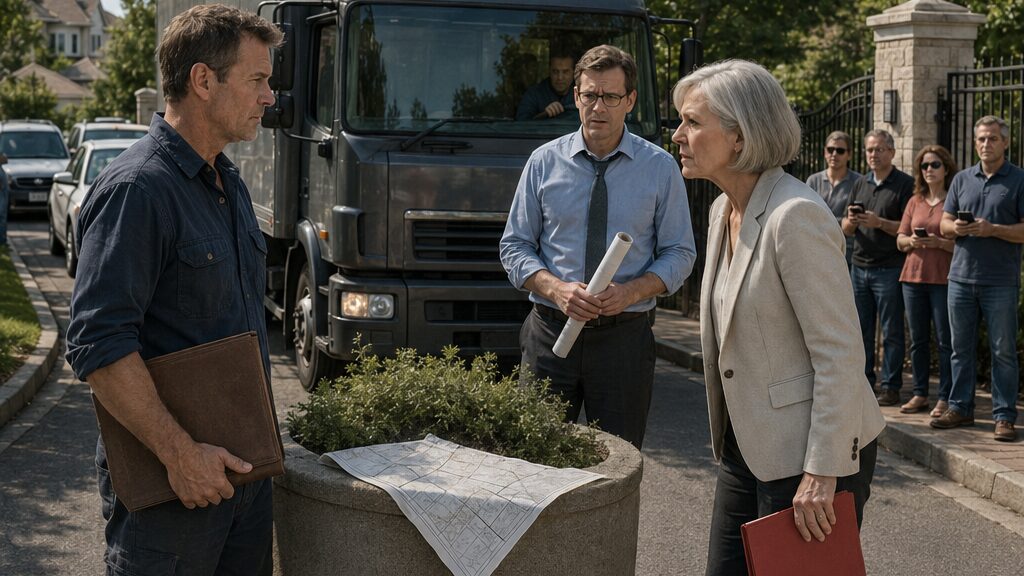
When the HOA Revoked His Gate Pass, He Closed the Road They Never Owned
Chapter 1: The Papers Landed Before Thomas Could Speak
The packet struck the table hard enough to scatter three loose pages into Thomas Carter’s lap.
Susan Allen kept one hand pressed on the remaining stack as if the documents might escape her authority. Her white jacket looked almost luminous beneath the clubhouse’s fluorescent lights. Behind her, forty folding chairs faced the board table, most of them occupied.
“Effective immediately,” she said, “your interior gate pass is revoked.”
Thomas did not reach for the pages.
A low murmur moved through the room. Someone near the coffee station shifted a phone higher, its camera aimed toward the board.
Susan slid a laminated access card across the polished table. It stopped against Thomas’s knuckles.
“You’ll enter and park from the public side like every other nonmember property owner.”
Thomas looked at the card, then at her. “I’m not a nonmember property owner.”
“You are not above the rules because your house sits on the corner.”
“That isn’t what I said.”
The board treasurer lowered his eyes to the agenda. Edward Lewis, the community property manager, sat two chairs from Susan with a legal pad open before him. He had written nothing since Thomas entered.
Susan lifted a complaint summary. “Forty residents signed this.”
Thomas recognized several surnames upside down. People who had borrowed his extension ladder. People whose delivery drivers he had waved through the narrow paved connector beside his house. Mark Johnson’s name appeared halfway down the second page.
“What exactly did they sign?” Thomas asked.
“A request for equal enforcement.”
“Equal enforcement of what?”
Susan’s mouth tightened. “Your repeated use of the residents’ gate without the same restrictions everyone else follows.”
“My access was part of the arrangement when the connector was paved.”
“The connector is a community access road.”
“No,” Thomas said. “It crosses my parcel.”
The murmuring stopped.
Susan leaned forward. “Owning a corner lot does not give you veto power over neighborhood operations.”
“I didn’t claim veto power.”
“You’ve claimed special access for years.”
Thomas glanced toward Edward. The manager’s pen rested between his fingers, unmoving.
“Did anyone review my deed before this vote?” Thomas asked.
Susan’s eyes shifted—not toward Edward, but toward the small parcel map displayed beside the agenda. The image had been enlarged until its boundary lines blurred into gray blocks. Thomas’s property appeared as a pale shape beside the gated entrance. The narrow connector was visible, but no lot numbers could be read.
“The governing documents authorize the board to regulate access,” Susan said.
“That wasn’t my question.”
A chair creaked in the audience.
Edward cleared his throat. “The association’s counsel can review any recorded instruments during an appeal.”
Susan turned slightly. “There is no appeal on the agenda tonight.”
Thomas studied her face. They had lived across the same entrance for nearly eighteen years. Before she became president, she had once brought soup after his father’s surgery. She had also called him at eleven at night when a catering truck could not clear the main gate, asking whether it could use the connector just this once.
There had been hundreds of just-this-onces.
Susan tapped the complaint summary. “The board cannot maintain credibility while one resident receives privileges unavailable to everyone else.”
“Forty people asked you to take my gate card?”
“They asked us to end preferential treatment.”
“That still isn’t the same thing.”
“Mr. Carter, this meeting is not going to become an argument over wording.”
The use of his surname did what the thrown papers had not. It made the distance between them official.
Thomas picked up the access card. Its corner had worn smooth from years in his wallet. He set it beside the packet.
“What happens to deliveries using the southeast connector?” he asked.
Susan gave a brief, impatient breath. “That has nothing to do with your personal access.”
“It may have everything to do with it.”
A voice from the back said, “Here we go.”
Thomas recognized Mark, though he did not turn around.
Susan’s expression sharpened. “Are you threatening to interfere with association property?”
Thomas felt heat rise beneath his collar. He could have told the room about the moving vans he had guided through before dawn, the ambulances he had helped turn around, the landscaping crews whose trailers cut over his gravel because the main entrance was too tight. He could have named every board president who had called the connector a favor when they needed it and a road when they did not.
Instead he gathered the scattered pages.
His father had believed that explaining too much weakened a man’s position. Thomas had inherited that habit so completely that he rarely noticed it anymore.
“I’m asking whether you verified what you’re regulating,” he said.
Susan sat back. “The decision has been made.”
Thomas placed the pages into the packet without straightening them. “Then I suppose I should verify it myself.”
He stood.
The people nearest the aisle moved their knees aside. Some looked satisfied. Others avoided his eyes. Katherine Wilson, seated near the wall, watched him with a pinched expression he could not read.
Susan called after him. “You have ten business days to comply with the revised parking designation.”
Thomas stopped at the clubhouse door.
“Put that in writing,” he said.
“It already is.”
He looked down at the packet in his hand. “Not the parking. The part where you claim the connector has nothing to do with my access.”
No one answered.
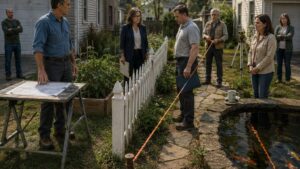
Outside, the gate arm rose for a resident’s SUV. Thomas had to wait on the public sidewalk until the vehicle passed. Beyond the brick columns, the community streets curved under evenly spaced lamps. His own house sat twenty yards away, separated from the development by an old iron fence, a strip of gravel, and the paved connector everyone treated as though it had always been there.
He walked home by the longer route.
In his office, he set the revocation packet beneath the brass desk lamp. The room still held his father’s metal filing cabinet, scarred at the corners and labeled with strips of yellowing masking tape.
Thomas opened the bottom drawer.
The property folder lay beneath old tax receipts and a warranty for a roof replaced twelve years earlier. The brown cardboard had softened along its folds. Inside were the deed, a survey, several photographs, and a plat map marked with his father’s blunt pencil lines.
A smaller envelope slipped from between the pages.
Thomas did not remember seeing it before.
On the front, in his father’s handwriting, were four words:
FOR THE CORNER AGREEMENT.
Inside was a single folded sheet. The ink had faded to gray.
Thomas read the first line twice.
Tom—if they ever act like the road is theirs, make them show you what they gave us in return.
Chapter 2: The Shortcut Everyone Used but Nobody Questioned
A delivery van crossed Thomas’s corner at 6:12 the next morning, its right tires passing over the parcel line before the sun had cleared the roofs.
Thomas stood behind his kitchen window with his father’s note in one hand and coffee cooling in the other. The driver slowed only long enough to avoid the concrete planter near the fence, then turned through the side entrance and disappeared into the development.
A second van followed nine minutes later.
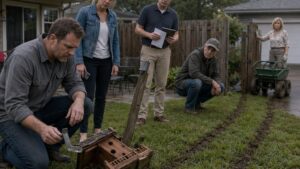
By seven, a landscaping trailer had cut across the same strip, leaving twin dark tracks in the dew along Thomas’s gravel shoulder.
He carried the property folder outside.
The connector looked insignificant when no vehicle occupied it: a narrow paved throat between the public road and the community’s side gate, scarcely wide enough for two cars to pass. One edge ran beside Thomas’s iron fence. The other curved around two concrete planters his father had poured decades earlier.
Thomas unfolded the old survey against the hood of his pickup.
The southeast boundary ran diagonally beneath the pavement.
Not beside it. Beneath it.
He paced the distance from the survey pin near the mailbox to the iron fence, measuring first with his stride and then with a tape from his truck. The numbers aligned within inches. Nearly the entire connector lay inside his lot.
For one clean moment, relief loosened his chest.
Then he read the deed again.
The relevant paragraph was dense with references to exhibits and recorded instruments. It granted “reciprocal rights of ingress and egress” across a portion of the southeast corner, subject to terms set forth in Exhibit C.
Thomas checked the folder.
There was no Exhibit C.
He emptied the contents across his desk. The deed. The survey. Tax records. Three photographs showing construction equipment near the old fence. A photocopy of meeting minutes with the bottom half missing. His father’s handwritten note.
No exhibit.
Thomas called the county recorder’s office and spent twenty minutes moving through automated menus before reaching a clerk. She searched the document number and confirmed that an attachment had once been indexed with the deed.
“It isn’t in the digital scan,” she said.
“Does that mean it wasn’t recorded?”
“It means it isn’t in the digital scan.”
“Can you tell me what it says?”
“Not without locating the original film or jacket.”
“How long does that take?”
“A few days, sometimes longer.”
By the time he hung up, another truck had used the connector. Its trailer bounced over the pavement seam, rattling the glass in his office window.
Thomas turned to his father’s note.
Make them show you what they gave us in return.
He remembered fragments. His father complaining about survey stakes. A row of orange flags along the frontage. Trucks hauling soil when the development expanded. The old gate being moved farther north. Thomas had been in his twenties then, working six days a week and paying little attention to board business.
He remembered one thing clearly: after the expansion, his father received a remote for the residents’ gate. No application. No annual renewal. It had simply appeared in an envelope.
Thomas called Edward Lewis.
The manager answered on the fourth ring. “Thomas.”
“You sound like you expected me.”
“I expected you to appeal.”
“I’m looking at my deed.”
A pause.
Thomas watched a contractor’s pickup roll across the connector. “It says reciprocal access.”
“I know.”
“You knew last night?”
“I knew there was an easement reference. I did not have the recorded exhibit in front of me.”
“Did Susan?”
“Not the exhibit.”
“Did she know it existed?”
Edward exhaled through his nose. “Thomas, these instruments are older than the current association.”
“That isn’t an answer.”
“The board’s position is that community use has been continuous for decades.”
“Use isn’t ownership.”
“I didn’t say it was.”
“You didn’t say anything last night.”
Edward was silent long enough for Thomas to hear keyboard taps in the background.
Finally he said, “Your parcel map supports your claim that the pavement lies within your boundary.”
There it was—the first solid thing anyone connected to the HOA had admitted.
Thomas gripped the phone more tightly. “Then why did Susan tell a room full of people it was association property?”
“I can’t speak for her wording.”
“You manage the property.”
“I manage the association’s operations. I don’t adjudicate title disputes.”
“Everyone likes that distinction after the vote.”
Another silence.
Edward’s voice lowered. “Do not block the connector.”
Thomas looked through the window at the tire tracks crossing his gravel.
“I didn’t say I would.”
“I’m telling you because the missing exhibit may impose access obligations. There may also be emergency-use language.”
“May?”
“We need the complete record.”
“You revoked my gate pass without the complete record.”
“I did not vote.”
“You sat there.”
Edward absorbed that without protest.
Thomas opened the revocation packet. The letter stated that his gate access had been rescinded because it created unequal treatment and was not supported by any current rule or recorded owner privilege.
Not supported by any recorded privilege.
He placed his finger on the deed’s reciprocal-access paragraph.
“My access may be supported by the same instrument you’re using to cross my land,” he said.
“That is possible.”
“And Susan knew that was possible?”
“I advised the board to delay final action until we reviewed the parcel history.”
Thomas went still. “When?”
“I’m not discussing internal correspondence.”
“When, Edward?”
“Last week.”
The answer settled between them.
Thomas looked toward the connector as a small school-service vehicle turned through it, saving perhaps three minutes over the main entrance. No driver slowed. No one looked toward his house.
“What are you afraid is in Exhibit C?” Thomas asked.
“I’m afraid no one knows exactly what is in it.”
“That’s not what I asked.”
Edward’s chair creaked faintly through the phone. “I’m afraid it ties your interior access to the association’s use of the connector. And I’m afraid it also gives the association rights you cannot suspend unilaterally.”
So neither side knew whether the missing paper was a shield or a chain.
After the call, Thomas drafted a letter. He did not threaten closure. He stated that ownership of the connector was disputed publicly without a title review, requested immediate restoration of his gate pass pending investigation, and reserved all rights concerning use of his parcel.
He printed three copies.
One went by certified mail to the association. One he slid beneath Edward’s office door. The third he placed in the old folder.
At noon, Susan’s response arrived by email.
The board acknowledged his correspondence but would not suspend enforcement. His gate credentials remained disabled. Any interference with resident access would result in fines and possible legal action.
Thomas read the final sentence twice.
Then he opened his workshop.
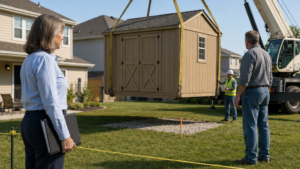
The concrete planters beside the connector had not moved in years, but each had a steel lifting eye embedded beneath the soil. His father had designed them that way.
Thomas rolled out the engine hoist, then stopped.
Edward’s warning returned to him: There may also be emergency-use language.
Thomas left the hoist beside the planter. Instead, he laminated a notice and mounted it on a temporary post at the edge of the pavement.
PRIVATE PARCEL. ACCESS UNDER FORMAL REVIEW. NO NEW OR EXPANDED USE WITHOUT OWNER CONSENT.
It did not block anyone. It did not threaten anyone. It merely said aloud what Thomas had allowed to remain unspoken.
By dusk, someone had pulled the notice from the ground and laid it face down in his gravel.
Thomas picked it up, brushed dirt from the plastic, and set it upright again.
His phone rang.
Edward did not greet him.
“Thomas, listen carefully. We still haven’t located Exhibit C.”
“I know.”
“Then don’t move those planters.”
Thomas looked at the steel lifting eye showing beneath the nearest planter’s rosemary.
“Why?”
“Because Susan has instructed counsel to treat any obstruction as an emergency enforcement matter.”
“That isn’t what I asked.”
Edward’s voice dropped. “Because if the exhibit says what I think it might say, both sides have been relying on half an agreement for thirty years.”
Chapter 3: One Concrete Planter Stopped an Entire Neighborhood
The delivery truck stopped twelve inches from the planter.
Its air brakes released with a violent hiss, and the driver leaned across the steering wheel to stare at Thomas through the windshield. Behind the truck, two cars waited in the right-turn lane. A landscaping trailer had already begun backing toward the public road.
Thomas lowered the engine hoist.
The planter now sat across half the connector, leaving enough space for a passenger car to pass slowly but not enough for commercial vehicles to sweep through without stopping. A second planter remained near the fence. Between them, Thomas had stretched a removable chain that could be dropped for emergencies.
He had mailed notice. He had waited through Tuesday. His gate card still did not work.
The driver climbed down. “You expecting me to jump the curb?”
“There’s a commercial entrance on the north side.”
“My route says this gate.”
“The north entrance is open.”
“That’s another mile.”
Thomas looked at the truck’s long cargo box. “Then it’s still open.”
The driver muttered something and returned to the cab.
Phones appeared almost immediately. A woman in running clothes recorded from the sidewalk. Someone inside the first car held a phone against the windshield. Thomas placed the old property folder on the planter’s rim and checked the chain again.
Mark Johnson came down the interior street in work boots and an untucked shirt.
“What are you doing?” he called.
“Restricting commercial use until the board reviews the deed.”
“You’re blocking everybody.”
“There’s room for cars.”
“Not if someone is coming out.”
“They can use the main gate.”
Mark glanced at the truck and then at the growing line behind it. “My wife has a medical supply delivery this morning.”
“Tell them to use the north entrance.”
“You know those drivers don’t read special instructions.”
“That doesn’t make this their road.”
Mark’s face hardened. “So this is revenge.”
Thomas felt the accusation land closer than he wanted it to.
“This is notice,” he said.
“You could’ve talked to people.”
“Forty people signed something before talking to me.”
“I signed a complaint about your gate pass.”
“And what did you think would happen?”
“I thought the board would explain why you had one.”
Thomas looked past him at the connector. “They could have asked me.”
“So could we,” Mark said. “But you could’ve told us.”
The delivery truck began reversing, its warning alarm cutting through the neighborhood.
Susan Allen arrived before it cleared the intersection.
She came on foot from the clubhouse, carrying a red folder. The board treasurer followed, along with Edward Lewis and several residents. Susan’s heels struck the pavement in quick, hard beats.
“Move it,” she said.
Thomas rested one hand on the planter.
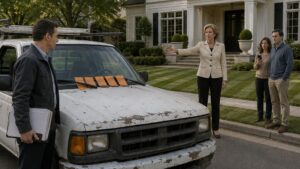
Susan stopped on the opposite side. “You were warned not to interfere with association access.”
“I restricted commercial traffic on my parcel.”
“You are obstructing a community roadway.”
Thomas opened the old folder. “Then show me where the association owns it.”
She held out the red folder. “The board has adopted an emergency fine schedule. Two hundred fifty dollars for the first hour, five hundred for every additional hour, plus legal costs.”
A few residents murmured.
Thomas did not take the paper. “Did the board vote on that schedule?”
“The executive committee authorized it this morning.”
“After I moved the planter?”
“After you created a hazard.”
Edward stood several feet behind her, holding a rolled map.
Thomas looked at him. “You found the exhibit?”
“No.”
“Then what did you bring?”
“The current county parcel map.”
Susan turned sharply. “Edward, this is not a title hearing.”
“No,” Thomas said. “It’s the part before one.”
He unfolded his own survey across the planter. The folder kept one corner from lifting in the breeze. He placed his finger on the diagonal boundary line beneath the connector.
“Edward, whose parcel contains this pavement?”
Susan stepped closer. “He is not qualified to issue a legal conclusion in the street.”
“I’m asking him to read a map.”
Edward’s eyes moved from Susan to the residents holding phones, then down to the survey. He unrolled the county map beside it.
For several seconds, only the reversing alarm sounded.
“The mapped parcel boundary,” Edward said carefully, “places the connector pavement within Thomas’s lot.”
Someone behind Susan whispered, “All of it?”
Edward traced the line. “Nearly all of the traveled surface.”
Susan’s expression did not collapse. It tightened.
“That does not extinguish the association’s easement,” she said.
Thomas looked at her. “So now it’s an easement.”
“It has always been an access easement.”
“Last night you called it association property.”
“I used ordinary language in a public meeting.”
“You used useful language.”
Susan opened the red folder. “Ownership of the underlying land does not permit you to obstruct lawful access.”
“Lawful under which terms?”
“The recorded easement.”
“The one no one can find?”
“The one you benefited from for decades.”
There was truth in that, and Thomas hated that it came from her.
He looked toward the gate beyond her shoulder. His access card no longer opened it. Yet every truck in the line had crossed his property under an arrangement the board claimed was unquestionable.
Susan raised the fine notice. “Move the planter now, and the board will consider reducing the penalties.”
“No.”
The word came out quieter than the traffic.
Mark rubbed a hand across his jaw. The woman recording stepped closer.
Susan’s voice sharpened. “Then you leave us no choice.”
A white county vehicle turned into the blocked lane. Its amber light flashed once.
The fire marshal stepped out wearing a reflective vest and carrying a tablet. He looked at the truck, the planter, and the removable chain.
“Who placed the obstruction?”
Thomas raised his hand.
The fire marshal walked the remaining width of pavement, measured the gap with his eyes, then examined the gate beyond it.
“This connector appears on an emergency-response diagram,” he said.
Susan seized the statement. “Exactly.”
Thomas turned to Edward. “You told me there might be emergency language.”
“I told you not to block it.”
“I left a removable chain.”
The fire marshal crouched beside the planter. “Can one person move this without equipment?”
“No.”
“Then the chain doesn’t solve the clearance issue.”
The small triumph Thomas had felt when Edward read the boundary aloud disappeared. Around him, the phones remained raised, but the scene had changed. He was no longer merely the owner proving the board wrong. He was the man standing beside a concrete obstacle on a route an emergency vehicle might need.
Susan saw the change too.
“This is what happens,” she said, “when personal grievances override community safety.”
Thomas looked at her. “You revoked my access before reviewing the same agreement.”
“That does not justify this.”
“No,” he said after a moment. “It doesn’t.”
The admission surprised the people around them. It surprised Susan most of all.
Thomas attached the hoist to the planter’s steel eye.
“I’m opening emergency clearance,” he said. “That is not consent to unrestricted use.”
He worked the hydraulic handle. The planter lifted just enough for its base to clear the pavement. He swung it toward the gravel shoulder, muscles tightening through his back as the crowd watched.
Mark stepped forward. “Need help?”
Thomas almost refused from habit.
Then he nodded.
Together they guided the planter aside. The fire marshal measured the opening again and approved the temporary clearance, instructing Thomas to keep the chain unlocked and the route available until the easement terms were determined.
The delivery truck had already left. Cars began filtering through one at a time.
Susan handed the fine notice to Edward. “Document the violation.”
Edward did not take it immediately.
Thomas folded the survey and returned it to the old folder. Publicly confirming ownership should have felt like victory. Instead he could hear his father’s voice in every silence he had allowed to harden.
Don’t let them take the corner.
He had never asked whether protecting it meant closing it.
As the residents dispersed, Katherine Wilson remained near the iron fence. She stared at one of the photographs protruding from Thomas’s folder—the old connector before it was paved, with survey stakes along the frontage.
“Where did you get that?” she asked.
“It was my father’s.”
Katherine took one step closer but did not touch it. “I’ve seen that photograph before.”
Thomas waited.
“When I was board secretary,” she said, “there was an exhibit attached to the original expansion minutes. A drawing, a photograph, and a page of conditions.”
“Exhibit C?”
Her face changed at the name.
“Yes,” she said. “And if I remember it correctly, the road was never the only thing the agreement protected.”
Chapter 4: The Complaint Meant Something Different to Every Neighbor
Katherine Wilson did not ask Thomas to sit down until she had placed the complaint petition on her kitchen table between them.
Her signature was on the second page.
“I thought I was asking the board to explain why you had permanent gate access,” she said. “I did not know Susan planned to revoke it.”
Thomas remained standing. Through the window over Katherine’s sink, he could see the roof of the clubhouse and the top of the brick gate column. Beyond both, the connector cut across his property like a gray seam.
“You signed something without knowing what it would be used for.”
“Yes.”
The direct answer took some of the force from his accusation.
Katherine folded her hands beside the petition. She was in her late sixties, small and straight-backed, with reading glasses hanging from a cord against her sweater. Before retirement, she had spent thirty years examining title files. Thomas had known that. He had never thought to ask for her help.
“I also believed your access was a private accommodation,” she said. “Susan said the board had no documentation supporting it.”
“She could have asked me.”
“So could I.”
He looked at the petition again. The heading called for equal enforcement of access and parking rules. Nothing in the visible language demanded confiscation of his gate card. Nothing mentioned the connector.
“What did Susan tell people?” he asked.
“That you entered through the residents’ gate without paying the access assessment.”
“I don’t pay it because my father’s agreement predates the assessment.”
“That was not in the email.”
“Neither was the fact that the community crosses my parcel every day.”
Katherine’s gaze moved toward the window. “Most people don’t know where your property line is.”
“That doesn’t move it.”
“No. But silence can make a boundary invisible.”
Thomas felt the words press against something he had been avoiding since the fire marshal measured the gap beside the planter.
Katherine opened a flat archival box. Inside were photocopies of old board minutes, newsletters, and photographs arranged in plastic sleeves.
“I kept records after my term ended,” she said. “Not official copies. Working copies.”
She found a photograph showing the entrance before the connector had been paved. Thomas recognized his father’s pickup near the old fence. Orange stakes ran across the front corner of the property. Behind them, a bulldozer sat where the community’s second brick column now stood.
Katherine turned the photograph over. A date and board file number had been written on the back.
“This was attached to the expansion discussion,” she said. “Your father objected when the developer shifted the entrance.”
Thomas studied the image. “I remember the stakes.”
“The original plan required taking a strip along your frontage. Not through condemnation. Through agreement.”
“What did he give them?”
Katherine drew out a copied page of meeting minutes. Several lines were missing at the bottom where the original had been cut off during duplication.
The visible portion recorded that the owner of the Carter parcel would permit paving and service access across the southeast corner in exchange for relocation of fencing, drainage work, and continued practical access through the residential gate.
Thomas read the final phrase twice.
Continued practical access.
His father had not been favored. He had been compensated.
“Why isn’t this in the current files?”
“It may be. But records were moved between management companies twice. The recorded exhibit should control, not these minutes.”
“You said there was another page.”
“There was. I remember a drawing and a list of conditions.”
“What conditions?”
Katherine shook her head. “Maintenance, delivery use, emergency passage. Possibly notice before changes. I won’t pretend certainty.”
Thomas slid the photograph back into its sleeve. His anger had changed shape. It was no longer directed cleanly at Susan or the people who had signed the petition. It had begun reaching backward toward his father.
“He should have recorded everything properly.”
“Perhaps he thought the board minutes were enough.”
“He thought a handshake was enough for most things.”
“And you inherited that?”
Thomas looked at her.
Katherine removed her glasses. “People knew you let trucks through. They did not know why. You never told them.”
“I shouldn’t have to announce every favor.”
“No. But you cannot expect people to value an arrangement they cannot see.”
The distinction irritated him because it was true.
They went to the HOA records room after lunch. Edward met them there with a ring of keys and an expression that suggested he had slept badly. The room smelled of paper, dust, and overheated copier plastic.
Susan had not joined them.
Edward unlocked two cabinets and placed old binders on the conference table. “The board authorized a limited records review,” he said.
“Limited by whom?” Thomas asked.
“By counsel.”
Katherine began with the years surrounding the expansion. Thomas searched boxes labeled ACCESS CONTROL, CAPITAL IMPROVEMENTS, and PARCEL CORRESPONDENCE. Several folders contained only empty fasteners where attachments had once been removed.
Half an hour later, Katherine found the minutes.
The full page confirmed that Thomas’s father had allowed the developer to pave the connector and modify drainage across his parcel. In return, the association had agreed to provide uninterrupted gate access to the Carter property and maintain the connector at association expense.
Thomas placed his palm flat beside the paragraph.
“They revoked something they were required to maintain.”
“According to these minutes,” Edward said.
“According to the board that made the agreement.”
“Minutes can establish intent. They do not always establish a recorded property right.”
Katherine pointed to the final sentence. “It says the terms were to be incorporated into Exhibit C.”
The exhibit itself was still absent.
Thomas leaned back. The small payoff of the minutes did not settle the dispute. It made the missing document more important.
Edward closed the binder slowly.
“Did you tell Susan any of this before Monday?” Thomas asked.
“I told her there was a reciprocal-access issue.”
“That is not the same as showing her this.”
“I did not have this page then.”
“But you warned her.”
Edward looked toward the closed records-room door.
Thomas waited.
Finally Edward said, “I sent her an email recommending that the vote be postponed until ownership and access rights were reviewed.”
“When?”
“Friday afternoon.”
Three days before the papers landed in Thomas’s lap.
“Did she answer?”
“She said the political cost of another delay was greater than the legal risk of correcting the decision later.”
Katherine stopped turning pages.
Thomas felt the room become very still.
Susan had not made a mistake in ignorance. She had chosen a public decision while knowing the foundation beneath it had not been checked.
“Forward me the email,” Thomas said.
Edward’s face tightened. “I can’t release internal board correspondence without authorization.”
“Then read it into the record at the next meeting.”
“There is no records hearing scheduled.”
Thomas closed his father’s folder. “There will be.”
Edward did not move.
Thomas stepped toward the door, but Edward spoke before he reached it.
“There is something else.”
Thomas turned.
Edward rested both hands on the binder.
“I warned Susan before the meeting,” he said. “And she told me to prepare the revocation packet anyway.”
Chapter 5: Susan Had Been Warned Before She Called the Vote
Edward printed the email at 8:07 Friday morning and placed it facedown on the conference table.
“I should not be giving you this,” he said.
Thomas turned it over.
The message was brief. Edward had identified the Carter parcel as the underlying property beneath the connector, noted a reciprocal-access reference in the deed, and recommended postponing enforcement until the recorded exhibit could be located.
Susan’s reply appeared beneath it.
Proceed. We can correct access later if necessary. We cannot keep appearing unwilling to enforce our own rules.
Thomas read the line again.
“Appearing,” he said.
Edward sat opposite him in the property-management office. Through the glass wall, an assistant sorted mail into association boxes.
“The board has been under pressure,” Edward said.
“That sentence does not change this one.”
“No.”
“Why give it to me now?”
“Because counsel asked whether the board had prior notice. I am not going to lie.”
“But you were willing to stay quiet in the meeting.”
Edward looked toward the glass wall. “My company’s contract renews next month.”
Thomas folded the email once, then stopped. He smoothed it flat again.
“So Susan was protecting her position, and you were protecting yours.”
“Yes.”
The answer was not defensive. That made it worse.
Edward continued. “The board has received complaints for two years about inconsistent enforcement. Parking trailers. Unapproved fences. Gate access. Susan ran on applying the rules equally.”
“And I was the example.”
“You were visible.”
Thomas placed the email inside the old folder. “Convenient.”
“Not fair. Convenient.”
Susan opened her front door that afternoon before Thomas could knock a second time. She had changed from the white jackets she wore to meetings into dark slacks and a plain blue shirt. Without the board table between them, she looked older and more tired.
“I assume Edward gave you something he should not have,” she said.
“He gave me something you should have disclosed.”
She stepped onto the porch and pulled the door nearly closed behind her.
Across the street, the connector was visible between Thomas’s planters. Passenger cars slowed through the narrowed opening. Commercial vehicles now used the north gate after the board sent temporary instructions.
Susan followed his gaze. “This has become exactly the disruption I was trying to prevent.”
“You created it.”
“You moved the planter.”
“After you revoked my access knowing the arrangements might be reciprocal.”
Her jaw tightened. “I knew there was uncertainty.”
“You knew enough to delay.”
“I had already delayed three enforcement votes.”
“That was not in your email to residents.”
“No. Because residents do not need a history of every board hesitation.”
“But they needed to watch you throw papers at me.”
For the first time, she looked away.
Thomas had expected denial. The absence of it unsettled him.
Susan rested one hand on the porch railing. “Last year the board waived a fence violation for a former president. Before that, it allowed a developer-owned home to use guest spaces for six months. Every exception became evidence that rules only applied to people without influence.”
“So you decided to prove otherwise with me.”
“I decided the board could not keep governing through private understandings no one could verify.”
“That part I agree with.”
She looked back at him.
Thomas tapped the folder. “What I do not agree with is deciding the outcome before verification.”
“If I had postponed again, the board would have lost the vote. Residents would have concluded that long-term owners receive special treatment.”
“My father gave up frontage for that access.”
“I know that now.”
“You knew there was a chance before Monday.”
“Yes.”
The word remained between them.
A service van approached the connector, slowed, then continued toward the north entrance. Susan watched it go.
“I believed we could restore your card later if the documents supported you,” she said.
“After making me the problem in front of forty people.”
“I did not anticipate you would restrict the connector.”
“You did not anticipate the landowner would notice?”
“I did not anticipate you would create an emergency-access issue.”
Thomas felt the old anger rise, but the fire marshal’s measurement kept him from using it cleanly.
“I should have checked that before moving the planter,” he said.
Susan’s expression shifted slightly.
“That does not excuse what you did,” he continued. “But I am not pretending my decision had no consequence.”
She folded her arms. “Then reopen the road completely.”
“No.”
“You just admitted it was unsafe.”
“I opened emergency clearance. Commercial convenience is different.”
“The association has relied on that entrance for decades.”
“And I relied on the gate.”
Susan stepped closer to the porch edge. “A neighborhood cannot function if one person can close an access point every time he feels insulted.”
“And ownership means nothing if a board can punish the owner while demanding uninterrupted use.”
Neither spoke for several seconds.
The connector lay between their houses, carrying one slow-moving sedan over Thomas’s land.
Susan’s voice softened, though not into apology. “You want me to reverse the decision publicly.”
“I want the board to correct it publicly.”
“You want me humiliated.”
Thomas considered the first meeting—the scattered papers, the phones raised, her use of his surname.
Part of him did want that. He could feel how easy it would be to deny it and preserve the cleaner version of himself.
“I wanted you to understand what it felt like,” he said. “That is not the same as what should happen next.”
Susan studied him.
“What happens next,” she said, “is counsel seeks an injunction if the connector remains restricted.”
“So that is your answer.”
“It is the board’s obligation to protect access.”
“Even before finding Exhibit C?”
“We cannot let you establish control by obstruction.”
Thomas removed Edward’s email from the folder and held it where she could see her own reply.
“I will give this to every homeowner before the next meeting.”
Her face went still.
“You would expose privileged correspondence.”
“I would expose prior notice.”
“You would damage the association in litigation.”
“You are authorizing litigation because you refuse to correct a decision you knew might be wrong.”
Susan’s grip tightened on the porch railing. “If you circulate that, counsel will argue that you are using internal communications to pressure the board.”
“I am pressuring the board.”
“At least you admit it.”
Thomas returned the page to the folder. “I am done protecting the appearance that Monday’s vote was informed.”
He walked back toward his property.
Before he reached the connector, his phone vibrated. A neighborhood email had arrived with the subject line EMERGENCY SPECIAL MEETING.
The board would meet Monday evening to consider authorizing legal action against him, including an injunction, recovery of attorney fees, and daily fines.
Thomas read the notice beside the planter that had started it.
The vote was scheduled for the same room where Susan had revoked his access.
This time, the papers on the table would be asking permission to sue him.
Chapter 6: The Old Agreement Protected More Than a Property Line
The county records clerk held the strip of microfilm against the light and said, “I think this is your missing attachment.”
Thomas leaned across the counter.
The image was small and reversed, its lines pale against the dark film. In one corner, he could make out the old shape of his father’s parcel. A hatched strip crossed the southeast corner exactly where the connector now lay.
The clerk fed the film into a reader. The machine hummed, and the image expanded across the screen.
EXHIBIT C appeared at the top.
Thomas felt his shoulders tighten.
The document did not give either side the simple victory they wanted.
His father had granted the association a nonexclusive right to use the connector for residents, deliveries, maintenance, and emergency services. The association, in return, agreed to maintain the pavement and drainage, preserve practical access through the interior gate for the Carter parcel, and consult the owner before any material expansion of use.
A final paragraph stated that the arrangement depended upon “continued good-faith accommodation by both parties.”
Thomas read it twice.
“Can I get a certified copy?”
The clerk nodded. “It may take a few minutes.”
While she prepared it, Thomas studied the old plat. His father had given up more than a driveway corner. The entrance expansion had moved drainage toward the Carter frontage and narrowed direct access to the public road. The gate pass had not been a favor. It had been part of keeping the property usable.
But the connector had never been his alone to close whenever he chose.
The agreement protected the neighborhood from isolation and the Carter property from being boxed out. Each side’s right existed because the other side had accepted a burden.
His phone rang before the certified copy was ready.
Mark’s name appeared on the screen.
Thomas answered. “What happened?”
“It’s Mrs. Thompson.”
The elderly resident lived three streets inside the development and used a wheelchair after a recent surgery.
“Her medical transport is at the north entrance,” Mark continued. “The driver says the turn from the main road is too tight with construction equipment parked there.”
“Tell them to move the equipment.”
“The landscaping contractor is trying. One truck is disabled.”
Thomas looked at Exhibit C on the reader.
“The side connector is open to passenger cars.”
“The transport van is too wide with your planter where it is.”
For one second, Thomas saw Susan’s future argument laid out cleanly: Carter refused access while an elderly resident waited. Extortion disguised as ownership. Personal grievance placed above community need.
Then he heard Mark say, “She has an appointment she waited six weeks for.”
“I’m coming.”
Thomas left before the clerk finished stamping the copy. He reached home twelve minutes later and found the transport van idling on the public road. Mark stood beside it, phone in hand. The driver had already opened the rear lift.
Thomas backed his pickup toward the planter and attached the engine hoist.
Mark approached. “I can help.”
“No. Guide the driver when I clear it.”
Thomas pumped the hydraulic handle. The planter rose reluctantly, soil trembling around the rosemary roots. He pulled the hoist across the gravel inch by inch.
No crowd had gathered this time. No board members stood with folders. The only witness was Mark, watching Thomas strain against a concrete object he had positioned in anger and now had to remove through choice.
When the opening was wide enough, Thomas unhooked the chain.
The van passed slowly. Through the side window, the elderly resident lifted one hand. Thomas returned the gesture.
Mark waited until the van disappeared through the gate.
“You could have made Susan reopen your access first,” he said.
“That would not get Mrs. Thompson to her appointment.”
“No.”
Thomas wiped his palms on his work pants.
Mark looked at the planter now resting entirely on Thomas’s gravel. “I thought you were trying to punish all of us.”
“I was trying to stop the board from treating the connector as theirs.”
“You also wanted us to feel it.”
Thomas did not answer immediately.
“Yes,” he said at last.
Mark nodded as though the honesty mattered more than an apology.
“The complaint I signed,” he said, “was supposed to ask why your gate card did not go through annual review. Susan’s summary made it sound like we demanded revocation.”
“Katherine told me.”
“I should have read what came after my signature.”
Thomas looked toward the community. “I should have explained the arrangement before it became a weapon.”
Mark glanced at him. “So what do you do now?”
“Write terms nobody has to guess about.”
That afternoon, Thomas sat at his kitchen table with the certified Exhibit C, his father’s note, and a blank legal pad.
He did not write demands.
He wrote conditions.
The connector would remain available for residents, emergency vehicles, deliveries, and approved service traffic. Commercial event traffic would require notice. The association would maintain pavement and drainage. Thomas’s interior gate access would be restored and treated as reciprocal consideration, not discretionary privilege. Any future changes would require written agreement. Liability and insurance responsibilities would be stated plainly.
He added a temporary provision allowing emergency and medical passage while the dispute remained unresolved.
When he finished, he read the page aloud. The sentences were plain enough that no future board president could call them ordinary language and mean something else.
His phone rang near sunset.
Katherine did not greet him.
“I found the vote,” she said. “The original board vote.”
“Where?”
“In a binder filed under drainage improvements. They recognized the reciprocal access arrangement unanimously.”
“Does it reference Exhibit C?”
“Yes. And there is something else.”
Thomas looked at his proposed agreement.
“The minutes say the gate access was granted because the entrance expansion reduced safe entry to the Carter property,” Katherine continued. “It was not temporary. It was not a courtesy.”
“Can you bring it Monday?”
“I already made copies.”
Thomas closed his eyes briefly.
The old agreement was imperfect, scattered across minutes, film, and memory. But it was no longer invisible.
“Thomas,” Katherine said, “the current board can still argue over enforceability.”
“I know.”
“What are you going to ask them for?”
He looked through the kitchen window at the connector. With the planter moved aside, vehicles could cross it again. Several slowed at the edge, uncertain whether they were permitted.
“Not permission,” he said. “A written arrangement.”
On the table, his father’s note lay beside the new proposal.
For thirty years, one generation had relied on a handshake and another had relied on silence. Monday’s meeting would decide whether the neighborhood preferred litigation to admitting what both sides had inherited.
Chapter 7: The Second Meeting Could Not Use the Same Story
Susan opened the emergency meeting with a motion to authorize litigation.
She did not throw the packet this time. She placed it squarely in front of the board treasurer, aligned its edges with the table, and read from the first page.
“The proposed action seeks immediate injunctive relief, recovery of fines and legal expenses, and confirmation of the association’s access rights.”
The clubhouse was fuller than it had been the week before. Residents stood along the rear wall. Mark sat near the aisle beside Katherine. Edward occupied his usual chair at the board table, but a stack of copied records now rested in front of him.
Thomas sat alone at the end of the first row with two folders on his knees.
The old brown folder contained his father’s note, the deed, the certified Exhibit C, and decades of incomplete trust.
The new folder contained one page.
Susan finished reading the motion. “Discussion is limited to the proposed legal action.”
Thomas stood.
“The notice says homeowners may comment before the vote.”
“You will have three minutes.”
“I’ll need five.”
A few people shifted in their chairs. Susan glanced toward the board treasurer, who gave a reluctant nod.
“Five,” she said.
Thomas walked to the table and placed both folders before him. No pages scattered. No one had to gather them from the floor.
He began with the parcel map.
“The connector crosses my property. Edward confirmed that in front of several of you Wednesday.”
Edward leaned toward his microphone. “The county map places nearly all of the paved surface within the Carter parcel.”
Susan folded her hands.
Thomas placed the certified Exhibit C beside the map.
“The recorded agreement grants the association limited access for residents, deliveries, maintenance, and emergencies. In return, the association agreed to maintain the connector and preserve practical access through the interior gate for my property.”
He passed copies to the board.
Several residents began reading before the pages reached the end of the table.
“The agreement does not let me erase the community’s rights because I’m angry,” Thomas continued. “It also does not let the board revoke my access while treating its own access as unconditional.”
Susan’s gaze lifted. “Your obstruction still violated the agreement.”
“Yes.”
The room quieted.
Thomas looked toward Mark, then at the residents who had watched him move the planter.
“I restricted the connector before confirming the emergency provisions. I left a removable chain, but the planter itself could not be moved quickly without equipment. The fire marshal was right. I created a risk.”
Susan leaned closer to her microphone. “That admission supports the requested injunction.”
“It supports correcting what I did.”
Thomas opened the new folder.
“It does not support pretending the board acted correctly.”
He placed Edward’s printed email beside Exhibit C. Susan’s expression changed, though only slightly.
“Before the first meeting,” Thomas said, “the property manager recommended postponing the revocation until the reciprocal-access issue could be reviewed.”
A murmur rose behind him.
Susan struck the gavel once. “Internal correspondence is not on the agenda.”
“It explains why we are here.”
“The board was required to address unequal enforcement.”
Katherine stood before Susan could recognize her.
“I signed the complaint,” she said. “I asked for an explanation of Mr. Carter’s gate access. I did not ask for revocation.”
Mark rose next. “Neither did I.”
Other voices followed—not a chorus, but scattered confirmations from different parts of the room.
Susan waited until they stopped.
“The petition reflected a broader concern,” she said. “For years, residents have accused this board of creating exceptions for long-term owners. Delaying another decision would have reinforced that belief.”
Thomas looked at her. “Then tell them why you proceeded.”
Susan’s face held, but the effort showed.
“I believed an erroneous access decision could be corrected later,” she said. “I did not believe the board could survive another appearance of selective enforcement.”
The room remained silent.
It was not an apology. It was not denial either.
Thomas returned the email to the folder.
“That is why I’m not asking the board to replace one private understanding with another.”
He distributed his one-page proposal.
The terms allowed resident, delivery, maintenance, medical, and emergency use of the connector. Large commercial or event traffic required advance notice. The HOA would maintain pavement and drainage, provide insurance coverage for association use, and restore Thomas’s interior gate access as part of the reciprocal arrangement. Any future change required written agreement from both sides.
The board treasurer read the first paragraph twice.
Susan scanned the page. “You drafted this without association counsel.”
“I drafted terms. Counsel can draft the final license.”
“And if the board refuses?”
“Then we can spend association dues and my savings arguing over a thirty-year-old agreement neither side fully honored.”
A resident near the wall asked, “What happens to the connector while lawyers review it?”
“It remains open under the temporary safety conditions already in place,” Thomas said. “No planter in the emergency width. No unrestricted event traffic. Normal residents and necessary services pass.”
Susan looked up. “You would leave it open before your gate card is restored?”
“Yes.”
The answer cost him more than he expected.
He had arrived prepared to hold the lane until the board corrected every public word. But that would have made the connector another weapon. His father’s note had warned him not to let the neighborhood take the corner. It had never told him to make the corner unusable.
Susan studied him as if searching for the trap.
Thomas met her eyes. “I’m not surrendering ownership. I’m refusing to make innocent people pay while we settle it.”
Mark leaned back in his chair. Katherine lowered her copy of the agreement.
Susan turned toward Edward. “Can management implement these temporary terms?”
“Yes,” he said. “And counsel can prepare a recorded access license from this framework.”
“Would you recommend litigation?”
Edward looked down at the documents before answering.
“Not before attempting correction.”
The board treasurer cleared his throat. “Then I move that we table litigation, rescind the access revocation and related fines, and authorize counsel to negotiate from Mr. Carter’s proposal.”
Susan did not second the motion.
Another board member did.
Discussion lasted twenty-three minutes. One member worried that restoring Thomas’s card would look like surrender. Another asked whether the HOA could afford drainage repairs. Susan argued that the board should not approve terms under public pressure.
Thomas did not interrupt.
When the discussion ended, Susan stared at the voting sheet.
“I will not resign over this,” she said.
No one had asked her to.
Katherine answered from the audience. “Then correct it while you are still president.”
Susan’s fingers rested beside the gavel.
At last she said, “Call the vote.”
The motion passed three to two.
Susan was one of the two opposed.
Edward disabled the daily fines from his laptop before the meeting adjourned. Then he removed a blank gate card from an envelope, programmed it, and set it on the table.
Thomas picked it up.
It was not the old worn card Susan had slid against his knuckles. This one had sharp edges and no history.
“The revocation is rescinded effective tonight,” Edward said.
Thomas looked toward Susan. She was gathering the litigation packets into a single stack.
No applause followed. Chairs scraped. Neighbors spoke in low voices. The correction felt smaller than humiliation had felt, but more solid.
Thomas placed the new card inside the old folder.
On the table, beside his father’s note, the one-page agreement waited to become something no one would have to guess about.
Chapter 8: The Road Stayed Open Under Different Terms
The landscaping contractor stopped at the painted boundary line and lowered his window.
“Mr. Carter?”
Thomas looked up from trimming rosemary beside the concrete planter.
“We’ve got two trailers,” the contractor said. “Management approved the north gate, but one driver says he can’t make the turn. Permission to use the connector?”
The question was ordinary. That was what made Thomas notice it.
He checked the trailers, then moved the small removable marker from the commercial lane.
“Straight through,” he said. “No stopping on the pavement.”
“Understood.”
Both trucks slowed before crossing.
Six weeks earlier, no one had slowed. The connector had been a piece of road people entered without seeing the land beneath it. Now a narrow painted stripe marked the parcel boundary, and a small sign listed permitted uses without threats or declarations.
RESIDENT, DELIVERY, SERVICE, MEDICAL, AND EMERGENCY ACCESS BY RECORDED AGREEMENT.
The HOA had paid to resurface two cracked sections and clear the drainage channel. Its insurer had added the connector to the association’s coverage. Event organizers now submitted notice before routing large vehicles through. Thomas’s gate card worked without annual review unless the underlying agreement changed.
Nothing about the arrangement was warm.
It was clear.
Thomas replaced the marker after the trailers passed.
Susan crossed the public road carrying a white envelope. She came alone, without a board folder or the clipped pace she used at meetings.
Thomas set down his pruning shears.
“I thought Edward handled the final documents,” he said.
“He did.”
She held out the envelope. Inside was the original revocation notice, stamped INVALID and signed by the board secretary. The daily fine schedule had been attached behind it with a line drawn through every amount.
“The board voted to retain it in the records with the correction,” Susan said. “This is your copy.”
Thomas folded the papers once and returned them to the envelope.
“Thank you.”
Susan looked toward the connector as a resident’s sedan approached. The driver slowed at the painted line, lifted two fingers from the steering wheel, and continued through.
“It functions better now,” she said.
“It functions more honestly.”
She accepted that without argument.
The legal agreement had been recorded three days earlier. It did not use the phrase good-faith accommodation. Counsel had replaced it with maintenance schedules, notice periods, insurance obligations, dimensions, and termination procedures. Thomas had insisted that the practical gate access remain explicit.
Susan had insisted that emergency passage could never be suspended.
Both provisions were there.
“I was wrong to proceed before the review,” she said.
Thomas waited.
“I thought correcting it later would be administrative,” she continued. “I did not account for what the public decision would do to you.”
The acknowledgment was quieter than the accusation had been. No neighbors watched. No phones were raised.
“You accounted for it,” Thomas said. “You decided it was worth the cost.”
Susan looked down at the envelope in his hand. “Yes.”
The answer prevented forgiveness from becoming easy.
She glanced toward her house. “I don’t expect us to return to how things were.”
“They weren’t as good as we pretended.”
“No.”
Thomas thought of the calls after midnight, the trucks waved through, the favors neither side had named because naming them might have required admitting dependence.
“We can speak directly next time,” Susan said.
“That would help.”
It was not friendship. It was enough to prevent silence from doing the work of resentment.
Susan crossed back toward the community entrance.
Thomas carried the invalid notice into his office. The metal filing cabinet still bore his father’s masking-tape labels. He opened the bottom drawer and removed the old property folder.
His father’s handwritten note lay inside.
If they ever act like the road is theirs, make them show you what they gave us in return.
Thomas read it once, then placed the recorded agreement beside it.
The neighborhood had given maintenance, access, insurance, and written limits. He had given passage under terms that could survive anger, elections, and memory.
He closed the folder without hiding it beneath the tax records. A new label on the drawer read CARTER–HOA CONNECTOR AGREEMENT.
Outside, another vehicle approached the corner.
The driver slowed at the painted boundary, checked that the lane was clear, and crossed.
Thomas watched from the office window.
The road stayed open, but no one crossed it anymore without knowing whose land carried them.
The story has ended.