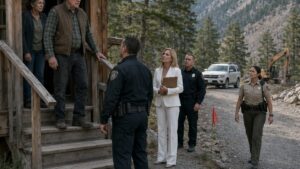
The Day He Closed the Neighborhood Pool and Finally Told His Children the Truth
Chapter 1: The Notice Folded Once at the Door
“Your children are no longer welcome at the pool.”
Donna Roberts stood on Patrick Young’s porch with a white sheet of paper held between two fingers. Behind her, beyond the crepe myrtles and the line of cedar fencing, children shouted and water slapped against concrete. The neighborhood pool was less than a hundred yards away, close enough that Patrick could hear the whistle Donna wore during her morning exercise classes.
Tyler and Michelle stood inside the open doorway behind him. Both were still wet. Tyler’s hair clung to his forehead, and Michelle had wrapped a striped towel around her shoulders. A damp footprint darkened the hardwood beneath each of them.
Patrick looked at Donna, then at the paper.
“What happened?”
“You know what happened.” Donna’s voice carried farther than it needed to. Two neighbors walking past slowed without quite stopping. “They disrupted the aqua-aerobics session again. Splashing, shouting, ignoring instructions.”
“We were playing,” Tyler said.
Patrick lifted one hand without turning. Tyler went quiet, but not willingly.
Donna’s mouth tightened. “The board has received complaints.”
“From who?” Michelle asked.
“That isn’t your concern.”
Patrick saw Michelle’s fingers close around the towel. She had Katherine’s habit of going still when something hurt.
Donna extended the paper. At the top was the association’s name, followed by the word SUSPENSION in bold. The rest was crowded with references to pool conduct, safety, and the board’s authority to restrict common amenities.
“How long?” Patrick asked.
“Indefinitely, pending board review.”
“There wasn’t a review.”
“I’m the board president. I’ve reviewed it.”
From the sidewalk came the faint scrape of someone’s shoe stopping against concrete.
Patrick took the notice. The paper was warm from Donna’s hand.
“They’re eight,” he said.
“And old enough to follow rules.”
“They splashed during a pool class.”
“They deliberately interfered with an organized activity.”
“We didn’t know it was your side,” Michelle said.
Donna looked past Patrick. “This is exactly why consequences are necessary. Children learn boundaries when parents enforce them.”
Tyler stepped forward. “You yelled before we even got in.”
“Tyler,” Patrick said.
The boy’s face reddened. He backed into the hallway, but his eyes stayed on Donna.
Patrick read the first paragraph again. The notice referred to the pool as an association-owned recreational facility. That phrase held his attention longer than the accusation against the twins.
Association-owned.
Three months earlier, a county tax statement had arrived with an attachment Patrick had not requested. The attachment listed two parcels under his name. One was the narrow residential lot beneath his house. The other was Parcel 411, described only by boundary coordinates and an old developer reference. He had placed the statement in Katherine’s property box and told himself he would examine it when work slowed down.
Work had not slowed down.
Neither had the discomfort that came whenever he opened that box.
Donna tapped the notice with one painted fingernail. “You’ll need to sign the acknowledgment.”
“I’m not signing anything on the porch.”
“Then I’ll record refusal.”
“That’s fine.”
She drew a pen from the folder beneath her arm. “You should also understand that any attempt by the children to enter the pool area will be treated as trespassing.”
Patrick looked up.
The word landed differently from the others.
“Are you absolutely sure about this?” he asked.
Donna stopped writing. “About what?”
“That you control who enters that property.”
For the first time, the confidence in her face shifted—not into doubt, but irritation.
“I run the board,” she said. “The association maintains the pool. Residents pay dues for access. I decide who is permitted to swim when rules are violated.”
Patrick studied her for another second.
Then he folded the notice once, exactly through the center, and slipped it into his shirt pocket.
Donna gave a short, humorless laugh. “I don’t know what point you think you’re making.”
“Neither do I yet.”
She capped her pen. “Then perhaps you should avoid making one publicly.”
She turned from the porch and walked down the path. The two neighbors had resumed moving, though one glanced back toward Patrick before they passed the hedge.
Patrick closed the door.
Tyler immediately said, “Why didn’t you tell her she can’t do that?”
“I asked what happened.”
“You heard what happened.”
“I heard two versions.”
“She hates us.”
“She doesn’t hate you.”
“You always say that when adults do something bad.”
Patrick looked at him. “I say it when I don’t know what someone thinks.”
“You didn’t even argue.”
“Arguing on the porch wouldn’t have changed the notice.”
“It would’ve shown you cared.”
The words were too clean to be accidental. Tyler had been holding them ready.
Patrick felt the folded paper against his chest.
Michelle sat on the bottom stair and stared at the wet bands her feet had left on the floor. “Can she really keep us out forever?”
“No,” Patrick said.
Tyler gave a bitter little shrug. “How do you know?”
Patrick hesitated.
Because he remembered the parcel number. Because Katherine had once complained that the original developer left half the neighborhood’s paperwork unfinished. Because he had seen an old map years ago with a rectangle drawn behind their house, extending farther than their fence.
Because he had spent three years avoiding every document Katherine had touched near the end of her life.
“I’m going to check,” he said.
Tyler turned away. “That means you don’t know.”
The twins went upstairs. A bedroom door closed harder than necessary.
Patrick stood alone in the entryway until the pool whistle sounded again outside.
At the kitchen table, he unfolded Donna’s notice. Her signature filled the bottom line in broad blue strokes. Above it, the document declared that the board’s decision was effective immediately.
He took a legal pad from the drawer and wrote down four questions.
Who owns the pool parcel?
What agreement grants access?
Who has authority to suspend use?
What did Katherine know?
He stared at the last question, then drew a line through it. After a moment, he wrote it again beneath the others.
The property box was on the top shelf of the hall closet behind winter blankets and an unused humidifier. It was gray plastic, with K. YOUNG—HOUSE written across the lid in Katherine’s handwriting.
Patrick carried it to the table.
Inside were mortgage statements, warranty papers, old tax bills, repair receipts, and the title documents they had signed when they bought the house. Katherine had arranged everything in labeled envelopes. Even during the final months, when she sometimes forgot whether she had eaten lunch, she had kept paper in perfect order.
Near the bottom was a thick envelope he did not remember seeing.
PARCEL RECORDS, Katherine had written.
Underneath, in smaller letters:
House lot + 411.
Patrick removed the deed. A plat map was folded behind it, its edges softened with age. He spread it beside Donna’s notice and followed the survey lines with his finger.
Their house sat on Lot 38.
Behind it, extending past the cedar fence and around the pump house, was a separate shape labeled PARCEL 411.
At its center was a blue rectangle added in faded ink.
POOL.
Patrick checked the ownership line twice.
Patrick Young and Katherine Young.
He leaned back slowly.
Outside, children cheered as someone jumped into the deep end.
Chapter 2: The Parcel Missing From Every Board Map
“The homeowners’ association does not appear anywhere in the ownership chain for Parcel 411.”
The county records clerk turned her monitor slightly so Patrick could see the list of transfers. Her office was cold enough that he kept his jacket on, though it was already hot outside.
He followed the entries down the screen: developer to holding company, holding company to the previous owners of his house, previous owners to Patrick and Katherine.
No association.
“No easement?” he asked.
“Not in the indexed records.”
“Lease?”
“Nothing recorded.”
“Could there be something old that isn’t indexed?”
“There could always be something filed incorrectly.” The clerk spoke with the careful neutrality of someone accustomed to people hearing more certainty than she offered. “But the legal description on your deed includes the parcel. The association’s common-area map does not.”
She opened a scanned subdivision plat. The neighborhood streets, lots, drainage strips, and landscaped island were marked in black. The pool appeared as a small rectangle behind Lot 38, but it was not shaded like the other common areas.
It looked almost forgotten.
Patrick placed Katherine’s plat map beside the screen. The boundary matched.
“What would you do next?” he asked.
“I can’t give legal advice.”
“I’m asking what record would settle the physical location.”
“A licensed boundary survey.”
Patrick nodded.
The clerk printed certified copies of the deed, the subdivision plat, and the transfer history. While the printer worked, she searched an older database that stored documents too irregular to fit the newer system.
“One item,” she said. “Not a property transfer.”
She opened a scanned invoice from twelve years earlier. The letterhead belonged to a pool maintenance company that no longer operated. The work description listed a pump replacement, chemical balancing, and deck-drain repair.
The customer line read:
Katherine Young, Parcel 411 pool site.
Patrick stared at it.
“Can I get a copy of that too?”
The clerk looked at him before clicking print. “You weren’t expecting her name.”
“No.”
That was not entirely true.
He had expected Katherine to be somewhere in the paperwork. He had not expected her to be addressed as the person responsible for the pool.
By Saturday afternoon, the kitchen table had disappeared beneath records. Donna’s folded ban notice lay beside the deed. Patrick set the certified plat on top and drew a transparent ruler along the parcel boundary.
The line passed behind his backyard fence, crossed the southern edge of the pool deck, enclosed the entire water surface, and continued around the pump house.
Tyler entered carrying a bowl of cereal.
“Are you suing her?”
“No.”
“Are you going to?”
“I’m figuring out what belongs to whom.”
Tyler looked over the maps. “Does the pool belong to us?”
“The land may.”
“That’s the same thing.”
“It isn’t.”
Tyler frowned. “Can we swim if it’s ours?”
“Not until I know exactly what the records mean.”
“So Donna can still stop us.”
“For now.”
Tyler carried his cereal away without eating any.
Michelle appeared a few minutes later and stood at the far end of the table. “Mom’s name is on that one.”
Patrick covered part of the invoice with his hand before realizing the gesture made it more conspicuous.
“She paid for a repair.”
“Why?”
“I don’t know yet.”
Michelle traced the air above the blue pool rectangle without touching the paper. “Did Mom own it too?”
“Yes.”
“Did she let everybody use it?”
Patrick looked at the maintenance invoice.
“I don’t know.”
Michelle nodded once and left. Unlike Tyler, she did not show anger. Her quietness was harder to answer.
Patrick logged into the county tax portal. Parcel 411 appeared beneath his residential lot. For six years, the taxes had been included in a combined annual statement. The amount attributed to the pool parcel was small enough to vanish among the other assessments, but it was there.
He had paid it each year.
On Sunday, he requested the HOA’s common-property schedule and six years of pool expenses. As a homeowner, he was entitled to inspect association records, though the management office made him submit the request through an online form.
Paul Davis, the treasurer, responded that evening.
Patrick,
I can provide the maintenance totals Monday. I do not believe the association has a separate deed for the pool parcel, but I assumed site ownership was incorporated into the original development documents. Donna is handling the access issue.
Paul
The message was cautious, almost helpful, and it confirmed more than Paul probably intended.
Patrick drafted an email to Donna.
He attached the certified deed and plat. He described Parcel 411 without accusation. He asked the board to suspend the children’s ban until the ownership and access rights were reviewed. He also proposed discussing a formal lease so the community could continue using the pool under clear terms.
He reread the message three times.
At the end, he gave the board until Friday to respond.
The email did not mention Katherine’s maintenance invoice.
Patrick told himself it was irrelevant until he understood it. The explanation sounded reasonable enough that he nearly believed it.
Monday morning, Paul met him in the HOA management office. The room occupied one side of the clubhouse and smelled faintly of printer toner and chlorine. Binders filled two metal cabinets. A framed photograph of the pool’s ribbon-cutting hung above the copier.
Paul was in his late sixties, thin and careful in every movement. He placed a spreadsheet on the desk between them.
“The association has paid routine operating costs,” Paul said. “Chemicals, lifeguard service when required, insurance riders, repairs.”
“Property taxes?”
Paul adjusted his glasses. “Not separately.”
“Because I’ve been paying them.”
“That appears possible.”
“Possible?”
“I’m not disputing your statement. I’m saying the records are not as clean as anyone would prefer.”
Patrick pointed to the expenditure columns. “You spent association money maintaining property the association may not own.”
“We maintained an amenity every resident has used for decades.”
“That’s not ownership.”
“No. But it creates expectations.”
Patrick looked at the framed photograph. Katherine stood near the edge of the ribbon, half turned toward someone outside the frame. He had not noticed her at first.
“What year was that?”
Paul followed his gaze. “Twelve years ago. After the pump replacement.”
“The invoice was addressed to Katherine.”
Paul’s expression changed by a fraction. “She coordinated the repair.”
“Why?”
“She was on the pool committee.”
“There was a pool committee?”
“Informal. Before Donna’s board reorganized everything.”
“Did Katherine give the association permission to use the land?”
Paul folded his hands. “I never saw an agreement.”
“That wasn’t my question.”
“No,” Paul said. “I don’t know what she said privately.”
The distinction sat between them.
Patrick gathered the papers. “I’m hiring a surveyor.”
Paul exhaled through his nose. “You should understand what that will look like.”
“Accurate?”
“Hostile.”
“My children were banned without a hearing.”
“I disagreed with the length of the suspension.”
“Did you say that at the meeting?”
“There wasn’t a formal meeting.”
Patrick paused. “Then who agreed with Donna?”
Paul looked toward the closed office door. “She acted under the emergency-conduct provision.”
“For splashing?”
“There were prior complaints.”
“About Tyler and Michelle?”
“About children during scheduled adult activities.”
Patrick slipped the spreadsheet into his folder. “That provision requires an immediate safety risk.”
Paul did not answer.
As Patrick reached the door, his phone vibrated.
Donna had replied.
Twelve minutes after he sent the deed and plat, she had written:
Patrick,
Your cute theory about historical parcel lines does not change the fact that the pool is a community amenity maintained through association funds. Threatening access because your children were disciplined is inappropriate and may expose you to legal consequences. I strongly recommend that you stop before you embarrass yourself and your family.
The suspension remains in effect.
Donna Roberts
Board President
Patrick read the message twice.
Then he called Heather Martin, the surveyor whose name the county clerk had written on a referral sheet.
“I need a boundary marked,” he said.
“How soon?”
“Before Friday.”
Chapter 3: Orange Stakes Across the Deep End
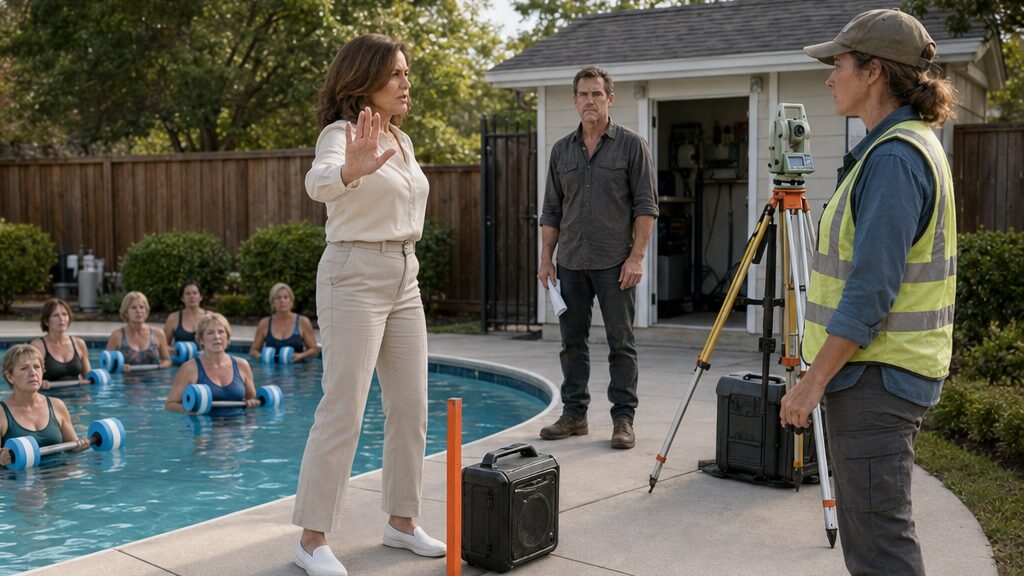
Heather drove the first orange stake into a seam in the pool deck three feet from Donna’s portable speaker.
The plastic cap flashed against the pale concrete. Around it, twelve women stood waist-deep in the water with foam dumbbells raised above their shoulders. Music continued playing for several seconds before Donna reached down and stopped it.
“What exactly are you doing?” she asked.
Heather checked the reading on her survey instrument. She wore a reflective vest over a long-sleeved work shirt, and her hair was pulled beneath a faded cap.
“Marking a property boundary.”
“During a scheduled class?”
“The control points are accessible now.”
Donna looked beyond her at Patrick, who stood near the gate holding the folded ban notice in one hand. “This is deliberate.”
“The surveyor chose the sequence,” Patrick said.
One of the residents lowered her foam weights. “Is this about the kids?”
Donna answered before Patrick could.
“Mr. Young is attempting to turn a routine disciplinary matter into a property dispute.”
Heather moved the tripod six feet and sighted toward the rear corner of Patrick’s lot.
Patrick felt every face turn toward him.
He had expected curiosity. He had not expected how quickly Donna would supply the neighborhood with a complete motive for him.
A father’s retaliation.
A tantrum in legal language.
Donna crossed the deck barefoot, leaving dark prints behind her. “You cannot drive objects into association property.”
Heather glanced at the stake. “It’s placed in an existing expansion joint. There’s no damage.”
“That isn’t the point.”
“What is the point?”
“You don’t have authorization to survey this site.”
“I have authorization from the recorded owner.”
Donna’s face hardened. “The HOA owns this pool.”
Heather straightened. “Can you produce the deed?”
The question carried across the water more effectively than a raised voice.
Donna looked at Patrick. “You hired her to stage this.”
“I hired her to find the line.”
“You sent me a decades-old plat and demanded control of an amenity that every homeowner pays for.”
“I asked you to review the records and suspend an unsupported ban.”
“Your children disrupted a class.”
“They splashed in a pool.”
“They ignored instructions.”
“They were told to leave before anyone gave them an instruction.”
Donna turned toward the women in the water. “This is exactly what I meant. He refuses to separate his children’s conduct from the association’s obligation to maintain order.”
Several residents looked uncomfortable. One climbed the steps and wrapped herself in a towel.
Heather returned to the instrument. “I need the deck clear along this line.”
Donna did not move.
Heather waited.
Patrick slipped the folded notice into his pocket. He could have shown everyone Donna’s email. He could have read the parcel description aloud and watched her certainty weaken in public.
Instead, he said, “Let her work.”
Donna gave a short laugh. “You still haven’t answered the obvious question. If you supposedly own this land, why have you allowed the community to use it for years?”
Patrick’s jaw tightened.
That was the question he had not answered for himself.
“I’m establishing what the records say.”
“No. You’re punishing the neighborhood because your children were punished.”
A man standing outside the fence raised his phone, though Patrick could not tell whether he was recording or reading messages. Two parents had arrived with children in swimsuits. They remained near the gate after seeing the equipment.
Heather called from the far side of the deck. “Patrick.”
He walked to her.
She pointed toward a fluorescent mark beside the pump-house wall. “The deed line encloses the entire structure. The southern boundary runs under this deck edge, then turns west beyond the fence.”
“All of the pool?”
“All of the water surface. Most of the deck. Pump house too.”
“Can you certify it?”
“That’s what I’m here for.”
Donna followed them. “This proves nothing except that old survey data can be interpreted to create confusion.”
Heather looked at her. “I’m not interpreting an HOA map. I’m retracing a recorded legal description from established monuments.”
“Speak English.”
“The pool is inside Parcel 411.”
The music had stopped, but the speaker emitted a low electrical hum.
Patrick became aware of the chlorine, the wet concrete, the orange stake beside Donna’s white water shoes. The entire dispute had narrowed into one bright object neither of them could pretend not to see.
Donna folded her arms. “Remove it.”
“No,” Patrick said.
She stared at him.
It was the first direct refusal he had given her.
Heather crouched and marked the point in her field book. “Parcel number?”
Patrick knew the answer, but he wanted it spoken by someone who had no interest in the argument.
“Four-one-one,” Heather said.
A murmur moved through the residents.
One woman asked, “Is that his parcel?”
Donna turned on her. “Nothing has been legally determined.”
Heather stood. “The recorded ownership and boundary are legal records. Questions about access rights are separate.”
“So the HOA could still have a right to use it?” the woman asked.
“Yes,” Heather said. “Through an easement, lease, license, or other agreement.”
Donna seized on the answer. “Exactly.”
“Do you have one?” Patrick asked.
Donna’s silence lasted less than a second.
“The association’s attorneys will address that.”
“You said you owned it.”
“We operate it.”
“That isn’t the same thing.”
The parent near the gate took her child’s hand and left. Another resident climbed from the pool. Within minutes, the aqua-aerobics class had dissolved into small clusters of conversation.
Patrick should have felt vindicated.
Instead, he watched a little boy press his face between the fence bars while his mother whispered to another parent. The boy looked toward Patrick, then toward the survey equipment, as if Patrick had arrived to take something away.
Donna saw him looking.
“By Friday,” she said loudly, “everyone in this community will understand that Patrick Young intends to close their pool because his children were asked to behave.”
“That’s not what I said.”
“It’s what you’re doing.”
“You could rescind the ban and discuss terms.”
“I will not let a homeowner purchase special treatment for his children by manufacturing a title crisis.”
Patrick stepped closer, lowering his voice. “You received the deed. You didn’t review it. You answered in twelve minutes.”
“I reviewed enough to recognize intimidation.”
“You recognized a problem you didn’t want.”
For a moment, something other than anger appeared in Donna’s face. Fear, perhaps, or calculation.
Then it was gone.
She picked up the speaker. “This class is canceled due to interference.”
No one answered her.
Heather continued around the site. She placed stakes near the gate, behind the pump house, and along the strip where the pool deck met Patrick’s rear fence. Each orange marker made the invisible parcel more difficult to dismiss.
By late morning, the boundary formed a broken fluorescent path around the amenity residents had treated as unquestionably theirs.
Patrick stood outside the gate while Heather packed her tripod.
“You got what you wanted,” she said.
“I got the line.”
“That isn’t necessarily the same thing.”
He looked at her. “Donna told you about the kids?”
“No. Everyone else did.”
“She banned them indefinitely.”
“I heard.”
“And she knew there might be an ownership problem.”
“Do you know that?”
“I know she refused to look.”
Heather closed the equipment case. “Katherine would have looked.”
The name struck harder spoken there than it had on the invoice.
“You knew her?”
“A little. I lived two streets over before my divorce. She called me once about drainage markers behind the pump house.”
“When?”
“Years ago.”
“Did she mention the parcel?”
“She said the developer left the pool arrangement unfinished.”
Patrick’s hand moved toward the notice in his pocket.
“What arrangement?”
Heather opened the cab of her truck but did not get in. “I don’t know the whole story. She showed me a maintenance folder and asked what would be needed for a formal access boundary. I told her she needed an attorney before a survey.”
“Did you survey it?”
“No. She never called back.”
Katherine’s illness had worsened quickly that year. Patrick remembered folders accumulating on the kitchen counter while he learned medication schedules, school pickups, insurance appeals, and how to answer the twins when they asked whether their mother would get better.
He had placed the folders in boxes after the funeral.
He had not opened most of them.
Heather reached behind the passenger seat and removed several copied pages held by a binder clip.
“I asked the old maintenance contractor whether they retained site records,” she said. “They had a scanned log. I thought you should see it before this goes further.”
Patrick accepted the pages.
The first was a pump schedule. The second listed chemical deliveries. On the third, beneath notes about replacing a drain cover and keeping the east gate accessible, was Katherine’s signature.
Beside it, in her handwriting, were seven words:
Community use continues while papers are prepared.
Patrick read the sentence again.
Behind him, an orange stake moved slightly in the wind, tapping against the metal pool fence.
Chapter 4: The Promise Written Beside the Pump Schedule
“Until we make this official, let the families use it.”
Patrick read Katherine’s sentence at the kitchen table while the twins ate without speaking. The copied maintenance log lay beneath his hand, its paper slightly crooked against the clean edge of the deed. He had spent the night hoping that better light would change the meaning.
It had not.
Katherine’s handwriting slanted upward near the end of the sentence, as it always had when she wrote quickly. Below it was a date from four years before her death. Beside the note, she had listed the pump inspection schedule and the code for the east gate.
Michelle noticed him looking at the page.
“Was that Mom’s?”
“Yes.”
“What does it say?”
Patrick folded the copy over before answering. “It says she wanted people to keep using the pool while some paperwork was being prepared.”
Tyler stopped chewing. “So you knew?”
“No.”
“You knew Mom did stuff with the pool.”
“I knew she helped with repairs.”
“That’s not what I asked.”
Patrick looked at him. “I didn’t know she wrote this.”
Tyler pushed his chair back. “But you knew there was paperwork.”
“I knew she talked about getting something formal.”
“And then you forgot?”
The word was not fair, but Patrick had no answer that sounded better.
After Katherine died, he had moved every unfinished matter into boxes. Insurance appeals. Contractor estimates. School forms. The attorney’s card she had left clipped to a folder he never opened. He had told himself there were more urgent things: keeping the twins fed, getting them to school, learning how to wash Michelle’s hair without pulling it, answering Tyler when he woke in the night and asked questions no parent could fix.
But the pool had remained behind their fence. The pump had continued humming. Maintenance crews had crossed the strip of grass beside the house with equipment and chemical drums. Patrick had seen them.
He had never asked why.
“I should have followed up,” he said.
Tyler stood. “So Donna’s right. You’re only doing this because she banned us.”
“No.”
“You didn’t care who owned it before.”
“I cared. I didn’t deal with it.”
“That’s the same thing when you’re the grown-up.”
Tyler left the kitchen. His cereal bowl remained on the table.
Michelle stayed seated. She turned Katherine’s old brass pool key between her fingers. Patrick had not seen it in years.
“Where did you find that?”
“In Mom’s sewing box.”
“She kept it there?”
Michelle nodded. “There was a label.”
“What did it say?”
“East gate.”
She placed the key beside Donna’s folded notice.
The two objects looked as if they had been waiting for each other.
“Are you going to close it?” she asked.
Patrick looked toward the window. Beyond the cedar fence, the orange survey stakes stood in hard morning light.
“I gave Donna until Friday.”
“That’s not an answer.”
“No,” he said. “It isn’t.”
Michelle slid from the chair and followed her brother upstairs.
Patrick spent the next two days asking questions he should have asked years earlier. Heather confirmed that Katherine’s note could support an argument that the HOA had permission to use the parcel, but not that it owned the land.
“Permission can be withdrawn,” Heather said over the phone. “Especially if there’s no term written down.”
“Could they claim a permanent right?”
“They can claim anything. Whether they win is another question.”
“What does the note do to my position?”
“It makes it less clean.”
Patrick appreciated that she did not soften it.
On Wednesday afternoon, Paul emailed copies of old maintenance records. The association had paid for chemicals, cleaning, insurance riders, and repairs. Katherine’s name appeared only in the earlier files. After Donna became president, invoices were redirected to the management office. Nothing showed a transfer of ownership. Nothing showed a lease.
The records described years of people behaving as if a temporary arrangement had become permanent because no one had forced them to name it.
That evening, Donna sent a neighborhood-wide message.
Residents,
The pool remains open. Recent survey activity was initiated by a homeowner in response to a disciplinary matter involving his children. The board is reviewing the situation with counsel. Please do not engage with survey markers or interfere with normal operations.
Patrick read the message twice.
She had not mentioned the deed. She had not mentioned Parcel 411.
By morning, three neighbors had stopped him near his driveway. One asked whether he planned to charge admission. Another wanted to know whether dues would increase. A woman whose son played with Tyler said quietly, “I think the ban was excessive, but closing the pool would hurt everybody.”
Patrick told each of them the same thing.
“I offered to discuss an agreement.”
None seemed reassured.
On Thursday night, he drafted a final email to Donna.
Rescind the children’s suspension by noon Friday. Confirm that the board will enter formal discussions regarding access to Parcel 411. If the board declines, the property will be closed pending resolution.
He attached the surveyor’s preliminary boundary exhibit.
Before sending it, he looked at Katherine’s note.
Community use continues while papers are prepared.
Patrick added one sentence.
I remain willing to preserve community access under a written, insured agreement.
Donna replied after midnight.
The board will not negotiate under threat, and the suspension will not be rescinded.
Patrick printed the email before breakfast.
At eleven forty-five Friday morning, he walked to the pool gate carrying a chain, a weatherproof notice, and Katherine’s key. Tyler and Michelle watched from the back window. Neither had asked to come.
The pool was empty except for the maintenance contractor checking the filter pressure. Patrick showed him the deed, the survey exhibit, and Donna’s response.
“I’m not asking you to take sides,” Patrick said. “I’m asking you to finish what you’re doing and leave before noon.”
The contractor studied the documents, then the chain. “The association pays me.”
“I understand.”
“If they tell me to come back?”
“Call me first.”
At noon, Patrick posted the notice on the gate.
PRIVATE PROPERTY
TEMPORARILY CLOSED PENDING ACCESS AGREEMENT
He threaded the chain through the metal bars.
For a moment he held Katherine’s key above the lock. It fit the old east-gate cylinder, not the new padlock he had purchased. He returned it to his pocket and snapped the padlock shut.
The sound was smaller than he expected.
Behind him, a car door slammed.
Tyler stood at the end of the path. Patrick had not heard him leave the house.
“You did it,” the boy said.
“Donna refused to negotiate.”
“You used us.”
Patrick turned. “No.”
“You waited until she banned us, and then you closed it for everybody.”
“I gave her a way to keep it open.”
“You wanted her to say no.”
The accusation struck because some part of it was true. Patrick had written a reasonable offer, but he had expected contempt. He had wanted Donna’s refusal documented. He had wanted the clean order of cause and consequence.
“You don’t know what I wanted.”
“Neither do you.”
Tyler walked back toward the house before Patrick could stop him.
At eleven minutes past noon, Donna arrived. She stood outside the gate filming the chain and notice with her phone. She spoke toward the screen in a measured voice about retaliation, community harm, and unauthorized interference with an HOA amenity.
Patrick stayed near the pump-house path.
When Donna finished, she turned the camera toward him.
“Would you like to explain why you have closed a facility maintained by your neighbors?”
“I explained it in writing.”
“You have no right to hold the community hostage.”
“I own the parcel.”
“You inherited a paperwork defect.”
“I inherited land.”
“And an obligation your wife understood better than you do.”
Patrick went still.
Donna saw that the words had landed.
“You knew about Katherine’s arrangement,” he said.
“I knew she cared about this neighborhood.”
“That isn’t what I asked.”
Donna lowered the phone. “Open the gate.”
“Rescind the ban.”
“This is bigger than your children now.”
“It became bigger when you refused to review the deed.”
Her expression tightened. “You think a boundary line gives you the right to destroy something she helped build?”
Patrick touched the folded notice in his pocket. “No. It gives me the responsibility to decide what happens on my property.”
A white municipal vehicle turned into the pool parking area.
Donna lifted her phone again.
The code-enforcement officer stepped out carrying a tablet and a folder. She looked at the chain, the posted notice, the orange stakes, and then at Donna.
“Who requested the inspection?”
“I did,” Donna said. “This homeowner has illegally closed a community facility.”
The officer opened the folder. “Before I review that claim, I need everyone to remain outside the marked parcel.”
Donna glanced at the nearest orange stake.
The officer pointed toward the public sidewalk.
“Ms. Roberts,” she said, “that includes you.”
Chapter 5: The Officer Who Would Not Choose a Side
Donna did not move until the code-enforcement officer repeated the request.
“This is the pool entrance,” Donna said. “I’m the HOA president.”
“I understand your role. I’m asking you to step outside the surveyed boundary while I review the ownership documents.”
Donna crossed the orange line with two rigid steps and stopped beside the sidewalk. Patrick remained near the pump house because Heather’s exhibit placed him inside Parcel 411.
The distinction was visible to everyone gathering along the fence.
The officer photographed the gate notice, padlock, survey stakes, and parcel markers. Then she asked Patrick for the certified deed and Heather’s preliminary exhibit.
Donna held out a binder.
“These are the association bylaws, maintenance records, and proof of insurance.”
“I’ll review them,” the officer said.
“The pool has been operated as a common amenity for decades.”
“That may be relevant to a civil access dispute.”
“It is relevant to whether he can lock out paying residents.”
The officer looked at her. “My office does not determine private easement rights.”
Donna’s certainty faltered. “Then why are you here?”
“To determine whether the closure violates municipal safety or property-maintenance codes.”
Patrick watched her scroll through the deed on her tablet. She asked him whether anyone was inside the pool enclosure when he locked the gate. He said no. She asked whether emergency access remained available. He showed her the fire-department lockbox fixed to the outer fence. She asked about chemical storage and pump operation. The maintenance contractor had left both secured.
Finally, she looked toward Donna.
“I cannot order Mr. Young to reopen private property based on the documents presented today.”
Donna’s face sharpened. “You’re accepting his interpretation?”
“I’m not deciding title. The certified deed identifies him as an owner, and the survey places the pool within the described parcel. If the association claims an access right, that is a civil matter for counsel or a court.”
“He is obstructing an amenity.”
“He is securing property under a colorable ownership claim.”
“So he can simply close it?”
“My office cannot compel him to provide access.”
A neighbor near the fence whispered to someone beside her. Donna heard it.
“What about trespassing?” she asked. “He accused me of trespassing.”
The officer glanced at the orange line. “I would advise anyone without the owner’s permission to remain outside the marked parcel until the civil issue is resolved.”
Donna’s lips parted.
The officer did not call her a trespasser. She did not vindicate Patrick with a dramatic declaration. She simply refused to become Donna’s instrument.
Patrick had expected satisfaction.
Instead, he felt the shape of the crowd behind him. Parents. Children. Residents who had paid dues in good faith. A little girl held a pair of pink goggles in one hand, looking through the locked fence at the still water.
The officer handed back his documents.
“Keep the gate secured safely. Do not interfere with emergency systems. And I recommend both parties contact counsel.”
Donna closed her binder. “The board is meeting at six.”
Patrick said nothing.
“You will attend,” she said.
“That sounded like an order.”
“It’s an opportunity to explain what you’ve done.”
“I already explained.”
“Not to the people receiving the bill.”
“What bill?”
Donna did not answer.
At four thirty, every resident received an emergency notice. Patrick read it on his phone while Tyler and Michelle sat at the kitchen counter doing homework.
The message warned that the title dispute could require immediate legal review, alternative pool access, relocation feasibility studies, and a special assessment. It did not provide an amount. It did not mention Donna’s refusal to negotiate.
Tyler looked up. “What’s a special assessment?”
“Extra money homeowners may have to pay.”
“Because you closed the pool?”
“Because the ownership was never resolved.”
“That’s not what the email says.”
Patrick placed the phone facedown. “No.”
At six, the clubhouse meeting room was full. Residents stood along the walls and spilled into the hallway. Donna sat at the center of the board table with Paul to her left and the HOA attorney to her right.
A photocopy of the pool-ban notice lay in front of her, unfolded to full size.
Patrick took the empty chair facing the board.
Donna began with a prepared statement about safety, fiduciary duty, and the board’s obligation to preserve community assets. Her tone remained controlled, but Patrick saw the strain around her mouth.
Then she held up the notice.
“This dispute began after Mr. Young’s children were suspended for repeated interference with an organized pool activity.”
Patrick stared at the paper. Donna had turned the document from a punishment into evidence against him.
“Did the board vote on the suspension?” he asked.
Donna ignored him. “Within days, Mr. Young claimed personal ownership of the pool site, demanded a lease, and closed the facility.”
“I asked you to review a certified deed.”
“You conditioned community access on reversal of discipline involving your own children.”
“I conditioned it on acknowledging ownership and discussing legal access.”
A board member cleared his throat. “Can we separate the discipline issue from the property issue?”
Donna turned. “His own correspondence connects them.”
The attorney raised one hand. “The motivation may matter in negotiations. It does not establish ownership.”
Donna’s gaze shifted toward him.
Paul opened a financial binder. “We have a more immediate concern. Our reserve fund can cover routine pool repairs, but not relocation or a substantial retroactive lease demand.”
A resident called from the back, “How substantial?”
Paul hesitated. “We do not have a figure.”
“You sent an assessment warning without a figure?”
Donna struck the table once with the flat of her hand. “Please allow the board to proceed.”
The room quieted, though not completely.
One board member proposed an emergency resolution declaring the pool essential common property and authorizing removal of Patrick’s lock.
The attorney leaned toward the microphone.
“You cannot vote on land you do not own.”
The sentence flattened the room.
Donna looked at him. “We are not conceding ownership.”
“Then you may authorize litigation or negotiation. You may not authorize entry onto a parcel currently titled to Mr. Young.”
“What about prescriptive rights?”
“That requires factual development and legal analysis. It is not created by a board vote tonight.”
The board member withdrew the motion.
Patrick felt the first clean edge of victory. Donna’s bylaws, emergency provisions, and meeting procedures had reached a boundary they could not cross.
Then Paul turned a page in the binder.
“If the pool remains closed through summer, the association may owe refunds under amenity representations in certain resale disclosures. Our insurer has also requested proof of site control before renewal.”
“How long have they been asking?” Patrick said.
Paul looked toward Donna.
She answered. “That is privileged board business.”
The attorney’s expression changed slightly. “Not necessarily.”
Donna pressed her fingers against the table. “We are not litigating internal communications in front of residents.”
A woman near the wall asked, “Did you know the HOA might not own it?”
The room stirred.
Donna said, “We knew there were inconsistencies in historical records.”
“When?” Patrick asked.
“This meeting is not an interrogation.”
“When?”
Paul closed the binder. “We should recess.”
Donna looked at him with open warning.
The recess passed in clusters of worried conversation. Several residents approached Patrick, not with anger now, but questions he could not answer. Would the pool reopen? Would he charge rent? Would the association have to buy the land? Could he sell it to someone else?
Patrick told them no decision had been made.
Each time he said it, the little girl with the pink goggles returned to his mind.
When the meeting ended without a vote, Donna left through the rear office. The attorney followed.
Patrick walked toward the parking lot.
“Patrick.”
Paul stood beneath the clubhouse light holding his phone.
“What is it?”
“I should have shown you this earlier.”
He opened an email dated three months before the ban. The sender was Donna. The subject line read: Pool Site Control—Confidential.
The message summarized a question raised by the insurer. County records appeared to show Parcel 411 under Patrick and Katherine Young. Donna instructed Paul not to contact Patrick until the board understood the financial consequences.
A later line read:
If this becomes public before renewal, we may face a special assessment and loss of coverage. Continue operating as usual while I determine the best approach.
Patrick looked up. “She knew.”
“She knew there was a problem.”
“And still banned my children from property she knew might be mine.”
Paul’s face tightened. “I told her discipline should wait.”
“But you didn’t tell me.”
“No.”
“Why?”
“Because I thought we could fix the title quietly.”
Patrick handed the phone back.
Paul did not take it immediately.
“There’s more,” he said. “The insurer’s deadline is Monday.”
Chapter 6: The Six-Year Bill Nobody Could Honestly Defend
The draft invoice covered six years and ended with a number Patrick could not look at without feeling both powerful and dishonest.
He had built it the way he built municipal estimates at work: square footage, annual fair-use value, maintenance offsets, tax payments, administrative costs, interest. Every line had a source. Every formula could be defended.
The total reached six figures.
Beside it lay Katherine’s handwritten promise.
Community use continues while papers are prepared.
Donna’s prior-knowledge email rested on top of the unfolded ban notice. For the first time since she had handed it to him, Patrick had pressed the crease flat. The phrase association-owned recreational facility ran across the center of the page.
Three documents. Three different versions of the truth.
Tyler entered the kitchen and saw the amount.
“Is that what they owe us?”
“It’s a draft.”
“That’s a lot.”
“Yes.”
“Would we get it?”
“Maybe some of it. Maybe none.”
Michelle came in behind him. She placed Katherine’s key on the table but did not sit.
“Would everybody have to pay?”
Patrick looked at the special-assessment notice on his phone. “The HOA would pay. The money comes from residents.”
“So everybody,” she said.
“They used the land.”
“Did Mom let them?”
Patrick looked at Katherine’s note.
“Yes.”
Tyler frowned. “Then why would they owe six years?”
“Because there was no agreement, no rent, and no proof of insurance rights.”
“But you knew they used it.”
Patrick did not answer quickly enough.
Tyler’s expression changed. “You did know.”
“I knew the pool was there. I knew your mother had talked about paperwork. I did not know exactly what she signed or promised.”
“You never asked.”
“No.”
Michelle touched the edge of the invoice. “We don’t want to swim there if it means that little girl with the pink goggles has to move.”
“No one is moving.”
“You said people might have to pay.”
Patrick lowered his voice. “Donna created this problem too.”
Michelle nodded. “But you made that number.”
The twins left together.
Patrick remained at the table, looking at the estimate. It was legally aggressive, financially plausible, and emotionally satisfying in ways he did not trust.
At Monday’s mediation, the pool remained visible through the clubhouse windows. The water was clean and unused. Orange stakes marked the edges of the disputed parcel like warning flags.
Donna arrived with the HOA attorney. Paul came alone and sat apart from her.
Patrick placed four items on the table: the deed, Katherine’s note, Donna’s email, and the draft invoice.
Donna looked at the total first.
“This would bankrupt the association.”
“It would trigger a special assessment.”
“You know many residents cannot absorb that.”
“I know you operated on land you knew the HOA might not control.”
“For three months. Not six years.”
“You continued operating after the insurer raised the issue.”
“Because shutting the pool without a plan would have created panic.”
“You mean disclosure would have created panic.”
Donna leaned back. “You think leadership means announcing every unresolved risk before you understand it?”
“I think it means not banning children from a property you may not own.”
“They disrupted a class.”
“They were eight.”
“They had been warned before.”
“By you, during adult activities scheduled over open-swim hours.”
The attorney intervened. “We should focus on settlement terms.”
Donna kept her eyes on Patrick. “Fine. Rescind the invoice, reopen the gate, and we will review the suspension.”
“Review?”
“The board will reconsider it.”
“No.”
She exhaled. “What do you want?”
“A written lease. Proper insurance. Reimbursement for taxes and documented property expenses. Independent review before any child can be suspended longer than a day. And the ban rescinded.”
Donna glanced at the invoice. “In exchange for abandoning this?”
“It is a negotiating position.”
“It is punishment.”
Patrick had no answer ready.
Paul spoke for the first time. “It is more than the association can pay.”
Donna turned toward him. “You are the treasurer. You should not negotiate against us.”
“I am stating a fact.”
“You stated facts selectively when you gave him my email.”
Paul’s hands remained folded. “I should have told the board to disclose the title issue when we learned about it.”
“You did tell the board.”
“I should have told the homeowners.”
Donna stared at him. “And caused an immediate insurance crisis?”
“The crisis existed whether we named it or not.”
The room went quiet.
Patrick looked at Paul. “Why didn’t you contact me?”
“I was afraid of the assessment. My daughter’s family lives here. They could not afford it.” Paul paused. “I told myself waiting a week was responsible. Then a week became three months.”
It was not the admission Patrick expected. Paul had not stayed silent because Donna controlled him. He had stayed silent because the truth had a cost, and he hoped someone else would find a way around it.
Patrick understood the logic too well.
Donna stood. “I need a private word with Mr. Young.”
The attorney objected, but Patrick followed her onto the empty pool deck.
The gate remained chained. Donna stopped beside the orange stake near the deep end.
“I’ll rescind the children’s ban today,” she said. “No review.”
“What changed?”
“You know what changed.”
“And the lease?”
“The board can negotiate one.”
“Publicly?”
“Through counsel.”
“What do you want in return?”
“Delete Paul’s email. Destroy every copy.”
Patrick looked through the fence at the still pool.
“You’re more afraid of that email than this closing.”
“I’m afraid of what happens when residents believe every imperfect decision is corruption.”
“You knew my family owned the parcel.”
“I knew the records were inconsistent.”
“You called it my cute theory.”
“I was trying to keep you from detonating the neighborhood over a pool suspension.”
“You could have called me three months ago.”
“And said what? That Katherine’s promise had never been formalized? That the insurer might walk? That we might need hundreds of thousands of dollars to purchase or relocate an amenity shown in every resale packet?”
“Yes.”
Donna shook her head. “You do not understand what happens when people think their property values are threatened.”
“You mean what happens to your position.”
“My position is how I get things done.”
“There it is.”
“No.” Her voice lowered. “You want me to be afraid for myself because that makes your decision easier. I am afraid for families who bought homes believing that pool belonged to them. I am afraid of retirees opening assessment notices. I am afraid of explaining that a woman we trusted left an unfinished promise and her husband waited years to weaponize it.”
Patrick felt the words strike where she intended.
“I didn’t know the full arrangement.”
“You knew enough to ask.”
“So did you.”
“Yes,” Donna said. “And I chose badly. But I am not going to stand in front of the neighborhood and pretend your hands are clean.”
She went back inside.
Patrick remained beside the orange stake. Donna had offered no apology to Tyler or Michelle. Even privately, she treated that as a concession rather than a correction. Yet her fear was not invented. Neither was Paul’s. Neither was Patrick’s long avoidance.
When he returned to the mediation room, the draft invoice waited beneath Katherine’s note.
Patrick gathered the documents and went home without signing anything.
The twins were on the back steps. Through the fence, the pool pump hummed on its automatic cycle.
Patrick sat beside them.
“I knew your mother wanted the pool available to families,” he said. “I didn’t know she had written permission in the maintenance file. But I knew there were unfinished papers, and I chose not to look.”
Tyler stared at the grass.
“Why?”
“Because they were hers. Because opening the box felt like agreeing she wasn’t coming back to finish them.”
Michelle turned the brass key in her hand.
“That doesn’t make it Donna’s pool,” Patrick continued. “And it doesn’t make what she did to you right.”
“But it makes it not just her fault,” Tyler said.
“Yes.”
The admission hurt less than resisting it had.
Patrick returned to the kitchen. He placed the invoice over the unfolded ban notice. Then he tore the estimate down the middle.
He did not tear the deed. He did not tear Donna’s email or Katherine’s promise. Evidence was not the same thing as punishment.
On a clean sheet of paper, he wrote proposed lease terms: a limited pool footprint, documented cost reimbursement, transparent insurance, independent discipline review, no retroactive commercial rent.
Then he sent a notice requesting one final open board meeting.
This time, he copi
Chapter 7: A Boundary That Did Not Become a Wall
“I am withdrawing the six-year commercial-use invoice.”
Patrick’s first sentence silenced the clubhouse more effectively than Donna’s gavel ever had.
Every folding chair was occupied. Residents lined the rear wall, some holding printed copies of the special-assessment warning, others watching Patrick with the guarded attention people reserved for someone who could alter the value of their homes with a signature.
Donna sat at the center of the board table. Paul was two seats away from her. The HOA attorney had a yellow legal pad open in front of him.
Tyler and Michelle sat in the first row.
Patrick placed the torn halves of the invoice estimate on the table.
A man near the back said, “Then the pool opens tonight?”
“No,” Patrick said. “Not until there is a lawful agreement, verified insurance, and a fair process for access.”
The room stirred again.
Donna leaned toward her microphone. “So the threat remains. You have simply changed the amount.”
Patrick looked at her. “I changed what I was trying to accomplish.”
He unfolded the pool-ban notice and laid it flat beside the deed.
The crease still cut through the words association-owned recreational facility.
“This was handed to me at my front door,” he said. “My children were suspended indefinitely without a board hearing. When I questioned whether the association controlled the property, Donna dismissed the recorded deed without reviewing it.”
Donna’s fingers closed around her pen.
Patrick raised one hand before the room could turn toward her.
“That is not the whole story.”
He placed Katherine’s maintenance log beside the notice.
“My wife, Katherine, allowed families to use the pool while formal papers were being prepared. She wrote that permission herself. She coordinated repairs. She intended the pool to remain available to this neighborhood.”
Tyler shifted in his chair. Michelle held the brass key in both hands.
Patrick continued.
“After she died, I knew there were unfinished property papers. I did not open them. I saw maintenance crews cross the parcel. I paid the taxes. I let the arrangement continue because dealing with it meant dealing with work Katherine had expected to finish.”
A woman in the second row lowered her copy of the assessment notice.
Patrick felt the impulse to explain more—to make grief sound reasonable, to turn avoidance into sacrifice. He let the silence remain instead.
“When my children were banned, I finally opened the box. I found legal leverage, and for several days I treated that leverage as if it made every decision I wanted to make fair.”
Tyler looked up at him.
“It did not.”
Donna spoke quietly. “But you still locked the gate.”
“Yes.”
“And circulated an invoice that would have financially harmed every homeowner here.”
“Yes.”
The clean answers unsettled her more than denial would have.
Patrick slid another page across the table.
“This is an email Donna sent Paul three months before the ban.”
Donna stood. “That communication was confidential.”
The attorney looked at her. “Sit down, Donna.”
She remained standing for a moment, then lowered herself into the chair.
Patrick did not read the email aloud. Copies had already been included in the packet placed on every chair.
“You knew?” someone asked Donna.
She looked around the room. “We knew the insurer had raised a title question. We did not know whether it was valid.”
“You told Paul to keep operating as usual,” another resident said.
“To prevent a premature closure.”
“And then you banned his kids?”
Donna’s voice sharpened. “Their conduct was separate.”
“It stopped being separate when you used authority over property you knew might not belong to us,” Patrick said.
She turned toward him. “And you stopped being an innocent landowner when you concealed your wife’s permission.”
“I agree.”
The answer left her nowhere to push.
Paul leaned toward his microphone. “I also knew about the insurer’s concern. I did not inform the homeowners or Patrick. I believed we could resolve it before anyone faced an assessment.”
A resident asked, “Could we have?”
Paul looked down at the financial binder. “Perhaps. But waiting removed options rather than creating them.”
Donna stared at the table. For the first time since the conflict began, she did not look like the person controlling the room.
Patrick placed the proposed agreement beside the documents.
“I am offering the association a renewable lease limited to the pool, deck, pump house, and maintenance path shown on Heather Martin’s survey exhibit. It will not include my yard or any additional part of Parcel 411.”
The attorney began reading.
“The association will reimburse documented property taxes and survey expenses,” Patrick continued. “There will be no retroactive commercial rent. The association must obtain insurance that identifies the actual ownership and covers operations on the leased area. Financial records related to the pool will be available to homeowners.”
A board member asked, “What about discipline?”
“No child receives a suspension longer than one day without written notice to a parent and review by at least two board members who were not involved in the original complaint. Adults using reserved activities do not receive greater rights than children during posted open-swim hours.”
Tyler raised his hand.
A few people turned, surprised.
Patrick nodded to him.
“Does that mean adults have to follow the rules too?”
“Yes.”
“If somebody yells at kids for being in the pool when it’s open swim, can they get in trouble?”
“The same conduct rules apply to everyone.”
Tyler lowered his hand. His face did not brighten, but some of the hardness left it.
The HOA attorney whispered with the two board members. Paul studied the lease exhibit, tracing the narrow maintenance path with one finger.
Donna did not touch the packet.
“What happens to the suspension?” Michelle asked.
Patrick looked at the board.
Paul adjusted his microphone. “I move that the suspension issued to Tyler and Michelle Young be rescinded immediately and removed from the association’s records.”
One board member seconded.
Donna lifted her head. “The chair has not recognized a motion.”
The attorney spoke before anyone else could. “The vice president may preside on a matter involving the president’s direct conduct.”
A board member took the gavel.
The vote passed four to one.
Donna cast the only opposing vote.
No one applauded. The absence suited the moment. The decision did not erase the locked gate, the threatened assessment, or the things each adult had chosen not to say soon enough.
The board then considered the lease. Questions came slowly: renewal length, maintenance responsibility, insurance limits, access hours. Heather’s survey exhibit defined the boundaries in clean lines. Paul confirmed that reimbursing Patrick’s documented expenses would not require a special assessment.
After forty minutes, the board approved the agreement subject to final legal review.
Donna closed her binder.
“I will not administer rules under a structure that assumes bad faith from the president,” she said.
“The structure assumes review,” Patrick replied.
“To you, that distinction is convenient.”
“It would have protected my children from me too, if I were the one making the complaint.”
Donna looked at Tyler and Michelle. Her expression softened, but only briefly.
“The length of the suspension may have been excessive,” she said. “The situation was handled under pressure.”
Tyler waited.
Donna did not say she was sorry.
She removed the association key card from her lanyard and placed it beside the gavel.
“My resignation is effective immediately.”
Then she left through the side door.
By late summer, the lease had been signed and recorded with the association’s supporting documents. The insurer renewed coverage after receiving the deed, survey, and site-control agreement. The reserve fund paid Patrick’s taxes attributable to Parcel 411 and the cost of Heather’s work.
Most of the orange stakes were removed.
Patrick asked Heather to leave one beside the gate.
“It isn’t needed anymore,” she said.
“I know.”
The stake stood just inside the fence, bright against the trimmed grass. It no longer marked where one side had defeated the other. It marked where permission began and where it ended.
On the afternoon the pool reopened, Patrick sat with the twins on the porch. Donna’s ban notice lay unfolded across his knee.
“I kept this because it reminded me I was right,” he said. “Then I kept it because it reminded me I wasn’t completely right.”
Michelle touched the crease.
“What will you do with it?”
“File it with the lease.”
“Why not throw it away?” Tyler asked.
“Because forgetting papers is how we got here.”
Michelle gave him Katherine’s brass key.
Patrick closed his fingers around it, then handed it to Tyler.
At the pool gate, families waited without crowding the entrance. Paul stood near the new rules board, answering questions. Beyond him, the water shifted in bands of blue light.
Michelle looked at Patrick. “Can we go in?”
Patrick nodded toward her brother.
Tyler slid Katherine’s key into the old east-gate lock. The cylinder resisted at first. He adjusted the angle and tried again.
The lock turned.
He opened the gate, but did not run through it. He held it for Michelle, then for the children waiting behind them.
Patrick remained outside for a moment beside the single orange stake.
Then Michelle reached back through the gate and held out her hand.
Patrick took it and stepped across the boundary with them.
The story has ended.