They Came to Cut Amanda’s Hedge, but the Invoices Led Back to the HOA President
Chapter 1: The Chainsaws Arrived Before the Appeal Was Heard
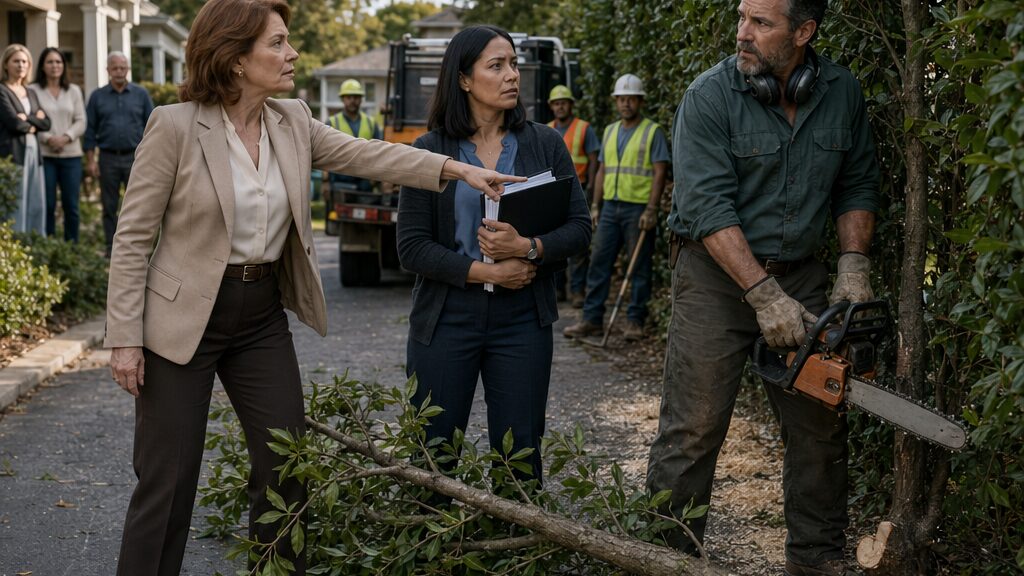
The chainsaw started three feet from Amanda Perez’s kitchen window.
The engine coughed once, caught, then climbed into a hard metallic whine that sent birds bursting from the hedge. Amanda set her coffee down so quickly it spilled across the counter. By the time she reached the driveway, a worker in orange ear protection had the saw angled toward the lowest trunk of the mature wax myrtles that had bordered her property for twelve years.
“Stop.”
The worker looked at Ronald King.
Ronald stood beside his white landscaping truck with one hand resting on the open driver’s door. He did not meet Amanda’s eyes.
Across the street, two more trucks crowded the curb. One belonged to a hauling company whose quarterly payroll Amanda had finished Friday. Another carried the logo of a tree-service subcontractor whose insurance renewal sat in a labeled folder in her garage office. A small loader idled behind them, its bucket empty.
Linda Roberts stood at the end of Amanda’s driveway in a navy blazer and pale slacks, holding a clipboard against her ribs.
“You were notified,” Linda said.
Amanda looked from the clipboard to the worker’s saw. “My appeal is scheduled for Thursday.”
“The compliance period expired yesterday.”
“The board hasn’t heard the appeal.”
“The appeal does not automatically stay corrective action.”
Linda spoke with the steady patience of someone explaining a rule to a child. She held out a stapled packet. The top page carried the association’s letterhead, Amanda’s address, and a bold heading: AUTHORIZATION FOR VEGETATION REMOVAL.
Amanda did not take it immediately.
Behind Linda, an orange survey stake stood beside the hedge. A strip of fluorescent tape fluttered from its top. Eighteen inches had been written in black marker along one side.
“That marker wasn’t there last night,” Amanda said.
“The easement was rechecked.”
“By whom?”
“The community manager.”
“The community manager is not a surveyor.”
Linda’s mouth tightened. “Amanda, we are not doing this in the street.”
“You brought chainsaws to my house before seven-thirty in the morning.”
One of the workers eased off the throttle. The sudden reduction in noise made the whole scene feel exposed. Garage doors had begun opening along the block. A neighbor stood barefoot at the end of his driveway with a phone in his hand.
Ronald finally stepped forward.
“Amanda, let me see if we can just take the outside face back,” he said. “Maybe we don’t have to remove the whole row.”
“You were hired to remove it.”
He glanced at Linda.
That glance answered more than his words.
Amanda took the packet. She turned past the violation notice, the compliance deadline, and a diagram showing the supposed easement line. The final page was a contractor authorization form. Ronald’s company name appeared near the top.
Her pulse slowed.
Not because she was calmer. Because she had found something she understood.
“Ronald,” she said, “what policy number did you give them?”
His expression changed.
Linda shifted the clipboard higher. “The association verified all vendor documentation.”
Amanda read the number again. She knew its pattern before she reached the expiration date. She had entered it into Ronald’s file herself two years earlier.
“This certificate expired last November.”
Ronald came closer. “That can’t be right.”
“It is right.”
She turned the page toward him but kept her thumb over the coverage limits. Client information did not become public simply because Linda had stapled it to a work order.
“That’s the old certificate,” Ronald said.
“Yes.”
“I sent the new one.”
“To the management company?”
“In January.”
Linda said, “This is a clerical attachment. It does not invalidate the work.”
“It may not invalidate the board’s order,” Amanda said. “It does mean this crew is standing on private property under a packet that lists expired coverage.”
Ronald looked back at the worker holding the saw.
Amanda kept her voice even. “If that blade hits a utility line, a window, a person, or the wrong property, whose insurer responds first?”
No one answered.
The worker lowered the saw until the chain stopped turning.
Linda stepped between Amanda and Ronald. “You are using privileged information to interfere with an authorized association action.”
“I am reading the document you handed me.”
“You recognized the number because you handle his books.”
“I recognized an expired date printed in public view.”
“That is not what happened.”
Ronald raised a hand. “Linda.”
She turned on him. “You have a contract.”
“I also have six people on this property and a packet with the wrong insurance attached.”
“You told me everything was current.”
“It is current. That’s not the point.”
Amanda heard the change in his tone. Ronald was not defending her. He was protecting the line beyond which his own risk became too visible to ignore.
Linda took out her phone. “I’ll have the correct certificate emailed within five minutes.”
“Not enough,” Amanda said.
Linda gave a small laugh. “You don’t get to decide that.”
Amanda looked down again at the work order.
The job number was printed beneath the authorization date.
DR-21-044-LS.
She had seen the first half of it before. Not in Ronald’s current records. In an older set of folders connected to drainage work performed near the lower retention basin. She could not yet place the year, but she knew the prefix. DR did not mean hedge removal.
Ronald saw where she was looking and reached for the packet.
Amanda moved it back.
“What does this job number refer to?” she asked.
Linda answered too quickly. “Grounds maintenance.”
“It begins with DR.”
“It is an internal code.”
“For drainage?”
Linda’s eyes held hers.
The worker nearest the hedge shifted his grip. The saw bar brushed a branch, and several narrow leaves dropped onto the driveway.
“Turn everything off,” Ronald said.
Linda stared at him.
“Until I get the current certificate and confirm the scope,” he added.
“You are already here.”
“And now I have a documentation problem.”
“You have a signed authorization.”
“I have an expired insurance page with my company name on it.”
For a moment, no one moved. Then the worker killed the chainsaw. The loader went silent next. One by one, engines shut down along the curb until the only sound was the ticking of cooling metal.
Amanda breathed once.
Then a cracking noise came from inside the hedge.
A second worker stepped backward holding a pole saw. A thick branch sagged away from the center of the row, half severed. It had been cut deep enough that its own weight finished the break. The branch dropped across the edge of the driveway, scattering leaves and pale splinters over the concrete.
Amanda stared at the exposed wood.
The opening was only two feet wide, but through it she could see directly into the front room of her house.
Linda looked at the damage, then at Amanda. “That section was within the marked area.”
“You cut it before showing me the order.”
“The order was issued last week.”
“My appeal was filed the same day.”
Linda tucked the clipboard under her arm. “You have until tomorrow morning. I will return with corrected vendor documents. If you want a licensed surveyor present, arrange one.”
“Tomorrow?”
“Seven-thirty.”
“That is less than twenty-four hours.”
“It is more time than the notice required.”
Linda walked toward her car without looking back. At the curb, she stopped beside Ronald.
“You and I will speak later,” she said.
Ronald said nothing.
The convoy did not leave immediately. Workers coiled cords, secured equipment, and avoided Amanda’s face. Ronald remained near the hedge until the others were inside their trucks.
“I didn’t know it was your address until this morning,” he said.
Amanda looked at him. “My name is on the work order.”
“The office handled the packet.”
“And you drove here without reading it.”
His jaw moved as if he were grinding down an answer.
“We need this contract,” he said quietly.
“That doesn’t explain the drainage code.”
He looked toward Linda’s departing car.
“No,” he said. “It doesn’t.”
He climbed into his truck.
Amanda stood beside the broken branch as the vehicles pulled away. The hedge no longer formed an unbroken wall. A gap had been forced through it, narrow but clean enough to reveal the room behind her.
She carried the work order into the garage office and laid it beside the labeled binders. Then she opened the cabinet where she kept archived association-related vendor records.
The prefix DR-21-044 was waiting somewhere inside.
Chapter 2: The Eighteen Inches That Did Not Match the Map
The orange stake was on the wrong side of the line.
Amanda saw it within seconds of laying the county map across the records counter.
The clerk had printed the recorded plat at full scale and marked the easement in blue pencil. It ran behind the oldest section of Amanda’s hedge, then curved toward a utility box near the side yard. Linda’s stake, by contrast, stood closer to the driveway, where the easement did not pass at all.
Amanda placed a photograph of the stake beside the plat.
“Could the easement have been amended?” she asked.
The clerk checked the parcel number again. “Nothing recorded here.”
“What about a maintenance access agreement?”
“Not under this lot.”
The clerk tapped a faint dashed line. “This is the original drainage and utility easement. It widens near the rear corner, but not where your picture shows.”
Amanda took out a ruler.
Even allowing for the hedge’s outward growth, the discrepancy was larger than eighteen inches. The association’s measurement appeared to begin from the wrong reference point entirely.
“Can I get a certified copy?”
The clerk nodded. “It’ll take about fifteen minutes.”
While she waited, Amanda checked her phone. Three missed calls from clients. One email from Linda. One voicemail from the association attorney.
She listened to the attorney first.
“Ms. Perez, I understand you raised concerns this morning regarding contractor documentation. Please be advised that any use of confidential vendor information obtained through your professional relationships may expose you to claims unrelated to the underlying covenant matter. The association remains willing to resolve the vegetation violation through ordinary channels.”
The message was polite. That made it worse.
Amanda replayed the phrase any use of confidential vendor information.
Nothing she had said that morning came from private files. The expired date had been printed on Linda’s own packet. But Linda had already chosen the argument she intended to make: Amanda was not a homeowner defending her property. She was a bookkeeper abusing access.
Amanda deleted neither the message nor the email.
The certified map was ready when she returned to the counter. She paid the fee, rolled one copy into a tube, and kept another flat inside a cardboard folder.
Back home, the broken hedge branch still lay where it had fallen. She dragged it onto the driveway and placed the county map across its thicker limbs, using two pieces of split wood to hold the corners flat.
The blue easement line passed behind the photographed hedge line.
The orange stake in the picture stood clearly in front of it.
“You finally noticed.”
Amanda turned.
Pamela Green stood on the sidewalk holding a grocery bag against one hip. She nodded toward the map.
“Noticed what?”
“That their measurements move.”
Pamela crossed the lawn without waiting to be invited. She set the bag down and crouched near the photograph.
“They measured my mailbox from the curb one year and from the pavement edge the next,” she said. “Different starting point, different violation.”
Amanda remembered the mailbox dispute. She also remembered dismissing it.
“You said the paint fine was selective,” Amanda said.
“It was.”
“The notice said the color didn’t match the approved palette.”
“The approved palette had six beige shades. Mine was number four. Linda said it reflected too yellow in direct light.”
Amanda almost smiled, but Pamela’s face stopped her.
“And the chalk?” Amanda asked.
Pamela looked toward her own house. Faint blue and pink marks remained on the sidewalk, nearly scrubbed away.
“My daughter drew flowers outside the driveway. Linda taped a cease-and-desist notice over them the day after I asked why the drainage assessment had no bid sheet.”
Amanda straightened.
“What assessment?”
“The emergency one. Two summers ago. We were told the lower basin had to be cleared immediately.”
“Did you request records?”
“I requested bids. Linda said the board acted under emergency authority. Three days later I got the chalk notice. A week after that, they measured my mailbox.”
Amanda looked down at the map again.
“Do you still have the notices?”
Pamela gave her a dry look. “I have every piece of paper that woman ever taped to my house.”
By late afternoon, Amanda’s garage office had begun to lose its usual order.
The certified plat lay beside the work order. Pamela’s notices formed a separate stack. Amanda had printed the association’s enforcement policy and highlighted the appeal section. Nothing in it allowed immediate corrective action when a timely appeal raised a disputed property boundary.
That was enough to stop tomorrow’s removal, or at least force delay.
It was not enough to explain the job number.
She opened the archived client cabinet.
Each drawer held color-coded folders by year. Ronald’s company records were blue. The tree-service subcontractor’s were green. The hauling company’s were gray. Amanda kept client information separate from anything she might use in the dispute. She did not open payroll files, bank statements, or tax returns.
Instead, she searched her own administrative index for public-facing documents: certificates provided to associations, published bid summaries, and invoice references clients had authorized her to retain for reconciliation.
DR-21-044 appeared in the index under a drainage project near the lower retention basin.
She pulled the folder.
The original invoice was not confidential in the same way a payroll ledger was; the association had paid it, and a copy should exist in HOA records. Still, Amanda handled the paper by its edges, conscious of the distinction she was trying to maintain.
The job description read:
Emergency drainage clearing and debris removal.
The vendor listed was Ronald’s company. The amount was $4,850.
Beneath it sat a second invoice dated eleven days later for $4,775. Then another for $4,900.
Each carried the same base job number with a different suffix.
Amanda took the hedge work order from the desk.
DR-21-044-LS.
Same base number.
The suffix LS could mean landscaping service. It could also be an internal continuation added without much thought. But why would a hedge removal in the current year sit under a drainage project opened two years earlier?
Her phone rang.
Linda.
Amanda let it go to voicemail.
A minute later, an email arrived from the association attorney. The subject line read: NOTICE REGARDING CONFIDENTIAL BUSINESS INFORMATION.
Amanda opened it.
The letter warned her not to disclose, reference, or rely upon information obtained through any vendor-client relationship. It also stated that the association had corrected the insurance attachment and intended to proceed at seven-thirty the next morning unless a court or licensed surveyor ordered otherwise.
Attached was the updated certificate.
Amanda checked the policy number.
Current.
Then she checked the work-order number.
Unchanged.
Outside, the gap in the hedge framed a direct view of the street. A car slowed as it passed, the driver glancing through the opening into Amanda’s front room.
She returned to the old drainage folder and placed the new work order beside the first invoice.
The hedge removal had not merely reused an old administrative code.
It had been folded into an unfinished project that had already generated multiple payments.
Chapter 3: Every Small Invoice Stayed Below One Dangerous Number
Six invoices ended within one hundred fifty dollars of each other.
Amanda arranged them in a row across her worktable.
$4,850.
$4,775.
$4,900.
$4,825.
$4,760.
$4,895.
Different dates. Different descriptions. Drainage clearing, debris hauling, slope stabilization, root removal, landscape restoration, emergency access trimming.
Every one remained below five thousand dollars.
Amanda opened the association’s published purchasing policy. Expenditures of five thousand dollars or more required approval by a majority of the board at a properly noticed meeting. Emergency expenses could bypass the requirement temporarily, but the board had to ratify them afterward and enter the action into the minutes.
She searched the online meeting archive.
No ratification appeared.
At seven-fifteen, Ronald’s trucks returned to the street but did not enter her driveway. Pamela stood beside the hedge with the certified plat rolled under one arm. Amanda had emailed the county map, the appeal policy, and the disputed measurement to the association attorney before dawn.
At seven-twenty-eight, Linda arrived alone.
“No work today,” Linda said before Amanda could speak. “The attorney recommended a temporary hold pending survey review.”
Pamela looked almost disappointed.
Linda continued, “This is not an admission that your hedge complies.”
Amanda glanced at the trucks waiting along the curb. “Then why are they here?”
“I had no obligation to cancel them until the hold was confirmed.”
Ronald remained inside the lead truck.
Linda’s gaze moved to Pamela. “This is a private compliance matter.”
“No,” Pamela said. “It’s a private property matter being performed in public.”
Linda ignored her and handed Amanda a letter. The removal was paused for ten business days.
A small victory. Long enough to save the hedge.
Not long enough to answer anything else.
“You used an old drainage project number on the work order,” Amanda said.
Linda’s expression did not change. “Administrative numbering is handled by management.”
“The project has invoices from two years ago.”
“Then you are referring to confidential vendor documents again.”
“I’m referring to the number on the work order you gave me.”
“And speculating beyond it.”
Linda stepped closer.
“You should be careful, Amanda. Your clients may not appreciate being dragged into a personal dispute.”
The word personal landed where Linda intended it to.
Amanda had spent years making sure clients never had reason to wonder whether she talked about their finances. At her former firm, a supervisor had once blamed her after a client discrepancy reached the wrong executive. The error had not been hers, but the explanation had not mattered. Trust, once questioned, became a stain no corrected memo could remove.
Linda knew that.
Or had guessed it.
By nine, Amanda was at the clubhouse records room with a written request for invoices, bid summaries, approval records, and meeting minutes connected to DR-21-044.
Steven Wilson met her at the door.
He was a careful man in his early sixties, dressed as though every day might unexpectedly require a board photograph. He carried a ring of keys and a yellow legal pad.
“I can give you the payment register and the monthly financial packets,” he said. “Vendor contracts require review.”
“By whom?”
“Counsel.”
“The meeting minutes are association records.”
“Most of them.”
Amanda stopped inside the doorway. “What does that mean?”
“It means some sessions involved legal advice.”
“Emergency ratifications should appear in open minutes.”
Steven’s face tightened. “You are assuming emergency ratifications were required.”
“The policy says they were.”
“You are reading the current version.”
“Was the threshold different two years ago?”
He did not answer.
The records room smelled of toner and old carpet. Steven placed three binders on the table. Each held monthly financial reports, check registers, and summary pages prepared for residents.
Amanda began with the public disbursement register.
The pattern appeared almost immediately.
Payments under five thousand dollars repeated across several vendors. Some occurred within days of one another. Others carried descriptions broad enough to cover almost anything: grounds correction, storm response, access restoration.
She made notes without copying client-specific details beyond what the association itself disclosed.
Steven watched from the door.
“Where are the minutes for the March emergency meeting?” she asked.
“There may not have been one.”
“Then where was the spending approved?”
“The president has limited emergency authority.”
“Up to what amount?”
Steven looked down at his legal pad.
Amanda turned to the front of the policy binder. A revision history showed the five-thousand-dollar threshold had been in effect for four years.
She slid the page toward him.
“Was the work divided to keep each invoice below this?”
“No.”
The answer came too quickly.
Amanda pointed to three entries from the same week. “Drainage clearing, debris hauling, and landscape restoration. Same project prefix. Three vendors. Total over fourteen thousand dollars.”
“Different scopes.”
“Approved separately?”
“Operationally, yes.”
“By the board?”
Steven closed the binder.
“I am not going to participate in an accusation based on incomplete information.”
“Then give me the complete information.”
“The executive-session records are not available.”
“Were there votes?”
“I said they are not available.”
“You didn’t say they exist.”
For the first time, Steven looked angry.
“You think because numbers align on a page, you understand what happened. You weren’t standing in three feet of water in those garages. You weren’t taking calls from residents threatening lawsuits while the basin backed up.”
Amanda held his gaze. “Then show me the emergency approvals.”
He took the binders from the table one at a time.
“You may submit another request through counsel.”
By noon, Linda’s version of the encounter had begun circulating.
An email went to the board and several vendors stating that Amanda had attempted to access protected contractor files while pursuing a personal covenant dispute. It did not accuse her directly of misconduct, but it asked vendors to review their confidentiality arrangements.
Two clients called to ask whether their records were involved.
Amanda answered both carefully.
“No private records have been disclosed,” she said.
“Then why is the HOA naming vendors?”
“I can’t speak for the HOA.”
“Are you investigating us?”
“I’m reviewing association spending records.”
The distinction sounded weaker aloud than it had in her head.
After the second call, she locked the client cabinets.
The binders behind those doors contained everything she needed to make the pattern sharper: deposit dates, invoice sequences, insurance renewals, job-cost notes. They also contained information she had no right to use without permission.
On her desk, she rebuilt the case using only documents available to any homeowner.
The purchasing policy established the threshold.
The disbursement register showed repeated amounts below it.
The work order connected her hedge to an older drainage number.
The meeting archive lacked ratification.
It was enough to raise a serious question.
It was not enough to prove why the invoices had been divided, who directed it, or whether the contractors understood the purpose.
At four-thirty, a truck door slammed outside.
Ronald entered the garage without knocking. He stopped just inside, taking in the locked cabinets, the rows of public records, and the work order pinned beneath a paperweight.
“You need to stop,” he said.
Amanda remained seated. “Stop what?”
“Calling this fraud.”
“I have not called it fraud.”
“Pamela has.”
“I don’t control Pamela.”
“Linda says you’re going after every contractor on the drainage job.”
“Linda says a lot of things.”
Ronald put both hands on the edge of her desk.
“That HOA contract is almost a third of my annual work.”
Amanda looked at his hands. Dirt remained in the creases around his nails.
“I didn’t send you to my hedge.”
“No. You just made it impossible for me to finish the job.”
“The work order had expired insurance attached.”
“A clerical mistake.”
“And an old drainage code.”
His eyes moved toward the invoices.
Amanda saw recognition before he looked away.
“You know what that code means,” she said.
“I know it was a bad couple of weeks.”
“What happened?”
“Rain. Basin overflow. Mud in garages. People screaming at anyone who answered the phone.”
“And the invoices?”
Ronald straightened.
“You think every small business has the cash to float a whole emergency project while a board schedules meetings? We billed work as it was completed.”
“Under separate descriptions.”
“We did separate work.”
“Every amount below the approval threshold.”
His face hardened. “You’re not the only person who can read a policy.”
“Did Linda tell you to keep the invoices below five thousand?”
Ronald stepped back from the desk.
Amanda did not repeat the question.
The silence between them was more damaging than either answer.
Finally he said, “If you keep digging, Linda will freeze the renewal. If she freezes the renewal, I lose winter work. If I lose winter work, six people lose hours.”
“That doesn’t answer me.”
“No,” Ronald said. “It tells you what your answer could cost.”
He turned toward the open garage door, then stopped.
“You always said you understood small businesses.”
“I do.”
“Then understand this one.”
He left without closing the door.
Amanda watched his truck pull away through the gap in the hedge. The invoices on her desk no longer looked like clean proof. Each amount represented work performed, wages paid, or pressure passed down to someone with less room to absorb it.
But Ronald had known what the threshold was.
And he had not denied that Linda knew too.
Chapter 4: The Voicemail Sounded Worse Until Amanda Heard the Rest
Linda’s voice came through Amanda’s desk speaker with a faint electronic hiss.
“Keep it under the number.”
Amanda stopped the recording.
The garage office was otherwise silent. Morning light crossed the worktable, catching the pale wood exposed where the hedge branch had broken. She had carried a short section inside without thinking and left it beside the invoices. Its severed end had begun to dry, the living green beneath the bark fading toward brown.
She pressed play again.
Ronald’s voice followed Linda’s, lower and harder to hear.
“I can’t keep moving crews without a deposit.”
“Then divide the work. Keep it under the number and submit the rest after inspection.”
Amanda paused it at the same place.
On its own, the exchange sounded decisive. Linda knew the approval threshold. She had instructed a contractor to stay below it. Pamela had sent Amanda the audio late the previous night with a message consisting of four words: This is what we need.
The file had no date attached. No visible source. Only the voices.
Amanda had spent half the night building a timeline around it anyway.
She hated how quickly certainty had arrived once the recording said what she already suspected.
At eight-thirty, Ronald texted an address for a diner near the highway. No greeting. No explanation.
He was already in a back booth when Amanda arrived. A coffee sat untouched in front of him. His work shirt was clean, but there was dried mud on one boot.
Amanda slid into the opposite seat and placed her phone on the table.
“Where did Pamela get the recording?”
“I sent her part of it two years ago.”
“Why?”
“I was angry.”
“At Linda?”
“At everybody.”
He looked toward the window. Trucks passed in flashes beyond the glass.
Amanda waited.
Ronald drew his phone from his pocket. “Play yours.”
She did.
Linda’s voice filled the booth, quieter than it had sounded in the office.
Keep it under the number.
Divide the work.
Submit the rest after inspection.
Ronald reached across and stopped it.
“That’s not the whole message.”
Amanda felt the certainty inside her shift.
He opened an archived voicemail and set his phone beside hers.
Linda’s voice began earlier.
“The board cannot meet until Monday. The west drain is backing into two more garages. If your crew can clear the culvert today, start there. Keep that phase under the emergency limit. Document every hour, every load, every machine. Keep it under the number and submit the rest after inspection so the board can vote on the second phase.”
Amanda listened without moving.
Ronald’s recorded voice asked, “You’ll put it in the minutes?”
“I will.”
The message ended.
The waitress approached, saw neither of them looking at the menu, and turned away again.
Amanda stared at the two phones.
“That changes it,” she said.
“Yes.”
“It doesn’t make the later invoices proper.”
“No.”
“But it doesn’t prove what Pamela thinks it proves.”
“No.”
“Why did you send her only that part?”
Ronald rubbed a thumb along the rim of his cup.
“She asked why three invoices were under five thousand. I sent the piece where Linda said it. I wanted Pamela to put pressure on the board.”
“You edited it.”
“I clipped it.”
“You removed the context.”
“I didn’t think she’d sit on it for two years and then pass it around like a confession.”
Amanda looked at him. “You knew exactly how it sounded.”
He met her eyes at last. “So did you.”
The words landed cleanly.
Amanda had not asked for the full file before arranging the recording beside the invoices. She had not asked Ronald what happened during the drainage emergency. She had trusted the shape of the evidence because it fit the argument she wanted to make.
At her former firm, a supervisor had once done the same thing to her. A partial email had been forwarded to an executive without the attachment that explained the discrepancy. By the time Amanda produced the complete exchange, the story had already settled into everyone’s mind.
She closed her phone.
“I’m not using it.”
Ronald’s shoulders lowered slightly.
“That doesn’t mean there’s nothing wrong,” she said.
“I know.”
“Then tell me what happened after the emergency.”
He leaned back.
“At first, it was what you heard. The basin was full. The culvert was blocked. We worked eighteen hours straight. The hauling company took mud out until midnight. The tree crew cleared roots from the access road.”
“And the board ratified it?”
“I assumed so.”
“You invoiced three phases.”
“We performed three phases.”
“Each below the threshold.”
“Because Linda told us the board could approve the rest later.”
“Did it?”
Ronald looked at the coffee.
“I got paid.”
“That wasn’t my question.”
“No. I never saw a vote.”
Amanda kept her hands flat on the table. “When did the drainage project become a standing landscaping code?”
“After the second storm. Linda said keeping one project open made billing easier.”
“Easier for whom?”
“Everybody, at first.”
He explained in short pieces. A damaged swale near the clubhouse. Root removal behind two homes. Slope work beside the retention basin. Each job related loosely enough to drainage that the same project number remained in use. Contractors submitted separate bills. Linda authorized scheduling. Steven signed monthly summaries. No one asked for a fresh vote because the work appeared in reports as continuation.
Then the jobs widened.
Tree trimming along common property.
Mulch replacement.
Private-lot corrections billed as access maintenance.
Amanda’s hedge.
“Did you know the removal order used that code before Monday?” she asked.
Ronald shook his head. “I knew Linda said it would count toward the renewal package.”
“What does that mean?”
He glanced toward the aisle before answering.
“She’s rebidding grounds maintenance next month. She told me the board liked vendors who supported enforcement.”
Amanda said nothing.
Ronald’s mouth tightened. “Not in those words.”
“What words?”
“She said, ‘The board needs partners, not contractors who second-guess every directive.’”
“And you understood that to mean cut my hedge.”
“I understood that if I refused, she could say I wasn’t responsive.”
“You could have called me.”
“You were my client.”
“And?”
“And I knew what you’d ask.”
Amanda looked at the mud on his boot, then at the untouched coffee.
“What did you think I’d do?”
“Make me choose out loud.”
The answer carried no accusation. That made it worse.
Ronald had chosen anyway. He had simply preferred to arrive with the saw running so the choice would look like procedure.
“How many times did she connect enforcement work to contract renewal?”
“Not always directly.”
“How many?”
He counted silently.
“Four that I remember.”
“Who were the residents?”
“I’m not giving you names.”
“I’m not asking for private customer details. I’m asking whether there was a pattern.”
“There was.”
“Did other vendors know?”
“Some knew pieces.”
“Did Steven?”
Ronald looked toward the window again. “Steven knew the invoices were being split.”
“How?”
“He called me once and asked why two crews were billing the same project in the same week.”
“What did you tell him?”
“That Linda had approved it.”
“And what did he do?”
“He said to make the descriptions more specific.”
Amanda sat back.
Not stop the work. Not call a board meeting. Make the descriptions more specific.
Ronald finally lifted his coffee and drank, then winced at the coldness.
“I’m not asking you to protect Linda,” he said. “I’m asking you not to burn down every business that did work the neighborhood needed.”
“I don’t want to.”
“Pamela does.”
“Pamela wants consequences.”
“She posted online last night that twenty-eight thousand dollars was stolen.”
Amanda’s phone was already in her hand.
Pamela’s post had been shared through the neighborhood group. It named no vendor, but the comments did. Ronald’s company. The hauling company. The tree subcontractor.
One resident had written: They were all in on it.
Amanda closed the screen.
“I’ll tell her to take it down.”
“She’ll listen to you?”
“I don’t know.”
“That’s the problem.”
Outside the diner, Ronald stopped beside his truck.
“There was real work,” he said. “There were also things I should have refused.”
Amanda waited.
“The first time Linda tied renewal to enforcement, it wasn’t your hedge. It was a cleanup order against a resident who questioned a special assessment. I told myself the violation was legitimate anyway.”
“And the second time?”
“I stopped asking whether it was legitimate.”
He opened the truck door.
Amanda looked back through the diner window at the two phones still visible on the table, one carrying a dangerous fragment and the other its missing context.
The easy proof was gone.
What remained was harder to show and more important to understand: a real emergency had created the shortcut, but fear had kept it alive long after the water receded.
Chapter 5: The Neighborhood Had Real Problems and False Records
The water mark inside the garage reached Amanda’s waist.
A dark line crossed the drywall three feet above the concrete floor, uneven but unmistakable. Below it, the wall had been replaced. Above it, the old paint remained.
The resident stood beside a row of plastic storage bins elevated on metal shelves.
“That storm came in through the side door and the floor drain,” the resident said. “By the time Ronald’s crew opened the culvert, the freezer was floating.”
Amanda touched the edge of the repaired drywall.
Outside, the lower retention basin looked harmless. Dry grass covered its slopes. A narrow concrete channel disappeared beneath a tangle of reeds. From the street, no one would have guessed that two summers earlier the basin had filled fast enough to push water into six garages.
“Linda was here until two in the morning,” the resident said. “She brought pumps herself.”
Amanda turned.
“She did?”
“She called every contractor she knew. Half the board wasn’t answering. Steven came for twenty minutes, then left when people started demanding guarantees.”
That detail did not fit the version Pamela had circulated.
“Did residents approve the emergency spending afterward?”
“I don’t remember a vote. I remember being grateful the water stopped.”
The resident opened a cabinet and took out a folder swollen with old papers. Inside were photographs, cleanup receipts, and a notice for a special assessment issued three months later.
Amanda read the amount.
It was too small to cover the work shown in the payment register.
“Did anyone question this?”
“Pamela did.”
The resident’s expression changed.
“She said the numbers didn’t add up. Linda said Pamela was trying to turn a disaster into a political fight.”
By noon, Amanda had visited three affected homes.
The work had been real.
Ronald’s crews had cleared the blocked culvert. The hauling company had removed mud. The tree subcontractor had cut roots that had forced their way into the access channel. The association had needed to act quickly.
Linda had acted.
That truth complicated nothing about the later concealment, but it changed the beginning. She had not invented the crisis to create a billing scheme. She had discovered during the crisis that she could move faster without questions.
At the basin, Amanda found old paint marks on the concrete wall corresponding to inspection points in Ronald’s original invoices. She photographed them, then compared them with later invoice descriptions.
The first three phases matched visible work.
A later charge for “slope stabilization” appeared to cover ordinary mulch and plant replacement near the clubhouse.
Another charge for “emergency access restoration” matched tree trimming performed months after the storm.
The same project number had become a container. Once opened for a legitimate emergency, it never truly closed.
Pamela arrived carrying a grocery bag full of notices.
“You talked to the flooded homeowners,” she said.
“Yes.”
“And?”
“The drainage work happened.”
“I never said it didn’t.”
“You said twenty-eight thousand dollars was stolen.”
“I said it was missing.”
“You used the word stolen.”
Pamela set the bag on the hood of Amanda’s car. “That got people’s attention.”
“It also got contractors accused of theft.”
“Maybe they should explain why they took the money.”
“Some of them performed the work.”
“Some of them came to your house with chainsaws.”
Amanda held her gaze. “Those are not the same accusation.”
Pamela gave a short, disbelieving laugh. “You’re defending them now?”
“I’m trying to separate what happened from what we’re angry about.”
“What happened is Linda used those people to scare anyone who challenged her.”
“That may be what happened later.”
“Later?”
Pamela pulled a stack of notices from the bag and slapped them onto the hood.
Mailbox color.
Trash-bin visibility.
Unauthorized sidewalk markings.
Landscape inconsistency.
Temporary parking obstruction.
Each notice carried a date.
Amanda began arranging them chronologically.
Pamela pointed to the first chalk citation. “That came the day after I requested the bid sheets.”
The mailbox notice followed eight days later.
Another resident received a trash-bin fine three days after questioning the drainage assessment at an open meeting.
A homeowner near the basin was cited for landscape inconsistency the week after asking why the reserve balance had fallen.
The violations were not all fabricated. The trash bins had remained visible. The mailbox color did differ slightly under direct light. Pamela’s daughter had drawn on common sidewalk beyond the driveway edge.
But the timing was too consistent.
The rules had become a drawer Linda opened when she needed leverage.
Amanda photographed the notices and copied the dates.
“This is useful,” she said.
Pamela folded her arms. “More useful than the recording?”
“The recording was incomplete.”
Pamela’s face went still.
“What do you mean?”
Amanda told her about the full voicemail.
Pamela listened without interrupting, but color rose slowly into her cheeks.
“So Ronald gave me a clipped version.”
“Yes.”
“And you believe him.”
“I heard the original file.”
“He still split the invoices.”
“For emergency work at first.”
“At first,” Pamela repeated. “That’s doing a lot of work.”
“I’m not excusing what came later.”
“You’re softening it.”
“I’m making it accurate.”
Pamela reached for the notices. Amanda put a hand over the stack.
“Leave these with me.”
“Why? So you can decide which parts are respectable enough to use?”
Amanda removed her hand.
Pamela gathered the papers. “You didn’t care when it was my daughter’s chalk. You didn’t care when it was my mailbox.”
“That’s fair.”
The admission stopped her.
Amanda continued, “I thought the notices were petty but legal. I thought records would tell us whether there was a real problem. I didn’t ask what it was doing to your family.”
Pamela looked away.
“My daughter stopped drawing outside,” she said. “She thought she’d gotten us in trouble.”
Amanda saw the faint chalk marks on the sidewalk in her mind, scrubbed until only color remained in the pores of the concrete.
“I’m sorry,” she said.
Pamela’s grip loosened on the stack.
“But I still need you to remove the post,” Amanda said. “The theft claim.”
Pamela laughed once, without humor. “There it is.”
“It’s hurting the case.”
“It’s hurting your professional image.”
“Both can be true.”
Pamela looked at her for a long moment.
“I’ll change it,” she said. “I won’t delete it.”
“Change it to what we can prove.”
“You don’t get to manage everyone’s anger like a ledger.”
“No,” Amanda said. “But I won’t build this on something false.”
Pamela left the notices on the hood.
By Thursday morning, the enforcement dates formed a clean column beside the association’s records requests and special-assessment questions. Amanda could not prove motive from timing alone, but the pattern gave context to Ronald’s account.
She requested access to the HOA office again.
This time the community manager allowed her to inspect vendor files already disclosed in prior annual reports. Several documents carried photocopied approval sheets. The signatures appeared genuine, but the dates did not align with the work.
One approval page had been reused behind three different invoices.
Another invoice description had been changed from “ornamental tree trimming” to “drainage access clearance.”
Amanda photographed only the association copies.
Linda entered the office as Amanda was returning a folder.
“You are very determined to make an emergency look criminal,” Linda said.
Amanda set the folder down. “The emergency was real.”
For the first time, Linda appeared uncertain.
“I visited the garages,” Amanda continued. “I saw the damage.”
“Then perhaps you finally understand why we acted.”
“I understand why you acted before a vote.”
Linda’s shoulders eased slightly.
“I don’t understand why the same project stayed open for two years.”
“The drainage system required continuing maintenance.”
“Then why change ornamental trimming into access clearance?”
“The work served both purposes.”
“Why reuse an approval page?”
“The manager may have copied the wrong attachment.”
“Why cite residents immediately after they requested financial records?”
Linda’s expression closed again.
“Covenant enforcement is separate from financial operations.”
“Not to the people receiving the notices.”
“You are allowing Pamela to turn ordinary administration into retaliation.”
“Pamela exaggerated. I told her so.”
A flicker crossed Linda’s face, almost satisfaction.
Amanda saw the trap. Linda wanted division more than denial. If Amanda and Pamela stopped trusting each other, the records would remain separate from the harm.
“The post was inaccurate,” Amanda said. “The dates are not.”
Linda picked up the folder and squared it with the edge of the table.
“You want a confession because it would simplify things. There isn’t one. There was a failing basin, an empty reserve account, and a board that could not make a decision before the next house flooded.”
“And afterward?”
“Afterward, there were bills.”
“And no votes.”
“There were reports.”
“Summaries.”
“Which Steven signed.”
Linda’s eyes held Amanda’s.
The statement was not a defense. It was a direction.
Amanda left the office and called Steven before she reached her car.
He answered on the fourth ring.
“I’m not discussing association business outside formal channels,” he said.
“Linda says you signed the reports.”
Silence.
“Did you know the invoices were being divided?” Amanda asked.
“Amanda—”
“Did you know?”
Another silence, longer this time.
“Yes,” Steven said.
The word was quiet enough that she nearly missed it.
“Why did you sign?”
“I signed summaries.”
“That is not an answer.”
“I knew the reports were incomplete.”
Amanda leaned against her car.
Across the parking lot, the drainage basin lay beyond a line of trimmed shrubs, dry and orderly from this distance.
“What record are you withholding?” she asked.
Steven breathed out slowly.
“Not over the phone.”
“Then where?”
“My house. Tomorrow morning.”
“What do you have?”
“The minutes Linda says never existed.”
Chapter 6: The Treasurer’s Silence Was the Strongest Approval Linda Had
Steven removed the minutes from a locked fireproof box beneath his desk.
The pages were not stamped, bound, or entered into any official record book. They were clipped together beneath a handwritten cover sheet dated two years earlier.
Amanda stood across from him in a home office crowded with filing cabinets and retired-company plaques.
“You kept these here?” she asked.
“I kept copies.”
“Why weren’t they in the clubhouse records?”
“Because the meeting was never finalized.”
Steven placed the packet on the desk but kept one hand over it.
“You can read them. You cannot photograph them.”
“If they are association minutes—”
“They are draft notes.”
“Written by whom?”
“The secretary.”
“Were you present?”
“Yes.”
“Was Linda?”
“Yes.”
“Was there a quorum?”
His fingers tightened against the paper.
“Yes.”
Amanda looked at him.
“The board met,” she said. “You discussed the emergency spending, and then no ratification appeared in the public record.”
“We did not finish the vote.”
“Why?”
“Because the amount had changed.”
He removed his hand.
Amanda read.
The notes began with the drainage emergency. Linda reported that contractors had been dispatched to prevent additional flooding. Steven reported the reserve balance. Two board members objected that the association could not absorb the full cost without a special assessment.
A motion appeared halfway down the second page: ratify emergency expenses up to twenty-one thousand dollars, subject to detailed vendor documentation.
Beside it, in the secretary’s handwriting, were the words discussion suspended.
“What happened next?” Amanda asked.
“One board member left.”
“Before the vote?”
“Yes.”
“Then you lost quorum.”
“Yes.”
“And the expenses continued.”
“The work was already underway.”
“Why wasn’t another meeting called?”
Steven sat down.
“We tried. One member refused to participate unless residents approved a special assessment first. Another said Linda had exceeded her authority and should be personally liable.”
“So Linda kept the invoices below the threshold.”
“At first, she said each phase was separate.”
“And you accepted that?”
“I accepted that people’s homes had been saved.”
Amanda turned another page.
The notes listed a reserve balance far lower than residents had been told in annual summaries.
“You knew the fund could not cover the work.”
“We all knew.”
“The published report said reserves were adequate.”
“It said reserves were stable.”
“They were not.”
“No.”
The admission seemed to reduce him physically. His shoulders rounded. His careful posture disappeared.
“Why did you certify the reports?” Amanda asked.
Steven looked toward the filing cabinets.
“I thought we could repair the balance before the next annual statement. Increase dues gradually. Delay cosmetic projects. Negotiate payment timing.”
“Without telling residents.”
“They had rejected two dues increases.”
“That did not give you permission to conceal the shortfall.”
“No.”
The word came faster this time.
Amanda turned to the final sheet. A handwritten note appeared at the bottom:
President recommends continued project coding until reserve recovery.
“Did you agree to this?”
“I said it would create an audit problem.”
“What did Linda say?”
“That an audit problem was better than six flooded homes.”
“And later, when the code was used for ordinary landscaping?”
Steven removed his glasses.
“I told her to close it.”
“Did you put that in writing?”
“Yes.”
“Where?”
He glanced toward the fireproof box.
Amanda understood.
“There are more records.”
“Emails. Draft reports. My notes.”
“Why keep them here?”
“For protection.”
“Whose?”
He did not answer.
Amanda closed the minutes.
“I need copies.”
“I’ll provide them if you agree not to identify me as the source.”
“You are the treasurer.”
“I am also personally exposed.”
“You signed reports you knew were incomplete.”
“I know.”
“And now you want the truth used without your part in it.”
His face tightened. “I am offering you the proof you asked for.”
“You are offering me another hidden arrangement.”
“That is not fair.”
“No,” Amanda said. “It is familiar.”
Steven stood.
“I spent thirty-five years in operations. You solve the immediate failure first. Then you stabilize. Then you report.”
“You did not report.”
“We were trying to prevent panic.”
“You were trying to prevent blame.”
His eyes flashed. “You think I don’t know that?”
The anger vanished as quickly as it came.
He sat again and rubbed both hands over his face.
“When the basin failed, residents called me a thief before the first invoice arrived. One man said he would sue every board member personally. Linda stood in the water and kept the crews moving. I went home and started calculating liability.”
Amanda said nothing.
“I told myself caution was my role,” he continued. “Linda took action. I controlled the numbers. That was the division.”
“But she controlled the numbers too.”
“Yes.”
“And you let her.”
“Yes.”
There it was—the surprise the documents had only circled. Steven had not been fooled. He had understood enough to resist and enough to remain silent.
Amanda slid the minutes toward him.
“I will use these only if they are authenticated and produced through a lawful records process.”
His head lifted. “Then Linda will know.”
“She should.”
“And my signatures?”
“They stay.”
He looked toward the box for a long moment.
Then he reached down and removed a second folder.
“Take everything,” he said.
By noon, Amanda’s garage office held three people instead of one.
Pamela sat at the side table organizing enforcement notices by date. Ronald stood near the client cabinets, reading a two-page authorization Amanda had prepared. Steven occupied the chair nearest the door, as though he had not decided whether he was staying.
The binders were open.
Not the private tax files. Not payroll records. Only association documents, vendor invoices covered by Ronald’s limited waiver, published policies, and Steven’s authenticated copies.
Amanda read the waiver aloud.
“It permits disclosure of invoice dates, project codes, original descriptions, revised descriptions, and payment timing related to DR-21-044. It does not permit disclosure of payroll, bank balances, tax information, other clients, or job-cost margins.”
Ronald took the pen.
“If I sign this, Linda knows I gave you the records.”
“Yes.”
“She may terminate the contract.”
“Yes.”
“You could say something encouraging.”
“I could. It would not change the risk.”
He gave her a tired look, then signed.
Pamela slid the enforcement chronology across the table. “I corrected the post.”
“I saw.”
“I wrote that the amount may include legitimate emergency work.”
“Thank you.”
Pamela tapped the papers. “I still think Linda used fines to scare people.”
“So do I.”
The answer softened something between them.
Steven opened the draft minutes.
“The board knew the reserve account could not cover the promised work,” he said. “If this becomes public, residents will ask why dues stayed flat.”
“They should ask,” Pamela replied.
“They will also receive a special assessment.”
Pamela’s expression changed.
“How much?”
Steven gave a range.
No one spoke for several seconds.
The numbers were not ruinous for every household, but they were high enough to matter. High enough to force choices. High enough that Linda’s concealment, however wrong, had postponed a real burden.
Amanda looked around the table.
“This cannot be presented as money disappearing,” she said. “Some work was necessary. Some was improperly coded. Some enforcement appears retaliatory. Those are different findings.”
Pamela nodded reluctantly.
Ronald asked, “What stops Linda from saying all of it was continuing emergency work?”
“The bid histories,” Amanda said. “The revised descriptions. The dates. The missing ratification. The enforcement pattern.”
Steven added, “And my reports.”
The words cost him.
Amanda began building the presentation.
For the first time, she did not work alone. Pamela checked dates against resident requests. Ronald identified which invoices reflected actual field work and which descriptions had been changed later. Steven marked where summaries omitted project totals.
By three o’clock, the case no longer depended on any single piece of evidence.
At three-ten, an email arrived from Linda.
The special meeting would proceed at six.
A second attachment followed.
Corrective hedge removal was rescheduled for six o’clock, citing expiration of the temporary hold after an expedited management review.
Pamela read the notice over Amanda’s shoulder.
“She scheduled both at the same time.”
Ronald checked his phone. “My office just received the dispatch.”
“You don’t have to go,” Amanda said.
“If I refuse without a board order, she can terminate for nonperformance.”
Steven stared at the meeting notice. “She wants you outside defending the hedge instead of inside presenting the records.”
Amanda looked through the garage door.
The severed opening in the hedge framed the clubhouse roof at the far end of the block. From her property, it was a five-minute walk.
She could remain home, stand in the driveway, challenge the crew, call the attorney, and protect the visible thing.
Or she could carry the binders into the meeting and leave the hedge behind.
At five-forty, Ronald’s trucks appeared at the end of the street.
Pamela rolled the certified survey order and tucked it under her arm.
“What are you doing?” Amanda asked.
“Standing where you stood Monday.”
“Pamela—”
“You have the records. I have the boundary order.”
Ronald stopped beside the garage. He had not changed into clean clothes. His crew waited in the trucks.
“I can delay setup,” he said. “Not forever.”
Amanda placed the missing minutes into the presentation binder. Then she closed it.
The chainsaw engine started outside, lower at first, then rising.
Every instinct told her to run toward the sound.
Instead, she handed Pamela the survey packet.
“Do not argue about the invoices,” Amanda said. “Do not accuse anyone of theft. If they cross the property line, call the attorney.”
Pamela took the papers.
“What if they cut before the meeting votes?”
Amanda looked through the gap at the first worker unloading a saw.
“Then make sure everyone inside can hear it.”
She carried the binders down the street toward the clubhouse while the chainsaw climbed behind her.