The HOA Cut Down His Sons’ Basketball Hoop, Then Learned Who Controlled the Summer Water
Chapter 1: The Saw Started Before Daniel Finished Reading the Notice
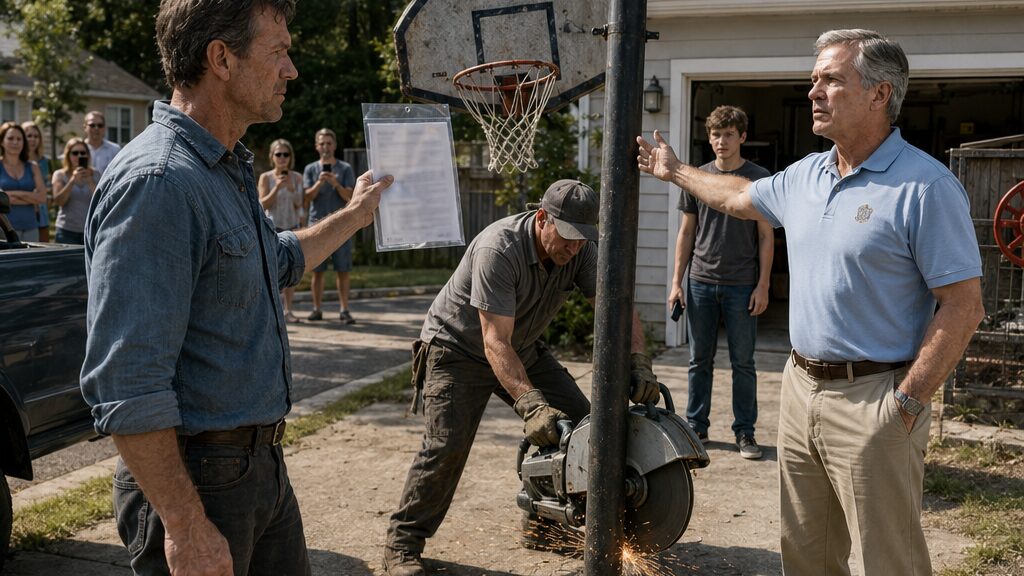
The saw was already halfway through the steel pole when Daniel turned into his driveway.
For one disorienting second, he thought Tyler had tried to move the hoop himself. Then he saw the contractor’s orange extension cord snaking across the grass, the spray of silver filings at the base, and Robert White standing beside the mailbox with one hand raised as if directing traffic.
Daniel braked hard enough to throw a socket wrench off the passenger seat.
Tyler was near the garage, barefoot, holding the folded notice Daniel had found taped to the front door the previous evening. His younger brother stood behind him. Neither boy spoke.
The saw screamed again.
Daniel got out of the truck and shut the door carefully.
“Stop cutting.”
The contractor eased off the trigger but kept both hands on the saw. He looked toward Robert instead of Daniel.
Robert wore a pale blue polo with the neighborhood crest over the chest. He had dressed for authority even on a Saturday morning.
“This structure was posted for removal,” Robert said. “You had forty-eight hours.”
Daniel looked at the paper in Tyler’s hand. “The notice says the board believes it may cross a common-area setback.”
“That is correct.”
“It doesn’t say the board authorized anyone to enter my property.”
Robert’s expression barely changed. “The association has enforcement rights.”
“Show me the vote.”
A car slowed on the street. Then another. A woman walking a terrier stopped at the curb. Daniel could feel the attention gathering, quiet and eager.
Robert glanced at the contractor. “Continue.”
The saw started again.
Tyler took one step forward. Daniel put out an arm without looking at him.
“Dad.”
“Stay there.”
The steel pole shuddered. The backboard tilted slightly, and the net swung in the still air.
Daniel walked to the garage, opened the cabinet beside the workbench, and pulled out a clear plastic sleeve containing the recorded survey of his lot. He returned while the contractor paused to adjust his grip.
“This is the latest survey filed with the county,” Daniel said. “The hoop is inside my line.”
Robert did not take the sleeve. “The association map shows otherwise.”
“What year?”
“That is not the issue.”
“What year is the map?”
Robert’s jaw tightened. “The board’s documents govern neighborhood compliance.”
Daniel slid the survey out far enough to expose the filing stamp. “This was recorded three years ago. Yours is from when the first phase was built.”
Robert looked past him toward the gathering neighbors. “Mr. Carter, this does not need to become a spectacle.”
“You brought a saw.”
A few people lowered their phones. One did not.
The contractor shifted his weight. “Sir, I’m just doing the work order.”
Daniel nodded once. “I know.”
Then he turned to Robert. “I’m asking you directly. Did you order him to cut down my sons’ basketball hoop today?”
Robert folded his arms. “I authorized removal of an unapproved structure that violates community standards.”
“That isn’t what I asked.”
The silence that followed was thin enough to tear.
Daniel took a pen from his shirt pocket and wrote the time along the top edge of the survey sleeve.
Robert looked at the pen, then at Daniel.
“Yes,” he said. “I ordered the removal.”
Daniel wrote that down too.
The contractor glanced between them. “You want me to finish?”
Robert answered before Daniel could. “Yes.”
The blade bit through the final inch of steel.
The hoop gave way with a hollow metallic groan. Daniel caught the edge of the backboard before it struck the driveway, but the weight drove him down onto one knee. Tyler rushed forward and helped lower it flat.
The rim scraped once across the concrete.
No one on the street spoke.
Daniel straightened and looked at the severed pole. The cut was rough and bright, as if the metal itself had been shocked open.
Tyler’s phone was in his hand now.
“Put it away,” Daniel said.
“I already posted it.”
Daniel turned. “Posted what?”
“The picture. Him pointing while they cut it.”
Robert’s head came up. “You photographed an association enforcement action?”
Tyler’s face had gone red. “You cut down our hoop.”
“Delete it,” Daniel said.
Tyler stared at him. “Why?”
“Because I said so.”
“That’s what he says.”
The words landed harder than Daniel expected.
Melissa appeared in the doorway, pulling a cardigan over her T-shirt despite the heat. Her eyes moved from the fallen hoop to the contractor, then to Robert.
“What happened?”
Robert answered with the practiced calm of someone who believed tone could settle facts. “The board completed an enforcement action after repeated noncompliance.”
“One notice,” Daniel said.
Robert ignored him. “We regret that it had to be handled this way.”
Melissa looked at the survey sleeve in Daniel’s hand. “Did they confirm the boundary?”
“No.”
Robert exhaled. “The association’s map is sufficient for enforcement.”
Daniel looked beyond him, past the fence, across the narrow strip of Carter land that ran behind the subdivision. In the distance, partly obscured by honeysuckle and the pump shed, the red valve wheel caught the sun.
It had been there longer than most of the houses.
Robert followed Daniel’s gaze but seemed not to understand what he was looking at.
Daniel bent, lifted the severed pole, and carried it toward the workshop.
Robert called after him. “You will receive an invoice for the removal.”
Daniel stopped.
The pole rested across both hands. Tyler stood beside the fallen backboard, phone still clenched at his side. Melissa watched Daniel with the expression she used when she could see anger in him before he admitted it existed.
Daniel turned just enough to face Robert.
“Before Monday,” he said, “you should find the irrigation agreement your board forgot to renew.”
For the first time that morning, Robert’s face lost its shape.
Only for a second.
Then he gave a short, dismissive laugh. “The irrigation system has nothing to do with this.”
Daniel carried the pole into the workshop without answering.
Behind him, Robert told the contractor to pack up. Car doors closed along the street. The spectators drifted away, already looking down at their phones.
Inside, Daniel laid the severed pole across two sawhorses. Tyler followed him.
“What agreement?” Tyler asked.
Daniel opened the old gray filing cabinet in the corner. The bottom drawer stuck halfway, swollen from years of summer humidity. He pulled harder until it came free with a metallic snap.
Dust rose from rows of folders labeled in his father’s handwriting.
Melissa stood at the door. “Daniel.”
He found the tab marked RIDGEVIEW IRRIGATION ACCESS.
The folder felt heavier than paper should.
He opened it on the workbench.
The first page named the development, the Carter parcel, and every phase of construction. Near the bottom, beneath signatures that had faded to brown, a red stamp crossed the renewal page.
EXPIRED.
The date was March 31.
Daniel looked toward the open workshop door, where the red valve wheel stood beyond the fence in full sun.
Chapter 2: The Agreement Nobody Renewed Still Fed Every Lawn
The agreement listed all 214 lots by phase, parcel number, and connection point.
Daniel read the first page twice before trusting it.
The original license had been signed by his father and the development company twenty-one years earlier. It allowed the subdivision to draw nonpotable irrigation water through a private line crossing Carter land. The line, pump controls, and main shutoff remained Carter property. The association paid an annual access fee and shared major maintenance costs.
The final renewal ended March 31.
No replacement was attached.
Melissa stood across the workbench with both palms flat on the scarred wood. “That doesn’t mean you can just shut it off.”
“I didn’t say I was shutting it off.”
“You looked at the valve before you opened the drawer.”
Daniel turned another page.
A clause required thirty days’ notice before termination, except for nonpayment, unsafe operation, or unauthorized use after expiration. The wording was dense enough to argue in either direction.
Tyler leaned over his shoulder. “So they’re stealing water.”
“No,” Melissa said. “They’re using water under an expired agreement. Those aren’t automatically the same thing.”
Daniel looked at her. “They knew enough about agreements this morning.”
“That is not an answer.”
He closed the folder.
By early afternoon, he had copied the agreement, photographed the expiration stamp, and pulled the county plat from the survey sleeve. The hoop’s base sat thirty-two inches inside the Carter line.
Robert’s map, which Daniel downloaded from the association website, was a preliminary site plan dated before the curb had been poured.
It showed the boundary as a thick gray stroke wide enough to hide the truth.
Daniel drove the utility cart along the back edge of the subdivision. The private line ran underground beside him, marked every hundred feet by small blue posts. On the other side of the fence, sprinklers ticked across clipped lawns. Water flashed in the sunlight and darkened the mulch beneath ornamental trees.
At the pump shed, he unlocked the door.
The air inside smelled of iron, old oil, and damp concrete. The pressure gauges trembled steadily. On the far wall, the red valve wheel controlled the main irrigation supply before it crossed toward the development.
Rust had formed around the hub.
Daniel found a wire brush and began cleaning it.
Each scrape uncovered brighter red paint beneath the brown.
His father had repainted that wheel every spring. Never blue, though most of the other controls were blue. Red meant stop. Red meant responsibility. Red meant a person should know exactly what would happen before turning it.
Daniel set the brush down.
Behind an electrical panel, he found the maintenance log in a sealed plastic pouch. His father’s entries filled the first pages in block letters. Daniel’s began after the funeral, shorter and more mechanical.
Pressure fluctuation. Bearing replaced. South joint seepage monitored.
Paper-clipped to the back were invoices.
Three were marked unpaid.
The oldest was four years old.
The association had reimbursed small items but ignored its share of a pump rebuild, trench repair, and a recommended replacement of the main expansion joint. Daniel remembered sending the bills. He also remembered Robert telling him at a board meeting that the association would “review the documentation.”
Nothing had followed.
A folded sheet slipped from the log and fell onto the concrete.
It was written in his father’s hand.
Do not transfer the line. Access can be shared. Control cannot. Once they own the valve, they will forget there was ever a favor.
Daniel stood alone in the pump shed, listening to the machinery feed water toward 214 homes.
For years, people had complained when pressure dipped but never asked who kept the system running. They sent notices about his work trailer, his fence stain, Tyler’s portable goal. Then every June, the board office emailed a single sentence asking him to “ensure adequate seasonal flow.”
Useful when invisible. Troublesome when seen.
His phone rang.
The caller identified herself as Amanda Perez, counsel for the association.
“Mr. Carter, I’m calling regarding statements you made this morning to Robert White.”
Daniel leaned against the workbench. “Which statements?”
“Concerning the irrigation system.”
“He found the agreement, then.”
A pause. “The association considers uninterrupted service essential.”
“It should have considered renewal essential.”
“I have not reviewed the full file yet.”
“Then review it.”
“I intend to. In the meantime, any intentional disruption could create substantial liability.”
Daniel looked at the pressure gauge. “The license expired.”
“That does not automatically settle questions of reliance, notice, or course of dealing.”
“Did Robert tell you his contractor entered my property and cut down a structure using an obsolete map?”
Another pause, longer this time.
“He told me an enforcement action occurred.”
“That is a careful sentence.”
Amanda’s voice stayed even. “I am asking you not to alter service while we determine the status of the agreement.”
“I’m asking the association to stop using my line without one.”
“Those positions are not equivalent in practical consequence.”
“No,” Daniel said. “They aren’t.”
After the call, he returned home with the invoices and maintenance log.
Melissa was at the kitchen table reading the agreement. Tyler sat on the counter, refreshing his phone.
“How many people saw it?” Daniel asked.
Tyler angled the screen away. “A lot.”
“Delete it.”
“It’s already been shared.”
Melissa looked up. “Robert posted a neighborhood message. He says the hoop was on common property and you threatened critical services in retaliation.”
Daniel felt something cold settle under his ribs.
“Critical services,” he repeated.
“He says irrigation supports erosion control and property protection.”
“Household water is county supply. Fire service is county supply. This line waters grass.”
“And foundations,” Melissa said. “And common landscaping. And whatever else they tied into it over the years.”
Daniel placed the unpaid invoices on the table.
Melissa read the totals.
Her expression changed, though not as much as he wanted.
“They owe this?”
“They ignored it.”
“That still doesn’t make every homeowner Robert.”
Daniel pulled a blank notice form from the printer tray.
“What are you doing?”
“Giving formal notice of unauthorized post-expiration use.”
“Daniel.”
He began typing.
Melissa came around the table. “Tell me what you are planning.”
He kept his eyes on the screen.
“Reduced irrigation service beginning Monday at noon,” he said. “No domestic water affected. No fire supply affected. Enough notice to stop pretending the agreement renews itself.”
Tyler gave a low whistle.
Melissa did not. “You decided that before you called a lawyer?”
“I know the system.”
“That isn’t what I asked.”
He stopped typing.
The cut hoop pole lay visible through the window on the workshop sawhorses.
“I asked Robert to stop,” Daniel said. “I showed him the survey. He told the man to keep cutting.”
Melissa’s face softened for half a second, then closed again. “So this is about the hoop.”
“It is about the contract.”
“It can be both.”
Daniel printed the notice.
By Sunday afternoon, copies had been delivered to the association office, emailed to Amanda, and sent by certified mail. He posted one at the pump shed and logged the pressure readings.
At the bottom, he wrote the operational change in plain language:
NONESSENTIAL IRRIGATION FLOW WILL BE RESTRICTED AT 12:00 P.M. MONDAY PENDING A VALID ACCESS AGREEMENT.
He signed his name.
Then he entered the schedule into the control log.
Monday. Noon.
Chapter 3: At Noon the Sprinklers Stopped in Perfect Unison
At exactly twelve, the sprinkler heads across Ridgeview dropped into the grass.
Daniel heard the silence before he saw it.
One moment, water hissed beyond the fence in overlapping arcs. The next, the sound collapsed row by row until only the pump remained, humming beneath the shed floor.
He stood with one hand on the red valve wheel.
A quarter turn clockwise.
No more.
The gauges dipped, steadied, and held at the reduced pressure he had calculated. Enough reserve remained in the private line to prevent vacuum stress. Nothing connected to household taps had changed. Nothing serving hydrants had changed.
Only irrigation stopped.
Still, the effect felt larger than the movement that caused it.
Daniel locked the shed and walked the fence line.
On the nearest street, a rotating sprinkler stalled halfway through its sweep. Water dribbled down the curb and stopped. Farther up the hill, three children stood around a sunken head, waiting for it to rise again.
Tyler rode beside Daniel in the utility cart.
“That was it?”
“That was it.”
Tyler looked back toward the silent lawns. “Robert’s going to lose his mind.”
Daniel kept driving.
His phone began vibrating before they reached the second phase.
Neighborhood messages arrived in clusters.
No irrigation pressure.
Anyone know what happened?
HOA says private owner cut service.
This cannot be legal.
One message included a screenshot of Robert’s announcement.
Due to an intentional act by a neighboring landowner, Ridgeview’s community irrigation utility has been sabotaged. Counsel has been engaged. Residents should document all resulting damage.
Daniel stopped the cart.
“Sabotaged,” Tyler read over his shoulder. “He’s making it sound like you broke something.”
Daniel took a screenshot.
“Post the agreement,” Tyler said. “Post the invoices too.”
“No.”
“Why not?”
“Because I’m not arguing property law in a neighborhood chat.”
“He is.”
“That doesn’t mean I should.”
Tyler leaned back, dissatisfied. “So he gets to tell everyone you’re some crazy guy with a valve?”
Daniel put the cart in motion again.
By two o’clock, the temperature had climbed into the upper nineties. Heat shimmered above the asphalt. The first lawns did not turn brown; grass did not die that quickly. But the neighborhood seemed altered anyway. Sprinkler boxes stood open. Residents walked from yard to yard comparing pressure. A landscaper knelt beside a controller and shook his head at a homeowner.
At the Carter house, Melissa had set the certified-mail receipts beside the contract.
“Amanda called twice,” she said.
“I saw.”
“She says the association is seeking an emergency injunction.”
“Let them.”
Melissa looked toward Tyler, then lowered her voice. “You sound pleased.”
“I sound prepared.”
“No. You sound like you were waiting for them to notice you.”
Daniel set his keys on the counter harder than he meant to.
The doorbell rang.
Ruth Williams stood outside holding a white plastic bucket.
She was small, silver-haired, and dressed as though she had come from working in the yard—gloves tucked into one pocket, dirt on one knee.
Daniel opened the door. “Ruth.”
“Is it true?”
“What part?”
“That you shut off the irrigation.”
“I restricted the private line. Household water isn’t affected.”
“I know my kitchen faucet works.”
She lifted the bucket slightly. “I filled this from it.”
Daniel looked past her toward the subdivision. “Then what do you need?”
Ruth’s eyes sharpened. “I need to know whether my garden is part of your lesson.”
The question held no anger at first. That made it worse.
Daniel stepped onto the porch and pulled the door nearly closed behind him.
“The association’s agreement expired.”
“So I heard.”
“They continued using the line without renewing or paying their share of repairs.”
“So I heard.”
“Robert ordered my boys’ hoop cut down on an old map.”
“I saw Tyler’s picture.”
Daniel waited.
Ruth set the bucket down. “My husband planted those hydrangeas the spring before he died. I can carry water to them for a few days. I cannot carry enough to the maple or the foundation bed. The clay pulls away from the house when it dries. I paid twelve thousand dollars to repair one wall eight years ago.”
“This won’t last that long.”
“You know that?”
“The board can sign a temporary agreement today.”
“And if Robert refuses?”
Daniel did not answer.
Ruth looked past him through the front window. The severed basketball pole was visible in the workshop.
“What they did was wrong,” she said. “I am not defending it.”
“Then tell Robert.”
“I intend to.”
She picked up the bucket. “But you turned the valve, Daniel.”
The sentence was quiet, almost gentle.
He watched her walk back toward the street.
Melissa stood inside the doorway.
“You knew about her foundation?” he asked.
“I knew she had repairs.”
“You didn’t tell me.”
“You didn’t ask who might be affected.”
His phone rang again.
This time he answered.
Amanda Perez spoke without greeting. “Mr. Carter, I am notifying you that the association considers your action reckless and unlawful.”
“The association has no current license.”
“You may believe that permits unilateral restriction. A judge may disagree.”
“Then a judge can read the agreement.”
“A judge will also read your son’s post.”
Daniel looked at Tyler.
“What post?”
Amanda continued. “The one saying, ‘Let’s see how Robert likes a dead neighborhood.’”
Tyler’s face changed.
Daniel held out his hand. Tyler gave him the phone.
The post had been deleted, but screenshots were already circulating.
Amanda said, “That language will be used to argue intent.”
“My son is sixteen.”
“And you controlled the valve.”
Daniel walked into the workshop. The cut pole lay where he had left it. Bright filings still clung to one end.
“Did Robert tell residents this was a public utility?”
“He described it as community infrastructure.”
“That is not ownership.”
“No. But dependence matters.”
Daniel looked through the open rear door toward the pump shed.
“Send me your proposed temporary agreement,” he said.
“We already requested full restoration.”
“That is not an agreement.”
“It is a demand.”
“Then we have nothing to discuss.”
He ended the call.
By evening, the neighborhood group had divided into camps. Some residents demanded Robert resign for failing to renew the contract. More accused Daniel of endangering property. A few threatened lawsuits against everyone involved.
The lawns remained mostly green, but the heat had taken the shine from them. Leaves on newly planted shrubs curled at the edges. Maintenance crews drove past the Carter property twice without stopping.
Near sunset, a delivery van pulled into the driveway.
A process server stepped out carrying a stiff white envelope.
“Daniel Carter?”
Daniel signed for it.
The envelope was marked CERTIFIED LEGAL NOTICE. Inside, Amanda’s letter accused him of disrupting essential community infrastructure, exposing residents to property damage, and acting with retaliatory intent.
Attached was Robert’s sworn statement.
It said Daniel had threatened the entire neighborhood immediately after a lawful enforcement action.
It did not mention the current survey.
It did not mention the expired agreement.
It did not mention the unpaid invoices.
Daniel read the final paragraph twice.
The association intended to seek emergency relief and hold him personally responsible for every documented loss.
Behind him, in the fading light, the red valve wheel sat one quarter closed.
Chapter 4: The Brown Lawns Made Robert’s Version Easier to Believe
By the time Daniel entered the clubhouse Tuesday evening, someone had taped a photograph of a cracked lawn to the meeting-room door.
Across the bottom, in black marker, were the words:
THIS IS WHAT RETALIATION LOOKS LIKE.
The grass in the picture was still mostly green. A dry seam had opened beside the curb, no wider than a finger. It could have been there for weeks. It did not matter. The image had already become evidence.
Inside, every folding chair was occupied.
Residents stood along the walls and near the back doors. The room smelled of hot carpet, coffee, and bodies that had come in angry. Robert sat at the front table beneath the association seal, flanked by two board members and Amanda Perez. A projector displayed Daniel’s property from the street, the fallen hoop visible in the driveway.
Robert looked up as Daniel entered.
“There he is,” someone said.
The room shifted toward him.
Daniel felt the certified notice folded inside his shirt pocket. He had brought the agreement, the survey, the invoices, and the maintenance log in a banker’s box. The box seemed too ordinary for the weight everyone had assigned to it.
A man near the aisle stepped forward. “My landscaper says three more days and my new sod is finished.”
A woman behind him said, “We pay dues for irrigation.”
“You pay dues to the association,” Daniel said.
“That’s the same thing.”
“No,” he said. “It isn’t.”
The distinction made the room louder.
Robert struck the table once with his gavel. “This meeting will come to order.”
Daniel stopped beside the last row. “Was this meeting properly noticed?”
Robert’s mouth tightened. “It is an emergency session.”
“Then say what the emergency is.”
“You created it.”
A few residents murmured agreement.
Amanda leaned toward her microphone. “Mr. Carter, you will have an opportunity to speak.”
Daniel set the banker’s box on an empty chair and remained standing.
Robert began with a timeline. He described the hoop as an unapproved structure placed in a common-area setback. He described Daniel’s warning as a threat made immediately after lawful enforcement. He called the irrigation line “critical community infrastructure” three times.
He did not say private.
He did not say expired.
He did not say unpaid.
A slide appeared showing Tyler’s deleted post.
LET’S SEE HOW ROBERT LIKES A DEAD NEIGHBORHOOD.
Daniel heard Tyler’s words repeated in whispers across the room.
Robert folded his hands. “This is not a contract disagreement. It is retaliation aimed at every family in Ridgeview.”
A woman in the front row turned around. “Your son wrote that?”
Daniel looked at the screen. “He did.”
“Then don’t pretend this is some technical issue.”
Daniel could have explained that Tyler was sixteen. He could have said the post lasted seven minutes. He could have pointed out that a teenager’s anger did not transfer ownership of a private line.
Instead he said, “What he wrote was wrong.”
The room quieted slightly.
Robert looked disappointed, as if he had expected denial.
Daniel continued. “It also does not renew an expired agreement.”
He lifted the first document from the box.
Amanda stood. “I would like to see that.”
Robert reached for it first, but Amanda took it from Daniel and carried it back to the table.
She checked the signature page, then the renewal addendum.
“Robert,” she said quietly, “where is the current file?”
“The manager maintains those records.”
“The manager says this is the complete file.”
Robert’s hand moved toward the gavel. “There may have been a clerical issue.”
“Where is the renewal?”
“I told you, it may be misplaced.”
Daniel watched Amanda’s face. She did not react dramatically. She simply read the expiration line again.
One of the board members leaned toward her. “You told us the agreement was active.”
“I was told it was active,” Amanda said.
The room changed by a degree. Not enough to help Daniel. Enough to unsettle Robert.
A resident near the wall called out, “Does any of this turn the water back on?”
Robert seized the opening. “That is the immediate concern.”
“It is irrigation,” Daniel said. “Not drinking water. Not fire service.”
“You don’t know what people depend on,” another voice answered.
Ruth Williams rose from the second row.
She had changed into a navy blouse and carried no bucket. Her voice was not loud, but people recognized her.
“My house water has not been touched,” she said. “Neither has the hydrant at the corner. I checked with the county.”
Robert interrupted. “No one has claimed domestic supply was affected.”
“You called it a public utility in your message,” Ruth said.
“I called it community infrastructure.”
“You knew what people would hear.”
A few residents looked at one another.
Ruth turned toward Daniel. “That does not make what he did harmless.”
Daniel held her gaze. “I know.”
“Do you?”
The question followed him to the front of the room.
Daniel laid the county survey beside the association map. The difference was obvious once both were enlarged. The old map showed a thick estimated line. The recorded survey marked the hoop base inside Carter property.
Robert studied the screen. “The board acted on the documents available.”
“You had access to the county record,” Daniel said.
“We had no reason to believe the association map was inaccurate.”
“I handed you the current survey before the pole was cut.”
Robert’s voice sharpened. “After the contractor had mobilized.”
The words produced a silence more damaging than a confession.
Amanda turned to him. “You saw the survey before removal was completed?”
Robert looked toward the room. “The structure remained noncompliant under the board’s interpretation.”
“Based on what provision?” Daniel asked.
Robert did not answer directly.
Instead he nodded to the projector operator.
Tyler’s post reappeared.
“This,” Robert said, “shows the true nature of the matter.”
Daniel understood then how useful his silence had been to Robert. Every fact Daniel had withheld left room for Robert to supply motive. Every hour he had let residents guess had hardened the simplest version of the story: angry landowner punishes neighborhood.
Daniel removed the unpaid invoices from the box.
Before he could place them on the table, Amanda’s phone vibrated. She read the screen, then leaned toward Robert.
“The renewal file is not in electronic storage,” she said. “Not under expired contracts, pending contracts, or legal review.”
Robert’s face remained still. “Then the manager failed to upload it.”
One board member looked at him. “I’ve never seen a renewal.”
“You were briefed.”
“Not on an expiration.”
The room broke into overlapping questions.
Robert struck the gavel repeatedly.
Daniel stepped back from the table. He no longer needed to make Robert look evasive. Robert was doing it himself.
The meeting ended without a vote.
Residents spilled into the parking lot, some arguing with board members, others photographing Daniel’s documents. Several still blamed him. One man told Daniel he would be hearing from an attorney. A woman asked if her rose bushes mattered less than his basketball hoop.
Daniel had no answer that would not sound cruel.
He carried the banker’s box toward his truck.
Amanda caught up with him near the curb.
“Mr. Carter.”
He stopped.
The parking-lot lights had come on. In their yellow glare, Amanda looked more tired than she had at the table.
“You said there were unpaid maintenance invoices.”
Daniel rested the box against the truck bed.
“There are.”
“Copies?”
“Yes.”
“Going back how far?”
“Four years.”
Amanda glanced toward the clubhouse doors, where Robert stood speaking to two residents.
“Do any include a renewal estimate?”
Daniel looked at her.
She lowered her voice. “I need to know whether Robert was told, in writing, that continued service required new terms.”
Daniel opened the box and touched the folder without removing it.
“He was told.”
Amanda’s eyes stayed on his hand.
“Bring me everything,” she said. “Not just what helps you.”
Then she walked back toward the clubhouse.
Daniel watched Robert turn and see them speaking.
For the first time since the hoop fell, Robert looked afraid of a document Daniel had not yet shown.
Chapter 5: The Missing Renewal Was Never an Accident
Robert’s signature appeared on page fourteen of the county file.
Daniel found it Thursday morning beneath a stamped estimate for replacing the main expansion joint and bringing the private irrigation crossing into current code. The estimate had been submitted eighteen months earlier.
At the bottom, beside ACKNOWLEDGED BY ASSOCIATION REPRESENTATIVE, Robert had signed in blue ink.
Daniel checked the date.
Two weeks later, Robert had told him the board had never received a formal repair proposal.
The county clerk slid another folder across the counter. “There should be a correspondence attachment.”
Daniel opened it.
The first letter was from the county utilities inspector. It warned that continued seasonal operation without joint replacement increased the risk of rupture during abrupt pressure changes. The second was Daniel’s renewal proposal, which raised the annual access fee and divided repair costs according to the original agreement.
The third was Robert’s response.
The association is not prepared to burden residents with unnecessary capital expenses at this time. Existing arrangements should continue while the board evaluates alternatives.
No alternative was listed.
No new agreement followed.
Daniel photographed every page.
Outside the records office, heat pressed against the parking lot. He sat in his truck with the engine off and read Robert’s letter again.
It was not theft. It was not a hidden transfer of funds or a secret plan to seize the line. It was smaller and, in some ways, harder to excuse.
Robert had been avoiding a bill.
The repair estimate would have required a special assessment or a visible increase in dues. The new access fee would have forced him to explain that the neighborhood’s polished landscaping depended on a private arrangement the board did not control.
So he delayed.
Then delayed again.
The system kept working, which made delay look wise.
Until the hoop.
Daniel drove home and spread the county copies across the workshop table. The severed pole still rested on the sawhorses behind him.
Melissa entered carrying two glasses of water.
“You found something.”
He handed her Robert’s signed estimate.
She read it slowly.
“So he knew.”
“Yes.”
“And he let the agreement expire.”
“Yes.”
She set the page down. “That helps you.”
“It proves he lied.”
“It also proves the repair was overdue before you changed the pressure.”
Daniel took a drink but did not answer.
Melissa opened the maintenance log. She followed the entries with one finger until she reached the note about the south expansion joint.
MONITOR UNDER LOAD. REPLACE BEFORE NEXT FULL SEASON.
Her eyes lifted. “You wrote this.”
“Last fall.”
“And then you ran the season anyway.”
“At stable pressure.”
“You changed that Monday.”
“I reduced it gradually.”
“You changed it.”
Daniel turned away and began sorting invoices.
Melissa stayed at the table. “I knew you were going to do it.”
His hands stopped.
“What?”
“Saturday night. Before you served the notice.”
Daniel faced her.
“You told me to be careful.”
“I did more than that. I saw the schedule on your pad. Monday, noon.”
“Why didn’t you stop me?”
“I tried.”
“No. You argued. That isn’t the same thing.”
Melissa’s face tightened. “You had already decided. You were just waiting for me to say something you could dismiss.”
Daniel looked toward the open workshop door.
The red valve wheel was visible through the trees, bright against the pump shed wall.
Melissa continued. “I understood why you were angry. I was angry too. They humiliated you in front of the boys. They cut something that belonged to us and acted like your words did not matter.”
Her voice dropped.
“But when I realized you wanted the whole neighborhood to feel what you felt, I got scared.”
Daniel said nothing.
“I did not trust what you were doing with that anger,” she said.
The sentence left no room for Robert.
No map. No contract. No unpaid invoice.
Only Daniel.
A truck pulled into the yard before he could answer.
The county utilities inspector stepped out with a hard case and a pressure gauge. Amanda followed in a separate car.
Daniel met them at the pump shed.
The inspector crouched beside the south expansion joint and ran a hand over the flange. A thin line of mineral crust marked the seam.
“You’ve got movement,” he said.
“How much?”
“Enough that I would not bring this line back to full pressure without a controlled sequence.”
Amanda looked at Daniel. “Can it remain restricted?”
“For a little while,” the inspector said. “But heat expansion is working the pipe. If the association gets a court order and someone opens it fast, this joint could fail.”
Daniel looked at Amanda. “No one touches that valve but me.”
“Robert believes the association has emergency access rights.”
“He believes many things.”
Amanda opened her case and removed copies of the county records. “I have reviewed the renewal correspondence.”
Daniel watched her expression.
“Robert did not provide these to me,” she said.
“Did he provide them to the board?”
“Not all of them.”
The inspector stood. “I need an operational decision before dawn tomorrow. Either keep the line at reduced pressure with documented risk controls or conduct a staged reopening with a technician present.”
Amanda said, “The association wants full service.”
“The pipe does not care what the association wants,” the inspector replied.
They returned to the workshop, where Daniel showed Amanda the invoices and maintenance log. He did not hide his own note about the joint.
Amanda read it twice.
“You knew replacement was recommended.”
“I knew it was recommended under full seasonal use.”
“And you restricted pressure during a dispute.”
“Yes.”
“Why?”
Daniel could have said contract enforcement. Unauthorized use. Liability control.
Melissa stood in the doorway behind Amanda.
Daniel looked at the cut pole.
“Because Robert told the contractor to keep cutting after I showed him the survey.”
Amanda waited.
“That is part of the answer,” she said.
“It is the honest part.”
She closed the log.
“Robert’s answer is that he could not present a higher access fee and a major repair assessment in the same year dues increased.”
“Then he should have said that.”
“He believed he could negotiate later.”
“He believed I would keep the water moving.”
“Yes.”
The word landed without defense.
Amanda gathered the county copies. “He was afraid a special assessment would cost him the presidency. He thought admitting the association did not control the line would make him look weak.”
Daniel looked at the invoices. Years of silence had allowed Robert to call avoidance stewardship.
The inspector returned from the pump shed carrying a printed order.
“This is not optional,” he said. “Controlled reopening before sunrise. Limited cycles only. Emergency technician present. No unsupervised valve operation.”
Daniel took the page.
At the bottom, a line required the property owner’s cooperation.
Amanda said, “If you refuse, the association will seek immediate court access.”
“And if I cooperate?”
“You preserve control for now.”
“For now.”
“That is what the facts support.”
After they left, Daniel stood at the workbench with the order in one hand.
Melissa came beside him.
“Are you going to open it?”
He looked through the door at the red wheel.
“I don’t know.”
“Yes, you do.”
Daniel folded the order.
Before sunrise, he would have to touch the valve again.
This time, closing it farther was no longer one of the choices.
Chapter 6: Before Sunrise Daniel Had to Choose What the Valve Meant
The expansion joint began vibrating at 4:37 Friday morning.
Daniel heard it through the pump-shed wall before the emergency technician finished unloading his tools.
A low metallic tremor traveled along the line, stopped, then returned stronger.
“Pressure imbalance,” the technician said. “Upstream temperature dropped overnight. Downstream line stayed hot.”
The county inspector shone a light across the flange. A bead of water appeared beneath the mineral crust.
“Not a rupture yet,” he said. “But we are out of waiting time.”
Daniel stood in front of the red valve wheel.
Moisture had darkened the concrete under the joint. The pump hummed unevenly, responding to the restricted flow and the closed neighborhood zones beyond it.
Melissa waited near the doorway with a folder of temporary operating terms. Amanda stood beside her, jacket buttoned against the cool before-dawn air.
Robert arrived last.
He stepped from his SUV carrying no tools and no documents.
“Open it fully,” he said.
The inspector did not look up. “That would be the fastest way to break the joint.”
Robert turned to Daniel. “You created this condition.”
Daniel placed one hand on the wheel. “The repair estimate has your signature.”
“This is not the time.”
“It became the time eighteen months ago.”
Amanda stepped between them. “We have a proposed emergency agreement. Limited flow, timed cycles, no waiver of either party’s claims.”
Robert did not take the folder.
“The association will not sign away its rights under pressure.”
“You do not currently have documented access rights,” Amanda said.
Robert stared at her. “You represent the association.”
“I do.”
“Then act like it.”
Her expression hardened. “I am.”
The joint shuddered again.
The technician checked the gauge. “We need to begin staged pressure equalization in five minutes.”
Daniel put both hands on the red wheel.
The metal felt cold and rough beneath his palms.
For years, the wheel had meant maintenance. His father had taught him to count turns, watch the gauge, and never force old threads. On Monday, it had meant something else. A line drawn against humiliation. A consequence delivered without shouting.
Now Ruth’s bucket sat in his memory beside Tyler’s fallen hoop.
One act did not erase the other.
Robert moved closer. “Open the valve.”
Daniel did not turn it.
“Sign the temporary terms.”
“I will not negotiate while you hold the system hostage.”
The phrase hung inside the shed.
Daniel looked at him. “Is that what you thought you were doing with the hoop?”
Robert’s eyes narrowed.
Amanda said, “Answer the question.”
Robert glanced toward the inspector and technician, then toward Melissa. There was no audience to perform for, only people waiting on a decision.
“The hoop violated standards,” he said.
“The survey showed it was on my land.”
“You produced that survey after weeks of refusing to cooperate.”
“I produced it before the cut was finished.”
Robert’s jaw worked.
Daniel kept his hands on the wheel. “Why order removal that morning?”
Robert looked at the leaking joint.
When he spoke again, his voice was lower.
“Because renewal discussions were going nowhere.”
Melissa shifted beside the door.
Daniel did not move. “What does that have to do with a basketball hoop?”
“You had begun treating every association request as optional. The trailer. The fence. The access lane. The irrigation proposal.”
“My property is not your negotiating table.”
Robert’s control slipped, not into rage but into something closer to exhaustion.
“You were making it clear the association had no authority over you.”
“It doesn’t own me.”
“It governs the community.”
“My land predates the community.”
“And every time you say that, you remind residents that their homes depend on a man who can decide he is finished cooperating.”
Daniel looked at the red wheel between his hands.
Robert had been afraid of this exact morning long before the hoop came down. Afraid that one private owner controlled what hundreds assumed was theirs. Afraid that admitting the arrangement would expose his own lack of control.
So he had tried to make Daniel smaller.
Not because the hoop mattered.
Because the man beside it did.
“You ordered the removal to remind me who controlled the neighborhood,” Daniel said.
Robert said nothing.
“That was it, wasn’t it?”
Robert looked toward Amanda, perhaps expecting rescue.
She gave none.
Finally he said, “I needed you to understand that participation is not optional.”
The technician swore softly as the pressure needle jumped.
“Decision,” he said. “Now.”
Daniel released the wheel and took the folder from Melissa.
The temporary agreement was six pages. He had added terms before dawn: limited irrigation cycles, joint repair within ten days, association payment of overdue maintenance shares, no admission of permanent easement, no property entry without verified authority, all valve operations witnessed and logged.
He held the folder toward Robert.
“Sign.”
Robert did not reach for it.
“You are demanding concessions under emergency conditions.”
“I am offering water under emergency conditions.”
“The board has not approved this.”
Amanda said, “Two board members approved it by email pending formal vote.”
Robert turned sharply. “They had no authority.”
“They do if you have a conflict.”
“I do not have a conflict.”
“You concealed the expiration and the repair estimate,” Amanda said. “That is now a governance issue.”
For the first time, Robert seemed to understand that the argument had moved around him.
Headlights swept across the pump-shed windows.
Two cars stopped outside.
The board members entered together, both carrying printed copies of the temporary agreement.
One of them looked at Robert. “We are withdrawing your authority over the irrigation matter pending review.”
“You cannot do that here.”
“We just did.”
The other board member signed the final page and passed it to Amanda.
Robert stared at the signature.
Daniel looked at Melissa.
She nodded once.
Not approval. Not forgiveness. Permission to choose carefully.
Daniel returned to the valve.
“Three minutes at one-eighth turn,” he told the technician. “Then hold and check the joint.”
He began turning the wheel counterclockwise.
The mechanism resisted, then moved with a deep metal creak.
The pressure gauge climbed.
Water struck the downstream line with a muffled rush. The expansion joint trembled but held.
“Stop there,” the technician said.
Daniel stopped.
They waited.
The bead beneath the flange grew, then steadied.
“Again,” the inspector said. “Same amount.”
Daniel turned the wheel another fraction.
Outside, somewhere beyond the dark line of houses, the first irrigation zone opened. Water entered empty pipes in pulses. A sprinkler coughed, spat air, and began a narrow arc across a common lawn.
Robert stood near the door, no longer giving orders.
Daniel watched the gauge instead of him.
They reopened the system in stages for nearly an hour. Not full service. Fifteen-minute cycles assigned to separate phases, enough to protect roots and soil while keeping pressure below the joint’s danger limit.
Every adjustment went into the log.
Time. Pressure. Witnesses. Signature.
When the final test cycle began, pale morning light entered the shed.
Amanda’s phone rang. She listened, then covered the microphone.
“The board is calling an emergency membership vote for six tonight,” she said. “Permanent agreement, repair assessment, and review of Robert’s conduct.”
Robert stepped outside without speaking.
Daniel closed the logbook and looked at the red wheel.
It was no longer fully open, and no longer his private instrument of punishment. A temporary tag hung from it with four signatures beneath his own.
Beyond the fence, sprinklers rose in narrow timed rows.
The neighborhood had water again.
Whether it would accept the terms that made the water possible remained unsettled.
Chapter 7: The Board Finally Read the Rules It Had Used Against Him
“I shut the irrigation down because the agreement expired,” Daniel said. “But I chose Monday at noon because Robert cut down my sons’ hoop.”
No one in the clubhouse moved.
The admission sat beneath the fluorescent lights, too plain to argue with. Behind Daniel, the projector showed two images side by side: the red valve wheel in the pump shed and the severed basketball pole lying across his workshop sawhorses.
Every chair was occupied again. More residents stood along the walls. Some had brought folders of landscaping estimates. Others held photographs of curled shrubs and dry patches. Ruth sat near the front with her hands folded over a legal pad. Melissa stood beside the document table, where copies of the temporary agreement had been arranged in neat stacks.
Robert sat at the end of the board table instead of the center.
Daniel looked down at the notes he had prepared, then set them aside.
“I had the right to challenge unauthorized use of my line,” he continued. “I had the right to demand a valid agreement. I did not have the right to pretend anger had nothing to do with the timing.”
A man near the aisle lifted a photograph. “My new sod doesn’t care what your motive was.”
“No,” Daniel said. “It doesn’t.”
The man seemed ready for resistance. Daniel’s answer left him with nowhere easy to put his anger.
A woman behind him said, “Are you accepting responsibility for the damage?”
“I am accepting responsibility for my decision. Claims still have to be reviewed individually.”
“That sounds like lawyer language.”
“It is the most honest answer I have.”
Robert leaned toward his microphone. “This is precisely what I warned the board about. Mr. Carter acted maliciously and now wants to use association failures as an excuse.”
Amanda Perez sat between the two remaining board members. She opened a binder.
“No one is excusing his conduct,” she said. “We are also reviewing yours.”
Robert’s face tightened. “My conduct was authorized.”
Amanda looked toward the projector operator. The image changed.
The recorded survey appeared beside the association’s preliminary site map. The hoop base was marked inside the Carter boundary.
Daniel heard a low murmur spread through the room.
One board member addressed Robert. “Did Daniel show you the recorded survey before the contractor completed removal?”
Robert folded his hands. “He produced a document during an active enforcement action.”
“That is not the question.”
“The contractor had already mobilized. The structure had been cited. Stopping the work would have created confusion and additional expense.”
Daniel remembered the blade restarting. Tyler’s arm tense beneath his hand. The bright edge of newly cut steel.
The board member asked again. “Did you see the survey before the pole was fully cut?”
Robert looked across the room, measuring the people who had once accepted his answers because they were delivered without hesitation.
“Yes.”
The single word changed the temperature of the meeting.
A resident near the wall said, “Then why didn’t you stop?”
Robert turned toward him. “Because one survey did not resolve every compliance issue.”
Amanda lifted a copy of the governing documents. “Which provision authorized removal from privately owned land without a confirmed violation or an entry order?”
Robert reached for his own binder.
Pages turned.
No answer came.
The projected image changed again. This time, the red valve wheel filled half the screen. Beside it was an old photograph taken at the irrigation line’s dedication. Robert stood smiling next to Daniel’s father, one hand resting on the wheel. A small plaque at the base identified the system as privately owned and licensed for association use.
Ruth raised her hand.
The board member recognized her.
“How many of us were told that line belonged to the Carter family?” she asked.
No one at the table answered immediately.
Ruth looked around the room. “I served on the landscaping committee for six years. I approved invoices. I thought irrigation was an association utility.”
Several residents nodded.
Amanda said, “That misunderstanding appears to have been allowed to continue.”
“Allowed by whom?” Ruth asked.
The projector advanced to Robert’s signed repair estimate.
Amanda read the date aloud, then the sentence acknowledging that continued operation required renewed terms and joint replacement.
One board member turned toward Robert. “You told us the renewal delay was clerical.”
“It was under negotiation.”
“You never brought it to the board.”
“The proposed increase would have required an assessment.”
“So you decided for us?”
“I prevented unnecessary panic.”
Robert’s voice had taken on the old firmness, but it no longer settled the room.
A resident called out, “You prevented a vote.”
Another said, “And then blamed him when the water stopped.”
Robert stood.
“You are all reacting to a week of inconvenience without remembering what this board has protected for twenty years. Property values. Standards. Resale stability. Every exception becomes the next demand. Every visible violation tells buyers the rules are optional.”
Daniel watched him closely.
Robert believed what he was saying. That was the hardest part. He had mistaken control for care so long that he could no longer hear the difference.
One board member asked, “Did you order the hoop removed to pressure Daniel before renewal negotiations?”
Robert’s eyes shifted toward Daniel.
The room waited.
“The association needed him to understand,” Robert said slowly, “that cooperation could not occur only on his terms.”
Melissa’s hand closed around the edge of the document table.
Amanda asked, “Was the hoop removal intended to influence the water negotiations?”
Robert looked down at his binder.
“Yes.”
No one applauded. No one shouted.
The silence was worse.
The board member removed the gavel from in front of Robert and placed it beside her own papers.
“Effective immediately, you are removed from all authority pending formal review.”
Robert stared at the empty space before him.
A man in the back said, “What about our claims?”
Amanda answered. “Residents retain the right to pursue documented losses. The temporary agreement does not waive claims against Daniel, Robert, or the association.”
Daniel felt dozens of eyes return to him.
He could have reminded them that household water had remained untouched. He could have blamed Robert again. Instead he said, “I will participate in mediation.”
Melissa looked at him.
It was the first decision he had made all week that she had not needed to pull from him.
The board moved to the permanent agreement. The proposed terms required the association to fund the expansion-joint replacement, pay outstanding maintenance shares, accept a higher annual access fee, and acknowledge that the line remained private property. Valve access would require two authorized witnesses. Any future entry onto Carter land would require verified authority and written notice except during a documented emergency.
Residents objected to the cost.
Daniel expected that.
“What happens if we reject it?” someone asked.
The county inspector stood near the side wall. “The temporary cycles continue only through midnight. After that, operation without an agreement would violate my emergency order.”
The room filled with low conversation.
Robert remained seated, hands flat on the table.
Then he pushed back his chair.
“I resign,” he said.
One board member began to speak, but he raised a hand.
“This community was empty grading and red clay when I joined the board. I spent twenty years trying to keep it from becoming careless.”
His gaze settled on Daniel.
“I made the wrong decision about the hoop.”
It was not an apology. Not quite.
But it was the first time he had named the act without hiding behind enforcement language.
Robert removed the association pin from his shirt and placed it beside the abandoned gavel. Then he walked out through the side door.
No one followed.
The membership vote passed by a narrow margin.
At eleven twenty-three, Amanda placed the final agreement before Daniel. Several clauses remained marked in yellow. One limited liability for preexisting pipe conditions. Another required mediation before litigation. A third gave the association emergency access only when Daniel or a designated operator could not be reached.
Daniel read each line.
Melissa stood beside him.
“You don’t have to forgive them to make it workable,” she said quietly.
He looked at the projected photograph of the wheel and the cut pole.
“No,” he said. “But I have to make sure no one person can do this again.”
At eleven fifty-two, Daniel signed.
Chapter 8: Water Returned, but Nothing Went Back to the Way It Was
The first repaired irrigation cycle began under the eyes of twelve people and three clipboards.
Daniel opened the transparent cover around the red valve wheel, checked the pressure reading, and waited for the county inspector’s signal.
“Phase one,” the inspector said.
Daniel turned the wheel.
Water entered the line with a steady rush. The new expansion joint held without trembling. Beyond the fence, sprinkler heads rose across the lower streets in measured rows, sending narrow arcs over lawns that were green in places and straw-colored in others.
The association’s acting board member recorded the time. Amanda signed beside her. Daniel added his initials last.
The clear cover locked over the wheel with two separate key cylinders—one for the Carter family, one for the association’s designated operator. A weatherproof sleeve beside it held the access log.
No one could operate the line alone.
Daniel stepped back.
The wheel was still red, but it no longer looked like a warning meant for one person.
Two weeks had passed since the emergency meeting. The new joint had been installed. The association had paid the oldest maintenance invoice and placed the remaining balance on a schedule approved by homeowners. The increased access fee had survived three angry email chains and one petition for reconsideration.
Robert had not returned to the clubhouse.
An independent review of the hoop removal and contract handling was underway. Daniel had been told not to contact him directly. That suited both men.
At the neighborhood entrance, a crew replaced damaged shrubs. Several lawns had recovered after timed watering. Others showed pale rectangular scars where sod would need to be replaced.
Not everyone waved when Daniel drove past.
One resident turned away from his mailbox. Another photographed Daniel’s truck. A third had placed a small sign near the curb demanding compensation for landscape damage.
Daniel did not stop to argue.
Mediation notices sat in a folder on his kitchen table. He had agreed to review claims involving new sod, vulnerable plantings, and documented foundation precautions. Amanda had warned him that some demands would be inflated.
He had answered that inflated did not mean all were false.
Ruth found him near the pump shed after the final test.
She carried pruning shears instead of a bucket.
“The hydrangeas made it,” Daniel said.
“Most of them.”
“And the foundation?”
“The soil pulled back along the west wall. No new crack that I can see.”
“I’ll pay for the inspection.”
Ruth considered him. “Through mediation?”
“If that is how you want it recorded.”
“I want it recorded.”
Daniel nodded.
She looked through the clear cover at the valve.
“That is better.”
“It is less convenient.”
“Most fair things are.”
She clipped a dead bloom from a shrub beside the shed.
Daniel watched it fall.
“I am sorry,” he said.
Ruth straightened. “For what part?”
He almost answered too quickly.
“For making people I was not angry with carry the consequence.”
She studied his face, perhaps checking whether he had memorized the sentence for legal purposes.
Then she tucked the shears into her pocket.
“Restoring the water does not erase it.”
“I know.”
“Replacing the hoop will not erase what Robert did either.”
“I know that too.”
Ruth gave a small nod. “Good.”
She walked home along the fence line.
Daniel remained beside the pump shed until the cycle ended. When the sprinklers dropped, the silence no longer felt like a victory.
That afternoon, he and Tyler set the new basketball pole.
The verified property line had been marked with two wooden stakes and a string. The new footing sat nearly four feet inside it, more distance than the survey required.
Tyler mixed concrete in a wheelbarrow while his younger brother held the level against the pole.
“We could put it closer,” Tyler said.
“We could.”
“Then why not?”
“Because I don’t want the boundary to be the first thing you see every time you shoot.”
Tyler shoveled more concrete around the base.
After a while, he said, “People still think you were right.”
“Some do.”
“Some think you should have left it off longer.”
Daniel adjusted the braces. “That would have made the story simpler.”
“Wouldn’t that be good?”
“No.”
Tyler rested both hands on the shovel.
Daniel looked at him. “Delete anything else you still have posted.”
“I already did.”
“Screenshots remain.”
“I know.”
“The next time you are angry, do not hand strangers the sharpest version of it.”
Tyler looked toward the workshop, where the cut pole still lay on the sawhorses.
“You did.”
Daniel had no defense.
“Yes,” he said.
The answer seemed to surprise Tyler more than an argument would have.
They finished setting the pole before sunset. The backboard went up the following morning after the concrete had cured enough to hold it. Melissa steadied the ladder while Daniel tightened the final bracket.
When he climbed down, she handed him the wrench.
“You kept the old pole,” she said.
“For evidence.”
“The review has photographs.”
Daniel looked into the workshop.
“Then why keep it?” she asked.
He wiped his hands on a rag.
“Because part of me likes seeing what they did.”
Melissa waited.
“And part of me likes remembering what I did next,” he admitted.
She nodded toward the scrap pile. “Those may be the same part.”
Together, they carried the severed pole behind the workshop. Daniel cut it into sections small enough for recycling. The saw made the same high metallic scream he had heard that Saturday morning.
This time, he controlled where the pieces fell.
Later that week, Amanda delivered the final countersigned agreement. It contained the board’s written acknowledgment that the hoop removal had been unauthorized. It also preserved residents’ claims and required Daniel to maintain specific notice procedures before any future service restriction.
He read the acknowledgment twice.
There was no triumph in it.
Only a fact finally stated correctly.
At the bottom of the agreement, four parties had signed where one informal arrangement had once been enough.
Daniel placed the document in a new binder rather than the old gray filing cabinet. On the cover he wrote:
RIDGEVIEW IRRIGATION — SHARED OPERATIONS
His father’s handwritten warning remained inside the original maintenance log.
Access can be shared. Control cannot.
Daniel added one line beneath it.
Control can be divided without being surrendered.
On Saturday evening, Tyler carried a basketball onto the driveway. Several neighborhood children followed at a cautious distance. For a moment, they stood as if waiting to learn whether the new hoop came with rules no one had explained.
Tyler bounced the ball once and passed it to his younger brother.
“First shot is yours.”
The younger boy missed the rim completely.
The ball struck the backboard frame and rolled toward Daniel.
He stopped it with his foot.
Across the fence, the irrigation system began its scheduled cycle. Sprinklers rose in alternating zones, not all at once. Water moved in controlled arcs beneath the lowering sun.
Daniel picked up the ball and handed it to Tyler.
“You take it.”
Tyler stepped behind the faded line on the driveway.
Daniel watched him set his feet, bend his knees, and release.
The ball touched the front rim, rose, and dropped through the net.
No one cheered loudly. The children moved under the hoop, arguing over who had next possession.
Daniel left them playing and walked to the pump shed.
He unlocked his side of the transparent cover but did not open it. The gauge showed stable pressure. The cycle matched the posted schedule.
He wrote the reading in the shared log.
Date. Time. Pressure. Operator observation.
Then he signed his name and closed the sleeve.
Behind him, a basketball struck concrete in an uneven rhythm. Ahead of him, water crossed the neighborhood through a line everyone now understood had an owner, a cost, and a limit.
Daniel locked the cover and returned to the driveway.
The story has ended.