The HOA Ordered William Off His Own Pasture, So He Made Them Read Every Line
Chapter 1: The Woman Standing Inside His Fence
“You need to leave.”
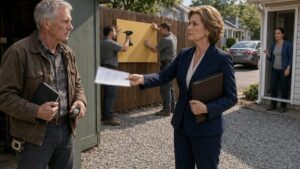
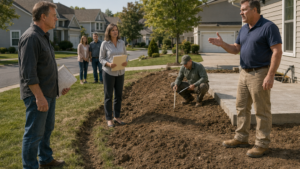
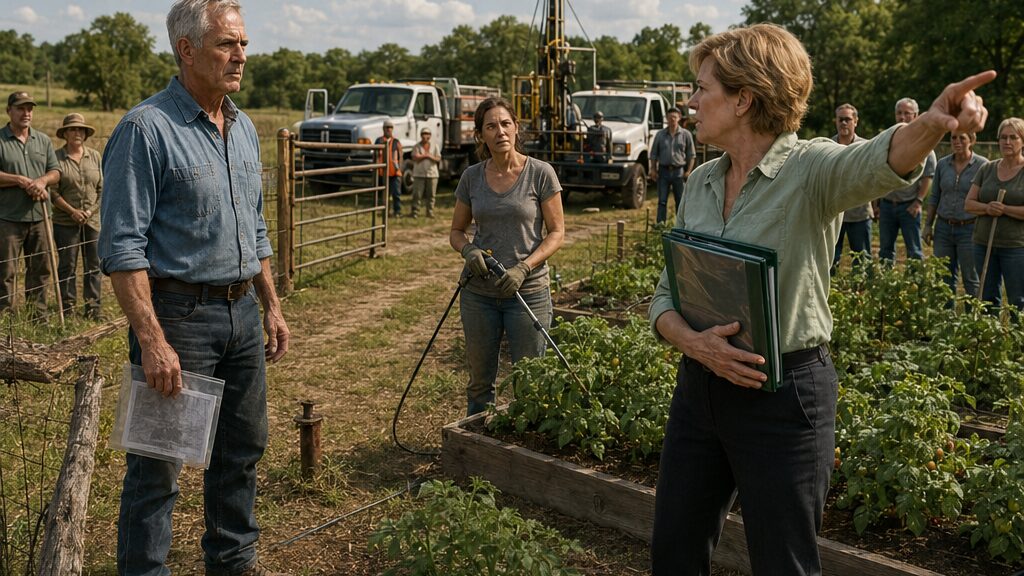
Carol Hall stood between two raised tomato beds with one arm extended toward the pasture gate. Her other hand pressed a green HOA binder against her ribs. Behind her, three women held watering wands over dark soil as if William Allen were the stranger who had wandered into their garden.
William stopped inside the fence he had repaired every spring for twenty-seven years.
“Leave where?” he asked.
“This property.” Carol sharpened the point of her finger toward the gate. “You’re interrupting scheduled garden hours.”
A sprinkler hissed behind her. Water struck broad squash leaves and pattered onto cedar boards that had not existed the previous summer.
William looked past Carol instead of answering.
Fourteen raised beds now occupied the southwest corner of his rear pasture. A small prefabricated shed stood where his wife had once parked a hay wagon. Black irrigation tubing ran beneath fresh mulch. A hand-painted sign beside the path read HAWTHORNE COMMUNITY GARDEN in cheerful green letters.
Someone had even hung a brass bell from the shed.
He had seen the beds from the county road, but distance had softened their size. Standing among them, he could see the permanence in every choice: corner posts sunk deep, gravel paths leveled with landscape fabric, a water tank mounted on blocks.
This was not a misunderstanding that could be carried away in a pickup.
Carol stepped closer. “Mr. Allen, we’ve tried to handle this respectfully.”
William glanced at the old woven-wire fence behind her. One cedar post leaned east, the same way it had leaned since a spring flood in 2008. A silver fence staple he had driven himself still held the top strand.
“Respectfully,” he repeated.
One of the women turned off her watering wand. Another looked down at the tomato vines.
Carol opened the binder. “The board adopted this area as a community asset. You received notice.”
“I received a letter telling me what you had decided about my land.”
“The association acted within its authority.”
“What authority?”
Her mouth tightened. “The development documents allow the board to manage common-use areas.”
William looked toward the subdivision roofs beyond the pasture rise. Five years earlier, that land had been soybeans. Now identical gray and beige houses stood along curving streets with names borrowed from trees the developer had cut down.
“This isn’t a common-use area.”
Carol gave him the patient smile used by people who believed patience itself proved them right. “That matter has been reviewed.”
“By whom?”
“The board.”
The sprinkler clicked through its arc. Water darkened the toe of William’s boot.
He could feel the three women watching him. He knew how he appeared: nearly seventy, sun-stiff shirt, work trousers, an old man arguing over a corner of grass while tomatoes ripened behind him.
He also knew where the boundary lay within half an inch.
William stepped between the beds.
Carol moved to block him. “You cannot disturb anything.”
“I’m walking.”
“You’re inside an HOA-managed facility.”
He ignored her and counted his paces from the leaning cedar post. Eleven and a half to the first gravel path. Four more along the southern bed. He crouched beside a row of beans where mulch had been piled against the boards.
Carol followed. “What are you doing?”
William pushed aside the mulch with two fingers. Beneath it lay compacted soil and a strip of landscape fabric. He took a folding knife from his pocket and lifted one corner.
A woman gasped as if he had cut a plant.
William peeled the fabric back. Six inches below the surface, the rounded top of an iron pin showed through the dirt.
For the first time, Carol’s expression changed.
William scraped the pin clean with the back of the knife. A faded orange cap clung to it, stamped with the registration number he had used when he still worked full-time.
He placed his palm on the metal.
“This pin marks my west line,” he said.
Carol recovered quickly. “An old marker doesn’t settle current use.”
“It settles location.”
“The community has maintained this ground for two seasons.”
“You’ve occupied it for two seasons.”
Anna Davis, the woman nearest the tomatoes, lowered her wand. She wore gardening gloves and had dirt across one cheek. “Carol told us the line ran along the fence.”
William looked at her. “Which fence?”
Anna pointed toward the old pasture fence behind the shed.
“That fence turns north twenty-three feet east of the legal corner,” he said. “It was built around a washout. It was never the property line.”
Carol closed the binder. “This is why the matter was reviewed.”
William stood slowly. “Then show me the survey.”
“There are documents.”
“Show them.”
“I don’t carry every attachment into the garden.”
“You brought the binder.”
Carol’s fingers tightened on its plastic edge.
The bell beside the shed moved once in the breeze, making a small, bright sound.
William walked to the old fence and sighted along the posts. The buried pin, the southern stone marker, and the cottonwood near the creek aligned exactly as they had on his 1998 plat. Nothing had moved except people’s confidence.
Carol removed a letter from the binder and held it out.
The HOA seal appeared at the top. Beneath it, a bold heading declared the garden an adopted community asset. The final paragraph instructed William not to obstruct access, irrigation, maintenance, or scheduled activities.
He read every line.
The paper used phrases that sounded official without naming any deed, easement, court order, or recorded instrument. It referred twice to “board findings” and once to “established community reliance.”
At the bottom, just above Carol’s signature, one sentence caught him.
See attached site determination and supporting property exhibit.
William turned the page over.
Blank.
“Where’s the attachment?”
Carol took the letter from his hand. “As I said, I don’t carry every document outside.”
“Then bring it.”
“This isn’t a records hearing.”
“It became one when you ordered me off my own pasture.”
One of the gardeners shifted her weight. Anna stared at the exposed pin.
Carol slid the letter back under the clear cover of her binder. “You will receive whatever the board is legally required to provide.”
William brushed the soil from his hands. His anger had cooled into something narrower and more useful.
“When?”
“Submit a written request.”
“I submitted a written refusal two years ago.”
Carol’s gaze flickered toward Anna, then returned to him. “I’m not discussing old correspondence in front of residents.”
William looked at the tomato beds, the shed, the black water lines, and the cheerful sign. None of it had appeared overnight. Lumber had been delivered. Money had been collected. Volunteers had been organized. Someone had looked at a map and decided the line could be placed wherever the community needed it.
He folded his knife and put it away.
“Cover the pin when you’re done,” Carol said.
William left it exposed.
At the gate, he turned back. Carol had opened the binder again, but she was no longer pointing. Anna remained beside the bed, staring down at the orange cap in the soil.
William tapped the top of the gatepost.
“I’ll request the attachment,” he said.
Carol did not answer.
He walked toward his house with the wording fixed in his mind: site determination and supporting property exhibit.
A document important enough to justify taking his land, yet not important enough to show him.
Chapter 2: The Refusal Letter Nobody Received
“The HOA owns nothing west of your line.”
The county recorder turned her monitor slightly toward William. A parcel map filled the screen, clean black boundaries laid over pale aerial imagery.
The subdivision ended at the eastern edge of his acreage.
No common tract crossed the pasture. No recorded easement reached the garden. No dedication transferred use to the homeowners association.
William leaned closer. “Search the association name again.”
“I did.”
“Search the developer.”
“I did that too.”
The recorder kept her voice even. She had known William when he still filed plats in person and corrected clerks who rounded bearings too early.
“There’s a utility easement along the road,” she said. “A drainage tract inside the subdivision. Nothing where those beds are.”
“What about amendments?”
“None affecting your parcel.”
She printed the index page and stamped the date in one corner. William watched the ink settle into the paper.
“Can an HOA adopt private land as a community asset?” he asked.
The recorder looked over her glasses. “Not through anything filed in this office.”
That was not a legal opinion, and both of them knew it. It was better. It was a fact.
William placed the stamped page in a folder beside his 1998 deed and drove home.
The garden sprinklers were running when he passed the rear pasture. A new banner had been tied beneath the painted sign.
SATURDAY GARDEN DEDICATION
10:00 A.M.
ALL RESIDENTS WELCOME
He drove past without slowing.
Inside his farmhouse, the kitchen table disappeared beneath paper. Deed copies. Tax maps. Old field notes. The HOA letter. The stamped county index.
William unlocked the narrow filing cabinet beside the pantry and pulled out a folder marked HAWTHORNE REQUEST.
The original letter from two summers earlier lay on top.
Dear Mr. Allen, it began, the Hawthorne Ridge community respectfully requests permission to develop a small seasonal garden near the western boundary fence.
The request promised removable beds, no permanent structures, and restoration of the ground at the end of each season.
William had declined in three sentences.
The area remains active pasture and is subject to existing access rights. I do not grant permission for garden construction, storage, irrigation, or public entry. Please keep all activities east of the recorded property line.
He had mailed the refusal certified.
The green receipt remained stapled to his carbon copy.
Received by: Carol Hall.
William ran his thumb over her signature.
Beside the folder lay a yellow note in his wife’s handwriting. It had been tucked into the file years earlier, probably because she had needed the table cleared before supper.
You can be right without making the whole house live inside the argument.
He turned the note facedown.
The next morning, he walked to the subdivision entrance carrying copies of the deed index, the refusal, and the signed receipt. Carol had not responded to his written records request.
Anna was fastening the dedication banner to a wooden post.
She watched him approach but did not leave.
“I’m not here to stop you working,” William said.
“You already cut up the fabric.”
“I lifted six inches.”
“You scared people.”
“Finding a boundary marker shouldn’t scare anyone who was told the truth.”
Anna pulled the knot tight. “Carol said you agreed at first, then changed your mind after we built.”
William handed her the refusal letter.
She read it once, then again more slowly.
“This could be anything,” she said, though her voice had lost force.
“The receipt is behind it.”
Anna turned the pages. Carol’s signature sat inside the postal box.
“She said the board never got a response.”
“She got one.”
Anna looked toward the houses. A school bus stopped at the far end of the street, releasing two children with backpacks.
“We paid for those beds,” she said. “Two hundred dollars per family. Lumber, soil, water access. We had to sign use rules.”
“To the HOA?”
“Yes.”
“Did the rules include a parcel number?”
Anna folded her arms. “They included a map.”
“Show me.”
She hesitated before opening her phone. After several swipes, she found a PDF and enlarged the lower corner.
The site map showed the garden inside a shaded tract labeled COMMUNITY OPEN SPACE.
William studied the image.
The road curves were correct. The drainage basin was correct. His pasture fence was drawn as a straight boundary line, though no straight fence existed there. The actual property line had been shifted west to contain the beds.
At the bottom was a small notation: Site exhibit approved for community use.
No surveyor’s seal. No recording number. No preparation date.
“Who gave you this?”
“It came with the garden packet.”
“From Carol?”
“From the management email.”
William took out his phone and photographed the screen.
Anna pulled it back. “Does it mean anything?”
“It means whoever made it knew enough to make it look right.”
“But it isn’t?”
“No.”
She looked past him toward the pasture. From the entrance, the garden sign seemed to stand inside the subdivision landscaping. Only the old fence hinted that something did not fit.
Anna’s jaw tightened. “Carol wouldn’t fake a map.”
“Then ask where it was recorded.”
A car slowed beside them. Carol drove past, saw William, and braked. She lowered her window.
“Mr. Allen, residents have been told not to engage with you about pending association matters.”
Anna’s face changed. “You signed for his refusal.”
Carol kept her eyes on William. “Private correspondence is being reviewed by counsel.”
“You told us he never answered.”
“I said the association had no effective denial preventing community reliance.”
“That isn’t the same thing.”
Carol parked along the curb and stepped out. “Anna, Saturday is important. The county commissioner has been invited. We are not turning the dedication into a records dispute.”
William held up the stamped county page. “There is no common tract west of my boundary.”
Carol glanced at it. “You are not an attorney.”
“No. I’m the owner.”
“The board’s position remains unchanged.”
She removed a stack of dedication flyers from her car. On the front, a drawing showed children carrying baskets beneath the words A PLACE WE BUILT TOGETHER.
William watched her hand one to Anna.
“We’ll address misinformation at the proper time,” Carol said.
“When is that?” Anna asked.
“After counsel responds.”
“After Saturday?”
Carol did not answer directly. “The dedication will proceed.”
William returned home before his temper could choose his words.
He placed Anna’s false map beside his recorded plat. The two borders diverged exactly where the garden began.
For twenty minutes, he stared at them.
Then he took out an old business card.
David Brown answered on the fourth ring.
“William Allen,” David said. “That usually means a line has gone somewhere it shouldn’t.”
“I need a subsurface access survey.”
There was a pause. “On your pasture?”
“Yes.”
“You still hold the mineral reservation?”
“And the access language.”
David asked for the deed book and page. William gave them from memory.
“There are two possible grids,” David said after checking the county images. “A narrow eastern route would avoid most of the improvements. The full historic grid crosses the southwest corner.”
“The garden.”
“I saw it on the aerial.”
William looked at his wife’s note lying facedown beside the file.
“How long would the full grid restrict access?” he asked.
“Depending on testing, up to ninety days.”
“And the narrow route?”
“A week, maybe ten days.”
Outside, the pasture fence cast thin bars across the yard.
William picked up the dedication flyer and looked at the smiling drawing of people gathering food from land they had never been given.
“Schedule the full grid,” he said.
Chapter 3: Orange Flags Between the Tomato Rows
The first survey truck turned through William’s gate while Carol was speaking into a portable microphone.
Residents stood between the garden beds holding paper cups and folded programs. Children had painted small signs for each plot. A blue ribbon stretched across the gravel entrance to the shed.
Carol paused mid-sentence.
Behind the first truck came a second, towing a compact soil-testing rig. Four crew members in orange vests sat inside. Their tires pressed deep tracks into the pasture lane.
William stood beside the open gate.
David Brown slowed his truck and lowered the window. His hair had gone nearly white since William last saw him, but his eyes still moved over ground the way a carpenter’s hand moved over wood.
“You certain about this entrance?” David asked.
“It follows the recorded access.”
“That wasn’t my question.”
William stepped back from the truck. “Proceed.”
The vehicles rolled past.
The crowd’s attention left Carol. Phones rose. The microphone squealed when she lowered it.
“What is this?” she demanded.
David parked near the first raised bed. His crew climbed out and began unloading cases, stakes, and reels of measuring tape.
Carol hurried across the gravel. “You cannot bring industrial equipment into this facility.”
David looked at William.
William walked toward them carrying his deed in a clear protective sleeve.
“This is private property,” Carol said.
“Yes,” William replied.
“Managed by the association.”
“No.”
She turned to the crew. “I am the HOA president. You need to leave until our attorney arrives.”
David removed a folded access plan from the truck. “We’re operating under instructions from the property and mineral-rights holder.”
“You’re standing in a community garden.”
“One does not cancel the other,” William said.
Carol’s husband pushed through the residents. “Is this some kind of stunt?”
“No,” David said. “It’s a subsurface survey.”
A crew member drove the first orange flag into the ground beside a tomato bed.
The small snap of the plastic marker drew more attention than the truck engines had.
Carol stepped toward it. “Take that out.”
The crew member stopped and looked to David.
William opened the deed sleeve.
“Book six hundred twelve,” he said. “Page two hundred forty-eight. Reservation clause begins in the fourth paragraph. Access language continues on the next page.”
Carol stared at him. “You memorized it?”
“I wrote the original field description.”
He placed the deed beneath the clear cover of her green binder, forcing the two documents into the same frame.
“The surface remains mine,” he said. “The subsurface rights remain mine. The recorded access allowing exploration remains in force.”
Carol pulled the binder back. “There are crops here.”
“I can see them.”
“You cannot destroy residents’ property.”
“The crew hasn’t destroyed anything.”
“They brought a drill.”
“A testing rig,” David corrected. “We mark first. No boring today.”
Carol looked toward the residents. The confidence she had displayed at the gate two days earlier now had to survive in front of everyone she had invited.
“This is harassment,” she said. “He waited until our dedication.”
William felt every face turn toward him.
He had known the timing.
David had offered Monday.
William had chosen Saturday.
“The association was notified of my rights,” William said.
“When?” Anna called from near the beans.
Carol answered before he could. “This is not the time for document theater.”
Anna came forward holding printed pages. William recognized his refusal letter.
“You signed for this two years ago,” she said.
Carol’s husband took the pages from her. “Where did you get that?”
“From Mr. Allen.”
Carol did not look at the receipt. “A refusal does not resolve all equitable use questions.”
One of the residents laughed once, without humor. “You told us there was no refusal.”
“I told you the board had established community authority.”
“How?”
“Our attorney is reviewing that.”
David’s crew stretched measuring tape along the gravel path. Orange flags began appearing at intervals between the beds, bright and unnatural against green leaves.
Carol pulled out her phone.
Within twenty minutes, the HOA attorney arrived. The county commissioner came shortly after, still wearing a polo shirt from another Saturday event. Carol met them at the gate and spoke rapidly, pointing toward William, the trucks, and the garden.
The attorney read the deed standing beside the shed.
Then he read it again.
The commissioner asked William whether the mineral reservation had ever been released.
“No.”
“Any access amendment?”
“No.”
“Any current lease?”
“Preliminary exploration agreement only.”
The commissioner examined the county plat David had brought.
“I’m not issuing a legal judgment from a tomato patch,” he said. “But I don’t see a county basis to remove a crew operating under recorded private rights.”
Carol’s face went pale around the mouth. “What about the HOA’s community-use determination?”
“Was it recorded?”
“Our counsel prepared findings.”
The attorney closed the deed. “Carol, we should speak privately.”
That was the moment William had imagined.
Not applause. Not shouting.
Just Carol standing beside the garden sign while her own attorney asked to speak where residents could not hear.
The satisfaction lasted less than ten seconds.
Anna stepped in front of William.
“My family paid two hundred dollars for plot seven,” she said. “The board charged fourteen families. We bought soil and plants because we were given a map showing this as common land.”
William glanced toward plot seven. A child’s wooden marker, painted yellow, read DAVIS TOMATOES.
“I didn’t charge you,” he said.
“No. You just picked the route that runs through every bed.”
David stopped unrolling cable.
Anna pointed toward the eastern edge of the pasture. “Your own contractor said there was another way.”
William looked at David.
“You told her?”
“She asked a technical question,” David said.
Carol turned from the attorney. “Another way?”
David folded his arms. “A reduced grid along the eastern access corridor could avoid most improvements. It offers less coverage, but it is workable for preliminary testing.”
The residents began speaking at once.
Carol seized the opening. “Then this route is retaliation.”
William’s hand tightened around the deed sleeve.
“It is the historic survey grid.”
“It is the route through our garden.”
“Your garden is on my land.”
Anna did not raise her voice. “Did you choose it because it was necessary?”
The question stripped the scene of its easy sides.
William could have pointed to the clause. He could have repeated the book and page. He could have explained the technical value of a wider grid, the old geological notes, the access alignment established before Hawthorne Ridge existed.
All of that would have been true.
None of it answered her.
A crew member planted another orange flag beside the child’s tomato marker.
William looked at the rows. He saw irrigation tubes, new leaves, hand-lettered stakes. Work people had performed because Carol had given them a false map.
He also saw the community-asset letter telling him not to interfere. Carol’s finger pointing toward his gate. Two years of silence after his refusal.
“We proceed under the signed plan,” he said.
Anna stared at him for a moment, then stepped away.
Carol’s attorney whispered something to her. She closed the binder and held it against herself like a shield.
David directed the crew toward the next line, but his movements had become slower.
By noon, orange flags divided every row.
The dedication ribbon remained tied across the shed entrance, forgotten and moving in the breeze.
When the residents began leaving, David approached William near the gate.
“We have not broken ground,” he said.
“I know.”
“The first bore is scheduled for next week.”
“I know that too.”
David looked back at plot seven. “The reduced route is still available until then.”
William slid the deed into its sleeve.
“You already have my authorization.”
“I’m asking whether you want your land surveyed,” David said, “or whether you want them to feel it.”
William said nothing.
David climbed into his truck.
Behind them, Anna removed the yellow tomato marker from the soil and carried it home.
Chapter 4: The Garden Map With Two Borders
Anna found the second boundary because a corner of the first one had begun to peel.
The laminated site map hung inside the garden shed above a rack of hand tools. Heat had curled the plastic away from the plywood backing, exposing another sheet beneath it. She caught the loose corner with one fingernail and pulled.
A faded red line appeared under the newer black border.
It ran east of the garden beds.
Anna stopped breathing for a moment.
The upper map showed the garden inside a shaded block labeled COMMUNITY OPEN SPACE. The older sheet beneath it placed the same beds beyond the subdivision boundary, squarely inside William’s pasture.
Someone had covered one border with another.
She took both maps down and laid them across the potting bench. The upper sheet had no preparation date or survey seal. The lower one carried a small developer logo and a notation beside the red line: Allen tract—no access granted.
The shed door opened behind her.
Carol stood on the threshold.
“You’re not authorized to remove board materials,” she said.
Anna kept one palm on the maps. “Which one did we pay for?”
Carol’s eyes moved from the exposed red line to Anna’s face.
“The current exhibit governs garden use.”
“That wasn’t my question.”
Carol stepped inside and closed the door. Beyond the thin walls, residents moved between the beds, trying to water around the orange survey flags. The testing rig remained parked near the access lane.
“The older drawing was preliminary,” Carol said.
“It says no access granted.”
“Preliminary documents contain language that changes.”
“Then why hide it?”
“I didn’t hide anything.”
Anna lifted the laminated page. Four strips of double-sided tape remained on its back, positioned exactly over the older map.
Carol reached for it. Anna pulled it away.
“You told us William never answered,” Anna said. “You told us the property line followed the fence. You charged us two hundred dollars apiece.”
“The funds paid for materials you received.”
“On land we didn’t have.”
Carol lowered her voice. “Do you want to save the garden or make a scene inside a shed?”
“I want to know whether you knew.”
A shadow crossed the small window. Someone passed outside carrying a watering can.
Carol looked toward the sound before answering.
“The board believed community reliance gave us a defensible position.”
“That means yes.”
“It means the situation was more complicated than one letter.”
Anna folded the older map along its existing creases and slipped it into her tote.
Carol moved between her and the door. “Association records cannot be removed.”
“Then call the sheriff and explain which border you want back.”
For the first time, Carol stepped aside.
William refused to suspend the survey that afternoon.
Anna stood at his gate with copies of both maps and the certified refusal. He remained on the house side, one hand resting on the top rail.
“I found the original exhibit,” she said.
“You should give it to the county.”
“I’m giving it to you first.”
He did not open the gate.
She held the pages through the wire. William took them and aligned the old red boundary with the recorded plat he carried in a folder.
The lines matched within the thickness of the pen.
“There,” Anna said. “Now you know we didn’t all walk onto your property knowing it was yours.”
“I know the board gave you a false map.”
“And the survey still runs through our beds.”
“It runs through my ground.”
Her mouth tightened. “You keep answering the legal question.”
“It is a property dispute.”
“It stopped being only that when you learned children planted those rows because we trusted the board.”
William looked toward the garden. Several bean plants had begun to yellow where foot traffic had compacted the soil near the flags.
“The testing agreement is signed,” he said.
“You can change it.”
“Changing a field plan costs money.”
“We paid money too.”
Anna left the maps with him and walked back toward the subdivision.
William carried them into his kitchen. He laid the false version beside the recorded plat, then placed the older exhibit between them. Three paper boundaries for the same patch of earth: one lawful, one concealed, one invented.
His telephone rang.
The caller introduced herself as Deborah Thomas from the county newspaper.
“I’m standing at your garden,” she said.
“My pasture.”
“That difference appears to be the story.”
When William arrived, Deborah was crouched beside plot seven with a camera. The yellow DAVIS TOMATOES marker had been returned to the soil. Behind it, the compact rig rose above the bed like a piece of farm machinery left in the wrong season.
“Please don’t photograph children’s names,” William said.
Deborah lowered the camera. “The marker is the strongest image here.”
“It belongs to a family, not your headline.”
“So does the garden.”
“The land belongs to me.”
She straightened. “I’ve read the deed index. I’ve also seen the HOA map residents received.”
“Have you seen the original map?”
Anna approached from the shed carrying a copy. “She has now.”
Deborah compared the two exhibits on the hood of her car. She photographed the borders, the missing notation, and the certified receipt bearing Carol’s signature.
“This proves the board had conflicting information,” she said.
“It proves more than that,” Anna replied.
“It proves Carol signed for a refusal. It doesn’t prove every board member saw it or who altered the map.”
William appreciated the distinction even as it frustrated him.
Deborah walked the edge of the beds. She photographed orange flags between tomatoes, the old fence beyond them, and William’s exposed boundary pin.
Then she returned to plot seven and framed the testing rig behind the child’s marker.
William saw the picture before she took it: machinery against hand-painted wood, an old man’s rights made visible as damage to something tender.
“That image is dishonest,” he said.
Deborah looked through the viewfinder. “Is the rig here?”
“Yes.”
“Is the marker here?”
“Yes.”
“Then the photograph is true. The question is whether it is complete.”
The shutter clicked.
The article appeared the next morning under the headline LAND SURVEY THREATENS HAWTHORNE COMMUNITY GARDEN.
The first paragraph acknowledged William’s recorded rights. The second described fourteen families facing the possible loss of summer crops. His certified refusal appeared near the bottom, after Carol’s statement that the HOA had acted on “long-standing community-use findings.”
The photograph dominated the page.
By noon, two strangers had driven slowly past William’s gate. Someone left a bag of spoiled tomatoes on his mailbox. Another person called and asked whether he enjoyed destroying food.
He carried the newspaper into the kitchen and placed it over the maps.
The image was not complete.
It was not false either.
Deborah arrived before sunset. She stood on the porch without a notebook in her hand.
“I received the full testing plan,” she said.
William did not ask from whom.
“There are two routes,” she continued. “The one through the beds and the reduced eastern corridor.”
“The broad route provides better coverage.”
“David Brown says the eastern route would serve preliminary work.”
“David should discuss contracts with his client.”
“He did. According to him, he recommended the lower-impact option first.”
William’s hand remained on the screen door.
Deborah watched him carefully. “Carol hid the refusal. The map was altered. Those are facts.”
“Yes.”
“And you knew there was a way around most of the garden.”
He looked beyond her toward the pasture. The orange flags were visible in the lowering light.
“Why did you reject it?” she asked.
William could recite the technical reasons. He could explain access history, grid consistency, subsurface uncertainty, and the legal right to use the recorded path.
But Deborah had not asked what he was allowed to do.
She had asked why.
Chapter 5: What Carol Promised Before the Houses Sold
The park promised in Hawthorne Ridge’s sales brochure was surrounded by chain-link fence and filled with storm water.
Carol stood beside Anna at the edge of the drainage parcel while mosquitoes hovered over cattails. Beyond the fence, a concrete outlet pipe emptied into shallow brown water. A weather-faded sign still displayed the developer’s rendering: shade trees, a play structure, benches, and a walking path around a bright green lawn.
None of it had been built.
“This is the community park?” Anna asked.
“It was supposed to be.”
Carol wore no green HOA shirt. She had come in a plain blouse and carried a cardboard records box instead of her binder.
Anna looked from the illustration to the drainage basin. “People bought houses because of this.”
“Among other things.”
“And paid amenity fees.”
“Yes.”
Carol set the box on the hood of her car. Inside were developer emails, board minutes, invoices, and glossy brochures. The earliest documents promised completion before the subdivision’s second phase. Later emails changed the park into a “future recreational concept.” The final developer notice transferred the drainage tract to the HOA without funds for improvements.
Carol had become president three weeks afterward.
“Residents were furious,” she said. “Property values had already flattened. Families were asking where their fees went. The developer had dissolved the local entity and moved on.”
“So you took William’s pasture.”
“I tried to give people something they had paid to receive.”
“On land that wasn’t ours.”
“The corner was unused.”
Anna stared at her.
Carol’s shoulders lowered. “I know how that sounds.”
“It sounds like you decided unused meant available.”
“There had been no livestock in that section for years. The fence looked like the boundary. The first attorney said long-term community use might create leverage.”
“After William refused?”
Carol opened a folder. Inside lay the certified letter with William’s three-sentence denial.
“I thought he would reconsider once he saw the garden working.”
“You told us he never answered.”
“I told myself his answer wasn’t final.”
Anna picked up an invoice for cedar boards. The payment came from an account labeled COMMUNITY AMENITY RESTORATION.
“You used the park money.”
“What remained of it.”
“And collected fees from us.”
“To keep the HOA reserve from collapsing.”
The answer was practical enough to make the deception worse.
Carol looked through the fence at the standing water. “At the annual meeting, I promised families they would have a shared space by spring. I had homeowners demanding refunds we couldn’t pay and board members threatening to resign. The garden cost less than fighting the developer.”
“So you made William pay for it instead.”
Carol flinched.
Anna held up the original site map. “Who changed this?”
“A management contractor redrew the exhibit.”
“At your direction?”
Carol looked toward the road.
“At your direction?” Anna repeated.
“I told them the fence represented the use boundary.”
“You knew it didn’t.”
“I knew William disputed it.”
“You had his survey.”
“I had a letter.”
“You had the map under the map.”
Carol pressed both hands against the hood. “I believed that if the garden succeeded, no one would force fourteen families to tear it out. I believed usefulness would become its own permission.”
Anna put the invoice back into the box.
“That isn’t permission,” she said. “It’s pressure.”
Carol closed her eyes briefly. “Yes.”
At William’s farmhouse, the records covered half the kitchen table by evening.
Deborah had sent him the article’s online comments only because one contained a photograph of the original sales brochure. William had driven past the drainage parcel and found Carol and Anna there. Anna handed him copies from the records box without asking Carol.
Now he studied the documents alone.
The missing park explained the garden’s urgency. It did not explain the false map, the buried refusal, or Carol ordering him off his own land. Pressure accounted for her choices without cleaning them.
William opened the testing plan.
The broad grid crossed eleven beds directly and required restricted access around the remaining three. The eastern route avoided all but one corner and reduced the testing window to ten days.
He had chosen the broad route because it was technically stronger.
He had also chosen it because Carol had smiled when he mentioned his deed.
Both things could be true.
A folded yellow note slipped from beneath the HAWTHORNE REQUEST folder.
He turned it over.
You can be right without making the whole house live inside the argument.
His wife had written it after a boundary case fifteen years earlier. William had spent six months contesting another surveyor’s minor bearing error, bringing files to dinner and correcting anyone who called the discrepancy harmless. He had won the professional review.
By then, she had stopped asking when the papers would leave the table.
He sat down.
The kitchen was quiet except for the refrigerator motor and the faint tick of the wall clock she had chosen.
William read the note again.
He had always believed precision protected people. A misplaced line could cost land, access, money, trust. He had seen vague agreements become lawsuits and friendly permissions become permanent claims.
But precision could also be used to narrow a person until only the error remained.
Carol had erased his boundary because she believed a useful result justified it.
He had selected the harshest grid because he believed a lawful result justified him.
The telephone was beside his elbow.
David answered immediately.
“I want the eastern route,” William said.
Silence held for a moment.
“All right,” David replied. “I’ll revise the field order.”
“Move the flags tonight.”
“I can move the crew at first light.”
“Before then.”
“William, they’ve gone home.”
“The first bore is next week.”
“No,” David said. “The schedule moved.”
William straightened. “Moved to when?”
“The equipment inspection cleared early. The rig operator marked the first location this afternoon.”
William looked at the plan. The first broad-grid bore sat between plots six and seven.
“When do they drill?”
“Dawn.”
“I’m withdrawing authorization for that point.”
“I can stop the bore, but the operator is coming from two counties over. There will be a cancellation charge.”
“Pay it from my deposit.”
“You need to sign the revised order.”
“Bring it.”
“I’m an hour away.”
“Then send it electronically.”
David exhaled. “I’ll send it now, but there’s another issue. The HOA attorney filed a request for emergency review. If you alter the plan before it is logged, Carol may claim the original grid was never necessary.”
William looked at his wife’s note.
“Maybe it wasn’t,” he said.
He opened his email and waited for the revised order.
Nothing arrived.
Thirty seconds passed.
Then a minute.
The telephone buzzed again.
David’s voice had changed.
“The operator is already staging the rig,” he said. “He misunderstood the dawn instruction. He’s at the garden now.”
Through the kitchen window, beyond the dark pasture, a white work light came on among the tomato rows.
Chapter 6: The Meeting Beside the Wilting Beans
Orange survey flags had been tied to the back of every folding chair.
When residents arrived beneath the striped canopy three days later, the flags trembled above their shoulders in the evening breeze. Some people tore them off. Others left them in place as if removing one might count as taking a side.
The first bore had been stopped before the drill entered the ground. William had reached the garden in time to stand between the rig and plot seven with the revised order displayed on his phone.
No plants had been crushed.
The machinery, however, had remained visible for two days while the attorney arranged the emergency meeting. Beans near the access lane had wilted in the heat. The newspaper photograph had spread through the county. Six board members sat at a long table beneath the canopy, each with a packet placed before them.
Carol sat at the center without her green binder.
Forty-two residents signed the attendance sheet.
William stood near the old pasture fence. Anna had set aside a chair for him at the front, but he remained standing until the HOA attorney called the meeting to order.
The attorney began with procedure.
Residents did not let him finish.
“Did the board know the land wasn’t ours?”
“Where did our garden fees go?”
“Why was the map changed?”
“Who pays for moving everything?”
A man near the back demanded Carol’s immediate resignation. A woman holding a basket of yellow beans shouted that William should stop all testing before anyone discussed paperwork.
Carol raised her hand.
The noise continued.
Anna stepped to the table and opened one of the meeting packets.
“Everyone has the same documents,” she said. “The recorded plat. The original site map. The altered map. William’s refusal. The receipt signed by Carol. The broad survey grid and the reduced route.”
The crowd quieted enough for pages to turn.
Paper moved beneath the canopy like dry leaves.
Carol spoke without a microphone. “I accept responsibility for not presenting Mr. Allen’s refusal to the full membership.”
“Not presenting?” someone called. “You buried it.”
“I believed the board had a defensible community-use position.”
“You lied to us.”
Carol’s face tightened, but she did not deny it. “I made decisions under pressure after the developer abandoned the promised park. Those decisions were wrong.”
The admission did not soften the crowd. It gave the anger a clearer target.
One board member pushed his packet away. “We were told counsel had confirmed access.”
The HOA attorney looked at him. “Counsel advised that no permanent construction should occur without a recorded agreement.”
Carol turned. “That advice came after the beds were ordered.”
“It came before installation.”
The board member stared at her.
Another resident stood. “So remove her.”
Several voices agreed.
William looked at the orange flag tied to the empty chair beside Anna. The plastic strip tapped the metal frame in a steady rhythm.
Carol had suppressed his refusal. She had used amenity money, altered the practical meaning of a site map, and relied on families’ labor to make removal politically painful.
The meeting could end with her resignation.
It would leave his part untouched.
A resident pointed toward William. “And he gets to drill wherever he wants?”
William stepped forward.
The attorney lifted a hand. “Mr. Allen will have an opportunity—”
“I have it now.”
The canopy settled into silence.
William placed his deed, the refusal letter, and both testing plans on the table. He aligned their edges before speaking.
“Carol knew she did not have permission,” he said. “The board spent money without verifying ownership. Those facts are in your packets.”
Carol stared at the papers.
William continued. “There is another fact.”
David stood near the rig at the edge of the pasture, arms folded across his work shirt.
“He offered me a reduced route before the dedication,” William said. “It would have avoided most of the beds.”
Murmurs moved through the chairs.
Anna did not look away from him.
“I selected the broad grid,” William said.
“Why?” the woman with the bean basket demanded.
William felt the prepared technical language gather in his mind: historic access alignment, stronger data coverage, subsurface continuity.
He let it go.
“Because it was lawful,” he said. “And because I wanted the association to feel what it had done.”
No one spoke.
The confession sounded smaller than the harm it named.
“I told myself those were the same reason,” he continued. “They were not.”
Carol’s husband shifted behind the board table. One of the residents who had called for Carol’s resignation lowered his hand.
William placed the revised field order beside the first.
“I changed the route before drilling began. That does not erase the choice.”
Anna stood.
“My family was lied to by the board,” she said. “Mr. Allen was treated as if his refusal meant nothing. Both are true. If this meeting becomes a contest over who deserves all the blame, the garden dies and everyone hires lawyers.”
“What do you suggest?” a board member asked.
“Restitution. A legal site. Written temporary access long enough to harvest what can be saved. And records residents can actually inspect before the board commits money or land.”
“The HOA reserve can’t cover all of that,” Carol said.
Anna faced her. “Then the people who approved it contribute.”
Two board members began protesting at once. The attorney asked them to stop.
He reviewed the documents for several minutes, speaking quietly with the county commissioner. The residents waited under the flags.
Finally, the attorney stood.
“The association can negotiate reimbursement from the remaining amenity reserve and voluntary contributions from responsible officers. It can also purchase or lease a replacement parcel. However, no agreement preserves access to the current garden unless Mr. Allen grants it in writing.”
Every face turned toward William.
The old reflex rose in him: no informal promises, no vague permissions, no access capable of becoming another claim.
He had learned that reflex honestly.
He did not intend to abandon it.
William opened his folder and removed a six-page draft.
“I prepared a temporary license,” he said. “Six weeks. Harvest and removal only. No new planting. No expansion. No claim of easement, adverse possession, community dedication, or continuing use.”
The attorney took the document.
“Insurance?” he asked.
“Page three.”
“Restoration?”
“Page four.”
“Water access?”
“Limited hours, metered, paid by the HOA.”
A few residents exchanged glances. The terms were strict, but they were possible.
Carol read the signature page. “What do you want in return?”
“My ground restored. My survey costs reimbursed. The false exhibit withdrawn in writing.”
“Money?” asked a board member.
“Only documented costs.”
The man who had demanded Carol’s resignation called out, “Then sign it.”
William placed a black pen beside the agreement but did not sit down.
“There is one paragraph missing.”
The attorney looked through the pages. “Missing from where?”
“From the final section.”
Carol’s expression sharpened. “What paragraph?”
William looked at the meeting packets spread across the table: competing maps, buried letters, official-looking words that had gained power because ordinary residents never saw what lay beneath them.
“It is not about my pasture,” he said.
The crowd waited.
He slid the unsigned agreement toward the center of the table.
“I’ll add it when the board decides whether this can happen to someone else.”
Chapter 7: Every Boundary Written Down Together
Carol arrived at the county recorder’s office without her green binder.
For nearly two years, William had never seen her attend a meeting, inspection, or confrontation without it pressed against her side. That morning she carried only a plain manila envelope and a black pen.
She stopped beside the conference table but did not sit.
The HOA attorney had arranged the documents in three stacks: temporary garden access, financial restitution, and permanent governance changes. The corrected plat lay alone at the center, its boundary drawn in a clean red line that did not follow the old fence or the invented community map.
Anna sat across from William. David waited near the window with the revised survey order rolled beneath one arm. Two former board members occupied the far end of the table, speaking in low voices about contribution limits.
The recorder opened the meeting.
“Anything signed today becomes part of the county record where applicable,” she said. “If anyone is relying on a verbal understanding, now is the time to put it on paper.”
William looked at Carol.
She gave no sign that she recognized the echo.
The financial agreement came first. The HOA reserve would repay the documented survey delay, fence restoration, and legal filing costs. Carol and three board members had agreed to contribute toward relocating the beds and replacing materials purchased with resident fees.
Two other board members had resigned without accepting personal responsibility. Their refusal remained noted in the meeting minutes but carried no legal force.
The HOA attorney slid the restitution page toward Carol.
She read each paragraph.
When she reached the signature line, she paused. “This doesn’t say I acted alone.”
“No,” Anna said. “Because you didn’t.”
One of the former board members shifted in his chair.
Carol looked at William. “And it doesn’t say you forgave me.”
“That isn’t something the recorder files.”
Her mouth tightened at one corner. It was not quite a smile.
She signed.
The temporary access license followed. William had shortened it from six weeks to the exact remaining harvest period calculated by Anna and the gardeners. Residents could enter during posted hours, maintain existing plants, remove produce, dismantle the beds, and restore the soil. They could not add structures, replant cleared rows, or claim continued use.
The license identified every permitted activity.
It also stated, in bold type, that kindness did not create ownership.
Anna read that sentence twice.
“You really needed bold type?” she asked.
“Yes.”
She nodded. “Fair enough.”
Carol turned the page. “After the license ends, there is no garden access at all?”
“Not on my pasture.”
“What if the new parcel is delayed?”
“Then the garden waits.”
Anna glanced at William, measuring whether there was room to argue. She found none.
Six weeks earlier, she might have called that cruelty. Now the replacement site had already been purchased near the subdivision entrance: two level acres beside the mail pavilion, with public road access and a water connection approved by the utility district. The HOA had acquired it through a combination of reserve funds, reduced landscaping expenditures, and voluntary resident contributions.
The new parcel was smaller than the promised park.
It was legal.
“Temporary permission has to remain temporary,” William said. “Otherwise we will be back here with different paper and the same argument.”
Anna signed as the residents’ garden coordinator.
William signed beneath her.
The recorder stamped the license and placed it in the filing tray.
David unrolled the reduced survey plan. The eastern route appeared as a narrow line along the pasture edge, avoiding all but one dismantled bed.
“We finished preliminary testing last week,” he said. “No additional access through the garden is required.”
One former board member leaned toward the map. “So the whole drilling fight was over nothing?”
“No,” David said. “The survey was legitimate. The route was the argument.”
William accepted that without defending himself.
The final stack contained the paragraph he had withheld beneath the striped canopy.
The HOA attorney read it aloud.
Before the association could commit funds, represent access, or dedicate property for community use, members would receive the underlying deed, lease, license, or recorded easement at least thirty days before approval. Any commitment involving land not owned by the HOA required a majority vote of all homeowners, not merely those attending a board meeting. Records could not be withheld behind attorney review unless counsel identified a specific legal privilege in writing.
The paragraph also required competing property exhibits to be preserved rather than replaced.
Carol looked at the language for a long time.
“You wrote this because of the map,” she said.
“I wrote it because residents should not have to peel one map off another to find the truth.”
The recorder adjusted her glasses. “This portion belongs in the amended bylaws, not the land record.”
“The amendment vote passed Tuesday,” Anna said. “Thirty-eight in favor. Four opposed.”
Carol had not attended that meeting.
William had.
He had sat in the back without speaking while homeowners argued over whether open records would slow the board’s work. Anna answered that delay was cheaper than paying twice for property they never possessed.
The amendment passed without applause.
That had suited William.
Carol signed the acknowledgment that the former community-asset letter was withdrawn and held no legal effect. She placed the pen beside the envelope.
Inside it were the original refusal, the altered map instructions, and her correspondence with the management contractor.
“All of it?” Deborah asked from the doorway.
The reporter had been permitted to observe after every party agreed. She carried a notebook but no camera.
Carol faced her. “All of it.”
“May I quote you?”
“You may quote the documents.”
Deborah waited, then closed her notebook.
Outside the recorder’s office, Carol stopped beside William on the courthouse steps.
“I kept thinking if the garden became useful enough, you would look unreasonable for objecting,” she said.
“You were right about that part.”
She looked at him.
“For a while,” he added.
A truck passed on the square.
Carol held the empty manila envelope against her leg. “I don’t expect the residents to trust me again.”
“That isn’t something you can require from them.”
“No.”
She descended the steps without asking him to forgive her.
By late August, the old garden had begun moving east.
Families lifted cedar boards, shoveled soil into trailers, and carried irrigation fittings to the replacement parcel. William allowed the harvest license to run its full term. He did not extend it by a day.
He helped only once, when a rusted bolt refused to release from the shed base. Anna found him kneeling in the dirt with a wrench.
“I thought this was resident work,” she said.
“It is.”
“You’re holding the wrench.”
“The bolt is on my side of the line.”
She laughed before she could stop herself.
William removed the bolt and left the wrench beside her.
The new garden opened without a ribbon. Each family received a packet containing the parcel deed, water agreement, use rules, budget, and corrected site plan. Anna made every gardener initial the boundary page.
Plot seven stood near the entrance.
The yellow DAVIS TOMATOES marker had been repainted, but the child’s uneven letters remained visible beneath the new coat.
At William’s pasture, David’s crew removed the last orange flags. The broad-grid markers had left small holes between the rows. Rain and grass would close them.
The old fence remained crooked around the washout.
William decided not to straighten it.
Instead, he carried one cedar stake from the dismantled garden to the exposed iron boundary pin. The stake had once supported Carol’s community sign. A strip of faded green paint remained near its top.
He drove it into the soil two inches east of the legal marker, careful not to disturb the pin.
Anna approached carrying the corrected plat in a clear sleeve.
“You know the stake isn’t an official monument,” she said.
“I know.”
“Someone might mistake it for the line.”
“Not if they read the plat.”
He took the document from her and checked the recorder’s stamp. The paper showed his pasture, the subdivision, the drainage tract, the replacement garden parcel, and the exact bend in the legal boundary.
For once, the fence and the line were both shown for what they were.
William handed the plat back.
“Keep a copy in the shed,” he said.
“We already have three.”
“Keep four.”
Anna slid it beneath her arm. Across the road, residents were assembling the new beds. No one waved him over. No one pretended the previous months had made them friends.
But the work was taking place on land they owned, under rules they had read, beside a boundary no one had moved to make the picture easier.
Anna touched the faded green stake.
“What does this mark?”
William looked from the iron pin to the new garden beyond the road.
“The place where we finally stopped guessing.”
The story has ended.