He Called Six Inches Harmless Until the Red Notices Reached His Front Door
Chapter 1: Six Inches Beyond the Cedar Fence
The steel rod appeared beneath Ruth Martin’s cedar fence just after seven in the morning.
It was no thicker than her thumb, ribbed with rust-colored ridges, and it pushed through the gap under the lowest board like something trying to escape. Ruth stopped with a basket of windfallen pears against her hip and watched the rod tremble each time the concrete pump coughed on the other side.
Fresh gray slurry had already seeped beneath the fence.
She set the basket down.
For three weeks, she had tolerated the nail guns, diesel engines, reversing alarms, and men shouting measurements over the machinery. Richard King had told the association that his new poolhouse would sit comfortably inside the resort parcel. He had repeated it at two board meetings and once across Ruth’s mailbox while smiling as though reassurance were something he could grant by volume.
The rod beneath her fence suggested otherwise.
Ruth went to the mudroom, returned with her steel tape measure, a narrow shovel, and the yellow survey map she kept rolled inside a mailing tube. She did not call Richard. Not yet.
On her side of the fence, the orchard sloped toward the private road. Rows of old pear trees broke the morning light into long stripes. The cedar boards followed a boundary surveyed the previous spring, after winter runoff had exposed one of the original markers.
Ruth knelt beside the fence and pushed the shovel into packed soil.
Six inches down, the blade struck metal.
She cleared dirt with her gloved fingers until the brass cap of the survey pin appeared. The stamped numbers matched the map.
The fence sat two inches inside her parcel, exactly where she had ordered it placed. The rebar extended beyond the property line by nearly eight inches.
Ruth pulled the tape out until the white numbers crossed the exposed rod. She measured from the center of the survey pin, checked the angle, then measured again.
The result did not change.
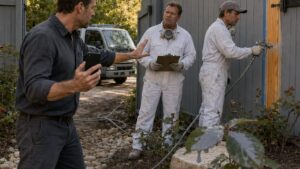
A worker’s boot appeared between the boards.
“Ma’am?”
Ruth stood. Through a wider gap, she could see a line of wooden forms pressed against the cedar posts. Vertical rebar rose from them in a grid that continued toward the unfinished frame of a two-story structure. Beyond it, the retreat’s cabins sat among newly planted grasses and expensive stone paths.
“I need to speak to whoever set these forms,” she said.
A few minutes later Daniel White came around the end of the fence. He wore a reflective vest over a faded work shirt and carried a rolled set of plans beneath one arm. He was younger than Ruth had expected, perhaps fifty, with concrete dust whitening the toes of his boots.
“You found something?” he asked.
“The foundation crosses my recorded boundary.”
Daniel glanced at the rod, then at the survey pin.
“How far?”
“Six inches at the form. More at the rebar.”
He pressed his lips together. “That’s between you and the owner.”
“It became your concern when you poured against my fence.”
“We haven’t poured the wall yet.”
“You poured the footing.”
Daniel shifted the plans under his arm. Behind him, the pump engine idled. Two workers watched from beside the hose.
Ruth handed him the survey map.
He did not take it.
“Richard said the setback was flexible along this strip.”
“A setback is not a property line.”
“He said the association has a maintenance easement.”
“An easement does not transfer ownership.”
Daniel looked toward the framed structure. “I’m not the lawyer.”
“No. You’re the man directing concrete into my soil.”
His jaw tightened, but not with surprise. That mattered more than the argument.
“Pause the pour,” Ruth said. “You can verify the corner before you make this permanent.”
Daniel looked at his crew. Then he looked up the slope toward the glass-fronted lodge where Richard’s office overlooked the construction.
“I need authorization.”
“Then get it.”
Daniel walked away without answering.
Ruth remained by the survey pin. The pump continued to idle for almost a minute. Then its engine rose in pitch, and the hose began to shudder again.
Concrete flowed.
Richard arrived ten minutes later in a white utility cart. He wore dark slacks, a pale blue shirt, and sunglasses despite the shade cast by the poolhouse frame. He stopped on the resort side of the fence and rested one hand on the top board.
“Morning, Ruth.”
“You need to stop the pour.”
“I hear we have a measurement disagreement.”
“We do not. The recorded monument is exposed.”
Richard glanced down as if the brass pin were a weed.
“How much are we talking about?”
“Six inches at the form.”
He gave a soft laugh. “Six inches won’t kill anybody.”
Ruth kept the tape measure in her hand. “That is not the standard.”
“The standard is reasonableness.”
“The standard is the recorded boundary and the required setback.”
Richard removed his sunglasses. Without them, the strain around his eyes was more visible.
“We are twelve days from opening the new wing,” he said. “I have crews scheduled, inspections lined up, and thirty-two bookings tied to that poolhouse. You want me to shut down over half a foot of dirt beside a fence?”
“I want you to stop building on my property.”
“The association maintains that strip.”
“For drainage and access.”
“Exactly. Shared use.”
“Not structural occupation.”
Richard’s smile thinned. “County staff don’t come out here to referee fence lines, Ruth. They barely have time to inspect actual hazards.”
Ruth looked beyond him. The poolhouse rose high enough to cast a shadow across the orchard edge. Its nearest wall would stand several feet above the fence, leaving no room for maintenance, drainage, or emergency clearance.
The fear that tightened her chest had little to do with six inches of soil.
She could already see where the roofline would force equipment toward the road. She could see the narrowed turn at the lower gate. She could see an engine trying to pass while smoke folded over the ridge.
But she did not say any of that.
She held out a copy of the survey.
Richard barely glanced at it.
“Send it to Laura,” he said. “We’ll have counsel review it.”
“Before you pour?”
“We’re already pouring.”
“That is your choice.”
“No, Ruth. It’s the practical choice.” He put his sunglasses back on. “You spent your career drawing lines. Some of us have to build things around them.”
He turned the cart toward the lodge.
Ruth watched him leave, the white vehicle moving past workers, stacked lumber, and a row of new cabin doors still wrapped in plastic.
Then she photographed the survey pin, the tape measurement, the rebar, and the concrete bleeding beneath the fence. She took each image twice, once wide and once close. In her home office, she opened the county property portal, downloaded the recorded survey, and printed three copies.
At eleven thirty, an email arrived from Laura Garcia, the HOA community manager.
The subject line read: EMERGENCY BOARD ACTION—MAINTENANCE EASEMENT.
Ruth opened it.
The association would meet at six that evening beside the construction site. The board intended to consider temporary authorization for structural work within the shared maintenance strip. Attendance was encouraged because postponement could affect retreat revenue and the private-road budget.
Attached was a map showing a narrow red band along Ruth’s fence.
The band covered the survey pin.
At the bottom of the notice, beneath Laura’s electronic signature, one sentence had been added in bold:
Approval, if granted, will take effect immediately.
Chapter 2: The Meeting Held Beside Wet Concrete
Richard sprayed the line himself.
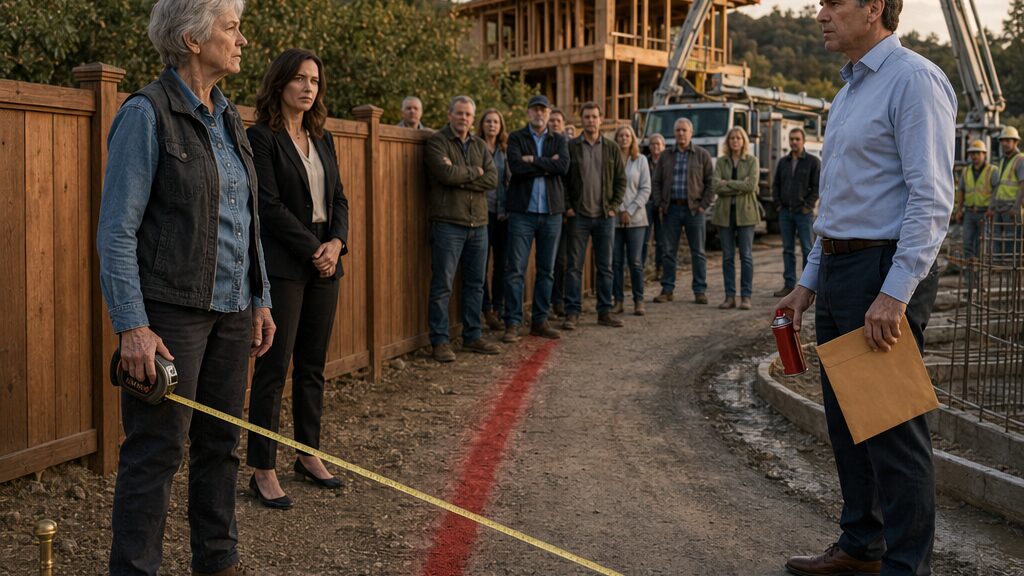
He bent beside Ruth’s fence with a can of red marking paint and drew a bright stripe through the dust, six inches wide and nearly twenty feet long. Homeowners stood in a loose semicircle near folding chairs while construction workers waited beside the silent pump.
When Richard finished, he straightened and held the can at his side.
“This,” he said, “is what we are being asked to sacrifice the road fund over.”
A few people looked down at the stripe. From where they stood, it did appear small.
Ruth remained near the exposed survey pin with her rolled plans beneath one arm. The steel tape measure hung from her hand. Ashley Moore stood several feet behind her, still in the dark suit she had worn to court that morning.
Ruth had not asked her daughter to come.
Ashley had arrived fifteen minutes before the meeting, shut her car door harder than necessary, and said, “You copied me on an emergency HOA notice. That usually means you’ve already decided not to listen to anyone.”
Now she watched Richard work the crowd with the patient confidence of someone accustomed to turning private decisions into public necessities.
“The retreat contributes more than forty percent of our annual road reserve,” Richard continued. “The expansion was approved in principle last year. Delaying it means lost bookings, contractor penalties, and another winter with patched pavement.”
One of the board members nodded.
A homeowner near the back asked, “How long would the delay be?”
“Over six inches?” Richard said. “Possibly months.”
His answer drew a murmur.
Ruth looked at Ashley. Her daughter’s expression remained neutral, but she had crossed her arms.
Laura sat at a folding table with a laptop and a printed agenda. Her eyes moved between Richard and Ruth without resting on either.
Richard gestured toward the red stripe.
“I’m asking the board for a temporary maintenance easement so the footing can be completed while counsel confirms the boundary issue. Nobody loses access. Nobody loses use. We keep people employed, protect the road budget, and resolve the paperwork properly.”
“It isn’t paperwork,” Ruth said.
Richard smiled toward her. “You’ll have your turn.”
“This is my property.”
“And this is an association meeting.”
That was the tone he preferred: never loud enough to sound cruel, always calm enough to make resistance seem unreasonable.
Laura cleared her throat. “We should follow the agenda.”
Richard stepped aside.
Ruth walked to the survey pin and pulled out the tape. The metal blade clicked as she extended it across the red stripe.
“The monument was recorded last spring,” she said. “The fence is two inches inside my line. The footing crosses six inches beyond the boundary. The reinforcing steel extends farther.”
She hooked the tape to the rebar protruding beneath the fence and held the measurement where everyone could see it.
A man in the front row leaned forward.
Richard said, “No one disputes that the forms are close.”
Ruth turned the tape so the numbers faced the group. “They are not close. They are across.”
“Within an established maintenance area.”
“An easement allows a stated use. It does not give the association ownership, and it does not authorize a permanent building.”
Richard opened his hands. “That is a legal interpretation.”
“It is also plain English.”
A few people shifted in their chairs.
Richard took an envelope from his folder. “To demonstrate good faith, the resort is prepared to compensate Ruth for the affected strip.”
He held it out.
Ruth did not move.
“How much?” someone asked.
Ashley looked sharply at Richard.
He named a figure large enough to produce another murmur.
Ruth said, “No.”
Richard’s expression changed for less than a second.
“You haven’t opened it.”
“The amount does not change the problem.”
“It changes whether this is a hardship.”
“You think the problem is the six inches.”
“It is the six inches.”
Ruth retracted the tape with a controlled hiss. Then she walked past the red stripe toward the lower end of the construction site.
The private road curved there between the poolhouse foundation and a drainage swale. Before construction, the shoulder had been wide enough for emergency vehicles to swing around the bend. Now stacked materials, new utility boxes, and the extended footing narrowed the usable lane.
Ruth hooked the tape to the edge of the concrete form.
“What are you doing?” Richard asked.
“Measuring what your map leaves out.”
She stretched the tape across the road to the opposite shoulder. Cars had worn shallow grooves into the dirt, and a delivery van parked near the lodge forced traffic farther toward the ditch.
Ruth read the distance aloud.
Daniel, standing with the crew, looked down.
A board member said, “What should it be?”
“For reliable fire-engine clearance on this turn, more than this. Especially once the poolhouse wall, roof overhang, utility bollards, and guest vehicles are present.”
Richard walked toward her. “The fire department reviewed the site plan.”
“Which version?”
“The approved version.”
“Does it show this footing?”
“It shows the poolhouse.”
“Does it show the footing crossing the maintenance strip?”
His silence lasted long enough for people to notice.
Ruth turned toward the homeowners. “The six inches are visible because they cross my boundary. The larger problem is that the same corridor carries drainage and emergency access. You cannot vote tonight on a temporary property fix without knowing what permanent obstruction you are approving.”
A woman near the back said, “Are you saying a fire engine can’t get through?”
“I’m saying no one here has shown that it can.”
Richard stepped between Ruth and the group.
“She retired fifteen years ago,” he said. “County codes change. Equipment changes. And she has opposed every expansion near her orchard since the retreat opened.”
“That is not true.”
“You objected to the hot-tub deck.”
“Because its runoff plans were incomplete.”
“You objected to the lighting.”
“Because it shone into three homes.”
“You objected to delivery hours.”
“They began at five in the morning.”
Richard faced the board. “This is a pattern. Every project becomes an emergency when it reaches Ruth’s fence.”
The accusation landed because it contained enough truth to resemble fairness.
Ashley came closer to Ruth. “Do you have the current fire-clearance standard with you?”
“No.”
“Then don’t state a conclusion you can’t support tonight.”
Ruth lowered her voice. “I stated a risk.”
“They heard a conclusion.”
Richard returned to the folding table and removed an older document from his folder.
“The association’s maintenance-strip amendment gives the board discretion to authorize access, grading, drainage work, utility work, and associated improvements within twelve inches of designated boundaries.”
He handed copies to the board.
Ruth did not need to read it. The title was enough.
Amendment 7B.
The paper seemed to lose weight in Richard’s hand and gain it in hers.
Laura looked at Ruth, then quickly down at her laptop.
Richard continued. “This language has been in effect for eleven years. It was created precisely so one owner could not block necessary improvements affecting the wider community.”
Ashley accepted a copy. Her eyes moved down the first page.
Ruth watched her reach the final paragraph.
The initials appeared in the lower margin beside a handwritten revision.
R.M.
Ashley looked up.
“Mom,” she said quietly.
Richard heard her.
“So you recognize it?”
Ruth did not answer.
One board member asked who had drafted the amendment.
Richard’s voice remained mild.
“Ruth chaired the infrastructure committee that submitted it.”
The homeowners turned toward her.
For the first time that evening, the red stripe at Ruth’s feet looked less like an intrusion and more like an accusation.
Ashley stepped beside her and held out the page.
“These are your initials, aren’t they?”
Ruth looked at the amendment she had written eleven years earlier and understood that stopping the vote had only bought Richard forty-eight hours to tell everyone she was fighting against her own rule.
Chapter 3: The Clause Written in Ruth’s Hand
Ashley placed the old amendment directly over the new survey.
The paper covered the boundary line, the poolhouse footing, and the red marks Ruth had drawn around the rebar. Only the survey seal remained visible at the lower corner.
“You wrote this,” Ashley said.
They stood in Ruth’s home office the next morning. Framed engineering certificates hung behind the desk. Rolled drainage plans filled a wooden rack. The steel tape measure rested unopened beside a cup of cold coffee.
“I helped write it.”
“Your initials are on every revision.”
“I chaired the committee.”
“That wasn’t my question.”
Ruth removed the amendment from the survey and aligned its edges with the desk.
“We had a drainage problem along the north parcels. Owners were refusing access for culvert maintenance. The road flooded twice.”
“So you gave the board power to use boundary strips.”
“For specific infrastructure work.”
The phrase sounded weaker aloud than it had in her memory.
Ashley tapped the clause. “‘Associated improvements.’ That could mean almost anything.”
“It was never intended to include buildings.”
“But you didn’t say that.”
“We had counsel review it.”
“Did counsel approve this exact language?”
Ruth looked toward the window.
Ashley exhaled. “There it is.”
“What?”
“The part where you decide silence is more dignified than admitting you made a mistake.”
Ruth’s hand flattened against the survey.
“I did not authorize Richard to pour concrete on my land.”
“No. But you wrote the ambiguity he’s using to tell everyone you’re a hypocrite.”
“He would have built anyway.”
“Maybe. But now every homeowner who is worried about fees has a reason not to trust you.”
Ruth turned away. Beyond the office window, the orchard descended toward the fence. Workers had covered the unfinished footing with plastic, but the poolhouse frame still rose above the trees.
Ashley softened her voice.
“Why didn’t you say anything at the meeting?”
“Because Richard was asking for an immediate vote.”
“That isn’t an answer.”
“It was not the moment.”
“It was exactly the moment.”
Ruth rolled the survey tightly enough to crease its edge.
Ashley watched her do it. “This is what you always do. You wait until you have every fact arranged, and by then everyone else has already decided what your silence means.”
The accusation reached beyond the amendment, and both of them knew it.
Ruth set the survey down.
“I have an appointment with Laura.”
Ashley picked up her car keys. “I’m coming.”
“No.”
“I’m a real-estate attorney.”
“You’re also my daughter.”
“Those are not mutually exclusive.”
“They have been before.”
Ashley’s face closed.
Ruth regretted the words immediately, but apology had never come easily when the wound was still open.
At the HOA office, Laura met them in the records room. Metal shelves held binders labeled by year. A small printer hummed beside boxes of ballots and maintenance invoices.
Laura shut the door.
“Richard asked me not to release anything outside formal records requests,” she said.
Ruth placed the survey and amendment on the table. “I am requesting the poolhouse approval file.”
“You submitted the request this morning. The association has ten business days.”
Ashley said, “You called Ruth and asked to meet before the deadline.”
Laura’s eyes moved to her. “I didn’t realize she was bringing counsel.”
“I’m not representing her.”
“Then why are you here?”
“To make sure nobody mistakes vagueness for protection.”
Laura sat down.
For a moment, none of them spoke.
Then Laura opened a drawer and removed a thin folder.
“The county approved a preliminary site concept,” she said. “Not the final footing layout.”
Ruth’s attention sharpened. “Did Richard know?”
Laura slid an email across the table.
It was from a county plans technician, sent six weeks earlier. The message requested revised setback dimensions, fire-access confirmation, and drainage calculations before final approval.
Richard had replied that updated drawings would follow.
“They never did,” Laura said.
Ashley read the exchange twice. “And construction started anyway?”
“Richard said the field changes were minor.”
“Did you tell the board?”
“I entered the county request in the permit log.”
Ruth opened the log. The entry described the email as a routine clarification.
“You minimized it.”
“I used the language Richard approved.”
Ruth looked at her.
Laura’s face tightened. “You think I don’t know how that sounds?”
“Why did you do it?”
“Because I manage this association. I don’t own a law firm. I don’t have ten acres. I have a salary and a child whose insurance comes through this job.”
Ashley leaned back slightly.
Laura continued before either could respond.
“Richard said the revised drawings were on the architect’s desk. He said stopping work would trigger penalties the association could not absorb. He said the retreat revenue was the only reason we didn’t impose a road assessment last year.”
“Those facts don’t make the permit final,” Ruth said.
“No. But they make people afraid.”
Ruth heard the answer beneath the answer. Laura had not believed the project was fully approved. She had believed Richard’s schedule mattered more than her doubt.
It was not so different from Ruth believing the amendment’s intent mattered more than its language.
Laura opened another binder.
“There’s more,” she said. “The board packet for tonight.”
“Another meeting?”
“Richard called a special session for tomorrow. He wants a formal vote after counsel reviews Amendment 7B.”
Ashley asked, “Has counsel reviewed it?”
“Not yet.”
Ruth looked at the folder. “What is he sending homeowners?”
Laura did not answer.
A phone chimed on the table.
Ashley checked hers first. Her mouth tightened.
The message had gone to the entire association.
Subject: BACKGROUND REGARDING CURRENT CONSTRUCTION DISPUTE.
Attached was Amendment 7B with Ruth’s initials enlarged in a yellow box. Richard’s note stated that the same person now opposing shared-boundary improvements had authored the board’s authority to approve them.
He included the estimated contractor delay costs.
He included the projected loss to the road fund.
He did not include the county email requesting revised plans.
By the time Ruth returned home, three messages waited on her answering machine. One neighbor asked whether she intended to reimburse the association. Another said everyone had made sacrifices for the road. The third hung up without speaking.
Ashley stood in the kitchen reading responses on her phone.
“They’re sharing it,” she said.
Ruth filled a glass with water but did not drink.
“Let them.”
“That is not a strategy.”
“I will answer with the documents.”
“Which documents? The survey proves the crossing. The amendment proves you helped create the argument against yourself. The county email helps, but Laura won’t release it publicly without risking her job.”
Ruth looked through the window toward the fence.
The plastic over the foundation had begun to lift in the wind. Dark clouds gathered above the western ridge.
A notification sounded on Ruth’s computer.
The county weather service had issued a flash-flood watch for the hills through the following night. Two inches of rain were possible over dry ground.
Ruth opened the site plans and enlarged the drainage sheet.
The original swale ran along the cedar fence, carrying stormwater toward the lower culvert. On Richard’s revised layout, the poolhouse footing occupied part of that channel.
The drawing did not show where the water would go instead.
Ruth took the tape measure from the desk and walked outside.
At the fence, she found a shallow pool already forming behind the fresh concrete. The soil was dry. No rain had fallen yet.
Water from the resort’s temporary construction line had leaked into the excavation and collected against the footing because the old drainage path was blocked.
Ruth crouched and touched the wet soil.
On the other side of the fence, the poolhouse frame creaked in the rising wind.
The first drops struck the plastic sheeting.
Then the water at Ruth’s boots began moving downhill, not through the swale, but between the first two rows of her orchard.
Chapter 4: Rainwater With Nowhere Left to Go
The first row of pear trees disappeared behind brown water before Ruth reached the lower gate.
Rain struck the orchard in hard diagonal sheets, turning the dry soil slick beneath her boots. The blocked swale had spilled over its edge and found the shallowest path downhill—between two rows of trees, across the gravel turnout, and toward the private road.
Ruth dragged a shovel from the shed and cut into the shoulder where the old drainage path had once crossed beneath the fence. Water surged into the trench, carrying bark, leaves, and loose soil with it.
On the resort side, plastic snapped against the poolhouse forms.
A flashlight moved behind the fence.
“Ruth?”
Daniel’s voice was nearly lost beneath the rain.
She climbed through the lower gate and found him in a hooded jacket beside the foundation. Two workers were pulling tarps over stacked lumber while water pooled against the fresh footing.
“You need to open the temporary channel,” Ruth said.
Daniel pointed toward a line of sandbags. “Richard told us not to disturb the forms.”
“The forms are the obstruction.”
“The concrete hasn’t cured.”
“The orchard is flooding.”
“So is the site.”
Ruth aimed her flashlight beneath the footing. Water had scoured a dark hollow under one corner, exposing aggregate that should have remained supported by compacted soil.
Daniel crouched.
The beam caught a stream of mud disappearing beneath the slab.
His expression changed.
“How long has it been doing that?” he asked.
“Long enough.”
He stood and shouted to the workers. “Shut down the generator. Get the pump over here.”
One of them hesitated. “Richard said—”
“I’m stopping the site.”
Daniel took out his phone and moved beneath the partial roof. Ruth could hear only fragments of the conversation.
“Erosion under the footing.”
“No, I’m not waiting until morning.”
“You can come look at it yourself.”
He ended the call and stared at the screen.
“He’ll be here in twenty minutes,” Daniel said.
“The lower culvert will not wait twenty minutes.”
Ruth walked toward the road.
At the bend below the orchard, runoff had crossed the gravel in a broad sheet. A neighbor stood ankle-deep in muddy water, trying to clear branches from the culvert grate with a garden rake.
When she saw Ruth, she stopped.
“You got what you wanted,” the woman said.
Ruth stepped into the ditch. “Move the rake.”
“What?”
“It’s catching the debris.”
“The grate is blocked.”
“The grate is holding back pressure. If you pull from the center, the branch will release all at once.”
The woman’s face tightened. She was one of the residents who had shared Richard’s message about the road fund.
Ruth set her shovel beneath the largest branch and levered it sideways. The woman watched for a moment, then moved to the opposite side.
“On three,” Ruth said.
Together they shifted the branch clear. Water punched through the culvert with a deep hollow roar, dragging leaves and gravel beneath the road.
The level dropped around their boots.
The woman looked uphill at the poolhouse.
“Is this because of the foundation?”
“It changed the drainage path.”
“You knew that would happen?”
“I knew it could.”
“That isn’t the same thing.”
“No.”
The answer surprised them both.
Headlights swept across the rain. Richard’s utility vehicle stopped near the construction gate, followed by Laura’s sedan. Richard stepped out without a coat, his shirt darkening immediately.
“What did you do?” he demanded.
Ruth climbed from the ditch. “I opened a temporary channel.”
“You cut association property during an active storm.”
“I redirected water toward the original culvert.”
“You altered the site after accusing us of improper drainage.”
Daniel came down from the foundation. “The footing is undermined at the southwest corner. I stopped the job.”
Richard turned on him. “You don’t have authority to shut down my project.”
“I have authority over my crew.”
“You’re reacting to surface wash.”
Daniel held out his flashlight. “Come look underneath it.”
Richard did not move.
Laura stood near her car, sheltering a folder beneath her jacket. “The county emergency line called back. They want photographs before daylight.”
Richard looked at her. “Why did you call the county?”
“I called public works because the road was flooding.”
“You work for the association.”
“That is why I called.”
The rain intensified, drumming on the utility cart roof.
Ruth took out the steel tape measure. She hooked it against the new concrete edge and stretched it across the usable road surface to the opposite shoulder.
Richard watched her.
“What now?”
“The road has narrowed another fourteen inches since the plans you circulated.”
“Because materials are stacked temporarily.”
“Because the footing, utility box, and drainage berm occupy the inside turn.”
She read the measurement, then pulled a folded fire-access diagram from the plastic sleeve inside her coat.
“The original clear width was marginal. This is below it.”
Richard laughed once, without humor. “You don’t work for the fire district.”
“No. I know how to read a turning radius.”
“You know how to make every inconvenience sound fatal.”
Ruth looked at the road, the water, the workers standing beneath the unfinished frame.
“I know what happens when an engine cannot get where it needs to go.”
Richard’s expression shifted, as though he had heard something beneath the words, but he let it pass.
“You manipulated this,” he said. “You opened soil along the fence before the storm, then created a drainage failure to make your complaint look urgent.”
Daniel stepped closer. “The erosion started under the footing. She didn’t put it there.”
“You were supposed to protect the pour.”
“I was given a layout without final drainage revisions.”
Richard’s head snapped toward Laura.
She held the folder tighter.
“No one is discussing internal records out here,” he said.
The neighbor from the culvert approached slowly. Mud streaked her jeans.
“My garage apron was under four inches of water,” she said.
Richard softened his voice. “I’m sorry. We’ll cover the cleanup.”
“I’m not asking who will pay for a broom.”
He had no immediate answer.
By midnight, the worst runoff had passed. Daniel’s crew installed a temporary pump and opened a narrow channel around the foundation. Ruth stayed until the water stopped climbing toward the lower homes.
At two in the morning, the county fire marshal emailed a preliminary access review based on the site plan, Ruth’s measurements, and Laura’s photographs.
Ruth opened it at her kitchen table while Ashley slept on the living-room sofa.
The message did not order a closure. It did something more dangerous to Richard’s position: it asked for verification of every structure affecting the private road.
Attached was a turning-radius map.
A red outline showed the path required by a standard engine entering the bend.
The line struck the poolhouse footing, clipped the new utility cabinets, and crossed the edge of the hot-tub deck.
At the bottom of the map, the fire marshal had written:
Current configuration does not demonstrate continuous emergency-vehicle clearance. Field inspection recommended before further occupancy expansion.
Ruth enlarged the image.
The poolhouse was not the only obstruction.
Three other resort additions sat inside the red path.
Chapter 5: The Inspection That Did Not Stop There
The county vehicle entered between two guest vans at ten seventeen Saturday morning.
Ruth watched from the orchard gate as a family unloaded luggage beneath the retreat’s timber porte cochere. A staff member carried a tray of sparkling drinks toward the patio. Music played quietly from hidden speakers among the landscaping.
Then the white county truck stopped beside the unfinished poolhouse.
The building inspector stepped out with a clipboard, followed by the fire marshal.
Richard reached them before Ruth did.
He wore a resort jacket over an open-collared shirt and carried a folder thick with plans. His smile was professional and controlled.
“We expected a site visit,” he said. “I’m glad we can clear up the misunderstanding.”
The building inspector looked toward the cedar fence. “Ms. Martin?”
Ruth came through the gate with her survey, photographs, and measurements arranged in a narrow binder.
Richard lowered his voice as she approached.
“You can still tell them the immediate hazard has been addressed.”
“The pump addressed the water for one night.”
“The footing is stable.”
“Daniel stopped work because it was undermined.”
“He overreacted.”
The inspector held out his hand for Ruth’s binder. “Let’s begin with the property line.”
Ruth gave it to him.
She had removed every adjective from her written statement. No reckless developer. No deliberate encroachment. No dangerous resort. Only dates, dimensions, photographs, and permit references.
The inspector walked to the brass survey pin. He compared it with the recorded map, then produced his own tape.
Richard stood on the other side of the fence.
“The association has a maintenance-strip amendment,” he said.
The inspector stretched the blade to the concrete form.
“An HOA document does not alter a recorded parcel boundary.”
“It authorizes associated improvements.”
“It does not authorize construction without county approval.”
The tape clicked.
“Six and three-eighths inches at the footing,” the inspector said.
He measured the rebar.
“Nine and a quarter.”
The first small satisfaction Ruth felt was not victory. It was relief that the number existed outside her own hands.
The inspector photographed the measurements. Then he examined the county permit card mounted near the construction trailer.
“This card references preliminary grading and site preparation,” he said. “Where is the building permit for the poolhouse?”
Richard opened his folder. “The full permit set is under revision.”
“Then why is there a poured footing?”
“We had authorization to proceed with preparatory work.”
“A structural footing is not preparatory grading.”
Richard glanced toward the lodge. Guests had begun to notice the officials.
“We can discuss this in my office.”
“We’ll discuss it here first.”
The inspector removed a red notice from his case.
The paper looked almost too bright against the wet-gray concrete.
STOP WORK—UNAPPROVED STRUCTURAL CONSTRUCTION.
He fixed it to the temporary site board.
Richard said nothing.
Ruth had expected some internal release when the notice went up. Instead she heard the music from the patio, the clink of glasses, and the low voices of guests wondering what had happened.
The fire marshal began walking the road.
Ruth followed with Richard and Laura. At the bend, the marshal checked the width, examined the new utility cabinets, and compared the layout with his turning template.
“The cabinets need protection from vehicles,” Richard said. “That’s why they’re set back here.”
“They’re set into the required clearance,” the marshal replied.
“They serve the entire property.”
“That doesn’t change where they are.”
He continued toward the hot-tub deck.
Richard stopped. “The complaint concerned the poolhouse.”
The building inspector looked up from his clipboard. “The complaint identified possible unapproved construction and access obstruction.”
“The deck was completed last year.”
“Final inspection?”
Laura opened her records folder.
Richard looked at her. “Not now.”
The inspector held out his hand.
Laura gave him the file.
The final inspection line was blank.
A resort employee guiding guests toward the cabins slowed as the inspector walked onto the deck. Beneath it, new plumbing crossed a drainage easement without protective access panels.
The inspector returned to his truck and brought out another red notice.
This one went on the deck gate.
Richard’s composure began to crack.
“This is unnecessary,” he said. “The deck has been in use for ten months without incident.”
“That is not a substitute for approval.”
Guests on the patio had stopped pretending not to watch.
The officials moved to the first of three new cabins along the lower road. Each was finished in dark cedar, with black metal roofs and private porches overlooking the vineyard slope.
The permit file showed approval for two replacement utility sheds.
The structures standing there had beds, bathrooms, kitchenettes, and gas fireplaces.
The inspector opened one door.
A couple inside was packing.
“We were told there was a maintenance issue,” the man said.
The inspector turned to Richard. “These units are occupied?”
“They passed internal safety review.”
“By whom?”
Richard did not answer.
The first red notice unrelated to Ruth’s boundary went on the cabin door.
A second followed on the adjacent unit.
The third cabin had no visible address marker and no final utility signoff. Its notice went beside a brass welcome plaque.
By then, staff members were quietly moving guests toward the main lodge. Phones were out. No one shouted, but the atmosphere had changed from leisure to uncertainty.
Richard drew Ruth aside near the landscaping wall.
“You have made your point.”
“This is not my inspection.”
“You called them.”
“I submitted evidence.”
“You knew they would look at everything.”
“I suspected they might.”
His face tightened. “Do you understand what happens if those cabins close? Refunds. Payroll. Debt payments. The road reserve loses its largest contribution.”
“You built occupied units under shed permits.”
“They were phased conversions.”
“That phrase does not make them legal.”
“You think paperwork is the whole world because you never had to keep eighty people paid.”
Ruth looked toward the employees gathering near the lodge entrance.
“No,” she said. “Paperwork is what tells those people whether the building around them was checked.”
The fire marshal emerged from the utility room beneath the lodge.
“The recent electrical upgrade does not match the approved plan,” he said. “And the rear service lane is partially blocked by storage.”
Richard spread his hands. “We can correct those items today.”
“Not while the building remains occupied at expanded capacity.”
The inspector conferred with the fire marshal beside the county truck. Their voices were low.
Laura stood apart, pale and rigid.
Ashley arrived through the orchard gate and joined Ruth.
“How far is this going?” she asked.
“I don’t know.”
“You thought the poolhouse would stop.”
“Yes.”
Ashley watched the officials.
“That was the clean version.”
Ruth did not argue.
The inspector returned with a larger notice.
“This is not a full condemnation,” he told Richard. “The original lodge may continue limited operation once occupancy is reduced and the service lane is cleared. The unapproved additions, deck, and poolhouse are closed immediately. No new guest check-ins until we verify fire access, utilities, and permit status.”
Richard stared at him. “It’s Saturday.”
“Yes.”
“We are fully booked.”
“That is why we’re addressing occupancy now.”
The red notice went on the lodge’s front door.
A woman at the reception desk covered her mouth. A guest rolled a suitcase backward across the stone floor. Outside, one of the arriving vans began loading luggage again.
Ruth stood beside the cedar fence while red paper appeared across finished doors, new railings, and the construction board. The notices did not look like justice from where she stood. They looked like wages, reservations, and frightened employees folded into official language.
By late afternoon, the last displaced guests had left.
Richard remained near the lodge steps with the bank representative and two board members. Laura sat inside, working through refund lists.
Ruth returned home.
At six twelve, the HOA sent an emergency notice to every owner.
Projected loss of retreat contributions: substantial.
Possible legal and correction expenses: under review.
Possible emergency special assessment per household: to be determined.
The final paragraph stated that the board would examine whether costs caused by an owner-initiated enforcement action could be charged to that owner.
Ashley read the notice over Ruth’s shoulder.
“They’re going to make you the reason everyone gets a bill.”
Ruth looked through the window at the red paper on Richard’s lodge door.
She had stopped the concrete.
She had also given the association a new way to measure the price of listening to her.
Chapter 6: The Truth Behind the Fire Lane
“Eight thousand four hundred dollars per household.”
The homeowner at the microphone read the estimate twice, as if the second reading might make it less real.
The HOA meeting room was full. Folding chairs lined the walls, and several residents stood in the doorway. On the front table lay the county notices, the retreat’s financial statement, Ruth’s survey, and a projected correction budget.
Richard sat at one end of the board table. He looked older than he had a week earlier.
Ruth sat in the first row with Ashley. The steel tape measure rested inside her canvas document bag beside an old evacuation map she had not opened in years.
The homeowner lowered the page.
“That is the high estimate,” Laura said from the side table. “It assumes extended closure, legal costs, and no recovery from insurance.”
“Which means it could be more,” someone replied.
Another resident turned toward Ruth.
“Richard offered to pay you. Why didn’t you take it?”
The room shifted toward her.
Ruth stood.
“Because the footing crossed my boundary and reduced a drainage and access corridor.”
“We know your answer,” the resident said. “We are asking whether six inches was worth eight thousand dollars to every family here.”
Ruth felt Ashley watching her.
A week earlier, she would have opened the survey first. She would have led with dimensions, approvals, and the difference between an easement and ownership.
Instead she took the old amendment from her folder.
“I drafted part of Amendment 7B,” she said.
The room quieted.
Richard looked up.
Ruth placed the document on the front table.
“Eleven years ago, the north side of the association flooded twice because two owners refused entry for culvert repairs. I chaired the infrastructure committee. We wrote language allowing access for drainage, utilities, and related improvements.”
“You wrote the rule you’re fighting?” someone asked.
“I wrote language broad enough to be misused.”
A board member said, “You never disclosed that at the first meeting.”
“No.”
“Why?”
“Because I believed the construction was plainly outside the amendment, and I thought the documents should settle it.”
Ashley’s eyes stayed on her.
Ruth continued.
“That silence made it easier to believe I was protecting only my land and hiding my part in the problem. I was.”
The admission did not rescue her. A few people looked angrier, not less.
Richard leaned toward his microphone.
“This is what I have been saying. The board relied on authority Ruth created.”
Ruth faced him.
“You relied on it after the county asked for revised setbacks, drainage calculations, and fire-access confirmation.”
Laura stood.
Her chair scraped sharply against the floor.
“I have the correspondence.”
Richard turned. “Laura.”
She carried a folder to the front table.
Her hands shook, but her voice did not.
“The permit log described the county request as routine clarification. That description was incomplete. Mr. King received written notice that final approval had not been granted.”
She placed copies beside the financial statement.
A resident asked why she had not released them earlier.
Laura looked at the room.
“Because I was afraid of losing my job.”
No one answered immediately.
“My child’s health insurance is through the association,” she continued. “Richard said stopping construction would trigger penalties and layoffs. I told myself the architect would fix the plans before anyone was hurt.”
Richard rubbed one hand across his face.
“I did say that,” he said. “Because it was true.”
He stood without using the microphone.
“The retreat is carrying loans against the cabins, the lodge improvements, and the road contribution agreement. If we miss another payment, the bank can place the project in default. If the retreat fails, the association loses nearly half its reserve funding.”
His voice was controlled, but the strain in it was no longer hidden.
“I did not build those units to humiliate Ruth. I built them because this community has voted down road assessments for six years while demanding better maintenance. People wanted revenue without higher dues. I found it.”
“You also occupied buildings without final approvals,” Ashley said.
Richard looked at her. “I thought the approvals would catch up.”
“They didn’t.”
“No.”
The room settled into an uneasy silence. Richard’s motive did not excuse him, but it made the damage harder to sort into innocent and guilty sides.
Ruth removed the old evacuation map from her bag and unfolded it.
A faded black line followed the private road past her orchard. Red pencil marked the turn near the current poolhouse site.
“My husband and I owned a larger orchard here,” she said. “Years ago, during the ridge fire, equipment could not make the lower turn after two vehicles stopped in the access lane. The fire did not reach our house. It reached the irrigation shed and the packing building.”
Ashley looked down.
“We lost the season,” Ruth continued. “Then the next one. My husband never recovered the business. He died believing we should have pushed harder when the association allowed that lane to narrow.”
She placed the steel tape measure beside the map.
“After that fire, I promised him I would never ignore blocked access again. I also stopped explaining that promise to anyone, including my daughter.”
Ashley’s mouth tightened.
Ruth did not look away.
“The six inches mattered because they were mine. But that was not the whole reason I fought. I should have said so before I asked everyone to trust my measurements.”
The anger in the room did not vanish. It changed shape.
One homeowner asked, “What happens now?”
The county correction plan lay at the edge of the table. Ruth opened it.
“The poolhouse foundation must be cut back and redesigned. The utility cabinets must move. The hot-tub deck needs access panels and a reduced footprint. The cabins can reopen in phases after inspections.”
“And the road?”
“The inside turn still needs more width.”
Richard said, “There is nowhere to get it without removing the entire poolhouse.”
“There is,” Ruth replied.
She unrolled a new sketch.
The proposed line crossed the entrance to her orchard, taking a narrow wedge of her frontage before returning to the existing road.
Ashley leaned over it.
“You would give them an easement?”
“A limited emergency-access easement. No utilities. No buildings. No guest parking. Independent survey and county recording.”
Richard stared at the drawing.
The wider turn would preserve most of the redesigned poolhouse footprint and allow phased reopening. It would also end his argument for unilateral authority over the existing maintenance strip.
“What do you want in return?” he asked.
“Independent permit review for all association construction.”
He said nothing.
“Release of Laura from retaliation.”
Laura looked at Ruth.
“Restoration of the original drainage swale. Removal of the encroaching concrete. And your resignation as board president once the consent agreement is signed.”
A murmur moved through the room.
Richard looked at the projected default schedule, then at the correction plan.
“You’re asking me to save the retreat by giving up control of it.”
“I’m asking you to choose whether saving it matters more than being the person who saved it.”
For a long moment, Richard remained still.
Then the bank representative leaned toward him and spoke quietly. Richard listened without looking away from Ruth’s drawing.
At last he sat down.
“I need the terms in writing by tomorrow.”
Ashley reached for the sketch.
“I’ll draft them.”
Ruth looked at her.
Ashley did not smile, but she pulled the steel tape measure closer and placed it along the proposed easement line.
For the first time since the dispute began, the tool did not mark what Ruth intended to keep.
It marked what she was prepared to give.
Chapter 7: A Boundary Wide Enough for Everyone
The excavator’s bucket slid beneath the defective footing and lifted.
Concrete rose from the ground in one gray slab, dragging wet soil and bent rebar with it. The cedar fence shuddered as the steel rods pulled free, then settled back into place.
Ruth stood behind the temporary barrier with Ashley and watched six weeks of argument leave the ground one broken section at a time.
Daniel raised one hand from beside the machine. The operator stopped.
A strip of concrete remained pressed against the original survey line.
Daniel checked the exposed edge, then crossed to Ruth with a set of marked plans tucked beneath his arm.
“This is the last section over your boundary,” he said. “I want you to see the cut before we remove it.”
Ruth opened her steel tape measure.
Ashley took the end without being asked and crouched beside the brass survey pin. The blade stretched between them, bright in the morning light.
“Six and three-eighths,” Ashley said.
“The same as the inspector found,” Ruth replied.
Daniel nodded to the operator.
The bucket came down again.
This time the concrete broke along the marked cut, leaving Ruth’s soil bare except for a shallow scar where the footing had crossed it. Daniel’s crew pulled the remaining rebar free and stacked it beside the demolition bin.
No one applauded.
The machine reversed, alarms sounding through the orchard, while workers began preparing the narrower replacement foundation farther inside the retreat parcel.
Richard stood near the lodge steps with the bank representative. He had attended every correction meeting, but he had spoken less at each one. The tailored jackets were gone. That morning he wore work boots and a plain canvas coat.
The county had approved a phased reopening plan. Two cabins could resume bookings after final fire and utility inspections. The lodge would operate at reduced capacity. The poolhouse could be rebuilt only after the access easement, drainage restoration, and independent review policy were recorded.
The retreat would survive.
It would not survive unchanged.
At noon, the HOA board gathered in the meeting room to sign the consent agreement.
The same table that had held Ruth’s survey and the estimated assessment now held a thick stack of final documents. Ashley sat beside Ruth, checking page numbers against a yellow legal pad. Laura arranged signature tabs and county filing copies.
Richard entered last.
He took the chair at the end of the table, where he had presided over the earlier meetings.
For several seconds, no one moved.
Then he looked at Laura.
“Is the staff health plan funded through the end of the year?”
“Yes,” she said. “The revised operating budget protects it.”
“And payroll?”
“Covered if the first two cabins reopen on schedule.”
He nodded once.
Ashley pushed the consent agreement toward him.
“The independent construction-review requirement begins immediately,” she said. “Any association or retreat project affecting drainage, utilities, access, setbacks, or common maintenance areas must receive outside review before work starts.”
Richard turned a page.
“The road easement?”
“Limited to emergency access and drainage maintenance,” Ashley said. “No parking, no guest use, no permanent structures.”
“And it remains on Ruth’s parcel.”
“Yes.”
Richard looked across the table at Ruth.
“You could have asked for money.”
“I did not need money.”
“You asked for my resignation.”
“I asked for the person who ignored the permit warnings to stop controlling permit decisions.”
His mouth tightened, but he did not argue.
He signed the operational corrections first. Then the reimbursement schedule. Then the agreement restoring the swale and relocating the utility cabinets.
The resignation letter lay at the bottom.
Richard rested his pen above the signature line.
“I believed the retreat could fix what the board would not,” he said.
One board member shifted in his chair.
Richard kept his eyes on the page.
“Everyone wanted the road repaired. Nobody wanted higher dues. The cabins brought in money. Every time I solved one problem, people asked me to solve the next one. After a while, waiting for permission felt like another way of choosing failure.”
Ruth said, “You still knew the permission had not been granted.”
“Yes.”
His answer came without qualification.
He signed the letter.
The sound of the pen moving across paper was small, but Laura released a breath she seemed to have held for weeks.
Richard set the pen down.
“My resignation takes effect when the county records the agreement.”
Ashley checked the clause. “That is correct.”
He stood.
At the door, he paused beside Ruth.
“You were right about the access.”
“I was late explaining why.”
He looked toward the orchard through the meeting-room window.
“That did not make me more willing to hear it.”
“No.”
He gave a tired nod and left.
By the end of the week, the county recorded the easement.
The new road line took a wedge from Ruth’s orchard entrance. Two old pear trees stood inside the graded area. They were not healthy trees, but they had been planted by Ruth’s husband when the orchard first expanded toward the fence.
Daniel met her beside them with orange marking ribbon tied around his wrist.
“We can bend the lane farther toward the resort,” he said. “It would save one.”
“And tighten the turn again.”
“By eight inches.”
Ruth looked at the lower branches. Their bark had split along one side, and the leaves were already thinning.
“Remove both.”
Daniel studied her face. “You’re sure?”
“No,” she said. “But remove them.”
The crew cut the trees low and carried the wood to Ruth’s shed rather than hauling it away. She kept two straight sections for gate posts.
The loss changed the view from her kitchen. For years, the pair of trunks had framed the end of the road. Now she could see farther into the retreat grounds: the corrected poolhouse foundation, the relocated utility cabinets, and the wider arc where an emergency vehicle could turn without touching either property line.
The drainage swale was restored before the next rain.
Daniel rebuilt the cedar fence along the verified boundary, replacing the damaged boards and setting the gate several feet back to accommodate the easement. He used wood from the old pear trees for the posts, smoothing the cut surfaces but leaving the grain visible.
On the morning of the final fire inspection, Ruth and Ashley met at the gate.
The fire marshal’s engine entered slowly from the private road. It passed the utility cabinets, followed the widened inside turn, and cleared the rebuilt fence without stopping. Its rear wheel remained well inside the compacted shoulder.
The driver completed the turn and raised one hand through the open window.
The fire marshal marked the test complete.
Ashley looked at Ruth. “You were right about the radius.”
Ruth pulled the steel tape from her coat pocket.
“I was wrong about other things.”
“That is not the part you usually volunteer.”
“I’m practicing.”
Ashley took the end of the tape and walked to the opposite edge of the lane.
They measured the clear width together. The number exceeded the required minimum by several inches.
Ashley bent to mark it on the final plan.
“Laura sent me the draft governance policy,” she said. “She wants an attorney to review it before the next board vote.”
“Are you going to?”
“I told her I would.”
Ruth retracted a few inches of tape. “As association counsel?”
“No. As someone who would rather read the rule before you write it this time.”
Ruth looked up.
Ashley’s expression was not quite a smile.
“I deserved that,” Ruth said.
“You did.”
The tape remained stretched between them.
Behind Ashley, workers installed the last section of drainage pipe. Across the road, two retreat employees prepared one of the approved cabins for reopening. The red notices had been removed from the doors that passed inspection. Others remained in place, their color faded by sun and rain.
Richard was nowhere in sight.
His resignation had become effective the previous afternoon. He still owned the retreat, but construction decisions now required board review, county approval, and an outside engineer’s signature. The limits did not erase his investment or his responsibility. They simply prevented either one from becoming authority by itself.
Daniel approached with the final fence board.
“Where do you want this?” he asked.
Ruth pointed to the verified line.
“Exactly there.”
He set the board between the new pear-wood posts and fastened it into place.
The repaired fence no longer followed the road as closely as before. It turned inward at the easement, acknowledging the space Ruth had given while preserving the property she had not.
When the work was finished, Ashley rolled the plans and handed them to Ruth.
“You should keep these.”
“I have copies.”
“You always have copies.”
Ashley looked at the tape measure still in Ruth’s hand.
For a moment, Ruth thought she might ask to borrow it. Instead, Ashley took it gently, walked to the new gate, and hung it from the iron latch.
The worn metal case rested against the pear wood.
“You’ll need it here more than I will,” Ashley said.
Ruth touched the gate post. The grain beneath her fingers came from one of the trees they had cut to widen the lane.
“Will you stay for lunch?”
Ashley glanced toward her car, then toward the orchard.
“I can stay for an hour.”
It was not forgiveness arranged into a neat conclusion. It was an hour.
Ruth opened the gate.
The tape measure swung once from the latch and became still above the line they had finally made wide enough for everyone.
The story has ended.