The Trail Beyond the HOA Gate Held a Promise No Rulebook Could Erase
Chapter 1: The Notice Fastened to the Wrong Gate
The staple gun snapped against the ranch gate before Gary Harris reached the end of the drive.
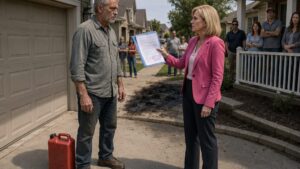
Deborah Moore pressed a second staple through the top of a cream-colored notice, then stepped back to inspect her work. Her clipboard was tucked beneath one arm. Beyond her, the subdivision’s trimmed lawns ended at the county road as abruptly as poured concrete. On Gary’s side of the fence, dry grass rolled toward the foothills, broken by cottonwoods, water troughs, and the slow movement of horses.
Gary stopped several feet from the gate.
“You’ve fastened that to private property.”
Deborah turned without surprise. “Then you’ll be sure to read it.”
She wore walking shoes too clean for the ranch road and a pale jacket despite the rising heat. Her posture suggested she had rehearsed the encounter and had arrived determined not to be redirected.
Gary looked at the notice through the rails. At the top was the logo of the Clearview Ridge Homeowners Association. Below it, in bold type, were the words ACCESS OBSTRUCTION VIOLATION.
“This gate isn’t in Clearview Ridge,” he said.
“The trail serves Clearview Ridge.”
“That isn’t the same thing.”
Deborah opened her clipboard. “The residents were promised a community trail connection when these homes were sold. Your gate blocks that connection.”
“My gate blocks a ranch road.”
“It blocks the safest walking route between the north and south entrances.”
Gary laid one hand on the weathered top rail. The chain around the posts was new, but the gate itself had been standing longer than the subdivision. He had replaced two hinges, three lower boards, and most of the bolts over the years. The sun had silvered the wood until it looked older than it was.
“The trail has always been private,” he said.
Deborah’s mouth tightened. “People used it.”
“People have crossed it.”
“Which establishes use.”
“Not the kind you think.”
Her gaze sharpened. “Are you an attorney now?”
Gary held her eyes for a moment. “I’m the landowner.”
He did not tell her that he had spent thirty-one years reading deeds, litigating boundary disputes, and advising county commissioners who preferred certainty until certainty cost them something. He had learned that announcing expertise too early rarely improved a conversation. It only changed what people concealed.
Deborah tapped the notice. “You have twenty-four hours to remove the obstruction before the board conducts an inspection.”
“You don’t have inspection authority here.”
“The association has an obligation to protect access promised to its members.”
“Inside the association.”
She flipped a page as though patience were a courtesy she had already exhausted. “Section Eight permits the board to enforce community access provisions.”
Gary leaned close enough to read the citation. He knew the structure of such documents even without seeing the full text: definitions, membership, common areas, architectural rules, enforcement powers. They were strongest where they were narrowest.
“What does Section One call association property?” he asked.
Deborah glanced down. “I’m not going to debate isolated language at a gate.”
“You brought isolated language to my gate.”
A truck slowed on the county road. The driver looked from Deborah to Gary, then continued toward the subdivision. Gary could see two residents standing near the white entrance fence, pretending to inspect a mailbox.
Deborah lowered her clipboard. “A child was hurt last week.”
That stopped him.
She watched the change in his face and continued more quietly. “A family from the south end walked along the county road because this route was locked. A pickup came around the bend. The boy jumped into the drainage ditch and broke his wrist.”
Gary looked past her toward the road. The bend sat beyond a rise where drivers often accelerated after leaving the subdivision. He had complained to the county twice about the speed limit sign being hidden behind overgrown brush.
“The driver should have slowed.”
“Yes. And the county should improve the shoulder. Neither happened before that child got hurt.”
“That doesn’t give your association my land.”
“No, but it gives us a reason not to accept a locked gate and silence.”
The last word landed harder than her accusation.
Gary’s thumb moved across a split in the top rail. He could have told her that the old route had never been a community trail. He could have explained the winter storms, the washed-out bridge years, the emergency vehicles that had once used the ranch road when the county entrance flooded.
He could have said why the chain had gone on and never come off.
Instead, he asked, “Who told buyers they had access?”
“The developer’s maps show it.”
“Maps used for sales aren’t deeds.”
“They are representations.”
“Take that up with the developer.”
“The developer dissolved the sales company eight years ago.”
“Then take it up with the county.”
“We did. The county says it’s a private dispute.”
“It is.”
Deborah closed the clipboard with a sharp clap. “Tomorrow morning at nine, the board will inspect the access point. I’ll bring the governing documents and the original neighborhood map. You can explain your position then.”
Gary lifted the lower corner of the notice. The paper had been stapled through a patch of old grain.
“Remove this yourself,” he said, “or I will.”
“Destroying an official notice will be documented.”
“It isn’t official here.”
For a second, neither moved. A horse called from the pasture, and another answered near the barn.
Deborah finally removed the staple gun from the gatepost and placed it in her bag. “Everyone thinks property rights are absolute until someone else pays for them.”
Gary pulled the notice free. One staple remained embedded in the wood.
“And everyone thinks a rule follows them wherever they carry the binder,” he said, “until they reach the edge of the property it governs.”
She walked back toward the county road, dust collecting around her shoes. At the subdivision entrance, the two watching residents joined her. One of them looked directly at Gary before turning away.
He folded the notice once and slid it into his jacket pocket.
Tyler found him twenty minutes later near the equipment shed, holding a pair of fencing pliers but staring toward the ridge.
“You pulled the notice down,” Tyler said.
“It wasn’t theirs to post.”
“She sent a message to half the neighborhood saying you refused to cooperate.”
“That was quick.”
“She also said there’ll be an inspection tomorrow.”
Gary bent over a coil of wire. “There won’t.”
Tyler was thirty-five, broad-shouldered from ranch work, with the same habit Gary had of becoming still when angry. “You could tell them why the road was closed.”
“They don’t need to know.”
“They think it’s a walking trail.”
“They’re wrong.”
“That hasn’t stopped anyone lately.”
Gary cut a length of wire harder than necessary. “The law doesn’t change because they misunderstand it.”
“No. But pressure does.”
Tyler’s phone buzzed. He glanced at the screen and swore under his breath.
“What?”
“Another post. Someone says residents have used the trail for twenty years.”
“They haven’t.”
“Someone did.”
Gary set down the pliers. “Emergency use isn’t public use.”
Tyler studied him. “Then say that.”
Gary picked up the wire again.
The silence between them grew until Tyler turned toward the outer pasture. He had gone only a few steps when he stopped.
“Dad.”
Gary heard something in his voice that brought him upright.
Tyler stood beside the locked gate leading from the lower pasture to the old trail. The chain was intact. The padlock hung where Gary had left it.
But in the dry soil beyond the gate, on the ranch side of the fence, were fresh shoe prints.
Two sets.
One large, one small.
They led away from the subdivision and toward the cottonwood bend.
Chapter 2: Her Rulebook Stopped at His Fence
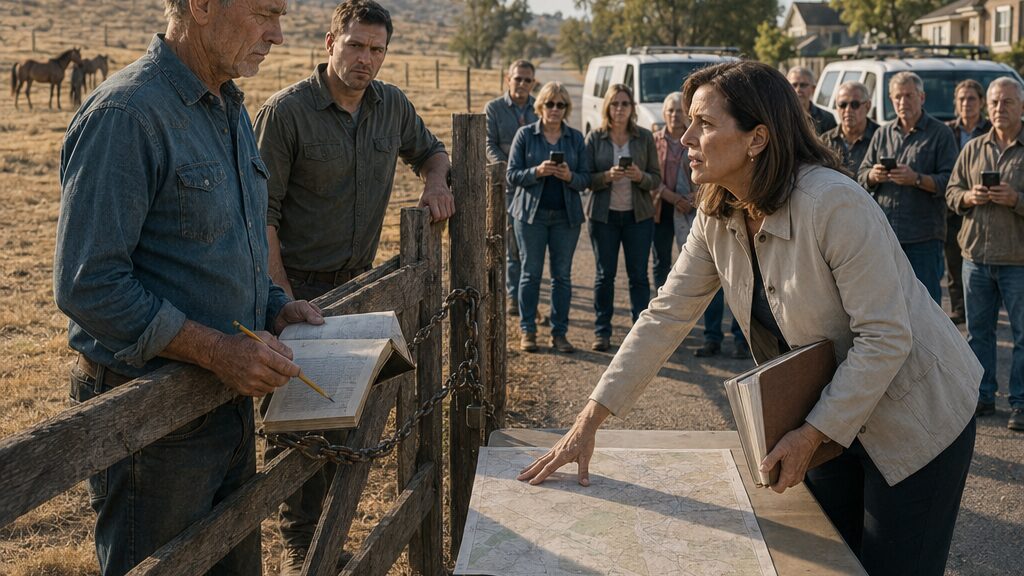
At eight fifty-six the next morning, two white HOA service vehicles pulled onto the shoulder outside Gary’s gate.
Deborah stepped from the first carrying a rulebook thick enough to require both hands. The HOA secretary emerged behind her with a folding table. From the second vehicle came three board members, a maintenance contractor, and a man wearing a fluorescent safety vest that displayed no county or utility insignia.
Residents followed on foot.
Gary counted seventeen before he stopped counting.
Tyler stood inside the gate with the chain looped through one hand. He had wanted to call the sheriff’s office. Gary had told him that deputies settled disturbances, not arguments over documents, and that calling too early would let Deborah turn a jurisdiction problem into a spectacle about intimidation.
Now, looking at the cluster of phones held at chest height, Tyler said, “It’s already a spectacle.”
“Then don’t perform for it.”
Gary walked through the side opening and closed it behind him. He remained on the public shoulder, leaving the gate locked between the ranch and the assembled group.
Deborah placed the rulebook on the folding table. Beside it, she arranged the violation notice, a subdivision map, and several printed photographs of the locked gate.
“This is a community access inspection,” she announced. “We are here to document the obstruction and provide the owner an opportunity to cure it voluntarily.”
Gary looked at the safety vest. “Who’s he?”
“A trail consultant.”
The man shifted his weight.
“Licensed surveyor?”
“No.”
“County inspector?”
“No.”
“Then he isn’t inspecting my property.”
A few residents murmured. Deborah planted her palms on the table.
“Mr. Harris, the board has no interest in escalation. Unlock the gate, allow us to confirm the trail condition, and we can address maintenance cooperatively.”
“No.”
A woman near the front spoke before Deborah could respond. Her son’s wrist was enclosed in a blue cast. “That road is dangerous.”
Gary looked at the boy, then at her. “I agree.”
“Then why won’t you let families use the trail?”
“Because agreement about one danger doesn’t create a right over someone else’s land.”
The woman’s face hardened. “Easy to say when it wasn’t your child.”
Gary felt the gate behind him without touching it. He remembered another blue cast, though not on a child, and the careful way his wife had tried to joke while the doctor wrapped her wrist years before the accident that killed her.
He forced his attention back to Deborah.
“You said you brought the governing documents.”
“I did.”
“Show me the provision that gives the association authority over this parcel.”
Deborah opened the binder to a marked page. Colored tabs projected from the edges. “Section Eight, subsection three. The board may maintain, regulate, and preserve access to community paths, trails, and common-use facilities.”
“Read the definition of community path.”
“The issue is whether this trail serves the community.”
“The document decides what the document governs. Read the definition.”
“This is not a courtroom.”
“No. In a courtroom, you wouldn’t have arrived without reading Section One.”
The board members exchanged looks. Deborah’s fingers pressed against the page until the paper bowed.
She flipped toward the front.
Gary waited.
The crowd became quiet enough for him to hear a horse moving along the fence behind Tyler.
Deborah found the section and read in a clipped voice. “‘Community path’ means any walkway, trail, sidewalk, or marked route situated upon association property or property burdened by an easement granted to the association.”
Gary nodded. “Now read ‘association property.’”
Her face changed before she spoke.
The shift was small. Her chin remained high, but her eyes moved from the language to the map, searching for an exit that the text had already closed.
“Read it,” one of the residents said.
Deborah looked at the board member who had spoken, then back at the page.
“‘Association property’ means real property described in Exhibit A and any additional property later annexed according to Article Twelve.”
Gary pointed to the binder. “Exhibit A.”
The secretary began flipping pages. Deborah reached past her and found the legal description.
Gary took a yellow carpenter’s pencil from his pocket. “Your western boundary follows the centerline of Clearview Creek, then turns north at the old survey marker.”
The secretary traced the printed description. “That’s what it says.”
Gary pointed through the fence toward the shallow creek bed running between the subdivision and his lower pasture.
“This gate is four hundred and eighteen feet west of that boundary. The trail beyond it is farther west. My ranch is not listed in Exhibit A, has never been annexed, and is not subject to an easement granted to your association.”
Deborah closed the rulebook halfway. “The board’s authority also derives from the original community plan.”
“Your covenants say otherwise.”
“You’re relying on a technical boundary to block an established route.”
“A property boundary is not a technicality in a property document.”
Someone laughed softly. Deborah’s head turned toward the sound, and it stopped.
Gary did not smile. Winning too visibly made people defend mistakes they might otherwise abandon.
He drew a line on a clear plastic cover laid over Deborah’s subdivision map. “Here is your association. Here is Clearview Creek. Here is my eastern fence.”
The pencil stopped at the gate.
“Your rulebook stops there.”
For several seconds, the only movement came from loose pages lifting in the morning breeze.
The boy with the cast tugged at his mother’s sleeve. The trail consultant removed his safety glasses and tucked them into his vest.
Deborah looked down at the line Gary had drawn. “You seem unusually familiar with these documents.”
“I read what people put against my gate.”
“That isn’t what I meant.”
Gary capped the pencil.
One board member asked, “Can we issue a violation or not?”
Deborah did not answer.
Gary did. “No.”
The board member looked to the secretary, who lowered her eyes to the legal description. “Not under this declaration.”
The words moved through the residents without anyone repeating them. Shoulders shifted. Phones lowered. The pressure at the gate seemed to loosen.
For one brief moment, Gary believed the matter had reached its end.
Then Deborah unfolded the larger map.
It was not the black-and-white plat attached to the declarations. It was a glossy sales map, faded along the creases, showing loops of green space, neighborhood streets, and a dotted line labeled COMMUNITY TRAIL CONNECTION.
The line crossed Clearview Creek.
Then it continued through Gary’s ranch.
A murmur rose from the crowd.
Deborah placed one finger on the dotted route. “This was provided to original buyers.”
Gary looked at the map without touching it.
The drawing was imprecise. The ranch boundaries had been softened beneath decorative shading. The old road appeared as a pleasant curve through trees, without gates, cattle crossings, washouts, or the narrow descent at the cottonwood bend.
But the route was real.
Or had once been real in a way he had never put into writing.
The mother of the injured boy leaned closer. “So they did promise it.”
“A sales illustration is not an easement,” Gary said.
Deborah’s confidence returned, changed now from certainty to pursuit. “It shows the access wasn’t invented last week.”
“It shows what a developer printed.”
“It shows a trail through your property.”
“It doesn’t show a legal right to use it.”
“Maybe not in your rulebook.” She tapped the dotted line. “But rights can come from agreements, prior use, representations, and conduct.”
Gary’s eyes moved to hers.
That language had not come from the covenants. Someone had advised her overnight, or she had read beyond the colored tabs.
Deborah saw that he recognized the distinction.
“You knew this route existed,” she said.
Tyler’s hand tightened around the chain behind the gate.
Gary folded his arms.
A resident near the back called out, “Did people use it or not?”
“Not as a public recreational trail,” Gary said.
Deborah stepped around the table. “That wasn’t my question.”
“It’s the relevant distinction.”
“Then answer the simple one. Did you ever give Clearview residents permission to cross your ranch?”
The breeze caught the corner of the old map. Deborah held it down with her palm.
Gary saw the dotted trail disappear beneath her hand at the same place where the cottonwoods began.
He remembered a storm siren. Mud against truck doors. His wife standing at the open gate with rain streaming from her hat brim, waving an ambulance through because the subdivision bridge had flooded.
He remembered saying they should leave a key with the fire district.
He remembered everything that had come after, too.
Tyler said, “Dad?”
Gary looked at the faces gathered beyond his fence. Some were angry. Some merely wanted an answer. The mother with the injured boy no longer looked triumphant. She looked tired.
Deborah waited.
Gary could have ended the mystery with one sentence.
Instead, he picked up the cream-colored violation notice and placed it on top of her rulebook.
“Your association has no authority to inspect or open this gate,” he said. “That is the only issue we’re resolving today.”
Deborah’s expression hardened.
“No,” she said. “It’s the only issue you’re willing to resolve.”
Chapter 3: The Permission Nobody Had Recorded
Tyler found the invoice in the locked drawer beneath Gary’s old legal files.
The paper was eleven years old, yellowed at the edges, and marked with a rust-colored ring from a coffee cup. Across the top, in Gary’s handwriting, were the words SHARED EMERGENCY TRAIL—GRADING AND DRAINAGE.
Beneath that were charges for gravel, culvert pipe, equipment hours, and replacement reflectors.
Tyler read the heading twice.
The gate key lay beside the invoice.
It was smaller than the current padlock key and worn smooth along one edge. A strip of faded red tape circled its head.
Gary had gone to check the north herd. He had told Tyler to retrieve the ranch insurance policy from the file cabinet before the representative called. Tyler had opened the wrong drawer only because the correct one stuck in humid weather.
At least, that was what he told himself while he removed the invoice and two pages beneath it.
One was a handwritten list of telephone numbers: fire district, sheriff’s dispatch, county road department, Ruth Nelson, and several names Tyler did not recognize. The second was a simple diagram of the trail, with the words emergency access only printed near the subdivision side.
No signatures.
No dates except the invoice.
No explanation for why the key had been hidden.
By noon, Tyler was sitting across from a county records clerk beneath fluorescent lights that made every document look older than it was.
The clerk examined the parcel index, then the digital deed history.
“There’s no recorded easement benefiting Clearview Ridge,” she said. “No access covenant, no right-of-way grant, no maintenance agreement.”
“So the HOA has nothing.”
“I didn’t say that.”
Tyler leaned back. “You just said there’s no easement.”
“There’s no recorded easement.” She turned the monitor slightly toward him. “That’s the clean answer. The expensive answer is that people can still argue about oral permission, implied rights, reliance, prescriptive use, developer representations, and who did what for how long.”
“My father let emergency vehicles cross. That doesn’t make it a neighborhood trail.”
“Probably not.”
“Probably?”
“I don’t give legal advice.”
“He used to.”
The clerk glanced at him. “Then he knows why paperwork matters.”
Tyler looked down at the invoice inside its clear sleeve.
The clerk softened. “A judge won’t turn every act of neighborliness into permanent access. But if families bought homes after being shown a map, if residents crossed openly, if the owner maintained the route for shared use, and if nobody clearly limited or revoked permission, somebody may decide it’s worth filing a claim.”
“Even if they lose?”
“Especially if the land is valuable enough.”
The trail corridor was not valuable by itself. What made it valuable was where it ran—between the creek and the county road, through the portion of the ranch closest to water and subdivision utilities. If the dispute clouded title there, it could affect financing for far more than a strip of dirt.
Tyler thanked the clerk and left with less certainty than he had brought in.
Outside, his phone showed three missed calls from the ranch insurer.
The fourth came while he was still crossing the parking lot.
The representative spoke quickly and without accusation. Photographs of the gate and online discussion of a claimed community route had reached the underwriting department. Until use was clarified, the company intended to exclude incidents arising from the disputed trail at the next renewal.
“What does that mean in plain English?” Tyler asked.
“It means if someone enters that route and gets hurt, coverage may be denied.”
“The gate is locked.”
“Your own documents apparently show historical access.”
“What documents?”
“We received a copy of a maintenance invoice.”
Tyler stopped beside his truck.
“From whom?”
“I’m not able to identify the sender.”
He did not need the answer.
Deborah had found more than the sales map, or someone at the board had.
“What fixes it?” he asked.
“A recorded agreement defining access, or a formal declaration that no permission exists, supported by enforceable controls. Your attorney can advise you.”
Tyler laughed once, without humor. “Of course.”
When he returned to the ranch, Gary was repairing a water line near the lower pasture. Tyler placed the invoice on the hood of the utility truck.
Gary looked at it and became very still.
“You went into my desk.”
“You told me to find the insurance policy.”
“Not in that drawer.”
“The insurer has this invoice too.”
Gary wiped his hands on a rag. “Deborah must have gotten it from an old contractor.”
“What was the shared emergency trail?”
“A ranch road used under limited circumstances.”
“What circumstances?”
“Floods. Fire access. Medical calls when the east subdivision bridge was underwater.”
“And residents?”
“Sometimes escorted through during emergencies.”
“Did they have a key?”
Gary’s gaze went to the clear sleeve. The old key remained inside.
“The fire district had one. Ruth’s husband had one because he coordinated the volunteer response team.”
“Did you ever put those limits in writing?”
“The purpose was understood.”
“By people who are dead, retired, or gone.”
Gary’s jaw tightened. “That doesn’t change the purpose.”
“It changes what anyone can prove.”
Tyler picked up the invoice. “You spent years telling clients that memory isn’t a land record.”
“This was neighbor help, not a conveyance.”
“Then why did you maintain it under a shared-access heading?”
“For accounting.”
“Why did you stop?”
Gary folded the rag carefully, as though the answer might remain inside it if he gave his hands enough work.
“The subdivision bridge was improved.”
“That isn’t the whole reason.”
“It was no longer necessary.”
“Then why hide the key?”
Gary looked toward the cottonwoods.
Tyler followed his gaze. From this distance, the old trail was nearly invisible except for a pale cut in the grass. It vanished where the ground curved downward beneath the trees.
“Something happened there,” Tyler said.
Gary opened the utility truck’s toolbox and put away a wrench. “The insurer needs a written response. I’ll handle it.”
“That’s what you always say.”
“And I usually do.”
“No. You make the immediate problem quiet. Then somebody else inherits what you didn’t finish.”
Gary closed the toolbox.
Tyler regretted the sentence before the metal latch clicked, but not enough to withdraw it.
“The succession loan depends on clean title and stable insurance,” he said. “We’re supposed to meet the lender Monday.”
“I know.”
“If the HOA files anything, even something weak, the bank can delay us for months.”
“They won’t win.”
“They don’t have to win. They only have to make the ranch expensive enough to hold.”
Gary looked at him then, and Tyler saw that he understood. Not just the legal point. The threat beneath it.
For years they had spoken about transfer schedules, grazing leases, equipment debt, and estate taxes as though the ranch’s future could be managed through columns. Tyler had accepted the gradual handover because Gary called caution stewardship.
Now caution looked dangerously similar to refusal.
“I called the developer’s successor company,” Tyler said.
Gary’s expression changed. “Why?”
“They own a narrow parcel along the creek. They might buy the trail corridor and create access on their side.”
“You contacted them about selling ranch land?”
“I asked whether they’d consider an option.”
“You had no authority.”
“I’m the one expected to take on the debt.”
“This land isn’t yours yet.”
“That’s exactly the problem.”
The words hung between them.
A horse pushed against the fence near the water trough. Gary went to check the latch though it did not need checking.
Tyler slid the invoice back into its sleeve.
“I don’t want to sell it,” he said. “But I won’t inherit a lawsuit wrapped around a story you refuse to tell.”
Gary kept one hand on the fencepost.
Tyler waited for him to turn, to explain the old key, the cottonwood bend, or why a road built for emergencies had become something he guarded like a grave.
Gary said nothing.
Tyler walked back toward the house with the invoice under his arm.
At the gate, he stopped and looked over his shoulder.
“If you won’t clear this up before Monday,” he said, “I’ll sell them the corridor before I let your silence take the whole ranch with it.”
Chapter 4: The Accident Beneath the Cottonwood Bend
The children’s voices came from beyond the locked gate just as thunder rolled over the western ridge.
Gary dropped the feed sack beside the barn and listened.
A girl laughed. Another voice called for someone to wait. The sounds carried from the old trail, faint beneath the cottonwoods but unmistakably inside the ranch boundary.
He ran.
By the time he reached the lower gate, the sky had darkened to the color of bruised steel. The chain remained looped through the posts. The padlock was shut. But the wire fence twenty yards south sagged where someone had pressed it down beneath a blanket.
Gary climbed over without stopping to remove his jacket.
“Get off the trail!” he shouted.
The laughter vanished.
Branches shifted ahead. Four children emerged from the trees, followed by three adults in subdivision walking clothes. One man held a phone on a stabilizing handle. A woman carried a rolled green banner printed with words Gary could not fully read from the distance.
The smallest child froze when she saw him.
“We’re leaving,” one of the adults said.
“You’re trespassing.”
“We’re conducting a peaceful access walk.”
“With children?”
“They came with their parents.”
Lightning flickered behind the ridge. The horses in the adjacent pasture began moving toward the barn.
Gary pointed back the way they had come. “The fence crossing is unsafe. You’ll go out through the gate.”
“The gate you locked?” the man with the phone asked.
“The gate I’m opening.”
He moved past them, counting heads. Four children. Three adults. No one appeared injured. One child wore a small backpack with a water bottle knocking against the side.
“Stay together,” Gary said. “Do not run. Do not touch the horses if they come near the fence.”
The woman with the banner looked toward the darkening sky. “We were told this would be quick.”
“By whom?”
No one answered.
Gary led them down the trail.
The old road narrowed beneath the cottonwoods, where roots pushed through the hard earth and rainwater had carved shallow channels along the slope. He had walked that bend hundreds of times since closing it, usually alone, usually carrying tools.
Today, the children’s shoes scraped behind him.
At the first crack of thunder overhead, one of them cried out. A horse in the pasture answered with a sharp, frightened call.
Gary stopped.
The bend lay twenty feet ahead.
A broken cottonwood limb rested beside the trail. Beyond it, the ground fell toward the creek in a steep, uneven bank. For an instant the present thinned around him.
He saw his wife’s bay mare coming around the curve.
He saw three cyclists where no cyclists were supposed to be, bright jackets flashing between trees. He heard one of them shout. The mare twisted sideways. A hoof struck loose stone.
His wife’s hand reached for the saddle horn.
Then there was only the sound of branches breaking below the bank.
“Mr. Harris?”
The child’s voice came from behind him.
Gary could not move.
Rain struck the leaves in scattered drops.
One of the adults stepped closer. “Are you all right?”
Gary pressed a hand against the nearest cottonwood trunk. The bark was rough beneath his palm. He drew one breath, then another.
“Walk,” he said. “Single file. Stay on the uphill side.”
They obeyed now.
At the outer gate, Tyler was waiting with bolt cutters and a sheriff’s deputy beside him. Gary unlocked the chain with the key from his belt and pushed the gate wide.
The children passed through first.
The mother of the smallest child hurried from the gathered residents and pulled her daughter close. Behind her stood Deborah.
She held no clipboard. Her arms were crossed tightly, and rain had darkened the shoulders of her jacket.
Gary waited until every person was outside the boundary. Then he faced her.
“You sent them.”
Deborah glanced toward the man with the phone. “I suggested residents document the trail’s condition.”
“You encouraged them to crawl under a fence.”
“I told them not to damage property.”
“You told them to enter it.”
“A peaceful test of an access claim is not the same as vandalism.”
“You brought children onto a livestock road during a storm.”
“I did not know children were joining.”
The deputy stepped between them without raising his voice. “That distinction can be discussed after everyone clears the roadside.”
Gary did not take his eyes off Deborah.
She looked past him toward the cottonwood bend. “No one was hurt.”
“Not today.”
Something in his voice made her expression falter.
Tyler closed the gate after the deputy took names. The residents dispersed under the rain, their phones and banners hidden beneath jackets. Deborah remained until the others had gone.
“I was trying to show that the route was passable,” she said.
“You showed that you don’t know what it is.”
“Then tell me.”
Gary locked the chain.
“You don’t get to force an answer by sending families onto my land.”
He walked away before she could respond.
Ruth Nelson arrived at the ranch kitchen an hour later carrying a metal recipe box and a plastic grocery bag filled with old papers.
Tyler had called her.
Gary stood at the sink, washing mud from his hands. His jacket hung over a chair, dripping onto the floor.
Ruth set the box on the table. “I heard what happened.”
“Everyone has.”
“Deborah called me yesterday.”
Gary turned off the faucet. “What did you tell her?”
“That my husband kept a key for emergencies. Nothing more.”
“You should have told her nothing.”
Ruth’s lined face tightened. “That strategy has worked beautifully so far.”
Tyler looked down at the table, but Gary saw the brief approval in his expression.
Ruth opened the recipe box. Inside were folded fire-district notices, handwritten phone trees, and photographs sealed in sandwich bags.
“The trail was never for recreation,” she said. “We used it when the bridge flooded, during the grass fire, and twice for ambulances. Your wife made that clear every time.”
Gary pulled out a chair but did not sit.
Ruth placed a photograph on the table. It showed the old gate open beneath heavy rain. His wife stood beside it in a dark coat, one arm raised as an ambulance crossed the ranch.
Tyler picked up the photograph carefully.
“I’ve never seen this.”
Gary had.
He remembered taking it after the ambulance passed because his wife had laughed at how soaked they both were. She had accused him of documenting everything except the things that mattered.
Ruth took out a handwritten note.
“She asked my husband to return the key after the county raised the bridge. He did. But you never sent a written cancellation to the fire district or the subdivision committee.”
“There was no subdivision committee then.”
“There was a volunteer neighborhood group.”
“They had no legal interest.”
Ruth looked at him. “You keep answering the legal question.”
“It’s the question they’re using to enter my land.”
“It isn’t the one Tyler is asking.”
Gary’s hand closed around the back of the chair.
Tyler set down the photograph. “Why did you close it?”
Rain tapped against the kitchen window.
Gary could have said the bridge improvement made the route unnecessary. He could have repeated what he had told Tyler beside the water line.
Instead, he looked at his wife’s figure in the photograph.
“She wanted the gate left accessible,” he said. “Not open. Accessible. For emergencies.”
Ruth’s eyes lowered.
“Years later,” Gary continued, “some residents started using it without calling. Walkers first. Then bicycles. I put up signs. They disappeared.”
Tyler waited.
“One Saturday, I left the gate unlocked because the fire district was inspecting the creek crossing. The inspection was canceled. I didn’t know.”
His voice had begun to thin, and he hated it.
“Your mother rode the lower pasture that afternoon.”
Tyler stopped breathing for a second.
“Three cyclists came through the bend,” Gary said. “They weren’t supposed to be there. They startled the mare. She went down the bank.”
The room held only the rain.
Tyler’s eyes moved toward the window, though the cottonwoods were not visible from the kitchen.
“I thought it happened near the creek.”
“It did.”
“You said the horse slipped.”
“It did.”
“You never said why.”
Gary looked at him. “Because the gate should have been locked.”
Ruth spoke softly. “The cyclists ignored two signs and a fence.”
“I left the gate open.”
“You did not push the horse.”
“I left it open.”
The sentence broke from him louder than he intended.
He sat at last.
For thirteen years, he had kept the facts arranged in precise order. The canceled inspection. The unlocked chain. The cyclists. The frightened mare. The fall. The hours at the hospital. The promise he made beside his wife’s bed when she briefly opened her eyes and asked whether Tyler knew.
Keep him from blaming himself, she had whispered.
Gary had obeyed by telling Tyler almost nothing.
Now Tyler stood across from him with grief arriving years late and nowhere to go.
“You let me think it was just an accident,” Tyler said.
“It was.”
“No. You decided which parts I could know.”
Gary had no answer that did not prove him right.
Ruth slid the old records toward the center of the table. “There was permission,” she said. “Limited permission. Gary ended it after the accident, but he ended it with a chain, not with paper.”
Tyler looked at the recipe box. “Can these prove the limits?”
“They can prove what we understood,” Ruth said. “They can’t prove what every buyer was told.”
Gary reached for the photograph.
His wife’s face was too small to read clearly, but he remembered the expression. Tired, amused, impatient with his caution.
A notification sounded on Tyler’s phone.
He read it, then turned the screen toward Gary.
The Clearview Ridge board had scheduled a public hearing for Tuesday evening. Attached to the announcement was the developer’s old map, enlarged and sharpened. The dotted trail ran across Gary’s ranch in bright green.
The words “emergency access only” appeared nowhere.
Chapter 5: A Legal Victory That Cost His Son
The lender froze Tyler’s succession loan at nine twelve Monday morning.
The notice arrived by email while Gary was sitting across from the loan officer in a glass-walled meeting room. Tyler read the first paragraph on his phone, placed it face down on the table, and stared at the framed photograph of wheat fields behind the officer’s desk.
The officer folded her hands.
“This is not a denial,” she said. “It is a suspension pending resolution of title and liability concerns.”
“There is no title defect,” Gary said.
“An association is publicly claiming access across the collateral property.”
“They have not filed a claim.”
“Not yet.”
“They have no recorded easement.”
The officer’s expression remained professional. “The underwriting committee reviewed the online hearing notice, the historic sales map, and photographs of the gate.”
She slid a printed image across the table.
Gary recognized the photograph immediately. It had been taken during Deborah’s inspection. He stood beside the gate with his yellow pencil in hand. The old map was open on the folding table. From the angle, the dotted trail appeared to run directly toward him.
The caption beneath the image read: LANDOWNER BLOCKS LONGSTANDING COMMUNITY ROUTE.
“The caption is false,” Gary said.
“The bank is not deciding who is morally correct.”
“Or legally correct, apparently.”
“Gary,” Tyler said.
The officer did not react to the edge in his voice. “We are deciding whether the loan can proceed without a foreseeable dispute affecting value, insurance, or access.”
Tyler turned his phone over again. “What resolves it?”
“A recorded settlement, a judicial determination, withdrawal of the association’s claim, or another outcome acceptable to underwriting.”
“And until then?”
“The transfer remains on hold.”
Outside the bank, Tyler walked ahead without speaking. Gary caught up beside the truck.
“You contacted the developer’s successor,” Gary said.
Tyler unlocked the driver’s door. “I told you that.”
“You didn’t tell me you obtained an option.”
Tyler stopped.
That was answer enough.
“How much land?” Gary asked.
“Seven acres following the creek corridor.”
“Seven.”
“They want enough width to reroute the trail outside the working pasture.”
“And connect it where?”
“To their utility parcel near the south entrance.”
Gary looked across the parking lot at the low commercial buildings that had replaced orchards within his memory. Seven acres would not destroy the ranch. That made the idea more dangerous. Sacrifice a strip, remove the dispute, preserve the larger operation—on paper it could look like prudence.
“What did they offer?”
“Enough to reduce the operating line and satisfy the lender’s reserve requirement.”
“You negotiated against the ranch while asking to inherit it.”
“I negotiated a way to inherit something other than your unresolved fight.”
Gary opened his mouth, then closed it.
Tyler leaned against the truck. His anger had gone past heat into exhaustion.
“I don’t want their money,” he said. “I want the transfer to work. I want the cattle note refinanced before winter. I want insurance that covers the ground we actually own. And I want one problem in this family to be handled before it becomes mine by default.”
Gary looked toward the bank entrance.
He had spent his career warning clients that delay was also a decision. Somehow, on his own land, he had treated delay as preservation.
“When does the option expire?”
“Friday.”
“Don’t sign anything.”
“Give me another choice before then.”
Tyler got into the truck and left Gary standing in the parking lot.
Deborah was waiting at the ranch office when he returned.
She had parked outside the cattle guard rather than driving in. The courtesy felt deliberate.
Gary opened the office door but did not invite her to follow. She entered anyway and placed a manila folder on his desk.
“I heard about the loan,” she said.
“That information isn’t public.”
“People talk.”
“People in your association seem to do little else.”
She accepted the insult without visible reaction. “The board can withdraw the violation and issue a written statement that it is not challenging ranch ownership.”
“In exchange for what?”
“Unrestricted pedestrian access during daylight hours.”
Gary laughed once.
“I’m serious.”
“That’s why it’s funny.”
“The board needs a result before Tuesday’s hearing. Residents believe a promised amenity was taken from them. The child’s injury changed the mood.”
“The child was hurt on a county road. Your answer is to send more children across livestock property.”
“With fencing improvements and trail maintenance.”
“Paid by whom?”
“The association.”
“Insured by whom?”
“We would discuss coverage.”
“Controlled by whom?”
“The board would establish rules.”
Gary looked at the thick folder. “Rules for land you do not own.”
“Rules accepted by agreement.”
“You’re offering to stop making a false claim if I voluntarily give you what the false claim cannot obtain.”
Deborah’s jaw tightened. “I’m offering a compromise.”
“No. You’re offering concealment.”
She turned toward the window. From the office, the gate was visible at the end of the drive, small against the pale road.
“My position is not secure,” she said.
Gary waited.
“There is a board election next month. Two members say I mishandled the inspection. Residents on the south end say I failed them before the boy was injured. Residents near your fence say I escalated too far.”
“All three may be true.”
She looked back at him. “You think I enjoy this?”
“I think you enjoy being certain.”
Her face changed.
“For six years,” she said, “every complaint came to me. Drainage, roofs, loose dogs, broken lights, speeders, the developer’s unfinished promises. People don’t want explanations. They want the person in charge to make the problem disappear.”
“You are not in charge of everything that affects them.”
“I know that now.”
“Do you?”
Deborah placed one hand on the folder. “If I stand at that hearing and say we have no claim, I become the woman who gave up the safest route after a child was hurt.”
“If you say you do have a claim, you’ll be lying.”
“I can say the history is disputed.”
“It is.”
“And request negotiations.”
“You already requested surrender.”
She looked again toward the gate. “Was your wife’s accident there?”
Gary did not answer.
“Ruth told me only that someone died after the trail’s informal use ended.”
“Ruth talks more than she should.”
“Maybe because you talk less.”
The words struck too close to Tyler’s accusation.
Deborah pushed the folder toward him. “The offer remains open until tomorrow afternoon.”
Gary left it unopened on the desk.
After she departed, he found Tyler’s option agreement in the printer tray. Tyler had likely printed it that morning and forgotten the final page.
The legal description traced the seven-acre corridor from Clearview Creek to the county road. The proposed purchase price sat near the top. It was generous enough to solve several immediate problems.
At the bottom, beneath the signature lines, a provision granted the buyer the right to construct and dedicate a public recreational trail.
Gary pictured the gate removed. Signposts. Gravel. Dogs off leash despite posted rules. Bicycles cutting the bend. Tyler watching strangers cross land that had once carried his mother’s last ride.
Then he pictured the bank’s suspension notice.
The ranch did not survive on memory. It survived on credit, water, insurance, labor, and decisions made before circumstances made them unavoidable.
That evening, Tyler found him at the kitchen table with the old map, the insurance letter, Deborah’s unopened folder, and a blank legal pad.
“I haven’t signed,” Tyler said.
Gary nodded.
“I won’t, before Friday.”
Gary wrote a heading on the legal pad: REVOCABLE EMERGENCY ACCESS LICENSE.
Tyler read it from across the table.
“No recreational use,” Gary said. “No resident key distribution. Activation only by emergency dispatch, fire district, or written ranch authorization. Association pays for insurance, maintenance, signage, and a coded lock system. Automatic suspension after misuse.”
Tyler sat slowly.
“You’re willing to open it?”
“For emergencies.”
“Why now?”
Gary looked at the photograph Ruth had left behind. His wife stood beside the open gate, waving the ambulance through.
“Because closing it was supposed to protect what came after her,” he said. “It was never supposed to stop you from having anything after me.”
Tyler’s eyes stayed on the legal pad.
“The board won’t accept all that.”
“They don’t have to. But they’ll have to reject safety in order to demand recreation.”
“And the old permission?”
“I’ll put it into the record.”
Tyler looked up. “All of it?”
Gary knew what he was asking.
“Yes.”
The answer left him exposed in a way no boundary hearing ever had.
He picked up the phone and called Ruth.
“Bring the recipe box tomorrow,” he said. “Every paper. The photographs too.”
There was a pause on the line.
“Are you finally going to tell it straight?” she asked.
Gary looked at Tyler.
“Yes,” he said. “Including the part that belongs to me.”
Chapter 6: The Truth Read Into the Minutes
Deborah presented the incomplete map as the hearing’s first exhibit.
It rested on an easel beside the HOA board table, enlarged until the green dotted line crossing Gary’s ranch could be seen from the back row. More than sixty residents filled the clubhouse. Several stood along the walls. The mother of the injured boy sat near the front, his blue cast resting in her lap while he drew on it with a black marker.
Gary entered carrying a slim binder.
Tyler walked beside him. Ruth followed with the metal recipe box pressed against her coat.
Deborah watched them take seats at the front.
“The purpose of this hearing,” she said into the tabletop microphone, “is to determine whether the Clearview Ridge trail connection should be recognized and preserved as a community amenity.”
Gary raised one hand.
A board member sighed. “Mr. Harris, public comment follows the presentation.”
“Then the purpose has already been misstated before the evidence begins.”
Murmurs moved through the room.
Deborah’s expression tightened. “You will have time to state your position.”
“My land cannot be recognized as your amenity by a board vote.”
The HOA secretary leaned toward Deborah and whispered something. Deborah nodded once.
“The record will reflect Mr. Harris’s objection.”
Gary sat back.
It was a small correction, but it changed the room. This was no longer an uncontested meeting about an obstructed community trail. It was a meeting where the first sentence had required repair.
Deborah described the sales map, the injury on the county road, and residents’ recollections of past access. She did not repeat the violation citation Gary had defeated at the gate. Instead, she spoke of reliance, safety, and neighborhood expectations.
Her argument was more careful now.
That made it more dangerous.
A board member displayed photographs of walkers near the trail from years earlier. Another read a statement from an original homeowner who remembered being told the route would “eventually connect.”
Then Deborah turned toward Gary.
“You have stated that the trail is entirely private and that the association has no enforceable right to use it.”
“That is correct.”
“Did you ever permit residents or emergency personnel to cross?”
The room became still.
Gary could have objected to the question’s breadth. He could have forced her to distinguish permission from ownership, residents from responders, emergencies from recreation.
Instead, he opened his binder.
“Yes.”
Tyler’s shoulders loosened slightly beside him.
Deborah had prepared for resistance, not admission. “Under what conditions?”
“During floods, fires, and medical emergencies when the subdivision’s eastern bridge was impassable. Access was coordinated through the volunteer response team or emergency services. It was not general pedestrian use.”
“Was that restriction recorded?”
“No.”
“Was the permission recorded?”
“No.”
“Did you maintain the route?”
“Yes.”
A resident called from the back, “Then it was shared.”
Gary turned toward the voice. “A road can be maintained for a limited purpose without becoming public. But the limitation should have been documented. It was not.”
Deborah looked down at her notes.
Gary continued before she could decide how to use the admission.
“That failure was mine.”
The sentence changed the room more than any legal citation could have.
Ruth placed the recipe box on the table before him. Gary removed the old fire-district notices, the emergency phone list, the diagram marked emergency access only, and the photograph of his wife beside the open gate.
“These records show what the permission was for,” he said. “They also show how informally it was handled. Neighbors trusted one another. Keys were held by people whose names everyone knew. When the bridge was improved, the need declined. Nothing was recorded.”
Deborah studied the documents. “And then you locked the gate.”
“Yes.”
“Without notice to the association.”
“There was no association right requiring notice.”
“Without notice to residents who had used it.”
Gary looked at the photograph.
“After my wife died there.”
No one moved.
He did not describe the hospital. He did not recount the sound beneath the cottonwoods or the years of blaming the unlocked chain. He gave them only the facts the dispute required.
“The gate had been left unlocked for a fire-district inspection that was canceled. Three cyclists entered without permission. They startled her horse at the bend. She fell into the creek bank and died from her injuries.”
The mother near the front put an arm around her son.
Gary kept his eyes on Deborah.
“I closed the trail. I posted signs. I retrieved the emergency keys. I did not record a revocation because I believed no legal right existed to revoke.”
“And did one?” a board member asked.
“No recorded easement existed then or now.”
“That wasn’t the question,” Deborah said quietly.
Gary nodded. “No permanent right existed. But expectations existed. My silence allowed them to harden into something people mistook for a right.”
Ruth spoke from beside him. “The old permission was for emergencies. Never recreation.”
Deborah opened the recipe box and examined the diagram. “Who wrote this?”
“My husband,” Ruth said. “He coordinated volunteers before the fire district expanded.”
“And the words ‘emergency access only’?”
“Gary’s wife.”
The secretary compared the diagram to the enlarged sales map. “This line appears to be the same route.”
“It is,” Gary said.
“Then the developer copied an emergency route onto a sales illustration without the restriction.”
“Most likely.”
A man in the second row stood. “So we were misled.”
“Possibly by the developer,” Gary said. “Not by a grant from the ranch.”
Another resident said, “That still leaves us walking on the county road.”
Gary opened the second section of his binder.
“I’m proposing a recorded emergency-access license.”
He distributed copies to the board.
Deborah read the first page. Her expression shifted as she reached each condition: coded gate lock, dispatch-controlled activation, no recreational use, insurance naming the ranch as an additional insured, association-funded maintenance, automatic suspension after misuse, annual review, and termination if another safe route became available.
“This is not community access,” one resident said.
“No,” Gary replied. “It is emergency access.”
The mother of the injured boy rose. “Would it have helped my son?”
Gary met her eyes. “No. He was walking home, not facing a medical emergency.”
Her disappointment was visible, but so was her understanding.
“Then what keeps another child off that road?”
“The county needs a shoulder or reduced speed. Your association can pursue that. I’ll sign the petition and grant a temporary construction easement if road work requires it.”
The offer produced no applause. It produced something more useful: people began talking about the actual problem.
A board member asked about insurance costs. Another asked who would test the lock. Residents near the south entrance wanted the county petition placed on the next agenda. The argument fractured into practical questions.
Deborah remained silent.
Gary watched her reach the final page of the license. Beneath it lay a separate document titled CORRECTION OF ACCESS CLAIM.
It stated that the HOA had no jurisdiction over the ranch, possessed no recreational easement, and had distributed an incomplete map that omitted the historic emergency limitation.
Deborah looked up. “You expect me to sign this tonight.”
“I expect the president who issued the violation and published the map to correct both.”
“The board issued them.”
“You signed them.”
Her fingers rested on the page.
A board member beside her said, “Deborah, did you know the map had been altered?”
She turned sharply. “It was not altered.”
“Did you know there was another version?”
The question came from the secretary.
Deborah looked toward the recipe box. “Ruth told me the route had been connected to emergency use.”
“When?” Gary asked.
“Before the inspection.”
The room tightened around her.
She drew a breath. “She would not provide documents. Residents were demanding action. The board election was approaching, and we had already been accused of ignoring the safety issue.”
“So you published the version that supported your position,” Gary said.
“I published the only map in the association archive.”
“Without disclosing what you knew was missing.”
“I knew there was a disputed oral history.”
“You knew enough to ask me about permission at the gate.”
Deborah looked across the residents she had tried to lead through certainty. Now they watched her with the same demand she had directed at Gary: say what you knew, and when.
“I believed,” she said slowly, “that if I admitted we might have no enforceable access, the board would abandon the safety problem entirely.”
“That explains your choice,” Gary said. “It does not excuse it.”
“No,” she said.
The word was nearly lost beneath the microphone’s low hum.
The secretary placed a pen beside the correction.
Deborah did not reach for it.
One board member proposed accepting the emergency license for legal review while withdrawing the violation immediately. Another moved to petition the county for shoulder improvements. Both motions received seconds.
The correction remained unsigned.
Gary closed his binder. He had put the old permission into the record, admitted the failure that belonged to him, and offered a route forward. He could not make Deborah accept the cost of her own truth.
The board voted unanimously to withdraw the violation.
The emergency-license motion passed five to one.
Then the secretary turned to Deborah.
“The correction must be included before the vote is reported to residents,” she said. “Will you sign it as president?”
Deborah looked at the enlarged map, at the green trail crossing land the association had never owned, and then at the residents waiting for her answer.
The pen lay between her hand and Gary’s gate key, which he had placed on the table beside the rulebook.
She picked up the pen.
Chapter 7: The Gate Opened Only for What Mattered
The emergency call came at 11:43 on a Thursday night, six weeks after the hearing.
Gary was awake before the second ring.
The coded lock at the ranch gate had triggered an alert on his phone. A red banner across the screen identified the request: MEDICAL ACCESS—CLEARVIEW SOUTH.
Tyler was already pulling on his boots in the hallway.
“Dispatch says chest pain,” he said. “Ambulance is coming from the west station. The county road adds nine minutes.”
Gary reached for the ring of keys hanging beside the office door.
Then he stopped.
The old brass key was no longer there.
In its place hung a black electronic fob attached to a stamped metal tag: EMERGENCY GATE—AUTHORIZED USE ONLY.
Tyler took it.
For a moment, Gary’s hand remained raised between them.
“You know the sequence?” he asked.
“I wrote the sequence.”
Gary lowered his hand.
They drove to the gate without speaking. Headlights swept across the wooden rails, the new reflective markers, and the sign installed under the recorded agreement. The sign carried no neighborhood logo and no promise of public use. It listed the fire district, emergency dispatch, and ranch contact number in plain black lettering.
Beyond the fence, the trail disappeared into darkness.
Tyler entered the code. The lock released with a mechanical click.
The sound was smaller than Gary expected.
For thirteen years, opening that gate had meant surrender in his mind. It had meant the unlocked chain, the cyclists, the mare losing her footing beneath the cottonwoods. Even after the license was signed, he had imagined the first activation as something he would have to endure.
Instead, Tyler unlooped the chain, pushed the gate inward, and set the magnetic warning light on the post exactly as the protocol required.
“South entrance is clear,” Tyler said into the radio issued by the fire district. “Ranch route is open. Livestock are secured.”
The ambulance appeared less than a minute later, its lights washing the pasture in pulses of white and red. Tyler stepped into the road and guided it through.
Gary stood beside the gate.
The vehicle crossed the boundary at controlled speed. No walkers followed. No phones recorded from the roadside. No one claimed the open gate meant anything beyond the emergency that had opened it.
As the ambulance climbed toward the cottonwood bend, Tyler closed the outer road behind it but left the gate unlatched for the return trip.
“You want me to ride ahead?” Gary asked.
“I already checked the lower pasture before bed. The horses are in the north lot.”
Gary looked at him.
Tyler added, “The automatic notification worked. Ranch hand confirmed both crossings are clear.”
The system had worked because Tyler had insisted on testing every part of it twice. The board had complained about the expense of the electronic lock and separate emergency insurance. Tyler had refused cheaper alternatives. Gary had watched him negotiate with the fire district, the insurer, the county, and the HOA’s new president without asking permission at each step.
He had also watched without correcting him.
That had been harder than Gary expected.
A sedan pulled onto the shoulder.
Deborah stepped out wearing a dark coat over sleep clothes. Since resigning as president, she had joined the emergency-access committee as the HOA’s unpaid records coordinator. The board had offered the role after she signed the correction and lost the election by fourteen votes.
She approached the gate but did not cross.
“South-end resident,” she said. “The patient’s spouse called the committee line by mistake before dispatch took over.”
“Who is it?” Tyler asked.
Deborah told him.
Gary knew the house. The resident had spoken against unrestricted access at the hearing but had demanded a reliable emergency route.
“Dispatch has their information,” Deborah continued. “I came to make sure no residents followed the ambulance.”
Tyler nodded. “None did.”
She looked toward the trail. “How long did activation take?”
“Forty-three seconds from alert to release.”
“That’s better than the test.”
“By eleven seconds.”
A faint sound of sirens carried from beyond the cottonwoods, then stopped near the subdivision.
Deborah folded her arms against the cold.
The old version of her would have filled the silence with instructions. Now she waited at the boundary until Tyler asked her to check whether the county-road entrance remained clear for the ambulance’s departure.
She went without arguing.
Gary watched her walk back toward the subdivision.
“She’s trying,” Tyler said.
“Yes.”
“That all you have?”
Gary looked at him. “What should I have?”
“I don’t know. Forgiveness. Condemnation. One of your complete legal findings.”
“She signed the correction.”
“She also sent children under a fence.”
“Yes.”
“So?”
“So both are true.”
Tyler gave him a tired half smile. “You’re getting less efficient with age.”
The ambulance returned twenty minutes later.
It moved more slowly now. Through the rear window, Gary saw the dim outline of the patient’s spouse seated beside the stretcher. Tyler stood clear of the gate and raised one hand to the driver.
The ambulance passed through and turned west toward the hospital.
Tyler closed the gate.
He tested the latch once, entered the reset code, and pulled the chain snug. The warning light changed from red to green.
The gate was locked again.
Nothing had been surrendered.
Gary looked down the trail. The electronic markers disappeared one by one through the pasture, each placed far enough apart for an ambulance driver to follow without turning the ranch road into an invitation.
At the cottonwood bend, the darkness remained.
But it no longer owned the whole route.
The next morning, the emergency committee issued a brief report. The shorter access had reduced travel time by eight minutes. The patient was stable after treatment. No unauthorized use had occurred. The gate log matched dispatch records exactly.
By noon, the county had also approved a preliminary study for a pedestrian shoulder along the dangerous bend of the public road. Gary had signed the temporary survey-access agreement two days earlier.
Deborah delivered the committee copy to the ranch office herself.
She placed it on Gary’s desk and remained standing.
“The new board wants to thank you at next month’s meeting,” she said.
“No.”
“I assumed.”
“Then why mention it?”
“Because refusing public praise is different from refusing to let people know the system worked.”
“The report does that.”
She glanced at the photograph on the wall behind him. It showed Gary’s wife at the old open gate, rain on her coat, one arm raised as an ambulance crossed.
“I was wrong about the trail,” Deborah said.
Gary did not rescue her from the statement.
“I was also right that the road was unsafe,” she continued.
“Yes.”
She looked at him, perhaps expecting more.
“You used one truth to justify another thing that wasn’t true,” Gary said.
“I know.”
“And I used the law to avoid telling the part that made me responsible for the confusion.”
Deborah nodded.
Neither apologized again. They had both done that in writing, in public, and at cost. Repeating it would not restore anything the first admission had failed to repair.
Before leaving, she touched the emergency report.
“The spouse said the gate made the difference.”
“The ambulance crew made the difference.”
“The gate helped.”
Gary looked toward the window. Tyler was outside with the ranch hand, replacing a worn hinge on the equipment shed.
“Yes,” he said. “It did.”
That afternoon, the lender confirmed the succession loan could proceed. The title insurer accepted the recorded license because it expressly denied any recreational easement. The ranch insurer restored full coverage subject to the new protocol.
Tyler let the developer’s purchase option expire without signing it.
He did not announce the decision. Gary found the unsigned agreement in the shred bin, cut into narrow strips.
Several days later, Gary entered the ranch office and saw that Tyler had moved the emergency fob.
It now hung on a brass hook beside the photograph of his mother.
The old key with the faded red tape hung beneath it.
Gary stood in the doorway.
Tyler looked up from the desk. “The fire district wanted the retired key retained for the historical file. I told them it stays here.”
Gary stepped closer.
In the photograph, his wife was smiling at someone beyond the frame. He had always remembered the mud, the rain, the danger of the open gate. He had forgotten that she was smiling because an ambulance had reached a neighbor in time.
Tyler closed the ledger in front of him.
“You all right?”
Gary touched the new fob, then the worn edge of the old key.
“For a long time,” he said, “I thought keeping it locked was the promise.”
Tyler waited.
Gary looked at the photograph.
“It wasn’t.”
Outside, the wooden gate stood closed across the ranch road. Its chain was secure. Its boundary was recorded, insured, and understood.
And when the next call came for something that truly mattered, it could open without erasing what it protected.
The story has ended.