She Woke to a Perfect Flower Border—and Learned the Neighborhood Had Already Voted on Her Yard
Chapter 1: The Flowers That Appeared Before Sunrise
Anna Lee opened the blinds and saw three strangers kneeling beneath her window.
For one suspended second, she assumed they were utility workers. Then one of them lifted a tray of orange marigolds, another pressed both hands into a mound of fresh soil, and a third woman stood to admire a ribbon of purple, red, and white flowers running across Anna’s front lawn.
The border had not been there when Anna went to bed.
She stepped closer to the glass. Damp soil formed a dark curve from the sidewalk toward the low wooden divider between her property and the house next door. New plants sat in neat repeating clusters, their leaves still wet from nursery mist. A green watering can rested on the grass beside a stack of empty black trays.
One of the women looked up.
Margaret Baker smiled as though Anna had arrived late to her own surprise party.
She waved through the window.
Anna did not wave back.
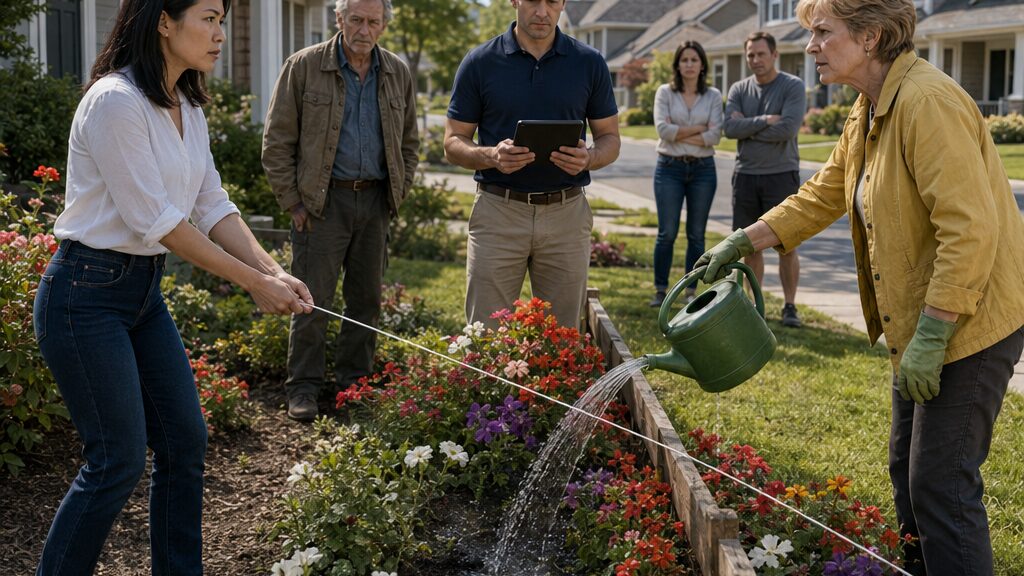
By the time she reached the front door, two of the women were carrying empty trays toward the sidewalk. Margaret remained near the center of the new bed, wearing gardening gloves and a yellow jacket bright enough to compete with the flowers.
“Good morning,” Margaret called. “We were hoping to finish before you woke up.”
Anna stopped on the porch.
“Finish what?”
Margaret glanced down at the border as if the answer were obvious. “Your welcome garden.”
The other women exchanged small smiles. One murmured something about coffee and headed away. The second followed with a bag of potting soil against her hip.
Anna descended the steps slowly.
The flowers were beautiful. That was what made her confusion harder to organize. Nothing looked damaged from a distance. The curve softened the empty lawn and drew attention away from the plain concrete path. Someone had even arranged the colors so the red flowers repeated every few feet.
But the smell of torn earth reached her before she reached the bed.
“You planted these here?”
Margaret laughed lightly. “Of course. We all thought the front needed something.”
“We?”
“Several of us.”
Anna looked toward the retreating neighbors, then back at Margaret. “Last night?”
“Early this morning. Cooler for the roots.”
Margaret bent to lift the watering can. She tipped it over a cluster of white flowers, sending a soft stream into the soil.
Anna heard herself say, “I appreciate the thought.”
The sentence came automatically. It had the polished shape of every phrase she used when a relative rearranged her plans, when a coworker volunteered her for something, when someone offered help that had already become an obligation.
Margaret’s shoulders relaxed.
“I knew you would.”
“But I didn’t give anyone permission to dig in my yard.”
The watering can remained tilted for another second before Margaret righted it.
“Oh.” Her smile narrowed. “I thought we understood each other.”
“We talked about gardening. You said the soil here was difficult.”
“And you said you appreciated advice.”
“Advice isn’t the same as planting.”
Margaret looked toward the sidewalk, perhaps checking whether the others were still close enough to hear. “Anna, it was meant as a welcome. This part of the street has always had coordinated beds.”
Anna crouched beside the nearest cluster. The soil was loose and black, unlike the compact pale dirt around it. A shallow trench curved toward the property divider, then continued several feet onto her side.
Near the wooden boundary, a small metal marker protruded through the grass. Anna had noticed it during the inspection before closing. The new flower bed crossed well past it.
She pointed. “That marker is the property line, isn’t it?”
Margaret’s expression changed so slightly Anna might have missed it if she had not been watching. The neighbor’s eyes went first to the marker, then to the flowers beyond it.
“That old thing isn’t exact.”
“It was in the survey packet.”
“Surveys can be interpreted in different ways.”
Anna stood. “Can they?”
A garage door opened two houses down. A man paused beside his car and looked toward them. Across the street, a woman carrying a travel mug slowed on the sidewalk.
Margaret lowered her voice.
“No one is trying to take anything from you.”
“I didn’t say they were.”
“You’re acting as though someone damaged the house.”
“I’m asking why people entered my yard without asking me.”
The woman across the street stopped near the curb. “They look wonderful,” she offered. “Margaret helped us with ours last year.”
Anna turned toward her. “Did she ask first?”
The woman’s mouth opened, then closed around a smaller answer. “Well, yes.”
Margaret set the watering can down harder than necessary.
“This neighborhood takes curb appeal seriously. Empty beds affect everyone.”
Anna looked at the flowers again. Their bright heads faced the morning light, perfectly arranged, already making her bare lawn appear unfinished without them.
That was the trap. To object was to become the person who hated flowers, generosity, and neighbors. The plants themselves seemed to testify against her.
“I’m not asking anyone to remove them right now,” Anna said. “I’m asking that no one touch anything else until I confirm the line and understand what happened.”
Margaret folded her gloved hands. “Removing them later could kill them.”
“Then it was a risk to plant them without permission.”
The man near the garage had begun walking toward them. He was older, gray-haired, and carried no gardening tools. He stopped several yards away, close enough to listen but not yet close enough to join.
Margaret noticed him.
“Robert,” she said, “tell her these beds have always been part of the street plan.”
Robert Harris looked from Margaret to Anna, then down at the fresh border. His gaze settled on the metal marker.
“They’ve been part of the street,” he said carefully. “That doesn’t necessarily make them part of a plan.”
Margaret’s jaw tightened.
Anna felt a small release in her chest, but Robert did not continue. He put his hands into his jacket pockets and studied the flowers as if they had asked him a question he preferred not to answer.
The second observing neighbor moved nearer. “It seems like there should be a simple compromise.”
Anna looked at the dark soil scattered across her grass. “A simple compromise would have been asking me yesterday.”
No one replied.
Margaret picked up the green watering can.
“You’re new,” she said. “I understand that this may feel unfamiliar. But people here help each other. We don’t put everything in writing before doing something kind.”
Anna almost apologized for making the morning uncomfortable. She felt the impulse rise with startling force.
Instead, she stepped beside the metal marker.
“Please leave the flowers as they are until the property line is confirmed.”
Margaret stared at her.
Then she turned toward the house next door.
“That may not be your decision anymore.”
Anna thought she had misheard. “What does that mean?”
Margaret removed one glove finger by finger.
“I sent photographs to management before we started. Thomas is already coming.”
“Why?”
“To inspect the landscaping issue.”
Anna looked across her own lawn, at the flowers planted while she slept, the torn soil, the empty nursery trays, and the neighbors waiting to see whether she would raise her voice.
“What landscaping issue?”
Margaret tucked the gloves beneath the watering-can handle.
“Yours.”
Chapter 2: Everyone Had an Opinion Except the Owner
Thomas Roberts photographed Anna’s yard before asking her what had happened.
He arrived in a silver sedan less than forty minutes after Margaret’s announcement, carrying a tablet and wearing a navy polo embroidered with the property-management company’s name. He stepped onto the sidewalk, took three wide photographs, then crouched to capture the flower border from curb level.
Anna stood near the porch with her survey packet folded beneath one arm.
“Would you like to hear why you’re here?” she asked.
Thomas straightened. “I’ve received the initial report.”
“From Margaret.”
“From a resident.”
Margaret stood beside the new bed holding the green watering can. She had changed her gloves but not her position. Two neighbors remained nearby, pretending to discuss a shrub across the street.
Thomas tapped his screen. “The concern appears to involve incomplete frontage landscaping and a disagreement regarding corrective work.”
Anna stared at him. “Corrective work?”
“The association’s standards require maintained planting areas where established streetscape elements exist.”
“There was no planting area yesterday.”
Margaret gave a quiet sigh. “There was always a bed here. It had simply been neglected.”
“This house was vacant for six weeks,” Anna said.
“Which is why we helped,” Margaret replied.
Thomas took another photograph.
Anna felt anger gather behind her ribs, but she kept her voice level. “People entered my property and planted flowers without permission. That is the issue.”
Thomas glanced at Margaret. “Were you under the impression that permission had been given?”
“I was more than under the impression.”
Margaret reached into her jacket pocket and produced her phone.
Anna’s stomach tightened.
Margaret scrolled, then held up the screen. “This was after I explained that the front soil needed attention.”
Thomas read aloud. “‘Thank you for letting me know. I appreciate any advice while I’m getting settled.’”
The words sounded different in his voice—formal, complete, almost contractual.
Anna remembered typing them while standing among half-open moving boxes. Margaret had sent three paragraphs about clay soil, approved edging, irrigation schedules, and which trash cans could remain visible from the street. Anna had been exhausted. She had answered with courtesy because courtesy was faster than a conversation.
“That says advice,” Anna said. “Not permission to dig.”
Margaret swiped to another message. “Then I wrote that several of us could help with the front.”
“What exactly did I answer?”
Margaret’s thumb paused.
Thomas looked at her.
She lowered the phone slightly. “You sent a heart reaction.”
One of the observing neighbors looked away.
Anna could almost hear how ridiculous her objection might sound to them. A heart icon. Flowers. A welcome gesture. Against those things she had only a line in the soil and the fact that no one had asked a direct question.
“A reaction to a message is not authorization,” she said.
Thomas’s expression remained neutral, but his tone hardened into procedure. “This is why the association encourages homeowners to communicate clearly.”
Anna unfolded the survey packet.
“I agree.”
She walked to the wooden divider and located the metal marker beneath the grass. Before anyone could interrupt, she pulled a thin roll of white mason’s string from the packet sleeve. It had been left by the surveyor at closing. She tied one end to the marker, crossed the lawn, and secured the other to a temporary stake near the sidewalk.
The line ran straight through the flower bed.
Several red and purple plants sat fully on Anna’s side. Others straddled the string. Margaret’s watering can rested beyond it, near Anna’s walkway.
Thomas looked down.
Margaret stepped into the bed and lifted the can.
Water spilled from its spout as she moved it, darkening the soil across the white string.
“There,” Anna said. “That is what I’m asking you to inspect.”
Thomas zoomed in with his tablet camera.
“The visible marker does not establish the full legal line on its own.”
“No,” Anna said. “The survey does.”
She opened the packet to the parcel diagram.
Thomas did not take it. “I’m not qualified to interpret private surveys.”
“But you’re qualified to tell me the flowers are established landscaping?”
“That is a maintenance classification.”
“Established since dawn?”
A short breath escaped Robert Harris. It might have been a laugh, but when Anna looked at him, his face was serious.
He had joined the group without anyone noticing. He wore work boots and a faded canvas jacket. His attention stayed on the string.
Thomas turned. “Robert, you used to assist with the grounds committee. Do you know whether this bed is part of the approved landscape plan?”
Robert rubbed one thumb along the seam of his pocket.
“The association plan stops at the common entrance and the mailbox islands.”
Margaret’s head snapped toward him.
“What about the coordinated frontage?” Thomas asked.
“That was neighbor-maintained.”
“So there was an established pattern.”
“There was an informal pattern.”
Thomas’s mouth tightened. “Those terms may not be meaningfully different for maintenance purposes.”
“They’re different if the plants are on private property,” Robert said.
Margaret held the watering can close to her leg.
“You helped design these beds.”
“I helped people who asked.”
“You know how long they’ve been here.”
Robert looked at the new flowers. “Not these plants.”
Margaret’s face went pale beneath the morning color.
Anna noticed it before anyone else did. This was not merely a disagreement about whether the bed existed. The arrangement itself mattered to Margaret—the repeating reds, the white clusters, the purple at each end. She watched Robert as if he had denied something more personal than landscaping history.
Thomas broke the silence.
“Regardless of how installation occurred, removal could create an appearance issue while the board reviews the matter.”
Anna turned to him. “Are you telling me I cannot remove things planted on my property without permission?”
“I’m advising you not to disturb established landscaping until management determines whether a violation would result.”
“You keep calling it established.”
“It now exists.”
The simplicity of that answer stunned her.
Someone could act before she objected, and the speed of the action became its own defense. The flowers had been in the ground less than three hours, yet Thomas spoke as if Anna had inherited an obligation from them.
She took the survey diagram from its sleeve.
“Show me the written authorization.”
Thomas blinked. “For what?”
“For entering my yard. For installing the plants. For classifying them as an association-controlled feature. Any of it.”
“This isn’t a courtroom.”
“I didn’t say it was.”
Margaret shifted the watering can to her other hand. “No one has claimed association control.”
“You said it might not be my decision anymore.”
“I said there are standards.”
“Standards are not permission.”
One of the neighbors murmured, “She’s making this much bigger than it needs to be.”
Anna heard it clearly.
She turned, not toward the voice but toward Thomas.
“Nobody gets to call a decision communal when the only owner involved was excluded from it.”
For the first time, Thomas stopped typing.
The street had gone quiet enough for Anna to hear water dripping from Margaret’s can onto the mulch.
Robert stepped closer to the string.
“The flowers are attractive,” he said. “But the line is the line. And unless the deed says otherwise, that side belongs to Anna.”
Margaret looked at him with naked disbelief.
“You don’t know what the deed says.”
Robert met her gaze. “Do you?”
Her silence lasted half a beat too long.
Thomas cleared his throat. “I’ll review the governing documents and inspection history. Until then, no one should make additional changes.”
Anna nodded once. “That is what I requested before you arrived.”
“However,” he continued, “I must also advise you that allowing planted material to decline could violate maintenance requirements. If the plants remain, they need water.”
Margaret lifted the green can slightly, an almost unconscious claim.
Anna looked at the flowers, then at the damp trail crossing the survey string.
“I will water anything on my property,” she said.
Margaret’s grip tightened around the handle.
“You don’t know what these need.”
“Then you can write down the instructions.”
The two observing neighbors exchanged glances. Melissa Clark had appeared near the sidewalk, dressed in denim overalls and holding a mug. She had not spoken, but her eyes moved from Anna to the string and then to Margaret.
Thomas closed the tablet cover.
“I’ll send a written summary.”
He walked back to his sedan without inspecting the rear of the bed or asking who had purchased the plants. Margaret carried the watering can home. The neighbors dispersed with the disappointed slowness of an audience denied a louder ending.
Robert remained.
Anna loosened the string where Margaret’s spilled water had pulled it toward the soil.
“You knew there used to be a bed here,” she said.
He looked toward Margaret’s house.
“I knew there used to be more than one.”
“What does that mean?”
Robert put his hands into his pockets again. “It means you should read whatever Thomas sends before you answer.”
“That isn’t an answer.”
“No.” He looked tired. “It’s the best advice I can give without making something worse.”
He walked away before she could stop him.
At 11:42 that morning, Anna’s phone chimed.
The email subject read: FRONTAGE LANDSCAPE MAINTENANCE NOTICE.
She opened the attached letter.
The inspection time listed at the top was 12:15 p.m.—thirty-three minutes in the future.
Yet the notice had already determined that the flower bed was an established streetscape element and warned Anna not to remove, relocate, or allow it to deteriorate pending review.
At the bottom, beneath Thomas Roberts’s digital signature, one sentence had been bolded:
HOMEOWNER ACTION CREATED OR CONTRIBUTED TO THE CURRENT CONDITION.
Anna read it twice.
The inspection notes were not complete.
The decision was.
Chapter 3: The Message That Sounded Like Permission
Anna found her own politeness quoted on page four of the complaint packet.
Thomas sent the file Monday morning, two minutes before Anna’s first work meeting. She opened it expecting photographs and rule citations. Instead, she found screenshots of messages between herself and Margaret, arranged beneath the heading HOMEOWNER CONSENT AND COORDINATION.
The first screenshot showed Margaret’s long explanation about the front soil.
The second showed Anna’s reply:
Thank you for letting me know. I appreciate any advice while I’m getting settled.
The third showed Margaret’s offer to have “a few of us help make the frontage look welcoming.”
Below it sat Anna’s heart reaction.
The packet did not include the message Anna had sent after discovering the flowers.
Please stop work until we clarify the property line.
That message appeared nowhere.
Anna minimized the file when her meeting began, but the words stayed behind everything her coworkers said. During a discussion about delayed approvals, she caught herself telling someone, “Let’s make sure silence isn’t treated as agreement.”
No one noticed the irony.
At lunch, she printed the packet and spread it across the dining table. Thomas had included eight photographs. Six were taken after the flowers were planted. One showed Anna standing on the porch with her arms folded. Another showed Margaret holding the watering can while Anna pointed toward the ground.
The captions beneath the images described “homeowner disagreement regarding existing landscape maintenance.”
Not installation.
Not entry.
Not permission.
Anna checked the timestamps. Margaret’s first photograph had been taken at 5:58 Saturday morning, before Anna opened the blinds. It showed black nursery trays lined along the sidewalk and a portion of the completed bed. In the corner of the image, one of the other women held a shovel.
Anna stared at the photograph until her embarrassment shifted into something colder.
They had documented the work before she knew it existed.
She drafted an email to Thomas.
The planting was unauthorized. The packet omits my written objection and incorrectly labels new work as existing maintenance.
She stopped.
Was “unauthorized” too aggressive? Should she say “not expressly authorized”? Should she acknowledge the heart reaction? Should she attach the survey? Should she wait for the county parcel map?
Her cursor blinked at the end of the sentence.
Twenty minutes passed.
She saved the message as a draft.
By Tuesday afternoon, several flowers near the middle of the bed had begun to wilt. Their leaves curled inward despite the water Anna applied that morning. When she knelt to inspect them, she found roots bent sideways inside holes too shallow for the nursery plugs.
The hurried planting had damaged them.
Margaret watched from her driveway.
“You’re overwatering the salvia,” she called.
Anna rose slowly. “I followed the nursery tags.”
“These aren’t nursery conditions.”
“You said you would write down the instructions.”
“I didn’t think you were serious about excluding me from their care.”
Anna looked at the green watering can beside Margaret’s garage door.
“They’re in my yard.”
Margaret’s gaze moved to the wilting plants. “And they’re suffering.”
The accusation was soft, almost sorrowful. It struck exactly where Margaret intended it to.
Anna felt herself begin to explain. She wanted to describe the shallow holes, the damaged roots, the morning watering schedule. She wanted Margaret to understand that she was not careless.
Instead, she asked, “Why wasn’t my stop message included in the packet?”
Margaret’s expression became guarded. “Thomas asked for relevant communication.”
“You didn’t think my objection was relevant?”
“I thought the issue was what we understood before the planting.”
“What did you understand?”
“That you wanted help.”
“No. You understood that I was being polite.”
Margaret’s face hardened. “That’s convenient now.”
Melissa Clark approached along the sidewalk carrying a cardboard drink tray. She slowed when she saw them.
“I brought coffee,” she said. “I can come back.”
“No,” Margaret replied quickly. “Maybe you can help Anna understand that no one meant any harm.”
Melissa looked at the wilted flowers.
“I know nobody meant harm.”
“That isn’t the same as nobody caused it,” Anna said.
Melissa shifted the tray to one hand. “I probably should tell you something.”
Margaret turned.
Melissa’s eyes stayed on Anna. “Saturday morning, Margaret told us you had asked for help with the whole front bed.”
“I said she welcomed help,” Margaret corrected.
“You said she wanted it done before the weekend inspection.”
“There was an inspection scheduled.”
“After you contacted Thomas,” Anna said.
Margaret lifted her chin. “Because the yard had been empty for weeks.”
Melissa looked between them. “When we were carrying the trays, you said Anna had picked the colors.”
Anna’s attention sharpened. “I never discussed colors.”
Margaret’s cheeks flushed.
“I may have said you would like them.”
“That isn’t what you told us,” Melissa said.
The street seemed to contract around the three women.
Margaret crossed her arms. “I was trying to keep everyone focused. People hesitate when they think there may be conflict.”
“You removed the hesitation by telling them I agreed,” Anna said.
“I removed unnecessary confusion.”
Melissa set the coffee tray on the low divider. “Margaret.”
“What? The flowers needed to go in. They had already been purchased.”
“By whom?” Anna asked.
Margaret looked toward her house.
It was not an answer.
Melissa exhaled. “I’m sorry, Anna. I thought you knew.”
The apology did not solve anything, but it shifted the weight of the morning. For the first time, someone who had participated acknowledged that Anna’s version was not unreasonable.
“What exactly did Margaret say at the beginning?” Anna asked.
Melissa rubbed her thumb against the cardboard tray.
“First she said you had asked for suggestions. Then she said you were fine with us taking care of it. By Friday night, she said you wanted the bed restored.”
“Restored?”
Melissa nodded. “That was the word.”
Margaret picked up one of the coffees.
“This conversation is becoming cruel.”
Anna looked at her. “What was being restored?”
Margaret’s hand stopped halfway to the cup.
For a moment, the defensiveness vanished. Something frightened and private moved across her face.
Then she looked away.
“You wouldn’t understand.”
She carried the coffee home without another word.
That evening, Anna finally sent her email to Thomas. She attached the omitted message, the survey diagram, and close photographs of the bent roots.
His reply arrived the next morning.
Thank you for the additional context. Management will review. In the interim, the association’s landscaping vendor has been asked to stabilize and complete the frontage bed to prevent further decline.
Anna read the sentence three times.
Complete.
She called Thomas immediately.
He did not answer.
She called the management office. The receptionist said he was in inspections until noon. Anna emailed again, this time without softening anything.
I do not authorize additional planting, digging, edging, watering, or vendor access on my property.
The message showed as delivered.
At 10:17, while Anna was presenting a project schedule from her home office, she heard the mechanical rattle of a trailer hitch outside.
She muted herself and went to the window.
A white landscaping truck had stopped at the curb. A vendor representative stepped down and opened the trailer gate.
Behind him stood rows of red, white, and purple flowers arranged in the same repeating pattern as Margaret’s border.
Margaret waited beside the sidewalk with her green watering can.
The representative lifted a shovel and looked toward Anna’s yard.
“Mrs. Baker said we’re extending the bed to the walkway,” he called.
Anna opened the front door.
“Who authorized that?”
The man glanced at his clipboard.
“Management.”
Chapter 4: The Garden That Belonged to Someone Else
Robert recognized the flower pattern before Anna finished unfolding the photograph.
He stood at the workbench in his garage, one hand resting beside a rusted pair of pruning shears. The photograph had slipped from an old folder he had brought down from a metal cabinet. Its colors were faded toward yellow, but the arrangement was unmistakable: red flowers repeating at even intervals, white clusters between them, purple plants anchoring both ends.
The same pattern now crossed Anna’s front yard.
Robert lowered himself onto a stool.
“Where did you get this?” Anna asked.
“I took it.”
In the photograph, two women knelt on opposite sides of the low wooden divider. One was younger Margaret, her hair darker and tied beneath a scarf. The other woman resembled her closely enough to be family.
Behind them stood Anna’s house, painted a pale blue it no longer wore.
“Who is she?”
Robert stared at the photograph.
“Margaret’s sister.”
Anna waited.
“She owned your house.”
The garage seemed to narrow around the answer. Along one wall hung rakes, shovels, and edging tools organized by size. Nothing in the room appeared accidental, except the silence Robert had kept.
“They planted the border together?” Anna asked.
“For years. It ran from Margaret’s porch, across the divider, and along the front of both homes. They changed the annuals, but the pattern stayed.”
“Was there an agreement?”
Robert looked toward the open garage door. Margaret’s yellow jacket was not visible across the street, yet he lowered his voice.
“There was an understanding.”
“That isn’t what I asked.”
“No. There was no written agreement.”
Anna placed the photograph on the workbench.
“Then why did Thomas call it established landscaping?”
“Because people remember seeing it.”
“People also remember the house being blue.”
Robert gave a tired nod. “Memory has a way of dressing itself up as a rule.”
He opened the folder again. Inside were photographs from neighborhood cleanup days, old grounds-committee notes, and printed garden layouts. Anna scanned the pages for an association stamp. None had one.
Robert tapped the photograph.
“Margaret’s sister became ill. The garden was something they could still do together. At the end, Margaret handled most of it, but her sister chose the colors.”
The explanation softened the edges of Anna’s anger without dissolving it.
“What happened after she died?”
“The house transferred to her estate. Then it sat. Margaret kept maintaining the bed because no one stopped her.”
“And when it was sold to me?”
Robert’s mouth tightened.
“That should have ended it.”
“Should have?”
“I told Margaret the new owner would decide what happened next.”
“When?”
“Before your closing.”
The words landed harder than Anna expected.
Margaret had not mistaken an old custom for a current right. She had been warned that the arrangement no longer belonged to her.
Robert turned away and began rearranging tools that were already straight.
“I also told her you might appreciate the history.”
“That is not the same as permission.”
“No.”
“Did you tell Thomas about any of this?”
“Not before Saturday.”
Anna looked at him.
He exhaled. “I thought Margaret would speak to you. I thought the two of you would work it out before management got involved.”
“You thought staying out of it would keep the peace.”
“Yes.”
“It didn’t.”
“No.”
For the first time, Robert’s neutrality looked less like wisdom and more like avoidance. He had known the border’s history, known the property had changed hands, and watched Margaret rebuild the pattern anyway.
“Why didn’t you say this in the yard?” Anna asked.
“Because once grief is made public, people use it to excuse everything or dismiss everything. Neither is fair.”
“And keeping it private was fair to me?”
Robert did not answer.
That afternoon, Anna carried the survey packet and the old photograph to the county property-record office. A clerk pulled the parcel history, scanned older deeds, and checked for easements, maintenance covenants, or recorded landscaping agreements.
There were none.
The legal boundary matched Anna’s survey. The strip where the flowers had been planted belonged entirely to her parcel.
The clerk turned the monitor slightly.
“There is a note from the prior transfer file,” she said. “Not a restriction. Just correspondence.”
A scanned letter appeared on-screen. It had been sent by the estate’s attorney during the sale preparation.
Existing personal landscaping arrangements with the adjacent owner will not survive transfer unless separately accepted by the purchaser.
Anna read the sentence twice.
“Who received this?”
“The estate, the listing agent, and the adjacent owner who had requested continued access.”
“Margaret?”
The clerk pointed to the name on the distribution line.
Margaret Baker.
Anna photographed the record reference, then sat in her car without starting it.
The flowers had begun as an intrusion. The photograph made them something more complicated: a ritual, a memorial, perhaps the last visible place where two sisters had made decisions together.
But the letter changed the shape of Margaret’s innocence.
She had known.
By evening, the old photograph lay on Anna’s dining table beside the county record. The repeating pattern no longer looked merely decorative. It looked like handwriting—recognizable, intimate, and copied onto a page that now belonged to someone else.
A knock sounded at the front door.
Margaret stood outside without the watering can.
Anna brought the photograph to the doorway.
Margaret saw it and stopped breathing for a moment.
“Robert gave you that.”
“He showed it to me.”
“He had no right.”
Anna almost laughed at the word.
“Your sister lived here.”
Margaret’s gaze remained on the image. “For twenty-three years.”
“I’m sorry.”
The sympathy was real, and Margaret seemed to hear that. Her shoulders loosened, but only slightly.
“She chose the red spacing,” Margaret said. “Three white plants, then one red. She said too much red made the whole thing look anxious.”
Anna looked down at the photograph.
“It mattered to both of you.”
“It still matters.”
“I understand that better now.”
Margaret’s eyes lifted, hopeful and wary at once.
“But you knew the arrangement ended when the property transferred.”
The hope vanished.
Anna placed a copy of the county correspondence beneath the photograph.
Margaret did not touch it.
“That letter was written by an attorney who never saw the garden.”
“It was sent to you before I bought the house.”
“I thought once you saw what belonged there, you would understand.”
“You decided I would understand after it was already done.”
“I knew what would happen if I asked.”
Anna held her gaze. “You thought I might say no.”
Margaret’s face tightened.
“That doesn’t mean no would have been reasonable.”
The answer stripped away the last possibility that this had been only a misunderstanding.
Margaret had recognized Anna’s right to choose. She had simply believed her own reason was more important.
Anna folded the copy once.
“Why did you tell the neighbors I requested the work?”
Margaret looked past her toward the dining table, where the photograph remained visible.
“Because they would not have helped otherwise.”
Chapter 5: A Peace Offering That Crossed the Line Again
Anna woke Saturday to a strip of fresh soil extending two feet beyond the place everyone had agreed to stop.
The temporary agreement had been simple: no new planting, no removal, and no work by either household until the board reviewed the records. Thomas had confirmed it by email. Margaret had replied with one word.
Agreed.
Yet a narrow trench now reached toward Anna’s walkway, filled with six new white flowers and one red plant.
The green watering can stood on Anna’s side of the survey string.
Anna went outside in slippers.
Margaret was kneeling beside the extension, pressing mulch around the red plant.
“What are you doing?”
Margaret did not look up. “Finishing the sequence.”
“We agreed not to change anything.”
“I didn’t change the existing bed.”
“You extended it.”
“The pattern was incomplete.”
Anna stared at the line of flowers. Three white, one red. The same rhythm from the photograph.
“You said you agreed.”
“I agreed not to disturb what was already planted. These were delivered yesterday, and leaving them in trays would have killed them.”
“So you created an emergency and used it as permission.”
Margaret sat back on her heels.
“You’re reducing everything to language.”
“Language is how people know what they agreed to.”
“You know what this pattern means now.”
“Yes.”
“Then you know why it cannot end halfway.”
Anna looked toward Margaret’s house. The original border continued neatly along her side, ending near the porch. If the complete pattern were moved there, nothing essential would disappear except Margaret’s claim over Anna’s ground.
“You could finish it on your property.”
“It was never designed that way.”
“Your sister’s house was sold.”
Margaret flinched.
Anna immediately regretted the bluntness, but she did not withdraw it.
Margaret rose and brushed soil from her gloves.
“I tried to give you time.”
“You gave me flowers.”
“I gave you something that belonged to this place.”
“You cannot give me something by taking away my choice.”
A car door closed at the curb. Melissa crossed the lawn with her phone in one hand.
“The board meeting was moved up,” she said. “Thomas sent a notice.”
Anna checked her inbox. The meeting would begin at ten in the association room. The listed action item was “retroactive approval of frontage restoration.”
Restoration.
The word Margaret had used from the beginning.
Melissa saw the new plants and stopped.
“You added more?”
Margaret lifted the watering can. “I completed the visual sequence.”
“After the written hold?”
“The plants were already purchased.”
Melissa’s expression changed.
“I told the board I supported a temporary compromise,” she said. “Not this.”
Margaret looked wounded. “You know why the garden matters.”
“I do. I also know Anna asked us to stop.”
“We are talking about seven plants.”
“We were always talking about whether she got to decide.”
Margaret stared at her, then carried the watering can home without another word.
At the association room, Thomas sat beside the board president with a folder arranged squarely before him. Anna, Margaret, Robert, and Melissa occupied the first row. Enlarged photographs of the flower border appeared on a monitor.
Thomas described the issue as an effort to regularize an “historically continuous frontage feature.” He did not mention the overnight installation until Anna interrupted.
“Was the work authorized before it began?”
Thomas clasped his hands. “The communication history was ambiguous.”
“My written objection was not.”
“That came after installation.”
“Because I did not know about the installation until after it happened.”
The board president looked toward Thomas. “Who approved the vendor work that followed?”
Thomas hesitated.
Anna watched him choose between accuracy and self-protection.
“I authorized stabilization measures,” he said. “The intent was to prevent plant loss while the matter was reviewed.”
“You authorized work after I expressly refused access.”
“The vendor was told not to alter disputed areas.”
“They arrived with plants for the disputed area.”
Thomas adjusted the folder.
“There may have been a misunderstanding between management and the vendor.”
Margaret spoke from behind Anna.
“I told them where the bed had always run.”
Thomas turned toward her. “You directed the crew?”
“I clarified the design.”
The board president’s face tightened. “At management’s request?”
Margaret did not answer.
The room grew still.
Melissa stood.
“I need to correct something I previously told the board,” she said. “I supported the original planting because I believed Anna had requested help. Margaret told several of us that she had. That was not true.”
Margaret’s chair scraped against the floor.
“I said Anna welcomed help.”
“You said she chose the colors.”
“I said she would like them.”
“You also said she wanted the old border restored before inspection.”
The board president raised a hand, but the damage had already shifted direction. The issue could no longer be reduced to poor communication between two neighbors.
Thomas opened another document.
“The board may still approve the bed retroactively if it determines the design serves a legitimate community appearance interest.”
Anna looked at the monitor. The photographs flattened everything—the property line, the damaged roots, the watering can placed beyond the string. On-screen, the flowers were simply attractive.
A vote in this room would favor the image over the boundary.
Her old instinct urged her to request more time, gather more records, and prepare a better packet. Instead, she stood before she had arranged every sentence.
“You should not vote here.”
The board president frowned. “The meeting has been properly noticed.”
“I’m not disputing the notice. I’m asking you to see what you’re approving.”
Thomas leaned toward the microphone. “The photographs are comprehensive.”
“No. They make the bed look like one object. It isn’t. It crosses two properties, and every disputed plant can be identified.”
Margaret watched her closely.
Anna continued.
“Hold the vote in the yard. Put the survey line back down. Let the board stand where the work happened and decide whether a neighborhood tradition can be imposed on one owner’s parcel.”
Thomas shook his head. “On-site meetings create logistical issues.”
“So did authorizing a vendor to enter my property.”
The board president looked at the other members. Quiet discussion passed between them.
Finally, she said, “The vote will be continued to next Saturday at the property.”
Thomas closed his folder with controlled irritation.
Outside the meeting room, Robert caught up with Anna.
“What are you planning to show them?”
Anna looked toward Margaret, who stood alone near the parking lot with the watering can hanging from one hand.
“The difference between saving flowers,” Anna said, “and letting them decide where they belong.”
Chapter 6: The Boundary Meeting No One Could Reframe
By nine o’clock Saturday morning, every disputed flower had been lifted intact from the ground.
Anna had not thrown them away. She had spent Friday evening loosening the soil around each root ball, placing the plants into black nursery trays, and labeling their original positions with strips of masking tape.
The beds on both sides of the wooden divider were empty.
A taut white survey string ran between them.
On Anna’s side, the disturbed earth formed a long dark scar. On Margaret’s side, the original bed remained shaped but bare where the repeated pattern had once crossed between the houses.
The HOA board arrived to find the red, white, and purple flowers arranged in trays beside the legal line.
Thomas stepped out of his car and stopped.
“You were advised not to remove established landscaping.”
“I preserved every plant,” Anna said. “Nothing was discarded.”
“You altered the site before the vote.”
“I made the site visible.”
Margaret stood near her porch clutching the green watering can. She had not spoken since coming outside.
Robert had helped Anna lift the plants, but now he remained beside his garage, leaving the center of the yard to her. Melissa set folding chairs near the sidewalk for the board members and then stepped away.
The board president walked along the survey string.
“This matches the recorded parcel map?”
Anna handed her copies of the county record and survey.
“The marker at the divider and the front stake establish the line shown there.”
Thomas opened his tablet. “The association does not adjudicate property boundaries.”
“Then it cannot approve landscaping across one.”
He looked up.
Anna gestured toward the trays.
“Those plants were arranged to appear like one continuous feature. They are not one feature. They occupied two separate parcels, and no recorded agreement joins them.”
Margaret’s watering can creaked as her grip tightened around the handle.
The board president examined the photographs Anna had placed on a small table: the old image of Margaret and her sister, the pre-sale correspondence, the message screenshots, and the vendor work order.
“Mrs. Baker,” she said, “did you receive notice that the prior arrangement would not continue automatically after the sale?”
Margaret stared at the empty bed.
“Yes.”
Thomas shifted his weight.
The admission moved through the group more quietly than an accusation would have.
The board president continued. “Why did you represent the planting as approved?”
“I believed Anna would accept it once she understood.”
“That is not what I asked.”
Margaret lifted her eyes.
“Because if I had asked directly, she might have said no.”
No one spoke.
Across the yard, a sprinkler clicked on and began ticking through its arc, sending water over a lawn untouched by the dispute.
Anna watched Margaret’s face. The older woman no longer appeared indignant. Without the flowers between them, she looked exposed.
Margaret set the watering can down but kept one hand on its handle.
“My sister could not leave the house during her last summer,” she said. “She sat by that front window and told me where each plant should go. When the red ones bloomed, she could see them from her chair.”
Her voice remained controlled until the final word.
“The pattern crossed the divider because we did. We never treated the yards as separate.”
Robert lowered his head.
Margaret continued.
“After she died, I kept planting it. When the estate cleared the house, when strangers walked through it, when the sign went up—I kept the bed the same. It was the only part no one had emptied.”
Anna looked toward her own front window.
She imagined another woman behind the glass, watching the red flowers emerge between white clusters. The image was easy to understand. That did not make Margaret’s choice harmless.
“You could have told me,” Anna said.
Margaret gave a brittle laugh. “And asked you to maintain a dead woman’s garden in front of your new home?”
“You could have asked what I was willing to do.”
“I did not want a smaller version.”
There it was—not only grief, but control shaped around grief.
Margaret pointed toward the trays.
“If you move the pattern to my side, it will face the wrong direction. The red sequence was meant to be seen from her window.”
Anna had expected the objection. She walked to the small table and unfolded a drawing.
It showed Margaret’s front porch and the bed beside it. The original sequence—three white plants, one red, purple at the ends—fit entirely within Margaret’s parcel. The curve faced inward toward Margaret’s sitting-room window rather than Anna’s.
“I measured your side,” Anna said. “The whole pattern fits here.”
Margaret did not approach the drawing.
“That is not where she saw it.”
“No.”
“Then it is not the same garden.”
“No,” Anna said again. “It would be a memorial garden, not a claim that time never moved.”
Margaret flinched as if struck.
Thomas stepped forward. “The board could consider a limited maintenance easement—”
“No,” Anna said.
The word came without preparation or apology.
Thomas stopped.
Anna turned to the board.
“I am not asking you to punish Margaret. I am asking you not to repair this by giving permanent authority over my property to the person who ignored my refusal.”
She looked at Margaret.
“I believe you loved your sister. I believe these flowers matter. But compassion cannot require me to surrender part of my home.”
Margaret’s mouth tightened.
“You make it sound as if I wanted your land.”
“You wanted the right to decide what happened on it.”
The distinction settled between them.
Robert came forward at last.
“I helped create the original curve,” he said. “I told both sisters the marker made the division awkward, and I said no one would care if the bed crossed it. That was careless.”
Margaret looked at him.
“You said it made the houses look connected.”
“It did.”
“And now?”
“Now one of those houses belongs to someone who did not agree.”
Robert pointed toward the trays.
“The flowers are still beautiful. But where they grow belongs to the person responsible for that ground.”
Thomas glanced toward the board president, perhaps hoping to redirect the meeting into procedure. She did not give him the opportunity.
“The association cannot retroactively approve private-yard work performed without owner consent,” she said. “The warning issued to Ms. Lee will be withdrawn. Management will review vendor-access procedures.”
The decision brought no applause. Only the sprinkler continued its steady clicking.
Margaret looked at the empty space where the flower border had been.
“You won,” she said to Anna.
The words held accusation rather than concession.
Anna shook her head.
“I still have torn soil in my yard. You still lost the place where you remember your sister. That is not a win.”
“What do you want from me?”
“The truth in the record. No more work on my side. And a decision about the plants.”
Margaret looked toward the trays.
Anna lifted the drawing.
“I will give you every plant from the original pattern for the memorial bed. Robert has agreed to help prepare the soil. Melissa offered to organize volunteers.”
Margaret stared at the design but did not take it.
“And your yard?”
“I will choose what goes there.”
“You may choose nothing.”
“I may.”
The possibility seemed to offend Margaret more than a different arrangement would have.
She picked up the watering can.
For a moment Anna thought she would carry it inside and leave the flowers to dry in their trays.
Instead, Margaret walked to the survey string.
She stood above it, looking down at the narrow white line that had divided the argument into something no one could call communal.
Then she stepped back onto her own property.
She placed the green watering can beside the proposed memorial bed.
The story has ended.