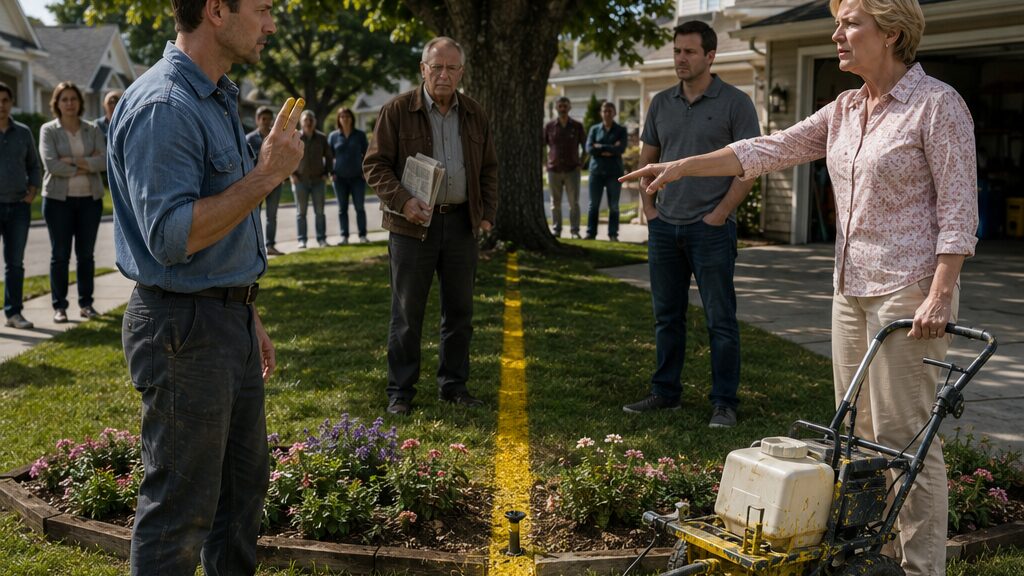
The Yellow Line Across His Lawn Washed Away, but the Boundary Fight Did Not
Chapter 1: The Yellow Line Appeared Before Breakfast
The yellow line began at the curb, crossed Ryan Lewis’s front lawn, cut through the edge of his flower bed, and stopped beneath the maple tree his father had planted twenty-two years earlier.
Ryan stood on the porch with one hand still wrapped around his coffee mug.
The line was too straight to be accidental. It was four inches wide, bright enough to hurt against the wet green grass, and fresh enough that a chemical smell drifted toward him in the morning air.
Across the street, Heather White was speaking to an irrigation contractor beside a wheeled paint machine.
Ryan set his mug on the porch rail.
“Heather.”
She turned, but she did not look surprised.
Several neighbors were already outside. One man held a leash while his dog pulled toward the yellow stripe. Another stood beside a mailbox with his arms folded. Michael Wright, Ryan’s next-door neighbor, watched from the edge of his driveway.
Ryan walked down the steps and stopped before his shoes touched the paint.
“Did you order this?”
Heather dismissed the contractor with a nod before answering.
“Yes.”
The simplicity of it unsettled him more than an excuse would have.
“You painted my lawn.”
“We marked the maintenance corridor.”
Ryan looked from her to the line. It passed directly over two sprinkler heads and through the cedar border he had installed around the flower bed.
“What corridor?”
“The access route to the shared drainage shutoff.” Heather spoke loudly enough for the neighbors to hear. “There has been confusion about where private landscaping ends.”
“There wasn’t confusion yesterday.”
“There has been for years.”
The contractor began wheeling the machine toward his truck. Ryan saw the label on one of the paint canisters before it disappeared beneath the handle: athletic field marking paint.
Heather stepped closer to the line.
“The committee authorized a visible boundary so everyone understands that this strip must remain accessible.”
“Which committee?”
“The landscape committee.”
“You chair the landscape committee.”
“That doesn’t make the need less real.”
Ryan crouched without touching the grass. The paint sat on the blades rather than soaking into the soil. He rubbed two fingers across the edge of the stripe. Yellow powder collected on his skin.
He heard someone behind him say, “Looks official enough.”
Heather heard it too. Her shoulders settled as if the comment had confirmed something.
Ryan rose.
“Who surveyed it?”
“The route is on the neighborhood maintenance map.”
“That isn’t what I asked.”
Heather’s mouth tightened. “We’re not going to turn this into a courtroom argument before breakfast.”
“You had a contractor paint across my property before breakfast.”
“It was done for the neighborhood.”
The phrase traveled farther than her voice. Ryan saw two neighbors exchange looks. Michael stared at the line where it approached the shared side yard.
Ryan kept his hands at his sides. He knew what anger looked like from the outside: raised volume, quick movement, a sentence regretted before it ended. His father had spent years fighting the old board over mailbox colors, fence heights, and a drainage trench that had never worked properly. Ryan had promised himself he would not inherit that habit.
But his silence had often been mistaken for agreement.
“Without asking?” he said.
Heather glanced toward the gathered neighbors. “We sent notices about preserving access.”
“You sent a newsletter reminding people not to block utility equipment.”
“And you built a garden border across the route.”
Ryan looked at the cedar boards. They were twelve inches high and stopped three feet from the circular valve box near the sidewalk. No one had mentioned them during installation. No worker had asked him to remove them.
Michael crossed the grass between their driveways.
“I’ve seen crews come through here,” he said. “More than once.”
Ryan turned to him. “Through my lawn?”
“Along this side. I think.”
Heather pointed down. “Exactly.”
“You think,” Ryan repeated.
Michael shifted his weight. “I’m saying it isn’t something she invented this morning.”
Before Ryan could answer, Edward Jones came down the sidewalk. He moved carefully, carrying a folded newspaper beneath one arm. He had lived in the neighborhood since before Ryan’s father bought the house and had worked in survey crews for the county before retiring.
Edward stopped beside the stripe.
“Field paint,” he said.
Heather’s expression hardened. “It is temporary by design.”
Ryan looked toward his irrigation controller mounted inside the open garage.
Heather followed his gaze. “Don’t be childish.”
“I’m checking your work.”
He crossed the driveway and opened the controller cover. Zone three controlled the front lawn. He turned the dial manually.
The sprinkler heads rose with a series of soft clicks.
Water struck the line at an angle. Yellow began bleeding from the grass almost immediately, thinning into pale streams that ran toward the gutter.
A neighbor laughed once, then covered it with a cough.
Heather stepped backward as spray darkened the toes of her shoes.
Ryan did not look at her. He watched the bright stripe dissolve into broken patches. Within a minute, the line that had looked absolute from his porch had become a dirty wash of color.
“The paint wasn’t the authority,” Heather said.
“No,” Ryan replied. “It just made the lack of authority easier to see.”
The contractor, now beside his truck, pretended not to hear.
Edward crouched where the line had passed near the maple. He studied the ground longer than the disappearing paint required.
Ryan shut off the sprinklers.
Edward stood slowly.
“She’s wrong to call that a surveyed boundary,” he said.
Heather folded her arms. “But?”
Edward looked toward the curb, then along the side of Ryan’s house.
“But there was an old maintenance route here. At least, that was the intention.”
Ryan felt the satisfaction leave the scene as quickly as the paint had.
“What intention?”
Edward glanced at Heather, then at the neighbors who had moved closer.
“Drainage work. Years ago. After the storm that flooded the lower lots.”
“My father never mentioned an easement across the front lawn.”
“I didn’t say easement.”
Heather seized on the distinction. “Call it whatever you want. Access has always been maintained.”
Edward shook his head. “That isn’t what I said either.”
The neighbors began talking among themselves. What had looked like a clean reversal now felt unfinished. The yellow water reached the gutter in narrow threads.
Ryan turned to Heather. “No one enters this yard again without written authority or my permission.”
“You may not have the right to refuse.”
“Then show me the right.”
She held his gaze for a moment, then walked across the street without answering.
By noon, most of the paint had vanished. Only a faint yellow stain remained near the curb.
At 4:17 that afternoon, Ryan’s phone vibrated on the kitchen counter.
The email came from Maria Torres, the HOA property manager.
The subject line read: NOTICE OF OBSTRUCTION—COMMON MAINTENANCE ACCESS.
Ryan opened the attachment.
He had seven days to restore unobstructed access or face daily fines.
Chapter 2: The Notice Used a Map Without Measurements
The notice contained a map, but the map contained no measurements.
Ryan enlarged it on his kitchen tablet Monday morning until the lines became blocky and the street names blurred. A red dashed route crossed the front corner of his lot, followed the side yard, and ended at a valve symbol behind the neighboring hedge.
There was no surveyor’s seal. No scale. No parcel number.
At the bottom of the page, someone had typed: MAINTENANCE CORRIDOR—DO NOT OBSTRUCT.
Ryan carried the tablet outside.
The faint yellow residue still marked the curb where the sprinkler had failed to reach. He crouched beside it and aligned the screen with the lawn.
The route on the map did not match the painted line.
Worse, it did not match the equipment.
The visible irrigation box sat several feet south of the dashed route. The drainage shutoff was farther toward Michael’s property than the map suggested. If a crew followed the red line exactly, they would walk into the maple tree.
Ryan took photographs from three angles, then emailed Maria requesting the recorded plat, easement language, survey date, and authorization for Saturday’s marking.
Her reply arrived eleven minutes later.
Please come to the management office at ten. Bring any records you believe are relevant.
The HOA office occupied a converted model home near the subdivision entrance. Maria Torres met him in a small conference room with the notice already printed.
She was younger than he expected, perhaps in her late thirties, dressed in a gray jacket with reading glasses resting on top of her head.
“I’ve paused the daily fine,” she said before he sat down.
“Paused isn’t withdrawn.”
“No. It isn’t.”
She rotated the maintenance sketch toward him.
Ryan placed his photographs beside it.
“The painted line, this dashed line, and the actual valve are in three different places.”
Maria examined the images. “The map is old.”
“How old?”
“I’m trying to determine that.”
“Who gave it to Heather?”
“The board’s shared records.”
“That wasn’t my question.”
Maria removed her glasses from her hair and put them on.
“Heather requested direction because she believed your garden border blocked routine access. I sent her the map. I did not authorize painting.”
“Did you tell her it was a recorded boundary?”
“No.”
“Did you tell her it wasn’t?”
Maria’s silence answered him.
Ryan leaned back. The room smelled faintly of printer toner and artificial lemon.
“This notice says common maintenance access.”
“That is how the route has been treated.”
“By whom?”
“Contractors. Prior boards. Residents.”
“Custom isn’t ownership.”
“No,” Maria said. “But long-standing access can create practical and legal questions.”
“Then ask those questions before accusing me of obstruction.”
Her jaw tightened, but she nodded once.
“That is fair.”
The admission did not sound like surrender. It sounded like someone recording a problem she would have to explain upward.
Maria opened a folder.
“We have invoices showing drainage crews used the route in three separate years.”
“Permission from the homeowner?”
“Not attached.”
“A recorded easement?”
“There is a utility easement on the original subdivision plat.”
“How wide?”
“The scanned copy is difficult to read.”
“Where does it run?”
“That is also difficult to read.”
Ryan tapped the map.
“Then this is not enough to fine me.”
“It is enough for the board to insist that no permanent obstruction be added until the location is confirmed.”
“The cedar border isn’t permanent.”
“It is anchored.”
“It lifts out in sections.”
Maria looked at him over her glasses.
“Would you agree not to extend it while we review the records?”
Ryan wanted to refuse on principle. The yellow line had been placed publicly, and now the private burden of restraint was being handed to him.
But refusing would give Heather the sentence she wanted: Ryan would not preserve access.
“I won’t extend it,” he said. “That isn’t permission to enter.”
“I’ll note that.”
“And the violation?”
“Paused pending review.”
He gathered his photographs.
Outside, Michael waited beside Ryan’s truck.
“I saw you pull in,” he said. “I had to drop off a pool form.”
Ryan unlocked the driver’s door but did not open it.
“Did you tell Heather crews crossed my lawn?”
Michael rubbed the back of his neck.
“She asked whether I remembered people using that side. I said yes.”
“How many times?”
“I don’t know. A few.”
“Did they ask permission?”
“I wasn’t standing there with a clipboard.”
Ryan looked toward the office window.
Michael lowered his voice. “You did let them through after that big storm.”
Ryan went still.
“What storm?”
“The year your dad died. The lower drain backed up. You opened the side gate yourself.”
The memory returned in pieces: wet cardboard stacked in the garage, condolence food no one ate, men in reflective jackets dragging hose across the grass. Ryan had wanted every visitor gone, every decision finished.
“That was emergency work.”
“I know.”
“Once.”
Michael looked toward the road. “Maybe. But crews came back later.”
“Who let them?”
“I assumed you did.”
Ryan opened the truck door.
“That seems to be doing a lot of work around here.”
At home, he searched the file cabinet his father had labeled PROPERTY. The folder contained the deed, tax assessments, appliance warranties, and a folded copy of the subdivision plat too faded to read.
Nothing mentioned a maintenance corridor.
He searched his old email. Then his text-message archive.
The thread with the former property manager was still there, dated five years earlier.
The first messages concerned the storm. A crew needed access to the rear shutoff. Ryan had replied while sitting beside his father’s unopened mail.
Use the lawn this once. Side gate is unlocked.
Below it, the manager had written: Thank you. We may need follow-up access after repairs.
Ryan had never answered.
Chapter 3: The Permission He Never Formally Withdrew
Use the lawn this once.
Ryan read the sentence again at 6:12 Tuesday morning, then took a screenshot before he could decide not to.
The words were clear. So was the message beneath them.
We may need follow-up access after repairs.
No agreement followed. No refusal did either.
He carried his phone to the front window. The grass had recovered from the sprinkler, but he could still see the path of the yellow line because he knew where it had been. It no longer looked like Heather’s certainty. It looked like the shape of something he had failed to finish.
At eight, he emailed the screenshot to Maria.
The subject line was simple: Prior Temporary Permission.
He wrote three sentences.
This is the only permission I can find. It was given for one emergency visit during the storm five years ago. I did not grant permanent access, but I also did not respond to the follow-up message.
He stared at the final sentence before sending it.
At 8:26, Maria called.
“I appreciate you disclosing this.”
“You sound surprised.”
“I’m surprised you sent it before the hearing.”
“I don’t want Heather finding it first and calling it proof of something it doesn’t prove.”
Maria was quiet.
“It does show that access occurred with your knowledge.”
“Once.”
“And that follow-up access was contemplated.”
“Contemplated isn’t granted.”
“I understand the distinction.”
“Does the board?”
“That will depend on what else exists.”
Ryan looked at the cedar border through the window.
“I’m going to the county records office.”
“Send me anything you find.”
The county building stood beside the courthouse, all brown brick and narrow windows. A records clerk led Ryan to a public terminal and helped him locate the subdivision filing by book and page.
The scanned plat appeared slowly.
Lot lines were dark and readable. Easement notes were faint, compressed by decades of copying. Along the rear boundaries, a ten-foot utility easement was clearly marked. Near Ryan’s front corner, another notation angled toward the side yard.
Ryan enlarged it.
The number could have been six, eight, or nothing at all.
The line itself faded where it crossed his parcel.
“Do you have the original?” he asked.
“Not available for public handling,” the clerk said. “We can request a higher-resolution scan.”
“How long?”
“Three to five business days.”
“My hearing is Thursday.”
The clerk considered this, then printed a certification request form.
“You could hire a licensed surveyor. The recorded monument references are clearer than the image.”
Ryan took the form.
Before leaving, he checked later filings for his parcel. No separate access agreement appeared. No dedication. No amendment.
That was something, but not enough.
Back home, he found Michael standing near the side yard, looking at the cedar border.
“I’m not measuring your property,” Michael said.
“You’re standing in it.”
Michael stepped backward.
“I came to tell you Heather sent something around.”
Ryan’s phone vibrated before he could ask.
The neighborhood email list had received a message from Heather with the subject: DOCUMENTED ACCESS HISTORY.
She had attached Ryan’s screenshot.
Not the full text thread. Only his message—Use the lawn this once—and the former manager’s reply about follow-up access.
Heather’s note read: The homeowner previously acknowledged the established maintenance route. The committee’s concern is continued safe access, not ownership of private landscaping.
Ryan read it twice.
“How did she get this?”
Michael raised both hands. “Not from me.”
Ryan called Maria.
She answered on the third ring.
“I did not authorize distribution,” she said immediately.
“But you sent it to the board.”
“I included it in the hearing packet.”
“And Heather is on the committee.”
“She is not on the board.”
“She has it.”
“I know.”
“Now the neighborhood thinks I admitted there’s an established route.”
Maria exhaled.
“I’ll issue a clarification that no legal conclusion has been reached.”
“After she already framed it.”
“I cannot unsend her email.”
Ryan looked across the street. Heather’s blinds were open. She stood inside near the window, speaking on her phone.
For years he had believed the safest response to public pressure was to give it nothing. No scene. No quote. No visible anger.
Now his own short sentence had become a weapon because he had never supplied the sentence that should have followed it.
This once does not mean whenever you decide.
He lowered his voice.
“Put the entire thread in the hearing packet.”
“It already is.”
“And note that I disclosed it voluntarily.”
“I will.”
Michael remained near the driveway after the call ended.
“She shouldn’t have sent that,” he said.
“No.”
“But people are going to ask why you never stopped the crews later.”
Ryan looked at him.
“Did you see later crews?”
Michael hesitated.
“I saw one truck two years ago. They parked near my driveway and carried equipment through the side.”
“Was I home?”
“I don’t know.”
“Did they enter my gate?”
“I couldn’t see.”
“Then what you know is that a truck parked near your driveway.”
Michael’s face reddened. “I’m trying to help.”
“You’re trying to make your assumptions sound useful.”
Ryan regretted the sentence as soon as it landed, but Michael had already stepped away.
“Fine,” he said. “Handle it yourself.”
He crossed back to his property.
Ryan stayed beside the washed-out line. His restraint had not protected the friendship. Precision without timing could wound as easily as accusation.
That afternoon, Maria confirmed the hearing for Thursday evening. The board would review the maintenance map, Ryan’s message, the subdivision plat, and testimony from residents familiar with prior drainage work.
At 7:04, Ryan received a text from Edward Jones.
I need to show you something before the hearing.
A second message followed.
Not at your house. Come to my garage tomorrow evening. Heather cannot know yet.
Chapter 4: The Old Sketch Was Never a Survey
Edward had two maps waiting on the workbench, and the yellow lines on them did not agree.
One was the same maintenance sketch Heather had circulated: a clean dashed route entering Ryan’s front lawn near the curb and running straight beside the house.
The other was older, folded into quarters, with pencil notes crowded around the edges. Its route angled toward Michael’s yard before disappearing beneath a coffee stain.
Ryan stood just inside the garage while Edward lowered the door behind him.
“You said Heather couldn’t know.”
“Not yet.”
Edward switched on the task light. The beam caught metal rulers, jars of screws, and a faded county survey jacket hanging from a nail.
Ryan pointed to the older sheet.
“What is this?”
“My field copy.”
“You surveyed the subdivision?”
“Parts of it. Not the original lots. The drainage repairs afterward.”
Edward placed two brass weights on the corners to flatten the paper. His hands were steady, but he avoided Ryan’s face.
“The lower homes flooded after that storm. Water backed up through three yards. The board wanted a maintenance route marked so contractors could reach the shutoff without moving fences every time.”
“And you drew one.”
“I helped draw one.”
“From what?”
“Old monument references. Visible equipment. What we believed the property lines were.”
Ryan leaned closer. A thin yellow pencil mark crossed the paper. Unlike Heather’s broad painted stripe, it bent around the maple’s recorded position and entered the side yard several feet north.
“There was supposed to be a pin near the curb,” Edward said. “We couldn’t find it.”
“So you guessed.”
“We approximated.”
“That is the word people use when they don’t want to say guessed.”
Edward accepted the sentence without protest.
“The work had to begin that day. Pumps were running. One family had water under the flooring.”
“You could have corrected the map later.”
“Yes.”
“But you didn’t.”
Edward took off his glasses and cleaned them on his shirt.
“The route worked. Contractors used it. Nobody challenged it. The board put the sketch in the maintenance file, and over time people stopped remembering what it was.”
“A temporary field route.”
“A practical route.”
“Not a survey.”
“No.”
The answer settled between them.
Ryan looked again at the second map. “Why does this one cross Michael’s yard?”
Edward replaced his glasses.
“Because the shutoff isn’t where the maintenance sketch says it is. The equipment was moved during a later repair. Or the symbol was drawn wrong. I’m not certain.”
“You were certain enough to let Heather paint my lawn.”
“I told her the sketch was not a boundary survey.”
Ryan turned from the bench.
“When?”
“Last month. She asked me about your garden border.”
“And what did she say?”
“That the route had been accepted for years.”
“Did you tell her accepted use isn’t the same as ownership?”
“I told her she needed records before making that claim.”
Ryan looked back at him. “And then Saturday, in front of everyone, you said there had been an old route.”
“There had.”
“You gave her just enough truth to keep the accusation alive.”
Edward’s jaw tightened.
“I was trying to stop both of you from turning a mistake into something worse.”
“You stopped nothing.”
The garage seemed smaller than when Ryan entered. Rain ticked faintly against the metal side door, though the storm was not due until the next night.
Edward folded his arms on the workbench.
“Your father knew about the route.”
Ryan felt the words before he understood them.
“What did he know?”
“He knew we couldn’t find the pin. He let the crew through while we worked out a permanent solution.”
“There was no permanent solution.”
“No.”
“Did he sign anything?”
“No.”
“Then why didn’t he tell me?”
Edward’s eyes shifted to the old county jacket.
“Because the drainage dispute had already taken years out of him. He told me he was done fighting boards over lines no one could see.”
Ryan stared at the faded pencil.
His father had argued over everything visible—letters, fence posts, mailbox paint—yet apparently left the uncertain line beneath the lawn untouched.
Maybe that had not been surrender. Maybe it had been exhaustion.
Edward slid a small notebook from beneath the map.
“These are my original field notes. Distances from the hydrant, curb joint, and the old maple. They may help a licensed surveyor locate the missing monument.”
Ryan reached for the notebook, but Edward kept one hand on it.
“I’ll give this to the surveyor.”
“Why not to me?”
“Because this cannot become another partial document passed around without context.”
“You mean the way Heather used my text?”
“I mean the way all of us have used whatever part supported the position we already wanted.”
Ryan withdrew his hand.
Edward continued, “I will tell the board the sketch was never a survey.”
“That should have happened years ago.”
“Yes.”
“And you’ll tell them Heather knew it was uncertain.”
Edward hesitated.
Ryan saw the hesitation and understood.
“You won’t.”
“I will if the full history is presented.”
“What full history?”
“Your permission. Your father’s permission. The later access you never challenged.”
“My permission was for one storm.”
“And your silence afterward allowed people to believe the route remained open.”
Ryan stepped back from the bench.
“So that is the trade. You admit your sketch was unreliable if I admit I was quiet.”
“It isn’t a trade.”
“It sounds like one.”
“It is the truth with all the inconvenient parts left in.”
Ryan looked at the two maps. One favored Heather’s story. The other offered him an easy weapon: proof that the route might cut through Michael’s property instead.
He could carry the field copy into the hearing and let the board turn its attention next door. Michael had already repeated assumptions as fact. It would be simple to return the pressure.
But the older map was no more authoritative than the newer one.
Ryan pushed it back toward Edward.
“I won’t use a guess to defeat another guess.”
Something in Edward’s face eased, though not enough to resemble relief.
“Then hire the surveyor.”
“I have.”
Edward nodded.
Ryan moved toward the garage door, then stopped.
“Did Heather know about the missing pin?”
“She knew I had never verified the route.”
“That wasn’t my question.”
Edward lowered his eyes.
“Yes.”
Ryan opened the side door. The first hard drops struck the driveway.
His phone buzzed before he reached the sidewalk. A neighborhood emergency notice filled the screen.
SEVERE STORM WARNING. RESIDENTS NEAR LOWER DRAINAGE LOTS SHOULD CLEAR ACCESS TO SHUTOFFS AND CATCH BASINS.
A second alert followed from Maria.
The hearing remains scheduled for tomorrow evening, but the forecast may require emergency drainage access overnight.
Ryan looked toward the darkening end of the street.
The dispute had spent a week living on paper.
By midnight, the ground itself might answer.
Chapter 5: Rain Found the Route the Maps Missed
The shallow trench beside Ryan’s flower bed became a stream at 1:18 in the morning.
Water rolled over the cedar border, carried mulch across the washed-out yellow path, and curved—not toward the route on Heather’s sketch, but toward Michael’s driveway.
Ryan stood beneath the porch light in a rain jacket and watched the flow split around the maple.
Across the street, Heather’s garage opened.
She ran through the rain carrying a flashlight.
“The lower catch basin is backing up,” she called. “We need the shutoff.”
Ryan was already moving.
Michael appeared at the side of his house in sweatpants and boots. Water had collected against the edge of his foundation, a dark sheet reflecting the security light.
“It’s coming through the side bed,” he said.
Ryan crouched where the runoff crossed the property line. He pressed two fingers into the soil, then swept the flashlight beam uphill.
The broad route Heather had painted remained mostly clear of standing water. The actual flow followed a lower depression several feet north, crossed the corner of Ryan’s lawn, and entered Michael’s landscaping.
“The surface grade is pulling it this way,” Ryan said.
Heather pointed toward Ryan’s side gate. “The valve is behind your house.”
“The valve box shown on the map is behind my house. The line feeds from the north.”
Michael stared at him. “Can you stop it?”
Ryan looked at the rising water beside the foundation.
“Yes.”
He crossed the cedar border, boots sinking into the saturated soil. Heather followed until he turned.
“Stay on the walk.”
“We don’t have time for this.”
“I’m not debating access. I’m keeping you out of the runoff channel.”
The distinction stopped her.
Ryan reached the circular box near the hedge and pulled the lid. The chamber was empty except for mud and a broken plastic marker.
“Wrong box,” he said.
Heather’s flashlight shook against the rain. “That’s the one on the sketch.”
“The sketch is wrong.”
Michael swore under his breath.
Ryan traced the pipe direction by the alignment of two smaller control boxes. The municipal crews he supervised used the same logic when old landscaping buried service indicators: follow the grade, the hardware spacing, and what water was already revealing.
A metal cap protruded beneath Michael’s hedge, almost hidden by ornamental grass.
Ryan pushed through the disputed strip and knelt beside it.
“This is the feed.”
Heather came closer. “That’s on Michael’s side.”
“Partly.”
Ryan cleared mud from the cap and found the valve stem. It had not been turned in years.
He ran back to his garage for a long-handled key. When he returned, water had reached the bottom course of Michael’s brickwork.
The key slipped once. Ryan reset it, braced both hands, and turned.
The valve groaned.
Nothing changed.
“Again,” Michael said.
Ryan leaned his weight into the handle. The stem moved another quarter turn. Somewhere under the lawn, pressure shifted with a dull metallic knock.
The water spilling from the rear drainage line slowed.
Michael swept his flashlight along the foundation. “It’s dropping.”
Heather stood in the rain, breathing hard. For a moment, no one spoke.
Ryan pulled the key free.
“The shutoff can be accessed from this side,” he said. “A small service pad here would avoid the flower bed and most of my lawn.”
Heather looked toward the route he had crossed.
“You still used the corridor.”
“I crossed ground to stop a flood.”
“Which proves access is necessary.”
“It proves access is necessary somewhere. It does not prove your line.”
Her face tightened.
“This is exactly why the committee acted. Last time the drainage failed, everyone asked why no one had protected the route.”
“You protected the wrong route.”
“We protected the one in the records.”
“The record you knew was uncertain.”
Michael looked from Heather to Ryan.
“You knew?”
Heather wiped rain from her eyes.
“I knew Edward would not call it a survey. I also knew crews had used it for years, and no one had given me a replacement.”
“That did not make it yours to paint,” Ryan said.
“No. It made it mine to worry about when the board kept asking who would be responsible if this happened again.”
The answer was not an apology. It was too raw for one.
Water continued draining from Michael’s yard.
A truck turned onto the street, amber lights flashing. The irrigation contractor stepped out with a code-enforcement inspector and a portable pump. Maria arrived behind them, coat thrown over sleep clothes.
Ryan showed the inspector the empty box, the hidden valve, and the path of the runoff.
The inspector placed small flags along the lowest grade.
“These are observational only,” he said. “Not property markers.”
Heather looked at the flags cutting toward Michael’s hedge rather than Ryan’s maple.
Maria said nothing, but she photographed every one.
By dawn, the storm had weakened. The lower catch basin cleared, and the pump was no longer needed.
Michael stood with Ryan beneath the garage overhang.
“You kept the water out,” he said.
Ryan wiped mud from the valve key.
“I shut a valve.”
“You crossed the strip you said they couldn’t use.”
Ryan looked at him.
“I said they couldn’t declare it theirs. I never said I would watch your foundation flood.”
Michael nodded, eyes on the muddy yard.
“I was wrong about the truck.”
Ryan waited.
“I checked my camera history. The crew two years ago never entered your gate. They carried equipment along my driveway.”
The admission landed quietly.
“Send that to Maria,” Ryan said.
“I already did.”
Across the street, Heather stood alone beside the remains of the yellow paint. Rain had erased even the faint curb stain.
The licensed surveyor arrived just after nine with a metal detector and Edward’s field notebook sealed inside a plastic sleeve.
He began at the hydrant, measured from the curb joint, then worked toward the maple.
The detector gave three false tones from irrigation fittings. On the fourth pass, near the edge of Ryan’s flower bed, it emitted a sharp, steady signal.
The surveyor knelt and cut a narrow plug of sod.
Six inches below the surface, his trowel struck metal.
He cleared the soil carefully until the top of an old iron pin appeared.
Edward, standing several feet away, closed his eyes.
The surveyor checked the measurement, then looked toward Ryan, Michael, and Heather.
“This is the original monument.”
He rose and followed its alignment across both yards.
“The access strip isn’t where any of you have been treating it.”
Chapter 6: The Boundary Favored Neither Side Completely
The licensed survey placed Heather’s painted line four feet inside Ryan’s property at the curb and nearly seven feet off course beside the maple.
That was the first result Maria displayed at the hearing.
The second result was less satisfying.
A narrow recorded utility easement did cross the front corner of Ryan’s lot. It angled toward Michael’s hedge, touched the edge of Ryan’s cedar garden border, and ended at the newly located shutoff.
Ryan sat at the end of the conference table while the board president traced the survey line with one finger.
“So Mr. Lewis owns most of the lawn in question,” the president said, “but the association retains access within this narrower strip.”
The surveyor nodded. “Subject to the recorded easement language, yes.”
Heather sat across from Ryan with her hands clasped over a closed folder. For the first time since Saturday, she had brought no map of her own.
Maria addressed the board.
“The violation notice was based on an unverified maintenance sketch. The painted marking was not authorized by management, and its location was materially inaccurate.”
One board member shifted in his chair. “But there was an obstruction.”
“The garden border overlaps the recorded easement by approximately eighteen inches,” Maria said.
Ryan looked at the survey printout.
Eighteen inches.
Enough to prevent a clean victory. Enough to require him to move part of what he had built.
The president turned to him.
“Mr. Lewis, do you dispute the survey?”
“No.”
“Do you accept that access must remain available?”
“Yes.”
Heather looked up.
Ryan continued, “Within the actual easement. With notice except in a genuine emergency. Not across whatever route a committee decides has become customary.”
The board president nodded slowly.
“That seems reasonable.”
Ryan took out his phone.
“There is something else that belongs in the record.”
Maria knew what was coming. She leaned back but did not interrupt.
Ryan opened the old text thread.
“Five years ago, after the storm, I wrote to the former manager: ‘Use the lawn this once. Side gate is unlocked.’ The reply said follow-up access might be needed. I never answered.”
He read the words without rushing.
“I considered my silence a refusal because I had only granted one visit. Other people treated it as unfinished permission. I should have clarified it then.”
Heather’s expression changed—not relief, but recognition that he had removed the easiest defense she could have used against him.
Ryan set the phone down.
“That does not make the painted line valid. It does mean I contributed to the uncertainty.”
The room remained quiet.
Edward stood near the wall with his field notebook.
The board president invited him forward.
Edward explained the missing pin, the emergency drainage work, and the approximate route he had drawn to keep crews moving. He did not soften the final sentence.
“The maintenance sketch was never a survey, and I failed to make sure it was labeled as temporary.”
“Did you tell Ms. White that?” Maria asked.
“Yes.”
“When?”
“Before the line was painted.”
Heather’s clasped hands tightened.
The president turned to her.
“Why proceed?”
Heather looked first at the board, then at Ryan.
“Because the route had been used for years. Because the garden border was expanding. Because after the last drainage failure, residents blamed the committee for not keeping access clear.”
“That answers why you were concerned,” Ryan said. “Not why you entered my property.”
The president raised a hand, but Heather replied before he could stop her.
“I thought making it visible would force the issue before another emergency.”
“It did,” Ryan said. “By making a claim you could not verify.”
Heather’s face reddened, though her voice stayed controlled.
“Yes.”
The single word changed the room more than an argument would have.
Maria slid a prepared page toward the board.
“Management recommends withdrawing the violation, reimbursing Mr. Lewis for turf restoration, paying the survey cost, and prohibiting committee-directed property markings without written authorization.”
“And the obstruction?” a board member asked.
Ryan looked at the map again.
His cedar border curved around a bed of lavender his father had planted during the last summer he was well enough to kneel in the yard. Moving the border would mean cutting through that corner.
He could insist on a different solution. The newly found valve could be reached from Michael’s side, but only if Michael agreed to a small service pad and the association paid to relocate the access cap.
Michael, seated behind Ryan, spoke.
“I’ll allow the service pad along my hedge.”
Ryan turned.
Michael continued, “It keeps crews off the flower bed and gives them a straight route from my driveway.”
The surveyor pointed to the drawing.
“That would reduce the affected portion on Mr. Lewis’s lot, but not remove it entirely. A narrow corner of the border still crosses the easement.”
Ryan studied the eighteen inches.
He thought of Saturday morning, when he had wanted the whole yellow line gone because every inch of it had been imposed. He thought of the storm, Michael’s foundation, and the valve hidden beneath wet grass.
“I’ll move the corner,” he said.
Heather blinked.
Ryan looked at the board.
“Not because the old sketch was right. Because the survey is.”
The president asked what he proposed.
Ryan pulled a notepad toward him and drew a simple route: service pad from Michael’s driveway, a hinged section at the corner of Ryan’s garden border, written notice for routine access, emergency entry limited to the recorded strip.
“No painted boundary,” he said. “No assumption that permission carries forever. Put the access terms in the property files for both lots.”
Maria read the sketch.
“This is workable.”
The board voted to withdraw the violation. The decision carried without opposition.
No one applauded.
Ryan preferred it that way.
Afterward, the board entered closed session to discuss committee authority and responsibility for the unauthorized marking.
Ryan gathered his papers in the hallway.
Heather came through the conference-room door before it closed.
“Ryan.”
He stopped.
She held no folder now. Her hands were empty.
“Can we speak after they finish?”
He looked at her through the glass panel, where the board members had already begun moving their chairs closer together.
“About what?”
Heather glanced toward the front windows. Thin professional yellow flags stood in the lawn outside, tracing the real easement through only a narrow corner of green.
“About why I knew the sketch was uncertain,” she said, “and why I used it anyway.”
Chapter 7: The New Line Was Drawn With Permission
Heather arrived without committee papers, a measuring wheel, or the bright safety vest she wore whenever she wanted a neighborhood task to look official.
She carried nothing at all.
Ryan was already outside with the surveyor, the irrigation contractor, and Michael. Thin wooden stakes marked the corrected easement across the corner of the lawn. The cedar border had been loosened but not yet moved, and the lavender behind it leaned into the morning light.
Heather stopped at the sidewalk.
“Am I early?”
“No,” Ryan said. “They’re marking the service pad first.”
The contractor knelt beside Michael’s hedge and set a square form over the ground where the access cap would be relocated. The new approach ran from Michael’s driveway, crossed a narrow piece of the recorded easement, and touched only the corner of Ryan’s garden.
Nothing about it resembled the thick yellow stripe that had cut through the center of the lawn two weeks earlier.
Maria arrived a few minutes later with a clipboard and two copies of the new access agreement. She laid them on the hood of her car.
“Routine entry requires forty-eight hours’ written notice,” she said. “Emergency entry is limited to the recorded strip. Any damage outside it is the association’s responsibility.”
Ryan read both pages before signing.
Michael signed next.
Heather remained near the curb.
Maria looked at her. “You’re here as a resident today, not as committee chair.”
“I understand.”
The board had removed Heather’s authority to direct contractors or mark private property without management approval. She had kept her seat on the landscape committee, but only after agreeing that all access disputes would go through Maria and the board.
The consequence was quieter than Ryan had once imagined he wanted.
It also seemed harder for Heather to hide from.
The contractor lifted one section of the cedar border. Roots clung to the soil beneath it.
“We only need about eighteen inches,” he said.
Ryan crouched beside him. The lavender at the corner had been planted by his father in a curve that made no engineering sense. Its shape followed the reach of a man kneeling with one bad knee and refusing to admit it hurt.
Ryan touched the outer board.
“Cut this section here. Keep the rest of the curve.”
The contractor measured twice.
Michael stepped closer. “We can shift the pad another few inches toward me.”
“It’s already within the best route,” Ryan said.
“You don’t have to lose more than necessary.”
“I’m not.”
He heard the difference as he said it. Two weeks earlier, any surrender of ground would have felt like proof that Heather had been right. Now the survey stakes made the distinction visible. The part he was giving up was not the broad strip someone had claimed for him. It was a narrow, recorded obligation he had chosen to honor.
The saw bit through cedar.
Heather flinched at the sound.
Ryan stood and walked toward the sprinkler control box. The contractor would need the turf damp before resetting the sod.
Heather followed him partway.
“Could we talk before everyone leaves?”
Ryan looked back at the workers. The surveyor was checking the alignment. Maria and Michael were reviewing the access diagram.
“Now is fine.”
Heather stopped beside the maple. No yellow paint remained there, though the grass still grew slightly uneven where the sprinkler had washed it away.
“I knew Edward couldn’t confirm the old route,” she said.
“You told the board that.”
“I didn’t tell them why I kept pushing.”
Ryan waited.
Heather looked toward the lower end of the street.
“The storm five years ago wasn’t the only failure. There was another one before you moved back into your father’s house full-time. Water reached a basement. The owners had just replaced the flooring.”
“I heard about it.”
“The board asked who had checked the route. I had sent three emails saying the contractor could not get through because of fences and landscaping.”
“So they blamed you.”
“They didn’t say it directly.”
“They didn’t need to.”
Heather gave a small, tired nod.
“The homeowners did. At the next meeting, one of them said I cared more about flowers than whether people’s homes flooded. After that, every time someone planted near a utility box, I saw the same water coming through that basement door.”
Ryan looked at the workers setting the new service pad.
“Fear explains why you wanted access.”
“I know.”
“It does not explain the line.”
Heather lowered her eyes.
“The garden border appeared, Maria sent me the old map, and the board president asked whether the route was still open. I wanted a clear answer before anyone could blame me again.”
“So you made one.”
“Yes.”
“On my lawn.”
“Yes.”
The second admission came without defense.
Heather rubbed her thumb against the side of her hand.
“I told myself the paint was temporary. I told myself you would complain, we would review the records, and the access would finally be settled.”
“You could have asked me.”
“I thought you would say no.”
“I might have.”
“That was the part I did not want to risk.”
Ryan studied her. The woman who had stood before the neighbors and declared the line was for the community had not been lying about her concern. She had simply treated the possibility of refusal as permission to avoid asking.
“That is what made it trespass,” he said.
Heather nodded.
“I know that now.”
The contractor called for Ryan.
He walked back to the garden border. The cut section had been removed, leaving a narrow opening aligned with the survey stakes. The lavender remained intact except for one outer stem bent beneath a boot.
Ryan lifted it carefully and tied it to a small support.
The surveyor opened a can of temporary field paint.
Heather stiffened when she saw the yellow cap.
Ryan noticed.
“So did I,” he said.
The surveyor looked between them. “I can use flags only.”
Ryan considered the ground. The contractor needed a visible guide for the trench, and the paint would prevent equipment from drifting into the flower bed.
“Use the paint,” he said. “Only between the stakes.”
The surveyor handed him the work order first.
Ryan read the marked width and signed the authorization.
Then the surveyor sprayed a narrow yellow line across the corner of the lawn.
It was no wider than two fingers. It began at Michael’s driveway, followed the actual easement, and ended beside the new service pad. It did not cross the maple. It did not divide Ryan’s yard into public and private halves. It simply showed where the work would occur.
Heather watched from the sidewalk.
Ryan did not feel humiliated.
The line was temporary, accurate, and placed with permission.
By noon, the new access cap was installed. The contractor reset the sod, reattached the shortened cedar border with a hinged end, and removed the old empty box near the hedge.
Maria photographed the completed work for the HOA file.
“The association will cover the turf treatment,” she said. “And the revised access policy goes to all homeowners this afternoon.”
“No committee markings,” Michael said.
“No markings without written authorization,” Maria corrected.
Heather accepted the distinction without comment.
When the others began packing their tools, Ryan turned the irrigation controller to the front zone.
The sprinkler heads rose.
Water swept across the repaired grass, darkening the new sod and striking the thin yellow guide line. The paint softened at the edges and began to fade.
Heather stepped away from the spray.
Ryan adjusted one nozzle so the water stopped short of the sidewalk.
“You always know exactly where those things will reach?” she asked.
“No.”
He turned the small screw another quarter turn.
“That is why I test them.”
Heather looked at him, then toward the dissolving line.
It was not an apology, and it was not friendship. It was enough recognition to make further explanation unnecessary.
Michael opened the relocated access cap and checked that the valve key fit cleanly. The hinged garden border lifted without disturbing the lavender.
“Straight route,” he said.
Ryan nodded.
He shut off the sprinklers after one full cycle.
Water settled into the soil. The narrow yellow line had nearly disappeared, but the new border remained clear, following the surveyed edge instead of an old assumption.
Heather crossed the street toward her house. At the curb, she stopped.
“I’ll ask next time.”
Ryan rested his hand on the sprinkler box.
“Ask before there is a next time.”
She nodded and continued home.
The last water ran through the repaired grass, curved around the shortened cedar border, and disappeared into the drain without crossing anything that had not been agreed upon.
The story has ended.