The HOA President Called His Garden an Eyesore—Then Her Own Rules Began to Collapse
Chapter 1: The Morning They Measured the Garden for Removal
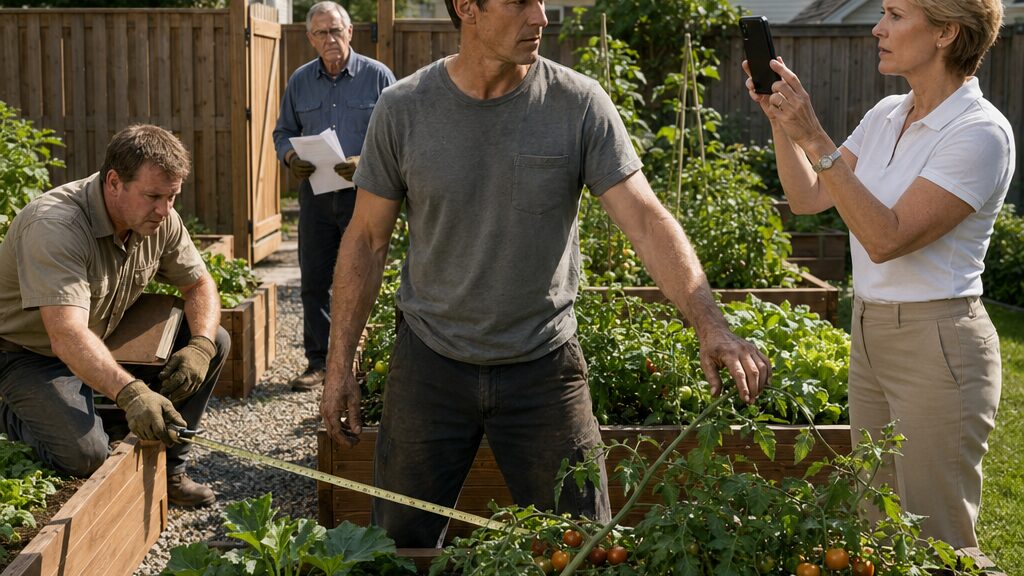
The measuring tape snapped across Jason Lewis’s tomato bed before he understood why two strangers were standing inside his gate.
Its metal edge struck a cedar board, bounced over a branch heavy with green fruit, and stopped against his boot.
“Seven feet, four inches,” the landscaping contractor called.
Virginia Adams held her phone above the plants, angling the camera toward the four raised beds as if documenting storm damage. She wore a white polo embroidered with the association’s name and the expression she used at board meetings when someone had spoken past their allotted three minutes.
Jason set down the pruning shears.
“What are you measuring?”
Virginia lowered the phone only far enough to look at him over it. “Access.”
“For what?”
“The removal.”
The contractor avoided Jason’s eyes. He was middle-aged, sunburned at the neck, with a clipboard tucked under one arm. The tape remained stretched through the tomato plants.
Jason stepped over it carefully and lifted it free of a branch.
Virginia raised her phone again.
“That monstrosity is an eyesore,” she said. “Please don’t interfere with the inspection.”
Jason looked at the garden before answering. Four cedar boxes sat in two clean rows, each surrounded by gravel. Tomatoes climbed black trellises. Lettuce filled the shaded corners. Beans curled around narrow poles. Nothing leaned over the fence. Nothing blocked the path. He had swept the gravel twenty minutes earlier.
“What inspection?”
“The compliance inspection you were notified about.”
“I was notified about a hearing.”
“You were notified that the board was reviewing an ongoing landscaping violation.”
“That isn’t permission to enter my yard.”
“The gate was open.”
“I was carrying compost.”
Virginia smiled without warmth. “Then perhaps you should secure the property if you don’t want authorized representatives entering.”
Jason felt heat gather behind his jaw. At work, he dealt with residents who parked on irrigation covers, planted trees over utility lines, and blamed the city when roots broke pipes. He knew what anger did to facts. It gave people an easier subject than the one they had come to discuss.
He turned to the contractor. “Do you have written authorization to remove anything today?”
The man glanced at Virginia.
“We’re not removing anything today,” Virginia said. “We’re assessing the work.”
“That wasn’t my question.”
The contractor began winding in the tape. “I was told it was an estimate.”
“By whom?”
Virginia stepped between them. “The board has already determined that these structures violate the landscaping standards. We have photographs, dimensions, and your failure to submit an architectural request.”
Jason looked at her phone.
“You’ve already taken photographs?”
“I sent the first set to the board Thursday.”
Thursday. The day before she had placed the violation notice in his mailbox.
“You reported it before you notified me.”
“I documented an existing violation.”
“You made a decision before I had a hearing.”
Virginia’s mouth tightened. “This community spent years overlooking unauthorized alterations. Residents complained that enforcement was inconsistent. The board adopted clearer standards so everyone would be treated equally.”
Behind her, the contractor had moved toward the second bed. He extended the tape along the gravel aisle.
Jason crossed the space and stood between him and the cedar boards.
“No more measurements.”
The contractor stopped.
Virginia’s phone tilted toward Jason’s face. “Are you obstructing an association inspection?”
“I’m refusing access for removal planning until you show me written authority.”
“You don’t get to invent procedure because you dislike the outcome.”
“And you don’t get to create an outcome before the procedure.”
For a moment, neither moved. A bee worked among the squash blossoms near Jason’s knee. Somewhere beyond the fence, a mower started and settled into a low mechanical hum.
Then a voice came from the neighboring yard.
“He isn’t inventing anything.”
Thomas Robinson appeared at the open gate wearing faded gardening gloves and carrying a narrow hand cultivator. He was seventy if he was a day, spare through the shoulders, with gray hair flattened on one side from a straw hat he had apparently removed in a hurry.
Virginia exhaled. “Thomas, this is an association matter.”
“That’s why I came.”
“You’re not on the board.”
“No. I spent thirty-two years checking what boards filed with the county.”
Thomas held up several folded pages. Soil marked one corner.
Virginia gave the papers a brief glance. “If this is another opinion—”
“It’s a statute.”
The contractor’s measuring tape clicked back into its housing.
Thomas unfolded the top page against the cedar bed. “State law limits restrictions on food-producing gardens located on an owner’s property, provided they meet basic health, safety, and placement requirements.”
Virginia did not look at the page. “Our landscaping rules are recorded and enforceable.”
“The rule you’re relying on was adopted before this statute took effect.”
“I wrote that rule myself.”
Thomas’s eyebrows lifted. “That doesn’t put it above state law.”
The contractor looked toward the gate.
Virginia finally lowered her phone. “The statute does not eliminate an association’s right to regulate structures, drainage, visibility, or architectural changes.”
“No,” Thomas said. “It doesn’t. But it does mean you can’t call vegetables ornamental clutter and have them hauled away because you dislike how they look.”
Jason watched Virginia’s expression change by degrees. Not defeat. Calculation.
She reached for the papers.
Thomas held them out, then paused over the second page.
“What?” Jason asked.
Thomas read a paragraph again.
Virginia saw the hesitation. “Go on.”
Thomas removed his glasses from his shirt pocket and put them on. “The owner is required to provide written notice describing the location and general dimensions of the garden before installation.”
Virginia turned toward Jason.
“Did you submit that notice?”
Jason said nothing.
He had completed site plans for municipal planting projects involving traffic sightlines, soil volumes, ADA clearances, and underground utilities. He had filed documents for trees that would never belong to him.
For his own yard, he had filed nothing.
Virginia’s confidence returned, quieter than before.
“There it is,” she said.
Thomas kept reading. “Failure to provide notice may allow reasonable enforcement, but it doesn’t automatically authorize removal.”
“It allows the board to act.”
“It allows review.”
“That is what we are doing.”
“With a contractor and a measuring tape?”
“To estimate potential costs if the violation is upheld.”
Jason looked at the man with the clipboard. “Were you told the hearing hadn’t happened?”
The contractor rubbed his thumb along the tape housing. “I was told to assess removal access. That’s all.”
“Thank you,” Jason said. “You can leave now.”
Virginia stepped forward. “He was invited by the association.”
“This is my lot.”
“And the declaration grants inspection rights.”
“For suspected maintenance failures after reasonable notice. Show me the notice that authorized contractor access today.”
Virginia stared at him, perhaps waiting for his voice to rise. It did not.
The contractor closed his clipboard. “I can reschedule if the board provides written authorization.”
Virginia’s eyes flashed toward him. “That won’t be necessary.”
He left through the gate without another word.
Jason picked the measuring tape’s flattened path through the tomato leaves. One stem had bent but not broken. He supported it with two fingers until it rested against the trellis.
When he looked up, Virginia was holding a cream envelope.
“The board will hear this matter Monday at seven,” she said. “The proposed action includes removal of all unapproved structures and assessment of contractor costs.”
Thomas held out his hand. “Let me see that.”
Virginia gave the envelope to Jason instead.
He opened it. The hearing date was printed in bold. Beneath it, the violation description referred to “four unauthorized landscape enclosures inconsistent with community aesthetic standards.” A second paragraph warned that continued noncompliance could result in daily fines.
The final line stopped him.
OWNER’S FAILURE TO APPEAR MAY BE TREATED AS ACCEPTANCE OF THE PROPOSED REMEDY.
Virginia lifted her phone once more and photographed him holding the notice.
“Now,” she said, “there can be no argument that you weren’t informed.”
She walked through the gate, latched it behind her, and continued down the path without looking back.
Thomas watched until she disappeared between the houses.
“You have time,” he said.
Jason folded the notice along its existing crease.
“Until Monday.”
“That’s time.”
Jason looked at the cedar beds, at the plants standing inside them, and at the shallow mark the measuring tape had left across the soil.
For the first time since he had built the garden, keeping it would require more than tending it.
Chapter 2: The Rule Nobody Had Checked Against State Law
Thomas found the date in the lower corner of the statute and tapped it hard enough to rattle the coffee cups.
“Three years after Virginia’s rule,” he said.
His kitchen table had disappeared beneath printed pages, an old association handbook, two county maps, and a laptop that hummed whenever Thomas opened another browser tab. The disputed landscaping provision lay beside the state statute like two witnesses who had not agreed on their story.
Jason leaned closer.
The handbook amendment had been adopted in March. The state law had taken effect three years later in July.
“So the rule is invalid,” Jason said.
“The part that bans food gardens because they don’t match an ornamental scheme is probably unenforceable.”
“Probably.”
Thomas gave him a look. “You work for the city. You know better than to trust anyone who says definitely before reading the exceptions.”
Jason sat back.
Outside the kitchen window, Thomas’s own garden occupied a narrow strip along the fence: herbs in clay pots, peppers in five-gallon buckets, and one stubborn row of carrots. It was less visible than Jason’s and too small to attract Virginia’s attention.
Thomas turned the statute toward him.
“The law protects the use,” he said. “It doesn’t protect every way you install it.”
Jason read the notice provision again.
Before installing a food-producing garden, an owner shall provide written notice identifying its approximate location, dimensions, and any permanent irrigation components.
“I didn’t know this existed.”
“That helps explain it. It doesn’t cure it.”
“The HOA didn’t know either.”
“Virginia may not have. The management company should have.”
Jason looked toward the handbook. “She said she wrote the rule.”
“She helped draft it. That doesn’t mean an attorney reviewed each update.”
Thomas opened the county property portal and enlarged an aerial photograph of Jason’s lot. The four beds appeared as pale rectangles behind the house.
“When did you install them?”
“First two last spring. The other two in October.”
“And the drip line?”
Jason’s attention shifted to the coffee in front of him.
Thomas noticed.
“You added irrigation.”
“A half-inch supply line from the rear spigot. It’s above ground until it reaches the gravel, then buried shallow.”
“Backflow device?”
“Yes.”
“Timer?”
“Yes.”
“Drainage?”
Jason hesitated. “The beds drain into the gravel.”
“That isn’t what I asked.”
“There’s perforated tubing beneath the lower pair.”
“Where does it discharge?”
“Near the retaining wall.”
Thomas removed his glasses.
The shared retaining wall ran along the back boundary between Jason’s lot and a common slope maintained by the association. The pipe did not penetrate the wall, but during heavy rain it directed excess water toward the rock trench beside it.
“It hasn’t caused damage,” Jason said.
“Has anyone inspected it?”
“No.”
“Was it on a plan?”
“No.”
Thomas leaned back and folded his arms. “Virginia may be wrong about the garden and right about the drainage.”
Jason stared at the statute. Relief had lasted less than twenty minutes.
“She didn’t mention drainage this morning.”
“She may not know about it.”
“She photographed everything.”
“Then she may know by Monday.”
Jason stood and carried his untouched coffee to the sink.
Thomas let him remain there a moment before speaking again.
“Why didn’t you file the notice?”
“I didn’t know I needed one.”
“The association asked for plans.”
Jason turned.
Thomas pointed to the handbook. “The hearing letter says there was a prior request.”
“It was a general architectural form.”
“And?”
“And the beds were already built.”
“That isn’t an answer.”
Jason watched water gather along the rim of the cup. Thomas had spent decades asking questions in rooms where people preferred assumptions. He rarely raised his voice because repetition usually did the work for him.
Jason dried the cup and returned to the table.
“I didn’t want the board involved.”
“Why?”
“They turn everything into a file.”
“That’s what boards do.”
“They wanted material samples. Dimensions. Purpose. Photographs.”
“Most applications do.”
Jason looked at the soil stain on the planting plan he had brought from home. It showed the beds in pencil, each measured to the inch. He had drawn sun angles, crop rotation zones, and the route of the irrigation line. In the bottom corner, he had written a date, then crossed it out.
Thomas picked up the page.
“This is more detailed than anything they asked for.”
“It wasn’t for them.”
“Who was it for?”
Jason took the plan back and folded it once.
Thomas did not press. Instead, he opened the association’s online records.
They spent the next two hours tracing amendments, board minutes, and management notices. The original declaration permitted reasonable landscaping controls. The later handbook prohibited “visible food cultivation structures inconsistent with the community’s ornamental character.” No recorded amendment supported the full language. The board minutes showed discussion, but not legal review.
“That’s useful,” Thomas said. “The handbook may have expanded beyond the declaration.”
“Will that stop removal?”
“It should stop immediate removal. But Monday won’t be a court. It’ll be five residents at folding tables deciding whether they believe their own process was fair.”
Jason knew three of them by sight. Christine Flores, the treasurer, walked every evening with a bright vest and counted cracked sidewalk panels under her breath. The other two board members rarely spoke at meetings. Virginia spoke enough for all of them.
Thomas printed the relevant pages.
“What you need,” he said, “is a clean argument. The state protects the garden. The declaration may not authorize a complete ban. No hearing has occurred. No contractor should have been sent.”
“And the missing notice?”
“You admit it.”
Jason looked up.
“You don’t hide a weakness Virginia can prove,” Thomas said. “You explain it and correct it.”
“And the irrigation?”
“If it drains toward common property, you need to inspect it before Monday.”
Jason gathered the pages into separate stacks. His hands moved automatically: statute, declaration, handbook, hearing notice. The planting plan remained apart from them.
Thomas watched him.
“You still haven’t answered why you never submitted that.”
“It was private.”
“A garden plan?”
Jason slid it into his folder. “The reason for it.”
Thomas’s expression softened, which made Jason more uncomfortable than suspicion would have.
“Private things can stay private,” Thomas said. “But silence has consequences when someone else is supplying the explanation.”
By late afternoon, Jason returned home with a folder thick enough to feel useful. He inspected the lower beds, lifted the gravel near the drainage outlet, and found damp soil where it should have been dry.
Nothing had failed. Nothing had cracked. But the direction of the water was clear.
He shut off the irrigation timer.
Inside, he opened the hall cabinet where he kept tax records, appliance manuals, and every envelope he intended to deal with later. Near the back was a letter from the management company, still sealed.
The postmark was eight months old.
He remembered carrying it in from the mailbox. He remembered recognizing the association logo and placing it behind the furnace warranty. He had told himself he would open it when the seedlings were established, when the first bed was finished, when he could read it without feeling that someone had entered a room where they did not belong.
Jason tore the envelope along one end.
Inside was a request for an architectural application, a site sketch, irrigation details, and a written description of the garden’s intended use.
At the bottom, someone had added a handwritten note:
Please include any special circumstances you would like the committee to consider.
Jason read the line twice.
The form beneath it was blank because he had chosen silence long before Virginia chose enforcement.
Chapter 3: The Produce Bags Left Before Sunrise
Virginia’s phone flashed just as Jason placed the second paper bag on Emma Lee’s porch.
He saw the light reflected in the glass storm door.
Across the street, Virginia stood beside her mailbox in running shoes and a pale jacket, holding the phone vertically. Dawn had barely separated the roofs from the sky, yet she was close enough for Jason to see her lower the device after taking the photograph.
He left the bag where it was.
Virginia crossed the street.
“That’s an early delivery,” she said.
“It isn’t a delivery.”
She looked at the two brown bags. Tomato stems showed above one folded edge. The other held lettuce, beans, and three small cucumbers.
“What would you call it?”
“Vegetables.”
“You’re distributing produce from an unapproved agricultural installation.”
Jason almost laughed, but her expression stopped him.
“I’m giving food to a neighbor.”
“Regularly?”
“That’s none of the board’s business.”
“It becomes the board’s business if the property is being used for commercial activity.”
“No money changes hands.”
“I have no way to verify that.”
Emma’s front door opened behind him.
She was in her late sixties, dressed in a blue robe with one hand gripping the doorframe. Her silver hair was pinned loosely at the back, and the surprise on her face turned quickly into embarrassment when she saw Virginia.
“Jason,” she said, “you didn’t have to bring all that.”
“I had extra.”
Virginia’s gaze moved from Emma to the bags.
“How often does he bring you produce?”
Emma straightened. “When he has some.”
“Is there an arrangement?”
Jason stepped between them. “She doesn’t need to answer.”
Virginia looked at him as if he had confirmed something. “The board will need an accurate account of the garden’s use.”
“The garden’s use is growing food.”
“For personal consumption?”
“For consumption.”
Virginia lifted her phone again.
Jason held out his hand, not touching it. “Don’t photograph her.”
“I’m documenting the alleged activity.”
“You photographed my yard. You don’t need her standing in the doorway.”
Emma pulled the robe tighter across her chest.
Virginia lowered the phone, though not before glancing at the screen.
“The hearing packet will be updated,” she said. “You should be prepared to explain whether this is a business.”
Then she walked back across the street, her shoes making almost no sound on the pavement.
Emma waited until Virginia entered her house.
“You shouldn’t have said anything,” Jason told her.
“I barely did.”
“You opened the door.”
“I thought it was you.”
Jason picked up the bags. “I’ll bring them inside.”
“No.”
“Emma.”
“Leave them.”
He set them down again.
She looked toward Virginia’s house before opening the storm door wider. “Come in for a minute.”
Her kitchen was small and warm, with a kettle beginning to tick on the stove. A stack of pharmacy envelopes sat beneath a ceramic fruit bowl. Jason looked away before she noticed.
Emma placed the vegetables on the counter.
“You cannot mention me at that meeting,” she said.
“I wasn’t planning to.”
“Or the others.”
“I know.”
“I mean it.”
Jason leaned against the sink. “She’s calling this commercial activity.”
“Then tell them nobody pays you.”
“They may ask who receives it.”
“Say neighbors.”
“They may ask which ones.”
“You don’t have to answer.”
Jason thought of the hearing notice’s warning that silence could be treated as acceptance. He had spent years believing the opposite—that silence kept other people from owning parts of his life.
Emma folded the top of one bag flat.
“I can buy vegetables,” she said.
“I know.”
“I’m not dependent on your garden.”
He did not answer.
Her pension covered the mortgage and utilities. The medical bills took what remained in irregular, punishing amounts. She could buy vegetables, but by the end of some months they came from cans because fresh food spoiled before she could justify the price.
The other two households had their own reasons. A couple with a newborn and reduced work hours. An older man recovering from surgery who refused help if it sounded like charity.
Jason never called it assistance. He left bags before sunrise and accepted empty ones hooked over his back gate later.
Emma’s voice softened. “I don’t want a room full of people discussing my finances.”
“They won’t.”
“And I don’t want you making the garden sound noble because of me.”
“I won’t.”
“It matters to you for other reasons.”
Jason looked at the tomato stems protruding from the bag.
Emma watched him carefully. “You still haven’t told them?”
“No.”
“She would have wanted you to.”
“You don’t know that.”
“I knew your mother longer than you knew her.”
The words landed harder than Emma intended. She pressed her lips together.
Jason pushed away from the sink.
“I need to inspect the drainage.”
“Jason.”
He stopped at the doorway.
Emma lowered her voice. “Your mother asked me not to let you abandon that garden after she was gone.”
He turned.
“She said you would make it useful for everyone else and pretend it meant nothing to you.”
“That sounds like her.”
“She was usually right about you.”
He gave a brief, unwilling smile.
Emma did not return it. “But she did not ask you to turn my life into evidence. Please understand the difference.”
“I do.”
Outside, the neighborhood had brightened. Garage doors opened. A dog barked from behind a fence. Jason crossed back to his yard and found an empty paper bag hanging from the gate latch, folded twice against the morning damp.
He took it inside before Virginia could photograph that too.
By noon, an email arrived from the management company. The subject line read: UPDATED HEARING MATERIALS.
Jason opened the attachment.
Virginia’s photograph appeared on the second page. He was shown in profile at Emma’s door, one bag in each hand. Emma stood behind him, partly visible through the glass.
Below the image, the alleged violations had been expanded.
Unauthorized landscaping structures.
Unapproved irrigation modification.
Possible commercial or distribution activity conducted from a residential lot.
A final paragraph requested records of sales, payments, customers, and recurring deliveries.
Jason read the list until the words stopped sounding bureaucratic and began sounding invasive.
He could disprove the accusation easily. He could name every person who had received a bag, state that no money had changed hands, and explain exactly why the vegetables mattered.
All it would cost was their privacy.
At the bottom of the packet, beneath Virginia’s electronic signature, the board had added one question for Monday night:
Describe the purpose for which the garden was constructed.
Chapter 4: The Hearing That Almost Ended Too Easily
“I wrote that rule myself,” Virginia said, as though authorship settled the matter.
She stood at the end of the folding tables with one hand resting on a black binder. Enlarged photographs of Jason’s garden had been arranged in front of each board member. In one, the tomato plants rose above the cedar beds in late-summer disorder. In another, Jason stood at Emma’s door holding two paper bags.
The community room smelled of burnt coffee and floor cleaner. Nearly every chair along the wall was occupied.
Jason sat beside Thomas with his folder closed on his lap.
Virginia looked toward him. “The landscaping standards were adopted because residents asked the board to stop selective enforcement. We cannot exempt one owner simply because his violation is productive.”
Thomas shifted in his chair, but Jason touched the edge of his sleeve.
Not yet.
Christine Flores sat at the center of the table with a calculator, a legal pad, and the expression of someone who had already found a number she disliked. Two other board members sat beside her. The HOA management representative occupied the far corner, close enough to participate and far enough to deny ownership of any decision.
Virginia opened the hearing.
She summarized the alleged violations in a steady voice: unauthorized structures, prohibited food cultivation visible from adjoining property, unapproved irrigation, and possible business activity. She referred to the photographs by number.
When she reached the image of Emma’s porch, Jason spoke.
“I object to that photograph being used.”
Virginia looked up. “On what basis?”
“It shows a resident inside her home who is not part of this hearing.”
“It documents distribution activity.”
“It documents me holding groceries.”
“Produce grown on the property.”
“Which is not commercial activity.”
“Then explain the arrangement.”
“There is no arrangement.”
Virginia waited.
Jason could feel the people along the wall watching him. He could name Emma. He could explain the medical bills he had glimpsed without permission. He could describe the empty bags returned to his gate.
Instead, he said, “I give vegetables away.”
“To whom?”
“To neighbors.”
“How many?”
“Enough that none are customers.”
Virginia’s lips pressed into a thin line. “The board cannot evaluate facts you refuse to provide.”
Jason opened his folder.
“The board can evaluate whether money changed hands. It didn’t.”
One of the board members leaned toward the microphone. “Do you have records?”
“No. People don’t issue receipts for tomatoes.”
A few residents shifted. Someone near the back coughed into a hand.
Virginia moved to the landscaping rule.
“The governing standard prohibits visible cultivation structures inconsistent with the ornamental design of the community.”
Thomas slid a printed statute toward Jason, but Jason kept his hands on the table.
“The state law that took effect three years after that rule limits an association’s authority to prohibit food-producing gardens,” Jason said.
Virginia’s gaze flicked toward Thomas. “We’re aware of the statute.”
“Were you aware of it Saturday when you sent a contractor into my yard?”
“The contractor was there to prepare an estimate.”
“For removal before this hearing.”
“To ensure the board understood potential costs.”
Thomas finally leaned toward his microphone. “That sounds like a remedy chosen before evidence was heard.”
Virginia ignored him. “Mr. Lewis failed to submit the required notice. The statute does not protect an owner who disregards the process.”
“It doesn’t authorize automatic removal either,” Jason said.
“That is your interpretation.”
“It is the statute’s language.”
Virginia opened the binder. “The association has always retained authority over structures and appearance.”
Christine lifted one of the enlarged photographs.
“Virginia, was this rule reviewed by counsel after the statute changed?”
Virginia turned toward her. “The handbook was reviewed as part of our regular update.”
“That isn’t what I asked.”
“The management company assisted us.”
The management representative adjusted in his chair.
Christine looked at him. “Did your office obtain a legal opinion on this provision?”
“We provided administrative support,” he said. “We don’t give legal advice.”
Virginia’s fingers tightened around the binder.
Christine reached beneath her legal pad and removed a printed email.
“I asked management for the complete correspondence file this afternoon.”
Virginia went still.
The room seemed to narrow around the paper.
Christine read silently for a moment, then looked up. “Eight months ago, management informed the board that state protections for residential food gardens might conflict with our handbook language. They recommended attorney review before enforcement.”
One of the other board members reached for the email.
Virginia did not.
Jason watched her face. He had expected surprise, perhaps denial. What he saw instead was recognition.
Christine placed the email beside Virginia’s photographs.
“Why wasn’t this circulated?”
“It was a general caution,” Virginia said.
“It was addressed to the full board.”
“The message came during the insurance renewal. We had several unresolved items.”
“That doesn’t explain why the rule was enforced without review.”
Virginia drew a breath.
“Because we had already spent two years being accused of favoritism,” she said. “Residents complained about sheds, paint colors, trailers, basketball hoops. Every time we delayed, someone claimed the board was protecting a friend. We adopted clear standards because inconsistency was damaging trust.”
“And then you ignored a warning that the standard might be unlawful,” Christine said.
“I believed the declaration still gave us authority.”
“You believed,” Thomas said. “But you sent a contractor.”
Virginia turned on him. “You are not a party to this violation.”
“No,” Thomas said. “I’m a homeowner watching the association prepare to dismantle another homeowner’s property.”
The chair nearest the wall creaked as someone leaned forward.
Christine raised one hand before the room could erupt.
“We are not deciding every policy tonight.”
She looked toward Jason. “Mr. Lewis, did you submit the notice required by state law?”
“No.”
“Did you submit an architectural application when management requested one?”
“No.”
“Did you install an irrigation component not shown on an approved plan?”
“Yes.”
A murmur moved through the room.
Virginia’s shoulders eased slightly.
Jason continued before she could speak.
“The supply line has a backflow device. The lower beds have drainage tubing directed toward the rock trench along the retaining wall. I shut the system off Saturday after confirming that the outlet may affect common property.”
Christine wrote something down.
“Has it caused damage?”
“Not that I can see. But it should have been disclosed and inspected.”
Thomas looked at Jason, not approving or disapproving. Simply listening.
One of the board members asked, “Why didn’t you submit the application?”
Jason felt the folded planting plan inside his folder.
“Because I didn’t want the board involved.”
Virginia gave a small, humorless laugh. “That is not a defense.”
“No,” Jason said. “It isn’t.”
The room quieted again.
Christine reviewed her notes.
“The commercial-use allegation appears unsupported. There is no evidence of sales or payment.”
Virginia started to respond.
Christine held up a hand. “The state-law issue requires counsel. The current removal order cannot stand tonight.”
Jason heard Thomas exhale beside him.
Christine continued. “I move that the removal remedy be withdrawn pending legal review.”
One of the board members seconded.
The vote passed four to one.
For several seconds, Jason did not move.
The garden would still be there in the morning.
Then Virginia opened a second folder.
“Withdrawal of the removal remedy does not resolve the unapproved irrigation modification,” she said. “Nor does it waive the association’s authority over drainage affecting common property.”
She slid a new notice across the table.
Jason stared at it.
The alleged violation concerned unauthorized discharge near the retaining wall. It required inspection within ten days and allowed daily fines if he failed to correct any adverse condition.
Relief drained from the room as quickly as it had arrived.
Christine looked irritated. “Was this issued before tonight?”
“It was prepared after the updated photographs were reviewed.”
“You could have raised it during the hearing.”
“I just did.”
The meeting ended without applause. Chairs scraped. Residents gathered in small groups, speaking in lowered voices. Thomas waited near the exit while Jason placed the new notice inside his folder.
Virginia approached him beside the empty coffee urn.
“You could end this,” she said.
Jason looked at her.
She kept her voice low.
“Remove the two lower beds. Eliminate the drainage line. Submit a simple plan for the upper pair, and I will recommend dismissal of the remaining violations.”
“What about the rule review?”
“That is a separate board matter.”
“Would the audit continue?”
“We haven’t agreed to an audit.”
“The management warning covered more than my garden.”
Virginia’s expression hardened. “You’re trying to turn a correctable application failure into a campaign against the board.”
“You sent someone to measure my yard for removal after being warned the rule might violate state law.”
“I was trying to apply the same standard to everyone.”
“Even if the standard was wrong.”
“Uniform enforcement is not personal.”
Jason looked across the room. Christine was collecting copies of the email. Thomas stood by the door with Jason’s coat over one arm.
Virginia drew closer.
“Two beds,” she said. “You keep half the garden, the fines disappear, and your neighbors stay out of the record. That seems like a reasonable outcome.”
It was the first time she had admitted she understood what his silence protected.
Jason held her gaze.
“How long do I have?”
“Until tomorrow afternoon.”
She walked away before he answered, leaving him with an offer that would save the garden only by cutting away the part of the dispute that no longer belonged to him alone.
Chapter 5: The Promise Buried Beneath the Cedar Boards
The cedar board came loose with a soft crack, and something narrow dropped into the gravel beneath it.
Jason crouched beside the lower bed.
He had gone outside before sunrise with a drill, a pry bar, and no decision. Virginia’s offer sat inside his house on the kitchen counter, written in an email that called the removal of two beds a “voluntary compliance resolution.”
He had told himself he was only inspecting the drainage.
Instead, he had removed three screws from the oldest board.
The object in the gravel was a wooden planting marker, gray at the edges and darkened by soil. Faded black lettering ran down one side in his mother’s uneven hand.
SAVE SEEDS FOR NEXT YEAR.
Jason held it between both palms.
The marker had belonged to the final garden behind her small brick house. During her last spring, she had labeled every row even after she became too weak to kneel. Beans. Tomatoes. Chard. Herbs. She had written the names slowly, pressing so hard that the marker tips splintered.
After the house was sold, Jason had salvaged the cedar from her beds before the new owners cleared the yard.
He had told no one why.
A gate hinge clicked behind him.
Emma stood on the path in a cardigan and house shoes, holding an empty paper bag.
“You’re taking it apart,” she said.
“Inspecting it.”
“With a pry bar?”
Jason set the marker on the edge of the bed.
Emma noticed the handwriting.
Her expression changed. “I wondered where that went.”
“You knew about it?”
“I helped her label the rows that year.”
Jason brushed dirt from the carved letters. “She could barely hold the pen.”
“She refused to let me write for her.”
“That also sounds like her.”
Emma placed the empty bag beside the trellis.
“Are you accepting Virginia’s offer?”
“I haven’t decided.”
“She told people there might be a settlement.”
“Of course she did.”
“Not the details.”
Jason replaced the board loosely and sat on the edge of the next bed. The tomatoes had begun to soften with the end of summer. A few leaves were yellowing near the base.
“If I remove these two,” he said, “the drainage issue disappears. The upper beds stay. Nobody has to explain anything.”
“And the rule?”
“The board can review it or not.”
Emma looked toward the neighboring roofs. “Will they?”
“No.”
She nodded as though he had confirmed something she already knew.
Jason turned the marker in his hands.
“I can rebuild smaller beds later.”
“Can you?”
“It’s wood.”
“That isn’t what I asked.”
He said nothing.
Emma stepped off the path and touched the cedar board with two fingers.
“Your mother asked me to watch you after she died.”
Jason looked up sharply.
“She had no right.”
“She knew that.”
“What exactly did she say?”
Emma hesitated.
“Tell me.”
“She said you would keep busy with practical things because practical things don’t ask questions. She said you might continue the garden if you believed other people needed it. But if it became only yours, you would let it go.”
Jason looked down at the marker.
Emma’s voice softened.
“She asked me not to let you abandon it.”
“You never told me.”
“You built four beds before I had to.”
“That wasn’t permission to keep it from me.”
“No. It was a judgment. Maybe the wrong one.”
The honesty disarmed him more than an apology would have.
Emma sat beside him, leaving a careful distance between them.
“I didn’t want your mother’s last request to become another obligation,” she said. “You already carried enough of those.”
“I made her a promise.”
“I know.”
“You were there?”
“In the kitchen. Not in the room.”
Jason remembered the last afternoon clearly enough that he usually avoided it. His mother had been propped against two pillows, frustrated by the oxygen tubing and more concerned about seed trays than the nurse’s instructions.
Don’t let all that die because I do.
He had promised.
At first, he had thought she meant the plants. Later, he understood she meant the habit of giving away what grew beyond one household’s need.
The promise had become easier to keep when no one knew it existed.
Emma touched the empty bag.
“If you accept the deal, I won’t blame you.”
“That makes one of us.”
“You would still have two beds.”
“And Virginia would still have the same authority tomorrow.”
“Maybe.”
“She knew the rule might be unlawful.”
“She also believes the neighborhood will fall apart if every person decides which rules deserve respect.”
Jason glanced at her.
Emma shrugged. “People can be wrong and still have reasons.”
The irritation in him cooled enough to become thought.
Virginia’s offer was not mercy. It was containment. Two beds removed, one violation corrected, one homeowner quiet. The management warning would remain an administrative oversight rather than the beginning of a wider question.
Jason carried the marker inside.
On the kitchen counter, he opened Virginia’s email again.
The proposed agreement required him to withdraw “all procedural objections related to prior enforcement activity.” It also stated that the settlement would not establish precedent for any other homeowner.
There it was.
Not only the beds. Not only the neighbors.
Silence, formalized.
Thomas arrived an hour later carrying a moisture meter and a length of clear tubing. Together they traced the irrigation line. The lower outlet had not damaged the retaining wall, but the soil beside the common trench was wetter than the surrounding grade.
“You can fix this,” Thomas said. “Redirect it inward, add a shallow dry well, reduce the timer.”
“I know.”
Thomas looked toward the loose board. “Taking the offer?”
Jason handed him the printed agreement.
Thomas read the waiver twice.
“They’re buying the rule back from you.”
“For two beds.”
“Cheap price.”
Jason expected Thomas to tell him what to do. Instead, the older man folded the pages and returned them.
“I can find statutes,” he said. “I can tell you what a paragraph probably means. I can’t decide what your garden costs.”
By noon, Jason had written two drafts.
The first accepted Virginia’s terms.
The second rejected them.
He left both open on the screen while he repaired the loose cedar board. Before replacing the final screw, he slid his mother’s marker into the dry space behind it, then stopped.
Hiding it again felt too much like everything else.
He carried it to the kitchen and set it beside the laptop.
The rejection email became shorter as he revised it.
He acknowledged the missing notice. He agreed to correct and submit the irrigation plan. He declined to waive objections to the contractor entry, premature removal preparation, or enforcement under a rule the board had been warned might conflict with state law.
At the end, he added one request.
Because the management warning identified possible conflicts beyond the garden provision, I request a formal review of all handbook rules adopted without recorded amendment or legal review.
He read the sentence once.
Then he copied Christine and the management representative.
Before he could reconsider, he pressed send.
The reply from Virginia arrived six minutes later.
Your proposal is rejected. All available enforcement options remain open.
A second message followed, this one from Christine.
I support placing the requested audit on a special meeting agenda. Please preserve all documents and photographs.
Jason looked through the window at the four beds.
The offer had disappeared. The private solution was gone.
For the first time, however, the board’s records were no longer being assembled only against him.
Chapter 6: The Rulebook Began to Split at the Seams
The county records clerk searched the index twice, then turned the monitor toward Jason.
“There’s no amendment,” she said.
Jason leaned across the counter. On-screen, the association’s recorded documents appeared by date: original declaration, plat, bylaws, easements, three amendments concerning assessments and common-area maintenance.
Nothing addressed food gardens.
Nothing authorized the handbook language Virginia had enforced.
Thomas stood beside him with both hands resting on his cane. He had brought it for the long courthouse hallway, though he seemed irritated each time it touched the floor.
“Could it be filed under another name?” he asked.
The clerk searched the subdivision, the association, and the management company.
“No.”
She pointed to the original declaration. “The board may adopt reasonable rules under this section, but a handbook rule cannot quietly rewrite a recorded property restriction. Whether this particular rule crosses that line is a legal question.”
Jason wrote down the document numbers.
“What about the retaining wall?”
“That easement is recorded. The association maintains the structure and access strip. If runoff from a private lot affects it, they can require correction.”
Thomas glanced at Jason.
“I know,” Jason said.
The clerk printed certified copies. Before they left, she handed Jason a receipt and said, “You would be surprised how many neighborhood disputes begin with someone assuming a handbook and a declaration are the same thing.”
The special HOA workshop convened four days later.
Unlike the hearing, it was held in daylight. Sunlight from the high windows fell across stacks of binders, printed statutes, insurance correspondence, and Jason’s reorganized photographs.
He had placed the images in chronological order.
First, the beds intact.
Second, Virginia photographing them before notice.
Third, the contractor’s measuring tape crossing the tomatoes.
Fourth, the removal hearing letter.
Fifth, the produce bags at Emma’s door.
Sixth, the drainage outlet near the retaining wall.
The photographs no longer formed a case about an eyesore. Together, they showed a process unfolding before its authority had been established.
Christine entered with the community attorney and set a red folder beside her chair.
Virginia arrived last.
She looked at the timeline but did not comment.
The attorney began with the governing documents. He spoke carefully, avoiding conclusions until he had named every uncertainty.
“The association may regulate location, drainage, maintenance, and structures,” he said. “It likely may not impose a blanket prohibition on food-producing gardens where state law protects them. The handbook’s ornamental-character language is vulnerable.”
“Vulnerable means not necessarily invalid,” Virginia said.
“Correct.”
“So the board acted within a reasonable interpretation.”
The attorney folded his hands. “The board’s decision to investigate may have been reasonable. Preparing physical removal before completing that investigation is harder to defend.”
Virginia looked toward Jason’s photographs.
Christine opened the red folder.
“What about the other rules mentioned in management’s warning?”
The attorney reviewed the list.
A prohibition on rooftop solar equipment broader than state law allowed.
A parking rule imposing immediate towing where the declaration required notice.
A rental restriction adopted in the handbook but never recorded as an amendment.
A limitation on political signs that ignored a state-mandated display period.
Each rule had its own history. None could be resolved by one answer.
Virginia’s face grew more rigid as the list continued.
“These provisions were copied from model community standards,” she said.
“Some appear to have been,” the attorney replied.
“They were widely used.”
“That does not establish enforceability under current state law or your declaration.”
One board member turned toward the management representative. “Did your company review the handbook?”
“We formatted and distributed revisions approved by the board.”
“Did you tell us legal review was needed?”
The representative pointed to the email Christine had produced. “We recommended it.”
Virginia closed her binder.
“This is becoming an effort to assign blame rather than correct policy.”
Jason had not intended to speak yet, but the words pulled him forward.
“Correction requires knowing how the policy was used.”
Virginia looked at him. “And you believe this workshop should revolve around your grievance.”
“No. My grievance is why the workshop exists. That isn’t the same thing.”
The attorney raised one hand. “We should keep the record focused.”
Christine turned to Jason. “Before we continue, there is an insurance issue.”
She removed a letter from the folder.
The association’s insurer had reviewed the management warning and the contractor incident. Coverage might be limited if the board knowingly continued enforcement after receiving notice that a rule could be unlawful. Intentional conduct and actions outside governing authority could fall outside portions of the policy.
The room went silent.
One board member whispered, “Meaning what?”
“Meaning,” Christine said, “that if a homeowner files a claim, the association may have to pay some defense costs directly.”
Virginia’s composure cracked.
“So now we govern according to hypothetical lawsuits?”
“We govern according to the documents and the law,” Christine said. “The insurance consequences are what happen when we don’t.”
Virginia looked around the table.
“You all remember why these rules were adopted. One homeowner demanded enforcement against a shed. Another demanded an exception for a trailer. Then everyone accused us of protecting whoever complained the loudest. I tried to create standards people could understand.”
Her voice had lost its meeting-room polish.
“For two years, I heard that the board was weak. That property values would decline. That buyers would see disorder. When we finally enforced consistently, the same people called us unreasonable.”
Jason heard the fear beneath the defense. It did not excuse the contractor in his yard. But it explained why Virginia had mistaken firmness for legitimacy.
Christine’s reply was quieter.
“Consistency does not make the wrong rule right.”
The attorney recommended an immediate pause on penalties related to disputed handbook provisions until review was complete.
The board voted unanimously.
It was a real victory, but not a clean one.
The drainage issue remained.
Jason stood and placed his own site plan on the table.
“The irrigation outlet directs excess water toward the common trench,” he said. “The wall is not damaged, but the installation should have been disclosed.”
Virginia looked at him with open suspicion, as though the admission concealed a strategy.
Jason continued.
“I will redirect the line, install a small dry well inside my lot, and submit the corrected plan for inspection.”
Thomas shifted behind him.
One board member asked, “Are you conceding that violation?”
“I’m conceding the condition that can be proved.”
“And the rest?”
“I’m asking the board to decide them under valid authority.”
The attorney examined the plan. “This correction appears reasonable.”
Virginia stared at Jason.
“You expect the board to sanction me after admitting you violated the drainage rule.”
“I expect the board to separate what I did wrong from what you did wrong.”
No one moved.
Jason slid the repair schedule toward Christine.
“I can finish by Friday. Inspect it Saturday.”
Christine accepted the paper.
Virginia’s gaze dropped to the first photograph in the timeline—the one showing the garden before the notices, before the measuring tape, before every plant had become evidence.
Jason had spent weeks defending the beds as if any admission would weaken the whole structure.
Now he understood that hiding the faulty line would make him no different from the board he was challenging.
“I’ll correct my part first,” he said. “Then I want a final decision on yours.”
Chapter 7: He Refused to Win by Hiding His Own Mistake
Jason began the final hearing by admitting the violation Virginia could still prove.
“The original irrigation outlet was directed too close to the common retaining-wall trench,” he said. “I installed it without approval. The line has been redirected, the dry well is complete, and the corrected plan was inspected last Saturday.”
He placed the signed inspection sheet on the table.
Beside it sat a shallow basket containing tomatoes, beans, three cucumbers, and a bundle of basil tied with kitchen string. Jason had almost left it at home. Now it rested against the edge of his site plan, too ordinary to be an exhibit and too deliberate to be decoration.
The community room was fuller than before. Residents stood along the rear wall after every chair had been taken. The board sat beneath the fluorescent lights with the community attorney at one end and the management representative at the other.
Virginia sat in her usual place, but she no longer controlled the binder in front of each member. Christine had prepared the agenda.
The drainage inspection was the first item.
The board accepted the correction unanimously.
No one applauded. Jason was grateful.
Christine moved to the garden-removal order.
“The legal review is complete,” she said. “Counsel has advised that the handbook language cannot be applied as a blanket prohibition on food-producing gardens. The provision also exceeds the authority clearly stated in the recorded declaration.”
One board member shifted through the papers. “So the rule is void?”
“The ornamental-character prohibition is unenforceable as written,” the attorney said. “Reasonable location, maintenance, drainage, and safety standards may still be adopted.”
Christine looked toward Jason.
“The proposed removal order has no valid basis.”
The words should have felt larger.
Instead, Jason noticed Virginia’s hands resting flat on the closed binder. Her nails were pressed into the cover.
Christine continued. “Before the board votes, Mr. Lewis requested time to address remedy.”
Jason stood.
He had written three pages the night before. They remained folded in his pocket.
“I could ask for reimbursement,” he said. “The contractor entered my yard. Removal was prepared before the hearing. I lost work hours gathering records and correcting a process that should not have reached that point.”
Virginia’s gaze lifted.
Jason kept his eyes on the board.
“I’m not asking for damages.”
A murmur passed through the room.
Thomas, seated in the first row, turned his head sharply.
Jason continued.
“I’m asking for the removal order to be formally voided, all related fines withdrawn, the disputed handbook provisions reviewed in public, and future enforcement decisions to require more than one officer’s approval.”
Virginia leaned toward her microphone. “That proposal assumes individual misconduct where the board acted collectively.”
“The contractor was instructed before the board heard the case.”
“Based on an existing rule and your failure to submit an application.”
“Both can be true,” Jason said. “I failed to submit. The board acted under a rule it had been warned might conflict with state law.”
Virginia looked at the residents behind him.
“This is exactly the problem,” she said. “Every enforcement decision becomes a referendum on the people enforcing it. The association was criticized for years because standards were uneven. Some owners received extensions. Others were fined. Every exception became proof of favoritism.”
Her voice remained controlled, but the control now looked costly.
“I tried to remove discretion,” she said. “I tried to create standards that applied to every property.”
Christine glanced at the attorney, then back at Virginia.
Jason said, “You replaced discretion with certainty.”
“I replaced confusion with rules.”
“You kept enforcing after you were told the rules might be wrong.”
Virginia’s expression tightened.
“I believed the board’s authority under the declaration remained intact. I still believe the association has an obligation to prevent one property from imposing costs or visual consequences on another.”
“My drainage did affect common property.”
For the first time, she seemed uncertain how to answer.
Jason rested one hand on the corrected plan.
“That was my mistake,” he said. “I fixed it. I’m not asking this board to pretend I did everything right.”
The room quieted.
“I’m asking you not to use my mistake to excuse yours.”
Thomas lowered his chin, almost imperceptibly.
Virginia looked toward the basket.
“And the distribution activity?”
“No sales. No customers. No business.”
“Then why bring produce to a hearing?”
Jason looked at the basket too.
“Because everyone has discussed the garden as a structure, a violation, a drainage source, or a legal category.”
He touched the cedar-colored edge of the plan.
“It is also where food grows.”
Virginia’s mouth tightened. “That does not exempt it from regulation.”
“No. It gives the regulation a real subject.”
Before she could respond, Emma stood from the second row.
Jason turned.
She wore a navy cardigan and held no papers.
Christine recognized her. “Would you like to comment?”
Emma walked to the microphone.
“My name is Emma Lee. I live across from Mr. Lewis.”
Jason felt his shoulders stiffen.
Emma did not look at him.
“The garden is not a business,” she said. “Mr. Lewis gives away what he does not use. I am not going to discuss who receives it or why. That is not the board’s concern.”
Virginia began to speak, but Christine raised a hand.
Emma continued.
“I am not asking for charity to become policy. I am saying the board treated something useful as suspicious because its purpose was not written on a form.”
Her voice was steady, though one hand gripped the lectern.
“Mr. Lewis should have filed the form. The board should have asked questions before sending someone to measure his yard for destruction.”
She stepped away before anyone could ask more.
Jason watched her return to her seat. She had protected her privacy without preserving his silence.
Christine called for the vote.
The first motion voided the removal order and withdrew all related fines.
It passed unanimously.
The second motion suspended enforcement of the disputed handbook provisions pending revision.
It passed four to one. Virginia voted against it.
The third motion required two board officers or a board vote before any future physical-removal remedy could be authorized.
Virginia leaned toward her microphone.
“This will slow enforcement.”
“Yes,” Christine said. “That is partly the point.”
The motion passed four to one.
The final item concerned Virginia’s role.
No one proposed removing her from the board. Instead, Christine moved to transfer unilateral compliance authority to a three-member review committee until the rule audit was complete.
Virginia looked around the table.
“So I remain responsible for complaints,” she said, “but without authority to act on them.”
“You remain one member of the process,” Christine replied.
The motion passed.
Virginia closed her binder.
There was no collapse, no public confession, no satisfying display of defeat. She gathered her papers with exact movements and aligned their edges before standing.
Residents began talking behind Jason.
Thomas approached the table.
“You gave up damages,” he said.
“I didn’t want money.”
“That wasn’t what I asked.”
Jason folded the inspection sheet.
“I wanted the rule corrected.”
“You could have had both.”
“Maybe.”
Thomas studied him, then looked at the basket.
“You going to take those home?”
Jason lifted it.
Emma met him near the door.
“You didn’t have to speak,” he said.
“Yes, I did.”
“You told me not to use you as evidence.”
“I didn’t.”
He understood.
Outside, the air had cooled. Residents gathered along the walkway in small groups, repeating phrases from the meeting: state law, recorded amendment, two signatures, public review.
Virginia emerged alone.
For a second, Jason thought she might walk past him.
Instead, she stopped.
“You made me the example,” she said.
“No. Your decision did.”
“I was trying to keep the rules from bending according to who asked.”
“And I was trying to keep everything private so no one could use it.”
Her eyes moved toward the basket in his hands.
“Neither worked,” she said.
“No.”
She walked toward the parking lot.
Jason watched her go, then carried the produce home through a neighborhood that had corrected its rules without deciding what to do with the people who had trusted them.
Chapter 8: What Grew After the Rules Were Rewritten
Virginia stopped at Jason’s gate while he was setting the final drainage stone.
He noticed her shoes first, motionless on the walkway beyond the open latch.
Early autumn had thinned the tomato vines and sharpened the morning light. The repaired dry well sat inside his property line beneath a bed of pale river rock. Water from the irrigation line now emptied into the center of his yard, where it could soak into the soil without reaching the common trench.
Jason pressed the stone into place and stood.
Virginia held a large white envelope against her side.
“The inspection is closed,” she said.
“I received the notice.”
“I know.”
For a moment, neither spoke.
The gate remained open between them.
Behind Jason, the four cedar beds had changed with the season. Beans had been cleared from one trellis. Lettuce filled the cooler corners. The last tomatoes hung red against tired leaves.
Virginia looked toward the beds.
“The revised policy passed last night,” she said.
Jason wiped his palms on his work pants.
“What changed?”
“Food gardens are permitted. Owners submit a simple location sketch and irrigation description. No material samples. No ornamental-design review.”
“Visibility restrictions?”
“Only for maintenance, blocked sightlines, and encroachment.”
“Removal authority?”
“Board vote, written notice, hearing, and time to cure unless there is an immediate safety risk.”
Jason nodded.
It was close to what he had requested. Not perfect. Not permanent. But written clearly enough that the next homeowner would not need Thomas’s kitchen table covered in statutes to understand it.
Virginia held out the envelope.
“This belongs to you.”
Inside was the enlarged photograph from the first inspection.
Jason stood beside the tomato bed while the contractor’s measuring tape crossed the cedar boards. Virginia’s phone had captured him at the moment he stepped between the man and the plants. His face was controlled, but one hand was clenched at his side.
A red evidence sticker remained in the corner.
“Why return it?” he asked.
“The management company was going to destroy duplicate hearing materials.”
“You could have let them.”
“I thought you might want to know what the board saw.”
Jason looked at the picture.
“What did the board see?”
Virginia took longer to answer than he expected.
“A homeowner refusing access.”
“That’s what you saw?”
“At the time.”
“And now?”
She looked past him into the yard.
“Now I see that I had already decided what the refusal meant.”
Jason slid the photograph back into the envelope.
It was not an apology.
Perhaps that was why he believed it.
Virginia rested one hand on the gatepost.
“The complaints did not begin with your garden,” she said. “Before you moved in, one owner built a storage structure that blocked a neighbor’s view. The board delayed for months. Then there was a trailer, then dead landscaping, then a rental dispute. Every person wanted discretion for themselves and certainty for everyone else.”
“So you removed discretion.”
“I thought rules would keep personal judgment out of it.”
“But someone still had to interpret them.”
“Yes.”
Her voice was quiet.
“I exceeded my authority.”
The sentence arrived without decoration.
Jason waited, but she offered nothing more.
“No apology?” he asked.
Virginia’s expression shifted.
“I am not going to apologize for believing the association needed standards.”
“I didn’t ask you to.”
“I should not have sent the contractor before the hearing. I should have circulated the management warning. I should not have photographed Emma in her doorway.”
Jason looked at the envelope again.
“That is close.”
“It is what I can say honestly.”
He nodded.
Virginia glanced at the open gate.
“Are you leaving this unlatched now?”
“Sometimes.”
“That seems unwise.”
“Probably.”
For the first time, something near humor touched her face, then disappeared.
She stepped back onto the walkway.
At the end of the path stood a small wooden basket Jason had built from leftover cedar. A simple card was fixed to the front beneath a clear cover.
SHARED HARVEST. TAKE WHAT YOU WILL USE.
The card had been approved under the new policy because it contained no advertising and no request for payment.
Virginia read it.
“You realize people may take more than they need.”
“Yes.”
“And you will have no way to enforce fairness.”
Jason looked at the basket.
“This isn’t the rulebook.”
She gave him a tired look, but did not argue.
After she left, Jason carried the returned photograph inside. He did not put it with the HOA file. Instead, he placed it beneath the old planting plan in the hall cabinet, no longer hidden behind unopened mail.
By noon, the basket held six tomatoes, two cucumbers, peppers, and a paper bundle of herbs.
The first person to stop was a child walking beside a parent. The child pointed to a yellow tomato and asked whether it was ripe. Jason explained that it was supposed to be that color.
The parent took one.
Later, the older man recovering from surgery selected a cucumber and left an empty paper bag folded beneath the basket.
Emma came near dusk.
She stood at the gate, examining the new sign.
“You made it public,” she said.
“Not who takes it.”
“That was the correct part to keep private.”
Jason handed her a bag of lettuce.
She accepted it without the old ceremony of pretending he had too much.
Thomas arrived carrying a small tray of pepper seedlings he had started too late in the year.
“For spring,” he said.
“They won’t survive outside.”
“I know that.”
“You want me to keep them indoors all winter?”
“You have better windows.”
Jason took the tray.
Thomas inspected the dry well, the revised irrigation route, and the final stone.
“Acceptable,” he said.
“That means a lot from someone with no inspection authority.”
“I have never allowed authority to limit my opinions.”
They stood beside the oldest bed.
The cedar had grayed, but the boards remained sound. Jason ran his hand along the upper edge and felt the small differences in the grain where pieces from his mother’s garden had been joined.
He went inside and returned with the wooden marker.
SAVE SEEDS FOR NEXT YEAR.
The writing had faded further since he found it, but the pressure marks remained deep.
Emma touched one corner.
“You’re not putting it back behind the board?”
“No.”
Jason cleared a place near the strongest bed and pressed the marker into the soil beside the late tomatoes.
It looked smaller there than it had in his hands.
Thomas read the words.
“Practical advice,” he said.
Emma glanced at Jason. “Among other things.”
The three of them stood without speaking as shadows crossed the gravel.
A neighbor stopped at the cedar basket and took two peppers. Another left a handful of small apples from a tree farther down the block. By evening, the basket no longer contained only what Jason had grown.
He walked Emma to the sidewalk, then returned to the gate.
For years, he had treated care as something safest when unseen. He had believed that silence protected dignity, that explaining a promise diminished it, that good work should not need witnesses.
The garden had survived because he finally accepted that privacy and invisibility were not the same thing.
He left the gate unlatched.
Beyond it, the cedar beds held what remained of the season and what had already been planted for the next one.
The story has ended.