Every Morning Someone Left an Orange, Until the HOA Called It a Threat
Chapter 1: The Orange Waiting Before Sunrise
The black-gloved hand vanished from Joshua Lee’s porch just as he opened the front door.
He caught only a retreating shape beyond the railing—a dark sleeve, a slight bend in one shoulder, then nothing but the clipped hedge and the pale strip of sidewalk before sunrise.
At his feet, centered neatly between two porch boards, sat a fresh orange.
Joshua remained in the doorway with one hand on the knob. The fruit was cool when he picked it up, its skin faintly damp, its stem still carrying a small green leaf.
Eleven mornings.
Eleven oranges.
Always before he left for the municipal maintenance yard. Always close enough to seven that he had begun checking the kitchen clock before opening the door.
Today it read 6:59.
Across the street, a curtain shifted.
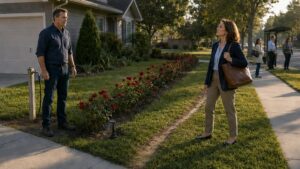
Joshua slipped the orange into his work jacket and stepped outside. He had nearly reached his truck when Virginia Brown’s front door opened.
“Joshua.”
She came down her walkway carrying a phone and a narrow spiral notebook. Her beige cardigan was buttoned wrong at the bottom, as if she had dressed in a hurry.
“Morning,” he said.
“Was there another one?”
Joshua unlocked the truck. “Another what?”
Virginia stopped at the edge of his driveway. “You know what.”
He looked toward the houses lining the quiet street. Porch lights glowed behind frosted glass. A sprinkler clicked twice and fell silent.
“It’s fruit, Virginia.”
“That does not answer the question.”
“No. There’s no question in what you said.”
Her mouth tightened. She lifted the phone and showed him a photograph taken from across the street. His porch filled the frame. In the center, bright against the weathered boards, lay yesterday’s orange.
Beneath the image was a list of dates and times.
Monday, 7:02.
Tuesday, 6:58.
Wednesday, 7:01.
The entries continued down the screen.
Joshua looked at her notebook. The same times had been written by hand.
“You’ve been logging them?”
“I started after the fourth delivery.”
“You started before you asked me.”
“I did ask you. Twice.”
“You asked whether I was expecting packages.”
“And you said no.”
“I wasn’t.”
Virginia lowered the phone. “An unidentified person is approaching your home every morning. They are avoiding cameras. They are wearing gloves. You may not be concerned, but other people are.”
Joshua opened the truck door.
“Other people,” he said, “or you?”
Her expression sharpened. “Last year, someone tested garage handles for three nights before the Robinson property was broken into. People saw him. Everyone assumed he was cutting through to the main road. By the time anyone took it seriously, the damage was done.”
Joshua knew the story. Everyone did. Virginia had been the first person the Robinsons called after finding the side door pried open. She had also been the person who admitted, repeatedly and publicly, that she had seen a stranger near the garages two nights earlier and dismissed him.
“This isn’t that,” Joshua said.
“You cannot know that.”
He did not answer.
Virginia watched his face. The change in hers was small but immediate.
“You do know something.”
Joshua set his lunch bag on the passenger seat.
“I know an orange isn’t a crowbar.”
“That is not what I said.”
“No. You keep making people finish the scary part for you.”
A porch door opened farther down the block. Rebecca Jones stepped out with a travel mug and her child’s backpack. She slowed when she saw them.
Virginia noticed, too. Her voice dropped.
“If you know who is doing this, tell me privately. I will document that there is no threat.”
“Document it for whom?”
“The property manager. The board, if necessary.”
Joshua gave a tired breath. “Nothing has happened.”
“Repeated unauthorized access is something.”
“It’s a public sidewalk and my porch.”
“Your porch is limited common-area frontage under the governing documents.”
“My porch is attached to my house.”
“And visible activity affecting community safety falls under compliance review.”
There it was: the shift from neighbor to officeholder. Virginia’s shoulders squared, and her words took on the measured rhythm she used at board meetings.
Joshua knew that rhythm. It turned ordinary disagreements into headings, subsections, and written findings.
He reached into his jacket and drew out the orange. Virginia’s eyes fixed on it.
The skin was imperfect. A pale scar crossed one side where a branch had rubbed against it. Near the stem, the leaf curled inward.
Joshua set it on the hood of his truck.
“Does that look like a threat to you?”
“It looks like an object left by someone who does not want to be identified.”
Rebecca had stopped beside her mailbox. She pretended to search through a stack of envelopes while listening.
Virginia raised her phone again.
“May I photograph it?”
“No.”
“It is already in public view.”
“It’s on my truck.”
“Joshua, refusing basic documentation only increases concern.”
He picked up the orange and returned it to his pocket.
“Then be concerned.”
He climbed into the truck. Virginia put one hand against the open door before he could close it.
“I am filing an incident report this morning.”
He looked at her hand until she removed it.
“Do what you think you have to do.”
“That is exactly what I’m trying to avoid.”
“No,” Joshua said. “You’re trying to make me do what you’ve already decided.”
He pulled the door shut.
At the yard, the orange sat inside his metal locker while he repaired a damaged irrigation valve and replaced two rusted bolts on a park gate. He thought about it whenever he reached for a tool.
At lunch, his phone showed three notifications from the neighborhood portal.
The first was a general reminder about reporting suspicious activity.
The second announced that the property-management representative had opened a case regarding “repeated unidentified porch deliveries.”
The third was addressed directly to him.
Mr. Lee,
Please confirm whether you have authorized the recurring placement of food items at the front entrance of your residence. If the individual is known to you, provide sufficient information for management to close the safety inquiry.
Joshua read it twice.
He typed, The deliveries do not present a danger.
Then deleted it.
He typed, The person involved has permission to approach my home.
He deleted that, too.
Permission created a name-shaped space. Virginia would keep asking until someone filled it.
He locked his phone and ate without answering.
When he returned home, Virginia was waiting beside his mailbox with a printed incident form tucked beneath her arm.
“I need your signature acknowledging receipt.”
Joshua took the paper but not the pen.
The attached photograph showed the orange on his porch. A red circle had been drawn around it. Under “Nature of concern,” Virginia had checked three boxes:
Unidentified visitor.
Repeated unauthorized activity.
Possible targeted harassment.
Joshua looked up.
“Harassment?”
“It is a provisional category.”
“Based on fruit.”
“Based on repetition, concealment, and your refusal to clarify.”
He folded the paper once.
“You don’t get to turn my silence into evidence.”
“I am not doing that.”
“You checked the box.”
Virginia’s gaze moved toward Rebecca’s house, where two neighbors had paused near the driveway.
“I have scheduled an observation,” she said. “Saturday morning. Seven o’clock. A community patrol volunteer will be present.”
Joshua felt the first real edge of alarm.
“No.”
“It will occur from common property.”
“No one is following anyone. No one is photographing anyone.”
“If the person is harmless, the matter ends.”
“You don’t know what harm looks like to somebody else.”
Virginia stared at him, perhaps hearing more in that sentence than he intended.
“Then explain it.”
Joshua folded the form again and slid it into his jacket.
“I’ll see you Saturday.”
Her expression eased as though she had won cooperation.
Joshua walked away before she could understand that he had meant a warning.
Chapter 2: The Neighborhood Decides It Is Dangerous
Joshua’s photograph appeared in the neighborhood safety alert before he finished his first cup of coffee.
The image had been taken the previous evening. He stood beside his truck in work clothes, holding the folded incident form. His face was turned partly away, but his address was visible on the mailbox behind him.
The caption read:
Resident declines to identify person involved in repeated early-morning activity. Residents are advised not to approach unknown individuals and to report unusual behavior.
No accusation. No name beside his.
It did not need either.
By seven-thirty, eighteen comments had appeared.
Could this be related to package theft?
Has anyone checked cameras?
Why would a homeowner refuse to cooperate?
One person suggested the oranges might mark houses for burglary. Another claimed criminals sometimes used ordinary objects to test whether residents were home.
Rebecca wrote: I’m across the street and have a child. I would rather be cautious than sorry.
Joshua closed the portal.
On his kitchen counter, eleven oranges filled a blue ceramic bowl. The newest one rested on top, its scarred side facing outward.
He had eaten none of them.
At work, his supervisor asked whether everything was all right at home. Joshua said it was. By noon, a coworker from another district had sent him a screenshot of the safety alert.
Small neighborhood, wide internet.
When Joshua returned Tuesday evening, Rebecca stood at the shared mail kiosk sorting envelopes. Her son waited beside her, dragging one sneaker through the mulch.
“Can I ask you something?” she said.
“You’re going to.”
She glanced toward the child. “Are you hiding someone?”
Joshua inserted his key into the mailbox.
“From what?”
“Virginia says you disabled your doorbell camera right before the deliveries started.”
Joshua stopped.
The doorbell camera above his porch had been dark for nearly three weeks. He had removed the battery himself.
“Virginia checked my camera?”
“She noticed it wasn’t lighting up.”
“That isn’t the same thing.”
Rebecca shifted the envelopes against her chest. “Why did you turn it off?”
Joshua pulled out a utility bill and two grocery circulars.
Because Carolyn had frozen the first time she noticed the camera’s blue light. Because she had asked, quietly, whether it recorded sound. Because she had looked down the street before saying she did not want people watching her carry things.
He had removed the battery that afternoon.
“It stopped working,” he said.
Rebecca studied him. “You fix electrical controls for the city.”
“I maintain pumps and facilities.”
“You know what I mean.”
He shut the mailbox.
Her son had moved closer to the curb, watching a beetle struggle across the concrete. Rebecca called him back without taking her eyes from Joshua.
“I don’t think you’re doing anything bad,” she said. “But when you won’t explain, people make up explanations.”
“Then maybe people should stop.”
“That’s easy to say when you’re not the one wondering who is walking around before daylight.”
Joshua looked at the boy beside her. The fear was not entirely borrowed. Rebecca’s hand rested on the child’s shoulder, firm and protective.
He softened his voice.
“There is no danger to your son.”
“How can you promise that without telling me what’s happening?”
Joshua had no answer that would not belong to someone else.
Rebecca read that silence as refusal.
“Fine,” she said. “But don’t act surprised when the board steps in.”
By Wednesday, orange number twelve had disappeared before Joshua opened his door.
For one sharp second he thought Carolyn had stopped.
Then he saw the fruit in a clear evidence bag hanging from his doorknob.
A property-management label had been attached to the plastic.
ITEM COLLECTED FROM LIMITED COMMON AREA.
Joshua carried it directly to Virginia’s house.
She opened the door wearing reading glasses and holding a mug.
“You bagged it?”
“Management requested preservation of one item.”
“It’s an orange.”
“Then you should have no objection to its being documented.”
He held the bag up between them. Condensation had formed inside the plastic.
“You took something left for me.”
“It was on an area governed by association rules.”
“Did you come onto my porch?”
“I retrieved an unidentified object.”
“You came onto my porch.”
Virginia’s face remained composed, but her fingers tightened around the mug.
“Joshua, I am trying to establish a safe record before Saturday. If we identify the person and determine there is no concern, this ends.”
“It ended every morning when I picked up the orange.”
“Not for everyone.”
“That’s because you keep sending alerts.”
She looked past him toward the street. “You are not the only resident here.”
“No. But I’m the only one whose front door you’re building a case around.”
He took the orange from the bag, peeled off the evidence label, and placed the fruit in his jacket.
Virginia’s composure cracked.
“That was part of the record.”
“It was breakfast before you arrested it.”
He walked away while she called his name.
That evening, he stood before the bowl of oranges. Twelve now, counting the one Virginia had collected.
He selected the smallest.
Carolyn’s house sat at the end of the block, a one-story place with faded green shutters and a narrow strip of garden behind a low wooden fence. No porch light was on. Her curtains were drawn.
Joshua climbed the two shallow steps and placed the orange beside her door.
For a moment, he considered knocking.
Instead, he turned the fruit so the leaf faced outward, exactly as she did.
He had reached the sidewalk when the curtain moved.
He kept walking.
Thursday brought a formal request for temporary surveillance permission. Virginia wanted authorization to place a portable camera on the common landscaping opposite Joshua’s porch.
He replied with one sentence:
I do not consent to recording my entrance or visitors.
Management responded that his consent might not be required for common-area observation.
Friday afternoon, Michael Thomas called.
His tone was careful.
“Joshua, I’m trying to keep this from becoming larger than it is.”
“Then cancel tomorrow.”
“Virginia has already arranged the patrol volunteer.”
“Cancel them, too.”
“There are liability concerns once residents report a recurring unknown person.”
“There’s no unknown person.”
Michael paused.
“So you know who it is.”
Joshua stared through the windshield of his parked work truck. Rainwater trembled in a pothole beside the curb.
“I know there’s no threat.”
“That isn’t the same answer.”
“It’s the only one you need.”
Michael exhaled slowly. “Saturday will be observation only. No confrontation unless there’s an immediate safety issue.”
“Virginia doesn’t know how to observe without turning it into a verdict.”
“That’s not fair.”
“Neither is taking pictures of my house and putting them online.”
“I’ll speak to her.”
“You should have spoken before the alert.”
Michael said nothing.
That silence told Joshua more than an apology would have.
At 6:42 Saturday morning, Joshua switched off his kitchen light and stood behind the curtain.
Five figures waited across the street.
Rebecca near her mailbox.
Michael beside a parked sedan.
A community patrol volunteer wearing a reflective vest.
One board member holding a travel mug.
And Virginia Brown, crouched behind the hedge with her phone lifted just above the leaves.
Joshua looked at the microwave clock.
6:43.
Seventeen minutes until Carolyn reached the corner.
Chapter 3: At Seven O’Clock Everyone Was Watching
Five residents waited in the blue-gray darkness before sunrise, all pretending not to watch Joshua’s front door.
Virginia remained behind the hedge. The patrol volunteer stood near the sidewalk with his hands hooked into the pockets of his reflective vest. Rebecca kept glancing toward her house, where her son was still asleep. Michael paced beside his sedan, unhappy enough to look innocent and involved enough not to be.
Joshua stepped onto the porch at 6:51.
Virginia rose halfway from the hedge.
“You were asked to remain inside.”
“By whom?”
“This is an observation.”
“Then observe me.”
Michael crossed the street before Virginia could answer.
“Joshua, no one is trying to provoke you.”
“You brought a patrol vest to watch someone deliver fruit.”
The volunteer lifted both hands. “I’m only here at the association’s request.”
“I know.”
Joshua descended the steps and positioned himself at the foot of the walkway.
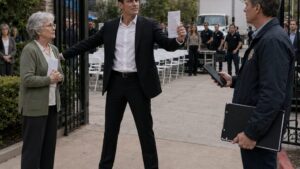
Virginia emerged fully from behind the hedge. “You are interfering with a documented safety procedure.”
“There is no procedure.”
“There is now.”
She held a clipboard beneath one arm. A printed page had been clipped to it, headed Community Safety Observation Record.
Joshua almost laughed. Instead, he looked at the time on his phone.
6:55.
At the far end of the block, a porch light clicked off.
His stomach tightened.
Virginia saw his attention shift and followed it.
“Is that the person?”
Joshua said nothing.
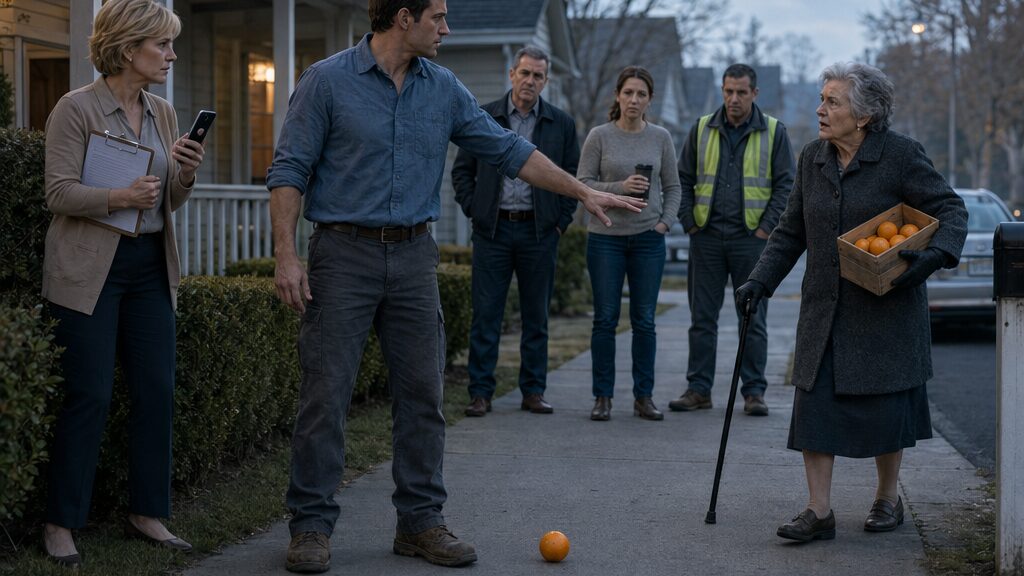
A small figure appeared beyond the row of parked cars. Dark coat. Slow, careful steps. One hand holding a cane, the other carrying a shallow wooden crate against her hip.
The black gloves were visible even from half a block away.
Virginia raised her phone.
Joshua crossed the street.
“Put that down.”
“I am recording from common property.”
“No faces.”
“If the individual approaches your residence—”
“No faces, Virginia.”
Carolyn Martinez continued toward them, apparently unaware that five people had arranged themselves around Joshua’s home like witnesses waiting for an incident.
Her cane tapped the sidewalk at an even pace.
Tap.
Step.
Tap.
Step.
The crate held perhaps two dozen oranges. A folded dish towel cushioned one side where it pressed against her arm.
Rebecca whispered, “That’s Carolyn.”
The patrol volunteer shifted his weight. “Ma’am?”
Carolyn stopped.
Her gaze moved from the vest to Virginia’s phone, then to Joshua standing in the street.
For one instant, her expression emptied.
Then she lowered her head and began walking again.
Virginia stepped forward.
“Mrs. Martinez, we need to ask you about repeated unauthorized deliveries.”
Joshua moved between them.
“Go inside, Carolyn.”
Carolyn’s eyes sharpened. “I am not going inside.”
Virginia angled the phone around Joshua’s shoulder.
“Mrs. Martinez, are you the person who has been approaching this residence every morning?”
Joshua reached out and covered the phone’s lens with his palm.
Virginia pulled it back.
“Do not touch my property.”
“Then stop pointing it at her.”
“This is a board-authorized inquiry.”
Michael came closer. “Virginia, lower the phone.”
“She is carrying the items in question.”
Carolyn looked down at the crate as though she had forgotten it was there.
“These?” she asked.
Her voice was quieter than usual but perfectly clear.
Virginia softened her tone. “Yes. We only need to understand why you’ve been leaving them.”
Carolyn looked at Joshua.
He saw recognition arrive in stages: the residents, the clipboard, the reflective vest, the phone, and finally him standing in front of her as if his body could erase the rest.
Her mouth tightened.
Joshua spoke before she could.
“You don’t have to answer.”
That was his mistake.
Carolyn’s chin lifted. “I can answer for myself.”
The words landed harder than Virginia’s accusations.
Joshua stepped aside, but only enough for Carolyn to see the group.
Virginia held the phone at chest height now.
“Have you been leaving oranges on Mr. Lee’s porch?”
Carolyn looked toward Joshua’s house. The empty porch boards waited in the growing light.
“Yes.”
Rebecca released a breath.
The patrol volunteer glanced at Michael as though expecting dismissal.
Virginia wrote something on the clipboard.
“And why were you doing that without notifying the resident or management?”
Carolyn’s eyes returned to Joshua.
“He knew.”
Every face turned toward him.
Virginia stopped writing.
“You told me the person was unidentified.”
“I never said that.”
“You allowed an official safety inquiry to continue.”
“I told you there was no danger.”
“That is not disclosure.”
“No,” Joshua said. “It isn’t.”
Carolyn shifted the crate against her hip. The movement made her wince.
Joshua reached for it automatically.
She stepped back.
The top row of oranges rolled against one another. One slipped over the edge, struck the sidewalk, and came to rest between Joshua and Virginia.
Bright, round, absurdly harmless.
No one moved to pick it up.
Virginia lowered the clipboard.
“Mrs. Martinez, if Mr. Lee authorized these deliveries, we can clarify the record. We will still need to address the use of gloves, the repeated timing, and access to limited common areas.”
Carolyn stared at her.
“The gloves?”
“They contributed to the concern.”
“My hands get cold.”
Rebecca looked away.
The patrol volunteer bent as if to retrieve the fallen orange, then stopped when Carolyn’s gaze moved toward him.
Virginia’s voice became more careful.
“No one is accusing you of wrongdoing. The concern was created by a pattern that appeared concealed.”
“It was seven in the morning,” Carolyn said. “I wasn’t hiding.”
“You approached before most residents were outside.”
“That was the point.”
Virginia glanced at Joshua. “Why?”
Carolyn’s fingers tightened around the crate handle.
Joshua knew that gesture. He had seen it at the grocery store when she counted bills twice before reaching the register. He had seen it when she refused his arm on the icy path behind her house.
He stepped between the question and its answer.
“This is over.”
Virginia’s face hardened. “It is not over merely because the explanation is embarrassing.”
“For whom?”
Michael intervened. “We have identified the person. There’s no immediate threat. Everyone can go home.”
Virginia did not look at him.
“Joshua knowingly withheld relevant information and obstructed an association inquiry.”
“Virginia,” Michael warned.
She pulled a folded notice from beneath the observation form. It had already been prepared.
Joshua saw his address printed at the top.
“You wrote that before she arrived.”
“It documents failure to cooperate with a safety investigation and interference with an authorized observer.”
“You planned to cite me no matter who showed up.”
“I planned for the possibility that you would continue obstructing.”
Joshua held out his hand.
Virginia hesitated, then gave him the notice.
The patrol volunteer removed his cap and rubbed the back of his head. Rebecca moved toward Carolyn.
“Can I carry that for you?”
Carolyn’s refusal was immediate. “No.”
Her voice made Rebecca stop.
Joshua unfolded the notice. Two violations. A hearing date to follow. Possible daily fines if the conduct continued.
He folded it again.
“Put whatever you want in your file,” he said. “But no photographs of Carolyn.”
Virginia gave a short, disbelieving shake of her head. “You do not control the record.”
“I control whether you get through me to make it.”
Michael stepped closer. “Joshua, don’t make this worse.”
Joshua looked at him. “You all came here before daylight to catch an old woman carrying oranges.”
Carolyn flinched.
Not at “catch.”
At “old woman.”
Joshua heard it too late.
Her face closed.
She bent slowly and picked up the fallen orange herself. When she straightened, the crate shook in her hands.
Joshua reached again.
“I’ve got it.”
“No,” she said.
“Carolyn—”
“I said no.”
She placed the fallen orange on the porch step. Not in its usual position. Not carefully centered. She set it down with enough force that it rolled against the railing.
Then she turned toward home.
Joshua followed her to the sidewalk.
“Let me carry the crate.”
She kept walking.
“Please.”
The cane struck the pavement in clipped, uneven taps now.
At the corner, she stopped without facing him.
“You let them think someone was after you?”
“I was trying to keep them out of your business.”
“You let them photograph your house. You let them call the patrol.”
“I told them there was no threat.”
“You did not tell me.”
Joshua opened his mouth and found nothing that did not sound like defense.
Carolyn turned then. Her eyes were wet, but her voice remained controlled.
“You decided what I could bear. You decided what they could know. You decided silence was kinder than asking me.”
“I promised I wouldn’t tell people about—”
“I asked you not to tell people why.”
The crate rested against her coat. One bruised orange showed through a gap in the slats.
“I never asked you to pretend you did not know me.”
Joshua felt the folded violation
Chapter 4: The Kindness He Turned Into Secrecy
Carolyn placed the entire wooden crate into Joshua’s arms before he could cross her kitchen threshold.
The weight drove his elbows down.
“You carried it this far,” she said. “You can carry it back.”
Her kitchen smelled faintly of coffee and orange peel. A dish towel lay folded beside the sink. Three bruised oranges rested in a shallow bowl near the window, their skins mottled where they had pressed against branches or one another.
Joshua adjusted the crate against his chest.
“I came to apologize.”
“You came to explain.”
“Both.”
Carolyn stepped aside from the doorway, but she did not invite him to sit. Her cane leaned against the counter within reach.
Joshua set the crate on the small table. One orange rolled against the wooden slats.
Carolyn watched him stop it with two fingers.
“You always do that,” she said.
“Do what?”
“Catch things before they fall. Even when nobody asked.”
Joshua looked at the orange under his hand.
Outside, a lawn mower started two houses away, then sputtered off. The quiet that followed felt intentional.
“I should have told you about the watch,” he said.
“Yes.”
“I thought if you knew, you’d stop coming.”
“I might have.”
“That’s why I didn’t.”
Carolyn’s expression did not change. “You hear yourself?”
He did.
He took his hand off the orange.
“I didn’t want them turning your business into a neighborhood discussion.”
“So you let them turn you into one instead.”
“I could handle it.”
“That was not your decision alone.”
Joshua glanced toward the window. From here, he could see the edge of his own roof beyond two yards and a line of trimmed hedges. Eleven houses close enough for people to know when lights came on, when cars left, when packages sat too long.
Carolyn pulled out a chair and lowered herself carefully.
The movement exposed what she usually hid: the stiffness in her left hip, the moment of pain before she settled.
Joshua looked away.
She noticed.
“That, too,” she said.
“What?”
“You look away when you think seeing something will embarrass me.”
He remained standing.
“I was trying to give you privacy.”
“You were trying to make yourself comfortable.”
The words were not loud. They did not need to be.
Joshua sat across from her.
For several seconds, neither spoke.
Then Carolyn reached into the crate and lifted an orange with a soft brown spot near the base.
“These aren’t store fruit,” she said. “You know that.”
“I know.”
“They come from my sister’s trees. She sends too many every season because she thinks I still feed half a school cafeteria.”
Carolyn turned the orange in her hands.
“When I worked, bruised fruit became slices. Soft apples became sauce. Nothing went to waste because children did not care whether something was pretty.”
Joshua remembered seeing her outside in late winter, sorting fruit at the table despite the cold, pressing each piece with her thumb.
“You could’ve kept them,” he said.
“For what?”
“To eat.”
“I am one woman.”
The corner of her mouth moved, not quite a smile.
“I gave some to Rebecca before all this. She left them in the mailbox for two days because she thought they might be from a delivery service.”
Joshua almost smiled, but Carolyn’s face remained serious.
“The morning routine mattered,” she said. “I woke at six when I worked. Coffee at six-ten. Shoes by six-thirty. Out the door before seven. Forty years of that does not disappear because someone hands you a retirement cake.”
Joshua looked toward the black gloves resting beside the sink.
“They’re yours?”
“Of course they’re mine.”
“Virginia made them sound like part of a disguise.”
“They cost eight dollars at the pharmacy.”
He let out a breath that might have been a laugh if the morning had been different.
Carolyn placed the orange back in the crate.
“You want to tell me what you thought you were protecting?”
Joshua leaned his forearms on the table.
The memory came with the smell of salt from the road and wet wool from Carolyn’s coat.
January. A sheet of ice behind the neighborhood grocery store. Carolyn on the pavement beside a split paper bag, soup cans rolling beneath parked cars. One knee twisted under her. One glove missing.
He had been leaving after a late shift when he saw her.
At first she insisted she was fine. Then she tried to stand and could not.
Joshua drove her to urgent care, waited through the X-rays, and brought her home with a badly bruised hip and instructions not to carry weight for several weeks.
She had asked him not to tell the neighbors.
Not because of the fall itself.
Because of what came after.
For nearly a month, Joshua carried her groceries from the store to her kitchen. Carolyn always had cash folded in an envelope. Always exact. Always ready.
Then one Thursday, the grocery clerk quietly pulled him aside.
The card Carolyn used for supplemental benefits had declined. The balance in her checking account was lower than she thought. She had begun removing items one by one: coffee, chicken, laundry detergent.
Joshua told the clerk to run the rest on his card.
He did the same the following week.
And the week after that.
Carolyn never mentioned it.
He had assumed she did not know.
“I covered three grocery balances,” he said.
Carolyn stared at him.
Joshua’s chest tightened.
“Four,” she said.
He looked up.
“The first week after the clinic, you paid for the prescription, too.”
“You knew?”
“The clerk cannot lie with her eyebrows.”
Joshua leaned back.
Carolyn’s gaze stayed steady.
“I knew the first time you handed me a receipt folded so the total was hidden.”
“I didn’t want you worrying.”
“I was already worried.”
“You needed the groceries.”
“Yes.”
“You would’ve put things back.”
“Yes.”
“So I paid.”
“And then you decided we would never speak of it.”
Joshua opened his hands. “You asked me not to tell anyone.”
“I asked you not to tell the neighborhood I was having trouble.”
“I kept that promise.”
“You built a wall around it.”
He had no quick answer.
Carolyn looked toward the bruised oranges by the window.
“The first orange was not repayment,” she said. “Not exactly. It was the only thing I could put in your hand without you refusing.”
Joshua remembered opening his door on that first morning and finding the fruit centered on the porch. He had known immediately.
Carolyn’s sister always left the leaves attached.
“The second was because you ate the first one at work,” she continued. “I saw the peel in your truck.”
“You looked in my truck?”
“It was on the seat.”
“The window was closed.”
“You need to clean your truck.”
Despite himself, Joshua smiled.
Carolyn did not, but some of the hardness left her face.
“Then it became a routine,” she said. “Seven in the morning. One orange. I could walk there. I could carry it. I could give something without asking whether you wanted it.”
Joshua looked at the crate.
“And I turned that into something secret.”
“You turned it into something shameful.”
“I was trying to stop them from seeing you as—”
He stopped.
“As what?” Carolyn asked.
He looked toward her cane.
She followed his gaze.
“There it is.”
Joshua rubbed a thumb across the edge of the table.
“After my father got sick,” he said, “he kept telling me he was fine. I believed him because it was easier. By the time I went over, he’d been on the floor most of the day.”
Carolyn’s expression softened, but she did not rescue him from what came next.
“I thought if I noticed sooner with you, if I handled things before they got worse—”
“I am not your father.”
“I know.”
“No. You know it in words.”
Joshua looked down.
Carolyn rested both hands on the table.
“You cannot make up for one person by deciding for another.”
The mower outside started again. This time it kept running.
Joshua listened to the engine for a moment, grateful for the noise.
“There’s a hearing,” he said. “They’re citing me for obstruction.”
“I heard.”
“I can challenge it.”
“You should.”
“I may need you there.”
Carolyn’s face closed again.
“No.”
“Carolyn.”
“I will not stand in that room while they discuss whether I was allowed to carry fruit.”
“If you don’t go, Virginia controls the explanation.”
“She already did.”
“This is how we correct it.”
“No. This is how you correct what happened to you.”
Joshua sat still.
Carolyn stood with effort and reached for her cane.
“I am not ready to make my grocery bill public so you can win an argument.”
“I’m not asking you to.”
“You will be. Maybe not today.”
She walked to the door and opened it.
Joshua rose.
“What do you want me to say?”
“The truth about yourself.”
“That I knew you?”
“That you made the decision.”
He lifted the crate.
Carolyn looked at it.
“Leave those.”
“You told me to take them back.”
“I changed my mind.”
Joshua set the crate down again.
At home, a new message waited on the neighborhood portal.
It had been posted by Virginia under the heading Clarification of Ongoing Compliance Matter.
The individual responsible for the repeated deliveries has been identified. However, the activity may still constitute unauthorized solicitation and repeated placement of unapproved materials within association-controlled frontage.
Joshua read the sentence twice.
The mystery had ended.
The violation had not.
Chapter 5: The Rule Changed After the Truth
The first fine arrived Monday morning.
Twenty-five dollars for accepting an orange.
Joshua found the notice taped inside his storm door, sealed in a clear plastic sleeve. Beneath the amount, the violation description read:
Receipt and retention of unauthorized food items delivered through recurring unapproved solicitation.
A second line warned that the fine could be assessed daily until the activity ceased.
He stood on the porch holding the notice while the seven o’clock minute changed on his phone.
No orange waited on the boards.
For the first time in nearly two weeks, the center space between the planks was empty.
At work, Joshua printed the HOA bylaws during lunch and spread the pages across a maintenance-room table between pipe fittings and work orders. “Solicitation” appeared five times.
Door-to-door sales.
Commercial flyers.
Political canvassing.
Fundraising.
Nothing about gifts. Nothing about fruit. Nothing about a resident walking to another resident’s home.
He highlighted every definition.
At three, Michael called and asked him to stop by the HOA office before the evening board session.
The office occupied one side of the community room, separated by a glass partition. Virginia was absent. The property-management representative sat at a desk with a laptop open. Michael stood beside a filing cabinet, holding Joshua’s printed objection.
“You did your homework,” Michael said.
“I read the rule.”
“The management company believes the board has broad authority over recurring distribution.”
“Distribution to one person?”
“They’re relying on the nuisance section.”
Joshua looked at the representative. “Which part?”
The representative turned the laptop so he could see.
“Repeated activity that causes reasonable alarm or interferes with quiet enjoyment.”
“Virginia caused the alarm.”
Michael’s jaw tightened.
“Let’s keep this useful.”
Joshua placed the fine notice on the desk.
“This says I’m being fined for receiving something.”
“It says you permitted an unapproved recurring activity after notice.”
“Show me where receiving fruit requires approval.”
Michael glanced at the representative.
No one answered.
Joshua leaned against the edge of the desk.
“Virginia changed the category after she found out who it was.”
Michael lowered his voice. “The initial process was not handled well.”
“Was the surveillance approved by the board?”
Another pause.
The property-management representative looked down at the laptop.
Michael closed the office door.
“Virginia submitted the observation as a compliance-chair action. She did not bring it to a vote.”
“So it wasn’t authorized.”
“She believed it fell within her delegated authority.”
“She put my picture on the neighborhood portal.”
“That alert should not have included your address.”
“She brought a patrol volunteer.”
“I know.”
“She photographed Carolyn.”
Michael looked at him. “There are no retained images of Mrs. Martinez.”
“That wasn’t my question.”
The room beyond the glass partition was beginning to fill. Chairs scraped across the tile. Two board members arranged papers at the long table.
Michael rubbed a hand over the back of his neck.
“I can recommend that your fine be suspended pending review.”
“Suspended isn’t withdrawn.”
“It gives us room.”
“For what?”
“To resolve this without turning it into a larger dispute.”
Joshua understood the offer. Quiet pause. Quiet correction. No admission.
“No.”
Michael’s expression hardened. “You may be right on the rule, Joshua, but refusing every practical option does not help.”
“A practical option would be deleting the safety alert and acknowledging the observation was unauthorized.”
“That requires a board decision.”
“Then make one.”
The property-management representative cleared her throat.
“There is another concern.”
She opened a PDF titled Hearing Packet and scrolled to the incident summary.
A photograph of the orange appeared beside Virginia’s typed notes. Under the heading Identified Source, Carolyn’s full name and unit number were listed.
Joshua straightened.
“Why is her address in that?”
“It is a standard identifying field.”
“She isn’t the cited homeowner.”
“She is the person performing the activity.”
Joshua looked at Michael.
“You knew this was published?”
“I hadn’t seen the final packet.”
“Who received it?”
“All board members, management, and involved parties.”
“Involved parties meaning Virginia.”
“And you.”
“And Carolyn?”
The representative hesitated. “She was copied because her conduct is referenced.”
Joshua stared through the glass at the residents entering the community room. Rebecca sat in the second row. Virginia had arrived and was speaking to one of the board members, a folder tucked beneath her arm.
Carolyn had asked him not to make her hardship public.
The HOA had published her address before she had agreed to speak at all.
Joshua turned back to Michael.
“Remove it.”
“The packet has already been distributed.”
“Send a corrected version.”
“We can redact the unit number from the public copy.”
“It should never have been there.”
Michael’s face tightened with something closer to shame than defensiveness.
“You’re right.”
Virginia opened the office door without knocking.
“The meeting begins in ten minutes.”
Her gaze moved from Joshua to the packet on the screen.
“If this is about the identifying information, management used the standard template.”
“You supplied it,” Joshua said.
“I supplied facts relevant to the hearing.”
“You supplied her home address.”
“She is a resident. Her address is already known to the association.”
“Not to every person who gets forwarded that packet.”
Virginia closed the door behind her.
“This is precisely why informal arrangements become problems. If you had cooperated at the beginning, there would have been no need for a formal record.”
Joshua looked at her.
“You keep making the damage proof that you were right to cause it.”
Virginia’s face flushed.
“The board has obligations beyond your personal preferences.”
“And Carolyn’s?”
“She chose to conduct repeated activity in common areas.”
“She walked down a sidewalk.”
“She left food items on limited common property after residents raised safety concerns.”
“The concern came from you.”
“No. The concern came from an unknown person approaching a home before daylight while concealing her hands and avoiding a disabled camera.”
Joshua almost answered sharply, but something in Virginia’s voice stopped him.
Not certainty.
Memory.
“You really thought someone was testing the houses,” he said.
Virginia folded her arms.
“I thought dismissing a pattern because it looked harmless would be irresponsible.”
“The Robinson break-in.”
Her eyes shifted.
Michael said, “Virginia.”
“No,” she said. “He wants to understand.”
She looked at Joshua.
“I saw the man near their garage. Twice. I told myself there was probably an explanation because I did not want to sound alarmist. Two days later, their side door was broken and their house was emptied while they were at work.”
Her voice remained controlled, but the last sentence came out thinner.
“I will not make that mistake again.”
Joshua nodded once.
Then he pointed to Carolyn’s address on the screen.
“So you made a different one.”
Virginia’s mouth tightened.
The door behind her opened again.
Everyone turned.
Carolyn stood in the doorway.
She wore the same dark coat from Saturday. In one hand she held her cane. In the other, folded together at the cuffs, were the black gloves.
Joshua stepped toward her.
“Carolyn—”
“Do not start.”
Her gaze moved to the hearing packet on the screen, then to Virginia.
“I received this,” she said. “At my house.”
Virginia lifted her chin. “You were copied as an involved resident.”
Carolyn held up the gloves.
“Then I suppose these are involved, too.”
No one spoke.
Carolyn entered the office and closed the door behind her.
“I will attend your hearing,” she said. “But this time, none of you will decide what I mean before I say it.”
Chapter 6: Carolyn Refuses to Be Protected Quietly
“Do not speak for me tonight.”
Carolyn said it before Joshua could pull out the chair beside her.
The community room had filled beyond its usual board-meeting crowd. Residents occupied every row. Several stood along the back wall beneath framed photographs of neighborhood landscaping projects and holiday gatherings.
At the front, the board sat behind a long folding table. Virginia occupied the far end, separate from the voting members but close enough to pass documents. Michael sat in the center with a microphone before him.
Carolyn placed her cane against the chair.
Then she set the black gloves on the table in front of her.
Joshua sat one seat away.
“All right,” he said.
She looked at him.
“You say that now.”
He folded his hands in his lap.
Michael called the meeting to order. The property-management representative read the case summary in a neutral voice that made the absurd parts sound ordinary.
Repeated food-item placement.
Unknown early-morning visitor.
Resident noncooperation.
Unauthorized observation.
Obstruction notice.
Daily fine.
When she finished, Michael adjusted the microphone.
“Mr. Lee, you may begin.”
Joshua looked at Carolyn.
She gave no signal.
He faced the board.
“I object to the fine, the surveillance, the safety alert, and the publication of Mrs. Martinez’s address.”
Virginia shifted in her seat.
Joshua continued.
“I knew who was leaving the oranges. I chose not to identify her. That choice made the situation worse.”
A murmur moved through the room.
He kept his eyes on the board.
“I believed I was protecting someone’s privacy. I did not ask whether she wanted that kind of protection. That was my mistake.”
Carolyn’s hands remained still beside the gloves.
Michael looked toward her.
“Mrs. Martinez, would you like to speak?”
“Yes.”
She rose slowly. Joshua’s body moved before he could stop it.
His hand lifted toward her elbow.
Carolyn looked at it.
He withdrew.
She steadied herself with the cane and walked to the small public-comment table.
From her coat pocket, she removed one orange.
It was not perfect. A pale scar crossed one side. A small leaf remained near the stem.
She placed it beside Joshua’s violation notice.
The orange rolled once and stopped against the folded black gloves.
Virginia watched it.
Carolyn adjusted the microphone.
“My name is Carolyn Martinez. I have lived in this neighborhood for twenty-three years. I worked in a public-school cafeteria for forty.”
She glanced toward the residents.
“I am the person who left the oranges.”
No one moved.
“I did not wear gloves to conceal my identity. My hands ache in the morning.”
A few people lowered their eyes.
“I did not arrive at seven because I hoped not to be seen. I arrived at seven because that is when I have left my house for most of my adult life.”
She rested both hands on the table.
“Work began at seven-thirty. I woke at six. Coffee at six-ten. Shoes by six-thirty. Out the door before seven. After retirement, the clock kept waking me even when no one needed me to open a kitchen.”
Joshua looked at the orange.
Carolyn’s voice remained even.
“This winter, I fell behind the grocery store. Mr. Lee found me. He took me to urgent care. He carried groceries while I recovered.”
She paused.
Joshua felt every person in the room turn toward him.
“He also paid for some things when I could not.”
Rebecca looked down at her hands.
Carolyn continued.
“I asked him not to tell anyone. I did not want neighbors bringing casseroles, checking my refrigerator, or discussing whether I should still live alone.”
A small, uncomfortable laugh came from the back and died immediately.
“My sister sends oranges from her trees. Too many. Some are bruised. Some are small. They are still good.”
She touched the fruit with one finger.
“I began leaving one for Joshua because he would not accept money. Then I continued because giving it made the morning useful.”
The room seemed to contract around that sentence.
“At seven o’clock, I was not a woman being watched. I was not a problem to be managed. I was a neighbor carrying something I could still carry.”
Joshua’s throat tightened.
Carolyn turned slightly toward him.
“But Mr. Lee decided the only way to protect my dignity was to hide me.”
He accepted the words without looking away.
“He let people suspect him. He let them discuss danger and trespassing. He thought that was kindness.”
Carolyn’s gaze returned to the board.
“It was not.”
Virginia drew a breath.
Carolyn looked directly at her.
“And turning me into an incident was not safety.”
Michael leaned toward the microphone. “Mrs. Martinez, the board acknowledges that the process—”
“I am not finished.”
Michael leaned back.
Carolyn’s grip tightened around the cane.
“I understand fear. I understand seeing something once and wishing later that you had acted. But fear does not become fair because it is written on a form.”
Virginia’s face changed.
Not dramatically. Her mouth loosened, and some of the stiffness left her shoulders.
“The Robinson home was robbed,” she said. “A person was seen near the property beforehand.”
Carolyn nodded.
“That happened.”
“I was the person who dismissed the warning.”
“I heard.”
Virginia’s voice sharpened, defensive now because the truth had entered the room without protecting her.
“When the same figure approached one residence repeatedly before daylight, with gloves, while the camera was disabled, I believed waiting would be negligent.”
Joshua looked toward the residents. For the first time, several faces showed not agreement with Virginia, but recognition of the shape of her fear.
Carolyn did not soften her answer.
“You believed caution required no consent.”
Virginia looked at the orange.
“I believed identifying the person would end the concern.”
“You identified me and then changed the rule.”
Silence.
Michael turned to the property-management representative.
“Is the solicitation citation supported by the current governing documents?”
The representative opened a binder.
“The language is broad.”
“That is not an answer.”
She hesitated.
“There is no specific provision covering noncommercial gifts between residents.”
A board member asked, “Then on what basis was the daily fine issued?”
Virginia spoke before the representative could.
“The nuisance provision allows intervention in repeated activity causing reasonable alarm.”
Rebecca stood from the second row.
“The alert caused the alarm.”
Heads turned toward her.
She looked nervous but continued.
“I repeated it. I asked Joshua whether he was hiding somebody. I did that because the notice said there might be a safety risk.”
Virginia’s face tightened.
Rebecca sat down again.
Michael looked toward the board members.
“The fine cannot stand if the underlying conduct was not prohibited.”
One board member nodded. The other began writing.
Joshua could feel the room moving toward the easiest resolution: withdraw the fine, close the case, call the process imperfect.
Michael turned to him.
“Mr. Lee, the board is prepared to dismiss the violation and refund any administrative charge.”
Joshua looked at Carolyn.
Her face revealed nothing.
He stood.
“That isn’t enough.”
A ripple moved through the room.
Michael frowned. “The citation would be removed.”
“Carolyn’s address was published in the hearing packet.”
“We can issue a corrected copy.”
“The safety alert described me as an uncooperative resident involved in suspicious activity.”
“We can remove the post.”
“Removing it doesn’t correct what people read.”
Virginia folded her arms.
“What are you asking for?”
Joshua’s instinct was to answer for Carolyn.
He stopped.
Then he turned to her.
“What do you want corrected?”
Carolyn studied him.
The room waited.
Finally, she said, “The record should say there was no threat. It should say the observation was not approved by the board. And my address should not appear in any public packet.”
Joshua nodded.
He faced Michael.
“That.”
Michael looked at the board members.
“We can direct management to issue a correction and begin a review of compliance procedures.”
“And the rule?” Joshua asked.
“We can clarify the solicitation language.”
“Publicly?”
Michael hesitated.
Joshua understood the cost now. A private dismissal protected the board. A public correction required admitting the institution had overreached.
He looked at the orange beside the violation notice.
“I’ll accept dismissal of the fine when the correction is issued,” he said. “Not before.”
Virginia stared at him.
“You are prolonging the matter.”
“No,” Joshua said. “I’m refusing to let the quiet version become the official one.”
Carolyn’s eyes remained on him.
This time, he did not try to read approval into her silence.
Michael gathered the papers into a single stack.
“The board will reconvene on the corrective actions within fourteen days.”
The gavel came down once.
Residents began to rise, but Carolyn stayed at the public-comment table.
Joshua walked toward her and stopped at arm’s length.
“Would you like help back to your seat?”
She considered him.
“Yes,” she said. “With the chair. Not with me.”
Joshua moved the chair closer.
Carolyn sat without his hand on her arm.
The orange remained at the front of the room, pressed against the notice that had tried to define it.
Chapter 7: What the Board Could Repair
The board rescinded Joshua’s fines in the first sentence of its letter and avoided explaining why for the next two pages.
The notice arrived fourteen days after the hearing. It cited “administrative inconsistencies” and confirmed that every charge had been removed from his account. A separate document offered a confidential resolution: no further action by either party, no admission of fault, and no public discussion of the matter beyond the corrected account balance.
Joshua carried both pages to the HOA office.
Michael was waiting behind the glass partition. A bowl of oranges sat near the meeting-room exit, bright against the gray folding table.
“Carolyn brought those?” Joshua asked.
“Rebecca did.”
Michael nodded toward the chair across from him.
Joshua remained standing and placed the confidentiality agreement on the desk.
“I’m not signing this.”
Michael leaned back. “The fines are gone.”
“The safety alert still says I refused to cooperate in a suspicious-activity investigation.”
“We removed the original post.”
“You didn’t correct it.”
“We drafted a clarification.”
“Where is it?”
Michael opened a folder but did not remove anything.
Joshua understood.
“You want my signature first.”
“I want an end to this that does not create another round of accusations.”
“Correcting the record is not an accusation.”
“It will be read as one.”
“That depends on how carefully you write it.”
Michael rubbed a thumb along the folder’s edge. He looked tired rather than defensive now.
“The association’s insurer reviewed the process. Virginia exceeded the authority delegated to the compliance chair. Management also agrees Carolyn’s unit number should not have appeared in the packet.”
“Then say that.”
“Publicly stating that a board officer exceeded authority has consequences.”
“So did publishing Carolyn’s address.”
Michael looked through the glass toward the community room. Virginia stood near the far wall speaking to one of the board members. She was no longer carrying a compliance folder.
“She has agreed to step down as compliance chair,” he said.
“Agreed or was asked?”
“Both.”
“Is she leaving the board?”
“No.”
Joshua absorbed that.
It was not removal. It was not complete accountability. It was a line moved back after damage had already crossed it.
Michael pushed the folder aside.
“We are commissioning an independent review of notification, surveillance, and privacy procedures. Future observations will require a board vote unless there is an immediate emergency. Resident addresses will be redacted from public hearing packets.”
“That should have been standard.”
“It will be now.”
Joshua looked at the unsigned agreement.
“And the correction?”
Michael took out a single page.
The language was restrained:
The previously reported early-morning activity at Joshua Lee’s residence involved consensual gifts between residents and presented no identified safety threat. The observation conducted in connection with the report did not receive prior board approval. The association regrets that incomplete information contributed to unnecessary concern.
Joshua read it twice.
It did not name Virginia. It did not call the surveillance improper. It did not say Carolyn’s privacy had been breached.
But it told the neighborhood there had been no threat, and it admitted the observation lacked approval.
“Post this,” he said. “Then I’ll sign an acknowledgment that the dispute over my fines is closed. Not a confidentiality agreement.”
Michael considered him for a long moment.
“All right.”
The word sounded costly.
When Joshua left the office, Rebecca was standing beside the orange bowl with her phone in both hands.
“I posted something,” she said.
He waited.
“I said I repeated speculation that wasn’t verified. I said Carolyn was delivering gifts with your knowledge and that neither of you posed a safety concern.”
“You didn’t have to name her.”
“She approved it.”
That stopped him.
Rebecca held out the phone. Beneath her correction was a short reply from Carolyn:
Thank you. I prefer that people ask me next time.
Joshua gave the phone back.
“Fair enough,” Rebecca said.
Virginia approached from the meeting room. Without the compliance folder, her hands seemed uncertain.
“The correction will be posted tonight,” she said.
“So I heard.”
She glanced at the bowl of oranges.
“I believed I was preventing something.”
Joshua nodded. “I know.”
Her eyes met his, perhaps expecting that understanding to become forgiveness.
It did not.
“I should not have included the photographs or the address,” she said. “And I should have taken your assurance more seriously.”
It was not a full apology. It was careful, limited, and spoken without witnesses close enough to hear.
Joshua accepted it for what it was.
“You should have asked before deciding what everyone needed.”
Virginia’s gaze shifted toward the office. “That seems to be the lesson.”
Carolyn waited outside beside a small wheeled crate. The correction had not yet been posted, but she already knew the board’s decision.
Joshua reached automatically for the crate handle.
She placed her cane across it.
He stopped.
“Would you like me to carry it?” he asked.
“No.”
They began walking.
At the first corner, Carolyn’s pace slowed. Joshua matched it without comment.
After half a block, she said, “You did well in there.”
“I refused paperwork.”
“You asked me what I wanted before you did it.”
The distinction settled between them.
At her walkway, Joshua reached toward the crate again, then caught himself.
Carolyn noticed.
“Walk me home,” she said. “But do not carry everything.”
She lifted one side of the crate. After a moment, Joshua took the other.
Chapter 8: One Orange Left in Plain Sight
Joshua heard Carolyn’s cane before the orange touched his porch.
Tap.
Step.
Tap.
At exactly seven, he opened the door.
Carolyn stood beside a half-filled crate without her black gloves. One orange rested in her bare hand, its small leaf moving in the morning air.
Across the street, Rebecca’s porch held two oranges in a paper bag. Another bag waited outside the house beside hers. Carolyn had begun making deliveries again, this time after asking who wanted them.
Joshua looked at the crate.
“Would you like help?”
“With half.”
He descended the steps and lifted one side. Carolyn kept the other.
Virginia passed on the sidewalk carrying her mail. She slowed, gave them a restrained nod, and continued without joining them.
At Carolyn’s gate, Joshua lowered his half when she did.
“You can keep the last one,” she said.
He reached toward the crate.
Carolyn caught his wrist lightly.
“Not from there.”
She placed the orange directly into his palm.
No porch boards. No gloves. No silence standing in for permission.
Joshua closed his fingers around the fruit.
“Thank you,” he said.
Carolyn nodded once.
Then she turned toward her house, carrying her half of the crate while Joshua remained by the gate with the orange in his hand.
The story has ended.