What They Remember
Part I — The Face in the Glass
The first time Daniel Mercer saw his father as a stranger, rain was running down the bus window and the city had dissolved into streaks of blue and amber light.
The exhibit proof rested on his lap, clipped to a board so it would not bend in transit. Black-and-white photograph. Rough white matte. Draft caption beneath it in his own careful type:
The average U.S. Army recruit in 1942 stood 5’8″ and weighed 144 pounds. During basic training, many gained between 5 and 20 pounds.
He had written that line three times already, trimming adjectives until it sounded like a fact and not an argument.
But he was no longer reading the caption.
He was staring at the central young man in the photograph.
A line of recruits stood in a field with rifles lifted overhead, thin wrists locked, faces strained into seriousness. Most looked anonymous in the way old military photos did—flattened by distance, swallowed by uniformity. But the man in the middle held Daniel’s eye. Narrow shoulders. Hollow cheeks. A guarded mouth. He did not look brave. He looked as if bravery had not arrived yet.
And he looked familiar enough to make Daniel sit straighter.
The bus lurched through an intersection. The board slipped against his knee. He caught it too quickly, the way he always did with old paper, with glass, with anything breakable.
His father used to say, If you’re going to hold something, hold it properly.
Daniel had spent forty-two years trying not to hear that voice and had somehow built his life around obeying it anyway.
He lowered the board and looked back out through the glass. The rain made the city seem farther away than it was. He could see his own reflection in the window—wire-rim glasses, careful tie still knotted after a long day, the pale face of a man who worked under museum lights and climate control. For a moment the reflected face overlapped the recruit’s face on the board.
That was what unsettled him.
Not resemblance exactly. Not yet.
Recognition.
By the time he reached the Military Memorial Institute, the feeling had sharpened into something worse.
He went straight past the security desk, nodded at the guard, and crossed the dark lobby to the archive wing with the board under his arm. The building smelled the way it always did at night: paper, polish, old radiators, wet wool from coats hung too close together.
His office light threw a rectangle across the floor. He set the board down, took off his jacket, and pulled the accession folder for the photograph from the cart waiting by his desk.
He meant to confirm the usual details—training camp, date range, provenance, reproduction rights—before sending the final label to print in the morning.
Instead he found himself going too fast.
The photograph had been donated decades earlier as part of a larger wartime collection from a dissolved veterans’ chapter. The front description was sparse: Basic rifle conditioning drill, Camp Boone, autumn 1942. No names attached. Anonymous recruits. Representative image.
Daniel slid out the secondary material. There was a typed index card, a yellowing envelope, a medical summary sheet from a training file someone had clipped in later for context. He skimmed automatically.
Average recruit height. Average weight. Chest measurement on intake.
His eye snagged there.
Chest, normal: 33 1/4 inches.
He knew the number. He had put it in his notes that afternoon and rejected it from the exhibit text because it felt too intimate. A chest measurement made the body harder to mythologize.
He reached for the envelope.
Inside was a roster sheet for the company pictured that week. Not a certainty. Just a cross-reference an earlier archivist had likely used and then ignored. A list of names. Home towns. Physical intake summaries in cramped old ink.
Daniel ran his finger down the column once.
Then again.
Then stopped breathing for half a second.
Mercer, Thomas Hale. Age 19. Height 5’8″. Weight 141 lbs. Chest 33 1/4.
Not even the average in the caption.
Three pounds lighter.
Daniel sat down hard.
His father was dead six years now. Colonel Thomas Mercer, Bronze Star, veterans’ speaker, the man people still described at memorial dinners as flint, iron, command made flesh. Daniel had grown up inside that version of him. The clipped voice. The rigid back. The sense that weakness was not merely regrettable but indecent.
And here, in a training field in 1942, before the medals and the photographs in dress uniform and the stories polished for banquet rooms, Thomas Mercer weighed 141 pounds.
Daniel looked at the boy in the center of the image again.
Not a colonel. Not a legend. Not the hard-faced man who corrected his son’s posture at the dinner table by tapping two fingers between his shoulder blades.
Just a thin nineteen-year-old trying not to look small.
On the medical summary sheet clipped behind the roster, a later training note had been added in another hand.
Weight after cycle completion: 152. Chest expansion improved. Bearing satisfactory.
Daniel stared at the word bearing until it blurred.
His father had taught bearing the way some men taught prayer.
And suddenly the rain on the windows, the photo on the board, the dry museum label in twelve-point type—none of it felt historical anymore.
It felt like the first lie in a family that had mistaken hardness for origin.
He reached for the phone on his desk and called up the surviving-contact file attached to Camp Boone veterans’ records.
There was one name not marked deceased.
Elias Boone.
Former medic. Same training company.
Ninety-six years old.
Daniel looked down at the photograph one more time. The broad-shouldered recruit two places to Thomas’s right looked stronger than all of them. The kind of young man people would point to and say, There. That one was born for it.
Daniel heard himself whisper into the empty office, “Who were you before they fixed you?”
The room, being an archive, gave him nothing back.
But the next morning he drove to see the only man left who might.
Part II — Boys Before the Uniform
Elias Boone lived in an assisted-care facility forty minutes outside the city, in a low brick building with too many flags near the entrance and too much lemon cleaner in the hallways.
Daniel had expected fragility. What he found was sharpness.
Elias sat by the window with a blanket over his knees and an unlit cigarette pinched between two stained fingers, as if habit had survived longer than permission. He was nearly swallowed by the chair. His wrists were bird-boned. But his eyes were bright and unpleasantly alive.
Daniel introduced himself, explained the exhibit, mentioned Camp Boone, and watched the old man’s expression stay flat until he set the reproduction of the photograph on the side table.
Elias leaned in.
His mouth moved once before the sound came out.
“Well,” he said. “Would you look at those scarecrows.”
Daniel managed a polite smile. “You remember it?”
“I remember not wanting my picture taken because I looked like a boiled matchstick.”
Elias tapped the image with one finger.
“And I remember him.”
Daniel’s throat tightened. “Thomas Mercer?”
“Tom Mercer.” Elias looked up at him. “You his boy?”
Daniel nodded.
Elias settled back slowly, studying him now instead of the photograph. “You’ve got his caution. Not his face.”
“That sounds about right.”
“No, it doesn’t.” Elias gave a short, dry laugh. “Nothing sounds right after enough time.”
Daniel sat across from him. “I’m trying to identify the men in the photo. For the exhibit.”
“That so?”
“Yes.”
“That the only reason?”
Daniel should have given the professional answer. Instead he said, “I found his intake record. He weighed a hundred and forty-one pounds.”
Elias’s laugh came quicker this time, and meaner.
“Oh, that’s what got you.” He shook his head. “You thought he came out of the womb saluting.”
Daniel felt heat rise under his collar. “That’s not what I said.”
“No. But it’s what sons say without opening their mouths.”
For a moment Daniel considered standing up and leaving. Then Elias leaned forward and tapped the picture again, right on Thomas’s chest.
“He wasn’t born hard,” he said. “None of us were. That was the whole point.”
The room seemed to draw in around that line.
Daniel took out his notebook. “Can you tell me about him?”
Elias looked offended. “I can tell you about all of them. Him’s the trouble. When people ask for one man, they usually want a monument. It was boys. Start there.”
And so he did.
Not battle first. Not medals. Camp.
The first march in wet socks.
The smell of wool, mud, and stomach acid.
Boys fainting because they were too proud to say breakfast wasn’t enough.
A recruit from Ohio throwing up in formation and having to stand in it until the drill sergeant was finished speaking.
Rifles held overhead until the arms went numb and then kept there longer because somebody dropped one.
Bread stolen from the mess.
Rags wrapped around feet.
Chest measurements taken like livestock data.
Weight checked.
Posture corrected.
Humiliation administered with military efficiency.
“Shame did half the training,” Elias said. “The other half was hunger and repetition.”
Daniel wrote the words down, then stopped. “My father never talked about any of this.”
“Of course he didn’t. Men don’t build a life around silence because talking worked out so well.”
Elias’s gaze drifted back to the photograph.
“Tom was scared of being seen as small,” he said. “Not scared of dying, at first. That comes later. Early on it’s simpler. He was scared the others would look at him and decide he didn’t belong.”
Daniel heard his father’s voice from years ago at the dinner table: Sit straight. You’re folding in on yourself.
Then in the garage when Daniel was fourteen and had failed to meet his eyes after a baseball loss: A man who looks defeated usually is.
He had hated those lessons. Hated the coldness of them. Hated the way every room seemed to come with invisible measurements once Thomas entered it.
Now, listening to Elias, he felt something more dangerous than anger.
Pattern.
“He measured everything,” Daniel said quietly.
“Your father?”
Daniel nodded. “Posture. Handshake. How a jacket should fit. Whether I was standing properly. Whether I looked…” He stopped.
“Soft?” Elias supplied.
Daniel looked up.
Elias gave a shrug. “Army taught a whole generation to fear softness like it was infection.”
He fell silent for a moment, then added, less harshly, “Tom wasn’t the cruelest of them. That’s something.”
“Was he kind?”
The old man looked at him as if the question itself were young.
“Sometimes,” he said. “And that’s usually harder to live with.”
Daniel frowned.
“There was a kid named Mullen,” Elias said. “Smaller than Tom, if you can believe it. Coughed all the time. Hands shook when he tried to clean his rifle. Sergeant had it in for him. Said he made the company look weak. One night Mullen’s bread ration disappeared. Tom gave him half his own and told him if he thanked him out loud, he’d hit him.”
Daniel could almost hear it, the disguised mercy. Care hidden inside threat because tenderness had to wear a harder face to survive.
“What happened to Mullen?”
“Made it through training.” Elias paused. “Didn’t make it through the war.”
Daniel wrote the name down.
The old man watched him. “You’re taking this like a historian.”
“I am a historian.”
“No,” Elias said. “You’re taking it like a son who doesn’t know yet whether he wants to forgive his father or expose him.”
The sentence landed clean and cruel.
Daniel shut the notebook.
“I’m trying to make the exhibit honest.”
“That’s not the same thing.”
“What do you mean?”
“I mean facts are easy. Weight, chest, date, rank. Men hide in facts all the time.”
Daniel looked back at the photograph on the table between them. “Then what am I missing?”
Elias was quiet long enough that Daniel thought he might refuse him.
Then he said, “The price of becoming usable.”
And Daniel knew, with the cold little certainty of an archivist opening the wrong box and finding exactly what he feared, that this story was about to get much larger than the label on his wall.
Part III — The Weight of Bearing
The letters were in a narrow file box in the secondary storage room, bundled with elastic so old it broke when Daniel touched it.
Most were ordinary enough to be painful.
Dear Mother, food is decent.
Dear Margaret, weather’s colder now.
Dear Hale family, training continues as expected.
His father had written like a man reporting from inside himself without admitting he was there.
He mentioned drills, rain, blisters, one man with a tooth abscess, a sergeant who had a voice “built entirely for public insult.” He described camp coffee as “fit for machinery.” Once, unexpectedly, he wrote that the sky over the range looked beautiful before dawn and then never made that mistake on paper again.
Daniel sat under the archive lamp turning pages with gloved fingers, reading a younger version of his father choosing over and over what not to say.
Then he found an unsent draft folded into the back of a file.
No envelope. No postage. Not mailed.
The handwriting was his father’s, but less controlled than the other letters.
I thought I would manage better than this. There are boys here broader in the chest and slower in the head who still somehow look more suited than I do. You learn quickly that being tired is nothing. Being watched while tired is the thing. I am gaining weight, they say. They measure us so often a man begins to think he is only the inches he can prove. I do not mean to fail at this. I could bear almost anything if it were not public.
Daniel read the paragraph twice.
Then again.
Being watched while tired is the thing.
He put the paper down and closed his eyes.
At thirteen he had spilled milk at breakfast, and his father had not raised his voice. He had simply handed Daniel a cloth and said, in front of the whole table, “If you’re embarrassed by a small mistake, son, learn not to make it twice where people can see.”
Daniel had carried that sentence for years like a stone in his pocket. Now he could feel its earlier shape—camp, line, drill, exposure, the learned terror of public inadequacy.
That did not make the sentence kinder.
It made it older.
He requested the field-service records next. Some were sparse. Some had been partially damaged by flood decades before. Still enough remained.
Assignment transfer. Theater movement. Commendation language. Sanitized summaries in the flat grammar of war.
One line matched the family story he had heard all his life.
Corporal Thomas Mercer continued retrieval under active fire after loss of lead position in forward movement.
The version told at home was cleaner. A strong young noncom carrying a wounded man to safety when others froze. The origin of Thomas Mercer’s reputation. The first bright rung on the ladder toward the stern father and decorated veteran Daniel had known.
But now Daniel no longer trusted clean stories.
He called Elias again.
The old man answered on the fourth ring and sounded annoyed to still be alive.
“That commendation,” Daniel said without preamble. “Lead position lost in forward movement. What happened?”
Silence.
Then: “That’s what they wrote?”
“Yes.”
“That’s a nice way to say Harland Pierce stopped standing.”
Daniel found the photo on his desk and looked at the broad-shouldered recruit to Thomas’s right. “Pierce?”
“The big one in your picture. Farm boy from Indiana. Shoulders like a barn door. Everybody assumed he’d outlast the rest of us.”
“What happened?”
Elias breathed in slowly. “Training exercise first. Real ugliness later. But the damage started early. He went down hard on a range march. Heat, underfed, pushed too far. They got him back up because that’s what happened then. If a man could stand, he was considered not dead enough to stop the schedule.”
Daniel gripped the phone tighter.
“And later?”
“Later there was mud, confusion, shouting, and one order that made sense on paper. Pierce got hit. Tom had to move when he wanted to stay. That’s the version you can live with.”
“And the version you can’t?”
Elias’s voice thinned.
“That your father obeyed because everyone who survived learned obedience down to the bone. He went back as far as he could. He kept moving because he was told to keep moving. He lived. Pierce didn’t. Then they pinned courage to the part of it that looked presentable.”
Daniel did not write any of that down.
He could see his father now not as the man at the podium telling veterans’ groups that duty gave boys shape, but as a younger man in mud, already trained to believe that being useful outranked being whole.
“You said he wasn’t the cruelest of them,” Daniel said. “What does that mean?”
“It means he still had softness in him when softness was expensive.”
Elias coughed hard enough that Daniel almost asked if he should call back. But the old man waved off the concern Daniel couldn’t possibly show through the phone.
“There was a village,” Elias said at last. “Not a massacre. Don’t go making him worse so you can make him simpler. But there was an order to clear a section fast after a bad exchange. Move through, keep formation, don’t break pattern for every body or every cry. Your father followed it. Civilians got left in that wake. One of our own too, maybe. Depends how kind you’re feeling with memory.”
Daniel stared at the rain beginning again against his office window.
“He protected Mullen,” he said. “But later he—”
“Welcome to war,” Elias snapped. Then, softer: “You want your father to sort cleanly into brave or guilty. He won’t. Men aren’t containers like that. Not if they stayed alive long enough.”
After the call ended, Daniel remained at his desk while the archive lights clicked from afternoon brightness into evening dim.
On the shelf above him sat the framed photo his mother had given him when he moved into his first apartment: Thomas in dress uniform, older, broad through the chest, expression severe and unreadable. Daniel had never liked it, yet he had always kept it.
Now he understood that even the body in that portrait was part of the record.
Not false.
Made.
He pulled the training photograph closer and studied the row of young men again. This time he saw not one father but several unfinished versions of manhood, each one about to be shaped by repetition, hunger, fear, and whatever part of himself he learned to bury fastest.
The broad one died.
The smallest one had been marked for protection.
His father had survived and never entirely come home from the method of survival.
On the back corner of the print, half hidden by the mounting sleeve, Daniel noticed a dark line. Pencil, maybe. He tugged the photo gently free.
There was writing on the reverse.
Just not enough light to read it cleanly yet.
His phone buzzed before he could turn it over.
It was his mother.
“Daniel,” Margaret said, formal even in worry. “I heard from Patricia that you’ve changed the exhibit language again.”
He looked at the photograph in his hands. “I’m still working.”
“Your father is the face of that panel, isn’t he?”
The fact that she knew without being told tightened something in him.
“Yes,” he said.
A pause.
“Then be careful,” she said. “A man can survive one war and still be damaged by what people choose to remember about him afterward.”
Part IV — The Things She Kept Quiet
Margaret Mercer’s house was exactly as his father had left it and exactly as she had remade it in order to deny that.
The medals were still in the hallway cabinet.
The umbrella stand still held the old walking stick Thomas used in winter.
The living room chairs were angled with such precision it looked less like neatness than continuation.
Margaret herself was in the kitchen, sleeves rolled once, polishing silver that did not need polishing. Her hair was pinned back. Her face, still handsome at seventy-four, had the composed alertness of someone who had spent decades protecting a weather system from becoming a storm in public.
“You drove in the rain,” she said instead of hello.
“So did you, raising me.”
She almost smiled at that. Almost.
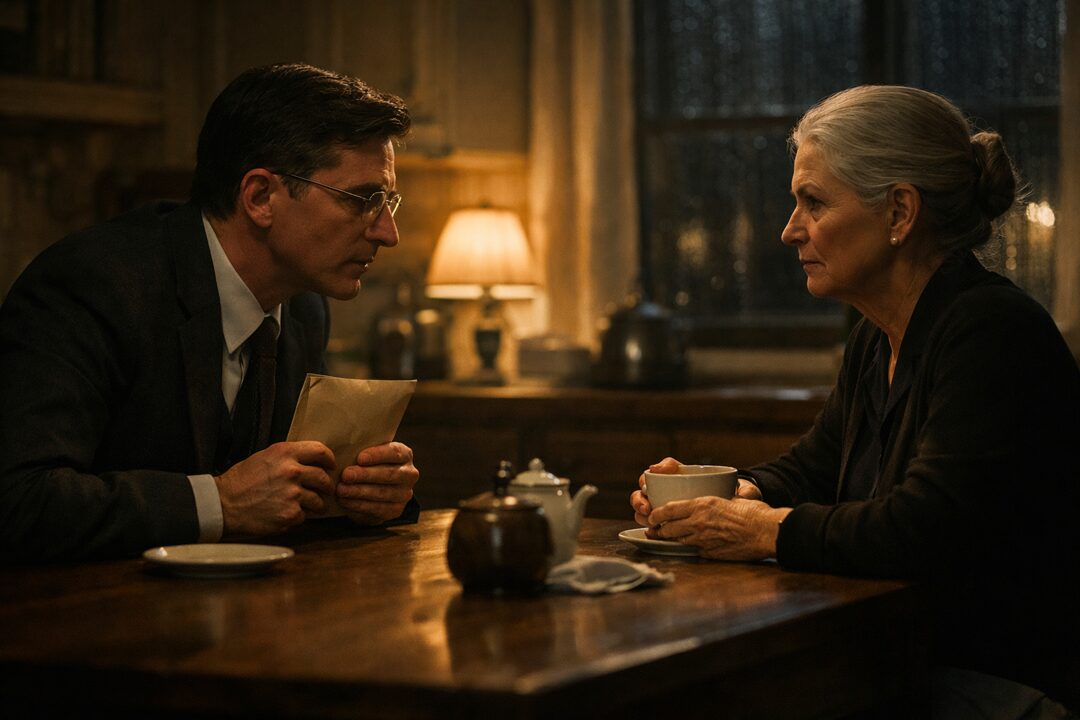
They sat across from each other with tea neither of them wanted.
“I’m not trying to embarrass him,” Daniel said.
“I know that.”
“Then what are you afraid of?”
Margaret put the spoon down carefully. “Reduction.”
He waited.
“You think truth always adds dimension,” she said. “Sometimes it removes shelter.”
Daniel thought of Elias saying facts are easy. Thought of the line in the draft letter about being watched while tired.
“I found his intake records,” he said. “He weighed one forty-one.”
“Yes.”
The answer hit him harder than denial would have.
“You knew?”
“Of course I knew.” She looked offended by the question. “You think wives marry statues?”
Daniel leaned back.
She folded the dish towel in her lap once before continuing.
“Your father kept all those records in a locked box, and not because he was proud of the numbers. He used to weigh himself long after the war. Not often. Quietly. As if checking something against a ledger no one else could see.”
Daniel pictured it too easily. The old scale in the upstairs bathroom. The shut door. Silence afterward.
“He was so hard on me,” Daniel said. It came out flatter than he intended.
Margaret’s eyes lowered.
“Yes,” she said.
No defense. No correction. Just yes.
The simplicity of it almost undid him.
“Then why protect the legend?”
She took a breath.
“Because there are truths a family can survive only by circling around.” She looked toward the hallway where Thomas’s medals sat behind glass. “He did not speak because he could not speak without losing structure. And I loved him enough not to ask him to collapse in front of us so we could call it honesty.”
Daniel looked away.
Rain tapped the window over the sink.
“You make silence sound noble,” he said.
“I didn’t say noble.” Margaret’s voice sharpened for the first time. “I said necessary.”
He thought of his childhood house measured by his father’s standards—shoes aligned, collars straight, emotions managed below visibility. Necessary for whom?
Margaret seemed to hear the question anyway.
“Your father was gentlest when no one was looking,” she said quietly. “That is not the same thing as being easy to live with. I know the difference better than you do.”
Daniel let that sit between them.
After a while she rose, crossed to the hutch, and brought back a thin envelope.
“He kept this in the Bible drawer,” she said. “Not with the medals. Not with the official papers. I never opened it.”
Inside was the original photograph.
Not the archive print. The one from the house. The paper was softer from handling, the corners worn.
Daniel turned it over.
There, in faint pencil, beneath the photographer’s stamp and half erased by time, were seven words in his father’s hand.
We were all thinner than they remember.
Nothing else.
No name. No explanation.
And near the left edge, not around himself, not around Harland Pierce with the broad shoulders, but around the smallest recruit in the row, the faintest pencil circle.
Mullen.
Daniel sat so still that Margaret reached for her cup and then stopped, as if even ceramic on wood would be too loud.
“He looked at that photo sometimes,” she said. “Only when he thought I was asleep.”
“Why didn’t you tell me?”
“Because you were his son.” Her voice softened. “And sons always think they want the man before the myth until they have to live without the myth’s protection.”
Daniel traced the circle without touching it.
The note changed everything and almost nothing.
His father had kept the image not as proof of greatness beginning, but as witness to a kind of erased ordinariness. To boys before selection. Before posture hardened into identity. Before survival required performance.
His phone buzzed on the table.
It was Ruth Kessler, the Institute’s director.
“Daniel, I need the final panel copy tonight,” she said when he answered. “The board reviewed the revised text. They feel it’s become… unnecessarily intimate.”
He looked at the photo.
“What does that mean?”
“It means the public-facing language should remain commemorative. Transformation, readiness, service. Not vulnerability.”
“They were vulnerable.”
“Yes,” Ruth said, patient in the way administrators become patient when they mean inflexible. “But this is a memorial exhibit, not a corrective essay.”
Daniel’s jaw tightened. “What exactly are they objecting to?”
“The line about men arriving hungry and unfinished. And the chest measurement detail. Frankly, some feel it diminishes the dignity of the soldiers.”
Daniel let out a short laugh with no humor in it.
“Dignity shouldn’t be that fragile.”
“History has to be legible,” Ruth said. “People come for meaning, Daniel.”
He looked at the old photograph, at the penciled circle around the smallest boy, at the sentence on the back that had somehow survived both war and marriage and fatherhood.
“Maybe meaning is the problem,” he said.
After he hung up, Margaret did not ask what Ruth had said. She had heard enough.
“You’re going to do what you were already going to do,” she said.
“I don’t know what that is yet.”
“Yes, you do.”
Daniel slipped the photo back into its envelope.
“What if telling it honestly feels like disloyalty?”
Margaret’s hands, always busy, went still in her lap.
“Love and loyalty are not the same thing,” she said. “But they do spend a lifetime pretending to be.”
For the first time that day, he saw how tired she was.
Not old. Tired.
Tired in the way people become when they have guarded another person’s silence so long it starts to feel like an inheritance.
He stood to leave.
At the doorway she said, without turning around, “Don’t make him smaller to prove he was once small.”
Daniel closed his eyes.
That was the line he needed.
And the line he would have to survive.
Part V — What the Label Said
The opening crowd was modest, respectable, damp from the weather.
Veterans in blazers.
Donors with wineglasses.
Two high-school history teachers.
A local reporter who had not expected anything in the recruits gallery to matter.
The training photograph hung in the center panel beneath softened light, large enough now that every face could be seen. Thin faces. Young faces. Not heroic because the wall asked them to be. Just present.
Daniel stood near the back while Ruth greeted people near the entrance. His mother arrived alone in a dark coat and did not come over to him. Elias did not attend; he had sent word through a nurse that old men were not stage props.
On the wall, beneath the image, the final text waited.
Daniel had sent it at 2:14 a.m.
Ruth had called once, objected once, then gone quiet when he said, “Put my name under it or take me off the exhibition entirely.”
Now it was there for strangers to read.
Not long. Not defensive. Not dressed like a speech.
Just this:
In 1942, the average Army recruit stood 5’8″ and weighed 144 pounds. Many gained between 5 and 20 pounds during basic training. Their measured bodies changed quickly: chest expansion improved, posture corrected, bearing became “satisfactory.”
We often remember soldiers as if they arrived already formed. Many did not. They arrived hungry, frightened, underweight, and unfinished. What military training built was real. So was the cost.
That was all.
No accusation.
No absolution.
No attempt to tell the whole war in a paragraph.
Only a refusal to let readiness pretend it had come first.
People approached the panel in the way museum visitors always did—half attentive, ready to move on in twelve seconds.
Then some of them slowed.
Daniel watched the sequence happen again and again. Eyes up to the photograph. Down to the numbers. Back up to the thin arms holding rifles overhead. A second look. Sometimes a third.
A man in his sixties murmured, “Jesus. Look at them.”
A teenager read the first line aloud under her breath and then stopped at unfinished as if it had snagged on something personal.
One donor frowned at the chest measurement detail and drifted away.
Ruth caught Daniel’s eye from across the room and gave him a look that promised future disagreement.
But the people who stayed with the panel stayed longer than they had anywhere else.
That mattered more than approval.
After the formal remarks, after the clink of glasses, after the reporter asked one shallow question and one useful one, Daniel finally stood beside the panel when someone called his name.
It was his mother.
She had not cried. Margaret Mercer did not perform grief for public use. But her face had changed.
“He would have hated that line,” she said.
“Hungry, frightened, underweight, unfinished?”
“Yes.”
Daniel waited.
She looked back at the photograph.
“And he would have read it three times.”
That was as close to permission as she knew how to give.
Beside them, an older veteran with a cane was reading the text in silence. After a moment he said, not to either of them in particular, “About time somebody wrote that.”
Margaret’s mouth tightened. Then, unexpectedly, she nodded.
A little later, when most of the room had moved on to the next gallery, Daniel stepped closer to the frame and slipped his hand into his jacket pocket.
Inside was the photocopy of the note from the back of the original.
He had not put it on the wall. Some things did not belong to public history just because they were true.
But he had used it.
Not the sentence itself. The permission inside it.
We were all thinner than they remember.
That line had changed the exhibit more than any board review or archival citation ever could.
Ruth approached him with administrative calm drawn over annoyance.
“You realize,” she said quietly, “that this will be the panel people quote.”
“I know.”
“You made it more controversial than it needed to be.”
Daniel looked at the recruits in the photograph. “No,” he said. “I made it harder to lie in front of.”
Ruth let out a breath that was almost a laugh. “You historians get insufferable when you believe you’re being moral.”
“No,” Daniel said again, softer this time. “Only when it gets personal.”
She studied him, then the image, then finally gave the smallest shrug.
“Well,” she said, “at least they’re reading it.”
And that, from a museum director, was close enough to surrender.
When the last of the guests had gone and the cleaners had begun their discreet work in the distant halls, Daniel remained alone in the recruits gallery.
The building had gone quiet in layers.
First voices.
Then footsteps.
Then all the little public sounds institutions make to reassure people they are not empty.
Rain moved against the tall windows again, threading the glass in silver lines.
The photograph held steady under the light.
Daniel stepped close enough to see the faces clearly. The strongest-looking boy in the row was still broad-shouldered. The smallest still looked breakable. His father still stood at the center, watchful, trying already to master the expression that would later become habit.
But now Daniel could see what the picture had hidden in plain sight all along.
Not weakness.
Exposure.
The strange dignity of men before legend had been put on them like a second uniform.
His father had not begun as the man who measured handshakes and posture and disappointment. He had begun as a frightened nineteen-year-old who could bear almost anything except failing where others could see. He had learned bearing because bearing was safer than softness. He had survived long enough to confuse the shell with the self.
And then he had come home and taught the shell to his son.
Daniel stood there with that truth and did not feel the clean release he might once have expected. He did not feel forgiveness, exactly. He did not feel accusation either.
He felt something quieter.
A mercy that did not excuse.
A sadness that did not reduce.
A kind of respect he had not known how to offer when respect meant pretending his father had always been made of iron.
He took the photocopy from his pocket and read the penciled words one more time under the gallery light.
Then he folded it and put it away.
Outside, the rain kept moving over the glass, the city beyond it blurred and alive.
Inside, the old photograph no longer looked frozen.
It looked like the last honest second before history taught those boys what to hide.