The Notice He Threw Into Her Soil Could Not Tell Him Who Had Kept the Farm Alive
Chapter 1: The Notice Landed Face Down in the Soil
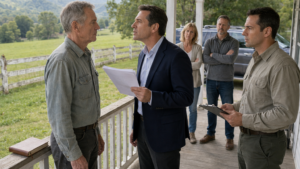
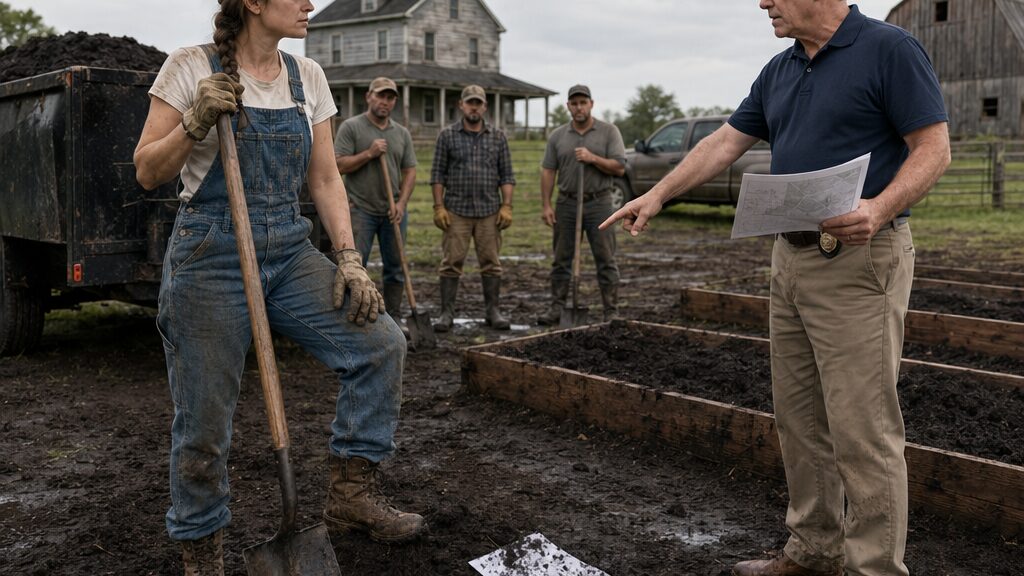
The notice struck the compost pile face down, slid six inches through the damp black soil, and stopped against the blade of Stephanie Hill’s shovel.
Edward Miller pointed at it as though the paper had completed an argument for him.
“You need to put that down,” he said.
Stephanie kept both hands around the ash handle. Behind her, the lined trailer held six tons of finished compost, dark and sweet-smelling beneath the thin morning mist. Three new garden beds ran toward the lower field in clean parallel rows. Beyond them stood the gray farmhouse, the equipment barn, and her father’s old pickup with one rusted wheel well.
The seasonal farmhand had stopped beside the trailer. Two men repairing a neighboring fence had also gone quiet. Edward had chosen a place where people could watch.
Stephanie looked from the notice to his polished brown shoes. Mud had already climbed over their edges.
“Which part do you want stopped?” she asked.
“All earth-moving activity. Compost distribution, trenching, grading, bed construction.” He folded his arms. “The language is clear.”
“The language might be. The site isn’t.”
His jaw tightened. He wore a navy polo tucked into pressed khakis, a county badge clipped to his belt. The white county vehicle waited near the barn with its lights off, official enough without making a spectacle of itself.
Edward pointed toward the trailer. “We received a complaint concerning untested material being deposited within a protected drainage easement.”
“The compost is tested.”
“You have documentation?”
Stephanie glanced toward the farmhouse kitchen window. A pale movement behind the curtain vanished.
“Yes.”
“Then why didn’t you provide it when requested?”
“You didn’t request it. You came here and read me an emergency order.”
“I called Friday.”
“You left a message saying you wanted to discuss land disturbance.”
“And you didn’t call back.”
“I was repairing the north pump.”
Edward looked briefly at the workers listening from the fence, then lowered his voice. “That does not excuse noncompliance.”
Stephanie pressed one boot onto the top edge of the shovel blade. She could have crossed the yard, gone into the office alcove beside the kitchen, and returned with the laboratory results, delivery records, temperature logs, and source certifications. She had copies arranged by date in a red binder.
The thought of handing them over after he had thrown the notice into her soil made her fingers tighten.
“What contamination did your sample show?” she asked.
Edward’s expression changed by less than an inch. “The order is precautionary.”
“Where did you sample?”
“The complaint identifies the compost pile as the probable source.”
“That wasn’t my question.”
His arms unfolded. “Ms. Hill—”
“Was it the trailer? The upper beds? The swale? The lower channel?”
“There has not yet been a complete materials analysis.”
“So you haven’t sampled anything.”
“The county does not need to wait for damage before acting.”
Stephanie nodded once. “Then show me the drainage benchmark you used.”
Edward pulled a second sheet from his folder. The paper showed a reduced parcel map crossed by pale lines and a shaded band. He held it out but did not release it.
“The mapped easement runs through this portion of the property.”
“Which benchmark?”
“The corridor is clearly marked.”
“The old fence corner? The culvert cap? The survey pin by the sycamore?”
He looked down at the map.
Stephanie waited.
A crow called from the barn roof. Somewhere inside the farmhouse, a cabinet door closed too hard.
Edward traced the shaded band with one finger. “The county mapping system establishes the regulated area.”
“That system was updated after the east culvert was replaced. If you measured from the old fence corner, you’re twelve feet north before you begin.”
“I’m not here to debate survey history.”
“You’re standing on it.”
Color moved slowly into his cheeks. He stepped closer, reducing the distance between them until Stephanie could smell coffee on his breath.
“You were instructed to stop,” he said. “Instead, you’re challenging the authority of the order in front of employees and neighbors.”
“I’m asking what it is based on.”
“That is a matter for formal review.”
“Then why are you explaining it here?”
For the first time, one of the fence workers shifted, boots scraping gravel. Edward heard it. His eyes moved toward the sound and back.
Stephanie bent, pulled the shovel free of the soil, and drove it into the compost pile again.
Edward’s voice sharpened. “I told you to put that down.”
“I’m moving material away from the exposed edge before it rains.”
“You are continuing prohibited work.”
“I’m preventing runoff.”
“You don’t get to interpret the order according to your own convenience.”
She lifted a full shovel load and deposited it inside the trailer’s liner. Then another.
Edward stared as though defiance should have looked louder.
Stephanie worked because the pile needed covering. She worked because the sky had been building rain since dawn. She worked because stopping under his gaze would feel too much like agreeing that he understood the land better than she did.
On the third load, Edward walked away.
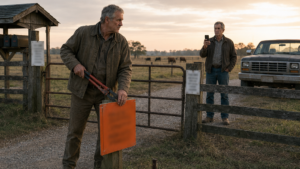
The quiet did not lift. It followed him across the yard to the barn, where he opened the rear door of the county vehicle and removed a laminated red-and-white placard.
Stephanie let the shovel fall upright in the compost.
He fixed the placard beside the barn entrance with four screws.
EMERGENCY STOP-WORK RESTRICTION.
The lettering could be read from the road.
The seasonal farmhand looked at Stephanie. “Should I finish the north row?”
“No.” The answer came harder than she intended. “Put the tools away.”
Edward returned with a copy of the posting receipt. His manner had cooled into something procedural.
“Any continued work may result in daily penalties. You’ll receive hearing information once the planning director reviews the file.”
Stephanie pulled the notice from the compost. Mud had soaked through one corner and blurred the bottom line of print.
“You left out an attachment,” she said.
Edward glanced at the pages in his folder.
“The order references an inspection worksheet. It isn’t here.”
“It will be included in the official packet.”
“Was the lower field inspected?”
His hesitation was brief enough that someone less angry might have missed it.
“The site review was sufficient to support temporary action.”
“That means no.”
“It means this conversation is over.”
He turned and crossed the yard without looking back.
Stephanie watched the county vehicle disappear beyond the sycamores. Only when the sound was gone did she notice her mother standing on the farmhouse porch in a faded cardigan, both hands gripping the rail.
Kathleen Hill looked at the red placard, then at the muddy paper in Stephanie’s hand.
“You shouldn’t have pushed him,” she said.
Stephanie laughed once without humor. “He came here with an order based on no sample and the wrong map.”
Kathleen descended the porch steps carefully. “That doesn’t mean the order can’t hurt us.”
“It already hurts us.”
“No.” Kathleen stopped beside the shovel. Her face had gone gray around the mouth. “I mean more than fines.”
Stephanie waited.
Her mother looked toward the road, though Edward was long gone.
“There’s a clause tied to any government restriction on the property,” Kathleen said. “If this stays in place, someone else may get the right to decide what happens to the farm.”
Chapter 2: The Map Beneath Her Mother’s Kitchen Drawer
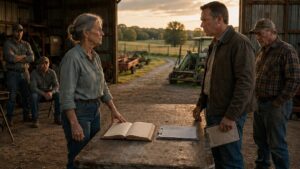
The older map was hidden beneath a stack of unpaid bills in the shallow drawer where Kathleen kept rubber bands, dead pens, and takeout menus from places that had closed years ago.
Stephanie found it because one corner had caught under the drawer rail.
She pulled, and the paper came free with a dry tearing sound. It was folded into quarters, yellowed along the edges and marked with blue survey lines. A crescent of dried mud stained the lower margin where Stephanie’s hand had touched it after carrying the notice inside.
Kathleen stood at the kitchen sink with her back turned.
“What is this?” Stephanie asked.
Her mother did not look around. “An old property map.”
“I can see that.”
“Then you know what it is.”
Stephanie opened it across the table. The Hill property occupied most of the page, bounded by the county road, Ryan Sanchez’s acreage, and the narrow creek along the southern edge. A drainage corridor had been drawn from the east culvert toward the lower field.
It did not cross the new garden beds.
The county map did.
Stephanie laid Edward’s copy beside it. The two shaded corridors ran almost parallel, separated by eleven or twelve feet at the upper end and nearly twenty near the trailer.
“Why was this hidden?”
“It wasn’t hidden.”
“It was under overdue bills in a drawer you tell me not to touch.”
Kathleen dried her hands. “Your father put papers wherever he could find room.”
“He’s been gone four years.”
The words struck both of them. Kathleen folded the dish towel once, then again.
Stephanie tapped the date in the corner of the older map. “This survey was recorded after the culvert replacement.”
“I don’t remember.”
“You signed it.”
Kathleen looked at the signature and sat down.
For several seconds, the refrigerator motor was the only sound in the kitchen. The mud-stained stop-work notice lay between them like something brought in on a boot.
“What clause were you talking about?” Stephanie asked.
Kathleen reached for the bills instead. “You should take those maps to the county.”
“I will. After you answer me.”
“It may not amount to anything.”
“Then tell me.”
Kathleen gathered the bills into a straighter stack. Red type showed through the envelopes: PAST DUE, FINAL REMINDER, PAYMENT REQUIRED.
Stephanie had seen overdue notices before. Farms ran on delays—seed paid after harvest, repairs stretched across seasons, fuel bought against money not yet earned. But there were too many envelopes, and her mother’s hands were too careful.
“I’m going to the records office,” Stephanie said. “When I come back, we’re finishing this conversation.”
Kathleen’s face hardened with familiar restraint. “You always think a thing becomes manageable once you know every measurement.”
“Usually it does.”
“People aren’t drainage ditches.”
“No. Ditches are easier. They don’t hide maps.”
The county records office occupied the ground floor of a brick building behind the courthouse. By late afternoon, the lobby smelled of copier heat and wet coats. A clerk led Stephanie to a public terminal and showed her how to search parcel documents.
The current digital map matched Edward’s copy. Its metadata listed an update three years earlier, but the attached survey reference dated back twenty-seven years—before the east culvert had been replaced.
Stephanie searched by book and page number from the older map.
The scanned document appeared sideways. She rotated it and leaned toward the screen.
The blue survey line on Kathleen’s paper was legitimate. Filed, stamped, and indexed. A note in the margin stated that the drainage easement had been adjusted following county roadwork and relocation of the culvert outlet.
The county’s mapping layer had not incorporated it.
For one clean moment, relief loosened Stephanie’s shoulders.
Edward’s order was built on a bad boundary.
Then she opened the full easement agreement.
The corridor was not the only issue. A paragraph near the end allowed temporary access and work restrictions whenever county officials believed a land alteration might affect downstream flow. The standard for emergency action was broad. The map could weaken the order, but it would not erase her unapproved trench.
A bank email appeared on her phone while she was reading.
PROPERTY REVIEW CONFIRMATION.
A representative would arrive Thursday morning to assess the Hill property and any conditions affecting its value.
Stephanie read the message twice. She had not scheduled a review.
She called Kathleen from the hallway.
“Why is the bank coming Thursday?”
Silence.
“Mom.”
“They review secured property sometimes.”
“Not without a reason.”
“It’s routine.”
“No, it isn’t.”
A door opened down the corridor, and two employees passed Stephanie carrying archive boxes. She lowered her voice.
“Did you borrow against the farm?”
“We already had the operating note.”
“That isn’t what I asked.”
Kathleen exhaled into the phone. “Come home.”
“Did you sign something?”
“Come home, Stephanie.”
The line went dead.
By the time Stephanie returned, the kitchen lights were on and the curtains had been drawn. Kathleen sat at the table with both maps spread before her. The dirty notice had dried stiff, its corner curled upward.
Stephanie placed printed copies of the recorded survey beside them.
“The county map is wrong,” she said. “But the easement still gives them room to restrict work if they claim downstream risk.”
Kathleen nodded as though she had expected no better.
“The bank review isn’t routine.”
“No.”
“What did you sign?”
Kathleen looked toward the dark window over the sink.
Stephanie pulled out the chair opposite her but did not sit. “You told me someone else might get to decide what happens to the farm.”
“I was trying to give us an option.”
“Who is us?”
“Both of us.”
“You didn’t ask me.”
“If I had, you would have said no before you heard the terms.”
“Because it’s my land too.”
“And my name is on every debt attached to it.”
Stephanie finally sat. The anger she had brought from the records office felt less clean in the kitchen. “What terms?”
Kathleen touched the edge of the older map.
“A buyer agreed to hold an offer open while we tried to get through the season,” she said. “But if the property is placed under a government restriction, they can move the review forward.”
Stephanie stared at her.
“An offer for what?”
Kathleen’s eyes met hers at last.
“For the farm.”
Chapter 3: The Water Went Somewhere Neither of Them Expected
Ryan Sanchez’s access road collapsed before sunrise.
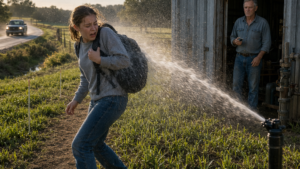
By seven, the gravel lane along the western boundary had split open in a muddy trench wide enough to swallow a truck tire. Water poured through the break, carrying pale stones downhill toward the creek.
Ryan stood beside it in rubber boots and a canvas jacket, holding his phone at arm’s length as he filmed.
Stephanie arrived with her shovel over one shoulder.
He lowered the phone. “Don’t step near the edge.”
“I can see it’s undercut.”
“You could have seen where the water was headed before you built that berm.”
She looked past him toward the lower field. The night’s rain had flattened the weeds and filled every depression. Her compost beds sat higher and drier than the surrounding ground. The shallow barrier she had built along their western edge had held.
Too well.
Water that once spread across the exhausted field had been directed toward a narrow cut between the properties. From there, it had found the soft base beneath Ryan’s road.
Stephanie drove the shovel into the mud several feet from the collapse. Brown water filled the opening almost immediately.
“How deep is your base?” she asked.
“Deep enough before you changed the grade.”
“I raised eight inches at the beds. The swale should have carried the overflow south.”
“It didn’t.”
“I can see that.”
Ryan’s expression tightened. “Can you?”
She pulled the shovel free and moved downslope, cutting three narrow test holes. The first filled quickly. The second stayed nearly dry. At the third, the blade struck compacted clay.
Stephanie crouched and scraped mud away with her gloved hand. Beneath it lay a buried ridge, likely pushed there when the county rebuilt the road shoulder years earlier. The old survey suggested the drainage channel ran east of the ridge. The digital map placed it west.
Neither showed what the water was doing now.
Ryan walked over, keeping his weight uphill. “What is it?”
“A plug.”
“Natural?”
“No.”
“Yours?”
“No.” She stood. “But my berm sent more water into it.”
Ryan gave a short nod. It was not forgiveness. It was acknowledgment.
They stretched a tape from the old fence corner to the culvert cap, then from the cap to the sycamore pin. Ryan entered figures into his phone while Stephanie read the measurements.
The county corridor was misplaced. Her new beds sat mostly outside it.
Her diversion channel did not.
The narrow trench she had cut two weeks earlier crossed into the recorded easement by nearly six feet before turning south. She had known the permit was still pending. She had also known another heavy rain would strip more topsoil from the lower field.
So she had dug.
At the time, the choice had felt practical. Standing beside Ryan’s broken road, it looked like what Edward would call it: unauthorized alteration with downstream consequences.
Ryan watched her face. “You knew you weren’t cleared.”
“I knew the application hadn’t been approved.”
“That means yes.”
“The county takes six weeks to approve a ditch while the field disappears in three storms.”
“And my road?”
“I didn’t know this ridge was underneath it.”
“You didn’t check.”
Stephanie set the shovel down. “No.”
The admission changed the space between them. Ryan looked almost disappointed that she had not argued.
He turned toward the breach. “A delivery truck uses this lane Friday.”
“I’ll help repair it.”
“The stop order says you can’t move soil.”
“This is your property.”
“With water coming from yours.”
She followed the flow with her eyes. The correct repair was already forming in her mind: cut a relief channel south of the buried ridge, lower the western end of her berm, armor the outlet with stone, then reseed the exposed slope. It would take a compact loader, half a day, and written approval she did not have.
“Why didn’t you come to me?” she asked.
Ryan shoved his phone into his pocket. “I did. Last month.”
“You asked whether the beds would hold water.”
“I asked what happened when they didn’t.”
“You said you didn’t want mud on your road.”
“And you told me you had it handled.”
“I thought I did.”
“That’s the trouble with you, Stephanie. You think knowing more than most people means you know enough.”
She picked up the shovel but did not answer.
Ryan walked to the edge of the road and pointed toward a red survey flag half-submerged near the ditch. “The county man was here Sunday.”
“Edward?”
“He looked at the upper beds and the trailer.”
“Did he walk the lower field?”
“No.”
That matched the missing inspection attachment and Edward’s hesitation.
Stephanie stepped closer. “What did you tell him?”
Ryan bent to retrieve the flag. “That the water pattern changed after you built the berm.”
“What else?”
“That I was concerned about runoff.”
The wording was too neat.
Stephanie looked at him. “You filed the complaint.”
“I made a call.”
“You filed it.”
“I didn’t accuse you of contamination.”
“But you gave them a reason to come.”
“My road was washing out.”
“It hadn’t washed out yet.”
“No. It was softening, and every time I tried to ask what you were doing, you acted like I needed a soil degree to deserve an answer.”
Stephanie looked down at the shovel blade. Wet clay clung to its edge.
Ryan continued more quietly. “I expected somebody to check the drainage. I didn’t expect an emergency order.”
“You didn’t tell me.”
“You wouldn’t have listened.”
“That doesn’t make going around me honest.”
“No.” He looked toward the broken lane. “It makes it what I did.”
A county vehicle appeared on the road above them.
Edward parked near the boundary and approached without stepping into the mud. He carried a new folder beneath his arm.
Stephanie felt Ryan’s attention shift between them.
Edward surveyed the collapse. For an instant, concern displaced the hard official expression he had worn the day before.
“Was anyone injured?”
“No,” Ryan said.
“Any fuel storage or livestock waste upstream?”
Stephanie answered before Ryan could. “No. The water was redirected by my berm and caught against an old buried grade.”
Edward’s gaze settled on her. “You admit your alteration caused this?”
“I said it redirected the water. The buried ridge caused the pressure point.”
“Was the alteration permitted?”
Stephanie did not respond quickly enough.
Edward opened the folder.
Ryan stepped forward. “The county map is wrong. We measured from the replacement culvert. Her beds aren’t where your map says.”
Edward looked at him. “The road failure is evidence of an active hazard regardless of a mapping discrepancy.”
“Then inspect the lower field,” Stephanie said. “The actual flow is visible now.”
“I will arrange a formal review.”
“It is visible now.”
Edward’s mouth tightened. “And because runoff from an unverified compost operation may have entered a drainage channel, I am amending the restriction.”
Stephanie looked at the paper he held out.
The heading read PUBLIC HEALTH PRECAUTION.
“You have clean-test records?” he asked.
She did. In the red binder on the desk at home, organized by date.
She thought of the notice in the dirt, the placard on the barn, her mother’s secret buyer, and Ryan’s road split open under water she had redirected.
“I’ll submit them through the hearing process,” she said.
Edward studied her, perhaps hearing the pride in the answer more clearly than she did.
“Until then,” he said, “the county will treat the material as a potential contaminant.”
He fixed the amended notice to the boundary post.
The accusation was no longer lying face down in Stephanie’s soil. It was upright, official, and visible from the road.
Chapter 4: Clean Soil Did Not Clear Her Name
“The compost is clean,” the agricultural extension specialist said.
Stephanie had expected the sentence to feel larger.
Instead, it landed in the small laboratory office between a humming refrigerator and a rack of sample jars, almost ordinary. The specialist turned the report around so Stephanie could read the figures herself.
Pathogen screening: clear.
Heavy metals: below threshold.
Carbon-to-nitrogen ratio: acceptable.
Maturity index: stable.
“There’s nothing here that supports a contamination claim,” the specialist said. “Not from the samples you submitted.”
Stephanie rested both palms on the edge of the desk. “Would you put that in a letter?”
“I already did.”
He slid a signed page from beneath the report.
For the first time since Edward had driven onto the farm, she felt the pressure in her chest ease. Not disappear. Just loosen enough to breathe around.
She placed the laboratory report, the source certificates, and the signed letter into the red binder. The binder had sat unopened on her desk while Edward posted two public notices. She had told herself she was preserving procedure. In truth, she had wanted him to discover he was wrong without receiving help from her.
That pride looked less defensible now that Ryan’s road had split open.
The county planning department occupied a fluorescent second floor above the tax office. Stephanie arrived before noon and found Edward waiting outside a conference room with the planning director.
Edward’s gaze dropped to the binder.
“You brought records,” he said.
“You asked for them.”
“I asked Monday.”
“You issued the order Monday.”
The planning director opened the conference-room door. “Let’s keep this useful.”
Inside, Stephanie laid out the laboratory findings, delivery receipts, temperature logs, and photographs of the composting process. The specialist had included chain-of-custody forms for each sample.
The planning director read in silence.
Edward stood beside the window rather than sitting. His face revealed little, but his eyes remained on the pages longer than Stephanie expected.
At last the director said, “These results do not indicate a public-health risk from the compost.”
Stephanie looked at Edward.
He gave a single nod. “Based on the submitted samples.”
“They were taken from the trailer, the upper pile, and both finished beds,” Stephanie said.
“I see that.”
“Then the amended contamination language comes down.”
The director folded his hands. “The public-health precaution can be revised.”
“Revised?”
“The underlying stop-work restriction remains.”
Stephanie stared at him. “On what basis?”
Edward answered. “Unauthorized alteration of a protected drainage system.”
“The beds are outside the recorded corridor.”
“That is disputed.”
“It’s recorded. I brought the survey.”
She removed the older map and the county filing from the binder. Mud from the original notice had left a brown thumbprint along one fold.
The director compared the maps.
Edward stepped closer. “Even if the mapped corridor is corrected, the field inspection yesterday showed altered flow entering Mr. Sanchez’s property.”
“You didn’t inspect the lower field yesterday.”
His eyes met hers.
“The road collapse was documented.”
“By standing beside it.”
“The consequences were visible.”
“So was the drainage path you chose not to walk.”
The director raised one hand. “Ms. Hill, you acknowledge that you cut a diversion trench before receiving approval?”
Stephanie’s mouth went dry.
The true answer sat between them, simple and damaging.
“Yes.”
Edward looked away first.
“I applied for approval,” she continued. “The lower field was losing soil. I made a temporary cut to carry runoff toward the south channel.”
“And that cut redirected water toward the Sanchez access road,” the director said.
“It contributed. There’s a buried grade beneath the road that neither county map shows.”
“Was that condition included in your application?”
“I didn’t know it was there.”
“Was the trench approved?”
“No.”
The director leaned back. “Then the restriction remains until the drainage issue is reviewed.”
Stephanie heard the laboratory refrigerator from the office down the hall, a low mechanical vibration passing through the wall.
She had proved the compost safe. The red accusation at the property line had no scientific basis. Yet the farm was still closed to work because of the thing she had actually done.
Edward spoke in a quieter tone. “The contamination posting can be removed today.”
It was meant as a concession.
Stephanie closed the binder. “You turned an untested assumption into a public-health notice.”
“We acted under the information available.”
“You had no sample.”
“We had a complaint, unverified material, and active runoff.”
“You also had a chance to inspect the site.”
The planning director’s expression sharpened. “This is becoming circular.”
“No,” Stephanie said. “It’s becoming specific.”
She stood.
“I want the complete inspection worksheet, including the lower-field requirement. I want the county map corrected. And I want the hearing on the emergency restriction scheduled before the bank review can be used against us.”
The director studied her. “What bank review?”
Stephanie realized too late that neither man had known.
Edward’s face changed—not satisfaction, exactly, but attention.
“It concerns the property value,” she said.
“Is there a pending transfer?” the director asked.
“That isn’t part of your enforcement authority.”
“It may affect timing.”
“Then schedule the hearing.”
The director glanced at Edward. Something passed between them that Stephanie could not read.
“Friday afternoon,” he said. “Expedited administrative hearing. You may present technical evidence, ownership records, and a corrective proposal.”
“Friday?”
“That is the earliest available time.”
“And until then?”
“No work within the affected area.”
Stephanie carried the binder back to the farm without stopping for lunch.
The red public-health notice was gone when she arrived, leaving four clean screw holes in the boundary post. The original stop-work placard remained on the barn.
Kathleen’s car was missing. A bank representative’s card had been tucked into the screen door.
Stephanie entered the kitchen and set the binder on the table. The room smelled faintly of coffee burned onto the bottom of the pot.
She opened the sideboard, looking for the property tax folder. It was not there.
Neither was the loan file.
In the back of the cabinet, beneath an envelope of old seed receipts, she found a cream-colored document clipped inside a blue folder.
OPTION TO PURCHASE REAL PROPERTY.
The buyer’s name was typed on the first page. The legal description covered the entire Hill farm. The option period extended through the end of the month, but a clause allowed accelerated review if any government restriction materially affected agricultural use.
At the bottom of the signature page, Kathleen Hill’s name appeared in blue ink.
The witness line was dated six weeks earlier.
Stephanie stood alone in the kitchen with the clean soil report in one hand and the signed sale option in the other.
Her mother had not merely spoken to a buyer.
She had given one a path to the farm.
Chapter 5: The Price Her Mother Put on Silence
Stephanie placed the sale option beside the mud-stained notice and waited for Kathleen to come home.
Darkness settled over the yard before headlights finally crossed the kitchen ceiling. A car door shut. Kathleen entered through the mudroom carrying a grocery bag and stopped when she saw the papers arranged on the table.
The bag sagged in her hands.
“You went through the cabinet.”
“You signed away an option on the farm.”
“I didn’t sign it away.”
“You gave someone the right to buy it.”
“Only under terms.”
“Terms you hid from me.”
Kathleen set the groceries on the counter. A carton of eggs tipped against a loaf of bread. “I was going to tell you.”
“When?”
“When there was something definite to tell.”
“There’s your signature.”
“It’s an option, not a sale.”
“The county restriction can accelerate it.”
“I know.”
Stephanie pushed the document toward her. “Then you knew exactly what you meant Monday.”
Kathleen took off her coat and hung it carefully on the chair, buying herself seconds. “The bank has been warning us since winter.”
“You told me the operating note was current.”
“It was current until the pump failed.”
“I paid for the pump.”
“With the money set aside for the spring payment.”
Stephanie’s anger faltered, then returned in a different shape. “Why didn’t you tell me?”
“Because you were already working fourteen-hour days and sleeping in your clothes.”
“That was my decision to make.”
“No. The note is in both our names.”
“So is the land.”
Kathleen looked toward the window. Beyond the glass, the barn placard shone white beneath the yard light.
“The buyer offered enough to clear the bank,” she said. “Not much more. But enough that we would not lose it at auction.”
“We are not at auction.”
“We are closer than you think.”
Stephanie opened her mouth, but Kathleen walked out through the mudroom.
The barn light came on a moment later.
Stephanie followed.
Kathleen stood at the workbench with Stephanie’s shovel laid across it. She picked up a flat file and drew it along the blade’s edge. The scrape of metal carried through the quiet building.
“What are you doing?”
“It’s dull.”
“That shovel is not the problem.”
“No. It never is with you.”
Kathleen ran the file again.
Stephanie leaned against the bench opposite her. “Who is the buyer?”
“A regional grower looking to consolidate acreage.”
“So they tear out the beds.”
“They farm.”
“They plant one crop over everything and drain what’s left out of the soil.”
“They pay their loans.”
The words hung between them.
Kathleen stopped filing. “You think I don’t see what you’ve done here?”
“I don’t know what you see.”
“I see darker soil than we had in twenty years. I see vegetables growing where your father said nothing would take. I see you hauling compost before daylight and reading extension reports at midnight.”
“Then why sell?”
“Because good soil does not stop a bank.”
Stephanie looked at the shovel. Fresh silver showed along the sharpened edge.
Kathleen’s voice softened. “Your father knew that too.”
“Don’t bring him into this.”
“He is already in it.”
Stephanie straightened.
Kathleen set down the file. “The debt did not begin with the pump. He refinanced the south parcel after two bad seasons. Then he borrowed again to keep the equipment. He never told you.”
“You told me everything was settled after he died.”
“I told you what I thought you could carry.”
“That is not the same thing.”
“No.”
The admission stripped the argument of its easy target.
Kathleen picked up the shovel and tested the edge with her thumb.
“He made me promise not to tell you until the note was stable,” she said. “He thought one good harvest would fix it. Then another. Then he got sick.”
Stephanie’s throat tightened.
Her father had asked only one promise of her in the hospital: Keep the farm if you can.
She had heard command where he may have meant warning.
Kathleen continued. “When the bank called in June, I asked for time. The buyer offered an option instead of forcing a decision. I thought if your beds worked, we could let it lapse. If they failed, we would leave without the county posting foreclosure notices where everyone could see.”
“You thought selling it secretly would hurt less.”
“I thought watching you fight until there was nothing left would hurt more.”
Stephanie turned away.
The barn smelled of oil, damp wood, and the compost clinging to her boots. Through the open side door, she could see the dark outline of the new beds she had built one load at a time.
“You didn’t trust me,” she said.
Kathleen gave a tired shake of her head. “I did not trust the numbers.”
“You could have shown them to me.”
“You treat every warning like an insult.”
Stephanie looked back.
Kathleen’s eyes were red but dry. “Edward told you to stop, and instead of bringing out the tests, you made him stand in the mud and prove he knew less than you.”
“He did know less.”
“That did not make silence wise.”
Stephanie had no answer that did not sound like the thing her mother had just accused her of.
Kathleen placed the shovel on the bench.
“The option has another clause,” she said. “If the restriction remains after Friday, the buyer can require an appraisal Monday and shorten the closing period.”
“How short?”
“Ten business days.”
Stephanie felt the barn narrow around her.
“The hearing is Friday afternoon.”
“I know.”
“And the county thinks I altered the drainage illegally.”
“You did.”
“I did it to save the field.”
“That may matter. It may not.”
Stephanie touched the sharpened edge of the shovel. She had spent days demanding that Edward admit what he had not inspected while withholding the clearest evidence she possessed. She had blamed Ryan for going around her while refusing to answer his questions. She had condemned Kathleen’s secrecy while guarding her own unauthorized trench as though motive erased consequence.
“I can challenge the map,” she said. “I can prove the compost is safe.”
Kathleen waited.
“But I can’t tell the hearing board the rest was all their mistake.”
“No.”
“If I admit the trench, they may uphold the order.”
“They may.”
“And if I don’t?”
Kathleen looked toward the red placard on the barn.
“They will find it anyway.”
Stephanie lifted the shovel and rested it against the wall.
For once, she did not take it with her.
At the kitchen table, she opened the red binder, added the clean soil report, the conflicting maps, and photographs of Ryan’s collapsed road. Then she wrote a new heading on a blank page:
UNAUTHORIZED DIVERSION — PURPOSE, EFFECT, AND CORRECTIVE PLAN.
She had spent the week preparing to prove Edward wrong.
Now she began preparing to tell the county where she was wrong too.
Chapter 6: He Knew the Inspection Was Incomplete
The missing attachment arrived in Edward Miller’s inbox at 7:12 Friday morning.
He opened it before removing his coat.
FIELD INSPECTION WORKSHEET — HILL PARCEL.
The upper section contained his notes from Sunday: compost trailer, raised beds, altered grade, possible drainage interference. Below that was a checklist.
Upper work area inspected: yes.
Boundary reference verified: partial.
Lower drainage outlet inspected: no.
Reason incomplete: access deferred due to time and ground conditions.
Required follow-up before emergency enforcement: pending.
Edward read the final line twice.
The worksheet had been saved locally on the tablet and failed to upload with the original report. That was the technical explanation.
It was not the moral one.
He had known he had not walked the lower field. He had told himself the complaint, the visible grading, and the approaching rain justified temporary action. After the road collapsed, he had treated the consequence as confirmation.
Now the attachment sat beside photographs showing the lower outlet had never been examined before the order.
A dry fragment of soil fell from the original notice when he lifted it from his briefcase. It landed on his desk near the unsigned correction form.
He brushed it away, then stopped.
The notice still carried the dark stain from where he had thrown it.
At nine, the planning director closed Edward’s office door.
“You’ve seen the attachment.”
“Yes.”
“The enforcement basis remains sound.”
“The required follow-up was pending.”
“A road failed.”
“After the order.”
“The hazardous condition existed.”
“We had not established that.”
The director sat opposite him. “Do you remember the Benton drainage case?”
Edward did.
A subdivision had flooded after the county delayed action on repeated complaints. Three homes suffered foundation damage. At the public meeting, residents had held up photographs of ruined rooms while the board asked why nobody had acted sooner.
Edward had been promoted into compliance work six months later. The lesson had never been stated plainly because it did not need to be: hesitation had a cost, and somebody would be made to own it.
“The Hill property showed active alteration and a probable downstream effect,” the director said. “The emergency restriction prevented further work.”
“It also included a contamination warning without a sample.”
“That language is being corrected.”
“After it was posted at the road.”
The director leaned back. “What are you proposing?”
Edward looked at the correction form.
“That we state the inspection was incomplete and the original map may be outdated.”
“At the hearing?”
“Yes.”
“That undermines the county’s order.”
“It qualifies it.”
“It gives Ms. Hill a procedural argument strong enough to seek dismissal.”
“She admits cutting the diversion without approval.”
“Then let the hearing rest on that.”
Edward’s hand tightened around his pen.
The director lowered his voice. “You are not being asked to lie. You are being asked not to overstate an internal deficiency when subsequent evidence supports continued restriction.”
The distinction was polished enough to survive a meeting.
Edward looked through the glass wall toward the public counter. A farmer in a feed-store jacket waited with a permit application clutched in both hands.
“What about the corrected survey?” Edward asked.
“Mapping will review it.”
“The recorded easement adjustment was filed years ago.”
“And not incorporated into the active layer.”
“That is our error.”
“It is a data issue.”
“It placed her beds inside a corridor they may not occupy.”
The director’s expression cooled. “You seem unusually invested in Ms. Hill’s position.”
Edward saw Stephanie standing with one boot against the shovel, asking him for a benchmark he could not name. He remembered the workers watching and his own decision to throw the notice rather than hand it to her.
“I’m invested in the record,” he said.
The director stood. “Then preserve it carefully. Do not turn a correctable process issue into an admission of reckless enforcement.”
After he left, Edward opened the hearing packet.
Stephanie’s submission had arrived overnight. It contained clean laboratory reports, historical maps, rainfall data, photographs of erosion before and after the berm, and a proposed correction to the drainage route.
The final section surprised him.
She had identified the diversion trench as unapproved.
She had described why she cut it, where it crossed the easement, how it redirected flow, and how the design failed to account for the buried road grade.
No excuse. No denial.
Edward read the paragraph twice.
An email from the county hearing clerk appeared moments later. Attached was a notice from the bank representative requesting confirmation of whether the restriction materially limited agricultural use. A copy of the property option clause followed.
If the restriction remained after the hearing, the buyer could accelerate the appraisal.
Edward had known enforcement could affect financing. He had not known the farm stood inside a ten-day sale window.
The distinction should not have mattered. Compliance decisions were not supposed to depend on a landowner’s debt.
Yet the emergency filing had done more than pause a trench. It had activated machinery outside the county office—bank review, buyer rights, public assumption—before the facts were complete.
At eleven thirty, Edward printed two reports.
The first was the original enforcement summary, clean and confident.
The second included the missing worksheet, mapping discrepancy, lack of initial sampling, and his recommendation to replace the emergency order with a conditional corrective plan.
He signed neither.
Before leaving for the hearing room, he placed both versions in separate folders.
The planning director waited by the elevator.
“Which packet are you carrying?” he asked.
Edward pressed the call button.
“Both.”
The elevator doors opened.
Edward stepped inside with the mud-marked notice resting on top of the unsigned correction, and for the first time that week, he did not know which document would cost him more to defend.
Chapter 7: She Put Down the Shovel Before She Spoke
Stephanie began by admitting the violation.
The hearing clerk had barely finished stating the parcel number when Stephanie leaned toward the microphone and said, “I cut the diversion trench before the county approved it.”
A murmur moved through the back row, where two neighboring landowners sat beside Ryan. Kathleen remained near the aisle with both hands folded over her purse.
The county hearing room was built for property lines, permit appeals, and arguments about setbacks. Its brown carpet absorbed footsteps. Fluorescent panels flattened every face. Through the narrow windows, the afternoon looked brighter than it had any right to.
Stephanie had left her shovel against the hallway wall.
She felt its absence more than she expected.
The planning director looked over his glasses. “Ms. Hill, are you conceding the drainage violation?”
“I’m conceding that I made the cut without written approval. I’m not conceding the county’s map is accurate, that the compost was contaminated, or that the emergency inspection was complete.”
Edward sat at the county table with two folders before him. The mud-stained notice lay on top of one. He had not looked at Stephanie since she entered.
The director nodded toward her binder. “Proceed.”
Stephanie placed the corrected survey beside the county map.
“The upper garden beds are outside the recorded easement. The digital layer uses the old culvert location. This filing shows the easement was adjusted after the replacement.”
She moved next to the laboratory results.
“The compost was tested from three locations. No pathogen or metals threshold was exceeded. The public-health posting was unsupported.”
Then she placed photographs of the lower field across the table: exposed roots after spring rain, channels cut through the topsoil, sediment collecting along the creek.
“I built the berm to slow this erosion. I cut a temporary diversion because the permit had been pending and another storm was forecast.”
The planning director tapped one photograph. “And the diversion contributed to the Sanchez road failure.”
“Yes.”
Ryan shifted in his chair.
Stephanie looked toward him. “I did not account for a buried grade beneath his road. I should have measured the flow beyond my boundary and told him exactly what I intended to change.”
Ryan held her gaze for a moment, then gave a small nod.
The admission did not feel like surrender. It felt like stepping onto ground she had refused to test.
A board member asked, “What remedy are you proposing?”
Stephanie unfolded a larger plan. “Lower the western berm by four inches. Cut a permitted relief channel south of the buried ridge. Armor the outlet with stone. Add a monitoring point at the boundary and restrict planting in the lower strip until the channel stabilizes.”
“Who prepared this?”
“I did, with guidance from the extension office.”
“Has the county engineering unit reviewed it?”
“Not yet.”
The planning director turned toward Edward. “Mr. Miller?”
Edward opened the first folder.
Stephanie saw the original report inside: clean pages, firm conclusions, no visible hesitation.
He placed it aside unopened.
Then he drew the second folder forward.
“The county’s initial enforcement record was incomplete,” he said.
The room went still.
The planning director’s jaw tightened.
Edward continued. “The required lower-field inspection was not completed before the emergency order was issued. The active mapping layer also failed to incorporate a recorded easement adjustment.”
One of the board members leaned forward. “Were you aware of those deficiencies when you posted the order?”
“I knew the lower field had not been inspected. I believed the complaint, visible grading, and forecast rainfall justified temporary action.”
“Did they justify a public-health contamination notice?”
“No.”
Stephanie looked at him.
Edward’s face had gone pale, but his voice remained level.
“The contamination language was added without direct sampling. That was an error. I also should not have represented the map as settled when the benchmark had not been verified.”
The planning director spoke sharply. “Subsequent events did establish a drainage hazard.”
“Yes,” Edward said. “They also established that the hazard differed from the one described in the original order.”
A board member picked up the mud-stained notice. “Is this the document served on the property?”
“Yes.”
“The inspection attachment referenced here is missing.”
Edward removed a printed worksheet and placed it beside the notice.
“It was not included in the service packet.”
“Why?”
“It failed to upload with the report.”
“And the absence was not corrected?”
“No.”
The planning director began to speak, but the board member raised one hand.
Stephanie watched Edward return his palms to the table. He had not rescued her. His testimony did not erase the trench or repair Ryan’s road. It simply removed the county’s claim to perfect certainty.
That was enough to change the room.
The board recessed for twenty minutes.
In the hallway, Kathleen approached Stephanie but stopped short of touching her.
“You did well,” she said.
“I admitted enough to keep the order alive.”
“You told the truth.”
“That has not saved anything yet.”
Ryan stood several feet away near the drinking fountain. After Kathleen moved aside, he came over.
“The delivery truck is rescheduled for Monday,” he said.
Stephanie nodded.
“If they approve your plan, I can bring the compact loader.”
She studied him. “You don’t owe me that.”
“No. But I need the road fixed.”
The answer was practical, which made it easier to accept.
“Thank you,” she said.
He glanced toward the hearing-room doors. “I should have come back to you before I called.”
“You should have.”
“And you should have answered the first time.”
“I know.”
Neither offered more.
When the board returned, Stephanie carried the shovel in from the hallway and rested it against the rear wall. She did not keep it beside her.
The chair read the decision.
The contamination finding was withdrawn. The county mapping division was ordered to correct the easement layer. The emergency stop-work order would be replaced by a conditional restriction.
Work could resume only for an approved corrective demonstration.
The board required the relief channel, lowered berm, stone outlet, and boundary monitoring point to be completed and inspected within seventy-two hours. Failure would restore the full restriction.
The lower planting strip would remain closed pending thirty days of monitoring.
Stephanie listened without moving.
The chair looked directly at her. “This is not a dismissal, Ms. Hill.”
“I understand.”
“It is an opportunity to correct a condition you helped create.”
“I understand that too.”
Outside, the bank representative waited beneath the courthouse awning.
“The buyer’s option remains active until Monday afternoon,” he told Kathleen and Stephanie. “If the restriction is replaced and the field demonstrates agricultural viability before then, acceleration may not apply.”
“May not?” Stephanie asked.
“The lender will review the county’s final inspection.”
The representative handed Kathleen a card and left.
Stephanie looked across the parking lot at Edward. He stood alone beside the county vehicle, the unsigned original report tucked under one arm.
For a moment, neither spoke.
Then Edward said, “The engineering unit can inspect Monday at two.”
“That leaves less than seventy-two hours.”
“It is the earliest field slot.”
“Rain is forecast Sunday.”
“I know.”
Stephanie looked toward Ryan’s truck, where the compact loader sat on its trailer.
The board had given her a path, but not time enough for pride.
She turned to Kathleen and Ryan.
“We start tonight.”
Chapter 8: The Farm Survived Without Proving Anyone Innocent
Rain began before the relief channel was finished.
The first drops struck the loader’s hood while Ryan was lowering the western berm. Stephanie stood in the shallow cut with mud up to her ankles, signaling for him to take another two inches from the high side.
Kathleen appeared from the barn carrying the long-handled shovel.
“You left this by the hearing-room wall,” she said.
Stephanie took it, then looked at the unfinished channel and handed it back.
“Open the outlet another foot.”
Kathleen blinked.
“You heard me.”
Her mother stepped into the mud and drove the sharpened blade into the bank.
They worked without pretending the week had repaired them.
Ryan shaped the channel with the loader while Stephanie checked grade with a level and measuring rod. Kathleen cleared loose soil from the outlet. By dusk, the first truckload of stone arrived. The driver dumped it near the lower field, and all three spread it by hand where machinery would have torn the wet ground apart.
The rain strengthened after midnight.
Water gathered behind the lowered berm, hesitated, and entered the new channel.
Stephanie followed it with a flashlight.
For thirty yards, the flow held cleanly within the cut. At the buried ridge, it turned south instead of pressing toward Ryan’s road. The stone outlet slowed it before it reached the creek.
Ryan stood at the property line, rain dripping from the brim of his cap.
“My road’s dry,” he said.
“Check the north edge.”
“I did.”
Stephanie crouched beside the monitoring stake. The water mark remained below the flagged threshold.
Kathleen came up behind her, breathing hard. “Is it working?”
“For now.”
That was the only honest answer.
By Monday morning, the rain had stopped. The garden beds shone dark beneath a weak strip of sunlight. The corrected channel carried a narrow, steady flow. Ryan’s repaired road remained intact.
Edward arrived at two with an engineer from the county.
He wore work boots this time.
The inspection took more than an hour. They measured the berm, checked the channel grade, photographed the outlet, and verified the boundary marker against the recorded survey.
Stephanie answered every question. When the engineer asked who designed the correction, she said she had, with extension guidance and Ryan’s measurements.
She did not say the county should have known that already.
At the lower strip, the engineer planted a second monitoring stake.
“No cultivation between these points for thirty days,” he said. “Weekly readings after rainfall. Submit photographs and measurements.”
“That removes nearly a quarter of the fall planting area,” Stephanie said.
“It does.”
Edward added, “The conditional approval requires it.”
She looked over the unused strip. Losing it would reduce the season’s revenue. The farm had survived the order, not escaped its cost.
“All right,” she said.
Edward signed the field report on the hood of the county vehicle.
The emergency restriction was withdrawn. The corrected drainage plan was approved subject to monitoring. The compost operation could resume outside the restricted strip.
He handed Stephanie a copy rather than dropping it.
“The mapping correction has been submitted,” he said.
“When will it appear?”
“I won’t promise a date I can’t control.”
It was the first thing he had said to her that sounded like respect.
Kathleen met with the bank representative on the farmhouse porch. The review lasted twenty minutes. When it ended, she remained seated with the papers in her lap.
Stephanie waited until the representative’s car disappeared.
“Well?”
“The acceleration clause does not apply,” Kathleen said. “The option runs to the end of the month as written.”
“And then?”
“I am letting it expire.”
Stephanie sat beside her.
The porch boards were still damp. From there, the new channel was barely visible, only a darker line through the lower field.
“We still owe the bank,” Kathleen said.
“I know.”
“The restricted planting will hurt.”
“I know.”
Kathleen folded the option agreement once. “I should have told you before I signed it.”
“Yes.”
“I thought I was sparing you.”
“I know that too.”
The words did not restore what secrecy had worn away. They made a place to begin.
Ryan drove past the porch on his way home and slowed near the gate. He raised one hand. Stephanie returned the gesture.
Later, she went into the kitchen with the county approval, the corrected survey, and the original mud-stained notice.
The first impulse was to throw the notice into the stove.
Instead, she opened the property file.
She placed the dirty page behind the new map, then added her drainage measurements, the clean soil report, and the county’s signed correction.
Kathleen watched from the doorway.
“You’re keeping it?”
Stephanie closed the folder.
“Yes.”
“Why?”
She looked through the window toward the barn, where the shovel leaned beside the door, its blade dark with the same soil Edward had mistaken for evidence and Stephanie had mistaken for certainty.
“So I remember that being right about the land wasn’t the same as handling it right.”
The following morning, Stephanie and Kathleen returned to the upper beds.
Kathleen held the shovel while Stephanie marked the first row outside the restricted strip. After a few minutes, she passed it over.
Stephanie took the handle, pressed her boot against the blade, and opened the soil.
The farm had not been declared innocent. Neither had she.
It was still theirs to care for.
The story has ended.