When Richard Kicked Her Clover Seed, Kathleen Refused to Surrender the Farm Her Mother Saved
Chapter 1: The Seed Sack at the Edge of the Corn
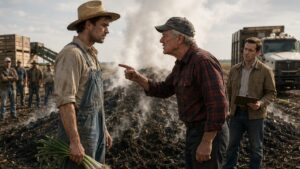
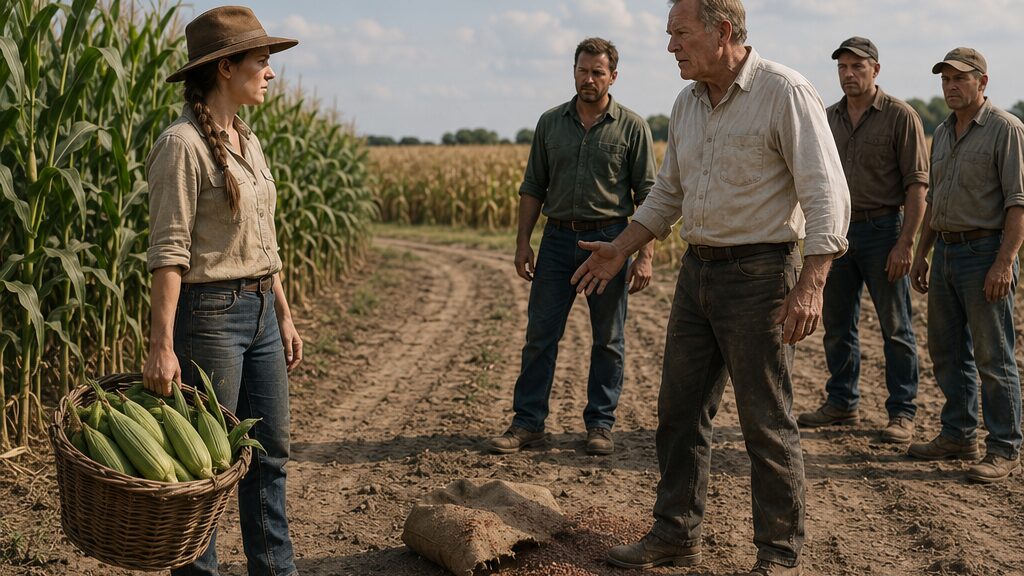
Richard’s boot struck the red clover sack before Kathleen could answer.
The burlap folded under his heel, then rolled off the field road and burst at one corner. A thin stream of seed spilled into the dust between the corn rows.
No one moved.
Kathleen still held the wicker basket against her hip. The ears of corn inside it pressed against her forearm, their green husks damp from the morning. Across from her, Richard lowered his foot as though he had only nudged aside a stone.
Behind him stood Eric Martin and two neighboring farmers who had come for the cooperative’s informal field walk. They had been discussing harvest dates and shared equipment ten minutes earlier. Now each man seemed to find something urgent to study in the dirt.
Richard pointed at the torn sack.
“That,” he said, “is what’s left of the operating reserve.”
Kathleen set the basket down carefully.
“Move your boot.”
“It isn’t on the sack.”
“You know what I mean.”
His face had gone red above the collar of his pale work shirt. “You bought seed for ground that ought to be earning rent. Without asking. Without showing me a contract. Without so much as saying the number out loud.”
“I showed you the rotation plan in June.”
“You left papers on my desk.”
“I went through them with you.”
“You talked about soil aggregates and nitrogen credits while we had a loan payment due.”
The two neighboring farmers exchanged a glance. Kathleen felt it without looking. In a place where people could discuss another family’s finances for twenty years while claiming never to pry, Richard had just handed them a fresh subject before breakfast.
She crouched beside the sack but did not pick it up. Red clover seed was finer than corn, smaller than a peppercorn, dull gold and brown against the pale road dust. Some had already disappeared into the tire grooves.
Richard gave a humorless laugh. “There. Take a good look. That’s your plan.”
Kathleen rose again.
“The north field lost nineteen bushels an acre against the home place last year.”
“Last year was dry.”
“It lost fourteen the year before that.”
“Fertilizer was late.”
“The subsoil is compacted to fourteen inches. Organic matter is under two percent in the west quarter. We’re paying for nitrogen that the roots can’t reach, and every hard rain carries topsoil into the ditch.”
One of the neighbors shifted his weight. Eric stared toward the corn.
Kathleen continued, because numbers were safer than anger.
“Thirty-two acres in clover after harvest. Not the whole field. One season of cover, then we terminate before planting. It reduces erosion, breaks the compaction cycle, and lowers next year’s nitrogen bill.”
Richard spread his hands toward the men behind him. “You hear that? One season. Like the bank takes payment in healthy soil.”
“The bank takes payment in cash we won’t have if yields keep sliding.”
“And where is the cash now?”
Kathleen did not answer quickly enough.
Richard’s mouth tightened. “Exactly.”
The silence changed. Before, the men had been embarrassed by his temper. Now they were listening for her mistake.
Kathleen felt the weight of the reserve figure inside her chest. She had known the balance when she ordered the seed. She had known Richard would resist. She had also known that waiting for his permission meant waiting until the ground failed badly enough that even he could no longer deny it.
Competence, she had always believed, should not need performance. A field either responded or it did not. A calculation either held or it failed. But people were not fields, and Richard had spent the morning proving that silence could be planted with anything he wanted.
He jabbed a finger toward the north acreage.
“I spoke to a leasing group yesterday. They’ll pay cash up front for five years. They put soybeans in next spring, carry the inputs, and we stop bleeding money.”
Kathleen looked beyond him. The corn stood high and green at the field edge, but farther in, where the soil tightened, the rows shortened and yellowed. From the road, the difference was almost invisible.
“You’re leasing out the north field?”
“I’m considering survival.”
“You’re considering stripping the last value out of it and handing the problem to somebody who won’t live here when it quits producing.”
Richard stepped closer. “You’ve been back eleven months.”
“I grew up here.”
“You left.”
“I came back when Mom got sick.”
“And now you think a degree makes you the first person in this family to understand dirt.”
The words landed harder because he had once taught her how to judge planting depth with the first joint of her finger. He had let her steer the tractor before her feet reached the pedals. For years, she had remembered him as the man who never raised his voice around machinery because anger made people careless.
Now the torn seed sack lay between them.
Kathleen folded her hands to keep from clenching them.
“Who paid the delinquent note in the drought year?”
Richard stopped.
Eric looked at him.
Kathleen kept her voice level. “You keep telling people you saved this farm. Tell them who covered the note when the machinery account went past due.”
The color drained from Richard’s face, then returned darker.
“That has nothing to do with this.”
“It has everything to do with who gets to stand here and talk about sacrifice.”
One of the neighboring farmers cleared his throat. Richard turned on Kathleen so sharply that the man stepped back.
“You want to drag your mother into this in front of everybody?”
“No.”
“Then don’t.”
Kathleen held his gaze. “I asked you a question.”
Richard stared at her for a long moment. Something moved behind his anger—not surprise, exactly, but fear that she knew more than he had allowed himself to believe.
Eric broke the silence.
“The drill’s supposed to come over Monday,” he said. “For the clover.”
Kathleen looked at him.
He rubbed a hand across his jaw. “I can’t bring it until this is settled. If there’s a dispute over the purchase, I don’t want my equipment in the middle.”
“We have a written sharing schedule.”
“And I have a note on that drill. I’m not risking it over an ownership fight.”
Richard nodded once, as if Eric had confirmed something obvious.
Kathleen looked from the spilled seed to the shortened corn rows. Without the drill, the planting window would narrow to days. A hard rain or early harvest delay could close it altogether.
Richard took his phone from his pocket.
“We’ll vote,” he said. “Five days. Farm office. Ownership shares represented in writing. Until then, no planting and no more spending.”
“You cannot lease the ground before the vote.”
“I can bring an offer.”
“And if the offer is already signed?”
“It isn’t.”
She watched his face.
He added, “Not yet.”
Richard turned toward the trucks. The neighbors followed at a distance, relieved to escape without choosing a side. Eric stayed long enough to glance at the torn sack.
“I’m sorry about the drill,” he said.
“No, you’re not.”
His expression hardened. “I’m sorry it came to this. That’s different.”
Then he left.
Kathleen stood alone beside the basket and the spilled seed. The north field rustled behind her, green enough to look healthy from the road.
Her phone vibrated.
A calendar invitation from Richard appeared on the screen.
HALL FARM OWNERSHIP VOTE—NORTH FIELD LEASE.
Five days from now.
Kathleen bent, gathered the torn sack in both hands, and realized Richard had not scheduled a discussion.
He had scheduled the day he intended to lock her out.
Chapter 2: What the North Field Had Stopped Giving
Half the seed had been ground into the tire track.
Kathleen knelt in the dust that afternoon with an empty coffee tin between her knees, picking intact clover seed from grit one pinch at a time. Broken hulls clung to her palms. Every passing farm truck pushed a warm breath of dust along the road, forcing her to shield the tin with her body.
She could have ordered another sack.
There was no money for another sack.
By the time Anna Roberts arrived from the county extension office, Kathleen had salvaged less than a third.
Anna stepped out of her county pickup carrying a soil probe and a flat plastic case. Her gaze moved from Kathleen to the torn burlap.
“I heard there was disagreement.”
“That traveled fast.”
“It reached my office before lunch.”
Kathleen stood and brushed her hands on her jeans. “Did Richard call you?”
“No. Three people did, none of them Richard.”
That sounded right.
Anna lifted the soil probe. “Show me the worst section.”
They walked between the rows without speaking. Near the road, the corn leaves brushed Kathleen’s shoulders. Farther west, the stalks thinned. Several ears sat too low, their tips poorly filled. The ground had baked into broad plates despite rain ten days earlier.
Kathleen stopped beside a flagged row.
“Here.”
Anna drove the probe into the earth. It entered smoothly for several inches, then stopped so abruptly the handle jolted in her hands.
She tried again nearby.
Same depth.
“About fourteen inches,” Kathleen said.
Anna nodded. “Maybe less in places.”
They dug a small inspection pit with a spade from the truck. The upper soil broke apart in gray-brown crumbs, but beneath it lay a dense horizontal layer. Corn roots spread sideways across it instead of descending.
Anna held up a twisted root.
“This field isn’t using what you’re applying.”
“I know.”
“Your tissue samples?”
“In the office.”
“And the yield maps?”
“Same folder.”
Anna looked toward the short rows. “The clover makes sense agronomically. Thirty-two acres is defensible.”
The words should have felt like relief. Instead, Kathleen heard the qualification waiting behind them.
Anna wiped soil from the probe. “Who approved the expenditure?”
Kathleen bent to replace the soil in the pit.
“The farm bought it.”
“That wasn’t my question.”
“Richard saw the plan.”
“Did he approve the order?”
Kathleen pressed the last clod into place with her boot.
“He didn’t object before the supplier deadline.”
Anna let the silence sit.
“You had his signature?”
“No.”
“Written authorization from the ownership group?”
“No.”
“How much of the reserve did you use?”
Kathleen named the figure.
Anna exhaled through her nose. “Kathleen.”
“The price increased twice this summer. The supplier required payment to hold it.”
“That explains why you acted. It doesn’t give you authority.”
“The farm agreement allows routine crop purchases.”
“Is a first-year conservation conversion routine?”
“It should be.”
“That answer will not help you in a bank office.”
Kathleen looked back toward the road, where the torn seed sack rested beside the coffee tin. “If I had waited, Richard would have refused.”
“Then you would have had a governance dispute before spending the money.”
“And lost the planting window.”
“You may lose it anyway.”
Anna’s tone was not cruel. That made it harder to reject.
They returned to the farm office, a narrow room attached to the machine shed. Kathleen spread the tissue tests, yield maps, fertilizer invoices, and soil reports across the scarred table. Anna studied each one, making short notes.
The evidence aligned. Declining yield. Increasing nitrogen cost. Compaction. Erosion along the drainage ditch. The north field had been losing capacity for years while producing just enough corn to disguise it.
Anna tapped the cost-share application.
“If the county approves this, it covers part of the seed and drilling. Not all of it.”
“It gets us through establishment.”
“It reimburses after verification. You still need cash up front.”
Kathleen said nothing.
Anna studied her face. “How low is the reserve?”
Kathleen opened the accounting program and turned the screen.
The number seemed smaller when another person saw it.
Anna leaned back. “Does this include the loan payment?”
“Not the October installment.”
“Input bills?”
“Two remain.”
“And harvest fuel?”
“Estimated.”
Anna closed her notebook. “Your soil diagnosis is correct. Your timing may even be correct. But Richard can argue that you committed money needed for operations.”
“He was going to use the same reserve to patch the old combine.”
“That does not make your purchase authorized.”
Kathleen stared at the spreadsheet. Her mother had taught her that numbers could be faced even when people could not. But the figure on the screen offered no defense. She had made a sound agronomic decision through an unsound process.
A truck door slammed outside.
For one sharp second, Kathleen expected Richard. Instead, the county loan officer appeared in the office doorway holding a folder.
“I was nearby,” the officer said. “Thought I’d save you a trip.”
Anna’s expression changed into professional neutrality.
The officer set the folder on the table. “We received notice of a possible long-term lease and a change in projected operating use. The bank needs updated ownership authorization before approving further discretionary draws.”
Kathleen opened the folder.
A formal request lay on top. Beneath it was a temporary restriction on the operating line.
“No further draws?” she asked.
“Not until the owners confirm management authority and intended acreage.”
“We need fuel.”
“Existing vendor arrangements may continue within the approved limit.”
“The limit won’t cover harvest.”
The officer glanced at Anna, then back to Kathleen. “That’s why this needs to be resolved quickly.”
“Who notified the bank?”
“I can’t discuss another customer’s communication.”
“It’s our account.”
“The notice came through an authorized owner.”
Richard.
Kathleen looked at the date. He had contacted the bank before kicking the seed sack, before announcing the vote, perhaps before she even knew he had spoken with the leasing group.
The officer pointed to the signature page.
“We need the updated authorization before any conservation expenditure is recognized under the operating plan.”
Kathleen read the final line twice.
Without Richard’s signature, the clover purchase would remain an unauthorized draw against a nearly empty reserve. Without authorization, the bank could treat her action not as stewardship but as mismanagement.
Anna gathered the soil reports into one stack.
“I can write that the practice is technically justified,” she said after the officer left. “I cannot write that it was properly approved.”
Kathleen looked through the office window at the coffee tin on the truck seat. A day earlier, the seed had represented a plan Richard refused to understand.
Now it also represented a decision she had made alone.
Her phone chimed with an email from the bank.
Updated ownership authorization required before close of business Friday.
That was the morning of Richard’s vote.
Kathleen had five days to prove the north field was failing.
She had less time to prove she had not helped push the farm toward the same edge.
Chapter 3: The Ledger Her Mother Never Explained
The canceled note carried the serial number of Richard’s old combine.
Kathleen checked it against the machinery ledger, then checked again. The number matched the machine Richard had bought during the drought year—the oversized used combine he had insisted would let the farm take on custom harvesting.
According to the family story, the contract work had saved them.
According to the canceled note in Kathleen’s hand, the machinery account had gone delinquent before the first custom season ended.
She sat alone at the farmhouse kitchen table two mornings after the field confrontation. The curtains were still the yellow checks her mother had sewn twenty years earlier. Around Kathleen lay boxes of tax returns, loan statements, seed invoices, insurance notices, and ledgers written in three different hands.
A dusting of clover seed had followed her in from the truck. Fine grains clung to the cover of her mother’s oldest ledger and settled into the crease beside the spine.
The back door opened.
Richard entered without knocking.
“You moved the records.”
“I organized them.”
“They belong in the office.”
“They were in six boxes under a leaking window.”
His eyes moved over the table. When he saw the canceled note, his jaw shifted.
“I need every current loan document,” he said.
“You have access to the accounting files.”
“I want the originals.”
“Why?”
“For the vote.”
“The vote concerns the north lease.”
“The vote concerns whether you’re fit to make financial decisions.”
Kathleen laid the note flat. “Then this seems relevant.”
Richard did not touch it.
“That loan was paid.”
“By whom?”
“The farm.”
“The payment account ends in four-one-seven-two. That wasn’t the farm account.”
“You’ve been digging through your mother’s private papers.”
“She left me responsible for them.”
“She left us both responsible for the operation.”
Kathleen watched him. “Did the custom work ever make money?”
“For a while.”
“How long?”
“Long enough.”
“That isn’t an answer.”
Richard walked to the counter and poured coffee from the pot she had made hours earlier. He drank it cold without reacting.
“We were trying to grow,” he said. “Your grandfather had just died. Acreage around us was being swallowed by larger outfits. We either expanded or spent the next decade shrinking.”
“So you bought a machine we couldn’t afford.”
“We bought capacity.”
“You signed the note.”
“Your mother agreed.”
The distinction was too careful.
Kathleen opened the ledger to the drought year. Several entries had been marked only as TRANSFER. No account source. No explanation. The handwriting was her mother’s, compressed and upright.
Richard reached for the ledger.
Kathleen pulled it back.
“What was account four-one-seven-two?”
“I don’t remember.”
“You remembered the serial number before I said it.”
His eyes sharpened. “Don’t play games.”
“I’m asking about money.”
“You’re asking about fifteen years ago because you can’t defend what you spent last month.”
“I can defend the clover.”
“Not to the bank.”
The truth of it stung. Kathleen closed the ledger.
Richard put both hands on the table. “Give me the current records.”
“I’ll copy anything related to the operating line.”
“All of them.”
“No.”
His face tightened, but his voice dropped. “Your mother did this too.”
“Did what?”
“Decided what everyone else was allowed to know. Called it protecting the family.”
Kathleen felt the words like a hand against her sternum.
“You’re the one refusing to explain the note.”
“And you’re the one hiding behind a dead woman whenever someone questions you.”
For a moment, neither spoke.
Richard looked older than he had in the field. The skin under his eyes was gray, and one sleeve of his shirt had been mended near the cuff with thread that did not match. Kathleen remembered her mother making those repairs at this same table while Richard complained that store-bought shirts were cut wrong.
She hated that memory for making him human when anger would have been easier.
He gathered a stack of current loan statements.
“I’m taking these.”
“Leave the originals.”
“I’m an owner.”
“So am I.”
“Then start acting like one.”
The door shut hard behind him.
Kathleen remained at the table until the quiet returned. Then she searched the boxes again.
Account four-one-seven-two appeared first on a property tax receipt. It belonged to a parcel south of town: twenty-six acres her mother had inherited separately from Kathleen’s grandmother. Kathleen had believed that land remained unencumbered. Her mother used to call it the last clean piece—small, rough, but entirely theirs.
A refinancing statement showed otherwise.
The parcel had secured a private loan three weeks before the machinery note was brought current.
Kathleen read the figures. The amount borrowed exceeded the combine arrears. Part had covered fuel, insurance, and payroll. Part had been transferred directly to the farm.
Her mother had risked her separate land to protect the shared operation.
To protect Richard.
At the bottom of the box, beneath old crop insurance maps, Kathleen found an envelope with her name on it.
The seal had been opened.
Inside was a repayment schedule and a single-page letter in her mother’s handwriting.
Kathleen read the first lines.
If this ever becomes yours to explain, do not use it to shame him. I agreed because the farm could not survive another split. But silence is a loan too, and somebody always pays the interest.
Kathleen stopped.
The rest of the letter detailed payments made from her mother’s nursing savings and rental income from the separate parcel. It did not absolve Richard. It did not accuse him either. It described two frightened adults making choices under pressure, then pretending afterward that the choices had cost less than they had.
The last paragraph was addressed directly to Kathleen.
Do not let the north field be mined for one more good-looking harvest. It is the first ground your grandfather trusted me to manage. If you take responsibility for it, leave something living behind.
Kathleen folded the letter along its existing crease.
Richard had accused her of hiding behind her mother. Yet her mother had asked for discretion, not deception. Kathleen had treated the two as the same because silence spared her from deciding when truth became necessary.
A pickup slowed outside.
Through the kitchen window, she saw Richard’s truck enter the yard. He did not come to the house. He crossed to the farm office, remained inside less than ten minutes, then drove away.
Kathleen waited until the dust settled before going over.
The current records were gone from the desk. In their place lay a notice from the leasing group confirming receipt of a preliminary acreage filing. The proposed lease would become binding upon ownership approval at Friday’s meeting.
Richard had moved before the vote.
Kathleen folded the notice and placed it beside her mother’s letter.
She should have put the letter back in the envelope.
Instead, she slipped it into the inside pocket of her work jacket.
Richard was concealing the past to control the future. She was concealing it to protect the dead.
The difference no longer felt as clean as it had that morning.
Outside, survey flags had appeared along the edge of the north field—bright orange markers spaced beside the road, placed by someone preparing to measure the lease acreage.
Kathleen stood among them with the unopened clover sack in her truck and her mother’s letter against her ribs.
The vote was still two days away.
Richard was already behaving as if the land belonged to someone else.
Chapter 4: Five Days Until the Lease Became Binding
Eric removed the shared drill before sunrise.
Kathleen heard the diesel from the farmhouse and reached the machinery shed as his tractor eased backward through the open doors. The red no-till drill followed behind it, steel discs ticking softly as they crossed the threshold.
She stepped into the lane.
Eric stopped, but he did not shut down the engine.
“You said Monday,” Kathleen called over the idle.
“I said I couldn’t bring it until the ownership question was settled.”
“It was already here.”
“Richard asked me to clear the shed.”
“And you did.”
Eric rested one forearm on the open cab window. “I need it on my west ground.”
“Not until next week.”
“I moved my schedule.”
“For him.”
“For myself.”
Kathleen looked at the drill. She had calibrated it with Eric in the spring, marking one hopper setting with a scratch near the lever because the factory chart ran heavy on small seed. Without it, she could hire a contractor, if she found one free, or broadcast the clover and hope for enough soil contact to establish.
Both options cost money the farm no longer had.
“You know the field needs it,” she said.
“I know you ordered seed before the owners agreed.”
“You saw the soil maps.”
“I also saw the bank restriction.”
That stopped her.
Eric glanced toward the farmhouse. “People talk.”
“They always have.”
“They talk differently when equipment loans are involved.”
He put the tractor in gear.
Kathleen stepped aside.
The drill rolled past her, its empty hopper rattling as if something inside had been left loose. Eric did not look back.
By eight, Kathleen was at the cooperative office with a legal pad, Anna’s soil report, and three versions of the operating budget.
The local cooperative clerk let her use the back table beside the seed catalogs. Kathleen reduced the clover acreage first from thirty-two acres to twenty-four, then to eighteen. She shifted the worst compacted strips into one continuous block so the drilling cost would stay manageable. She delayed lime on the home place, cut one fungicide pass, and revised the nitrogen estimate using a conservative credit rather than the full extension figure.
At eighteen acres, the plan still improved the north field’s most damaged section and kept enough corn in production to meet most of the projected cash need.
Most was not enough.
Anna arrived just before noon and read the figures without speaking.
“You’re still short,” she said.
“By eleven thousand if harvest fuel stays under estimate.”
“And if it doesn’t?”
“More.”
Anna tapped the line marked EQUIPMENT DISPOSAL.
“What are you selling?”
“The old grain cart and the second utility tractor.”
“The utility tractor runs.”
“We don’t need two.”
“Richard uses it for mowing and auger work.”
“He prefers it. That isn’t the same as needing it.”
Anna turned the page. “The smaller acreage works from a conservation standpoint. I can amend the application.”
“Will the county approve it before Friday?”
“They may issue conditional approval.”
“Can I take that to the bank?”
“You can take it. Whether they count it as liquidity is another matter.”
Kathleen stared at the revised map. Eighteen acres looked small on paper. On the ground, it covered the area where roots turned sideways and rain carved brown water into the ditch.
Her mother’s separate parcel appeared in the margin of the farm map, twenty-six acres south of town.
Kathleen traced its boundary with one finger.
Anna noticed. “Don’t.”
“It would clear the shortfall.”
“It would clear this shortfall.”
“It’s debt-free now.”
“Because your mother spent years paying off the loan against it.”
Kathleen closed the map.
“I can list it today.”
“And prove Richard right that the farm consumes everything around it?”
“That isn’t a financial argument.”
“No. It’s the argument you came here making.”
The cooperative’s front bell rang. Through the open doorway, Kathleen saw the farm auction representative place a stack of sale flyers on the counter.
The timing felt less like coincidence than instruction.
She walked out to the machinery shed that afternoon and inventoried every piece of equipment. The second utility tractor sat beneath a film of chaff, its tires good, its engine recently serviced. The old grain cart needed bearings but remained sellable.
At the rear of the shed stood Richard’s preferred row-crop tractor, newer than the rest, with hydraulic capacity they rarely used. Selling it would cover the shortfall and part of the restricted operating line.
Kathleen photographed the serial plates and called the auction representative.
An hour later, the representative returned with preliminary values.
“The row-crop tractor brings the most,” the representative said. “Market’s decent. Utility tractor moves too, but not enough by itself.”
Kathleen nodded. “Prepare estimates for both.”
The representative checked the ownership sheet. “There’s a lien notation on the larger tractor.”
“What lien?”
“Equipment schedule says pledged collateral.”
Kathleen took the paper.
The pledge had been filed six months earlier, when her mother was already ill and Kathleen was handling most daily operations. Richard’s signature appeared beside the bank stamp.
He had used the tractor to secure an extension on the operating note.
He had not told her.
Kathleen drove to the north field before dusk with one intact handful of clover seed in her coat pocket. She paced the shortened plan, counting rows and measuring boundaries against the flags. At the western edge, she opened her palm.
The seed barely covered the hollow of her hand.
Something so small could root across eighteen acres if placed correctly. Scattered badly, it would disappear.
Her phone rang.
Richard.
She let it ring twice before answering.
“I heard you called an auction representative,” he said.
“You pledged the row-crop tractor.”
“I extended the note.”
“You did it without telling me.”
“You weren’t an owner when I signed.”
“Mom was.”
“She knew the farm needed room.”
“Did she sign?”
Silence.
Kathleen turned toward the road. Richard’s truck was not visible.
“Did she sign?” she asked again.
“The bank accepted the collateral.”
“That wasn’t my question.”
“You keep confusing paperwork with survival.”
“And you keep calling secrecy management.”
His breath came hard through the phone. “The lease fixes this.”
“The lease delays it.”
“The lease gives us cash.”
“And gives someone else five years to pull yield from damaged ground.”
“At least there’ll be a farm left when they’re done.”
Kathleen closed her fingers around the seed. “I have an eighteen-acre plan. Lower establishment cost. Enough corn stays in production to cover most of the payment.”
“Most.”
“We sell the utility tractor and grain cart.”
“No.”
“You haven’t seen the numbers.”
“I know what those machines are worth.”
“Then you know they help.”
“They don’t solve the gap.”
“I’ll solve the rest.”
“With your mother’s parcel?”
Kathleen went still.
Richard continued, quieter now. “You think I don’t know what you’re considering?”
“How would you?”
“Because your mother thought the same way every time the farm got tight. Sell what was hers. Protect what belonged to everybody.”
The line went silent except for wind against the phone.
Kathleen looked down at her fist.
“Then tell me why,” she said.
Richard hung up.
She returned to the machinery shed after dark to photograph the lien documents. Richard’s truck was parked outside, unlocked. On the passenger seat lay the lease folder, a thermos, and a white envelope bent beneath the edge of the console.
Kathleen recognized her mother’s handwriting before she opened the door.
Her own name was written across the front.
The envelope she had found in the records box was still in her jacket. This was another one.
She reached through the open window and pulled it free.
Inside was a photocopy of the repayment letter—the same schedule, the same account transfers, the same warning about silence.
A crease ran across the page as though it had been folded and unfolded for years.
Richard had not discovered the truth this week.
He had been carrying it in his truck.
Chapter 5: The Debt Richard Could Not Admit
“I found the letter years ago.”
Richard stood inside the machinery shed holding the torn clover sack by its stitched top. Kathleen had laid the photocopy on the workbench between them. Outside, the last light had thinned to a gray strip beneath the doors.
“How many years?” she asked.
He looked at the sack instead of her. “Nine.”
“And you said nothing.”
“She told me not to.”
“The letter says not to use it to shame you. It doesn’t say pretend it never happened.”
“You think there’s a difference in a town this size?”
“There was a difference between telling the town and telling me.”
Richard set the sack down. A few seeds leaked through the torn corner and clicked against the concrete.
“She didn’t want you carrying it,” he said.
Kathleen laughed once, without humor. “So she left me the farm instead.”
“She wanted you to have a chance at a life that wasn’t built around old mistakes.”
“I came back to take care of her.”
“You came back because she was dying.”
The words struck cleanly because they were true.
Richard rubbed both hands over his face. The fight seemed to leave his shoulders for a moment.
“The combine was my idea,” he said. “Custom harvesting looked like the only way to grow without buying more ground. First year, the transmission went. Second year, two clients didn’t pay. Then the drought cut our own crop.”
“And Mom refinanced her parcel.”
“After I told her not to.”
“Did you?”
“I told her we should sell the machine.”
“After the note was delinquent?”
He did not answer.
Kathleen watched him pick up the sack again. He ran a thumb along the split seam, testing the damage with the care of someone handling something he had no right to claim.
“How much did she cover?” Kathleen asked.
“You read the letter.”
“I want you to say it.”
Richard’s jaw worked.
“All of it,” he said. “The arrears. Fuel. Payroll. The insurance bill.”
“And the payments afterward?”
“Her nursing income. Rent from the south parcel. Some farm distributions she should’ve kept.”
Kathleen leaned against the workbench. For two days she had imagined this moment as a clean exposure: Richard forced to name what he owed, the truth settling accounts the way a canceled note settled debt.
Instead, he looked like a man who had spent years waiting for a bill no bank could issue.
“Why keep telling people you saved the farm?” she asked.
“I never said I did it alone.”
“You never corrected them.”
“No.”
“Why?”
He placed the sack on the bench.
“Because once people know somebody covered your failure, they stop seeing anything else you ever did.”
“That’s pride.”
“Yes.”
The admission took some of the force from her anger.
Richard looked toward the dark shape of the row-crop tractor.
“I stayed,” he said. “When your father left. When your grandfather died. When your mother worked nights at the hospital, I planted and harvested. I fixed what I could. I made decisions with whatever bad choices were left. Then one bad purchase became the only thing she thought needed hiding.”
“She hid the cost because you both asked silence to do the work of repair.”
“You sound like her.”
“She wrote it.”
“I know.”
Kathleen picked up the photocopy. “You read the part about the north field?”
Richard’s expression closed.
“She made me promise not to strip it for one last crop,” Kathleen said.
“She made promises when she was sick.”
“She made that one before.”
“The farm needs cash now.”
“The north field needs recovery now.”
“And if we miss the payment while you wait for roots and organic matter?”
“The reduced plan keeps most of it in corn.”
“Most again.”
“We sell equipment.”
“The useful machines are pledged.”
“The utility tractor and grain cart aren’t.”
“They won’t cover enough.”
“I know.”
Richard looked at her carefully. “You’re thinking about the south parcel.”
Kathleen did not answer.
His voice sharpened. “Don’t.”
“You don’t get to tell me what to do with it.”
“No. But I get to tell you I watched your mother feed this farm with everything that was hers. It never got full.”
“Then help me keep it from taking more.”
“The lease does that.”
“The lease takes the land instead of the money.”
“For five years.”
“Five years of someone farming to the contract. They won’t care what’s left below the yield monitor.”
“They’ll pay enough to stabilize the note.”
“And when the lease ends?”
“We’ll deal with that then.”
Kathleen stared at him. “That’s what you said about the combine, isn’t it?”
Richard’s face hardened.
She regretted the line as soon as it left her, not because it was false, but because she had chosen it to wound.
He turned away.
“I’m not trying to humiliate you,” she said.
“You brought up the drought note in front of half the county.”
“I asked one question.”
“You knew what it would sound like.”
“Yes.”
The honesty surprised them both.
Kathleen folded the photocopy.
“I was angry.”
“You wanted them to stop looking at you like a careless kid.”
“I wanted you to stop making me one.”
“So you reached for the one thing you knew I couldn’t answer publicly.”
She had no defense.
The shed settled around them: cooling metal, distant insects, the soft scrape of burlap as Richard straightened the damaged sack.
“My mistake doesn’t make the lease right,” she said.
“No.”
“And your shame doesn’t give you authority over me.”
“No.”
“Then cancel the filing.”
Richard threaded a length of baling twine through the torn corner and pulled it tight.
“No.”
Kathleen felt the answer in her stomach.
“Why?”
“Because your plan still leaves us short. Because the bank doesn’t care who paid what fifteen years ago. Because October comes whether the clover roots or not.”
“The county application—”
“Reimbursement. Later.”
“The equipment sale—”
“Not enough.”
“I can bring the remaining gap.”
“With the south parcel.”
“That’s my decision.”
“It’s the same decision your mother made.”
“Maybe.”
Richard dropped the sack onto the bench.
“And maybe that’s what I’m trying to stop.”
For the first time, Kathleen understood that he did not see the lease as surrender. He saw it as the only way to prevent her from repeating her mother’s sacrifice.
The understanding did not make him right. It made opposing him more painful.
“The vote is tomorrow,” he said. “I’m presenting the lease.”
“I’m presenting the reduced plan.”
“And I’m telling them you used reserve funds without authorization.”
Kathleen looked at the letter in her hand.
“If you do that, I’ll have to explain why I acted.”
“Explain your soil tests.”
“They’ll ask why I refused to wait.”
“Then answer.”
“You know where that answer leads.”
Richard met her eyes at last.
“Yes.”
The word was almost a challenge, but not quite. It carried fear.
Kathleen slipped the letter into her jacket.
“You’re willing to expose my mistake,” she said, “as long as I keep protecting yours.”
Richard’s face tightened.
“I’m willing to tell the truth about the account,” he said.
“Not all of it.”
“No one ever tells all of it.”
Kathleen walked toward the shed door.
Behind her, Richard lifted the torn seed sack from the bench.
“At the vote,” he said, “I will tell them exactly what you spent and when.”
She stopped with one hand on the door.
For years, she had believed keeping her mother’s confidence was loyalty. By morning, that silence could cost them the field her mother had asked her to protect.
Kathleen opened the door.
The choice was no longer whether to expose Richard.
It was whether she could tell the whole truth without turning it into a weapon.
Chapter 6: The Vote No One Could Leave Unchanged
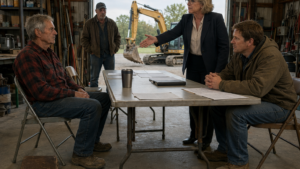
Richard began the meeting by accusing Kathleen of unauthorized spending.
He stood at the end of the farm office table with the operating ledger open in front of him. The county loan officer sat to his right. Anna occupied a chair near the window. Eric leaned against a filing cabinet, present because the equipment-sharing agreement would be affected by either plan.
Beside Richard lay the lease contract.
Beside Kathleen lay the repaired clover sack.
She had stitched the corner before dawn with waxed twine. The seam was uneven but tight.
Richard tapped the ledger.
“Fourteen thousand eight hundred dollars was transferred from the operating reserve for seed, delivery, and drilling arrangements without ownership approval.”
The loan officer looked at Kathleen. “Is that accurate?”
Every instinct she had told her to qualify the answer. Richard had seen the plan. The purchase fell near ordinary crop spending. The deadline had forced action. The field was failing.
Kathleen put both palms on the table.
“Yes.”
No one moved.
Richard had expected resistance. She saw it in the slight pause before he continued.
“You agree it was unauthorized?”
“I agree I did not obtain written approval from the ownership group.”
Anna lowered her eyes to her notebook.
Kathleen continued. “I believed the purchase was necessary and within routine management authority. I also knew Richard opposed it. I proceeded anyway.”
The loan officer folded his hands. “Why?”
“Because I thought being correct about the field excused making the decision alone.”
Richard stared at her.
“It didn’t,” Kathleen said.
The admission changed the room. It did not clear her. It removed the easiest version of Richard’s case—the version in which she was too proud to recognize fault.
She opened the first folder.
“The north field has lost yield for three consecutive seasons. The worst acreage has severe compaction, low organic matter, and inefficient nitrogen uptake. Anna verified the findings.”
Anna slid copies of her report across the table. “The diagnosis is sound. A red clover rotation is an appropriate practice.”
Richard pointed to the lease. “Appropriate does not mean affordable.”
“No,” Kathleen said. “It doesn’t.”
She replaced the original thirty-two-acre plan with the revised map.
“Eighteen acres. The most damaged continuous block. The remaining ground stays in corn. We sell the second utility tractor and the old grain cart. The county cost-share reimburses part of establishment after verification. I accept responsibility for the unapproved draw and repay my share from future distributions.”
The loan officer studied the figures.
“This still leaves a projected gap.”
“Eleven thousand under the conservative harvest estimate.”
“And your source?”
Kathleen felt the letter inside her jacket.
“The south parcel could cover it.”
Richard’s hand flattened on the table. “No.”
Everyone looked at him.
The lease representative, seated near the door, spoke for the first time. “Before the discussion goes further, the leasing group revised its offer this morning.”
A new page slid across the table.
The amount was higher by nearly twenty percent.
Cash upon execution. Five-year term. Tenant control over crop selection and input practices, subject only to basic conservation compliance.
The figure was enough to erase the immediate shortage, restore part of the operating reserve, and carry the loan through harvest.
Eric whistled softly.
Richard looked at Kathleen as if the number ended the argument.
“This is what stability looks like,” he said.
Kathleen read the conditions again. “They can sublease operational rights.”
“Common provision,” the representative said.
“They can remove residue.”
“Within compliance standards.”
“They can decline cover crops unless required.”
“They assume production risk.”
Kathleen pushed the contract back.
“They assume this year’s risk. We inherit what’s left.”
Richard’s patience snapped. “And your answer is to sell the only land your mother owned separately?”
“My answer is not final.”
“You put it in the plan.”
“I put it down because hiding the gap would make this another false choice.”
Richard looked toward the loan officer. “You see the problem. Every solution she has spends something her mother protected.”
Kathleen touched the repaired sack.
“That is true.”
The room went quiet again.
She removed the letter from her jacket.
Richard’s face changed.
Kathleen placed it on the table but kept her hand over it.
“The operating reserve is not the first money this farm used without everyone understanding the cost,” she said.
“Kathleen,” Richard warned.
She looked at him. “I’m not going to shame you.”
“You already—”
“I’m going to tell them what happened, including what I did.”
Richard sat down slowly.
Kathleen addressed the table.
“Fifteen years ago, the farm fell behind on a machinery note tied to Richard’s combine expansion. My mother refinanced her separate parcel. She covered the arrears, fuel, payroll, and insurance. She kept making payments with nursing income and rent.”
Eric stopped leaning against the cabinet.
The loan officer looked from Kathleen to Richard.
Richard’s voice was low. “I told her to sell the combine.”
“After the note was already delinquent,” Kathleen said. “You also stayed. You planted, repaired equipment, and kept the farm operating while she worked nights. Both things are true.”
Richard looked at her then, startled not by the accusation but by the part she had refused to erase.
“She asked him not to tell me,” Kathleen continued. “She also wrote that silence becomes a debt of its own. I turned her request for dignity into a reason not to explain anything. That was my mistake before I spent the reserve, and it is why we’re here now.”
Anna glanced at the repaired seam on the sack.
Kathleen uncovered the letter.
“My mother did not ask me to preserve Richard’s embarrassment. She asked me not to use it against him. She asked me to leave something living in the north field.”
Richard’s eyes stayed on the page.
The lease representative cleared his throat. “The offer expires at noon.”
The wall clock read ten forty-three.
The loan officer spoke carefully. “From the bank’s perspective, either proposal could proceed if properly authorized. The lease produces stronger immediate liquidity. The reduced planting plan carries more operational risk but may be workable with asset sales and a documented management structure.”
“What structure?” Richard asked.
“Dual authorization above an agreed threshold. Monthly reporting. No unilateral pledges or discretionary draws.”
The condition landed on both of them.
Richard would lose the freedom to pledge machinery alone.
Kathleen would lose the freedom to act first and explain later.
Eric looked at the map. “If the revised plan passes, I could return the drill under a repayment agreement. Fuel and wear paid first.”
Kathleen met his eyes. “At full rate.”
He nodded.
It was not generosity. That made it usable.
Richard picked up the lease contract. “This offer keeps the bank out of our throat.”
“It also keeps us from managing the north field for five years,” Kathleen said.
“And your plan may still fail.”
“Yes.”
The answer seemed to anger him more than certainty would have.
“You’re asking me to risk the farm on eighteen acres of clover.”
“No. I’m asking you to risk less land, sell equipment we can replace, accept oversight, and stop pretending immediate cash has no future cost.”
“And the south parcel?”
“I will not sell it to cover a decision we have not made together.”
Richard looked at the letter again.
Kathleen slid two signature pages toward him: the lease authorization and the revised operating plan.
“This is not a vote on whether I was right,” she said. “I was wrong to spend the money alone. It is not a vote on whether you were wrong fifteen years ago. You were. It is a vote on what we do now that neither of us gets to hide behind being the one who saved the farm.”
No one spoke.
The lease representative checked the clock.
Richard rose abruptly.
“I need ten minutes.”
“Richard,” the representative said, “the offer—”
“Ten.”
He walked out through the equipment yard, leaving both signature pages on the table.
Through the window, Kathleen watched him pass the utility tractor, the grain cart, and the row-crop tractor pledged to the bank. He stopped beside the north field road where the survey flags began.
The room waited.
Nine minutes passed.
At ten minutes, Richard had not turned back.
The lease contract remained unsigned, but so did Kathleen’s plan.
At eleven, he was still standing at the field edge with the deciding vote in his hands.
Chapter 7: What They Chose to Leave Living
Richard returned to the office and tore the lease signature page in half.
The sound was small, no louder than a stalk snapping under a boot, but everyone in the room heard it.
He placed the two pieces on the table.
The lease representative stared at them. “That offer expires at noon.”
“I understand.”
“You may not receive the same terms again.”
“I understand that too.”
Richard lowered himself into the chair beside the window. He looked toward Kathleen, then at the repaired clover sack between them.
“I’m voting against the lease.”
The loan officer removed the unsigned contract from the center of the table. “Then we need to determine whether the alternative meets the bank’s conditions.”
“It will,” Richard said.
Kathleen did not let herself mistake the words for agreement. “Only if we cover the gap.”
Richard nodded toward the equipment list.
“Sell the row-crop tractor.”
The loan officer frowned. “That unit is pledged.”
“Then sell it through the bank and apply the proceeds to the note.”
Kathleen studied him. The row-crop tractor was the machine Richard chose even for jobs the smaller tractor could handle. He kept the cab spotless and replaced the seat before the old one had worn through. It was the first piece of equipment he had purchased after the combine debt was finally cleared.
“The utility tractor and grain cart were my proposal,” she said.
“They don’t bring enough.”
“The row-crop tractor does more work.”
“So will the one we already own.”
“You hate that tractor.”
“I’ll survive.”
The words were dry, almost familiar, and for a second Kathleen heard the uncle who had once taught her to drive.
The loan officer reviewed the figures. “Selling pledged collateral would reduce the outstanding balance, but you would still need documented authority changes.”
Richard picked up the revised management agreement.
“Dual approval above the threshold,” he said. “Monthly reports. No new liens without both signatures.”
Kathleen watched him read each provision. He paused at the clause requiring written approval for nonroutine crop expenditures.
“That applies to both of us,” she said.
“I can read.”
“I know.”
He signed.
The movement was not dramatic. His hand shook once near the end of his last name, and he pressed harder to finish it.
Kathleen signed beneath him.
Anna amended the conservation application that afternoon. The cooperative clerk confirmed the smaller seed order could be retained without penalty. The loan officer agreed to release enough restricted funds for harvest fuel once the equipment sale was listed and the revised operating plan was filed.
Nothing was solved cleanly.
The auction estimate came in lower than expected. The bank required a reserve cushion that cut into fertilizer purchases for the home place. Richard argued over every line. Kathleen refused to reduce the clover acreage below eighteen. They settled on postponing a grain-bin repair and using a temporary patch through harvest.
Eric remained by the filing cabinet until the others left.
“The drill can come back tomorrow,” he said.
Kathleen closed the folder. “Under the same terms you use for everyone else.”
“Fuel, wear, and transport.”
“And repayment for the missed schedule.”
Eric lifted his eyebrows. “You want to charge yourself for a drill I removed?”
“I want the agreement to say what happens next time either one of us changes the schedule.”
He considered that, then nodded.
“Full rate,” he said. “Written this time.”
“Yes.”
He pushed away from the cabinet. At the door, he stopped.
“I thought you came back believing none of us knew what we were doing.”
Kathleen looked at him. “I came back believing I shouldn’t have to explain what I knew.”
“Close enough from the outside.”
Then he left.
The planting began three days later.
The north field had been harvested early on the damaged section, leaving pale rows of chopped stalks and dry husks. Eric pulled the drill into place while Kathleen carried the repaired sack from the truck.
Richard stood beside the hopper.
For one uncomfortable moment, both of them reached for the sack.
Kathleen let go first.
Richard lifted it carefully, supporting the patched corner with one hand. The burlap bore the mark of his boot, a dark smear that would not brush away.
He poured.
The clover seed flowed in a narrow, clean stream, rattling softly against the metal hopper. No seed spilled through the repair.
Kathleen checked the scratched calibration mark near the lever.
“Too heavy,” Richard said.
“It’s correct for clover.”
“The chart says—”
“The chart runs heavy on seed this small.”
Eric leaned from the tractor cab. “She’s right.”
Richard looked at the mark, then at Kathleen. “Show me.”
She demonstrated the setting and walked him through the test distance. They weighed the collected seed on a hanging scale, adjusted the rate once, then began.
The drill crossed the field slowly. Steel discs opened narrow lines through the residue, placed the seed, and pressed the soil closed behind it. From the road, the work looked almost like nothing. No tall crop. No dramatic change. Only faint seams in the earth.
Richard walked the first pass instead of riding in the tractor.
Kathleen followed several yards behind, checking depth. The seed rested shallow enough to emerge, deep enough not to dry out immediately.
At the west edge, Richard stopped beside the place where the compacted layer was worst.
“You were right about this section,” he said.
Kathleen pressed soil around a seed with her thumb. “Not about everything.”
“No.”
He looked toward the road where the lease flags had been removed.
“The tractor sale closes next week.”
“I saw.”
“I kept thinking equipment was proof we were moving forward.”
“Sometimes it is.”
“Sometimes it’s a payment with tires.”
Kathleen stood.
The sun had dropped behind the harvested corn, flattening the field into long bands of shadow. Eighteen acres had been planted. The rest remained under the old system because the farm could not afford more change at once.
It was less than Kathleen had wanted.
It was more than Richard had been willing to risk.
Two weeks later, the tractor left on a flatbed. Richard watched from the shed without speaking. Kathleen stood beside him but did not offer comfort he had not asked for.
The farm survived the October payment.
It did not emerge untouched. Their operating line was smaller. Every future purchase required both signatures. Eric’s equipment agreement carried stricter terms. The home-place repairs remained delayed. Kathleen’s distributions would be reduced until the unauthorized seed expense was repaid.
One evening, Richard entered the office carrying the north-field soil map.
He laid it across the desk.
Kathleen looked up from the harvest records.
“What is it?”
He pointed to the colored bands marking compaction and organic matter.
“You said the red section is worst.”
“Yes.”
“And these numbers along the side?”
“Sampling depths.”
He remained standing.
Kathleen waited.
Richard cleared his throat. “Show me how to read the rest of it.”
Chapter 8: The First Green Between the Corn Rows
The first clover shoots appeared where Richard had kicked the sack.
Kathleen found them on a cold morning several weeks after planting, two small leaves rising from the dirt beside the field road. More green showed farther in, fine and scattered between the chopped corn rows.
She crouched and touched one leaf with the back of her finger.
The stand was not perfect. A dry spell had thinned the eastern edge, and wheel traffic had left several bare strips. Anna’s inspection report called establishment adequate, not exceptional.
Adequate was enough to release the first cost-share payment.
A pickup stopped on the road.
Richard stepped out carrying a clipboard.
He had begun carrying it after the new management agreement took effect. At first, Kathleen had assumed it was temporary obedience for the bank. Then she noticed he wrote down fuel purchases, repair approvals, and changes to the harvest schedule before making them.
He walked into the field and looked at the green between the rows.
“That all clover?”
“Most of it. Some winter weeds.”
“How can you tell?”
Kathleen showed him the paired leaves and the faint pale marking that would sharpen as the plants matured.
Richard bent stiffly to look.
“I thought there’d be more.”
“There will be, if it overwinters well.”
“And if it doesn’t?”
“We evaluate and adjust.”
He gave her a sideways glance. “That answer used to irritate you when I gave it.”
“You usually meant we would ignore the problem until spring.”
“Sometimes spring fixed it.”
“Sometimes spring made it visible.”
He almost smiled.
They walked toward the center of the planted section. Corn stubble caught at their boots. Richard used the clipboard to note a bare patch near the wheel track.
“The bank wants next year’s crop plan by January,” he said.
“I know.”
“I started a draft.”
Kathleen stopped.
Richard handed her the clipboard. His handwriting filled the first page: acreage, seed estimates, expected fuel use, machinery needs. Several lines ended with question marks instead of decisions.
At the bottom he had written: NORTH FIELD—KATHLEEN’S RECOMMENDATION.
She looked up.
“I didn’t know the rate,” he said.
“You could have asked.”
“I am.”
The answer carried no defense.
They continued to the west quarter, where the clover stand was thickest. Richard stood with both hands in his jacket pockets.
“I’ve been thinking about what your mother wrote,” he said.
Kathleen waited.
“I thought responsibility meant being the person who decided before everybody else got scared.”
“That was part of it.”
“It became control.”
“Yes.”
He nodded once. “I’m not asking you to say it wasn’t.”
Kathleen looked across the field. The green was low enough that someone passing on the road might not notice it. Below the surface, roots had already begun entering cracks the corn could not reach.
“Mom did the same thing differently,” she said. “She decided what truths everyone could handle.”
Richard’s face tightened. “She was trying to protect you.”
“I know. She was also protecting you from having to face me.”
He did not argue.
“She made me promise not to let this field be stripped,” Kathleen said. “I treated the promise like it gave me the right to decide alone. It didn’t.”
“You were right about the ground.”
“That didn’t make the rest right.”
Richard scraped mud from his boot against a corn stalk.
“I don’t know what repair looks like between people,” he said.
Kathleen glanced at the clipboard. “Probably less efficient than a field plan.”
“That sounds expensive.”
“It usually is.”
They returned to the road without settling anything more.
In the office that afternoon, Kathleen opened Richard’s draft and added the projected clover termination date, reduced nitrogen needs, and the machinery costs they could no longer hide inside general expenses. She left the home-place acreage unchanged where his estimates were sound.
At the bottom, beneath his line asking for her recommendation, she added a second signature space.
Richard came in near dusk. He read the plan standing beside the desk.
“You changed the fertilizer figure.”
“The clover credit won’t be known until spring. I used the lowest defensible estimate.”
He nodded.
“And you left my corn acreage.”
“It works if the yield projection holds.”
“And if it doesn’t?”
“We evaluate and adjust.”
This time, he did smile.
Kathleen signed first, then turned the paper toward him.
Richard picked up the pen. He hesitated over the second line, not because he objected, but because the page looked unfamiliar with room for both of them.
He signed.
Outside the office window, the north field lay dark under the evening sky. The clover could no longer be seen from that distance, but Kathleen knew where it had taken root.
Something living had been left behind.
The story has ended.