The Seat Reserved for Him
Part I — The Runway
By the time Major Adrian Vale came back from the scrub latrine, the engines were already turning.
The dawn airfield was a strip of white coral hacked out of jungle and heat. Men moved through dust and prop wash with the hard, automatic speed of people who had done this too often to waste motion on ceremony. Adrian was still buttoning his jacket with one hand, the other pressed once, uselessly, against his stomach.
He looked up at the bomber.
And saw Sergeant Daniel Mercer in his seat.
The observer position had been reserved for Adrian. Everyone on the strip knew it. It was why the crew had tolerated him all week with that careful, flat politeness combat men used on visiting officers whose wars were mostly made of paper. Mercer sat behind the glass nose, headset crooked, one shoulder turned as he secured a strap. For a second he glanced out.
He saw Adrian.
He lifted a hand, not quite a wave, more an apology made small enough to fit between ranks.
Then the props bit harder, and the plane jolted forward.
Adrian could still have stopped it.
That was what he would think later, over and over, until the thought became a blister he could not stop touching. He could have raised his arm. He could have shouted. He could have made the crew chief signal a hold. A major could delay a takeoff if he wished to endure the hatred that followed.
Instead he stood there half out of breath, the smell of fuel in his nose and the raw shame of his own body still hot in him, and told himself the same lie three times in quick succession.
It’s only this one flight.
There’s another aircraft later.
Don’t make a spectacle of yourself.
The bomber rolled, gathered itself, and lifted.
For one ugly second he saw Mercer through the angled glass again, face already turned away, already working.
Then the plane was only aluminum and noise and morning light.
“Major.”
Adrian turned. The crew chief, a staff sergeant with his sleeves darkened by grease, kept his face carefully blank. “Weather crate’s due out after oh-eight hundred. Colonel says you can ride that one inland.”
“Fine,” Adrian said.
His voice came out steadier than he felt. That, at least, still belonged to him. “There was a delay.”
The crew chief glanced once toward the latrine path, then back at Adrian’s polished boots. “Yes, sir.”
No accusation. No sympathy. The worst kind of mercy.
Adrian adjusted his cap, though it was already straight. He was thirty-four, lean, well-spoken, and neat in a place that punished neatness. His uniform still held a pressed line at the sleeve. On another man that might have looked dignified. Here it looked like proof he had not earned the same dust.
He walked away before anyone could offer help.
The wave that had sent him off the plane had not been sickness exactly. It had started as a tightening just under the ribs while he waited to board, then a sudden, humiliating certainty that if he sat down in that aircraft with the engines rising and the crew pretending not to look at him, he would either vomit or ask to get off. His body had given him a cleaner excuse. He had taken it with gratitude.
Relieve yourself. Wash your face. Breathe once. Return composed.
That had been the plan.
Now the bomber was a speck over the water.
“Sir.”
He turned again. Mercer stood there in memory now, not fact: sun-browned, narrow-eyed from glare, oil living permanently in the seams of his knuckles. Earlier, before boarding, Adrian had watched him tighten a cable and grin at some joke from the pilot. Mercer had the tired ease of men who belonged where they were. He wore his wedding ring on a chain at his throat while flying. Adrian had noticed the glint when he leaned over a map case.
“Observer rig’s cramped,” Mercer had said then, not deferential, not insolent. “If you feel boxed in, don’t fight the headset wire. It snags.”
“I’ll manage.”
Mercer had smiled a little, as if he already knew that was the sort of answer Adrian would give. “Yes, sir.”
Now the man was gone into the bright, and Adrian could still hear the engines fading.
He told himself again that there would be another aircraft. That this was an inconvenience. That the sharp, private collapse in him had passed and no one need ever know it had been there.
A lieutenant jogged across the strip with a clipboard. Trucks coughed alive. Somewhere behind the maintenance tent someone laughed too loudly at something unfunny. War had an indecent way of going on.
Adrian stood in the middle of it, dry-mouthed and furious with himself for caring how it looked.
He had not missed the flight because he was a coward, he told himself.
He had missed it because he was a man with a body.
The plane dwindled toward the horizon.
And the seat reserved for him went with it.
Part II — Radio Silence
The morning did not improve.
By eight the heat had come up off the coral hard enough to make the runway shimmer. Adrian sat outside operations with a tin mug of coffee gone metallic from standing and listened to aircraft engines rise and fall across the strip. Men came in and out with messages, charts, weather slips, maintenance complaints. Nobody invited him to help. He was too senior to be ordered and not useful enough to be needed.
At nine-thirty, the bomber was late.
No one said late at first. They said overdue on weather. They said radio range was poor. They said there had been storms over the coast. One captain even said, almost cheerfully, that the Virginian had run late on three of its last six returns.
Adrian learned the aircraft’s nickname only then, as if names should have waited until after departure to matter.
The Virginian.
A clerk marked a time on a board. A radioman adjusted his headset and called again into static.
At ten-fifteen, the room changed.
It was not dramatic. Nobody shouted. No chair scraped back. But the men inside operations stopped making remarks designed to flatter probability. Voices went lower. Pages turned more carefully. Someone took down the easy language and put up the real one.
Missing.
Not officially. Not yet. But the word arrived in the body before it reached the board.
Adrian stood at the doorway, then moved aside because he hated how easily his presence could look like supervision. A jeep rattled up and Lieutenant Nora Hale climbed out with a field bag banging against her hip. She had sleeves rolled above the elbow and a face that looked as if sleep had been discontinued by policy.
“What have we got?” she asked.
“Bomber overdue from the coast,” the captain said. “Search likely if weather opens.”
Nora nodded once, already looking for forms. She saw Adrian and gave him a quick, assessing glance that took in the fresh shave, the rigid posture, the untouched coffee.
“You were meant to be on it,” she said.
It was not a question.
“Yes.”
“And you’re here.”
“Yes.”
She waited. Adrian had the odd, sharp sense that she was giving him an opening he did not deserve.
“Scheduling change,” he said.
Her mouth twitched in a way that did not qualify as belief. “Of course.”
She walked past him into the office.
By noon, the weather over the coast had worsened. Search aircraft were discussed, delayed, discussed again. Every update seemed to narrow rather than clarify. Adriан found himself standing under the awning outside medical, listening to rain begin somewhere far beyond the tree line.
A corporal came by carrying flight gear in a heap.
“Where are you taking that?” Adrian asked.
The corporal looked at the pile as if he had forgotten it was in his hands. “Dead crew locker, sir. Unless they turn up.”
Unless they turn up.
The phrase landed with a violence no official wording could have matched.
“Whose?”
“Virginian’s.”
Adrian nodded and stepped aside.
The corporal went past. On top of the heap lay a headset, a stained scarf, and a canvas duffel with MERCER stenciled on the side in fading white paint.
Adrian went after him before he had decided to.
“Wait,” he said.
The corporal stopped.
“That bag. I’ll take it.”
The corporal’s eyes flickered once over Adrian’s rank, then down to the name. “Sir?”
“I said I’ll take it.”
The man let go without argument.
The bag was heavier than Adrian expected.
He carried it behind the supply tent where the noise from operations thinned and the air smelled of wet canvas and old fuel. For a moment he simply stood there with the duffel hanging from his hand, feeling like a thief who had not yet chosen what to steal.
Then he crouched and opened it.
The first things were ordinary enough: socks, a razor, a tin of tobacco, a folded undershirt gone stiff with tropical salt. Then his hand touched something wrapped in a soft square of cloth.
He unfolded it.
A pair of baby shoes.
They were absurdly small. White once, now cream from being handled. Not issued, not practical, not belonging within a thousand miles of an airstrip where men vanished into cloud and sea.
Under them lay a photograph. Mercer in shirtsleeves, younger somehow though he could not have been much younger, standing beside a woman with dark hair pinned back and one hand resting low on the swell of her belly. The two of them were smiling like people trying not to tempt bad luck by naming their happiness too loudly.
There was also a letter, half written.
Nell—
Made it through another damn rain line today and if this war has any decency at all it’ll spit me back out before the baby learns my face from paper—
The sentence stopped there.
Adrian read it twice. Then a third time, because the first two had not hurt enough apparently.
He heard footsteps and looked up.
Nora stood a few feet away under the edge of the awning, cigarette in one hand, watching him with a physician’s impersonal patience.
“You’re not supposed to go through that,” she said.
“No.”
“But you are.”
“Yes.”
She looked at the baby shoes in his palm. Something in her face tightened, then went flat again. “They tell us to inventory effects as if accuracy makes it cleaner.”
“What does accuracy make?”
“The last decent thing we can offer.”
Rain started properly then, hard enough to drum on the corrugated roof.
Adrian put the shoes back with care that felt obscene. “Has search launched?”
“Not yet.”
“And if they do?”
She met his eyes. “You know what usually happens when weather pins search this long.”
He did. That was the trouble. He knew enough to understand silence.
Nora flicked ash into the mud. “You should eat something.”
“I’m not hungry.”
“That wasn’t sympathy.”
Then she looked at the open bag again.
“You knew him?”
“No.”
“But now you do.”
It was a plain statement, and that made it worse.
Adrian closed the duffel and set his hand on top of it as if keeping something in place that had already shifted beyond repair.
By late afternoon, the board inside operations had the official language.
LOST WITH AIRCRAFT.
No survivors had not been written yet. It did not need to be.
Men crossed the room more quietly now. A clerk retyped a list because the first copy had a coffee stain on it. Someone asked for the crew names and received them in a voice that sounded like recitation.
Mercer. Pilot. Co-pilot. Gunner.
Typed men. Filed men.
Adrian stood in the doorway and felt something begin to rot inside him.
Part III — What Mercer Carried
Colonel Matthew Rusk sent for him at sixteen hundred.
Rusk’s office was a partitioned room at the end of operations, clean by force. Maps pinned flat. A fan that pushed hot air from one corner to another. The colonel sat behind a field desk with his jacket buttoned despite the heat, as immaculate as if the war had agreed not to touch him above the wrists.
“Major Vale,” he said. “Sit.”
Adrian sat.
Rusk folded his hands. “You’ve had an unpleasant day.”
The sentence was so carefully proportioned it almost made Adrian laugh.
“Yes, sir.”
“I’m told you were delayed before departure.”
“Yes, sir.”
“Medical?”
“No, sir.”
“Digestive trouble?”
Adrian hesitated one second too long.
Rusk saw it and chose to treat it as confirmation. “Unfortunate timing. Still, fortunate outcome.”
He let the phrase rest between them.
Adrian looked at the desk. There were papers there already prepared for a future that had not existed this morning. Reports. Casualty notices. A typed summary with his own name on it.
“Washington takes an interest in these things,” Rusk said. “An observer nearly lost on a combat reconnaissance run. It reflects well on theater commitment. Shared risk. Frontline seriousness.”
Adrian lifted his eyes. “With respect, sir, I wasn’t on the aircraft.”
“No. But you were assigned to it.”
The colonel’s tone remained patient, almost kind. That was what made it dangerous.
Rusk slid a page toward him. “You need only confirm that you were pulled to alternate transit due to sudden illness. Nothing dramatic. Nothing untrue in the technical sense. Later dispatches can make use of your proximity to the event.”
Adrian did not touch the paper.
“And Sergeant Mercer?” he asked.
Rusk’s face did not change. “Casualty packet will be prepared with the others.”
“He was in my seat.”
“He was in an open position when the aircraft departed.”
“My seat was open because of me.”
Rusk leaned back. “Major, you are tired. And guilt is a poor clerk. It files everything under murder.”
Adrian said nothing.
The colonel tapped the paper once. “War is a machine that runs on tolerable versions of the truth. If every ugly detail went upward unshaped, nothing would hold.”
“Meaning?”
“Meaning the dead are still dead, whether you phrase it well or badly. The living, however, remain useful.”
Adrian stared at him.
Rusk’s voice softened. “Do not turn a moment of bad luck into self-indulgence. You did not order that plane down. You did not assign the weather. You did not kill the crew.”
No. He had done something smaller. That was the part that would not let him breathe.
When he stepped back outside, the sun was low and mean over the strip. Men were already rigging one end of a hangar for a memorial service. Folding chairs. A field altar. A flag that had seen too much weather to manage dignity.
Nora was at a table with casualty forms spread before her.
“He asked for your signature?” she said without looking up.
Adrian stopped. “You knew?”
“I know Rusk.”
She lined up two papers exactly square. “What wording?”
“Sudden illness. Alternate transit. Shared risk.”
Nora gave a short sound with no amusement in it. “That’s clean.”
“It’s also close enough to true to be dangerous.”
Now she looked at him. “Close enough is what people say when they want the lie to fit better.”
A mechanic wheeled crates past them. A chaplain walked by carrying his Bible as if it were another item to be logged and issued.
Adrian said, “Mercer had a wife.”
Nora’s hands paused over the papers. “Most of them belong to somebody.”
“There were baby shoes in his bag.”
She nodded once. “I know.”
“You inventoried them?”
“I inventory everything.”
The answer came too quickly. For the first time all day Adrian saw the effort it cost her to speak in that even voice.
“He wasn’t meant to sit there,” Nora said.
“What?”
“In the observer position. That wasn’t the usual arrangement for him. They shifted because command wanted a seat left proper for you. When you didn’t show, they filled the balance fast. Enlisted men do that. They absorb inconvenience the way sand absorbs oil.”
The strip seemed to tilt under Adrian’s feet.
“He took it because it was empty.”
“He took it because men like him are used to making a clean shape around men like you.”
She regretted the cruelty the instant it landed; he could see it in the set of her mouth. But she did not take it back.
He said, very quietly, “I told myself I stepped away because I had to.”
“Did you?”
He looked toward the far end of the runway where the light was whitening into evening. He could have lied to her. She was only one lieutenant. One more person among many who already knew he had been spared.
But the day had stripped something from him. Maybe it was vanity. Maybe it was only stamina.
“I had to relieve myself,” he said. “That part was true.”
“And the rest?”
He swallowed. “I thought I was going to disgrace myself in front of the crew.”
Nora said nothing.
“The engines were starting. I got… not sick. Not exactly. I couldn’t seem to draw a full breath. I had the absurd conviction that if I sat down in that nose I would either beg to get off or vomit in my own lap.”
He stopped because he heard what the confession sounded like out loud: small, bodily, humiliating. Not noble enough for tragedy. Too ugly for honor.
“So I stepped away,” he said. “And my body gave me a reason fit for polite conversation.”
Nora watched him for a long moment.
Then she said, “Fear dressed as procedure. The Army’s favorite uniform.”
He almost smiled. Almost.
“Do you think I killed him?”
“I think that’s the wrong question.”
“What’s the right one?”
She turned one of the casualty forms toward herself and corrected a date with a blunt pencil. “What will you let them do with it now?”
That question followed him into the evening like a second shadow.
Part IV — The Useful Lie
The draft statement reached Adrian before supper.
A clerk brought it folded once, with instructions that the colonel requested a review before the memorial at nineteen hundred. Adrian took it to the empty edge of the runway, where the last light made the coral look almost soft, and read it standing up.
Major Adrian Vale, attached to this theater in an observer capacity, was scheduled for operational transit this morning and reassigned at the last moment due to sudden physical distress…
He read no further for several seconds.
Physical distress.
It was almost elegant. It turned a private collapse into a respectable inconvenience. It made the day sound procedural, unlucky, blameless. Further down, the language tightened even more skillfully: Vale had remained available for subsequent transport in continued performance of duty. The loss of the Virginian was noted with appropriate solemnity. The crew were praised. No one sentence lied in a way that could be neatly underlined.
That was what made the whole thing vile.
He folded the paper and unfolded it again.
For a flicker of a second he let himself imagine signing it.
He saw the rest with terrifying ease. The dispatch home. The sympathetic handshake. The subtle increase of his worth in rooms where war was currency and proximity to danger could be spent years later. He would not need to invent anything. The machine had done the work for him.
And Mercer?
Mercer would become one line in a packet sent to a woman named Nell, accompanied by formal sorrow and some version of brave service under difficult conditions.
The baby shoes would go into the parcel.
The half-written letter would go too, unless someone decided unfinished things were harder on wives than clean condolences.
Adrian folded the statement so sharply the paper bit his thumb.
When he looked up, Nora was a few yards away smoking under the wing of an idle transport plane.
“How generous of them,” she said.
He walked toward her. “You knew they’d do this.”
“I knew they wouldn’t waste a survivor with rank.”
She took the statement from him and skimmed it. “Neat work.”
“He says the dead stay dead regardless of phrasing.”
“Spoken like a man who doesn’t write to widows.”
Rain threatened again beyond the trees. The air had that swollen stillness before a storm.
Adrian said, “If I say nothing, will it remain like this?”
“Yes.”
“If I speak?”
“It’ll be uglier for everyone in the room.”
He almost laughed at the dryness of that answer. “You make it sound persuasive.”
Nora handed the paper back. “I’m not here to persuade you. I’m here to tell you the window is small.”
He looked at her. “Why do you care?”
Her eyes shifted away to the darkening runway. “Because once the wrong sentence goes into a file, it breeds. Then one day somebody reads it like gospel and the dead are gone twice.”
She crushed the cigarette under her heel.
“Correct it now,” she said. “Or spend the rest of your life discovering that silence is not the same thing as innocence.”
Then she walked off, leaving him with the damp wind and the page in his hand.
At nineteen hundred the hangar filled.
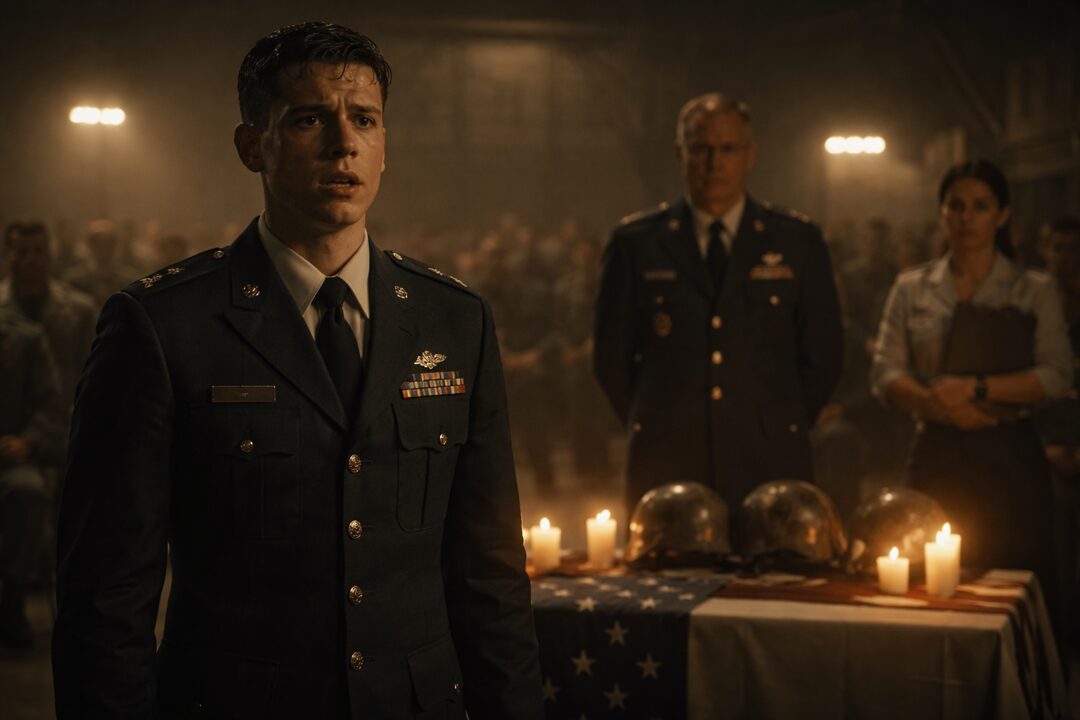
Not crowded. War did not stop long enough for proper attendance. But enough men came to make the rows of folding chairs look deliberate. The chaplain stood near the front. Rusk beside him. A table held four helmets, four tags, four candles that trembled uselessly in the warm air.
Mercer’s name was on a typed card beneath one of the helmets.
Adrian stood at the side, statement folded in his breast pocket, and watched mechanics remove their caps. Watched a gunner from another crew sit rigid with both hands on his knees. Watched Nora take a place near the back where she could leave if she needed to.
He thought of the baby shoes.
He thought of Mercer glancing once through the glass and lifting that small, apologetic hand.
A corporal approached. “Sir? Colonel says after the prayer, if you would say a few words about the mission assignment.”
Mission assignment. Even now the lie would arrive in soft shoes.
The chaplain began.
Adrian did not hear most of it.
He heard instead the clean sentences Rusk had prepared, marching toward him in order. Sudden illness. Alternate transit. Shared risk. Steady conduct. Meaning shaved until it could be filed.
The prayer ended.
Rusk stepped forward. “Major Vale was slated to travel with the crew this morning and can speak to their professionalism and readiness.”
A few heads turned.
Adrian felt the whole room waiting for him to behave like a man worth preserving.
He walked to the front.
The paper in his pocket might as well have been burning.
Part V — Names in the Hangar
For one second he almost used the prepared words.
He could feel them arranged behind his teeth, ready to save him.
Then he looked at the helmet over Mercer’s card.
And understood with perfect clarity that if he lied now, the lie would not stay here. It would go outward in letters and files and memory. It would harden. Years later someone would tell the story cleanly, maybe even admiringly, and Mercer would still be dead inside a sentence that had made him smaller.
Adrian took the folded statement from his pocket.
He did not open it.
“The observer seat on that aircraft was reserved for me,” he said.
The hangar went very still.
Rusk’s face did not change, which was worse than anger.
Adrian went on.
“I missed departure. Sergeant Daniel Mercer took the open position when the crew adjusted for takeoff. The aircraft went out with him in the seat meant for me.”
No one moved.
He heard his own pulse in the brief silence that followed. If he stopped now, he could still pretend he had only clarified logistics. But the truth, once started, had its own appetite.
“I stepped away before boarding,” he said. “Partly because I needed to relieve myself. And partly because I was afraid.”
A man in the second row looked up sharply.
Adrian kept his eyes on the helmets.
“I was afraid of the aircraft. Afraid I would disgrace myself in front of the crew. I used the bodily excuse because it was easier to admit. When I returned, the plane was already moving. I did not stop it.”
The words sounded plainer than the day had felt. That was right. Truth was often less dramatic than the lie built around it.
He turned then, not to Rusk, but to the room.
“Sergeant Mercer did not die in some abstract open position. He died where I was meant to sit. And if my rank made it easier for everyone to treat that as routine, then my rank belongs in this accounting too.”
The chaplain lowered his eyes.
A mechanic in the back shifted his weight.
Adrian held the paper once, then tore it neatly in half.
“I won’t sign a statement that turns this into a cleaner story,” he said. “I will not accept a commendation for nearly dying on a flight I did not take. If a report goes forward, Sergeant Mercer’s name belongs at the center of it, not mine.”
The rip of paper seemed louder than his voice had been.
For the first time, Rusk moved. Only his hand, flattening against the table beside the helmets.
“Major,” he said, quiet and dangerous.
But Adrian had already finished.
He laid the torn pages beside the candles and stepped back.
No one applauded. This was not that kind of room.
The silence that followed was heavier than outrage. It carried embarrassment, relief, contempt, recognition—all the things soldiers rarely let coexist in public.
Then Nora rose from the back and came forward with a folder under her arm. She did not look at Adrian. She looked at Rusk.
“I have the corrected casualty inventory prepared, sir,” she said.
The colonel’s jaw tightened.
For a moment Adrian thought Rusk might stop her there, in front of everyone, and restore control by sheer force of rank. Instead the older man looked across the room and understood, as commanders do, exactly how public a fight he could survive.
“File it,” he said.
Two words. Nothing more.
But they cost him.
The memorial resumed because it had to. The chaplain spoke. Names were read. Men bowed their heads. Yet the ceremony had changed shape. Mercer was no longer a dead crewman fitted neatly into a loss. He had become a specific absence in a specific seat.
When it was done, people left in small, swift groups.
No one came to congratulate Adrian. No one should have.
At the hangar door Nora stopped beside him.
“You waited too long,” she said.
“Yes.”
“But not forever.”
Then she handed him a sealed envelope.
“Nell Mercer. Home address included.”
He looked at it.
Inside, he knew, would be the formal notice, now corrected where it could be corrected. Not enough. Never enough. But not the other thing.
“What am I meant to do with this?” he asked.
“Send the truth,” Nora said. “As much of it as the mail can carry.”
She walked out into the night.
Across the hangar, Rusk stood alone for a moment beneath the weak electric light, looking not defeated exactly, but narrowed. Like a man who had tried to compress something human into a usable shape and found the edges still cutting through.
When he met Adrian’s eyes, there was no forgiveness there.
Only recognition.
That, too, would have to be enough.
Part VI — Bench Seat
The next morning Adrian boarded a transport plane on a rough canvas bench along the fuselage.
No nose seat. No reserved place. No briefing about visibility or strategic value. Just thirty men, cargo netting, heat, and the metallic stink of old fear ground into the floor.
He preferred it.
Mercer’s duffel sat between his boots.
Nora had overseen the inventory at first light. Tobacco tin. Photograph. Half-written letter. Baby shoes. Ring on its chain. Each item wrapped, listed, and placed with a care so exact it felt like apology translated into method.
Adrian had written his own letter before boarding.
He had started three times. The first draft sounded official. The second sounded guilty. The third, finally, sounded like a man with no right words left and no permission to hide behind better ones.
Your husband was kind to me the morning he died.
He gave up nothing knowingly, and everything happened because small things happen fast in war.
He should not be reduced by that.
He was not a line on a page here.
He had not written that Daniel died in Adrian’s seat because the fact belonged to the record, not as spectacle for a widow. But he had written enough that the loss would not reach her already cleaned.
The engines started.
Men settled into the noise with the blank patience of the transported. One private crossed himself. Another slept at once. Across from Adrian, a corporal held a tin cup between both hands as if warming them, though the air was already hot.
As the plane taxied, Adrian felt the old tightening under his ribs.
Not as violently as yesterday. Not with the same humiliating rush. But there it was—a body remembering.
He put one hand on Mercer’s duffel and let the feeling exist without naming it something cleaner.
Through the small round window he saw the strip slide by: the hangar, the fuel drums, the pale runway where a man could change his life by leaving it for two minutes. Somewhere beyond those trees, paperwork was already moving. Reports. Corrections. Objections. Perhaps Rusk would blunt what he could. Perhaps some version of the lie would survive after all. Institutions were durable that way.
But not all of it.
Not now.
The transport lifted rough and unsentimental into the morning.
Adrian did not imagine that truth had redeemed anything. The dead were still dead. Mercer was still on the wrong side of the world from the woman in the photograph, and the child who would one day wear those tiny shoes, or never wear them, would not know the shape of the seat that had mattered.
War would go on reducing men.
Files would go on trying to smooth them.
Still, the duffel remained heavy between Adrian’s boots, and the weight felt correct.
A soldier beside him shouted over the engine noise, “You all right, Major?”
Adrian looked at the man, then out the window at the shrinking strip.
After a moment he answered with the only sentence he had that did not insult the living or flatter the dead.
“No,” he said. “But I’m here.”
The soldier nodded as if that were sufficient.
Maybe, for now, it was.
Adrian tightened his hand around the canvas strap and kept it there as the island dropped away beneath them, carrying one man forward and another man home by the slower route of paper, cloth, metal, and a name that would not be cleaned into usefulness.
The plane flew on.
And the seat reserved for him stayed empty behind him, where it always would.