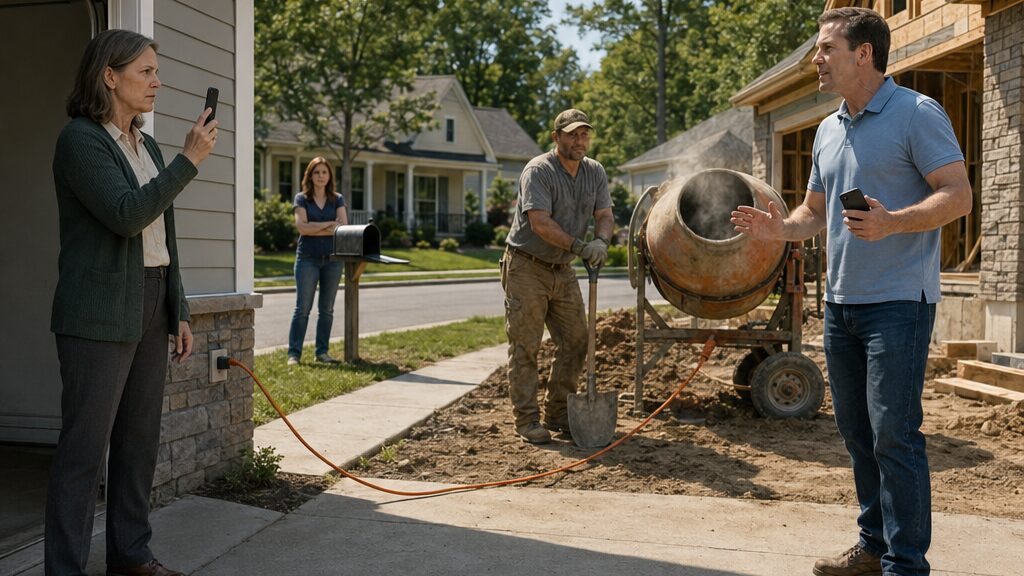
The Orange Cord Across Katherine’s Driveway Exposed More Than Her Neighbor’s Stolen Electricity
Chapter 1: The Cord That Did Not Belong There
The meter on the garage wall was spinning fast enough to catch Katherine Mitchell’s eye from six feet away.
She stopped with one hand on the recycling bin.
Inside the house, the air conditioner was off. The washing machine had finished an hour earlier. Her coffee maker was unplugged, as it always was after breakfast. Yet the small black wheel behind the meter’s glass face kept turning with steady purpose.
From beyond the garage came the deep mechanical churn of Anthony Harris’s cement mixer.
Katherine set the bin down and listened.
The mixer turned. The meter spun.
The mixer paused. The wheel slowed.
She stepped closer to the side wall of the garage. At first, she saw only the outlet cover hanging open. Then she noticed the bright orange extension cord plugged into the lower socket.
It ran beneath the garage door.
Katherine stared at it for several seconds, waiting for an explanation that would make the sight ordinary. Perhaps a delivery driver had moved something. Perhaps a worker had asked while she was inside and someone else had answered.
There was no one else.
She lived alone.
Katherine crouched and touched the cord. It trembled faintly against the concrete floor. Dust had collected around it in a thin gray ridge, which meant it had not been placed there that morning.
She took out her phone and photographed the outlet.
Then she opened the garage door.
The cord crossed the threshold, stretched along the edge of her driveway, disappeared beneath a stack of lumber, and continued toward the Harris property. Two houses down, a leaf blower started and stopped. Somewhere behind her, a dog barked once.
Katherine followed the cord.
Anthony’s renovation had consumed the side yard for nearly three weeks. Wooden framing rose behind his house where a patio had been. Bags of cement sat under a blue tarp. A narrow trench had been dug along the foundation, and two workers moved around a portable mixer that rocked on its metal stand.
The orange cord ran directly into it.
One of the workers looked up as Katherine approached. He was wearing a dust-covered cap and holding a shovel.
“Morning,” he said.
“Is that mixer connected to my garage?”
The worker glanced toward the cord, then toward Anthony’s house.
“I guess that’s where they ran it.”
“Who told you to?”
The question made him straighten.
“Homeowner said the power source was approved.”
Katherine looked at the second worker. He busied himself with a bag of mix, avoiding her eyes.
“Approved by whom?”
The first worker lifted one shoulder. “You’d have to ask him.”
The mixer resumed its grinding rotation. The cord tightened slightly along the driveway, vibrating like a line under tension.
Katherine stepped back onto her property.
She did not unplug it.
Not yet.
Instead, she walked to the side of her garage and photographed the meter. Then she returned inside, opened the drawer beside her kitchen table, and took out the utility bills she had been meaning to review.
Numbers behaved better than people. They stayed where they were put.
She laid the current bill beside the previous three months. Her electricity use had risen sharply despite the cooler weather. The amount due was eighty-seven dollars and forty-two cents higher than the average she had recorded in her ledger.
Katherine ran her finger down the handwritten columns.
She had assumed the increase came from an aging appliance. She had checked the freezer seal, changed the air filter, and reduced the thermostat. She had even spent an evening reading about phantom electrical loads.
Now the explanation lay across her driveway in bright orange.
Her first impulse was to call Anthony immediately. Her second was to gather everything before he could make the problem smaller.
She wrote down the meter reading, the time, and the weather. Then she returned outside and photographed the cord from three angles: at the outlet, across the property line, and connected to the mixer.
The first worker watched her.
“Ma’am,” he said, “we can shut it down if there’s an issue.”
“There is an issue.”
“We were told it was handled.”
“Who told you that?”
He hesitated. “Mr. Harris.”
Katherine nodded once.
The worker reached toward the mixer switch, but a voice came from Anthony’s back porch.
“Don’t stop it.”
Anthony crossed the yard quickly, wearing jeans and a polo shirt with the sleeves pushed high on his arms. His expression was not angry. That would have been easier. Instead, he wore the patient smile of someone approaching a misunderstanding he expected to control.
“Katherine,” he called. “I was going to come over.”
She looked at the running mixer. “When?”
“As soon as we got through this pour.”
“You connected your equipment to my house.”
“It was temporary.”
“You didn’t ask me.”
Anthony glanced at the workers and lowered his voice, as though her volume were the embarrassing part.
“Scott said it would be fine for a day or two. Your outlet is right there, and ours on this side isn’t carrying enough load.”
“Scott doesn’t own my garage.”
“No one said he did.”
“Then why did you use it?”
Anthony gave a short breath through his nose. Behind him, the mixer continued turning.
“It’s one outlet, Katherine.”
The sentence landed with such casual certainty that for a moment she could only hear the scrape of wet concrete inside the drum.
Anthony spread his hands.
“I’ll cover whatever it cost.”
“You don’t know what it cost.”
“Then tell me. I can send it to you right now.”
Katherine looked down at the orange cord between them. It crossed the property line without a bend, as if the boundary had never existed.
“This is not a bill you forgot to split,” she said. “Disconnect it.”
Anthony’s smile faded, though only slightly.
“We’re in the middle of a pour.”
“Then find another power source.”
His eyes moved to her phone.
“You’ve been taking pictures?”
“Yes.”
Something changed in his face—not guilt, exactly, but calculation.
He turned toward the workers. “Keep it running.”
Then he faced Katherine again.
“Let’s not turn one outlet into a neighborhood problem.”
Chapter 2: One Outlet in Front of Everyone
“I can send you a hundred dollars before we finish this conversation,” Anthony said.
He already had his phone in his hand.
Katherine stood beside the orange cord, aware that both workers had stopped pretending not to listen. Across the street, her next-door neighbor was collecting mail with unnecessary slowness.
Anthony tapped his screen. “What’s your number?”
“You haven’t asked what you owe.”
“I’m offering more than enough.”
“That isn’t permission.”
His jaw tightened. “I understand that you’re upset.”
“No, you understand that I caught you.”
The mixer turned behind him, each rotation pulling a faint shudder through the cord. Anthony glanced at it, then at the wet concrete waiting in a wheelbarrow.
“We’re on a schedule,” he said. “The electrician couldn’t get here until Monday. Scott said temporary access between adjacent lots was allowed during approved work.”
Katherine heard the phrase approved work.
“Show me the approval.”
Anthony’s expression hardened. “You can ask Scott.”
“You’re the one connected to my house.”
“And I’m trying to make it right.”
“You’re trying to keep the mixer running.”
One of the workers shifted his shovel from one hand to the other. The neighbor across the street closed her mailbox but did not go inside.
Anthony lowered his voice again. “This doesn’t need to be a performance.”
Katherine felt heat rise into her face. He had crossed onto her property, used her electricity, and now he was granting her the option of avoiding embarrassment.
She looked at the worker who had first spoken to her.
“How many days has this cord been here?”
The worker’s eyes moved toward Anthony.
“Answer her,” Anthony said, but the words sounded like a warning.
The worker rubbed his thumb along the shovel handle. “We used it Tuesday for the saw. Thursday for the compressor. Today for the mixer.”
Katherine turned to Anthony.
“You said a day or two.”
“I said temporary.”
“Three workdays that he remembers.”
“We didn’t run equipment all day.”
Her ledger waited on the kitchen table. Eighty-seven dollars and forty-two cents. The amount was no longer the center of the problem, but it was evidence that the problem had existed before she noticed it.
Anthony took a step closer.
“Katherine, I am asking you to be reasonable.”
She nearly laughed, but the sound would have come out wrong.
“Disconnect it.”
“We have concrete setting.”
“That is not my responsibility.”
“This addition is approved by the HOA.”
“The HOA cannot approve taking power from my property.”
“Scott said neighbors are expected to cooperate during construction.”
“Did Scott tell you I agreed?”
Anthony did not answer immediately.
That pause was enough.
Katherine walked back toward her garage.
Anthony followed. “Where are you going?”
“To shut off the circuit.”
His footsteps quickened. “Wait. Give us twenty minutes.”
She continued walking.
“Katherine.”
The way he said her name made it sound like a final warning disguised as familiarity.
She entered the garage and opened the breaker panel. The switches were neatly labeled in her late husband’s handwriting: kitchen, hall, washer, garage outlets. His letters were narrow and upright, each word printed as if someone else might need to understand it later.
Katherine placed her thumb on the garage-outlet breaker.
Anthony stood at the open door.
“If you shut that off, you could ruin the batch.”
“You should not have connected it to my house.”
“I offered to pay you.”
“You offered after I found it.”
She flipped the breaker.
The mixer groaned once and stopped.
Silence spread across the two properties. Without the machine, Katherine could hear water dripping from the drum and the small metallic clicks of cooling equipment.
Outside, the orange cord went still.
Anthony stared at her.
“That was unnecessary.”
“No. It was the first necessary thing anyone did this morning.”
She unplugged the cord from the dead outlet and began coiling the portion lying inside her garage. She stopped at the threshold, leaving the rest on his side.
Anthony stepped forward. “Don’t damage my equipment.”
“I’m not touching your equipment.”
“You’re obstructing approved work.”
Katherine held up her phone. “Then send me the written approval.”
“I don’t carry HOA paperwork in my pocket.”
“You seem to carry everything else you need.”
His face flushed.
The first worker approached carefully. “We can rent a generator.”
Anthony turned on him. “That’ll take half the day.”
“It’ll take about an hour.”
“We don’t have an hour.”
The worker looked at the concrete, then at Katherine. “We should’ve verified the power.”
Anthony’s attention snapped back to her. “Happy now?”
Katherine felt every eye in the driveway. It would have been easy to retreat, to say she only wanted the cord removed, to let the moment shrink.
Instead, she photographed the silent mixer.
“I’m not happy,” she said. “I’m documenting when you were told to stop.”
Anthony’s gaze fixed on the phone.
For the first time, his irritation gave way to something closer to fear.
“You’re making this bigger than it is.”
“No. I’m recording what it is.”
He put his phone in his pocket.
“Scott will hear about this.”
“Good.”
“You cannot interfere with a permitted project because you don’t like construction noise.”
“This is not about noise.”
“That’s how it’s going to look.”
The words were quiet, almost conversational. Katherine understood the threat precisely because he had not raised his voice. He was telling her that facts could be rearranged socially. By afternoon, she could become the lonely widow who resented improvements next door.
She bent, placed the coiled section of cord just beyond her property line, and stood.
“You have no permission to use my outlet again.”
Anthony looked toward the waiting workers.
“You’ve made your point.”
“No. I have withdrawn access. Those are different things.”
The neighbor across the street finally turned toward her own house.
Anthony gave Katherine a flat smile.
“I hope you’re prepared to explain why you stopped approved work.”
Katherine went inside before he could make her answer.
Her hands shook only after she locked the door.
She returned to the kitchen table and added a line to the ledger: 9:18 a.m.—breaker switched off after direct refusal ignored.
Then she saved the photographs to a folder and emailed copies to herself.
At 9:42, her phone buzzed.
The message was from Scott Thompson.
Anthony has informed me of an incident involving temporary construction access. The board expects residents to cooperate with approved neighborhood improvements. Please avoid further interference while we review the matter internally.
Katherine read it twice.
Scott had not asked what happened. He had not asked whether she had agreed. He had not mentioned the electrical use.
He had called it cooperation.
Chapter 3: The Approval Nobody Could Produce
The HOA portal showed Anthony’s architectural request as CLOSED—APPROVED.
There was no application attached.
Katherine clicked the record again. The page displayed Anthony’s address, a reference number, Scott Thompson’s initials, and a completion date from eleven days earlier. The fields for plans, contractor information, and county permit number were blank.
She took a screenshot.
At the kitchen table, the cord photographs lay beside her open ledger. In the clearest image, the orange line crossed the seam between driveways before disappearing beneath Anthony’s lumber. The timestamp showed 8:37 Saturday morning. Another image showed the meter reading. A third showed the cord connected to the mixer.
Numbers and pictures. Things that did not change their account depending on who was listening.
Katherine wrote Scott an email.
Please provide the written authorization Anthony referenced, including any document permitting use of my electrical outlet or access to my property.
Scott replied twenty-six minutes later.
The HOA does not authorize private utility arrangements. Anthony may have misunderstood a general discussion about neighbor cooperation. I encourage both parties to resolve this without escalation.
Katherine read the message slowly.
Scott had moved from expectation to misunderstanding without acknowledging the difference.
She wrote back.
Please also provide the architectural plans and county permit number supporting the approved status shown in the portal.
No reply came that evening.
By Sunday morning, the cord was gone. A rented generator stood beside Anthony’s foundation, rattling loudly enough to be heard through Katherine’s kitchen window. She watched workers continue framing along the rear wall.
Anthony did not look toward her house.
Katherine opened the county permitting website and searched his address. The property record appeared, but no active building permit matched the addition. She searched by Anthony’s name, then by parcel number.
Nothing.
A permit application might not display immediately, she told herself. Records could lag. Websites could be incomplete. She refused to let suspicion become certainty merely because it fit.
On Monday morning, she called the county office.
The permit clerk asked for the address and placed her on hold. Katherine sat at the table with a pen pressed against the paper.
“I see an application started,” the clerk said when she returned. “It hasn’t been issued.”
“What does started mean?”
“Documents were submitted, but the review isn’t complete. There are outstanding items.”
“Would concrete foundation work be allowed before issuance?”
“No, ma’am.”
Katherine looked through the kitchen window at the framed wall rising beside Anthony’s house.
“Could the HOA approve it separately?”
“The HOA can approve whatever its covenants require. That doesn’t replace a county building permit.”
The answer produced no satisfaction. Only a cold, exact clarity.
“Thank you.”
She ended the call and wrote down the time, the clerk’s role, and the substance of the conversation.
At eleven, Scott finally answered her email.
The HOA approval concerns exterior appearance only. County permitting is the homeowner’s responsibility. I will not circulate another resident’s private submission materials. Please allow the board to manage this appropriately.
Katherine compared that message with the portal page. Approved. No attachments. No permit number. Scott’s initials.
She could request a hearing. She could place the screenshots before the board and ask why Scott had encouraged cooperation with work he now claimed was outside HOA responsibility.
Her cursor hovered over the hearing-request link.
Then she closed the page.
The thought of the clubhouse made her chest tighten: folding chairs, polite faces, Scott’s smooth explanations, neighbors studying her as though temperament mattered more than evidence. Katherine knew how those meetings worked. A person could enter with records and leave having been described as emotional without ever raising her voice.
She opened the county code-enforcement form instead.
The complaint fields were simple: property address, description, dates observed, supporting material, contact information. A checkbox allowed anonymous submission.
Katherine attached the photograph of the orange cord, then removed it. The electrical use was her private dispute. The unpermitted work was the county’s concern.
She attached photographs of the foundation trench, framing, and mixer. She described the active construction and the clerk’s confirmation that no permit had been issued.
At the bottom, the form asked whether the work presented an immediate danger.
Katherine selected Unknown.
The final field requested her name.
She stared at it.
Her late husband would have entered his without hesitation. He had believed that a person should stand beside every claim they made. Katherine had once admired that certainty and sometimes resented the trouble it brought through their front door.
She checked Submit anonymously.
The confirmation number appeared.
For a moment, she felt the clean relief of having acted. Then she imagined Scott telling the neighborhood that someone had gone behind the board’s back. Anthony would know. Or believe he knew. Anonymous did not mean invisible when only one person had challenged the project.
Katherine printed the confirmation and placed it in her ledger.
Before dawn on Tuesday, air brakes hissed outside her house.
She rose, pulled aside the curtain, and saw two concrete trucks turning into Anthony’s drive. Their headlights swept across the orange-stained dust where the cord had lain.
The county complaint had been filed less than eighteen hours earlier.
Across the property line, workers were already guiding the first chute toward the unfinished foundation.
Chapter 4: The Stop-Work Notice Was Not the Ending
Virginia Allen pressed the red notice against a temporary post while the concrete was still dark with moisture.
Katherine watched from behind the narrow curtain beside her front door.
The county vehicle had arrived just after ten, without sirens or urgency. Virginia stepped out carrying a clipboard, walked the edge of Anthony’s property, and spoke first to the renovation foreman. Within minutes, the mixer stopped. A worker lowered his shovel. The concrete truck driver folded the chute back into place.
Anthony came out of the house fastening one cuff.
Even through the glass, Katherine could see the force of his gestures.
Virginia did not match them. She pointed toward the excavation, then toward the framed wall, and finally toward the paper she had attached to the post. Her movements were measured, almost economical.
Anthony looked across the driveway.
Katherine stepped away from the curtain.
The relief she had expected did not come. The county had confirmed what she had found, but the sight of the stopped equipment made the consequence physical. Wet concrete sat unfinished in the forms. Workers stood with nothing to do. Money was being lost by the minute.
She reminded herself that she had not poured without a permit. She had not connected to someone else’s house. She had not told a crew that private access had been approved.
Still, she remained inside.
Twenty minutes later, someone knocked.
Virginia stood on the porch, her clipboard against one hip.
“Ms. Mitchell?”
“Yes.”
“I’m Virginia Allen with county inspections. I’m speaking with adjacent property owners because of the active work.”
Katherine opened the door farther. “Is there a problem with my property?”
“Not that I’m aware of.” Virginia glanced toward the Harris lot. “I need to confirm whether construction equipment was connected to your electrical service.”
Katherine hesitated only once before answering. “It was.”
“With your permission?”
“No.”
Virginia’s eyes moved to the garage.
“Do you have photographs?”
Katherine had prepared them for this possibility, though she had told herself she was only organizing records. She brought the printed copies from the kitchen table.
Virginia studied the first image.
“This was Saturday?”
“The timestamp is on the bottom.”
“And you told Mr. Harris to disconnect?”
“I told him directly. He continued until I shut off the breaker.”
Virginia looked at the image of the silent mixer.
“Did the HOA authorize access?”
“They couldn’t. Scott Thompson said afterward that Anthony may have misunderstood a general conversation.”
Virginia made a note.
“For clarity, an HOA’s architectural approval does not authorize work without county permits, and it does not create access rights over private property.”
Katherine felt the sentence settle into place.
“So the work wasn’t permitted.”
“The application was incomplete. Structural and foundation work should not have begun.”
“What happens now?”
Virginia glanced toward the forms. “Some portions may have to be exposed or removed so they can be inspected. That decision will depend on what documentation the homeowner can produce.”
Across the street, a car had slowed. The driver looked toward the red notice before continuing.
Virginia handed the photographs back.
“Keep the originals.”
“I will.”
“I may need a written statement later.”
Katherine’s grip tightened slightly on the papers. “Does my name have to be attached?”
“If the electrical-use issue becomes part of an enforcement record, possibly.”
Virginia did not ask why Katherine had submitted anonymously. She only waited.
“I’ll provide what’s required,” Katherine said.
After Virginia left, Anthony crossed the property line.
He did not knock. He stopped at the edge of Katherine’s porch and called her name.
She opened the door but kept the storm door locked.
“You reported me.”
It was not a question.
“The county found unpermitted work.”
“You knew they’d stop the pour.”
“I knew there was no issued permit.”
Anthony’s face was pale beneath the anger.
“Do you have any idea what this costs?”
Katherine held the doorframe. “Did you know the permit had not cleared?”
“That is between me and the county.”
“You made my electricity part of it.”
“I offered to pay you.”
“You offered after you were caught.”
His voice rose. “You could have handled this like a neighbor.”
The foreman stood near the silent mixer, watching without appearing to watch. Two homeowners had come outside farther down the street.
Katherine saw the shape of what Anthony was doing. If he spoke loudly enough, the story would begin here: not with the cord, but with the stopped work and the woman behind the locked storm door.
“You were told to disconnect,” she said.
“And you made sure the county got here before we finished.”
“I did not schedule the inspector.”
“But you filed.”
“Yes.”
The word surprised both of them.
Anthony stepped closer.
“So you admit it.”
“I reported work the county confirmed should not have started.”
“You were waiting for this.”
“No.”
“You’ve hated this project since the first truck came in.”
“That is not true.”
“You complained about the noise.”
“I asked when the driveway would be clear.”
“You photographed my property.”
“I photographed the cord attached to mine.”
Anthony looked toward the small audience gathering by mailboxes and driveways.
“There it is,” he said. “That’s what this is about. You didn’t like being inconvenienced, so now a whole addition may have to be torn apart.”
Katherine’s mouth went dry.
The accusation was wrong, but it had enough truth around its edges to travel. She had disliked the trucks. She had disliked the noise. She had disliked Anthony’s assumption that she would adjust.
Before she could answer, Virginia called from the construction site.
“Mr. Harris.”
Anthony turned.
“You need to remain on your property while this inspection is active.”
He looked back at Katherine once, then crossed the driveway.
By noon, the workers had left. The generator was silent. The orange extension cord lay partly buried beneath sawdust and a torn cement bag, abandoned as if no one wanted to claim it.
Katherine photographed that too.
At two, Scott sent a neighborhood-wide email.
A residential construction matter has been referred to outside authorities before the HOA review process was completed. Residents are reminded that internal communication protects property values and prevents unnecessary escalation.
He did not name her.
He did not have to.
Replies began appearing in the community portal. Some homeowners complained about unauthorized construction. Others complained about neighbors who reported one another rather than speaking directly. One person wrote that private disputes should not threaten families with financial ruin.
Katherine closed the page.
At four-thirty, an envelope appeared beneath her doormat.
The HOA logo was printed in the upper-left corner. Inside was a formal violation notice concerning an exterior modification at her home.
Katherine read the first paragraph twice before understanding what Scott had chosen.
The notice cited the metal handrail beside her front steps. It stated that no architectural approval could be located and required removal or proof of authorization within fourteen days.
Katherine went outside and placed one hand on the rail.
Her late husband had used it during the final year of his life, when three shallow steps had become a daily calculation. The installer had matched the dark finish to the porch fixtures. Scott had walked past it dozens of times.
Six years without a letter.
Four days after the complaint, it had become a violation.
Chapter 5: Rebecca’s Reason Did Not Excuse Anthony
Rebecca Harris arrived on Saturday carrying the orange cord in both arms.
It was coiled tightly, but one end dragged against Katherine’s porch step.
Katherine had been watering the potted fern beside the back door. She set the can down without inviting Rebecca to sit.
“I thought this belonged here,” Rebecca said.
“It belongs to Anthony.”
“He doesn’t want it.”
Katherine looked at the scraped plug, then at Rebecca’s face. She appeared tired rather than angry. Her hair was pulled back carelessly, and there were faint shadows beneath her eyes.
“Then put it in your garage.”
Rebecca lowered the cord onto the porch table.
“I came to ask whether you would withdraw the complaint.”
“The county has already inspected.”
“They can still allow the project to move forward without making us remove everything.”
“That decision belongs to the county.”
“They said the complaint included unauthorized utility use.”
Katherine’s shoulders stiffened. “Did Anthony tell them it was authorized?”
“He said Scott told him temporary access would be fine.”
“Scott does not own my outlet.”
“I know.”
The answer was quiet enough to change the air between them.
Rebecca looked toward the Harris property. From the back porch, the unfinished addition appeared skeletal, wrapped in house film that snapped softly in the wind.
“My mother is losing mobility,” she said. “The addition is for her. Bedroom, small bathroom, no stairs. Her lease ends next month.”
Katherine said nothing.
“We locked the construction rate in before prices went up again. The lender gave us a completion window. Every delay changes something—interest, labor, material storage. Anthony thought if we could get the foundation started, the rest would catch up.”
“He thought starting without permission would force everyone else to accept it.”
Rebecca flinched.
“That isn’t how he would say it.”
“No. He would call it keeping the schedule.”
Rebecca folded her hands.
“The electrician delayed the temporary service. Scott told Anthony people here usually work things out. He mentioned your exterior outlet because it was close.”
“Did Scott say I had agreed?”
“I wasn’t there.”
“Did Anthony ask me?”
“No.”
The cord sat between them, its bright surface dulled by dirt.
Rebecca drew a slow breath. “He believed you would say yes if he explained.”
“He did not explain.”
“I know.”
“And after I said no, he kept the mixer running.”
Rebecca’s eyes dropped to the cord.
“He told me you shut it off before he could finish.”
“That is not the same thing.”
“No.”
Katherine had prepared herself for excuses. Rebecca’s refusal to provide them unsettled her more than a defense would have.
“Did Anthony know the county permit had not been issued?” she asked.
Rebecca’s fingers tightened together.
“He knew they wanted revisions.”
“That is not what I asked.”
“He thought the revisions were administrative.”
“Did he know?”
Rebecca looked toward the unfinished framing again.
“Yes.”
The word came out flat.
“He knew Friday afternoon. The contractor said they should postpone the pour. Anthony said we couldn’t lose another week.”
Katherine felt anger return, cleaner now.
“Then the cord was not the only shortcut.”
“No.”
“Why are you asking me to withdraw something you know was true?”
“Because truth does not pay the lender.”
Katherine stepped back as if struck, not by the cruelty of the sentence but by its honesty.
Rebecca rubbed her palms against her jeans.
“I’m not saying you were wrong. I’m saying the consequences don’t stop with Anthony’s pride. My mother has already packed. The contractor may leave. We have deposits tied up in work the county might make us remove.”
“And I should carry that because I live next door?”
“I’m asking you to help limit it.”
“How?”
“Tell the inspector the electrical issue was resolved privately.”
“It was not resolved privately.”
“Anthony will repay the bill.”
“He has not even asked to see it.”
Rebecca looked away.
Katherine thought of the handrail notice folded on her kitchen table. She could have told Rebecca about it and watched the sympathy shift. Instead, she waited.
“Would you tell the board what you just told me?” Katherine asked.
Rebecca’s eyes returned to hers.
“About the permit?”
“And about Scott suggesting my outlet.”
“I can’t do that without talking to Anthony.”
“You came here without talking to him?”
“He knows I came to ask you to withdraw.”
“That was not my question.”
Rebecca’s expression hardened for the first time.
“You want me to stand in a room and help dismantle my own household.”
“I want you to decide whether protecting your household requires making me responsible for what Anthony chose.”
Silence held between them.
From the Harris yard came the snap of loose plastic and the hollow knock of a board shifting in the wind.
Rebecca reached for the cord but did not lift it.
“Scott has done this before,” she said.
Katherine remained still.
“What?”
“Not with your power. With approvals.”
Rebecca’s voice had dropped.
“He let the treasurer replace a fence before the paperwork cleared. He approved a board member’s detached office without the setback review. There was a roof color exception for another house that never went through a meeting.”
“How do you know?”
“Anthony helped Scott with the portal last year. He saw the entries.”
“Why would Scott take that risk?”
“He says strict enforcement creates resentment and hurts resale. He thinks good judgment matters more than paperwork.”
“Good judgment for whom?”
Rebecca gave a tired, humorless smile.
“That depends on who asks.”
Katherine looked at the cord again. It no longer seemed like one man crossing one boundary. It looked like a line running through several houses, invisible until someone pulled it tight.
“Will you provide those examples?”
“Not publicly.”
“Then Scott will deny them.”
“I know.”
“Anthony will deny knowing the permit was incomplete.”
Rebecca did not answer.
Katherine picked up the cord and held it out.
“Take this home.”
Rebecca accepted it reluctantly.
“I am sorry he used your electricity.”
“That is not the same as him being sorry.”
“No,” Rebecca said. “It isn’t.”
She descended the porch steps, then stopped.
“There were three homeowners Scott helped,” she said without turning. “All of them served with him or donated to the landscaping project he wanted.”
Katherine watched her cross the yard with the orange coil pressed against her body.
Three favors were not a misunderstanding.
They were a method.
Chapter 6: The Ledger Katherine Had Kept Closed
Scott Thompson’s signature appeared at the bottom of a six-year-old warning letter.
Katherine found it in a file marked HANDRAIL—MEDICAL, beneath an installer’s invoice and a photograph of her late husband standing on the porch with one hand gripping the newly fitted rail.
The letter was not about the handrail.
It concerned a drainage channel her husband had challenged after stormwater from a common area repeatedly flooded their side yard. Scott had written that the board considered the matter closed and discouraged further outside complaints while an internal review was pending.
The language was nearly identical to his recent email.
Katherine sat on the floor beside the open filing cabinet.
For years, she had kept her husband’s records without examining them closely. He had saved everything: dated photographs, printed emails, handwritten measurements after storms. At the time, Katherine had thought the stacks of paper made the house feel permanently under dispute.
“You cannot live like every disagreement is a trial,” she had told him once.
He had looked at her across the kitchen table and said, “It becomes a trial when one side controls the record.”
She had hated that answer because it sounded like a warning she might someday be forced to understand.
Katherine pulled out the remaining documents.
Her husband had requested an open board review. Scott had persuaded him to postpone it, promising a site inspection. No inspection report appeared in the file. Two months later, after her husband’s health declined, the complaint ended.
On the final page, in Katherine’s handwriting, were four words:
Please let this go.
She remembered writing them on a note she had left beside his medication. She had meant the drainage fight, the sleeplessness, the anger that followed every HOA email.
He had let it go.
The flooding continued for another year, until the county required the association to correct the channel after a different homeowner complained.
Katherine closed her eyes.
Her silence had not protected him. It had only made his evidence easier to bury.
The next morning, she carried copies of the old file to the county records office. The clerk helped her locate archived property correspondence and inspection notes. The drainage complaint had been listed as resolved internally despite no corrective action at the time.
Scott’s name appeared again.
So did two of the properties Rebecca had mentioned. One received an after-the-fact approval for a fence. Another received a variance letter written without a recorded board vote.
None of it alone proved corruption. Together, it showed a habit: favored homeowners acted first, paperwork arrived later, and anyone outside the circle was told to wait.
Katherine added dates to her ledger.
The eighty-seven dollars and forty-two cents remained near the beginning, but it no longer looked like the central amount. It was simply where the newer record started.
At home, she slid the timestamped cord photographs into her husband’s old file. Orange crossed the pale page like a marker drawn through two separate years.
Her phone rang.
Scott.
Katherine let it ring twice before answering.
“I was hoping we could resolve the handrail issue informally,” he said.
“You sent a formal notice.”
“And I’m offering a practical solution.”
“What solution?”
“If you can provide any medical documentation showing the rail was necessary, I can recommend that the board waive the approval requirement.”
“It was installed six years ago.”
“I understand.”
“You knew it was there.”
“I do not personally inspect every exterior modification.”
“You have walked past it.”
Scott paused.
“I’m trying to help you, Katherine.”
“What do you want?”
His tone cooled slightly.
“There is an HOA review scheduled next week concerning the Harris property and the disruption surrounding it. If you withdraw any request for further board action, I believe the rail matter can be closed.”
Katherine looked at the open file on her table.
“So the handrail is acceptable if I stop asking questions.”
“That is not what I said.”
“It is exactly what you offered.”
“I offered discretion. Boards use discretion all the time.”
“With everyone?”
Another pause.
“This neighborhood functions because people allow room for judgment.”
“Whose judgment?”
“Please don’t turn this into something personal.”
Katherine almost smiled.
The rail had supported her husband’s weight when he could no longer climb three steps safely. Scott had ignored it for six years. Now he was using it as leverage while telling her not to be personal.
“What happens if I refuse?” she asked.
“The violation process continues.”
“Fines?”
“Potentially.”
“And if I withdraw?”
“I can make a recommendation.”
Not a promise. A favor.
The same structure Anthony had relied on. Act without written authority, then trust Scott to arrange the record afterward.
Katherine’s hand rested on the ledger.
“I want an open hearing.”
Scott went silent.
“Katherine, that is unnecessary.”
“I want the handrail notice, Anthony’s architectural approval, and the board’s exception practices discussed in an open session.”
“You are combining unrelated issues.”
“They became related when you offered to trade one for the other.”
“That is a serious accusation.”
“It is a description of this call.”
His breath came softly through the phone.
“You should think carefully before making private conversations public.”
“I have spent years thinking carefully.”
“This could divide the neighborhood.”
“It is already divided. The difference is that the decisions have been private.”
Scott’s voice lost its practiced warmth.
“If you proceed, the board will examine your compliance history in full.”
Katherine looked around the kitchen. For a moment, fear returned in its old form: not fear of fines, but of becoming the woman people avoided at mailboxes and community events. Her husband had borne that look. She had stood beside him physically and left him alone publicly.
“I understand,” she said.
“Do you?”
“Yes.”
She ended the call.
Her hand was shaking.
Katherine sat until the trembling passed. Then she opened the HOA portal and submitted a formal request for an open hearing. She attached Scott’s handrail notice, his email regarding neighbor cooperation, the blank architectural approval record, and her own written account of the phone call.
For the first time, she entered her full name in every required field.
Before clicking submit, she added one final sentence:
I am the resident who filed the county complaint, and I am prepared to explain why.
The confirmation appeared on the screen.
Within an hour, the hearing notice was posted to the community calendar.
By evening, neighbors had begun discussing it online. Some called Katherine courageous. Others said she had allowed a minor dispute to become a campaign against volunteers. One homeowner asked whether anonymous complaints should be permitted at all.
Katherine read enough to understand the direction of the pressure, then closed the portal.
She placed the ledger, the old drainage file, and the orange-cord photographs into a single document box.
At the top she laid the handrail notice.
The hearing would no longer be about whether she possessed evidence.
It would be about whether she could speak before Scott explained her silence for her.
Chapter 7: The Meeting Where Katherine Used Her Name
Scott began the hearing with Katherine’s handrail.
Not Anthony’s unpermitted foundation. Not the missing records. Not the extension cord. The first image projected onto the clubhouse wall showed Katherine’s front steps and the dark metal rail her husband had once gripped with both hands.
“Before we address the larger dispute,” Scott said, “the board must establish that enforcement applies equally to everyone.”
Katherine sat in the second row with the document box at her feet.
The clubhouse was fuller than she had ever seen it. Folding chairs filled the meeting room, and homeowners stood along the rear wall beneath framed photographs of neighborhood landscaping projects. Anthony and Rebecca occupied two seats near the front. Virginia Allen sat at the end of the board table with a county folder closed before her.
The orange cord rested in a coil on top of Katherine’s ledger.
Scott gestured toward the projected photograph.
“Our records contain no architectural approval for this exterior modification.”
The HOA treasurer shifted in her chair. “The rail has been there for years.”
“That does not make it compliant.”
Katherine stood.
Scott looked mildly surprised, as though he had expected her to wait until invited.
“The rail was installed for my husband when he could no longer climb the steps safely,” she said.
“We understand there may have been medical circumstances.”
“There were.”
“Then documentation should resolve the matter.”
Katherine took the violation notice from her box.
“You sent this four days after the county stopped Anthony’s construction.”
A murmur passed through the room.
Scott leaned back. “The timing is unfortunate, but unrelated.”
“Then why did you offer to dismiss it if I withdrew my request for this hearing?”
The room went quiet.
Scott’s expression changed by less than an inch.
“I offered discretion to resolve multiple sources of tension.”
“You offered to trade enforcement for silence.”
“That is your interpretation.”
“It is what happened.”
Scott folded his hands.
“This is exactly why the board prefers written procedures over emotional characterization.”
Katherine felt the old pressure enter the room. It was not in his words alone. It was in the careful pace, the lowered voice, the invitation for everyone else to see him as reasonable and her as wounded.
Her hand touched the top of the document box.
For years, she had believed that facts became stronger when she stayed out of their way. Now she understood that silence created an empty space, and someone like Scott would always fill it.
“My name is Katherine Mitchell,” she said. “I filed the county complaint.”
Several people turned toward her. Someone at the back whispered.
Anthony looked directly at her.
Scott nodded slowly. “Thank you for finally acknowledging that.”
“I filed anonymously because I believed the records should be enough.”
“And were they?”
“No.”
The answer unsettled him.
Katherine lifted the coiled cord from the ledger and placed it on the board table. Its plug struck the wood with a small, hard sound.
“This was connected to my garage on three documented workdays. The last time, it powered a cement mixer after I told Anthony he did not have permission.”
Anthony stood.
“That is not accurate.”
Katherine faced him.
“Which part?”
“I did not know you objected until the morning you shut it off.”
“The worker said it had been used Tuesday and Thursday.”
“I knew they were using temporary power. I believed access had been cleared.”
“By Scott?”
Anthony glanced at the board table.
“He told me neighbors were expected to cooperate during approved projects.”
Scott raised one hand. “I never authorized the use of a private outlet.”
“You pointed out that hers was close,” Rebecca said.
Anthony turned toward his wife.
Rebecca remained seated, but her hands were clenched together.
Scott’s voice sharpened. “Were you present for that conversation?”
“No. Anthony told me afterward.”
“That is secondhand.”
Rebecca looked at Anthony. “Then tell them.”
He did not.
Katherine opened her ledger.
“At 8:37 on Saturday morning, I photographed the cord connected to the mixer. At 8:44, a worker stated Anthony had approved the source. At 9:12, I told Anthony to disconnect it. At 9:18, I shut off the breaker because he would not.”
Anthony shook his head.
“You make it sound calculated. We were trying to finish a pour.”
“You knew the permit had not been issued.”
The accusation changed the room.
Anthony looked at Rebecca again.
She lowered her eyes, then raised them.
“You knew Friday afternoon,” she said.
His face tightened. “The contractor said the revisions were minor.”
“He said to postpone.”
“We were going to lose the crew.”
Rebecca’s voice remained quiet. “That does not mean you did not know.”
Anthony sat down.
Virginia opened her county folder.
“For the board’s clarity,” she said, “the permit application had not been approved when foundation and framing work began. The county issued a stop-work order for that reason. HOA architectural approval could not replace the required permit.”
Scott tapped one finger against the table.
“No one is disputing the county’s authority. The question before us is whether Ms. Mitchell escalated a neighbor misunderstanding into a broader attack on volunteer governance.”
Katherine took out the portal screenshot.
“This architectural request was marked approved under your initials. There were no plans attached, no county permit number, and no recorded vote.”
“Our portal is not a legal archive.”
“Then what is it?”
“A management tool.”
“For decisions that can be changed later?”
“For decisions requiring judgment.”
Katherine placed three additional property records beside the screenshot.
“These homeowners received exceptions or after-the-fact approvals. All three had board connections. Other residents received violations for smaller changes.”
Scott’s face reddened.
“You have no basis to suggest favoritism.”
“I have dates, records, and your signatures.”
“You have selected documents stripped of context.”
“Then provide the context publicly.”
The HOA treasurer reached for one of the records.
“I don’t remember voting on this fence exception.”
Scott turned to her. “It was handled administratively.”
“By whom?”
“As president, I have authority to manage routine matters.”
“Do you have authority to waive setbacks?” Katherine asked.
Scott’s mouth flattened.
A homeowner near the rear wall spoke. “I had to remove a shed over eighteen inches.”
Another voice followed. “My roof color took two meetings.”
The pressure shifted. Not into applause or outrage, but into questions Scott could no longer answer one at a time.
He called for order.
“We are not reopening every historical decision tonight.”
Katherine removed the old drainage letter from her box.
“You used the same language with my husband six years ago. You asked him to delay an outside complaint while the board handled drainage internally. The board marked it resolved. Nothing was corrected until the county intervened after another homeowner complained.”
Scott stared at the letter.
“That matter is irrelevant.”
“It is why I filed anonymously.”
She looked at the room rather than at him.
“I thought if I documented everything and stayed quiet, no one could accuse me of making it personal. Instead, my silence allowed other people to explain my motives. Anthony called me vindictive. Scott called me uncooperative. I helped that happen because I was afraid being visible would make me the problem.”
Her throat tightened, but she did not stop.
“I am not asking this board to destroy Anthony’s project. I am not asking anyone to punish his family for needing space for Rebecca’s mother. I am asking that private favors stop replacing written rules, and that no homeowner be expected to surrender property because someone else has a deadline.”
Anthony looked down at his hands.
Scott pushed a sheet of paper across the table.
“There is a possible resolution. The board can suspend Katherine’s handrail violation, close the architectural review after Anthony obtains county approval, and establish future documentation guidelines.”
Katherine read the page.
The paragraph concerning prior approvals stated that no admission of improper procedure would be made. Scott would retain enforcement authority.
“You want the records closed,” she said.
“I want the neighborhood to move forward.”
“With the same person controlling the exceptions.”
Scott leaned toward her.
“Compromise requires everyone to give something.”
Katherine placed the proposed settlement back on the table.
“I already gave silence. It did not help.”
The treasurer asked for a recess.
Board members gathered near the side wall while the room filled with low conversation. Anthony and Rebecca did not speak to each other. Virginia remained seated, her county folder closed again.
Katherine returned the cord to the top of her ledger.
When the board reconvened, the treasurer read the motion.
The handrail violation would be suspended pending a formal accessibility review. Anthony’s architectural approval would be reopened and aligned with county requirements. All discretionary exceptions from the previous seven years would be audited. Until the audit ended, Scott would be removed from enforcement and approval oversight.
The motion passed by one vote.
Scott did not look at Katherine.
The room emptied slowly. Some neighbors stopped to speak to her; others passed without meeting her eyes. Anthony remained near the front until Rebecca touched his arm.
As Katherine closed her document box, he approached.
“You got what you wanted,” he said.
She looked at the unfinished anger in his face.
“No,” she said. “I got my name attached to what happened.”
Outside the clubhouse, the board posted the audit notice to the community portal.
For the first time since the cord appeared, the next question was not whether Katherine could prove the truth.
It was what living beside it would cost.
Chapter 8: The Outlet Behind the New Locking Cover
The cement mixer started again six weeks later.
Katherine was in her garage tightening the final screw on a locking outlet cover when the familiar mechanical churn crossed the property line.
Her hand stopped.
Then she noticed the temporary power box beside Anthony’s driveway. A thick black cable ran from it toward the reduced construction site. Nothing crossed her property.
She finished tightening the screw.
The county had allowed Anthony to retain part of the foundation after sections were opened for inspection. Other portions had been removed and repoured. The addition was smaller now, its rear wall set farther from the property line. Revised plans were posted inside a plastic sleeve near the permit card.
The work had not ruined him.
It had cost him.
Those were not the same thing.
Katherine closed the outlet cover and tested the lock. The small brass key turned cleanly. She slipped it onto the ring she kept beside the garage door.
A shadow moved across the threshold.
Anthony stood outside holding an envelope.
“I won’t come in,” he said.
Katherine stepped into the driveway.
He looked thinner than he had at the hearing. The confidence had not disappeared, but it no longer arrived ahead of him.
“This is the utility reimbursement,” he said.
He held out the envelope.
Katherine opened it. Inside was a check for one hundred twenty dollars and a printed calculation based on the equipment’s estimated use.
“The bill increase was eighty-seven forty-two.”
“The rest is for the trouble.”
“I don’t want money for trouble.”
Anthony’s mouth tightened. “Then call it interest.”
She took the check.
The mixer turned steadily behind him.
“I should have asked,” he said.
Katherine waited.
“I should have stopped when you told me to.”
There was no explanation attached. No mention of Scott, the lender, the workers, or the concrete schedule.
Anthony looked toward the outlet cover.
“I kept thinking that if I admitted what happened, everything else would collapse.”
“Some of it did.”
“Yes.”
He placed his hands in his pockets.
“I’m not asking you to say we’re fine.”
“We’re not.”
“I know.”
Rebecca appeared near the temporary power box and raised one hand. Beside her stood an older woman with a cane, studying the new framing. Rebecca pointed out where the bedroom windows would be.
Anthony followed Katherine’s gaze.
“My mother-in-law came to see it.”
“The smaller plan still works?”
“It has to.”
There was no self-pity in the answer, only fatigue.
Katherine folded the envelope.
“The orange cord is still in my garage.”
Anthony gave a short nod. “Rebecca said you might have it.”
“I’ll return it.”
“You can throw it away.”
“It belongs to you.”
“So did the mistake.”
Katherine looked at him.
He seemed to regret the sentence as soon as he said it, not because it was false but because it sounded too polished. He glanced toward the construction site.
“I’ll take it.”
She brought the cord from the shelf where it had rested since the hearing. The dirt had dried into its grooves. She handed the coil across the property line.
Anthony accepted it with both hands.
For a moment, neither moved.
Then he carried it back toward his house.
The board audit continued. Scott remained HOA president in title, but the treasurer and another board member now handled enforcement. Draft rules required written votes, attached plans, and conflict disclosures for exceptions.
Some neighbors thanked Katherine.
Others stopped inviting her into casual driveway conversations. At the mailbox, greetings occasionally became nods. One homeowner removed her from a community dinner message thread, then claimed it was accidental.
Katherine noticed every change.
She also noticed that no violation arrived for the handrail after the accessibility review confirmed it could remain.
The ledger stayed in her kitchen drawer, but she no longer opened it each evening. The cord photographs had been copied into the audit record. Her husband’s drainage file had been returned to the cabinet, though she kept his final warning letter near the front.
Rebecca came by once with an updated construction schedule. She did not ask forgiveness for Anthony or offer friendship. She only wanted Katherine to know when trucks would block part of the street.
“Thank you,” Katherine said.
Rebecca looked at the locked outlet cover.
“That was probably smart.”
“It should not have been necessary.”
“No,” Rebecca said. “But it was smart.”
They stood together for a moment, watching Rebecca’s mother test the temporary ramp leading to the unfinished addition.
By early autumn, the new exterior walls were enclosed. The mixer disappeared. The temporary power box remained until the electrician completed the permanent connection.
The next HOA meeting drew fewer people than the hearing.
Katherine sat in the second row with no document box at her feet. Scott occupied his usual chair but did not lead the enforcement report. The treasurer presented the first findings from the audit: several undocumented approvals would require ratification, and new conflict-of-interest rules would be put to a homeowner vote.
No one applauded.
People asked practical questions about costs, timelines, and whether existing improvements would have to be removed. The board answered as clearly as it could.
Near the end, the treasurer opened the floor for homeowner comments.
For years, Katherine had treated that moment as an opportunity to remain still. Someone else would speak. Someone else would be better prepared, more confident, less likely to be misunderstood.
Scott looked down the row of chairs.
“Any comments?”
Katherine raised her hand first.
The treasurer recognized her.
She stood without notes.
“I would like the new exception policy to include a public log,” she said. “Not private homeowner details. Just the rule involved, the reason for any exception, and the recorded vote.”
A man in the rear asked whether that would create more paperwork.
“Some,” Katherine said. “But less uncertainty.”
The treasurer wrote down the suggestion.
“We can add that to the draft.”
Katherine sat.
That was all.
No speech. No confrontation. No one needed to be defeated for her words to remain in the record.
After the meeting, she walked home beneath the neighborhood’s evenly spaced streetlights. Anthony’s addition was visible through the trees, modest and square, with a warm lamp burning in the room intended for Rebecca’s mother.
At her own porch, Katherine placed her hand on the dark metal rail and climbed the steps.
The orange cord was gone.
The outlet was locked.
Her name was not.
The story has ended.