The Locked Red Door Made the Neighborhood Suspicious Until Mark Finally Opened It
Chapter 1: The Red Door Behind Mark Hill’s Wall
Barbara Walker’s hand was already wrapped around the upper bolt when Mark stepped through the kitchen door.
The metal gave a dry scrape beneath her fingers.
“Don’t touch that.”
Barbara turned without letting go. She stood on the narrow strip of grass beside the stone wall separating their yards, one polished shoe planted between Mark’s rosemary bed and the drainage channel. Her phone rested in her other hand.
“I was only checking whether it opens onto my property.”
“It doesn’t.”
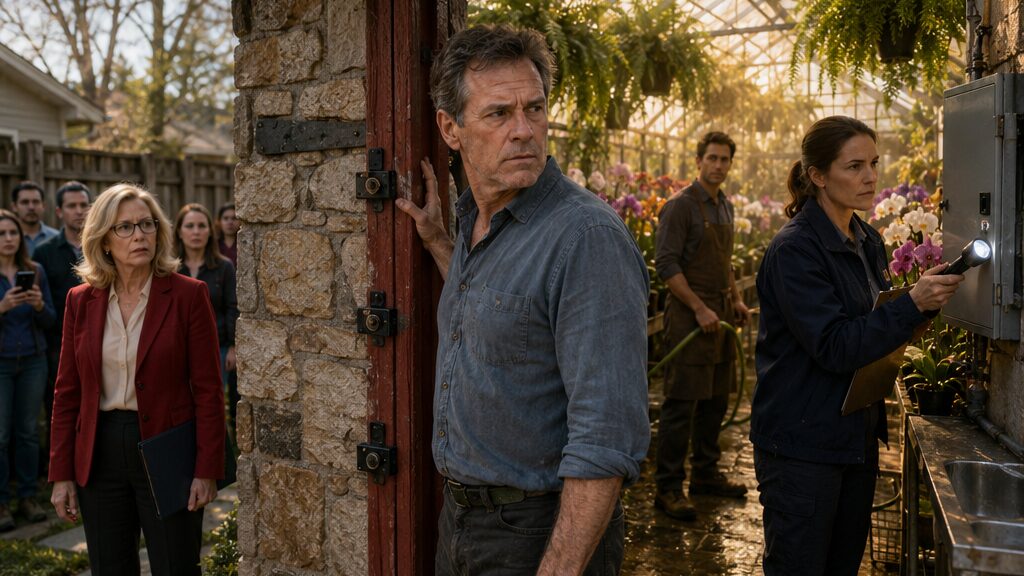
Mark crossed the lawn. The red door sat inside the old stonework like something salvaged from another century—sun-faded boards, black strap hinges, and three locks arranged from shoulder height to knee height. The door had been there before Barbara joined the architectural committee, before Mark retired, before half the houses on the block replaced their original fences with white vinyl panels.
Only the locks were new.
Barbara released the bolt as Mark approached, but her eyes moved over all three.
“That seems excessive for a garden gate.”
“It isn’t a gate.”
“Then what is it?”
Mark checked the upper bolt, the central padlock, and the lower latch in that order. He knew Barbara noticed the routine. She noticed everything that could later become a sentence in meeting minutes.
“It’s private.”
Her expression tightened, not with surprise but with the satisfaction of having received the answer she expected.
“Several residents have asked about it.”
“Several residents don’t live here.”
“That isn’t really the point.”
“It is to me.”
A lawn mower started two houses away, then cut off almost immediately. Mark glanced toward the neighboring deck. No one was visible, but one blind shifted behind an upstairs window.
Barbara lowered her voice. “People have seen lights behind this wall at night.”
His hand stopped on the central lock.
The pause lasted no more than a second, but Barbara saw it.
“What kind of lights?” he asked.
“Bright ones. At two or three in the morning.”
“They’re mistaken.”
“Are they?”
Mark looked past her toward the narrow side yard. The wall ended at a cedar fence that belonged entirely to his lot. No opening, no shared easement, no path from Barbara’s property. He had checked the survey again when she became committee chair.
“You cannot reach this door without entering my yard,” he said. “You crossed the property line to get here.”
Barbara’s chin lifted. “The side gate was open.”
“That wasn’t permission.”
“I’m trying to resolve a neighborhood concern informally.”
“You’re standing in my backyard with your hand on a locked door.”
Her phone rose slightly. “And you’re refusing to say what’s behind it.”
Mark heard how that sounded. He also knew how quickly one explanation would lead to another. A greenhouse would become questions about size. Questions about size would become questions about permits. Questions about permits would lead to dates, records, and the week he had stopped answering every call that came into the house.
He stepped between Barbara and the door.
“You need to leave.”
For the first time, uncertainty crossed her face. It disappeared when she looked toward the upper windows of the surrounding houses.
“I’ve been asked to document the exterior condition.”
“By whom?”
“The architectural committee.”
“You chair the committee.”
“That does not mean the concern is mine alone.”
She took three photographs before Mark could answer: one of the full door, one close enough to show the locks, and one with Mark standing in front of it.
The camera shutter sounds were small and clean.
“Barbara.”
“If there is no violation, this should be easy to clear up.”
“You came onto my property without notice.”
“And you’ve added hardware to an exterior structure without submitting a modification request.”
“They’re locks.”
“They are visible alterations.”
Mark almost laughed. That would have been easier than saying what moved beneath his ribs.
Barbara looked at the black metal, then at him. “What are you protecting?”
The question was quieter than the others.
For an instant, he pictured the humid air beyond the door, the narrow paths between benches, and the white orchid whose first bloom of the season had opened that morning. He pictured a plastic tag with handwriting nearly washed away by ten years of mist.
He closed his hand around the key in his pocket.
“My property.”
Barbara’s expression cooled. “Then the association will handle it formally.”
She walked back across his lawn without apologizing. At the side gate, she turned.
“You should know that rumors get worse when people are given nothing else.”
Mark waited until the latch clicked behind her.
Then he stood alone beside the door.
The mower started again. Somewhere across the street, a dog barked twice. Ordinary sounds returned, but the yard no longer felt private. He could sense the attention from decks and windows, all of it aimed at the red boards and the three black locks.
He had added the lower latch after finding the door open by half an inch six weeks earlier. The padlock came next. The upper bolt was old, but he had replaced its screws with longer ones.
He told himself the changes were practical.
He did not ask why he had begun checking them three times before bed.
Mark went inside and pulled the property folder from the cabinet above the refrigerator. The original landscape approval was there. So was the building permit, folded along a crease gone soft with age. He found the greenhouse plans beneath a warranty for a heater no longer manufactured.
The final inspection card was not with them.
He searched the kitchen drawer, the desk, and the metal box in the hall closet. Nothing.
At noon, an email from the property manager arrived.
The subject line read: ARCHITECTURAL REVIEW REQUEST.
Barbara had attached her photographs. The written concern referred to “a heavily secured accessory structure of unknown purpose,” “reported nighttime activity,” and “possible unapproved electrical use.”
Mark read the last phrase twice.
Then he went back outside.
At the red door, he listened before unlocking it.
A ventilation fan hummed faintly on the other side.
He slid the upper bolt, opened the padlock, and lifted the lower latch. Warm, wet air touched his face as the door moved inward. The greenhouse stretched beyond the stone wall, its glass roof washed pale by spring light. Ferns hung from overhead pipes. Narrow benches held orchids in bark, moss, and clay pots. Their labels stood like small white markers among dark leaves.
Mark entered and locked the door behind him.
Someone had adjusted the misting line over the western bench.
He saw the fresh droplets before he saw the man standing at the far end of the aisle.
Samuel held a watering wand in one hand. His work apron was damp at the waist, and a ring of keys hung from his belt.
Neither of them spoke.
Then Samuel looked toward the locked door and said, “You know those locks were never supposed to keep me out.”
Chapter 2: The Son Mark Would Not Name
Samuel set the watering wand across the bench as if he had been expecting an argument and wanted both hands free.
Mark remained near the door.
“How did you get in?”
“The same way I’ve been getting in.”
“That isn’t an answer.”
“It’s the only one you ever give me.”
The humid air softened sounds, but not the edge in Samuel’s voice. He had his mother’s dark eyes and Mark’s habit of standing too still when angry. At thirty-four, he no longer looked like the son Mark remembered leaving the house with two duffel bags. He looked tired, capable, and entirely at home among the plants.
Mark glanced at the key ring.
“You copied a key.”
“Mom gave me one.”
“She gave you a key ten years ago.”
“It still works.”
“Not after today.”
Samuel’s mouth tightened. “Then change the lock again.”
Mark walked down the center aisle, checking leaves as he passed. The eastern bench held young cattleyas under shade cloth. A pale root had grown beyond one pot and curled around the wire shelf. He touched it lightly, avoiding Samuel’s face.
“You’ve been coming at night.”
“After my nursery shift.”
“How long?”
“Since January.”
The answer stopped Mark beside a cluster of dendrobiums.
Three months. The extra water in the collection trays. The fertilizer container left half an inch out of place. The heater setting he had blamed on a faulty dial.
“You could have told me.”
Samuel gave a short, humorless breath. “I tried.”
“You left messages about taking plants.”
“I left messages about keeping them alive. You heard what you wanted.”
Mark checked a moisture gauge he did not need to check. “Nothing here leaves without records.”
“Good. I brought records.”
Samuel reached beneath the western bench and removed a clear plastic sleeve. Inside was a single sheet of paper folded into quarters.
Mark knew the handwriting before Samuel opened it.
The letters leaned slightly right, dark where the pen had paused. His wife had written plant names in two columns, with dates and small notes beside them.
Samuel placed the page on the bench.
“These are the ones she said would come with me when I had a permanent place.”
Mark did not touch it.
At the top of the list was a white phalaenopsis they had bought when Samuel finished high school. Below it, a miniature cattleya his mother had divided by hand. Several entries referred not to individual pots but to future divisions.
“This isn’t a transfer document,” Mark said.
“No. It’s a promise.”
“She made notes about everything.”
“She wrote my name at the bottom.”
Mark looked.
For Samuel, when he is ready.
The words had faded where the page had been folded, but they were still readable.
“You weren’t ready,” Mark said.
Samuel stared at him. “I came back three months after the funeral.”
“You came for two hours.”
“I came to ask what we were going to do with this place.”
“You said you wanted to break up the collection.”
“I said I couldn’t maintain all of it alone.”
“And then you left.”
“Because you told me none of it belonged to me.”
Mark turned toward the benches. The orchids seemed to narrow the aisle between them. Each tag carried a date, a cross, a note in ink. Some were in Mark’s block printing. Some bore Samuel’s mother’s smaller handwriting. A few had been rewritten because moisture had erased the original words.
“You stopped coming,” Mark said.
“You stopped letting me in.”
“That door was never locked then.”
“No. You did that later.”
A pipe clicked overhead as the ventilation system adjusted. Samuel picked up the list and slid it back into its sleeve.
“Barbara was here this morning,” Mark said.
“I saw her car.”
“She knows about the lights.”
Samuel’s expression changed, not into fear but calculation.
“The west bench drops below minimum temperature on cold nights,” he said. “I’ve been checking it after closing.”
“You had no right.”
“And the plants had no choice.”
Mark looked toward the west wall, where a compact heater sat beneath the bench. Its power line ran inside metal conduit to a gray electrical panel near the potting sink.
“You used the supplemental circuit.”
“I used what you installed.”
“Don’t touch it again.”
“Then schedule the inspection.”
The words landed too quickly.
Mark’s gaze moved to him. “What inspection?”
Samuel held his eyes. “The one you never finished.”
Mark felt the greenhouse change around him. The warmth became close and stale.
“You don’t know anything about that.”
“I know Mom kept the card clipped inside the permit folder. I know the city called after she died. I know they called again.”
“Enough.”
“I know you told them you weren’t ready.”
Mark picked up a fallen leaf and folded it once between his fingers.
Samuel stepped closer. “You can keep telling Barbara it’s private. You can keep telling me it’s yours. Neither answer protects this place.”
“I built it.”
“With her.”
“I maintained it.”
“With me, lately.”
Mark looked at the damp apron, the trimmed roots on the worktable, the freshly cleaned filters. Samuel had not merely entered. He had worked. Carefully.
Against his will, Mark said, “The new growth on the white cattleya was tied correctly.”
Samuel’s face shifted, almost imperceptibly.
“You would have snapped it,” Mark added, as if correction could take back the praise.
“But I didn’t.”
“No.”
For several seconds, only the fan moved air through the leaves.
Samuel collected his gloves. “Tell the HOA what the structure is. Show them the original approval. Get the electrical work closed.”
“They don’t need to see inside.”
“They will if you keep acting like there’s something to find.”
Mark’s jaw tightened. “You sound like her.”
“No. Barbara thinks silence proves guilt. I think silence creates damage.”
Samuel walked toward the red door.
Mark did not move aside at first. “Are you coming back tonight?”
“That depends.”
“On what?”
“On whether you plan to save the greenhouse or just keep possession of it.”
He unlocked the door with the old brass key his mother had given him. Before leaving, he looked back at the rows of orchids.
“If you change the lock, I stop helping.”
The door closed behind him.
That evening, Mark drove to the commercial nursery where Samuel worked. He waited in the far end of the parking lot until employees began leaving through a side entrance. Samuel emerged carrying a lunch bag and saw Mark’s truck at once.
He did not approach.
Mark lowered the passenger window.
“The association may request an inspection,” he said.
Samuel stood beneath the parking-lot light. “May?”
Mark handed him a copy of Barbara’s email.
Samuel read it without coming closer. “Possible unapproved electrical use.”
“She guessed.”
“She guessed correctly.”
“The structure was approved.”
“Then prove it.”
Mark gripped the steering wheel. “You think this is simple.”
“No. I think you’ve made it harder every year you refused to deal with it.”
A delivery truck backed toward the loading dock, its warning signal repeating between them.
Mark said, “Your mother asked me to keep the collection alive.”
Samuel folded the paper.
“She asked both of us.”
Before Mark could answer, Samuel placed the email on the passenger seat and walked to his car.
When Mark reached home, a certified envelope was wedged inside the storm door.
The property manager’s return address appeared in the upper left corner. Barbara’s name was listed beneath the architectural committee heading.
Mark opened it at the kitchen counter.
The notice ordered him to provide records and permit access for inspection within seven days. Failure to cooperate could result in a formal hearing, daily fines, and a recommendation that the structure be removed.
At the bottom, beside the inspection deadline, someone had underlined one sentence in blue ink:
The association has been unable to determine whether the concealed structure presents a safety risk.
Mark set the red-door key on top of the notice.
For the first time, the key looked less like protection than evidence.
Chapter 3: The Inspection Everyone Came to Watch
“Mr. Hill, will you open the door voluntarily?”
Melissa Roberts asked the question from the center of Mark’s backyard, her clipboard tucked beneath one arm. She wore work boots and a navy municipal jacket, practical clothes that made Barbara’s red blazer look even sharper by comparison.
Behind them, the neighborhood had gathered without admitting it had gathered.
Two residents stood near Barbara’s side fence. Another leaned against a parked car beyond the open gate. Susan Nelson waited beside the property manager with a folder pressed to her chest. Curtains moved in three upstairs windows.
Barbara had called the visit an administrative inspection.
The audience made it something else.
Mark rested his hand on the upper bolt.
“Yes,” he said. “You may inspect. The association representatives stay outside unless you determine their presence is necessary.”
Barbara stepped forward. “The committee requested access.”
“The city is inspecting for safety.”
“We also have architectural authority.”
Melissa looked between them. “I’ll conduct the initial inspection alone. If I need someone else, I’ll say so.”
Barbara’s lips pressed together, but she moved back.
Mark had laid the original plans and permit copies on a folding table near the wall. He had also removed the weeds from the drainage channel, swept the stone path, and checked every greenhouse system twice before dawn.
Samuel had not answered his last message.
Mark inserted the key into the top lock.
The metal clicked loudly in the waiting yard.
He slid the bolt. Opened the central padlock. Lifted the lower latch.
Three deliberate movements.
Someone near the fence whispered, “Here we go.”
Mark pulled the door inward.
Warm air rolled into the yard carrying the smell of wet bark, moss, and leaves. Sunlight passed through the glass roof and struck the mist suspended above the benches. Hanging ferns softened the steel supports. Orchids filled the long interior in rows—white, gold, lavender, rust-red—some no larger than coins, others opening across stems tied to slender stakes.
The yard went silent.
Melissa stepped through first.
Barbara leaned sideways to see past Mark. “That’s a greenhouse?”
Mark did not answer.
Inside, the fans turned at a low steady speed. Water moved through the misting lines with a faint pulse. The greenhouse was not decorative. It was ordered work: labels aligned, tools cleaned, walkways clear, temperature readings logged on a board near the sink.
Melissa paused beneath a basket of pale green orchids.
“I was expecting a utility shed,” she said.
“So was everyone else,” Barbara called from outside.
Melissa ignored her. She ran a hand along one of the steel supports, checked the foundation line, and looked upward at the roof vents.
“How old is the structure?”
“Eleven years.”
“You built it?”
“I designed the systems. A licensed contractor handled the frame and slab.”
Melissa turned to the plans on her clipboard. “The dimensions appear consistent with the approved drawing.”
A murmur passed through the yard.
Mark felt no satisfaction. He knew what remained near the potting sink.
Melissa continued down the center aisle. She examined clearances, heater placement, water lines, and exits. At the far end, movement stirred behind a curtain of hanging roots.
Samuel stepped into view wearing his nursery apron.
Barbara’s voice came from the doorway. “Who is that?”
Samuel looked at Mark before answering.
“I maintain the collection.”
The phrasing struck harder than if he had said son.
Melissa glanced at him. “Do you live on the property?”
“No.”
Barbara said, “Then there has been an unauthorized person entering at night.”
“He has permission,” Mark said.
Samuel’s eyes shifted toward him.
It was the first time Mark had said it aloud.
Melissa wrote something on the inspection sheet. “Name?”
“Samuel Lopez.”
“And your relationship to the owner?”
The greenhouse seemed to wait.
Mark’s mouth went dry.
Samuel answered, “He’s my father.”
Outside, someone inhaled sharply. The sound was small, but it carried.
Barbara’s posture changed. Not softened—recalculated. “You never mentioned a son was working here.”
“You never asked a relevant question,” Mark said.
“I asked what was behind the door.”
“And I told you it was private.”
Melissa raised one hand without looking up. “Personal history is outside the scope of this inspection.”
She moved to the west bench. “Who maintains the environmental systems?”
“We both do,” Samuel said.
Mark said, “I do.”
Their answers overlapped.
Melissa looked at them, then at the temperature log. “These records are thorough.”
She checked the date columns. Some were in Mark’s block lettering. Others were in Samuel’s tighter hand.
Samuel pointed toward the heater. “We had a low-temperature issue in January, but the supplemental circuit kept the bench stable.”
Mark’s head turned toward him.
Melissa followed Samuel’s gesture.
“What supplemental circuit?”
Samuel realized too late what he had said.
Mark stepped toward the panel. “It was added after the original construction.”
“By whom?”
“I installed the conduit and hired an electrician for the connection.”
“Permit number?”
“It should be with the original file.”
Melissa crouched beside the gray panel. She checked the labeling, then opened the cover. Her face revealed nothing.
Outside, Barbara said, “Is there a problem?”
Melissa stood. “I’m still inspecting.”
She traced the conduit from the panel to the heater and ventilation controls. At the junction box, she photographed the installation. Then she returned to the table near the door and compared Mark’s documents with the number displayed on her tablet.
The waiting stretched.
Mark heard droplets striking trays beneath the benches. He saw a faded orchid tag near Samuel’s elbow, his wife’s handwriting barely legible across it.
Melissa finally looked up.
“The greenhouse itself was permitted,” she said. “The foundation, frame, setbacks, and original mechanical system were inspected.”
Barbara’s shoulders lowered slightly.
“There,” Susan said from outside, almost under her breath.
Melissa continued. “However, the city record shows an electrical revision opened nine years ago and never finalized.”
Mark stared at the tablet though he could not read it from where he stood.
“That doesn’t mean the work is unsafe,” he said.
“No. It means the work was not approved for continued use.”
Samuel folded his arms.
Melissa returned to the panel. “The installation appears orderly, but appearance is not a substitute for inspection. Until the circuit is evaluated, I need the supplemental heater and related equipment disconnected.”
“The orchids on this bench cannot take a prolonged shutdown,” Mark said.
“Then you’ll need a temporary plan that does not use this circuit.”
“How long?”
“That depends on the permit history and whether the work meets current code.”
Barbara stepped to the threshold. “So there is an unapproved electrical system inside a concealed structure.”
Melissa turned sharply. “There is an incomplete permit associated with a visible electrical modification. Those are the facts.”
“The association’s concern was justified.”
“Your concern about inspection was not unreasonable,” Melissa said. “Your notice referred to possible hazardous activity. I have not found evidence supporting that description.”
Several residents looked away.
Barbara’s face flushed, but she held her ground. “We couldn’t know because he refused access.”
Mark felt the old instinct rise—the urge to say nothing, to let her words strike the wall he had built around himself.
Instead he said, “You could have asked for records before telling people I was hiding a danger.”
“I did ask questions.”
“You asked what was behind my door.”
“And now we know there was an unapproved circuit behind it.”
Samuel looked from Barbara to Mark. Neither of them had enough truth to claim victory.
Melissa closed the panel. “I’ll issue a written correction notice. This structure is not condemned. I am not ordering removal today.”
The word today stayed in the greenhouse after the rest of the sentence passed.
Mark heard it. Barbara did too.
Susan stepped closer to the doorway. She looked at the orchids, then at a faded sign stored face-down beneath the potting bench. “Didn’t Mark’s wife used to teach plant workshops?”
Barbara glanced at her.
Susan continued quietly, “Years ago. Before the clubhouse renovation.”
Mark picked up the sign and turned it farther away.
Melissa gathered her photographs. “I’ll need the complete permit file. If the revision can be reopened, correction may be straightforward. If it cannot, a new application will be required.”
“And the HOA?” Barbara asked.
“That is between the association and the owner, within the limits of your governing documents.”
Barbara looked through the greenhouse again. Wonder had disappeared from her face, replaced by the hard focus of someone rebuilding an argument after part of it had collapsed.
“The architectural committee meets Tuesday,” she said. “The association can require removal of an unapproved accessory structure.”
“The structure was approved,” Mark said.
“The electrical alteration was not. And the committee never approved the locks, nighttime use, or any change in function.”
Samuel gave a short laugh. “The function is growing plants.”
Barbara met his gaze. “Then it should be easy to document.”
Mark stepped between them, though he was no longer sure whom he meant to protect.
Melissa handed him a preliminary notice. A box near the bottom was marked: ELECTRICAL REVISION—FINAL INSPECTION NOT COMPLETED.
He recognized the permit number.
He also recognized the date beside it.
The inspection had been scheduled for the week his wife died.
His hand tightened around the paper.
Barbara saw the change in his face but not its cause.
She turned toward the residents beyond the wall. “Until the board reviews the records, no one should assume the greenhouse is allowed to remain.”
The orchids moved gently beneath the fans.
Mark had opened the door and disproved everything the neighborhood had imagined.
Now Barbara had one true fact, and it might be enough to make him take the greenhouse apart.
Chapter 4: The Permit That Stopped After Her Death
“The city never closed the file,” the permit clerk said.
Mark stood at the counter beneath fluorescent lights, one hand flattened over the folder he had carried from home. Behind the clerk, shelves of rolled plans and gray archive boxes filled the wall. The words sounded administrative, almost harmless.
Then she turned the monitor toward him.
The permit number matched the one Melissa had shown him. The status read OPEN—FINAL ELECTRICAL INSPECTION NOT COMPLETED.
“Can it be reopened?” Mark asked.
“It was never closed.”
“I mean the inspection.”
“That depends on whether the work still meets code and whether the permit can be amended under the original scope.”
The clerk clicked through several screens. Dates appeared in a narrow column.
Mark recognized the first one. The electrical revision had been approved nine years earlier. Below it was the scheduled final inspection.
April 18.
His wife had died on April 16.
The clerk continued scrolling. “There were three rescheduling contacts after the missed inspection.”
Mark’s throat tightened.
“By phone?”
“One phone call and two mailed notices.”
“I don’t remember those.”
The clerk looked at him with professional neutrality. “The record says the first call was answered.”
“By whom?”
“It doesn’t list a name.”
He knew.
He had answered from the kitchen with the hospital bracelet still around his wrist. Someone had asked whether the inspector could come the following week. Mark had said no. When asked for another date, he had said he would call back.
He never had.
The clerk printed the history and slid it beneath the glass partition. “You’ll need an electrical contractor to assess the current installation. Then the city can determine whether to complete the old permit or require a new one.”
“Does the city require removal?”
“Not automatically.”
The small relief barely formed before she added, “But if the work can’t be brought into compliance, the affected equipment cannot remain connected.”
Mark folded the printout without looking at the dates again.
In the parking lot, his phone showed two missed calls from Samuel and an email from Melissa.
The email was brief. The greenhouse itself was not subject to an immediate demolition order. The electrical circuit had to remain off until evaluated. She had attached a correction process and written, Repair appears feasible based on the visual inspection.
Mark read the line twice.
Then he opened Samuel’s message.
Call me before you speak to the HOA.
Mark did not call.
At home, the red-door key lay on the kitchen table beside the unfinished inspection card he had found that morning in an old envelope of medical bills. His wife had clipped it to the envelope, perhaps because she had intended to reschedule the appointment herself.
The card carried her handwriting in the lower corner.
Ask Samuel about west bench load.
Mark turned it facedown.
He spread the city documents across the table and began arranging them by date. Original building approval. Foundation inspection. Frame approval. Electrical revision. Missed final.
The pattern was clear enough to defend.
The reason was not.
A knock sounded at the back door.
Samuel entered without waiting after Mark unlocked it. He placed a contractor estimate on the table.
“The nursery supervisor gave me the name of an electrician who does greenhouse systems.”
“I already have a process from the city.”
“A process isn’t a quote.”
Mark looked at the estimate. It included replacement breakers, updated grounding, new labeling, and permit coordination.
“You contacted someone without asking me.”
Samuel pulled out a chair but did not sit. “The west bench cannot stay on extension power for long.”
“It isn’t your decision.”
“There it is again.”
Mark pushed the estimate back. “I went to the permit office.”
“And?”
“The file can be corrected.”
Samuel’s eyes moved to the printed history. He picked it up.
Mark reached for it, but Samuel had already seen the dates.
“You answered the city,” Samuel said.
Mark stared at the table.
“The clerk said the first rescheduling call was answered.”
“You knew they called.”
“I had other things to handle.”
Samuel looked at the unfinished inspection card, then at Mark. “They contacted you three times.”
“I said I had other things.”
“For nine years?”
The kitchen seemed too bright.
Mark stood. “Do not stand in my house and measure grief by paperwork.”
“I’m not measuring grief. I’m measuring the decisions you made after.”
“I kept everything running.”
“You kept everything frozen.”
Mark’s hand closed around the back of the chair.
Samuel lowered his voice. “Mom died, and you treated every unfinished thing like it had to stay exactly where she left it. The plants. The records. The greenhouse. Me.”
“That is not what happened.”
“You changed the locks.”
“After you left.”
“I left because every time I came here, you acted like I was trying to take something from you.”
“You wanted to divide the collection.”
“I wanted to follow her plan.”
Mark looked toward the red key.
Samuel picked up the inspection card. His eyes stopped at the note in his mother’s handwriting.
“Ask Samuel about west bench load,” he read.
Mark said nothing.
“She was planning for me to help with the system.”
“She asked questions. That doesn’t make you responsible for the greenhouse.”
“No. Her plan does.”
Samuel set down the card. “Barbara has drafted removal language for the hearing.”
Mark looked up. “How do you know?”
“Susan called me.”
“Susan Nelson?”
“She remembered Mom’s workshops. She wanted to know whether the greenhouse had ever been used for association events.”
“It was not an association facility.”
“I told her that.”
“What else did you tell her?”
“That the city permit was legitimate and that the electrical file could be corrected.”
Mark’s anger rose, sharpened by fear. “You had no right to discuss my property.”
Samuel’s expression hardened. “Then go to the hearing alone.”
He turned toward the back door.
Mark followed him into the yard. “You think Barbara wants facts? She wants removal because I embarrassed her in front of the neighborhood.”
“Maybe. But she also has one fact you handed her.”
“I did not hand her anything.”
“You refused every smaller chance to deal with this until she brought an inspector.”
Mark stopped beside the stone wall.
The red door stood closed, the three locks dark against the worn boards.
Samuel faced it too. “You keep calling this privacy.”
“It is.”
“No. Privacy is deciding who enters. This is deciding no one gets to ask what your decisions cost them.”
Mark unlocked the door.
The greenhouse was warmer than the yard, though the disconnected west circuit left one corner noticeably cooler. Samuel went directly to the temperature board and checked the readings.
Mark watched him move between the benches, adjusting vents and inspecting roots with the confidence of long practice.
“You know these plants,” Mark said.
Samuel kept writing.
“Better than the nursery staff knows half their stock.”
Samuel looked at him over his shoulder. “You’ve said that before.”
“No. I said you tied one growth correctly.”
“That was as close as you got.”
Mark took the permit history from his pocket. “Melissa says repair appears feasible.”
Samuel set down the pencil. “Then repair it.”
“I will.”
“And the hearing?”
“I’ll show them the city records.”
“That won’t answer the ownership issue.”
“There is no ownership issue.”
Samuel walked toward the oldest bench, where the orchid tags had faded from years of mist. He touched one marked with his mother’s handwriting.
“The greenhouse was never meant to belong to you alone,” he said.
Mark felt the words settle among the rows of plants.
Samuel turned to face him.
“She promised me more than a few orchids.”
Chapter 5: What the Orchids Were Supposed to Become
The temperature alarm began sounding at 6:12 in the morning.
Mark reached the greenhouse before the second cycle ended. The display beside the west bench flashed fifty-two degrees, then fifty-one.
The temporary heater had stopped.
He pulled the plug, checked the breaker, and felt the casing. Cold.
Behind him, the red door opened hard enough to strike the stopper.
Samuel entered carrying two insulated plant blankets and a portable propane heater approved for commercial greenhouse use.
“You got the alert?” Mark asked.
“I installed the alert.”
They did not waste time arguing.
The most sensitive orchids came first. Together they lifted trays from the west bench and carried them toward the warmer center aisle. Mark moved the mature cattleyas; Samuel handled the younger plants with exposed roots. Their shoulders nearly touched each time they passed.
The greenhouse filled with the sounds of urgency—pots scraping wire shelves, clips snapping, the ventilation fan slowing to preserve heat.
Samuel set up the portable heater near the central aisle.
“We can’t run it unattended.”
“We won’t.”
“The city said no temporary fuel source without supervision.”
“I read the notice.”
Samuel adjusted the unit. “Good.”
Mark ignored the tone.
By seven, the temperature had stabilized at fifty-five degrees, still low but no longer falling. Condensation clouded the glass. The orchids crowded the center benches, leaves overlapping in an arrangement his wife would have called careless.
Samuel checked the white phalaenopsis from his mother’s list.
“No cold damage yet.”
“There won’t be if we keep the humidity balanced.”
“You can’t balance humidity if you’re afraid to open a vent.”
“I designed the system.”
“And then left one part uninspected.”
Mark turned away.
Samuel pulled a plastic storage bin from beneath the potting table, searching for spare clips. A small brass lock hung from the bin’s latch.
He held it up. “Why is this locked?”
“Old records.”
“You lock records inside a locked greenhouse?”
“Give me the key.”
Samuel twisted the latch. The brass shackle had rusted through on one side and opened in his hand.
“Looks like it decided for us.”
Inside were workshop handouts, plant-care sheets, photographs, and a stack of notebooks swollen slightly from humidity. Samuel lifted the first folder.
A drawing was clipped to the front.
It showed the greenhouse benches rearranged into two wide aisles. Folding stools lined the center. A sink had been added at a child’s height. In the corner, his mother had written: Saturday classes—Samuel lead.
Samuel did not speak.
Mark recognized the drawing. He had seen it once at the kitchen table while she and Samuel argued cheerfully over whether twelve students could fit without blocking the exits.
He had forgotten where she put it.
Samuel opened the folder. Inside were lesson outlines, supply lists, and a page titled Community Orchid Workshop Plan. His name appeared beside instructor.
“She wanted this to become a teaching space,” he said.
“She talked about it.”
“She planned it.”
“She planned many things.”
Samuel looked up. “You helped draw the bench changes.”
Mark saw his own measurements in the margins.
“That was before.”
“Before she died?”
“Yes.”
“Or before I left?”
Mark moved a tray farther from the heater. “We needed the benches for the collection.”
“She wanted the collection divided enough to make room.”
“She underestimated how much space the mature plants would require.”
Samuel laughed once, without humor. “You turned her plan into a horticultural objection.”
“The plants survived.”
“That’s always your answer.”
Samuel spread the papers across the worktable. A photograph slipped free. It showed his mother standing beside the red door before the locks were added. Samuel was next to her, younger and thinner, holding a tray of seedlings. Mark had taken the picture.
On the back, in her handwriting, were the words: First class when Samuel is ready.
Samuel placed the photograph between them.
“You told me she wanted you to keep the greenhouse intact.”
“She did.”
“She wanted both things.”
Mark said nothing.
The portable heater clicked off. Samuel restarted it while Mark checked the temperature. Fifty-six degrees.
They worked in silence for another hour. The danger eased, but the plants could not stay crowded indefinitely. An orchid spike bent beneath a neighboring leaf. Mark separated them carefully.
Samuel returned to the folder.
“There’s a list of equipment she wanted me to have.”
“I know about the plant list.”
“This is different.”
Mark looked.
The page named tools, propagation trays, workshop materials, and responsibility for the west bench. At the bottom, his wife had written that Samuel should manage the teaching program when he had stable work and a place nearby.
“She never changed the deed,” Mark said.
“She didn’t need to make me owner of the house.”
“She did if she intended legal control.”
“I’m not asking for the house.”
“You are asking for authority over something attached to it.”
“I’m asking you to admit she built a future here that included me.”
The words hung between them.
Mark checked the temperature again though it had not changed.
Samuel folded the photograph into the folder. “At the hearing, I won’t stand up and tell the board this is only your private greenhouse.”
“I didn’t ask you to.”
“You will need someone who can explain the correction plan.”
“I can explain it.”
“You can explain equipment. You can’t explain why the space matters without turning Mom into a reason no one is allowed to enter.”
Mark faced him. “I kept these plants alive because she asked me to.”
Samuel’s expression did not soften. “She asked us.”
“I did not know whether you would come back.”
“I came back.”
“You came for the list.”
“I came because I kept getting temperature alerts from a system you were pretending you could manage alone.”
Mark’s breath caught.
The truth was too close to accusation and too close to mercy.
He looked across the greenhouse. Orchids filled every bench, but for the first time he saw the empty aisle his wife had drawn. He saw stools where pots now stood. Samuel teaching people how to read roots instead of flowers. The door open for a purpose, not to satisfy curiosity.
“I kept growing them,” Mark said, “because if I divided the collection, there would be nothing left waiting for you.”
Samuel lowered his eyes.
Mark continued before he could stop. “Every year you stayed away, I thought one more season. One more bloom. If I kept it as she left it, you might come back and know where you belonged.”
Samuel’s jaw tightened.
“You could have called me.”
“I did not know what to say.”
“You could have started with that.”
The temperature alarm went silent as the reading reached fifty-eight.
It felt like a small mercy neither of them had earned.
Samuel gathered the workshop papers. “I’ll help you file the correction plan.”
Mark nodded.
“But I won’t support you at the hearing unless the plan acknowledges my role.”
“You want your name on the permit.”
“I want legal responsibility for the systems I’m expected to maintain. And I want the teaching plan preserved as an option.”
“The HOA will use public access against us.”
“Then write limits.”
Mark looked at the red door. Three locks, all chosen by him.
He went to the worktable, pulled the correction application from the folder, and found the section for responsible parties.
His hand hovered above the line.
Samuel did not move closer.
Mark wrote Mark Hill first.
Below it, he wrote Samuel Lopez.
The letters looked strange together, not because they were wrong but because Mark had kept them apart for so long.
He signed the page and slid it across the table.
Samuel read it without touching it.
“The hearing is in two days,” Mark said.
Samuel folded the application once and placed it with the workshop plan.
“That still doesn’t mean I’ll stand beside you.”
Chapter 6: Barbara Walker’s Case for Removing It
“Beauty does not make an unsafe structure lawful.”
Barbara’s first sentence carried cleanly through the community clubhouse.
An enlarged photograph of the red door stood on an easel beside her. The three locks were sharp under the projector light. Mark appeared at the edge of the image, one hand lifted as if blocking the camera.
Every chair was occupied.
Mark sat at the front table with the city records, contractor estimate, and correction application arranged in a straight line. The empty chair beside him had been reserved for Samuel.
It remained empty.
Barbara continued. “This hearing is not about orchids. It is not about anyone’s grief, hobbies, or personal preferences. It is about whether one owner may conceal a modified accessory structure from association review while expecting every other owner to follow the rules.”
Several residents nodded.
Mark looked toward the back doors.
No Samuel.
The property manager read the possible outcomes: fines, mandatory correction, restricted use, or removal if the structure could not be brought into compliance with governing documents and city requirements.
Barbara placed both hands on the lectern.
“Years ago, this association approved a deck without complete documentation. A railing failed. A visitor fell and required surgery. Residents accused the board of negligence, and they were right to ask why no one had verified the work.”
Her voice changed slightly on the final sentence.
Mark had heard about the accident but not Barbara’s role. She had joined the committee shortly afterward, when homeowners were still arguing over legal fees and insurance premiums.
“We now face another structure,” she said, “with an electrical permit left open for nine years. Mr. Hill refused basic questions, added locks without approval, and allowed nighttime access by someone not identified to the association.”
Mark saw how the facts aligned when placed in that order. He had given her the shape of the argument.
Barbara clicked to the next image: the greenhouse electrical panel.
“The city did not condemn the structure,” she said, “but the circuit was ordered out of service. The committee therefore recommends removal unless full compliance can be established within thirty days.”
Susan Nelson shifted in her seat at the board table.
“Barbara,” she said, “that is not the draft circulated yesterday.”
Barbara looked at her. “The recommendation was revised after reviewing the insurance requirements.”
“The draft said correction or removal.”
“The risk justifies stronger language.”
Susan opened her folder. “The city inspector’s report says the structure appears repairable.”
“Appears.”
“It also says no evidence of hazardous activity was found.”
Barbara’s face tightened. “I did not say hazardous activity was found.”
“You circulated a notice warning residents that an unknown secured structure might contain hazardous equipment.”
A murmur moved through the room.
Barbara’s gaze flicked toward Mark, then back to Susan. “The purpose was to prevent residents from approaching until inspection.”
“You wrote that the owner refused to confirm whether dangerous materials were present.”
“He refused to confirm anything.”
Mark stood before the board could call on him.
“That part is true,” he said.
The room quieted.
He had planned to begin with the permit history. Dates were easier than admissions. Instead he looked at the photograph of himself beside the locked door.
“I refused to explain what the structure was. I refused to provide the original approvals when I could have. I missed the electrical inspection after my wife died, and I ignored later chances to reschedule it.”
Barbara watched him without expression.
Mark placed the inspection history on the table.
“The greenhouse was legally built. The electrical revision was permitted but never finalized. That failure is mine.”
The admission tasted like metal.
A committee member asked, “Why wait nine years?”
Mark could have said grief. Everyone would have understood enough to stop pressing.
He looked at the empty chair.
“Because correcting it meant reopening decisions my wife and I had not finished. I treated delay as preservation. It was not.”
Barbara spoke from the lectern. “That may explain the lapse, but it does not remove the association’s responsibility.”
“No,” Mark said. “It doesn’t.”
For the first time that evening, she appeared uncertain.
Mark handed copies of the contractor estimate and Melissa’s correction process to the property manager. “The work can be brought into compliance. The application is prepared. The city has not ordered demolition.”
“The association still has authority over use,” Barbara said.
“Yes.”
“And nighttime access.”
“Yes.”
“And exterior modifications, including the locks.”
Mark looked at the projected photograph. “Then review them.”
A chair scraped near the back.
Samuel entered carrying the workshop folder. He did not take the seat beside Mark. He stood against the wall.
The property manager asked whether he wished to speak.
Samuel said, “Not yet.”
Barbara turned to him. “You are the person who was entering the greenhouse after dark?”
“I was maintaining temperature-sensitive plants after my nursery shift.”
“Without being listed as an occupant or contractor.”
“I’m listed on the correction application.”
Barbara looked toward Mark’s documents. “As what?”
Mark answered. “Responsible co-operator.”
Samuel’s eyes met his.
The chair beside Mark remained empty.
A board member asked, “Does that mean the greenhouse will operate as a business?”
“No,” Mark said.
Samuel added, “The original plan included educational workshops, but no commercial sales.”
Barbara seized the phrase. “Workshops would increase traffic and create an association-use issue.”
“Not under the current application,” Samuel said. “The application covers maintenance and code correction only.”
“And future use?”
Samuel looked at Mark.
The room waited.
Mark felt the familiar wall rise inside him: say less, offer nothing that could be used. He could keep the workshops out, keep Samuel’s claim vague, keep the greenhouse technically his.
Samuel’s silence made the choice visible.
Mark said, “Any future workshop would require separate HOA review, limited attendance, scheduled hours, and proof of insurance.”
Barbara stared at him. “You are proposing community access after insisting the structure was private?”
“I am proposing that privacy and controlled access are not opposites.”
A few residents shifted.
Susan asked, “Who would manage it?”
Mark looked at Samuel. “He would.”
Samuel stepped away from the wall but did not smile.
Barbara closed her folder. “This is becoming a new use, not a correction.”
“No,” Susan said. “The correction stands on its own. Future workshops can be reviewed separately.”
Barbara’s voice sharpened. “And if the corrected system fails? If someone is injured? We will be asked why we permitted an exception.”
Mark said, “Then do not grant an exception. Set conditions.”
He placed the correction application before the board.
“Thirty days for electrical work is not enough. The contractor requires permit review first. I am requesting sixty days, no public access during correction, city inspection before reactivation, and association access by appointment for verification.”
Barbara studied him.
“And the locks?”
“One functioning lock after final approval. Inspection access with notice. No emergency-access claim without an actual emergency.”
The last words landed directly between them.
Barbara’s face changed. Not defeat. Recognition.
Susan spoke carefully. “That seems narrower than removal.”
The property manager reviewed the documents. “The board can approve a conditional correction agreement tonight and reserve all future-use questions.”
Barbara looked toward the enlarged photograph. The door she had turned into evidence now stood above them like a question about her own judgment.
She said, “I will withdraw the emergency-access request.”
A whisper passed through the room.
“But,” she added, “I will support correction only if the city closes the permit, the association verifies the work, and Mr. Hill accepts responsibility for future compliance.”
Mark nodded. “I accept that.”
Samuel finally approached the table.
He placed the workshop folder beside the application but kept one hand on it.
“I’ll manage the correction,” he said. “If the agreement recognizes me as a responsible operator.”
Barbara looked at Mark. “Does it?”
For years, Mark had answered every threat by narrowing the circle around himself.
He picked up the application.
“It does,” he said. “And I propose the agreement state that responsibility is shared.”
The board members leaned over their copies.
The property manager began reading the revised terms aloud.
Mark looked at the empty chair beside him, then at Samuel standing on the other side of the table.
The board had not yet voted.
But the plan in front of them no longer allowed Mark to save the greenhouse alone.
Chapter 7: The Door Opened on Mark’s Terms
“Samuel, go ahead and energize the system.”
Melissa Roberts stood beside the new electrical panel with her tablet raised. She had addressed Samuel, not Mark.
For one old reflexive second, Mark nearly stepped forward.
Then he kept his hands at his sides.
Samuel checked the main disconnect, read the contractor’s labels, and looked toward Melissa for confirmation. She nodded.
He closed the switch.
The greenhouse lights came on in two clean rows. A moment later, the ventilation fans began turning overhead. Warm air moved through the leaves, stirring the hanging roots and carrying the damp scent of bark along the central aisle.
No breaker snapped.
No alarm sounded.
Samuel watched the control display climb through its startup sequence. “West bench heater active.”
Melissa compared the readings with the approved plan. “Ventilation?”
Samuel adjusted the thermostat.
The roof vents opened with a measured mechanical hum. Cool spring air entered above them and blended with the greenhouse warmth.
Mark knew every sound in that system. He had designed most of it, repaired it, and kept it functioning through winters when ice covered the outside glass. Yet hearing it start under Samuel’s hand did not feel like losing it.
It felt like the building had taken a full breath.
Melissa moved methodically from panel to heater, then to the grounding point and emergency disconnect. The contractor followed behind her, answering questions only when asked.
The final inspection had drawn a smaller audience than the first. Susan Nelson waited near the open red door with the signed correction agreement. The property manager stood beside her. Barbara remained a few steps outside in a navy coat, holding no phone and taking no photographs.
The board had approved the agreement by four votes to one.
Sixty days for correction. No fines if the work passed inspection. No public use without separate review. Association entry by appointment except in a documented emergency. Mark and Samuel listed as jointly responsible for operation and compliance.
Barbara had voted in favor.
She had not apologized for the warning she circulated. Mark had not asked her to.
Melissa inspected the final junction box, tightened the cover, and entered a note on her tablet.
“The electrical revision meets the approved scope,” she said.
Mark let out a breath through his nose.
Samuel did not move. “Is that the final?”
“It will be when I close the record.”
Melissa tapped through two screens. The greenhouse was quiet enough for Mark to hear each touch against the glass.
At last she turned the tablet toward them.
The old permit status no longer read open.
FINAL APPROVED.
Samuel stared at the screen.
Mark looked past it to the western bench, where the white cattleya had opened two flowers during the weeks of repair. Its tag still carried fading handwriting.
Melissa handed Mark a printed approval card. “Keep this with the site records. The city file is closed.”
He took it carefully.
Nine years of delay had ended in one ordinary sheet of paper.
Susan smiled. “That should satisfy the agreement.”
“It satisfies the city requirement,” Barbara said from outside. Her tone was controlled rather than sharp. “The association still needs to verify the exterior terms.”
Susan gave her a brief look.
Barbara added, “Which is why we’re here.”
Mark nodded. “Come in.”
Barbara hesitated at the threshold.
During the first inspection, she had leaned around him to see inside. Now the door stood fully open, and no one blocked her.
She entered without touching anything.
The correction work had changed less than she probably expected. New conduit ran neatly along the wall. The panel had updated labels. A red emergency shutoff had been installed near the entrance. The plants remained where they had been, except for one section of the center bench that Samuel had cleared.
The empty space was not large enough for a class.
Not yet.
The property manager measured the exterior lock placement against the agreement. Mark had removed the upper bolt and lower latch three days earlier. Their dark outlines remained on the red wood, but only the central lock still functioned.
He had kept the old hardware in a drawer.
Barbara examined the door. “One keyed lock.”
“As agreed,” Mark said.
“And the inspection notice?”
Samuel pointed to a weatherproof holder attached inside the doorway. It contained the final approval, emergency contacts, and the scheduled quarterly association verification window.
Barbara read the card.
“You listed Samuel first.”
“He manages the systems.”
Her eyes moved between them. “And you?”
“I own the property.”
“That wasn’t my question.”
Mark looked toward Samuel, who was checking the west-bench temperature again even though the display had stabilized.
“I’m still responsible,” Mark said. “I’m not responsible alone.”
Barbara absorbed the answer without comment.
The property manager finished the checklist and signed the association verification form. Susan added her initials as board witness.
“There is one remaining question,” Barbara said.
Mark knew which one before she asked.
“Will the greenhouse now be open to residents?”
Susan’s pen stopped.
The contractor glanced toward the door, then returned to packing his tools.
Mark could have answered no and ended it. For weeks he had imagined that answer—calm, final, legally supported. The correction agreement protected him. The city approval protected the structure. Barbara no longer had a reason to stand inside.
But behind her, the red door was open. Beyond it lay the same neighborhood that had turned ignorance into suspicion.
He looked at the cleared section of bench.
“Not generally,” he said.
Barbara’s expression tightened by a degree.
Mark continued. “This is still private property. There will be no unscheduled visits, no tours, and no access because someone is curious.”
Susan lowered her eyes, hiding what might have been a smile.
“If Samuel submits the workshop plan,” Mark said, “we may request approval for several small classes each year. Scheduled attendance. Limited numbers. Separate insurance. No association control over the collection.”
Barbara looked at Samuel. “Is that what you want?”
Samuel glanced at Mark before replying. “It’s what my mother planned. Whether it happens depends on whether the conditions make sense.”
“No promises?” Barbara asked.
“No,” Samuel said.
Something in her posture eased.
“That is probably wiser,” she said.
Mark heard no surrender in the words, only recognition of a boundary. It was enough.
Barbara walked toward the white cattleya near the west bench. She stopped at a respectful distance.
“This one was here during the first inspection.”
“Yes,” Mark said.
“It was not blooming.”
“No.”
She studied the two open flowers. “I understand why people wanted to see inside.”
“That did not give them a right to.”
“No.”
The answer came without argument.
Barbara turned toward him. “The emergency language in my notice was too broad.”
Mark waited.
“I believed delay created risk,” she said. “I still believe that. But I should not have described an unknown risk as if it were established.”
It was not an apology shaped for public approval. No residents were present to hear it beyond those required for the inspection.
Mark nodded once. “I should have provided the permit records when you first asked.”
“You should have.”
Susan shifted her folder beneath one arm. “This may be the closest either of you gets.”
Barbara almost smiled.
Melissa closed her case. “My part is finished.”
She shook Samuel’s hand first, then Mark’s.
“Keep the records current,” she said.
“We will,” Samuel answered.
After the others left, Mark and Samuel remained inside the greenhouse.
Through the open door, Mark watched Barbara and Susan walk back along the stone path. Barbara paused near the removed bolt holes but did not photograph them.
Samuel began returning tools to the workbench.
“The west bench is holding at sixty-eight,” he said.
Mark placed the final inspection card beside the workshop folder.
“You could put your teaching plan in the association packet next month.”
Samuel fitted a screwdriver into its drawer. “I could.”
“That isn’t an answer.”
Samuel looked at him.
Mark recognized his own words from the day they faced each other across the orchids.
“No,” Samuel said. “It isn’t.”
The silence that followed was not comfortable, but it was no longer sealed.
Mark took the old brass key from his pocket—the one Samuel’s mother had given him years earlier. The new lock used a different cut. Two copies had been made.
He set one on the worktable.
Samuel looked down at it.
“This doesn’t settle everything,” he said.
“I know.”
“I’m not moving back.”
“I didn’t ask.”
“And if we do classes, I decide how they’re taught.”
“We decide what happens to the collection.”
Samuel’s mouth tightened, but not with anger. “Shared responsibility?”
“That is what I signed.”
Mark picked up the second key.
Together they walked toward the red door.
The missing bolts had left pale marks in the weathered wood. For years, Mark had thought every added lock made the boundary clearer. Now the single remaining lock seemed stronger because it no longer had to carry his grief for him.
He stepped outside and pulled the door closed.
The latch met the frame with a soft, familiar sound.
Mark locked it once.
Then he placed the spare key in Samuel’s palm.
Samuel closed his fingers around it.
Mark moved back from the door and waited.
Samuel inserted the key into the central lock. He turned it, pushed the red door inward, and stood in the opening while warm air moved past him into the yard.
This time, Mark did not ask how long he intended to stay.
He followed him inside.
The story has ended.