The Chair on Mark Carter’s Roof Hid More Than the Neighborhood Wanted to See
Chapter 1: The Chair Above the Roofline
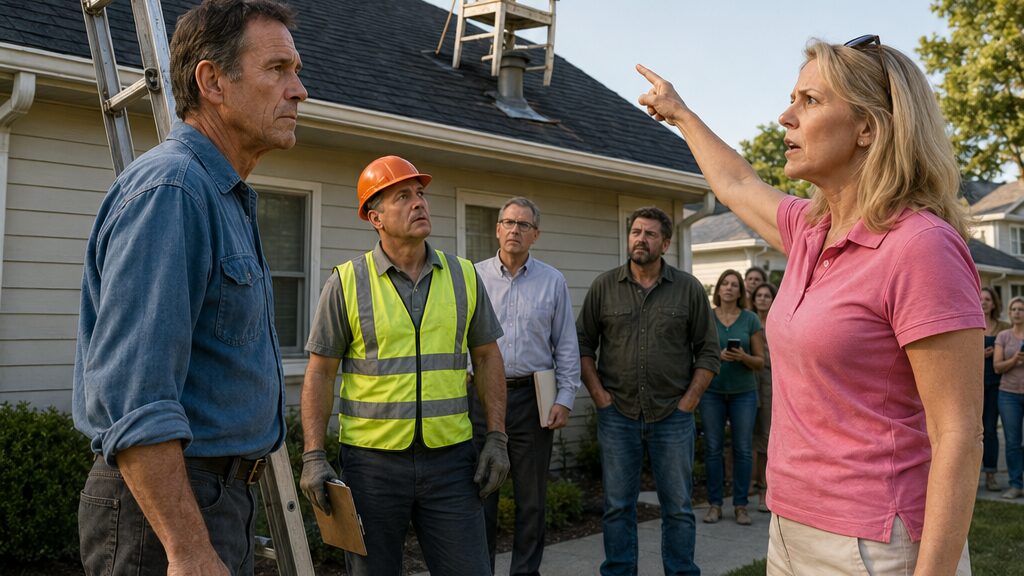
Samantha Green stood in the middle of Mark Carter’s front lawn with one arm raised toward his roof and three phones pointed in the same direction.
“Why is there a chair up there?”
Her voice carried farther than it needed to. A sprinkler clicked across the next yard. Somewhere behind the hedge, a garage door stopped halfway down.
Mark kept one hand on the extension ladder resting against his gutter. He had been checking the lower bracket when Samantha arrived. Now she stood beneath him in a pink polo, sunglasses pushed into her hair, her phone held upright as though the answer might appear more clearly on its screen.
The chair sat ten feet above her line of sight, weathered white against the charcoal shingles. Its back faced the street. Two flat steel straps ran from its legs to a wooden frame built over the old roof vent.
“The whole neighborhood is talking about it,” Samantha said.
Scott Hernandez stood near the sidewalk, arms folded. Two other residents lingered behind him, pretending not to listen while recording openly.
Mark climbed down one rung at a time.
“Is it loose?” Scott asked.
“No.”
“Could it come loose?”
“No.”
Samantha tilted her phone toward the roof. “Nobody bolts a patio chair to a house.”
Mark stepped onto the grass and folded the ladder’s locking braces. “It isn’t a patio chair.”
The statement produced exactly the reaction he expected. Samantha looked at Scott. Scott looked at the roof. One of the residents whispered something that made the other laugh.
Mark carried the ladder toward the garage.
“Then what is it?” Samantha called.
He stopped, but he did not turn around.
“It’s where it belongs.”
The laughter ended.
Samantha followed him to the driveway. “That isn’t an explanation.”
“It wasn’t meant to be.”
Her mouth tightened. In the years since she had taken over the compliance committee, she had learned to make silence look like guilt. Mark had watched her do it at board meetings—with basketball hoops, unauthorized paint colors, trash bins visible after seven in the evening. She never raised her voice much. She simply kept asking until the other person supplied enough words to be used against them.
“You made an exterior alteration without architectural approval,” she said.
“I repaired an existing structure.”
“With a chair.”
Mark set the ladder beside the garage wall. “You don’t know what I repaired.”
“Because you refuse to say.”
“That doesn’t make it dangerous.”
Scott shifted his weight. “Mark, I signed the maintenance request because I saw the thing from my driveway. I didn’t know it was strapped down.”
“You could’ve asked.”
Scott glanced at Samantha. “I’m asking now.”
Mark looked past them toward the roof. From the street, the chair appeared absurd. He understood that. The white slats were peeling. One rear leg had been shortened by two inches and fitted into the frame. Thin wire mesh ran beneath the seat where no one could see it.
He had built the support in an afternoon, using cedar offcuts and galvanized screws. He had tested it in wind with a pull scale. It would hold more force than the original vent cap ever had.
But none of that was what they wanted to know.
They wanted the part beneath it.
A faint movement passed under the seat—too small to notice from the lawn. Mark noticed. He always did.
Samantha raised her phone again. “I’m documenting the condition.”
“You’re documenting a chair.”
“I’m documenting an apparent rooftop hazard.”
Mark walked back toward the ladder.
“What are you doing?” she asked.
“Checking your hazard.”
He extended the ladder and climbed. The shingles were warm beneath his knees when he reached the frame. He kept his body between the chair and the people below.
First he pressed both steel straps. No movement. Then he checked the lag screws at the blocking. Tight. He ran two fingers beneath the rear rail without lifting it.
A dry flutter came from inside the vent hood.
He held still.
From below, Samantha called, “Well?”
Mark looked through the narrow shadow beneath the seat. A small brown head remained tucked low. The bird’s dark eye watched him. Beneath her breast, just visible through strands of grass, lay four pale eggs.
“Nothing moved,” he said.
“That doesn’t answer whether it’s permitted.”
Mark descended.
Samantha was already typing.
“What are you filing?” he asked.
“An emergency hazard report.”
Scott lowered his arms. “Emergency seems strong.”
“So did the balcony railing,” Samantha said.
The words changed her face. For an instant, her anger gave way to something harder and older. Mark remembered the accident two streets over—the railing that had pulled free during a graduation party, the resident who had fallen twelve feet, the months of accusations afterward. Samantha had not been compliance chair then, but she had attended every meeting.
Mark also remembered that the railing had shown visible rot for a year.
“This isn’t that,” he said.
“You don’t get to decide that alone.”
“And neither do you.”
Samantha finished typing and pressed the screen with her thumb. “Now the city will decide.”
The neighbors began to drift away. Scott remained.
“You could make this easier,” he said quietly.
“For who?”
“For yourself.”
Mark looked toward the roof again. The chair’s white back caught the morning light. It had once stood indoors beside a drafting table. Before that, it had been one of a pair.
He closed the garage door.
By noon, a photograph of the roof had appeared in the neighborhood message group. Someone had enlarged the chair and drawn a red circle around it. The caption read: POSSIBLE FALLING OBJECT—KEEP CHILDREN CLEAR.
Mark did not reply.
At three, Jessica called.
“Dad, what did you put on the roof?”
He stood at the kitchen sink looking through the window toward Samantha’s house. “It’s secured.”
“That isn’t what I asked.”
“It’s temporary.”
“For what?”
“I’ve got it handled.”
There was a pause long enough for him to hear the clinic intercom behind her.
“Handled like the gutter last fall?” she asked.
“The gutter was fine.”
“The gutter detached.”
“One bracket detached.”
“During a storm.”
“It didn’t hit anything.”
“Dad.”
He rubbed the edge of the counter with his thumb. “I need to go.”
“You called me.”
“No, you called me.”
“That’s not the point.”
He ended the conversation before she could ask the question Samantha had asked.
That evening, Mark climbed to the roof after the street had gone quiet. He brought a shallow dish of water but left it several feet from the vent so he would not attract predators. The bird remained beneath the chair. The eggs were intact.
He inspected the flashing along the lower edge. One corner had lifted farther than the week before. The old sealant had cracked into gray scales.
He pressed it down, knowing it would not stay.
A permanent repair would mean removing the chair, opening the frame, replacing the flashing, and dismantling part of the enclosure behind the vent.
He had known that for eleven months.
When he returned downstairs, the front porch light caught a strip of orange paper taped across his door.
NOTICE OF MUNICIPAL INSPECTION.
The complaint category was printed in block letters beneath it.
DANGEROUS STRUCTURE—IMMEDIATE REVIEW.
Chapter 2: Before Anyone Touches the Chair
The municipal inspector placed the ladder beneath the white chair while Samantha told him it should already have been removed.
“There’s an active complaint,” she said. “The association considers it an immediate risk.”
The inspector, a broad man in a reflective vest, checked the ladder’s feet against the concrete. “The city determines whether it’s an immediate risk.”
Robert King stood near the mailbox with a folder under one arm. Scott was beside him. Several residents had gathered again, although no meeting had been announced.
Mark stood at the foot of the ladder.
“No one touches the chair until you look underneath it,” he said.
Samantha gave a short, impatient laugh. “That’s exactly the kind of statement that concerns people.”
The inspector looked at Mark. “Is there electrical equipment under it?”
“No.”
“Gas line?”
“No.”
“Structural damage?”
“Look first.”
The inspector studied him, then the roof.
Samantha stepped closer. “He has refused to provide any documentation. We have children walking under that roofline every day.”
“No one walks under that section,” Mark said.
“That is not the point.”
“It is if you’re describing the risk.”
Robert opened his folder. “Let’s allow the inspection.”
The inspector climbed.
The ladder flexed once under his weight. Mark kept his hand against the side rail, not because the ladder needed steadying, but because he wanted control over at least one part of the moment.
When the inspector reached the gutter, he leaned sideways to study the chair’s lower frame. He tested one steel strap, then the other. He pressed the backrest. Nothing shifted.
“These fasteners go into blocking?” he asked.
“Yes.”
“What size?”
“Three-eighths-inch galvanized lag screws. Four inches.”
“You install the blocking?”
“I did.”
The inspector climbed one rung higher and angled his head beneath the seat.
He stopped.
Samantha folded her arms. “What is it?”
The inspector raised one hand without looking down.
No one spoke.
A few seconds later, he laughed once—not loudly, but with clear surprise.
Samantha took a step toward the ladder. “What did you find?”
He descended slowly and turned to Mark. “How long has she been there?”
“Nine days.”
“She?”
“House wren, most likely.”
Jessica’s voice came from behind the crowd. “Not most likely.”
Mark turned.
She crossed the lawn in navy clinic scrubs, her dark hair pulled back. She had arrived without calling. A wildlife rehabilitation officer walked beside her carrying binoculars and a small field notebook.
Jessica looked up at the roof. “You could have told me.”
“I knew what it was.”
“That’s not the same thing.”
The wildlife officer waited until the inspector moved aside, then climbed high enough to view the nest without touching the frame. After less than a minute, she came down.
“Active nest,” she said. “Four eggs. No disturbance unless there’s an immediate threat.”
Samantha looked from her to the inspector. “The chair is the threat.”
“No,” the inspector said. “The chair is secured.”
“It’s an unapproved object.”
“That’s an association issue. From a municipal structural standpoint, I’m not seeing an immediate hazard.”
The silence that followed felt different from the one Mark had created two days earlier. That silence belonged to the people who had expected the city to agree with them.
Scott looked up through the chair legs. From the right angle, a fringe of dry grass was visible beneath the seat.
“So it’s covering the nest?” he asked.
“And the vent opening,” Mark said.
Jessica turned sharply. “What vent opening?”
Mark ignored the question.
The inspector climbed again, this time carrying a small flashlight. He examined the frame from both sides, then crouched near the lower edge. His expression changed.
“What?” Robert asked.
The inspector pointed. “The chair itself is fine. Better anchored than some manufactured covers I’ve seen.”
Samantha opened her mouth.
“But the flashing below the vent is deteriorated.”
Mark’s grip tightened on the ladder rail.
The inspector came down and removed his gloves. “There’s separation along the lower edge. Not enough for an emergency order today, but it needs repair.”
“How soon?” Robert asked.
“I’d recommend thirty days after the nest is inactive. Sooner if water intrusion worsens.”
Samantha’s posture straightened. “Then there is a violation.”
“Not the one you reported.”
“There is still a dangerous condition.”
“I did not say dangerous. I said deteriorated.”
She looked toward the neighbors, as if searching for the authority her own wording had just lost. Two phones lowered.
The inspector continued. “The temporary cover is keeping direct rain off the opening. I wouldn’t remove it while the nest is active unless the structure loosens.”
Scott gave Mark a reluctant nod. “Kind of smart.”
Mark did not answer.
Jessica waited until the inspector and wildlife officer moved toward their vehicles.
“You knew about the flashing,” she said.
“I knew it was aging.”
“That corner is lifted.”
“I’ve been watching it.”
“For how long?”
Mark looked past her.
Samantha was speaking quietly with Robert near the mailbox. She had taken a photograph from her folder—a close image of the vent edge, taken months earlier. Even at a distance, Mark recognized the angle.
He had taken the photograph himself for the insurance claim.
Robert noticed him looking.
“Mark,” he said, “the association has records on this condition.”
Mark stayed beside the ladder.
Samantha walked back across the lawn with the folder open. Her earlier certainty had returned, but now it had narrowed into something more careful.
“We sent you a maintenance inquiry last June,” she said. “You acknowledged it.”
“I acknowledged receipt.”
“You also submitted an insurance estimate for the vent and flashing.”
Jessica stared at him.
Samantha turned one page. “Eleven months ago.”
The municipal inspector paused beside his truck. “You had a contractor evaluate it?”
“Yes,” Mark said.
“And the work wasn’t done?”
“No.”
“Why?”
Mark looked up at the chair. Beneath the slats, the nest remained invisible from the lawn. The white paint had peeled in thin curls along the backrest. One curl lifted in the breeze and settled again.
“The condition is stable,” he said.
Jessica stepped closer. “That’s not an answer.”
“It’s the answer I have.”
Samantha closed the folder. “The city may not order immediate removal, but the association can address deferred maintenance and unauthorized exterior modifications.”
Robert’s face tightened. “We need to review the governing documents before making that statement.”
“I already have.”
The inspector shut his truck door. “My report will say there is no immediate structural hazard associated with the chair. It will also recommend repair of the vent flashing after the active nest period.”
Samantha nodded as though he had confirmed everything she wanted.
Mark knew better.
So did Robert.
But when the crowd dispersed, Jessica remained in the yard with her arms folded.
“You took the insurance money?” she asked.
“It was paid directly against the estimate.”
“Where is it?”
“In the account.”
“And the contractor?”
“I didn’t schedule him.”
Her expression changed—not to anger, but to fear.
“Dad,” she said quietly, “what else is under that chair?”
Before he could answer, Samantha held up the maintenance file from the sidewalk.
“The hearing packet goes out Monday,” she said. “Every notice, photograph, and estimate from the past eleven months will be included.”
Chapter 3: The Approval That Solved Nothing
The envelope carried the words CONTINUING VIOLATION in red across the top.
Mark opened it at the kitchen table with the municipal inspection report already lying beside his coffee.
The city’s conclusion occupied three sentences.
The chair and its supporting frame did not present an immediate structural hazard. An active bird nest was present and should not be disturbed without appropriate guidance. Deteriorated flashing at the existing roof vent required repair after the nesting period.
Samantha’s notice was four pages long.
It cited exterior modification rules, maintenance obligations, nuisance provisions, architectural review procedures, and a daily fine beginning in ten days. Attached to it was a photograph of the chair taken from the street. Someone had typed ROOFTOP DEBRIS beneath the image.
Mark turned the photograph facedown.
At seven that evening, the HOA clubhouse was nearly full.
Robert sat at the center of the board table. Samantha sat to his right with the same folder she had carried during the inspection. Scott occupied a chair in the first row, looking uncomfortable.
Mark chose a seat near the aisle.
Samantha began with procedure.
“The municipal report does not authorize the installation,” she said. “It only states that the object is not an immediate city-code hazard.”
“Object,” Scott murmured.
Samantha ignored him. “The association’s concern has always included exterior appearance and deferred maintenance.”
Mark looked at Robert. “The emergency alert said falling hazard.”
Robert adjusted his glasses. “That language is under review.”
“It was sent to every homeowner.”
“We understand.”
“No,” Mark said. “You understand now.”
A board member leaned toward the microphone. “Mr. Carter, no one is disputing that the initial report may have been overstated. The question tonight is whether the chair was approved.”
“It’s a temporary cover.”
“Made from a chair.”
“Yes.”
“That distinction may not exist in the declaration.”
Samantha placed the city report on the table. “He also failed to correct the vent condition after receiving funds for repair.”
Mark felt the room shift.
The residents who had smiled at the nest photographs now looked toward him again.
Robert lifted one hand. “We should avoid discussing insurance specifics unless they are directly relevant.”
“They are relevant,” Samantha said. “The association contacted Mr. Carter about the deteriorated flashing last year. He obtained an estimate. The condition remained.”
Mark stood.
“The chair keeps water off the opening. It is fastened into structural blocking. The city confirmed that.”
“And the underlying repair?” Samantha asked.
“Will be done when the nest is inactive.”
“Why wasn’t it done before the nest existed?”
There it was.
Not accusation. Not performance. A clean question.
Mark could have answered it. He could have said the contractor wanted to dismantle the enclosure behind the vent. He could have explained that the vent did not belong only to the roof, that it opened into a room he had not entered in months.
Instead he said, “The condition was stable.”
Samantha leaned back. “That is what you said outside.”
“It remains true.”
Robert looked down at the papers. “The board is not making a final determination tonight. We will schedule a hearing and suspend the emergency-removal request pending wildlife clearance.”
A small release moved through the room.
Then Robert added, “The daily fine remains scheduled unless an approved corrective plan is submitted.”
The release vanished.
Mark folded the notice once and placed it in his jacket pocket.
Outside, Scott caught up with him.
“I saw the straps,” he said. “The chair’s not going anywhere.”
Mark kept walking.
“I told Robert that.”
“Good.”
“But the flashing does need work.”
“I know.”
Scott stopped near the curb. “You act like everyone who asks is trying to take something from you.”
Mark turned. “Most people don’t ask. They decide.”
Scott looked toward the clubhouse doors, where Samantha stood speaking with two residents.
“You could still give them less to decide.”
Mark went home without answering.
Jessica was waiting in his kitchen.
The contractor estimate lay open on the table.
“You went through my papers.”
“You left the file in the hall cabinet.”
“That doesn’t make it yours.”
“The insurance company paid twenty-eight hundred dollars.”
“The money is untouched.”
“That’s not the problem.”
Mark set his keys beside the municipal report.
Jessica picked up the estimate. “Replace vent flashing. Remove and rebuild exterior enclosure as needed. Seal roof penetration. That’s the work.”
“I can read.”
“Then why didn’t you schedule it?”
“The contractor wanted to tear out more than necessary.”
“So you found someone else?”
“No.”
“You planned to do it yourself?”
Mark removed his jacket. “Eventually.”
She watched him hang it over the chair by the kitchen wall.
“Eventually was eleven months ago.”
“The roof isn’t leaking into the house.”
“How do you know?”
“I check.”
“From where?”
He did not answer.
Jessica’s eyes moved toward the ceiling.
The attic access was in the hall, but the narrow stair beyond it led to a rooftop room that had not been used since her mother died. Mark kept the door locked. Jessica had stopped asking about it after the first year.
Now she looked back at the estimate.
“The vent opens into that room.”
Mark poured the cold coffee from his cup into the sink.
“Doesn’t it?”
“Yes.”
“What was Mom doing up there?”
“Nothing at the end.”
“That isn’t what I asked.”
He rinsed the cup.
Jessica took a breath, forcing her voice lower. “At the clinic, people wait too long because they’re afraid of what an exam will find. They call it watching. They call it giving it time. Usually they’re just trying not to know.”
“This is a roof vent.”
“No. The roof vent is the part you can talk about.”
Mark placed the cup upside down on a towel.
She crossed the kitchen and opened the hall cabinet again. Behind tax folders and appliance manuals sat a long envelope from the roofing contractor. She removed it and shook the contents onto the table.
A second estimate slid out, followed by a check carbon and a folded drawing.
Mark moved faster than she expected. He reached for the drawing, but Jessica caught it first.
It showed the rooftop enclosure in pencil: windows, planter shelves, a narrow workbench, and the old vent at one end. Beside the workbench was a chair drawn in simple lines.
The same slatted back.
The same shortened rear leg.
Jessica looked from the sketch to the ceiling.
“That chair was already part of the room.”
Mark said nothing.
She unfolded the contractor’s cover letter.
“Removal of the damaged vent assembly may require dismantling the unfinished growing-room wall,” she read. “Owner declined pending review.”
Her voice softened.
“Dad.”
He took the paper from her, folded it along its old crease, and placed it flat on the table.
“The city cleared the chair,” he said.
Jessica stared at him. “And you think that solved something?”
“It solved what they accused me of.”
“No. It proved they used the wrong accusation.”
She looked toward the hall.
“What happened in that room after Mom died?”
Chapter 4: The Room He Refused to Finish
Jessica had the attic ladder down before Mark reached the hallway.
“Put it back,” he said.
She stood on the third step with the contractor’s drawing folded into her scrub pocket. Above her, the narrow stair rose into darkness.
“You’ve had a year to put things back.”
“That door stays locked.”
“Why?”
Mark looked toward the kitchen window. Beyond it, the white chair was only a pale edge above the gutter.
Jessica climbed another step.
He caught the ladder rail. “I said stop.”
She turned. “Then answer me down here.”
The anger in her face was familiar. It was the same expression she had worn at sixteen when he refused to let her drive in freezing rain, and at thirty-two when he tried to repair her porch steps without telling her. Beneath it now was something worse: uncertainty about whether he could still be trusted with his own house.
“What happened in that room?” she asked.
“Nothing happened.”
“That isn’t true.”
Mark lowered his hand from the rail.
Jessica reached the landing and faced the narrow painted door. A brass key hung from a nail beside the frame. She stared at it.
“You leave the key right here?”
“It’s my house.”
“Then why lock it?”
He climbed after her. The stairwell smelled of old pine and roof heat. At the top, Jessica took the key before he could stop her.
The lock turned stiffly.
When she opened the door, dry air moved past them carrying dust, cedar, and the faint mineral smell of empty clay pots.
The room was narrower than Jessica remembered. Three roof windows lined the south wall, each clouded at the corners. Unfinished shelves ran beneath them. A workbench stood at the far end beside the old vent enclosure.
Nothing had fallen. Nothing had rotted through.
That made the neglect harder to defend.
Jessica stepped inside.
On the floor were unopened bags of potting soil, a coil of irrigation tubing, and two wooden planter boxes still marked with pencil layout lines. A faded apron hung from a peg. Beside the workbench sat a second white chair.
The first chair’s twin.
Jessica touched the slatted back.
“The one on the roof came from here.”
Mark stayed near the door. “It wasn’t being used.”
“You cut the leg.”
“To fit the frame.”
She ran her thumb over a notch in the top rail. “Mom made this mark.”
Mark knew the mark. A shallow crescent left by a slipping drill bit.
Jessica looked around again, seeing the room differently now. “You built this with her.”
“We started it.”
“When?”
“The spring before she got sick.”
The words came out flatter than he intended.
Jessica moved to the shelves. Small paper packets were arranged in a row beneath a layer of dust. She picked one up and read the label.
“Basil.”
She checked the date stamped across the bottom.
Her face changed.
“This is from after her diagnosis.”
Mark looked away.
Jessica found another packet. Then another.
Tomatoes. Marigolds. Lettuce.
All purchased during the months when his wife had begun using a cane inside the house and pretending she did not need it outside.
“She was still planning this,” Jessica said.
“She planned everything.”
“That isn’t an answer.”
“She kept buying things we weren’t going to use.”
Jessica placed the packets carefully on the workbench. “Did you tell her that?”
Mark crossed the room and pressed one of the roof-window latches. It did not move.
“She wanted the wall finished before winter,” he said.
“And?”
“I told her there was time.”
Jessica waited.
The room held the answer before he spoke it.
“There wasn’t,” he said.
A bird moved across the roof above them. Its feet made a faint scratching sound near the vent.
Jessica looked toward the enclosure. The interior paneling stopped three feet short of the corner. Behind the framing, daylight showed through a narrow gap around the old vent box.
“The contractor would have to remove this wall,” she said.
“Part of it.”
“And the shelves.”
“Two.”
“And the chair.”
“The outside chair is temporary.”
“No.” She turned toward him. “The chair is what you put there so nothing else had to change.”
Mark’s jaw tightened.
“You think because I work at a clinic, everything is a diagnosis.”
“I think you know exactly what you’re doing.”
“I’m keeping water out until the nest clears.”
“You were keeping water out before the nest.”
He picked up the coil of tubing and placed it on the bench, though it had not been in the way.
Jessica moved closer.
“I thought you were embarrassed,” she said. “Or stubborn. Maybe you didn’t want the board telling you what to do.”
“They don’t get to tell me what something means.”
“They’re not asking what it means. They’re asking why it wasn’t repaired.”
“And you’re doing the same thing.”
“No. I’m asking why you preserved the unfinished part instead of finishing what she wanted.”
Mark looked at the white chair.
He remembered his wife sitting in it with a blanket over her knees, pointing toward the south windows. She had wanted low shelves for children, hooks for watering cans, a table that could be wiped clean after seed-starting days.
He had measured everything twice.
Then she had asked him to finish the wall while she was still strong enough to see it.
He had said the weather was wrong.
He had said the lumber shipment was late.
He had said there would be time.
Jessica picked up a folded neighborhood map beneath the seed packets. Circles had been drawn around six houses.
“What is this?”
Mark recognized his wife’s handwriting in the margins.
Children’s homes. Ages beside them.
“She wanted to invite them up here,” Jessica said.
“That was an idea.”
“She wrote dates.”
“She wrote a lot of things.”
Jessica unfolded the map fully. “You told me this room was supposed to be for her plants.”
“It was.”
“Not only hers.”
Mark’s voice sharpened. “You weren’t here.”
Jessica went still.
He regretted the words as soon as they left him, but pride held them in the air.
“No,” she said. “I was at work. Then I was driving her to appointments. Then I was filling prescriptions while you told both of us the wall could wait.”
Mark turned toward the window.
The old vent gave a soft metallic tick as the roof cooled.
Jessica gathered the seed packets. “I’m not asking you to tear it out tonight.”
“Good.”
“I’m asking you to stop pretending the HOA invented the problem.”
He did not answer.
The next morning, she returned before eight with a storage box and work gloves.
Mark met her at the foot of the attic stairs.
“What are those for?”
“To move anything the contractor might damage.”
“There is no contractor scheduled.”
“There will be after the hearing.”
“That isn’t your decision.”
“No. But letting the roof deteriorate isn’t a private memory anymore.”
She climbed past him.
In the room, Jessica began sorting the loose papers from the workbench. Mark stayed near the doorway, watching her separate receipts from sketches.
Then she stopped.
A narrow envelope had been wedged behind the lower drawer. The paper had yellowed along one edge.
Jessica pulled it free.
On the front, in his wife’s handwriting, were two words.
For Mark.
His body tightened before she opened it.
“Give me that.”
Jessica looked at him.
“Did you know it was here?”
“No.”
She slid one finger beneath the flap but did not tear it.
Mark crossed the room and held out his hand.
For a moment, neither moved.
Then Jessica gave him the envelope.
It was unsealed.
Inside was one sheet of paper, folded twice. The first line was written in the same firm hand as the measurements on the wall.
Mark—
If I cannot help you finish the room, please do not leave it unfinished for me.
He stopped reading.
Jessica stood beside the workbench, waiting.
Mark folded the page along the wrong crease.
“What else does it say?” she asked.
He placed it in his shirt pocket.
“That’s enough.”
“No, it isn’t.”
He walked toward the door.
Behind him, Jessica said, “She knew you would do this.”
Mark stopped on the landing.
“Do what?”
“Turn the unfinished room into proof that you loved her.”
Her voice broke, but only once.
“And maybe she was asking you not to.”
Chapter 5: The Rule Samantha Could Not Release
Robert King placed a printed copy of the neighborhood alert on Samantha’s dining table.
“Who authorized this?”
Samantha did not sit.
The alert showed Mark’s roof beneath a red warning banner. The phrase POSSIBLE FALLING HAZARD appeared above instructions to keep children away from the property.
“I did,” she said.
“You sent it under the association letterhead.”
“I’m the compliance chair.”
“You are not authorized to issue emergency safety findings.”
“I issued a precaution.”
“You called it a hazard.”
“The chair was on a roof.”
Robert took off his glasses and folded them beside the paper. Without them, his expression looked older and less official.
“You had not inspected the fastenings.”
“I requested access.”
“You stood in his yard and demanded an explanation.”
“He refused one.”
“That does not make you an engineer.”
Samantha walked to the kitchen counter, where the hearing packet had been divided into labeled stacks. Photographs. Notices. Insurance correspondence. Governing documents.
She had built the file carefully.
The chair remained the one careless-looking thing in it.
“Residents expect consistency,” she said. “Last month we made the Taylors remove a decorative cupola because they had no approval. Before that, the Campbells had to repaint their shutters. If Mark gets to bolt furniture to his roof and refuse every question, what exactly are we enforcing?”
Robert put his glasses back on.
“The city report says it is secure.”
“The city report also says the flashing is deteriorated.”
“It says repair is recommended after the nesting period.”
“He knew about it for eleven months.”
Robert studied her. “That is a maintenance issue. It is not the same as an emergency falling hazard.”
Samantha crossed her arms.
She could still see the balcony railing from four years earlier.
It had belonged to a second-floor unit at the edge of the community. Several residents had complained that it wobbled. The board had delayed action because the owner promised to repair it. Then, during a graduation party, a woman leaned against it and the lower fasteners tore free.
Samantha had arrived before the ambulance left.
The woman survived. The board’s excuses did not.
Every meeting afterward had contained the same accusation: someone knew, and no one acted.
“I will not be the person who knew,” Samantha said.
Robert’s expression softened, which irritated her more than anger would have.
“This is not that railing.”
“You do not know that until someone checks.”
“Someone checked.”
“After I filed the report.”
“And before you told the neighborhood children were in danger.”
Samantha looked down at the alert.
She remembered typing the words. She had intended them to create urgency. Urgency made people move. Without it, notices disappeared into kitchen drawers and board members asked for another month.
“Mark created the uncertainty,” she said.
“No. Mark created some of it. You filled in the rest.”
At the HOA records room that afternoon, the attorney joined them by speakerphone.
Samantha sat at one end of the narrow table. Robert sat opposite her with the municipal report open.
The attorney’s voice came through a small black conference unit.
“The association may enforce maintenance provisions and architectural restrictions,” she said. “However, the emergency-removal demand is vulnerable.”
“Because of the nest?” Samantha asked.
“Because the stated basis was an imminent structural danger that the city did not substantiate.”
“The flashing is damaged.”
“That is a separate condition.”
“It is under the chair.”
“Physical proximity does not merge two legal issues.”
Robert glanced at Samantha.
She looked at the photograph attached to the original alert. Someone had circled the chair in red before the inspector ever arrived. In the file metadata, the photograph was labeled HAZARD IMAGE 1.
“Who labeled this?” Robert asked.
Samantha said nothing.
“Samantha.”
“I did.”
“Before inspection?”
“Yes.”
The attorney paused. “Did the board review the full municipal report before approving the fine schedule?”
Robert’s gaze moved to Samantha.
He had approved the schedule after she summarized the report by email.
“No,” he said. “We reviewed the compliance chair’s findings.”
The room became very quiet.
The attorney continued. “Then I recommend suspending the fines until the hearing and issuing a clarification regarding the emergency notice.”
Samantha leaned toward the conference unit. “If we suspend everything, he will treat it as permission to delay again.”
“That is not the legal question.”
“It is the practical one.”
“The practical question is whether the association can require a corrective plan without relying on unsupported claims. It can. The risk is that selective presentation of the evidence may invalidate the existing enforcement action.”
Selective presentation.
The phrase landed harder than accusation.
Samantha opened the city report.
She had read the conclusion. She had read the paragraph about deteriorated flashing. She had not read the inspector’s detailed notes on the steel straps, blocking, and load resistance.
Nor the line stating that the temporary cover reduced water exposure.
Robert watched her.
“You did not read all of it,” he said.
“I read what mattered.”
“No. You read what supported the action you had already taken.”
She closed the report.
“Someone still has to make people follow rules.”
“That does not give us permission to improve the facts.”
After the call ended, Robert remained seated.
“The board will vote on limiting unilateral compliance alerts,” he said.
“So that every safety concern waits for a committee?”
“So that one person does not declare a hazard before evidence exists.”
Samantha gathered the photographs into a single stack.
“You were happy to let me handle enforcement when residents were angry about fines.”
“I was.”
“And now you want distance.”
“I want responsibility.”
She gave him a dry look. “That arrived late.”
“Yes,” he said. “It did.”
The admission unsettled her.
She had expected him to defend himself, or blame her, or retreat into procedure. Instead he sat with the failure between them.
“The hearing is in three days,” he said. “Withdraw the emergency-removal demand. Keep the maintenance issue. Let Mark present a plan.”
“He has had eleven months.”
“And we have had a week to correct an inaccurate notice.”
Samantha stood.
Outside the records-room window, children were riding bicycles along the clubhouse sidewalk. One of them glanced toward Mark’s street, where the white chair could be seen above the roofs.
Samantha thought again of the broken railing.
Then she thought of the inspector’s hand testing the chair and finding no movement.
“If I withdraw it now,” she said, “everyone will say he was right.”
Robert closed the folder.
“He was right about some of it.”
“And wrong about the repair.”
“Yes.”
She gripped the file against her chest.
That was the part she could not release. If Mark could be right and wrong at once, then enforcement required judgment instead of certainty. Judgment could fail. Certainty felt safer.
“I won’t withdraw the removal demand,” she said. “The board can vote it down at the hearing.”
Robert stared at her.
“You understand what that means?”
“It means the record will show I did not ignore a known condition.”
“No,” he said. “It means the record will show you were given a chance to correct yourself and chose your authority instead.”
Samantha turned toward the door.
Behind her, Robert added one final page to the hearing packet.
It was the inspector’s complete report.
Chapter 6: What His Wife Actually Asked
The contractor’s removal order was already displayed on the clubhouse screen when Mark entered.
A diagram showed the white chair, the old vent, and a red arrow pointing toward the roof edge. Beneath it, in bold type, were the words REMOVE TEMPORARY STRUCTURE.
Jessica walked beside him carrying a flat portfolio. Mark carried the envelope from the rooftop room in his jacket pocket.
The room was fuller than it had been the week before.
Robert sat at the center of the board table. Samantha was beside him, rigid and composed. Scott had taken a seat near the aisle. The wildlife rehabilitation officer waited in the back row.
Mark sat without looking at the screen again.
Robert called the hearing to order.
“The board has two issues before it,” he said. “The temporary rooftop structure and the deferred vent repair.”
Samantha opened her folder. “The compliance committee recommends waiving all accrued fines if Mr. Carter authorizes immediate removal and submits a contractor repair schedule.”
The wildlife officer raised her hand.
Robert acknowledged her.
“Immediate removal is not recommended while the nest remains active,” she said. “The eggs have hatched. There are nestlings now.”
A murmur moved through the room.
Samantha’s expression barely changed. “The chair can be removed without disturbing the nest if a professional performs the work.”
“No,” the officer said. “Not safely enough for me to recommend it.”
Robert looked at the attorney seated at the end of the table.
“The association should not require action contrary to wildlife guidance,” the attorney said.
Samantha adjusted the papers in front of her. “Then removal upon clearance.”
Robert turned to Mark. “Would you agree to that condition in exchange for cancellation of the fines?”
Mark looked at the red arrow on the screen.
For eleven months, he had rejected every proposal that required dismantling the corner wall. For two weeks, he had defended the chair as though proving it safe would prove everything else acceptable.
Jessica placed the portfolio on the table between them.
Mark stood.
“No,” he said.
Samantha’s shoulders eased slightly, as though his refusal restored the shape she expected.
Then Mark continued.
“I won’t agree to remove it as though the chair caused the problem. And I won’t leave the vent unrepaired.”
The room stilled.
He took a folded sheet from the portfolio and laid it beneath the document camera.
A drawing appeared on the screen.
It showed a low metal-and-cedar vent hood with a sloped back, removable side panels, and screened openings beneath a protective overhang. Its proportions echoed the chair without copying it exactly.
Scott leaned forward.
Mark pointed to the drawing. “The hood fastens to the existing blocking. The flashing gets replaced. The damaged wall section comes out and goes back after inspection. The side panel can be removed for future maintenance.”
A board member asked, “Has an engineer approved this?”
“The city inspector reviewed the attachment method this morning. The contractor reviewed the flashing detail.”
Robert looked toward the attorney. “And architectural review?”
“I submitted the full application yesterday,” Mark said.
Samantha opened her copy. “You submitted it after the deadline.”
“I submitted it before this hearing.”
“That does not erase eleven months.”
“No.”
The single word changed the room more than any defense had.
Mark placed another paper under the camera: the original pencil measurements for the white chair, drawn on the same sheet as planter shelves and a workbench.
“This was part of a growing room my wife and I started building.”
He heard a chair shift behind him.
“The vent served that room. Repairing it means opening the last wall she laid out.”
Samantha’s expression remained controlled, but her eyes moved to the drawing.
Mark reached into his pocket and removed the note.
He did not put it under the camera.
“My wife asked me to finish the room. I told her there was time. There wasn’t.”
Jessica looked down.
Mark unfolded the note.
“She wrote that if she could not help finish it, I should not leave it unfinished for her.”
His voice roughened. He stopped, pressed the paper flat against the table, and continued.
“I found that after the complaint. I should have found it sooner. I should have opened the room sooner. I should have done the repair when the insurance payment came.”
Samantha spoke quietly. “Then the association was right to require action.”
“About the repair,” Mark said. “Not about the falling chair. Not about telling families my property was dangerous before anyone inspected it.”
Several residents turned toward Samantha.
Mark did not.
“I used the nest as a reason to keep waiting,” he said. “The nest was real. Protecting it was right. Waiting before it arrived was my choice.”
Jessica opened the portfolio and removed a neighborhood map marked with circles.
“My mother wanted the room used for seasonal planting sessions,” she said. “The houses marked here had children she planned to invite.”
A woman in the second row recognized her address.
“She asked me about seed trays,” the woman said.
Jessica nodded. “She wasn’t planning a private memorial.”
Mark looked at the circles.
For a year, he had remembered the room as the last thing his wife had touched. He had not allowed himself to remember that she had designed it for people who would come after her.
Robert folded his hands. “What are you asking the board to approve?”
“The repair plan. Work begins when the wildlife officer confirms the nest is inactive. The chair stays until then. Afterward, I will restore it and place it inside the completed room.”
“And the fines?” a board member asked.
“Cancel those based on the false hazard notice,” Mark said. “If there is a proper maintenance fine under the documents, assess it under the proper rule.”
Jessica looked at him in surprise.
Samantha did too.
Mark continued. “I won’t ask you to pretend I handled the repair correctly. I also won’t accept a record saying I endangered the neighborhood.”
Robert leaned back.
The attorney whispered to him, then spoke for the record.
“The board may separate the unsupported emergency action from the valid maintenance concern.”
Samantha’s fingers tightened around her pen. “That rewards noncompliance.”
“No,” Robert said. “It corrects our process.”
She turned to him. “And what message does that send?”
“That facts do not become optional because a violation may exist somewhere else.”
For the first time, Samantha had no immediate answer.
The wildlife officer stood. “There is one further complication. The nestlings are approximately four days old. Work near the vent should wait until they fledge and the nest is confirmed inactive.”
“How long?” Robert asked.
“Likely three to four weeks. Possibly longer.”
Samantha looked at the chair on the screen.
“So it remains.”
“For now,” Mark said. “And I inspect the fastenings every day.”
Scott raised his hand.
“I’m on the maintenance committee,” he said. “I can witness the checks if the board wants documentation.”
Mark looked at him.
Scott gave a small shrug. “I signed the first complaint. I can sign something accurate this time.”
Robert called for a short recess.
The residents stood, but Mark remained at the table. Jessica sat beside him.
“You read the rest of the note?” she asked.
He nodded.
“What did it say?”
He looked at the measurements beneath the camera.
“She wrote that finishing something wasn’t the same as losing it.”
Jessica pressed her lips together.
Across the room, Samantha stood alone near the water dispenser. Robert approached her with a single-page form. She read it, then set it down without signing.
When the hearing resumed, Robert announced that the emergency-removal demand and related fines were suspended. The maintenance issue would remain open pending completion of the approved repair.
Then he addressed the residents.
“The board will also review how the original hazard notice was issued and whether compliance alerts require independent verification.”
Samantha stared straight ahead.
Mark stood again.
“One more request.”
Robert nodded.
“I want the repair approval entered publicly,” Mark said. “The correction too. Same distribution list as the warning.”
A murmur passed through the room.
Samantha looked at him then.
There was anger in her face, but also recognition. He was not asking for humiliation. He was asking for symmetry.
Robert glanced at the attorney.
“That is reasonable,” she said.
Mark gathered his drawings.
As he turned away, Samantha spoke.
“The removal recommendation remains mine.”
Robert closed his folder. “Then the minutes will reflect that you maintained it after reviewing the full report.”
Samantha’s face lost color.
Mark paused at the aisle.
The hearing had not made her harmless. It had not made him innocent. The roof still needed repair. The room still waited above his ceiling. The note still rested in his pocket.
But the next choice belonged to him.
He looked back at the board.
“Approve the plan,” he said. “Investigate the notice. I’ll finish the work.”
This time, he did not lower his eyes.
Chapter 7: The Shape the Shelter Left Behind
The nest was empty.
Mark saw it before the wildlife officer spoke. The woven cup beneath the chair had collapsed slightly on one side, and the four open mouths that had once risen at every vibration were gone.
The officer climbed down from the ladder and closed her field notebook.
“No fresh droppings. No response from adults. They’ve been out long enough.”
Mark kept one hand on the ladder rail.
“So we can work.”
“You can work.”
Jessica stood near the driveway with a cardboard box of seed packets pressed against her hip. Scott waited beside a stack of cedar boards and sheet metal laid across two sawhorses.
For six weeks, the white chair had remained above the roofline. No one had touched it without Mark present. Scott had signed a daily inspection sheet each evening, recording the fastenings, weather, and visible condition. The first few entries had felt like surveillance. By the third week, they had become a routine neither man discussed.
Now there was nothing left beneath the chair to protect.
Mark climbed first.
The roof felt steeper than it had in May. He moved slowly, clipped his safety line to the anchor, and knelt beside the frame. The chair’s paint had peeled further under the sun. A thin brown feather rested against one steel strap.
He picked it up and tucked it into his shirt pocket.
Scott reached the roof behind him.
“You want me to hold the back while you take the lower screws?”
“No. Take the left strap.”
Scott positioned his wrench.
Mark stopped him. “Quarter turn first. If the frame shifts, we reset.”
Scott gave him a look. “I know.”
Mark almost told him that knowing and doing were different things. Instead, he nodded.
They loosened the straps evenly. The chair lifted without resistance.
For a moment, Mark held it above the open vent frame. Without the chair, the roof looked exposed and unfinished. The old flashing had curled away from the shingles at one corner, exactly as the inspector had warned. Darkened wood showed beneath it.
Scott looked down.
“That’s worse than I thought.”
“It hasn’t spread.”
“It didn’t need to.”
Mark lowered the chair into Jessica’s hands at the ladder.
She received it carefully.
The nest remained in the frame. Mark lifted it with both hands and set it inside a shallow box the wildlife officer had provided. It weighed almost nothing.
The officer took the box. “You can keep it once I document it, but not outside. It may attract parasites.”
Mark nodded.
Jessica looked up from the lawn. “Where do you want the chair?”
He glanced toward the open door of the rooftop growing room.
“Inside.”
She carried it up through the house instead of down the ladder.
By midday, the old vent assembly lay in pieces on a tarp. Mark removed the deteriorated flashing and cut away the damaged section of wall. The work exposed the narrow growing room behind it: unfinished studs, dusty shelves, and the empty space where he had stopped building.
Scott measured the opening.
“Your new hood is ready.”
“Not until the blocking is replaced.”
“The old blocking is solid.”
“The lower edge is stained.”
“It’s surface staining.”
Mark drove the point of his awl into the wood. It stopped firmly.
Scott waited.
Mark tested two more places.
“You were right,” he said.
Scott smiled without looking up. “I’ll write down the date.”
They replaced the flashing first. The new metal slid beneath the shingles and turned up against the vent curb in one continuous piece. Mark sealed the corners, then inspected Scott’s work twice before fastening the cedar frame.
The hood waited below.
From the street, it looked like a small sloped shelter. Its back curved downward in the same angle as the white chair. The side panels could be removed with four screws, and the screened opening allowed the vent to breathe without exposing it to direct rain.
Scott ran a hand along the cedar edge.
“You made a chair that isn’t a chair.”
“I made a vent hood.”
“It has a backrest.”
“It has an overhang.”
Scott laughed. “Call it what you need to.”
They carried it up together.
When the frame settled over the vent, the fastener holes aligned on the first try. Mark tightened each screw by hand before using the driver. The hood sat low against the roofline, deliberate and clean.
From the lawn, Jessica called, “It looks like the chair left its shadow.”
Mark looked at the shape beneath his hands.
She was right.
A car door closed at the curb.
Samantha Green crossed the driveway carrying a white envelope.
Scott’s expression changed.
“You expecting her?”
“No.”
Mark descended, leaving the final inspection to the contractor who had arrived to check the flashing.
Samantha stopped near the sawhorses. She wore no sunglasses and carried no folder. The envelope in her hand bore the association seal.
“The board approved the completed installation pending the contractor’s sign-off,” she said.
Mark wiped his hands on a rag.
“That could have been mailed.”
“Yes.”
She held out the envelope.
Inside was a formal correction addressed to every homeowner who had received the original alert.
The municipal inspection found no immediate structural hazard associated with the temporary rooftop chair. The prior warning had been issued without independent verification. The association regretted the inaccurate characterization.
A second page described the revised policy: future emergency alerts required confirmation from the HOA president or a qualified inspector. Compliance chairs could still report suspected hazards but could not publish findings alone.
Mark read both pages.
“Satisfied?” Samantha asked.
“No.”
Her face tightened, though she had expected the answer.
Mark folded the correction and returned it to the envelope.
“It’s accurate,” he said. “That matters.”
She looked toward the new hood.
“You finished it.”
“The contractor still has to sign off.”
“You designed it from the chair.”
“Yes.”
For several seconds, neither spoke.
Then Samantha said, “I was wrong to send the alert before the inspection.”
Mark waited.
“I believed the chair was unsafe,” she continued. “I still believe leaving the flashing that long was irresponsible.”
“It was.”
The agreement startled her.
Mark looked at the roof. “I was wrong about that.”
Samantha gripped the envelope with both hands.
“I don’t know what you want me to say.”
“I didn’t ask you here.”
“No.” She drew a breath. “I came because mailing the correction felt like doing the same thing again. Using paper so I wouldn’t have to stand in front of the person affected.”
Mark thought of every unopened notice that had arrived at his door, each one certain of what it named.
Samantha’s voice lowered.
“I am sorry.”
Scott had moved toward the contractor, giving them distance. Jessica stood in the open doorway of the growing room, watching without pretending not to.
Mark studied Samantha’s face.
He saw no performance there. He also saw no way to make the damage disappear simply because she had named it.
“I believe you regret it,” he said.
“That isn’t forgiveness.”
“No.”
She looked down.
“Maybe later?”
“I don’t know.”
The answer hurt her, but she nodded.
“I’ll accept that.”
She placed the envelope on the sawhorse and walked home.
Jessica waited until Samantha crossed the property line.
“You could have given her something.”
“I did.”
“What?”
“The truth.”
Inside the growing room, the white chair stood beside the south windows.
Jessica had sanded the loose paint from the back and left the worn places visible. The shortened rear leg had been fitted with a new cedar block so the chair sat level again. On the workbench were the old seed packets, the neighborhood map, and the note Mark’s wife had written.
Mark entered carrying the empty nest box.
The repaired wall looked different, but not erased. He had reused two of the original boards beside the new vent panel. Their old pencil lines remained visible beneath the clear finish.
Jessica opened the box of supplies.
“Where do you want the children’s trays?”
Mark looked at the low shelf beneath the window.
“There.”
She set out six shallow trays.
The first planting session would begin the following Saturday. Only six children at a time. Their parents would remain downstairs until Mark finished installing the second handrail. Jessica had insisted on written rules. Robert had approved limited seasonal access without calling it a community amenity.
Practical arrangements. Boundaries. Things his wife would have understood.
Mark placed the empty nest on the upper shelf, behind glass.
Jessica handed him a packet of marigold seeds.
“These are expired.”
“They’ll still grow.”
“Some of them.”
“That’s enough.”
She smiled faintly.
Together, they filled the trays with soil. Mark pressed a straight groove into each row with the edge of a wooden ruler. Jessica dropped the seeds one at a time.
When they finished, she carried the watering can to the sink.
Mark sat in the white chair.
Through the south windows, the new vent hood was barely visible above the lower roof. From this angle, its curved back did resemble the chair that had sheltered the nest.
He unfolded his wife’s note and read the last lines again.
Finish it while it can still become something other than mine.
Mark placed the paper beneath the neighborhood map.
Outside, the contractor called that the flashing had passed inspection.
Jessica opened the window a few inches. Fresh air moved through the repaired vent and across the soil trays.
On the shelf, the empty nest remained intact.
The white chair no longer stood over an opening.
It stood inside the finished room, facing what came next.
The story has ended.