The HOA President Called Her Backyard Marsh Worthless Until the Ground Exposed What He Had Buried
Chapter 1: Forty Truckloads Behind the Cattails
The dump truck lifted its bed over the last standing cattails before Samantha Harris reached the back fence.
A warning horn pulsed through the morning. Gray soil slid out in a heavy sheet, folding reeds beneath it and pushing a wave of dark water toward her property. The driver lowered the bed, shifted gears, and followed deep tire tracks back toward the subdivision road.
Another truck waited behind him.
Samantha stopped on the slope behind her house with one hand still on the gate. The wetland had never been picturesque in the way real-estate brochures used the word. In winter it looked flattened and brown. In summer it carried mosquitoes and the sour smell of warm mud. But every spring, water spread between the cattails, frogs called after sunset, and red-winged blackbirds balanced on the reeds.
Now a broad gray shelf covered nearly half of it.
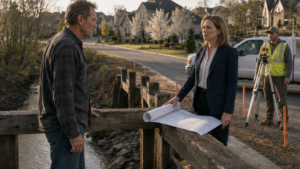
Bright survey flags rose from the mud in two rows. Some were pink, some orange, all clean enough to have been planted that morning. A man in a white pullover stood between them with his arms folded.
Jack Martin saw her coming and raised one palm toward the excavator operator.
“Hold up a minute.”
The engine remained running. Its low vibration moved through the ground beneath Samantha’s boots.
“What is this?” she asked.
Jack looked past her toward the houses. “Emergency drainage work.”
“Authorized by whom?”
“The board.”
He said it with the practiced finality of someone announcing a decision already entered into minutes. His white work shoes were almost untouched by mud. Samantha noticed that before she noticed the rolled plans beneath his arm.
Behind him, another truck released its brakes.
She opened the small notebook she carried when she walked the property. A smear of black soil transferred from her thumb across the bottom corner of the page.
“How many loads?”
Jack’s mouth tightened. “I’m not doing an interrogation out here.”
“How many?”
“Forty contracted. We’re not finished.”
Samantha looked over the wetland again. Forty loads would not merely reinforce the existing drainage path. They would raise the tract, force runoff elsewhere, and bury whatever remained beneath the fill.
“Where is the permit?”
“This is common-area maintenance.”
“That wasn’t my question.”
Jack shifted the plans under his arm. “Three houses on the south loop took water twice last year. Insurance carriers are already asking whether the association has addressed it. We’re addressing it.”
A loader drove forward and pressed its bucket into the fresh fill. Muddy water squeezed from beneath the weight.
Samantha lifted her phone and photographed the machine, the truck, the flags, and Jack standing between them.
He gave a short laugh. “You can take all the pictures you want.”
“I intend to.”
The first orange flag stood near the old drainage swale. The second appeared several feet farther west than she remembered from the recorded plat. She walked toward it, stepping carefully along a strip of undisturbed sedge.
Jack followed.
“You need to stay outside the work zone.”
“This line is wrong.”
“It was marked by the contractor.”
“That doesn’t make it right.”
He moved ahead of her and planted himself between Samantha and the flag. “You’ve complained about this tract for years. Standing water. Frogs. Mosquitoes. Now we fix it, and suddenly it’s precious.”
“I never complained about the water.”
“You complained about the smell.”
“Once, after somebody dumped grass clippings into it.”
Jack glanced at the workers, as though asking them to witness how unreasonable she was being. “The board acted under its emergency authority. You’ll receive notice with everyone else.”
Samantha crouched beside the flag. Fresh fill covered the ground around its base. She pressed two fingers into the surface and felt loose aggregate over saturated soil.
Her mind supplied the old sequence automatically: vegetation, soils, hydrology. Three categories, none decisive alone. She had spent years teaching junior staff not to treat a boundary as a colored line on a map. The ground had to be read in layers.
She straightened before Jack could see where her thoughts had gone.
“Stop the trucks until the line is verified.”
“No.”
“You may be filling outside the common tract.”
“We had it surveyed.”
“Then show me the survey.”
Jack pulled a folded sheet from beneath the plans. It was not a survey. It was a landscape rendering: a curved walking path, ornamental grasses, six parking spaces, and a narrow blue channel reduced to a decorative ribbon.
“You’re building parking?”
“Overflow access. The residents approved the concept last year.”
“They approved a concept drawing for the clubhouse.”
“They approved improving underused common space.”
The phrase landed harder than his refusal.
Underused.
Samantha looked at the flattened reeds. A dark shape moved in the shallow water near the remaining cattails and disappeared beneath a ridge of soil.
Jack tapped the page. “This will improve drainage, stabilize the ground, and add value. It’s not complicated.”
“No,” she said. “It’s only being presented that way.”
His expression cooled. He reached inside a clear folder and handed her a two-page resolution bearing the HOA seal. The board had declared recurring flooding an emergency threat to homes and common property. It authorized immediate grading, drainage correction, and soil stabilization without waiting for the next membership meeting.
Christine Brown’s signature appeared below Jack’s.
Two other board members had signed.
The resolution was real. That did not make the work lawful.
Jack watched her read. “We’ve done what we were elected to do.”
Samantha folded the pages once but did not return them. “Does this resolution mention federal or county review?”
“It doesn’t need to.”
“Does the contract identify the wetland boundary?”
He stepped closer. “You’re treating a drainage ditch like a national park.”
“I’m asking what was reviewed.”
“And I’m telling you that people have water in their basements.”
For the first time, his voice carried something other than impatience. It carried fear—not for the wetland, but for an approaching consequence he believed he could outrun.
Then the next truck sounded its horn.
Jack turned and waved it forward.
Samantha moved to the side and photographed the license plate. The truck passed close enough to spray the lower legs of her pants.
She returned home through the backyard instead of using the road. From the kitchen, she retrieved a folder of photographs taken the previous April. One showed water extending from the cattails to the maple near her fence. Another captured standing water around the orange-barked willow. The date and location were embedded in each file.
When she returned, the loader had already spread another ridge of fill.
Jack was speaking to the excavator operator. Samantha did not call to him. She aligned the spring photograph with the present landscape and took a second image showing the missing waterline.
Then she found the western flag.
Only its top remained visible. Fresh soil had buried the lower half.
She scraped the fill away with the heel of her boot. Beneath it, the ground was black and wet. The flag leaned toward her house, not away from it.
Samantha opened the county plat on her phone and measured from the rear corner pin. She checked twice.
The flag stood nearly four feet inside her recorded property boundary.
As she photographed it, the loader turned toward her.
Chapter 2: The Emergency Meeting Beside the Mud
Jack held Samantha’s spring photograph above the folding table as though it were proof against her.
“This,” he told the gathered homeowners, “is what she wants us to preserve.”
A few people laughed. Most did not. They looked past him toward the wetland, where truckloads of fill had hardened into a gray platform under portable work lights.
Jack shook the photograph once. “Standing water. Mosquitoes. Dead reeds. Meanwhile, families on the south loop are carrying ruined drywall out of their basements.”
Eric Gonzalez stood near the front with his arms crossed. His jaw tightened when Jack mentioned the flooded homes.
Samantha remained at the edge of the group, beside the orange boundary flag she had dug out two days earlier. The board had called the emergency meeting only after she emailed photographs showing the fill crossing her property line. The notice had described the issue as “resident concerns regarding temporary construction impacts.”
Temporary.
The loader tracks behind Jack were deep enough to hold rain.
Christine Brown sat at the table with a ledger and a stack of printed resolutions. She avoided Samantha’s eyes.
Jack lowered the photograph. “We can either act, or we can wait until another storm destroys more homes. The board chose to act.”
Eric stepped forward. “My basement flooded in March and again in September. We lost the furnace the second time.”
Samantha looked at him. “I’m sorry.”
He gave a humorless laugh. “Are you? Because the first thing you did was try to shut down the only work anyone’s done.”
“I tried to stop fill from crossing an unverified line.”
“You called the county.”
“I asked whether permits had been issued.”
“That’s the same thing when you know it’ll delay everything.”
Murmurs moved through the group. Samantha recognized the tone. It was not cruelty. It was the exhaustion of people who had hauled wet boxes upstairs, argued with adjusters, and learned what their policies did not cover.
Jack spread the landscape rendering across the table.
“The new grade directs surface water toward the outlet,” he said. “The reinforced base stabilizes the common tract. The overflow spaces keep vehicles off the street during events. Three problems addressed with one project.”
Samantha studied the drawing. There were arrows showing water movement but no existing elevations, no soil profile, and no delineated wetland boundary.
“This is a concept plan,” she said.
“It’s the approved plan.”
“It has no drainage calculations.”
Jack smiled without warmth. “You’re a homeowner, Samantha. Not the project engineer.”
The group quieted.
She felt the old instinct rise—the need to defend every credential, every year of work, every report she had signed before her name became something people whispered over conference tables.
She let the instinct pass.
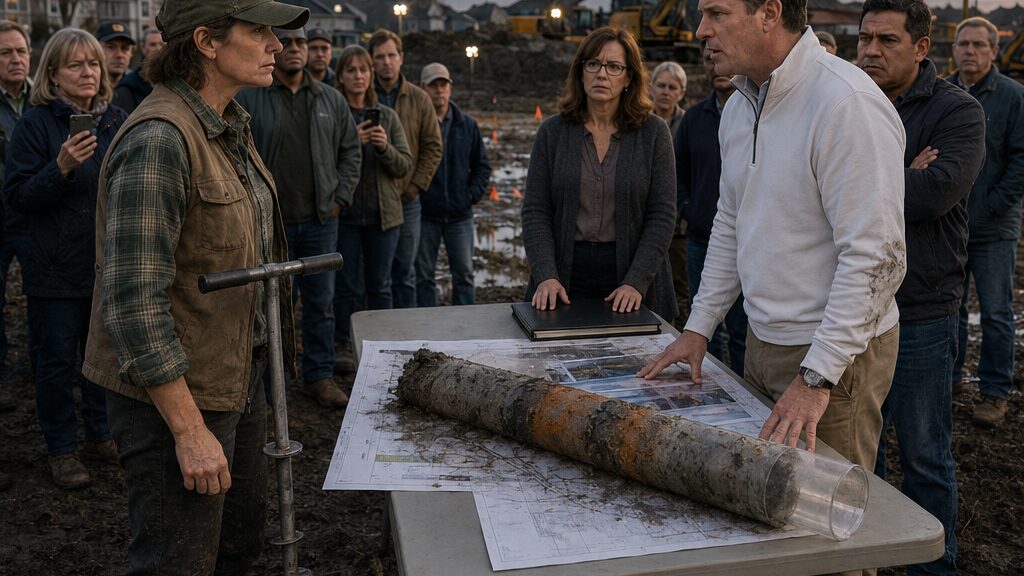
Instead, she picked up the narrow hand auger leaning against her chair.
Jack’s smile faded. “What are you doing?”
“Checking the ground you called stabilized.”
“You don’t have authorization to disturb common property.”
“You authorized forty truckloads to disturb it.”
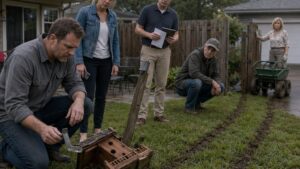
She walked three paces beyond the fresh fill, set the auger point into an undisturbed patch, and turned the handle. The first inches resisted. Below that, the tool sank more easily.
Several residents moved closer.
Samantha drew the auger out and pushed the cylindrical soil core onto the edge of the folding table. It landed partly across Jack’s glossy plan.
The upper layer was dark. Beneath it ran a gray band mottled with rusty orange stains.
Jack stared at the mud on the paper. “That proves nothing.”
“It shows depleted matrix with iron concentrations.”
Eric frowned. “In English.”
“This soil stays saturated long enough for oxygen to leave it. The gray is not surface mud from yesterday’s rain. The orange staining forms when iron moves through wet soil and oxidizes.”
Someone behind Eric asked, “So it’s a swamp?”
“It is evidence of wetland soil,” Samantha said. “Not the only evidence.”
Jack folded his arms. “You pushed a garden tool into wet ground beside a drainage ditch.”
She pointed toward the remaining cattails. “Hydrophytic vegetation.”
Then toward the shallow pooled water beyond the fill. “Surface hydrology.”
Finally, the core. “Hydric soil.”
The words came back cleanly. She had not spoken them publicly in years, yet her voice did not shake.
Jack’s certainty changed—not enough for the others to name it, but enough for Samantha to see. His chin lifted. His hands tightened beneath his arms.
She took the county plat from her folder and placed it beside the soil core.
“The orange construction line is west of the recorded common-property boundary. The fill has crossed onto my parcel. More importantly, the staked work area overlaps the wetland indicators visible on site.”
“You can’t establish a jurisdictional boundary at a neighborhood meeting,” Jack said.
“No. But you also can’t erase one with a landscaping drawing.”
A few people looked from him to the soil.
Eric leaned closer, not convinced but no longer dismissive. “Are you saying the water in my basement doesn’t matter?”
“No.”
“Then what are you saying?”
“That filling storage area can move the water somewhere else. Maybe toward my house. Maybe toward yours. Unless someone calculated it, none of us knows.”
Jack placed both palms on the table. The cuff of his white sleeve brushed the gray soil, leaving a damp streak.
“The contractor has experience.”
“Experience is not a permit.”
“The board attorney reviewed our authority.”
“HOA authority is not environmental approval.”
“You keep implying a violation.”
“I am telling you that continued discharge into a regulated wetland may be an unpermitted federal action.”
The sentence changed the meeting.
A woman near the back lowered her phone. One board member whispered to Christine. Eric’s anger narrowed into wary attention.
Jack glanced around and seemed to understand that ridicule would no longer be enough.
“What exactly qualifies you to make that claim?”
The question came softly.
Samantha looked at the soil core. For an instant she saw another sample tray under fluorescent office lights, another room where men had repeated her conclusions after removing her name.
“I know how to read the ground,” she said.
“That isn’t an answer.”
“It is the answer I’m giving tonight.”
Jack straightened. “Then here is mine. The work resumes at seven tomorrow morning. Anyone entering the marked construction area will be treated as interfering with an authorized HOA project.”
“You cannot exclude me from my own property.”
“The disputed strip will be reviewed.”
“After you bury it?”
“If necessary.”
The honesty of the answer drew a sharper silence than any insult could have.
Samantha gathered the soil core into a clear sample sleeve. She sealed it, wrote the date and location, and placed it in her folder.
Jack rolled the stained landscape plan toward himself. “Meeting adjourned.”
No one applauded. People left in small groups, speaking quietly. Eric remained near the table, staring at the wetland but not approaching her.
Samantha carried the auger toward the boundary flag. She intended to stay until the work lights were switched off.
Christine caught up with her beside the cattails.
“You named the soil type before you touched it,” she said.
Samantha kept walking.
Christine lowered her voice. “Where did you learn to read hydric soil?”
Chapter 3: The Report She Refused to Write
The unopened drainage packet was still in the locked bottom drawer of Samantha’s desk.
She found it beneath old tax records and a county field manual whose plastic cover had yellowed at the edges. The HOA envelope bore a date from eight months earlier. Christine had written Samantha’s name across the front by hand.
Samantha remembered receiving it. She had also remembered choosing not to open it.
At the time, the south-loop residents had begun complaining about runoff. Jack had asked whether she could “take a quick look” at several drainage maps before the board hired a consultant. She had told him she no longer did that work.
That had been true.
It had not been the whole truth.
She carried the packet to the kitchen table and cut the envelope open with a butter knife.
Inside were photographs of standing water near two houses, a copy of the subdivision drainage plan, and a short consultant email. The email recommended field verification before any grading near the rear common tract. It specifically noted mapped wetland potential and advised coordination with county stormwater staff.
A handwritten note in Jack’s block lettering crossed the bottom:
Review later if full project proceeds. Immediate maintenance may not require it.
Samantha read the line twice.
The packet did not prove he knew the tract was jurisdictional. It proved he had been warned the question existed.
She spread her old field charts beside photographs of the new soil core. The color values, mottling, and texture were familiar enough that her hands remembered the classification before she finished checking the guide.
Her phone rang.
Christine.
Samantha let it ring once before answering.
“I didn’t know that email was in the packet,” Christine said.
“You signed the resolution.”
“I signed what Jack presented.”
“That is not the same as reading what he presented.”
The silence on the other end sharpened.
“I came to you first,” Christine said. “Before we voted on anything.”
Samantha looked at the unopened envelope torn across the table. “I know.”
“You said you wanted no involvement.”
“I know.”
“We had residents threatening legal action. The insurance broker wanted a mitigation plan. Jack said the contractor could stabilize the tract under maintenance authority.”
“And you believed him.”
“I wanted to.”
The answer was quieter than Samantha expected.
Christine continued, “What did you do before you moved here?”
Samantha closed the soil manual.
“I worked for the county.”
“In wetlands?”
“Wetlands and stormwater review.”
“Then why didn’t you tell us?”
Because the last report she had signed had been rewritten after submission. Because a supervisor had removed her warning about downstream storage, then restored her name when the project failed. Because at the hearing, the county attorney had asked whether her original calculations had been “preliminary impressions.” Because she had answered carefully while the altered report sat in front of everyone as though it were hers.
“I left that work,” Samantha said.
“That doesn’t answer me.”
“No. It doesn’t.”
After the call, Samantha drove to the county records office.
The clerk directed her to a public terminal. She searched the subdivision parcel, the common tract, and recent permit applications. There was no grading permit under the HOA’s name. No stormwater revision. No wetland-review request.
She printed the recorded plat and the original drainage sheets.
The plan was twenty-two years old. It showed a broad shallow storage area behind the houses, connected to a narrow outlet channel. The rear tract was not decorative leftover land. It was part of the subdivision’s original water management.
In the margin, an old field notation marked seasonal saturation near the western boundary.
Samantha recognized the handwriting.
Her own.
Years before any house had been built, she had assisted with a preliminary county review of the tract. She had forgotten the subdivision name, but not the willow, the mottled clay, or the way the water collected after spring rain.
She sat back from the terminal.
The old boundary sketch matched the line she had identified beside the HOA table.
For the first time since the trucks arrived, certainty brought no relief. She had known enough eight months earlier to ask the right questions. Had she opened Christine’s packet then, the board might have stopped before the first load arrived.
A clerk placed another file beside her keyboard. “This was attached to the archived review.”
The top page was a memorandum from Samantha’s former supervisor. It had been filed after the failed county project that ended her career.
The memo described her field conclusions as “insufficiently supported” and suggested that her communication under pressure had become “rigid and adversarial.”
Samantha felt the room narrow.
The language had followed her into interviews. It had turned years of careful work into a question of temperament. She had kept a copy at home, but seeing it attached to a public file made the old humiliation immediate.
If Jack searched her employment history, he would find it.
If regulators reviewed her complaint, they might find it too.
She returned home with the plat, the old field notes, the consultant email, and the memorandum. For an hour she arranged the papers without writing anything.
Anonymous evidence would be easier. Photographs could be submitted without claiming authority. The county could inspect on its own.
But anonymous photographs would not establish the boundary. They would only ask someone else to begin where she already stood.
Samantha opened a blank report template.
She entered the date, parcel number, observed vegetation, hydrology indicators, and soil characteristics. When she reached the certification line, her hands stopped.
The empty space waited beneath the findings.
She thought of Eric’s basement. Christine’s unopened request. Jack’s white sleeve marked by the soil he had called meaningless.
Then she typed her name.
The report did not claim more than she could support. It identified preliminary wetland indicators, documented encroachment, requested an immediate field review, and warned that continued fill could alter drainage and destroy evidence.
She attached the photographs, plat, soil-core record, and consultant email. She sent copies to the county stormwater office, the board, and the HOA attorney.
The message left her outbox at 3:42 p.m.
At 3:47, Jack replied.
Your allegations are disputed. Do not enter the project area. Work will continue under the board’s emergency authority.
At 6:58 the next morning, Samantha stood behind her fence with the report printed in her hand.
The first truck arrived before seven.
Its horn sounded once. The gate opened. Fresh fill began sliding toward the line she had certified.
Chapter 4: The Flooded Homes Were Not a Lie
Eric Gonzalez opened the basement storage room and the smell reached Samantha before the light did.
Wet cardboard. Concrete dust. The sour trace of insulation that had dried without ever becoming clean again.
A brown line circled the room at knee height. It crossed the cinder-block wall, the steel shelving, and the side of a dented freezer. On the lowest shelf, plastic bins had replaced the cardboard boxes that once held family photographs and winter clothes.
“That was March,” Eric said.
He pointed higher.
“This was September.”
The second line ran nearly four inches above the first.
Samantha stood in the doorway, her notebook closed against her palm. She had expected evidence of seepage. She had not expected the furnace platform to be newly poured, or the row of children’s books fanned open across a workbench, their pages warped into stiff waves.
Eric nudged one with his finger.
“My daughter kept asking when they would flatten out.”
Samantha said nothing.
“They didn’t,” he added.
A portable dehumidifier hummed beside the wall. Its drain tube disappeared into a floor sink.
Eric folded his arms. “Jack said you wanted to see what we were protecting.”
“I asked to see where the water entered.”
“You mean you asked for proof.”
“I didn’t say that.”
“You didn’t have to.”
Samantha crouched beside the floor drain. Mineral deposits feathered across the concrete, but the darkest staining began along the rear wall, not at the drain. She followed it toward a narrow window well.
“Did water rise through the floor?”
“Some. Most came through there.”
He pointed to the wall-floor joint beneath the window.
“During which storms?”
“The two big ones.”
“Any flooding before last year?”
“Minor seepage. Nothing like this.”
She walked the perimeter, noting repaired cracks, new sealant, and the location of the downspout outside. Eric watched every mark she made as though each one might become an argument against him.
“Jack told us the rear tract had stopped draining,” he said. “He said it was holding water too close to the houses.”
“The wetland is supposed to hold water.”
“Not in my basement.”
“No.”
The answer startled him.
Samantha met his eyes. “Water in your basement is damage. I’m not disputing that.”
His arms loosened slightly.
“I am disputing the claim that filling the storage area automatically fixes it.”
“He showed us the arrows.”
“On a concept plan.”
“He showed us elevations.”
“General ones.”
Eric looked toward the stained books. “You keep saying what isn’t enough. What would have been enough?”
“A current drainage survey. Outlet inspection. Calculations showing where the displaced water would go. Wetland review before grading.”
“And while all that happened?”
“You would still deserve temporary protection.”
“Sandbags?”
“Sump backup. Outlet clearing. Temporary diversion that doesn’t bury the storage basin.”
“Easy to say now.”
The words landed because they were true.
Samantha looked at the mud line again. “Christine asked me to review the drainage packet months ago.”
Eric’s expression changed. “You knew about this?”
“I knew people were reporting flooding. I did not review the packet.”
“Why?”
She could have given him the safe answer: she had left the profession; the HOA should have hired its own consultant; informal advice created liability.
All of those things were true.
None were sufficient.
“I didn’t want to be involved.”
Eric stared at her. The dehumidifier clicked off, and the room seemed suddenly smaller.
“So while we were ripping out drywall, you decided involvement was inconvenient.”
“I decided I didn’t trust what would happen if I put my name on another drainage problem.”
“That sounds better to you?”
“No.”
He turned away, jaw working. When he spoke again, his voice had lowered.
“Jack showed up the night of the second flood. He helped carry the furnace parts upstairs. He called the adjuster before I did. Maybe he cut corners. But he was here.”
Samantha looked at the water lines.
That was the piece she had refused to imagine. Jack had not invented the residents’ fear. He had stepped into a vacuum she had helped leave.
Outside, Eric led her along the side yard. The downspout discharged toward a shallow swale that should have carried water behind the houses. Instead, leaves and sediment had packed the channel nearly level with the lawn.
Farther downhill, a corrugated outlet pipe vanished beneath a tangle of roots and construction debris.
Samantha knelt and shone her flashlight through the opening. Less than a third of it was clear.
“This is blocked,” she said.
Eric crouched beside her. “Completely?”
“Not completely. Enough to back up runoff during heavy rain.”
He scraped at the debris with a stick. Water collected behind it in a dark pocket.
“Would clearing this have stopped the floods?”
“I can’t promise that.”
“Would it have helped?”
“Yes.”
He sat back on his heels.
Jack’s explanation had depended on a single cause: the wetland held too much water. But the original drainage design was undersized, the outlet had been neglected, and the houses had less margin than anyone had admitted.
Samantha photographed the blockage and the elevation between the swale and Eric’s foundation.
“Why didn’t the contractor inspect this?” he asked.
“That’s a question for the board.”
They drove separately to the HOA office. Jack was already there with Christine and the two board members. A large rendering of the completed project leaned against the wall.
Jack looked from Eric to Samantha. “I assume she told you your basement isn’t relevant.”
Eric placed his muddy stick on the conference table.
“She found the outlet blocked.”
Jack glanced at it. “The project includes outlet work.”
“It wasn’t in the plan you showed us,” Samantha said.
“It’s field adjustment.”
“Then where is the revised scope?”
Jack ignored her and addressed Eric. “The fill has already stabilized the worst section. The contractor confirmed it yesterday.”
Samantha looked at the rendering. “Confirmed how?”
“Compaction testing.”
“On the fill?”
“Of course.”
“What about the saturated subsoil beneath it?”
Jack’s irritation sharpened. “The base was prepared.”
“Was unsuitable material removed?”
“The contractor knows what he’s doing.”
“That is not an answer.”
Christine leaned forward. “Jack, was there a geotechnical review?”
“The retaining foundation is not a residence.”
“That wasn’t her question either,” Christine said.
A faint sound came from outside. Not loud—more like a stone shifting under pressure.
They moved to the window.
Beyond the parking lot, the new concrete retaining foundation ran along the raised edge of the filled tract. A thin dark line had appeared near one corner. As Samantha watched, water beaded from it and traced downward.
They crossed the lot quickly.
Jack reached the foundation first. He wiped the damp line with his thumb. The concrete was only days old, pale and smooth except for the crack descending from the top edge.
“It’s superficial,” he said.
Samantha crouched and pressed her fingertips to the soil at the base. Water welled around them.
Eric stood behind her. “Is that supposed to happen?”
“No.”
Jack’s white shoes sank slightly as he stepped closer.
The crack gave a soft, dry tick and lengthened another inch.
Chapter 5: The Warning Hidden in the Board Packet
Christine found the missing attachment because the page numbers jumped from twelve to fourteen.
She stood in the HOA records room with the emergency-resolution packet open across a metal cabinet. Samantha had come expecting meeting minutes and invoices. Instead, Christine held page fourteen in one hand and stared at the empty space where thirteen should have been.
“It was complete when the consultant emailed it,” she said.
“How do you know?”
“The index lists fourteen pages.”
Shelves crowded the narrow room. Old newsletters, reserve studies, landscaping bids, and insurance correspondence filled mismatched binders. The air smelled of paper and overheated toner.
Christine opened the digital archive on the office computer. The consultant’s original message contained three attachments. The packet distributed before the board vote contained only two.
She clicked the third.
The missing document was a two-page site caution memorandum.
Samantha read it standing beside her.
The consultant had not delineated the wetland, but had identified mapped hydric soils, seasonal water storage, and uncertain outlet capacity. The recommendation was explicit: suspend permanent grading near the rear tract until permitting requirements and alternative drainage measures were evaluated.
At the bottom of the second page, someone had highlighted one sentence:
This review may extend the project schedule by several months.
Christine lowered herself into the desk chair.
“I signed the resolution the next morning.”
“Did Jack send the packet?”
“Yes.”
“Did anyone else have access?”
“The property manager could have assembled it. The attorney’s office sometimes removes drafts.”
“But this wasn’t a draft.”
“No.”
Samantha placed the sealed soil sample bag beside the memorandum and clipped them together. Gray clay pressed against the plastic, streaked with orange.
Christine watched her label the documents.
“What happens if I give you this?”
“You don’t give it to me. You preserve it in the association record.”
“And then?”
“We disclose it to the inspector.”
Christine looked toward the closed door. “The reserve account can’t absorb a restoration order.”
“That doesn’t change what the record says.”
“It changes what happens to everyone who lives here.”
“The fill already changed that.”
“You make it sound simple.”
“I don’t think it is simple.”
“Then stop talking like the paperwork is separate from people.”
Samantha’s hand paused over the evidence label.
Christine’s face had gone pale. She was not defending Jack now. She was calculating roofs postponed, sidewalks unrepaired, monthly dues raised for retirees who already counted every increase.
“I approved an emergency project because three families had repeated flooding,” Christine said. “I believed delay created more risk than action.”
“That was understandable.”
“It wasn’t careful.”
“No.”
Christine shut her eyes briefly. “I kept telling myself the attorney would catch anything serious.”
Samantha understood the wish. Authority passed upward until responsibility disappeared.
The office door opened.
Jack entered without knocking.
He saw the memorandum on the desk and stopped.
For several seconds, none of them spoke.
Christine lifted the paper. “Why wasn’t this in the board packet?”
Jack closed the door behind him. “Because it wasn’t a final engineering opinion.”
“It was part of the consultant’s submission.”
“It was a caution note based on database mapping. No field work.”
“You removed it.”
“I removed an alarmist preliminary attachment from an emergency maintenance decision.”
Samantha studied him. He was not surprised the document existed. He was only angry that it had returned.
“You knew review could delay the project,” she said.
“Everyone knew permitting could delay it.”
“Yet you told residents no outside review was required.”
Jack set his keys on the cabinet. “The financing window for the expansion closes at the end of the quarter.”
Christine stared at him. “What financing?”
“The clubhouse accessibility work, parking improvements, and drainage package were priced together.”
“The board approved concept development, not a construction loan.”
“The lender required demonstrated site progress before final release.”
Samantha saw the shape of it then. The overflow lot was not a side benefit. It was part of the collateral package supporting the larger development contract. Stop the fill, and Jack did not merely face angry residents. He faced a stalled project, expiring bids, and a lender questioning whether he controlled the site he had promised.
“How much are you exposed?” Christine asked.
Jack looked at her, then away. “Personally? Enough.”
“You signed a personal guarantee?”
“The association wasn’t the borrower.”
Christine rose. “You tied our common area to your development financing?”
“I advanced funds because the board could not wait through another budget cycle.”
“Without disclosing the guarantee?”
“I disclosed the arrangement to counsel.”
“That is not the same as disclosing it to us.”
His restraint cracked. “You wanted the flooding fixed. Eric wanted the flooding fixed. Every meeting for six months was residents demanding action. Now everyone wants to pretend I invented the urgency.”
“No one said that,” Samantha said.
“You did, the moment you called regulators.”
“I said your solution was unreviewed.”
“And your solution was what? Another year of studies?”
“Clear the outlet. Install temporary controls. Calculate the system.”
“While insurance nonrenewals spread house by house?”
He stepped closer to the desk. Mud had dried in the seams of his white shoes.
“I had a contractor ready, residents demanding results, and a project that could solve drainage and fund improvements the association could not otherwise afford. The consultant would have buried us in review.”
“So you buried the tract instead,” Samantha said.
His face hardened.
That choice—not the pressure, not the fear—was where responsibility settled.
Jack reached for the memorandum. Christine placed her hand over it.
“No,” she said.
His eyes moved to hers.
“This stays in the record.”
“You are creating liability.”
“The liability already exists.”
“You signed the resolution.”
“I know.”
Christine’s voice broke on the last word, but her hand did not move.
By afternoon, Samantha had scanned the memorandum, preserved the email metadata, and added it to her county submission. She was careful not to call it proof of intentional violation. It proved notice of risk, omission from the board packet, and the need for investigation.
At four, the HOA attorney sent her a formal letter.
It stated that the construction area remained association-controlled common property; that unauthorized entry could expose her to injury and liability; and that her continued collection of samples might constitute interference with contracted operations.
The letter instructed her not to cross the temporary barriers.
Samantha read it twice at the wetland edge.
The most important sampling point lay beyond the barrier Jack had moved that morning.
Christine joined her carrying a records box.
“The board attorney copied me,” she said.
“He’s trying to cut off access.”
“He says the disputed strip is under association control until a survey resolves it.”
“My deed says otherwise.”
“Your deed doesn’t stop a contractor.”
A diesel engine sounded from the subdivision entrance.
Another dump truck turned onto the service lane.
Jack walked beside it, signaling the driver forward. Behind the truck, a county vehicle entered with amber lights flashing.
The stormwater inspector stepped out before the gate had fully opened.
Chapter 6: The Line the Board Could Not Move
The county inspector asked Samantha to state her qualifications while Jack stood close enough to hear every word.
They had gathered beside the folding table at the wetland edge. A federal regulator had joined the inspection after reviewing Samantha’s submission, and the HOA attorney waited near the barrier with a legal pad tucked under one arm.
The dump truck remained idling at the gate.
Samantha looked at the recorder clipped to the inspector’s vest.
“My name is Samantha Harris. I worked eleven years in county wetland and stormwater review. My duties included field identification, preliminary delineation support, drainage-plan review, and compliance documentation.”
Jack made a small sound behind her.
The inspector glanced at him. “You’ll have an opportunity to respond.”
Jack lifted both hands. “I only want the record to be complete.”
Samantha knew what was coming.
The old memorandum lay inside Jack’s folder. She could see its yellow county header.
The federal regulator gestured toward the preserved soil sleeve. “Did you collect that sample?”
“Yes.”
“Under what protocol?”
She described the location, depth, field conditions, labeling, photographs, and storage. Her voice settled as she spoke. The sequence was familiar: methods first, conclusions second, limitations always stated.
The regulator split the preserved core lengthwise with a clean sampling knife. Beside it, he placed a fresh core he had taken from the undisturbed area that morning.
The layers matched.
Dark surface soil. Gray matrix. Orange concentrations following old root channels.
He pressed the tip of his pen against the gray band. “This is consistent with prolonged saturation.”
Jack stepped forward. “Consistent is not conclusive.”
“No single indicator is conclusive by itself,” Samantha said.
The regulator looked toward the cattails and pooled water. “Which is why we evaluate all three categories.”
The county inspector unfolded the original drainage plan. “The rear tract is also shown as stormwater storage.”
“Our contractor maintained that function,” Jack said.
“By raising the grade?”
“By redirecting water to the outlet.”
“The blocked outlet?” the inspector asked.
Jack turned toward Christine. “That was scheduled for clearing.”
“No work order was issued,” Christine said.
The attorney spoke quietly to Jack, but he shook his head.
The inspector walked the western line with the recorded plat, a measuring wheel, and the association’s construction drawing. Samantha followed only when invited. At the buried orange flag, he stopped.
“This flag is inside the Harris parcel.”
“The contractor relied on field marking,” Jack said.
“Whose field marking?”
Jack did not answer immediately.
The excavator operator, standing several yards away, looked toward the machine.
The inspector asked again.
“The project manager’s,” Jack said.
“You were acting as project manager?”
“I coordinated the work.”
The admission entered the recorder without emphasis.
They moved toward the retaining foundation. The crack from two days earlier had widened enough to hold the edge of a coin. Damp soil bulged beneath one section.
The federal regulator examined the pooled water behind the wall. “Was unsuitable subgrade removed?”
Jack pointed toward the contractor. “Compaction tests were performed.”
“On imported fill,” Samantha said. “Not the saturated layer below it.”
Jack turned on her. “You are not the engineer of record.”
“No. I’m describing what is visible.”
“You always do that,” he said. “You state an observation in a way that implies a conclusion, then step back when someone asks you to own it.”
The words were too precise to be accidental.
He opened his folder and removed the former supervisor’s memorandum.
Christine inhaled sharply.
Jack handed it to the inspector. “For completeness. Ms. Harris left county service after questions arose about the support for her field conclusions and her conduct under review.”
The old language looked smaller in the inspector’s hands than it had on the records-office screen.
Samantha felt the familiar pressure behind her ribs. She could dispute the memo line by line. She could explain who altered the report, who restored her name, who benefited from calling her rigid after ignoring her calculations.
Instead, she looked at the recorder.
“That memorandum followed a project where my findings were changed after submission,” she said. “I objected publicly. The final report carried my name even though portions were not mine.”
The inspector waited.
“I became defensive,” Samantha continued. “I communicated badly in the hearing. I left because I no longer trusted the county to preserve my work.”
Jack crossed his arms.
She looked toward Eric, who had joined the residents behind the barrier.
“Months ago, this HOA asked me to review its drainage packet. I refused. I did not explain my experience or my concerns. That was my choice, and it contributed to the board acting without information I could have raised earlier.”
A murmur passed through the residents.
Jack’s expression shifted. He had expected denial, not admission.
Samantha faced the inspector again. “None of that changes the field indicators. It does explain why I am identifying my limits and signing my conclusions now.”
The federal regulator tapped the two matching cores.
“Her methods are reproducible,” he said. “We have independently observed hydric soil, wetland vegetation, and surface hydrology. Final jurisdictional review will proceed through the agency, but no additional fill should be discharged pending that determination.”
The county inspector nodded. “I am issuing a temporary stop-work order for grading and structural work within the rear tract.”
The truck engine shut off at the gate.
The sudden quiet spread across the neighborhood.
Eric exhaled. Christine gripped the records box against her chest.
Jack looked at the inspector. “Temporary means the work can resume after revised plans.”
“It means work stops now,” the inspector said.
“We can pull back from the flagged area. Regrade the western edge. Submit modifications.”
“Possibly,” the inspector said. “The county order does not determine federal restoration obligations.”
That distinction moved through the group more slowly.
A stop order was not victory. It did not remove the fill. It did not restore storage. It did not solve Eric’s basement or the association’s financial exposure.
Jack understood it first.
He turned to Samantha. “You’ve stopped the only active flood project we had.”
“I stopped this project.”
“And when the next storm comes?”
“We clear the outlet immediately. We install temporary protection. Then we design a system that works.”
“With what money?”
“The same community money that will pay more if the foundation fails.”
“You think a regulator will design it for us?”
“No.”
“Then what exactly have you accomplished?”
Samantha looked at the wetland. The gray fill covered most of the spring waterline. Tire tracks crossed her boundary. The remaining cattails leaned beneath dust.
“I made it impossible to keep pretending the question was settled.”
Jack laughed once, without humor. “That will be comforting when somebody’s basement floods.”
Eric stepped forward from the residents. “She found the blocked outlet.”
Jack looked at him.
“She also admitted she should have helped earlier,” Eric said. “You haven’t admitted anything.”
The words did not turn the crowd. There was no applause. But the alignment had changed.
The county inspector posted the stop-work notice on the temporary barrier. The federal regulator sealed portions of both soil cores and gave Samantha a receipt for the retained sample.
As the officials packed their equipment, Christine approached Samantha.
“The board will need an emergency meeting.”
“Yes.”
“The attorney says we should challenge the order.”
“Then ask him what happens if the jurisdictional finding goes against us.”
Christine nodded, already calculating.
Near the foundation, Jack stood alone. His white shoes were now streaked dark along the sides. He stared at the crack as if concentration might close it.
A bead of water emerged halfway down the concrete face.
Then another.
The line widened with a faint pop. Muddy water pushed through and ran over Jack’s shoe before spreading across the newly compacted ground.
Chapter 7: Every Yard of Fill Came Back Out
The first excavator bucket broke into the gray platform six weeks after the stop-work order.
Its teeth lifted a compacted slab of fill and exposed black, shining soil beneath it. Water gathered immediately in the depression, as if the ground had been waiting under pressure for permission to breathe.
Samantha stood behind the temporary fence with the restoration plan folded beneath one arm. The machinery was the same size as the equipment that had buried the tract, but the work moved differently now. Each load was measured. Each truck carried a manifest. A regulator photographed the excavation depth before another section could be removed.
Nothing happened quickly enough for the residents watching from the sidewalk.
“Six months of disruption,” someone said behind her.
“And higher dues,” another answered.
Christine Brown had posted the special assessment the previous week. It covered the first phase of fill removal, engineering review, temporary flood protection, and legal costs. Even divided across the subdivision, the amount hurt.
There had been no clean victory meeting. No moment when everyone decided Samantha had been right and therefore the cost no longer mattered.
Several residents still avoided her.
Jack Martin had resigned as HOA president after the board removed him from all project authority. He remained responsible for portions of the private financing tied to the failed expansion, though the exact settlement was still being negotiated through attorneys. He had not attended the last two community meetings.
He was present that morning.
Jack stood near the abandoned retaining foundation, hands in the pockets of an old brown jacket. He wore work boots instead of white shoes.
Beside the concrete wall sat the pair he had ruined during the inspection. Mud had dried over the leather, darkening the seams. Samantha did not know why he had left them there. Perhaps the crew had found them in the site trailer. Perhaps he had brought them himself.
The excavator lifted another load.
Under the imported gravel, a buried orange flag emerged twisted around a root. The operator stopped. The regulator stepped forward and marked the location.
Samantha recognized it as one of the original wetland indicators, not the misplaced construction flag near her property.
The regulator called her over.
She entered through the controlled access point and knelt beside the exposed soil. The gray layer was intact beneath the compressed surface, though several root channels had been crushed.
“Recovery potential?” he asked.
“Moderate,” she said. “If the grade is restored and the outlet work doesn’t drain it too aggressively.”
He nodded and wrote the assessment down.
Months earlier, Samantha would have softened the answer or added three qualifications before allowing anyone to attach her name to it. Now she stated what the ground supported and stopped there.
Across the tract, Eric Gonzalez was speaking with the drainage engineer beside the cleared outlet. The blocked pipe had been opened within days of the inspection, and temporary pumps and backflow controls had been installed before the next major storm.
That storm had come hard.
Water had risen along the south loop but had not entered Eric’s basement.
It was not proof that the final design would work. It was proof that filling the wetland had never been the only available response.
At noon, the restoration crew paused. Residents crossed to the clubhouse for the drainage meeting, carrying folding chairs and paper cups of coffee.
The new plan covered three tables.
It preserved the wetland storage area, replaced the undersized outlet, added a controlled overflow channel, and established individual protection measures for the lowest homes. The overflow parking spaces were gone. So was the decorative walking path.
The engineer pointed to the revised elevations.
“This approach does not eliminate flood risk,” he said. “No responsible plan can promise that. It reduces the obstruction at the outlet, preserves storage capacity, and limits how quickly water reaches the south-loop foundations.”
One resident raised a hand. “Why wasn’t this plan offered first?”
The engineer glanced toward Christine.
“Because a full analysis was not completed first.”
The answer settled heavily over the room.
Christine stood at the end of the table with the association ledger open before her.
“The board has adopted a new review policy,” she said. “Any project involving drainage, grading, structural work, or mapped environmental features will require independent technical review before funds are committed.”
A man near the door asked, “Independent from whom?”
“From the person proposing the project. From the contractor performing it. And from any board member with a financial interest.”
No one needed Jack’s name added.
Christine continued. “The full record of the failed project, including the omitted consultant memorandum, is available to every homeowner.”
Her voice remained steady, but Samantha saw the effort in the way she held the edge of the ledger.
The meeting moved to the assessment schedule. Complaints sharpened. A retired homeowner asked how she was expected to absorb another monthly increase. A family wanted to know why residents who had opposed the fill had to share the restoration cost.
Christine did not hide behind the attorney.
“The association authorized the work,” she said. “The association bears responsibility. We are pursuing recovery where possible, but waiting for that process would delay restoration.”
“That means we pay for Jack’s decision,” someone said.
“It means we pay for a board decision we allowed to proceed without adequate review.”
The room quieted—not in agreement, but in recognition.
Eric stood near the drainage plan, turning a pencil between his fingers.
“I supported the fill,” he said.
Several heads turned.
“I wanted something done. I still think the board waited too long before acting on the flooding.” He looked toward Samantha. “And she waited too long to tell us what she knew.”
Samantha did not look away.
Eric placed the pencil on the plan.
“But this design protects the outlet and keeps the storage area. The temporary work already helped my house. I support moving forward.”
It was not an apology. She was grateful it was not.
After the meeting, he found her outside.
“My daughter threw those books away,” he said.
Samantha remembered the swollen pages in his basement.
“I’m sorry.”
“She kept one. The cover peeled off, but she said it still had the whole story inside.”
He gave a small, tired smile.
“I thought you cared more about frogs than families.”
“I made it easy to think that.”
He nodded. “Jack made it easy to think there was one solution.”
They stood watching trucks carry the fill away.
By early spring, the retaining foundation had been removed. The cracked sections were broken apart and hauled off under separate manifests. The fill platform disappeared load by load until the original shallow basin returned.
Restoration did not make the tract look untouched.
The soil bore excavator tracks. Some cattails never returned. A section near the western edge required reseeding and erosion matting. Orange monitoring stakes remained at fixed intervals, each one tied to months of inspections still ahead.
Samantha worked with the engineer and restoration team, but she refused Christine’s suggestion that she chair the new technical committee.
“I’ll review the wetland monitoring,” she said. “I won’t become the answer to every board decision.”
Christine accepted that after a pause.
“You could have made this easier for us,” she said.
“I know.”
“And we could have asked better questions.”
“Yes.”
That was as close as either of them came to absolution.
On the first warm afternoon of March, Samantha took the final archived soil core from her refrigerator. The regulatory case no longer required her portion. The agency had retained its own samples, photographs, and field records.
She carried the sleeve to the restored bank.
The core had lost its clean cylindrical shape. Dark surface soil had collapsed against the gray center, and the iron stains had blurred along the plastic. Months earlier, she had treated it as proof that could speak where she would not.
Now it looked less like evidence than memory: compressed, incomplete, still truthful.
She opened the sleeve and returned the soil to the shallow hole where she had first sampled it.
Water moved slowly around the edge.
A cluster of new cattail shoots stood several feet away, no taller than her hand. They were too young to hide the monitoring stakes or the scar where the foundation had been.
Jack stood on the far side of the former construction area.
He had come alone. For a while he said nothing.
“The lender took the expansion property,” he said at last.
Samantha pressed the loose soil flat with her palm.
“I heard.”
“The association may recover some of the advance.”
“I heard that too.”
He looked toward the south-loop houses. “The outlet work should have been done first.”
“Yes.”
“I thought if I waited, people would say I was useless.”
Samantha wiped mud from her hand onto a cloth.
“So you made delay the enemy.”
“And you made involvement the enemy.”
The words were not cruel. That made them harder to dismiss.
“Yes,” she said.
Jack looked at the returning water.
“I still don’t think that tract is beautiful.”
“It doesn’t need to be.”
He nodded once.
No apology followed. No request for forgiveness. He walked back toward the road, leaving the stained white shoes beside the place where the foundation had stood.
Samantha remained until the water covered the soil she had returned.
Near the new cattails, a frog moved beneath the surface and sent a small ring outward. The circle touched an orange monitoring stake, widened across the shallow basin, and disappeared into the open channel leading away from the houses.
The story has ended.