The HOA Threatened His Garage Until an Old Survey Put Their Clubhouse on His Land
Chapter 1: The Tape Measure Crossed an Older Mark
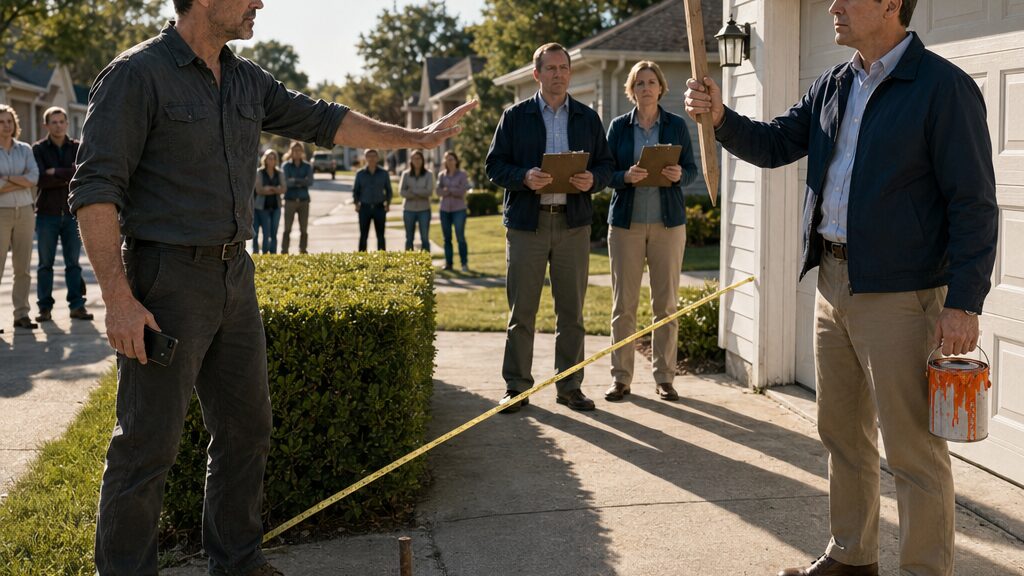
The metal tip of Patrick Hall’s tape measure struck the garage wall with a sharp click.
“Two feet,” Patrick said.
Richard Carter stood at the edge of his driveway with his coffee cooling in one hand. Patrick had arrived before eight, wearing pressed khakis and a navy windbreaker embroidered with the Maple Ridge association crest. Two board members waited behind him with clipboards. Across the street, a garage door had stopped halfway open. Farther down, a neighbor pretended to pull weeds from an empty flower bed.
Richard looked at the yellow tape stretched from the hedge to the pale siding of his detached garage.
“Two feet from what?”
Patrick kept his eyes on the markings. “From the association boundary.”
“That wasn’t my question.”
One of the board members shifted her clipboard against her chest. Patrick rewound six inches, checked the number again, then smiled as though patience were a service he was providing.
“The approved site map is clear.”
“Is it a recorded survey?”
Patrick’s smile held, but something behind it tightened.
The garage had stood there for eleven years, built by the previous owner and listed in the sale documents Richard and Linda had signed. Nobody had challenged it during the purchase, the appraisal, or the years of annual HOA inspections. Patrick had been president for four months.
He stepped over the narrow strip of grass near the hedge and pulled the tape straight again.
“The structure interferes with community spacing standards,” he said. “We’ve had concerns about visual consistency.”
“From whom?”
“That isn’t relevant to the measurement.”
Richard set his coffee on the mailbox post. “It’s relevant if you’re measuring a property line.”
Patrick turned toward the board members. “We’re documenting existing conditions. That’s all.”
Then he took a can of orange marking paint from a canvas bag.
Richard moved before Patrick could press the nozzle.
“Don’t spray my driveway.”
Patrick paused with his index finger resting on the cap. “This is temporary.”
“It’s still my driveway.”
“It marks the point of noncompliance.”
“You haven’t established the point.”
The garage door behind Richard was closed. Linda’s flowerpots stood along the side wall, their red geraniums catching the low morning light. The scene should have felt ordinary. Instead, every object seemed to have become evidence.
Patrick lowered the can but did not put it away.
“Richard, this doesn’t need to become adversarial.”
“You brought two witnesses and marking paint to my house before breakfast.”
“They’re board members.”
“That doesn’t make them surveyors.”
A quiet cough came from across the street. Richard did not look toward it. He could feel the attention gathering—the small, disciplined stillness of people who wanted to watch without being seen watching.
Patrick walked toward the hedge, dragging the tape across the grass. Its metal edge passed over a small circle of rust near the soil.
Richard noticed it because the tape snagged.
He crouched.
Beneath a crust of dirt and dead leaves was the top of an iron pin, no wider than his thumb. He had seen it before while trimming the hedge and assumed it was an old piece of fencing. A faint groove ran across the metal cap.
Patrick tugged the tape free.
“What is that?” Richard asked.
“Old landscaping hardware, probably.”
“You know that?”
Patrick gave the tape another pull. “It isn’t on our map.”
Richard took out his phone and photographed the pin before anyone could step on it.
One of the board members moved closer. “Could that be a survey marker?”
Patrick answered before Richard could.
“Not one relevant to the current layout.”
“Which recorded survey shows the current layout?” Richard asked again.
Patrick’s jaw shifted.
He walked back to the driveway, bent, and sprayed a short orange line on the concrete.
The hiss lasted less than a second.
Richard stared at the mark.
Patrick straightened. “That is the association’s position.”
“You just painted my property after I told you not to.”
“It can be removed.”
“So can an unsupported violation notice.”
The second board member looked down at his clipboard.
Patrick capped the paint. “You’ll receive formal notice. You’ll have an opportunity to respond through the normal process.”
“What recording number is on the survey?”
“The board uses the approved site plan.”
“That wasn’t the question either.”
For the first time, Patrick’s voice lost its polished softness.
“You’ve lived here long enough to understand that the association has a duty to enforce standards consistently.”
Richard looked at the orange mark, the measuring tape, and the old iron pin half hidden under the hedge. Consistency was not what he saw. He saw a man deciding where the line was because he had arrived carrying the tools.
“Then enforce them with the correct documents.”
Patrick snapped the tape into its case.
“We’ll send everything by Friday.”
The board members followed him toward the sidewalk. One of them glanced back at the garage, then at the pin Richard had uncovered. Patrick did not.
By the time their car doors closed, three neighbors had found reasons to be outside.
Gary Mitchell stood at the end of his driveway with a folded newspaper under one arm. He had lived two houses down since before Richard and Linda moved in. He raised one hand, but the gesture stopped before it became a wave.
Richard picked up his coffee. It had gone cold.
Linda opened the front door.
“What happened?”
He looked at the orange line Patrick had left across the driveway.
“He says the garage is over the property line.”
“Is it?”
Richard glanced toward the hedge.
“I don’t know yet.”
Linda wrapped her arms against the morning chill. “What was that thing in the ground?”
“Maybe nothing.”
He said it too quickly.
Inside the house, his work phone began ringing. A shipment had missed a transfer window in Ohio, and three drivers were waiting for new instructions. Richard went in, answered the call, and spent the next forty minutes tracing routes and correcting paperwork. It was work he understood. Every delay had a time stamp. Every trailer had a number. Every claim had a record.
When he returned outside, the driveway was empty except for the orange paint.
He knelt by the hedge again and cleared more dirt from the iron pin with the edge of an old screwdriver. The groove on its cap was not random. It formed a small cross.
He photographed it from three angles, then measured its distance from the garage wall.
The result made no sense against Patrick’s orange mark.
At noon, Richard searched the county property database from his office. His deed appeared. The parcel number appeared. A simple boundary sketch appeared, too small and clean to show the pin or the garage.
He searched the HOA website.
The “approved site map” was posted under landscaping documents. It showed lawns, common paths, sprinkler zones, and the clubhouse footprint. In one corner, a faint line ran beside Richard’s lot.
There was no surveyor’s seal.
No recording number.
No legal description.
Just the association logo and a revision date from six years earlier.
Richard downloaded the file before returning to work.
That evening Patrick sent a short email: Formal enforcement materials will be delivered by the end of the week. Please refrain from altering boundary markers pending review.
Richard read the sentence twice.
Boundary markers.
That morning Patrick had called the iron pin irrelevant landscaping hardware. Now he was warning Richard not to alter it.
Richard printed the email and placed it beside the photograph of the pin.
On Friday, Patrick had promised to send a formal notice.
Richard no longer wondered only whether the garage crossed the line.
He wanted to know why Patrick was already changing the language.
Chapter 2: The Certified Letter Changed Their Marriage
“Lien,” Linda said.
Then, after reading the paragraph again, she said it a second time.
“Lien.”
The certified envelope lay open between them on the kitchen table. Its green delivery slip was folded beneath four pages of association letterhead. Through the window behind Linda, Patrick’s orange mark remained visible on the driveway, bright against the concrete.
Richard took the notice from her.
The first page listed the alleged violation. The second imposed a $2,000 fine. The third gave them fourteen days to submit a correction plan. The fourth warned that continued noncompliance could result in legal action and a lien against the property.
Linda sat down slowly.
“They can put a claim against the house?”
“They’re saying they can.”
“That isn’t what I asked.”
Richard reread the legal paragraph. The language was careful. May pursue. May assess. May record. It was written to sound inevitable without promising exactly what would happen.
“We have a hearing process,” he said.
“In fourteen days?”
“That’s the correction deadline.”
“And after that?”
“They escalate.”
Linda pushed the letter toward him. “Then we take the garage down.”
Richard looked at her.
“We don’t even know if it’s wrong.”
“We know they’re threatening the house.”
“It isn’t that simple.”
“It feels simple from where I’m sitting.”
She stood and crossed to the sink. The garden outside had begun to lose its summer color, but she still checked the soil every morning and turned the pots so each side received light. Richard knew how carefully she maintained small things. He also knew why the word lien had frightened her. Their savings could absorb a repair, perhaps a legal consultation. It could not absorb a long fight without changing everything else.
“We paid for that garage when we bought the house,” he said. “It was in the appraisal.”
“And if the appraisal was wrong?”
“Then I’ll find that out.”
“You said the same thing Tuesday.”
“It’s Friday.”
“Exactly.”
He flattened the pages on the table.
The notice cited Article Seven of the community covenants and a rule governing setbacks from common property. It referred to the “association-approved boundary map” twice.
No survey was attached.
No recording number appeared in the footnotes.
No licensed professional was named.
Richard pulled the site map from his folder and placed it beside the notice. The clean printed line looked authoritative until he studied what was missing.
Linda watched him.
“What are you looking for?”
“The source.”
“The source of what?”
“The boundary they’re enforcing.”
She returned to the table. “Isn’t that the map?”
“It’s a landscaping map. It shows sprinkler zones.”
“It shows our lot.”
“It shows where someone decided to draw our lot.”
She rubbed her forehead. “Richard, please don’t turn this into one of your work problems.”
“What does that mean?”
“It means you think if you trace every paper far enough, the problem has to become reasonable.”
“At least paper leaves a trail.”
“People live in the meantime.”
He folded the notice and slid it back into the envelope.
Linda stared at him. “That’s what you do when you’ve decided the conversation is over.”
“I haven’t decided anything.”
“You folded it.”
“It was in the way.”
She gave a quiet, humorless laugh. “Fine. Unfold it, then.”
He did not.
For three nights, Richard slept badly. He lay beside Linda listening to the furnace cycle and imagined a county filing attached to their address. His father had ignored official notices when Richard was seventeen—tax letters, supplier demands, a bank warning—stacking them unopened in a desk drawer until the family hardware store closed. Richard still remembered carrying boxes out under a sign someone else had already bought.
He had promised himself that no paper would ever surprise him that way.
Saturday morning, he measured the garage himself. He worked from the iron pin toward the corner of the structure, then from the driveway to the hedge. He repeated the numbers until they matched.
The measurements did not tell him where the legal line was.
They only proved that Patrick’s orange mark depended entirely on where Patrick had chosen to begin.
Gary Mitchell walked past with his dog. Usually he stopped to complain about college football or ask whether Richard had seen the latest dues increase. This time he shortened the leash and nodded without slowing.
“Morning.”
“Gary.”
The dog pulled toward the hedge and sniffed near the iron pin. Gary tugged it away.
“You know anything about that marker?” Richard asked.
Gary looked down.
“No.”
The answer came too fast.
“You were treasurer when the site map was revised.”
“That was years ago.”
“I’m asking about the pin.”
Gary adjusted his grip on the leash. “You should probably let the board handle the boundary.”
“They’re handling it with orange paint.”
“I don’t want to be in the middle.”
“You’re already standing in it.”
Gary’s expression hardened, not with anger but discomfort. “Talk to Patrick.”
Then he walked on.
That afternoon Linda found Richard at the garage workbench with the notice spread beside printed county records. The coffee next to him had gone untouched long enough to form a gray film.
“You haven’t eaten.”
“I’m close to something.”
“To what?”
“The map they used isn’t recorded.”
“That doesn’t prove they’re wrong.”
“No. But it proves they’re pretending certainty.”
Linda leaned against the doorframe. “How much will it cost to prove anything?”
Richard minimized the surveyor search page on his laptop.
“I don’t know yet.”
“That means you looked.”
“I’m comparing options.”
“With what money?”
He hesitated.
Her face changed before he answered.
“Our emergency account?”
“I haven’t spent anything.”
“You were thinking about it.”
“I was thinking about protecting the house.”
“So was I when I suggested removing the garage.”
“That would cost more than a survey.”
“Maybe. But you dismissed it before checking.”
“Because tearing down a legal structure to satisfy a map with no seal is irrational.”
“And spending thousands without talking to me is rational?”
“I said I haven’t spent it.”
“Yet.”
The word sat between them.
Richard looked at the printed notice. He wanted to tell her that fear was exactly why they needed evidence. Instead he heard himself say, “Give me one week.”
Linda’s mouth tightened.
“You don’t get to ask for a week as though I’m outside this.”
“I’m asking you not to panic.”
“I’m asking you not to disappear into paperwork and call it protecting me.”
She left before he could answer.
On Monday, Richard called the county recorder’s office. The clerk searched the parcel number and confirmed that older subdivision plats were stored in the archive room. Some had been scanned. Others required an in-person request.
“How far back?” Richard asked.
“The original subdivision filing was in the late forties.”
“Can I see every amendment after that?”
“You can request the chain.”
He opened his work calendar.
The next available personal days were months away, but he had three vacation days remaining. He booked all of them.
Then he submitted an online records request for the original subdivision plat, every amended plat, monument notes, and recorded boundary agreements affecting his parcel.
A confirmation appeared on the screen.
Request received.
Estimated retrieval: two business days.
Richard printed it and placed it beside the certified envelope.
For the first time since Friday, the paper on the table did not belong to Patrick.
But as Richard closed the folder, he noticed Linda standing in the hallway.
She had seen the vacation request on his laptop.
She had also seen the surveyor estimates he had forgotten to minimize.
Neither of them spoke.
The archive might show what the association was avoiding.
It might also show Linda how far Richard had already decided to go without her.
Chapter 3: The Clean Map Was Not the First Map
The county clerk held up Patrick’s site map and shook her head.
“This has no recording number.”
Richard leaned toward the counter. “So it isn’t a survey?”
“It may be based on one. It may be based on several things. But this document itself isn’t recorded as a boundary survey.”
The archive room smelled of paper, dust, and the faint chemical sweetness of old copier toner. Flat-file cabinets lined one wall. A large table occupied the center beneath fluorescent lights. Richard had arrived with the certified notice, his deed, the HOA map, and photographs of the iron pin.
The clerk placed the site map aside.
“What you need is the subdivision chain.”
She returned with a gray archival folder thick enough to require both hands.
The newest document was a clean digital plat from twelve years earlier. It showed Richard’s parcel as Lot 18, the clubhouse parcel as common property, and a straight dividing line between them. At first glance, the line appeared to support Patrick’s measurement.
Richard felt his stomach drop.
The clerk traced the margin with one finger. “This is a reproduction.”
“Of what?”
“That’s what we’re going to find.”
Beneath it lay a scanned amendment from the nineteen-eighties, then a drainage easement, then a road-widening plan. Each version simplified what came before. Curves became straight segments. Handwritten notes vanished. Small monument symbols disappeared beneath cleaner labels.
Richard took notes in columns: date, recording number, preparer, reference document.
It was the same method he used when a freight claim moved through three warehouses and nobody could explain where the damage occurred. Start with the latest record. Move backward until the story changed.
Near noon, the clerk rolled out a brittle sheet reinforced with transparent archival film.
“Original filing,” she said.
The title block read 1948.
The survey was hand-drawn in dark ink, its lines faded brown at the folds. Lot numbers leaned at slightly different angles. Distances were written beside boundary segments. Along the western edge of Lot 18, a small cross marked an iron monument.
Richard placed his phone photograph beside it.
The groove on the cap matched the symbol.
“That pin is still there,” he said.
The clerk adjusted her glasses. “Then do not disturb it.”
Richard almost laughed. Patrick had first called it landscaping hardware, then warned him not to alter boundary markers.
He followed the original line north from the monument. It did not run where the modern site map placed it. The old boundary bent slightly east, following a bearing written in survey notation.
“What does this amendment do?” he asked, pointing to a later stamp.
The clerk pulled another page from the folder. “It shifts a utility easement. Not the fee boundary.”
“So the lot line stayed here?”
“According to these records, yes. But I’m not a surveyor, and I can’t give you a legal opinion.”
Richard nodded. “I understand.”
He did not, not fully. Relief had arrived too quickly and felt unsafe.
He placed tracing paper over the 1948 plat and copied the key points. Then he overlaid the dimensions from his deed. The garage footprint, drawn from the county improvement record, sat inside the original parcel with room to spare.
Not two feet over.
Not one inch over.
Inside.
Richard leaned back from the table.
The certified notice in his folder suddenly seemed smaller.
He took out his phone to call Linda, then stopped. He wanted confirmation first. Something that could not be dismissed as his interpretation of an old map. He set the phone facedown.
The clerk returned with a large modern aerial print.
“This may help you orient the structures.”
They aligned the 1948 monument with the current road and drainage features. The original boundary crossed the landscaped strip beside the clubhouse.
Richard looked again.
“Where is the clubhouse wall?”
She pointed to the aerial image.
The line did not stop at the flower bed.
It continued beneath the building.
Richard pulled the modern site plan closer and compared the clubhouse dimensions. The eastern wall of the structure sat well inside the area described by his deed. The rear meeting room appeared to cross even farther.
“How much?” he asked.
“I can’t calculate that accurately from these reproductions.”
He used the scale anyway, first with a ruler, then with a calculator. He checked the conversion twice.
Approximately fourteen feet separated the original boundary from the association’s line.
Fourteen feet.
Patrick had accused his garage of crossing by two.
Richard stood and walked to the far end of the archive room. Through the narrow window, county employees crossed the parking lot carrying lunch bags and folders. Nothing outside had changed. Cars moved. Doors opened. Somewhere, a printer started.
Inside the room, the entire dispute had reversed.
The clerk waited until he returned to the table.
“There’s one more item,” she said.
She handed him a card from an old index system. It referenced a boundary-maintenance memorandum connected to Lot 18, but the document number space was blank.
“Is this recorded?”
“I haven’t found a recorded copy.”
“What does it mean?”
“It means someone indexed a reference to an agreement. It doesn’t prove the agreement was completed.”
Richard photographed the card.
The clean modern map had not come from nowhere. Someone had simplified the line, then repeated it often enough that it began to look official. The missing memorandum suggested there had been discussion about the discrepancy long before Patrick measured the garage.
“Who requested these files most recently?” Richard asked.
The clerk glanced at her computer.
“I can tell you the folder was accessed in March.”
“By whom?”
She paused. “The request lists Maple Ridge Homeowners Association.”
March was two months before Patrick became president.
Richard thought of the orange paint. The shifting language in Patrick’s email. Gary refusing to discuss the marker.
The board had looked at this folder before accusing him.
He copied the access information and asked for certified copies of the 1948 plat, the relevant amendments, and the index card. The clerk stamped the request and told him the copies would be ready the following morning.
Outside, Richard sat in his truck without starting it.
He called Linda.
“I found the original survey.”
She was quiet. “And?”
“The garage is inside our lot.”
Her breath released softly, but she did not celebrate.
“You’re sure?”
“I need a licensed surveyor to confirm it.”
“How much?”
He looked at the estimates saved on his phone.
“I’m still checking.”
“Richard.”
“The line is wrong by about fourteen feet.”
This time the silence changed.
“What does fourteen feet reach?”
He looked through the windshield as though the clubhouse might be visible from the county parking lot.
“The building.”
“What building?”
“The clubhouse.”
Linda did not answer for several seconds.
Then she said, “Come home before you do anything.”
“I will.”
“Before you hire anyone.”
He closed his eyes.
“I heard you.”
“That isn’t the same as agreeing.”
The call ended.
Richard placed the phone on the passenger seat. On top of his folder lay the copied aerial image. The faded 1948 line ran cleanly through the clubhouse footprint.
The old survey had answered whether his garage crossed the boundary.
It had opened a much larger question.
If the line still controlled, the HOA had threatened Richard’s home from inside a building standing fourteen feet onto his land.
Chapter 4: Fourteen Feet Created a Larger Problem
Samantha Rivera’s survey instrument pointed past Richard’s garage and stopped on the clubhouse wall.
She adjusted the tripod, looked through the scope again, then checked the figures on her tablet.
“That can’t be right,” Richard said.
Samantha did not look up. “That sentence usually means I need to check it twice.”
The instrument stood near the iron pin beneath the hedge, its legs pressed into the damp soil. A second prism pole rose beside the driveway. Bright pink flagging marked two temporary control points. Linda watched from the back step with her arms folded, saying nothing.
Richard had hired Samantha that morning.
He had not told Linda until the white survey truck pulled into their driveway.
Samantha moved the prism pole six inches, took another reading, and entered the result. “The monument matches the original plat within acceptable tolerance.”
“And the garage?”
“Inside your deeded parcel.”
The answer should have released something in him. Instead, his attention stayed fixed on the sight line toward the clubhouse.
“How far inside?”
“Your closest garage corner is more than eleven feet from the controlling boundary.”
Richard let out a breath.
The $2,000 fine, the lien warning, Patrick’s orange paint—all of it rested on a line that did not reach the garage.
Linda stepped off the porch. “So they were wrong.”
“About the garage,” Samantha said.
Her tone carried a qualification.
She lifted the tripod and repositioned it near the rear corner of the lot. Richard followed while Linda remained by the steps. Beyond the hedge, the clubhouse roof rose above a row of trimmed shrubs. The building had a small meeting hall, an office, and a covered patio used for summer gatherings.
Samantha sighted again.
Then she walked toward the common-property landscaping with Richard beside her.
“Do we have permission to go over there?” he asked.
“We’re locating your boundary from your side first.”
She measured from the iron pin to a second monument shown on the 1948 plat. The modern map had omitted that point entirely. A sprinkler head sat where the old field notes described a stone reference.
Samantha drove a wooden stake into Richard’s lawn.
A fluorescent string ran from the hedge toward it.
The line passed safely behind the garage.
Richard looked at Linda, but she was watching Samantha’s hands, not him.
The surveyor extended the line farther north. It crossed the hedge, entered the clubhouse flower bed, and disappeared beneath a row of ornamental grasses.
“Can you mark the next point?” Richard asked.
“If the association permits access. Otherwise I can calculate it from here.”
A side door opened.
Patrick Hall stepped out of the clubhouse.
He wore no windbreaker this time, only a white shirt with the sleeves rolled to his elbows. His gaze moved from Samantha’s truck to the instrument, then to the bright string cutting toward the building.
“What’s happening?” he asked.
“Licensed boundary survey,” Richard said.
Patrick’s eyes went to Samantha. “On association property?”
“I’m working from Mr. Carter’s parcel,” she replied.
“That string crosses common landscaping.”
“It follows the record boundary.”
Patrick came closer. “Which record?”
“The original subdivision plat, later deed descriptions, and surviving monuments.”
His expression barely shifted, but his right hand closed around the keys he was holding.
“You should coordinate with the board before placing anything beyond your lot.”
Samantha met his eyes. “That is exactly what I’m determining.”
Richard expected Patrick to argue. Instead, the HOA president looked toward the clubhouse wall, as if measuring the remaining distance without a tape.
“How long will this take?” he asked.
“A field survey isn’t something I estimate for an interested party.”
“I’m the association president.”
“You’re not my client.”
Patrick turned to Richard. “We need to talk before you create unnecessary alarm.”
Richard looked at the orange mark still visible on his driveway.
“You created the alarm.”
Patrick’s jaw tightened. “There are procedures for disputes like this.”
“I used one. I hired a surveyor.”
A curtain moved in the clubhouse office window. Someone inside was watching.
Patrick lowered his voice. “Call me when you’re finished.”
He returned to the building without waiting for an answer.
Samantha watched the door close.
“He knew where that line was heading,” she said.
Richard looked at her. “You saw that?”
“I saw a man who didn’t ask whether the line reached the clubhouse.”
She resumed her work.
By early afternoon, she had enough measurements to calculate the disputed boundary. She drove another stake into the edge of the clubhouse landscaping. The wooden top stood between two flowering shrubs, less than three feet from the building’s eastern wall.
The bright string continued from the iron pin to the new stake.
If extended, it would pass directly through the clubhouse.
Samantha showed Richard the preliminary drawing on her tablet.
The garage sat entirely inside Lot 18.
The association’s line was displaced roughly fourteen feet.
The clubhouse crossed the controlling boundary along most of one side, with part of the meeting room and storage area inside Richard and Linda’s deeded parcel.
“It’s substantial,” Samantha said. “But this is still preliminary. I need to review title documents, easements, and any boundary agreements.”
Richard thought of the blank index reference at the recorder’s office.
“There may be some kind of old memorandum.”
“Recorded?”
“Not that the clerk could find.”
“Then I need whatever exists.”
Linda had come close enough to see the tablet. “What happens if there isn’t an agreement?”
Samantha glanced from Linda to Richard. “That becomes a legal question. My job is to show where the record boundary is.”
“How much more will the full report cost?” Linda asked.
Richard turned toward her.
Samantha named the remaining fee.
Linda’s face went still.
“That’s in addition to the deposit?”
“Yes.”
“What deposit?”
Samantha stopped.
Richard felt the entire afternoon narrow to the space between him and Linda.
“I paid the initial fee this morning,” he said.
“From where?”
He did not answer quickly enough.
Linda looked toward the house. “The emergency account.”
“I moved enough to start the work.”
“You told me you were still comparing prices.”
“I was, until the county records showed the line under the clubhouse.”
“And that meant you no longer had to speak to me?”
“I needed to secure the date before the deadline.”
“You needed proof.”
“Yes.”
“You needed to be right before you came home.”
“That isn’t fair.”
Linda gave him a long look. “No, Richard. What isn’t fair is discovering our shared money is gone while a stranger explains our property to me.”
Samantha stepped back toward her equipment.
Richard lowered his voice. “The money isn’t gone. It paid for this.”
He pointed at the string.
Linda followed his hand.
The bright line stretched from their hedge, past the legal garage, and toward the clubhouse wall. It was the proof Richard had wanted. Clean. Physical. Difficult to argue with.
Linda’s eyes returned to him.
“You keep acting as if the line is the only thing that matters.”
She walked into the house and closed the door.
Richard stood beside the stake with the preliminary survey open on Samantha’s tablet. The garage was safe. The board’s accusation was collapsing. The clubhouse appeared to be on his land.
None of it felt like victory.
Samantha packed the prism pole into its case.
“I’ll send you a preliminary exhibit tonight,” she said. “The certified report will take several days.”
“Can anyone else know the result before then?”
“Anyone who understands surveying could make a reasonable guess from the stakes.”
Richard looked toward the clubhouse. Patrick stood behind the office window now, no longer pretending not to watch.
At five twelve, after Samantha’s truck had left and Linda had not come back downstairs, Richard’s phone rang.
Patrick’s name appeared on the screen.
Richard answered.
Patrick did not mention the fine, the garage, or the survey stakes.
“Can you meet me tomorrow evening?” he asked.
“Where?”
“The clubhouse.”
Richard looked through the kitchen window at the fluorescent string disappearing into the association’s flower bed.
“You haven’t received Samantha’s report.”
“No,” Patrick said. “I haven’t.”
“Then how do you know we need to meet?”
A pause followed.
When Patrick spoke again, his voice was quieter.
“Because this is bigger than your garage.”
Chapter 5: Patrick Wanted the Garage Dispute Forgotten
Patrick greeted Richard without a clipboard.
The empty clubhouse meeting room smelled faintly of floor cleaner and old coffee. Folding tables had been pushed against one wall. A bulletin board displayed pool hours, committee vacancies, and a notice about rising insurance premiums. Patrick had chosen two chairs near the center of the room, far from the office door.
Richard remained standing.
“You wanted to talk.”
Patrick gestured toward a chair. “This doesn’t have to be formal.”
“The fine was formal.”
“We can withdraw the fine.”
Richard sat then, not because Patrick asked but because the offer confirmed what he had suspected.
Patrick took the opposite chair. A thin folder rested on his knee.
“We can also close the violation,” he said. “No hearing. No fees. No lien process.”
“In exchange for what?”
“Nothing.”
Richard waited.
Patrick looked toward the dark windows. “In exchange for everyone recognizing that mistakes happen and moving forward.”
“That sounds like something.”
“The board relied on a map that may not reflect every historical detail.”
“Every historical detail?”
Patrick exhaled. “The garage is not the problem we believed it was.”
“You mean it’s legal.”
“I mean we’re prepared to withdraw the enforcement action.”
Richard leaned back. “And the clubhouse?”
Patrick’s fingers tightened on the folder.
“We need time to assess that.”
“You had time in March.”
The room went silent.
Patrick’s eyes sharpened. “Who told you that?”
“The county archive log.”
Patrick looked away first.
Richard felt the anger return, but it was different from the anger in the driveway. Then, Patrick had looked careless. Now he looked cornered.
“You requested the original plat before you measured my garage,” Richard said.
“The association’s insurance carrier requested updated property information.”
“And found the boundary problem.”
“They raised questions.”
“So you knew.”
“We knew there was an inconsistency.”
“You painted my driveway anyway.”
Patrick rubbed one thumb along the folder’s edge. “The board was advised to resolve the inconsistency before the policy renewed.”
“By threatening me?”
“By obtaining a corrective agreement.”
Richard stared at him.
Patrick opened the folder and removed a single page. “The assumption was that the garage issue would bring the boundary question into a normal compliance process.”
“You manufactured a violation so I’d sign something.”
“No.”
“That’s exactly what you just described.”
“We believed the accepted line had governed the property for decades.”
“Accepted by whom?”
Patrick slid the paper across the table.
It was an old photocopy, the text faded unevenly. At the top, someone had typed Boundary Maintenance Understanding. Below were references to Lot 18, common landscaping, and continued association use of the clubhouse grounds.
The signature lines were blank.
Richard read it twice.
“This isn’t signed.”
“The original may have been.”
“May have been?”
“It was referenced in association records.”
“The county has an index card with no recording number.”
Patrick nodded once. “Which suggests there was an agreement.”
“It suggests somebody wrote down that there might be one.”
“The previous owner allowed the association to maintain that strip for years.”
“Mowing grass doesn’t transfer land.”
“I know that.”
“Do you?”
Patrick’s voice rose. “I know exactly what is at stake.”
The sound carried in the empty room, then died against the acoustic ceiling.
He lowered his voice again.
“The clubhouse policy renews in six weeks. If the insurer sees an unresolved title defect, coverage could be restricted or declined. If the association has to litigate, correct the building, or purchase the land at market value, we could be looking at a special assessment.”
“That’s the board’s problem.”
“It becomes eighty-four families’ problem.”
Richard said nothing.
Patrick opened another page. It showed projected maintenance costs: roof repairs, pool equipment, drainage work, insurance increases. Numbers crowded the bottom.
“Some of these households can absorb a five-thousand-dollar assessment,” Patrick said. “Some can’t absorb five hundred. We already have owners behind on dues.”
“You should have told them that before using their association to threaten my house.”
Patrick’s face tightened. “You think I enjoyed delivering that notice?”
“You came with paint.”
“I came because the board needed control of the process.”
There it was. Not regret. Not quite.
Control.
Patrick continued, “The association has operated from that line for more than thirty years. The clubhouse was expanded based on it. Landscaping, utilities, insurance, taxes—everything assumes it.”
“And my deed?”
“We were trying to reconcile the two.”
“Without telling me what you knew.”
“If we had opened with ‘the clubhouse may be on your land,’ what would you have done?”
Richard thought of the survey string cutting through the flower bed. He thought of Linda saying the line was not the only thing that mattered.
“I would have checked.”
Patrick gave a brief, tired laugh. “Exactly.”
“So you decided I shouldn’t.”
“I decided the association couldn’t afford a panic before we understood our position.”
“You understood enough to target the garage.”
Patrick looked down at the unsigned page.
For the first time, Richard saw more than arrogance. Patrick looked exhausted. The cuffs of his white shirt were frayed. A yellow legal pad on the table carried columns of figures and several crossed-out totals.
The man had not invented the financial pressure.
He had only chosen to pass it to Richard.
Patrick pushed the unsigned understanding closer.
“Your predecessor knew about the clubhouse line. That much is clear.”
“No signature.”
“There may be correspondence elsewhere.”
“No recording.”
“Not every agreement is recorded.”
“Not every agreement is binding.”
Patrick nodded slowly. “That’s why we need time.”
“You had time. You used it to send me a lien threat.”
“I can withdraw it tonight.”
“And what happens to the boundary?”
“We preserve the existing use while the attorneys review the documents.”
“You want me to pretend your building isn’t on my land.”
“I want you not to force a crisis before we know whether one exists.”
Richard folded the photocopy along the typed boundary description. The crease ran through the middle of the page.
Patrick reached for it.
“Don’t damage that.”
“It’s a copy.”
“It’s the only copy we’ve located.”
Richard set it flat again.
The faded line in the 1948 survey had felt like a clean answer. This paper made the answer less clean, though not less true. Someone before Richard had known there was a conflict. Someone had drafted language to preserve the clubhouse’s use. Whether it had ever been accepted was another question.
Patrick gathered the financial sheets.
“Withdraw the survey request,” he said. “Let the association’s attorney handle the title review. We’ll cancel everything against your garage.”
“No.”
“Richard.”
“You don’t get to control the evidence after threatening me with evidence you didn’t have.”
Patrick’s face hardened again. “Then understand what follows. Once this becomes a formal title dispute, every homeowner may have to pay for it.”
“That consequence belongs to the decision that created the problem.”
“Some of those people weren’t here when the clubhouse was built.”
“Neither was I.”
Patrick stood.
The meeting was over, but he did not move toward the door.
“Your predecessor already agreed to this,” he said. “Maybe not on the copy you saw. But he allowed the association to use that ground for years. Courts pay attention to conduct.”
Richard picked up the unsigned page.
“Then show me the agreement.”
Patrick’s reply came quietly.
“We’re still looking for it.”
Richard left the clubhouse with the photocopy in his folder and the weight of eighty-four households attached to a boundary he had not created.
As he crossed the parking lot, his phone vibrated.
A message from Gary Mitchell waited on the screen.
I have something you need to see. Please don’t call Patrick first.
Chapter 6: The Neighbor Who Helped Preserve the Wrong Line
Gary Mitchell opened his front door holding a folder against his chest.
“I should’ve brought this over years ago,” he said.
Richard remained on the porch. “You told me you knew nothing about the marker.”
“I said I didn’t want to be in the middle.”
“You were already in it.”
Gary flinched at the repeated words. He stepped aside.
The living room looked unchanged from the last time Richard had been there: framed family photographs, a recliner angled toward the television, stacks of local newspapers beside the fireplace. Gary placed the folder on the dining table but kept one hand over it.
“I was treasurer for nine years,” he said. “You know that.”
“I know.”
“I wasn’t president. I didn’t make property decisions.”
“But you kept the records.”
Gary pulled out several oversized photocopies. Each showed the clubhouse grounds at a different time—sprinkler repairs, hedge replacement, drainage maintenance. A thick black line separated common property from Lot 18.
The line matched Patrick’s site map.
On the oldest copy, beneath the black marker, Richard could still see a faint original line bending east.
His line.
“They drew over it,” he said.
“Not at first.” Gary sat down. “The old maintenance company used the deed line. Then the clubhouse addition went in during the eighties. Somebody noticed the wall didn’t match the plat.”
“Somebody?”
“The board back then. I wasn’t on it.”
“And they drafted the unsigned agreement.”
Gary nodded. “The owner of Lot 18 let the association mow the strip. He didn’t object to the building. The board wanted a permanent boundary adjustment. He kept saying he’d review it.”
“Did he sign?”
“I never saw a signed copy.”
“Did the board record anything?”
“No.”
“Then why change the map?”
Gary rubbed both hands over his face. “Because the maintenance crews needed one line. The board told them to use the clubhouse landscaping edge. Over time, every new copy used that version.”
“That isn’t an explanation.”
“It’s what happened.”
Richard studied the maps. The false line had not appeared in one act. It had accumulated through convenience—one maintenance plan, one copied drawing, one missing note at a time—until Patrick could hold it up as certainty.
Gary tapped the newest sheet.
“When the insurance review started, Patrick came to me. He wanted old financial files and property documents.”
“He found the discrepancy.”
“He found enough to worry.”
“And then he asked whether I’d fight.”
Gary’s gaze dropped.
Richard waited.
“He asked what kind of homeowner you were.”
“What did you say?”
“I said you paid on time, kept to yourself, read the rules.”
“That’s all?”
Gary stared at the folder.
“Gary.”
“He asked whether you were the kind who reads everything.”
The words settled harder than Richard expected.
Patrick had not selected the garage only because it touched the false line. He had assessed Richard. Quiet. Procedural. Unlikely to make a public scene. Perhaps likely to sign something if the threat looked official enough.
“What did you tell him?”
“I said yes.”
Richard pushed back from the table.
Gary raised a hand. “I didn’t know he’d issue a fine.”
“You knew he wanted leverage.”
“I thought they’d call it a setback correction. Offer to waive something. Get a signature.”
“You thought threatening my property was acceptable as long as it stayed polite.”
“No.”
“You gave him the map.”
Gary’s silence answered.
Richard gathered the copies.
“They’re association records,” Gary said weakly. “You can’t take the originals.”
“These are copies.”
“I made them for you.”
“After the survey stakes showed up.”
Gary stood. “I was trying to keep the neighborhood stable.”
“So was Patrick.”
“That isn’t fair.”
“It’s exactly fair.”
Richard placed the folder under his arm and walked to the door.
Gary followed him. “Richard, if this goes to court, people are going to lose money they don’t have.”
“You should have thought about that when you helped preserve a line you knew was wrong.”
“I did think about it. That’s why I kept quiet.”
Richard turned.
Gary’s face had gone pale. For the first time, he looked less like a former treasurer protecting records and more like an old neighbor who had spent years hoping a buried problem would remain buried.
“I’m sorry,” Gary said.
Richard wanted the apology to satisfy him.
It did not.
At home, Linda was waiting at the kitchen table. The preliminary survey exhibit lay between them beside Patrick’s unsigned agreement. Samantha had emailed the drawing that afternoon. In clean black lines, it showed the garage safely inside Lot 18 and the clubhouse crossing the boundary.
Richard added Gary’s maps to the table.
Linda examined each one.
“So they knew,” she said.
“Gary knew. Patrick knew enough.”
“And the old owner?”
“Allowed maintenance. Maybe discussed an agreement. No signed copy yet.”
Linda looked at the clubhouse footprint on Samantha’s exhibit. “What are you going to do?”
“File the encroachment notice.”
“That isn’t what I asked.”
“It preserves our rights.”
“What do you want after that?”
Richard pulled out a chair. “The fine canceled. Legal costs paid. The records corrected.”
“And the building?”
He did not answer.
Linda studied him. “You’ve imagined making them remove it.”
“They threatened our home.”
“Yes.”
“They targeted me because they thought I’d fold.”
“Yes.”
“They knew their own line was questionable.”
“Yes, Richard.”
Her agreement left him nowhere to push.
He looked down at the faded survey copy. For days, the line had represented certainty. Now it carried faces: Patrick, Gary, the neighbors who had avoided his driveway, the homeowners who would receive an assessment if the clubhouse became unusable.
Linda touched the edge of Samantha’s exhibit.
“I will stand beside you if you protect our property,” she said. “I will not stand beside you if this becomes revenge.”
“They don’t get to walk away.”
“I didn’t say they should.”
“You suggested tearing down our garage.”
“Because I was afraid, and you treated that fear like stupidity.”
Richard looked up.
Linda’s voice stayed level.
“Then you spent our money without asking. You decided you were the only person capable of protecting us. Now you have proof, and you still haven’t asked what protecting us means.”
“I’m asking now.”
“No. You’re waiting for me to approve what you already want.”
He started to deny it, then saw the survey invoice beneath her hand.
She was right.
His father had ignored papers until they destroyed everything. Richard had responded by building a life around never being surprised, never appearing uncertain, never depending on someone else to act in time. But he had hidden behind competence as surely as his father had hidden behind avoidance.
The methods were different.
The silence felt the same.
“I was wrong about the money,” he said.
Linda waited.
“I should have told you before I hired Samantha.”
“Yes.”
“I thought if I had the answer first, I could keep you from worrying.”
“You kept me from deciding.”
He nodded.
The admission did not repair the room, but it changed its temperature.
His phone chimed.
An email from the HOA had arrived with the subject line: FORMAL HEARING NOTICE—LOT 18.
Patrick had scheduled the hearing for Monday evening, two days before the fourteen-day correction deadline. The meeting would be held in the clubhouse.
Richard read the notice aloud.
Linda looked toward the window. Beyond the dark glass, the clubhouse roof was barely visible above the hedge.
“Inside the building on our land,” she said.
“Apparently.”
“What will you ask for?”
Richard looked at the line running through Samantha’s drawing.
For the first time, he did not answer immediately.
“I don’t know yet.”
Linda folded her hands on the table.
“Then we decide before Monday.”
The hearing notice remained open between them, no longer merely a threat from Patrick.
It was a deadline for Richard to choose what kind of victory he was willing to live with.
Chapter 7: The Board Meeting Could Not Stay Private
The hearing took place inside the building that stood across Richard’s property line.
He noticed the fact before he noticed the crowd.
Every folding chair in the clubhouse meeting room was occupied. Homeowners lined the back wall and stood in the hallway beyond the open doors. Some held copies of the hearing notice. Others had printed the association’s latest financial statement. Conversations stopped when Richard and Linda entered.
Patrick sat behind the board table with two members and the HOA attorney. His clipboard had returned, but it remained closed beneath his hands.
A projector displayed a single sentence:
LOT 18 COMPLIANCE HEARING
Nothing mentioned the clubhouse.
Richard carried Samantha’s certified survey in a flat document case. Linda walked beside him, not behind him. They had spent most of Sunday deciding what they could accept and what they would not. They had agreed on principles before numbers.
No demolition demand.
No secret withdrawal.
No agreement that left the false line in place.
Patrick tapped the microphone.
“This hearing concerns an alleged setback violation involving the detached garage at Lot 18.”
A voice from the back called, “Then why did we get an email about a title problem?”
Patrick’s eyes moved toward the hallway.
“The board will address questions after the compliance matter.”
Another homeowner raised a folded paper. “My email says insurance could be affected.”
The room stirred.
Richard looked at Patrick. So much for keeping the dispute contained.
The HOA attorney leaned toward the microphone. “The association recently identified a potential discrepancy between historical records and a site map used for maintenance and compliance purposes. No conclusion should be drawn until the documents are reviewed.”
Richard opened his case.
Patrick saw the motion. “Mr. Carter will have an opportunity to present.”
“I’d like the association to present first,” Richard said.
“You received the notice.”
“I received an accusation. I’d like to see the survey supporting it.”
Several heads turned toward Patrick.
The attorney whispered to him. Patrick’s hands remained flat on the clipboard.
“The association relied on the approved site map,” he said.
“Is it recorded?”
“No.”
“Was it prepared by a licensed surveyor?”
“We have not confirmed the preparer.”
“Does it contain a surveyor’s seal?”
Patrick’s voice tightened. “No.”
The room changed. It was not applause or open anger. It was smaller and more dangerous: people leaning toward one another, reconsidering what they had been told.
The HOA attorney took the microphone.
“Based on the material available tonight, the association does not have sufficient survey support to sustain the garage violation as issued.”
Linda’s hand touched Richard’s wrist beneath the table.
There it was—the first thing they had come for.
Patrick looked toward the attorney. “We had agreed to discuss—”
“I’m giving my legal assessment,” the attorney said.
A homeowner near the front spoke without raising her hand. “So the $2,000 fine was improper?”
“The board must vote to rescind it.”
“Must?”
The attorney paused. “It would be my recommendation.”
One of the board members opened her folder. “I move that the fine be rescinded and all enforcement activity against the garage be suspended.”
The second board member seconded the motion.
Patrick stared at them, then called the vote.
It passed unanimously, including his reluctant yes.
The small payoff should have felt larger. Richard had spent two weeks wanting the accusation erased. Now that it was, he saw how little it resolved.
Patrick cleared his throat.
“With that matter concluded, I propose that the parties continue the separate boundary discussion privately.”
“No,” Richard said.
Patrick looked at him. “The garage hearing is over.”
“The garage hearing began because the board needed leverage over the boundary.”
Voices rose across the room.
Patrick struck the table once with the heel of his hand. “That is an allegation.”
Richard removed Gary’s copied maintenance maps and placed them beside Samantha’s survey.
“It’s documented.”
Gary stood near the back wall. His face was gray beneath the fluorescent lights.
Richard did not look at him when he explained the layers: the 1948 plat, the surviving iron pin, the fourteen-foot discrepancy, the maintenance maps that had gradually overwritten the deed line, and the association’s March visit to the county archive.
He did not exaggerate.
He did not call Patrick corrupt.
He let the dates sit where accusations would have been.
Then Gary spoke.
“I gave him the maps.”
The room turned.
Gary kept one hand on the back of a chair. “I was treasurer when some of those copies were made. We knew the maintenance line didn’t match the old plat. We kept using it because the clubhouse had already been expanded.”
Patrick’s face hardened. “Gary, you’re simplifying decades of history.”
“No,” Gary said. “I helped simplify it on paper. That was the problem.”
A woman near the aisle asked, “Did the board know before it fined him?”
Gary looked at Patrick.
Richard did not need him to answer.
Patrick reached for the microphone.
“The insurance review raised questions. It did not establish ownership. The board had a responsibility to prevent an unverified claim from destabilizing the association.”
“You mean my claim,” Richard said.
“I mean any claim.”
“You knew enough to ask whether I was the kind of homeowner who read everything.”
Patrick’s eyes flashed toward Gary.
The room erupted.
The attorney switched off the microphone, but Patrick continued speaking over the noise.
“Yes, I asked. Because leadership requires assessing risk. The clubhouse serves everyone here. If coverage is denied or this goes into litigation, the special assessment could be several thousand dollars per household.”
The number cut through the anger.
A man by the wall said, “How many thousand?”
Patrick looked at the legal pad before him. “We do not have a final estimate.”
“You have a range,” Richard said.
Patrick hesitated. “Between $3,500 and $7,000, depending on legal costs and required corrective work.”
The room fell quiet again.
Richard saw fear replace outrage. An older homeowner lowered herself into an empty chair. A couple near the doorway whispered about their mortgage. Patrick had not invented this pressure. He had used it badly, but it was real.
Patrick turned toward Richard.
“This is what I have been trying to prevent.”
“By threatening the same thing against one household.”
“I was trying to secure continuity.”
“You were trying to secure my signature before I knew what it meant.”
Patrick’s voice dropped. “And now everyone may pay.”
The words landed where he intended.
Richard looked around the meeting room. The eastern wall, according to Samantha’s survey, stood on his parcel. The storage room behind it did too. Legally, he could demand that the association stop using his land. He could file a title action. He could ask for damages, rent, removal, or purchase.
He could make Patrick’s fear come true.
Linda rose beside him.
“We are not asking for the clubhouse to be torn down,” she said.
Several people exhaled at once.
Patrick blinked.
Linda continued. “But we will not accept a private promise, another unofficial map, or a withdrawal that leaves the same problem for the next owner.”
Richard unfolded the 1948 survey on the table.
The paper had been copied, certified, and reinforced, but the original line still looked faint beside the bold modern exhibits. For days, he had imagined laying it down like a weapon.
Instead, he placed his palm beside it.
“We will offer a temporary easement while the records are corrected,” he said. “The clubhouse can remain open during that period.”
Patrick leaned forward. “Under what terms?”
“The fine is rescinded in writing. The lien threat is withdrawn. The association reimburses our survey and reasonable legal costs. A licensed description of the true boundary is recorded. Any permanent easement must be paid, limited to the existing structure and necessary access, and approved by both Linda and me.”
One board member began taking notes.
Richard continued.
“The association also discloses the boundary history and this enforcement action to every homeowner. Future property violations require documented support before fines or lien notices are issued.”
Patrick’s mouth tightened. “You want the board to publicly admit wrongdoing.”
“I want the record corrected in more than one place.”
A homeowner near the front asked, “What happens to Patrick?”
Richard looked at him.
“That isn’t my decision.”
It was the first answer that surprised Patrick.
The HOA attorney studied the proposed terms. “A temporary easement could prevent immediate insurance disruption. A permanent agreement would still require valuation, title review, and membership approval under the governing documents.”
“Then do that,” Richard said.
Patrick leaned back. For a moment he looked as if he might refuse simply because the offer had come from Richard.
Linda spoke quietly.
“You wanted time. This gives you time. It just doesn’t give you secrecy.”
The two board members exchanged a look.
One moved to authorize the attorney to negotiate a temporary easement and corrective settlement based on Richard’s conditions. The other seconded.
Patrick did not call the vote immediately.
From the back, someone said, “Call it.”
Another voice followed. “We need the insurance protected.”
“And the records fixed.”
Patrick looked down at the closed clipboard that had once seemed sufficient to define Richard’s property.
Then he called the vote.
The motion passed two to one.
Patrick’s was the only no.
As people began talking again, the HOA attorney came around the table and asked Richard for a copy of Samantha’s certified survey.
Richard handed it over.
Patrick remained seated.
“You could still force this into court,” he said.
“I could.”
“Why aren’t you?”
Richard glanced at Linda.
“Because being able to hurt you doesn’t make it the right correction.”
Patrick absorbed the words without thanking him.
The attorney opened a blank legal pad.
“The temporary easement must be signed before the insurer’s review deadline,” she said. “If negotiations fail, all options remain open.”
Richard folded the faded survey along its existing crease, careful not to create a new one.
“We’ll negotiate,” he said. “But nothing stays private.”
Chapter 8: The Line Remained but Its Meaning Changed
The workers removed Patrick’s orange paint before they installed the legal markers.
A pressure washer erased the short stripe from Richard’s driveway in pale, muddy streams. Six months earlier, the mark had announced that the association’s version of the boundary was already settled. Now a licensed crew set two permanent caps along the line recorded with the county.
Neither marker touched the garage.
Richard watched from beside the hedge while Samantha Rivera checked the final positions. The old iron pin remained in place, cleaned but undisturbed, its cross-shaped groove visible above the soil.
“Everything closes,” Samantha said, reviewing the measurements. “The recorded description, the monuments, and the easement exhibit all match.”
Beyond her, workers replaced the tall ornamental grasses beside the clubhouse with a lower hedge. The new landscaping did not pretend to be the boundary. It followed the permanent easement corridor and left the survey markers accessible.
The clubhouse remained standing.
That fact pleased some residents and angered others.
The settlement had required a smaller special assessment than Patrick’s worst projection, but it was still enough to produce hostile emails and clipped conversations at mailboxes. A few homeowners blamed the old boards. Some blamed Patrick. Several blamed Richard for insisting on compensation instead of simply donating the occupied land.
Richard had stopped trying to correct every version of the story.
The association had canceled the $2,000 fine, withdrawn the lien threat, and reimbursed the Carters for Samantha’s work and their legal expenses. A title-company appraisal established payment for a permanent, limited easement covering the existing clubhouse encroachment and necessary maintenance access. The agreement prohibited expansion onto the parcel without a new negotiation.
The county recorded the true boundary.
The HOA posted the full history, including the unsupported garage enforcement, to its owner portal.
New procedures required a licensed survey or recorded legal description before the board could issue fines involving property lines.
The settlement was practical.
It was not painless.
Linda came down the driveway carrying two glasses of iced tea. She handed one to Richard and looked toward the clubhouse.
“They trimmed the hedge lower than I expected.”
“Samantha said the caps have to remain visible.”
“I know. I’m deciding whether I like visible.”
Richard smiled slightly. “I thought you wanted the line clear.”
“I wanted the record clear.”
She touched her glass to his.
They had used part of the easement payment to restore their emergency account. Another portion covered repairs they had postponed on the house. At Linda’s insistence, they contributed a small amount to the clubhouse drainage work—not as a refund to the association, but as a designated payment that could not be used for legal fees.
Richard had resisted at first.
Then he had agreed before transferring anything.
That difference mattered more than the amount.
A car stopped near the clubhouse entrance.
Patrick Hall stepped out carrying a white envelope.
He had resigned as president the morning after the membership approved the permanent settlement. The official notice cited the need for new leadership during implementation of the governance reforms. It did not contain an apology.
Patrick crossed the landscaped strip and stopped on the association side of the new marker.
“I have the final board certification,” he said.
Richard accepted the envelope.
Patrick looked at the garage. The orange paint was gone, leaving only a faint difference in the concrete where the pressure washer had cleaned more deeply.
“The insurer renewed,” Patrick said. “No title exclusion.”
“That’s good.”
“The assessment passed.”
“I heard.”
“Some people are still angry.”
“I’ve heard that too.”
Patrick shifted his weight. “The board would have faced a serious financial problem if you’d demanded removal.”
Richard waited.
Patrick seemed to expect either reassurance or accusation. Richard offered neither.
Finally Patrick said, “I still believe I was trying to protect the association.”
“You were.”
Patrick’s expression changed.
Richard continued, “You chose to do it by putting the risk on us.”
The two statements remained together, neither erasing the other.
Patrick nodded once.
He did not apologize.
Richard did not forgive him.
Patrick returned to his car and drove away.
Near the hedge, Gary Mitchell worked on his knees, pressing soil around a replacement shrub. He had volunteered when the landscaping committee asked for help restoring the disturbed ground.
He and Richard no longer spoke as they once had.
They exchanged greetings. They discussed irrigation schedules and nothing more. Gary had testified during the settlement review and provided every map he possessed. That cooperation had helped, but it had not restored the years of trust his silence had spent.
Gary stood and brushed dirt from his gloves.
“Marker’s clearer now,” he said.
“It is.”
“Probably should’ve stayed clear all along.”
Richard looked at him.
Gary gave a small nod and returned to the shrub.
The survey crew packed its equipment. Samantha handed Richard a flat envelope containing two certified copies of the final recorded plat.
“One for your files,” she said. “One for whoever needs it.”
Richard thanked her.
After the trucks left, he and Linda stood alone beside the garage. The new marker caught a narrow strip of afternoon light. The faded survey line no longer existed only on brittle paper or copied maps. It had become a recorded description, physical monuments, and an agreement that named exactly what belonged to whom.
Richard opened the envelope.
He removed the first certified copy and held it out to Linda.
She did not take it immediately.
“You don’t want to file it?”
“I have another copy.”
“That has never stopped you from filing something first.”
“No.”
Her mouth curved.
Then she accepted the plat.
Together they walked toward the house. Linda carried the document flat against her palm while Richard picked up the two empty glasses.
At the kitchen table, she opened the survey and traced the boundary with one finger. The line passed behind the garage, across the yard, and beneath the limited clubhouse easement.
“It still looks severe on paper,” she said.
“It’s only a line.”
Linda looked up.
Richard corrected himself.
“It’s a line with consequences.”
She nodded and placed the plat in the drawer where they kept the deed, insurance policy, and mortgage records.
Richard did not move it to his office.
Outside, the clubhouse lights came on for an evening committee meeting. Cars arrived one by one. People crossed the land through an access right that was now defined, paid for, and recorded.
The building had not been destroyed.
Richard’s property had not been surrendered.
The neighborhood had not united around him, and Patrick had not transformed into a friend. Gary’s apology had not restored what his silence had damaged. Even the legal victory carried a cost that some families would feel for months.
But the garage remained.
The lien threat was gone.
The false map could no longer be passed forward as truth.
Linda closed the drawer.
For years, Richard had believed security meant finding the correct paper before anyone else could use the wrong one against him. Now the most important document in the house was filed where both of them could reach it.
Through the window, the old iron pin stood beside the new marker.
The faded line had once been ignored, then sharpened into a weapon.
In the end, Richard had made it visible without letting it decide what kind of man he would become.
The story has ended.