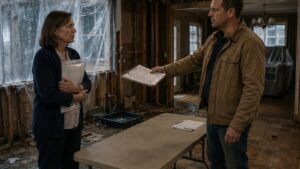
The HOA Ordered Him to Remove One Hidden Dish, Then the Whole Neighborhood Went Offline
Chapter 1: The Notice Arrived Before His Father’s Game
The violation notice had been taped beneath the oxygen-supply delivery slip, as if the two papers belonged together.
Samuel Johnson stopped halfway through pulling the front door closed. The delivery driver’s carbon copy fluttered against the cream-colored envelope, both held to the brick by a strip of clear tape. Through the storm door, he could hear the low mechanical breath of his father’s oxygen concentrator and the television announcers filling time before the Panthers pregame show.
He peeled away the tape carefully.
The envelope bore the green crest of Ridgecrest Meadows Homeowners Association and the words ARCHITECTURAL COMPLIANCE in block letters. Samuel opened it on the walkway.
The notice gave him fourteen days to remove an unauthorized satellite receiver from the rear roofline. Failure to comply would trigger an $850 enforcement charge, a $340 administrative assessment, and daily fines thereafter.
He read the amounts twice.
The receiver had been installed three days earlier by a licensed technician. Samuel had submitted the manufacturer specifications, the placement diagram, and a photograph showing the dish tucked behind the chimney. The installer had laughed when Samuel asked whether it could be seen from the street.
“Only if somebody climbs your neighbor’s maple tree,” the man had said.
Samuel folded the notice along its original crease and slipped it beneath the oxygen receipt before stepping inside.
Benjamin Johnson sat in the recliner with a clear tube looped beneath his nose. At seventy-eight, he had grown lighter without seeming smaller. His shoulders still carried the square shape of the public-works foreman he had once been, but his hands rested quietly now, one on the blanket over his knees and the other on the remote.
“You get the tanks signed for?” Benjamin asked.
“Yeah.”
“They short us again?”
“No. All there.”
Samuel laid both papers facedown on the kitchen counter.
On the screen, an analyst pointed at a field diagram and predicted that Carolina’s offensive line would collapse before halftime. Benjamin snorted.
“Man’s been saying that every week for ten years.”
“And one Sunday he’ll be right.”
“He’ll retire first.”
The new satellite receiver had been Samuel’s answer to a problem that should have been small. The cable package available in Ridgecrest Meadows no longer carried the out-of-market sports feed Benjamin wanted, and the streaming applications froze whenever the house’s older television tried to authenticate. Benjamin had claimed it did not matter. He had also spent two Sundays listening to radio commentary with his eyes closed.
Samuel had promised his mother, before cancer reduced her world to one hospital room, that Benjamin would never be made to feel like a burden. He had learned how to manage medication schedules, cardiology appointments, sodium restrictions, insurance appeals, and the quiet embarrassment with which his father accepted help.
The dish was not medically necessary. That was what the HOA would say.
But necessity had become a narrow word in Samuel’s house. Oxygen was necessary. Diuretics were necessary. The scale beside the bathroom door was necessary because three pounds of fluid could mean another hospital admission.
A football game was not necessary.
It was only one of the last things that still made Benjamin lean forward.
Samuel waited until his father became absorbed in a replay, then went through the laundry room and out the back door. A ladder lay beneath the eaves where the installer had left it for Samuel to use while trimming a branch.
From the ground, the dish vanished behind the chimney. Samuel moved to the fence line, then to the far corner of the yard. Only the upper edge appeared, a slim gray curve against the shingles.
He climbed four rungs.
From there, the dish was obvious: compact, securely mounted, its cable running neatly beneath the flashing. The installation permit sticker remained beneath the bracket.
Samuel took several photographs with his phone. One from the ladder. One from the backyard. One from the front sidewalk, where the roof looked uninterrupted.
The neighborhood beyond the fence was quiet in the deliberate way Ridgecrest Meadows preferred. Matching mailboxes. Trimmed hedges. Neutral siding colors with names such as river stone and winter wheat. The association newsletter often praised “visual continuity,” though nobody agreed on what that meant until a violation arrived.
Samuel returned inside and called the management number printed at the bottom of the notice.
The property manager answered after seven minutes of recorded piano.
“I’m calling about a satellite citation at 418 Cedar Hollow,” Samuel said.
The manager clicked at a keyboard. “Yes. The rear-roof installation.”
“It’s behind the chimney. I submitted the installation packet before the work was done.”
“I see a submission.”
“And?”
“It was not approved.”
“I never received a denial.”
“The committee’s silence does not constitute approval.”
“The installation complies with the placement language. I have photographs.”
“The board president reviewed the property.”
“When?”
Another pause. More keyboard clicks.
“The violation has been entered.”
Samuel looked through the doorway. Benjamin was arguing with the television now, correcting a former quarterback’s analysis.
“I’m asking for an informal review before charges begin.”
“The president is not available for informal reviews.”
“Who is the president?”
“Deborah Roberts.”
Samuel knew the name only from the election flyer that had appeared in every mailbox two months earlier. Restore Standards. Rebuild Trust. Protect Values.
“Then schedule me for the earliest formal review.”
“There is an opening Monday at nine.”
“I’ll be there.”
“I should advise you that the administrative assessment is applied once a formal hearing is requested.”
Samuel straightened. “The letter says the assessment applies after fourteen days.”
“That is the noncompliance charge. The hearing fee is separate.”
“How much?”
“One hundred twenty-five dollars.”
He closed his eyes for a moment.
“Email me the policy authorizing that.”
“I can include it in the hearing confirmation.”
“And note that I requested an informal review first.”
“I can note that you called.”
“Not the same thing.”
The manager said nothing.
Samuel’s voice became quieter. “Please note the request exactly.”
After the call, the email arrived within minutes. The Monday hearing was confirmed. A $125 administrative charge had already been added to his account.
Below it was a warning that an expedited exterior inspection could occur at any time.
Samuel printed the cardiologist’s accommodation letter he had obtained before installing the dish. It said Benjamin’s limited mobility and chronic heart condition made reliable in-home recreation beneficial to his quality of life. It did not demand special treatment. It asked only that the association consider the least restrictive placement.
He placed the letter with the permit, photographs, and notice.
From the living room came the opening music for the game.
“You coming?” Benjamin called.
“In a minute.”
Samuel opened the HOA portal and searched recent violations. The system did not show other homeowners’ records, but he remembered the large dish mounted above a garage two streets over and a bright white receiver attached to the side of a house near the pond.
Perhaps theirs had been approved. Perhaps the rules had changed. Perhaps Deborah Roberts was enforcing everything now.
Samuel wanted to believe that.
He slid the notice into a kitchen drawer beneath a stack of appliance manuals and closed it before Benjamin could see.
Then his phone chimed with a second HOA email.
The Monday hearing remained scheduled, but the exterior inspection had been moved forward to eight o’clock that same morning. The message ended with one sentence:
Additional violations observed during inspection may be assessed separately.
Samuel read it while the crowd on television roared.
He looked toward the living room, then through the kitchen window at the chimney hiding the small gray dish.
What had been an irritation settled into something harder.
Chapter 2: She Refused to Read the Letter
“Irrelevant,” Deborah Roberts said before she had opened the cardiologist’s letter.
Samuel kept his hand on the document for half a second longer, then released it onto the conference table.
The HOA office occupied a converted sales center near the entrance to Ridgecrest Meadows. Framed photographs of landscaped medians lined the walls. A bowl of wrapped peppermints sat beside a stack of violation-payment forms. Behind Deborah, a window overlooked the stone monument announcing the community name.
The inspection had occurred an hour earlier. Samuel had watched from his front porch as the property manager photographed the roof from the street and then walked along the side yard without asking permission to enter the fenced backyard. The manager had not climbed high enough to see the dish clearly.
Now Deborah sat at the head of the table with an open laptop. The HOA treasurer occupied one chair to her right. The property manager sat on her left with a legal pad.
Samuel had arranged his evidence in order: permit, installation diagram, front-view photograph, backyard photograph, cardiologist’s letter.
Deborah touched none of it.
“The rule prohibits externally mounted equipment visible above the roofline,” she said.
Samuel slid the front-view photograph toward her. “Show me where it’s visible.”
She looked at the photograph, though only briefly. “The inspector confirmed the installation.”
“The inspector confirmed something is on the roof. The covenant says visible from a common area.”
“The board has discretion.”
“Discretion still requires you to apply the language.”
The treasurer shifted in his chair. Deborah’s expression did not change.
“We have spent months trying to correct years of inconsistent enforcement,” she said. “Residents complained that certain owners received exceptions while others were cited. That stops now.”
It was the first thing she had said that sounded like an explanation rather than a verdict.
Samuel nodded once. “Then review the evidence consistently.”
“We are.”
“You called a medical accommodation request irrelevant without reading it.”
“The medical condition does not change the appearance of the equipment.”
“The requested placement does. The letter explains why the least restrictive option matters.”
Deborah exhaled through her nose and turned toward the property manager. “Please note that the homeowner was advised medical information does not override architectural standards.”
Samuel placed two fingers on the cream violation notice and drew it back toward himself.
“No,” he said. “Please note that the president declined to review the accommodation request.”
The property manager looked from Samuel to Deborah.
Deborah’s tone sharpened. “That is not what happened.”
“The envelope is still sealed.”
All three of them looked down.
The cardiologist’s letter lay exactly where Samuel had placed it. The flap remained closed.
The treasurer cleared his throat. “Perhaps we should read it for the record.”
Deborah picked up the envelope, but instead of opening it, she placed it on top of Samuel’s roof photograph. The cream paper covered everything except the chimney and one thin edge of gray equipment.
“The problem,” she said, “is that every homeowner believes his circumstances are unique. Once we make one exception, we cannot defend the next denial.”
“An accommodation review is not an automatic exception.”
“Are you an attorney, Mr. Johnson?”
“No.”
“Then please allow the board to govern.”
Samuel felt heat rise beneath his collar. He did not move his hands.
“I’m allowing you to govern,” he said. “I’m asking you to document how you’re doing it.”
The property manager wrote something on the pad.
Samuel pointed toward the photograph under the envelope. “There are at least two more visible receivers in the neighborhood. One on Meadow Run and one near the pond.”
“They may predate the rule.”
“Then the records will show that.”
“They may have approvals.”
“The records will show that too.”
Deborah closed her laptop.
“This is exactly the attitude that created the problem,” she said. “People move into a managed community and immediately start looking for technicalities. Rules exist to protect everyone’s investment.”
“My father’s illness isn’t a technicality.”
“I did not say it was.”
“You said the letter was irrelevant.”
“To the appearance standard.”
Samuel leaned back.
Beyond Deborah’s shoulder, a small router sat on a shelf beneath the window. Its green indicators flickered in a steady sequence. On the casing was the faded blue emblem of Carolina Regional Fiber Services, the company whose field operations Samuel directed.
He recognized the model. He had approved its replacement schedule.
Deborah followed his glance and seemed to mistake it for distraction.
“If you want complete freedom to alter your property,” she said, “there are neighborhoods without standards.”
The treasurer looked down at the table.
Samuel said, “I asked to keep a receiver hidden behind a chimney.”
“And I am telling you that Ridgecrest Meadows is not the place where every homeowner decides which rule applies to him.”
Her voice had risen just enough to carry through the thin office wall.
Samuel’s jaw tightened.
Deborah continued, “This is not the hood, Mr. Johnson. We cannot run a community on personal exceptions and whatever somebody thinks he can get away with.”
The room became very still.
The property manager stopped writing.
Samuel looked at Deborah. He had heard the word used in a dozen ways by people who expected tone to protect meaning. He had also spent enough of his life watching people decide afterward that he had misunderstood them.
He would not give her that argument now.
He slid the sealed medical letter out from beneath the violation notice. He aligned its edges with the permit and photographs, then folded the notice once across the center.
“Put the exact statement in the minutes,” he said.
Deborah’s face changed—not remorse, but awareness.
“That was not a racial statement.”
“I didn’t characterize it.”
“You are clearly implying—”
“I’m asking for the exact words.”
The treasurer spoke quietly. “We should include them.”
Deborah turned on him. “We are not turning the minutes into a transcript.”
Samuel looked at the property manager. “Then note that I requested the statement be entered and the president refused.”
The pen resumed moving.
Deborah opened her laptop again. “The violation stands. The administrative charge stands. Because installation has been confirmed, we are moving the compliance inspection to Wednesday.”
“You inspected today.”
“Today established the presence of the equipment. Wednesday will determine whether removal has begun.”
“And if it hasn’t?”
“Additional enforcement.”
Samuel placed the folded notice into his folder.
He no longer wanted her sympathy. That surprised him less than the relief it brought.
He stood.
Before leaving, he glanced again at the router’s blue emblem.
“You should locate the original utility agreement for this development,” he said.
Deborah frowned. “What does internet service have to do with your satellite?”
“Read the agreement before you send another notice.”
The treasurer studied him now.
Deborah gave a short, humorless laugh. “Is that a threat?”
“No.”
Samuel tucked the folder beneath his arm.
“It’s the first useful warning I’ve given you.”
He walked out before she could answer.
At home, Benjamin was asleep in the recliner, the oxygen concentrator pulsing beside him. Samuel carried the folder into his office and opened the lower drawer of a metal filing cabinet. Closing documents filled two hanging folders: title insurance, survey, builder warranty, community disclosures.
Near the back was a thin packet stamped with the former board’s seal.
UTILITY ACCESS AND MAINTENANCE AGREEMENT.
The provider name across the top was older than the one on Deborah’s router, but Samuel recognized it immediately.
Wirecore Networks.
He had not seen that name in eight years, not since the company had been absorbed and its field division placed under his authority.
At the bottom of the maintenance authorization was a signature.
His own.
Chapter 3: The Contract Did Not Grant Revenge
Samuel’s signature appeared beneath the words AUTHORIZED OPERATIONS REPRESENTATIVE, dated eight years earlier.
He sat at his desk with the old agreement open beneath the green lights of a network test unit. The device blinked beside the folded HOA notice, indifferent to the fact that one document governed his house while the other governed the systems beneath the entire neighborhood.
He remembered the development before the stone entrance monument and ornamental pond. Ridgecrest Meadows had been dirt roads, conduit trenches, numbered lots, and portable toilets leaning in red clay. Wirecore had been a small contractor then, hired to install a fiber backbone because the larger providers had refused to build before enough homes existed.
Samuel had supervised the field work.
He had also signed the final maintenance authorization after the HOA’s first board accepted the infrastructure.
He turned through the agreement slowly.
The easement allowed access to shared utility enclosures, buried conduit, service cabinets, and equipment rooms. It required the association to keep access points clear and to provide written notice before changes affecting operations. Another section required both parties to cooperate with federal, state, and local nondiscrimination obligations.
Nothing said a homeowner’s architectural dispute permitted service retaliation.
Samuel knew that before he called Catherine Hill.
He called anyway.
Catherine answered on the fourth ring. “You only call after business hours when somebody has dug through a marked line.”
“No excavation.”
“Then this is personal.”
Samuel looked at the sealed cardiologist’s letter. “I need you to review an old service agreement.”
“Send it.”
“I already did.”
A pause.
“You called before sending?”
“Check again.”
He heard her keyboard. “Wirecore. Ridgecrest Meadows. This has your signature.”
“It does.”
“What happened?”
Samuel gave her the clean version first: the dish, the notice, the hearing, the refusal to review the medical request. He left Deborah’s remark until Catherine asked why his voice sounded as if he were reading from an incident report.
Then he told her exactly what Deborah had said.
Catherine became quiet.
“Was it recorded?”
“No.”
“Witnesses?”
“Treasurer and property manager.”
“Will either confirm it?”
“I don’t know.”
“Did you ask for it in the minutes?”
“Yes.”
“Good.”
“I also told her to read the utility agreement.”
Catherine sighed. “Why?”
“Because she should.”
“That isn’t why.”
Samuel watched the test unit blink.
“I wanted her to understand she was talking to somebody who knew what he was reading.”
“And did she?”
“No.”
“Then all you did was connect two disputes she had not yet connected.”
He disliked the accuracy of that.
Catherine promised to review the agreement before morning. Samuel remained in his office long after Benjamin went to bed, reading each section and marking pages with yellow tabs.
One provision concerned operational interference. If the association blocked safe access to shared equipment, the provider could suspend affected services until access was restored. Another authorized temporary shutdowns for hazards, heat events, equipment failure, or emergency maintenance.
Affected services.
Not all services.
Until access was restored.
Not until an unrelated fine was withdrawn.
Samuel found no clean weapon in the contract. He found procedures, obligations, notice periods, and narrow remedies. Yet the more he read, the more he understood how exposed Deborah had made the association by speaking before checking its records.
At nine the next morning, Catherine spread the agreement across a table in her office.
She wore reading glasses low on her nose and had marked fewer pages than Samuel.
“You have something,” she said.
“But.”
“But it is not what you want it to be.”
Samuel sat opposite her. “You don’t know what I want.”
“I know you highlighted the suspension section three times.”
“The board threatened operational access.”
“They threatened another exterior inspection.”
“In an email last night, the property manager said they may restrict contractor entry until the architectural issue is resolved.”
Catherine held out her hand.
Samuel passed her his phone.
The message had arrived after midnight, copied to the board:
Until the unauthorized roof equipment matter is resolved, no further contractor access related to the Johnson property or associated utility review will be permitted without written HOA approval.
Catherine read it twice.
“This is badly written.”
“It covers associated utility review.”
“It may mean they won’t let you use your company position to inspect your own house.”
“That is not how shared access works.”
“No. But poor wording is not the same as an actual obstruction.”
Samuel leaned forward. “If they block a scheduled safety inspection?”
“Then the company follows safety protocol. Not Samuel Johnson. The company.”
“I am the operations director.”
“And today you are also an angry homeowner.”
The sentence landed more sharply than he expected.
Catherine removed her glasses.
“The nondiscrimination clause helps you establish that the parties were expected to comply with applicable law,” she said. “It does not automatically prove Deborah discriminated. Her refusal to review the accommodation may matter. Her selective enforcement may matter. Her remark certainly matters. But a contract clause does not turn those facts into a switch you can flip.”
Samuel looked toward the window. Traffic moved below, ordinary and detached from Ridgecrest Meadows.
“She looked at my father’s letter and called it irrelevant.”
“She did not look at it. That may be worse.”
“She thinks rules belong to her.”
“And right now you think infrastructure belongs to you.”
“It belongs to the provider.”
“Exactly.”
Catherine tapped the operational-access section.
“This agreement gives the provider the right to reach its equipment. It gives the provider the right to suspend affected branches when safe operation is impossible. It does not give you the right to black out a neighborhood until someone apologizes.”
“I didn’t say that.”
“You haven’t had to.”
Samuel’s phone vibrated on the table.
A field supervisor had sent a maintenance reminder. Ridgecrest Meadows was scheduled for a thermal inspection Wednesday morning because one cabinet had shown elevated temperatures during the previous cycle.
Samuel turned the screen toward Catherine.
“That inspection predates the HOA dispute.”
“Then document that. Send neutral notice. Use a different supervisor. Do not go yourself.”
“And if they refuse access?”
“Then follow the safety plan exactly. No broader.”
Samuel picked up the phone.
For the first time since the hearing, he felt something close to balance. The contract did not permit revenge, but neither did it require him to accept obstruction. Deborah could not convert a property dispute into control over utility infrastructure merely because the equipment served his street.
He sent the inspection notice through company channels. It named the field crew, the shared enclosure, the scheduled time, and the contractual access provision. He copied the property manager and board.
The reply came forty minutes later from Deborah.
The board does not consent to contractor entry while questions remain regarding unauthorized equipment and potential conflicts of interest. Any attempt to access association property without written authorization will be treated as trespass.
Catherine read over his shoulder.
“She has now been warned,” Samuel said.
“She has now written something foolish,” Catherine replied. “Those are not always the same as deliberate obstruction.”
“The agreement is explicit.”
“So send one final clarification.”
Samuel drafted it while Catherine watched. He removed every reference to his house, his father, the dish, and Deborah’s statement. The email explained that the inspection concerned shared network equipment unrelated to any individual architectural violation. It stated that denial of safe access could require temporary suspension of affected services.
Catherine approved it after changing “will require” to “may require.”
By late afternoon, no one had responded.
Samuel returned home and found Benjamin at the kitchen table sorting pill bottles into a weekly organizer.
“How’d the meeting go?” Benjamin asked.
“What meeting?”
“The one you put on the calendar and then tried to hide under a grocery list.”
Samuel opened the refrigerator. “It’s being handled.”
“That means badly or expensively.”
“Neither.”
Benjamin gave him a long look, but Samuel turned toward the shelves before it could become a question.
At seven the next morning, his company phone rang.
The field supervisor did not bother with a greeting.
“We’re at the Ridgecrest enclosure,” he said. “There’s a new chain on the gate and a padlock through the cabinet cage.”
Samuel set down his coffee.
“HOA lock?”
“Has their property tag on it.”
“Any board representative there?”
“No. Manager isn’t answering.”
“What are the temperatures?”
“External reading is twelve degrees above the last cycle. We need the cabinet open to verify load and ventilation.”
Samuel looked through the kitchen window. Behind the chimney, the hidden dish caught a thin edge of morning light.
“Photograph everything,” he said. “Do not cut the lock.”
The supervisor hesitated.
“There’s something else. The chain crosses the emergency access latch. Whoever put it there wasn’t just closing a gate.”
Samuel’s grip tightened around the phone.
“They locked the equipment itself.”
“Looks that way.”
On the test unit in his office, the green indicators continued blinking.
For now.
Chapter 4: Every Green Light Turned Dark
The new padlock was warm beneath the field supervisor’s gloved hand.
Samuel stood outside the shared utility enclosure ten minutes after the call, staring through the chain-link gate at the cabinet he had helped commission eight years earlier. A bright steel chain crossed the gate twice, then looped through the cabinet cage behind it. A laminated Ridgecrest Meadows property tag hung from the lock.
The field crew waited beside their truck. One technician held an infrared scanner aimed through the fence.
“External temperature climbed another two degrees,” the supervisor said. “Could be the afternoon load. Could be a fan problem. We can’t know from out here.”
Samuel photographed the chain, lock, property tag, emergency latch, and scanner display. He made himself move slowly.
“Call the property manager again.”
“We’ve called four times.”
“Call from my phone.”
The manager answered on the second ring.
Samuel put the call on speaker. “We’re at the shared enclosure for the scheduled thermal inspection. Association locks are blocking both the gate and cabinet access.”
“I’m aware of the lock,” the manager said.
“Who authorized it?”
“The board president.”
The supervisor looked at Samuel.
“Was the board informed that the chain crosses the emergency latch?”
“I don’t know.”
“Is anyone coming with a key?”
“Deborah said all contractor access requires written board approval.”
“You received the access notice yesterday.”
“She does not consider that approval.”
“It is notice under the utility agreement, not a request for permission.”
The manager lowered her voice. “Samuel, I’m not getting between you and Deborah.”
“This is not about my house.”
“That is not how she sees it.”
Samuel looked through the fence at the cabinet. Its small ventilation slots breathed out heat he could feel even from several feet away.
“How does the rest of the board see it?”
A silence followed.
“The treasurer asked why the gate was being locked,” the manager said at last. “Deborah told him it was temporary.”
“Did the board vote?”
“I don’t have minutes authorizing it.”
There it was: not proof of a conspiracy, not even proof that Deborah understood what she had done. Only proof that she had acted alone and expected authority to follow.
Samuel ended the call and contacted Catherine.
“Do not cut the chain,” she said immediately.
“We aren’t.”
“Document the temperature. Send an emergency-access demand. Give them a specific deadline.”
“How long?”
“What does protocol require?”
Samuel knew the answer. “Thirty minutes for an active thermal warning.”
“Then thirty minutes. And Samuel—affected branches only.”
He watched the green status indicators through the cabinet vents. They pulsed in orderly rows.
“Affected branches share the same distribution cabinet.”
“All of them?”
“All one hundred eighty-seven homes pass through this enclosure before splitting.”
Catherine was quiet.
“That makes the remedy broad,” she said. “It does not make it personal.”
Samuel sent the emergency demand to the property manager, Deborah, the treasurer, and the association’s general email address. It cited the access agreement and included the photographs. He gave them thirty minutes to provide a key or written permission to remove the association’s lock.
At minute twelve, Deborah replied.
No contractor may enter association-controlled property until the board has reviewed the conflict of interest created by Mr. Johnson’s unauthorized installation and employment relationship.
Samuel read the sentence twice.
The supervisor said, “She’s tying the cabinet to your dish.”
“Yes.”
At minute twenty-one, the treasurer called.
“I didn’t approve that lock,” he said. “I’m driving over.”
“Do you have a key?”
“No. Deborah does.”
“Can you reach her?”
“She told me not to interfere.”
At minute twenty-eight, the scanner showed another degree of heat.
Samuel opened the safety protocol on his tablet. The language was familiar because he had helped write it after a cabinet fire in another county. When internal equipment could not be inspected during an active heat warning, service loads had to be reduced or disconnected before the system crossed the risk threshold.
The procedure did not ask who had caused the obstruction.
The supervisor waited beside him. “We can shed half the branches first.”
“For how long?”
“Maybe ten minutes. If the temperature keeps climbing, all of them.”
Samuel looked at his watch.
The deadline passed.
“Begin staged load reduction,” he said.
The supervisor radioed the network center. On Samuel’s tablet, a diagram of Ridgecrest Meadows appeared in green. One branch changed to amber, then gray. Several streets lost service.
For one brief moment, Samuel felt the satisfaction he had denied wanting. Deborah had been warned. The contract had been clear. The equipment was real, the heat was real, and now the cost of her refusal would no longer remain inside his kitchen drawer.
Then the temperature rose again.
“Second branch,” the supervisor said.
Samuel nodded.
Across Ridgecrest Meadows, status icons darkened street by street.
Samantha Rivera was speaking to a hospital discharge team when her screen froze.
She clicked once, then again. The patient list vanished behind a spinning symbol. Her headset went silent.
“No,” she whispered.
The modem lights beside her desk blinked red. Her backup connection showed one weak bar, not enough for the secure medical system. On the other side of the wall, her smart doorbell announced that it had lost connection.
She called the hospital from her phone.
“I’m locked out,” she said. “The neighborhood service dropped.”
The supervisor on duty told her to reconnect within fifteen minutes or transfer the caseload. One of Samantha’s patients was waiting for home oxygen delivery approval before discharge.
She moved her laptop to the front window, then to the upstairs bedroom. Nothing.
Outside, garage doors opened manually. A teenager stood in a driveway holding a game controller as though it might explain what had happened. Phones began appearing in people’s hands.
At the enclosure, the final branches remained amber for less than five minutes.
“We’re at limit,” the field supervisor said. “Either we open the cabinet or take it down.”
The treasurer arrived in a golf cart, still wearing house slippers. He stared at the chain.
“She put it through the cabinet too?”
Samuel did not answer.
The treasurer called Deborah. She declined the call. He tried again.
The scanner alarm sounded.
Samuel’s thumb hovered above the authorization field on his tablet.
Catherine’s warning returned to him: The company. Not Samuel Johnson.
But he was both men, and he could no longer tell which one wanted the system dark.
“Full safety suspension,” he said.
The supervisor entered the command.
The remaining green indicators went black.
The neighborhood did not become silent. It became louder in pieces: car alarms that could not be reset through applications, residents calling across lawns, children complaining from porches, backup batteries chirping inside houses.
Samuel watched the cabinet’s external temperature begin to fall.
The shutdown had proven the operational danger. It had also done exactly what Deborah would accuse him of intending.
His phone filled with messages. Some demanded answers. Some contained screenshots of the HOA portal. Others claimed the outage was retaliation over a roof dispute, though Samuel had not told anyone outside the company and Catherine.
Then a neighborhood post appeared with a photograph of Samuel beside the locked enclosure.
HOA DISPUTE TAKES INTERNET DOWN FOR ENTIRE COMMUNITY.
By the time he reached home, nearly every house had someone standing outside.
Benjamin was asleep in the recliner, unaware that the television had shifted to an error screen.
Samuel had just closed the door when someone struck it three times.
Samantha stood on the porch holding an open laptop. Her face was controlled, but her hands were shaking.
On the screen was a hospital notice showing a transferred patient caseload and a missed remote-session alert.
“You work for the provider,” she said.
Samuel did not deny it.
“A patient waited forty minutes for oxygen approval because I disappeared from the system.”
Behind her, neighbors watched from the sidewalk.
Samantha lifted the laptop between them.
“Tell me this had nothing to do with your satellite dish.”
Chapter 5: His Father Would Not Call It Justice
Benjamin pointed at the frozen football picture and asked, “Why did the game disappear after you promised that dish would keep it on?”
Samuel stood inside the front door with Samantha’s accusation still pressing against his chest.
The television showed a quarterback suspended mid-throw. A small error message sat in the lower corner. The satellite signal had delivered the game, but the receiver’s authentication still depended on the neighborhood network.
Samuel had not considered that.
Benjamin looked from the screen to his son. “Well?”
“There’s a network problem.”
“You said the new equipment wouldn’t have those.”
“The equipment here is fine.”
“Then whose equipment isn’t?”
Samuel set his keys on the kitchen counter. He could still hear voices outside, residents moving from driveway to driveway.
“The HOA locked our field crew out of the shared cabinet,” he said. “It was overheating. We had to suspend service.”
Benjamin studied him. “You had to?”
“It was safety protocol.”
“That all?”
Samuel did not answer quickly enough.
Benjamin reached for the remote and turned the frozen screen black.
“What does this have to do with that letter you hid in the kitchen drawer?”
Samuel looked toward the drawer.
His father gave a tired smile with no humor in it. “You think old means blind?”
Samuel took out the violation notice and placed it on the table. He explained the fines, Deborah’s refusal to read the cardiologist’s letter, the remark in the office, and the lock on the utility enclosure. He told the truth in order until he reached the moment he had authorized the shutdown.
There he began choosing words.
Benjamin noticed.
“How many houses?”
“All of them served through that cabinet.”
“How many?”
“One hundred eighty-seven.”
Benjamin removed the oxygen tube, rubbed the sore place beneath one nostril, then fitted it back.
“And you let the whole place go dark over one woman?”
“It wasn’t over her. The cabinet temperature was rising.”
“Would you have waited longer if she had never talked to you that way?”
Samuel stared at the folded notice.
“That’s not a fair question.”
“It’s the only one that matters.”
The oxygen concentrator released another measured breath.
Samuel sat across from him. “She blocked emergency access. The agreement allows suspension.”
Benjamin nodded slowly. “Legal, then.”
“Contractual.”
“Safe?”
“Yes.”
“Right?”
Samuel’s jaw tightened. “You think I should have let the cabinet burn?”
“I think you know there were choices between burning and everybody losing service.”
“We reduced branches first.”
“For how long?”
“Minutes.”
Benjamin looked toward the dark television.
When Samuel was eleven, his father had spent six weeks on a municipal picket line after the town outsourced sanitation work. Management cut off access to the employee fuel station, then claimed the workers had abandoned routes. The strike had ended with partial reinstatement and no back pay.
Samuel remembered anger. He remembered his mother stretching groceries. He had not remembered what Benjamin mentioned next.
“They shut the water off at our house during that strike,” Benjamin said.
Samuel frowned. “The town did?”
“No. We fell behind.”
“You never told me.”
“You were a child.”
Benjamin’s hand closed around the blanket over his knees.
“Your mother carried pots from the church kitchen for three days. I sat in that house knowing I had helped stop garbage collection for people who had nothing to do with our fight, and then somebody at the water office pressed a button and made us helpless too.”
“That wasn’t the same.”
“No. Nothing ever is when you’re the one pressing the button.”
Samuel stood and walked to the window.
Across the street, a neighbor held a phone above his head searching for signal. Farther down, a garage door remained half open because its owner could not reset the motor. Samantha had gone home after Samuel promised the outage had begun as a safety response. She had not accepted the explanation.
He had not entirely accepted it either.
“The HOA did this,” he said.
“Deborah did wrong.”
“She targeted this house.”
“I believe you.”
“She talked about us like we didn’t belong here.”
“I believe that too.”
Benjamin’s voice softened. “But those people outside didn’t say it.”
Samuel turned.
“You put that dish up for me,” Benjamin continued. “I know what you were trying to give me. But I don’t want a football game bought by making another sick person scared. I don’t want nurses locked out, old folks staring at dead security screens, or somebody wondering whether their oxygen order went through.”
Samuel thought of Samantha’s laptop held between them like evidence.
“I followed the protocol.”
“You followed the part that let you stay angry.”
The words did not rise. They did not need to.
Samuel’s company phone rang. Catherine.
He answered in the kitchen.
“The association’s counsel contacted me,” she said. “They’re threatening claims for business interruption and alleging personal retaliation.”
“The cabinet was overheating.”
“We can defend the initial suspension. Duration is becoming the problem.”
“Access is still blocked.”
“The treasurer says he can authorize removal of the lock if another board member joins him. They are trying to reach one.”
Samuel looked at Benjamin.
“What happens if we restore before they withdraw the violation?”
“You lose leverage.”
“And legally?”
“You reduce exposure.”
Samuel lowered his voice. “Deborah will say I backed down.”
“She may.”
“The fines stay.”
“For tonight, yes.”
“The medical refusal stays buried.”
“Unless you bring it into the open another way.”
Samuel pressed his palm against the counter. He had spent two days believing that restraint meant waiting until the strongest possible moment. Now he saw how easily waiting could become permission—permission for Deborah to keep escalating, permission for himself to make the price larger.
“When can the crew restore?”
“If the treasurer opens the enclosure, they can inspect, cool the cabinet, and begin bringing branches up.”
“Do it.”
Catherine paused. “The board has offered nothing.”
“I know.”
“Samuel, I need you to say clearly that restoration is not conditioned on the architectural dispute.”
“It isn’t.”
“Not anymore?”
He looked at the cream notice.
“No,” he said. “Not anymore.”
The treasurer secured a second board member’s written authorization within twenty minutes. The field crew cut the association’s chain, opened the cabinet, and found a failed ventilation fan. They replaced it while portable blowers lowered the internal temperature.
Samuel remained on the phone as each branch was tested.
One by one, the status icons changed from gray to amber.
Benjamin watched him from the recliner.
“First branch ready,” the supervisor said.
“Restore it.”
“Second?”
“As soon as it clears.”
“What about written approval from the association?”
“We have emergency authorization. Bring every safe branch back.”
Samuel ended the call and opened the neighborhood message board. Accusations covered the screen. Several residents demanded his resignation from a company role they had only just learned he held. Others demanded Deborah’s removal. Most simply wanted service.
He typed a statement, then deleted it.
Tomorrow’s emergency HOA meeting had already been announced. He would speak there, where people could answer him rather than react to a post.
The modem on Benjamin’s side table blinked red, then amber.
Finally, one green light appeared.
Samuel watched it steady.
He had restored service without the fine being canceled, without the violation being withdrawn, and without Deborah admitting anything.
For the first time since the notice arrived, he had no leverage protecting him from the truth he would have to tell.
Chapter 6: The Meeting Changed When He Admitted Fault
“I approved the suspension.”
Samuel said it before Deborah could call the emergency meeting to order.
The clubhouse was packed beyond its folding chairs. Residents stood along the walls and crowded the doorway. Laptop screens glowed on knees, showing restored connections and outage reports. On the front table lay printed complaints, utility photographs, and the same cream violation notice Samuel had carried into the HOA office.
Deborah sat behind a nameplate, her posture rigid. The treasurer and another board member occupied the remaining seats. The property manager stood beside a projector screen.
Murmurs spread through the room.
Samuel remained standing near the center aisle.
“The equipment was overheating,” he continued. “The association’s lock blocked emergency access. Safety protocol supported a temporary suspension. I still approved how broadly it was applied, and I allowed my personal conflict with this board to affect my judgment.”
Deborah leaned toward her microphone. “So you admit the outage was retaliation.”
“No.”
“You just said—”
“I said the safety reason was real and my judgment was not clean.”
That quieted the room more effectively than denial would have.
Samuel held up a photograph of the chained enclosure.
“The cabinet serves every home in Ridgecrest Meadows. A failed ventilation fan raised the temperature. The lock crossed the emergency latch and prevented inspection. That required load reduction.”
A resident near the back called, “Then why did it stay off for hours?”
“Because access remained blocked, and because I waited too long to separate the safety issue from what happened at my house.”
Several people spoke at once.
Samantha stood from the second row. “Service restoration began before this meeting was scheduled.”
Deborah turned toward her. “That does not excuse what happened.”
“No,” Samantha said. “It doesn’t. But you told the neighborhood he was holding the internet until his fines were canceled. The restoration started while the fines were still active.”
The property manager looked down.
Samuel met Samantha’s eyes. She did not smile or nod. Her support was limited to the fact she knew.
“That is correct,” he said. “The violation remains. The administrative charges remain. I ordered restoration anyway.”
The room’s anger did not disappear. It divided.
A resident demanded reimbursement for lost work. Another wanted to know why a shared utility cabinet had been locked. Someone asked whether Samuel had disclosed his company role when he bought his home. Someone else shouted that the dish should have been approved in the first place.
Deborah struck the table with the wooden handle of a gavel.
“We are not going to let one contractor redirect attention from an abuse of public trust.”
“This is a private association,” the treasurer said.
“You understand what I mean.”
Samuel walked to the front table and placed the roof photograph beside the notice.
The image showed his chimney, shingles, and a narrow gray edge almost lost in shadow.
“This is the installation,” he said. “The association cited it as visible above the roofline from a common area.”
The photograph began moving hand to hand through the front row.
“I submitted this image, the permit, and a sealed letter from my father’s cardiologist. Deborah Roberts called the letter irrelevant before opening it.”
Deborah’s face tightened. “Medical conditions do not nullify covenants.”
“No one asked to nullify them. The request asked for the least restrictive placement.”
Samuel unfolded the violation notice.
“At the hearing, I asked why more visible receivers elsewhere had not been cited. I asked for the enforcement history. I was denied it.”
The treasurer adjusted his microphone. “I requested those records yesterday.”
Every face turned toward him.
He held up a thin stack of pages. “There are four satellite installations visible in current property photographs. Two have no approval record. One was approved under the former board. One has never been cited.”
“Those files are incomplete,” Deborah said.
“That is possible,” he replied. “Samuel’s citation was issued within three days.”
A new murmur moved across the room.
Deborah stood.
“When this board took office, the association was nearly nine months behind on vendor payments. More than thirty owners had unpaid dues. The prior board waived fines without documentation and approved modifications for friends. We received complaints that enforcement depended on who someone knew.”
Her voice shook once, then steadied.
“I promised to end that. I applied the written standards as they exist.”
For the first time, residents listened to her without interruption.
She opened a binder and held up a budget page.
“We do not have the money for years of legal disputes over every roof fixture. Property values depend on predictable rules. If I allowed one owner to present a personal hardship after installation and receive an exception, every future enforcement action would be challenged.”
Samuel could see the logic that had hardened around her fear. It did not excuse the unopened letter. It explained why she had treated reading it as surrender.
The treasurer said, “Strict enforcement does not explain locking a utility enclosure without a board vote.”
Deborah’s gaze moved toward him. “Mr. Johnson introduced his employer into a private architectural dispute. I believed access had to be controlled until the conflict was reviewed.”
“You were warned the inspection was unrelated,” Samuel said.
“I did not trust your warning.”
“That was your choice.”
“And shutting down service was yours.”
“Yes.”
The answer seemed to unsettle her more than resistance would have.
Samuel took the cardiologist’s envelope from his folder. It was still sealed.
“My father did not ask to become evidence in this room,” he said. “I kept his condition private because I did not want his life reduced to whether strangers believed he was sick enough for kindness. That silence made it easier for Deborah to describe this as a homeowner searching for a loophole.”
He placed the envelope beside the photograph.
“But privacy is not deception, and a request for review is not permission to insult someone.”
Deborah’s hand tightened on the binder.
Samuel did not repeat her exact remark. He did not need to. The property manager had provided draft minutes containing his request that it be recorded and Deborah’s refusal.
The treasurer read that portion aloud.
No one applauded. The silence afterward was heavier.
Samantha spoke from her chair. “Two things can be wrong.”
A man near the wall muttered, “That doesn’t get my lost workday back.”
“No,” Samantha said. “It doesn’t.”
She looked at Samuel.
“He should answer for the outage. The board should answer for the lock and selective enforcement. We don’t have to choose one wrong so we can ignore the other.”
Catherine stood near the rear doors, present as counsel but silent until the board asked what immediate action was possible.
She stepped forward with a proposed framework: all active architectural fines suspended pending an independent review; no retaliation by either party; open access to shared infrastructure; a reimbursement process for documented outage losses; and publication of accommodation-review procedures.
Deborah read the first page.
“This gives away the board’s authority.”
“It subjects the board’s authority to a consistent process,” Catherine said.
“And his company?”
“Accepts independent review of the shutdown and potential credits to affected accounts.”
Samuel had agreed to that before entering the room.
The board debated for forty minutes. Residents interrupted. The property manager corrected dates. The treasurer admitted he had known about the budget shortfall but not the lock. Deborah refused to resign and refused to apologize for enforcing standards, though she said her words in the hearing had been “poorly chosen.”
It was not enough for Samuel.
He let it remain not enough.
At ten minutes past nine, the board voted.
Two in favor. One against.
All active architectural fines were suspended. Samuel’s violation and the other uncited installations would enter the same independent review. The utility access policy would be rewritten immediately, and the association would preserve all relevant records.
Deborah cast the dissenting vote.
When the result was announced, the room did not erupt. Residents gathered their papers and began forming smaller arguments in the aisles.
Samuel picked up the roof photograph. The cream notice had left a faint fold across the image, directly over the chimney.
Samantha approached him.
“My patient got home,” she said. “The oxygen was delivered.”
“I’m glad.”
“That doesn’t make us even.”
“I know.”
She studied him, then the photograph.
“I’ll serve on the review committee if they create one.”
Samuel nodded. “They’ll need someone who doesn’t trust either side too easily.”
“That may be the first accurate thing you’ve said to me.”
Across the room, Deborah stood alone behind the board table while the treasurer spoke with Catherine.
Samuel had wanted the community to see what Deborah had done. Now they had also seen him.
The fines were suspended, but not erased. Service was restored, but the claims remained. No one had won cleanly enough to hide behind victory.
The independent review would decide what the rules had been.
The harder question was what any of them would do after learning how those rules had been used.
Chapter 7: The Dish Stayed, but Nothing Stayed Hidden
The refund check arrived without an apology.
Samuel found it inside a plain white envelope six weeks after the emergency meeting. The amount covered the administrative charge, the inspection fee, and every fine the HOA had added before the review began. A single typed sentence explained that the assessments had been reversed under the association’s revised enforcement process.
No signature. No acknowledgment of the unopened medical letter. No mention of Deborah’s words.
Samuel carried the envelope into the kitchen, where Benjamin sat with a bowl of oatmeal cooling in front of him. The oxygen tube curved over his cheeks, and the skin beneath his eyes had taken on a darker, thinner look.
“They paid you?” Benjamin asked.
“They refunded the charges.”
“That wasn’t my question.”
Samuel placed the check on the table.
Benjamin read the amount, then turned the paper over as though an apology might have been printed on the back.
“That all they sent?”
“That’s all.”
Benjamin pushed it toward him. “You going to send it back?”
“No.”
“Good.”
Samuel smiled despite himself. “You sound disappointed.”
“I’m disappointed in plenty. Doesn’t mean I want you throwing away money.”
The independent report sat unopened in Samuel’s email. Catherine had called before dawn to tell him the summary was final. The review found that the HOA had applied satellite rules inconsistently, failed to maintain reliable approval records, and denied Samuel a proper accommodation review. It also found no evidence that the entire board had participated in discriminatory treatment.
The report described Deborah’s remark as inappropriate and inconsistent with the association’s conduct policy. It did not assign legal intent.
That phrase had stayed with Samuel: no evidence of the entire board.
Accurate language. Unsatisfying language.
The provider review had been equally careful. The initial safety suspension was justified because the utility cabinet could not be accessed during a thermal warning. The decision to reduce every service branch had followed written protocol. The duration, however, had been longer than necessary because escalation decisions were not sufficiently separated from Samuel’s personal dispute.
His company issued service credits to every household and adopted a rule barring employees from approving emergency actions involving communities where they had active personal disputes.
Samuel had helped write that rule.
His phone buzzed with a message from Samantha.
Meeting starts at ten. They moved it to the office.
He looked toward the living room. The television was already tuned to the pregame channel, but Benjamin had not asked what time kickoff began.
“You still want to watch?” Samuel asked.
“Depends how long they spend predicting things they’ll deny saying by halftime.”
“I have to go to the HOA office.”
Benjamin stirred his oatmeal. “Then go.”
“You sure?”
“I’m sitting in a chair, not crossing a desert.”
The sharpness was familiar, but the breath behind it was not. Benjamin paused after the sentence and waited for the concentrator to catch up.
Samuel noticed. Benjamin noticed him noticing.
“Go handle your little government,” his father said.
“It’s not government.”
“That’s what makes them worse.”
The HOA office looked smaller without Deborah at the head of the table.
Her resignation letter lay beside the final review report. She had stepped down as president two days earlier but had not sold her house or left Ridgecrest Meadows. The letter said the board could no longer function effectively while every decision she made was viewed through the dispute.
It did not mention Samuel.
The treasurer had become acting president. Samantha sat across from him with a draft of the new compliance procedures. A retired former board secretary had joined them to help reconstruct older records.
Deborah occupied a chair along the wall.
She wore a charcoal cardigan instead of the tailored jacket Samuel associated with the hearings. A cardboard file box rested near her feet. When Samuel entered, she looked at him once, then returned her attention to the report.
No one offered a dramatic greeting.
The acting president began with the revised accommodation policy. Requests involving disability, medical limitations, or access needs would now be reviewed before fines were imposed. Denials required written reasons. Architectural decisions, approval dates, and photographs would be available to homeowners through the portal.
Samantha had added another provision: committee members with personal conflicts had to abstain.
“Too much discretion caused this,” she said. “Then the answer became more discretion.”
The former secretary adjusted her glasses. “The old board kept half its records in personal email accounts. We can publish what exists, but there will be gaps.”
“Then label the gaps,” Samantha said. “Don’t pretend missing records prove consistency.”
Samuel listened as they debated deadlines, appeals, privacy, and whether medical letters should be retained or destroyed after review. Nothing about the process felt triumphant. It felt slow, technical, and necessary.
The final item concerned his dish.
The independent reviewer found that it was not visible from a common area under ordinary viewing conditions. It could remain.
The acting president looked toward Samuel. “Any objection to closing the violation?”
“No.”
Deborah spoke from the wall.
“The dish should never have required six weeks of proceedings.”
Every head turned.
Her face held no invitation to forgive her.
“I was trying to correct years of favoritism,” she continued. “I believed exceptions would destroy what little authority the board had left. I still believe the association was in a financial crisis.”
“That part was true,” the acting president said.
Deborah nodded.
Then she looked directly at Samuel.
“What I said in this room was wrong. What I refused to read was wrong. I am not going to describe it as poor wording.”
The apology Samuel had imagined was sharper than this one. In those imagined versions, Deborah understood everything he had felt and named it perfectly.
This version contained no promise that she had changed beyond recognition. It did not erase the lock, the outage, or the way she had looked at him before deciding what kind of man he was.
It was simply more honest than the letter.
Samuel folded his copy of the report.
“I should have separated my work authority from my anger sooner,” he said. “People paid for a dispute they didn’t create.”
Deborah’s gaze shifted toward Samantha.
“Yes,” she said. “They did.”
No one applauded.
The meeting continued.
By noon, Samantha had agreed to serve on the permanent compliance committee. The acting president approved publication of the review standards. Catherine’s non-retaliation agreement was entered into the association records, along with the provider’s emergency-access rules.
When Samuel left, Deborah was carrying her file box to her car.
She would remain in the neighborhood. She would stand in grocery lines beside people who had lost work during the outage and drive past the house she had cited. Samuel would see her mailbox, her porch light, and perhaps her face at future meetings.
Consequences did not always remove people. Sometimes they made them stay where the truth was known.
At home, Benjamin had moved from the kitchen to the recliner. The game had begun, but the volume was low.
Samuel sat beside him.
“You miss anything?” he asked.
“Turnover.”
“Panthers?”
Benjamin gave him a look. “Who else?”
The receiver beneath the television showed a steady green light. Across the room, the modem lights pulsed in sequence, quiet and ordinary again.
Samuel glanced through the window.
From this angle, the satellite dish could not be seen at all. It remained behind the chimney, doing its work without announcing itself to the street.
Benjamin leaned back and closed his eyes during a commercial.
“You tired?” Samuel asked.
“Just resting them.”
Samuel did not reach for the remote. He did not check his phone or explain the meeting. He sat close enough to hear the oxygen concentrator release each measured breath.
On the television, the game resumed.
The green network lights reflected faintly in the darkened window, while above them the hidden dish kept receiving a signal no one outside the house could see.
The story has ended.