The HOA Called Police on His Workshop, Then His Quiet Refusal Exposed Their Own Rules
Chapter 1: The Morning Police Entered Raymond’s Own Driveway
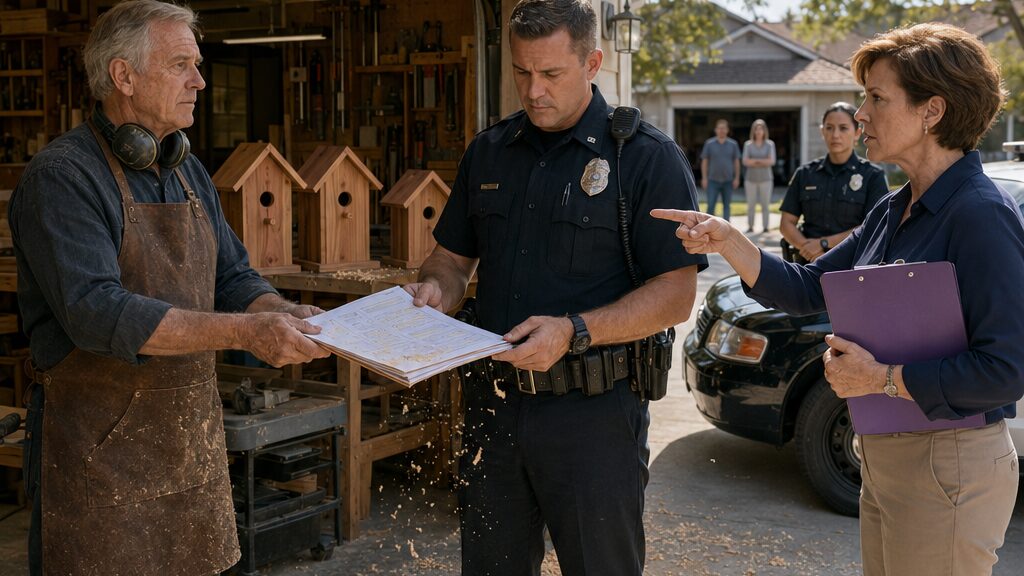
The police cruiser stopped sideways across Raymond Walker’s driveway, blocking his truck and throwing a bar of red light across the open workshop.
Raymond still had both hands on a cedar board.
The table saw whined beneath his palms until he found the switch and killed the motor. The sudden quiet felt unnatural. He removed his hearing protection and saw Sharon Moore standing beside the cruiser with her purple clipboard pressed against her ribs.
“There he is,” she told the officers. “He’s been out here all morning.”
Raymond looked from Sharon to the two uniformed officers walking toward him. Across the street, a garage door had risen halfway. A neighbor stood behind it pretending to sort recycling.
The lead officer stopped at the edge of the workshop.
“Sir, are you Raymond Walker?”
“Yes.”
“Do you live here?”
“For thirty-four years.”
Sharon stepped closer. “That doesn’t address the business operation.”
The officer raised one hand without looking at her. “We’ll speak to everyone.”
Raymond’s leather apron felt heavier than it had five minutes earlier. Cedar shavings clung to its front and gathered around his shoes in pale curls. On the workbench sat three unfinished birdhouses, each no larger than a bread loaf. Behind them, sunlight fell through the old garage windows and caught the dust in the air.
The second officer glanced into the shop. “Any weapons in here?”
“Tools,” Raymond said. “Some sharp ones.”
The officer’s mouth shifted, though not quite into a smile.
Sharon tapped her clipboard. “He has been warned repeatedly. He is loitering around an unauthorized commercial structure and refusing to cease operations.”
Raymond turned his head slowly.
“My garage is now an unauthorized structure?”
“I said commercial structure.”
“You said loitering.”
“You spend hours out here after being directed to stop.”
The lead officer looked at Sharon. “Ma’am, loitering generally doesn’t apply to a homeowner standing on his own property.”
“That is why I also reported possible trespass.”
Raymond stared at her.
“Whose property did I trespass on?”
Sharon opened her mouth, then adjusted her grip on the clipboard. “There has been confusion about the common boundary behind the garages.”
There was no confusion. The fence had stood in the same place since before Sharon bought her house nine years earlier. Raymond had replaced two rotted posts himself, using the original survey markers.
He could have said all of that. Instead, he wiped his palms on his apron, walked to the workbench, and lifted a thin manila packet from beneath a carpenter’s square.
Cedar shavings slid from its cover.
Sharon’s eyes followed the packet. For the first time that morning, she stopped speaking.
Raymond handed it to the lead officer.
“What’s this?” the officer asked.
“My deed. The county parcel map. The association plat. Farmers-market receipts. The covenant section she keeps quoting.”
The officer opened the packet. A curled shaving caught against the metal clip and fell onto his sleeve.
“You prepared all this today?”
“No.”
“How long have you had it ready?”
“Two weeks.”
Sharon’s chin lifted. “That alone should tell you he knew he was in violation.”
Raymond looked at her but said nothing.
Two weeks earlier, the first certified notice had arrived in an envelope stamped FINAL COURTESY WARNING, though Raymond had never received an initial one by certified mail. The words had irritated him enough to make him read every page of the governing documents for the first time in years.
He had read them twice.
Then he had printed the relevant sections, highlighted three lines, and placed the packet beside the table saw.
The lead officer unfolded the deed. “This lists Raymond and Elaine Walker.”
“My wife,” Raymond said. “She died four years ago.”
The officer’s tone softened. “I’m sorry.”
Raymond gave a small nod.
The officer checked the parcel number against the survey page. “This garage is fully within the lot boundary.”
“Yes.”
The second officer walked to the fence line, looked down at the old survey pin, then returned.
“No sign of a property dispute from what I can see.”
Sharon’s expression tightened. “The deed is not the issue. The sign is.”
She pointed toward the board mounted above the garage door.
WALKER CUSTOM WOODWORK.
The paint had faded from dark green to a grayish blue. One corner had split, but the lettering remained legible.
“That advertises a business,” Sharon said. “He has customers coming to the property. He operates power equipment. He sells products. The covenants prohibit commercial activity in residential lots.”
The officer looked at Raymond. “Do you sell things from here?”
“Mostly at the Saturday farmers market.”
“Mostly?”
“Sometimes a person who knows me picks something up.”
Sharon gave a sharp breath, as if he had just confessed to a felony.
“Exactly.”
“How much money are we talking about?” the officer asked.
Raymond pointed to the receipts in the packet. “Eight hundred twelve dollars last year before materials.”
Sharon shook her head. “Income is income.”
The officer turned another page. The market receipts were held together with a rusted paper clip. Most were handwritten by the coordinator in blue ink. Twenty-five dollars for a birdhouse. Forty for a cedar planter. Twelve for a set of wooden ornaments.
“This is all of it?” the officer asked.
“Yes.”
“Do you have employees?”
“No.”
“Business license?”
“Not for a hobby.”
“Deliveries? Customer parking? Regular operating hours?”
“I work when I’m awake and stop when my hands get tired.”
The second officer looked down, hiding another almost-smile.
Sharon did not.
“He begins before eight,” she said. “The saw can be heard from adjoining lots. Cars have stopped in the street. He has ignored notices. I was elected to enforce the rules consistently, and he believes his history here places him above them.”
That landed differently.
Raymond felt it because part of it was true. Not the part about being above the rules. The part about the saw. He had started early twice in the previous month, both times because the summer heat made afternoon work difficult.
He also knew two buyers had collected orders from the driveway after the market was canceled by rain.
But Sharon had not called the police over sound or parked cars. She had told the dispatcher there was a man refusing to leave a commercial workshop on disputed property. Raymond had heard her through the open window.
The lead officer closed the receipt bundle.
“This is an HOA matter,” he said. “Possibly a county code question, depending on use. It isn’t a criminal trespass based on what we’ve seen.”
Sharon’s face reddened. “So you are doing nothing?”
“We’re clarifying the situation.”
“I gave dispatch the exact violations.”
“You gave dispatch allegations.”
The distinction settled over the driveway.
Across the street, the neighbor lowered the garage door by another foot.
The officer returned to the packet. Raymond watched his thumb move down the highlighted covenant page.
Section 4.3.
Residential lots shall not be used for commercial enterprise, excluding incidental home occupations, remote professional work, and hobby activity producing gross annual receipts below $5,000, provided such activity does not create unreasonable traffic, signage, noise, or hazard.
The officer read it once.
Then again.
Sharon shifted the clipboard from one arm to the other. “That section does not apply.”
“Why not?” the officer asked.
“Because this is clearly a business.”
The officer held up the receipts.
“He reported eight hundred twelve dollars.”
“That may not be accurate.”
“It’s documented.”
“By him.”
“The market coordinator signed several of these.”
Sharon looked at Raymond as if the signatures were another personal insult.
The officer pointed to the highlighted sentence. “Even if the income exemption applies, this language leaves separate questions about traffic, signage, and noise. Those are civil association issues. But the commercial prohibition by itself doesn’t appear to support what you reported.”
Raymond let out a breath through his nose. It was not relief yet. Relief would have required the cruiser to leave, the clipboard to close, and the workshop door to remain open tomorrow.
Still, the weight in his chest shifted.
The lead officer turned the page toward Sharon.
“Ms. Moore, have you read Section 4.3?”
For the first time since the cruiser arrived, Sharon looked at the covenant rather than at Raymond.
And did not answer.
Chapter 2: The Workshop Sign That Made a Hobby Look Guilty
Two weeks earlier, Sharon had photographed Raymond’s workshop sign before she said good morning.
He was sweeping cedar shavings away from the garage door when he heard the click of her phone. She stood outside the fence in pressed beige slacks, one hand holding the purple clipboard, the other aiming the camera above his head.
“What are you doing?” Raymond asked.
“Documenting.”
“You could try speaking first.”
“I have tried informal communication.”
She lowered the phone. “This sign advertises a business.”
Raymond looked up at it.
WALKER CUSTOM WOODWORK had hung there for twenty-seven years. Elaine had painted the letters at the kitchen table, complaining that his first sketch looked like a funeral notice. She had added a small bird at the end, its wings reduced to three green strokes.
The sun had bleached the bird almost white.
“It’s an old sign,” he said.
“Old violations remain violations.”
“It wasn’t a violation when I ran the cabinet shop.”
“That was before this association adopted its current commercial-use restrictions.”
“I retired eleven years ago.”
“Yet the sign remains.”
Raymond pushed the broom through the shavings. A gust lifted the light curls and carried several under the fence toward Sharon’s shoes.
She stepped back.
“And you continue selling products.”
“A few birdhouses.”
“At a public market.”
“That is generally where markets happen.”
Her mouth tightened. “Sarcasm will not change the covenant.”
Raymond rested both hands on the broom handle. “How much do you think I make?”
“That isn’t relevant.”
“It should be if you’re calling it a business.”
“The board is not required to investigate your profits before enforcing prohibited use.”
That sentence stayed with him after she left. Not because it frightened him, but because it sounded rehearsed.
The following Saturday, Sharon appeared at the farmers market.
Raymond saw her standing three booths away while he wrapped a cedar birdhouse in brown paper for an older couple. She wore sunglasses and carried no shopping bag. Her phone rose twice.
The farmers-market coordinator noticed.
“Friend of yours?” she asked.
“HOA.”
“Ah.”
The single syllable contained years of other people’s stories.
Raymond’s table held twelve birdhouses, three planters, and a row of small wooden ornaments. By noon he had sold four pieces. Gross sales came to one hundred and seven dollars. After the booth fee and cedar, he might keep sixty.
Sharon waited until the older couple left.
“You have inventory,” she said.
“I brought things to sell. That’s how the table works.”
“You also accept custom orders.”
“Sometimes people want a larger opening for bluebirds.”
“That is commercial production.”
Raymond folded his arms.
“Sharon, I made kitchen cabinets for forty years. I know what commercial production looks like. This is something I do because sitting in the house all day doesn’t suit me.”
For a moment, something in her expression loosened. Then she glanced at the coordinator, at the other vendors, at the rows of customers moving between tents.
“I was elected because the previous board ignored problems until they became expensive,” she said. “Home values depend on consistent enforcement.”
“My birdhouses are lowering home values?”
“One exception becomes ten.”
“That sounds like a slogan.”
“It sounds like experience.”
She walked away before he could answer.
On Monday, Rebecca came by after work and found him at the kitchen table with the covenant binder open beneath a magnifying lamp.
She set down a grocery bag. “You finally reading those?”
“I’ve read them before.”
“Signing the acknowledgment page is not reading.”
Raymond ignored that.
He had reached the commercial-use section. The first paragraph appeared to support Sharon. The second narrowed it. The third contained the exemption.
Gross annual receipts below $5,000.
He read the line three times, then took out a yellow highlighter.
Rebecca leaned over his shoulder. “That seems useful.”
“It means she’s wrong.”
“It means she’s wrong about one part.”
He looked up.
Rebecca nodded toward the window facing the garage. “Dad, the sign makes it look like a business.”
“It was a business.”
“Exactly.”
“Was.”
“Then take it down.”
“No.”
The answer came too quickly.
Rebecca studied him. “Why not?”
“It’s my sign.”
“That isn’t a reason.”
“It’s enough of one.”
She moved away from the table. “What about the saw? A neighbor told me you started before seven-thirty last Thursday.”
“Seven forty-five.”
“That distinction will charm the board.”
“It was going to be ninety-six degrees.”
“So start later and do hand work first.”
“I don’t need a schedule from people who have never used a table saw.”
Rebecca unpacked groceries with more force than necessary. “You also don’t need a $1,500 fine.”
“There is no valid fine.”
“You haven’t even had a hearing.”
“There won’t be one once they read this.”
He tapped the highlighted clause.
Rebecca looked at the page, then at him. “You always think the right piece of paper will end the human part of an argument.”
“The human part is usually where people lie.”
She went still.
Raymond regretted the sentence but did not withdraw it. Rebecca zipped the empty grocery bag and left it on the counter.
Outside, a lawn mower stopped. In the silence, someone knocked on the back door.
It was the neighbor from the next lot, still wearing hospital scrubs.
“I’m not here about the business thing,” the neighbor said. “But the saw woke me after a night shift. More than once.”
Raymond felt Rebecca watching from the kitchen.
“You could have told me.”
“I put two notes in your mailbox.”
Raymond remembered them. Folded sheets without signatures. He had assumed they came from Sharon and thrown them away.
“I didn’t know they were yours.”
“I’m telling you now.”
The neighbor did not sound angry. That made it worse.
“I’ll watch the time,” Raymond said.
“Thank you.”
After the neighbor left, Rebecca closed the covenant binder.
“There,” she said. “That was the human part.”
Raymond reopened it.
He printed Section 4.3, copied his market receipts, and retrieved the deed and survey from the metal file cabinet. He prepared the packet with the precision he once used for cabinet bids.
But he did not remove the sign.
He did not alter his workshop hours.
And when Rebecca asked again why the board above the garage mattered more than avoiding a fight, he told her she was making too much of painted wood.
The certified notice arrived the next afternoon.
PROPOSED DAILY FINE: $1,500.
Raymond read the amount twice. At the bottom, beneath Sharon’s signature, a sentence warned that enforcement could begin following board review and continue for each day the unauthorized activity remained.
He looked through the kitchen window at the faded sign.
The small bird Elaine had painted was almost invisible in the afternoon glare.
Still, he left it hanging.
Chapter 3: The Rule That Saved Him Did Not End the Fight
The police cruiser left Raymond’s driveway, but Sharon stayed.
She stood beside the mailbox while the officers turned at the corner, her purple clipboard held flat against her chest. Raymond gathered his packet from the lead officer and brushed a cedar shaving from the highlighted covenant page.
“This is not finished,” Sharon said.
“The police seemed finished.”
“They are not the association.”
“No. They understood the difference.”
Her eyes narrowed. “Section 4.3 does not authorize excessive noise, customer traffic, or commercial signage.”
“Then perhaps you should have called the board instead of 911.”
“I called because you refused to comply and because ownership of the rear access strip was unclear.”
“It was unclear only while you were speaking.”
The words came out sharper than Raymond intended.
Across the street, the garage door finally closed.
Sharon opened her clipboard. “You will receive an amended notice.”
“Amended means the first one was wrong.”
“It means the board will address the remaining violations.”
Raymond tucked the packet under his arm. “Make sure you read the next section before sending it.”
Color rose along Sharon’s neck, but her voice remained controlled.
“I was elected to correct years of informal exceptions. People are tired of rules applying only when convenient.”
Raymond looked at the clipboard, then at her.
“On that point, we agree.”
He went inside the workshop and lowered the door between them.
For nearly twenty minutes, he stood in the dimness without turning on a machine. The cedar board remained beside the saw, its cut unfinished. He could hear Sharon’s shoes cross the driveway, pause, then continue toward the sidewalk.
Only after her car door shut did he breathe normally.
Rebecca arrived before noon.
She entered through the kitchen carrying her laptop and found Raymond rinsing two coffee mugs.
“You called the police?” she asked.
“I did not.”
“Half the neighborhood says there were two cruisers.”
“One.”
“That distinction again.”
Raymond poured coffee. “They confirmed the deed and read the exemption. No action.”
Rebecca set the laptop down. “So it’s over?”
“Yes.”
His phone chimed on the counter.
An email notification appeared from the homeowners association.
AMENDED NOTICE OF VIOLATION.
Rebecca looked at the screen. Raymond turned it facedown.
“That doesn’t look over.”
“It can wait.”
“No, it can’t.”
She opened the email before he stopped her.
The commercial-business allegation had been withdrawn pending income verification. In its place were three separate claims: unreasonable equipment noise, prohibited business signage, and customer parking that obstructed neighborhood access.
A formal hearing had been set for the following Thursday.
Rebecca scrolled farther.
“They attached photographs.”
“I know what my garage looks like.”
“One shows a car across the end of the neighbor’s driveway.”
“It was there four minutes.”
“You timed it?”
“I was carrying out a planter.”
She turned the laptop toward him. “Dad, did you tell the officer customers never come here?”
“I said mostly at the market.”
“That is not what I asked.”
Raymond set his mug down. A few cedar shavings had fallen from the document packet onto the kitchen table. Rebecca brushed them into a small pile with the side of her hand.
“Did Sharon send you anything before the certified notice?” she asked.
“Nothing that required an answer.”
Rebecca went to the metal tray where Raymond kept mail. Beneath a hardware catalog, she found two folded association notices.
Neither had been opened.
The first requested that he avoid operating power equipment before eight in the morning. The second asked him to remove online references directing buyers to residential pickup.
Rebecca held them up.
“These are dated last month.”
“They are courtesy notices.”
“They are warnings.”
“They are not board findings.”
“You ignored them because the envelope wasn’t threatening enough?”
“I ignored them because Sharon had already decided what I was.”
Rebecca stared at him. “And you decided anything she said had to be false.”
Raymond picked up the packet. “The central allegation was false.”
“The central allegation was the one you knew how to defeat.”
He went to the window.
The garage door remained closed. Through its top panes, he could see the old sign hanging above it.
“I have worked on that property longer than Sharon has lived in this state,” he said.
“That doesn’t make the saw quieter.”
“I told the neighbor I would watch the hours.”
“But you didn’t tell the board. You didn’t answer the notices. You didn’t remove the pickup address.”
“I removed it yesterday.”
“After the police came.”
Raymond turned. “Whose side are you on?”
Rebecca’s face changed, not dramatically, but enough.
“I came because I thought you needed help.”
“I need the association to follow its own rules.”
“And you don’t?”
He looked down at the shavings scattered across the table. One curl had landed on the printed photograph of the parked car.
The phone rang.
Raymond answered on speaker when he saw the association’s number.
“This is James Wright,” a man said. “I’m the HOA treasurer. I understand there was police involvement this morning.”
“There was unnecessary police involvement.”
“I’m not calling to defend that. I reviewed the commercial-use section. Based on what you provided, the association cannot begin the proposed daily fine without notice, a hearing, and a board vote.”
Rebecca pulled a chair closer.
“So the $1,500 fine is withdrawn?” Raymond asked.
“The commercial violation is being reconsidered. The proposed amount was never active.”
“Sharon wrote that it could accrue daily.”
“After board action. That did not occur.”
“Then the notice was misleading.”
James paused. “I would say it was more aggressive than our normal process.”
“Would you say that at the hearing?”
Another pause.
“I will state the procedure accurately.”
Rebecca wrote the words on a pad.
James continued. “However, Mr. Walker, the exemption does not protect unreasonable noise, traffic, or signage. Those claims will proceed.”
“I understand the sentence.”
“I need to know whether you understand the distinction.”
Raymond looked at Rebecca. She did not rescue him.
“Yes,” he said.
“Good. Bring your receipts and any evidence of corrective action. The board may resolve this without penalties if the nuisance concerns are addressed.”
After the call ended, Rebecca closed the laptop.
“That was better than I expected.”
“He wants to protect the association.”
“That is his job.”
Raymond gathered the cedar shavings into his palm and carried them to the trash.
Rebecca watched him. “Why won’t you take down the sign?”
He opened the cabinet beneath the sink, dropped the shavings in, and closed the door.
“It has been there a long time.”
“So has the roof. You replaced that.”
“It isn’t the same.”
“Then tell me what is.”
Raymond picked up his coffee, though it had gone cold.
Instead of answering, he walked toward the workshop.
Rebecca followed.
The garage door groaned upward, revealing the benches, tools, and unfinished birdhouses. Above the opening, the faded sign shook slightly as the door moved beneath it.
Rebecca dragged over the short ladder.
“What are you doing?”
“Looking at it.”
“There is nothing to see.”
She climbed two steps and ran her fingers along the lower edge of the sign. A strip of paint had begun peeling away where the board met the frame.
“Rebecca.”
She ignored him and lifted the loose edge carefully.
Beneath it, protected from sun and rain, a narrow band of original green paint remained. There were small pencil marks under the painted lettering, almost hidden by the frame.
Rebecca leaned closer.
The marks formed words in a slanted hand she recognized before she finished reading them.
She looked down at Raymond.
“This is Mom’s handwriting.”
Raymond’s grip tightened around the cold coffee mug.
Rebecca read the penciled line aloud.
“Keep making them when I can’t.”
The workshop seemed to narrow around him.
On the bench, three unfinished cedar birdhouses waited beneath the afternoon light.
Rebecca stepped down from the ladder.
“What did she mean, Dad?”
Raymond looked at the sign, then at the open doorway.
For once, no document in the house contained the answer.
Chapter 4: The Complaint Raymond Could Not Honestly Deny
The plastic bag was waiting on Raymond’s workbench when he opened the workshop three mornings later.
Inside it lay a handful of pale dust.
Not shavings. Dust—the fine powder that escaped the saw guard and settled wherever air could carry it.
A folded note had been taped to the bag.
This was inside my bedroom window.
Raymond read it twice before noticing the neighbor standing just beyond the open garage door.
Still dressed in hospital scrubs, the neighbor looked as though sleep had been postponed rather than completed.
“You came onto my property?” Raymond asked.
“Your side door was open.”
“That doesn’t answer the question.”
“I wanted you to see it before you told the board there wasn’t a problem.”
The bag made a soft hiss beneath Raymond’s fingers.
“I never said there wasn’t any dust.”
“You said Sharon invented the complaints.”
“She exaggerated them.”
“Not all of them.”
Raymond placed the bag on the bench. Behind it stood the three unfinished birdhouses, exactly where he had left them after Rebecca found Elaine’s handwriting. He had not turned on the table saw since.
The neighbor stepped nearer but remained outside the threshold.
“I’m not asking you to close the shop.”
“That is what the notice says.”
“The notice isn’t mine.”
“You complained.”
“About the saw before eight and cars blocking my driveway.”
Raymond looked toward the neighboring house. The closest bedroom window faced the workshop, separated by one fence and less distance than he had allowed himself to notice.
“You work nights,” he said.
“Three nights a week.”
“You could have signed the notes.”
“I thought you’d recognize the handwriting.”
“I don’t study my neighbors’ handwriting.”
“No. You throw away anything you think came from the HOA.”
Raymond felt the accuracy of it like a splinter under the nail.
The neighbor nodded toward the dust. “I cleaned the window track last weekend. That was what came out of one corner.”
“I have a collection system.”
“You have an old shop vacuum connected with tape.”
“It works.”
“It works near the blade.”
Raymond glanced at the silver tape around the hose joint. He had replaced it twice that year.
The neighbor’s voice softened. “My complaint asked for later hours, better dust control, and no pickups at the house. I never asked anyone to fine you fifteen hundred dollars a day.”
Raymond folded the note and placed it beside the bag.
“Sharon said residents wanted the operation shut down.”
“She never asked me that.”
The workshop seemed to change shape around him. The complaint was no longer one solid thing he could reject. It had edges now—some sharpened by Sharon, others made by his own habits.
“How many cars blocked your driveway?” he asked.
“Three this summer.”
“Not at once.”
“That isn’t the defense you think it is.”
Raymond rubbed a thumb along the workbench. Cedar dust gathered in the groove beside his nail.
“One was there less than five minutes.”
“My mother’s home-care driver had to wait in the street.”
Raymond looked up.
He had seen the van. White, with a blue stripe. He had assumed it belonged to another house.
The neighbor drew a breath. “Your birdhouses are not the problem. You acting like no one else exists when you’re inside this garage is the problem.”
Raymond’s first instinct was to defend the forty years he had spent measuring twice, checking clearances, leaving job sites cleaner than he found them. The words rose and stopped behind his teeth.
Inside this garage, he thought.
That was the distinction.
Outside it, his attention narrowed.
“What hours?” he asked.
The neighbor blinked. “What?”
“What hours would work?”
“After nine on weekdays. Ten on weekends.”
“That is late.”
“For someone who doesn’t work nights.”
Raymond almost argued. Instead, he nodded once.
“No customer pickups.”
“I already removed the address.”
“From the market page?”
“Yes.”
“And the dust?”
“I’ll replace the hose and add a filter unit.”
The neighbor looked toward the bag.
“That would help.”
Raymond extended his hand. After a brief hesitation, the neighbor took it.
The agreement lasted less than an hour.
At ten-fifteen, Sharon arrived carrying the purple clipboard and a printed notice. She stopped at the fence rather than entering the driveway.
“I understand you contacted the complainant directly,” she said.
“The complainant contacted me.”
“Board policy discourages private pressure on residents who file reports.”
“We reached an agreement.”
Sharon’s eyes moved to the new handwritten schedule Raymond had taped beside the light switch.
POWER EQUIPMENT: 9 A.M. WEEKDAYS, 10 A.M. WEEKENDS.
“No pickups,” he added. “I’m upgrading the dust system.”
“That does not resolve the existing violations.”
“It resolves the neighbor’s concerns.”
“The board determines compliance, not private arrangements.”
Raymond came to the garage opening. “What exactly are you trying to correct?”
“Repeated disregard for the covenants.”
“I am changing the hours, removing pickups, and addressing the dust.”
“The sign remains.”
“The commercial allegation failed.”
“The sign still creates an appearance of commercial use.”
“An appearance is not a violation.”
“It may be evidence of one.”
“You already had evidence. The police read it.”
Sharon’s grip tightened on the clipboard. “The officers did not rule on association enforcement.”
“No. They only ruled out the emergency you invented.”
For a moment, neither spoke.
Then Sharon held out the notice.
“The compliance committee is recommending the maximum available penalty for each unresolved nuisance category following the hearing.”
Raymond did not take it.
“You want the fine even after the neighbor agreed?”
“I want rules that do not depend on whom a resident can persuade privately.”
“The neighbor wasn’t persuaded.”
“That will be determined at the hearing.”
Raymond accepted the paper at last.
Sharon turned toward the sidewalk.
“Why does this matter so much to you?” he asked.
She stopped.
“When I joined the board,” she said without facing him, “there were six open violations, two unpaid assessments, and a roof dispute that had been ignored for eleven months. Everyone wanted enforcement until enforcement reached their own driveway.”
Then she walked away.
The explanation was not sympathy. But it was enough to show the shape of her justification: every exception looked to her like the beginning of collapse.
Raymond looked at the recommendation in his hand.
Maximum penalty.
Not correction. Not compliance.
Penalty.
That afternoon, James Wright sat alone in the HOA office reviewing files before the hearing. He had asked Sharon to provide the annual disclosures for all board members because Raymond’s written response accused the committee of selective enforcement.
The form was routine. Home occupations, rental activity, architectural changes, pending permits.
James checked his own first.
Then the two unnamed board members.
Then Sharon’s.
She had marked every category no.
James leaned back.
From the office window, he could see the rear lane behind the houses. Sharon’s detached garage stood three lots away. A car with out-of-state plates was parked beside it, and a woman James did not recognize carried a rolling suitcase through the side entrance.
He returned to Sharon’s disclosure and read the certification line.
No rental use of dwelling or accessory structure.
James opened the association’s archived correspondence.
Seven months earlier, Sharon had asked whether short-term guests were allowed to use community parking passes.
She had described the question as hypothetical.
James printed the email and placed it beside her signed disclosure.
Then he reached for the county permit search.
Chapter 5: The Garage Behind Sharon’s Perfect Compliance Record
The woman with the suitcase waved Rebecca down before Rebecca reached Sharon’s front walk.
“Are you the property manager?”
Rebecca stopped beside the detached garage.
“No.”
The woman frowned at her phone. “The message said someone would bring the new keypad battery.”
Rebecca looked at the side entrance. A small black lockbox hung beneath the porch light. Through the open door she could see the corner of a neatly made bed, folded towels, and a narrow table holding two water bottles.
Pale cedar mulch covered the landscaping strip. Several chips had stuck to the woman’s damp suitcase wheels and been dragged across the concrete floor.
“I think you have the wrong person,” Rebecca said.
“Do you know how to reach Sharon?”
“I do.”
The answer made the woman relax.
“The code worked last night, but it took four tries this morning. I don’t want to get locked out.”
Rebecca took one step back.
“How long are you staying?”
“Through Monday.”
A car turned into the lane. James Wright parked near the HOA office and climbed out carrying a file folder. When he saw Rebecca beside Sharon’s garage, his pace quickened.
“Everything all right?” he asked.
The woman lifted her phone. “Just a lock problem.”
James glanced through the open rental door, then at Rebecca.
“I’ll contact the owner,” he said carefully.
The woman thanked him and went inside.
James waited until the door closed.
“You should not be here,” he told Rebecca.
“You asked me to meet you at the office.”
“At the office.”
“She stopped me.”
“That distinction will not matter if Sharon says you were investigating her property.”
“I wasn’t. Not until a guest mistook me for her manager.”
James pressed the file against his side. “Come inside.”
The HOA office occupied one room of the clubhouse, furnished with two metal cabinets, a scarred conference table, and a printer that hummed even when idle. James locked the door behind them.
On the table lay Sharon’s annual disclosure, her earlier email about guest parking, and a printed county database page.
Rebecca read the permit entry.
Accessory dwelling short-term rental.
Status: expired.
Expiration date: two years earlier.
“No renewal?” she asked.
“Not in the public system.”
“Then she’s been operating illegally.”
“Possibly without a current county permit. That is not the same as proving every stay was illegal.”
Rebecca looked at him. “You sound like my father.”
“Today that may be useful.”
James sat and opened the folder. “The association requires board members to disclose rental activity because they vote on parking, access, and nuisance enforcement. Sharon certified that she had none.”
“But you saw the garage.”
“I saw a guest. I saw a bed through an open door. I found an expired permit. We still need to separate what we know from what we assume.”
Rebecca pulled out a chair.
“What do we know?”
James counted on his fingers.
“The county permit expired. Sharon asked about guest parking passes seven months ago. She marked no rental activity on her disclosure three months later. A guest is staying there now.”
“And the income?”
“We do not have access to her income.”
“Rental listings show prices.”
“Listings show advertised prices, not collected amounts.”
Rebecca opened her laptop. “We can estimate occupancy.”
“No.”
She looked up.
“We are not building a public accusation from guesses,” James said. “That is how this started with Raymond.”
The words slowed her hands.
James’s shoulders dropped. “I supported the proposed fine schedule because Sharon told the board she had verified the commercial-use section. I did not read the exemption until the police incident.”
“You trusted her.”
“I wanted someone else to be certain.”
“That’s convenient.”
“Yes.”
The answer was so immediate that Rebecca closed the laptop.
James slid the signed disclosure across the table. “The board relied on self-certification. We did not verify anyone. That was careless.”
“Will you put this on the hearing agenda?”
“I will ask Sharon for an explanation first.”
Rebecca pushed back from the table. “So my father gets police in his driveway, and she gets a private conversation?”
“Your father received notices he ignored.”
“He did not hide a rental.”
“We do not yet know what she will say.”
“I know what the guest said.”
“You also know how it felt when Sharon turned incomplete facts into certainty.”
Rebecca looked through the office window toward the detached garage.
The guest had set the suitcase upright just inside the doorway. Cedar chips marked a pale trail across the dark floor.
By late afternoon, Rebecca had copies of the public permit record and Sharon’s disclosure. She drove directly to Raymond’s house.
He was replacing the workshop vacuum hose. The new line was thicker, and a cardboard box containing a ceiling filter sat unopened beside the table saw.
Rebecca placed the documents on the bench.
“Her garage is a short-term rental.”
Raymond did not stop tightening the hose clamp.
“The permit expired two years ago,” she continued. “She said on her board disclosure that she had no rental activity.”
“James knows?”
“He found the records.”
“Then James can handle it.”
Rebecca stared at him. “That is all?”
“What were you expecting?”
“The truth to matter.”
“It matters whether or not I carry it door to door.”
“She called the police on you.”
“Yes.”
“She threatened fifteen hundred dollars a day over eight hundred dollars a year.”
“Yes.”
“And she is renting out her own garage while enforcing commercial restrictions against you.”
Raymond tested the hose joint.
“We do not know her income.”
“We know she lied on the form.”
“We know the form conflicts with what appears to be happening.”
Rebecca gave a disbelieving laugh. “Now you want precision?”
“I wanted it from her too.”
“This could end the case.”
“It could turn the hearing into a personal ambush.”
“She made it personal when the cruiser arrived.”
Raymond set down the screwdriver.
“And if I answer that by doing the same thing, what exactly have I proved?”
“That she cannot use the rules as a weapon without being subject to them.”
“That is the board’s job.”
“The board failed.”
“Then make them do it properly.”
Rebecca folded her arms. “You are protecting her.”
“No. I am protecting the difference between evidence and revenge.”
“She did not protect that difference for you.”
Raymond looked toward the unfinished birdhouses.
“That does not remove it for me.”
Rebecca’s anger did not disappear, but it changed direction. She picked up the disclosure and tapped Sharon’s signature.
“Then request a review of every board member.”
“Not yet.”
“Why?”
“Because James said he would ask her.”
“And if she buries it?”
“Then we decide.”
Rebecca hated the waiting. Raymond could see it in the way she squared the pages before returning them to the folder.
The decision arrived the next morning.
Sharon came alone, without the clipboard.
She stood at Raymond’s back door holding a white envelope.
“I would prefer to discuss this privately,” she said.
Raymond let her into the kitchen but did not offer coffee.
She sat across from him and placed the envelope between them.
“I have reviewed the nuisance complaint,” she said. “There may be a path to withdraw the matter without a hearing.”
Raymond did not touch the envelope.
“What path?”
“You agree to remove the sign, restrict all sales to off-site locations, and keep any discussion of board disclosures confidential.”
The last phrase rested between them.
Raymond looked at her.
Sharon slid the envelope closer.
Inside was a typed agreement bearing the association’s letterhead. The commercial complaint would be withdrawn. The nuisance hearing would be canceled. No fines would be assessed.
A confidentiality clause occupied half the second page.
Rebecca, standing in the hallway where Sharon could not see her, went completely still.
Raymond laid the document flat.
“What does my workshop have to do with board disclosures?”
Sharon met his eyes.
“Nothing,” she said. “Provided we both keep it that way.”
Chapter 6: The Private Deal That Would Protect the Wrong Rule
Sharon’s withdrawal agreement lay between them like a clean board hiding a split beneath the grain.
Raymond read the confidentiality clause again.
The homeowner agrees not to disclose, distribute, discuss, or use information concerning association officers’ private property matters in connection with the pending complaint or any future association proceeding.
“This was prepared by the board?” he asked.
“It is a proposed settlement.”
“That was not my question.”
Sharon placed both hands on the kitchen table. Without the purple clipboard, she seemed less protected by her own posture.
“The board has not voted on it.”
“Does James know?”
“He knows I intended to explore resolution.”
“Does he know about this clause?”
Her silence answered.
Rebecca stepped into the kitchen.
Sharon turned sharply. “This was meant to be private.”
“It is his house,” Rebecca said. “Not a mediation room.”
Raymond gave her a look, and she stopped near the counter.
He returned to the agreement. “You withdraw everything. I remove the sign, stop pickups, follow the new hours, and say nothing about your garage.”
“My property is separate from your violations.”
“Then it should not be in the agreement.”
Sharon’s jaw tightened. “The information was obtained through inappropriate scrutiny.”
“A guest asked my daughter for help with the keypad.”
“That does not authorize her to investigate my home.”
“County permits are public.”
Sharon looked toward Rebecca. “You searched them.”
“James did,” Rebecca said.
A flicker crossed Sharon’s face.
Not surprise that the records existed. Surprise that James had seen them.
Raymond folded the agreement once, then opened it again.
“Is the garage a rental?”
Sharon looked at the window over the sink. Beyond it, the workshop sign was visible above the garage door.
“Yes.”
The admission came quietly.
“How long?”
“On and off for nearly two years.”
“Your permit expired.”
“I filed renewal paperwork.”
“The county shows no renewal.”
“They requested electrical upgrades I could not complete immediately.”
“But you continued renting it.”
Sharon’s voice sharpened. “I had obligations.”
“So does everyone you cite.”
She pushed back from the table. “You think this is about vacation money?”
“I did not say what I thought.”
“My sister’s son was injured and lost his job. My own mortgage rate adjusted. The rental covered payments that could not wait for a county inspection calendar.”
Rebecca’s expression shifted, though only slightly.
Sharon saw it.
“I did not convert the garage to get rich,” she continued. “I made a room useful. I screened guests. I limited stays. There were no parties, no complaints, no damage to the neighborhood.”
“And no disclosure,” Raymond said.
“I was working through the permit issue.”
“You signed a form saying there was no rental.”
“I believed it was temporary.”
“You believed the rule should bend.”
The sentence stopped her.
Raymond did not raise his voice.
Sharon stared at the agreement.
“When I joined the board,” she said, “every meeting was residents demanding action. Boats left in driveways. Roof repairs ignored. People running businesses from garages while claiming they were hobbies. The former board made exceptions for friends and threatened everyone else. I said I would make enforcement consistent.”
“By hiding your own exception.”
“I was going to correct it.”
“When?”
She looked away.
Raymond understood something then. Sharon had not begun with a plan to target him so that no one would notice her garage. The truth was less organized and more human. She had needed to believe her case was different. Each form she signed made that belief harder to surrender. Each notice she issued against someone else made disclosure more dangerous.
By the time she reached Raymond’s workshop, enforcement was no longer only a duty. It was cover she could call principle.
Rebecca moved to the table.
“You called the police because he ignored you,” she said.
Sharon’s eyes returned to her. “He ignored written notices, continued operating equipment, and refused to remove commercial signage.”
“So you reported trespassing.”
“The rear access boundary had been questioned.”
“By whom?”
Sharon did not answer.
Raymond placed one finger on the confidentiality clause.
“This is not consistency.”
“It ends the conflict.”
“It hides two conflicts.”
“It protects both of us.”
“It protects me from a hearing I am entitled to have and protects you from one you do not want.”
Sharon leaned forward. “Do not pretend you have nothing to lose. The exemption will not save you from nuisance enforcement. The board can restrict your hours, require modifications, order the sign removed, and impose fines if you refuse. You could spend months contesting it.”
Raymond glanced toward the workshop.
The garage door was closed. He had not swept the bench that morning. Cedar shavings lay around the unfinished birdhouses, curls of pale wood catching the light like scraps from something interrupted.
Sharon followed his gaze.
“Sign this,” she said. “Keep working under reasonable limits. No fines. No public spectacle.”
The offer was not empty. It gave him almost everything he had said he wanted.
Rebecca knew it too. She did not speak.
Raymond imagined the agreement filed in a cabinet, the hearing canceled, the old sign removed after dark. He could install the filter, keep the new hours, sell only at the market. The shop would survive.
Across three lots, Sharon’s guests would continue arriving through the side door until the county forced a decision or stopped asking.
The association would learn nothing except that pressure worked best when applied privately.
Raymond took out his pen.
Sharon exhaled.
He drew a line through the confidentiality clause.
Then another through the sentence withdrawing only his case.
“What are you doing?”
“Correcting it.”
He wrote beneath the struck language.
All home-based activity and board-member disclosures shall be reviewed under the same published standards.
Sharon stood.
“That is not acceptable.”
“It is the only part that matters.”
“You are willing to risk your workshop to make a point?”
Raymond set down the pen.
“No. I was willing to risk it because I thought being right was enough.”
Rebecca looked at him.
He reached for the folded notice from beneath the agreement—the one about early saw hours.
“The neighbor was right about the noise,” he said. “The cars should not have come here. I ignored notices because I assumed every complaint belonged to you.”
Sharon said nothing.
“I will say that at the hearing.”
“You will hand the board grounds to penalize you.”
“I will hand them the truth.”
He slid the agreement back across the table.
“If the same truth closes my shop, then it closes my shop. But it will not be traded for silence.”
Sharon gathered the pages. Her fingers were unsteady, though her voice was not.
“You may regret this.”
“I already regret enough.”
She left without another word.
The back door closed. Rebecca remained standing by the table.
Raymond picked up the two coffee mugs he had never filled.
“What did Mom mean?” she asked.
He stopped.
The question had waited since the workshop sign revealed Elaine’s handwriting.
Raymond set the mugs down.
“Your mother painted the first birdhouses,” he said. “I cut the pieces. She chose the colors.”
“I remember some of them.”
“She kept doing it after her hands started hurting. On the bad days, I told her we could stop.”
Rebecca lowered herself into Sharon’s empty chair.
“She said people still needed places to come home to.” Raymond looked at the workshop through the window. “The week before she went into hospice, she made me promise I would keep building them. Not selling them. Building them.”
“And you never told me.”
“I did not want the promise examined.”
Rebecca’s eyes shone, but her voice stayed level. “So you let me think you were hiding in there.”
“Some days I was.”
The admission loosened something in the room.
His phone rang before either could say more.
James was calling.
“I received a message from Sharon,” he said. “She says settlement discussions failed.”
“They did.”
“She also says you are demanding review of private board matters.”
“I am demanding that the same disclosure rules apply to the people enforcing them.”
James was silent for several seconds.
“Are you prepared for your own conduct to be reviewed in full?”
“Yes.”
“The noise reports, pickups, signage, prior notices?”
“Yes.”
Rebecca looked at him, making certain.
Raymond did not look away.
James exhaled. “Then I am scheduling an emergency open meeting for Thursday evening. Your nuisance case will remain on the agenda.”
“And Sharon’s disclosure?”
“Also on the agenda.”
Through the phone, Raymond heard papers moving.
“I should warn you,” James continued. “Once the notice goes out, neither matter can be handled quietly.”
“That is why it has to go out.”
The email arrived twelve minutes later.
EMERGENCY OPEN MEETING: HOME-BASED ACTIVITY, ENFORCEMENT PROCEDURE, AND BOARD DISCLOSURE REVIEW.
Raymond read every line.
His workshop was named in the first agenda item.
Sharon’s rental disclosure was named in the second.
At the bottom, the notice stated that both matters could result in restrictions, penalties, or suspension of privileges.
Raymond carried the phone into the workshop.
The cedar shavings still covered the bench. He picked up the broom, held it for a moment, then leaned it back against the wall.
For once, he left the evidence of his work exactly where it had fallen.
Chapter 7: The Hearing Where Both Sides Had to Tell the Truth
Sharon Moore opened the emergency meeting by asking the board to suspend Raymond’s workshop immediately.
She did not look at him when she said it.
The community clubhouse was fuller than Raymond had ever seen it. Folding chairs filled the room in crooked rows. Neighbors stood along the back wall beneath a bulletin board crowded with pool rules and landscaping notices. At the front, the unfinished cedar birdhouse Raymond had brought rested beside two thick files: his violation record and Sharon’s board disclosures.
James Wright leaned toward the microphone.
“Before motions are considered, both agenda items will be reviewed separately and under the same procedures.”
“They are not equivalent,” Sharon said. “Mr. Walker’s violations have affected neighboring properties. My private finances have not.”
Raymond sat beside Rebecca with his hands flat on his knees. He had brought no speech. Only the birdhouse, his receipts, and the amended operating plan.
James opened Raymond’s file first.
“The original commercial-use allegation is unsupported by the income evidence provided,” he said. “Gross receipts fall below the covenant’s hobby exemption.”
A murmur moved through the room.
“However,” James continued, “the exemption does not override nuisance, signage, or traffic restrictions.”
Sharon lifted her clipboard. “Which is why suspension is appropriate until compliance can be verified.”
Raymond stood before James invited him to.
Rebecca touched his sleeve, then let go.
“I started the saw too early,” Raymond said.
The room quieted more completely than it had for James’s procedural explanation.
Raymond looked toward the neighbor in hospital scrubs.
“More than once. I also let buyers pick up orders at the house. One blocked a driveway used by a home-care vehicle.”
Sharon’s pen stopped above the clipboard.
“I received two notices,” Raymond continued. “I did not answer them because I assumed they came from Sharon and that anything she said was part of the same false business complaint.”
He heard a chair shift behind him.
“That was my mistake.”
The admission felt less like surrender than removing a warped board before it spoiled the whole frame.
“I have changed the hours. No power equipment before nine on weekdays or ten on weekends. No pickups at the house. The online address is gone. I replaced the dust hose and installed a ceiling filter.”
James looked toward the affected neighbor.
“Does that address your complaint?”
The neighbor stood reluctantly.
“It addresses what I asked for.”
“Do you support closure of the workshop?”
“No.”
Sharon turned. “You previously documented repeated disruption.”
“I documented noise and blocked access. I did not ask for him to stop woodworking.”
“You signed the complaint.”
“I signed what I wrote. The board changed what it meant.”
The words struck the room harder than any accusation Raymond could have made.
One unnamed board member examined the original complaint.
“The resident requested limited hours and no customer parking,” she said. “There is no closure request here.”
Sharon’s voice remained steady. “The compliance committee considered the total pattern, including unauthorized signage.”
Raymond reached for the unfinished birdhouse.
“The sign should come down.”
Rebecca looked up at him.
Sharon did too.
“It belonged to my old cabinet business,” Raymond said. “Leaving it up made the shop look like something it is not.”
He placed the birdhouse in front of the microphone.
“My wife painted that sign. She also painted the first birdhouses we made together.”
His throat tightened, but he did not look away from the board.
“When her hands began failing, I cut the pieces and she finished what she could. Before she died, she wrote a line beneath the sign where no one could see it.”
Rebecca lowered her eyes.
“She asked me to keep making them when she could not.”
No one moved.
“I did not tell my daughter. I did not tell the board. I treated the reason like private property and expected everyone else to respect something I refused to explain.”
He rested his fingertips on the cedar roof.
“The workshop is not a business I am trying to hide. It is also not more important than my neighbors. I am asking to keep it under clear limits that apply to anyone doing work from home.”
James nodded once.
The first board member made a motion to dismiss the commercial violation and replace the remaining complaints with a written operating agreement. The motion included the new hours, no residential pickups, upgraded dust control, and removal of the old business sign.
It passed without opposition.
Raymond sat down.
Rebecca whispered, “You kept it.”
“Not yet,” he said.
James pulled Sharon’s disclosure file forward.
The change in the room was immediate. People who had relaxed after Raymond’s decision leaned forward again.
“The second agenda item concerns an accessory structure used for short-term rental,” James said. “County records show the permit expired two years ago. The annual board disclosure signed afterward states that no rental activity occurred on the property.”
Sharon placed the purple clipboard on the table.
“My permit renewal was delayed by required upgrades,” she said. “The garage was already converted and safe for occupancy.”
“Did you continue accepting paying guests?” James asked.
“Yes.”
“Did you disclose that to the board?”
“No.”
“Why?”
Sharon looked around the room.
For the first time, the crowd did not seem to strengthen her. It made her smaller.
“My mortgage payment increased,” she said. “A family member needed financial help after an injury. The rental covered both.”
One neighbor near the back lowered her folded arms.
Sharon continued. “There were no parties. No noise complaints. I screened guests and kept the property maintained. I believed I could complete the upgrades before the permit issue became material.”
James tapped the disclosure.
“But you certified no rental use.”
“Yes.”
“And while the rental continued, you led enforcement against another homeowner’s alleged commercial activity.”
Sharon’s face tightened. “His activity created complaints.”
“That explains reviewing his conduct,” James said. “It does not explain misrepresenting your own.”
“I was trying to restore consistent enforcement.”
Raymond watched her hands. They remained clasped, but one thumb rubbed the edge of the other until the skin reddened.
Sharon looked toward him at last.
“He ignored every informal notice,” she said. “He treated me as though I had no authority because I had not lived here as long as he had. I wanted one case handled cleanly. One case that proved the board would act.”
There it was.
Not a scheme. Not only money.
She had needed Raymond to be wrong because his resistance had become a test of whether anyone would take her seriously.
That did not excuse the cruiser in his driveway. It made the harm more recognizable.
“You could have read the exemption,” Raymond said.
“I should have.”
“You could have told the officers it was an HOA dispute.”
“I should have.”
“And you could have disclosed your garage.”
Sharon looked down.
“Yes.”
The room held the word without applause.
James presented a proposed resolution: Sharon would be removed from compliance oversight, the county matter would be referred for permit review, and any association penalties would wait until the board established a uniform policy for home-based activities and rentals. She would remain responsible for back assessments or fees determined under that policy.
One board member objected that removal was excessive.
The affected neighbor spoke from the second row.
“She called police over a complaint that asked for quieter hours. That is not a paperwork error.”
The motion passed.
Sharon lifted the purple clipboard, then seemed to reconsider. She left it on the table.
James turned to the final motion concerning Raymond.
“The proposed conditional workshop agreement is before the board.”
Raymond looked at the unfinished birdhouse. A thin line of cedar grain ran crooked across its roof, correcting itself near the ridge.
“All in favor?” James asked.
Hands rose.
Rebecca counted silently beside him.
The vote was unanimous.
Chapter 8: What Raymond Built After Winning the Right to Stay
Six weeks later, Raymond climbed a ladder and removed WALKER CUSTOM WOODWORK from above the garage.
The screws resisted. One had rusted into the frame, and when it finally turned, the sign shifted against his shoulder with more weight than its size should have carried.
Rebecca steadied the ladder.
“You sure?” she asked.
“No.”
“That is not what people usually say before handing me something heavy.”
Raymond lowered the sign carefully.
The protected strip beneath its lower edge still held Elaine’s handwriting.
Keep making them when I can’t.
He ran his thumb near the pencil marks without touching them.
The old sign did not go into the trash. He wrapped it in a moving blanket and stored it flat above the workshop cabinets.
In its place, he mounted a smaller cedar plaque.
There was no business name. Only the simple bird Elaine had painted years earlier, restored by Rebecca from an old photograph. Three green strokes formed each wing.
Beneath it were the words:
NEIGHBORHOOD WOODSHOP
SUPERVISED HOURS
“It looks official,” Rebecca said.
“It looks smaller.”
“That may be healthy.”
Raymond gave her the screwdriver.
The county had given Sharon sixty days to complete the electrical work, renew the rental permit, or stop accepting guests. Back permit fees and association assessments remained under review. No one had been arrested. No property had been seized. The consequences were slower and less dramatic than the stories neighbors had invented after the meeting.
They were also real.
The HOA adopted a new policy covering home offices, craft sales, lessons, rentals, parking, signage, and noise. Every board member filed a new disclosure. James personally checked that each form was complete instead of assuming confidence meant accuracy.
Raymond signed the same operating agreement he had proposed at the hearing.
He kept the later hours.
He stopped home pickups.
He also opened the workshop twice a month for supervised neighborhood projects.
On the first Saturday, Rebecca arranged folding tables beneath the garage awning. Children sanded precut birdhouse panels while their parents stood near enough to interfere but far enough to pretend they were not worried.
Raymond placed a cardboard box at the end of the table.
Instead of sweeping the cedar shavings into the trash, he had collected the clean curls for decoration. The children pressed them into shallow trays around painted wooden birds.
The neighbor from next door arrived after sleeping through the morning.
“The filter works,” the neighbor said.
“So does the clock.”
“I noticed.”
Raymond handed over a small cedar planter.
The neighbor examined the corners. “Am I allowed to pay for this?”
“No pickups.”
“This is not a pickup. I walked.”
Raymond took the planter back.
“Then you can have it.”
Near noon, Sharon appeared at the end of the driveway.
Conversation did not stop, but it thinned.
She carried a thick association binder against her side. No clipboard.
Rebecca moved closer to Raymond.
Sharon approached the workshop entrance and held out the binder.
“This belongs in the association office,” she said. “James thought you might still have it.”
Raymond checked the cover. It was the older covenant volume he had borrowed after the first certified notice.
“I forgot.”
“I assumed you had.”
There was no sharpness in the words.
Behind them, a child dropped a sanding block. It struck the concrete with a flat clap, then rolled beneath the workbench.
Sharon looked toward the cedar plaque above the garage.
“You removed the sign.”
“Yes.”
“I know that was not easy.”
Raymond studied her face. She looked tired, though not defeated.
“Did you finish the electrical work?” he asked.
“The inspector returns Tuesday.”
“And the rental?”
“Closed until then.”
He nodded.
Sharon glanced at the tables. “This is what you decided to do with the workshop?”
“Some of it.”
“My nephew used to build model airplanes.”
The family member she had helped, Raymond assumed, though he did not ask.
“You can bring him when the permit work is done,” he said.
Sharon’s expression shifted.
“That is not necessary.”
“No.”
He took the binder from her. “It is an invitation, not an exception.”
For a moment, she almost smiled.
“I used your case to prove I could enforce the rules,” she said.
Raymond waited.
“I told myself that was different from targeting you.”
“It was not.”
“No.”
The child beneath the workbench called for help.
Sharon stepped aside.
“I am sorry about the police,” she said.
Raymond looked toward the driveway where the cruiser had stood.
“I believe you.”
It was not forgiveness arranged into a neat sentence. It was enough truth to leave room for something later.
Sharon walked back toward the street.
Raymond set the binder inside the workshop, then knelt beside the child. A square cedar panel had been clamped crooked against the bench.
“Can I cut it?” the child asked.
“With help.”
“I know how.”
“That is usually when help matters most.”
Raymond loosened the clamp and aligned the pencil mark beneath the small hand saw. The child wrapped both hands around the handle.
Raymond placed one hand over them and steadied the board with the other.
Around them, cedar shavings caught in the sunlight. They no longer looked like waste escaping a closed room. They covered the shared table, clung to small sleeves, and curled around the painted birds waiting to be taken home.
“Slow at first,” Raymond said.
The child drew the blade toward them.
The first cut was uneven.
Raymond did not correct it alone.
Together, they guided the saw back to the line.
The story has ended.