My Neighbor Reported My Lawn Every Monday Until I Learned Why He Needed Mine to Fail
Chapter 1: The Sixth Monday Measurement Drew an Audience
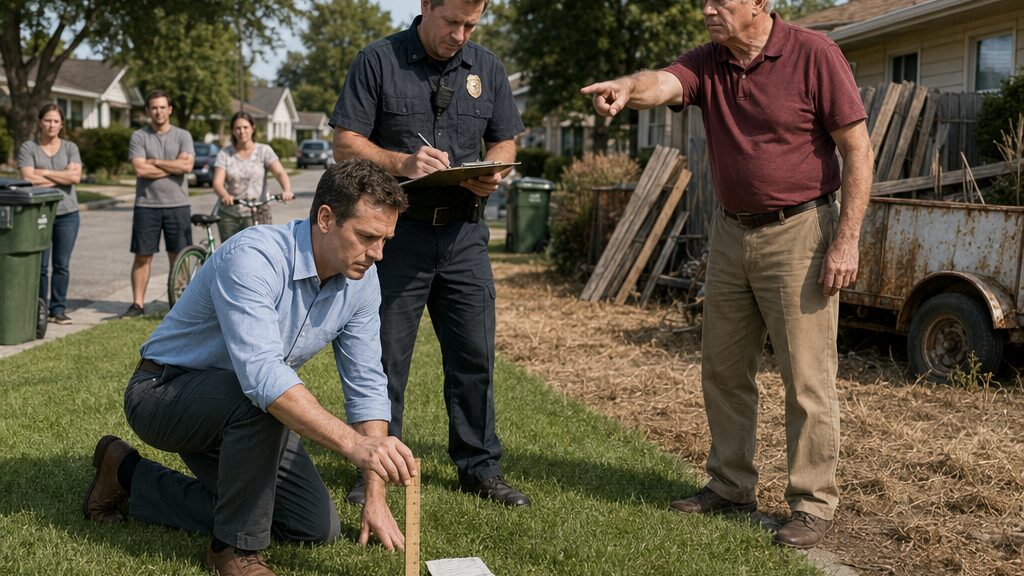
Steven Nelson was already on one knee in Gary Roberts’s front lawn when Ronald Clark pulled his curtain aside.
The movement happened in the upstairs window next door: one pale hand, one narrow opening, one gray face watching through the glass. Gary saw it without turning his head. By the sixth Monday, he had learned exactly where to look.
Steven pressed a plain wooden ruler into the grass beside the sidewalk. The folded complaint notice lay near his boot, its city seal visible above the crease.
“Three and a quarter,” Steven said.
Gary stood with his arms loose at his sides. Across the street, a woman slowed while dragging two trash bins toward her garage. A landscaping truck rolled past, then braked at the stop sign longer than necessary.
Ronald’s front door opened.
“You measured the edge,” Ronald called. “The center grows faster.”
Steven closed his eyes for half a second before rising. He was not a police officer, though the dark city shirt and clipped radio made people treat him like one. He had visited Gary’s property often enough to stop checking the address.
“The complaint identifies the front lawn,” Steven said. “I’m checking representative areas.”
Ronald crossed his driveway with a folded sheet in his hand. Behind him, his yard seemed determined to contradict every word he spoke. A rusted utility trailer leaned on one low tire beside the garage. Weather-darkened boards were stacked against the fence. The strip of grass near his curb had gone the color of straw.
“That section was cut yesterday,” Ronald said. “Check by the maple.”
Gary felt the familiar heat rise under his collar.
He had cut the lawn Saturday morning, the same way he always did. He used the mower’s three-inch setting, edged the sidewalk, blew the clippings back from the street, and rinsed the green stains from the front steps. He had done it before the first complaint and before the second. By the fourth, he had started taking dated photographs.
By the fifth, he had begun keeping the envelopes.
Steven walked toward the maple.
Ronald followed him onto Gary’s property without asking.
“Here,” Ronald said, pointing with the folded page. “That patch.”
Steven inserted the ruler. “Three and a half.”
Ronald pointed closer to the porch. “There.”
A boy riding a bicycle slowed on the opposite sidewalk. Two houses down, a garage door stopped halfway open.
Gary looked at Ronald. “How many places are you asking him to measure?”
“As many as necessary.”
“To find what?”
Ronald’s jaw tightened. “A violation.”
Steven moved to the third spot before Gary could answer. The ruler stood upright among the blades, absurdly straight and small. Gary suddenly saw the scene as the neighbors must see it: three grown men gathered over ordinary grass, one of them holding official paperwork, another watching each fraction of an inch as though the street depended on it.
Ronald folded his arms.
Steven read the ruler. “Three and three eighths.”
“The limit is four,” Gary said.
“I know the limit,” Ronald replied.
Steven pulled the ruler free and brushed dirt from its end. “The property is compliant.”
Ronald looked toward the maple again. “It wasn’t last Tuesday.”
“The complaint was submitted this morning,” Steven said.
“That doesn’t mean the problem began this morning.”
Gary heard a lawn sprinkler clicking somewhere behind the houses. Each turn of the mechanism sounded too loud in the silence.
Steven reached for the notice. “I’ll mark it unsubstantiated.”
“That’s what you marked the others,” Ronald said.
“Because the measurements were under four inches.”
Ronald’s face changed then—not much, just enough for Gary to notice. The anger did not sharpen. It withdrew. For a moment Ronald looked less like a man defending a rule than a man watching a door close.
Then he glanced at the people observing from across the street and lifted his chin.
“He trims after I report him,” he said.
Gary laughed once before he could stop himself. It came out hard and humorless.
“You file at seven in the morning,” he said. “The inspector gets here before nine. Are you saying I mow the lawn while you’re on the phone?”
Ronald did not answer him. He looked at Steven instead.
Steven tucked the notice under his clipboard. “Mr. Clark, unless you have a dated photograph showing a measurement above the limit, repeated complaints about the same condition are not likely to produce a different result.”
“I have photographs.”
“With a visible measurement?”
Ronald looked down at the paper in his hand.
“No.”
Steven nodded as though that settled something, but Gary knew better. Nothing was settled. The city truck would leave. Ronald would return behind his curtain. Another envelope would arrive.
Gary stepped closer to Steven.
“I want the exact measurements entered in the file.”
Steven glanced up. “They’ll be in my notes.”
“All three.”
“Gary,” Brenda said from the porch.
He had not heard the front door open. She stood in her work blouse with one hand around a coffee mug, her expression carefully neutral. That carefulness bothered him more than anger would have.
Steven studied Gary. “I can list all three.”
“And note that this is the sixth complaint in six weeks.”
Ronald’s folded page crackled in his fist.
Steven’s voice lowered. “That information is already attached to the address.”
“I want the result attached too. Every time.”
Brenda took one step down from the porch. “The lawn passed. Let him finish.”
Gary knew what she meant. Do not turn this into a performance. Do not give Ronald the scene he came looking for.
But the scene already existed. It existed in the paused garage door, the bicycle circling slowly at the corner, the woman across the street pretending to rearrange bins. Gary had spent six Mondays trying to make himself smaller inside it.
He crouched beside the ruler.
Steven looked surprised.
Gary held it steady against the grass and said, “Three and three eighths. Put that in the public record.”
Ronald stared at him.
For the first time since the complaints began, Gary did not feel only embarrassed. He felt attentive.
Steven wrote the number.
The audience gradually dissolved once the city truck drove away. The garage door finished opening. The boy on the bicycle disappeared around the corner. Brenda went inside without speaking.
Ronald remained at the property line.
“You’re making this bigger than it needs to be,” he said.
Gary looked past him at the trailer, the boards, and the dead strip along the curb. “I was about to say the same thing.”
Ronald’s eyes narrowed. “Keep your yard in compliance, and there’s no problem.”
“It has been in compliance.”
“On inspection days.”
Gary waited for him to explain, but Ronald simply turned and crossed back through his own uneven grass.
That evening, Gary placed the sixth envelope in the bottom drawer of his desk. The first five were already there, arranged by date. Beside them lay printed photographs of the yard, the mower settings, and each measurement Steven had recorded.
He set the four-inch ruler on top.
Brenda stood in the doorway.
“You looked like you enjoyed that at the end,” she said.
“I enjoyed having it documented.”
“That’s not what I said.”
Gary closed the drawer. “He keeps sending the city to our house.”
“I know.”
“People stop and watch.”
“I know that too.”
“He’s trying to make it look like we’re doing something wrong.”
Brenda held his gaze. “Then don’t help him make it look like two neighbors losing their minds over grass.”
She left before he could answer.
At twelve forty-three that night, a white flash crossed the bedroom ceiling.
Gary sat up.
A second flash came through the narrow space between the curtains.
He went to the window and looked down.
Ronald stood beside the shared fence in slippers and a dark robe, holding a camera over the top rail. He aimed toward Gary’s lawn, waited, and took another photograph.
This time he was not photographing the grass.
He was photographing Gary watching him.
Chapter 2: The Yard Next Door Hid More Than Clutter
The fourth camera flash came from below the fence line.
Gary stepped away from the bedroom window before Ronald could take another picture. Brenda remained sitting against the headboard, one hand resting on the lamp switch.
“Do not go outside,” she said.
“He’s on our property.”
“You don’t know that.”
“He’s leaning over the fence with a camera.”
“At one in the morning. Which is exactly why you shouldn’t walk out there angry.”
Gary pulled on his jeans.
Brenda switched off the lamp. “Gary.”
He stopped with one foot inside the pant leg.
The room went dark except for the streetlight leaking through the curtains. In that dimness, the argument seemed older than the six complaints. It carried every evening Gary had said the situation was handled, every Monday Brenda had watched a city truck stop in front of their house, every time he had insisted the next inspection would be the last.
Another flash brightened the ceiling.
Gary finished dressing but did not leave the bedroom. He stood behind the curtain and used his phone to photograph Ronald from inside the house.
By morning, Ronald was gone from the fence. A thin strip of dew lay silver across Gary’s lawn. On the other side, the dead grass around Ronald’s trailer looked almost white.
Gary walked the property line before work.
The trailer’s metal frame was flaking into orange scales. One wheel had sunk deep enough into the dirt that weeds had grown around the rim. Several boards leaned against the fence without straps or brackets. A plastic tarp covered something bulky near the garage, its corners weighted by paint cans.
He took three photographs from his side of the fence.
“You’re doing it now,” Brenda said behind him.
Gary lowered the phone. “Doing what?”
“What he does.”
“He photographed our bedroom window.”
“And you’re photographing his yard.”
“From our property.”
“That makes it legal. It doesn’t make it healthy.”
Gary put the phone in his pocket. “I need a record.”
“You have six city reports saying the lawn passed.”
“He keeps filing anyway.”
Brenda looked toward Ronald’s house. The upstairs curtain was closed.
“What exactly are you trying to prove?” she asked.
“That he’s targeting us.”
“You already know he is.”
“That he doesn’t care about the rules. He cares about control.”
Brenda folded her arms. “And once you prove that?”
Gary looked at the rusted trailer. He had no answer that did not sound like punishment.
At work, he spent the morning estimating trench distances for a utility project and the afternoon thinking about the distance between Ronald’s camera and the bedroom window. Numbers usually settled him. Measurements had edges. They either matched or they did not.
But the more he replayed the sixth inspection, the less certain he felt about the moment he had crouched beside the ruler. He had wanted the record. He had also wanted Ronald to see him taking control of it.
When he came home, the office drawer was open.
The complaint envelopes had been moved onto the desk. Brenda stood beside them, holding a folder Gary had started the previous week. Each divider bore a date. Behind the sixth tab were printed photographs of Ronald’s yard.
The four-inch ruler lay across the pages.
“You labeled them,” she said.
Gary placed his keys carefully beside the keyboard. “So I could keep the inspections straight.”
“You made a file on him.”
“I made a file on what he’s doing.”
“There are photographs of his trailer.”
“It may violate the exterior-storage section.”
Brenda stared at him. “You researched his property?”
“I researched the rules he keeps using.”
“That isn’t the same thing.”
“No. It’s the only way to make them apply equally.”
She turned one photograph toward him. It showed the boards against Ronald’s fence. In the corner, barely visible, was Ronald bending over near the garage.
“Did he know you took this?”
“I was standing in our yard.”
“That isn’t what I asked.”
Gary looked away.
Brenda sat in his desk chair. The anger left her face, replaced by something quieter.
“I don’t like opening the curtains anymore,” she said.
He looked back at her.
“I check his window before I get the mail. Yesterday, I waited until he drove away before I brought the recycling bin in. I hate that I’m doing that.”
Gary’s first instinct was to tell her she did not need to. The sentence rose automatically and died before reaching his mouth.
“He makes me feel watched,” she said. “And now you’re making this room feel like a surveillance office.”
Gary sat on the edge of the desk.
For several seconds, neither of them touched the folder.
“The inspections make me feel like I’m twelve years old,” he said finally.
Brenda’s expression shifted.
Gary rubbed his palms together. “When that truck stops outside, I start checking things I already checked. The grass. The mailbox. The bins. I think about my father’s shop.”
Brenda knew the story, but he rarely spoke about it. His father had ignored warning letters until penalties became liens, then blamed the town, the bank, and anyone who asked why he had not opened the mail.
“I keep thinking if everything is correct,” Gary said, “nothing can happen to us.”
“And Ronald keeps proving that being correct doesn’t stop someone from accusing you.”
He nodded.
Brenda touched the ruler with one finger. “Then this isn’t making you feel safer.”
“No.”
It was the first honest answer he had given her about the complaints.
For a moment, that honesty felt like relief.
Then Brenda closed the folder.
“I won’t support retaliation,” she said. “If you request records, speak to the city, or defend us, tell me. But if you start hunting for every thing wrong with his property because you want him embarrassed, you do it without pretending it’s for me.”
Gary felt the shame before the defensiveness.
“He has three obvious violations.”
“That may be true.”
“He’s reported us six times.”
“That is also true.”
“So what am I supposed to do?”
“Decide what outcome you want before you choose the weapon.”
She left the office.
Gary remained beside the open drawer until the room darkened. He eventually returned the envelopes to their places but left the ruler on the desk.
The next morning, Ronald’s driveway was empty. Gary stood at the kitchen window while coffee brewed and noticed details he had ignored before: a broken gutter elbow near the garage, a sag in the fence, two unopened bags of patching material under the tarp. The yard did not look merely cluttered. It looked interrupted, as though each repair had begun on a day Ronald believed he would finish it later.
Gary disliked the thought because it weakened the clean shape of his anger.
At three that afternoon, the doorbell rang.
A courier envelope rested on the porch after the delivery driver returned to the van. The city seal appeared in the upper corner.
Brenda watched Gary bring it inside.
“It’s Thursday,” she said.
He opened it at the kitchen counter.
The notice identified another complaint concerning excessive lawn height and possible neglected edging along the public sidewalk. Inspection was scheduled for Friday morning.
Not Monday.
Gary read the date twice.
Attached to the complaint was a photograph taken at night. The yard was dark, the grass impossible to measure. In the upstairs window, Gary’s silhouette stood behind the curtain.
Brenda took the page from him.
Ronald was no longer trying to catch the lawn above four inches.
He was building a picture of Gary watching back.
Chapter 3: Three Years of Complaints Changed the Pattern
The municipal records clerk returned carrying a box large enough to hold far more than six lawn complaints.
She placed it on the counter between them and flexed her fingers.
“This is everything responsive to the address request,” she said. “Three calendar years, code enforcement only. Personal contact details have been redacted.”
Gary stared at the box. “All of that came from one address?”
“Not all of it came from the address. Some records concern the address.”
That distinction landed harder than he expected.
The Friday inspection had ended like the others. Steven measured the lawn, found nothing above the limit, and marked the seventh complaint unsubstantiated. When Gary showed him the nighttime photograph, Steven’s expression had tightened.
“A photograph of a yard is not a measurement,” he had said.
“Then why was an inspection scheduled?”
“Because the complaint alleged an observable condition.”
“There was no observable condition.”
Steven had looked toward Ronald’s closed house. “That is why I’m documenting the result.”
Gary filed the public-records request that afternoon.
He told Brenda before submitting it. He did not ask her approval, and she did not offer it. She only said, “Read for the pattern. Don’t read for ammunition.”
Now, at the records office, Gary lifted the first folder from the box.
The earliest complaints were not about him. One concerned a basketball hoop left near the curb. Another cited holiday lights displayed past the HOA’s recommended removal date. A third reported a work van parked overnight on a driveway.
The names were redacted, but the addresses were not.
Gary recognized every house.
Ronald had complained about the family across the street, the retired couple near the corner, and the owner of a small plumbing business two doors down. Some complaints were verified. Most were closed without action.
He began a timeline on a yellow legal pad.
Date. Address. Allegation. Result.
By noon, the columns had become repetitive. Trash container visible from street. Grass exceeding four inches. Fence stain inconsistent with approved palette. Commercial vehicle. Exterior storage. Dead vegetation.
The language in several complaints was nearly identical.
Possible decline in neighborhood standards.
Selective noncompliance encourages further deterioration.
Prompt inspection requested.
Gary could hear Ronald’s voice inside the phrases—formal, aggrieved, certain that urgency increased truth.
The clerk passed by and glanced at the spread of folders.
“You can request copies by page,” she said.
“I’ll need more than a few.”
“That happens.”
Gary looked up. “Does one person usually file this many complaints?”
She considered the question before answering. “The system doesn’t limit legitimate reports.”
“That’s not what I asked.”
“No,” she said. “It isn’t typical.”
The small payoff should have felt satisfying. Instead, Gary experienced a hollow confirmation. Ronald had not singled him out because of some private insult or old misunderstanding. Complaining was a method Ronald had used across the neighborhood.
But Gary’s address appeared more often than any other.
Seven times in six weeks.
He turned to a folder labeled with Ronald’s property address.
The first notice was dated nearly two years earlier. Dead turf above the permitted percentage. The city had granted additional time after documentation of a household medical hardship.
A second notice concerned unsecured exterior lumber. Compliance had been deferred.
A third involved the utility trailer and an unpaved parking surface. The file included a handwritten note: homeowner states repairs delayed due to caregiving responsibilities.
Gary stopped writing.
The date fell three weeks before the obituary he remembered seeing in the neighborhood newsletter. Ronald’s wife had died that spring.
Gary closed the folder and sat back.
For months, Ronald’s yard had been a visual argument in Gary’s favor. The dead grass, rusted trailer, and leaning boards made every complaint look ridiculous. Now the same objects carried different information. They were still violations. They were also tasks left unfinished during an illness.
Gary thought of Brenda’s warning: read for the pattern, not the ammunition.
He opened the next file.
The records shifted after Ronald’s wife died. The city extended deadlines twice. An HOA board note recommended voluntary assistance through a neighborhood maintenance program. Ronald declined.
Then the complaint activity increased.
Not gradually. Suddenly.
Within two weeks of the second extension, Ronald reported three other properties. Before a scheduled follow-up on his trailer, he filed four complaints in nine days. The follow-up was postponed after staffing shortages.
Gary drew lines between the dates.
The pattern sharpened.
Every time Ronald’s own property approached formal review, complaints went outward.
At first Gary told himself it could be coincidence. He checked the dates again. A dead-turf inspection was scheduled for April 12; Ronald filed complaints on April 8, 9, and 11. A trailer review was set for August 3; Ronald reported two lawns and a fence between July 28 and August 1.
The complaints did not legally delay his inspections. Nothing in the file showed that.
But they filled the same enforcement queue. They redirected attention. They created noise.
Gary felt vindication rise, then caught himself enjoying it.
He photographed the timelines, requested copies, and brought the box back to the clerk.
“Is there anything else associated with the address?” he asked.
She checked the index. “One administrative correspondence file. Not complaint records.”
“Public?”
“Partially.”
She returned with a thin folder.
The first page was a notice from the city informing Ronald that deferred compliance would expire unless repairs began. The second referenced an upcoming exterior review requested by a property insurer.
Several lines were redacted. Enough remained visible.
Failure to correct identified hazards may affect continued coverage.
Gary read the sentence twice.
An insurance review was not an HOA warning. It was not a neighbor complaint that could be dismissed as petty. If coverage disappeared, Ronald’s ability to remain in the house could become uncertain.
Gary copied the public pages and drove home with the folders stacked on the passenger seat.
Brenda was at the kitchen table when he arrived. She looked at the pile but did not ask whether he had found proof.
Gary spread only the complaint timeline before her.
“He reported other people,” he said. “A lot of them.”
Brenda traced one line with her finger. “And us more than anyone.”
“Yes.”
“Why?”
Gary added the inspection dates.
She saw the alignment before he explained it.
“He complains before they check his house,” she said.
“It looks that way.”
“Does reporting someone else stop his inspection?”
“No.”
“Then why do it?”
“I don’t know. Maybe he thinks it changes what they notice. Maybe he wants to look like the person protecting standards instead of the person failing them.”
Brenda leaned back.
Gary placed the insurance notice beside the timeline.
Her eyes moved over the sentence about continued coverage.
“That’s what he’s afraid of,” she said.
“Maybe.”
“And you’re afraid that if you don’t document everything, someone can take your home from you the way your father lost the shop.”
Gary said nothing.
The ruler still lay on the desk in the next room, holding down the earlier complaints as though four inches could measure the distance between fear and control.
Brenda closed the insurance page.
“What are you going to do?”
Gary looked through the kitchen window toward Ronald’s yard. Ronald stood beside the trailer with both hands on its rusted frame. He pushed once, testing its weight. The trailer did not move.
For one second, Gary saw an older man confronting a job he could no longer manage alone.
Then Ronald looked up, saw Gary at the window, and raised his camera.
Gary stepped away from the glass.
On the final copied page, beneath the insurance language, a review date had been typed in bold.
It was three weeks away.
Chapter 4: The Complaint Worked and Made Everything Worse
Steven Nelson walked past Gary’s lawn without slowing.
For half a second, Gary thought the inspector had come about an eighth complaint. Then Steven crossed the property line, stepped around the rusted trailer, and headed toward Ronald’s front door.
Gary remained behind the kitchen window.
The complaint had taken him forty minutes to submit and nearly two weeks to justify to himself. He had listed only what could be seen from his own property or the public sidewalk: dead turf beyond the percentage allowed by city code, unsecured lumber leaning against the shared fence, and a utility trailer stored on bare ground in the front yard.
He attached photographs, dates, and the relevant sections.
He had not told Brenda.
Steven knocked twice. Ronald opened the door wearing a button-down shirt tucked into work pants, as if he had dressed for an appointment he had not expected.
“What is this?” Ronald asked.
Steven held up his city identification, though Ronald knew him by sight. “Property-maintenance inspection.”
“Based on whose complaint?”
“I don’t disclose complainant information at the site.”
Ronald looked directly at Gary’s kitchen window.
Gary stepped back too late.
Steven began with the dead turf. He paced the curb strip, photographed the brown patches, and entered notes into his tablet. Ronald followed close behind, explaining that the summer heat had damaged every lawn on the block.
Steven glanced toward Gary’s green yard but said nothing.
At the trailer, he crouched near the sunken wheel.
“It’s temporary,” Ronald said.
“How long has it been here?”
“I move it.”
“There are weeds growing through the frame.”
“That doesn’t answer the question.”
Steven stood. “No. It helps answer it.”
Gary should have felt vindicated. Instead, he became aware of the refrigerator humming behind him and the coffee cooling untouched in his hand.
Ronald pointed toward the lumber. “Those boards are for the fence.”
“They need to be secured.”
“They’re against the fence.”
“That isn’t secured.”
“They haven’t fallen.”
Steven looked at the top board, which leaned several inches over the property line. “The code doesn’t require someone to be injured first.”
Ronald’s mouth tightened.
The inspection lasted twenty-three minutes. Gary knew because he watched the clock twice and then hated himself for watching it again.
Steven returned to his truck, printed three pages, and carried them to Ronald’s door. He did not tape them there. He handed them over one by one.
Dead vegetation.
Improper trailer storage.
Unsecured exterior materials.
Ronald read the headings without moving. Then he looked across the narrow space between the houses.
Gary felt something inside him loosen.
For six Mondays, the city truck had stopped in front of his home. For six Mondays, he had stood outside while a ruler turned his lawn into evidence. Now Steven had walked past him. The rules had continued across the property line.
The relief was real.
That frightened him more than the guilt.
Ronald crossed the yard before Steven had driven away.
“You filed this.”
Gary opened the back door rather than making Ronald shout through the glass.
“I filed a documented complaint.”
“You went through my property.”
“I took every photograph from my yard or the sidewalk.”
“You’ve been waiting for this.”
Gary thought of the midnight camera flash. “You reported my lawn seven times.”
“So this is revenge.”
“This is the same code.”
Ronald lifted the three notices. His hand shook slightly, whether from anger or strain Gary could not tell.
“My wife died in that house.”
Gary said nothing.
“I spent eighteen months taking her to appointments while that trailer sat exactly where it sits now. Nobody cared until you decided to make a case.”
“The lumber is leaning over my fence.”
“Then you could have knocked on the door.”
The accusation struck because it was true.
Gary had documented. He had researched. He had requested records. He had not once knocked.
“You didn’t knock before calling the city about my grass,” he said.
Ronald’s face hardened. “Your grass was visible from the street.”
“So is the trailer.”
A garage door opened across the road. Someone stood just inside the shadow, not quite pretending not to listen.
Ronald saw the movement too.
His voice rose. “He’s targeting a widower because I asked him to follow the neighborhood standards.”
Gary felt the conversation change shape. It was no longer two men at a property line. It had become a statement meant for witnesses.
“I followed the standard every time,” Gary said.
“You trimmed before inspection.”
“That is not true.”
“You’ve been photographing me.”
“After you photographed our bedroom window.”
Ronald turned toward the open garage across the street. “You hear that? He admits it.”
Gary understood then that facts would not rescue the scene. Every sentence became another object Ronald could hold up and point toward.
Steven’s truck pulled away.
Ronald folded the notices against his palm. “I’m appealing all three.”
“That’s your right.”
“And I’m filing with the HOA. Harassment. Invasion of privacy. Targeting an older resident.”
“You submitted a photograph of me inside my own house.”
“I photographed the yard.”
“With me in the window.”
Ronald’s stare held for a moment, then shifted toward the notices.
“I was trying to protect this neighborhood before you moved here,” he said.
He walked back across his dead grass without waiting for an answer.
Gary remained by the open door until the neighbor across the street lowered the garage.
Inside, the kitchen felt too bright.
Brenda came home after six. She set her bag on the counter, saw Gary’s face, and looked through the window toward Ronald’s house.
“What happened?”
Gary placed copies of the three citations on the table.
She did not touch them.
“You filed it.”
He pulled out a chair. “Everything was verified.”
“You filed it without telling me.”
“I knew what you would say.”
“That is not a defense.”
“He was violating three sections.”
“I’m not arguing about his yard.”
“He keeps using the city against us.”
“And you promised you would tell me before you acted.”
“I said I would tell you if I requested records or defended us.”
“You knew exactly what I meant.”
Gary heard his own voice growing precise. “The trailer is a safety issue. The lumber crosses onto our side. The turf citation is city code.”
Brenda looked at him for a long time.
“You sound like a complaint form.”
He stopped.
She opened the file on the table. Behind the citations were copies of Ronald’s deferred notices, the insurance letter, and Gary’s photographs.
“You submitted all of this?”
“Only the public violations.”
“You used the hardship records?”
“No.”
“But you brought them.”
“I needed context.”
“For what?”
Gary had no clean answer.
Brenda closed the folder.
“You didn’t file because the trailer scared you,” she said. “You filed because you wanted him to stand where you stood.”
Gary’s relief from that morning returned to him in memory: Steven walking past his lawn, Ronald holding three pages, the rules continuing next door.
He looked away.
Brenda’s voice softened, which made it worse. “I understand why.”
“Then why are you acting like I’m the problem?”
“Because understanding why you did something doesn’t make the way you did it harmless.”
She went upstairs.
Gary stayed in the kitchen until he heard a drawer open, then another. When Brenda came down, she carried a small overnight bag.
“Where are you going?”
“My sister’s.”
“For how long?”
“I don’t know. One night. Maybe two.”
“Because I filed a legitimate complaint?”
“Because you made a decision for this house and hid it from me.”
She placed the complaint folder in the center of the table.
“Gary, I don’t know whether you want peace anymore.”
The front door closed behind her.
On the table, the three citations rested beneath the same photographs Gary had once considered proof that he was different from Ronald.
Chapter 5: Ronald’s Daughter Refused to Defend Him
Lisa Clark arrived Saturday morning carrying a ring of keys and an expression that suggested she had rehearsed being angry.
Gary was pulling weeds near the driveway when she parked behind Ronald’s car. She stepped out, looked toward her father’s house, then crossed directly to Gary.
“You’re Gary Roberts?”
“Yes.”
“I’m Lisa Clark.”
He set the garden tool down.
“I know about the citations,” she said.
Gary glanced at Ronald’s closed garage. “Then you probably know he’s appealing.”
“He called me before he called the city.”
Her voice was clipped, but not hostile. She looked tired rather than furious.
“I’d like to see what you submitted.”
Gary straightened. “Your father has copies.”
“I didn’t ask what he has.”
The answer surprised him enough that he studied her more carefully. She was in her early forties, dressed for a weekend of physical work in jeans and a faded long-sleeved shirt. A pair of heavy gloves protruded from her back pocket.
“Why do you want my file?” he asked.
“Because he says you climbed his fence.”
“I didn’t.”
“He says you walked behind the garage.”
“I didn’t.”
“He also says the trailer is road-ready.”
Gary looked toward the weeds threaded through its frame.
Lisa followed his gaze. “That is why I want to see your file.”
They sat at the kitchen table where Brenda had left the complaint folder. Her overnight bag was gone, but the absence remained in every room.
Lisa examined each photograph without speaking. She checked the angles, then stood at the window to compare them with the view.
“These were taken from here?”
“Some from the yard. The trailer photos came from the sidewalk.”
She returned to the table.
“And the lumber?”
“From my side of the fence.”
Lisa pressed two fingers against her forehead. “He said you moved it to make it look unsafe.”
Gary almost laughed. “The boards weigh sixty pounds apiece.”
“That doesn’t mean he couldn’t believe it.”
She turned to the copies of the public records. When she reached the insurance notice, she stopped.
“You have this?”
“It was in the city file.”
“He knows?”
“I haven’t mentioned it.”
Lisa sat back. The anger she had brought with her changed direction.
“The insurer comes in less than two weeks,” she said.
“The city notice said three.”
“They moved it up.”
Gary looked toward Ronald’s house.
“I’ve tried to hire people,” Lisa continued. “A contractor for the fence. A landscaping company for the turf. Someone to haul the trailer. He cancels appointments after I make them.”
“Why?”
“Because help looks like evidence.”
“Evidence of what?”
“That he can’t stay there alone.”
Gary said nothing.
Lisa opened the folder again. “After my mother died, I asked him to move closer to me. He heard that as me asking for the house. When I offered to manage repairs, he said I was building a case to declare him incompetent.”
“Are you?”
Her eyes lifted sharply.
Gary held up a hand. “I’m asking because that’s what he’s afraid of.”
“No. I want him safe. I want the insurance renewed. I want to stop spending my lunch break calling contractors he sends away.”
She closed the folder.
“He was always strict about the neighborhood. Even when I was a kid, he measured where the trash cans sat behind the fence. But this—” She tapped the complaint timeline. “This got worse after my mother became ill.”
Gary thought of the aligned dates.
“He files complaints before inspections at his house,” he said.
Lisa looked at the timeline again. “Show me.”
He pointed to the first cluster, then the second. Her face went still.
“He told me the city kept postponing.”
“They did postpone some reviews.”
“Because he complained about other properties?”
“There’s no proof of that.”
“But he believed it worked.”
Gary did not answer.
Lisa stood abruptly. “Come with me.”
“To his house?”
“To the garage. He’s at the hardware store.”
“I’m not going onto his property.”
“You don’t have to. Stand at the driveway.”
She crossed back next door and opened Ronald’s garage using one of her keys. Gary remained on the public sidewalk.
The door rose with a shudder.
Inside, shelves sagged beneath paint cans, old tools, irrigation parts, and boxes labeled in black marker. Lisa moved several boards and pulled a narrow wooden ruler from a workbench drawer.
Four inches had been marked with a dark line.
She held it up.
“He made this after the city sent the first dead-turf notice,” she said.
Gary looked at the worn edge. “For my lawn?”
“For everyone’s.”
She searched the bench and found a stack of index cards. Each carried an address, a date, and a short note.
Bins visible.
Fence leaning.
Grass high near curb.
On Gary’s card, seven dates appeared. Beside two were the words city follow-up Thursday and insurance documents due.
The pattern was no longer an inference.
Lisa lowered the cards.
“He wasn’t just distracting himself,” Gary said.
“No.”
“He was trying to create enough activity that his own place looked like one problem among many.”
Lisa’s mouth tightened. “He was trying to be the person reporting decline, not the person causing it.”
The garage door rattled.
Ronald’s car turned into the street.
Lisa slid the cards back onto the bench but kept the ruler in her hand.
Gary stepped away from the driveway.
Ronald parked hard enough to jolt the car. He climbed out carrying a small hardware-store bag.
“What are you doing?” he demanded.
Lisa held up the ruler.
For a moment, Ronald looked older than he had during any inspection. His shoulders lowered, and his eyes went to Gary before returning to his daughter.
“You opened my garage.”
“I used my key.”
“That key is for emergencies.”
“This is becoming one.”
Ronald walked toward her. “Give me that.”
“Did you time the complaints around your inspections?”
“I reported violations when I saw them.”
“You wrote the inspection dates on his address card.”
Ronald stopped.
Gary expected denial. Instead Ronald looked toward the street.
“The city only responds when there’s a pattern,” he said.
“A pattern of what?” Lisa asked.
“Decline.”
“You created the pattern.”
“I documented it.”
“You used him.”
Ronald’s face tightened with something closer to injury than anger. “You don’t understand how fast they decide an older man can’t manage his own property.”
“Then let me help you manage it.”
“I do not need you taking over.”
“The insurer moved the review up.”
That reached him. His hand closed around the hardware-store bag.
“When?”
“Next week.”
Ronald looked at the trailer, then at the unfinished fence. His fear appeared only briefly before pride covered it.
“This is because of him,” he said.
“No,” Lisa replied. “The citations are because of the yard. The appeal is your choice. The false complaints were your choice too.”
Ronald turned to Gary. “You showed her my records.”
“She asked.”
“You had no right.”
“They’re public.”
“That doesn’t make it decent.”
Gary felt the truth of the sentence even as Ronald used it to avoid his own.
Lisa placed the ruler on the garage workbench.
“I’m hiring someone Monday,” she said. “You can be angry while they work.”
“No.”
“Then you can explain the trailer to the insurance adjuster.”
Ronald’s face closed.
Later, back in Gary’s kitchen, Lisa stood beside the complaint folder.
“He’ll appeal,” she said. “He’ll say you harassed him. He’ll name you at the HOA hearing.”
“I expected that.”
“He’ll use my mother.”
Gary looked at her.
“He’ll say the yard fell apart while he cared for her. That part is true. He’ll leave out everything after.”
“Are you asking me not to respond?”
“I’m asking you not to turn his worst two years into entertainment for the neighborhood.”
Gary thought of the open garage across the street during the confrontation, of how easily private damage became public spectacle.
“I don’t want that.”
Lisa studied him. “You wanted something close to it when you filed.”
He did not deny it.
She left with a copy of the photographs and the contractor sections of the code.
That afternoon, an email arrived from the HOA board president. Ronald had formally appealed the citations and submitted supporting images.
The first showed Gary holding his phone near the fence.
The second showed him at the public sidewalk beside Ronald’s trailer.
The third had been taken through Gary’s bedroom window. His silhouette stood behind the curtain, camera raised.
The complaint accused Gary of trespass, surveillance, and a sustained campaign of harassment against a grieving older homeowner.
The hearing notice named both men.
Chapter 6: The Hearing Put Both Yards on Trial
Ronald’s first exhibit was a poster-sized photograph of Gary holding a camera.
It stood on an easel at the front of the HOA community room, enlarged until Gary’s face appeared grainy and severe. The angle hid the sidewalk beneath his feet and made the trailer behind him look farther away than it was.
“This is not a neighbor documenting a concern,” Ronald said. “This is a man conducting surveillance.”
Gary sat beside Brenda at the second table.
She had come home two days earlier, but the complaint folder still remained on his desk instead of the kitchen table. They had spoken carefully since her return, as if each sentence needed inspection before delivery.
Across the room, nearby homeowners filled the folding chairs. Some had received complaints from Ronald. Others had known him for decades. Lisa sat alone near the back wall.
The HOA board president asked Ronald to continue.
“My wife and I lived in this neighborhood for thirty-one years,” he said. “We followed the covenants before some residents here owned homes. After she became sick, a few repairs were delayed. I never denied that.”
His voice remained controlled. That made the room lean toward him.
“What I deny is that one neighbor has the right to photograph my home, search my records, and file multiple complaints because I asked him to maintain his lawn.”
Gary felt Brenda’s hand move near his beneath the table, not touching, but close.
Ronald displayed the second photograph. Gary stood at the property line with the complaint folder under one arm.
“He watched my house. He documented my visitors. He involved my daughter. Then he used city enforcement to punish me.”
“I involved myself,” Lisa said from the back.
The board president looked up. “You’ll have an opportunity to speak.”
Ronald did not turn around.
One board member asked, “Mr. Clark, are you disputing the physical violations?”
“I’m disputing the way the evidence was obtained.”
“That wasn’t the question.”
“The trailer can be moved. The lumber was for repairs. The lawn suffered during a difficult period.”
The second board member looked toward Steven Nelson, who sat with a city folder on his lap.
“Mr. Nelson, were the citations verified independently?”
“Yes.”
“Did the city rely solely on Mr. Roberts’s photographs?”
“No. I inspected each condition in person.”
Ronald raised a hand. “After he directed you where to look.”
Steven’s expression barely changed. “The trailer was visible from the street. The lumber was visible above the shared fence. The dead turf was visible from both.”
The room shifted, not against Ronald exactly, but away from certainty.
Gary knew this was the moment he had prepared for. His folder contained the seven inspection results, the three-year complaint timeline, Ronald’s deferred notices, the insurance correspondence, and photographs of every violation.
If he submitted all of it, Ronald’s appeal would collapse beneath the weight.
The board president turned to him. “Mr. Roberts?”
Gary stood.
He carried only one stack to the front table.
The four-inch ruler lay across the top.
A faint murmur moved through the chairs.
Gary placed the ruler beside six stamped reports and the seventh inspection sheet. Each bore the same disposition: unsubstantiated.
“This is the ruler used during the sixth inspection,” he said.
Ronald gave a short laugh. “You kept it.”
“Yes.”
The laugh had been intended to make Gary appear obsessive. It almost succeeded.
Gary looked at the ruler, then at the enlarged photograph of himself.
“I kept it because I was trying to make certainty do something it couldn’t do.”
Brenda’s eyes lifted.
Gary continued before he could retreat into safer language.
“My lawn passed every inspection. I believed that if I documented enough, the accusations would stop mattering. They didn’t. The city truck still arrived. People still watched. My wife stopped opening the curtains without checking the house next door.”
Ronald shifted at his table.
Gary placed the first report down.
“Three and a quarter inches.”
The next.
“Three and five eighths.”
The third.
“Three and a half.”
He continued until all seven results formed a line beneath the ruler.
Steven opened his folder. “Those numbers match the city record.”
The board president examined the pages. “Mr. Clark, did you possess any photograph showing grass above four inches?”
Ronald’s answer came after a pause. “I observed it before inspection.”
“Did you measure it?”
“I didn’t need to place a ruler in every photograph to recognize neglect.”
One nearby homeowner spoke before being called. “You measured my trash cans from the curb.”
The board president raised a hand. “Please wait.”
Another voice came from the chairs. “He reported my work van three times.”
The room threatened to become what Gary had once imagined he wanted: Ronald surrounded by every complaint he had filed, each neighbor ready to return a piece of humiliation.
Gary reached into his folder.
The full three-year history waited there.
The board president saw its thickness. “You may submit all relevant records.”
Gary’s fingers rested on the insurance notice.
He pictured Ronald at the trailer, pushing against metal that would not move. He remembered Lisa saying her father believed help looked like evidence. He also remembered the midnight camera flash, Brenda leaving with an overnight bag, and Ronald turning private fear into official accusations against everyone around him.
Withholding everything would protect Ronald by sacrificing the truth.
Submitting everything would expose more than the hearing required.
Gary removed the complaint timeline but left the deferred notices and insurance pages in the folder.
“This summary contains dates, addresses, allegations, and outcomes from public complaint records,” he said. “I’m submitting it only to show the repeat pattern and how often complaints were unsubstantiated.”
Ronald stared at the folder still in Gary’s hand.
The board president asked, “Are there additional records?”
“Yes.”
“Are they relevant?”
“They concern Mr. Clark’s property.”
Ronald’s jaw tightened.
Gary closed the folder. “They also concern private hardship and deferred compliance. The city already verified the three current violations. I don’t believe the rest is necessary to decide whether he filed repeated unsupported complaints.”
Silence settled over the room.
The choice did not feel noble. It felt incomplete and risky.
The board president studied him. “You understand that withholding potentially relevant evidence may limit the board’s findings?”
“Yes.”
Ronald looked down.
Gary continued, “I am requesting one specific remedy. Repeat complaints about the same condition should require dated evidence showing the alleged violation before another inspection is scheduled.”
Steven leaned forward. “The city can flag recurring unsubstantiated reports for supervisory review. We cannot prevent residents from filing, but we can require more information before dispatching an inspector.”
The board president made a note.
Ronald stood. “So now he writes enforcement policy?”
“No,” Steven said. “He identified an administrative problem.”
Ronald turned toward Gary. “And my property?”
“The trailer and lumber were independently verified,” Gary said. “Those are safety and access issues. I’m not withdrawing them.”
“The grass?”
Gary hesitated.
The dead turf had harmed no one. Yet it had been part of the complaint he filed for the same reason Ronald had reported his lawn: because a rule existed and anger made the rule useful.
“I’ll address that when the board rules,” he said.
Ronald’s face gave nothing away.
Lisa was called next. She confirmed that Gary had not entered Ronald’s property and that she had opened the garage herself. She did not mention the insurance review until a board member asked whether repairs were underway.
“They will be,” she said. “My father has resisted help. That does not excuse false complaints, and it does not mean he should lose his home over cosmetic issues.”
Ronald finally turned toward her.
The hurt in his expression was sharp, but Lisa did not look away.
Steven then verified the photograph locations using city inspection images. One had been taken from Gary’s yard. Two came from the public sidewalk. None showed trespass.
The accusation did not disappear, but its foundation weakened.
After ninety minutes, the board president closed the record.
“We will issue a written decision,” she said. “Until then, both parties are directed to avoid photographing occupied windows and to communicate through the board regarding disputed compliance matters.”
No applause followed. Chairs scraped. People gathered their coats and spoke in low voices.
Gary packed the reports carefully. Brenda helped him place the ruler back inside the folder.
“You didn’t use the insurance letter,” she said.
“No.”
“Why?”
“Because I wanted the complaints stopped. I didn’t need everyone knowing what he might lose.”
She nodded once. It was not forgiveness, but it was movement.
Ronald waited near the exit while the room emptied. Lisa stood several feet away, giving him space he had not asked for.
When Gary passed, Ronald spoke quietly.
“You had more.”
Gary stopped.
Ronald’s eyes went to the closed folder.
“You could have put all of it in front of them,” he said.
“Yes.”
“Why didn’t you?”
Gary looked at the man who had measured other people’s lives because his own had become harder to control.
“Because the rules were supposed to stop the harm,” he said. “Not make sure you had nothing left.”
Ronald absorbed the answer without thanking him.
Behind them, the board president locked the evidence cabinet.
The written ruling had not yet come, and Gary had just limited the strongest case he possessed.
Chapter 7: Equal Rules Did Not Mean Equal Punishment
The envelope arrived on a Monday, but no city truck followed it.
Gary stood at the front window for several minutes after opening the letter, waiting for Steven Nelson’s dark vehicle to turn onto the street. The curb remained empty. No inspector stepped onto the lawn. No ruler entered the grass.
The HOA board had issued its decision.
Ronald’s allegations of trespass and unlawful surveillance were not supported by the evidence. The three municipal violations remained separate from the HOA appeal, though the board acknowledged that the trailer and lumber created legitimate safety concerns.
The final paragraph mattered most.
After repeated complaints about the same condition were found unsubstantiated, any additional complaint would require dated photographic evidence or another verifiable basis before the association requested a new inspection.
Gary read that section twice.
Brenda stood beside him with her coffee.
“So they changed the process,” she said.
“They changed the HOA referral process. The city still accepts complaints.”
“But they won’t automatically send someone every Monday.”
“No.”
The word felt smaller than the relief it carried.
Gary folded the decision along its original crease. He expected satisfaction, perhaps even the clean vindication he had imagined while building the records timeline.
Instead, he looked next door.
The trailer was still there.
Lisa’s contractor had secured the lumber into two horizontal racks beside the garage. The boards no longer leaned over Gary’s fence, and the sagging section had been braced with new posts. A landscaping crew had cleared weeds around the trailer but had not moved it.
The dead turf remained untouched.
Near noon, a tow vehicle backed into Ronald’s driveway. It was not large enough for the trailer.
A worker climbed out, inspected the sunken wheel, and shook his head. Ronald stood beside him with his hands on his hips. Lisa arrived ten minutes later. Even from inside, Gary could tell they were arguing.
Brenda looked over his shoulder.
“Don’t go out there.”
“I wasn’t planning to.”
“You were leaning toward the door.”
“I was trying to see what was happening.”
“That sentence has caused enough trouble.”
Gary stepped away from the window.
The next morning, Steven called.
“The safety corrections are due Friday,” he said. “Mr. Clark requested another extension.”
“Are you asking my opinion?”
“No. I’m informing you because the lumber encroachment affected your property, and you’re the reporting party.”
“What happens if the trailer stays?”
“Administrative penalties begin. The city may eventually order removal, but that is not immediate.”
“And the turf?”
“The board asked whether you intend to maintain that portion of your complaint.”
Gary looked at the dead strip through the office window.
“The grass isn’t dangerous.”
“No.”
“It violates the code.”
“Yes.”
Steven waited.
Gary understood why the question felt familiar. For weeks, he had wanted someone else to make the moral decision appear procedural. If the code said the turf was wrong, then Gary would not have to decide whether pursuing it was necessary.
“What happens if I withdraw it?” he asked.
“The existing notice can be closed at complainant request if no independent public-interest concern remains.”
“And the trailer?”
“That inspection stands.”
“The lumber?”
“Compliance has been verified.”
Gary rubbed the corner of the HOA decision between his fingers.
“I’ll withdraw the turf complaint.”
Steven did not congratulate him. “Send it in writing.”
After the call, Gary drafted the email and left it open on the screen.
Brenda read it from behind his shoulder.
“You can still be angry,” she said.
“I know.”
“You don’t have to pretend the lawn never mattered.”
“It mattered because he made mine matter.”
“That’s different.”
Gary sent the withdrawal.
That afternoon, Ronald appeared at the shared fence.
“The city called,” he said.
Gary waited.
“You withdrew the grass citation.”
“Yes.”
Ronald glanced toward his curb. “It was never your business.”
“Neither was the height of my lawn.”
“That is not the same.”
Gary felt the old argument rise, ready and practiced. He could list seven inspections. He could quote the three measurements from the sixth Monday. He could explain the new evidence rule.
Instead, he said, “No. It isn’t exactly the same.”
Ronald seemed surprised.
“The trailer could shift,” Gary continued. “The boards crossed my fence. Those affected other people. The dead grass mostly affects how the yard looks.”
“You filed all three.”
“I did.”
“So you admit you were being petty.”
“I admit part of me wanted you inspected.”
Ronald’s expression tightened with satisfaction, as if he had finally obtained the confession he needed.
Gary did not take it back.
“You embarrassed me,” Ronald said.
“You embarrassed me first.”
“That makes it right?”
“No.”
The answer left nowhere comfortable for either of them to stand.
Ronald looked toward Gary’s house. Brenda was visible through the kitchen window, not hiding that she was watching.
“I spent thirty-one years keeping this place up,” Ronald said. “People drive past now and see a trailer, brown grass, and my daughter hiring men to do work I used to do myself.”
Gary leaned one hand against the fence post.
“And you thought if everyone else looked worse, no one would notice.”
Ronald’s eyes hardened.
Gary expected denial.
Instead Ronald said, “I thought if the city saw problems everywhere, mine wouldn’t become the only story.”
“It became mine.”
Ronald looked down.
The admission did not resemble an apology. It was smaller and harder than one.
On Thursday morning, Lisa returned with a larger towing company. The driver positioned a jack beneath the trailer frame, but the rusted coupler refused to release. Metal struck metal. The sound carried down the block.
Gary watched from his driveway while pretending to sort recycling.
Ronald stood beside the trailer, arguing with the driver about the lift point. Lisa crossed the yard toward Gary.
“He won’t let them cut the old lock,” she said.
“Why not?”
“He says the key is in the garage.”
“Is it?”
“He has been looking for two hours.”
Gary glanced toward the trailer. “They can’t move it without cutting the lock?”
“They can, but it will cost more and probably damage the coupler.”
Ronald turned and saw them speaking.
“I know where it is,” he called.
Lisa lowered her voice. “The insurance adjuster comes tomorrow.”
Gary considered going inside.
Then Ronald walked toward the property line.
“Do you know where to rent a low-profile trailer jack?” he asked.
Gary almost thought he had misheard him.
“There’s an equipment place near the industrial park,” Gary said.
“I called. They’re out.”
“The farm-supply store rents them.”
“They said they had bottle jacks.”
“There’s another place near the highway.”
Ronald’s mouth tightened. Asking had already cost him something; asking twice would cost more.
Gary took out his phone. “I’ll find the number.”
“I didn’t ask you to arrange it.”
“No. You asked where.”
Gary searched and found a rental shop twenty minutes away. One jack remained.
Ronald wrote the address on the back of an old receipt.
“Thank you,” he said without looking up.
It was not reconciliation. It was not even warmth.
But the next morning, the trailer rolled away behind the tow vehicle.
The ruts remained in the yard, two dark grooves cutting through dead grass. Ronald stood beside them while Lisa spoke with the insurance adjuster near the garage.
Gary placed the four-inch ruler in the bottom drawer of his workbench, among tape measures, chalk line, drill bits, and spare utility blades.
For the first time, it looked like an ordinary tool.
Chapter 8: The First Monday Nobody Measured the Grass
The new fence crossed the surveyed property line by two inches.
Gary found the error on a Monday morning while checking the gate latch. One post stood on Ronald’s side, but the lower rail angled toward Gary’s yard until the final panel rested beyond the metal survey pin.
Two inches.
He crouched beside the pin and pressed his thumb into the soil.
Behind him, Brenda opened the back door.
“What is it?”
“The fence is over.”
“How far?”
“About two inches at the end.”
She came down the steps and examined the rail.
The repair looked solid. Lisa’s contractor had replaced the warped boards, set new posts, and secured the lumber that had once leaned over the old fence. Ronald’s yard was still uneven, but the trailer was gone. Fresh gravel covered the place where it had sat. Several squares of new sod had been laid near the driveway, not enough to replace the dead turf, only enough to stop erosion around the ruts.
Brenda looked at Gary.
“Are you going to report it?”
The question was quiet.
Gary knew she was not asking about the fence.
Inside the garage, the complaint folder remained on a shelf. The public-records copies were boxed beneath it. The HOA decision was filed with the house documents. The ruler lay in the workbench drawer.
He could photograph the pin, attach the property survey, and create a complete record before breakfast.
He stood.
“I’m going to talk to him.”
Ronald was in the side yard filling a watering can. He had started using a cane on uneven ground, though he left it leaning against the garage whenever Lisa visited.
Gary stopped at the fence.
“Ronald.”
Ronald looked up. His first reaction was still guarded, but it no longer arrived as quickly.
“What?”
“The new fence crosses the line near the back.”
Ronald set down the watering can. “No, it doesn’t.”
Gary felt the old rhythm begin.
“I checked the survey pin.”
“The contractor measured.”
“Come look.”
Ronald’s eyes narrowed. “Did you take pictures?”
“No.”
That interrupted him.
Gary walked toward the back corner on his side. Ronald followed along the fence until they reached the pin.
Gary pointed to the rail.
Ronald crouched slowly, one hand braced against the post. He sighted along the fence, then looked at the metal marker.
“That pin could have shifted.”
“It’s set in concrete.”
Ronald pressed the soil around it with two fingers.
For several seconds, Gary expected an argument about survey records, erosion, or the accuracy of contractors.
Ronald stood with effort.
“It’s over,” he said.
“Yes.”
“Two inches?”
“About that.”
Ronald looked toward his garage. “I’ll call them.”
The admission came without anger, excuse, or demand for proof.
Gary felt something inside him release—not forgiveness exactly, and not trust. The release was simpler. He had brought a problem directly to the man next door, and the problem had remained only a problem.
“When are they coming?” Gary asked.
“Probably not today.”
“I’m not asking for an inspection.”
Ronald looked at him. “I know.”
That afternoon, Lisa arrived with groceries. She carried two bags inside, then returned to speak with the contractor by phone. Ronald stood beside her, listening rather than interrupting.
The insurance company had renewed coverage after the trailer was removed and the lumber secured, though the policy required continued repairs. Lisa had arranged monthly visits from a landscaping crew. Ronald complained about the price but no longer canceled them.
He remained in the house.
Gary learned these things not from records but from brief conversations across the fence. Lisa mentioned the insurance renewal while returning a borrowed extension cord. Ronald explained the gravel delivery when the truck blocked Gary’s driveway for ten minutes.
The changes were practical and incomplete.
Ronald never apologized for the seven complaints.
He once said, “I should have had better evidence,” which was not the same as admitting he had been wrong.
Gary replied, “You should not have filed them,” and Ronald changed the subject.
The new HOA procedure took effect. Repeat complaints concerning the same condition required dated evidence, and three unsubstantiated reports triggered administrative review. Steven sent Gary a copy of the updated policy without comment.
No city truck came the following Monday.
Or the Monday after that.
Gary still noticed the time around eight thirty, when inspections had usually begun. For several weeks, he looked toward the street before catching himself.
Then one Monday passed without him remembering at all.
The fence contractor returned in early autumn. He removed the final panel, reset the rail inside Ronald’s line, and replaced the disturbed soil around the marker. The work took less than an hour.
Ronald inspected it when the contractor finished.
He did not measure.
That evening, Gary and Brenda sat on the back steps while sprinklers clicked across the neighborhood. Ronald watered the new sod by hand. He moved slowly from one square to the next, careful not to flood the gravel.
“He could use a hose timer,” Brenda said.
“He says timers fail.”
“Of course he does.”
Gary smiled.
The grass in his own yard had grown higher than usual. A utility project at work had kept him late three nights, and rain had prevented him from mowing Saturday.
Brenda noticed him looking.
“How high?”
“I don’t know.”
“You own several tools that could answer that.”
Gary looked through the open garage toward the workbench drawer.
For a moment, he imagined the ruler standing among the blades, the old dark line marking the legal limit. He remembered kneeling beside Steven while the neighborhood watched. He remembered wanting a number to protect him from another person’s judgment.
The lawn was probably still compliant.
He left the ruler where it was.
“I’ll cut it tomorrow,” he said.
After dark, someone knocked on the front door.
Gary opened it and found no one on the porch. Ronald’s house was lit next door, the upstairs curtain open for the first time Gary could remember.
A plain wooden ruler lay beside the doormat.
It was not Gary’s ruler.
This one was older, its edge worn smooth, with a dark mark drawn at exactly four inches.
Gary picked it up.
There was no note, no apology, and no request that he understand more than Ronald had been willing to say.
Across the yard, Ronald stood at his window.
Gary held up the ruler.
Ronald gave one small nod and let the curtain fall—not shut, only halfway.
Gary carried the ruler into the garage. He opened the workbench drawer and placed it beside his own.
Then he closed the drawer.
The next morning, he knocked on Ronald’s door before starting the mower and asked whether the hour was too early.
Ronald looked past him at the grass.
“No,” he said. “It’s your yard.”
The story has ended.