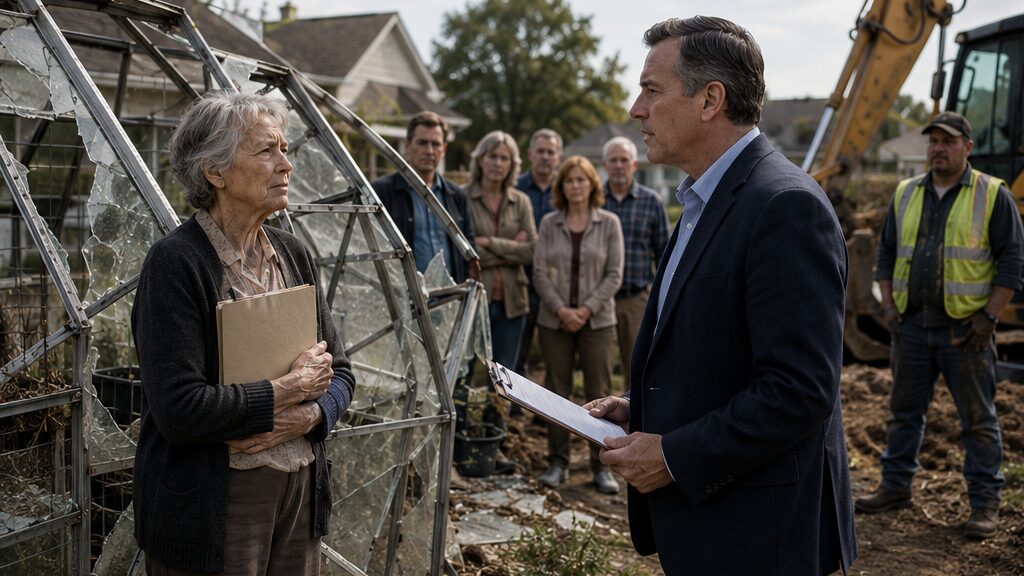
The Greenhouse They Destroyed Revealed the Homeowner They Never Expected to Challenge Their Power
Chapter 1: The Morning the Greenhouse Fell Apart
The first sound Margaret Lewis heard that morning was not the birds that usually gathered near the garden fence.
It was glass breaking.
She looked up from the kitchen window just in time to see the yellow arm of an excavator swing across her backyard. The machine’s bucket came down through the roof of her greenhouse, crushing the clear panels she had replaced one by one over the last twelve years.
For several seconds, Margaret did not move.
Her hand remained wrapped around the handle of her coffee mug. The steam rising from it disappeared into the cold morning air near the window, but she barely noticed.
The greenhouse was gone before she could even reach the back door.
“Stop!”
Her voice came out sharper than she expected.
She pushed through the door and crossed the lawn faster than her knees usually allowed. The grass was still damp beneath her shoes, and small pieces of broken plastic and glass glittered between the garden beds.
The excavator operator looked down from the cab.
A man in a safety vest stood beside the machine, holding a clipboard.
“Ma’am, you need to stay back,” he called.
Margaret stopped several feet away.
“Stay back from what?” she asked. “My own greenhouse?”
The man glanced toward the street.
There was no apology in his expression. Only the look of someone waiting for a conversation he believed was already finished.
“This was approved,” he said.
“Approved by who?”
He hesitated just long enough for Margaret to notice.
Then he pointed toward the neighborhood entrance.
“The HOA.”
Margaret looked back at the broken structure behind her.
For years, the greenhouse had been the quietest place in her life.
It was where she started seedlings every spring. Where she grew herbs when winter covered the yard in gray. Where she kept the small plants that had belonged to her late husband before he passed away.
It was not expensive.
It was not impressive.
But every corner of it carried a piece of her life.
She stepped carefully over the broken frame.
“You cannot just come into my yard and destroy something because someone says they have permission.”
The supervisor lowered the clipboard.
“Mrs. Lewis, we’re not here to argue. The work order came through the proper channels.”
That phrase bothered her more than the destruction.
Proper channels.
As if a folder of paperwork could make the broken glass disappear.
As if following a process automatically meant the process was fair.
Margaret looked toward the house.
She had spent years believing that calm conversations solved problems. She had ignored several small disagreements with the neighborhood association because she assumed people would eventually listen.
Maybe that had been her mistake.
She had mistaken patience for protection.
The excavator engine started again.
Margaret raised her hand.
“Do not move that machine another inch.”
The operator looked uncomfortable, but the supervisor shook his head.
“We’ve already been instructed to complete the removal.”
“By whom?”
No one answered.
That silence told her more than a response would have.
By the time the machine finally moved away from the backyard, the greenhouse was only a pile of bent metal and broken panels.
Margaret stood there holding a piece of the old frame.
The metal was cold against her fingers.
She remembered building the first section with her husband. They had argued about where to place it. He wanted more sunlight; she wanted more protection from winter wind.
In the end, they had compromised.
That was how they had always lived.
Measure twice.
Listen once.
Build carefully.
Now someone had destroyed it in less than ten minutes.
A shadow moved across the yard.
Margaret turned.
David Moore stood near the fence.
He wore a pressed jacket and carried a folder under his arm. He looked less like someone arriving at a damaged property and more like someone attending a meeting.
“Margaret,” he said calmly.
She looked at him.
“You knew about this?”
David sighed.
“I knew the removal was scheduled.”
“You knew they were coming?”
“Yes.”
“And you let them destroy it?”
His expression tightened.
“I didn’t let anyone destroy anything. The HOA enforced the rules.”
Margaret looked at the folder.
“What rules?”
David opened it.
“This structure was not approved.”
“It has been there for years.”
“That does not mean it was compliant.”
The word landed harder than she expected.
Compliant.
A word she had heard many times during her years working with local administrative offices. A word that could mean something simple.
Or something people used when they wanted a person to stop asking questions.
“I never received a notice saying it would be removed.”
David looked away briefly.
“You received previous communication about the issue.”
Margaret felt a small knot form in her stomach.
Previous communication.
Not a conversation.
Not a warning.
Not a person standing at her door explaining what would happen.
A letter.
A document.
Something she had probably placed on her desk while telling herself she would handle it later.
“I thought it was about an inspection,” she said quietly.
David closed the folder.
“This is exactly why the board has procedures.”
Margaret looked around her yard.
At the destroyed greenhouse.
At the plants now exposed to the open air.
At the man standing there explaining why everything that happened was acceptable.
“Procedures are supposed to prevent damage,” she said. “Not explain it afterward.”
For the first time, David’s confidence shifted.
Only slightly.
But Margaret noticed.
“I understand you’re upset,” he said.
“No,” she replied. “You understand that I’m upset. That is different.”
The conversation ended without resolution.
David left through the gate.
Margaret remained in the yard.
She did not cry.
She did not shout.
She simply walked to the pile of debris and picked up every piece she could save.
By noon, she had collected the broken panels, the damaged plants, and the pieces of the wooden shelves her husband had built.
She placed them carefully in the garage.
Then she went inside.
On the kitchen table sat an envelope she had not opened.
The HOA logo was printed in the corner.
Margaret stared at it.
For the first time that day, she felt something stronger than anger.
A question.
She opened the envelope.
Inside was a violation notice.
Chapter 2: The Rulebook That Changed the Argument
The number at the bottom of the notice was the first thing Margaret saw.
The fine.
Not the explanation.
Not the rule.
Not the signature.
The amount.
She read it twice.
Then a third time.
It was not enough to destroy the greenhouse.
They were charging her for having it.
Margaret placed the paper flat on the kitchen table and walked away.
She returned five minutes later.
The paper was still there.
The same words.
The same accusation.
The same official tone that made the situation feel finished before she had even responded.
Unauthorized structure.
Violation of community standards.
Required correction.
She hated how ordinary the words looked.
Her greenhouse had been reduced to a paragraph.
Margaret opened the drawer beside the table and pulled out the folder where she kept neighborhood documents.
She had always been organized.
Tax records.
Insurance papers.
Repair receipts.
Old letters.
She knew exactly where everything was.
Except the one thing she needed.
The earlier HOA communication David mentioned.
She searched through the folder.
Nothing.
She checked another drawer.
Still nothing.
Then she remembered.
The unopened envelope from months earlier.
She had placed it on her desk after seeing the HOA return address.
She had thought:
I will look at this when I have time.
Then she had watered the greenhouse.
Then she had prepared dinner.
Then another day had passed.
And another.
Margaret sat down.
The realization bothered her.
Not because she believed she was wrong.
Because she knew she had avoided something.
She had always told herself that ignoring unnecessary conflict was maturity.
Maybe sometimes it was.
But maybe sometimes it was just a quieter form of surrender.
The next morning, she went to the HOA office.
David was sitting behind a desk when she arrived.
He looked surprised.
“Margaret.”
“I want to discuss the violation.”
David motioned toward the chair.
“Of course.”
She sat down and placed the notice in front of him.
“You destroyed my greenhouse before we had a conversation.”
David folded his hands.
“We had communicated the issue.”
“You sent paperwork.”
“Yes.”
“That is not the same thing.”
David remained calm.
“That is exactly why we have written procedures. Everyone receives the same treatment.”
Margaret looked at him.
“Everyone?”
“Yes.”
“Everyone gets their property removed before they can explain?”
David’s jaw tightened.
“That is not what happened.”
“Then tell me what happened.”
For a moment, neither spoke.
Then David opened a binder.
“The structure violated setback requirements and was not registered with the HOA.”
Margaret leaned forward.
“Which setback?”
“The rear boundary area.”
“The boundary area?”
“Yes.”
Something in the way he answered caught her attention.
Not the words.
The certainty.
He sounded like someone repeating information he had accepted long ago.
“Who measured it?”
David looked down.
“The board relied on available records.”
“Which records?”
“The ones provided during the review.”
Margaret waited.
He did not answer.
She understood then.
There was a gap.
A space between what David believed and what had actually been verified.
“I want copies,” she said.
“Of what?”
“Everything related to my property.”
David leaned back.
“Margaret, this does not need to become a bigger dispute.”
She almost laughed.
A bigger dispute.
The greenhouse was already destroyed.
The dispute had simply moved from her backyard to paperwork.
“I’m not making it bigger,” she said. “I’m trying to understand what happened.”
David pushed the violation notice back toward her.
“You have thirty days to correct the issue.”
Margaret picked it up.
“Correct what?”
“The violation.”
“The greenhouse is already gone.”
David did not respond.
That was the first answer she received that day.
Not from his words.
From his silence.
That evening, Margaret sat at her dining table surrounded by papers.
She searched through old property documents until her eyes became tired.
Then she found something.
A thin envelope.
Inside was a survey from years earlier.
She unfolded it carefully.
The paper smelled old.
The lines were faded.
But one mark caught her attention.
The rear boundary.
She placed the HOA notice beside the survey.
Then she looked back and forth.
The two documents did not appear to say the same thing.
Margaret reached for her phone.
For the first time since the greenhouse fell, she was not calling to complain.
She was calling to ask questions.
Chapter 3: The Records That Changed Who Had Power
Margaret arrived at the county records office carrying two folders.
One contained everything the HOA had sent her.
The other contained everything she had collected over the years.
She noticed the difference immediately.
The HOA folder was thinner.
Cleaner.
More confident.
Her folder was heavier.
Messier.
Full of receipts, notes, old maps, and reminders of a home that had been lived in rather than managed.
At the front desk, Margaret explained what she needed.
The clerk directed her to the property records section.
That was where she met Katherine Baker.
Katherine listened quietly as Margaret explained the greenhouse, the excavation, and the HOA violation.
She did not react dramatically.
She simply asked questions.
“When was the greenhouse built?”
“About twelve years ago.”
“Who approved the original placement?”
“My husband and I checked the property documents ourselves.”
“Do you have the survey?”
Margaret placed it on the counter.
Katherine studied it carefully.
Then she looked at the HOA paperwork.
Then back at the survey.
“I would want to verify this before making a conclusion,” Katherine said.
Margaret nodded.
That answer would have frustrated her a week earlier.
She wanted someone to immediately say she was right.
She wanted someone to look at the broken greenhouse and understand.
But she was beginning to learn something.
Being right and proving something were not the same.
After several minutes, Katherine pointed to the documents.
“There may be a question about how this area was interpreted.”
Margaret felt her shoulders straighten.
“What kind of question?”
“The HOA appears to be treating this boundary differently than this recorded survey.”
“Meaning?”
“Meaning the assumption may not match the official record.”
It was not a victory.
Not yet.
But it was the first crack in the certainty that had surrounded her.
Later that afternoon, Margaret attended the HOA meeting.
She carried the same folder.
The same survey.
The same notice.
But she walked differently.
Not because she felt powerful.
Because she finally knew what she was asking.
David stood at the front of the room.
When he saw her, his expression changed.
“Margaret, we already discussed this.”
“No,” she said. “We discussed what you believed happened.”
The room became quiet.
Several board members looked up.
Margaret placed the survey on the table.
“I want to understand how the HOA determined my greenhouse violated the boundary rules.”
David looked at the document.
“We followed the review process.”
“Which used what measurement?”
A pause.
“The available information.”
Margaret opened the second folder.
“I requested the official property record.”
She placed it beside the HOA paperwork.
The difference was small.
Almost invisible.
But everyone at the table could see it.
David leaned forward.
“Where did you get that?”
“The county records office.”
The room changed.
Not dramatically.
Not with anger.
With uncertainty.
Because uncertainty was something authority struggled with.
David had arrived prepared to discuss a violation.
Now he had to discuss whether the violation had ever been properly understood.
One board member picked up the survey.
“David, did we have this document during the review?”
David did not answer immediately.
That was enough.
Margaret watched him carefully.
She had expected anger.
Instead, she saw something else.
Concern.
For a brief moment, David did not look like someone defending power.
He looked like someone realizing he might have made a mistake.
Then his expression hardened again.
“The project has already been completed,” he said.
There it was.
The new argument.
Not whether they were right.
Whether it mattered anymore.
Margaret looked toward the empty chair where her greenhouse used to be.
“The fact that something already happened does not make it correct.”
No one spoke.
She picked up the survey.
Then the violation notice.
Then the photographs of the destroyed greenhouse.
“Put every decision in writing,” she said.
David looked at her.
“What?”
“Every claim. Every rule interpretation. Every reason you believe this was justified.”
Her voice remained calm.
“If you are certain you were right, you should have no problem writing it down.”
The room stayed silent.
It was the first time Margaret felt the balance shift.
Not because she had won.
Because everyone else had finally started asking the same questions she had been asking.
When the meeting ended, David stopped her near the door.
“Margaret.”
She turned.
His voice was quieter.
“This is more complicated than you think.”
She looked at him.
“Maybe.”
A pause.
“But that is exactly why it should have been handled more carefully.”
She walked away holding the folders against her chest.
She had entered the meeting trying to prove one thing.
Now she had discovered something else.
David Moore had personally approved the excavation.
The question was no longer only whether the greenhouse removal was wrong.
The question was why he had been so certain before he knew the truth.
Chapter 4: The Pressure Behind the Decision
The neighborhood group chat changed before Margaret even finished making coffee.
For three weeks, she had avoided reading most messages about the greenhouse. She knew what would be there.
Opinions.
Assumptions.
People who had seen only one side of the story.
But that morning, her phone kept vibrating on the kitchen counter.
Margaret finally picked it up.
The first message was from a neighbor two houses away.
“Margaret, can we talk? I think there’s something you should know about David.”
She stared at the screen.
A month earlier, she would have ignored it.
She would have told herself that neighbors often made situations worse. That rumors created more damage than silence.
That had always been her way.
Stay calm.
Stay private.
Handle things yourself.
But the greenhouse had taught her something.
Silence did not always prevent conflict.
Sometimes silence simply gave other people more room to decide what happened.
She replied.
“When?”
Twenty minutes later, she was sitting across from the neighbor at a small table near the community park.
The neighbor looked uncomfortable.
“I wasn’t sure if I should say anything,” the woman admitted.
Margaret wrapped both hands around her coffee cup.
“Then why did you?”
The woman looked toward the houses.
“Because I don’t think David expected this to become what it became.”
Margaret waited.
“He’s been under pressure for months.”
“From who?”
“From the board. From residents who keep complaining about appearances. People saying the neighborhood is losing standards.”
Margaret frowned.
“A greenhouse?”
The neighbor shook her head.
“It wasn’t really about the greenhouse.”
Those words stayed with Margaret.
Not about the greenhouse.
She looked down at the table.
The broken structure in her yard had felt like the entire conflict.
But maybe it had only been the place where a larger problem finally became visible.
“What was it about?” Margaret asked.
The neighbor hesitated.
“Control.”
The answer was simple.
Too simple.
But Margaret understood it.
David had not looked angry when he stood beside the destroyed greenhouse.
He had looked certain.
Certain that the rule mattered more than the person affected by it.
Later that afternoon, Margaret walked through the neighborhood.
She passed the entrance sign where HOA announcements were posted. She passed the small gardens people had built over the years. She passed homes with decorations, additions, and changes that had all been approved or debated.
She realized something she had not considered.
An HOA was not only paperwork.
It was people.
And people brought their fears into every decision.
That evening, Margaret reviewed the documents again.
The survey.
The violation notice.
The removal authorization.
This time, she looked at them differently.
Before, she had searched for proof that David was wrong.
Now she searched for the moment where the mistake began.
She found it in a line from the approval record.
“Based on previous interpretation of rear property limitations.”
Previous interpretation.
Not verified measurement.
Not confirmed boundary.
Interpretation.
Margaret leaned back.
The word bothered her.
A person’s home had been changed because someone interpreted something.
She wrote the word down.
Interpretation.
Then she wrote another.
Responsibility.
The next HOA meeting was tense from the beginning.
David stood near the front of the room with several folders.
He looked tired.
Not weak.
Not defeated.
Just tired.
Margaret noticed that.
It was easier to fight someone when they looked like a villain.
Harder when they looked like a person who had convinced himself he was doing the right thing.
“Before we begin,” David said, “I want everyone to remember that this board acts in the interest of the community.”
Margaret listened.
That sentence would have angered her before.
Now she heard something underneath it.
A need to justify himself.
A board member asked about the property records.
David answered carefully.
“The board followed the information available at the time.”
Margaret looked at him.
“At the time?”
David glanced toward her.
“Yes.”
“So the information was not complete.”
A few people shifted in their seats.
David folded his hands.
“The board made a reasonable decision based on what we knew.”
Margaret nodded slowly.
“That may be true.”
David seemed surprised by her response.
“But a reasonable decision can still be wrong.”
The room became quiet.
She had not planned to say that.
It simply came out.
Because she finally understood the difference between wanting someone punished and wanting something corrected.
David looked away.
For a moment, Margaret saw the person beneath the position.
A man afraid that admitting a mistake would mean admitting he had failed.
But then he returned to the same argument.
“The greenhouse was still an unapproved structure.”
Margaret looked at him.
“And if the interpretation was wrong?”
David did not answer.
That silence was different from the silence before.
Before, silence protected authority.
Now, silence revealed uncertainty.
After the meeting, Margaret gathered her papers.
David approached her near the doorway.
“You think I wanted this to happen?”
She stopped.
The question surprised her.
“I don’t know what you wanted.”
David looked toward the parking lot.
“My job is to keep this neighborhood from becoming chaotic.”
Margaret followed his gaze.
“And you think people’s homes are where chaos begins?”
“That’s not what I said.”
“No.”
She adjusted the folder in her arms.
“But sometimes that’s what people hear.”
David looked frustrated.
Not angry.
Frustrated.
“My father’s neighborhood fell apart because nobody enforced anything,” he said quietly. “People stopped caring. Rules became suggestions.”
Margaret studied him.
There it was.
The thing beneath the paperwork.
The reason.
Not an excuse.
Not a justification.
But a reason.
David was not trying to destroy her garden.
He was trying so hard to prevent disorder that he had forgotten rules were supposed to serve people.
Margaret almost softened.
Almost.
Then she remembered the excavator.
The broken glass.
The plants lying in the open air.
Understanding someone did not erase what they had done.
“I understand why you care about standards,” she said.
David looked at her.
“But standards without care become something else.”
He had no answer.
The next morning, Margaret received an email from the HOA.
The subject line contained only four words.
Formal Review Hearing Scheduled.
She opened it.
The date was set.
The board would officially review the greenhouse removal decision.
Margaret stared at the screen.
The fight was no longer happening in her backyard.
It was moving into a room where every claim had to survive questions.
And for the first time, she wondered whether she was ready for what the records might reveal.
Chapter 5: The Hearing Where Facts Finally Spoke
Margaret arrived at the hearing carrying the same folder she had carried for weeks.
But this time, it felt different.
At first, the folder had been a shield.
A way to protect herself from people who refused to listen.
Now it felt heavier.
Not because of the papers.
Because of what they represented.
Every page was a choice.
Every record was a moment where someone had decided something about her home.
The hearing room was smaller than she expected.
A long table.
Several chairs.
A stack of documents waiting near the board members.
David sat at the front.
He looked prepared.
Margaret appreciated that.
She did not want an easy victory.
She wanted a fair process.
The board chair opened the meeting.
“The purpose of this review is to examine whether the enforcement action followed proper procedure.”
Margaret looked at David.
Not whether someone felt bad.
Not whether someone was embarrassed.
Whether the process was correct.
That mattered.
David presented first.
He explained the history of the complaint.
He explained the HOA rules.
He explained the concerns about property standards.
Listening to him, Margaret understood why some people supported him.
He was not careless with words.
He sounded responsible.
That was what made the situation difficult.
A person could sound responsible and still make a mistake.
When it was her turn, Margaret stood.
She placed the photographs of the destroyed greenhouse on the table.
No dramatic movement.
No accusation.
Just evidence.
“This was my greenhouse,” she said.
She placed the violation notice beside it.
“This was the notice I received.”
Then she placed the survey beside both.
“And this was the record that was not considered before the removal.”
The room became quiet.
One board member picked up the survey.
“Can you explain the difference?”
Margaret looked at Katherine’s notes from their meeting.
Then she answered carefully.
“I cannot explain why the difference existed. That is the problem.”
David shifted in his seat.
Margaret continued.
“I am not here because I dislike rules. I have lived in this community for years. I understand why rules exist.”
She looked around the room.
“But a rule cannot protect a community if the people enforcing it stop asking whether they are applying it correctly.”
No one interrupted.
The board reviewed the documents.
Questions started moving toward David.
“Was the survey reviewed before approval?”
David answered honestly.
“No.”
“Was another measurement performed?”
“No.”
“Was Margaret given an opportunity to respond before removal?”
David paused.
“No.”
That answer changed the room.
Not dramatically.
But enough.
Because the conflict was no longer about a greenhouse.
It was about a decision made too quickly.
David leaned forward.
“I want to clarify something.”
Everyone looked at him.
“I believed we were preventing a larger problem.”
Margaret watched him carefully.
There was no anger in his voice.
Only exhaustion.
“The neighborhood has been changing,” he continued. “Residents complain about exceptions. They complain when rules are not enforced. I thought if we allowed one situation to continue, others would follow.”
A board member asked:
“So you acted before confirming the boundary?”
David looked down.
“Yes.”
The honesty surprised Margaret.
She had expected him to defend every choice.
Instead, he admitted the mistake.
Not completely.
Not yet.
But enough to show there was a person behind the position.
The board continued reviewing the information.
The decision was not immediate.
Margaret had expected that.
Real accountability rarely arrived with a single sentence.
After the meeting ended, she walked outside.
The air felt different.
Not lighter.
Just quieter.
Katherine approached her.
“You handled that well.”
Margaret smiled slightly.
“I almost didn’t come.”
“Why?”
Margaret looked back at the building.
“Because I thought needing help meant I had failed.”
Katherine nodded.
“And now?”
Margaret looked at the folder in her hand.
“Now I think refusing help can become its own kind of mistake.”
Two days later, the board sent their decision.
The HOA would review its enforcement process.
The greenhouse removal would be examined again.
And David’s role as board president would be discussed in a separate leadership review.
Margaret read the message twice.
She did not feel victorious.
The greenhouse was still gone.
The damage was still real.
But for the first time, the record showed what had happened.
And that mattered.
That evening, Margaret walked into the backyard.
The empty space where the greenhouse had stood looked different now.
Not like a wound.
Like a place waiting for a decision.
Her phone rang.
She looked at the screen.
David.
For a moment, she considered letting it go to voicemail.
Then she answered.
“Hello?”
There was a long pause.
“I wanted to tell you something before the board meeting.”
Margaret waited.
“I should have checked the records myself.”
The words were quiet.
Almost difficult for him to say.
She closed her eyes briefly.
“Thank you for saying that.”
Another pause.
“But I need you to understand something,” David said.
“What?”
“I still believe standards matter.”
Margaret looked out at the empty garden.
“I know.”
“And I still think the neighborhood needs rules.”
“I know that too.”
The conversation was not an apology.
Not a friendship.
Not a perfect ending.
But it was the first honest conversation they had.
When the call ended, Margaret placed the phone down.
The next morning, she received another notice.
This time, it was not a violation.
It was a meeting request.
The board had scheduled a vote.
And the future of David Moore’s leadership would be decided.
Chapter 6: The Garden That Became a New Beginning
The first thing Margaret Lewis noticed when she stepped into her backyard that morning was what was missing.
The broken glass was gone.
The twisted metal frame was gone.
The empty space remained.
For months, that space had felt like a reminder of everything that had happened. Every time she looked toward the corner of the yard, she saw the excavator bucket. She saw David standing near the fence with his folder. She saw herself holding a broken piece of the greenhouse frame, wondering how something she had cared for so carefully could disappear so quickly.
But that morning, the space looked different.
Not healed.
Not finished.
Just different.
A small wooden sign sat near the edge of the garden.
It was simple.
No official lettering.
No HOA approval sticker.
Just a handwritten note from several neighbors who had helped clear the area.
For Margaret’s garden.
She touched the edge of the sign.
A few months earlier, she would have questioned why anyone needed to help.
She would have said she was fine.
She would have carried the entire weight herself because that was what she had always done.
Now she understood something she had resisted for years.
Accepting help did not mean losing control.
Sometimes it meant allowing people to show they cared.
Behind her, she heard footsteps.
Margaret turned.
David stood near the back gate.
For a moment, neither of them spoke.
Their conversations had changed.
Before, every sentence between them had been about rules.
Violations.
Procedures.
Now there was simply a quiet understanding that some things could not be repaired by paperwork alone.
“I hope I’m not interrupting,” David said.
Margaret looked at the empty greenhouse space.
“No.”
David stepped closer.
He looked older than he had months earlier.
Not physically.
Something else.
The certainty he used to carry had been replaced by caution.
“I wanted to see the garden.”
Margaret nodded.
“The new frame is coming next week.”
“I heard.”
She looked at him.
“You heard?”
David gave a small smile.
“This neighborhood talks.”
For the first time in a long while, Margaret almost laughed.
Almost.
Then David became serious.
“I owe you an apology.”
Margaret did not answer immediately.
She had imagined this moment before.
A clear apology.
A confession.
A statement that everything had been wrong.
But real life rarely arrived in perfect sentences.
“I should have verified the information before approving the removal,” David continued. “I should have asked questions before assuming the answer.”
Margaret looked at the garden beds.
“That would have changed a lot.”
“I know.”
The silence that followed was not uncomfortable.
It was honest.
David looked toward the place where the greenhouse had stood.
“I still believe neighborhoods need standards.”
Margaret nodded.
“They do.”
“And I still believe someone has to protect those standards.”
“They do.”
He looked at her, surprised.
“But?”
Margaret smiled slightly.
“But people cannot become invisible because rules exist.”
David looked down.
“I forgot that.”
It was not a dramatic confession.
No one was watching.
No one was recording.
There was no audience waiting for the right words.
Just two neighbors standing in a backyard where something had been broken and something else was beginning to grow.
The HOA review had changed more than David’s position.
The board had rewritten part of the enforcement process.
Future property complaints required additional verification.
Residents would receive a chance to respond before major actions were taken.
David had stepped away from his role as president after the review.
Not because the neighborhood had turned against him.
Because he realized that holding the position required more humility than he had shown.
Margaret had expected anger from some people.
Instead, many neighbors had admitted they had never questioned the process either.
They had simply trusted that someone else had checked.
That realization stayed with her.
Mistakes did not always begin with bad intentions.
Sometimes they began with people assuming someone else had already done the careful work.
The new greenhouse arrived two weeks later.
It was smaller.
Margaret chose it that way.
The old one had represented years of memories.
This one represented something different.
A new beginning.
Several neighbors helped assemble it.
At first, Margaret wanted to organize every detail.
She wanted to tell everyone where every piece belonged.
Then she stopped herself.
She laughed when one neighbor placed a shelf slightly too low.
“That’s going to bother you forever,” the neighbor joked.
Margaret looked at the shelf.
Then at the people standing around her.
“No,” she said. “I think I’ll survive.”
They laughed.
The sentence surprised her because it was true.
For years, she had believed protecting something meant holding it tightly.
Now she understood that some things became stronger when more hands helped carry them.
The first plant she placed inside the new greenhouse was not one of the expensive ones.
Not one of the rare flowers she had spent years growing.
It was a small seedling.
Ordinary.
Fragile.
Full of possibility.
She pressed the soil around it carefully.
The same way she had done thousands of times before.
But this time felt different.
The greenhouse had once been proof of what she could build alone.
Now it was proof of what could survive after being tested.
Her phone buzzed.
A message from David.
The board approved the updated review process today.
Margaret read it.
Then another message appeared.
I think we should have asked better questions from the beginning.
She looked through the greenhouse glass.
The sentence stayed with her.
Not because David had finally admitted he was wrong.
Because he had finally learned to ask.
Margaret placed the phone down.
Outside, the neighborhood continued moving.
Cars came and went.
People walked dogs.
Children rode bicycles near the sidewalk.
Ordinary things.
The kind of things people often overlooked.
She smiled and watered the first seedling.
The greenhouse they destroyed had revealed a fight.
But the one they rebuilt revealed something else.
A community was not defined by whether it never made mistakes.
It was defined by what it did after discovering them.
The seedling leaned slightly toward the morning light.
Margaret adjusted the soil around it.
Then she stepped back.
And let it grow.
The story has ended.